PART 2: HOA Karen Held Her Gala on My Farm Again—So I Let My Manure Irrigation Run on Schedule
PART 2
At 7:10, I walked out of the barn carrying a portable air horn and the laminated notice I had posted at the pasture entrance that morning.
George came with me.
“What are you doing?”
“One last warning.”
“That’s the smartest thing you’ve said all week.”
“I say smart things constantly.”
“You’re confusing talking with intelligence.”
We reached the fence line.
Karen was speaking about Willow Creek’s “commitment to preserving green community spaces.”
I nearly choked.
I sounded the horn once.
The string quartet stopped.
Two hundred people turned.
Karen stared at me.
I raised my voice.
“Ladies and gentlemen, this is private agricultural property. The irrigation and fertilizer cycle for this field begins at 7:15. The HOA has been notified in writing that it does not have permission to hold an event here. Please move to the subdivision side of the marked boundary.”
Silence.
Then whispers.
A man near the nearest table looked at Karen.
“Is this his land?”
Karen lifted the microphone.
“Please ignore Mr. Sterling. We have addressed this matter.”
“No, you haven’t.”
She smiled with the controlled patience of someone speaking to a misbehaving child.
“Jack, this is a charity event. If you have a legal disagreement with the board, we can discuss it Monday.”
“There’s nothing to discuss.”
I held up the plat.
“Your tents are approximately ninety feet inside my property.”
Someone else shouted, “Karen, you said the HOA owned this field.”
She kept smiling.
“It is designated open-space use adjacent to Willow Creek.”
George called back, “That is false.”
She saw him.
Her expression changed.
George had been practicing real-estate law before Karen bought her first clipboard.
“Mr. Albright, please don’t inflame the situation.”
“I’m trying to prevent two hundred people from getting fertilized.”
That produced nervous laughter.
It also produced movement.
A few guests picked up purses.
One family gathered its children.
A catering manager approached Karen urgently.
She covered the microphone.
They argued.
I checked my watch.
7:12.
“Three minutes,” I called.
The catering manager immediately began ordering his workers to move trays.
Karen grabbed his wrist.
“We paid for the field until ten.”
He pulled free.
“You didn’t pay him.”
“The HOA contracted this venue.”
“With who?”
She didn’t answer.
His face changed.
“Oh, hell.”
He shouted toward his staff.
“Move the food! Now!”
That did it.
The illusion began collapsing.
People started leaving the tent.
Karen raised the microphone.
“Everyone, please remain calm. Mr. Sterling is attempting to sabotage a community event because of a personal grudge.”
I almost admired the sentence.
Even with the clock running, she needed to control the story.
7:13.
I returned toward the barn.
George followed.
“You really going to let it run?”
“It’s scheduled agricultural work.”
“There are still people out there.”
“They’ve been warned.”
“That is not the same thing as wanting them sprayed.”
“I don’t want them sprayed.”
“Then give them another minute.”
I looked at him.
He wasn’t defending Karen.
He was protecting me.
There’s a difference.
I stopped at the control panel.
7:14.
The irrigation pump normally started automatically.
My hand rested beside the emergency override.
I could shut it down.
Across the field, more people were moving.
But Karen remained at the podium.
About fifty guests stayed with her.
Some because they believed her.
Some because they were confused.
Some because nobody wants to abandon a $200 dinner based on a property dispute they don’t understand.
I picked up my phone.
Called sheriff dispatch again.
“This is Jack Sterling at parcel 118-04-27.”
“Yes, Mr. Sterling. We have your agricultural notice.”
“The unauthorized event is still on the field. I’ve given a verbal evacuation warning. A deputy is en route, correct?”
“Yes, sir.”
“Thank you.”
I ended the call.
7:15.
The pump engaged.
Low vibration traveled through the barn floor.
George closed his eyes.
“Oh, boy.”
For several seconds, nothing happened.
Pressure built through buried irrigation lines.
Then the first impact sprinkler rose from the grass.
Chug.
Chug.
Chug.
A clean arc of diluted brown fertigation solution swept across an empty corner of the pasture.
Guests screamed anyway.
Another head rose.
Then a third.
The smell arrived before most of the liquid.
Fish emulsion has a quality difficult to describe politely.
Imagine low tide trapped in a hot garbage can with seaweed and a dead carp.
Now add compost extract.
The string quartet stopped instantly.
A violinist abandoned his chair.
The remaining guests began running toward Willow Creek.
Karen stood frozen.
The first sprinkler sweep missed her by ten feet.
She pointed at me.
“You wouldn’t dare!”
The sprinkler rotated.
Chug.
Chug.
Chug.
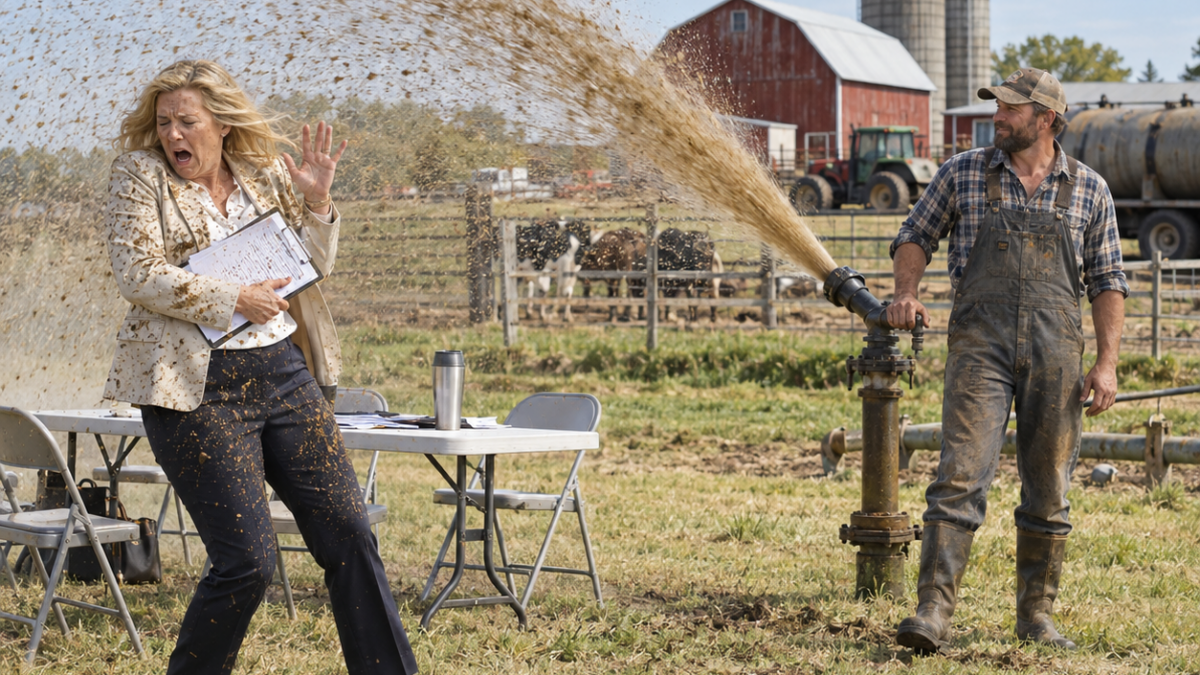
The next pass caught the lower half of the platform.
Karen jumped backward.
Her heel slipped.
She grabbed the podium.
The microphone squealed.
That was when she finally ran.
Not gracefully.
Karen had spent eleven months marching across my property with all the confidence of a woman who believed boundaries existed primarily for other people.
Now she sprinted toward one.
The nearest sprinkler completed another rotation.
The edge of the spray caught her shoulder and back.
Not a fire hose.
Not enough to knock anyone down.
But enough.
Her pink pantsuit turned dark in irregular patches.
Her carefully sprayed hair collapsed against one side of her head.
She let out a scream I heard over the pump.
“You did this on purpose!”
I didn’t answer.
Guests streamed off the field.
Some were angry.
Some laughing despite themselves.
Others gagging.
One man in a white linen jacket stopped beside the fence and looked at me.
“Is that manure?”
“Organic fertilizer.”
“That’s manure.”
“It contains compost extract.”
He looked at his sleeve.
“I’m calling it manure.”
“Fair.”
Then he crossed the property line.
Within four minutes the pasture was empty except for abandoned chairs, tipped glasses, tablecloths, the tent, and Karen.
She was now standing safely on the HOA side of the fence.
Her rage had overcome her embarrassment.
“You psychopath!”
George whispered, “Do not answer.”
“I wasn’t going to.”
“You look like you want to.”
“I look like this naturally.”
Karen held up her soaked phone.
“You destroyed the gala!”
I pointed toward the posted signs.
“You held it on an active farm.”
“You knew we were there!”
“Yes.”
“You intentionally sprayed us!”
“I notified you yesterday that the field was scheduled for fertigation.”
“You could have turned it off!”
That was the dangerous question.
Because she was right.
I could have.
George stepped forward.
“Karen, stop talking.”
She stared.
“You stay out of this.”
“No.”
His voice changed.
Lawyer voice.
“You were given written notice that the event was unauthorized, written notice of the agricultural schedule, a verbal warning five minutes before irrigation started, and multiple posted trespass signs. If you intend to make accusations, do it through counsel.”
“I am calling the police.”
“Please do.”
“I already did,” I said.
Her mouth opened.
Right on cue, headlights turned into my driveway.
A sheriff’s cruiser.
Deputy Aaron Miller stepped out.
He took three steps.
Stopped.
Sniffed.
Then looked at me.
“What in God’s name?”
“Fish emulsion.”
He stared across the field.
“That explains almost nothing.”
George coughed into his fist to hide a laugh.
Karen charged toward him.
“Deputy! Arrest him!”
Miller held up one hand.
“Ma’am.”
“He assaulted two hundred people with sewage!”
“It isn’t sewage,” I said.
George elbowed me.
Karen continued.
“He deliberately activated industrial sprinklers while people were standing there.”
Miller looked at me.
“Did you?”
“My automated fertigation cycle began at 7:15. I warned the event organizers in writing and the guests verbally before it started.”
I handed him the packet.
He opened it.
First document.
Deed.
Second.
Certified plat.
Third.
My letter to Karen.
Received and signed.
Fourth.
Email to every HOA board member.
Fifth.
Notification to vendors.
Sixth.
Agricultural application log.
Seventh.
Dispatch confirmation.
Deputy Miller read slowly.
Karen crossed her arms.
“You don’t seriously believe this was an accident.”
I answered before George could stop me.
“I never said it was an accident.”
Miller looked up.
George whispered, “Wonderful.”
I continued.
“It was scheduled farm work. I knew they were trespassing. I warned them to leave. I allowed the scheduled operation to continue once they had been given notice.”
Miller studied me.
“Anyone injured?”
“Not that I saw.”
A woman nearby raised her hand.
“My shoes are dead.”
The deputy looked at them.
Cream-colored heels.
Brown spots.
“I mean physically injured.”
“No.”
Karen screamed, “My reputation is injured!”
George muttered, “That condition may be preexisting.”
I looked at him.
He shrugged.
Deputy Miller turned toward Karen.
“Ms. Miller, did Mr. Sterling authorize the HOA to use this property?”
“We considered it part of the neighborhood open-space system.”
“That wasn’t the question.”
“I’m president of the association.”
“Did the landowner authorize the event?”
Karen pointed toward the field.
“Nobody was using it!”
Miller looked at me.
I said, “Cover crop.”
Then back at Karen.
“Ma’am, empty land still belongs to somebody.”
“We have an easement.”
“Show me.”
Karen froze.
“What?”
“The easement.”
“The development master plan—”
“Do you have a recorded easement allowing HOA events on this parcel?”
Her mouth tightened.
“No.”
“Did you receive this notice?”
He showed her my certified letter.
“I receive hundreds of pieces of mail.”
“Is that your signature?”
Silence.
“Yes.”
“Did you understand it said the event was not authorized?”
“I disagreed with his interpretation.”
Miller rubbed his forehead.
“This is not an interpretation issue.”
He looked toward the pasture.
“You brought vendors and approximately how many guests?”
“Maybe one hundred eighty.”
“Onto land after the owner expressly told you not to?”
Karen said nothing.
Miller turned toward me.
“Mr. Sterling, I’m going to document your complaint. The trespass issue may be referred to the prosecutor depending on the facts and whether warnings were knowingly ignored. I’m not standing here promising anyone gets arrested tonight.”
“Understood.”
Karen pointed at him.
“What about him?”
“The fertilizer?”
“Yes!”
Miller looked at me.
“That will also be documented.”
Fair.
I nodded.
George looked relieved.
Nobody got to create a two-hundred-person manure shower and simply declare immunity because the deed was on his side.
Miller continued.
“Mr. Sterling, I strongly suggest you shut the system down while people remove event property.”
“Agreed.”
I hit the override.
The pump wound down.
Sprinklers lowered.
The field went quiet.
Smelly.
But quiet.
Karen looked triumphant for half a second.
Then Miller said, “And nobody steps back onto that property until Mr. Sterling gives permission.”
Her expression collapsed again.
“What about our tent?”
“You’ll arrange removal with the landowner.”
“The rentals have to be returned tonight.”
“That sounds like something you should have considered before erecting them on somebody else’s farm.”
George turned away.
His shoulders shook.
Deputy Miller noticed.
“Counselor, behave.”
“I’m retired.”
“Then retire quietly.”
The deputy took statements.
Several board members admitted they knew I had objected.
One showed Miller the email.
Another, Cynthia Wells, tried claiming Karen told them my lawyer had “withdrawn the objection.”
George immediately asked, “Who told you that?”
“Karen.”
Karen stared at Cynthia.
“Don’t drag me into your confusion.”
Cynthia’s expression changed.
That was the first visible crack.
Not the fertilizer.
Not the deputy.
That sentence.
Karen had just thrown one of her own board members under the tractor.
By nine, most guests were gone.
The caterer removed food equipment after I granted written access.
The rental company returned the next morning.
I insisted on a simple condition.
Nobody from the HOA board entered my land unless accompanied by the vendor crew.
Karen called it humiliating.
I called it boundary management.
The next morning, the north pasture smelled like Neptune had died there.
I sat on the porch drinking coffee.
George arrived carrying a newspaper and a paper bag.
“You’re famous.”
“I don’t want to be famous.”
“Then you shouldn’t fertilize two hundred rich people.”
“I fertilized a field.”
“Tell that to the headline.”
He unfolded the local paper.
**HOA GALA ENDS IN STINKY PROPERTY DISPUTE**
I closed my eyes.
“That’s terrible.”
“The online headline is better.”
“I don’t want to know.”
“‘Manure Meeting: Willow Creek Party Was Held on Farmer’s Land Without Permission.’”
“George.”
He was delighted.
“You have become folk art.”
“I’m going back inside.”
“Wait.”
He handed me the bag.
Tomato biscuit.
From Henderson.
“He says congratulations.”
“I don’t feel congratulated.”
George sat beside me.
His expression changed.
“You worried?”
“Yes.”
“About what?”
“Everything.”
Civil claims.
Vendor losses.
Guests’ clothing.
Whether I had crossed a line by letting the system run.
Whether being legally justified in defending my property necessarily made what I did wise.
George bit into his biscuit.
“You did cross a line.”
I looked at him.
“Thanks.”
“You wanted honesty.”
“I didn’t ask.”
“You never do.”
He wiped crumbs from his fingers.
“You built the situation carefully. You warned them. But you also knew what would happen.”
“Yes.”
“If somebody had fallen and broken a hip, we’d be having a very different conversation.”
“I know.”
“So remember that.”
“I will.”
Then he smiled.
“But Karen holding a gala on your farm after three written warnings was insane.”
“That helps.”
“It shouldn’t.”
It did anyway.
The story spread.
Not nationally.
Not the kind of viral fantasy Karen later accused me of engineering.
But locally?
Everybody knew.
Within forty-eight hours, residents were posting photographs.
Not only of the gala.
Of Karen’s previous notices.
Garbage-can fines.
Holiday-light violations.
Grass-height warnings.
Playset citations.
George’s old legal instincts woke fully.
“Now.”
“Now what?”
“Recall.”
We had been preparing for months.
Willow Creek’s bylaws required signatures from twenty-five percent of homeowners to compel a special membership meeting for removal of a director.
Before the gala, getting twenty-five percent had seemed difficult.
After?
People came to us.
We placed a petition table on George’s property.
Not HOA common space.
Not my farm.
Private residential land.
By noon, twenty-nine percent.
By three, forty-one.
By evening, fifty-three.
Karen sent an emergency community email.
**DO NOT SIGN ILLEGAL PETITION CIRCULATED BY OUTSIDE AGITATORS.**
George printed it and added it to the signature table.
“Marketing,” he said.
Within an hour, we gained eight more signatures.
The board fractured.
Cynthia called me.
“I need to talk.”
“About what?”
“The gala.”
“Bring George.”
“I don’t want George.”
“Then we don’t talk.”
She agreed.
We met at a diner.
Cynthia looked wrecked.
No makeup.
Hair in a ponytail.
Nothing like the woman who had sat beside Karen during months of meetings.
“She lied to us.”
George asked, “About what specifically?”
“She told us your deed had an access clause.”
“It doesn’t.”
“I know that now.”
“She had copies.”
“I didn’t see the full deed.”
“Why not?”
“Because Karen gave us a summary.”
I watched her.
“You voted to fine me.”
She looked down.
“Yes.”
“For a barn on property the HOA doesn’t own.”
“Yes.”
“For my farm truck.”
“Yes.”
“For crops.”
She closed her eyes.
“Yes.”
“Why?”
Her answer was almost a whisper.
“Because opposing her made your life hell.”
George leaned back.
There it was.
The real governance system.
Not bylaws.
Fear.
Cynthia continued.
“When I questioned the gala, Karen said you’d never actually call the police because it would make you look antisocial.”
“Then why did she tell guests the field was HOA land?”
Cynthia shook her head.
“I don’t know.”
George asked, “Did she show the board my letter?”
“What letter?”
The final cease-and-desist.
The one addressed to all directors.
Cynthia had never seen it.
Neither had two others.
Karen had intercepted physical copies sent to the HOA office.
The email, however, had gone directly to their addresses.
Cynthia admitted she rarely checked the board account because Karen handled “official correspondence.”
George’s face turned hard.
“Then you weren’t governing.”
“I know.”
“You were decorations.”
Her eyes filled.
“I know.”
I almost felt sorry for her.
Almost.
The emergency meeting took place nine days after the gala.
The clubhouse fire marshal capped occupancy, so speakers were set up outside.
People filled the patio.
The parking lot.
Even sections of the sidewalk.
Karen stood behind the board table.
No pink.
Dark navy suit.
Hair perfect again.
Control restored externally.
Inside?
I wasn’t sure.
She opened with a forty-minute statement.
I’ll give her credit.
It was well prepared.
She called the gala incident “a malicious agricultural assault.”
She described me as a hostile landowner who had spent months undermining community cohesion.
She argued that Willow Creek had long treated my north pasture as visually integrated green space.
She said residents had used the area informally for years.
That was partly true.
Before I returned to farming full-time, my grandfather had sometimes allowed neighborhood children near the field.
Permission.
Not ownership.
Karen blurred the distinction deliberately.
Then she made her biggest mistake.
She accused me of staging the entire dispute for revenge.
George stood.
“We have certified mail receipts.”
Karen glared.
“You’ll have your turn.”
“I’m correcting a factual statement.”
“You are out of order.”
The crowd started murmuring.
George sat.
Smiling.
He loved procedure too much.
When Karen finally finished, George took the microphone.
No shouting.
No jokes.
No manure references.
He placed the deed on a projector.
Parcel boundary.
Agricultural classification.
No HOA membership.
No event easement.
Then the first barn notice.
The second.
The truck violation.
Noise complaint.
Crop violation.
Soccer-field incident.
Community-garden sign.
Every point paired with my written response.
Then the gala advertisement.
My warning.
Her receipt.
The board email.
The vendor warning.
Dispatch log.
Drone photographs of the event.
No fertilizer footage.
Not yet.
George looked at Karen.
“Did Mr. Sterling grant permission?”
“No.”
“Did you receive his warning?”
“I disputed it.”
“That wasn’t the question.”
A little laugh moved through the room.
Karen’s face reddened.
“Yes.”
“Did the HOA possess a recorded right to hold this gala on his farm?”
“In my interpretation—”
“Yes or no?”
Karen stared at him.
“No.”
That single word destroyed months of narrative.
Residents shifted.
Whispered.
Karen tried recovering.
“But his response was disproportionate.”
George nodded.
“That issue can be evaluated separately.”
Smart.
He did not defend every choice I made.
He didn’t need to.
“The question before Willow Creek tonight is whether its president knowingly organized a major paid event on property she knew the association did not own and for which permission had been expressly denied.”
He stepped away.
Then residents spoke.
Mr. Henderson first.
His flagpole.
Garcias.
The playset.
Sarah.
The soccer incident.
“I believed Karen when she said the field was community space,” Sarah told everyone. “I let my children run there. Later I learned it was an active agricultural field. That wasn’t just disrespectful to Jack. It could have been dangerous for my kids.”
Karen interrupted.
“They were supervised.”
Sarah turned.
“You weren’t even there when they first entered.”
“I arrived—”
“You encouraged us to stay.”
Karen stopped.
Then George called Cynthia.
Not formally.
This wasn’t court.
But everyone treated the room as though it mattered.
Cynthia admitted Karen had withheld documents.
Barry admitted he had never reviewed my deed himself.
Another director, Len Foster, said Karen told the board the association’s insurer had approved the gala venue.
The insurer later denied that.
Karen’s support disappeared in real time.
You could see it.
Not dramatic.
Chairs angled away.
Eyes stopped meeting hers.
People who once nodded now studied papers.
Karen raised her voice.
“This board made collective decisions!”
Cynthia responded.
“Based on what you told us.”
“You had responsibilities too.”
“You’re right.”
That surprised Karen.
Cynthia stood straighter.
“I should have read the documents myself.”
Silence.
“I didn’t.”
She looked toward me.
“I’m sorry.”
Then toward residents.
“I’m sorry to all of you.”
Karen stared at her as though accountability were betrayal.
That told me everything.
The removal vote required a majority of votes cast under the association’s bylaws.
Ballots were counted by an independent community-association manager George insisted we hire for the meeting.
Not unanimous.
Nothing ever is.
Eighty-one percent voted to remove Karen from the board.
The room went silent when the number was read.
Karen sat perfectly still.
The applause started slowly.
I didn’t join.
Neither did George.
This wasn’t a football game.
A woman had just lost something she built her identity around.
Karen looked across the room at me.
I expected rage.
What I saw was emptiness.
She packed her purse.
Collected nothing else.
At the door, she turned.
“You got what you wanted.”
I stood.
“No.”
She laughed bitterly.
“Please.”
“I wanted you off my farm.”
“You destroyed me over a field.”
That bothered me.
I walked closer.
“No, Karen.”
Her eyes hardened.
“You did.”
“I didn’t write the barn violation.”
She stared.
“I didn’t tell families my pasture belonged to them.”
No answer.
“I didn’t plant your garden sign.”
Her face twitched.
“I didn’t schedule your gala.”
People had gone quiet.
I kept my voice low.
“You made those choices.”
“So did you.”
That stopped me.
She looked toward the windows.
“Don’t pretend you’re innocent. You let those sprinklers turn on because you wanted to humiliate me.”
Silence.
George watched me.
I could lie.
Spin.
Justify.
Instead I said, “Partly.”
Karen looked surprised.
“I wanted the farm work to continue. I wanted proof you ignored the warnings.”
I swallowed.
“And yes. Part of me wanted you embarrassed.”
The room felt different.
More honest.
“If somebody had gotten hurt, I would’ve regretted that for the rest of my life.”
Karen’s expression changed.
Not forgiveness.
Not triumph.
Something smaller.
Recognition.
“So we’re both awful.”
“No.”
I shook my head.
“We both made choices we have to own.”
She picked up her purse.
Then she left.
George walked over.
“You just gave opposing counsel a lovely quote.”
“Wasn’t thinking like a client.”
“Clearly.”
“Was I wrong?”
He looked toward the door.
“No.”
The next month was less satisfying than stories usually make consequences sound.
Caterers submitted damage claims.
Rental equipment had to be professionally cleaned.
Several guests demanded reimbursement for clothing.
The HOA’s insurer reserved rights and disputed coverage because the event was held without documented permission.
The board hired independent counsel.
The sheriff’s report went to the prosecutor.
Ultimately, Karen received a trespass-related citation under local law tied to her role after documented warnings.
It was not a dramatic felony prosecution.
Nobody hauled her away in handcuffs.
She paid a fine, entered a diversion-style agreement, and agreed to stay off my property.
My own insurance company received claims too.
Because while I was within my rights to irrigate and fertilize my farm, intentionally allowing a cycle to continue around known trespassers created arguments no sane lawyer wanted to test unnecessarily before a jury.
George looked at me across his office desk.
“This is the part nobody puts in revenge stories.”
“What?”
“The bill.”
“How bad?”
“Manageable if we settle certain clothing and vendor-cleaning claims without admission.”
“Karen pays?”
“HOA will pursue allocation separately.”
“I hate this.”
“Consequences are less cinematic when accountants arrive.”
I rubbed my eyes.
“Was it worth it?”
George thought about that.
“Ask me after you learn something.”
I didn’t like that answer.
But I understood it.
So I contributed to a settlement fund.
Not because Karen owned the field.
She didn’t.
Not because the HOA had permission.
It didn’t.
Because people who had been misled into attending the gala didn’t deserve to absorb every dollar of the feud between Karen and me.
The families whose clothing was ruined got modest reimbursements.
The caterer’s cleaning costs were resolved.
The tent company got paid.
The HOA pursued Karen for portions associated with the unauthorized venue decision.
Nobody became rich.
Nobody was financially annihilated.
The point was accountability.
The new board election came next.
Everyone expected George to run for president.
He refused twice.
Then his wife told him she was tired of hearing him complain about people who actually volunteered.
He ran.
Won.
His first words as president were:
“This is the worst thing that has ever happened to me.”
The room laughed.
His first official action was more serious.
The HOA passed a resolution confirming that Sterling Farm was not within the association.
It sounds ridiculous that such a resolution was needed.
My deed already proved it.
But symbolism mattered.
The resolution prohibited board members, committees, vendors, and contractors from entering or using my property without written permission.
Then they conducted a legal review of every active enforcement action from Karen’s tenure.
Not everything disappeared.
Some violations were legitimate.
If someone left a broken refrigerator on a front lawn for four months, Karen being unpleasant didn’t magically make that compliant.
But dozens of fines based on unwritten or selectively enforced standards were canceled.
Mr. Henderson’s flagpole dispute was resolved.
The Garcias kept the playset after adding a small safety setback.
The kids’ slide remained offensively green.
Civilization survived.
Then George addressed the boundary.
“Jack,” he said, sitting at my kitchen table, “the residents want to install a fence.”
“I already have boundary markers.”
“A good fence.”
“What’s wrong with mine?”
“You have sections repaired with cattle panels.”
“They work.”
“You also used baling wire.”
“American engineering.”
“Your neighbors want something that doesn’t look like a prison camp assembled during a tornado.”
I glared.
George smiled.
“The HOA will pay.”
That helped.
We settled on a post-and-board agricultural fence.
Wood.
Simple.
Four feet high.
Strong enough to establish a boundary without making the subdivision feel walled off.
At the main walking path, George proposed a sign.
I rejected his first version.
**PRIVATE PROPERTY — TRESPASSERS WILL BE PROSECUTED.**
Too hostile.
His second:
**STERLING FARM — ACTIVE AGRICULTURAL LAND. PLEASE REMAIN BEYOND THE FENCE.**
Better.
Priya Patel suggested adding:
**WE’RE GLAD YOU’RE OUR NEIGHBORS. PLEASE ENJOY THE VIEW FROM YOUR SIDE.**
That stayed.
The day contractors finished it, I walked the full boundary.
For the first time in a year, I felt something inside me unclench.
Not victory.
Safety.
There was now a physical line matching the legal one.
Children could see it.
Guests could see it.
Future board presidents could see it.
Nobody needed a deed to know where the subdivision ended and my farm began.
George found me near the north pasture.
“You happy?”
“I’m a farmer.”
“So no.”
“I’m content.”
“That sounds worse.”
The field had recovered from the gala.
Grass thick.
Soil dark.
The fertigation had done its job.
George looked across it.
“You know what residents call this field?”
“I’m afraid to ask.”
“The Brown Ballroom.”
“No.”
“The Stink Meadow.”
“Stop.”
“Karen’s Splash Zone.”
“I will remove you from my property.”
He smiled.
“Boundaries. I respect them.”
Karen’s house went on the market two months later.
I didn’t know whether she moved because of us, finances, embarrassment, or simply because she was tired.
Maybe all of it.
She and her husband sold to a young couple named Nathan and Brooke Ellis.
The morning the moving truck came, I was repairing a cultivator.
Karen walked down my driveway.
She stopped before the new fence.
Did not cross.
That mattered.
“Jack?”
I turned off the grinder.
“Morning.”
Her hair was different.
Shorter.
No elaborate helmet.
No clipboard.
She looked tired.
“I’m leaving.”
“I saw.”
“Thought you’d be happy.”
“I’m not unhappy.”
“Same thing.”
“No.”
She looked toward the pasture.
The grass was waist-high in places.
“I really did think it should be community space.”
“I know.”
“It looked wasted.”
“To you.”
She nodded.
“To me.”
I waited.
“I grew up in apartments,” she said.
That surprised me.
“Never had land.”
I said nothing.
“My father worked maintenance. My mother cleaned offices at night. When we bought our first house, it felt like…”
She searched for the word.
“Proof.”
“Of what?”
“That we had made it.”
She looked toward Willow Creek.
“I think that’s why I cared so much about everything looking right.”
Mailbox colors.
Grass.
Barns.
Playsets.
Fences.
I began understanding something I wished she had understood herself years earlier.
“To you, disorder felt like losing something.”
She looked at me.
“Maybe.”
“That doesn’t excuse it.”
“I know.”
Another surprise.
She ran a hand along the top board of the fence.
Without crossing.
“I hated your barn.”
I laughed.
“I know.”
“It looked old.”
“It is old.”
“I thought old meant neglected.”
“My grandfather built half of it.”
Her face shifted.
“I didn’t know that.”
“You never asked.”
“No.”
We stood there.
Two people who had spent a year communicating almost entirely through certified mail.
Karen looked toward the pasture.
“That smell took three washes to get out of my hair.”
I tried not to smile.
Failed.
She pointed.
“Don’t.”
“I didn’t say anything.”
“You’re thinking something.”
“Fish emulsion is persistent.”
For the first time since I met her, Karen laughed.
Small.
Unwilling.
But real.
Then her expression turned serious.
“You could’ve shut it off.”
“Yes.”
“I still think what you did was cruel.”
I nodded.
“Parts of it were.”
She looked surprised again.
“I was angry.”
“So was I.”
“I wanted you to finally understand that you couldn’t use the farm.”
“You could have called the sheriff.”
“I did.”
“Before the sprinklers.”
“I should have pushed harder to clear everyone out.”
Silence.
“Sorry about your clothes.”
“My shoes cost four hundred dollars.”
“That seems irresponsible.”
She stared.
Then almost smiled.
“Goodbye, Jack.”
“Goodbye, Karen.”
She walked toward her house.
At the road she stopped.
“That barn still needs paint.”
“Get off my farm.”
She laughed once and kept walking.
Her car left Willow Creek that afternoon.
No one cheered.
I was glad.
Humiliation had already done enough.
A year later, Mr. Henderson died.
His name was Samuel, though everybody called him Mr. Henderson because he had reached that age where first names felt disrespectful.
His daughter invited me to the funeral.
Afterward, she asked whether I wanted something from his garden shed.
I chose his old wooden-handled hoe.
The blade was worn narrow.
His hands had polished the handle smooth over decades.
I hung it inside my barn.
George noticed.
“You’re becoming sentimental.”
“Shut up.”
Samuel’s flagpole remained.
The new board officially approved it.
A small brass plate at the base read:
**IN MEMORY OF ELLEN HENDERSON
WHO LIKED THIS VIEW.**
That explained the whole fight better than any bylaw ever could.
People weren’t attached to fences.
Flagpoles.
Gardens.
Barn colors.
They were attached to meaning.
The mistake Karen made over and over was seeing only the object.
A red barn.
A green slide.
A flagpole.
An empty field.
She never stopped long enough to ask what lived inside those things for the people who owned them.
The farm changed too.
My organic vegetable business grew.
I started supplying three restaurants and a local co-op.
The north pasture rotated through alfalfa, pumpkins, clover, and grazing cover crops.
One autumn, I opened a small section of the farm for a harvest day.
With permission.
That word mattered.
Willow Creek families came.
I showed children how irrigation worked.
They picked pumpkins.
I let them climb onto a parked tractor for photographs.
Parents bought produce.
George worked a table and gave away tomatoes I was trying to sell.
“You’re ruining my margins.”
“It’s community outreach.”
“It’s theft.”
“Talk to the HOA.”
At noon, Sarah approached with her two children.
The same kids who years earlier had run across my newly seeded field.
They were much taller now.
Her son looked at the pasture.
“Is this where the gross party happened?”
Sarah went red.
“Ethan.”
“What?”
I laughed.
“Yes.”
“Mom said Mrs. Miller got sprayed with poop water.”
“It wasn’t poop water.”
He looked disappointed.
“Fish fertilizer.”
“Still gross.”
“Extremely.”
His sister asked, “Why did she have the party here?”
I looked at Sarah.
She nodded.
“Because she thought she could use land that didn’t belong to her.”
“Why?”
“Because people sometimes convince themselves that wanting something makes it theirs.”
The girl thought about it.
“Did she say sorry?”
That stopped me.
“Eventually.”
“Did you?”
“For what?”
“For spraying everybody.”
Children.
Efficient moral investigators.
“Yes.”
“To everyone?”
“I helped pay for cleanup and damage.”
“That’s not saying sorry.”
Sarah looked mortified.
“Claire.”
“No.”
I crouched.
“She’s right.”
The girl waited.
“I’m sorry people who didn’t understand the property dispute got caught in it.”
She nodded.
“That’s better.”
Then she ran off toward the pumpkins.
George had heard.
He grinned.
“Out-lawyered by a nine-year-old.”
“Go steal more tomatoes.”
The harvest day became annual.
We set up the event only on sections of farm I designated.
The HOA helped with parking.
Everybody signed vendor agreements.
George insisted.
“Trauma response,” he called it.
Eventually we added educational signs.
**THIS IS A WORKING FARM.**
**ASK BEFORE ENTERING FIELDS.**
**EQUIPMENT MAY OPERATE WITHOUT WARNING.**
**PRIVATE LAND CAN STILL BE A GOOD NEIGHBOR.**
That last line was Priya’s.
I liked it.
Five years after the gala, George stepped down as HOA president.
His replacement was Sarah Patel.
She was organized.
Patient.
Far less interested in controlling mailbox colors.
At George’s final meeting, residents gave him a plaque.
He read it.
“Ugly.”
“You’re welcome,” Priya said.
Then George looked at me.
“Jack.”
“No.”
“You don’t even know.”
“I’m not joining the board.”
Nobody had asked.
The room laughed.
“You’d be terrible,” George said.
“Good.”
“You enjoy rules too much.”
“I enjoy rules that have reasons.”
“That’s exactly what dangerous people say.”
When the meeting ended, he and I walked toward the farm.
The new fence had weathered silver.
Children rode bicycles on the subdivision path.
Nobody crossed.
George stopped at the boundary plaque.
“Remember the community garden sign?”
“I try not to.”
“You gave Karen sixty seconds.”
“She used forty.”
“Efficient woman.”
I looked across the field.
“She wasn’t always wrong.”
George raised an eyebrow.
“Careful.”
“She was wrong about me. Wrong about the land. Wrong about her authority.”
“That sounds like always.”
“She was right that a neighborhood needs standards.”
George nodded.
“Of course.”
“The problem was she thought standards belonged to her.”
“That is the disease.”
We stood quietly.
My father used to say land teaches humility if you work it long enough.
Weather doesn’t care about your schedule.
Seeds don’t read plans.
Machinery breaks on the morning you need it most.
A field can look perfect and still fail.
Another can look terrible and recover.
Farming leaves very little room for believing authority and control are the same thing.
Maybe that was why Karen and I collided so hard.
She believed the right rule could make life orderly.
I knew life laughed at plans.
Ten years after I returned home, the barn roof finally needed replacing.
I dreaded it.
Not because of cost.
Because I remembered Karen’s first notice demanding that I repaint or remove the barn.
The original red boards had faded almost brown.
I considered painting them fresh red.
Then my contractor discovered several boards too damaged to save.
He removed one.
Behind it, carved into an interior support, were initials.
**H.S. 1948**
Henry Sterling.
My grandfather.
I sat inside the barn for a long time holding that board.
My grandfather had been twenty-three in 1948.
Newly married.
Broke.
Building a barn from lumber milled off his own property.
My father was born two years later.
Three generations had worked inside those walls.
Karen had once called it an unapproved outbuilding.
I had been furious.
Now, years later, the phrase seemed almost funny.
I asked the contractor to save every usable original board.
The damaged ones became shelves.
One became a frame around the old farm deed.
Another became the backing for Samuel Henderson’s hoe.
The barn received a new roof.
Fresh red paint.
Same color.
The day we finished, Sarah Patel walked over from Willow Creek.
“Looks good.”
“HOA-approved?”
She pretended to inspect it.
“Wrong shade.”
I stared.
She laughed.
“Relax.”
“I have trauma.”
“We’ve noticed.”
She handed me an envelope.
I groaned.
“What is this?”
“Open it.”
Inside was a card signed by dozens of Willow Creek residents.
**THANK YOU FOR KEEPING THE OLD BARN.**
I looked at Sarah.
“Why?”
“People like it.”
“Karen hated it.”
“Karen hated cilantro too. We don’t build policy around that anymore.”
Fair.
On the tenth anniversary of the manure gala, George arrived at my house carrying champagne.
“No.”
“Tradition.”
“There is no tradition.”
“There is now.”
He had invited several people.
Priya.
Sarah.
The Garcias.
Cynthia, surprisingly.
Even Deputy Miller, now a sergeant.
We sat on my porch.
Not the pasture.
Nobody was allowed to suggest that.
George raised his glass.
“To the Brown Ballroom.”
“I hate all of you.”
Miller laughed.
“I still have your incident report.”
“Burn it.”
“Public record.”
Cynthia smiled cautiously.
She and I had become cordial over the years.
Not close.
Some relationships don’t need to become close to become peaceful.
“I still have the pink pantsuit photo,” she said.
Everyone looked at her.
“You took one?”
“Karen sent it to the board as evidence.”
George nearly fell out of his chair.
“She documented herself?”
“She documented everything.”
I raised my glass.
“To documentation.”
That I could support.
The sun lowered over the north pasture.
Golden.
Almost exactly like the evening of the gala.
But no tents.
No trespassers.
No anger.
Just neighbors sitting where they had been invited.
George became quiet.
“You know what the funniest part is?”
“What?”
“The manure wasn’t what beat her.”
I nodded.
“I know.”
“The deed did.”
“Mostly.”
“And the certified letters.”
“And her own emails.”
“And the residents.”
“And Karen.”
George looked at me.
“Karen?”
“She beat herself.”
Every escalation had been optional.
She could have stopped after my first sentence:
My property is not part of Willow Creek.
She could have verified the deed.
Stopped the fines.
Told parents the pasture was private.
Removed the garden proposal.
Moved the gala fifty yards onto HOA land.
Any one of those decisions would have ended the fight.
Instead she kept treating every boundary as a challenge to her authority.
Eventually she challenged one she could not redefine.
The property line.
Sergeant Miller lifted his glass.
“To property lines.”
Priya added, “And not spraying innocent people.”
I winced.
“Are we going to discuss that forever?”
“Yes.”
Fair again.
Years later, when my knees finally convinced me to slow down, I leased most of the vegetable acreage to a young farmer named Mateo Ruiz.
Twenty-seven.
First-generation farmer.
Smart.
Hardworking.
Obsessive about soil biology.
I kept the house, barn, and several acres.
The first thing I gave Mateo was not a tractor key.
It was a map.
Property boundaries.
Drainage.
Irrigation.
Access.
Fence lines.
Then I showed him the HOA boundary.
“This line matters.”
He looked at me.
“Bad history?”
“Educational history.”
George, now eighty, had come along because retirement continued failing to keep him occupied.
“He sprayed a gala with manure.”
Mateo looked at me.
I sighed.
“Organic fertilizer.”
“Two hundred people,” George added.
“Approximately one hundred eighty.”
Mateo stared.
“Should I be worried about you?”
“Yes,” George said.
“No,” I said.
“Probably,” George corrected.
I showed Mateo the agreement with Willow Creek.
Clear access rules.
Emergency contact numbers.
Shared drainage responsibilities.
No surprises.
“Good neighbors,” I told him, “aren’t people who never disagree.”
“What are they?”
“People who know which side of the fence they’re standing on.”
George made a face.
“You’ve been practicing that line.”
“Since 2019.”
Mateo laughed.
He became a good steward.
Better at some things than I was.
That bothered me for about three days.
Then I realized that was the point.
The farm did not need to prove my importance.
It needed to survive me.
One evening, I found Mateo talking to children at the Willow Creek fence.
They were asking about pumpkins.
Instead of chasing them away, he invited their parents to schedule a farm visit.
Exactly right.
Boundary without hostility.
That had taken me years to learn.
The hardest lesson of the entire fight was that being right does not excuse everything you do while defending yourself.
Karen was wrong about the farm.
Wrong about the HOA’s authority.
Wrong to threaten liens.
Wrong to mislead residents.
Wrong to plan the gala after written notice.
But my anger had become strategic enough that I nearly enjoyed watching the situation escalate.
That was dangerous.
I could admit that without surrendering the truth.
The field was mine.
The boundary was real.
Her trespass was wrong.
And I still could have chosen more restraint at the final moment.
Both things could be true.
That understanding made the ending better, not weaker.
Because victory stopped meaning that Karen suffered.
It became everything that existed afterward.
Samuel’s memorial flagpole.
The Garcias’ green slide.
Children watching tractors safely from behind a fence.
The barn freshly red.
Annual harvest days.
An HOA that posted financial reports instead of threats.
Neighbors who asked instead of assumed.
Fields that remained fields.
One autumn afternoon, nearly fifteen years after Karen’s first barn letter, I drove my old tractor across the north pasture.
Slowly.
My knees complained with every bump.
Mateo was behind me in the newer machine.
Show-off.
The clover needed mowing before winter.
We worked until sunset.
When I turned toward the house, I saw families walking along the Willow Creek path.
Several waved.
I waved back.
A little boy stood at the fence.
He cupped his hands around his mouth.
“Mr. Sterling!”
I stopped the tractor.
“What?”
“Is this the manure field?”
Mateo almost fell off his machine laughing.
I closed my eyes.
Legends are impossible to control.
“Yes.”
The boy’s father looked embarrassed.
“Sorry!”
“It’s fine.”
The boy shouted again.
“Are you spraying tonight?”
“No!”
“Cool!”
I restarted the tractor.
Mateo pulled alongside.
“You know that’s your legacy.”
“No.”
“Yes.”
“My legacy is sustainable agriculture.”
“Manure sprinkler.”
“Three generations of farming.”
“Manure sprinkler.”
“Combat engineer.”
“Manure sprinkler.”
I pointed toward the far end of the field.
“Go mow something.”
He laughed and drove away.
Later that night, I walked along the fence.
The weathered sign still stood near the path.
**STERLING FARM — ACTIVE AGRICULTURAL LAND.**
Beneath it:
**WE’RE GLAD YOU’RE OUR NEIGHBORS. PLEASE ENJOY THE VIEW FROM YOUR SIDE.**
The wood had faded.
Letters needed repainting.
I ran my hand over the top rail.
I thought about my grandfather.
He never met Karen.
Thank God.
He would have had no patience for certified letters.
My father would probably have invited the whole HOA into the barn and settled the dispute over coffee.
I had done it my way.
Messier.
Louder.
Smellier.
But somehow the farm remained.
That mattered.
Beyond the fence, Willow Creek porch lights came on one by one.
On my side, the barn glowed red in the last evening light.
The field was darkening.
Quiet.
Exactly the quiet I had wanted when I came home after twenty years.
But I finally understood something.
Peace is not the absence of neighbors.
It is not the absence of rules.
It is not getting everything your way.
Peace is knowing where you stand.
Knowing where the boundary lies.
Knowing the person on the other side respects it.
And knowing that when disagreements happen, nobody has to become an enemy.
Karen taught us that by doing almost everything backward.
She mistook control for leadership.
Silence for agreement.
Open land for available land.
Rules for ownership.
My patience for surrender.
And when she finally brought two hundred people onto a working farm despite every warning I could put on paper, the farm answered in the only language she had left herself willing to hear.
Years later, I no longer smiled because her gala was ruined.
I smiled because the pasture survived it.
The people survived it.
Even Karen survived it and, I hope, learned something.
The neighborhood survived her.
Then improved.
The north field has hosted pumpkins, alfalfa, clover, school visits, harvest days, deer, thunderstorms, and more sunsets than I can count.
But never another unauthorized HOA meeting.
That part of the lesson stuck.
I stopped beside the old irrigation control box before going inside.
Zone Four.
Same field.
New pump.
Cleaner plumbing.
I ran my fingers across the switch.
For one ridiculous second, I could almost hear Karen screaming across the pasture.
**You ruined everything!**
I looked toward Willow Creek.
Children laughing.
George’s old house lit warmly.
Samuel’s flagpole visible above the trees.
Families walking safely behind the fence.
Then toward the barn my grandfather built.
The farm wasn’t ruined.
Neither was the community.
Something had been ruined that evening.
Karen’s belief that saying something belonged to her made it true.
I could live with that.
I turned off the barn light.
Behind me, sprinklers began clicking across a different field.
Clear water this time.
Nothing dramatic.
Nothing foul-smelling.
Just irrigation.
Exactly the way I liked it.
And as I walked toward the house, I realized the sweetest part of winning had never been watching Karen run through fertilizer in a pink pantsuit.
It was hearing my neighbors laugh on the other side of a fence they finally respected, while twenty acres of Sterling soil remained exactly what my grandfather had trusted me to protect.
Mine to farm.
Mine to care for.
And, whenever I chose, mine to share.
The north pasture has never looked exactly the same to me since that summer.
For years after Karen left Willow Creek, I could stand beside the irrigation controls at sunset and remember every detail of that night.
The white tents.
The string quartet.
The glasses of wine.
Karen at the microphone talking about community while standing ninety feet inside land she had been expressly forbidden to enter.
And then that first sprinkler rising out of the grass.
Chug.
Chug.
Chug.
I used to smile when I remembered it.
Eventually I stopped.
Not because I regretted defending the farm.
I never regretted that.
I stopped smiling because, with enough distance, I understood the ending differently.
Karen losing her title was satisfying.
Her moving away brought relief.
The HOA apologizing mattered.
But the part that stayed with me wasn’t watching a bully get humiliated.
It was everything that grew after she was gone.
That became clearer the summer George turned eighty-two.
By then he walked with a cane and complained about his knees almost as often as he complained about the HOA.
He was no longer president.
Sarah Patel had taken over two years earlier, and George enjoyed pretending he had escaped public service even though he attended every meeting and sent Sarah three-page emails about commas in proposed amendments.
One morning I found him sitting beneath the maple beside my barn.
He had walked over without telling anyone.
“You’re going to get heatstroke,” I said.
“I survived practicing law for forty years.”
“That has nothing to do with heat.”
“It prepared me for hell.”
I brought him iced tea.
We sat quietly.
Across the field, Mateo was cultivating between rows of pumpkins.
The young farmer had gradually assumed most of the farm’s daily operation because my knees had finally become more persuasive than my pride.
George watched the tractor.
“You miss doing it?”
“Every day.”
“Then why’d you stop?”
“I didn’t stop.”
“You know what I mean.”
I looked at my hands.
Age had changed those too.
Thicker joints.
Old scars.
A tremor sometimes when I was tired.
“I spent twenty years following younger officers who thought forty was ancient,” I said. “Now twenty-seven-year-olds ask if I need help climbing onto a tractor.”
George smiled.
“Life is vindictive.”
We drank our tea.
After a while, he looked toward the north pasture.
“Do you remember how angry you were?”
“At Karen?”
“At everybody.”
“I wasn’t angry at everybody.”
He gave me a look.
“All right.”
I smiled.
“Maybe.”
“You were.”
He tapped his cane against the dirt.
“You know what I thought when you first called me about the recall?”
“What?”
“That you were exactly as stubborn as she was.”
I turned toward him.
“Excuse me?”
“Oh, relax.”
“You waited fifteen years to tell me this?”
“I was waiting until you became too old to hit me.”
“I can still manage.”
He laughed.
“Karen thought everything had to bend around her authority. You thought everything had to bend around your property line.”
“It was my property line.”
“Yes.”
“Important distinction.”
“Very.”
He leaned back.
“But boundaries can protect something without becoming walls around the person who owns them.”
I looked at the new fence.
Children from Willow Creek were standing behind it watching Mateo work.
None crossed.
One waved.
Mateo waved back.
“What are you trying to tell me?”
George shrugged.
“That eventually you figured that out.”
I thought about our first year.
NO TRESPASSING signs every twenty feet.
Security cameras.
Certified mail.
Folders.
Maps.
Part of it had been necessary.
Part of it had become armor.
I had returned from the Army wanting peace.
When Karen challenged my farm, I turned defending peace into another mission.
There had been comfort in that.
A clear threat.
A clear objective.
Documentation.
Planning.
Countermove.
Win.
Those habits had kept men alive overseas.
But home was not a combat zone.
Eventually, if I treated it like one long enough, I risked becoming part of the problem I claimed to hate.
“You’re getting philosophical,” I told George.
“I’m dying.”
I turned sharply.
He laughed.
“Not today.”
“Don’t do that.”
“But someday.”
He looked across the pumpkins.
“We all are.”
I hated that sentence because I knew why he said it.
George had been diagnosed with congestive heart failure six months earlier.
Medication helped.
Doctors were optimistic about time.
But time had become something we acknowledged instead of assumed.
He pointed his cane toward the barn.
“You going to keep the farm in the family?”
“No kids.”
“What about Mateo?”
“We’ve talked.”
“And?”
“He wants to buy someday.”
George nodded.
“You going to let him?”
“I think so.”
“Good.”
“You don’t even know what he offered.”
“I don’t care.”
“That explains why you were a terrible real-estate lawyer.”
He smiled.
“The land needs somebody who understands what it is.”
That sentence stayed with me.
Not what it was worth.
What it was.
When my grandfather owned those twenty acres, the town was miles away.
When my father farmed them, subdivisions had begun creeping closer.
When I came home, Willow Creek surrounded three sides of us.
In another generation, the farm might become one of the last working parcels anywhere near town.
Its value as development land had become ridiculous.
A builder offered me nearly four million dollars once.
Townhouses.
One hundred and sixteen units.
Retention ponds.
Internal roads.
He showed me a rendering.
The barn replaced by a clubhouse.
The north pasture covered in roofs.
I declined before he reached the financial projection.
“You could be rich,” George said when I told him.
“I’m already old. One condition at a time.”
But selling to Mateo was different.
He didn’t look at the pasture and see units.
He looked at soil.
Drainage.
Crop rotation.
That meant something.
The following spring, George’s health declined.
He stopped walking to my farm.
So I went to him.
His wife had died years earlier, and his daughter Laura came from Richmond to help.
One afternoon, he asked her to leave us alone on the porch.
“You remember Karen’s gala?” he asked.
“How could I forget?”
“You know what my biggest regret is?”
“You didn’t record it in slow motion?”
He smiled weakly.
“No.”
“What?”
“That it took a farmer getting pushed too far before any of us stood up.”
I said nothing.
“We all complained about Karen privately.”
He looked toward Willow Creek’s houses.
“Henderson complained. The Garcias complained. I complained. Everybody complained in kitchens and driveways.”
“But nobody wanted to be first.”
“No.”
“Until you.”
“Until you had property she couldn’t legally control.”
I nodded.
George took a breath.
“She wasn’t powerful because her bylaws were strong.”
“No.”
“She was powerful because everybody was isolated.”
That was the lesson Willow Creek never forgot.
After Karen, board meetings became boring.
Beautifully boring.
People argued about pool hours.
Landscaping budgets.
Roof colors.
Occasionally voices rose.
But when somebody disagreed, other people heard them.
Nothing happened in private just because the president preferred it there.
Meeting minutes were published.
Financial statements available.
Hearings had deadlines.
Board members rotated.
No president chaired the architectural committee anymore.
George had insisted on that reform.
“Concentrated authority,” he called it.
Sarah called it “the Karen clause.”
George pretended not to approve.
Everyone knew he did.
He died that October.
Quietly.
At home.
His daughter called me just before sunrise.
I sat on the edge of my bed for a long time.
Then I went outside.
The farm was covered in mist.
Mateo hadn’t arrived yet.
Willow Creek was silent.
I walked the property line.
Past the wooden fence.
Past the sign.
Past the field where Karen’s gala had once stood.
Then I sat beneath the maple beside the barn.
George’s chair was gone.
The memory wasn’t.
At his funeral, Sarah spoke about his years as HOA president.
Then Walter Henderson’s daughter spoke.
Then Priya.
Then, somehow, somebody expected me to speak.
I hated public speaking outside of necessity.
George knew that.
Which was probably why his daughter informed me that he had specifically requested it.
“He planned this?”
She nodded.
“Dad.”
“Figures.”
I stood behind the lectern.
Looked at the room.
Half of Willow Creek was there.
I had prepared notes.
Didn’t use them.
“George once told me people like Karen use bureaucracy as a weapon.”
A few people smiled.
“He also loved bureaucracy more than anyone I’ve ever met.”
Laughter.
“That’s not a contradiction.”
I paused.
“He believed rules mattered because people mattered.”
The room quieted.
“He taught me that if rules protect only the person enforcing them, they aren’t governance. They’re control.”
I looked at Laura.
“And he taught this neighborhood something more important.”
I swallowed.
“That fear works best when everybody thinks they’re afraid alone.”
People nodded.
“That stopped here because George made neighbors talk to one another.”
Afterward, Laura handed me an envelope.
“Dad left this for you.”
Inside was one page.
Jack,
Please refrain from turning my death into another opportunity to become sentimental about land boundaries.
You were right about your farm.
Karen was wrong.
I was right about virtually everything else.
Try not to ruin Mateo’s life by supervising him after you retire.
Also, the manure thing was funny.
You may admit this now.
—George
I laughed and cried at the same time.
Then I folded the letter and placed it beside Karen’s old apology in the farmhouse desk.
Two letters.
Two people.
One had started as my enemy.
One as my ally.
Both had changed me.
That winter, I signed an agreement giving Mateo the option to purchase the farm over a fifteen-year period.
Not immediately.
I wasn’t ready to leave.
Maybe I never would be.
But the future had a name now.
Mateo Ruiz.
He insisted on one condition.
“What?”
“The barn stays.”
I looked at him.
“That was already a condition.”
“Then we agree.”
“What about the house?”
“You can keep living there.”
“How generous.”
“I figured.”
“If you become annoying, I’m changing the locks.”
“You taught me where the spare key is.”
“That was a mistake.”
He smiled.
By then Mateo had married a woman named Elena.
They had a little girl, Sofia.
She became the first child in decades to treat Sterling Farm like a farm rather than a battlefield.
At four, she followed chickens.
At five, she learned tomatoes were fruit and argued about it for three months.
At six, she asked why the north pasture had so many underground sprinkler heads.
Mateo made the mistake of telling her.
“Mr. Jack sprayed a bad lady with poop.”
I nearly dropped my coffee.
“Elena!”
Mateo laughed.
Sofia stared at me.
“You sprayed somebody with poop?”
“No.”
“What was it?”
“Organic fertilizer.”
“What’s that?”
Mateo said, “Fish poop.”
“It is not fish poop.”
Sofia’s eyes widened.
“Can we do it again?”
“No.”
“Why?”
“Because good judgment develops slowly.”
She had no idea what that meant.
Neither did Mateo, apparently, because he laughed for five minutes.
The harvest festival expanded.
Eventually Willow Creek and Sterling Farm held it jointly.
That sentence would have caused Karen’s head to explode in 2019.
But it worked because the terms were clear.
The farm chose which field.
The HOA handled parking.
Vendors carried insurance.
Guests signed nothing ridiculous.
Nobody trespassed.
Children learned about compost.
People bought vegetables.
The community garden sold seedlings.
One year we raised enough money to fund a scholarship for local students entering agriculture, environmental science, or skilled trades.
Sarah suggested naming it after George.
I added Walter.
So the Albright-Henderson Community Scholarship began.
George would have complained about the font.
Walter would have given recipients tomatoes.
At the first award ceremony, the recipient was a seventeen-year-old girl named Maya Collins who wanted to study agricultural engineering.
When she shook my hand, she said, “Mr. Sterling, I want to design irrigation systems.”
I laughed.
“Good choice.”
“My dad told me about your sprinkler story.”
“Bad choice.”
She smiled.
“Actually, that’s why I got interested.”
I stared.
“What part inspired engineering?”
“The fact the system covered the whole field.”
I nodded.
“At least somebody appreciates the hydraulics.”
That evening, I went to the north pasture alone.
The grass was freshly cut.
Sunset painted the field gold.
Exactly like that night.
I stood where Karen’s podium had been.
Nothing marked the spot.
I liked that.
No plaque.
No monument.
No celebration of humiliation.
Just grass.
I tried to remember her face as clearly as I once could.
The pink suit.
The collapsed hair.
The fury.
But memory had softened the details.
What came easier now was the conversation at the fence before she moved.
Her saying she had grown up in apartments.
Her parents working jobs that made owning a house feel like proof of success.
Her belief that a perfect neighborhood meant safety.
That did not excuse what she did.
Understanding is not absolution.
But it gave the story dimensions revenge never had.
Karen became dangerous when she stopped distinguishing between preserving something and controlling it.
I nearly made the same mistake when protecting the farm became a campaign rather than simply protecting the farm.
People can become what they hate slowly.
One justified escalation at a time.
That was why I eventually stopped telling the gala story as a victory story.
When people asked, I told it as a boundary story.
The HOA crossed mine.
I defended it.
Then I learned boundaries work both ways.
They tell other people where they must stop.
They also tell you how far your own anger should go.
Years later, Sarah called me from the HOA office.
“Jack?”
“What now?”
“We have a problem.”
“Then solve it.”
“A developer bought the property east of Willow Creek.”
“So?”
“They want temporary construction access through the subdivision.”
“Not my farm.”
“No.”
“Excellent. Goodbye.”
“Wait.”
I sighed.
“They asked if they could cross your south field instead.”
“No.”
“I knew you’d say that.”
“Then why call?”
“Because the developer told them the farm was probably going to be sold soon anyway.”
I sat straighter.
“What?”
That sentence sounded familiar.
Unused field.
Neglected land.
Probably available.
Same mistake.
Different person.
I called Mateo.
We met the developer the next morning.
His name was Carson Bell.
Young.
Polished.
Confident.
He spread plans across my dining table.
“We’d only need approximately eighty feet of temporary access.”
“No.”
“It could generate substantial income.”
“No.”
“We’d restore the land.”
“No.”
He looked at Mateo.
“Are you the future owner?”
“Yes.”
“Perhaps you’d like to reconsider.”
Mateo looked at me.
Then back at Carson.
“No.”
I nearly smiled.
Carson gathered his plans.
“You understand access from the east will cost us considerably more.”
“Yes,” Mateo said.
“Then why refuse?”
Mateo answered before I could.
“Because this is a farm.”
Carson looked confused.
“Yes.”
“No.”
Mateo pointed at the field.
“You see empty space between where you are and where you want to go.”
He looked toward me.
“I learned not to make that mistake.”
After Carson left, I stood on the porch.
Mateo joined me.
“Was that too dramatic?”
“Terrible.”
“You liked it.”
“A little.”
He smiled.
That was when I knew Sterling Farm would be fine without me.
Not because Mateo hated developers.
He didn’t.
Not because nothing would ever change.
It would.
Because he understood that land should change according to the people responsible for it, not according to whoever finds it convenient.
The following spring, I formally transferred operational control of the farm to him.
We held no ceremony.
I signed papers.
He signed papers.
Then we fixed a broken pump.
That felt more appropriate.
At sunset, Mateo handed me the old clipboard I had used on the night of Karen’s gala.
I had forgotten it existed.
Deed copy.
Plat.
Old fertilizer schedule.
The sheriff notification had faded.
“You kept this?”
“It was in the irrigation office.”
“What do you want me to do with it?”
“Frame it?”
“No.”
“Burn it?”
I looked at the papers.
Then shook my head.
“File it.”
“Under what?”
I thought for a moment.
“Lessons.”
He wrote it on the folder.
LESSONS.
Perfect.
I was seventy-three when I finally stopped driving tractors alone.
Not because I wanted to.
Because Elena caught me climbing down backward with one knee shaking badly enough that she threatened to call my doctor.
“Traitor.”
“I’m saving your life.”
“My life was fine.”
“You almost fell.”
“I almost do many things.”
She told Mateo.
Mateo took the tractor keys.
“This is theft.”
“It’s management.”
“I still own part of this farm.”
“Call the HOA.”
That insult had survived generations.
I spent more time on the porch.
At first I hated it.
Then I started noticing things I had missed while always working.
Hawks circling above the pasture.
Wind changing before rain.
Children walking along the Willow Creek path.
Sofia growing taller every month.
Neighbors waving.
The fence aging.
My barn settling.
The ordinary signs that life continues without asking whether you’re ready.
One autumn afternoon, Sofia came onto the porch carrying a school assignment.
She was twelve.
“Interview someone old.”
“Go find George.”
“Dad says George died.”
“Excuses.”
She rolled her eyes.
“You count.”
“Barely.”
Her assignment required interviewing someone about a major event in the community’s history.
I knew what was coming.
“The manure gala?”
She shook her head.
“The farm.”
That surprised me.
“What about it?”
“Why didn’t you sell it?”
I looked across the fields.
“That’s your question?”
“One of them.”
She turned on her phone recorder.
“Why didn’t you?”
I thought about money.
Developers.
Karen.
Grandfather.
Dad.
Mateo.
Her.
“Because some things become more valuable when you refuse to convert their value into money.”
She stared.
“That sounds like something old people say.”
“It is.”
“Can you say it normally?”
I laughed.
“Because I loved it.”
“Better.”
“Your teacher will hate you.”
“She already does.”
Sofia looked toward Willow Creek.
“Did you hate Mrs. Miller?”
“No.”
“You sprayed her.”
“Complicated.”
“Dad says you hated her.”
“Your father enjoys exaggeration.”
“Did she hate you?”
“For a while.”
“Why?”
“Because I told her no.”
“That’s stupid.”
“Yes.”
“Why didn’t she just listen?”
I looked at Sofia.
There were entire books inside that question.
“Sometimes people hear ‘no’ as disrespect.”
“Why?”
“Because they confuse authority with being right.”
She typed something.
Then asked, “Were you always right?”
“No.”
Her head snapped up.
“Really?”
“Surprising?”
“Yes.”
“Thank you.”
“What were you wrong about?”
I looked toward the north pasture.
“I thought winning meant beating her.”
“What did it mean?”
I pointed toward Mateo working.
Toward Willow Creek.
Toward the fence.
Toward children walking safely along it.
“This.”
She frowned.
“That’s not very exciting.”
“No.”
“It’s better for real life.”
She considered that.
“Can I use that?”
“Charge royalties.”
She rolled her eyes again.
When she left, I remained on the porch.
The field was green.
The barn red.
The fence silver with age.
I realized then that fifteen years had passed since Karen’s gala.
Fifteen.
Long enough for children to become adults.
Long enough for neighbors to die.
Long enough for apologies to matter more than arguments.
Long enough for anger to become story.
I walked to the irrigation shed.
The old control panel had been replaced twice.
Zone Four still existed.
Different pump.
Same field.
I opened the cabinet.
Inside, taped to the door, Mateo had placed a tiny label:
BEFORE ACTIVATING, VERIFY FIELD IS CLEAR.
Underneath, in smaller print:
SERIOUSLY, JACK.
I laughed until I had to sit down.
That evening, Willow Creek held another outdoor meeting.
Not on my land.
Their own common green.
I could hear music.
Someone announced raffle winners over a microphone.
Children shouted.
Nobody needed my field.
Nobody assumed they did.
I poured iced tea.
Same thing I had been drinking the first time Karen’s letter arrived about my barn.
Then I walked to the fence.
Sarah saw me.
Raised a hand.
I raised mine.
Mateo drove past on a tractor and honked.
Sofia waved from the passenger seat.
Behind them, the north pasture stretched toward sunset.
No tents.
No angry HOA president.
No manure-soaked linen.
Just good soil.
My grandfather used to say land remembers what you do to it.
I don’t know if that’s literally true.
Soil has chemistry.
Biology.
Structure.
Not memory.
But people remember through places.
The barn remembered my grandfather because I did.
Samuel’s flagpole remembered his wife because his family did.
George’s chair beneath the maple remembered him because I still looked there sometimes expecting to see him.
And the north pasture remembered the night a neighborhood finally decided fear wasn’t governance.
Not because grass remembers.
Because we do.
I rested both hands on the top board of the fence.
On one side was Sterling Farm.
On the other, Willow Creek.
Years earlier, that line had felt like a battlefield.
Now it was just a fence.
That may have been the most satisfying ending possible.
No enemies.
No invasion.
No campaign.
Just neighbors who knew where one property ended and another began.
A few minutes later, a little boy from Willow Creek approached.
“Mr. Sterling?”
“Yes?”
He pointed toward the pasture.
“My dad says you sprayed a whole wedding with cow poop.”
I closed my eyes.
“It was not a wedding.”
“Oh.”
“And it wasn’t cow poop.”
“Fish poop?”
“No.”
“Compost poop?”
“That is not a scientific category.”
He thought.
“Did everybody smell bad?”
“Yes.”
His face lit up.
“Cool.”
I sighed.
“Go home.”
He ran away laughing.
I looked toward the darkening pasture.
Maybe Mateo was right.
Maybe that was my legacy.
I could live with worse.
The sprinklers started automatically in the vegetable field farther south.
Clean water rose into the evening light.
For a moment, droplets turned gold.
I listened to the familiar rhythm.
Chug.
Chug.
Chug.
Once, that sound had marked retaliation.
Now it was simply farming again.
That meant more than I can explain.
I had come home after twenty years wanting peace.
Karen threatened it.
I fought back.
For a while, I became so focused on defeating her that I nearly forgot why I was fighting.
Eventually the answer became simple again.
This dirt.
This barn.
This work.
The freedom to say yes.
The freedom to say no.
The wisdom to know neither word makes you ruler of anybody else.
Willow Creek eventually learned the same thing.
And if I’m proud of anything, it isn’t that Karen left soaked in fertilizer.
It’s that years later, the children of Willow Creek can stand safely behind a weathered wooden fence, wave at the farmer on the other side, and understand that respecting a boundary doesn’t make people less connected.
Sometimes it’s exactly what lets them become neighbors.
I turned toward the house.
Behind me, water continued falling across Sterling soil.
Clear water.
No revenge.
No spectacle.
No lesson being forced on anybody.
Just a farm doing what farms do.
Growing.
Changing.
Remembering.
And still, after everything, belonging to itself.
[END OF STORY]








