PART 2: HOA Karen Gave Me 48 Hours to Destroy My Bee Hotel—Then She Learned Who Was Protecting It
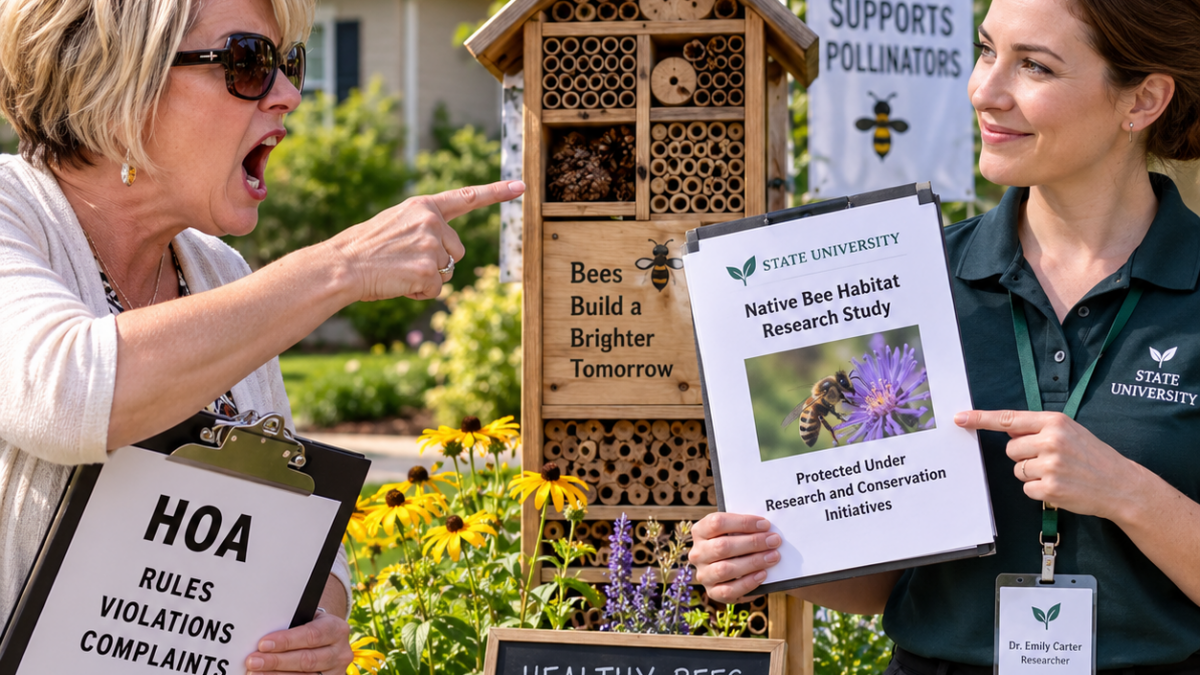
PART 2
I carried my coffee inside and shut the door.
Sarah followed me into the dining room.
The table had slowly transformed over the previous three months from the place where we ate dinner into something that looked disturbingly familiar to me.
Folders.
Highlighted documents.
Certified-mail receipts.
Printed HOA bylaws.
Photographs.
A notebook filled with dates and times.
The similarity to the operations tables I had worked around during my years in the Marines wasn’t lost on me.
Sarah noticed me staring at it.
“You’re doing the thing,” she said.
“What thing?”
“The thing where your face goes completely calm because you’re furious.”
I almost smiled.
After twenty-six years of marriage, she knew me too well.
“I’m not furious.”
“Mark.”
“I’m organized.”
“That’s worse.”
I sat down.
Gunner, our aging golden retriever, lifted his head from beside the kitchen doorway, decided nothing edible was happening, and went back to sleep.
I opened the folder containing the university documents.
The entire mess had begun because of one phone call from my old friend Mike.
We had served together years earlier.
Mike had eventually left the Corps, gone back to school, earned a doctorate, and somehow transformed himself from the guy who once tried to cook canned chili on an engine block into Professor Michael Vance, a respected entomologist at Northwood University.
I had never stopped giving him grief about the tweed jackets.
He had never stopped reminding me that I once believed all bees lived in giant hives and spent their lives making honey.
“Mark,” he’d said when he first called me about the project, “I need somebody obsessive.”
“Good afternoon to you too.”
“I’m serious. I need a woodworker who’s obsessive about tolerances.”
“That sounds healthier.”
Then he explained.
His research team was studying native solitary bees.
Unlike honeybees, many native bee species didn’t live in large colonies. Females nested individually, often using hollow plant stems, beetle holes in wood, or narrow natural cavities.
Habitat loss had reduced many of those nesting opportunities.
Researchers wanted to study whether properly designed artificial nesting habitats could improve reproduction and species diversity in suburban environments.
The commercially sold “bee hotels” Mike’s team had examined weren’t good enough.
Some used treated lumber.
Some contained rough drilled cavities that could damage delicate wings.
Others lacked proper depth, drainage, ventilation, or weather protection.
“We’ve got funding,” Mike told me. “We’ve got graduate students. We’ve got monitoring equipment. What I don’t have is someone who can build these things correctly without charging me like we’re constructing a moon base.”
“So you’re calling the retired Marine.”
“I’m calling the retired Marine with a CNC router.”
That was how I got involved.
I had left active service two years before.
For most of my adult life, my days had been shaped by orders, schedules, missions, and responsibility.
Retirement was supposed to feel peaceful.
At first, it felt empty.
Oak Creek Meadows helped.
Sarah and I had chosen the neighborhood because of the mature trees, quiet streets, and modest distance from the city.
Our children were grown.
For the first time in decades, nobody depended on me to be anywhere at 0500.
I could drink coffee on my porch.
I could take Gunner for long walks.
I could spend six hours making a dining chair because I wanted the joint to fit perfectly.
My woodworking business grew almost accidentally.
One table for Sarah became a bookshelf for a neighbor.
That became a desk for a former Marine.
Then a custom bed.
Eventually I painted a small sign for the garage:
SEMPER FI WOODWORKS.
I wasn’t getting rich.
I didn’t care.
The smell of cedar and oak was better medicine than I knew how to explain.
When Mike gave me the bee project, something clicked.
This wasn’t just another commission.
It had a purpose.
We spent weeks refining the design.
Mike sent research papers.
I sent sketches.
He corrected nesting dimensions.
I redesigned drainage.
We selected untreated cedar because it resisted weather without introducing harmful chemicals.
I drilled the cavities with absurd precision.
Sarah came into the shop one evening and found me using compressed air to clean individual holes.
“You know they are insects, right?” she asked.
“They’re university insects.”
“Oh. Forgive me.”
“These bees have standards.”
She laughed.
That sound alone made the project worth doing.
When the structure was finally finished, even Mike was impressed.
It looked more like a small piece of architecture than an insect habitat.
The roof was cedar shake.
I formed the copper flashing myself.
The nesting blocks could be removed individually for inspection.
The design allowed researchers to monitor occupancy while minimizing disturbance.
Sarah insisted we place it near her roses.
“If we’re hosting scientists,” she said, “they might as well have good catering.”
For the first week, nothing happened.
Then one afternoon I saw the first mason bee enter a nesting cavity.
I watched that tiny metallic-blue insect disappear into something I’d built, and I felt ridiculous pride.
I texted Mike.
FIRST TENANT.
His reply came thirty seconds later.
DON’T SCARE HER AWAY, LANDLORD.
That probably should have been the most dramatic event involving the bee hotel.
Then Karen Shipman saw it.
Karen was president of the Oak Creek Meadows Homeowners Association.
Before that day, I’d barely interacted with her.
I knew her reputation.
Everybody did.
My next-door neighbor Dave had once spent nearly two months fighting with her because his Japanese maple was supposedly planted two feet too close to the driveway.
Two feet.
He moved it eventually.
Not because Karen was right.
Because he got tired.
“That’s how she wins,” Dave told me afterward. “She makes being correct more exhausting than surrendering.”
I’d laughed at the time.
I shouldn’t have.
The first time Karen confronted me, I was pulling weeds beside the roses.
Her golf cart slowed outside the house.
She stared at the bee hotel.
Then she backed up.
She actually backed the golf cart up.
The moment she stepped out holding that clipboard, something in Dave’s warning returned to me.
“What is that?”
No greeting.
No introduction.
Just accusation.
“A native bee habitat.”
“A what?”
“It’s part of a research project with Northwood University.”
Her eyebrows rose.
“So you’re intentionally attracting insects?”
“Pollinators.”
“Bees.”
“Solitary bees.”
“They’re still bees.”
I stood and brushed soil from my hands.
“They don’t form swarms, Karen. Most are extremely docile.”
She ignored that.
“Was this submitted to the architectural review committee?”
“It’s a research habitat.”
“That isn’t what I asked.”
I glanced at the clipboard.
“No.”
Her face brightened.
That’s the part I remember most clearly.
She wasn’t concerned.
She wasn’t frightened.
She looked pleased.
She had found something.
“Section Seven, Paragraph B, Subsection Four prohibits unapproved freestanding structures.”
“That section concerns sheds and outbuildings.”
“It says other freestanding structures.”
“Birdhouses are freestanding.”
“Don’t be difficult.”
“I don’t think I’m the one being difficult.”
Her eyes narrowed.
“You’ll receive formal notice.”
Three days later I did.
Fourteen days to remove the structure.
Initial fine: $250.
Daily fines afterward.
I read the letter twice.
Then I read the bylaws.
All of them.
Sarah found me at one in the morning with three highlighters and a legal pad.
“Come to bed.”
“Did you know we’re technically prohibited from storing a canoe where it can be visible from an adjacent elevation?”
“We don’t own a canoe.”
“That’s not the point.”
She sighed.
“You’re enjoying this.”
“I am absolutely not enjoying this.”
“You have four highlighters.”
“Different categories.”
She kissed the top of my head.
“I married a strange man.”
I prepared a formal response.
Not angry.
Not sarcastic.
Professional.
I explained the scientific purpose of the habitat.
I included Mike’s university letter.
I attached photographs.
I cited the portions of the bylaws covering garden ornamentation and accessory landscaping features.
Then I sent the entire package certified mail.
Karen received it.
I knew because I had the signed receipt.
Fourteen days passed.
Another HOA envelope arrived.
The $250 fine had been imposed.
My appeal had been rejected.
The explanation consisted of one sentence:
The committee has reviewed your correspondence and determined that it does not alter the nature of the violation.
That sentence bothered me more than the fine.
Because it told me they hadn’t considered anything.
They had decided first.
Procedure was merely theater.
Then the rumors started.
Mrs. Henderson stopped visiting Sarah’s roses.
Parents hurried children past our lawn.
Dave came over one evening looking embarrassed.
“You need to know what Karen’s telling people.”
“Let me guess. Killer bees.”
He blinked.
“Actually, yes.”
I laughed.
Then I realized he wasn’t joking.
“She’s telling people you’ve installed some kind of experimental hive. Said the university is breeding aggressive bees.”
“That’s insane.”
“I know.”
“Mike would have a stroke.”
Dave shoved his hands into his pockets.
“People don’t know the difference, Mark. They hear ‘experimental’ and ‘bees’ and they picture a horror movie.”
Sarah took it harder than I did.
One afternoon I found her standing at the front window.
Two mothers were walking on the opposite sidewalk.
Their children usually stopped to pet Gunner.
That day they crossed the road before reaching our house.
Sarah watched them go.
“This is our home,” she said quietly.
“I know.”
“I don’t care about Karen’s stupid fine. I care that she’s making people afraid of us.”
That was when the fight changed for me.
Up until then, it had been bureaucratic.
Annoying.
Almost amusing.
But watching Sarah feel unwelcome in the neighborhood we had chosen for our retirement did something to me.
I started documenting everything.
Dates.
Conversations.
Letters.
Copies of newsletters.
Screenshots from the HOA portal.
Every fine.
Every public statement.
Every certified-mail receipt.
I wasn’t planning revenge.
Not yet.
I simply knew that when institutions failed, records mattered.
And I had spent twenty years learning how valuable accurate records could become.
After Karen dismissed the university letter and continued the fines, I finally called Mike.
“I need Northwood to step in.”
There was silence.
Then he said, “How bad?”
I told him.
All of it.
When I finished, he sounded less like my friend and more like Professor Vance.
“She ignored my letter?”
“Completely.”
“And she’s publicly claiming we’re breeding dangerous insects?”
“Apparently.”
“Mark, we’re operating under a grant with defined research sites and reporting obligations. Your location is registered in our study.”
“I know.”
“Interfering with one site affects the dataset.”
“I know.”
“And she threatened to destroy university-monitored research material.”
“That’s why I’m calling.”
There was another pause.
Then Mike said, “Don’t do anything.”
“Meaning?”
“Meaning don’t argue with her. Don’t touch the structure. Don’t pay the fine yet. Send me every document you’ve got.”
“What are you doing?”
“I’m calling the dean.”
That was how I met Alan Davies.
Associate counsel, Northwood University.
Alan had the calmest voice of any attorney I’d ever spoken with.
He asked questions in sequence.
When had the habitat been installed?
When had Karen first complained?
What exact language was used in the violation?
Did I have proof she received Mike’s letter?
Had anyone from the HOA attempted physical removal?
Were the fines continuing?
I answered everything.
Finally he said, “Mr. Thorne, homeowners associations have considerable contractual authority, but authority is not unlimited.”
“I figured.”
“The university isn’t interested in turning a neighborhood disagreement into litigation.”
“Neither am I.”
“Good. Because litigation should be the last tool, not the first.”
I liked him immediately.
“However,” he continued, “the association has now been informed that this structure participates in a grant-funded research program. If they knowingly destroy or materially interfere with that work, the university may have interests of its own to protect.”
“What happens next?”
“A letter.”
I almost laughed.
“Karen likes letters.”
“She may like this one less.”
The university’s letter arrived the following week.
Three pages.
Dense.
Professional.
Polite enough to frame.
Sharp enough to cut glass.
It explained the project.
Referenced the research program.
Outlined the university’s interest in maintaining study continuity.
Requested immediate suspension of enforcement.
Advised the HOA against physical interference.
And reserved the university’s legal rights if its research was damaged.
For four glorious days, nothing happened.
No new fines appeared online.
No letters arrived.
No golf cart stopped outside my house.
I thought maybe Karen had finally encountered an authority large enough to make her reconsider.
Sarah thought so too.
“We might actually be done,” she said.
I should have known better.
Karen did not interpret resistance as information.
She interpreted it as disrespect.
On Friday morning, Dave knocked on my door holding a fluorescent-yellow piece of paper.
“You’ve seen this?”
I hadn’t.
The headline read:
EMERGENCY COMMUNITY MEETING—IS YOUR FAMILY SAFE?
Below it was a stock image of an angry hornet.
Not a solitary bee.
Not even the right type of insect.
An angry hornet.
The flyer warned residents about an “unapproved experimental insect-breeding installation.”
It mentioned “uncontrolled populations.”
“Potential stinging hazards.”
“Property-value concerns.”
Then came the part that made Sarah go pale.
The address.
112 Arbor Lane.
Our home.
The flyer announced a binding community vote on forced removal.
Sarah dropped it onto the counter.
“She published our address.”
“Everybody already knows where we live.”
“That’s not the point.”
No.
It wasn’t.
She wasn’t notifying residents anymore.
She was recruiting them.
I called Alan.
He listened while I read the flyer.
When I finished, he was quiet for several seconds.
Then he said something I didn’t expect.
“Good.”
“Good?”
“A public meeting.”
“Alan, she’s calling us a safety threat.”
“Yes. In writing.”
“I fail to see the good part.”
“Mr. Thorne, she has created a public venue where the university can directly correct her claims in front of the people she’s been misleading.”
That made sense.
Then his voice changed slightly.
“But before we go in there, I want you to do something else.”
“What?”
“Find your HOA’s financial records.”
I leaned back.
“Why?”
“Because people who abuse procedural authority often become careless elsewhere.”
“That’s a pretty serious assumption.”
“It’s not an assumption. It’s a question. We’re going to answer it with documents.”
The HOA website contained years of records.
Finding them was another matter.
The site looked like it had been designed by someone who hated users.
Eventually I located scanned budgets, meeting minutes, invoices, annual reports, and expenditure summaries.
I downloaded everything from the previous two years.
Then I printed them.
Sarah walked into the dining room and stared at the growing stacks.
“What exactly are we doing now?”
“Alan wants us to look for irregularities.”
She pulled out a chair.
“Move over.”
I’d nearly forgotten that before raising our children, Sarah had worked in bookkeeping.
For the next two nights we became accountants with insomnia.
At first there was nothing.
Landscaping.
Pool maintenance.
Insurance.
Utilities.
Event expenses.
Repairs.
Then Sarah circled something.
“Why did the Fourth of July barbecue cost forty-five hundred dollars?”
I looked over.
“Auntie Kay’s Catering.”
“The barbecue was canceled.”
She was right.
Heat advisories had forced the event indoors, then the board canceled it altogether.
Yet the association had apparently paid thousands for catering.
I searched the business.
Almost no online presence.
No proper company website.
A post-office box.
One glowing review.
Signed K. Shipman.
“Could be nothing,” I said.
Sarah shook her head.
“Could be.”
Then we found Prestige Party Planners.
Owned by Karen’s sister-in-law.
More payments.
Not illegal by itself.
But undisclosed family vendor relationships deserved questions.
Then came landscaping.
Oak Creek Meadows spent an astonishing amount maintaining common areas.
Most monthly invoices from Green Pastures Landscaping were predictable.
Then, eight months earlier:
SPECIAL PROJECT—RETAINING WALL / STONEWORK / FOUNTAIN INSTALLATION.
$22,000.
I remembered Karen announcing an entrance beautification project.
So the next morning I drove to the neighborhood entrance.
There was no fountain.
No new retaining wall.
Nothing remotely worth twenty-two thousand dollars.
I came home.
Sarah was waiting.
“Anything?”
“No.”
She stared at the invoice.
“Maybe it was postponed.”
“Then why was it paid?”
That question sent us deeper.
County property records included recent aerial imagery.
I typed Karen’s address.
The screen loaded slowly.
Then the image appeared.
I zoomed in.
For several seconds neither Sarah nor I spoke.
Karen Shipman’s backyard contained an elaborate new stone retaining wall.
A slate patio.
And in the center—
a three-tiered fountain.
Sarah leaned toward the monitor.
“No.”
I placed the invoice beside the screen.
Stonework.
Retaining wall.
Fountain installation.
Twenty-two thousand dollars.
Sarah’s voice fell to a whisper.
“Mark.”
“I see it.”
“That’s our money.”
“We don’t know that yet.”
“Her backyard matches the invoice.”
“We still verify.”
She looked at me.
“Sometimes I hate how reasonable you are.”
“Reasonable holds up better in court.”
I photographed the invoice.
Saved the aerial record.
Downloaded the board minutes authorizing the supposed community project.
Then I called Alan.
He didn’t celebrate.
Good lawyers rarely do.
He asked for documents.
He asked about dates.
He asked whether the invoice identified the service location.
It didn’t.
He requested copies of the meeting minutes.
Then he said, “Do not accuse anyone publicly yet.”
“Understood.”
“Do not contact the contractor.”
“Understood.”
“Do not contact Ms. Shipman.”
“That one will be difficult.”
“Especially do not contact Ms. Shipman.”
Meanwhile I decided the scientific side of the fight needed something Karen didn’t understand.
Human contact.
I printed a one-page sheet from Mike’s department.
No legal language.
No accusations.
Just photographs and simple facts about solitary native bees.
Then Sarah baked cookies.
“What are these for?”
“Counterintelligence.”
She stared at me.
“They’re chocolate-chip cookies.”
“Exactly.”
Mrs. Henderson was first.
When she opened her door, she looked nervous.
“Mark.”
“Morning.”
I held out the plate.
“Sarah made too many.”
Nobody has ever believed that sentence, but civilization depends on pretending.
Mrs. Henderson took the plate.
I handed her the university sheet.
“I also wanted you to have this. I know you’ve heard some things about the bees.”
Her expression shifted.
“I don’t want trouble.”
“Neither do I.”
“Karen said they’re dangerous.”
“Mike’s department wrote this. Don’t take my word for anything. Read it.”
She glanced down.
“They don’t have hives?”
“No.”
“They don’t swarm?”
“No.”
“Are they going to sting my grandchildren?”
“Not unless your grandchildren somehow trap one against their skin. Most of these species are extremely reluctant to sting.”
Mrs. Henderson studied me.
“I’ve been avoiding Sarah.”
“I know.”
Her face softened.
“I’m ashamed of that.”
“Don’t be. You were worried.”
She looked again toward our house.
“I love her roses.”
“She loves showing them off.”
A small smile appeared.
“Tell her I’ll come by tomorrow.”
I visited eleven more homes.
No arguments.
No accusations.
Just information.
The reactions changed almost immediately.
Fear became questions.
Questions became curiosity.
My last stop was Bill Mercer.
Retired Army first sergeant.
Seventy years old.
Still stood like he was waiting for formation.
Bill had fought Karen before.
His crime had been wanting a taller flagpole.
I found him polishing his 1967 Mustang in the garage.
He listened to the entire story.
When I got to the university letter, he snorted.
When I got to the emergency meeting, his jaw tightened.
When I showed him the $22,000 invoice and aerial image, he stopped polishing.
“You’re sure?”
“No.”
That surprised him.
“I have documents suggesting something happened. That’s different.”
He nodded slowly.
“Marine.”
“Army.”
He pointed the rag at me.
“You’ve annoyed me less than usual today.”
“Meeting’s Thursday.”
“What time?”
“Seven.”
“I’ll be there at six-thirty.”
The clubhouse was packed Thursday night.
Nearly a hundred residents.
Karen’s propaganda had worked.
She wanted fear.
She got turnout.
Unfortunately for her, turnout cuts both ways.
Sarah sat beside me.
Mike arrived wearing the inevitable tweed jacket.
“You own anything else?” I asked.
“This is professorial armor.”
Alan wore a dark suit and carried a slim leather portfolio.
Bill sat near the aisle.
Dave sat two rows behind him.
Mrs. Henderson waved nervously from the center.
At seven sharp Karen struck the gavel.
“This emergency meeting of the Oak Creek Meadows Homeowners Association is now in session.”
She wore purple.
Bright purple.
She looked delighted.
For fifteen minutes she spoke about community standards.
Liability.
Safety.
Precedent.
She used the word “infestation” four times.
Finally she declared, “We cannot allow one homeowner’s personal hobby to endanger the entire community.”
Mike leaned toward me.
“Personal hobby?”
“Easy, Professor.”
“I have published papers older than her haircut.”
Sarah covered a laugh with a cough.
Karen finally announced that I would receive five minutes to respond.
I walked to the center of the room.
Not the lectern.
I wanted to stand among my neighbors.
“My name is Mark Thorne. I live at 112 Arbor Lane.”
People turned.
“I’m a retired Marine, a woodworker, Sarah’s husband, and the owner of the terrifying structure you’ve all been invited here to discuss.”
A few people laughed.
Karen didn’t.
“The first thing I want everyone to understand is that you don’t have to believe me.”
That got their attention.
“Northwood University is here.”
I gestured toward Mike.
He stood.
“Professor Michael Vance. Entomology.”
Someone called, “Are they dangerous?”
Mike smiled.
“If you’re asking about Mr. Thorne, I served with him, so yes.”
The room laughed.
Even Bill.
Karen slammed the gavel.
Mike continued.
“The bees, however, are not.”
For the next fifteen minutes, despite Karen’s attempts to interrupt, Mike explained the research.
Solitary bees.
Nesting behavior.
Pollination.
Why they don’t form defensive colonies.
Why the hotel existed.
How research sites were monitored.
Then a mother in the second row raised her hand.
“My daughter walks past that house every day.”
Mike nodded.
“Then she’s probably walking past hundreds of native bees already. Most people simply don’t notice them.”
Another resident asked about swarming.
“They don’t swarm.”
Another asked about allergies.
Mike explained that any stinging insect could theoretically cause reactions, but solitary native species generally presented far less encounter risk than social wasps.
The room changed.
You could feel it.
Fear requires imagination.
Knowledge gives imagination boundaries.
Karen’s monster was shrinking in real time.
She stood.
“We are not here for a science lecture.”
Mike sat.
I looked at her.
“No. We’re here because you told everybody the science was dangerous.”
Applause.
Small.
But real.
Karen’s face tightened.
I continued.
“Three months ago I gave the HOA documentation from Northwood University. The board ignored it.”
I held up the certified-mail receipt.
“Then I was fined.”
Another document.
“When the university’s legal department contacted the board, enforcement briefly stopped.”
Another.
“Then this flyer appeared.”
I held up the yellow page.
“This flyer used an image of a hornet to frighten people about solitary bees.”
Someone called, “Seriously?”
Karen struck the gavel again.
“Mr. Thorne, your five minutes have expired.”
Alan stood.
“Madam President.”
She froze.
“Who are you?”
“Alan Davies. Associate counsel, Northwood University.”
The room became very quiet.
“I am here regarding the university’s research interest and the association’s threatened destruction of the monitored habitat.”
Karen glanced around.
“This meeting concerns HOA business.”
“Exactly.”
Alan walked forward.
“We have already notified the board in writing. Before any vote authorizes expenditure of association funds to interfere with the project, residents may wish to understand the potential consequences.”
That landed.
Nothing focuses homeowners like hearing the phrase association funds.
Karen started objecting.
Then Bill stood.
“Let him speak.”
Karen stared at him.
“Mr. Mercer, sit down.”
“No.”
One word.
Seventy years of command behind it.
The room went still again.
Alan spoke for less than ten minutes.
He didn’t threaten.
He didn’t grandstand.
He simply explained that destroying research material after receiving formal notice could create legal exposure the community would ultimately fund.
Then he closed his portfolio.
“I am not here to tell this association how to govern itself. I’m here to ensure it makes decisions based on accurate information.”
Karen seized the moment.
“Then we’re done.”
I looked at Alan.
He gave the smallest nod.
I turned back toward the residents.
“Actually, there is one more issue.”
Karen’s voice sharpened.
“No.”
“It concerns the money you intend to use to destroy my property.”
The room shifted.
Alan connected his laptop to the clubhouse projector.
Karen stepped forward.
“This is completely outside the agenda.”
Bill said, “Then let’s expand the agenda.”
Several residents agreed.
Karen hammered the gavel.
Nobody cared anymore.
That was the moment her power really disappeared.
Not when she lost the vote.
Not when the audit came later.
Right there.
When the gavel made noise—
and nobody obeyed.
The first document appeared on the wall.
A catering invoice.
I spoke.
“Last summer, Oak Creek Meadows paid more than four thousand dollars for catering connected to the Fourth of July event.”
A man in back called out.
“That event was canceled.”
“Correct.”
Murmurs spread.
The next image appeared.
Prestige Party Planners.
Sarah had helped trace the ownership connection.
“Several association payments were made to a company connected to a relative of Ms. Shipman.”
Karen shouted, “That’s legal!”
Alan immediately lifted a hand.
“No one has said otherwise.”
That mattered.
Facts.
Only facts.
Let people reach their own conclusions.
Then came the invoice.
$22,000.
RETAINING WALL / STONEWORK / FOUNTAIN INSTALLATION.
People recognized the description.
Karen had announced the beautification project months earlier.
I asked one question.
“Has anyone here seen the new community fountain?”
Silence.
Then someone said, “There isn’t one.”
Alan advanced the slide.
County aerial imagery.
Karen’s property.
The stone wall.
The patio.
The fountain.
The room exploded.
People stood.
Chairs scraped.
Someone shouted, “That’s her house!”
Another voice:
“You spent our money on your backyard?”
Karen went white.
Then red.
Then white again.
“That image proves nothing!”
She turned toward Alan.
“This is defamation.”
Alan remained perfectly calm.
“We have made no accusation of criminal conduct. We are displaying association documents and public property imagery and asking for an accounting.”
Perfect answer.
Karen pointed at the screen.
“That was a prototype.”
Silence.
Then somebody laughed.
Karen realized what she’d said.
Too late.
“A prototype?” Dave repeated.
Karen tried to recover.
“To evaluate materials.”
“You spent twenty-two thousand dollars of HOA funds testing a fountain in your backyard?”
The laughter grew louder.
But beneath it was anger.
Real anger.
Mrs. Henderson stood.
Her hands were trembling.
“Karen, you fined me eighty dollars because my garbage can was visible from the street for one afternoon.”
The room quieted.
Karen looked at her.
Mrs. Henderson’s voice shook harder.
“My husband was in the hospital.”
I hadn’t known that.
“He’d had chest pains. I forgot the can.”
Karen opened her mouth.
Mrs. Henderson continued.
“You told me rules were rules.”
Karen lowered her eyes.
Another homeowner stood.
“You threatened a lien over my fence stain.”
Another.
“You made me remove my daughter’s graduation banner.”
Dave stood.
“You made me dig up a tree.”
Then Bill rose.
Nobody spoke over him.
“For years,” he said, “you told everybody that rules were what kept this neighborhood respectable.”
He walked slowly toward the front.
“You measured flagpoles.”
He pointed toward Dave.
“You measured trees.”
Toward Mrs. Henderson.
“You fined a woman whose husband was in the emergency room.”
Then he pointed toward the projected invoice.
“And now residents are looking at twenty-two thousand dollars in association spending they cannot account for.”
Karen gripped the lectern.
“This is a coordinated attack.”
“No,” Bill said. “This is an overdue question.”
He turned toward the crowd.
“I move that tonight’s vote on Mr. Thorne’s research structure be suspended pending review of the university documentation.”
“Seconded!” Dave called.
Hands rose.
Karen shouted that she hadn’t recognized the motion.
Nobody listened.
Then Alan quietly read from the bylaws.
Homeowners present at a general meeting could petition for a no-confidence vote when the required threshold was met.
Within three minutes, enough residents had signed.
Karen read the signatures.
Her hands shook.
“No.”
Bill folded his arms.
“The bylaws, Karen.”
That sentence was beautiful.
Not because it humiliated her.
Because those were the words she had used against everybody else.
Rules were rules.
The vote happened by paper ballot.
Sarah helped collect slips.
Dave and two residents counted.
I stood against the wall beside Mike.
My heart was pounding harder than I wanted to admit.
Mike whispered, “You okay?”
“Yep.”
“You’re lying.”
“Yep.”
I wasn’t worried about winning.
I was looking around at the people.
Three months earlier they had crossed the street to avoid my yard.
Now they were talking openly.
Comparing experiences.
Realizing they weren’t isolated.
The power Karen had accumulated wasn’t created entirely by rules.
It had been created by silence.
Everyone thought they were the only one being bullied.
The moment they compared notes, the illusion collapsed.
Bill walked to the front holding the tally.
He didn’t smile.
“The vote is eighty-seven to four.”
Nobody moved.
“Karen Shipman has lost the confidence of this community.”
The room erupted.
Applause.
Cheering.
Some people stood and hugged.
Mrs. Henderson cried.
Dave slapped Bill on the shoulder.
Sarah squeezed my hand.
Karen didn’t say a word.
She grabbed her purse.
For one second our eyes met.
There was rage there.
But also disbelief.
She had come expecting to destroy my bee hotel.
Instead, she’d lost the room.
Then she walked out.
The contractor with the sledgehammer never came back.
But the story wasn’t finished.
Not even close.
Because once residents realized financial questions existed, they wanted answers.
Gerald, the treasurer, resigned that night.
He looked sick.
“I signed what she put in front of me,” he admitted quietly.
Bill stared at him.
“Then you’re going to help us figure out what you signed.”
Gerald nodded.
The remaining board members stepped down within days.
Bill became interim president.
Dave, a retired accountant, agreed to help oversee the finances.
And somehow—mostly because my neighbors apparently enjoyed irony—I became chair of the architectural review committee.
At our first meeting, Bill slid a form toward me.
“Application number one.”
I looked down.
Applicant: Mark Thorne.
Project: Native Pollinator Research Habitat.
I stared at him.
“You filled this out?”
“I like paperwork.”
“You’re sick.”
“Marine calling Army sick. That’s adorable.”
The committee voted unanimously.
My bee hotel was formally approved.
More importantly, the new board designated it a protected community environmental project connected to Northwood University’s research.
Every fine was canceled.
The HOA issued a written apology to Sarah and me.
But I kept thinking about something.
If Karen’s behavior had been limited to bullying, I would have been ready to stop.
She was gone.
The bee project was safe.
The neighborhood could move forward.
But twenty-two thousand dollars still needed an explanation.
So the new board hired a forensic accountant.
That decision exposed everything.
The fountain was only the beginning.
Personal fuel charges.
Grocery purchases.
Questionable reimbursements.
A spa weekend categorized as board development.
Cash withdrawals with vague documentation.
Payments to connected vendors.
Unusual landscaping charges.
Four years of records.
The estimated misuse eventually climbed to nearly seventy thousand dollars.
I remember sitting beside Sarah when Dave showed us the preliminary total.
She stared at the number.
“Seventy thousand.”
“Almost.”
“From neighbors.”
“Yes.”
“From people like Mrs. Henderson.”
I nodded.
Her eyes filled with anger.
“She made people afraid over fifty-dollar fines while doing this?”
That’s what made the financial misconduct feel different.
It wasn’t just theft in an abstract sense.
HOA money came from families.
Retirees.
Young couples.
Parents.
People who paid because they believed common funds would maintain roads, landscaping, insurance, and shared property.
Karen had weaponized financial pressure against homeowners while allegedly treating those same common funds like a personal reserve.
The board gave the audit to law enforcement.
After that, I stayed out of it.
Mostly.
Karen tried contacting me once.
My phone rang on a Tuesday afternoon.
Unknown number.
“Mark.”
I recognized her voice immediately.
“Karen.”
“You destroyed my life.”
I stood alone in my workshop holding a piece of walnut.
“No.”
“You planned that meeting.”
“You planned the meeting.”
“You embarrassed me.”
“I showed documents.”
“You turned everyone against me.”
“I explained the bees.”
“You dug through my finances.”
“They were HOA records.”
She breathed hard.
Then she said, “You could have just taken that stupid thing down.”
I looked through the garage window.
The bee hotel stood in sunlight.
Sarah’s roses moved gently in the breeze.
A mason bee disappeared into one tube.
“You’re right,” I said.
Silence.
She clearly hadn’t expected that.
“I could have removed it.”
“Exactly.”
“And Mrs. Henderson could have paid her fine.”
Karen said nothing.
“Dave could have left his tree somewhere else.”
Nothing.
“Bill could have bought a shorter flagpole.”
“Mark—”
“And you could have stopped when the university explained what the project was.”
Her breathing changed.
“But you didn’t.”
“I was doing my job.”
“No. You were enjoying your power.”
“Don’t lecture me.”
“I’m not.”
I set the walnut down.
“I’m telling you exactly where you made your mistake.”
“What mistake?”
“You thought everybody obeyed because they respected you.”
Her silence told me I’d hit something.
“They obeyed because fighting you individually wasn’t worth the exhaustion.”
“Go to hell.”
“Maybe.”
I looked again toward the yard.
“But once you gave everyone a reason to stand in the same room and talk to each other, the fear disappeared.”
She hung up.
That was the last conversation we ever had.
The investigation eventually became public.
Then the local news picked up the story.
A reporter called.
I almost refused.
Sarah persuaded me otherwise.
“People should know the bee part,” she said.
“Why?”
“Because right now the headline will just be corrupt HOA president. That’s easy. People will forget it.”
She pointed toward the habitat.
“But that is the reason anyone started looking.”
The news crew came one afternoon.
Mike joined us.
They filmed the bee hotel.
My workshop.
Sarah’s roses.
They interviewed neighbors.
Mrs. Henderson volunteered.
So did Bill.
The reporter asked me the predictable question.
“Do you feel vindicated?”
I thought about it.
“No.”
She lowered the microphone slightly.
“No?”
“Vindicated would mean I wanted to beat Karen.”
“Didn’t you?”
“At one point?”
I laughed.
“Absolutely.”
The reporter smiled.
“But?”
I looked down the street.
Kids were riding bicycles.
Dave was pruning his Japanese maple.
Bill’s new flagpole stood three streets away.
“But winning against one person isn’t the same as fixing what allowed the problem.”
That quote made the broadcast.
The investigation moved through the legal system.
The financial evidence was extensive enough that Karen eventually accepted a plea arrangement rather than take the case through a full trial.
She was ordered to pay restitution.
She received probation.
And community service.
The last part produced one of those moments that sounds invented even when it isn’t.
Her community service assignment included work with the county parks department.
Natural habitats.
Public gardens.
Pollinator areas.
When Bill heard, he laughed so hard he had to sit down.
“Think they’ll let her use pesticides?”
“Bill.”
“I’m asking for educational reasons.”
Karen put her house up for sale not long afterward.
The day the sign appeared, I expected to feel triumphant.
Instead I felt tired.
Sarah stood beside me at the kitchen window.
“She’s really leaving.”
“Looks that way.”
“How do you feel?”
I searched for the word.
“Finished.”
That was it.
Not victorious.
Not happy.
Finished.
Revenge had sounded appealing during the worst nights.
When I watched Sarah worry.
When neighbors treated us like hazards.
When Karen threatened to send a man with a sledgehammer onto my property.
Part of me had wanted to make her feel every ounce of humiliation she’d created for others.
But when consequences finally arrived, I understood something.
The best revenge wasn’t hurting Karen.
It was making her irrelevant.
Oak Creek Meadows didn’t need another tyrant.
It needed adults.
So we rebuilt the HOA.
That became the real work.
Bill insisted every major expenditure be published clearly.
Dave created simple monthly financial reports residents could actually understand.
Meeting minutes went online within days instead of months.
Conflict-of-interest disclosures became mandatory for board contracts.
We rewrote portions of the architectural guidelines.
The old version was filled with phrases like “aesthetic incompatibility” and “community character,” subjective language that allowed whoever controlled the committee to interpret almost anything as a violation.
I hated that.
Rules should tell people what is expected.
Not give officials excuses to punish people they dislike.
So we simplified them.
Measurements where measurements mattered.
Clear deadlines.
Written explanations for denials.
Appeal procedures.
Reasonable exemptions.
Most importantly, we created a presumption that homeowners could improve and enjoy their property unless the project caused a genuine, demonstrable problem.
At our first ARC meeting under the new rules, Bill submitted his flagpole application.
Twenty-five feet.
Higher than Karen had permitted.
I read it.
Engineering details.
Setback.
Foundation.
Lighting.
Everything perfect.
“You prepared this like you’re invading Normandy,” I told him.
“Army.”
“Explains the paperwork.”
I looked at the committee.
“Any objections?”
None.
“Approved.”
Bill stared at me.
“That’s it?”
“That’s it.”
“No three-month review?”
“No.”
“No certified letters?”
“No.”
“No public hearing?”
“Bill, get out.”
He grinned.
Two weeks later, he raised a large American flag on a clear Saturday morning.
A handful of neighbors gathered.
Nothing dramatic happened.
No speeches.
No television crews.
Just an old soldier standing with his hand over his heart while the flag climbed.
I stood beside Sarah.
She slipped her hand into mine.
“That feels bigger than a flagpole.”
“It is.”
We also changed environmental guidelines.
Rain gardens.
Native plantings.
Pollinator habitats.
Rainwater systems.
Projects that had previously been treated with suspicion were now evaluated on actual impact rather than whether they looked unusual.
And the bee hotel?
It became famous.
Children started stopping by.
Parents asked questions.
Some apologized.
One mother who had crossed the street to avoid us months earlier came with her eight-year-old son.
“Is this where the blue bees live?”
I crouched beside him.
“Some of them.”
“Are they really blue?”
“Metallic blue.”
His eyes widened.
“Like robots?”
“Exactly like robots.”
His mother laughed.
The boy watched until a mason bee landed near one of the nesting tubes.
He didn’t run.
He leaned closer.
That mattered to me more than I expected.
Fear had almost destroyed the project.
Understanding transformed it into curiosity.
Mike noticed the change too.
He suggested a neighborhood pollinator day.
Bill immediately approved it.
Then he added, “With receipts.”
Dave nearly applauded.
We set up tables in my yard.
Mike brought microscopes.
Graduate students showed children how nesting cells worked.
We planted native flowers near the clubhouse.
Sarah handed out lemonade.
Mrs. Henderson distributed cookies.
Bill spent half the day pretending he wasn’t fascinated.
I caught him asking a graduate student whether leafcutter bees actually cut pieces from leaves.
“Science curiosity, Sergeant Major?”
“Security assessment.”
“Sure.”
“Shut up, Marine.”
The research results were excellent.
Occupancy increased.
Species diversity exceeded expectations.
Then one afternoon Mike arrived practically vibrating.
“I need you outside.”
“I am outside.”
“Closer to the hotel.”
He held a specimen photograph.
“See this?”
“A bee.”
He gave me the kind of disappointed look professors reserve for people wasting their education.
“This species hasn’t been documented in the county in roughly three decades.”
I looked from the photograph to the habitat.
“Here?”
“Here.”
For once, I had no joke.
That tiny structure Karen called an insect-infested monstrosity had provided useful data on a species researchers hadn’t recorded locally for thirty years.
Mike put a hand on my shoulder.
“You understand what this means?”
“Karen was wrong?”
“Beyond that.”
“Hard to imagine.”
He ignored me.
“It means suburban conservation sites can matter more than people think. Everybody assumes ecological restoration has to happen somewhere remote. It doesn’t. Sometimes biodiversity depends on ordinary yards.”
I ran my fingers over the cedar post.
“Ordinary yard.”
“Extraordinary carpenter.”
“You’re getting sentimental.”
“I have tenure. I’m allowed.”
Months passed.
The family who bought Karen’s house came over shortly after moving in.
A young couple.
Two children.
The wife introduced herself as Natalie.
“We heard there was some history between your houses.”
I looked toward Sarah.
She looked away, trying not to laugh.
“You could say that.”
Natalie’s husband rubbed the back of his neck.
“The realtor was vague.”
“Smart realtor.”
Natalie pointed toward the bee hotel.
“Is that the famous thing?”
“Unfortunately.”
“My kids want one.”
I blinked.
“One what?”
“A bee hotel.”
Her daughter stepped forward.
“Mom said you make them.”
The little girl couldn’t have been more than seven.
“What kind of bees do you like?” I asked.
She considered this seriously.
“Purple ones.”
“We’ll have to negotiate.”
I built them a smaller habitat.
No charge.
A month later their garden was filled with native flowers.
Sometimes life gives you closure quietly.
No courtroom.
No shouting.
Just children playing in the yard of the person who once tried to make yours miserable.
The first anniversary of the emergency meeting came and went.
Nobody officially commemorated it.
Bill wanted to call it “Liberation Day.”
We stopped him.
Mostly.
But that evening Sarah and I sat on the porch.
Gunner was older now.
His muzzle had gone almost entirely white.
He lowered himself slowly beside my chair and rested his head on my shoe.
The evening sun caught the copper roof of the bee hotel.
Tiny shadows moved across the nesting blocks.
Sarah leaned her head against my shoulder.
“Do you ever think about how ridiculous this all was?”
“Every day.”
“All of that because of bees.”
“Technically because of paperwork.”
She laughed.
Then became quiet.
“I was scared.”
“I know.”
“No, I mean really scared.”
I turned toward her.
“When she started putting our address everywhere, I thought we’d made a mistake moving here.”
My stomach tightened.
She had never told me that.
“I thought maybe retirement wasn’t going to work. Maybe we’d picked the wrong place. Maybe we’d always be fighting.”
“I’m sorry.”
“For what?”
“I could have handled it differently.”
She shook her head.
“You handled it exactly like you.”
“That’s not necessarily reassuring.”
She smiled.
“You didn’t scream.”
“I wanted to.”
“You didn’t threaten her.”
“I imagined several very satisfying speeches.”
“You documented everything. You called the right people. You talked to neighbors.”
“And investigated twenty-two-thousand-dollar fountains.”
“That too.”
She looked across the lawn.
“Do you know what I think?”
“That you should have married an accountant?”
“I think you needed this.”
That surprised me.
“Needed Karen?”
“God, no.”
“Good.”
“You needed to remember that retiring didn’t mean becoming useless.”
The words hit harder than I expected.
For two years I had avoided explaining something even to Sarah.
Leaving the Marine Corps had been harder than joining it.
People congratulated me.
They thanked me.
They told me I’d earned rest.
They were right.
But identity doesn’t disappear just because somebody hands you retirement papers.
For twenty years, people needed me to solve problems.
Build something.
Protect something.
Train somebody.
Make decisions.
Then one day I was standing in a suburban garage trying to decide whether walnut or cherry looked better for a coffee table.
I loved Sarah.
I loved my shop.
I loved our quiet life.
But sometimes quiet felt dangerously close to unnecessary.
The bee project changed that.
Not because I needed conflict.
Because I needed contribution.
Mike had needed my craftsmanship.
The research needed volunteers.
My neighbors eventually needed somebody willing to keep records and stand up.
I hadn’t retired from usefulness.
I had simply needed to redefine it.
Sarah squeezed my hand.
“You know what the funniest part is?”
“What?”
“Karen thought she was attacking a wooden box.”
I smiled.
“She underestimated the box.”
“She underestimated the man who built it.”
“No.”
I looked toward the street.
Mrs. Henderson was walking slowly past with her granddaughter.
Dave waved from his driveway.
Farther down, Bill’s flag moved above the rooftops.
“She underestimated everybody.”
That was the truth.
People like Karen rarely create power entirely on their own.
They borrow it.
One frightened neighbor at a time.
One exhausted homeowner who decides a hundred-dollar fine isn’t worth fighting.
One board member who signs without reading.
One resident who sees something wrong but assumes somebody else will handle it.
Karen’s authority had looked enormous because everyone faced it separately.
The night we stood together, it became exactly what it had always been.
A woman holding a clipboard.
Nothing more.
Years later, people still call my structure the bee hotel.
Mike hates the term.
“It’s a solitary native pollinator nesting habitat.”
“Bee hotel.”
“You’re devaluing years of entomological research.”
“Bee hotel.”
Sarah calls it the Bee Castle.
The kids prefer that.
I still build new research units for Northwood.
What started as one volunteer project became a small consulting role.
Mike asked me to help redesign installation guidelines for suburban citizen-science sites.
Eventually I helped create a community-integration packet.
Scientific fact sheets.
Sample HOA notices.
Design specifications.
Conflict-prevention recommendations.
Basically, a manual titled:
HOW TO PREVENT ANOTHER KAREN.
Mike refused that title.
Academic cowardice.
One semester he invited me to speak to graduate students.
“About bees?”
“About people.”
“I’m not qualified.”
“You’re spectacularly qualified.”
So I stood in front of thirty future scientists and told them something I wished Mike and I had understood before the project began.
Good science isn’t enough.
You can possess flawless data and still lose public trust if people are frightened.
You can be completely correct and still fail if you treat confused neighbors like idiots.
Explain early.
Invite questions.
Show people what you’re doing.
Understand community rules before installation.
Build relationships before conflict.
And document everything.
Especially that last part.
After the lecture, a student approached me.
“Mr. Thorne, do you think the conflict was ultimately good for the research?”
I thought carefully.
“No.”
She seemed surprised.
“But it increased publicity.”
“Publicity isn’t automatically good.”
“It helped expand the project.”
“Eventually.”
I leaned against the desk.
“But Sarah was scared. Neighbors were misled. People lost money. A community had to discover its president was abusing authority. None of that becomes good because we learned something afterward.”
She nodded.
“What I would say is this: when something bad happens, you decide whether the only thing left behind is damage.”
That answer stayed with me.
Because that became the real lesson of Oak Creek Meadows.
Karen tried to destroy something.
Instead we built.
We built better rules.
Better financial controls.
Better relationships.
More pollinator habitat.
More transparency.
A stronger community.
And strangely enough, more bee hotels.
By the third spring after the fight, there were seventeen approved pollinator habitats throughout Oak Creek Meadows.
Seventeen.
Bill complained.
“Whole neighborhood’s going soft.”
His own yard contained two.
One morning I caught him photographing a mason bee.
He lowered his phone.
“You saw nothing.”
“Absolutely nothing.”
“It was for identification.”
“Obviously.”
“Security.”
“National security.”
He pointed toward me.
“Keep walking.”
I did.
Some victories are loud.
Ours had been.
Eighty-seven to four.
Applause.
Angry homeowners.
A president walking out beneath the weight of her own misconduct.
Those are satisfying memories.
I won’t pretend otherwise.
Watching someone who bullied others finally face consequences can feel deeply satisfying.
But the moments I treasure aren’t the loud ones.
They’re smaller.
Mrs. Henderson standing beside Sarah’s roses again.
Dave planting another tree without fear.
Bill raising his flag.
Children crouching near the nesting blocks.
Natalie’s daughter discovering her first metallic-blue mason bee.
Sarah laughing on our porch.
Gunner asleep in the sun.
And late afternoons when I sit beside the structure Karen once wanted smashed with a sledgehammer.
The bees still don’t care about any of it.
They never cared about bylaws.
Or emergency meetings.
Or university lawyers.
Or Karen.
Each female simply finds a suitable nesting tube.
She gathers pollen.
Builds a chamber.
Lays an egg.
Seals it.
Then begins another.
Small work.
Patient work.
One chamber at a time.
I understand that kind of work.
I spent twenty years believing service had to look dramatic.
Uniforms.
Deployments.
Concrete barriers.
Bridges.
Orders.
Sometimes it does.
But sometimes service looks like untreated cedar standing beside a rose garden.
Sometimes courage looks like an elderly woman raising her hand at an HOA meeting.
Sometimes leadership looks like showing everybody the bank statements.
Sometimes revenge looks like refusing to become the person who hurt you.
Karen wanted me angry.
She wanted me reckless.
She wanted an excuse to portray me as the dangerous veteran who wouldn’t follow rules.
Instead, I gave her documentation.
When she spread fear, we gave people facts.
When she tried to isolate us, we talked to neighbors.
When she hid behind procedure, we read the procedure.
When the finances didn’t make sense, we followed the numbers.
And when her power finally collapsed, we didn’t replace her with another person who wanted control.
We replaced the system that made her possible.
That was the part she never understood.
She believed authority meant making people obey.
The Corps taught me something different.
Authority without accountability eventually destroys itself.
Years after Karen left, Oak Creek Meadows isn’t perfect.
No neighborhood is.
People still argue.
Someone complains about parking.
Someone else hates another person’s fence.
The pool heater breaks.
The landscaping company occasionally forgets a corner.
Bill still thinks every meeting could be fifteen minutes shorter.
He’s usually right.
But people talk.
They vote.
They ask questions.
They read the numbers.
Nobody is afraid of the board.
That’s how it should be.
One evening, after almost everyone else had gone inside, I watched a leafcutter bee fly toward the hotel carrying a perfect green circle cut from one of Sarah’s roses.
Sarah caught me watching.
“Your tenants are destroying my plants.”
“They’re researchers.”
“They’re eating my roses.”
“Structural material.”
“Mark.”
“Important environmental work.”
She came down the porch steps.
The bee disappeared into a tube.
Sarah examined the missing circle in one leaf and shook her head.
“I can’t believe I went through three months of HOA warfare for insects that vandalize my garden.”
I put an arm around her.
“Rules are rules.”
She elbowed me hard enough to make me laugh.
The sunset turned the copper roof orange.
From somewhere down the street, children were shouting.
Bill’s flag moved gently above the trees.
Gunner—much slower now—wandered onto the lawn and lay at our feet.
And for a moment, everything was completely ordinary.
That was what we had fought for.
Not victory.
Not revenge.
Ordinary peace.
Karen once stood in that same yard and gave me forty-eight hours to destroy the bee hotel.
She came armed with fines, threats, a contractor, and absolute confidence that nobody would challenge her.
She believed the structure was powerless because it was small.
She believed I was powerless because I was one homeowner.
She believed my neighbors were powerless because she’d spent years keeping them intimidated and separated.
She was wrong three times.
The hotel survived.
The research flourished.
The community changed.
And the last time Mike’s team inspected the nesting blocks, they recorded another strong season of native bee activity.
I watched one tiny mason bee disappear into a cedar tube I’d drilled years earlier.
No drama.
No applause.
Just a living creature finding a safe place to build something that would outlast her.
I ran my hand across the weathered cedar.
Then I thought about Karen’s old threat.
Forty-eight hours.
A ten-thousand-dollar fine.
A sledgehammer.
All because one woman believed power meant destroying whatever refused to submit to her.
She never understood what builders know.
Destroying something takes seconds.
Building something worthwhile takes patience.
And sometimes, if you build it well enough, protect it carefully enough, and stand beside the right people when someone comes to tear it down—
what survives isn’t just the thing you built.
It’s the community around it.
The fight began over one little hotel for bees.
But the thing we saved was our home.








