PART 2: HOA Karen Forged a Judge’s Order to Seize My 612-Acre Ranch—Then the Real Judge Had Her Taken Out in Handcuffs
PART 2
Travis stared at me.
“You think it’s fake?”
“I think the case number belongs to an order that says the exact opposite.”
“You’re sure?”
“Yes.”
He looked toward Dalia.
She was standing beside the office, giving instructions to contractors.
One of them taped a large notice across my door.
**PROPERTY UNDER HOA COURT-ORDERED CONTROL**
Travis swore under his breath.
I caught his arm.
“Don’t.”
“They’re driving cattle off our pasture.”
“I know.”
“They broke the gate.”
“I know.”
“They’re acting like we don’t exist.”
“I know.”
“Then why are you standing here?”
“Because if I shove one of those guards, Dalia gets exactly what she wants.”
He stopped.
I pointed toward the camera.
“She wants this to become a fight.”
Travis breathed hard.
I continued.
“She has paper. We need evidence.”
That was the hardest decision I made that morning.
People like to imagine defending property means charging forward.
Sometimes it means refusing to give the person stealing it the incident she needs.
I had owned Ironbell for nineteen years.
I knew every rise in that ground.
Every creek crossing.
Every bad fence post.
Every place cattle gathered before a storm.
There is something deeply unnatural about standing on your own ranch while strangers tell you where you are allowed to walk.
But anger does not change a deed.
Evidence does.
So I recorded.
Dalia directed guards to block access to the office.
Rhett’s crew placed temporary barriers.
Two workers opened the eastern pasture gate.
Cattle were pushed toward auxiliary pens.
I told Travis:
“Check every animal.”
“What about them?”
“Animals first.”
He nodded and ran toward the pens.
I called the sheriff’s office.
Then my attorney.
Tessa Langford answered immediately.
“Griffin?”
“They’re here.”
“Who?”
“Dalia. Contractors. Private security.”
Silence.
“How many?”
“Six trucks. Two SUVs. Around ten guards.”
“What are they claiming?”
“She has an emergency possession order.”
Another silence.
“What judge?”
“Ellsworth.”
“What case?”
I gave her the number.
Tessa’s voice changed.
“That’s our case.”
“I know.”
“Send me a photo.”
“She won’t let me keep the document.”
“Get whatever you can.”
“I saw the signature.”
“Do not confront them physically.”
“I’m not.”
“Sheriff?”
“Called.”
“Good. Record everything.”
“Already doing it.”
Dalia noticed me on the phone.
“Your lawyer can explain this to you later.”
I lowered the phone.
“Tessa heard that.”
“Even better.”
Dalia walked closer.
“You are creating unnecessary difficulty.”
“You broke my gate.”
“Court authorized.”
“You moved my cattle.”
“Emergency land management.”
“You’re blocking my office.”
“Temporary control.”
“You have an answer for everything.”
“I have a court order.”
I looked at her.
“No.”
Her smile weakened.
“You have a piece of paper.”
She stepped closer.
“Same thing.”
“No, Dalia.”
I glanced toward the camera.
“It really isn’t.”
Her eyes narrowed.
Then she turned and walked away.
That was when I heard her speaking into her phone.
Not loud.
But loud enough.
“The ranch is secured.”
Pause.
“Yes.”
Another pause.
“The paperwork worked exactly as planned.”
I looked at the camera again.
Good.
Keep talking.
By nine, the situation was chaos disguised as administration.
A worker brought me an invoice.
I almost refused it.
Then I saw the number.
**$87,500**
“Corrective drainage expenses.”
“Emergency security.”
“Administrative enforcement.”
At the bottom, a clause claimed Cedar Ridge could assert a lien against certain land-use rights if I failed to pay.
I read it twice.
Then folded it.
Dalia was not relying on one fake document.
She was stacking papers.
Order.
Invoice.
Lien language.
Safety notices.
Possession signs.
If enough official-looking pages existed, people might stop asking whether any of them were lawful.
That was her method.
Create paperwork faster than anyone could challenge it.
Then treat the stack as authority.
Around eleven-thirty, Investigator Conrad Finley from the county sheriff’s office arrived.
Conrad had been around long enough not to be impressed by binders.
He asked Dalia:
“Show me the order.”
She produced it immediately.
“Your department should assist us with enforcement.”
Conrad took the paper.
Read it.
Then looked at me.
“You have the case number?”
I nodded.
He moved toward his vehicle.
Dalia followed.
“What are you doing?”
“Verifying the order.”
“The court already verified it.”
“I’m verifying it.”
“You’re delaying lawful enforcement.”
Conrad looked at her.
“I don’t enforce an unverified color printout because someone tells me it came from a judge.”
Dalia folded her arms.
“The system may not be updated.”
“Maybe.”
He made the call.
It lasted less than five minutes.
When he came back, his face had changed.
“Mrs. Prescott.”
“Yes?”
“The court’s records division cannot locate an emergency possession order in this case.”
Dalia did not blink.
“It was entered late.”
“They have no record.”
“Electronic filing delays happen.”
“Then give me a certified copy.”
“I don’t carry one.”
“You just told Mr. Barlo the original was online.”
Dalia’s eyes hardened.
Conrad continued.
“Until this document can be verified, nobody moves property.”
“We’re performing emergency work.”
“You stop.”
“We have authority.”
“Show me verified authority.”
Dalia looked around.
For the first time, her security guards were not staring at me.
They were staring at her.
One whispered to another.
Rhett walked closer.
“Dalia?”
She snapped:
“Keep the crew in place.”
Conrad stepped between them.
“No.”
Rhett stopped.
Conrad said:
“Leave everything as it stands until verification.”
Dalia pointed toward the ranch.
“This property presents a public hazard.”
Conrad’s voice remained flat.
“Then the proper agency can document that.”
“I’m president of the affected community.”
“That does not make you a judge.”
She went quiet.
That sentence landed harder than anything I could have said.
Tuesday morning, Tessa and I were at the courthouse before the doors fully opened.
We brought:
Photos.
Gate video.
The $87,500 invoice.
Conrad’s incident report.
Images of Dalia’s order.
Tessa asked the clerk for every filing in the case.
Felicity Ward handled judicial records.
She pulled the number.
Looked at the screen.
Then frowned.
“This is the restraining-order case.”
“Yes.”
“Where did you get this?”
Tessa handed her Dalia’s version.
Felicity read it.
Her face changed.
“This was not entered here.”
“Are you sure?”
“I’m looking at the docket.”
She printed the last real order.
Judge Marlene Ellsworth.
Same caption.
Same parties.
Same case number.
Same formatting.
Same signature.
Tessa placed the two documents side by side.
I felt cold.
The real order said:
Cedar Ridge Estates, its officers, agents, contractors, and anyone acting on its behalf were prohibited from entering the disputed portion of Ironbell Ranch while the case was pending.
Dalia’s document said:
Cedar Ridge Estates was granted temporary emergency control over Ironbell Ranch to correct drainage conditions and secure the premises.
Some paragraphs were identical.
The language about the parties.
The findings section.
The case caption.
Even spacing.
Someone had used the real order as a template.
Then flipped the result.
No trespass became possession.
Prohibition became permission.
The judge’s signature remained.
Tessa whispered:
“My God.”
Felicity stared.
“The signature image is identical.”
I looked at her.
“You mean copied?”
“I’m saying the documents appear to use the same signature image.”
Tessa said:
“Was there ever an amended order?”
“No.”
“Emergency motion?”
“No.”
“Possession request?”
“No.”
“Any filing granting Cedar Ridge control?”
“No.”
I stood there looking at two pages.
One protected my ranch.
The other had been used to invade it.
That was when the fight stopped being about HOA arrogance.
Someone had counterfeited judicial authority.
Tessa filed an emergency motion immediately.
Declare the fake order void.
Enforce the original restraining order.
Stop all further entry.
Preserve evidence.
Then she forwarded the materials to investigators.
Every minute of my camera footage went too.
Especially Dalia at the gate:
**The judge already signed it. I don’t need anyone’s permission anymore.**
Tessa listened to that sentence three times.
“She knew she was using the order as authority.”
“Yes.”
“But criminal intent requires more.”
“I know.”
“We prove what we can.”
That was Tessa.
She hated exaggeration.
She once told me the best courtroom strategy was to remove every sentence you could not prove.
I liked that.
Dalia, meanwhile, doubled down.
Tessa sent a formal demand:
Stop entry.
Preserve emails.
Preserve drafts.
Preserve communications with contractors.
Dalia replied that I was obstructing a lawful judicial order.
Then she contacted my feed suppliers.
One driver showed up at Ironbell Tuesday afternoon.
He parked outside the damaged gate.
Called me.
“Griffin, who’s in charge out there?”
“I am.”
“I got an email saying Cedar Ridge manages the ranch now.”
“They don’t.”
“Who signs this load?”
“I do.”
“My office says we can’t deliver until authority gets clarified.”
I closed my eyes.
We had cattle to feed.
Real cattle.
Real schedules.
Legal nonsense does not pause animal needs.
“Take the western road.”
“That adds forty minutes.”
“I know.”
“Can that trailer make the turn?”
“Barely.”
“I’ll try.”
For days, we rerouted deliveries.
Hired hands worked longer.
Cattle care got harder.
The auxiliary pens were crowded.
Two calves were checked by a veterinarian after the forced movement.
Fence damage.
Gate damage.
Lost time.
Fuel.
Everything began costing money.
Tessa gave one instruction.
“Receipts.”
“What?”
“Every dollar.”
“I know what we’re spending.”
“That’s not evidence.”
I smiled.
“You enjoy this too much.”
“No. I enjoy judges not rolling their eyes at made-up damages.”
So we documented.
Veterinarian.
Welding repair.
Gate electronics.
Labor.
Fuel.
Temporary fencing.
Delivery rerouting.
Site cleanup.
No guesses.
No revenge numbers.
Facts.
Late Tuesday, Felicity called Tessa.
The court’s technical team had compared the files.
No takeover order ever existed.
The fake had been created using the real one as a base.
Then Felicity added something that made the case darker.
“The genuine order was personally served on Mrs. Prescott.”
Tessa put the phone on speaker.
“When?”
“Five weeks ago.”
“Proof?”
“Signed proof of service.”
“So she cannot reasonably claim she never knew what the real order said.”
“That’s correct.”
I sat back.
Five weeks earlier.
Dalia had been personally handed the order forbidding her from entering my ranch.
Now she had arrived carrying another version bearing the same signature and claiming the opposite.
Coincidence was becoming difficult.
Dalia responded by changing the subject.
Drainage.
Safety.
Emergency.
She emailed every Cedar Ridge homeowner.
Photos included.
Muddy runoff.
Eroded soil.
Crooked fence.
Flooded ditch.
She claimed my negligence threatened homes.
Then asked residents to support an emergency intervention.
The photos looked bad.
They were supposed to.
Travis called me.
“You need to see the east ditch.”
We drove out.
Fresh machine tracks.
A side gate left open.
Portable barriers moved.
Soil disturbed.
I did not touch anything.
Photos.
Video.
Independent engineer.
The engineer walked the site.
Compared older ranch photographs.
Checked drainage.
Looked at machine tracks.
Then said:
“These conditions are recent.”
“How recent?”
“Some disturbance appears consistent with heavy equipment activity.”
“Could normal ranch work cause it?”
“Not like this.”
One of our cameras answered the next question.
Hours before Dalia sent her dramatic drainage email, a vehicle from Rhett’s crew had been parked beside that ditch.
We had signs her own contractor had disturbed the very ground she was using as evidence of emergency neglect.
Tessa looked at the footage.
“She’s building justification after the takeover.”
“That’s what it looks like.”
“We say ‘appears.’”
“I know.”
“Good.”
She filed for an independent site inspection.
Requested stronger restrictions.
Dalia held an HOA meeting.
Told residents I was “hiding behind lawyers.”
Promised a groundbreaking for Cedar Ridge’s expansion.
That told me something.
She still expected to win.
Rhett was beginning to doubt her.
He asked Dalia for fresh confirmation from the court.
She told him:
“We have all the paperwork we need.”
That sentence would matter later.
At Tessa’s office, an anonymous envelope arrived.
No return address.
Inside:
Real estate development agreement.
Highlighted deadline.
**CONTROL OF THE PARCEL MUST BE ESTABLISHED BY 5:00 P.M. FRIDAY**
Project value:
**$6.2 MILLION**
I looked at Tessa.
“Well.”
She kept reading.
Attached addendum.
Cedar Ridge expansion.
Developer represented by Warren Pike.
Project could proceed only if lawful control of my 52-acre strip was proven.
There it was.
The real target.
Fifty-two acres.
Not my entire ranch.
The corridor Cedar Ridge wanted for ninety-six luxury homes.
A connection road.
Drainage infrastructure.
Utilities.
It would cut Ironbell in half.
I had refused three purchase offers.
Not because I hated development.
Because that land mattered to my operation.
Feed route.
Water.
Grazing.
Access.
Selling it would make the ranch worse forever.
Then Tessa turned another page.
**Northgate Planning LLC**
Success fee if project closed:
**$480,000**
“Who owns that?” I asked.
“Give me ten minutes.”
It took her fifteen.
She came back from her computer.
“The ultimate financial interest traces to Dalia.”
I stared.
“Personally?”
“Connected to her through business records.”
“How much does she get if the expansion closes?”
“Potentially four hundred eighty thousand.”
Everything clicked.
She had spent months telling Cedar Ridge residents one selfish rancher was blocking community progress.
But Dalia had nearly half a million dollars tied personally to getting control of my land.
This was never only ideology.
It was money.
Two days later, Celeste Larkin called Tessa.
HOA treasurer.
She wanted secrecy.
Not because she enjoyed drama.
Because she was scared.
Celeste said the Cedar Ridge board had approved only:
A survey.
A drainage study.
Preliminary planning.
No vote to seize land.
No vote authorizing a private takeover.
No vote authorizing Dalia to direct guards.
And no board approval she could find for Northgate’s success fee.
Then the spending.
Roughly $163,000 of HOA money.
Emergency consulting.
Site security.
Dispute management.
Contractor activity.
Some paid to Rhett’s operation.
I sat in Tessa’s conference room listening.
“So homeowners paid for the trucks at my gate.”
Celeste looked miserable.
“Yes.”
“They thought it was drainage work?”
“Most of them.”
“And Dalia had a $480,000 private fee waiting?”
Celeste nodded.
Tessa said:
“You need independent counsel.”
Celeste looked at her.
“I’m the treasurer.”
“That makes this more important.”
“I have records.”
“Preserve what you are legally entitled to preserve.”
“Should I confront Dalia?”
“No.”
I said it too quickly.
Tessa looked at me.
Then back at Celeste.
“Do not destroy anything. Do not take records you have no lawful right to take. And do not warn anyone if investigators have asked you not to.”
Celeste nodded.
Dalia found out anyway.
That evening, she called Celeste.
The conversation lasted four minutes.
Celeste recorded notes immediately afterward.
Dalia ordered her to stop providing documents.
Threatened to remove her as treasurer.
Threatened to blame her for every questionable payment.
The next morning, Celeste arrived at Tessa’s office carrying a flash drive.
Her hands shook.
“Everything I legally have is copied here.”
Tessa asked:
“What do you think is most important?”
Celeste hesitated.
“I don’t know who created the fake order.”
Fair.
Then she said:
“But I know who Dalia paid to carry it.”
“Who?”
“Rhett Dorsy.”
Conrad Finley widened the investigation.
The sheriff’s office had never been asked to execute any court possession order.
There was no lawful enforcement request.
The men at Ironbell had been private guards and contractors.
Paid by Cedar Ridge.
Coordinated through Rhett.
Directed by Dalia.
Conrad called Rhett in.
At first, Rhett stuck to the safest sentence he knew.
“I performed a contract.”
Conrad showed him the genuine order.
Then the fake.
Rhett read both.
Twice.
Sweat appeared near his hairline.
“The client gave us the court document.”
“Who?”
“Dalia Prescott.”
“Did you verify it?”
“No.”
“Why not?”
“She told us legal had cleared it.”
“What were you instructed to bring?”
Rhett hesitated.
“Site-control equipment.”
“What does that mean?”
“Barriers. Security.”
“Bolt cutters?”
Silence.
Conrad waited.
“Yes.”
Emails showed the fake document had reached Rhett’s operations team Sunday night.
Sender:
Dalia.
Instructions:
Arrive before seven.
Bring lock-cutting equipment.
Secure site same day.
Do not negotiate with Griffin.
Do not take direction from ranch personnel.
That was not an improvised emergency response.
It was an operation.
Back at Ironbell, we inventoried what had been left behind.
Temporary fencing.
Handover forms.
One form stated:
**OWNER VOLUNTARILY SURRENDERED EAST PASTURE FOR EMERGENCY MANAGEMENT**
I held it up.
“Did I volunteer?”
Travis laughed bitterly.
“You looked extremely voluntary while they cut your lock.”
Then we found a site plan.
New subdivision entrance.
Future road.
Drawn straight across my 52 acres.
Not proposed.
Not dotted.
Drawn as if approved.
I had never sold one foot.
Dalia learned Rhett was cooperating.
She threatened his contract.
If he disclosed internal records, she would withhold payment.
Rhett hired his own attorney.
Smartest thing he had done.
He had spent fifteen years building his company.
Now he understood protecting Dalia might turn a bad contract into criminal exposure.
Still, when she summoned him to the HOA office, he acted normal.
Dalia told him:
“The emergency hearing is a formality.”
Rhett asked:
“What if the judge says the signature isn’t hers?”
According to what he later testified, Dalia looked at him like he was stupid.
“The signature is real.”
Rhett said:
“That’s not what I asked.”
She answered:
“They can’t say I invented a real signature.”
That sentence scared him.
Because suddenly he understood the logic.
The signature had been copied from a real order.
Dalia seemed to believe that made the fake harder to attack.
After leaving, Rhett called his attorney.
“I kept emails.”
“What kind?”
“Emails about the final version.”
“The order?”
“Yes.”
“Before it was printed?”
“Yes.”
His attorney told him to stop talking to anyone except counsel and investigators.
Thursday’s emergency hearing was scheduled before Judge Marlene Ellsworth herself.
The same judge whose signature appeared on both documents.
Meanwhile, Warren Pike’s company started asking questions.
Where was certified proof of land control?
Where was the actual order?
Where was the deed?
Where was the easement?
Dalia had none.
The $6.2 million development deadline was Friday at five.
No land control, no deal.
No deal, no $480,000 success fee.
The walls were closing in.
That was when Dalia asked to meet me privately.
Tessa said:
“No.”
Then:
“With counsel present, maybe.”
So we met in Tessa’s conference room.
No guards.
No briefcase performance.
Dalia looked different.
Controlled.
Tired.
She slid a proposal across the table.
“Three hundred fifty thousand dollars.”
I looked at it.
“For what?”
“Access agreement.”
“To the 52 acres?”
“Yes.”
“And I drop all complaints?”
“Yes.”
“Forgery investigation?”
“That isn’t yours to control.”
“Convenient.”
She leaned forward.
“You wanted fair compensation. Here it is.”
“I told you three times I wasn’t selling.”
“This is more than fair.”
“The price was never the issue.”
“Everyone has a price.”
“Apparently you do.”
Her face hardened.
Tessa lifted one hand.
“Griffin.”
I nodded.
Then asked Dalia:
“If I sign this, will you retract your claims that my ranch created the emergency?”
“Yes.”
The answer came too quickly.
I smiled.
“So you admit they were false.”
Her eyes flashed.
“You’re twisting my words.”
“No.”
She pushed back from the table.
“You people think you’re clever.”
Tessa closed the folder.
“This meeting is over.”
Dalia gathered her papers.
At the door, she stopped beside me.
“This is the only fair offer you will ever get.”
I opened the door.
“Then I guess we’re done.”
She leaned close.
“You’ll regret this.”
I said:
“Put it in writing.”
She left.
That afternoon, Dalia called an emergency HOA meeting.
Her last attempt to keep Cedar Ridge residents angry at me.
She told them I was sabotaging millions in property value.
Then Celeste stood.
Asked about the $163,000.
Asked about Northgate Planning.
Asked about Dalia’s success fee.
The room erupted.
Dalia refused to answer.
Board members demanded documents.
Residents shouted questions.
She walked out.
That night, Tessa organized everything.
Not dramatically.
Methodically.
Folder one:
Deed.
Survey.
Ranch boundary.
Folder two:
Real restraining order.
Proof of service.
Folder three:
Fake seizure order.
Gate video.
Photos.
Folder four:
Damage.
Invoices.
Veterinary records.
Folder five:
HOA financials.
Northgate.
$6.2 million development agreement.
$480,000 success fee.
Folder six:
Contractor evidence.
Emails.
Rhett’s testimony.
Tessa looked at me.
“Tomorrow is not a criminal trial.”
“I know.”
“We’re not asking Judge Ellsworth to convict Dalia of forgery.”
“I know.”
“We’re proving one thing first.”
“The HOA has no right to control my ranch.”
“And that the order they used was not issued by the court.”
I nodded.
“Criminal charges follow their own process.”
“Exactly.”
That distinction mattered.
Justice becomes dangerous when people want one courtroom to do everything.
Thursday morning, I stood beside my broken gate before leaving.
Travis came over.
“You nervous?”
“Yes.”
He looked surprised.
“You think we could lose?”
“No.”
“Then what?”
I looked at the bent gate hardware.
“I’m thinking about how easy it was.”
“What?”
“For her to show up with a fake paper and make ten men believe they were the law.”
Travis looked toward Cedar Ridge.
“That scares you more than losing the ranch?”
“Yes.”
My phone buzzed.
Tessa.
**Rhett will testify.**
Then:
**He’s giving investigators the emails.**
I put the phone away.
“Let’s go.”
The courtroom was packed.
HOA members.
Reporters.
Contractors.
Celeste.
Warren Pike.
Rhett in the witness area.
Dalia entered wearing an expensive dark suit.
Private attorney beside her.
She looked at Rhett.
Gave him a tiny nod.
She still believed he was hers.
Judge Marlene Ellsworth entered.
Sixty-one.
No patience for performance.
Everyone stood.
Then sat.
She did not waste time.
“What document does Cedar Ridge Estates claim granted authority over Ironbell Ranch?”
Tessa stood.
“Your Honor, that is precisely the issue.”
She handed up the certified real order.
Then Dalia’s version.
Both went on the screen.
Side by side.
I will never forget that image.
Same judge.
Same signature.
Same case.
Same parties.
Opposite commands.
Judge Ellsworth read the real one.
Then the fake.
Slowly.
She looked at Felicity Ward.
“Ms. Ward, is there any order in the court’s record granting Cedar Ridge possession or control of Ironbell Ranch?”
“No, Your Honor.”
“Any amendment?”
“No.”
“Any emergency possession order?”
“No.”
“Any order authorizing entry?”
“No.”
The judge looked at Dalia.
The entire courtroom went silent.
“Mrs. Prescott.”
Dalia stood.
“Your Honor.”
Judge Ellsworth lifted the fake document.
“Who turned my no-trespass order into a seizure order?”
Nobody moved.
Dalia’s attorney stepped forward.
“Your Honor, my client received that document through a processing service and did not personally draft—”
The judge raised a hand.
“I asked Mrs. Prescott.”
Dalia swallowed.
“I received it from a legal processing service.”
“Name?”
“My counsel may need to verify—”
“Do you know the original order prohibited Cedar Ridge from entering the ranch?”
“I don’t recall the exact language.”
Tessa stood.
“May I?”
The judge nodded.
Proof of service.
Dalia personally served.
Then an email from Dalia after service.
She complained that the judge’s restrictions were “unreasonable” and prevented Cedar Ridge from accessing the exact strip it needed.
Judge Ellsworth read the email.
Looked at Dalia.
“You wrote this?”
“I believe so.”
“So you had read my order.”
Dalia hesitated.
“I had reviewed portions.”
The judge’s face did not move.
Rhett testified next.
Dalia relaxed slightly.
I saw it.
She expected him to say he was a contractor relying on lawful documentation.
He did.
At first.
“I was hired by Cedar Ridge.”
“Were you present Monday morning?”
“Yes.”
“Who directed the operation?”
“Mrs. Prescott.”
Dalia’s head turned.
Rhett continued.
“She sent the order.”
“Directly?”
“Yes.”
“What instructions accompanied it?”
“Arrive before seven. Bring access-control equipment. Bring lock-cutting tools. Secure the site.”
“Did she tell you to negotiate with Mr. Barlo?”
“No.”
“What did she say?”
“Not to negotiate.”
Tessa introduced the emails through the verified investigative process.
One referenced:
**FINAL VERSION**
Another instruction:
**KEEP SIGNATURE IMAGE FROM PRIOR ORDER IN PLACE**
Dalia shot to her feet.
“He’s lying!”
Judge Ellsworth looked up.
“Sit down.”
“He altered it!”
“Mrs. Prescott.”
“He is trying to save his company!”
“Sit down.”
Dalia sat.
Barely.
Rhett looked at her.
Then at Tessa.
“I didn’t create that order. She sent it to me and said the court approved it.”
Dalia whispered something to her attorney.
He did not respond.
Celeste testified about finances.
The $163,000.
Development conditions.
Northgate.
The potential $480,000 success fee.
Tessa was careful.
“Your Honor, we are not asking this court to resolve every financial allegation today.”
Judge Ellsworth nodded.
“We offer these records as context for motive and continuing risk of unauthorized entry.”
That was enough.
Dalia had a Friday deadline.
Nearly half a million dollars at stake.
A development company requiring proof of control.
A rancher saying no.
And suddenly a fake order appeared granting exactly the authority she needed.
Judge Ellsworth called a short recess.
When she returned, she ruled from the bench.
The purported emergency possession order had never been issued by her court.
It had no legal effect.
The original restraining order remained valid.
Cedar Ridge had no authority to occupy Ironbell Ranch.
No authority to control my cattle.
No authority to take records.
No authority to cut locks.
No authority to restrict access.
The suspected forged judicial document would remain preserved and referred to appropriate authorities.
I sat there breathing for the first time in days.
Dalia did not.
She stood.
“This is staged.”
Her attorney reached for her arm.
She pulled away.
Judge Ellsworth looked at her.
“Mrs. Prescott, sit down.”
She pointed at me.
“He bought every one of you.”
A murmur moved through the room.
“Sit down.”
“That ranch belongs to Cedar Ridge!”
The judge’s voice sharpened.
“No, it does not.”
Dalia stepped away from her table.
Her attorney whispered:
“Dalia.”
She kept moving.
Toward the evidence table.
Tessa stood.
A court officer moved instantly.
Dalia reached for the binder containing the fake order and financial exhibits.
“These are HOA records.”
The officer blocked her.
“You need to return to your table.”
She tried reaching around him.
Judge Ellsworth’s voice cut through everything.
“Mrs. Prescott, return to your seat immediately.”
Dalia turned.
“These documents were stolen!”
“Return to your seat.”
“You are allowing criminals to use association property against me!”
“One final warning.”
Dalia looked directly at the judge.
“You can’t do anything to me.”
Silence.
She added:
“I represent an entire community.”
Judge Ellsworth’s expression changed.
Not anger.
Something colder.
“You do not represent that community in my courtroom.”
Dalia stood still.
“You are responsible for your own conduct.”
Then the judge looked at the court officer.
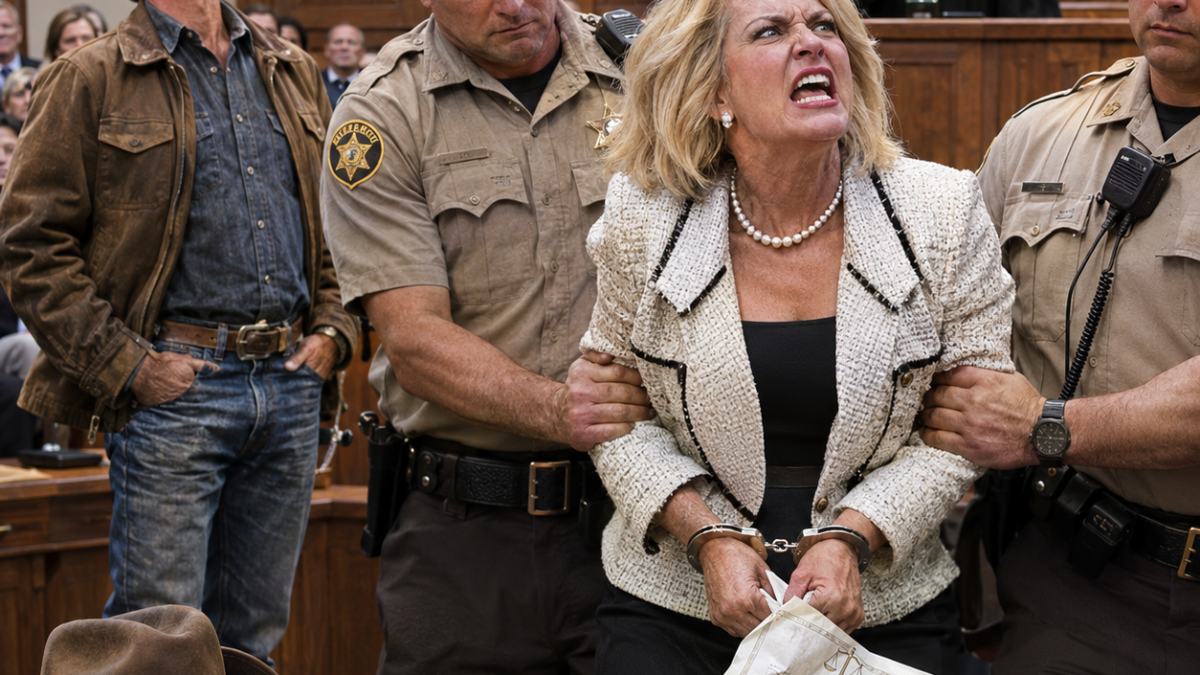
“Remove Mrs. Prescott.”
The officer reached for her arm.
Dalia jerked away.
“Don’t touch me.”
“Ma’am.”
“I said don’t touch me!”
A second officer moved in.
Dalia resisted again.
The first officer controlled one arm.
The second secured the other.
Then came the sound.
Click.
One cuff.
Click.
The other.
The courtroom went silent.
Not movie silent.
Real silent.
The kind where you hear somebody breathe three rows back.
Dalia stared down at the steel around her wrists.
For once, she had nothing to say.
Four days earlier, she stood at my gate promising I would be dragged off my own land.
Now court officers were leading her toward the side door.
Her attorney stared down at the table.
Not one Cedar Ridge board member stood up.
Judge Ellsworth directed the clerk to create a full record of Dalia’s disruption and refusal to obey courtroom orders for contempt proceedings.
Then something else happened.
Investigator Conrad Finley stepped forward.
He had been waiting.
Not with HOA paper.
Not with a color printout.
With an actual properly issued warrant arising from the separate criminal investigation.
The judge did not declare Dalia guilty of forgery that morning.
That mattered.
Her criminal case had its own process.
But investigators had developed enough evidence for lawful action.
The contrast was almost unbearable.
Dalia had invaded my ranch with counterfeit authority.
Now real authority was moving carefully, document by document, exactly the way she had pretended hers worked.
After she was removed, the hearing continued.
Judge Ellsworth looked around the courtroom.
“Property disputes are decided through lawful process.”
Nobody moved.
“They are not resolved by manufacturing authority the court never granted.”
Then she turned toward Tessa.
“The restraining order remains in effect.”
“Yes, Your Honor.”
“All unauthorized interference with Ironbell Ranch is to cease.”
“Yes.”
“Evidence related to the purported order is preserved.”
“Yes.”
I closed my eyes briefly.
Ironbell was mine.
It had always been mine.
But hearing a judge say Cedar Ridge had no legal basis to take it felt like getting oxygen back.
In the gallery, Celeste whispered something to another board member.
I later learned what.
“Did we just use HOA money to hire people to enforce a fake court order?”
The other board member had no answer.
Warren Pike left the courtroom before the hearing ended.
His company’s legal department called Tessa outside.
The $6.2 million development deal was terminated.
No proof of lawful land control.
No project.
Tessa looked at me.
“She lost it.”
“The project?”
“Yes.”
“The fee?”
“No closing. No success fee.”
Four hundred eighty thousand dollars.
Gone.
Not taken from Dalia.
Never earned.
That distinction mattered too.
She had been willing to risk everything for money that would now never exist.
Then Celeste called.
“Emergency HOA meeting.”
“When?”
“Tonight.”
“About what?”
She almost laughed.
“Removing Dalia.”
I drove home.
For the first time since Monday, the road to Ironbell felt like mine.
The HOA control signs came down.
One by one.
Contractors removed equipment under supervision.
No revenge.
No damaged trucks.
No threats.
Everything documented.
Travis and I walked the east pasture.
Cattle back out.
Two calves fine.
Fence bent in places.
Gate destroyed.
Dirt torn up.
Nothing compared with losing the ranch.
Travis stopped beside the old office.
“Well?”
“Well what?”
“You won.”
I looked at him.
“Didn’t feel like winning.”
“What does it feel like?”
“Getting my own keys back.”
He laughed.
We put a new lock on the gate.
Heavy.
Probably overkill.
I did not care.
The ranch staff finalized damages.
Tessa reviewed every line.
Around $143,700 in documented losses and response costs.
Gate.
Access controls.
Fence repairs.
Labor.
Feed disruptions.
Veterinary checks.
Site restoration.
Legal and operational expenses where recoverable.
Tessa crossed out anything she considered weak.
“You just deleted twelve thousand dollars.”
“Because you cannot prove twelve thousand.”
“I lived through it.”
“Judges don’t reimburse emotional irritation by the hour.”
“That seems unfair.”
“Welcome to law.”
I laughed.
She was right.
I did not want a revenge number.
I wanted a number I could defend under oath.
That evening, Cedar Ridge homeowners filled their clubhouse.
No one invited me.
Good.
It was their problem now.
Celeste laid out the records.
Contractor payments.
Northgate agreement.
Development deadline.
Dalia’s potential fee.
Residents were furious.
A retired couple stood.
“We were told this money was flood protection.”
Another homeowner held up Dalia’s drainage email.
“Were these photos taken after the contractors entered the ranch?”
People started asking whether they had funded the conditions Dalia later called an emergency.
Then the vote.
Eighty-four valid votes.
Seventy-eight to remove her.
Dalia Prescott was no longer president of Cedar Ridge Estates.
The new board ordered an independent audit.
The $163,000 flagged spending went under review.
They formally abandoned any claim to my land based on Dalia’s fabricated documents.
The association’s attorney sent me a letter.
For the first time in years, an HOA letter arrived that did not contain a threat.
Cedar Ridge recognized Ironbell Ranch as outside its boundaries.
No dues.
No architectural control.
No enforcement rights.
No claim of possession.
No access to the 52-acre corridor without a lawful agreement.
I filed the letter.
Not because I needed permission to own my ranch.
Because after what happened, paperwork mattered.
The criminal investigation continued.
Slowly.
Properly.
People in town wanted daily updates.
I did not.
The evidence was bigger than one hearing.
Origin of the forged file.
Email chains.
Financial motive.
Contractor instructions.
False handover forms.
Attempted land control.
Use of HOA funds.
Each piece needed proof.
Dalia had lawyers.
As she should.
Even someone who abuses process deserves process.
That belief surprised some people.
One rancher I knew said:
“After what she did, you really care about her rights?”
“Yes.”
“Why?”
“Because this whole thing started when she decided rules only mattered for people she liked.”
He looked at me.
“Fair.”
I meant it.
If the lesson was that fake authority is dangerous, the solution could not be more fake authority.
Weeks passed.
Ironbell returned to routine.
That was healing.
Cattle moved.
Feed trucks used the east road again.
Fence repaired.
Grass gradually covered machinery scars.
One afternoon, Travis and I replaced a section of damaged gate hardware.
He held the post while I tightened bolts.
“You know what I keep thinking about?”
“What?”
“The guards.”
“What about them?”
“They really believed her.”
“Most did.”
“They cut a ranch lock because she showed them paper.”
“Yes.”
“That bothers me.”
“Me too.”
“What would you have done if Conrad hadn’t checked?”
I stopped working.
That question had lived in my head.
“I don’t know.”
“You’d have fought?”
“Eventually.”
“Physically?”
“No.”
“Then what?”
“Court. Sheriff. State. News. Whatever lawful route was left.”
Travis nodded.
“She almost pulled it off.”
“For a morning.”
“Long enough.”
Yes.
Long enough to move cattle.
Break gates.
Disrupt feed.
Scare employees.
Create documents.
That is the danger of forged authority.
It does not have to survive forever.
It only has to survive long enough for people to act on it.
That was what made Dalia’s scheme worse than ordinary trespass.
She used the appearance of law to turn other people into tools.
Guards thought they were protecting a court order.
Contractors thought they were executing a lawful project.
Homeowners thought their dues funded flood safety.
Developers thought Cedar Ridge might control the land.
Everyone got a different lie.
Dalia stood in the middle.
Months later, Rhett came to the ranch.
He called first.
I appreciated that.
I met him at the gate.
He looked uncomfortable.
“I wanted to apologize.”
“For which part?”
“Fair.”
He looked at the new lock.
“I should have verified.”
“Yes.”
“I had a document.”
“A fake document.”
“I know.”
“Didn’t know then.”
“You brought bolt cutters.”
He looked away.
“That’s the part I can’t defend.”
I waited.
“We were told the owner would resist a lawful order.”
“Did you ever ask why the sheriff wasn’t enforcing it?”
He said nothing.
“That should have bothered you.”
“It does now.”
“Good.”
He looked toward the ranch.
“I nearly lost my company.”
“You almost helped take my ranch.”
“I know.”
That answer mattered.
No excuse.
I asked:
“Why did you cooperate?”
“At first?”
“Yes.”
“To save myself.”
“Fair.”
He looked surprised.
“Later, because I saw the real order.”
He shook his head.
“She told me the signature was real like that made everything okay.”
“Did you believe her?”
“For about ten seconds.”
He laughed without humor.
“Then I realized she knew exactly what had been copied.”
We stood quietly.
I finally said:
“Learn from it.”
“I have.”
“How?”
“My crews do not execute access-control orders anymore without direct verification through counsel or issuing authority.”
“That sounds expensive.”
“Cheaper than this.”
I nodded.
He left.
I never became his friend.
Didn’t need to.
Accountability does not require permanent hatred.
Celeste stayed on the new board temporarily.
She refused the presidency.
When someone nominated her, she reportedly said:
“I’ve had enough of presidents for a while.”
I liked her.
She helped the independent audit.
The audit showed what happens when one person controls narrative faster than others check records.
Some payments were legitimate planning costs.
Some were poorly authorized.
Some demanded deeper investigation.
Not every suspicious dollar became a proven crime.
Again, that mattered.
We did not need to inflate anything.
The proven facts were already bad enough.
Dalia’s private success fee was real.
The development condition was real.
The fake order was real.
Her distribution of it was real.
Her instructions were real.
Her knowledge of the genuine order was real.
Her courtroom conduct was certainly real.
I was there.
Ironbell’s civil case moved separately.
The association’s new board had a choice.
Fight me.
Or acknowledge damage caused under prior leadership.
They chose negotiation.
Good.
We documented restoration.
Access.
Animal disruption.
Operational loss.
Gate damage.
Some claims were disputed.
We argued.
Tessa enjoyed that far more than any reasonable human should.
Eventually, responsible parties paid amounts determined through settlement and proper proceedings.
I did not buy a new truck.
Did not build some ridiculous gatehouse.
The money repaired damage.
Restored operations.
Covered costs.
That was what compensation was for.
The 52 acres stayed exactly where they had always been.
Part of Ironbell Ranch.
No subdivision road.
No decorative entrance.
No Cedar Ridge sign.
Grass.
Cattle.
Water.
Farm road.
The things Dalia called “underutilized land” were the things that made the ranch function.
One spring morning, Warren Pike came to see me.
Developer.
The man behind the $6.2 million project.
He had watched the courtroom disaster.
I almost declined.
Then curiosity won.
He arrived alone.
No lawyers.
We sat outside the ranch office.
“I owe you an apology.”
“You never entered my land.”
“No.”
“Then why?”
“My company relied too heavily on representations from Cedar Ridge.”
“That’s your problem, not mine.”
“Yes.”
I liked that answer.
He continued.
“We required lawful control as a closing condition.”
“I saw that.”
“We should have demanded proof earlier.”
“Probably.”
He smiled slightly.
“I understand why you didn’t sell.”
“Do you?”
“I’ve seen the ranch road.”
“That’s part of it.”
“Water?”
“Part.”
“Operations?”
“Yes.”
He looked across the pasture.
“We saw fifty-two acres on a project map.”
“There’s the problem.”
He nodded.
“To us, it was a corridor.”
“To me, it was ranch.”
He looked embarrassed.
“That’s fair.”
Then he said something unexpected.
“We will not pursue Cedar Ridge West.”
“I know.”
“Even if the association someday acquires another route.”
“That’s your decision.”
“The project became toxic.”
I almost laughed at the word.
Not because it was funny.
Because Dalia had spent months calling my ranch a problem.
In the end, her own scheme became the thing no developer wanted near.
Warren left.
No handshake deal.
No future promises.
Just closure.
Dalia’s criminal proceedings eventually moved forward.
Forgery-related conduct.
Fraud.
Use of the altered judicial document.
Other allegations prosecutors believed they could prove.
I did not attend every hearing.
I attended enough.
Courtrooms are less satisfying than stories.
Lots of waiting.
Scheduling.
Arguments about evidence.
Motions.
Continuances.
No dramatic music.
That is probably a good thing.
Justice should not need entertainment.
What mattered to me was that the fake order was no longer a question.
It had been established that Judge Ellsworth’s court did not issue it.
Electronic records showed how it related to the genuine order.
Witnesses described how it was distributed and used.
Emails documented Dalia’s role in the “final version.”
Financial records showed motive.
The process took time.
Dalia eventually faced the consequences the law supported.
I did not need to embellish them.
She had already lost the thing she valued most before any final judgment.
Control.
No presidency.
No development deal.
No private success fee.
No contractors waiting for instructions.
No HOA office from which she could issue notices.
No audience applauding when she said one ranch should not stand in the way of progress.
She became what she had always refused to be.
One person subject to the same rules as everyone else.
That may have been the hardest punishment for her.
One day, months after the hearing, I received a letter.
Not from Dalia.
From a Cedar Ridge homeowner named Eleanor.
I had never met her.
She wrote:
**Mr. Barlo, I voted for Mrs. Prescott because she told us your ranch was causing flooding and blocking emergency improvements. I repeated some of those claims to neighbors. I now understand I was wrong. I am sorry.**
I read it twice.
Then put it down.
Travis saw it.
“Fan mail?”
“Apology.”
“Frame it.”
“No.”
“Why not?”
“Because she made a mistake and admitted it.”
“Still.”
I wrote back.
Short.
**Thank you for saying so. I hope Cedar Ridge does better going forward.**
That was it.
People make mistakes.
Communities make mistakes.
The dangerous part is when pride makes correction impossible.
Dalia could have stopped long before the fake order.
She could have accepted my first no.
Could have chosen another route.
Could have negotiated honestly.
Could have gone to court and lost.
Could have waited for the case to proceed.
Could have abandoned the $480,000 fee.
Could have told Warren the land was not controlled.
At every step, there was an exit.
She kept choosing escalation.
First:
HOA letters.
Then fines.
Then fake lien language.
Unauthorized surveyors.
Stakes.
Trespass.
Drainage accusations.
Contractors.
Private guards.
A fake judicial order.
Each move required the next one because the previous lie had not produced what she wanted.
That is how people end up doing something insane.
Rarely one giant leap.
Usually a staircase.
One step at a time.
The fake order became the final step she could not explain away.
And the irony was perfect.
The real order already existed.
It protected me.
She could not tolerate that.
So someone turned protection into permission.
Kept the judge’s signature.
Changed the decision.
She thought the signature was the power.
It was not.
The court was the power.
Process was the power.
Record was the power.
The signature only meant something because it represented an actual judicial decision.
Detached from that decision, it was ink.
That lesson stayed with me.
I had a copy of Dalia’s fake order in my case file.
Sometimes I looked at it.
If you did not know better, it looked completely legitimate.
That bothered me.
Correct font.
Case number.
Seal.
Caption.
Signature.
Legal language.
The lie did not look sloppy.
That is why Conrad verifying it mattered.
Authority should be verifiable.
Not merely convincing.
After the case, I changed Ironbell’s own procedures.
Any outsider claiming court authority?
Call counsel.
Verify through issuing agency.
No employee surrenders access based solely on a paper presented at the gate.
No physical resistance unless safety requires it.
Record everything.
Travis joked:
“New ranch policy. Assume everyone with a briefcase is dangerous.”
“Especially lawyers.”
Tessa heard about that.
She sent me an invoice with:
**Briefcase Hazard Consultation — $500**
I called her.
“You’re not funny.”
“I’m hilarious.”
I kept the invoice.
Never paid the joke line.
She tried.
Ironbell healed faster than I did.
Grass came back.
Cattle forgot strangers had crowded them into pens.
New gate hardware replaced the broken lock.
Supply deliveries normalized.
Workers stopped checking the road whenever a black SUV appeared.
I did not.
For months, every black SUV made my shoulders tighten.
That irritated me.
I had spent nineteen years feeling safe on my own land.
Dalia changed that in one morning.
One fake piece of paper.
It took time to get that feeling back.
One evening, I sat on the porch after sunset.
Travis came by.
Two beers.
He handed me one.
We looked toward Cedar Ridge lights on the hill.
“You ever hate them?”
“Who?”
“All of them.”
“No.”
“Really?”
“Sometimes.”
He laughed.
“Honest.”
“Most homeowners didn’t know.”
“They funded it.”
“They paid dues.”
“Same thing?”
“No.”
I took a drink.
“Dalia used the community as cover.”
Travis nodded.
“She kept saying everything was for them.”
“Exactly.”
“If I hate all of them, I’m helping her keep using them.”
He thought about that.
“You’ve gotten philosophical since someone tried stealing your ranch.”
“I was always philosophical.”
“No. You were annoying.”
“Still am.”
We laughed.
Cattle moved somewhere in the darkness.
Normal sound.
Good sound.
The new Cedar Ridge board eventually invited me to speak.
I declined.
Then Celeste asked personally.
“Five minutes.”
“No.”
“Three.”
“No.”
“Two.”
“This sounds familiar.”
She laughed.
“Fine. Just attend.”
I did.
The clubhouse was packed.
Residents approved reforms.
Independent legal verification before major land agreements.
Board approval for external enforcement actions.
Conflict-of-interest disclosures.
No private success fees connected to HOA projects without full disclosure.
Audit rights.
Document retention.
Restrictions on unilateral contractor spending.
Then Celeste stood.
“There is one more item.”
She looked toward me.
“Formal acknowledgement that Ironbell Ranch has never been part of Cedar Ridge Estates.”
A vote.
Unanimous.
I almost laughed.
The HOA had no power to make my ranch “not part” of Cedar Ridge.
It already wasn’t.
But symbolically?
It mattered.
Afterward, one homeowner approached.
Young guy.
Maybe thirty.
“I was one of the people who applauded when Dalia said one ranch couldn’t block progress.”
“I remember that meeting.”
His face reddened.
“You were there?”
“Back row.”
He nodded.
“I’m sorry.”
“Thank you.”
“I still think development is good.”
“So do I.”
He looked surprised.
“You do?”
“When it’s lawful.”
He smiled.
“Fair.”
“You want progress? Buy the land you need.”
He laughed.
“That simple?”
“Usually.”
That became one of the best outcomes.
People learned disagreement was not war.
I could oppose a road across my ranch without opposing every Cedar Ridge homeowner.
They could want new homes without being entitled to my acreage.
That is what property rights do.
They create a clear line.
Negotiation can happen across it.
Dalia’s problem was believing a line only mattered if she liked where it was.
The 52 acres became more important to me after the fight.
Not financially.
Emotionally.
My father had helped me fence part of that ground when I first bought Ironbell.
He had been gone years.
I remembered him complaining about the rocky soil.
One afternoon after everything settled, I rode out to the old farm road.
Stopped where Cedar Ridge’s proposed entrance would have cut through.
I could almost see their rendering.
Paved road.
Stone sign.
Landscaping.
Luxury homes beyond.
It probably would have looked nice.
But it would not have been Ironbell.
I got off the ATV.
Walked to the creek.
Sat.
For the first time, I allowed myself to think about what almost happened.
If I had panicked at the gate.
If Conrad had trusted the paper.
If Tessa had not recognized the case number.
If Felicity had not checked the docket.
If Rhett had destroyed his emails.
If Celeste had stayed afraid.
If Judge Ellsworth had not been available quickly.
How long could Dalia have maintained control?
A day?
A week?
Long enough to sign something?
Long enough to satisfy Warren’s Friday deadline?
Long enough for another layer of documents to make the fraud harder to unwind?
I would still have won eventually.
I believe that.
The deed was real.
But “eventually” can be expensive.
That was the danger.
Dalia’s plan did not require permanently stealing 612 acres in one morning.
It needed temporary control of fifty-two acres long enough to close a deal.
That realization made the motive even uglier.
The entire ranch takeover was theater.
Overreach designed to create a document trail suggesting Cedar Ridge controlled more than it did.
I sat beside the creek until the sun went low.
Then rode home.
A year after the invasion, I replaced the gate sign.
The old one had survived.
But the paint was faded.
New sign:
**IRONBELL RANCH**
**PRIVATE PROPERTY**
Underneath, smaller:
**COURT ORDERS WILL BE VERIFIED**
Travis laughed so hard he had to sit down.
“You actually put that up?”
“Yes.”
“That is the pettiest thing you’ve ever done.”
“It’s educational.”
“You stole that line from someone.”
“No idea what you’re talking about.”
Tessa photographed the sign.
Sent it to me with:
**Approved. No bill.**
That was generosity.
Years later, people still asked about Dalia being handcuffed.
That became the headline.
The dramatic part.
HOA Karen fakes order.
Real judge sees signature.
Handcuffs.
I understand why.
It was unforgettable.
But when I tell the story, I always make one correction.
Judge Ellsworth did not handcuff Dalia because she had already been found guilty of forgery.
The judge ordered her removed because Dalia disrupted the courtroom, refused direct orders, tried to interfere with evidence, and resisted the officers removing her.
The suspected forgery was separate.
Conrad had a proper warrant from that investigation.
That detail matters.
Because if I tell a story about fake legal authority and then exaggerate real legal authority, I learned nothing.
What happened was strong enough.
No embellishment needed.
The real judge saw a fake order carrying her signature.
Confirmed her court never issued it.
Protected my ranch.
Preserved evidence.
Had Dalia removed when she refused to obey courtroom orders.
Then investigators followed lawful process on the criminal case.
That was justice.
Not instant.
Not cinematic.
Correct.
One winter morning, Judge Ellsworth retired.
I read about it in the newspaper.
There was a photograph of her.
Same expression I remembered.
Serious.
I considered sending a thank-you letter.
Then decided against anything that might seem inappropriate.
Tessa said:
“You can thank a judge after a case ends.”
“Really?”
“Yes.”
So I wrote one.
Not about Dalia.
About process.
**Your Honor, I wanted to thank you for treating the ranch dispute as what it was—a matter to be decided by the law rather than whoever arrived with the most people and the most convincing paper.**
I mailed it.
No request.
No expectation.
A month later, I received a brief response through proper channels.
One sentence stayed with me.
**Courts only work when people trust that an order means what the court actually ordered.**
Exactly.
That was the heart of everything.
Dalia’s crime was not just trespassing.
Not just wanting land.
Not just money.
She attacked trust.
If anyone can take a real signature and attach it to whatever command they want, then every legitimate order becomes suspicious.
She had used the court’s credibility as a weapon.
That was why Judge Ellsworth reacted so strongly.
Dalia thought she was borrowing power.
She was counterfeiting it.
Cedar Ridge eventually found another expansion plan.
Different direction.
Smaller phase.
No Ironbell land.
It cost more.
Construction took longer.
Imagine that.
They survived.
The community did not collapse because one rancher said no.
Property values did not vanish.
Homeowners continued living their lives.
The catastrophe Dalia predicted never came.
Her whole argument had been built on urgency.
We need your land now.
The community needs it.
There is no alternative.
You are blocking progress.
Those sentences sound powerful until somebody actually searches for alternatives.
There almost always are.
Dalia did not want an alternative.
She wanted my land because the route was cheaper and her success fee depended on it.
That is different.
One afternoon, the new Cedar Ridge president called.
“We’re starting roadwork near your boundary.”
“Okay.”
“I’m sending the survey and contractor contact.”
“Good.”
“We won’t enter Ironbell.”
“Even better.”
“Do you want a site meeting?”
“Yes.”
We met.
Survey stakes.
Clear maps.
No drama.
Contractor asked permission to temporarily park one truck near my gate for thirty minutes.
I said yes.
Written note.
Done.
I drove home laughing.
That simple interaction would have been impossible under Dalia.
Respect makes complicated things simple.
Entitlement makes simple things complicated.
I kept one photograph from that original Monday.
The takeover notice on my office.
Not the handcuffs.
Not Dalia in court.
The paper:
**PROPERTY UNDER HOA COURT-ORDERED CONTROL**
I kept it in a drawer.
Sometimes I showed it to ranch employees during training.
“Does this look official?”
“Yes.”
“Would you obey it?”
They hesitated.
Good.
Then I would say:
“Verify.”
That became Ironbell policy.
Not cynicism.
Verification.
The same reason we check a cattle gate even when somebody says it is closed.
Because trust is good.
Checking is better.
One spring, a young employee named Nate asked:
“What if it’s really a court order and we slow things down by checking?”
“Then the issuing authority will verify it.”
“What if they get mad?”
“Real authority survives verification.”
He nodded.
That was another lesson Dalia gave me accidentally.
Legitimate power does not fear being checked.
People with legitimate orders can tell you where they were filed.
Legitimate surveyors can show records.
Legitimate contractors can show authorization.
Legitimate law enforcement can identify themselves.
It is counterfeit authority that needs speed.
Pressure.
Confusion.
Thirty-minute deadlines.
Threats.
“Obey now, argue later.”
That is what Dalia used.
Urgency was part of the scam.
The morning she arrived, she wanted me overwhelmed.
Cattle moving.
Guards blocking roads.
Workers cutting locks.
Papers taped everywhere.
She wanted the scene itself to convince me resistance was hopeless.
For a few minutes, it almost did.
Then I saw the case number.
One small detail.
That was enough.
People often ask why I remembered it.
Simple.
When someone is trying to take your land, you remember the number on the lawsuit.
Tessa teased me later.
“You can’t remember where you left your truck keys, but you memorized twelve digits.”
“Priorities.”
She laughed.
By the second anniversary, Ironbell looked exactly like Ironbell again.
Fence repaired.
Gate straight.
Grass over the disturbed ditch.
No HOA signs.
No contractor barriers.
The east pasture full.
I stood at the gate one morning.
Travis came up beside me.
“Two years.”
“What?”
“Since invasion day.”
“I didn’t know we were celebrating.”
“I brought donuts.”
“That changes things.”
We sat on the tailgate.
A cow bellowed.
Travis said:
“Ever think about selling now?”
“No.”
“Even after all this?”
“Especially after.”
“Why?”
I looked across the ranch.
“Because leaving would make her decision part of why I lost it.”
He nodded.
“You’re stubborn.”
“Yes.”
“Think that’s why she hated you?”
“Probably.”
We ate donuts.
No speeches.
That was enough.
The financial aftermath at Cedar Ridge lasted longer.
Audits.
Insurance questions.
Legal fees.
Homeowner anger.
The new board worked through it.
Some people moved.
Most stayed.
Celeste eventually resigned.
On her last day, she sent me an email.
**I used to think the treasurer’s job was paying bills. Turns out sometimes it’s asking why there is a bill at all.**
I replied:
**That sounds expensive to learn.**
She responded:
**Very.**
She deserved peace too.
Dalia had threatened to pin the payments on her.
Celeste chose truth before that happened.
That took courage.
Not perfect courage.
She did not act on day one.
Neither did Rhett.
Neither did some board members.
But they acted before the end.
I have learned not to demand that everyone be heroic immediately.
Sometimes people need time to understand what they are part of.
What matters is what they do once they know.
Dalia knew.
Then kept going.
That was the difference.
A few years later, a reporter contacted me for a story about fraudulent legal documents in property disputes.
He asked:
“What was your first emotion when Dalia was taken out in handcuffs?”
I said:
“Relief.”
“Not satisfaction?”
“Some.”
“Vindication?”
“Sure.”
“Revenge?”
“No.”
He looked disappointed.
“Why not?”
“Because I didn’t put the handcuffs on her.”
“But you brought the evidence.”
“I protected my ranch.”
“Same thing?”
“No.”
I leaned forward.
“Revenge would mean I wanted her hurt because she hurt me. I wanted her stopped.”
He wrote that down.
Then asked:
“What was the most satisfying moment?”
I thought he expected the handcuffs.
It wasn’t.
“The cattle going back into the east pasture.”
He stopped writing.
“Really?”
“Yes.”
“Why?”
“Because that meant the ranch was functioning again.”
He smiled.
“That’s not a very viral answer.”
“I own cattle. We’re not known for entertainment.”
He laughed.
The article still used the handcuffs in the headline.
Of course.
I did not mind.
Years soften anger.
They also sharpen certain memories.
I remember the bolt cutters.
The first metallic snap.
The moment my lock hit the ground.
I remember Dalia telling me:
**Today, the judge has already decided.**
That sentence used to make me angry.
Now it almost makes me laugh.
The judge had decided.
Dalia just hated the decision.
The genuine order told her to stay out.
Instead of respecting it, she tried to rewrite reality.
That is what she did in every part of her life.
My ranch was “community expansion.”
My refusal was “obstruction.”
Her private fee was “planning.”
Trespass was “emergency management.”
Contractors were “court enforcement.”
A forgery was a “court order.”
Everything got a new name until it sounded acceptable.
But names do not change facts.
You can call cattle land a development corridor.
It is still someone’s land.
You can call private security an enforcement team.
They are not deputies.
You can call an invoice a lien.
That does not make it legally valid.
You can call a copied signature judicial authority.
It is still a copied signature.
Eventually, reality catches up.
In Dalia’s case, reality wore a black robe and asked:
**Who turned my no-trespass order into a seizure order?**
I sometimes wonder what went through Dalia’s mind at that exact moment.
She had probably rehearsed explanations.
Processing service.
Clerical error.
Emergency authority.
Contractor misunderstanding.
But no rehearsal prepares you for the person whose signature you copied holding the paper in her own hand.
That was the one audience Dalia could not bully.
She had intimidated homeowners.
Contractors.
Employees.
Even board members.
She was used to people assuming confidence meant knowledge.
Judge Ellsworth did not.
She had the official docket.
The genuine order.
The authority Dalia had tried to imitate.
There was nowhere to hide.
That was the climax everyone remembers.
But I remember what happened afterward too.
I drove home.
Parked.
Opened the ranch gate myself.
That simple act nearly got me.
My own hand on my own gate.
No guard asking permission.
No fake order.
I stood there longer than necessary.
Travis drove up.
“You opening it or marrying it?”
I laughed.
“Shut up.”
“You’ve been staring at that lock for five minutes.”
“It’s a good lock.”
“It’s a lock.”
“Best lock I ever bought.”
He shook his head.
We drove in.
Cattle grazed.
The sun went down.
For the first time all week, I slept through the night.
That is how I measure victory now.
Not by how badly the other person loses.
By how fully your normal life comes back.
Ironbell came back.
Cedar Ridge found new leadership.
The fake order became evidence instead of authority.
The development deal died.
The private fee disappeared.
The audited money was traced.
My documented damages went through lawful claims.
And the woman who once stood at my gate saying I had thirty minutes to leave eventually learned what an actual court order feels like when you refuse to obey it.
The difference was simple.
Her paper demanded compliance because she wanted it to.
The real court demanded compliance because lawful authority, procedure, record, and accountability all stood behind it.
That difference saved my ranch.
One evening, long after the last major hearing, I walked out to the 52 acres Dalia wanted most.
The grass was high.
A few cattle grazed along the creek.
The old farm road curved through the pasture.
No luxury entrance.
No subdivision.
No decorative wall.
I leaned against a fence post my father had set decades earlier.
At some point, I realized I was smiling.
Not because Dalia had lost.
Because the land looked exactly like itself.
People underestimate how beautiful that can be.
Nothing new.
Nothing grand.
Nothing worth putting in a development brochure.
Just land doing what land had always done.
I thought about that $480,000 fee.
Imagine risking freedom, reputation, leadership, money, and the trust of an entire community for a payment tied to land you did not own.
Then imagine telling yourself you were doing it for everyone else.
That was Dalia’s tragedy.
She lied to so many people that eventually she may have started lying to herself.
The community needs this.
The ranch is dangerous.
The court supports us.
The project is inevitable.
Griffin will surrender.
Each lie made the next one easier.
Until she stood in front of the one person who knew beyond doubt that the final lie was impossible.
The real judge.
I went home as sunset turned the pasture orange.
At the gate, the sign was still there.
**IRONBELL RANCH**
**PRIVATE PROPERTY**
**COURT ORDERS WILL BE VERIFIED**
I unlocked it.
Drove through.
Locked it behind me.
Then looked once toward Cedar Ridge.
Their lights were beginning to come on across the hill.
For years, Dalia had acted as if those lights represented something bigger than me.
More homes.
More voters.
More money.
More influence.
Therefore, more rights.
But property rights are not a popularity contest.
Eighty-four homes do not get to vote away one rancher’s deed.
A community’s ambition does not become ownership because enough people applaud.
And a judge’s signature does not become permission simply because someone pastes it beneath different words.
Dalia Prescott learned all three lessons at once.
She arrived at Ironbell with six trucks, private guards, bolt cutters, and a forged order.
She promised I would be removed from my own ranch if I refused to surrender.
I never laid a hand on her.
Never cut her locks.
Never forged her name.
Never sent men to her house.
I saved video.
Called the sheriff.
Called my lawyer.
Checked the court record.
Followed the money.
And waited for the real authority to speak.
When it did, Dalia could not shout over it.
She could not fine it.
She could not threaten it.
She could not rewrite it.
The court officer reached for her arm.
She resisted.
The cuffs closed.
And the woman who believed a copied signature made her untouchable discovered that the law she had tried to imitate was very real after all.
Months later, Travis asked me one final question.
“If you could go back to that Monday morning, knowing everything, what would you do differently?”
I thought about it.
“Nothing.”
“Really?”
“I’d still record.”
“Still let them cut the lock?”
“If stopping them meant starting a fight with ten guards? Yes.”
“Still let them move cattle?”
“I’d hate it.”
“But yes?”
“Yes.”
He shook his head.
“You’re more patient than me.”
“No.”
I looked toward the gate.
“I just learned something before Dalia did.”
“What?”
“Power that has to be faked isn’t power.”
Travis smiled.
“Sounds like something a lawyer told you.”
“No.”
“Tessa?”
“Maybe.”
He laughed.
I did too.
Then we went back to work.
Because that is where this story actually ends.
Not in the courtroom.
Not with handcuffs.
Not with the dead development deal.
Not with the lost success fee.
It ends at Ironbell Ranch.
Cattle in the east pasture.
Feed truck coming through the repaired gate.
Travis complaining about fencing.
Me checking water lines before sunset.
No guards.
No fake notices.
No HOA claiming control.
Just 612 acres that had belonged to me before Dalia’s scheme and still belonged to me after it collapsed.
She tried to counterfeit the court’s authority to take my ranch.
The real court gave me something much simpler.
It confirmed she never had that authority in the first place.
And in the end, that was all I needed.
Dalia had walked onto Ironbell holding a fake order and telling me the judge had already decided who would be forced to leave.
Four days later, the real judge looked at that stolen signature.
Dalia refused to sit down.
Refused to stop shouting.
Refused to keep her hands off the evidence.
Then the court officers stepped forward.
The cuffs clicked shut.
And for once, the person being escorted away was not the landowner she had threatened.
It was her.
I drove home that afternoon.
Opened my own gate.
Looked across my own pasture.
And never again confused a loud claim of authority with the real thing.








