PART 2: HOA Karen Fined Me $12,000 for Smoking Brisket—Then She Learned It Was Feeding the Fire Department
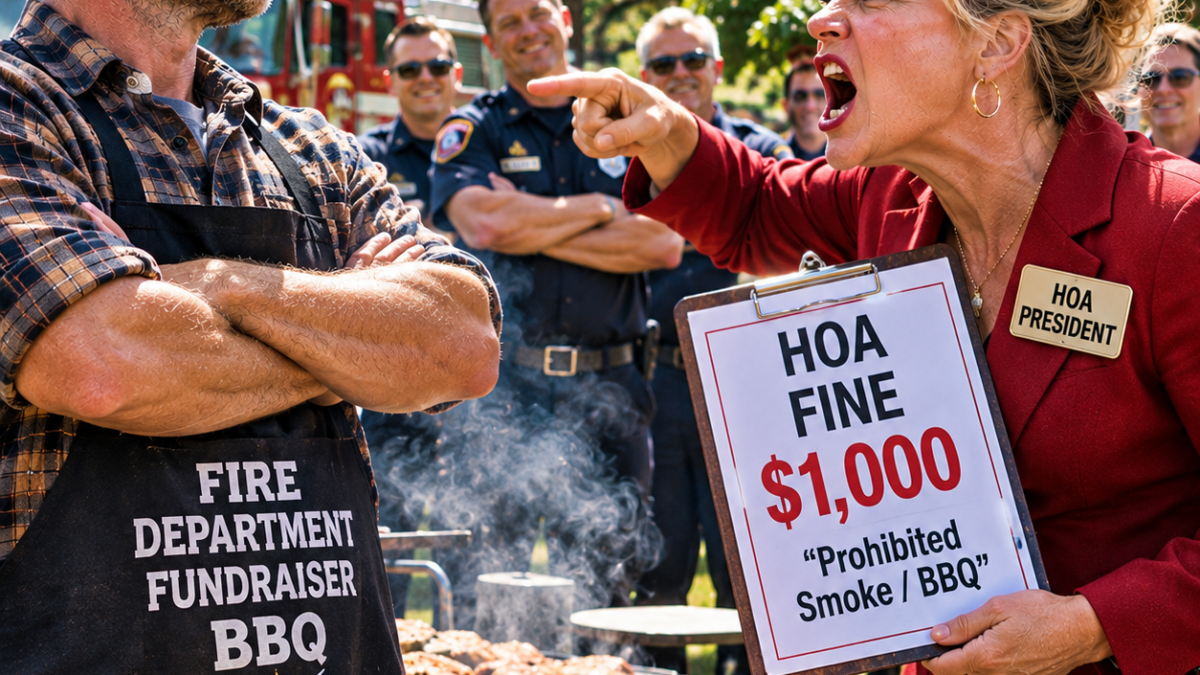
PART 2
Karen left with the expression of a woman who believed she had just won.
That was useful.
People make different choices when they believe the outcome is already decided.
She climbed into her golf cart and drove away, leaving behind the smell of perfume, damp grass, and self-importance.
I stood there for several seconds.
Then Chief Miller called.
“You awake?”
“I’ve been awake all night.”
“How are the briskets?”
“Fine.”
“The cook?”
“Fine.”
“You?”
I looked down the street where Karen had disappeared.
“Ask me tomorrow.”
“That sounds ominous.”
“HOA.”
There was a pause.
“Oh, hell.”
“She fined the smoker.”
Another pause.
Then laughter.
Not polite laughter.
Deep, uncontrollable laughter.
“Chief.”
“I’m sorry.”
“No, you aren’t.”
“No.”
He caught his breath.
“How much?”
“Five hundred.”
“That’s ridiculous.”
“And another five hundred per hour.”
He stopped laughing.
“What?”
“She says it’s a commercial appliance.”
“You’re donating the food.”
“I know.”
“For our fundraiser.”
“I know.”
“We’re a county fire department.”
“I know.”
“Jack.”
“What?”
“I’m trying to decide whether to be angry or impressed.”
“At what?”
“The confidence required to be that wrong before breakfast.”
Despite myself, I smiled.
“Can you send me something in writing?”
“What kind of something?”
“Letter confirming the cook is for the fundraiser. That I’m not being paid. That the meat is for the event.”
“You think you’ll need it?”
“Yes.”
“Give me ten minutes.”
—
I brought the briskets to temperature.
Wrapped.
Adjusted airflow.
Then went inside.
Sarah was at the kitchen table.
She had heard some of it through the window.
“How bad?”
I handed her the notice.
She read it.
Then read it again.
“Five hundred an hour?”
“Apparently.”
“This can’t be enforceable.”
“Probably not.”
“Probably?”
“I haven’t read the clause yet.”
“You’ve read the whole HOA binder.”
“Years ago.”
“You remember everything.”
“I remember enough to know she’s stretching something.”
Sarah looked worried.
“Lien?”
“Threat.”
“Can she?”
“Not lawfully without a valid debt.”
“That isn’t what I asked.”
I sat down.
“No. I don’t think she can get anywhere close if we challenge it properly.”
She exhaled.
“But she wants us scared.”
“Yes.”
That was the part bothering me.
The General could survive being called ugly.
I could survive a fine.
But Karen had put the word **lien** on paper because she knew homeowners reacted emotionally to threats against their houses.
Sarah and I had bought that home with twenty years of sacrifice behind us.
Combat pay.
Teacher salary.
Skipped vacations.
Old cars.
Base housing.
Careful savings.
Our home was not just an asset.
It was the first place that had ever truly felt permanent.
Karen knew exactly what word to use.
—
I pulled out the covenant binder.
Section 7B-4.
**Exterior equipment, temporary structures, and appliances visible from common roadways are subject to reasonable aesthetic and safety standards as determined by the board.**
Vague.
Very vague.
Nothing about smokers.
Nothing about hourly fines.
Nothing about charitable cooking.
Nothing defining “commercial appliance.”
I read the enforcement section.
Fines required notice.
Opportunity to cure.
Appeal rights.
Board review.
Karen had skipped almost all of it.
Interesting.
Then Chief Miller emailed.
Official fire department letterhead.
He confirmed:
I had volunteered for the annual Blackwood County Fire Department fundraiser.
No payment.
No commercial enterprise.
The General was being used temporarily.
The food would be served at the department’s charitable event.
He even added a sentence thanking me for three years of service.
Perfect.
I wrote my response.
No anger.
No sarcasm.
No Marine Corps language.
Just facts.
I cited the temporary nature of the smoker.
The charitable purpose.
The lack of commercial activity.
The appeal process.
I attached Chief Miller’s letter.
Then I mailed it certified.
Return receipt.
Paper trail.
—
Sarah watched me leave for the post office.
“You’re smiling.”
“No.”
“Yes.”
“It’s the weather.”
“You hate hot weather.”
“I’m adapting.”
“You’re planning something.”
“Documentation.”
“That’s what you call planning when you don’t want me to worry.”
I kissed her.
“I’m going to the post office.”
“Jack.”
I stopped.
“Don’t let her turn you into the person you were overseas.”
That landed harder than she intended.
I had brought parts of war home.
Most veterans do.
Not the stories people expect.
Habits.
Scanning exits.
Sleeping lightly.
Thinking three moves ahead when someone else is just having an argument.
Sarah knew that side of me better than anyone.
“This isn’t war.”
“Good.”
“It’s paperwork.”
“That may be worse.”
—
Two days later, the fundraiser began.
The General did exactly what it was designed to do.
Two hundred pounds of brisket.
Bark like dark lacquer.
Perfect smoke ring.
Tender enough to slice clean without falling apart.
The fire station parking lot filled before noon.
Families.
Kids.
Veterans.
Local businesses.
Firefighters in department shirts.
The smell alone could have raised money.
By early afternoon, Chief Miller stood on a folding platform with a microphone.
“We’ve already broken last year’s total.”
Applause.
“Thirty thousand dollars and counting.”
More applause.
“And a lot of that is because this man has apparently decided sleep is optional.”
He pointed toward me.
People laughed.
I shook my head.
“Jack Thorne has donated his time, his smoker, and his sanity for three years running.”
He raised a hand.
“Thank you.”
Applause.
I hated public praise.
Sarah loved watching me hate it.
Then I saw Karen.
Dessert table.
Arms folded.
Watching.
Her smile was gone.
She had come.
Why, I didn’t know.
Maybe to see whether I was actually telling the truth.
Maybe because the whole town attended.
Maybe because she liked being seen.
She caught me looking.
I nodded.
She didn’t.
—
That evening, we returned home exhausted.
Sarah carried containers.
I backed The General into the garage.
Then she stopped at the front door.
“Jack.”
Two papers were taped to it.
Violation notice.
Second notice.
**FAILURE TO COMPLY.**
Fine doubled.
One thousand dollars.
Attached behind it:
My certified appeal packet.
Unopened.
Across the envelope, handwritten:
**REFUSED.**
I stared.
Sarah said:
“She didn’t even read it.”
“No.”
“The fire chief’s letter is inside.”
“Yes.”
“She refused certified mail from a homeowner appealing a fine.”
“Yes.”
“What now?”
I removed everything carefully.
“Scanner.”
She sighed.
“You really are going to war.”
“No.”
I looked at the unopened envelope.
“She is.”
—
I created a folder on my computer.
**OPERATION BRISKET FREEDOM**
Sarah saw it.
“Really?”
“I needed a filename.”
“You’re fifty-three.”
“I’m aware.”
“That is the most Marine thing I’ve seen you do since retirement.”
I scanned:
Original notice.
Second notice.
Certified receipt.
Refused appeal.
Chief’s letter.
Photographs of The General.
Date and time stamps.
Then I started reading the HOA’s rules again.
Not casually.
Line by line.
Something I learned in the Marines:
If a person claims absolute authority from a rulebook, read the rulebook.
Very often, they haven’t.
—
The next morning, I walked Oak Haven.
Three miles.
Slowly.
Karen’s home sat near the community pool.
Beautiful property.
Perfect lawn.
Except:
Gnomes.
A lot of them.
Section 4A allowed one decorative seasonal lawn item.
Karen had eleven ceramic gnomes.
One fishing.
One sleeping.
One mooning the sidewalk.
That last one seemed metaphorically appropriate.
Photograph.
Her mailbox:
Bass-shaped.
HOA standard required plain black.
Photograph.
Fence:
Six inches above stated maximum.
Photograph.
Decorative wagon planter:
Not approved.
Photograph.
Solar flamingos:
Not even close.
Photograph.
I didn’t intend to file complaints.
Not yet.
The point wasn’t to become Karen.
The point was evidence.
If the rules existed only for people she disliked, that mattered.
Selective enforcement weakens authority.
Hypocrisy becomes evidence when documented.
—
One week after the fundraiser, the HOA’s attorney sent a certified letter.
I opened it at the kitchen table.
Sarah watched my face.
“How much?”
“Twelve thousand and change.”
“What?”
Karen had apparently continued calculating fines while The General was in my driveway.
Even after it had been rolled back into the garage.
The legal letter demanded payment.
Threatened lien proceedings.
Attorney fees.
Collection costs.
Possibly foreclosure if the lien remained unpaid.
Sarah went pale.
I hated that.
Karen would never see this moment.
She would never know how one threatening letter could change the temperature inside a home.
Sarah said:
“Can they really—”
“No.”
I interrupted too quickly.
She noticed.
“Jack.”
“No. Not if we fight it.”
“That sounds different.”
“It is.”
“How much will fighting cost?”
“I don’t know.”
That was the first answer that genuinely scared both of us.
—
I called Dave Martinez.
Former platoon sergeant.
After retirement, forensic accountant.
One of the smartest men I knew and one of the few who could insult me continuously for three hours while still feeling supportive.
“Thorne.”
“Martinez.”
“You dead?”
“Not yet.”
“Need money?”
“No.”
“Body buried?”
“No.”
“Then why are you calling?”
“HOA.”
He laughed.
“Never mind. Body would be easier.”
I explained.
Smoker.
Fundraiser.
Fines.
Lien threat.
Karen.
When I finished:
“Twelve grand?”
“Yes.”
“For brisket?”
“Yes.”
“Good brisket?”
“Obviously.”
“Then she’s a criminal.”
“That is not how accounting works.”
“Should be.”
I sent him publicly available HOA budgets, annual disclosures, minutes, expense summaries.
“See anything strange.”
“Define strange.”
“Anything you wouldn’t sign your name to.”
“That may be a lot.”
“Good.”
—
While Dave dug into numbers, I started talking to neighbors.
Carefully.
Not campaigning.
Listening.
Mrs. Gable first.
Widow.
Rose garden.
Soft voice.
Still kept a photograph of her late husband George in Navy uniform near the front window.
I noticed something missing.
“Didn’t you used to have a bird feeder?”
Her shears stopped.
“How do you know?”
“I remember seeing one.”
She looked toward the street.
“Karen made me remove it.”
“Why?”
“Rodents of the sky.”
I thought I had misheard.
“What?”
“That’s what she called birds.”
“Seriously?”
“She said the feeder attracted pests.”
“What kind?”
“Cardinals, mostly.”
Her voice trembled.
“My husband loved cardinals.”
I waited.
“After he died, I kept feeding them.”
She looked at the empty hook.
“Karen fined me two hundred dollars.”
“Did you appeal?”
“I can’t afford lawyers.”
“You shouldn’t need one.”
Mrs. Gable gave me a tired smile.
“That’s not how things work here.”
—
Then Mark Henderson.
Two sons.
Empty driveway where I remembered a basketball hoop.
Karen had sent weekly violations.
Aesthetic impact.
Eventually he sold it.
“Told the boys it broke.”
His jaw tightened.
“My oldest saved six months for it.”
“Why not fight?”
Mark glanced toward the street.
“You’re finding out.”
Yes.
I was.
—
Vegetable garden.
Swing set.
Driveway pressure washing.
Trash cans.
Decorative flags.
Children’s toys.
Different houses.
Same signature.
Karen Miller.
It was never one catastrophic abuse.
It was a thousand small ones.
That was why people tolerated it.
Each individual fight cost more energy than compliance.
Karen understood that.
Maybe instinctively.
—
Then Dave emailed.
Subject:
**BINGO**
I opened the spreadsheet.
Prestige Lawn Care.
Large payments.
No clear competitive bidding.
Rates substantially above comparison estimates.
Owner:
Harold Miller.
Karen’s brother-in-law.
Then consulting fees.
A small company with vague services.
Registered through a business address tied to Karen’s maiden family name.
I called Dave.
“Tell me I’m reading this wrong.”
“You’re reading it right.”
“Could it be legitimate?”
“Possible.”
“But?”
“But nobody disclosed the relationship in the minutes I reviewed.”
“What else?”
“Reserve fund movement I don’t like.”
“How much?”
“Enough that I’d want source documentation.”
“This is fraud?”
“I did not say fraud.”
“Good.”
“I said it smells terrible.”
“Better.”
“You need counsel.”
“I know.”
—
Captain Ava Rostova.
Retired JAG.
Property and HOA litigation.
Her parents had once nearly lost their home in a corrupt association dispute.
That gave her professional interest a personal edge.
I told her everything.
She was quiet for a long time.
Then:
“Jack.”
“Yes?”
“Your smoker may be the least interesting part.”
“Unfortunately.”
She reviewed the $12,000 lien threat.
The refused appeal.
Selective enforcement photos.
Mrs. Gable.
Hendersons.
Dave’s preliminary financial analysis.
“This lien threat is challengeable.”
“Good.”
“The fine process appears defective.”
“Better.”
“The selective enforcement material is useful.”
“Good.”
“And this financial issue…”
She tapped Dave’s spreadsheet.
“Could become very serious if the underlying records confirm it.”
“What do we do?”
“Two battles.”
Of course.
Military lawyers never retire spiritually.
“Legal defense first. I answer the lien threat.”
“And second?”
“We remove Karen.”
I stared.
“From office?”
“Yes.”
“How?”
“Her bylaws.”
She pulled the binder toward her.
“Let’s see whether your queen remembered to outlaw democracy.”
—
Article 12, Section 4.
Special meeting.
Twenty-five percent petition threshold.
Removal for cause by majority of homeowners present.
Ava smiled.
“There.”
“So we need signatures.”
“Yes.”
“How many?”
“Quarter of the membership to force the meeting.”
“That’s a lot.”
“Do people like her?”
“No.”
“Then it’s not.”
—
Mark Henderson joined me first.
Door to door.
Mrs. Gable signed first.
Her hand shook.
She stared at George’s photograph before putting pen to paper.
“He would have fought.”
“You don’t have to do this for him.”
“I know.”
She signed.
“I’m doing it for me.”
That mattered.
Then vegetable-garden couple.
Retired teacher.
Swing-set family.
More.
Some doors closed.
Fair.
Fear had trained people.
But twice as many opened.
Forty percent signed within a week.
Karen heard about it.
Of course.
Her response was spectacularly stupid.
New violations.
Mark’s grass:
Quarter inch too long.
Mrs. Gable:
Unapproved mulch.
One petition signer:
Trash bin visibility.
Another:
Decorative wreath.
Retaliation so obvious it practically came with a label.
Ava added everything to the file.
“Keep them coming.”
“That sounds unethical.”
“Not your notices. Hers.”
“Oh.”
—
The special meeting was scheduled.
Then Karen posted another event.
Same day.
Same time window as the fire department’s next fundraiser planning barbecue.
**MANDATORY COMMUNITY STANDARDS AND BEAUTIFICATION SUMMIT**
Chief Miller called.
“Is this woman challenging brisket to a duel?”
“Apparently.”
“Does she know brisket always wins?”
“History supports you.”
He laughed.
Then his tone changed.
“Jack, this isn’t funny anymore.”
“I know.”
“She’s targeting the department now.”
“Indirectly.”
“She’s targeting what it represents.”
“Yes.”
“Want help?”
I smiled.
“Actually.”
—
We upgraded the barbecue.
City permit.
Public park approval.
Fire department co-sponsorship.
Band.
Bouncy castle.
Food.
The General.
Ava reviewed every permit.
Every clause.
Every insurance requirement.
For once, Karen would not have a technical opening.
She approved use of the park because denying the fire department would look terrible.
But attached conditions.
Noise limits.
Cleanup.
Inspection.
Ava smiled.
“Excellent.”
“What?”
“She just officially approved your event.”
—
The day came.
The General started at four in the morning.
This time the city permit sat visibly inside my garage window.
Karen drove past around seven.
Slow.
Looked at smoker.
Looked at permit.
I waved.
She accelerated.
Petty satisfaction is still satisfaction.
—
By five, the park was packed.
Kids jumping.
Band playing.
Fire engine parked nearby.
Chief Miller letting children climb into the cab.
Smoke drifting.
Brisket disappearing faster than I could slice.
Neighbors laughing.
Talking.
Meeting one another like humans instead of adjacent property owners.
Across the street, Karen’s beautification summit had almost nobody.
A few loyalists.
Empty chairs.
At six-thirty, she came for us.
Clipboard.
Two board members.
She marched through the crowd.
“Mr. Thorne!”
Music softened.
People turned.
“This event is in violation of our noise restrictions.”
Ava looked at the decibel meter app she had brought purely because she enjoyed overpreparing.
“We’re below the stated limit.”
Karen glared.
“You are also operating a commercial enterprise on common ground.”
“No sales,” I said.
“Donations.”
“For the fire department.”
“That distinction is irrelevant.”
Chief Miller stepped forward.
Tall.
Uniform.
Calm.
“Ma’am.”
Karen turned.
“This is a Blackwood County Fire Department-sponsored event.”
“This is HOA property.”
“We have the required city permit.”
“I don’t care.”
That was her problem.
She said those words too often.
Ava stepped beside him.
“Your own board approved the event.”
Karen looked at her.
“Who are you?”
“Ava Rostova. Counsel for Mr. Thorne.”
Karen’s face tightened.
“Of course.”
Ava smiled.
“Yes.”
Then a news van arrived.
I had not called them.
One of the neighbors had.
Reporter Maria Flores got out.
Camera behind her.
Karen saw the lens.
Everything changed.
—
“Ma’am, can you explain what’s happening?”
Karen transformed instantly.
Voice softer.
Posture controlled.
“The HOA is simply ensuring community standards are followed.”
Chief Miller stepped closer.
“The event is permitted.”
Maria looked at him.
“You’re Fire Chief Miller?”
“Yes.”
“What is this fundraiser for?”
“Emergency equipment.”
“How much has Mr. Thorne contributed?”
“His labor? Hundreds of hours over several years.”
Karen interrupted.
“This is not about charity.”
Maria turned.
“What is it about?”
Karen paused.
Wrong question.
I could see it.
She had no answer that sounded good on camera.
Maria turned to me.
“Mr. Thorne, were you fined for this smoker?”
“Yes.”
“How much?”
“More than twelve thousand dollars after accumulated penalties.”
The reporter’s eyebrows rose.
“For this?”
“Yes.”
“While you were preparing food for the fire department?”
“Yes.”
Karen snapped:
“He was violating our covenants!”
Mrs. Gable stepped forward.
Then Mark.
Petition in hand.
Mark said:
“Forty percent of the homeowners signed a petition for a vote of no confidence.”
Maria turned toward Karen.
Karen went pale.
That was the moment the story stopped being about barbecue.
—
The local news called it:
**THE BRISKET REBELLION**
I hated the phrase.
Everyone else loved it.
Footage showed firefighters serving food.
Children playing.
Karen trying to shut it down.
Mrs. Gable talking about George’s bird feeder.
Mark talking about the basketball hoop.
Me explaining the $12,000 fine.
Karen looked exactly how she always looked when someone said no to her.
Only now the county saw it.
—
At seven-thirty, we moved to the special meeting.
Standing room only.
Karen began with a speech.
Property values.
Standards.
Leadership.
Misinformation.
Then Ava stood.
“Madam President, under Article 12, the petitioners have the right to proceed with the stated agenda.”
Karen tried to interrupt.
Ava kept going.
“First motion: vote of no confidence.”
Then she looked at me.
“Mr. Thorne.”
I went to the front.
I had planned a detailed speech.
I abandoned it.
“I don’t want to talk about my smoker.”
That got everyone’s attention.
“I want to talk about Mrs. Gable’s bird feeder.”
She looked down.
“Mark’s sons’ basketball hoop.”
Mark swallowed.
“The vegetable gardens.”
“The swing sets.”
“The flags.”
“The small things people loved until somebody decided joy needed approval.”
Silence.
“This neighborhood does not have a rule problem.”
I looked at Karen.
“It has a trust problem.”
Then Dave stood.
Projector.
Spreadsheet.
The room changed.
—
Prestige Lawn Care.
Invoices.
Rates.
Harold Miller.
Brother-in-law.
Consulting payments.
Undisclosed relationships.
Reserve fund problems.
Legal expenses connected to enforcement disputes.
Dave never accused.
That made it stronger.
He said:
“These are the transactions.”
“These are the public records.”
“These are the relationships.”
“These are the missing disclosures.”
The homeowners reached the conclusion themselves.
Karen shouted:
“This is private financial business!”
A resident answered:
“It’s our money!”
Applause.
Dave continued.
Karen tried to leave.
Ava said:
“The vote hasn’t occurred.”
Karen turned.
“I refuse to participate in this circus.”
Mrs. Gable stood.
Tiny woman.
Soft voice.
“No.”
Karen stopped.
Mrs. Gable held the bird-feeder violation.
“You made me afraid in my own home.”
The room went silent.
“My husband died.”
Her voice shook.
“That feeder was one of the few things I still enjoyed every morning.”
Karen looked irritated.
“It violated nuisance standards.”
A sound moved through the room.
Not anger yet.
Disgust.
Mrs. Gable continued.
“You never asked why it mattered.”
Karen crossed her arms.
“We cannot make exceptions based on emotion.”
Mrs. Gable nodded.
“No.”
Then:
“But you made exceptions for yourself.”
She pointed toward the screen showing Karen’s family-linked contracts.
That ended her.
Not me.
Not Dave.
Not Ava.
Mrs. Gable.
—
The vote was called.
Hands rose.
Almost everyone.
Karen removed.
Her board authority gone.
Then another motion.
Freeze discretionary spending pending independent audit.
Passed.
Third:
Refer suspicious financial findings to outside counsel and the district attorney if warranted.
Passed.
Karen sat still.
For the first time, the clipboard was on the table.
Not in her hand.
—
I expected satisfaction.
I felt relief.
Different thing.
Sarah found me outside afterward.
“You okay?”
“Yes.”
“You don’t look happy.”
“I am.”
“That’s not your happy face.”
“I don’t have a happy face.”
“You do when brisket turns out.”
Fair.
I looked back at the clubhouse.
“This got bigger than I wanted.”
“Most important things do.”
—
The interim board asked me to serve.
I refused.
At first.
Then Mrs. Gable asked.
“You started this.”
“No.”
“Yes.”
“No.”
She stared.
“You Marines are exhausting.”
“Correct.”
She eventually talked me into a temporary seat.
Mark joined.
Mrs. Gable joined.
Ava agreed to help as counsel.
Our first act:
Ninety-day moratorium on violation notices.
The neighborhood exhaled.
You could almost feel it.
Then covenant review.
Vegetable-garden ban:
Gone.
Overbroad play-equipment restrictions:
Gone.
Vague 7B-4:
Rewritten.
Due process:
Clear.
Appeal process:
Independent.
Fine caps:
Reasonable.
No hourly punishment fantasies.
No president unilaterally inventing penalties.
—
The $12,000 brisket fine?
Expunged.
I received a formal letter.
**BALANCE: $0**
I framed it.
Sarah laughed.
“You wouldn’t frame my teaching award.”
“Different historical significance.”
“I hate you.”
“No, you don’t.”
—
Then the audit came.
Worse than Dave’s preliminary review.
Prestige Lawn Care was only part of it.
Pool maintenance.
Newsletter printing.
Consulting.
Decorations.
Reserve fund transfers.
No-bid contracts.
Friends.
Family.
Large amounts over years.
Enough that outside counsel referred the material to prosecutors.
The DA opened a criminal investigation.
That part was no longer ours.
Good.
Communities should not prosecute people by popularity.
Evidence goes to professionals.
Professionals decide.
—
Karen disappeared for several weeks.
Blinds closed.
No golf cart patrols.
Then letters arrived.
Defamation threats.
Lawsuit threats.
News station.
Me.
Ava.
Board.
Almost everyone.
Ava answered one:
**Your allegations are denied. Please direct all future communication through counsel.**
One sentence.
Karen responded with six pages.
Ava did not respond.
I learned something valuable:
Sometimes silence is the most expensive thing you can give an angry person.
They keep paying their lawyer to fill it.
—
The neighborhood began changing before any criminal charge.
Mrs. Gable put the bird feeder back.
Custom-built.
Miniature version of her house.
The first morning cardinals returned, she called Sarah crying.
Mark bought his boys another basketball hoop.
Better one.
Whole street came outside for the first game.
Vegetable gardens returned.
One family planted tomatoes so aggressively it looked like retaliation.
I respected that.
The General became a neighborhood attraction.
When I smoked ribs, people wandered over.
Not because of smoke complaints.
Because they had beer.
Much better system.
—
Months later, Karen and Harold were charged.
Fraud-related offenses.
Financial misconduct tied to HOA funds.
The arrest itself was quiet.
No cameras.
No crowd.
Two unmarked vehicles.
Detectives.
Handcuffs.
I watched from my kitchen window.
Sarah beside me.
I expected triumph.
Instead I felt tired.
“She did this to herself,” Sarah said.
“Yes.”
“You okay?”
“Yes.”
“Really?”
I looked at The General in the garage.
“Yeah.”
Because by then Karen had already lost what mattered.
Fear.
People no longer feared her.
The title was gone.
The HOA was repaired.
Whether she spent one day or ten years in jail would not rebuild Oak Haven any further.
That belonged to the courts.
—
Eventually, Karen and Harold took plea deals.
Restitution.
Community service.
Restrictions on future board service.
Financial consequences.
Their house sold.
They moved.
No parade.
No champagne.
Just a moving truck.
Mrs. Gable watched from her porch.
Mark watched.
I watched.
Then Sarah asked:
“Dinner?”
And that was the perfect response.
“Yeah.”
Life continued.
—
Recovered money came back to Oak Haven.
Not all at once.
Not magically.
But enough.
We could have lowered dues immediately.
Instead, after community vote, we used part of it for neglected repairs.
Tennis courts.
Playground.
Pool equipment.
Reserve fund restoration.
And a scholarship.
That one was Mrs. Gable’s idea.
“For kids who want to serve the community.”
First recipient wanted to become a paramedic.
Chief Miller cried at the ceremony.
Denied it afterward.
Firefighters are terrible liars.
—
One year later, fundraiser day returned.
The General rolled out.
Same driveway.
Same hickory.
Same applewood.
This time no violation notice.
Instead, smokers lined the street.
Mark did chicken wings.
Another neighbor smoked pork shoulder.
Mrs. Gable made potato salad.
Vegetable-garden people brought salsa.
City permit closed part of the street.
Fire engine.
Band.
Bouncy castle.
Dunk tank.
Chief Miller volunteered.
Bad decision.
Kids targeted him relentlessly.
Sarah and I stood on the porch.
She put her arm around me.
“You know what’s annoying?”
“What?”
“Karen accidentally caused all this.”
“No.”
“You know what I mean.”
“She caused the crisis.”
“And the crisis forced everyone to meet.”
“That doesn’t make her responsible for the good.”
“I didn’t say responsible.”
She looked around.
“Catalyst.”
I hated that word because it was accurate.
—
Mrs. Gable climbed the porch steps.
Plate of brisket.
“Jack.”
“Yes, ma’am?”
“Cardinals were at the feeder this morning.”
She smiled.
“They’re happier.”
“Scientific conclusion?”
“Absolutely.”
She sat beside us.
A little boy rode past on a bicycle.
Behind him came Mark’s sons.
Basketball shoes hanging from their backpacks.
Across the street, tomatoes grew behind a fence.
A flag hung from a porch.
Music played.
Smoke drifted.
Nobody looked afraid.
That was the thing I wanted.
Not obedience.
Not chaos.
Freedom inside reasonable rules.
There is a difference.
—
Chief Miller found me later.
Young firefighter beside him.
“This is Evan.”
We shook hands.
Evan said:
“Sir, that brisket is legendary.”
“Please don’t call me sir.”
“Chief says you helped pay for the thermal units.”
“Everyone here did.”
Chief Miller nodded.
“Brisket helped.”
“Brisket did not write checks.”
“No.”
“It merely encouraged donations.”
Evan laughed.
Then:
“Thanks anyway.”
I looked at the fire engine.
New equipment inside.
Years earlier, Karen had stood on my driveway and called The General a commercial nuisance.
Now it had helped raise enough money for equipment that might save one of her former neighbors someday.
Irony rarely smells this good.
—
People asked me later whether the whole thing was revenge.
Yes and no.
Did I enjoy watching Karen discover her own rules applied to her?
Yes.
Did I enjoy the $0 balance letter?
Absolutely.
Did I enjoy seeing her financial relationships exposed?
I won’t lie.
Yes.
But revenge wasn’t the part that lasted.
Revenge is sharp.
Quick.
Restoration takes longer.
Mrs. Gable’s bird feeder lasted.
The boys’ hoop lasted.
The rewritten covenants lasted.
The reserve fund controls lasted.
The scholarship lasted.
That mattered more.
—
The board eventually asked me to run for president.
“No.”
Unanimous response:
“Why?”
“Because I already had one career where people called me when something went wrong.”
Mark said:
“You’re good at it.”
“That’s not a reason.”
Mrs. Gable said:
“You like rules.”
“I respect rules.”
“Same thing.”
“No.”
Sarah whispered:
“You’d hate every second.”
“Exactly.”
I remained involved.
Committee work.
Budget review.
Emergency planning.
No title.
Perfect.
—
The General got a plaque.
Against my will.
Dave commissioned it.
He mounted a small brass plate on the smoker’s frame:
**THE GENERAL**
**VETERAN OF THE BRISKET REBELLION**
I removed it.
He put it back.
I removed it again.
Mrs. Gable threatened me.
It remains.
—
Years passed.
Oak Haven stayed imperfect.
Good.
Perfect communities are usually either fictional or terrifying.
Neighbors argued.
Pool hours.
Parking.
Dog waste.
Tree trimming.
Dues.
But disagreements were public.
Records available.
Appeals fair.
No one person controlled everything.
Rules had reasons.
And if nobody could explain the reason?
We reconsidered the rule.
That was healthy.
—
One afternoon, a new homeowner knocked on my door.
Young couple.
First house.
He had received a notice because his trash can remained visible after collection day.
He looked terrified.
“Am I going to get fined?”
“Probably not.”
“But the notice—”
“Courtesy warning.”
“So what do I do?”
“Move the can.”
“That’s it?”
“That’s it.”
He looked confused.
“I heard stories about the old HOA.”
“Different time.”
“Someone told me a smoker caused a coup.”
I sighed.
“Who?”
“Dave.”
“Of course.”
I showed him The General.
He laughed.
“That?”
“That.”
“How much were you fined?”
“Too much.”
“Did you really get Karen arrested?”
“No.”
“But—”
“Her conduct got investigated.”
“Same thing?”
“No.”
Important distinction.
I told him:
“Don’t turn every disagreement with an HOA into war.”
He looked surprised.
“You?”
“Yes.”
“What should I do?”
“Read the rule. Ask questions. Appeal if it’s wrong. Fix it if it’s reasonable.”
“That simple?”
“Usually.”
“And if someone threatens a lien over brisket?”
I smiled.
“Then call me.”
—
Sarah retired from teaching.
She started volunteering more.
Library.
Tutoring.
Fundraisers.
She loved Oak Haven after the changes.
One evening we sat on the porch.
The General was cooling after a cook.
“Remember when we almost moved?”
I looked at her.
“We never talked about moving.”
“I did.”
“When?”
“In my head.”
That hurt.
“Why?”
“The lien letter.”
I stayed quiet.
“I thought, if this is what homeownership is going to feel like…”
She shrugged.
“I didn’t want to live afraid.”
I took her hand.
“You should have told me.”
“You were busy naming military operations after brisket.”
Fair.
“I’m sorry.”
She smiled.
“You fixed it.”
“We fixed it.”
“Community fixed it.”
“Yes.”
Then she looked at me.
“You know that’s the part you should tell people.”
“What?”
“Not that you beat Karen.”
“What then?”
“That everyone stopped being afraid at the same time.”
She was right.
Again.
Annoying woman.
—
Fear had been Karen’s real currency.
Not dues.
Not fines.
Fear.
Mrs. Gable paid because she feared escalation.
Mark sold the hoop because he feared fines.
Families removed gardens because they feared liens.
Board members approved questionable contracts because they feared conflict.
Karen’s power was not inside the covenant binder.
It lived inside the gap between what people thought she could do and what anyone was willing to challenge.
The moment we compared stories, that gap closed.
That was why she fell so fast.
Not because I was a Marine.
Not because Ava was a lawyer.
Not because Dave knew spreadsheets.
Because once forty percent of Oak Haven signed their names to the same piece of paper, everybody discovered they were never alone.
—
The fundraiser became annual.
Then county-wide.
Other neighborhoods participated.
Local businesses donated.
The General remained centerpiece.
One year we raised nearly fifty thousand dollars.
Chief Miller stood on the platform.
“Jack Thorne.”
I immediately started walking away.
“No.”
Crowd laughed.
He continued.
“The man who once received a twelve-thousand-dollar HOA fine for this smoker.”
Bigger laugh.
I turned around.
“Chief.”
He ignored me.
“Has now helped this fundraiser raise over one hundred fifty thousand dollars across six years.”
Applause.
I hated every second.
Loved the cause.
Worth it.
—
Mrs. Gable eventually passed away.
Quietly.
Her daughter asked if I wanted the bird feeder.
“No.”
“Why?”
“It belongs there.”
The new homeowner kept it.
That mattered.
The first spring after Mrs. Gable died, cardinals still came.
Sarah and I sometimes stopped during walks.
She’d squeeze my hand.
Small things become symbols only because people attach love to them.
Karen never understood that.
To her, a bird feeder was an object.
A hoop was an object.
A garden was an object.
A smoker was an object.
She never saw the relationships wrapped around them.
That was her failure before the financial misconduct ever mattered.
She managed property.
She forgot people.
—
Mark’s boys grew up.
One played college basketball at a small school.
Not because of the driveway hoop.
Probably.
But Mark still blamed Karen jokingly.
“She almost destroyed his career.”
“Bit dramatic.”
“Says the man with Operation Brisket Freedom.”
Fair.
—
Dave retired from forensic accounting.
At his party, I gave him a spreadsheet.
One cell.
**BINGO**
He laughed harder than anyone.
Then said:
“You know what bothers me?”
“What?”
“If she’d left your smoker alone, I never would have looked at the books.”
“I know.”
“She got away with it for years.”
“Yes.”
“All because nobody asked.”
“That’s usually how it works.”
He nodded.
“Think she understands?”
“Probably not.”
“Does that bother you?”
“No.”
It didn’t anymore.
Whether Karen learned the lesson had stopped mattering.
Oak Haven learned it.
That was enough.
—
Ava once asked whether I regretted not suing personally for more damages.
“No.”
“You could have.”
“I know.”
“Emotional distress. Bad-faith collection. Possibly fees.”
“I know.”
“You’re boring.”
“I got the fine erased.”
“You could have made a point.”
“We made the point.”
She looked at me.
“You really changed after retirement.”
“No.”
“Yes.”
“I still like winning.”
She laughed.
“That part I believe.”
—
Karen’s house sold to a family with three children.
The first month:
Basketball hoop.
Vegetable boxes.
A little plastic playhouse.
I drove by.
Sarah beside me.
She noticed.
“Say it.”
“No.”
“Say it.”
“I’m not saying anything.”
She smiled.
I looked at the playhouse.
“Looks good.”
That was all.
—
The old HOA law firm sent us a final invoice after being terminated.
We disputed several charges.
Ava handled it.
Turns out Karen had used HOA counsel for matters that were much closer to personal vendettas than legitimate association business.
Some charges were written off.
Some reimbursed.
Even the lawyers wanted distance by then.
Power is very lonely after the paperwork changes.
—
The scholarship fund grew.
One recipient became a firefighter.
Another studied nursing.
Another civil engineering.
At every award ceremony, I thought about the money Karen had siphoned away.
Recovered money turned into tuition.
That felt like the cleanest kind of justice.
Not simply returning what was stolen.
Redirecting it toward something useful.
—
One year, a wildfire hit the county.
Not Oak Haven.
But close enough.
Blackwood County crews worked brutal shifts.
The thermal imaging equipment purchased from fundraiser money was used repeatedly.
Chief Miller called afterward.
“Remember Karen’s commercial appliance?”
“Yes.”
“It helped pay for gear that found a trapped dog in a smoke-filled house.”
I smiled.
“Dog okay?”
“Very.”
“Family?”
“Safe.”
“Good.”
Then he said:
“Worth the fine?”
“No.”
He laughed.
“Worth the fight?”
“Yes.”
—
That was the answer.
Not everything bad becomes good because something useful follows.
Karen’s abuse was still wrong.
Mrs. Gable should never have lost her feeder.
Mark’s boys should never have lost their hoop.
Sarah should never have been afraid of losing our home.
But once it happened, we had a choice about what came after.
We chose to build.
—
My Marine years taught me how to defeat threats.
Oak Haven taught me something harder.
How to stop treating every problem as an enemy once the danger is gone.
That took longer.
The first year after Karen left, I still noticed every violation.
Mailbox color.
Fence height.
Trash cans.
I had trained myself too well.
Then one Saturday, Sarah caught me staring at a neighbor’s overgrown lawn.
“Don’t.”
“What?”
“You’re turning into her.”
I looked horrified.
“That is offensive.”
“Then stop measuring grass with your eyes.”
I laughed.
She was right.
Rules need humility too.
—
The best HOA meeting I ever attended lasted nineteen minutes.
Budget approved.
Pool repair discussed.
One fence appeal granted.
Meeting adjourned.
No yelling.
No coup.
No projector.
No forensic accountant.
I walked home happy.
Boring government is underrated.
—
The General aged.
Steel discoloration.
New firebox seal.
Fresh thermometer.
One wheel replaced.
Still cooked perfectly.
A younger firefighter once asked if I would ever replace it.
“No.”
“It’s huge.”
“Yes.”
“ inefficient.”
“Careful.”
He laughed.
“I mean compared to newer smokers.”
“The General has character.”
“He’s a smoker.”
“Leave.”
Chief Miller nearly fell over laughing.
—
Sarah and I became grandparents.
Our granddaughter’s first Oak Haven fundraiser happened before she could walk.
I held her near the smoker.
Sarah said:
“Not too close.”
“I know.”
“You say that about everything.”
“I spent twenty years around dangerous equipment.”
“And therefore you’re overconfident.”
Marriage.
The child stared at the smoke.
Then sneezed.
I told everyone she approved.
—
Years later, she asked about the brass plaque.
“What’s Brisket Rebellion?”
I looked at Sarah.
She smiled.
“Your story.”
I told the short version.
“Lady fined smoker.”
“Why?”
“She thought it broke rules.”
“Did it?”
“Not the way she claimed.”
“Then what?”
“People checked.”
“That’s it?”
“That’s the important part.”
She frowned.
“Did you beat her?”
Sarah laughed.
I said:
“We fixed the neighborhood.”
My granddaughter considered that.
“Can I have brisket?”
“Yes.”
Better ending.
—
People love revenge because it gives stories clean edges.
Villain.
Hero.
Fall.
Victory.
Real life is messier.
Karen was wrong.
Deeply.
Repeatedly.
She harmed people.
Used fear.
Misused money.
She deserved consequences.
But if I had spent the rest of my life needing her to suffer, then Oak Haven would still belong partly to her.
The better revenge was that she became irrelevant.
The neighborhood moved on.
Children grew.
Gardens returned.
Cardinals came back.
Fundraisers got bigger.
The General kept smoking.
No one needed Karen in the story anymore.
That was freedom.
—
I still have the first violation notice.
Five hundred dollars.
Another five hundred every hour.
Lien threat.
Covenant 7B-4.
I keep it in a drawer.
Not framed.
The $0 letter is framed.
That difference matters.
One represents fear.
The other represents correction.
I’d rather look at the second.
—
On the tenth anniversary of my retirement, Sarah asked what I missed about the Marines.
“People.”
“What else?”
“Purpose.”
She nodded toward the street.
Fundraiser banners.
Neighbors setting up tables.
Firefighters unloading equipment.
“You found another one.”
I looked around.
Maybe.
Service changes shape.
Sometimes it wears camouflage.
Sometimes turnout gear.
Sometimes it looks like an old man standing beside a smoker at four in the morning making food nobody is paying him to cook.
Purpose doesn’t always announce itself.
Sometimes it smells like hickory.
—
The latest fundraiser raised more money than any previous year.
When sunset came, the street glowed under temporary lights.
Band playing.
Children dancing badly.
Adults dancing worse.
Firefighters laughing.
Sarah stood beside me.
The General gave one last slow plume of smoke.
“You happy?” she asked.
“Yes.”
“Peaceful?”
I looked around.
Music.
Noise.
People.
Smoke.
Nothing quiet about it.
“Yeah.”
She smiled.
“Funny.”
“What?”
“You came here looking for peace.”
“I found it.”
“In this?”
“Yes.”
Because peace isn’t silence.
That was another thing I learned.
Peace is being able to make noise without fear.
To disagree without retaliation.
To ask questions without becoming a target.
To enjoy your home without wondering whether someone will turn a rulebook into a weapon tomorrow.
Oak Haven finally had that.
—
Karen had called The General a monstrosity.
Maybe she was right about one thing.
It is enormous.
Ugly, depending on taste.
Heavy.
Smoky.
Completely unreasonable for cooking dinner for two people.
But every year, when two hundred pounds of brisket come out of that smoker and hundreds of people gather to support the fire department, I remember the morning she stood on my lawn and threatened our home because of it.
She thought she was looking at a violation.
She was looking at the thing that would expose her.
Not because the smoker had power.
Because the cause behind it did.
Community.
Service.
People showing up for one another.
Those were the things Karen tried to regulate but never understood.
—
The last time someone asked me what finally defeated her, I gave them the answer they didn’t expect.
“Brisket didn’t.”
They laughed.
“What did?”
“Paper.”
“Paper?”
“Letters. Budgets. Petitions. Receipts. Votes.”
I thought.
“And neighbors.”
That was the real answer.
“The smoker just made everyone hungry enough to show up.”
—
The General is still in my garage.
The brass plaque is still attached.
Mrs. Gable’s old street still has cardinals.
Mark’s old basketball hoop has been replaced twice.
The community garden occupies a patch of common land Karen once wanted covered with decorative gravel.
The scholarship fund grows every year.
Firefighters have better equipment.
Our house is still ours.
No lien.
No $12,000 debt.
No fear.
—
And if I could go back to the moment Karen handed me that first violation notice, I would still do almost everything the same.
I would document.
Appeal.
Read the rules.
Talk to neighbors.
Get experts.
Follow process.
Stand firm.
But I would understand one thing sooner.
I wasn’t protecting a smoker.
I wasn’t even protecting my house.
I was protecting the idea that authority should serve people rather than frighten them.
The smoker was simply where Karen chose to cross the line.
—
She thought five hundred dollars an hour would make me roll The General back into the garage and apologize.
Instead, it led me to Mrs. Gable’s missing bird feeder.
The Henderson boys’ empty driveway.
Dave’s spreadsheets.
Ava’s legal files.
A forty-percent petition.
A packed community meeting.
An audit.
An investigation.
Restitution.
Reform.
A neighborhood finally learning that rules without accountability are just tools waiting for the wrong hands.
—
Karen once said:
“We have standards here.”
She was right.
We do now.
Better ones.
Transparency.
Fairness.
Due process.
Conflict disclosure.
Reasonable rules.
Respect.
Those standards turned out to matter far more than whether someone could see a smoker from the street.
—
The General let out another puff of smoke as I closed the vents at the end of the anniversary fundraiser.
The last brisket had been served.
Chief Miller was stacking tables.
Mark’s family loaded chairs.
Kids were asleep against their parents.
Sarah handed me a cold drink.
“Done?”
“For today.”
She looked at the smoker.
“Worth all the trouble?”
I ran my hand across the warm steel.
The dents.
The replaced wheel.
The ridiculous brass plaque.
Then looked down the street at the community we had almost left.
“Yeah.”
She leaned against me.
I thought about how different the ending could have been.
A frightened payment.
A silent compromise.
A smoker hidden away.
A widow still without cardinals.
Children without hoops.
Money disappearing into family contracts.
Everyone isolated.
Karen still holding the clipboard.
Instead:
Smoke drifted across Oak Haven.
Nobody complained.
The fire department drove away with another successful fundraiser behind them.
Neighbors stayed late to help clean.
And the home Sarah and I had once feared losing stood exactly where it had always been.
Safe.
Ours.
Surrounded by people we finally knew well enough to call friends.
That was the part Karen never understood.
A community cannot be forced into looking perfect.
It has to be built.
Slowly.
Honestly.
By people willing to show up for each other.
Kind of like brisket.
Time.
Patience.
Heat.
A little smoke.
And if you rush it or try to control every second, you ruin the whole thing.
Karen tried to control Oak Haven.
We learned how to care for it instead.
The difference changed everything.
And every year, when I open The General and the first wave of hickory smoke rolls into the morning air, I remember the five-hundred-dollar notice she once waved in my face.
Then I look at the fire engine parked down the street.
At the neighbors setting up tables.
At the children running across lawns where toys are finally allowed again.
And I smile.
Because Karen tried to fine the smoke out of Oak Haven.
All she really did was give the whole neighborhood a reason to gather around the fire.
For a few minutes after the last fire truck disappeared around the corner, I stayed beside The General with one hand resting on its warm steel lid.
The street was finally getting quiet.
Empty folding chairs lined the curb. Paper plates had been stacked into black trash bags. The band was breaking down its equipment. A few children were still chasing one another across the grass while exhausted parents called their names from driveways.
The smell of hickory smoke lingered everywhere.
A year earlier, that same smell had brought Karen Miller marching onto my lawn with a clipboard and a threat against my home.
Now it smelled like something completely different.
Freedom.
Sarah came up behind me carrying two plastic cups of lemonade.
“You’re doing it again,” she said.
“Doing what?”
“Standing there staring at the smoker like it’s going to give you life advice.”
I accepted the cup.
“It has excellent judgment.”
“It’s a steel barrel.”
“Exactly. Never interrupts.”
She leaned against my shoulder.
For a while, neither of us spoke.
Across the street, Mark Henderson and his sons were loading the basketball hoop equipment they had brought to the block party. Mrs. Gable stood beside her daughter, laughing as she wrapped leftover potato salad in foil.
A cardinal landed briefly on a maple branch above her.
Mrs. Gable saw it.
So did I.
She pointed upward.
“George,” she whispered.
Her late husband had loved cardinals.
For years, that bird feeder had been her small connection to him. Karen had taken even that from her.
Now the feeder was back.
The birds were back.
And Mrs. Gable no longer checked the street before enjoying her own front yard.
That mattered more than Karen’s punishment ever could.
Sarah followed my gaze.
“You okay?”
“Yeah.”
“You’ve been quiet all day.”
“I’ve been serving brisket for eight hours.”
“That has never stopped you from talking before.”
I smiled.
Then my expression faded.
“I keep thinking about how close we came to leaving.”
Sarah didn’t answer immediately.
“I know.”
“No, I mean really leaving.”
She looked at me.
“When the lien letter came, I started checking houses.”
I turned toward her.
“What?”
“Online.”
“You never told me that.”
“I didn’t want you to think I was giving up.”
“Sarah.”
“I was scared.”
Her voice was calm, but the words hurt.
“I knew you were fighting it. I knew Karen was probably wrong. But every time an envelope came, I wondered whether this was the one that would somehow cost us the house.”
I stared at the home behind us.
The porch light.
The windows we had replaced ourselves.
The oak tree we planted our first spring.
A lifetime of ordinary things that had somehow become sacred because they were ours.
“I’m sorry,” I said.
“For what?”
“For not seeing how scared you were.”
“You were scared too.”
“No.”
She gave me that look wives develop after decades of marriage.
“Jack.”
I sighed.
“Fine.”
“You reorganized the garage at two in the morning after the attorney letter.”
“It needed organizing.”
“You labeled extension cords.”
“They were different gauges.”
“You were terrified.”
I laughed despite myself.
“Maybe a little.”
She slipped her hand into mine.
“That’s why this matters.”
She gestured toward the neighborhood.
“Not because Karen lost.”
I nodded.
“Because we stayed.”
The independent audit remained open for several more months.
Every few weeks, the board received another update.
Some were boring.
Misclassified expenses.
Sloppy recordkeeping.
Missing receipts.
Then there were the serious findings.
Invoices from Prestige Lawn Care had been inflated far beyond reasonable market rates.
A consulting company Karen claimed provided “community development strategy” had almost no visible operations.
Payments had gone to people connected to her family.
Reserve funds had been drained to cover legal expenses arising from enforcement fights Karen herself had created.
The deeper the auditors went, the worse it became.
One evening, Dave Martinez came to my house with a folder.
Sarah brought coffee.
Dave placed the folder on the kitchen table.
“This is the final draft.”
I didn’t open it.
“How bad?”
“Bad enough.”
“Criminal?”
“Not my call.”
“Dave.”
He sighed.
“There are transactions I would absolutely refer.”
“How much?”
He looked at Sarah before answering.
“More than a hundred thousand dollars in questionable or unsupported expenditures over several years.”
Sarah sat down slowly.
“That much?”
Dave nodded.
“And that doesn’t include legal fees caused by selective enforcement.”
I opened the folder.
Pages.
Columns.
Dates.
Numbers.
The language was neutral.
Professional.
Almost sterile.
That somehow made it more disturbing.
Karen hadn’t stolen the neighborhood overnight.
She had done it invoice by invoice.
Fine by fine.
Contract by contract.
A little at a time.
The same way she had taken away basketball hoops, gardens, flags, and bird feeders.
Small enough that people tolerated each individual act.
Large enough that, over years, the damage became enormous.
Dave watched me.
“What are you thinking?”
“That she counted on everyone being too busy to look.”
“Usually works.”
Sarah frowned.
“That’s depressing.”
Dave shrugged.
“Most fraud isn’t genius. It’s people realizing nobody checks.”
I looked at the numbers again.
“Well.”
“What?”
“We check now.”
The district attorney’s office requested interviews.
Not just with me.
With Dave.
Mark.
Mrs. Gable.
Several former board members.
Contractors.
Karen’s brother-in-law.
I gave them everything.
Original notices.
Appeal letters.
Certified-mail receipts.
The $12,000 demand.
Photographs.
Meeting records.
I expected the interview to feel dramatic.
It didn’t.
The investigator was a middle-aged woman named Detective Reyes who asked questions in a quiet conference room.
“When did you first suspect financial misconduct?”
“After Dave reviewed the public disclosures.”
“Before that?”
“I thought Karen was abusing authority.”
“But not stealing?”
“I had no evidence.”
She nodded.
“Important distinction.”
“I agree.”
“Did you ever threaten Mrs. Miller?”
“No.”
“Attempt to intimidate her?”
“No.”
“Did you publicly accuse her of theft before the audit?”
“No.”
“Why not?”
“Because suspicion isn’t proof.”
Detective Reyes stopped writing.
“That answer is going to make our lives easier.”
“I spent twenty years in an organization where accusations without evidence can destroy people.”
“You were a Marine.”
“Yes.”
She smiled slightly.
“I’ve interviewed Marines before.”
“My condolences.”
That earned a laugh.
Karen’s arrest happened months later.
Quiet Tuesday.
Gray sky.
No crowd.
I happened to be home repairing a hinge on The General when two unmarked cars drove into the neighborhood.
Sarah stepped outside.
“Those police?”
“Probably.”
We both knew where they were going.
Karen’s house.
For years, people had watched her golf cart move through the neighborhood like a patrol vehicle.
That morning nobody went outside.
Curtains moved.
Garage doors remained closed.
A few minutes later, Karen appeared between two detectives.
No pink clipboard.
No violation notices.
No righteous speech.
Just ordinary clothes and a face that looked suddenly older.
Her hands were behind her.
I couldn’t tell whether she was handcuffed until she turned.
She was.
Sarah inhaled.
I felt nothing at first.
Then something heavy.
Not pleasure.
Not pity.
Finality.
Karen looked down the street.
For one second, our eyes met.
There was no hatred in her expression anymore.
Only disbelief.
As though some part of her still couldn’t understand how a woman who had once controlled an entire neighborhood could be sitting in the back of a police car.
She looked away.
The door closed.
The cars left.
Sarah touched my arm.
“You thought you’d enjoy that.”
“Maybe.”
“Do you?”
“No.”
“Why?”
I watched the empty street.
“Because it stopped being about winning a long time ago.”
The criminal case dragged on.
Lawyers always do.
Depositions.
Motions.
Negotiations.
The district attorney had financial records, testimony, contracts, and the independent audit.
Karen’s brother-in-law had problems of his own.
Rumor said he tried blaming everything on Karen.
Rumor said Karen blamed the board.
Rumor said several old board members were cooperating.
I stopped listening to rumors.
If I had learned anything from the entire ordeal, it was that facts were powerful enough without embellishment.
Eventually, plea agreements were reached.
Restitution.
Probation.
Community service.
Restrictions on serving on boards or managing association funds.
The exact punishment disappointed some people.
Mark wanted jail.
Dave said financial crimes rarely ended the way television taught people they should.
Mrs. Gable surprised everyone.
When someone asked whether she was angry Karen avoided prison, she shook her head.
“I don’t want her in a cell.”
Mark stared.
“After everything she did?”
Mrs. Gable looked toward her bird feeder.
“I want her somewhere she has to live without controlling anyone.”
That ended the conversation.
The new board had harder work ahead.
Removing Karen was easy compared with rebuilding trust.
People wanted revenge rules.
Ban relatives from contracts forever.
Eliminate all fines.
Abolish architectural review.
Let everyone do whatever they wanted.
I understood the emotion.
But swinging from tyranny to chaos wasn’t reform.
During one covenant meeting, a homeowner stood.
“If Karen abused the rules, why keep an HOA at all?”
Another resident applauded.
Then more.
I waited.
Finally I said:
“Because the street still needs maintenance.”
The room quieted.
“The pool still needs insurance.”
Someone nodded.
“Common landscaping still costs money.”
Another nod.
“Rules aren’t the problem.”
A woman in the second row crossed her arms.
“Easy for you to say. You fought the rules.”
“No.”
I shook my head.
“I fought bad enforcement.”
“That’s the same.”
“It isn’t.”
I held up the revised covenant draft.
“A rule saying you can’t leave a collapsed car in your front yard for five years protects neighbors.”
A few people laughed.
“A rule saying Mrs. Gable can’t feed cardinals because one person dislikes birds is control.”
Mrs. Gable raised her hand.
“Cardinals are innocent.”
More laughter.
I continued.
“The difference is purpose, clarity, and accountability.”
Mark leaned back.
“Sounds boring.”
“Good governance usually is.”
That became something of a slogan.
Boring is good.
No surprise fines.
No secret contracts.
No president with unilateral power.
No legal threats used as personal weapons.
Just procedures.
The kind of boring we had once taken for granted.
One of the most emotional moments came when Mark Henderson rolled a new basketball hoop into his driveway.
His older son, Tyler, had grown nearly six inches since the original one disappeared.
His younger son, Ben, had barely remembered why they sold it.
Mark called me.
“Come outside.”
“Why?”
“Just come.”
I walked over.
The boys were assembling the base.
Mrs. Gable stood nearby.
Sarah followed me.
Mark handed Tyler the last bolt.
“Go ahead.”
The boy tightened it.
Then they raised the hoop.
Nothing dramatic.
Metal pole.
Backboard.
Net.
But Mark’s eyes filled.
He looked embarrassed.
“Dad,” Tyler said.
“I’m fine.”
“You’re crying.”
“Dust.”
“There’s no dust.”
“Shut up.”
We laughed.
The boys started shooting.
First shot missed.
Second hit rim.
Third dropped clean through the net.
Mrs. Gable clapped like they had won a championship.
A year earlier, that sound would have represented a violation.
Now it sounded like home.
Mrs. Gable’s bird feeder became ridiculous.
Once the rule disappeared, she upgraded.
The original small feeder was replaced by a handcrafted wooden structure shaped like a miniature colonial house.
Then she added a birdbath.
Then flowers.
Then another feeder.
I walked by one morning.
“Mrs. Gable.”
“Yes?”
“This is escalating.”
She smiled sweetly.
“I don’t know what you mean.”
“You’re running an airport.”
Three cardinals, two blue jays, and several sparrows crowded the yard.
She pointed toward the old empty hook where her previous feeder had hung.
“For years I looked at that and remembered Karen.”
Her smile softened.
“Now I look at this and remember George.”
I didn’t joke after that.
The General became famous enough that strangers occasionally knocked on my door.
A local barbecue forum had shared the television clip.
Someone posted photographs from the fundraiser.
A restaurant owner offered to buy the smoker.
“No.”
He named a number.
“No.”
He doubled it.
Sarah whispered:
“Think about it.”
“Traitor.”
The General wasn’t valuable because of steel.
My friend had built it when I retired.
It had fed firefighters.
Neighbors.
Veterans.
Families.
It had become tied to one of the strangest chapters of my life.
Some objects stop being objects.
The General had crossed that line.
The next fundraiser became bigger than we expected.
A local grocery store donated meat.
Two restaurants donated sides.
Businesses sponsored tables.
The county approved a partial street closure.
A radio station covered the event.
Chief Miller estimated more than five hundred people attended.
I stood at The General before sunrise.
Fire glowing.
Smoke beginning.
Dave arrived carrying coffee.
“Need help?”
“No.”
“Good. I wasn’t offering.”
“Then why are you here?”
“Coffee.”
He handed me one.
We stood beside the smoker.
“Remember the first fine?”
“Yes.”
“Five hundred dollars.”
“Plus five hundred an hour.”
He smiled.
“How much do you think this smoker has raised now?”
“Too much math before sunrise.”
“Probably over a hundred grand.”
I looked at the thin smoke drifting upward.
“Not bad for a visual nuisance.”
At noon, Chief Miller approached with a young firefighter.
Evan.
Twenty-four.
Quiet.
Fresh from training.
“Jack, tell him.”
“Tell him what?”
“The story.”
“No.”
Evan looked confused.
Chief Miller pointed at The General.
“This smoker nearly caused a suburban civil war.”
“It did not.”
“HOA rebellion.”
“Stop.”
“Television cameras.”
“Chief.”
“Twelve-thousand-dollar fine.”
Evan stared.
“For barbecue?”
“For fundraising.”
“That’s insane.”
“Yes.”
Chief Miller walked away laughing.
Evan stayed.
“Can I ask you something?”
“Sure.”
“Why did you keep doing the fundraiser after all that?”
The question surprised me.
“Why wouldn’t I?”
“I don’t know. After something becomes that stressful, sometimes people quit.”
I looked toward firefighters serving food.
Families donating.
Kids touring the engine.
“Then Karen would have changed what this meant.”
Evan nodded slowly.
“I guess.”
“That smoker existed before her.”
I tapped the steel.
“It serves a purpose after her.”
That answer seemed to satisfy both of us.
Later that year, Blackwood County experienced one of its worst structure fires in a decade.
Apartment building.
Night.
Multiple families trapped.
Firefighters used thermal imaging equipment partly funded by the annual fundraiser.
Several residents were located in smoke-filled units.
Everyone survived.
Chief Miller came to my house two days later.
No uniform.
Just jeans.
He sat on the porch.
“I wanted you to know.”
He told me what happened.
Equipment.
Search teams.
A child found behind a bedroom door.
A firefighter locating an elderly resident through thick smoke.
My throat tightened.
“Everyone okay?”
“Yes.”
He nodded.
“That fundraiser mattered.”
“It was everyone.”
“I know.”
He looked toward The General.
“But this ridiculous thing helped.”
I laughed quietly.
“You came here to compliment my smoker?”
“Don’t get emotional.”
“Too late.”
After he left, I told Sarah.
She cried.
So did I.
Not much.
Marine amount.
Which means nobody saw it.
Except Sarah.
Unfortunately.
That night I went into the garage alone.
The General sat cold.
Black steel.
Heavy hinges.
Firebox empty.
I remembered Karen calling it a monstrosity.
Commercial appliance.
Visual nuisance.
Something that reduced property values.
Then I pictured a firefighter moving through black smoke with a thermal camera purchased through funds raised partly by food cooked inside that smoker.
The absurdity overwhelmed me.
For months I had thought the greatest victory was defeating Karen.
It wasn’t.
The greatest victory was that the thing she tried to stop continued doing good after she was gone.
That was a lesson I carried with me.
Never allow a bully to define the meaning of something you love.
Oak Haven eventually developed traditions that had nothing to do with Karen.
Spring cleanup.
Summer movie nights.
Fall cookout.
Holiday toy drive.
Community garden.
Fire department fundraiser.
People stopped saying “new board.”
It became simply “the board.”
That was when I knew healing had actually happened.
Karen’s name came up less often.
Then rarely.
Then mostly when new residents heard the old story.
One afternoon, a young couple moved into Karen’s former house.
Three children.
Within two weeks they installed a portable basketball hoop.
I saw it while walking with Sarah.
She nudged me.
“Look.”
“I see it.”
“Funny.”
“Yes.”
The next week, raised vegetable beds appeared in their backyard.
Then a small bird feeder.
Sarah laughed.
“What?”
“You look happy.”
“I’m enjoying the symmetry.”
“Marine poetry?”
“Something like that.”
Years after the Brisket Rebellion, I found the original fine while cleaning my desk.
The paper had yellowed slightly.
Karen’s signature remained bold.
Five hundred dollars.
Additional hourly penalties.
Lien warning.
I sat holding it.
Sarah passed the office.
“What did you find?”
I showed her.
She leaned against the doorway.
“You going to keep that forever?”
“I don’t know.”
“You framed the zero balance.”
“Yes.”
“Why keep the bad one?”
Good question.
For years, I thought documentation was about never forgetting.
Military habit.
Records protect you.
Evidence matters.
But there is a point where preserving evidence turns into preserving anger.
The legal cases were closed.
The board changed.
Karen gone.
No one needed Exhibit A anymore.
I tore the notice in half.
Sarah’s eyes widened.
Then again.
And again.
Dropped it in the recycling bin.
“Wow.”
“What?”
“Personal growth.”
“Don’t make this weird.”
“It’s very moving.”
“Sarah.”
She kissed my forehead.
“Proud of you.”
I pretended to hate that.
The zero-balance letter stayed framed.
Not because it represented Karen.
Because it represented correction.
There is a difference.
Bad systems tell people:
You are powerless.
Good systems admit:
We were wrong.
That framed page was Oak Haven admitting it had been wrong.
That was worth keeping.
One warm evening, long after everything had settled, I sat with Mrs. Gable on her porch.
She was older now.
Moving slower.
The feeder was crowded.
“Jack?”
“Yes?”
“You know what George would have liked most about all this?”
“The birds?”
“No.”
“The barbecue?”
“He hated barbecue sauce.”
“That’s suspicious.”
She laughed.
“He would have liked that people talk again.”
I looked down the street.
Neighbors standing by a mailbox.
Children biking.
Someone mowing.
Nothing dramatic.
“He always said subdivisions were funny.”
“How?”
“People live twenty feet apart and act like strangers.”
She smiled.
“Karen kept us strangers because strangers are easier to control.”
That was one of the smartest things anyone said about the whole affair.
“When we started talking…”
“She lost.”
“Yes.”
Mrs. Gable watched a cardinal land.
“Funny how simple it was.”
Not easy.
Simple.
There is a difference.
She died the following winter.
Peacefully.
Her daughter invited Sarah and me to the funeral.
The church was full.
Mark came.
Dave.
Chief Miller.
Half the neighborhood.
During the service, her daughter talked about George.
The Navy.
The cardinals.
Then she mentioned the fight over the feeder.
People laughed softly.
Afterward, she handed me a small envelope.
Inside was a photograph.
Mrs. Gable standing beside the giant bird feeder, smiling.
Written on the back:
Thank you for reminding me that home should feel like home.
I sat in my truck afterward and cried harder than I had when Karen was arrested.
That told me everything about what mattered.
The next board meeting opened with a motion.
Name the community garden after Mrs. Gable.
Unanimous.
No debate.
A small sign went up:
ELEANOR GABLE COMMUNITY GARDEN
Below it:
Grow Something That Makes You Happy.
That line was Mark’s idea.
Perfect.
As retirement went on, I understood more clearly what I had actually been looking for when I came to Oak Haven.
I used to say peace.
But peace was too vague.
What I wanted was belonging without obligation.
A place where nobody cared what rank I had once held.
Where my usefulness wasn’t measured by missions.
Where Sarah and I could have boring evenings.
Where neighbors borrowed tools.
Where firefighters stopped by for barbecue.
Where children played basketball in driveways.
Where a widow could feed birds.
Where a smoker could be ugly and beloved at the same time.
That was home.
Karen almost drove us away before we found it.
Ironically, fighting her forced us to find it faster.
I would never thank her.
But I could acknowledge the truth.
Pressure sometimes reveals what was already there.
Under the fear, Oak Haven contained good people.
They simply needed a reason to stand beside one another.
The General still sits in my garage.
Older.
More scratched.
Still heavy as sin.
The brass plaque remains bolted to the side.
VETERAN OF THE BRISKET REBELLION
I have stopped removing it.
Some battles are unwinnable.
Dave visits sometimes.
He taps the plaque.
“Historic artifact.”
“Cooking equipment.”
“Symbol of democracy.”
“Steel tube.”
“Monument to freedom.”
“Get out.”
He never does.
Every year before the fundraiser, I wake around three-thirty.
Coffee.
Wood.
Meat.
Fire.
There is a moment just before sunrise when the whole neighborhood is dark.
The General is the only thing awake besides me.
Smoke rises beneath the streetlights.
No Karen.
No clipboard.
No violation notice.
Just quiet work.
I love that hour.
It reminds me that the story began with someone trying to make me afraid of doing something good.
It ended with the whole neighborhood showing up to help.
That is the version worth remembering.
Not the revenge.
Not the arrest.
Not even the vote.
The transformation.
A frightened widow became a woman who signed the first petition.
A father who sold his sons’ basketball hoop became someone willing to confront the board.
Neighbors who barely knew one another became friends.
A smoker called a nuisance became the center of a fundraiser that helped save lives.
And a Marine who came home wanting to be left alone discovered that peace sometimes means letting people into your life.
I never expected that lesson.
But I’m grateful for it.
Because the best thing Karen ever did was fail.
She failed to scare us permanently.
Failed to isolate us.
Failed to make us believe her authority was greater than our rights.
Failed to turn Oak Haven into the sterile little kingdom she wanted.
And after she failed, we built something better.
Not perfect.
Never perfect.
But ours.
So when the first brisket hits the cutting board every year and that dark crust cracks under the knife, I still hear Chief Miller somewhere behind me yelling that people are hungry.
I still hear children laughing.
I still see Sarah standing on the porch smiling at the chaos.
And sometimes, if the morning is quiet enough, I imagine I can hear Mrs. Gable telling me the cardinals are happy.
That is enough.
More than enough.
Because Karen’s clipboard is gone.
The threat letters are gone.
The $12,000 fine is gone.
But the smoke is still rising.








