PART 2: HOA Karen Fined Me $100 a Day for Rain Barrels During a Drought—Then the State Came Down on Her Hard
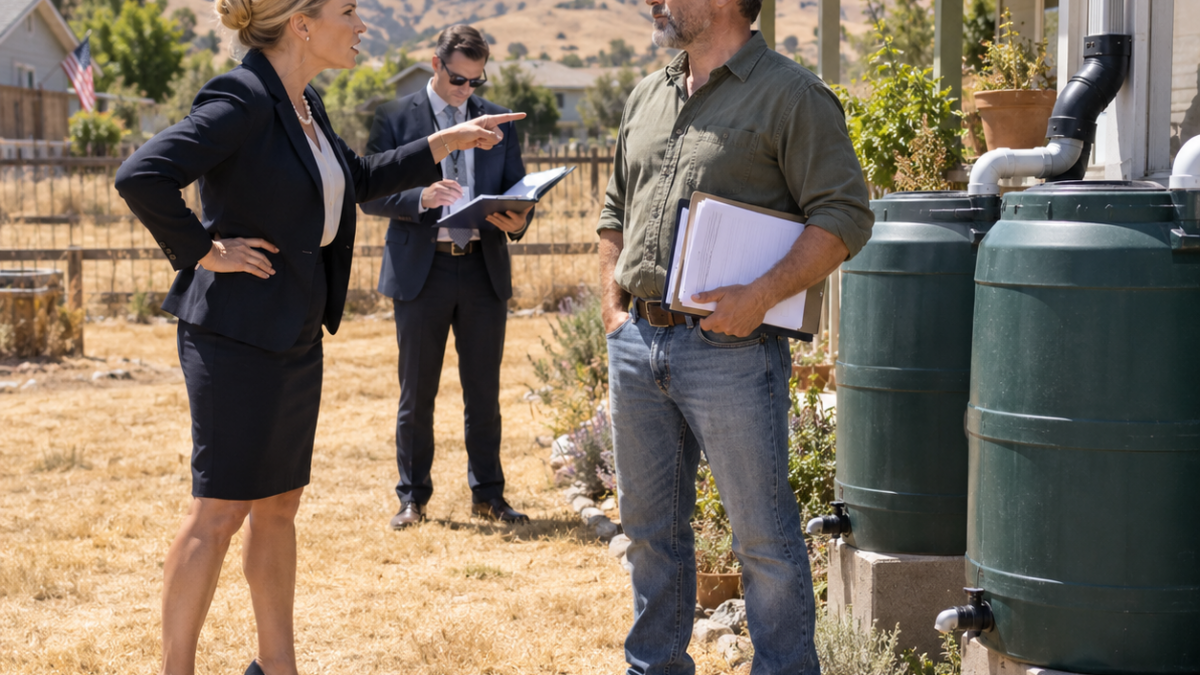
Karen handed me a $500 fine for collecting rainwater while our county was under drought restrictions, then warned that another hundred dollars would be added every day until I removed the two barrels behind my garage.
She called them “unsightly storage containers,” even though I had painted them to match the house, screened them with lattice, and installed them specifically so my wife could keep her vegetable garden alive without pulling another gallon from the strained municipal system.
What Karen didn’t realize was that the harder she pushed me over those two barrels, the more people outside our little neighborhood were going to start asking why an HOA president believed her personal opinion mattered more than state law.
“You have until Friday, Mr. Riley.”
Karen Peterson stood on my porch in a pastel pantsuit, pressing the violation notice toward my chest.
Behind her, every lawn on Oakmont Meadows looked tired.
Brown patches.
Curling leaves.
Sprinklers shut off under municipal drought restrictions.
The summer had been brutal.
Weeks of triple-digit heat.
Reservoir levels dropping.
Watering schedules posted on city websites.
Neighbors watching gardens they had spent years building slowly burn yellow beneath the Texas sun.
My wife, Sarah, refused to let hers die.
Neither did I.
So I installed two fifty-five-gallon rain barrels beneath the rear gutters.
Nothing industrial.
Nothing visible from the street.
They sat behind a cedar lattice enclosure that matched our fence and had been painted a muted taupe almost identical to the brick mortar.
When storms finally came, the barrels captured runoff we used on tomatoes, peppers, herbs, and Sarah’s roses.
To me, that was common sense.
To Karen, apparently, it was rebellion.
“Five hundred dollars?” I asked.
“Initial penalty.”
“And the hundred dollars a day?”
“Continuing noncompliance.”
“Under what rule?”
Karen lifted her chin.
“The association prohibits unsightly exterior storage.”
“They’re rainwater-harvesting barrels.”
“They are containers.”
“They’re protected by state law.”
Her smile changed.
Not much.
Just enough for me to know she had heard that before.
“State law does not give you permission to destroy the aesthetic integrity of this community.”
“I’m not destroying anything.”
“That is your opinion.”
“No. That part is visible.”
Karen stepped closer.
“You need to understand something, Mr. Riley. Oakmont Meadows has standards.”
I looked past her at the dead grass beside the sidewalk.
“So does the state.”
That landed.
For twenty years, I had served in the Army Corps of Engineers.
I retired as a captain after two deployments to Iraq and one to Afghanistan.
Regulations had been part of my life for longer than Karen had probably owned that clipboard.
Specifications.
Building codes.
Water-management plans.
Environmental restrictions.
Chain of command.
I knew the difference between a rule and somebody’s interpretation of one.
More importantly, I knew what happened when the lower-level rule directly conflicted with higher authority.
Texas law did not simply tolerate residential rainwater harvesting.
It protected it and limited how far homeowners associations could go in trying to prohibit it.
An HOA could impose certain reasonable placement or screening requirements.
I had already met them.
Karen knew that because I had sent her copies before installing the system.
She had ignored them.
Now she was betting that I would pay rather than fight.
Most people did.
Fifty dollars over a trash can.
A hundred over a basketball hoop.
Two hundred because a play structure was the wrong color.
Karen understood that harassment did not have to be legal if it was cheaper than resistance.
She had built her authority on that equation.
I took the papers.
“Thank you.”
Her expression faltered.
“That’s it?”
“I’ll review them.”
“You’ll remove the barrels.”
“I didn’t say that.”
“If you fail to comply, we will proceed with collection. Eventually that can include a lien.”
Sarah had stepped into the hallway behind me.
I felt her go still.
Karen noticed too.
She smiled.
That was the moment this stopped being about water.
I looked at the notice again.
Then at Karen.
“Put every future communication in writing.”
“I’m happy to.”
“Good.”
She turned and walked down the porch steps.
I closed the door.
Sarah looked at me.
“What now?”
I placed the violation notice on the dining-room table beside the drought advisory I had printed that morning.
Then I opened my laptop.
“Now I find out how many laws she’s willing to ignore just to make two barrels disappear.”
The original dispute began with two screened rain barrels, a $500 fine, and an additional $100-per-day penalty even though the source material states that Texas law protected rainwater harvesting and limited HOA interference.
PART 2
Sarah knew that look.
She had seen it in Baghdad.
Fort Hood.
Fort Leonard Wood.
Once in Germany when a contractor tried to substitute inferior bridge fasteners and insisted the paperwork was “close enough.”
My wife called it the Riley Face.
She said my voice got quieter while everyone else’s got louder.
“What are you doing?”
“Reading.”
“That’s never reassuring when you’re angry.”
“I’m not angry.”
“You alphabetized the folders.”
I looked down.
She was right.
Drought restrictions.
HOA covenants.
State law.
Rainwater specifications.
Photographs.
“A through D,” she said.
“That is simply good records management.”
“It is war preparation.”
She kissed the top of my head.
“Try not to invade anybody before dinner.”
I spent four hours checking everything.
Our county’s drought restrictions.
Municipal conservation notices.
The HOA declaration.
Architectural standards.
Meeting minutes.
My original installation paperwork.
Photographs showing the barrels from the street.
Or rather, not showing them from the street.
That part mattered.
You could stand in front of the house and never know they existed.
The cedar lattice blocked almost everything.
From our next-door neighbor’s yard you could see the tops only if you stood near the rear fence.
Even then, they looked like two neutral-colored utility containers.
Karen’s description made them sound like blue chemical drums balanced on the front porch.
Then I reviewed the state protections.
The source document I had originally relied on was clear in principle: an HOA could not simply prohibit residential rainwater harvesting. Reasonable restrictions could exist, but they could not be used as a disguised ban.
I had followed the placement and screening provisions.
I had photographs.
Receipts.
Measurements.
A drawing.
Even the paint code.
Sarah sat across from me.
“You kept the paint label?”
“Of course.”
“It was eight dollars.”
“The price is irrelevant.”
“You have the receipt.”
“Yes.”
She smiled.
“You terrify me sometimes.”
The next morning, I drafted a response.
No insults.
No threats.
No paragraphs about tyranny.
Just facts.
I identified the violation.
Cited the HOA clause Karen relied on.
Explained why the barrels were not prohibited storage.
Cited the state protection for rainwater harvesting.
Attached photographs proving they were screened.
Included the drought advisory.
Then wrote:
**Please confirm in writing that the fine has been rescinded and that no additional daily penalties will accrue.**
Certified mail.
Return receipt.
I drove to the post office myself.
The clerk looked at the thick envelope.
“Legal trouble?”
“Neighborhood trouble.”
“Worse.”
He wasn’t wrong.
Karen signed for it two days later.
Then nothing.
One week.
Two.
No letter.
No email.
No apology.
For a few days, I thought maybe somebody on the board had finally spoken to an attorney.
Then the lilac envelope appeared.
Karen loved colored stationery.
I still don’t know why.
Maybe plain white paper did not feel sufficiently imperial.
Inside:
**FINAL DETERMINATION OF ARCHITECTURAL CONTROL COMMITTEE**
My appeal was denied.
Original fine:
$500.
Fourteen days of continuing penalties:
$1,400.
Total:
$1,900.
Sarah read it twice.
“She’s serious.”
“Yes.”
“She read your state-law letter?”
“She signed for it.”
“And still did this?”
“Yes.”
“Why?”
“Because she thinks I’ll pay.”
Sarah looked at the rain barrels through the kitchen window.
The tomatoes behind them were still green.
Our neighbors’ grass looked worse each day.
The city had just reduced permitted irrigation hours again.
“This is insane.”
“Yes.”
“What do we do?”
I picked up the meeting notice stapled to the fine summary.
“My hearing.”
“You get one?”
“Not exactly.”
The letter described the monthly board meeting where I could “address the board before final enforcement.”
Not a neutral hearing.
Not an independent grievance process.
Karen’s room.
Karen’s agenda.
Karen’s rules.
Still useful.
Sarah saw me smile.
“Oh, no.”
“What?”
“You like this.”
“I like witnesses.”
The clubhouse meeting was the following Thursday.
Beige walls.
Beige carpet.
Beige curtains.
Oakmont Meadows had somehow developed an aesthetic philosophy based on oatmeal.
Twenty residents attended.
Most looked as if they had been sentenced to jury duty.
Karen sat in the middle of the board table wearing royal blue.
Arthur Abernathy sat on her right.
Seventy-something.
Thin.
Permanent frown.
He had served on the board longer than anyone.
On Karen’s left sat Brenda Lee, a younger woman who spent most meetings looking at her phone.
At the far end sat David Miller.
Late thirties.
Two little girls.
Software project manager.
He looked like a man who wanted to vanish into the wall.
I sat in the front row.
Leather portfolio.
Copies for everyone.
When Karen reached my item, she cleared her throat.
“Next we have continued noncompliance involving unauthorized exterior storage containers at 121 Oak Drive.”
I stood.
“They’re rain barrels.”
Karen stared.
“I’m sorry?”
“You just called them storage containers. They’re rainwater-harvesting barrels.”
“Mr. Riley, you’ll have an opportunity to speak.”
“I just did.”
A few residents smiled.
I walked to the small podium.
“My name is Jack Riley.”
I described the system.
Two barrels.
Fifty-five gallons each.
Rear yard.
Screened.
Neutral color.
Used only for irrigation.
Then I distributed copies of the state-law material.
“Texas law protects residential rainwater harvesting and restricts an HOA’s ability to prohibit these systems.”
Abernathy did not look down.
Brenda glanced at the first page.
David read everything.
I continued.
“The association may impose certain reasonable conditions relating to appearance and location.”
I displayed photos.
“I met them.”
Karen leaned back.
“Our attorney disagrees.”
“May I see the opinion?”
“No.”
“Why?”
“Attorney-client privilege.”
“Then please explain the legal reasoning.”
Karen’s eyes narrowed.
“We are not conducting a law-school seminar.”
“No.”
I looked around the room.
“We’re discussing whether the HOA can threaten a lien against my house for doing something state law expressly allows.”
That woke people up.
Lien.
Everyone understands that word.
Karen leaned toward her microphone.
“You are deliberately mischaracterizing the situation.”
“How?”
“No one is threatening your home.”
I lifted the lilac notice.
“Page two says unresolved balances may lead to a lien.”
She glanced at Brenda.
Brenda kept looking down.
Karen changed direction.
“The issue is aesthetics.”
“The system is screened.”
“The committee still finds it objectionable.”
“Based on what objective standard?”
“The committee’s judgment.”
“Who is on the committee?”
Karen paused.
“Several qualified members.”
“Names?”
“This is unnecessary.”
“Then put them in the minutes.”
Abernathy slammed his hand on the table.
“We’re the board.”
I looked at him.
“Yes.”
“And we decide what complies.”
“No.”
He stared.
“You decide within the authority granted to you by the governing documents and applicable law.”
“Same thing.”
“It isn’t.”
The room became very quiet.
Karen stepped in.
“The committee decision stands.”
David finally spoke.
“Karen.”
She turned.
David held my state-law printout.
“He may be right.”
Abernathy scoffed.
“He isn’t.”
David continued.
“At least we should ask counsel.”
Karen’s face changed.
“I already did.”
“When?”
“Earlier this week.”
“Can we see the response?”
Karen’s voice became sharp.
“I said I handled it.”
David looked at me.
Then her.
“You said the attorney approved the fines?”
“Yes.”
“Specifically?”
“Yes.”
He looked unconvinced.
I was too.
No competent attorney would advise them to openly violate a state protection without at least explaining the risk.
Karen called the vote.
Abernathy moved to uphold the fine.
Brenda seconded.
Karen voted yes.
David voted no.
Three to one.
Karen smiled.
“Mr. Riley, your current balance is nineteen hundred dollars. The rain barrels must be removed by month’s end.”
I gathered my papers.
“And if I don’t?”
“Collection continues.”
“Lien?”
“If necessary.”
There it was.
In front of witnesses.
I nodded.
“Thank you.”
Karen looked puzzled.
“For what?”
“Clarifying the board’s position.”
I left.
Sarah was waiting in the car.
“Well?”
“Three to one.”
“David?”
“No.”
“The others?”
“Yes.”
She started the engine.
“What now?”
“Now I stop trying to convince Karen.”
The next month was harassment by stationery.
Dandelion.
Fifty dollars.
An actual dandelion.
One.
Photographed with enough zoom to make it look like agricultural collapse.
Then porch light.
I had replaced a burned-out bulb with an LED.
Hundred dollars.
Then garden hose.
Karen claimed it was “improperly stored in a visible manner.”
It was on a hose reel.
Behind a shrub.
Sarah read that violation.
“What does she want?”
“Apparently the hose has offended civilization.”
Then the strangest one:
My consulting business.
I worked from a home office.
No clients visited.
No signs.
No employees.
No inventory.
Nothing visible.
Karen classified it as prohibited commercial use.
Five thousand dollars.
Then the HOA’s collection law firm added another several thousand in threatened legal fees.
That was the letter that finally scared Sarah.
Not the rain barrels.
Not the dandelion.
The lien language.
She sat at the kitchen table holding the packet.
“Jack.”
“I know.”
“No, you don’t.”
I stopped typing.
“She’s talking about our house.”
“I know.”
“We just finished paying off the last deployment-era debt.”
“I know.”
“We moved here because you promised we were done fighting.”
That one hurt.
“I didn’t promise nobody would ever cause trouble.”
“You promised peace.”
“I wanted peace.”
Sarah’s eyes filled.
“So do I.”
The anger inside me shifted.
For weeks, I had approached Karen like a technical problem.
Input.
Process.
Documentation.
Countermeasure.
Sarah reminded me that behind every spreadsheet was our home.
I sat beside her.
“I will not gamble the house.”
“Are you sure?”
“Yes.”
“Then get real help.”
She was right.
I had treated legal research like engineering specifications.
Useful.
Not enough.
I called Marcus Thorne.
Former Army JAG.
Civil-litigation attorney.
Big man.
Bigger laugh.
His office walls held framed commendations, trial sketches, and a photograph of him wearing body armor somewhere he refused to identify.
I gave him the binder.
He read silently for nearly an hour.
Then looked up.
“Captain.”
“I retired a captain.”
“That’s why I said captain.”
“Don’t start.”
He smiled.
“This woman is a trial lawyer’s dream.”
“That sounds expensive.”
“For somebody.”
He tapped the state-law section.
“Your rainwater system appears protected.”
Then the fines.
“Her retaliation timeline is beautiful.”
“Beautiful?”
“Legally.”
He pointed.
“You challenge the rain-barrel fine.”
“Correct.”
“Then suddenly dandelion.”
“Yes.”
“Light bulb.”
“Yes.”
“Hose.”
“Yes.”
“Home business.”
“Yes.”
“And collection threat.”
“Yes.”
Marcus leaned back.
“She either has the worst timing in Texas or she is retaliating.”
“I know which I think.”
“Judges appreciate proof.”
He picked up my spreadsheet.
“You have proof.”
Marcus wanted broader evidence.
Selective enforcement.
Prior fines.
Board procedure.
Financial records.
“Financial?”
“Yes.”
“What does money have to do with rain barrels?”
“Maybe nothing.”
He smiled.
“But people who abuse one kind of authority sometimes get careless with another.”
That was when David Miller became important.
I saw him one evening standing over a bare patch in his backyard.
His daughters were nearby.
One was crying.
“What happened?”
David looked embarrassed.
“Play slide.”
“What?”
“Karen said it was an unapproved play structure.”
The plastic slide was gone.
“How much?”
“Two hundred, plus fifty a day.”
“You were on the board.”
“Doesn’t matter.”
“Did you vote against it?”
“She handled it through architectural.”
His voice was exhausted.
“My wife said take it down.”
One daughter looked at me.
“Daddy says the slide broke.”
David closed his eyes.
I understood.
It was easier to tell a child a slide broke than explain that an adult stranger decided she should not have it.
“Coffee tomorrow?”
David hesitated.
Then nodded.
We met eight miles away.
Ridiculous.
Two neighbors driving eight miles to talk because they were afraid Karen would see.
David told me everything.
Karen dominated meetings.
Abernathy supported her.
Brenda avoided conflict.
The management company processed whatever Karen sent.
The HOA’s law firm sent collection templates without scrutinizing individual facts.
David joined the board hoping to moderate things.
Instead, he learned silence.
“What about the attorney opinion she cited against me?”
David looked away.
“There isn’t one.”
I said nothing.
“She lied?”
“Yes.”
“Did she ask counsel?”
“Not before the vote.”
He looked ashamed.
“I knew that.”
“And you let her say it.”
“I voted against you.”
“You let her lie.”
He rubbed his face.
“I know.”
I thought of his daughters.
“You want this to stop?”
“Yes.”
“Then help.”
David gave me six names.
Families Karen had targeted.
Mrs. Gable.
Widow.
Forced to repaint her house because the approved beige shade changed.
The Wilsons.
Basketball hoop.
Removed after escalating fines.
Patels.
Graduation banner.
Another family over a swing set.
Another over work equipment.
Every story shared one feature.
Individually, the fight cost more emotionally than compliance.
Marcus called it atomization.
“A bully wants each person alone.”
Sarah called it simpler.
“She makes everybody think they’re the only problem.”
We invited the families to our house.
No secret code.
No dramatic name.
Just:
**Meeting Regarding Shared HOA Governance Concerns**
Every invited household came.
Twelve adults.
Fear makes people quiet at first.
Then Mrs. Gable spoke.
She held a photograph of her house before repainting.
Soft cream.
Almost identical to the new approved color.
“My husband chose this paint.”
Her voice shook.
“He died three years before Karen fined me.”
Nobody moved.
“Keeping the house the way we built it together mattered to me.”
She swallowed.
“I spent four thousand dollars repainting it because Karen said the old shade lowered neighborhood standards.”
Mr. Wilson spoke next.
Basketball hoop.
His son had finally found a sport he loved.
Karen called it visual clutter.
After a month of fines, they removed it.
“He stopped playing.”
That sentence hurt.
Mr. Patel talked about his son’s graduation banner.
Forty-eight hours.
Fine.
“He was the first person in our family to graduate college.”
The banner said:
**WE’RE PROUD OF YOU, ARJUN.**
Karen called it an unapproved sign.
Sarah sat beside me.
Her eyes were wet.
I looked around the living room.
“This is why she keeps winning.”
Silence.
“Not because she’s right.”
“Because each time she does this, one family decides it isn’t worth fighting.”
Mrs. Gable nodded.
“What do we do?”
“Together?”
“Yes.”
“Document.”
Mr. Wilson laughed slightly.
“Of course that’s your answer.”
“I’m an engineer.”
We created a homeowner group.
No crusade name.
No flags.
No slogans.
Just neighbors.
David served as an internal whistleblower from the board.
Mrs. Gable, who had worked forty years in bookkeeping, took finances.
Mr. Wilson built a private website.
Marcus became counsel.
I handled records and timeline.
Sarah handled something more important.
People.
Coffee.
Food.
Calls.
Comfort.
She noticed when Mrs. Gable was overwhelmed.
When David felt guilty.
When Mr. Wilson got too angry.
Armies call it morale.
Communities call it being human.
Marcus sent a ten-page demand.
Every fine disputed.
Rain barrels protected.
Retaliation documented.
Selective enforcement.
Improper collection threats.
Breach of fiduciary responsibility allegations.
Demand for refund.
Demand to suspend enforcement.
The letter went to:
Karen.
Every director.
Management company.
HOA law firm.
Certified.
Karen signed.
Three days later, the response arrived.
Intent to lien.
Over ten thousand dollars claimed.
Including the fabricated home-business violation.
Marcus called laughing.
“She swallowed the fishing pole.”
“Sarah hates when lawyers sound happy.”
“Tell Sarah I’m professionally delighted.”
“What does this change?”
“Retaliation after notice.”
“Strong?”
“Potentially.”
He became serious.
“Do not stop documenting.”
We didn’t.
Then Mrs. Gable requested five years of financial records.
Karen delayed.
Accountant unavailable.
Documents in storage.
Management company compiling.
Three weeks.
Marcus threatened court action.
A cardboard box arrived.
Loose paper.
Duplicates.
Missing months.
Faded receipts.
Mrs. Gable looked inside.
“She thinks this will stop me?”
I smiled.
Karen had made her second major miscalculation.
Never challenge a retired bookkeeper with disorganized paper.
Mrs. Gable turned her dining room into a forensic command center.
Bank statements on one wall.
Vendor list.
Contracts.
Check register.
Receipts.
Four volunteers entered data.
It took two weeks.
Then patterns appeared.
Miscellaneous payments.
No receipts.
Consulting fees.
A shell-looking company.
But the biggest:
Evergreen Prestige Landscaping.
Oakmont Meadows paid almost twice the market rate compared with similar proposals Mrs. Gable obtained.
No competitive bidding record.
No meaningful performance documentation.
Owner:
Gary Peterson.
Karen’s brother-in-law.
Mrs. Gable called me.
“You need to come here.”
I drove over.
She pointed to the business registration.
Then the checks.
Then meeting minutes.
“This is family.”
“Yes.”
“Was the relationship disclosed?”
“Not in the minutes.”
“Board approval?”
“Not properly.”
She leaned back.
“Jack.”
“What?”
“I think she’s been using this place as her own checking account.”
“Careful.”
“I know.”
“Suspicious isn’t proven criminal.”
She nodded.
“Marcus said you’d say that.”
Good lawyer.
We handed everything to him.
Then my engineer brain found its own weapon.
Data.
If Karen’s argument was that rain barrels harmed the community, I wanted numbers showing what they actually did.
I installed a flow meter.
Logged rainfall.
Tracked barrel volume.
Measured irrigation use.
Compared it with municipal water prices.
Pulled HOA common-area irrigation figures from the financial records.
The city was begging residents to conserve.
Oakmont Meadows still spent heavily maintaining ornamental landscaping.
My system reduced our household irrigation draw.
Reduced runoff.
Saved money.
And kept Sarah’s food garden alive.
I built a report.
Charts.
Monthly data.
Gallons captured.
Municipal gallons avoided.
Storm runoff reduction estimates.
Cost recovery.
Marcus flipped through it.
“You made a forty-page report about two barrels.”
“Yes.”
“Of course you did.”
“They work.”
“I believe you.”
“Now everyone else can.”
He pointed at the final chart.
“What’s this?”
“Projected annual savings if thirty percent of homeowners installed similar systems.”
He stared.
“You calculated neighborhood adoption?”
“Yes.”
Marcus laughed.
“Karen fined you for something that could reduce community water use during drought.”
“That is the data.”
“This is going to hurt.”
The timing became more important when the drought worsened.
The state issued additional conservation messaging.
Local officials urged rainwater capture where feasible.
Municipal restrictions tightened.
Suddenly Karen’s policy looked not only legally questionable but environmentally absurd.
She was fining homeowners for conserving water while publicly complaining about dead common-area landscaping.
That contradiction spread.
First privately.
Then publicly.
Karen accelerated.
She slapped an orange tow warning on my truck.
My personal Ford.
Clean.
Registered privately.
No commercial signage.
Only a small Army Corps of Engineers castle decal on the rear window.
She called the decal evidence of business use.
Security footage showed Karen arriving at dawn with a tow operator.
Pointing.
Insisting.
The driver placed the warning but refused to hook the truck without another authorization.
Marcus told me:
“Do not remove the sticker.”
Sarah sighed.
“Of course he said that.”
“Evidence.”
“You two are soulmates.”
I called the non-emergency police line.
Then the tow company.
I calmly informed them the truck was privately owned, lawfully parked on private property, and that towing it over a military-service decal would produce immediate legal action.
The dispatcher put me on hold.
Then:
“Sir, our driver will not tow until ownership and authority are confirmed.”
“Good.”
Ten minutes later, a police cruiser arrived.
Then the tow truck.
Then Karen.
She stepped from her vehicle furious.
The officer, Sergeant Daniel Miller, listened.
Karen spoke first.
“This is a prohibited commercial vehicle.”
The officer looked at the truck.
“Sir?”
“Personal vehicle.”
“What business?”
“None.”
Karen pointed at the decal.
“There.”
Sergeant Miller leaned closer.
Then straightened.
“That’s Army Corps of Engineers.”
“Yes.”
He looked at me.
“Service?”
“Retired captain.”
He nodded.
“82nd Airborne.”
Small world.
Karen interrupted.
“It doesn’t matter what the symbol means. It identifies an organization.”
The officer turned.
“Ma’am, a military-service emblem does not make a personal vehicle commercial.”
“Our covenants—”
“Do not convert a private truck into a business vehicle.”
“The HOA ordered the tow.”
“Do you have a court order?”
“No.”
“Municipal citation?”
“No.”
“Proof the vehicle belongs to a business?”
Karen pointed again.
“The logo.”
Miller looked at the tow driver.
“You’re not towing this.”
The driver nodded instantly.
Karen exploded.
“I am the president of this HOA!”
Officer Miller’s voice became very calm.
“And I am telling you there is no lawful basis presented here for taking this man’s truck.”
She looked at me.
I said nothing.
The camera above my garage captured everything.
That afternoon, Mr. Wilson edited the video.
Context captions.
No music.
No insults.
Just what happened.
Someone shared it outside our private group.
Then local social media.
By evening, thousands of views.
By morning, tens of thousands.
The moment Officer Miller identified the Army Corps emblem became the clip everyone shared.
I hated that part.
Not because I was ashamed of service.
Because it risked making the story about me being a veteran instead of Karen trying to seize private property without proper authority.
But public narratives choose their own fuel.
Veteran.
Drought.
Rain barrels.
HOA.
Tow truck.
Karen.
Local television called.
Jessica Chen from Channel 8.
Smart.
Prepared.
Not interested in shouting.
We agreed to interview.
I stood beside the barrels.
Not in uniform.
No medals.
Just jeans.
Jessica asked:
“What started this?”
“Two rain barrels.”
“Were they prohibited?”
“State law protects rainwater harvesting, subject to reasonable restrictions. I complied with the restrictions.”
“And the fines?”
“Started at five hundred dollars. Then daily penalties.”
She looked toward the brown lawns.
“During drought restrictions.”
“Yes.”
“Why?”
“You’ll have to ask the HOA.”
She did.
Karen ran from her front door to her car holding a binder in front of her face.
“No comment.”
The footage was devastating because it was so ordinary.
The next day, everything changed.
The state water-conservation office contacted our attorney after seeing the coverage.
Not because they were coming to arrest Karen.
Not because state agents cared about our neighborhood drama.
Because the case touched a policy area the state actively encouraged.
Marcus provided documentation.
Our installation.
Karen’s notices.
HOA rules.
My report.
The office responded in writing that state policy protected rainwater harvesting and that local private restrictions could not be applied in a way that unlawfully prohibited protected systems.
Then the state property-regulation side became interested in the association’s enforcement procedures.
The letter was not dramatic.
Government letters rarely are.
It did not say:
**KAREN IS A TYRANT.**
It said, in bureaucratic language, that the HOA’s restrictions and fines appeared inconsistent with applicable state protections and that continued unlawful enforcement could expose the association to corrective action and liability.
Marcus read it twice.
Then placed it on my table.
“That.”
“What?”
“That is the letter we needed.”
Sarah read the first paragraph.
“State sided with us?”
“Hard,” Marcus said.
I laughed.
He was right.
Karen could call me argumentative.
Marcus aggressive.
Neighbors disgruntled.
Reporters sensational.
She could not dismiss the state agency charged with applying the law she had been ignoring.
The letter was copied to the HOA management company.
That company panicked immediately.
Collection activity on my property suspended.
Then all disputed rainwater-related enforcement.
Corporate compliance review.
The HOA law firm also went quiet.
Marcus received a call from a senior partner.
Not the junior associate whose name appeared on the lien threat.
A senior partner.
“We were not provided the full factual background.”
Marcus put the phone on speaker after getting permission.
“Your firm threatened a lien.”
“We relied on client representations.”
“You were given our dispute letter.”
“We are reviewing internally.”
“Good.”
The management company notified Karen that no new fines should be issued without legal review.
Karen ignored them.
She called an emergency board meeting.
That was her last mistake.
David sent me the proposed amendments beforehand.
Ban all exterior water containers.
Define commercial vehicles at board discretion.
Create a fine for “defamation or disparagement” of board members.
Maximum:
One thousand dollars.
Marcus stared at the draft.
“She’s trying to outlaw criticism.”
“Yes.”
“After the state told her the original rule conflicts with law.”
“Yes.”
He smiled.
“We’re done playing defense.”
Our homeowner group had grown.
The viral video opened doors fear had kept closed.
Fifty-four households joined our legal complaint.
More shared evidence.
More fines.
More unequal enforcement.
Karen’s allies received exceptions.
Her critics received penalties.
Mrs. Gable’s financial work continued.
Evergreen Prestige looked worse.
Inflated contract.
Family connection.
No meaningful disclosure.
Missing bids.
Questionable reimbursements.
Marcus filed suit.
Not because we wanted the most dramatic headline.
Because Karen was preparing new rules to punish residents who challenged her.
The lawsuit named:
HOA.
Karen in her board capacity and individually where supported.
Certain directors.
Management company on claims tied to its conduct.
It sought:
Refunds of disputed fines.
Declaratory relief protecting rainwater systems.
Injunctions against retaliatory enforcement.
Damages where legally available.
Accounting.
Review of the landscaping contract.
Legal fees.
We served it at Karen’s emergency meeting.
That clubhouse was packed.
Every seat.
Walls.
Hallway.
Jessica Chen stood in back with a camera crew.
Karen opened with a speech about “outside agitators” and “malicious online attacks.”
Apparently homeowners questioning their own HOA were now outsiders.
Then she tried moving directly to the water-container amendment.
Abernathy moved.
Karen looked at David.
“Second?”
David leaned toward his microphone.
“No.”
Karen stared.
“What?”
“No.”
The room became silent.
David continued.
“I move to table all proposed amendments.”
Abernathy snapped:
“Out of order.”
David ignored him.
“These amendments are retaliatory, legally questionable, and written to punish residents challenging this board.”
Applause.
Karen pounded the gavel.
“You will not grandstand.”
David’s face went red.
But he kept speaking.
“I’ve stayed quiet too long.”
That mattered more than his vote.
He looked at the crowd.
“I knew there was no attorney opinion when Karen told Mr. Riley there was.”
Gasps.
Karen turned white.
“David.”
“I knew.”
His voice broke.
“And I said nothing.”
Karen hissed:
“You voted against the fine.”
“That wasn’t enough.”
He looked toward his daughters in the crowd.
“The board fined my children’s slide out of our yard.”
One daughter held her mother’s hand.
David swallowed.
“I let it happen because I was afraid of fighting my own board.”
He looked back at Karen.
“That ends tonight.”
The applause rolled across the room.
Marcus stood.
He carried four bound packets.
Karen’s face changed when she saw him.
“Madam President.”
“This is a members’ meeting. You are not recognized.”
“I don’t require recognition to complete service.”
He walked to the board table.
Karen.
Abernathy.
Brenda.
Management representative.
One copy each.
“You have been served.”
The room erupted.
Karen stared at the caption.
“What is this?”
“Civil action filed this afternoon.”
Marcus turned toward the homeowners.
“The plaintiffs include Jack and Sarah Riley and fifty-three other Oakmont Meadows households.”
People gasped.
“The action challenges unlawful and retaliatory enforcement, seeks refunds of disputed fines and legal fees, requests judicial declarations concerning protected homeowner rights, and seeks review of financial transactions involving association vendors.”
Karen shouted:
“This is slander!”
Marcus held up one finger.
“Careful.”
The room quieted.
“These allegations will be tested with evidence.”
Then Mrs. Gable stood.
The seventy-something widow Karen once intimidated over beige paint.
She carried a ledger.
“I’d like to discuss Evergreen Prestige Landscaping.”
Karen’s entire body stiffened.
Mrs. Gable projected the vendor registration.
Gary Peterson.
Karen’s brother-in-law.
Then invoices.
Then HOA expenditures.
Then comparable bids obtained later.
“I spent forty years as a bookkeeper.”
Her voice was soft.
“This contract is nearly twice the market cost based on the comparisons we obtained.”
Karen interrupted:
“They provide premium service.”
Mrs. Gable continued.
“I found no record in the minutes showing you disclosed the family relationship before key contract decisions.”
“I didn’t need to.”
Marcus said nothing.
He did not have to.
Residents began shouting.
“How much?”
“Where’s the money?”
“Did we vote?”
“Why is your family getting paid?”
Karen banged the gavel.
“Enough!”
Then I stood.
Not at the podium.
Beside my seat.
I held one document.
The state letter.
“This started with two barrels.”
The room settled.
“Two screened barrels collecting rain during a drought.”
I held the letter higher.
“State officials have now confirmed the association cannot apply its rules in a way that unlawfully prohibits protected rainwater harvesting.”
Karen shouted:
“That letter is advisory!”
“Then let the court decide.”
Silence.
“But before we get there, every homeowner should understand something.”
I looked around.
“This was never only about water.”
Mrs. Gable.
David.
The Wilsons.
Patels.
Fifty-four families.
“It was about whether a board can punish people until surrender is cheaper than being right.”
No one moved.
“It was about whether a rule can mean whatever the president says it means.”
I looked directly at Karen.
“And it was about what happens when nobody asks where the money goes.”
Karen’s mouth tightened.
I placed the letter down.
“We’re asking now.”
That was when Mr. Wilson walked forward with the proxies.
One hundred fifty-seven.
Verified.
Marcus had reviewed the procedure.
Karen’s emergency meeting had unintentionally created exactly the forum needed to call a removal vote under the association documents.
David made the motion.
No confidence.
Remove Karen.
Remove Abernathy.
Remove Brenda.
Brenda started crying.
“I didn’t do anything.”
Mrs. Gable answered from the front row.
“That was part of the problem.”
Brenda closed her eyes.
She knew.
Karen stood.
“You cannot hijack my meeting.”
David looked at her.
“Our meeting.”
That may have been the most important sentence of the entire night.
Our meeting.
Not Karen’s.
Karen had spent years confusing office with ownership.
The homeowners voted.
Proxy cards rose.
Hands.
Voices.
Almost unanimous.
Abernathy voted no.
Karen voted no.
A handful of loyalists abstained.
Everyone else:
Remove.
Karen sat frozen.
No elegant ending.
No dramatic confession.
No apology.
Just disbelief.
People who rely on fear always look surprised when fear expires.
She gathered her binder.
Looked at me.
“You’ve destroyed this community.”
I shook my head.
“No.”
“You turned neighbors against each other.”
“No.”
“You brought lawyers.”
“After you threatened my home.”
“You embarrassed me publicly.”
“You ordered a tow truck.”
“You attacked my family.”
I almost laughed.
“Karen.”
She stopped.
“You fined me for rain.”
That silenced her.
She left.
The next morning, Abernathy resigned entirely.
Brenda submitted a resignation two days later.
David became interim president until elections.
Mrs. Gable became interim treasurer.
I was asked to run.
I declined.
Sarah smiled when I told her.
“Good.”
“You thought I’d be bad?”
“You’d make forty-page reports about mulch.”
“Mulch matters.”
“Exactly.”
The state matter resolved first.
The association formally rescinded the rain-barrel fines.
Then all fines tied to my retaliation timeline underwent review.
Many were voided or refunded.
The management company settled claims concerning fees it had processed after receiving notice of disputes.
The HOA law firm waived some charges and refunded others through negotiated resolution rather than spending years fighting over whether junior staff had sufficiently reviewed Karen’s requests.
The landscaping matter took longer.
Independent audit.
Vendor records.
Bank statements.
Invoices.
Family connection.
Investigators.
The evidence supported self-dealing serious enough to expose Karen and others to civil liability and further inquiry.
Our lawsuit did not become some magical billion-dollar victory.
Real litigation is slower and uglier.
But it did what we needed.
The Evergreen contract ended.
Money was recovered.
Improper fines were refunded with interest through settlement.
Legal fees were covered substantially.
Karen’s individual settlement required a significant contribution after her insurance carrier disputed coverage for intentional misconduct and conflicts of interest.
She sold her house.
Not because a judge threw her onto the sidewalk.
Because litigation, repayment, legal costs, and the collapse of her position became more than she wanted to carry.
The last time I saw her, she was supervising movers.
No pantsuit.
No binder.
Jeans.
T-shirt.
She looked smaller.
I was adjusting a gutter line that fed the rain barrels.
Karen saw me.
Then the barrels.
Still there.
That was inevitable.
She walked toward the property line.
“I suppose you’re happy.”
I climbed down.
“About what?”
She stared.
“All of it.”
“I’m happy the fines are gone.”
“You know what I mean.”
I wiped my hands.
“No.”
“My house.”
“I didn’t make you sell it.”
“My reputation.”
“I didn’t sign the Evergreen contract.”
“You organized everyone.”
“After you threatened a lien against my house.”
Karen looked toward Sarah’s garden.
The tomatoes were huge that year.
“You could have just removed them.”
“The barrels?”
“Yes.”
That sentence explained everything.
“Karen.”
“What?”
“You still think the problem was that I didn’t give you what you wanted.”
She folded her arms.
“You made this into a crusade.”
“No.”
I pointed toward the barrels.
“I asked you to follow the law.”
“You wanted to humiliate me.”
“I wanted to water tomatoes.”
For the first time, Karen had no response.
I continued.
“If you had rescinded the first fine, none of this would have happened.”
“You were challenging my authority.”
“That’s the part you never understood.”
I looked at her.
“It wasn’t your authority.”
Karen’s face hardened.
She turned away.
Then stopped.
“One day this neighborhood will regret what you did.”
“Maybe.”
That surprised her.
“Boards will make mistakes.”
“People will argue.”
“Rules will still annoy people.”
I looked toward the clubhouse.
“But now they’ll know the president isn’t the law.”
Karen left without answering.
The moving truck disappeared by sunset.
Sarah came outside holding two glasses of tea.
“Feel better?”
“A little.”
“Only a little?”
“I thought it would feel bigger.”
“What?”
“Her leaving.”
Sarah sat beside me.
“That’s because the barrels were never really about her.”
She was right.
The new election changed Oakmont Meadows.
David Miller won president.
He almost refused.
His daughters convinced him.
Mrs. Gable became treasurer.
Mr. Wilson joined architectural review.
Priya Patel, an attorney and Arjun’s older sister, joined the board.
The first thing they did was not eliminate rules.
That would have been easy.
And stupid.
Instead, we held workshops.
What actually affects neighbors?
Drainage.
Unsafe structures.
Abandoned vehicles.
Common-area maintenance.
Noise.
Real nuisances.
What does not?
The exact shade of a mailbox.
A basketball hoop used by a child.
A reasonable graduation banner.
A screened rain barrel.
A veteran’s decal.
The rewritten covenants became shorter.
Clearer.
Due-process requirements explicit.
State-law protections incorporated.
Rainwater harvesting encouraged.
Solar energy addressed.
Gardening protected within reasonable standards.
Fines capped and structured.
Independent hearing panel.
No director could sit in judgment on a violation they personally initiated.
Vendor conflicts had to be disclosed.
Competitive bids above a threshold.
Financial statements online.
Contracts searchable.
Term limits.
And one provision David insisted on:
**No rule may be adopted primarily to target a particular homeowner or retaliate against protected complaints, appeals, or participation in association governance.**
Karen never got her anti-defamation rule.
Good.
The money recovered from the settlement created a community-improvement fund.
At the first workshop, somebody suggested decorative entrance columns.
Nobody wanted them.
Then Mrs. Wilson raised her hand.
“Playground.”
Her husband looked at her.
Their son looked down.
Everyone knew the basketball-hoop story.
David nodded.
“Playground.”
Approved overwhelmingly.
Mr. Wilson designed it.
Bright colors.
Slides.
Climbing structure.
Shade cover.
Basketball half-court beside it.
No beige.
We dedicated it on a Saturday.
The Wilson boy—older now—took the first shot.
Missed.
People cheered anyway.
Mrs. Gable cried.
So did Sarah.
I did not.
Officially.
The rainwater project grew too.
Once the HOA stopped threatening people, neighbors became curious.
David installed two barrels.
Patels installed four.
Mr. Wilson built a concealed cistern system.
Mrs. Gable refused.
“I’m too old to start collecting weather.”
Fair.
During the next drought season, more than thirty homes had some form of rain capture.
The HOA itself added a larger system at the clubhouse for common-area landscaping.
That was poetic enough without anyone needing to say it.
I volunteered to design it.
David looked at my first plan.
“Twenty-two pages?”
“Preliminary.”
“No.”
“What?”
“We need gutters and a tank.”
“We need first-flush diversion.”
“Fine.”
“Filtration.”
“Okay.”
“Overflow routing.”
“Jack.”
“Foundation calculations.”
He stared.
I stared back.
Mrs. Gable said:
“Let him build it. He’ll die if you don’t.”
The system went in.
Two thousand gallons.
Discreet tank.
Irrigation connection.
During the first storm, several neighbors stood beneath the clubhouse awning watching water feed into it.
Mark Wilson looked at me.
“We’re cheering for a tank.”
“Yes.”
“We’ve become strange people.”
“Yes.”
Worth it.
The following year, Oakmont Meadows received a local water-conservation recognition.
David called me immediately.
“You sitting down?”
“No.”
“We got an award.”
“For what?”
“Rainwater.”
I laughed so hard Sarah came outside.
“What?”
I put the phone on speaker.
David repeated it.
Sarah nearly dropped her gardening shears.
“The HOA?”
“Yes.”
“The same HOA?”
“Technically.”
She looked at my original barrels.
“I need a picture of Karen’s face.”
“Sarah.”
“I’m only human.”
The award plaque went inside the clubhouse.
Underneath it, someone added a smaller engraved strip:
**CONSERVATION BEGAN WITH TWO BARRELS.**
No names.
Perfect.
My original engineering report circulated beyond Oakmont Meadows.
Not because it was groundbreaking science.
It wasn’t.
Because people like practical examples.
Municipal conservation staff used parts of the case in educational workshops.
Rainfall.
Capture.
Irrigation.
Runoff.
Simple data.
One county employee told me:
“Your feud accidentally became outreach.”
“I prefer project.”
“Feud gets better attendance.”
Fair.
Marcus eventually closed our case file.
He came to the house for dinner.
Sarah cooked.
He brought wine.
Mrs. Gable came.
David.
Wilsons.
Patels.
The first six households.
Our original living-room alliance.
Marcus raised his glass.
“To evidence.”
Mrs. Gable said:
“To bookkeeping.”
Mr. Wilson:
“To cameras.”
David:
“To finally saying no.”
Sarah looked at me.
“And to tomatoes.”
Everyone agreed.
I looked around the table.
Six households.
A year earlier, they had arrived nervous.
Whispering.
Some parked down the street because they feared Karen noticing.
Now they were laughing loud enough for the neighbors to hear.
That was the victory.
Not Karen moving.
Not the settlement.
Not the viral video.
Fear leaving the room.
Mrs. Gable stayed in Oakmont Meadows until she was eighty-seven.
Her house remained the shade she loved.
When it finally needed repainting, David stopped by.
“You need an architectural application.”
She glared.
He raised both hands.
“Kidding.”
She told him to get off her porch.
He did.
We laughed about that for years.
Mr. Wilson’s son eventually played high-school basketball.
At graduation, the Wilsons hung a huge banner.
Larger than necessary.
Technically within the new temporary-display rule.
David drove past.
Sent me a photo.
Caption:
**Aesthetic emergency.**
I replied:
**Deploy Karen.**
He sent a skull emoji.
Arjun Patel finished graduate school.
Another banner.
Mrs. Patel made it even bigger.
No fine.
David’s daughters got their slide back.
A better one.
When it broke years later, David replaced it.
One evening he came over.
“You know my youngest doesn’t even remember the first one.”
“That’s good.”
“I do.”
“Also good.”
He looked at the rain barrels.
“I used to tell myself Karen was just difficult.”
“Most people did.”
“I was on the board.”
“Yes.”
“I should’ve stopped it earlier.”
“Yes.”
He looked surprised.
“You could soften that.”
“You want me to lie?”
“No.”
I handed him a beer.
“You stopped when it mattered.”
“Late.”
“Late is still a direction.”
He nodded.
That became our shorthand.
Late is still a direction.
The state’s involvement changed something else.
Other HOAs nearby quietly reviewed their own rainwater rules.
Marcus received calls.
Some boards amended restrictions voluntarily.
One management company circulated guidance reminding associations not to write covenants that conflicted with state protections.
Nobody publicly credited Oakmont Meadows.
Fine with me.
Good reforms do not need statues.
Karen’s case became a story people exaggerated.
Eventually I heard versions where state troopers arrived at the HOA meeting.
Never happened.
Another version claimed the governor called me personally.
Absolutely not.
Someone said Karen got sentenced to prison over the rain barrels.
Also false.
She faced consequences tied to financial and legal misconduct, but collecting rainwater was not what put her in legal jeopardy.
The truth mattered.
The state protected the activity.
The board ignored that protection.
Karen retaliated.
The financial review exposed conflicts.
Homeowners organized.
Courts and regulators addressed different parts.
That was plenty dramatic without inventing helicopters.
Sarah understood why I corrected people.
“Engineer problem.”
“What?”
“You hate a good story if the measurements are wrong.”
“Yes.”
She smiled.
“That’s why I married you.”
“For measurement accuracy?”
“No.”
“You build things that stay where you put them.”
That was one of the nicest things she ever said.
Years passed.
Our two fifty-five-gallon barrels became the smallest part of the system.
I eventually installed a fifteen-hundred-gallon cistern along the side of the house.
Screened.
Filtered.
Connected to drip irrigation.
Overflow routed to a rain garden.
Sarah expanded vegetables.
Tomatoes.
Peppers.
Okra.
Basil.
Rosemary.
Strawberries that birds ate before we did.
Every time water restrictions tightened, our garden stayed alive on stored rain.
Neighbors stopped treating the system like eccentric engineering.
They asked questions.
“Cost?”
“Maintenance?”
“Mosquitoes?”
“Filter?”
“Overflow?”
I answered all of them.
Except when David asked:
“Would Karen approve?”
I told him to leave.
One summer, the drought became severe.
The city prohibited most lawn irrigation.
The common areas browned despite the clubhouse cistern.
Nobody complained.
That was another change.
Under Karen, brown grass would have triggered panic over property values.
Under the new board, David sent one email:
**Grass can recover. Reservoirs need water more than medians do.**
That sentence received thirty-seven thumbs-up reactions.
Karen would have fainted.
Sarah’s roses survived because we rationed captured water.
One morning she handed me a red blossom.
“For the barrels.”
“They don’t need flowers.”
“It’s for you.”
“Oh.”
She smiled.
“You really are an engineer.”
Eventually I retired from consulting too.
Retirement the second time was easier.
I had projects.
Community water plan.
Veteran mentoring.
Garden.
The HOA asked me once to chair architectural review.
“No.”
“Why?” David asked.
“I know what power does to people.”
“You?”
“Especially people who believe they’re immune.”
David laughed.
“You’d last three days before creating a spreadsheet.”
“Exactly.”
I served instead on a temporary sustainability committee.
No enforcement power.
Perfect.
We organized an annual workshop.
Solar.
Rainwater.
Native landscaping.
Energy efficiency.
One year a state conservation specialist spoke.
Afterward she walked to our house to see the original barrels.
“These?”
“Yes.”
She stared.
“All that over these?”
“Yes.”
“They’re tiny.”
“Yes.”
She laughed.
“Government policy history is often ridiculous.”
“HOA history too.”
She took a photograph.
By then the lattice had weathered.
I could have replaced it.
Didn’t.
The cedar had turned silver-gray.
Sarah liked it.
Karen would have called it deterioration.
That made me like it more.
I kept the original $500 violation notice in a frame inside my office.
Not visible to guests.
Mostly.
Our grandson Tyler found it one day.
“What’s this?”
“Old HOA fine.”
“For what?”
“Rain barrels.”
He looked out the window.
“Those?”
“Yes.”
“Why?”
“They didn’t like them.”
“That’s stupid.”
Children remain excellent judges of bureaucracy.
He read the hundred-dollar-per-day line.
“They were going to charge you every day?”
“Yes.”
“Did you pay?”
“Some fines, under protest. Not that one after counsel intervened.”
“What does under protest mean?”
“It means you do something temporarily without admitting the other side is right.”
He thought.
“Like when Mom makes me clean my room?”
“No.”
“Sounds the same.”
I had lost control of the lesson.
Tyler asked:
“Did you beat Karen?”
I gave him the answer I wished people had understood earlier.
“We changed the rules.”
“That’s boring.”
“It is.”
“Did she cry?”
“Probably.”
He brightened.
Children.
Later that evening, Sarah asked what I had told him.
“The boring truth.”
“Poor kid.”
“He asked whether she cried.”
“What did you say?”
“Probably.”
Sarah nodded.
“Good.”
Her sense of mercy had limits.
The biggest emotional change came when Karen’s former house sold again.
Years had passed.
A new family moved in.
Single mother.
Two children.
Her name was Renee.
One afternoon she knocked.
“Mr. Riley?”
“Yes.”
“I’m sorry to bother you.”
She looked embarrassed.
“I heard you know about HOA rules.”
“That is unfortunately true.”
She showed me a letter.
Not a violation.
An application.
She wanted to install a rain barrel.
One.
Behind her garage.
“Why are you showing me?”
“I didn’t know what to submit.”
I laughed.
“What?”
“Nothing.”
I helped her complete the form.
The new ARC approved it.
Three days.
No drama.
Renee installed a blue barrel.
Bright blue.
Visible from one angle through the side fence.
Technically guidelines preferred neutral colors.
The ARC asked whether she wanted to paint it.
Renee said her son had painted fish on it.
David looked at the photograph.
Blue barrel.
Yellow fish.
Green turtle.
He called me.
“What do you think?”
“Why are you asking me?”
“Historical consultation.”
“Does it create a real problem?”
“No.”
“Then approve it.”
“The guideline says neutral.”
“Guideline or mandatory rule?”
“Guideline.”
“Then use judgment.”
They approved.
Renee’s son added another fish.
Oakmont survived.
That decision mattered.
Because reform does not mean replacing Karen’s rules with Jack’s rules.
It means giving people reasonable space.
I did not want every house to look like mine.
Karen did.
That difference was bigger than rainwater.
Mrs. Gable died in winter.
Her family asked whether the HOA would allow her memorial service in the clubhouse.
Of course.
The room filled.
Photographs.
Flowers.
Her old bookkeeping ledger displayed on a table.
Someone had written:
**SHE FOUND THE MONEY.**
I laughed and cried at the same time.
David spoke.
“She taught us that transparency is not distrust.”
Then:
“It is how trust is earned.”
That became part of every new-board orientation afterward.
Financial records understandable.
Vendor relationships disclosed.
Budgets explained.
Questions welcomed.
No one should need a retired widow with a calculator to discover conflicts after the fact.
Though if you did, Mrs. Gable was the one you wanted.
Marcus retired before I did.
At his retirement dinner, he introduced me to another attorney.
“This is the rain-barrel captain.”
I stared.
“Please don’t.”
Too late.
The nickname stuck.
Marcus raised a glass.
“Jack taught me something.”
“That engineers over-document?”
“That too.”
He became serious.
“Most abusive systems depend on people believing their individual problem is too small to fight.”
He looked around the table.
“A fifty-dollar fine.”
“A paint color.”
“A toy.”
“A barrel.”
“One small injustice is easy to swallow.”
He nodded toward me.
“But if the same person keeps feeding everyone the same poison, eventually somebody compares notes.”
That was the whole story.
Compare notes.
Karen’s biggest protection had been isolation.
Once neighbors saw the pattern, her authority shrank.
Not because she suddenly became weaker.
Because people realized how much of her power had been borrowed from their silence.
Sarah and I grew older.
She kept gardening long after my knees made ladder work unpleasant.
I hired people for gutter cleaning.
Hated that.
Our water system remained my favorite project.
Every rainstorm still sent me outside.
Sarah mocked me.
“You know gravity still works if you don’t watch it.”
“I monitor.”
“You stare at water.”
“Data.”
“Rain.”
“Data rain.”
One spring storm filled the cistern completely.
Overflow entered the rain garden exactly as designed.
Sarah stood under the porch roof.
“Happy?”
“Yes.”
“You’ve had this system fifteen years.”
“Yes.”
“You still act surprised.”
“No.”
She kissed my cheek.
“You absolutely do.”
She died three years later.
Cancer.
The garden was hers until the end.
During treatment, bending became harder.
I raised some beds.
Added wider paths.
Drip lines.
She still grew tomatoes.
The summer before she died, drought returned.
The city restricted watering severely.
Our stored rain kept the garden alive.
One evening, she sat beside the tomato bed holding a glass of iced tea.
“Remember when Karen said the barrels were ugly?”
“Yes.”
“She really hated these?”
“Yes.”
Sarah looked at the tomatoes.
“Idiot.”
I laughed.
She rarely called people names.
Then she said:
“I’m glad you fought.”
I looked at her.
“Even with everything?”
“Yes.”
“The lawsuit?”
“Yes.”
“The stress?”
“Yes.”
“The reporters?”
“Mostly.”
“The tow truck?”
“That part was ridiculous.”
I smiled.
She reached for my hand.
“You were fighting for our home.”
I squeezed her fingers.
“Sometimes I wonder if I made it bigger than it needed to be.”
Sarah shook her head.
“She made it bigger.”
Then:
“You just refused to make yourself smaller.”
I never forgot that.
After she died, I nearly removed the system.
Not immediately.
But I considered it.
The garden hurt.
Every pipe fed something she had planted.
Every valve reminded me of Sarah asking whether the roses had enough.
For months, I let weeds grow.
Then Renee’s son knocked.
He was twelve.
The blue-barrel kid.
“Mr. Riley?”
“Yes?”
“Mom says you know tomatoes.”
“I know infrastructure.”
He stared.
“Do you know tomatoes?”
“Some.”
He held a seedling.
His school agriculture project.
“Can you help?”
Sarah would have laughed.
We planted it in her old garden.
One tomato plant became four.
Then peppers.
Then basil.
Eventually the garden came back.
Not Sarah’s garden.
Different.
That was important.
Grief does not require preserving everything exactly.
It requires learning which things can change without becoming betrayal.
The water system stayed.
One rainy afternoon, I sat under the porch listening to the cistern fill.
For the first time since Sarah died, the sound did not hurt.
It sounded useful again.
Life.
When I eventually sold the house, I included the system as a feature.
The buyer was an engineer.
Civil.
Inferior branch.
We argued immediately.
He loved the cistern.
Asked for schematics.
I had them.
Of course.
Forty-six pages.
He stared.
“For a residential rainwater system?”
“I simplified.”
He laughed.
“Mrs. Riley must have been patient.”
“She was.”
I handed him a second folder.
HOA.
Current rules.
Approvals.
Water-system documentation.
State guidance.
He flipped through.
“Is this because of that Karen story?”
“You’ve heard it?”
“Everybody’s heard it.”
I sighed.
“Then forget half of what you heard.”
“Which half?”
“The dramatic half.”
He looked toward the two original fifty-five-gallon barrels.
“You’re leaving those?”
“Yes.”
“They still work?”
“Perfectly.”
“Those started it?”
“Yes.”
He touched the lattice.
“Crazy.”
“That word has survived every retelling.”
Before closing, I removed one thing from the office wall.
The original violation.
Sarah had once told me to keep it.
I took it with me.
Not because I needed anger.
Because it reminded me of scale.
Five hundred dollars.
Two barrels.
Small enough to ignore.
That was how it began.
The final time I drove through Oakmont Meadows, the common-area playground was full.
Wilson’s basketball half-court busy.
Mrs. Gable’s house occupied by a young couple who kept the cream color.
David had moved but still visited.
Renee’s blue rain barrel with fish remained visible from the side street.
The clubhouse cistern stood behind a decorative screen.
A plaque beside it read:
**RAINWATER HELPS OAKMONT CONSERVE DURING DROUGHT.**
I parked for a minute.
Read it twice.
The association that once fined me for harvesting rain now taught residents how to do it.
That was enough.
People love revenge because it is easy to picture.
Karen loses her house.
Karen gets sued.
Karen leaves town.
Those things happened in one form or another.
But punishment was never the part that lasted.
The state letter yellowed.
The lawsuit closed.
The viral video disappeared beneath newer outrage.
Karen became a story.
What lasted was infrastructure.
A fair hearing process.
Transparent contracts.
A playground.
A basketball hoop.
Gardens.
Rain barrels.
Neighbors who knew one another well enough to compare letters.
A board that understood the state stood above its preferences.
Systems.
I spent my career building systems.
I should have recognized sooner that communities are systems too.
A badly designed bridge fails under load.
So does governance.
Karen concentrated too much authority in one place.
No independent review.
No transparency.
No meaningful appeals.
No resistance from the rest of the board.
Every force flowed through one weak point.
Eventually the structure cracked.
The new Oakmont distributed the load.
Committees.
Voting.
Records.
Appeals.
Conflict disclosures.
Independent advice.
Nothing heroic.
Just better engineering.
If Karen taught me anything, it was that freedom inside a community is not the absence of rules.
It is knowing the rules have boundaries.
It is knowing you can question authority without being punished for asking.
It is knowing your home cannot become collateral because one person dislikes your choices.
And it is knowing a board serves the people who elected it, not the other way around.
Years after the case ended, a letter arrived at my new home.
Oakmont Meadows return address.
I opened it.
Annual conservation report.
The neighborhood had reduced municipal irrigation use significantly compared with the years before widespread rain harvesting.
Thirty-eight properties had capture systems.
The clubhouse system had supplied thousands of gallons to landscaping.
Below the numbers was a photograph.
Children filling watering cans beneath the community cistern.
At the bottom, handwritten by David:
**Still ugly?**
I laughed.
Then cried a little.
Sarah would have loved that.
I placed the report beside Karen’s original fine.
Two pieces of paper.
One said:
**REMOVE THE UNSIGHTLY CONTAINERS.**
The other showed an entire neighborhood saving water because those containers stayed.
That contrast was the ending.
Karen told me my little water toys would cost me everything.
She threatened daily penalties.
Legal fees.
A lien.
My home.
She believed if she raised the price of resistance high enough, I would eventually surrender.
Instead, she forced fifty-four families to compare stories.
She forced us to read the law.
Read the books.
Read the contracts.
Read the covenants.
Read the fine print.
And once people started reading, her power vanished remarkably fast.
The state did not rescue us like cavalry riding over a hill.
It did something more important.
It confirmed the line Karen was never entitled to cross.
From there, we did the rest ourselves.
Neighbors organized.
A board member found courage.
A widow followed the money.
A lawyer forced accountability.
A community voted.
And the two barrels Karen hated remained exactly where they had been from the beginning, catching rain one storm at a time.
The last lesson Sarah ever gave me about them was the simplest.
We were sitting beside her roses after a summer storm.
The barrels were full.
Water dripped softly from the gutters.
She looked toward them and said:
“Funny.”
“What?”
“All this happened because she wanted you to throw water away.”
I laughed.
“That’s one way to put it.”
Sarah rested her head against my shoulder.
“Good thing you didn’t.”
She was right.
I kept the water.
We kept the garden.
Our neighbors got their voices back.
And in the end, the only thing Oakmont Meadows finally decided it could afford to waste was Karen’s version of authority.








