PART 2: HOA Karen Dumped My Firewood Into the Creek—Then the Flood She Caused Cost Her $230,000
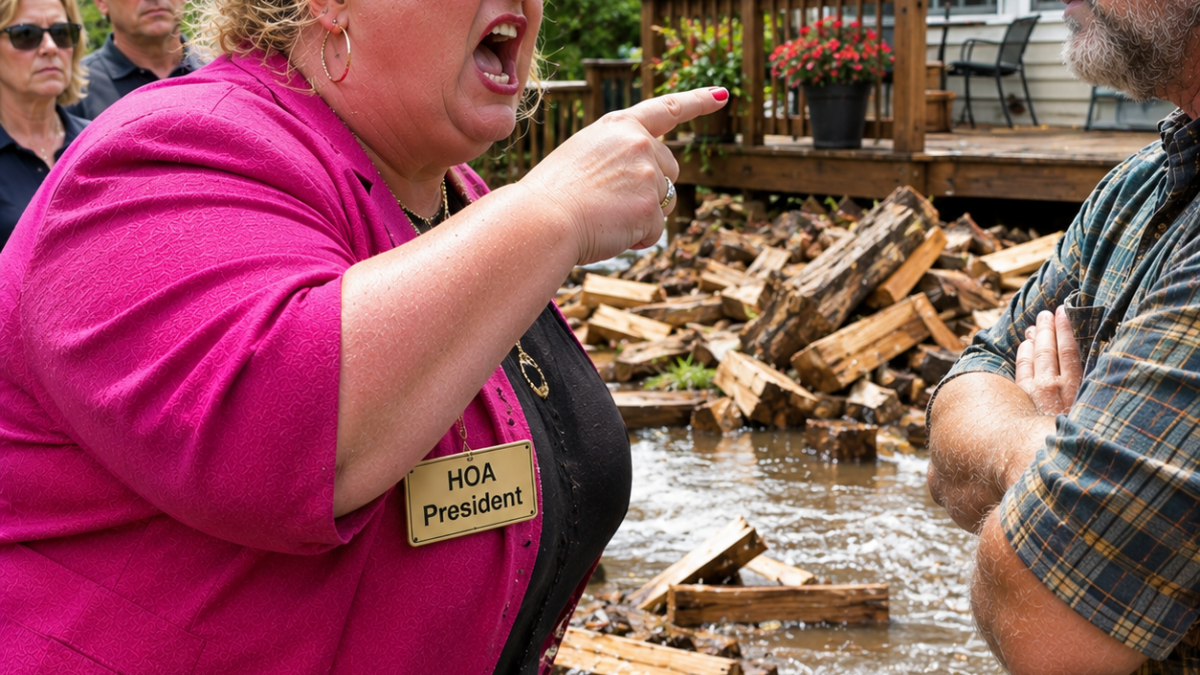
When I stepped onto my back porch and saw Karen Miller directing two hired men to throw three full cords of my seasoned red oak into the creek behind my house, I didn’t shout, because twenty-five years with the Army Corps of Engineers had taught me that the person making the loudest mistake is often the last person you want to interrupt. She claimed my firewood violated a newly invented HOA rule, ignored the privacy fence that hid it from every neighbor, and kept ordering logs into the water even after I told her she was trespassing, destroying nearly two thousand dollars of my property, and obstructing the primary drainage channel for our entire side of Oak Creek Estates. What bothered me most wasn’t watching two years of carefully cured wood disappear into muddy water—it was the way those logs began locking together against the rocks downstream, because I knew exactly what would happen if the weather forecast on my phone was right.
My name is John Peterson, and Sarah and I had bought our house a year earlier because the creek was supposed to make retirement peaceful.
The half-acre lot backed up to a narrow natural channel shaded by maples and sycamores. I had spent months cutting, hauling, splitting, and stacking the oak myself for the wood stove in my workshop. The stack sat well inside my property, behind a ten-foot privacy fence, arranged tightly enough that I could have measured the rows with a level.
Karen still called it an eyesore.
“This is a violation of Aesthetic Ordinance 7.4-B,” she announced as another log splashed into the creek. “I’m authorized to enact immediate remediation.”
“There is no 7.4-B.”
Her mouth tightened.
“The board approved an addendum last month.”
“Then show it to me.”
“You would know about it if you attended meetings.”
I took out my phone and started recording.
Karen glared at the screen.
“You are not allowed to record me.”
“I’m documenting what’s happening on my property.”
“You’re harassing me.”
“You’re throwing my firewood into a waterway.”
She pointed at the workers.
“Keep going.”
One of them hesitated.
Karen snapped, “I’m paying you by the hour.”
Another log went over the wall.
I kept filming.
When the last pieces disappeared into the creek, Karen told me I would receive both a fine and a bill for the labor she had hired to destroy my own property. Then she walked away as if the matter had been settled.
I didn’t follow her.
Instead, I photographed everything.
The disturbed ground.
Bootprints.
Tire marks.
The logs floating against the bank.
Most importantly, the growing obstruction where several heavy pieces had already wedged together.
Back inside, I opened the 140-page Oak Creek Estates covenants.
No 7.4-B.
No secret addendum.
The real firewood rule simply required wood to be stacked neatly and safely.
Mine had been.
I drafted a certified letter to Karen and the board documenting the trespass, destruction of approximately $1,850 worth of property, and the fabricated rule. Then I added a section titled **Hazard Notification**.
I explained that dumping hundreds of logs into Oak Creek had reduced the channel’s capacity and created a foreseeable flood risk downstream during moderate or heavy rainfall. I specifically warned that any resulting erosion, water damage, or property loss could be traced directly to the obstruction.
I mailed one copy to Karen and another to the HOA.
Both return receipts came back signed.
Then I visited George Henderson.
George lived downstream at the creek’s lowest bend. He was in his seventies, retired, quiet, and fiercely proud of the garden he and his wife Mary had spent years building beside his workshop.
I showed him the logjam.
His face changed.
“My roses are right there.”
“I know.”
“Will it flood?”
“If we get enough rain.”
George looked toward the sky.
“So what do we do?”
“I’ve warned the board.”
“And if they ignore you?”
I didn’t answer immediately.
Because my phone had vibrated.
Weather alert.
A Gulf system was moving north.
Three to five inches of rain expected within twenty-four hours.
I looked back at the creek.
The logs had already begun collecting leaves and silt between them.
They no longer looked like firewood.
They looked like a dam.
PART 2
George read the weather alert over my shoulder.
For several seconds he didn’t say anything.
Then he looked from the screen to the creek.
“Three to five inches?”
“That’s what they’re forecasting.”
He walked closer to the bank.
The creek was shallow that afternoon, barely a foot deep through most of the channel, and if you didn’t understand how quickly a small watershed could change during a sustained storm, it looked harmless.
George pointed toward the logs.
“Can we just pull them out?”
That was the obvious question.
And the one I had been asking myself since Karen left.
Physically, yes.
A chainsaw, winch, rope, maybe a couple of men, and we could probably remove most of the wood before the storm.
Legally, however, the situation had become more complicated.
Karen had created the obstruction while claiming to act on behalf of the HOA, and I had already formally notified the board of the hazard. If I started moving the wood on my own and somebody got hurt, or if one of the logs broke loose and damaged infrastructure downstream, Karen would immediately claim I had altered the scene and caused whatever followed.
I hated that calculation.
It made me feel like I was choosing documentation over common sense.
But there was another problem.
Several of the heaviest logs had already jammed beneath exposed roots and against large stones.
The mass was tightening.
Removing them safely would require equipment.
Possibly county authorization.
Definitely more than George and I could accomplish before dark.
“I’m calling public works,” I said.
George nodded.
I stepped away and made the call.
The after-hours clerk took my information.
Creek obstruction.
Private HOA action.
Heavy timber.
Potential flood hazard.
Storm incoming.
She said a county water-management employee could inspect when available.
“When?”
“I can’t promise tonight.”
“The storm starts overnight.”
“I understand.”
“Can you mark this urgent?”
“I already have.”
I hung up.
George looked at me.
“And?”
“They know.”
“That doesn’t sound reassuring.”
“It isn’t.”
I called Karen.
She answered on the sixth ring.
“What now, John?”
“The storm forecast.”
“What about it?”
“Your workers created a major blockage in Oak Creek.”
She sighed.
“You’re still whining about the firewood?”
“Karen, I warned you in writing.”
“And I received your little engineering lecture.”
“Then you know the risk.”
“There is no risk.”
“Three to five inches of rain.”
“It’s a creek. Creeks carry water.”
“Not through a wall of oak.”
She laughed once.
“You’re being melodramatic.”
“Remove the obstruction.”
“You put the wood there.”
I went quiet.
“Say that again.”
“The wood was yours.”
“You ordered men to throw it into the creek.”
“Because you stored it illegally.”
“No.”
“Yes.”
“Karen, I have video.”
“So?”
“Remove the logs.”
“Not my responsibility.”
The line went dead.
I stared at the phone.
George had heard enough.
“She hung up?”
“Yes.”
He looked at the creek again.
For the first time, there was fear in his face.
Not panic.
George was too controlled for that.
But fear.
“I’m moving Mary’s garden tools.”
“Good.”
“My lathe?”
“How heavy?”
“Six hundred pounds.”
I looked toward his workshop.
“Get whatever you can off the floor.”
His expression tightened.
“You really think it’s going to reach the workshop?”
“I don’t know.”
That was the honest answer.
“I hope I’m wrong.”
We spent the next two hours preparing as much as possible.
George and I carried boxes from the workshop onto shelving.
Power tools.
Hand tools.
Finishing supplies.
Wood stock.
His father’s old planes and chisels.
Mary moved photographs and garden equipment.
Sarah came down with plastic storage bins.
Nobody mentioned Karen.
The argument had become irrelevant.
The water would decide what mattered.
By seven that evening, the sky had turned the color of wet slate.
The first rain started just after midnight.
Soft.
Steady.
I lay awake listening.
Sarah rolled toward me.
“You’re not sleeping.”
“No.”
“Creek?”
“Yes.”
“Can you do anything?”
“Not right now.”
She put her hand on my arm.
“Then stop running scenarios.”
“I’m not.”
“You’re counting seconds between heavier bands of rain.”
I looked at her.
“How do you know?”
“Twenty-seven years.”
I stared at the ceiling.
The rain intensified.
Around two in the morning, it became hard enough to drown out the usual sounds of the house.
At three twenty, I got up and looked through the kitchen window.
Standing water covered parts of our lawn.
The creek was still inside its banks near our property.
Barely.
I shined a flashlight toward the logjam.
Water pressed against it.
Brown.
Fast.
Higher than I had ever seen it.
I put on rain gear.
Sarah came into the hallway.
“Where are you going?”
“Backyard.”
“No.”
“I need to see—”
“You can see from here.”
“I need to check George.”
She stepped closer.
“John, don’t go into moving water.”
“I know.”
“Promise.”
“I promise.”
At four-oh-three, my phone rang.
George.
I answered immediately.
“John?”
His voice was almost drowned out by noise.
“What’s happening?”
“It’s over the bank.”
“How bad?”
“Bad.”
“I’m coming.”
“John—”
“I’m coming.”
I took the waterproof flashlight and went out the back.
The rain hit my hood hard enough to make it difficult to hear.
My yard was saturated, but the creek still looked roughly recognizable.
Then I reached the property line.
And stopped.
Downstream, George’s backyard had disappeared.
The creek had become a broad brown sheet spreading over the lowest ground.
Water covered the garden.
Rose bushes that had stood waist-high the day before were submerged almost to their tops.
A small decorative bench floated sideways before catching against a tree.
The workshop sat in darkness with water around its foundation.
George stood on the raised patio under an overhang.
I stayed on the highest ground I could find.
“George!”
He turned the flashlight toward me.
“It came up in twenty minutes!”
I pointed toward the creek.
The logjam was almost completely submerged.
What had been dozens of pieces of separate firewood was now one compact mass trapped against rocks, roots, and debris.
Leaves.
Branches.
Trash.
Everything washed down by the storm had collected against it.
Water had nowhere to go.
It climbed.
Then found the lowest land.
George’s.
Another surge came through.
I heard Mary scream from inside the house.
The water struck the side of the workshop.
Siding flexed.
Then came a cracking sound.
George flinched.
“My tools.”
“Forget the tools.”
“My father’s lathe is in there.”
“We got what we could.”
Another sheet of muddy water rolled across the garden.
I hated myself for what I did next.
But I knew it mattered.
I took out my phone.
Started recording.
Wide shot.
Flooded garden.
Workshop.
Creek.
Then the obstruction.
I narrated the date and time.
“Four twelve a.m. Water is overtopping the bank downstream from the timber obstruction created October fifteenth.”
George looked at me.
“You’re documenting?”
“Yes.”
He understood.
His face tightened.
“Do it.”
I zoomed toward the dam.
Water thundered against the oak.
One log shifted.
Another rotated.
But the mass held.
The channel had become a choke point.
The flood kept spreading.
At dawn, rain finally weakened.
Gray light revealed the damage.
It was worse than darkness had allowed us to understand.
George’s garden looked as though somebody had dragged a river through it.
Mud covered everything.
Roses flattened.
Mulch gone.
Decorative stone displaced.
The workshop had taken almost three feet of water.
Its door hung crooked.
Insulation protruded through damaged siding.
Inside, tools sat in black water.
The lathe.
Table saw.
Joiner.
Cabinets.
Lumber.
Boxes.
All of it.
Mary stood beside George.
She looked at the garden.
Then bent down and lifted one broken rose cane from the mud.
Her lips trembled.
“My mother brought that from England.”
George put his arm around her.
She kept staring at the stem.
That moment did more to me than the destroyed workshop.
Insurance can price a table saw.
It can estimate drywall.
It can depreciate a lathe.
Nobody can write a meaningful number beside a plant grown from a cutting your mother carried across an ocean.
Sarah arrived with coffee.
Mary couldn’t drink hers.
Around nine, George’s insurance adjuster arrived.
Her name was Ms. Albright.
Sharp eyes.
Practical shoes.
No wasted words.
She photographed the waterline.
Workshop.
Foundation.
Garden.
Then George handed her the thumb drive I had prepared.
“What is this?”
“Video.”
“Of the flood?”
“Before the flood.”
She looked at me.
I explained.
Karen.
Firewood.
Workers.
Creek.
Certified warning.
Ms. Albright inserted the drive into her tablet.
She watched my first recording.
Karen directing the workers.
**Get the rest of it.**
Then she read the letter.
The hazard notification.
The line about a foreseeable downstream flood.
Her face changed.
Not dramatically.
Professionals are good at hiding reactions.
But the neutral insurance-adjuster expression disappeared.
She looked toward the logjam.
Then toward George’s destroyed workshop.
“This wasn’t caused by weather alone.”
George rubbed his face.
“What does that mean?”
“It means your policy will respond according to coverage, but we’re also looking at third-party liability.”
“Whose?”
She didn’t answer immediately.
Then:
“The person who created the obstruction.”
A county water-management truck arrived minutes later.
The inspector walked the creek.
Measured.
Photographed.
Asked me to show him the original location of the woodpile.
He looked at the privacy fence.
Then at the creek.
“So the wood was here?”
“Yes.”
“And workers carried it over that wall?”
“Yes.”
“Not washed from the stack?”
“No.”
“Video?”
I showed him.
He watched once.
Then again.
He looked at the obstruction.
“That’s direct dumping.”
“Yes.”
“Into a county-regulated waterway.”
“Yes.”
He wrote something on his clipboard.
“Who ordered it?”
Before I could answer, a pearl-white SUV pulled up.
Karen.
Of course.
She emerged wearing a navy suit and an expression of grave concern.
“George!”
She hurried across the lawn.
“Mary! I came as soon as I heard.”
Mary didn’t even turn.
Karen surveyed the damage.
“This storm was unbelievable.”
Ms. Albright looked at her.
“Are you Karen Miller?”
Karen straightened slightly.
“I am. President of Oak Creek Estates.”
“Were you the person who ordered firewood placed in this creek on October fifteenth?”
Karen’s concern vanished.
She glanced at me.
“That’s a ridiculous way to describe what happened.”
“How would you describe it?”
“I was correcting an HOA violation.”
“The wood went into the creek?”
“It had been improperly stored near the creek.”
I almost interrupted.
Ms. Albright didn’t need me.
“Did you instruct workers to carry it from Mr. Peterson’s property and throw it into the creek?”
Karen’s eyes narrowed.
“Again, I was performing remediation.”
The county inspector looked up.
“Ma’am.”
Karen turned toward him.
“Our preliminary assessment indicates the obstruction was formed by timber deliberately placed in the channel.”
Karen’s face hardened.
“The storm moved everything.”
He pointed upstream.
“These logs are interlocked at the same location they were initially deposited. They have trapped additional debris, reduced channel capacity, and contributed materially to the overbank flooding.”
Karen’s cheeks reddened.
“You can’t know that already.”
“I manage waterways for the county.”
“Well, John claims he’s an engineer too. Everybody suddenly thinks they’re an expert.”
He ignored that.
“Dumping solid material into this channel without authorization violates county environmental code.”
Karen’s mouth opened.
He continued.
“We’ll issue a formal notice.”
She turned toward me.
“This is your fault.”
I actually thought I’d misheard her.
“My fault?”
“If you hadn’t stacked all that wood near the creek—”
“It wasn’t near the creek.”
“It was on your property.”
“Yes.”
“So?”
Ms. Albright interrupted.
“Ms. Miller.”
Karen swung toward her.
“I have a timestamped recording showing you directing workers to place the wood in the channel.”
Karen’s expression froze.
“I also have a certified letter received by you and the HOA specifically warning that the obstruction created a severe flood risk.”
She lifted the tablet.
“The warning describes almost exactly what happened here.”
Karen’s eyes flicked toward George.
Then Mary.
Then the flooded workshop.
For the first time since I had met her, something close to fear appeared.
Ms. Albright said:
“This is not simply a weather claim.”
She looked directly at Karen.
“There is potential personal liability.”
Personal.
That word landed.
Karen had spent years hiding behind:
**The board.**
**The association.**
**The covenants.**
Now somebody had removed the shield.
She said:
“I was acting in my official capacity.”
Ms. Albright’s response was simple.
“That will be for counsel to evaluate.”
Karen left twenty minutes later.
No dramatic speech.
No threats.
She got into her SUV and drove away.
George’s insurance carrier acted quickly.
Emergency cleanup.
Drying equipment.
Temporary repairs.
Debris removal.
They also issued formal notice that the company intended to pursue subrogation against the responsible parties.
George and Mary came to our house several days later.
Mary looked exhausted.
George looked worse.
Sarah put dinner in front of them.
For ten minutes nobody discussed money or lawyers.
Then George said:
“The adjuster keeps talking about depreciation.”
I nodded.
“Normal.”
“My father’s tools.”
His voice broke slightly.
“He bought some of those before I was born.”
Mary touched his arm.
“And the roses.”
George nodded.
“How do you depreciate that?”
“You don’t.”
He looked at me.
“What do we do?”
“You need your own lawyer.”
“The insurer has one.”
“The insurer’s lawyer represents the insurer.”
“Who do you know?”
Tom Donovan.
Retired JAG.
Property litigation.
Insurance disputes.
The kind of man who sounded irritated even when he was happy.
I gave George the number.
Tom called me a week later.
“John Peterson?”
“Yes.”
“George Henderson gave me your evidence file.”
“Okay.”
“I need to tell you something.”
“What?”
“You may be the most annoying witness I’ve ever hoped to have.”
I smiled.
“Why?”
“Because you documented everything.”
“That makes me annoying?”
“To the defense.”
He laughed.
“The certified letter is beautiful.”
“Never heard anyone call certified mail beautiful.”
“You predicted the mechanism of damage, notified the responsible party, confirmed receipt, then documented the exact predicted event.”
“I would rather have been wrong.”
“I believe you.”
His tone changed.
“This is serious.”
“I know.”
“Karen had no written authority?”
“None I could find.”
“No board vote?”
“Not according to Maria.”
“You have a board source?”
“Yes.”
“Excellent.”
“What are you thinking?”
“Gross negligence. Recklessness. Trespass. Property destruction. Potential punitive exposure.”
“How much?”
“George and Mary are still obtaining final estimates, but I’m preparing a demand and complaint in the neighborhood of two hundred thirty thousand.”
I stopped.
“Two hundred thirty?”
“Roughly one-fifty for restoration, workshop damage, tools, landscaping, related losses. Thirty for diminished property value and flood stigma. Fifty punitive.”
“That’s huge.”
“So was the damage.”
“Do you expect that number?”
“I expect Karen’s lawyer to understand what a jury could do after watching your video and reading your letter.”
The lawsuit was filed the following Monday.
George and Mary Henderson against Karen Miller personally, with the HOA named where necessary to resolve coverage and liability.
Amount sought:
$230,000.
Karen was served at home.
I didn’t witness it.
A neighbor did.
According to him, she opened the door, saw the process server, and said:
“I do not accept unsolicited materials.”
The server replied:
“It’s not a pizza, ma’am.”
Then left the papers.
I would have paid money to see Tom’s face when he heard that story.
The real blow came from insurance.
Maria called me late one afternoon.
Her voice barely above a whisper.
“John.”
“Yeah?”
“We had an executive session.”
“How bad?”
“Terrible.”
“What happened?”
“Karen demanded the HOA’s D&O carrier pay for her lawyer.”
“And?”
“The broker was on the call.”
She paused.
“He said directors-and-officers coverage protects board members for covered errors and omissions committed within their duties.”
“That sounds normal.”
“He also said intentional, malicious, willful, or criminal conduct may be excluded.”
I leaned back.
“The illegal dumping.”
“Yes.”
“And the letter.”
“Yes.”
The insurer had issued a preliminary denial of personal coverage.
Karen would have to fund much of her own defense while the coverage questions played out.
“How did she take it?”
Maria exhaled.
“She screamed.”
“At who?”
“Everybody.”
“She threatened to sue the carrier. Then the board. Then George.”
“Me?”
“You too.”
“Of course.”
Maria’s voice changed.
“John, she’s falling apart.”
I didn’t feel the satisfaction I expected.
Not yet.
Because desperate people often become more dangerous before they become reasonable.
Karen proved that a week later.
Every household in Oak Creek Estates received a special assessment notice.
Five hundred dollars per home.
Emergency legal defense fund.
The letter described a “malicious legal attack against the association” allegedly orchestrated by me and George.
It warned that the neighborhood’s financial stability and property values were under threat.
Sarah read it at the kitchen table.
Then looked at me.
“She wants everyone else to pay her lawyer.”
“Looks that way.”
“Can she do that?”
“Not like this.”
I called Maria.
“Was there a board vote?”
“No.”
“Budget authorization?”
“No.”
“Then where did this come from?”
“She drafted it herself.”
“Article Nine?”
“She cited it.”
“Does it give the president unilateral assessment authority?”
“No.”
“How many homeowners?”
“About a hundred fifty.”
I did the math.
Seventy-five thousand dollars.
War chest.
Paid by neighbors.
For Karen’s personal exposure.
That was the moment the neighborhood stopped being afraid.
My phone started ringing.
People I’d barely spoken to.
“Is this true?”
“Are we being sued?”
“Is George taking our HOA?”
“Why is Karen personally named?”
“Why won’t insurance pay her?”
I answered the same way every time.
“Come to the next meeting.”
Then I sent an email.
No insults.
No speculation.
Just evidence.
Video of Karen directing the dumping.
Certified warning letter.
Return receipt.
Photos of George and Mary’s property.
Redacted insurance-language summary showing intentional and criminal acts might not be covered.
Then one paragraph:
**The lawsuit arises from a specific unauthorized act by Karen Miller. Before paying any special assessment, homeowners should demand the board disclose who authorized that assessment, what legal expense it is intended to fund, and whether the association’s carrier has accepted or denied coverage.**
The email spread.
By Saturday afternoon, neighbors were standing in my driveway.
A young father I’d seen at meetings came holding a violation notice.
“Basketball hoop.”
A retired woman had paperwork over azaleas.
Another man had fines over a trash bin.
Someone else had a warning because Christmas lights stayed up until January fourth.
Everyone had a story.
For years Karen had dealt with them separately.
One at a time.
Fear works best in isolation.
Now they were comparing notes.
A recall petition started on the hood of my truck.
Required threshold:
Twenty-five percent.
By sunset, more than seventy percent of households had signed.
Tuesday night’s meeting was standing room only.
Karen looked stunned when she entered.
Usually, HOA meetings drew fifteen people.
Twenty on a controversial night.
Now the library community room overflowed into the hallway.
Karen banged the gavel.
“Meeting will come to order.”
Nobody became quiet.
She tried again.
“We have several routine items—”
“Recall petition!”
The voice came from the back.
Karen froze.
“That is not on the agenda.”
Another homeowner stood.
“We move to amend the agenda.”
Maria raised her hand.
Her hand was trembling.
Her voice wasn’t.
“Karen, the bylaws require a recall petition signed by twenty-five percent of members to be addressed promptly.”
Karen turned toward her.
The look she gave Maria was pure betrayal.
Maria didn’t lower her eyes.
That mattered.
The petition reached the table.
More than seventy percent.
Karen flipped through pages as though hoping the signatures would disappear.
“They haven’t been verified.”
The treasurer, Frank, said:
“We can verify them now.”
She glared at him too.
One by one, people who had spent years avoiding Karen’s anger stopped caring whether she was angry.
That is how authority disappears.
Not all at once.
Person by person.
I stood.
“Before the recall vote, I think residents deserve information about the assessment.”
Karen immediately said:
“No.”
Frank, the treasurer, looked at the crowd.
“I agree with John.”
Another board member nodded.
Karen’s head turned sharply.
“Excuse me?”
“We need transparency.”
I connected the projector.
First:
Video.
Karen in the fuchsia tracksuit.
Workers carrying my firewood.
Her voice:
**Get the rest of it.**
The room went silent.
Then the fabricated ordinance.
Then Karen saying I would be billed.
I stopped the video.
Next slide:
The actual covenants.
No 7.4-B.
Actual firewood rule.
Neat and safe storage.
A man said:
“She made up the rule?”
I answered:
“The written documents don’t contain the rule she cited.”
Next:
My certified letter.
Hazard Notification highlighted.
I read only the important sentence.
**The debris dam poses a severe flood risk to downstream properties in the event of moderate to heavy rainfall.**
Then:
Return receipt.
Karen’s signature.
Next:
George’s garden under water.
Workshop.
Three-foot waterline.
Mud.
Mary standing beside the ruined roses.
Someone behind me whispered:
“Jesus.”
Then:
Insurance coverage language.
Intentional.
Willful.
Criminal acts.
Potential exclusions.
I looked at the room.
“This assessment is being presented as a community defense.”
I turned toward Karen.
“But residents deserve to know whether it is actually intended to fund Karen’s personal defense after her carrier questioned coverage.”
Karen stood.
“You are lying.”
I didn’t argue.
“Then show the board vote authorizing the assessment.”
She said nothing.
“The minutes?”
Nothing.
“Carrier acceptance of your defense?”
Her mouth tightened.
“This information is confidential.”
Frank the treasurer cleared his throat.
“No.”
Karen looked at him.
“What?”
“The carrier denied preliminary personal coverage.”
A murmur spread.
Frank continued.
“I was in the executive session.”
“You are violating confidentiality.”
“I’m correcting a material omission in an assessment notice sent to every homeowner.”
The room erupted.
Karen slammed the gavel.
“You will not undermine me in this manner!”
Maria stood.
“Karen, you sent homeowners a bill without a board vote.”
“Sit down.”
“No.”
That one word changed the room.
Karen stared at Maria.
The quiet librarian.
The woman who had probably spent years saying yes because confrontation exhausted her.
Maria said it again.
“No.”
The treasurer moved to rescind the special assessment.
Seconded immediately.
Four board members voted yes.
Karen abstained.
The five-hundred-dollar fee died on the spot.
Then Maria moved for a vote of no confidence and immediate removal under the recall petition.
Frank seconded.
Hands went up.
Rows.
Dozens.
Almost everyone.
When the call came for opposition, nothing moved.
Not even Karen’s hand.
She sat rigid.
Frank looked toward her.
“Karen.”
No response.
“Your presidency is terminated.”
Her fingers tightened around a stack of papers.
“You don’t have the authority.”
“The members just voted.”
“This is illegal.”
“Then you can challenge it through the process.”
That sentence was almost too perfect.
Karen had told so many people the same thing.
She stood.
For a moment I thought she would throw the gavel.
Instead, she placed it on the table.
Collected her papers.
Walked out.
Nobody cheered.
The entire room exhaled.
That was more powerful.
The lawsuit continued.
Removing Karen from the board did not erase George’s workshop.
It didn’t replant Mary’s roses.
It didn’t undo the flood.
Tom Donovan scheduled Karen’s deposition.
He later told me it was one of the ugliest three hours he’d spent with a witness.
Karen tried every explanation.
The firewood was illegally stored.
No written basis.
The workers misunderstood.
Video contradicted her.
The storm was unprecedented.
County rainfall records showed it was heavy but not outside historical experience.
George’s grading was defective.
County inspection found no such cause.
The creek would have flooded anyway.
Hydrology analysis disagreed.
Then Tom produced my certified letter.
“Mrs. Miller, is this your signature?”
Karen looked.
“Yes.”
“You received the warning?”
“I received an envelope.”
“Did you read it?”
“I receive a great deal of correspondence.”
“Did you read it?”
“I don’t remember.”
Tom slid a copy forward.
“Please read the highlighted section.”
She did.
Silently.
“Out loud.”
Her voice tightened.
She read the flood warning.
Tom asked:
“What did you do after receiving it?”
“I was not responsible for his wood.”
“Did you call the county?”
“No.”
“Hire a crew to remove the obstruction?”
“No.”
“Ask Mr. Peterson to remove it?”
“No.”
“Warn Mr. Henderson?”
“No.”
“Did you take any action?”
“No.”
Tom waited.
Then:
“Why?”
Karen said:
“I’m not a hydrology expert.”
Tom leaned forward.
“No. But Mr. Peterson spent twenty-five years with the Army Corps of Engineers, and he told you exactly what could happen.”
Objection from her attorney.
Tom rephrased.
“You were warned by someone with relevant professional experience that the logs you ordered dumped into the creek could cause downstream flooding.”
“Yes.”
“And you did nothing.”
“I didn’t believe him.”
“Why?”
“He was angry.”
“Did anger make the laws of water flow differently?”
Her attorney objected again.
Tom smiled.
He had his answer.
Then came the special assessment.
“Mrs. Miller, your insurer had raised exclusions regarding your personal defense before the five-hundred-dollar assessment notice was issued, correct?”
“I don’t recall.”
Tom handed her the email.
She stared.
“Yes.”
“Did your assessment notice disclose that?”
“No.”
“Did it disclose the lawsuit named you personally?”
“It was a community matter.”
“That wasn’t my question.”
“No.”
“Was there a board vote?”
Karen shifted.
“The president has emergency authority.”
“Show me where.”
She couldn’t.
By the end, her lawyer requested a break.
Fifteen minutes later, they returned.
Tom made one offer.
No negotiation.
$230,000.
Full settlement.
Secured by lien against Karen’s house.
Otherwise, trial.
George and Mary were prepared to go before a jury.
Video.
Certified warning.
County report.
Insurance investigation.
Deposition.
Everything.
Karen’s attorney asked for a private conference.
They left.
George later told me that waiting felt longer than the flood.
Twenty-three minutes.
Door opened.
Karen’s lawyer returned first.
Karen behind him.
She looked exhausted.
He sat.
“We settle.”
The agreement was drafted that afternoon.
$230,000.
Personally owed by Karen Miller.
Payment schedule.
Lien securing the debt against her home.
The war ended not with a courtroom verdict, but with signatures.
The first money went where it needed to go.
George and Mary’s immediate uninsured losses.
Professional landscape restoration.
Workshop repairs.
Tool replacement.
Insurance subrogation.
Their lawyer fees as provided through settlement structure.
Mary’s roses were the hardest part.
A landscape architect helped identify old varieties based on photographs.
Some could not be matched exactly.
Then something unexpected happened.
Mary’s sister in England found descendants of several original rose cuttings growing in her own garden.
She shipped propagation material through the proper agricultural process.
Months later, Mary planted descendants of the same family roses.
Not the originals.
But related.
I stood nearby while she pressed soil around the first one.
George asked:
“You okay?”
Mary wiped her cheek with the back of her glove.
“I’m fine.”
She wasn’t.
Neither was I.
Some restoration happens through contracts.
Some through family.
Karen’s house went on the market within a month.
Lien.
Settlement obligation.
Legal expenses.
No HOA-funded defense.
She needed liquidity.
The pearl-white SUV remained in the driveway while showings happened.
Her lawn stayed perfect.
That detail almost hurt.
For years she had used that lawn as proof of moral superiority.
Now strangers walked across it deciding whether the house was worth their offer.
On moving day, I watched from my kitchen.
Not proudly.
Not with satisfaction.
Just because the truck was hard to miss.
Karen wore plain slacks and a sweater.
No power suit.
No fuchsia tracksuit.
No clipboard.
She looked tired.
Smaller.
At one point she stood beside the SUV while movers carried boxes past her.
She glanced toward my house.
Our eyes met through the window.
I didn’t wave.
Neither did she.
There are moments when silence is kinder than anything you could say.
Then she drove away.
Sarah came beside me.
“You wanted this.”
“Her leaving?”
“Consequences.”
“Yes.”
“Does it feel good?”
I thought.
“No.”
“Why?”
“Because George’s garden still flooded.”
She leaned against the counter.
“That’s probably why you’re not her.”
That was enough.
The neighborhood held a special election.
To my horror, residents nominated me for interim president.
I refused.
Then they nominated me again.
Sarah voted yes.
I stared at her.
“What?”
“You’ve complained about leadership for a year.”
“That doesn’t mean I want the job.”
“Exactly why you should do it.”
I accepted on one condition.
Temporary.
My job was to make the HOA less dependent on personalities.
First meeting.
No dramatic gavel.
No speeches.
I put the covenants on the table.
“Our rules became weapons.”
Nobody disagreed.
We hired legal help to clean them up.
Vague phrases like **aesthetically pleasing** were narrowed or removed where possible.
Objective standards replaced Karen-style personal interpretation.
No fabricated rules.
No surprise addenda.
Enforcement required written authority.
Notice.
Cure period.
Documented board action where required.
Appeals became real appeals.
Not a performance before the same person who issued the fine.
We also addressed the creek.
The last waterlogged logs had to come out professionally.
An environmental contractor removed debris.
Dredged accumulated silt where appropriate.
Stabilized damaged banks.
Restored channel geometry.
The HOA reserve funded part of the work.
At the first meeting where I proposed using association money for the creek, somebody asked:
“Why should we pay for Karen’s mistake?”
Fair question.
“Because the creek is shared infrastructure.”
“But she caused it.”
“Yes.”
“And she paid settlement money.”
“To George and Mary.”
“So why us?”
“Because leaving the channel unstable to prove a philosophical point would be stupid.”
Silence.
Then George, sitting in the back, said:
“Fix the creek.”
Motion passed.
The contractor finished before spring rains.
For the first time since the flood, I could stand near the bank without automatically calculating obstruction ratios.
Water moved cleanly.
No wall of timber.
No backed-up silt.
Just a creek doing what creeks do.
George’s workshop took longer.
Walls opened.
Insulation removed.
Electrical systems inspected.
Machinery evaluated.
Some tools salvageable.
Others destroyed.
His father’s old lathe was ruined.
That one hurt.
A modern replacement arrived months later.
Technically better.
More accurate.
Safer.
George stared at it.
“Nice machine.”
“You don’t sound convinced.”
“It isn’t Dad’s.”
“No.”
He ran one hand over the new bed.
Then:
“But Dad would’ve liked it.”
That was progress.
Mary’s garden came back the following spring.
Not identical.
She didn’t want identical anymore.
The landscape architect redesigned drainage.
Raised several beds.
Added native plants near the creek.
Replanted heirloom roses farther from flood exposure.
When the first one bloomed, Mary cut a single flower.
Brought it to our house.
Sarah put it in a glass by the kitchen window.
No speech.
No explanation.
We all knew what it meant.
The new HOA behaved differently.
At first, residents attended meetings in huge numbers.
People were suspicious.
They wanted receipts.
Minutes.
Votes.
Contracts.
Good.
Then attendance gradually dropped.
Also good.
Healthy governance is boring enough that people don’t feel they need to supervise every meeting personally.
We still argued.
Parking.
Pool hours.
Tree trimming.
Whether a playground should have rubber surfacing or mulch.
Normal disagreements.
Nobody threatened liens because they lost an argument.
Maria became board secretary.
The woman who once whispered information to me now read meeting minutes aloud in a clear voice.
The treasurer, Frank, stayed another term.
He apologized publicly for failing to challenge Karen sooner.
Not dramatically.
“I knew some things didn’t feel right,” he said. “I kept telling myself they weren’t serious enough to fight over.”
He looked at the room.
“I was wrong.”
I respected that.
Not everyone who enables a bully is a bully.
Sometimes they are simply afraid of conflict.
But fear still has consequences.
One afternoon, months after the lawsuit settled, I received a certified envelope.
My stomach tightened automatically.
Old conditioning.
Inside was a refund check.
The HOA returned several improper fines Karen had assessed against me during her presidency.
Including a fee for “remediation labor” connected to the firewood incident.
Sarah looked at the amount.
“How much?”
“Not much.”
“What are you going to do with it?”
“Buy firewood.”
She laughed.
I did.
But this time, I stacked it differently.
Not because Karen had been right.
She hadn’t.
I built a raised covered shed farther from the creek.
Dave, one of the neighbors, saw it.
“Thought the old stack was legal.”
“It was.”
“Then why change?”
“Better drainage. Easier access.”
He smiled.
“Karen would claim victory.”
“She can claim whatever she wants.”
He looked toward the creek.
“She gone.”
“Exactly.”
That was another lesson.
Winning doesn’t mean refusing to improve anything your opponent criticized.
It means being free to make improvements for your reasons, not because somebody bullied you.
I stepped down as interim president as soon as the permanent board was elected.
Arthur, another retired professional in the neighborhood, took over.
I went back to being a homeowner.
That transition mattered to me.
Too many stories about bad authority end with the hero taking the same chair and deciding they can use it better.
Maybe.
But the healthiest outcome is often a chair that matters less.
Power should be limited enough that you don’t need a saint sitting in it.
My life returned to the workshop.
The new wood stove.
Firewood.
Sarah.
Creek.
Ordinary things.
George and I became closer than we had been before.
Trauma does that sometimes.
Not always.
But sometimes.
One evening in late spring, he invited us over for barbecue.
His restored patio looked different.
Better drainage.
New furniture.
The garden was thriving.
Water moved through Oak Creek with a low steady sound.
George handed me a beer.
We stood near the spot where the floodwater had once reached his workshop.
He looked around.
“You know something?”
“What?”
“I almost hate saying this.”
“Then don’t.”
“In a weird way, the place is better now.”
I laughed.
“Mary hear you say that?”
“She said it first.”
Mary called from the grill:
“I said the drainage was better, not that I enjoyed being flooded!”
George grinned.
“See?”
I looked toward the garden.
The new roses were blooming.
Workshop lights on.
Creek clear.
“I get what you mean.”
George grew quiet.
“Still wish it never happened.”
“Of course.”
“But we’re here.”
“Yeah.”
He lifted his bottle.
“To not drowning.”
I tapped mine against his.
“A low bar.”
“Best kind.”
Sarah and Mary laughed behind us.
The sun dropped lower.
Oak Creek reflected orange through the trees.
For a while, none of us talked about Karen.
That was perhaps the most important detail.
She had dominated our lives for months.
The strongest sign that the conflict was over wasn’t the settlement.
It was forgetting to mention her at dinner.
Years later, people still told the firewood story.
Usually wrong.
They made it sound like I had deliberately left the logs in the creek because I wanted the flood to happen.
That wasn’t true.
I warned the HOA.
Called public works.
Warned George.
Helped move what we could.
I hoped the storm would weaken.
It didn’t.
I would never call what happened a clever revenge plan.
George lost too much for that.
Mary lost too much.
The satisfying part came afterward.
Karen created a danger because she wanted to prove she could.
I documented it.
Warned her.
She ignored the warning.
When consequences arrived, the evidence prevented her from rewriting what she had done.
That was justice.
Not the flood.
The flood was damage.
There’s a difference.
The $230,000 settlement didn’t make George happy.
It made rebuilding possible.
The lien didn’t give me pleasure.
It made the agreement enforceable.
Karen losing her presidency didn’t restore the roses.
It stopped her from using the HOA to hurt someone else.
That distinction mattered more as I got older.
Anger wants somebody to suffer.
Justice wants harm acknowledged, repaired where possible, and prevented from happening again.
For a while, I had both feelings.
I’m not proud enough to deny it.
The morning after the flood, standing in mud while Karen blamed me, I wanted her destroyed.
Financially.
Socially.
Completely.
Then I watched George pick rusted tools out of his workshop.
Watched Mary lift broken rose branches from mud.
And something changed.
Karen’s destruction became less interesting than their restoration.
That shift probably saved me from becoming obsessed with her downfall.
One autumn evening, years after she left, I was splitting oak near the new woodshed.
George walked over.
Older now.
So was I.
“You still stack that stuff like the Army’s inspecting it.”
“There’s a correct way.”
“It’s firewood.”
“Exactly.”
He picked up one split log.
“Red oak?”
“Yes.”
“Seasoned?”
“Eighteen months.”
“Karen would’ve hated it.”
“Karen hated breathing if someone else was doing it wrong.”
George laughed.
Then we both went quiet.
The joke felt meaner than it once would have.
He set the log down.
“You ever wonder where she ended up?”
“No.”
He looked at me.
“Really?”
“Not anymore.”
That was true.
There had been a time I wanted updates.
Did she regret it?
Did she blame me?
Was she miserable?
Had she learned anything?
Eventually, I understood none of those answers changed my life.
George’s garden mattered.
My creek mattered.
The neighborhood mattered.
Sarah mattered.
Karen’s inner life was hers.
The last thing I wanted was to spend retirement carrying it.
We finished stacking the wood.
Then walked to the creek.
The water was low.
Clear enough to see stones on the bottom.
A few leaves floated downstream.
Nothing blocked them.
George pointed at the bend where the dam had formed.
“Hard to picture it.”
“I can picture it.”
“Me too.”
His workshop stood behind him.
New siding.
New tools.
Door open.
Mary’s roses beyond it.
“You know,” he said, “my father always told me tools are supposed to be used, not worshipped.”
“He’d probably like the new lathe.”
“I think so.”
He smiled.
“I still miss the old one.”
“Both can be true.”
He nodded.
That phrase had become useful over the years.
You can rebuild and still grieve.
You can forgive without pretending nothing happened.
You can feel compassion for somebody facing consequences without excusing what they did.
You can win a lawsuit and still wish there had never been a reason to file one.
Sarah called from our porch.
“Dinner!”
George looked toward his house.
“Mary’s cooking too.”
“Then why are you coming to mine?”
“Your wife cooks better.”
“I’m telling Mary.”
“You wouldn’t.”
I absolutely did.
George nearly lost dessert.
That was life afterward.
Not cinematic.
Better.
One winter night, I lit the stove in my workshop.
The new stack of oak had dried perfectly.
One split log caught.
Then another.
Heat built slowly.
I sat on the bench with a cup of coffee.
Outside, snow had started falling.
The creek moved under a thin edge of ice.
Years earlier, the firewood Karen threw away represented two winters of preparation.
At the time, losing it had felt like the entire insult.
Almost two thousand dollars.
Months of labor.
Personal property.
But those losses ended up becoming the smallest numbers in the story.
The flood.
The workshop.
The garden.
The legal expenses.
The $230,000 settlement.
The home Karen had to sell.
All because she couldn’t accept one simple boundary:
My property was not hers to manage however she wanted.
I added another log to the stove.
It settled with a dull crack.
For a second I remembered the sound of the old oak hitting the creek.
Splash.
One after another.
I remembered Karen standing there.
Confident.
Certain.
Untouchable.
Then I remembered the same woman at the recall meeting, unable to find a single hand raised in her defense.
Power can disappear quickly when people realize it was built mostly from their willingness to obey.
Outside the workshop window, Oak Creek kept moving.
Clear water.
Open channel.
No debris dam.
No flood.
No Karen.
Just the sound of water passing through the place where it belonged.
That was the ending I cared about.
Not the lawsuit.
Not the lien.
Not the moving truck.
The creek was clear.
George’s roses were blooming again.
His workshop lights came on most evenings.
The HOA had gone back to managing common property instead of people’s lives.
And my firewood sat under a roof, dry and stacked exactly the way I liked it.
The last thing Karen ever tried to throw away had become, in the strangest possible way, the thing that forced our entire neighborhood to stop throwing away common sense.
[END OF STORY]








