PART 2: HOA Karen Dumped My $1,850 Firewood Into the Creek—Then the Flood She Created Cost Her $230,000
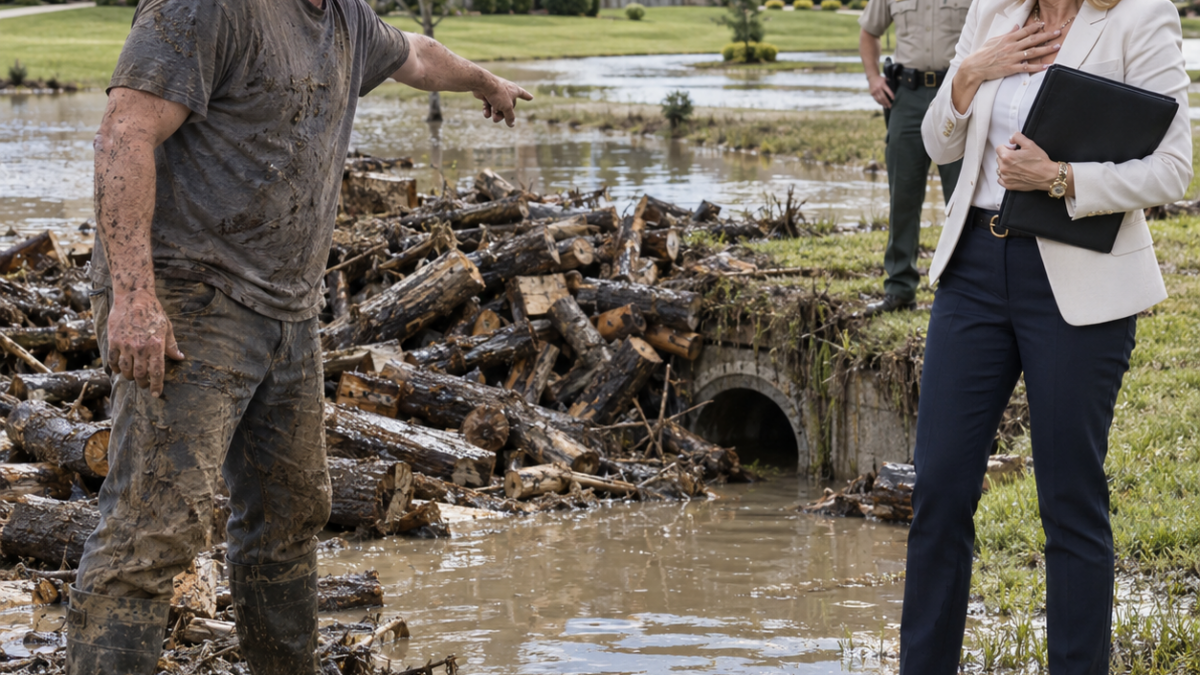
The first piece of oak hit the creek while I was still standing on my back porch holding my morning coffee, and the woman ordering it thrown there smiled as if she were doing me a favor.
By the time I reached the bottom of my yard, nearly two years of seasoned firewood was floating downstream because our HOA president had invented a rule that did not exist.
What Karen did not understand was that I had spent twenty-five years studying what happens when you obstruct moving water, and the sky above Oak Creek was already beginning to change.
“Stop.”
I didn’t shout.
I didn’t need to.
The two men standing beside my woodpile froze immediately.
Karen Miller turned toward me with a clipboard pressed against her chest and the smug expression she wore whenever she believed the letters HOA gave her authority over another human being.
She was wearing a bright fuchsia tracksuit that morning, spotless white sneakers, and enough perfume that I could smell it from twenty feet away.
“John,” she said brightly. “Perfect timing. I’m correcting a serious compliance issue.”
I looked past her.
Three cords of seasoned red oak had been stacked against the rear wall of my property.
I had cut much of it myself.
Split it.
Rotated it.
Covered it through two wet seasons.
Restacked it when necessary.
It was fuel for the wood stove in my workshop, enough to carry me through two winters.
Now hundreds of those logs were scattered through the creek behind my house.
Some floated slowly.
Others had already lodged against stones and exposed roots.
One of the workers still held a split oak log against his chest.
“Put that down,” I told him.
He looked at Karen.
Karen pointed toward the creek.
“Continue.”
He hesitated.
Then dropped it onto the grass instead.
Good man.
“What exactly,” I asked Karen, “do you think you’re doing?”
She lifted the clipboard.
“Immediate remediation under aesthetic ordinance 7.4-B. Firewood may not be stored where it is visible from community areas.”
I looked toward the ten-foot privacy fence on one side of my property.
Then toward the dense woods beyond the creek.
Then back at her.
“Visible to who?”
“That is irrelevant.”
“There is no ordinance 7.4-B.”
Her mouth tightened.
“I assure you there is.”
“I’ve read every page of the covenants.”
“The board approved an addendum.”
“When?”
“Last month.”
“Show me.”
“I don’t have to justify board decisions to you while enforcing them.”
That was when I took out my phone.
Her expression changed immediately.
“What are you doing?”
“Recording.”
“You do not have permission.”
“I’m standing on my property.”
“This is harassment.”
“No. This is documentation.”
I slowly moved the camera toward the creek.
Logs were collecting at a narrow bend where the channel tightened between two raised banks.
I had spent twenty-five years with the Army Corps of Engineers.
I knew drainage.
I knew culverts.
I knew flow restrictions.
And I knew exactly what hundreds of heavy pieces of timber could become once leaves, branches, mud, and storm debris began collecting between them.
A dam.
An accidental one perhaps.
But a dam nevertheless.
“Karen,” I said, still recording, “you need to have every piece of that wood removed from the creek.”
She laughed.
“You’re the person who created the violation.”
“My firewood was on my land.”
“And now it isn’t.”
“That creek drains half this section of the neighborhood.”
“That isn’t my concern.”
“It becomes your concern when you block it.”
She stepped closer.
“You think because you’re some retired engineer you know better than the board?”
“Yes.”
That stopped her.
I kept my voice even.
“On this subject, absolutely.”
Her cheeks flushed.
“You veterans are all the same. You believe rules don’t apply to you.”
“The actual rules apply to me. The imaginary ones don’t.”
I pointed toward the water.
“If those logs stay there and we get serious rain, they’ll collect debris and choke the channel. The lowest property downstream belongs to George Henderson. His garden and workshop could flood.”
Karen rolled her eyes.
“Now you’re being dramatic.”
“No.”
I moved the camera closer to her face.
“I’m giving you a warning.”
She turned toward the workers.
“Finish the job.”
Neither man moved.
Karen’s voice sharpened.
“I’m paying you.”
One reluctantly lifted another log.
I watched him carry it toward the creek.
Then I said something that made both men stop again.
“If you throw another piece into that water after I’ve warned you that this could create a flood hazard, I’m documenting your participation too.”
The log went back onto the ground.
Karen exploded.
“Fine! I’ll handle it myself!”
She grabbed the piece.
Dragged it several feet.
And shoved it over the bank.
Splash.
My phone caught everything.
Her face.
Her words.
The log entering the creek.
Then another.
And another.
By the time she finally left my yard, nearly the entire woodpile was in the drainage channel.
I didn’t chase her.
I didn’t threaten her.
I went inside, backed up the recording twice, photographed the obstruction from every angle, opened the HOA covenants, and confirmed what I already knew.
Ordinance 7.4-B did not exist.
Then I wrote Karen and the HOA board a certified letter.
Not an angry letter.
A warning.
I estimated that the timber had already reduced the channel’s effective capacity by more than half.
I wrote one sentence twice before deciding to leave it exactly as it was:
Any flood damage caused by this obstruction will be a direct and foreseeable consequence of the unauthorized dumping ordered by HOA President Karen Miller.
Three days later, the certified-mail receipt came back.
Karen had signed for it personally.
That evening, Sarah found me standing at the kitchen window staring toward the creek.
She followed my eyes toward the dark clouds building over the tree line.
“What is it?”
I opened the weather forecast on my phone.
Three to five inches of rain.
Starting after midnight.
And when I looked back toward the creek, the first leaves were already collecting between the logs.
PART 2
Sarah looked from the weather forecast to my face.
“How bad?”
I didn’t answer immediately.
The rain estimate had increased twice that afternoon.
Three inches would have been enough to make me uneasy.
Five could transform Oak Creek from a shallow drainage channel into a fast-moving brown river.
Under normal conditions, the creek handled storms well.
It had been doing so long before Oak Creek Estates existed.
The original developer had preserved the natural channel because county engineers recognized its importance to the neighborhood drainage plan.
Water from streets, rear easements, and several culverts eventually made its way into that narrow ribbon behind my property.
But the creek had been designed by nature and protected by engineering around one basic assumption.
Water could move.
Karen had changed that.
Sarah folded her arms.
“Can’t we just pull the wood out ourselves?”
“I thought about it.”
“And?”
“Some of those logs are already wedged under roots and against rocks. Others are downstream on property I don’t own. If I get in there with equipment now and somebody gets hurt or I damage the bank, Karen will claim I caused whatever happens next.”
Sarah hated that answer.
So did I.
“You’re really going to leave it?”
“No.”
I picked up my phone.
“I’m notifying the county.”
I called the water-management department.
It was after normal business hours, so the call went to voicemail.
I left my name, address, parcel number, and a concise description of the obstruction.
Then I emailed photographs.
I copied the HOA.
I copied Karen.
I copied George Henderson.
And I copied myself.
Sarah shook her head.
“You copy yourself on everything.”
“Future me appreciates documentation.”
“Future you needs hobbies.”
“I had a hobby.”
I pointed toward the creek.
“Karen threw it into the water.”
That finally made her smile.
But the smile disappeared when thunder rolled somewhere beyond the trees.
George Henderson lived immediately downstream from me.
His backyard curved with the creek where the channel bent south.
Beautiful property.
Beautiful garden.
He had spent almost twenty years building it.
Rows of roses.
Japanese maples.
Stone paths.
A greenhouse his wife Mary used for herbs.
At the back stood a detached workshop where George restored antique furniture and repaired old clocks.
He was seventy-three, retired from accounting, and possessed the peaceful manner of someone who had spent his working life watching other people panic over numbers.
I walked down before dark.
He was covering several plants.
“You’re preparing?”
He nodded toward the sky.
“Mary says I worry too much.”
“She’s usually right?”
“Painfully.”
I smiled.
Then became serious.
“George, keep an eye on the creek tonight.”
He stood.
“Because of your firewood?”
“Yeah.”
He had already seen the obstruction.
The afternoon Karen dumped it, I had walked him along the bank.
He understood the problem immediately.
“I received your email,” he said.
“If water starts climbing, call me before it reaches the patio.”
“You think it could?”
“I hope not.”
“That wasn’t my question.”
I looked toward the creek.
“Yes.”
His expression tightened.
“John, if you believed this was that dangerous, why didn’t the HOA remove it?”
“I told them.”
“And?”
“Nothing.”
George muttered something about idiots with clipboards.
It was the harshest thing I had ever heard him say.
I returned home before the rain began.
At 11:47 p.m., drops started tapping the bedroom window.
At midnight, the sound became steady.
By one, it was a downpour.
I lay awake listening.
Sarah was awake too.
Neither of us admitted it.
Rain against the roof usually relaxed me.
That night every burst sounded like another gallon headed toward the obstruction behind my house.
At 2:20 a.m., I went downstairs.
I shined a flashlight through the rear glass door.
The creek was rising.
Not dangerous yet.
But fast.
At 3:05, I checked again.
Several logs had shifted.
Branches were collecting behind them.
A plastic lawn chair from somewhere upstream had lodged sideways against the pile.
Bad.
At 3:41, the phone rang.
George.
I answered before it completed the first ring.
“John.”
His voice told me everything.
“It’s coming over.”
“I’m on my way.”
I pulled on waterproof pants, boots, rain jacket.
Sarah was already downstairs.
“Where?”
“George.”
“I’m coming.”
“No.”
“John—”
“Stay here. Watch our yard. If water gets above the stone edge, call me.”
She hated that too.
But nodded.
The rain struck my hood like gravel as I crossed the yard.
My flashlight caught sheets of water running over the grass.
When I reached the creek, I stopped.
The channel had disappeared.
Water had spread across both banks.
Behind the log jam, the creek had widened into a dark moving lake.
The obstruction looked worse than I imagined.
Karen’s firewood had locked together in layers.
Large oak pieces formed the base.
Branches and leaves filled the gaps.
Mud packed between everything.
More debris arrived every second.
The whole mass shuddered under pressure but held.
Water had nowhere to go.
So it was going sideways.
Toward George.
I hurried downstream.
His backyard was already under several inches.
He stood on his covered patio wearing boots and an old raincoat.
A flashlight trembled in his hand.
“John!”
“I see it.”
His rose garden was disappearing.
The flower beds nearest the creek were completely underwater.
Mulch floated like islands.
A wooden bench drifted sideways.
Mary stood inside the back door.
Her hands were pressed against her mouth.
George pointed.
“My workshop.”
Water had reached the threshold.
I waded toward it.
“Don’t go inside.”
“My tools are in there.”
“Don’t.”
“My father’s lathe—”
“George.”
He looked at me.
“I know.”
I understood why he wanted to go.
A workshop isn’t just a building when you work with your hands.
It contains years.
Tools acquire history.
Scars.
Familiar weight.
The spots where your fingers automatically reach.
His father’s lathe was probably worth less on an insurance worksheet than a modern replacement.
To George, it was irreplaceable.
But the water was moving too fast.
We stood helplessly beneath the patio roof.
Then came the sound.
Wood breaking.
The bottom panel of the workshop door bowed inward.
Water burst through.
George closed his eyes.
“My God.”
I put one hand on his shoulder.
“I’m sorry.”
He didn’t answer.
I took out my phone.
It felt cruel.
But necessary.
I recorded.
The flooded garden.
The workshop.
The depth markers on the retaining wall.
The direction of flow.
Then I walked far enough upstream to show the obstruction.
The same oak.
The same logs.
The same creek.
The exact hazard I had described in writing.
The rain continued until dawn.
By six, the worst had passed.
The flood slowly retreated.
What remained looked like a war zone.
Mud covered George’s backyard.
Rose bushes lay flat.
Several had been torn from the ground entirely.
His greenhouse panels were cracked.
The workshop contained nearly three feet of water at its peak.
Furniture projects were ruined.
Hand tools floated inside open drawers.
Power equipment sat coated in brown silt.
Mary walked into the garden after sunrise.
She stopped beside one empty flower bed.
For a moment she simply stared.
Then she knelt.
George hurried toward her.
She picked something from the mud.
A broken rose cane.
“That was Mum’s.”
George put his arm around her.
She cried against his chest.
That was when my anger toward Karen changed.
Until then, the firewood had been mine.
My property.
My fight.
Now I was looking at a seventy-year-old woman holding a broken piece of a rose her mother had brought from England decades earlier.
Karen had never seen those roses.
She hadn’t known what George kept in his workshop.
She hadn’t cared.
To her, throwing my wood into the creek had been a performance.
A way to remind me she was president.
But arrogance has blast radius.
And George and Mary were standing inside it.
At nine that morning, their insurance adjuster arrived.
Her name was Denise Albright.
She wore rubber boots with a business jacket under a rain shell and carried a tablet in a waterproof case.
She inspected the house first.
Then workshop.
Then garden.
George handed her the flash drive I had prepared.
“What’s this?”
“Video from before the flood.”
She looked at me.
“You recorded the obstruction?”
“I recorded the person creating it.”
That got her attention.
We stood under the patio while she watched.
Karen appeared on the tablet in her fuchsia tracksuit.
“This is a violation…”
Denise watched the workers throwing logs.
She heard me warn Karen about flood risk.
She watched Karen personally shove another log into the creek.
Then she opened my certified letter.
Read the hazard section.
Checked the delivery receipt.
Karen’s signature.
Denise slowly lowered the tablet.
“You sent this before the storm?”
“Nearly two weeks before.”
“To the HOA?”
“And directly to her.”
“She acknowledged delivery?”
“That’s her signature.”
Denise looked toward the ruined yard.
Then toward the creek.
“This changes things.”
“How?”
“This does not look like an ordinary storm loss.”
George stepped closer.
“What does that mean for us?”
“We’ll still deal with your immediate coverage based on your policy. But if another party caused the loss, our company can pursue recovery against them.”
“Karen?”
“Potentially Karen, the association, contractors, anyone legally responsible.”
She looked at me again.
“This documentation is unusually thorough.”
“Occupational habit.”
“What did you do?”
“Army Corps of Engineers.”
She nodded slowly.
“That explains the letter.”
A county truck arrived before noon.
Water management.
The inspector was named Caleb Morris.
He walked the creek with me.
Measured.
Photographed.
Examined the debris.
Then stared at the obstruction for a long time.
“Somebody dumped all this?”
“Yes.”
“Into the channel?”
“Yes.”
“Why?”
“Firewood violation.”
He looked at me.
I waited.
He looked back at the logs.
Then back at me again.
“You’re serious.”
“I wish I weren’t.”
I showed him the original video.
His jaw tightened.
“We’ll need a copy.”
“Take it.”
“This is regulated drainage.”
“I know.”
“Dumping material into the channel without authorization is prohibited.”
“I know.”
“You warned the association?”
I showed him the letter.
He read it.
Then exhaled.
“This could get ugly.”
“It already has.”
Karen arrived fifteen minutes later.
Pearl-white SUV.
Navy suit.
Umbrella.
She walked across George’s lawn wearing the expression of someone arriving at a charity event.
“George!”
He turned.
Karen spread her arms.
“I heard about the terrible flooding.”
George didn’t answer.
Mary went inside.
Karen kept approaching.
“What an awful storm. Absolutely unprecedented.”
Denise stepped between us.
“Are you Karen Miller?”
Karen straightened.
“I’m president of Oak Creek Estates.”
Of course she said that first.
Not yes.
Not hello.
Her title.
Denise held up the tablet.
“Did you order firewood removed from Mr. Peterson’s property and placed into the creek?”
Karen’s smile faltered.
“I authorized remediation of a violation.”
“That isn’t what I asked.”
Karen looked at me.
“He caused this.”
I almost admired the speed.
“What?”
She pointed.
“Those logs were his.”
Denise said, “The video shows you ordering people to throw them into the channel.”
“They were improperly stored.”
Caleb stepped closer.
“Ma’am, storage on private land is a separate issue from dumping into a regulated watercourse.”
Karen looked him up and down.
“And you are?”
“County water management.”
Her face changed again.
“We’re evaluating the obstruction.”
“This was an act of God.”
Caleb shook his head.
“The rainfall was significant. The blockage appears man-made.”
“Appears?”
“It is composed primarily of cut firewood placed in a concentrated area.”
Karen’s voice rose.
“The storm moved it!”
“No.”
Caleb pointed upstream.
“Natural transport scatters material according to flow. This is compacted in a way consistent with deliberate placement.”
I didn’t say anything.
I didn’t need to.
Denise opened my letter.
“Ms. Miller, were you notified before this storm that the logs created a flooding hazard?”
“I receive dozens of letters.”
“This one.”
Denise showed her the signature card.
“That is your signature?”
Karen stared.
“It appears to be.”
“So you received a written warning.”
“I receive complaints constantly.”
“Did you remove the obstruction?”
“It was not my responsibility.”
“You ordered it placed there.”
“For HOA enforcement.”
“Was there an HOA rule authorizing disposal of property into the creek?”
Karen looked toward me.
“He’s manipulating this.”
Denise remained expressionless.
“Do you have such a rule?”
Karen’s silence answered.
Caleb wrote something on his clipboard.
That sound—pen scratching paper—seemed to bother Karen more than anything.
She pointed at me.
“This man has been hostile toward the board since he moved here.”
I finally spoke.
“I’ve lived here a year.”
“Exactly.”
“I’ve attended two meetings.”
“You challenge everything.”
“I challenged an ordinance that doesn’t exist.”
“It was approved.”
“Show us.”
“I don’t carry the entire HOA code with me!”
I held up my phone.
“I do.”
I had downloaded the bylaws.
Karen’s face went scarlet.
Caleb raised a hand.
“This isn’t productive.”
He looked at her.
“We will be issuing a written report. The obstruction needs professional removal immediately.”
Karen turned.
“To him.”
“No.”
He pointed toward the creek.
“To whoever has legal responsibility for placing material in the channel. That determination can be made through the appropriate process.”
She left without saying goodbye.
George watched the white SUV disappear.
Then he looked at me.
“She still thinks this is your fault.”
“Karen thinks gravity needs HOA approval.”
For the first time since the flood, George laughed.
It didn’t last long.
The insurance company began emergency cleanup.
Fans.
Dehumidifiers.
Mud removal.
Electrical inspection.
Temporary workshop stabilization.
Landscape assessment.
They paid immediate covered losses and then announced that they would pursue subrogation against responsible parties.
But George and Mary had losses an insurance spreadsheet couldn’t understand.
Mary’s roses.
George’s father’s tools.
Handwritten restoration notes.
Old wood stock.
Family pieces waiting for repair.
Three days after the flood, they sat at our kitchen table.
George looked exhausted.
“The adjuster has been fair.”
“That’s good.”
“But fair isn’t the same as whole.”
I understood.
Mary turned her coffee cup between both hands.
“They keep talking about replacement value.”
Her voice shook.
“My mother took those rose cuttings from her garden before she moved here. She carried them across the Atlantic.”
Sarah reached across and touched her wrist.
Mary continued.
“You cannot order that from a catalog.”
“No,” I said.
“You can’t.”
George looked at me.
“Do you know a lawyer?”
I did.
Thomas Donovan.
Retired JAG.
Civil litigation.
Property disputes.
The kind of man who spoke softly enough that people leaned forward, then realized too late he had led them directly into admitting something expensive.
Tom met George and Mary the following week.
He called me afterward.
“John, did you really send that hazard letter before the flood?”
“Yes.”
“And Karen signed for it?”
“Yes.”
“And you have video of her creating the obstruction?”
“Yes.”
“You understand normal people do not hand lawyers cases this clean.”
“I try to be helpful.”
He laughed.
Then became serious.
“We’re going to pursue her personally.”
“Not just the HOA?”
“HOA as secondary defendant. Karen primary.”
“Why?”
“Because the rule she claimed to enforce does not exist. There was no board authorization. She entered private property. She ordered personal property destroyed. She dumped it into a regulated drainage channel. Then she ignored a written warning identifying the exact foreseeable harm.”
“How much?”
“Current demand will be two hundred thirty thousand.”
I went silent.
“That much?”
“Property restoration. Workshop repairs. equipment. landscaping. loss of use. diminution questions. uncovered losses. punitive component.”
“And insurance?”
“The Hendersons’ carrier will pursue its own recovery. We coordinate.”
“Will Karen’s HOA insurance cover her?”
“Interesting question.”
The answer came quickly.
No.
Or at least, not fully.
A board member named Maria called me four days after the complaint was served.
Maria worked at the county library.
Quiet woman.
Usually sat at the end of HOA meetings and spoke only when asked.
Karen had dominated her for months.
“John?”
“Yes?”
“Can we talk?”
“Sure.”
“Not outside my house.”
That told me how nervous she was.
We met at a coffee shop.
Maria sat with both hands around her cup.
“Karen called an emergency executive session.”
“How’d that go?”
“Badly.”
“What happened?”
“She demanded the association pay her attorney.”
“And?”
“The insurance broker joined by phone.”
Maria lowered her voice.
“He said the directors-and-officers policy does not cover intentional criminal acts or malicious conduct.”
I nodded.
“And because of the county citation…”
“What citation?”
Maria blinked.
“You haven’t heard?”
“No.”
“The county issued Karen a citation for illegal dumping into the drainage channel.”
That was new.
Maria continued.
“The carrier said they’re reserving rights and may deny personal coverage because she acted outside authorized board duties.”
“How did Karen take that?”
“She screamed.”
I could picture it.
“She said she was protecting the neighborhood. Then she threatened to sue the insurance carrier.”
“Of course.”
“She also threatened the board.”
I leaned back.
“How?”
“She said if we refuse to fund her defense, she’ll make sure we all get named.”
That was Karen.
Cornered, she didn’t search for an exit.
She searched for hostages.
A week later, every house received a special-assessment letter.
Five hundred dollars per household.
Emergency community legal-defense fund.
Sarah brought ours inside.
I read it once.
Then again.
“She’s doing what I think she’s doing?”
“Yes.”
“Making everyone pay her lawyer?”
“Trying.”
The letter described the lawsuit as an attack against Oak Creek Estates by a “disgruntled homeowner and opportunistic claimant.”
No mention of the creek video.
No mention of my warning.
No mention of the county citation.
No mention of her insurance problem.
No mention that she was individually targeted for unauthorized conduct.
Just five hundred dollars.
Payable within thirty days.
I called Tom.
“You see the assessment?”
“George emailed it.”
“Can she do that?”
“Depends on your bylaws and whether the board properly authorized it.”
“Maria says the board didn’t.”
Tom became very quiet.
“That would be helpful.”
By dinner, my phone was full of messages.
Neighbors angry.
Confused.
Afraid.
Five hundred dollars was not nothing.
Especially to retired homeowners.
Especially when they had no idea what they were paying for.
A father named Jason came to my driveway.
Karen had fined him months earlier over a basketball hoop.
He held the assessment letter.
“What the hell is this?”
“Her legal defense.”
“She says it’s ours.”
“It isn’t.”
“How do you know?”
I showed him the video.
He watched.
Then the warning letter.
Then the photographs of George’s property.
His face changed.
“You warned her?”
“In writing.”
“And she left the wood?”
“Yes.”
“And now I have to pay five hundred dollars?”
“No.”
“Letter says I do.”
“Then attend the meeting Tuesday.”
Jason stared toward Karen’s house.
“She’s been doing this for years.”
“What?”
“Making everyone feel alone.”
That sentence stayed with me.
By Saturday afternoon, my driveway was crowded.
Not because I invited anyone.
People just came.
Jason.
Carol.
A widowed teacher Karen once fined over azaleas.
A couple who received repeated notices over a child’s playset.
An elderly man threatened because his garbage can was visible from the road.
A woman cited because the paint on her shutters was allegedly two shades too dark.
Everyone had paperwork.
Everyone had a story.
For years, Karen had benefited from keeping each fight separate.
One homeowner believed he was the difficult one.
One woman thought she had misunderstood the rules.
Another paid because arguing cost more emotionally than the fine.
But once they stood together holding all those letters, something changed.
Fear became pattern recognition.
Jason put the recall petition on my truck hood.
The bylaws required twenty-five percent of homeowners.
By sunset, we had more than seventy percent.
Tuesday night, the library meeting room was packed.
Karen sat at the board table.
She looked tired.
But still defiant.
She struck the gavel.
“Meeting to order.”
Nobody quieted.
She struck again.
“We will maintain decorum.”
A man near the back called out:
“Then explain the five hundred dollars.”
Applause.
Karen raised her voice.
“The special assessment will be addressed during new business.”
“Address it now!”
“Recall petition!”
“Where’s the insurance money?”
Karen’s eyes widened at that one.
Maria sat two seats away from her.
She looked terrified.
But then she raised her hand.
“Karen.”
“What?”
“The bylaws require a recall petition signed by twenty-five percent of owners to be addressed promptly.”
Karen glared.
“This meeting has an agenda.”
Maria swallowed.
“We have signatures from more than seventy percent.”
Silence.
Karen stared at her.
“You helped them.”
Maria’s voice trembled.
“I read the bylaws.”
That line broke something.
Not in Maria.
In Karen.
Because the tool Karen had always claimed as her own—the rules—was now being used against her.
“Fine.”
She threw down the gavel.
“Present your circus.”
Jason delivered the petition.
Then I stood.
Karen pointed at me.
“You are not controlling this meeting.”
“I don’t intend to.”
I carried my laptop forward.
“The homeowners should understand what the assessment is paying for.”
“It pays for community defense.”
I connected the projector.
“No.”
The wall brightened.
Karen appeared on-screen.
Fuchsia tracksuit.
My backyard.
My firewood.
The first log hit the creek.
Nobody spoke.
The recording continued.
Karen cited ordinance 7.4-B.
Then my voice:
“There is no ordinance 7.4-B.”
Karen’s recorded voice:
“The board approved an addendum.”
On-screen, I warned about flooding.
Then Karen said:
“Now you’re being dramatic.”
The room changed.
You could feel it.
Not anger yet.
Disbelief.
Then Karen ordered the workers to continue.
Finally, they stopped.
And she threw another log in herself.
I paused the video.
“That happened on my property.”
Then came the bylaws.
I showed section 11.3-G.
Actual firewood rule.
Neatly stacked.
No hazard.
No authorization for confiscation.
No authorization for dumping.
Then the certified letter.
I enlarged the hazard paragraph.
Read it.
Then displayed the signed receipt.
Karen’s signature.
“Mrs. Miller received this warning nearly two weeks before the storm.”
Someone said:
“Oh my God.”
Next came George’s backyard.
Before.
Roses.
Workshop.
Stone paths.
Then after.
Mud.
Water line.
Ruined tools.
Destroyed greenhouse.
Flattened garden.
Mary sat beside George.
When the image of her ruined rose bed appeared, she looked down.
I almost stopped.
George squeezed her hand.
I continued.
Then the insurance letter.
Coverage dispute.
Willful acts.
Potential exclusion.
Finally, Karen’s $500 assessment.
I turned toward the room.
“This isn’t a lawsuit created by Oak Creek residents.”
I pointed toward the screen.
“It began when one individual entered private property, invented a rule, destroyed personal property, dumped it into a regulated creek, received a written warning about flood risk, ignored it, and then tried to charge all of you for the consequences.”
Karen stood.
“That is defamatory!”
George stood too.
His voice was quiet.
“Sit down, Karen.”
She looked shocked.
George Henderson had never raised his voice at anyone.
He didn’t raise it then either.
Which made it stronger.
“My wife lost roses her mother gave her.”
Karen opened her mouth.
George continued.
“I lost tools my father owned.”
“George, the storm—”
“You were warned.”
“You don’t understand—”
“I understand perfectly.”
Mary stood beside him.
“You never came back after the flood.”
Karen blinked.
“I came that morning.”
“You came to defend yourself.”
Mary’s voice cracked.
“You never asked what we lost.”
The room became absolutely still.
That hurt Karen more than any legal argument.
Because there was no bylaw she could quote against grief.
Jason stood.
“You fined me one hundred dollars for a basketball hoop.”
Carol stood.
“You made me remove azaleas that had been there eleven years.”
Another neighbor.
“You threatened a lien over my garbage bins.”
Another.
“You cited my daughter’s chalk.”
One after another.
Not shouting.
Testifying.
Karen sank into her chair.
Frank, the treasurer, finally cleared his throat.
“I move to rescind the emergency assessment immediately.”
“Second,” Maria said.
The other board members voted yes.
Karen stared at them.
“Traitors.”
Then Maria took a breath.
“I move for a vote of no confidence and removal of Karen Miller as president and director pursuant to the recall petition.”
The room seemed to hold its breath.
Frank said:
“Second.”
Karen shot upright.
“You cannot do this.”
Maria looked at her.
“We can.”
“You people have no idea what I’ve done for this neighborhood.”
Jason answered from the back.
“We’re finally finding out.”
The recall vote was overwhelming.
When the call came for those opposed to Karen’s removal, nobody raised a hand.
Not even Brenda, a board member who had defended Karen through almost everything.
Karen looked around.
At neighbors.
At former allies.
At people who had once lowered their eyes when she approached.
Nobody did now.
Frank spoke gently.
“Karen, the vote has passed.”
She didn’t move.
“Please leave the chair.”
For a moment, I thought she might fight.
Instead, her shoulders dropped.
She gathered her papers.
One page fell.
Maria bent automatically to pick it up.
Then stopped.
Karen picked it up herself.
She walked toward the exit.
At the door she turned.
Her eyes found me.
“You did this.”
I shook my head.
“No.”
Her lips trembled.
“You wanted revenge.”
“No, Karen.”
I looked toward George and Mary.
“I wanted you to stop.”
She left.
Nobody cheered.
That mattered to me.
The absence of celebration made the moment feel less like vengeance and more like consequence.
The lawsuit continued.
Karen’s deposition took place several weeks later.
Tom described it afterward.
“She tried everything.”
“What does everything mean?”
“Blamed you. Blamed the workers. Blamed the rain. Blamed the county. Blamed George’s grading. Blamed the creek.”
“Did she blame gravity?”
“Give her time.”
Tom started with the video.
“Ms. Miller, is that you?”
Karen answered:
“It appears to be.”
“Are you directing those workers?”
“I was supervising HOA remediation.”
“Show me the ordinance.”
She couldn’t.
She spoke vaguely about an addendum.
Tom produced board records.
No addendum.
No vote.
No authorization.
Then he presented my certified letter.
“Your signature?”
“Yes.”
“You received it?”
“I receive many documents.”
“This document warned that your dumped material could cause flooding?”
“I’m not an engineer.”
“Mr. Peterson is.”
“That does not make him infallible.”
“Did you contact anyone to evaluate his warning?”
“No.”
“Did you remove the logs?”
“No.”
“Did you notify downstream residents?”
“No.”
“Did you contact county water management?”
“No.”
“Did you even inspect the creek after receiving the warning?”
Karen hesitated.
“No.”
Tom moved to the special assessment.
“After your insurance carrier indicated your personal conduct might not be covered, you attempted to collect five hundred dollars from every household?”
“For community defense.”
“Was the board properly informed that coverage might be denied because your conduct was alleged to be malicious and unauthorized?”
“My insurance discussions were confidential.”
“That wasn’t my question.”
Her lawyer objected repeatedly.
It didn’t matter.
By lunch, Karen’s version of events had collapsed.
Tom showed her the flood photographs.
Mary’s garden.
George’s workshop.
The water line.
Ruined equipment.
Then he displayed a pre-flood photograph of the roses.
He asked one simple question.
“Did community aesthetics improve after your remediation?”
Karen’s lawyer reportedly closed his eyes.
The deposition ended with a settlement discussion.
Tom’s position was simple.
$230,000.
Full amount.
Karen’s lawyer asked for reduction.
Tom refused.
They asked to remove the punitive component.
Tom refused.
They proposed installment terms without security.
Tom refused.
“Why so hard?” I asked him later.
“Because they’re not negotiating whether she caused it anymore.”
“What are they negotiating?”
“How much accountability she can escape.”
“And?”
“Not much.”
The settlement was executed that afternoon.
Karen Miller personally agreed to pay George and Mary Henderson $230,000.
Part immediately.
The balance under a structured schedule.
Secured by a lien against her home.
When George told me, I expected relief.
Instead, he sat quietly at my kitchen table.
“Two hundred thirty thousand dollars.”
Sarah poured him coffee.
“That’s what Tom asked.”
“I know.”
George stared at his hands.
“My father bought that lathe used for two hundred dollars.”
I understood.
The number sounded enormous until you stood in front of something money could never reconstruct.
“Mary cried when Tom told us.”
“Because you won?”
“No.”
He looked up.
“Because it meant it was over.”
That was the real victory.
Not Karen owing money.
George and Mary no longer having to fight.
A month later, the for-sale sign appeared on Karen’s lawn.
I saw it during my morning walk.
White post.
Red lettering.
Perfectly centered.
Naturally.
For several seconds I stood there.
I had imagined that moment.
During the weeks after the flood, I had imagined Karen losing everything.
Anger creates fantasies like that.
You picture the bully finally experiencing helplessness.
You imagine satisfaction.
But standing there in the cool November air, I didn’t feel satisfaction.
I felt tired.
That house was still someone’s home.
Whatever Karen had done, the boxes that would soon be packed contained a human life.
Photographs.
Clothes.
Furniture.
Christmas decorations.
Normal things.
Consequences can be deserved without being enjoyable.
Two weeks later, a moving truck arrived.
I could see part of the street from my upstairs window.
Karen walked between the house and truck.
No tracksuit.
No clipboard.
No HOA badge.
Gray sweater.
Dark pants.
Hair pulled back.
She looked smaller.
Not physically.
Somehow the title had added inches to her posture.
Without it, she was simply a woman moving out of a house.
Sarah came beside me.
“You don’t have to watch.”
“I know.”
Karen carried one small cardboard box herself.
She placed it in the SUV.
Then stood beside the open driver’s door.
For one second I thought she might look toward my house.
She didn’t.
She climbed inside.
Started the engine.
Drove away.
The neighborhood remained silent.
No cheers.
No waving.
No one came outside to celebrate.
The white SUV disappeared around the corner.
And just like that, Karen Miller’s reign at Oak Creek Estates was over.
The creek took longer to heal.
Environmental contractors removed the remaining logs.
Some were buried deep in mud.
Others had traveled hundreds of feet downstream.
Crews cleared debris.
Dredged sediment.
Repaired eroded banks.
Reseeded disturbed areas.
Installed temporary erosion controls.
I spent several days walking the work with them.
Old habits.
One contractor laughed.
“You know you’re not in charge, right?”
“I’m aware.”
“Could’ve fooled me.”
The HOA paid for part of the restoration from reserves because the channel served the whole community.
That decision passed unanimously.
By then Frank was acting president.
He lasted three months.
Then announced he wanted no part of the job.
At the special election, George nominated me.
I refused.
Then Carol nominated me.
I refused again.
Then Maria said:
“John, everyone already calls you before we do anything involving drainage.”
“That’s because you keep calling me.”
“Exactly.”
Sarah sat in the back smiling.
I pointed at her.
“This is funny to you?”
“Extremely.”
I agreed to serve as interim president under one condition.
We rewrote the enforcement process.
The old covenants contained words I hated.
Appropriate.
Attractive.
Harmonious.
Unsightly.
Reasonable appearance.
Words that sounded harmless until someone like Karen used them as weapons.
We replaced subjectivity with measurable standards whenever possible.
Setbacks measured in feet.
Noise in hours.
Deadlines in days.
Written warnings.
Appeal procedures.
Board votes recorded.
No single officer could order removal of private property.
No contractor could enter a homeowner’s lot without documented authorization except genuine emergencies defined in advance.
And if the HOA believed something constituted an immediate safety hazard?
Professional evaluation first.
Not Karen evaluation.
We also created a rule I considered embarrassingly obvious.
No dumping material into the creek.
George framed that page.
He hung it in his rebuilt workshop.
His workshop reconstruction took months.
Insurance covered much.
The settlement covered what remained.
New walls.
Electrical.
Insulation.
Flooring.
Workbenches.
Storage.
Then came the tools.
George replaced modern equipment easily enough.
Table saw.
Planer.
Dust collector.
But his father’s lathe was different.
The machine had been underwater.
Rust had spread through the bedways.
The motor was ruined.
Bearings contaminated.
Electrical components unsalvageable.
Everyone told him to replace it.
He refused.
One Saturday I found him in the workshop staring at the dismantled machine.
“You’re still trying?”
“My father taught me on this.”
I ran my hand over the cast iron.
“We could rebuild it.”
George looked at me.
“We?”
“I know people.”
Over the next eight weekends, we restored the lathe.
New motor.
New bearings.
Cleaned ways.
Replaced wiring.
Rebuilt switches.
Removed rust carefully.
Preserved every mark we could.
The first time it turned again, George stood with one hand on the headstock.
The motor hummed smoothly.
He didn’t say anything.
Then he wiped his eyes.
“Dust,” he said.
“Terrible in here.”
“Absolutely.”
The garden was harder.
Mary’s original roses were gone.
But she had given cuttings to friends over the years.
Sarah started calling.
One cutting had gone to a woman three streets away.
Another to Mary’s sister.
Two had been planted at a church memorial garden.
By spring, we had found descendants from six of the original varieties.
When we told Mary, she cried again.
This time differently.
We replanted them together.
The garden wasn’t the same.
That mattered.
People sometimes say restoration makes everything as good as new.
It doesn’t.
Some things should not become new.
They should carry history.
The replacement workshop was better insulated.
The new drainage around George’s yard was stronger.
The roses were younger.
The creek banks were reinforced.
Everything had changed.
But the scars gave the place meaning.
Late one May evening, George invited Sarah and me over.
The patio had been rebuilt.
The grass had returned.
Young roses climbed new trellises.
The creek moved quietly beyond the garden.
No logs.
No debris.
Clear water reflecting orange sunset.
George handed me a beer.
Mary brought plates outside.
For a while nobody mentioned Karen.
That felt healthy.
Finally, George looked toward the workshop.
“You know what Tom said when the last payment cleared?”
“What?”
“He said the file was officially closed.”
“Good.”
George nodded.
“Strangest two words I’ve ever been happy to hear.”
Mary looked toward her roses.
“I thought I would hate this garden.”
Sarah asked, “Why?”
“Because it wasn’t the old one.”
She touched one of the new leaves.
“But then these started blooming.”
One rose had opened that morning.
Deep red.
A descendant of the plant her mother brought from England.
Mary smiled.
“Not the same plant.”
“No,” Sarah said.
“Same family.”
Mary nodded.
George took a drink.
“In a strange way, Karen forced us to rebuild.”
I looked at him.
“Don’t give her credit.”
He laughed.
“I knew you’d say that.”
“Rain grows flowers too. We don’t thank the flood.”
“Fair.”
We watched the creek.
When I first bought the house, that sound had been one of the reasons I wanted to live there.
Moving water.
Nothing dramatic.
Just a steady whisper behind the trees.
After the flood, I hated it for a while.
It reminded me of that night.
The phone ringing.
George’s voice.
The workshop filling.
Mary holding the broken rose stem.
But sitting there months later, the sound had changed again.
It meant the water was moving.
Free.
Unblocked.
Doing what it was supposed to do.
That became my favorite symbol of everything that happened.
Karen believed control meant stopping things.
Stopping people from stacking wood.
Stopping children from leaving basketball hoops where she disliked them.
Stopping residents from planting flowers outside her preferred list.
Stopping disagreement.
Stopping criticism.
Stopping anyone from challenging her interpretation of authority.
But healthy communities work more like water.
They need channels.
Boundaries.
Structure.
But they also need movement.
When you block everything because you fear losing control, pressure builds.
Eventually something overflows.
Karen did not understand that until the entire neighborhood overflowed around her.
A year after the flood, my term as interim president ended.
They asked me to run permanently.
I declined.
This time, I meant it.
Maria became president.
The quiet librarian Karen once intimidated.
At her first meeting, she brought a three-ring binder thicker than mine.
I leaned toward Sarah.
“We’ve created a monster.”
Maria heard me.
“Transparent monster.”
The room laughed.
That was another sign the neighborhood had healed.
People could laugh at the board.
They could disagree.
They could ask questions.
Nobody feared retaliation.
My own woodpile returned too.
That autumn, I cut another three cords of oak.
I chose a new location.
Not because Karen had been right.
She hadn’t.
The old location was legal.
But after the flood, I wanted more distance from the creek.
George came over while I was stacking.
“You know somebody could call this an eyesore.”
I looked at him.
He tried to keep a straight face.
I picked up a split log.
“Get off my property.”
He laughed.
Sarah brought coffee.
The three of us stood looking at the stack.
Straight rows.
Raised base.
Covered top.
Plenty of airflow.
George nodded approvingly.
“Military precision.”
“Engineering precision.”
“Same thing.”
“Not even close.”
He pointed toward the creek.
“At least put up a sign.”
“What sign?”
“Ordinance 7.4-B compliant.”
I laughed so hard I nearly dropped the log.
The original three cords were gone forever.
Some had been recovered after the flood.
Waterlogged.
Mud-filled.
Worthless as seasoned firewood.
I could have dried pieces again.
I didn’t.
Most were hauled away during creek restoration.
I kept one.
A single red-oak log found wedged beneath a downstream root.
I cleaned it.
Dried it.
Then split it carefully in my workshop.
Inside, the wood remained surprisingly beautiful.
Dark streaks marked where water and minerals had penetrated.
I cut one half into a small plaque.
No dramatic inscription.
Just the date of the flood.
The other half I turned into a simple wooden bowl.
I gave it to George and Mary.
Mary ran her fingers over the grain.
“This was from the creek?”
“Yeah.”
“The wood that flooded us?”
“Part of it.”
George stared at the bowl.
“You have a strange sense of humor.”
“Occupational damage.”
Mary carried it into the kitchen.
A month later, we visited.
The bowl sat in the center of their table filled with apples.
That image stayed with me.
Something once used carelessly and destructively had become useful again.
Not because the damage never happened.
Because we decided the damage would not get the final word.
People still occasionally ask about the lawsuit.
The number always gets attention.
Two hundred thirty thousand dollars.
They want the dramatic part.
The settlement.
The lien.
The house sale.
Karen losing the presidency.
But when I think about the story, money isn’t the first thing I remember.
I remember my coffee cooling on the porch.
I remember the first log hitting the creek.
I remember warning her.
I remember the certified-mail receipt with her signature.
I remember George calling at four in the morning.
I remember Mary holding that broken rose.
And I remember the first spring bloom in the restored garden.
That is the arc that matters.
Power.
Carelessness.
Damage.
Accountability.
Repair.
Karen wanted to punish me over a woodpile.
Instead, she exposed the danger of giving one person unchecked discretion.
Her mistake cost her $230,000.
But her downfall wasn’t really caused by the lawsuit.
It started much earlier.
It started when she looked at another person’s property and decided her title mattered more than his rights.
It deepened when she invented a rule.
It became reckless when she ignored a technical warning.
It became indefensible when she tried to make her neighbors pay for her mistake.
The money was simply the final measurement of consequences that had been accumulating all along.
One evening, long after everything was over, Sarah and I walked down to the creek.
The water was low.
Clear enough to see smooth stones beneath the surface.
Dragonflies moved above the bank.
The reinforced areas had grown over with native plants.
You could barely tell heavy equipment had ever been there.
Sarah slipped her hand into mine.
“You ever miss the old place?”
“What old place?”
“Before all this.”
I thought about it.
The house before Karen.
The neighborhood before the fight.
The garden before the flood.
There was temptation to say yes.
Then I remembered something.
Before all this, Carol had been afraid to challenge a fine.
Maria barely spoke at meetings.
Jason assumed he was alone.
George and Mary knew only a few neighbors.
We lived beside one another.
We weren’t really a community.
“No,” I said.
Sarah looked surprised.
“I miss what was lost.”
I watched the creek.
“But I don’t miss what we were.”
She squeezed my hand.
Water moved steadily past us.
That was enough.
The following winter, snow covered Oak Creek Estates.
My workshop stove burned the new oak.
The rebuilt woodpile was doing exactly what it was meant to do.
One evening George came over carrying something wrapped in an old towel.
“What’s that?”
“Open it.”
Inside was a turned wooden handle.
Beautifully shaped.
Smooth walnut.
Steel cap.
“What is it?”
“Handle for your splitting maul.”
I looked at him.
“You made this?”
“On Dad’s lathe.”
That got me.
He saw my expression and pretended not to.
“Old handle looked terrible.”
“It was fine.”
“It offended community aesthetics.”
I laughed.
He handed it to me.
Near the bottom, he had carved a tiny symbol.
A wave beneath an oak leaf.
“What’s this?”
George shrugged.
“Seemed appropriate.”
I installed the handle the next day.
Every time I use it, I think about that flood.
Not Karen.
George.
Mary.
Sarah.
Maria.
Carol.
The people who rebuilt things.
That is one benefit of getting older.
Eventually you understand that enemies should not occupy the center of your memories.
Let them become footnotes.
The important chapters belong to the people who stayed.
Karen Miller became a cautionary story.
Years later, new homeowners sometimes heard fragments.
“Something about firewood.”
“Some lawsuit.”
“A president got removed.”
“Flooding.”
“Quarter-million dollars.”
The facts blurred.
That was fine.
I never needed a legend.
The written records remained precise.
County report.
Insurance findings.
Settlement agreement.
Revised bylaws.
Creek restoration plan.
Those were enough.
Maria once joked that future boards would find our archives and assume Oak Creek Estates had survived a natural disaster.
I corrected her.
“We survived a governance disaster.”
She wrote that in the meeting minutes.
I told her to remove it.
She refused.
Transparent monster.
On the second anniversary of the flood, George and Mary hosted another barbecue.
The roses were taller.
The workshop smelled of fresh-cut wood.
The creek murmured behind us.
Mary brought out the oak bowl I had made.
This time it was full of tomatoes from her garden.
George raised his beer.
“To ordinance 7.4-B.”
Everyone groaned.
“There was no ordinance 7.4-B,” I said.
“That’s why we’re drinking to it.”
Maria raised her glass.
“To rules that actually exist.”
Carol added:
“And presidents who read them.”
Everyone laughed.
I looked around that patio.
At people who had once been strangers.
At the restored garden.
At George’s workshop lights glowing through the windows.
At Mary’s roses moving gently in the evening breeze.
I remembered Karen standing on my property telling me she was the authority.
For a long time, I thought the satisfying ending would be watching her lose.
It wasn’t.
The satisfying ending was this.
What she damaged had been rebuilt.
What she divided had come together.
What she tried to control learned how to govern itself.
What she threw into the creek eventually became a bowl holding tomatoes on George’s table.
And the water she tried to use as a dumping ground ran clean behind us.
The lawsuit mattered because accountability matters.
The $230,000 mattered because real damage requires real restitution.
Karen needed consequences.
But consequences were only half the story.
The other half was what we chose to build afterward.
When the sun went down, Sarah and I walked home beside the creek.
At our property line, I stopped.
Moonlight reflected off the surface.
Water passed through the exact place where the log jam once stood.
Quietly.
Freely.
No obstruction.
No pressure building unseen beneath the surface.
I thought about that first morning again.
Karen had thrown my firewood into the creek because she wanted to prove she could control what happened on my property.
Instead, the creek exposed everything she had been trying to hide—her arrogance, her dishonesty, her abuse of authority, and the fear she had used to keep an entire neighborhood silent.
She had tried to make three cords of oak disappear.
They didn’t disappear.
They became evidence.
The evidence became a lawsuit.
The lawsuit became a reckoning.
And the reckoning gave Oak Creek Estates something it had not possessed in years.
Peace.
I stood there until Sarah tugged gently on my arm.
“Coming?”
“Yeah.”
We walked toward the house.
Behind us, the creek kept moving.
And that, more than Karen’s lost title, more than the settlement, more than the house she had to sell, felt like the final victory.
Because after everything she had done to stop, control, and punish the people around her, the world had simply continued without her.
The roses grew back.
George’s lathe turned again.
My workshop stayed warm.
Neighbors laughed together.
And the creek flowed on.
The following spring, the last visible scar from the flood disappeared beneath new grass along George’s creek bank, but none of us pretended the damage had simply vanished. The garden looked beautiful again, the workshop stood stronger than before, and the creek ran clean between reinforced banks, yet every person who had lived through that night understood that restoration did not mean forgetting. It meant deciding what the damage would become.
George’s rebuilt workshop became the heart of his property again. The insurance money and Karen’s settlement had paid for new electrical work, insulated walls, better drainage, replacement machinery, and a proper raised foundation that would protect the building if the creek ever rose unexpectedly again. But the first machine George turned on every morning was still his father’s restored lathe.
We had spent eight weekends rebuilding it.
The motor was new. The bearings were new. Most of the wiring had been replaced. But the cast-iron bed, the worn handwheel, and the small dent near the headstock remained exactly as they had been when George learned woodworking beside his father.
One Saturday, I walked into his shop and found him turning a piece of walnut.
The machine hummed steadily.
“You’re going to wear that thing out again,” I said.
George smiled without looking up.
“That’s what tools are for.”
“What are you making?”
“You’ll see.”
He refused to tell me.
Two weeks later, he arrived at my workshop carrying something wrapped in an old towel.
“Open it.”
Inside was a new handle for my splitting maul.
Dark walnut.
Hand-shaped.
Perfectly fitted.
The old handle had been scarred from years of use, and I had been threatening to replace it for months.
“You made this?”
“On Dad’s lathe.”
That silenced me.
Near the base of the handle, George had carved a tiny oak leaf above three flowing lines representing water.
I ran my thumb over the carving.
“What’s this supposed to mean?”
He shrugged.
“Wood and water.”
“That’s subtle.”
“I’m an accountant, not a poet.”
I laughed.
Then I noticed something else.
A darker streak ran through the walnut.
George pointed toward it.
“Imperfection in the grain.”
“You could’ve cut around it.”
“I could have.”
“Why didn’t you?”
“Because it didn’t weaken anything.”
He looked at me.
“Some scars just become part of the design.”
I knew he wasn’t talking about wood anymore.
That handle became one of my favorite things in the workshop.
Every autumn, when I split oak for the stove, my hand closed around something made on the machine floodwater had nearly destroyed.
That mattered more than any court document.
The legal case officially ended when Karen’s final settlement paperwork cleared.
Tom Donovan called George first.
Then George called me.
“It’s done.”
Those were the only words he needed.
The $230,000 settlement had been distributed according to the agreement. The insurance carrier recovered what it was legally entitled to recover. George and Mary received compensation for their uninsured losses, landscaping restoration, workshop damage, and the personal property that could actually be valued. The punitive component remained the clearest acknowledgment that what happened had not been a random accident.
Karen had been warned.
She had understood enough to know there was a risk.
She had chosen to ignore it.
That distinction mattered.
But once the final paperwork arrived, I put the legal binder in a cabinet.
Not on display.
Not framed.
Not treated like a trophy.
I kept the evidence because responsible people keep records.
I did not want to build my life around defeating Karen.
She had already occupied too much of it.
Her old house changed quickly after she left.
A young couple moved in with two children and a golden retriever that immediately discovered a talent for escaping through the side gate.
The first time I saw the dog sprinting down the street with the father chasing behind it in slippers, I laughed harder than I should have.
The property that had once felt like Karen’s command post became simply another family home.
A bicycle appeared on the lawn.
Sidewalk chalk covered part of the driveway.
Someone planted sunflowers where Karen had once maintained a perfect row of identical shrubs.
Nobody issued a violation.
Nobody measured anything.
Nobody cared.
That may have been one of the clearest signs that Oak Creek Estates had changed.
The community still had rules.
We needed them.
Shared drainage had to be maintained.
Common areas needed funding.
Road repairs required planning.
People still argued over parking and noise and fence lines.
But disagreement no longer automatically became punishment.
When residents challenged a board decision, the board had to answer with documents.
When someone received a violation notice, they had a real appeal process.
When the board considered entering private property, legal authority had to be identified in writing.
No president could invent a rule and call it enforcement.
That reform mattered more to me than becoming interim president ever did.
I served until the next scheduled election.
When nominations opened, several neighbors asked me to run permanently.
I refused.
Maria confronted me after one meeting.
“You realize everyone expects you to stay.”
“That’s the problem.”
She frowned.
“What does that mean?”
“If a system only works because one person is in charge, the system is still broken.”
She considered that.
I continued.
“You should run.”
Maria almost dropped her notebook.
“Me?”
“You know the bylaws.”
“So do you.”
“You listen.”
“So do you.”
“You hate confrontation.”
She stared at me.
“That sounds like a reason not to run.”
“No. It means you’ll think before creating one.”
Maria eventually agreed.
She won easily.
At her first meeting as president, she brought a binder organized with colored tabs.
I leaned toward Sarah.
“We have created something dangerous.”
Maria heard me.
“Something transparent.”
The room laughed.
That was exactly what I wanted.
Not obedience.
Comfort.
People should be able to laugh during an HOA meeting.
They should be able to disagree with a president without wondering what violation notice will appear the next morning.
They should be able to say, “Show me the rule,” and expect someone to actually show it.
By summer, George and Mary’s garden looked almost impossibly green.
Many of the roses destroyed in the flood had been replaced with descendants from cuttings Mary had shared years earlier.
One had come from her sister.
Another from a neighbor.
Three came from the church garden.
The most important was a deep red variety descended from the rose Mary’s mother had brought from England.
When the first flower opened, Mary called Sarah.
Sarah called me.
Within fifteen minutes, four adults were standing around a rose bush staring at one flower.
George shook his head.
“If anyone saw us…”
“They’d think we were insane,” I said.
Mary smiled.
“Let them.”
She touched one petal carefully.
“It came back.”
Not the same plant.
Not the same garden.
But the same line continued.
That became another lesson from the whole ordeal.
You cannot always restore what was lost exactly as it was.
Sometimes all you can do is preserve what mattered and let it take a new form.
The original firewood never returned.
Most of it was removed during creek cleanup.
Some logs had split.
Others were buried in mud.
Several traveled far downstream.
I kept one piece.
It had wedged beneath a root near George’s property and remained there until the environmental crew removed the obstruction.
I dried it slowly for months.
When the moisture finally dropped enough, I cut it open.
Inside, the oak was streaked darker from water exposure, but still solid.
I turned part of it into a bowl.
Not perfect.
One side held a small dark scar.
I left it.
When the bowl was finished, I carried it to George and Mary.
Mary recognized the wood immediately.
“That came from the flood?”
“From my original stack.”
George turned the bowl in his hands.
“Most expensive firewood in America.”
“Probably.”
Mary placed it in the center of their kitchen table.
The next time Sarah and I visited, the bowl was full of tomatoes from the restored garden.
I stood looking at it longer than necessary.
A piece of wood Karen had thrown away to prove she had power now held food from a garden she had nearly destroyed.
I could not have designed a better ending.
On the second anniversary of the flood, George invited several neighbors over for dinner.
No speeches were planned.
No ceremony.
Just barbecue, folding chairs, children running through the yard, and the creek moving quietly behind us.
Jason came with his family.
Carol brought dessert.
Maria arrived late because she had been dealing with an actual HOA issue involving storm-drain maintenance.
When she sat down, I handed her a beer.
“Enjoying leadership?”
“No.”
“Perfect. You’re qualified.”
She laughed.
As the sun dropped behind the trees, George lifted his bottle.
“I propose a toast.”
Everyone groaned.
George ignored us.
“To ordinance 7.4-B.”
I pointed at him.
“There was no ordinance 7.4-B.”
“That is exactly why we’re drinking.”
Maria raised her glass.
“To rules that exist.”
Carol added, “And board presidents who read them.”
Sarah said, “And firewood that stays on land.”
George looked toward the creek.
“And water that keeps moving.”
That one quieted us.
We raised our drinks.
The creek reflected orange evening light.
There were no logs blocking it.
No mud-covered garden.
No emergency vehicles.
No woman standing beside it explaining why consequences applied only to other people.
Just water.
Moving.
Later, Sarah and I walked home along the bank.
She slipped her hand into mine.
“Do you ever think about Karen?”
“Sometimes.”
“Angry?”
“Not anymore.”
That answer surprised me as I said it.
For months, anger had fueled everything.
Documentation.
Letters.
Meetings.
Court preparation.
But anger is expensive fuel.
You cannot run on it forever without damaging yourself.
“What do you feel?” Sarah asked.
I thought about Karen leaving in her white SUV.
About the empty house.
About the settlement.
About the flood.
“Mostly I think she wasted a lot.”
“Money?”
“Everything.”
Time.
Reputation.
Home.
Trust.
Community.
All because admitting one mistake felt more frightening to her than making ten more.
Sarah nodded.
We continued walking.
When we reached our property, my new stack of firewood stood under a simple covered rack farther from the creek.
Three neat rows of oak.
Raised from the ground.
Dry.
Legal.
George had already joked that he intended to report it.
I told him I would throw him into the creek.
That was the difference now.
We could joke about it.
I stopped near the bank.
The water slid over stones.
Somewhere downstream, George’s restored workshop lights glowed through the trees.
His father’s lathe was probably inside.
Mary’s roses were blooming outside.
Maria was running the HOA without terrifying anyone.
The neighborhood had not become perfect.
Nothing does.
But it had become healthier.
And I finally understood that the $230,000 settlement was not the most important consequence Karen faced.
Money could be calculated.
Loss of trust could not.
She had spent years demanding respect and discovered too late that fear was not the same thing.
The moment people stopped fearing her, all the authority she believed she possessed vanished.
The flood merely revealed what had already been eroding underneath.
Sarah tugged gently at my hand.
“Coming?”
“In a second.”
I took one last look at the creek.
Karen had thrown my firewood into that water because she wanted to make something of mine disappear.
Instead, the wood became evidence.
The evidence became accountability.
The accountability became reform.
And the damage eventually became a reason for neighbors who barely knew one another to sit together around George’s rebuilt garden and laugh.
That was the ending I preferred.
Not Karen losing her house.
Not the lawsuit.
Not even the $230,000.
The ending was George’s lathe turning again.
Mary’s roses blooming again.
A bowl made from one ruined log sitting on their table.
A new HOA president opening a binder instead of inventing rules.
My workshop stove burning legally stacked oak.
And Oak Creek flowing cleanly behind all of us, carrying nothing except water downstream.
Karen tried to punish me by throwing away something I had worked hard to build.
What she never understood was that communities, like good timber, can survive tremendous pressure when the grain is strong.
The firewood was gone.
The flood receded.
The lawsuit closed.
But what grew afterward was worth far more than anything she managed to destroy.








