PART 2: HOA Karen Drove Through My Farm for 6 Months—Then Her $90K SUV Hit the Spike Strips She Ignored Every Warning About
PART 2
For the next few weeks, I lived with a strange kind of routine.
Wake before six.
Coffee.
Feed cattle.
Check fencing.
Check cameras.
Write down whatever Karen had done since the previous evening.
At 7:15 most mornings, there she was.
White SUV.
Thirty, sometimes thirty-five miles an hour on a farm lane never meant for that kind of speed.
Then again near sunset.
Same direction in reverse.
Sometimes she honked.
Sometimes she waved.
Once, she slowed beside the camera, leaned toward her windshield, and blew it a kiss.
I watched that clip three times.
Not because it was funny.
Because it finally erased whatever doubt I had left about her intentions.
She knew.
She knew exactly what she was doing.
My neighbor Hank Doyle watched the video over coffee the next morning.
He was older than me, broad-shouldered, permanently sunburned, and had lived on neighboring acreage long enough to remember when half the county roads were still gravel.
He stared at my laptop.
Then shook his head.
“She’s either fearless or stupid.”
“Could be both.”
“She’s trying to make you angry.”
“I know.”
“Working?”
I looked at him.
“Very.”
He grinned.
“Don’t let her know.”
That was easier said than done.
The following Wednesday, Karen crossed during the middle of the afternoon while I was working near the barn.
She came through faster than usual.
Daisy was drinking near the fence.
The horn blasted.
Daisy jerked backward so violently she slipped.
Her hindquarters hit the ground.
The rest of the herd scattered.
I dropped what I was carrying and ran.
“Easy, girl. Easy.”
Daisy struggled up.
Her sides were heaving.
Sweat already darkened her coat.
Karen’s SUV disappeared over the rise.
She never slowed.
Never stopped.
Never looked back.
I stood beside Daisy with one hand against her neck while she trembled.
That was the moment I came closest to doing something stupid.
I could see Karen’s route.
I knew where she lived.
I owned trucks.
Chains.
Heavy equipment.
It would have taken very little imagination to make her next drive unpleasant.
Dad’s voice came back instead.
He used to tell me:
“You can be angry without being a criminal.”
I repeated that sentence while Daisy calmed down.
Then I called the veterinarian.
The stress caused complications.
The bill wasn’t cheap.
The emotional cost was worse.
When the paperwork came, I put the invoice in my evidence folder.
No speech.
No social media post.
Just another document.
Priya looked at it during our next meeting.
Her expression changed.
“She’s affecting livestock now.”
“Yes.”
“You’ve got video?”
“Three angles.”
“She honked?”
“Right beside them.”
“Deliberately?”
“I can’t prove what was in her head.”
Priya nodded.
“Good answer.”
“What?”
“That’s how you answer in court.”
She pushed the bill into the folder.
“Facts. Never improve them.”
I leaned back.
“What exactly do you want me to do while we wait?”
“We file for trespass and damages.”
“How long?”
“Longer than you want.”
“And tomorrow morning?”
“What about it?”
“She’ll drive through.”
“Probably.”
“And the morning after that.”
“Probably.”
I rubbed my face.
“So I just watch?”
Priya studied me.
“No.”
That surprised me.
She continued.
“You can protect access to private property. You can use gates. Barriers. Enforcement. But I am going to tell you this once and I need you to listen.”
“I’m listening.”
“No hidden booby traps.”
“I know.”
“No homemade devices.”
“Priya—”
“No clever farm engineering designed to surprise someone at speed.”
I looked at her.
“You think I’d do that?”
“I think you’re angry, you’re mechanically competent, and someone is endangering your cattle every morning.”
Fair.
She continued.
“If you use any lawful vehicle-control measure, it needs to be open, warned, documented, and reviewed with law enforcement beforehand. No surprises. No ambiguity.”
“So she sees exactly what can happen?”
“Yes.”
“And drives through anyway?”
“Then the facts look very different.”
That sentence became the foundation of everything I did afterward.
I did not want to hurt Karen.
I wanted her stopped.
Those are not the same thing.
Deputy Ruiz agreed.
When I called and explained that I was considering an openly warned vehicle deterrent on my private road, she did not congratulate me.
Good.
I didn’t need a cheerleader.
She said:
“Put everything in writing.”
“I already have.”
“Post clear warnings.”
“I will.”
“Give us notice before you use anything.”
“Done.”
“And Nate?”
“Yes?”
“If there is any doubt about whether your setup creates an unreasonable danger, don’t use it.”
“Understood.”
That was the difference between what people later called revenge and what actually happened.
The version around town became:
Farmer buried spikes and waited.
The reality was weeks of legal consultation, notices, camera documentation, police reports, and warnings Karen could have obeyed at any moment.
I put up larger signs.
They were impossible to mistake.
Private road.
No through traffic.
Vehicle-control measures in use.
Tire damage possible.
All activity recorded.
I photographed each warning.
Deputy Ruiz came to the property with another deputy.
They reviewed my documentation.
Walked the road.
Looked at the warnings.
Confirmed the private-property record.
Nothing was hidden from them.
That mattered to me more than the deterrent itself.
Karen had spent months surviving on ambiguity.
“I thought I had an easement.”
“I didn’t see the sign.”
“I believed the road was HOA access.”
“I didn’t receive the letter.”
Every new piece of documentation removed one more place for that argument to hide.
When Ruiz finished, she said:
“If she comes through again, call us.”
“That simple?”
“That simple.”
I looked down the empty road.
“Think she will?”
Ruiz gave me a tired smile.
“You know her better than I do.”
Unfortunately, I did.
Sunday night I barely slept.
Not because I wanted Karen to appear.
Part of me hoped she wouldn’t.
If she turned around at the first warning, that would be victory enough.
No broken SUV.
No screaming.
No court.
Just a boundary finally respected.
At six Monday morning, I made coffee.
Opened the camera feeds.
The road looked almost blue in the early light.
Corn wet with dew.
Barn quiet.
Hank drove past on the county road around 6:45.
He slowed.
Rolled down his window.
“You think she comes?”
“She’s never missed a Monday.”
He nodded.
“Good luck.”
“Hopefully I don’t need it.”
He drove away.
6:58.
7:03.
7:09.
Nothing.
For a moment, I thought maybe word had reached her.
Maybe she knew Ruiz had inspected the property.
Maybe her lawyer had finally told her the truth.
Then at 7:14, sunlight flashed off chrome at the western camera.
White SUV.
My stomach tightened.
Karen came over the rise.
She passed the first warning.
No brake lights.
Passed the second.
Still nothing.
Third.
Fourth.
She kept coming.
I remember whispering at the screen:
“Turn around.”
She didn’t.
What happened next lasted seconds.
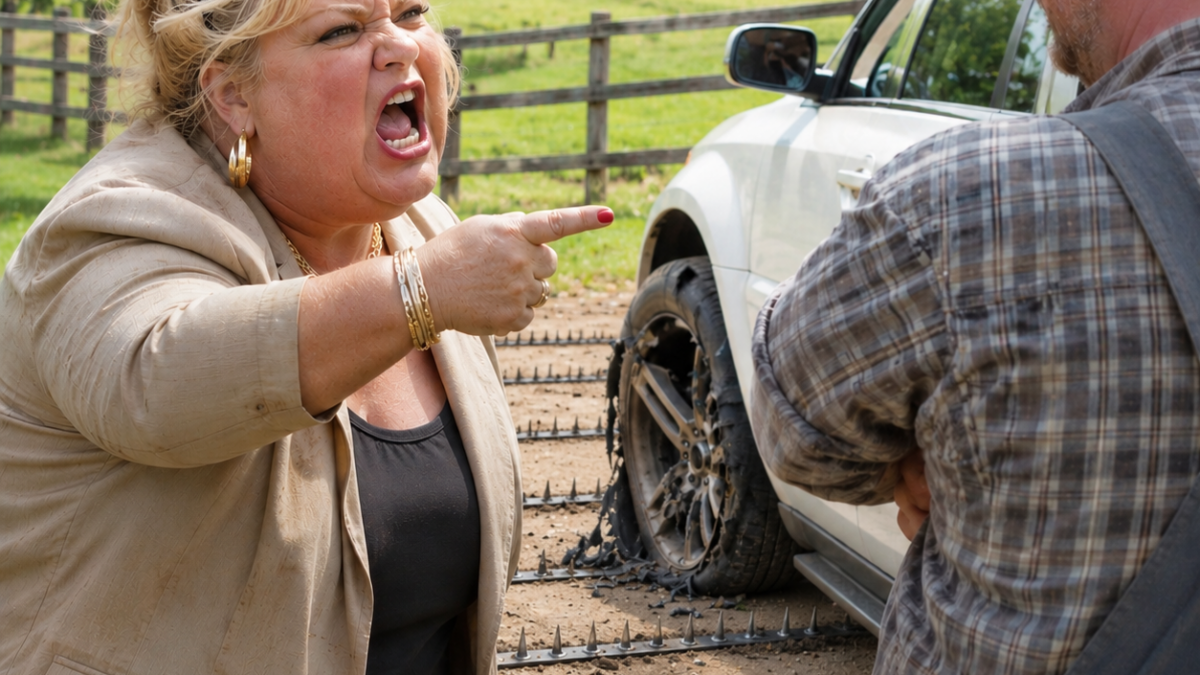
Her tires met the warned vehicle-control devices.
The SUV slowed as multiple tires lost pressure.
It continued forward briefly, then came to a stop on my dirt road.
No rollover.
No collision.
No injury.
Just a ninety-thousand-dollar SUV sitting where it had no legal reason to be.
I stayed still for a few seconds.
My hands were colder than they should have been.
This was the part people assume felt wonderful.
It didn’t.
It felt serious.
Karen’s door opened.
She stepped out.
Walked around the SUV.
Looked at the tires.
Then kicked one.
Even through the camera microphone, I could hear her screaming.
I called the sheriff.
“This is Nate Lyman.”
“Location?”
“County Road Twelve.”
“What’s happening?”
“Mrs. Whitfield entered my property again. Her vehicle is disabled. No injuries.”
“You need medical?”
“No.”
“Any confrontation?”
“Not yet.”
“We’re sending a deputy.”
I saved the camera feeds.
Backed them up.
Then walked outside.
Karen saw me coming.
Her face changed.
“What the hell did you do to my car?”
I stopped a safe distance away.
“I warned you.”
“You put traps in the road!”
“You were notified repeatedly that this is private property and that vehicle deterrents were in use.”
“You tried to kill me!”
“No.”
She pointed at the SUV.
“All four tires!”
“You’re standing here yelling at me, Karen. You’re not injured.”
“I’m calling the police.”
“Already did.”
She froze.
“What?”
“Deputy Ruiz is on her way.”
That shut her up for maybe two seconds.
Then the anger came back twice as hard.
“My husband is the HOA president. You have no idea who you’re dealing with.”
“I know exactly who I’m dealing with.”
She pulled out her phone.
Started recording.
Her voice changed instantly.
Not angry now.
Performative.
Loud.
Controlled enough for an audience.
“I am being held hostage on my own property by a violent man who placed deadly traps—”
“Karen.”
She kept filming.
“He has been harassing me for months—”
“This is my property.”
She pointed the camera at me.
“Stay away from me!”
“I’m ten feet away.”
“You destroyed my car!”
“You drove past multiple written warnings.”
“This is an HOA access road.”
“No.”
She swung the camera toward the road.
I calmly pointed toward the nearest sign.
Then another.
Then the camera.
“My name is Nate Lyman. This is private property. Mrs. Whitfield entered without permission after repeated written notice. She is not injured. Law enforcement is on the way.”
Her phone lowered slightly.
She had expected anger.
She wanted something she could post.
Instead, she got a statement.
Then we heard gravel.
Deputy Ruiz’s vehicle came over the rise.
Karen ran toward it.
“Officer!”
Ruiz stepped out.
Karen barely let her close the door.
“This man tried to kill me! He destroyed my vehicle! He buried traps on a public access road!”
Ruiz let her speak.
That was one thing I liked about her.
She didn’t interrupt emotional people.
She gave them enough room to finish whatever story they had chosen.
When Karen finally stopped, Ruiz turned to me.
“Mr. Lyman.”
I handed her the folder.
Certified notices.
Delivery receipt.
Deed.
Survey.
Photographs.
Sheriff reports.
Images of warning signs.
Documentation from Ruiz’s previous visit.
Camera timestamps.
Karen laughed.
“All fake.”
Ruiz looked at her.
“Mrs. Whitfield, do you have a recorded easement?”
“My attorney has it.”
“Do you have a copy?”
“No, but—”
“Has a court ruled that you have an easement?”
“No.”
“Were you told the property owner disputes your access?”
Karen crossed her arms.
“That doesn’t matter.”
Ruiz looked down at her notes.
“Were you personally warned to stop using this road?”
Silence.
“Mrs. Whitfield?”
“My lawyer said the issue was under review.”
That was not the same answer.
Ruiz asked:
“Did your lawyer tell you to continue driving across Mr. Lyman’s property?”
Karen hesitated.
I saw it.
So did Ruiz.
“No.”
Ruiz wrote something.
“Did you see the warning signs this morning?”
“They’re ridiculous.”
“That wasn’t my question.”
Karen’s face tightened.
“Yes.”
“All of them?”
“I wasn’t counting.”
“But you saw warnings.”
“Yes.”
Ruiz nodded.
Then said:
“You’re being cited for criminal trespass.”
Karen’s mouth opened.
“I’m the victim.”
“The vehicle issue will be handled separately. You can make whatever civil claim you believe you have.”
“You’re not arresting him?”
“No.”
“He destroyed a ninety-thousand-dollar vehicle!”
“You drove it onto clearly marked private property after repeated warnings.”
Karen stepped backward.
“You people are unbelievable.”
Ruiz’s voice stayed even.
“You’re welcome to explain your position to the judge.”
The tow truck arrived.
Driver’s name was Walt.
He looked at Karen’s SUV.
Then at Ruiz.
“All four?”
“Yes.”
Walt whistled.
Karen snapped:
“Just tow it.”
He prepared the vehicle for removal.
Karen’s composure deteriorated with every minute.
Then Walt gave her the recovery price.
She handed him a black card.
Declined.
The little electronic beep might have been the loudest sound on the farm.
Karen stared.
“Run it again.”
He did.
Declined.
Ruiz looked away.
I looked down at my boots.
Not because it was funny.
Because if I made eye contact with Hank, who had arrived at the edge of the property by then, I was going to laugh.
Karen dug through her purse.
Produced another card.
That one worked.
The SUV went onto the flatbed.
Before Ruiz left, she handed Karen the citation.
Then turned toward me.
“You’re pressing charges?”
I thought about six months.
The damaged corn.
The signs.
The broken chain.
Daisy.
The vet bill.
Every horn blast.
“Yes.”
Karen stared at me.
I didn’t look away.
“Yes, ma’am. I am.”
The tow truck left.
Ruiz left.
Karen eventually left too.
And for the first time in months, my road was silent.
I stood there listening.
Wind.
Birds.
Cattle.
No engine.
That should have been the end.
It wasn’t.
Two days later, a certified envelope arrived.
Heavy paper.
Expensive letterhead.
Whitfield and Associates.
Karen wanted $42,000.
Vehicle repairs.
Emotional distress.
Humiliation.
Reckless endangerment.
Property destruction.
I called Priya.
“You busy?”
“Always.”
“You’re going to enjoy this.”
I read the demand.
When I finished, she laughed once.
Not loudly.
“Good.”
“Good?”
“This is useful.”
“They want forty-two thousand dollars.”
“I heard you.”
“How is that good?”
“Because now they’ve committed their theory to paper.”
“What theory?”
“That Karen was an innocent motorist unexpectedly harmed while using a legitimate access road.”
I looked at the evidence boxes beside my desk.
“Which she wasn’t.”
“Exactly.”
Priya continued.
“Now we answer.”
She asked me for every measurable loss.
Crop damage.
Fence repair.
Gate and chain.
Trail cameras.
Veterinary expenses.
Lost work time.
Road repairs.
Then the emotional and punitive claims she believed could legitimately be raised.
We spent hours going through my incident log.
Twenty-three damaged corn rows across the period.
Estimated yield loss.
Photos.
Vet invoices.
Repair receipts.
Nothing guessed.
Nothing inflated.
Priya said:
“Do not give me what you think she deserves.”
“Okay.”
“Give me what you can prove.”
That was her favorite sentence.
Our response and counterclaim went out certified.
It was not angry.
That made it stronger.
Dates.
Events.
Attachments.
March.
April.
May.
June.
Written warnings.
Police records.
Trespass footage.
Crop damage.
Livestock distress.
The final paragraph was almost brutal in its calmness.
This was not a misunderstanding.
It was repeated, knowing conduct after notice.
When I finished reading the draft, I called Priya.
“You wrote that?”
“Yes.”
“Sounds mean.”
“It’s factual.”
“Meaner than yelling.”
“Usually.”
Then silence.
For the first time since this started, Karen stopped driving across my farm.
Of course, not having an SUV helped.
Hank came by about a week later.
He was grinning before he reached the porch.
“What?”
“You’re famous.”
“I don’t want to be famous.”
“Too late.”
“For what?”
“Spike Strip Sally.”
I closed my eyes.
“No.”
“Oh, yes.”
“Who started that?”
“Internet.”
“The internet needs work.”
“Creek View residents are sharing photos.”
“I hope nobody posts my address.”
“Everyone knows where you live.”
“Helpful.”
He sat.
Then his expression changed.
“There’s something else.”
“What?”
“The HOA held an emergency meeting.”
I waited.
“People are asking who’s paying Karen’s lawyers.”
“That’s between them.”
“Not if she used HOA money.”
I looked at him.
“What?”
“Assistant treasurer started checking.”
“Who?”
“Patricia Chen.”
I knew the name only vaguely.
Retired accountant.
Lived in Creek View.
Hank said:
“Apparently she found legal retainers coming out of HOA accounts.”
“For Karen’s case?”
“Looks like it.”
“How much?”
“Rumor says thousands every month.”
I leaned back.
That was not my case.
Not yet.
And I wanted nothing to do with another war.
But when people misuse organizations for personal fights, the bookkeeping eventually has opinions.
A few days later, someone at the county clerk’s office called.
“Mr. Lyman, did you file a complaint involving the HOA’s finances?”
“No.”
“Someone did.”
“Not me.”
“Understood.”
That was all she would say.
Then local news published the first story.
Assistant treasurer Patricia Chen had asked for an independent audit.
Legal expenses labeled as property-boundary defense did not appear connected to any HOA-owned boundary.
The firm receiving payments?
Same one Karen used against me.
Residents became furious.
The HOA was supposed to maintain roads, landscaping, common areas, drainage, gates.
Instead, some of their dues had apparently financed Karen’s private fight over a road the HOA did not own.
An emergency board meeting followed.
Karen attended with her husband, Richard.
Richard was HOA president.
Karen vice president and heavily involved with finances.
Patricia brought records.
Residents brought questions.
Someone recorded parts of the meeting.
I saw the video later.
A homeowner stood.
“Did our dues pay your private attorney?”
Karen answered:
“The legal matter involved community access.”
“Show us the easement.”
“We’re reviewing historical documents.”
“Did we vote to fund your defense?”
“The board authorized legal services.”
“Which board?”
Silence.
Another resident:
“How much?”
Karen tried to move on.
People refused.
Patricia spoke.
Her tone was the opposite of Karen’s.
No performance.
No outrage.
Numbers.
Invoices.
Dates.
Approximately eight thousand dollars in recurring legal retainers and related expenditures under categories that did not match the work being performed.
Then other irregularities.
Vendor payments.
Consulting expenses.
Reimbursements.
Enough questions that the board voted to put Karen and Richard on administrative leave pending an independent forensic audit.
Hank called me.
“You hear?”
“Yes.”
“You happy?”
“No.”
“Really?”
“Hank, if she stole HOA money, those are other people’s dues.”
“So?”
“So I’m not happy they got robbed.”
He thought about that.
“Fair.”
Validation felt good.
Other people losing money did not.
The forensic audit took things further.
Roughly $60,000 in association funds had been misused or embezzled over the preceding years according to the source records that surfaced in the investigation.
Not all of it involved me.
Most didn’t.
There were vendor payments linked to personal contractors.
Questionable reimbursements.
A consulting payment to a business connected to Karen’s relatives.
And the legal expenses tied to her personal trespass dispute.
Richard claimed ignorance.
The board removed them both.
Unanimous.
Then the sheriff’s office confirmed a fraud and embezzlement investigation.
When Deputy Ruiz called, she sounded tired.
“You didn’t hear this from me.”
“Then don’t tell me.”
“Good answer.”
I smiled.
She continued.
“Your trespass file may become relevant to showing whether some legal expenditures were personal rather than HOA business.”
“What do you need?”
“Copies you already gave us.”
“You have permission.”
“Thanks.”
Then she said something that stayed with me.
“You’d be amazed how often one small case opens a door nobody knew was there.”
I looked down my private road.
A few months earlier, all I wanted was for one white SUV to stop crossing my corn.
Now an HOA board was collapsing.
Not because of me.
Because Karen refused to stop when every exit was still open.
That pattern looked familiar.
The first drive?
She could have apologized.
Second?
Turn around.
Certified letter?
Stop.
Sheriff warning?
Stop.
Signs?
Stop.
Lawyer advice?
Stop.
Citation?
Settle.
At every point, she chose another step forward.
Entitlement is expensive because it keeps convincing you that backing down is humiliation.
Karen would rather lose everything than admit the first “no” applied to her.
The interim HOA president eventually sent Priya a notarized apology.
The association acknowledged Karen had acted without legitimate authority.
They disclaimed any easement over my farm.
They withdrew the access claim completely.
Then offered to mediate repayment of some of my damages.
Priya called.
“What do you want?”
“From the HOA?”
“Yes.”
“They didn’t drive the SUV.”
“Some board actions helped her.”
“I know.”
“We could pursue them.”
I looked out the window.
My road was quiet.
“I want the damaged property repaired.”
“Okay.”
“I want written acknowledgment there’s no easement.”
“We have it.”
“I don’t want to destroy forty families financially because Karen couldn’t hear the word no.”
Priya was quiet.
“Reasonable.”
“Don’t sound disappointed.”
“I’m a lawyer. I always sound disappointed when a client refuses to maximize damages.”
I laughed.
We negotiated the civil side carefully.
My claim against Karen continued.
The HOA handled what it legitimately owed separately.
I did not want them paying for her personal wrongdoing twice.
Karen’s own attorney situation became almost comical.
The lawyer who sent the $42,000 demand withdrew from representing her in parts of the dispute after discovering the supposed easement was not valid and after HOA-payment questions emerged.
At one point Karen reportedly argued that she had been advised the road was legally available.
Her own lawyer’s communication showed something different.
They had told her the easement claim needed review and specifically warned her not to keep using the road until it was resolved.
That mattered.
A mistaken belief can explain one trespass.
Maybe two.
It becomes harder to call something a mistake after lawyers, land records, signs, police, and the owner all tell you the same thing.
Eventually the court date arrived.
The courthouse wasn’t dramatic.
Old sandstone.
Worn steps.
Flag moving in the wind.
I had been there twice before.
Jury duty.
Zoning dispute.
Never because a woman with a luxury SUV decided a farm road belonged to her.
Priya walked beside me.
“You nervous?”
“No.”
“You’re lying.”
“Little.”
“Good.”
“Why good?”
“Means you understand judges are human beings and courtrooms are unpredictable.”
That did not make me feel better.
Karen was already inside.
I almost didn’t recognize her.
No gold sunglasses.
No bright designer coat.
Gray suit.
Tired eyes.
Smaller somehow.
That sounds cruel.
I don’t mean physically.
Some people seem large because everyone around them keeps moving out of the way.
Once the room stops moving?
They become ordinary-sized again.
The prosecutor addressed trespass and property destruction.
The HOA financial investigation was proceeding separately.
Karen’s lawyer tried the argument we expected.
Good-faith belief in an old easement.
Historical community access.
Misunderstanding.
The prosecutor opened my evidence binder.
Certified letter.
Signed receipt.
Camera still.
Private-road signs.
Deputy Ruiz’s reports.
Video of Karen striking a sign.
Additional footage.
He said:
“This was not good-faith confusion after the defendant received direct notice.”
Karen’s attorney responded.
“She believed Mr. Lyman was wrong.”
The prosecutor nodded.
“Then the lawful response was court.”
He looked at the judge.
“Not hundreds of additional trips across his land.”
Judge Carson reviewed everything.
She asked about livestock.
The veterinarian record was admitted.
She asked about damaged crops.
Priya had yield calculations and photographs.
She asked about property signs.
We had before-and-after images.
Then Karen stood to speak.
Her voice was quiet.
Nothing like the morning beside her SUV.
“Your Honor, I made poor decisions.”
Judge Carson waited.
“I believed there was an access right.”
The judge looked at her.
“For how long?”
Karen hesitated.
“At first.”
“And after the certified notice?”
Silence.
“After Deputy Ruiz spoke to you?”
Karen looked toward her lawyer.
The judge repeated:
“After the deputy?”
“I believed the matter was disputed.”
Judge Carson’s voice remained calm.
“A disputed right is not permission to continue exercising it indefinitely while refusing the owner’s direction.”
Karen nodded.
Then she said:
“I was angry.”
That may have been the most honest sentence she ever said about the entire case.
She continued.
“I felt like he was trying to take something away that had always been available.”
I almost spoke.
Priya touched my arm.
Karen went on.
“I let that anger make decisions.”
The judge asked:
“Did you damage his signs?”
“Yes.”
“Did you continue driving after warnings?”
“Yes.”
“Did you understand livestock had been affected?”
“I found out later.”
“Did you stop?”
Karen looked down.
“No.”
Judge Carson paused.
Then Karen turned toward me.
Not fully.
Just enough.
“I owe Mr. Lyman an apology.”
The courtroom went silent.
She said:
“I was wrong.”
For six months, I had imagined hearing that.
I thought it would feel enormous.
It didn’t.
It felt late.
Still important.
But late.
The judge accepted Karen’s guilty plea to criminal trespass and property destruction.
The embezzlement matter remained separate.
Restitution:
$8,500 toward verified crop, gate, and veterinary losses.
Twelve months probation.
Five-hundred-foot stay-away order from the affected parts of my property.
Barred from HOA office for at least five years.
When the gavel came down, I didn’t smile.
I didn’t look at Karen.
I looked at Priya.
“That’s it?”
“For this case.”
Funny thing about legal battles.
They consume your entire life while they’re happening.
Then one morning, somebody says a few sentences, a gavel falls, and the thing that has lived in your head for months becomes a file.
Outside, a reporter asked if I wanted to comment.
“No.”
“Nothing?”
“The evidence already did.”
Priya smiled.
Once we reached the parking lot, she said:
“You stole my line.”
“You charge too much. I’m getting my money’s worth.”
She laughed.
Then:
“You handled it well.”
“I almost didn’t.”
“I know.”
I looked at her.
“How?”
“You’re a forty-five-year-old farmer with heavy equipment.”
Fair.
“I had options.”
“Many bad ones.”
“I know.”
She leaned against the truck.
“That’s the point, Nate. The impressive part isn’t that you won.”
“What is?”
“That you gave yourself a chance to win before you did something that would make the truth irrelevant.”
I thought about Daisy trembling beside the fence.
The broken sign.
Karen throwing my letter into the mud.
There were moments I wanted immediate justice.
Immediate justice usually means anger wearing a uniform.
Real justice took months.
I hated that.
Now I respected it.
That evening, I drove home the long way.
Clouds had cleared after rain.
Fields green.
Road damp.
When I reached the turn toward my property, I slowed.
The warning sign still stood.
PRIVATE ROAD.
NO THROUGH TRAFFIC.
For six months, those words felt almost ridiculous.
Just aluminum and paint asking someone to care.
Now they meant something again.
I rolled down the window.
Listened.
Nothing.
No engine.
No horn.
The tire tracks had already started fading beneath new gravel.
I drove to the pasture.
Daisy stood near the fence.
Healthy.
Calm.
Her earlier pregnancy had been lost during the worst part of the stress.
That still hurt.
But a later season was kinder.
Eventually she stood with a healthy calf beside her, and the sight did something to me no court order could.
Life continued.
Animals don’t care about verdicts.
They care whether the field is quiet.
I leaned against the fence.
Daisy looked at me.
Chewed.
Looked away.
Perfect.
Hank came over after dark.
Two beers.
“You won.”
“I got a court order.”
“Same thing.”
“No.”
“What’s the difference?”
“Winning sounds louder.”
Hank opened a beer.
“You disappointed?”
“No.”
“Thought you’d celebrate.”
“I’m sitting here with you.”
“That is depressing.”
I laughed.
We watched the stars.
Then he asked:
“You still have those tire strips?”
“Locked away.”
“Planning to use them again?”
“No.”
“Never?”
“Hopefully.”
He nodded.
“Good.”
People misunderstand deterrence.
If you enjoy using it, something has gone wrong.
The whole point is to create a boundary strong enough that nobody needs the consequence again.
Karen’s house went on the market.
I heard that from Hank.
Of course.
Hank knew everything.
“Richard too?”
“Yeah.”
“They leaving?”
“Looks like.”
I didn’t ask price.
Didn’t care.
Then he added:
“Rumor says they’re separating.”
“Hank.”
“What?”
“Stop.”
“You don’t want to know?”
“No.”
He looked genuinely offended.
“You’re ruining retirement for me.”
“I’m not responsible for your hobbies.”
The truth was I had spent enough time thinking about Karen.
What happened to her marriage wasn’t my victory.
Her finances weren’t my victory.
Her humiliation wasn’t my victory.
The road being empty?
That was mine.
The HOA elected a new board.
Patricia Chen became president.
The woman who had found the accounting problems.
She met me once in town.
I was buying fence hardware.
She came down the aisle.
“Mr. Lyman?”
“Yes.”
“Patricia Chen.”
“I know.”
She offered her hand.
I shook it.
“I wanted to apologize personally.”
“You didn’t drive through my corn.”
“No, but I served on a board that let two people accumulate too much control.”
“That’s different.”
“Still matters.”
I respected that.
She continued.
“We’ve adopted a policy that no HOA officer can assert a property right without outside title verification.”
“Seems obvious.”
“You’d be surprised.”
“I’m not anymore.”
She smiled.
Then:
“You reminded a lot of people that property lines still mean something.”
That sentence stayed with me.
Not because it flattered me.
Because boundaries are strange things.
Most are invisible.
The line between my farm and Creek View wasn’t a brick wall.
It existed on paper.
Survey coordinates.
Fence posts.
Mutual respect.
Most days, that is enough.
Civilization depends on millions of invisible lines people choose not to cross.
Property.
Privacy.
Consent.
Authority.
Money.
Power.
Karen kept crossing because nobody stopped her soon enough.
She had spent years inside the HOA issuing rules.
Trash cans.
Flowers.
Mailboxes.
Maybe eventually that authority stopped feeling borrowed.
She started treating it like a personal quality.
Like because she could enforce rules inside Creek View, she could define reality outside it.
My farm corrected that misunderstanding.
Not because farms are magical.
Because my deed said what it said.
I sometimes wondered how Karen became Karen.
People online like easy answers.
Narcissist.
Psychopath.
Monster.
I don’t know.
I’m not a psychologist.
I only know what I saw.
Someone who had been rewarded too many times for refusing to back down.
If people move whenever you push, eventually pushing feels like leadership.
Then somebody doesn’t move.
That feels like aggression.
That was me.
I wasn’t fighting her.
I just stopped stepping aside.
To her, that probably felt like war.
The criminal financial investigation continued after my case closed.
I stayed out of it unless investigators needed records.
The roughly $60,000 audit findings created their own legal consequences.
Residents pursued recovery.
The association separated Karen’s personal legal expenses from legitimate HOA costs.
Richard faced his own questions.
I did not follow every filing.
That was deliberate.
You can win a boundary dispute and still let the person keep occupying your mind.
I had no interest in giving Karen that last piece of property.
My eighty acres had been enough to defend.
My thoughts were mine too.
Summer arrived.
Corn reached waist height.
The pasture greened.
Mornings smelled like dew and hay again.
I sat on the porch one evening with iced tea.
The road stretched empty toward the rise.
No fresh ruts.
No dust.
No white SUV.
The silence returned so gradually I almost missed when it became normal.
That is the strange thing about peace.
Conflict announces itself.
Peace doesn’t.
No siren.
No judge.
No letter.
You simply realize one day that you haven’t checked the road camera in three hours.
Then three days.
Then maybe you forget entirely.
One morning I was halfway through breakfast when I realized I hadn’t opened the camera feed.
I laughed.
That was recovery.
Not deleting Karen’s videos.
Not burning the evidence folder.
Forgetting to check.
The folder eventually moved off my kitchen table.
First to the desk.
Then a shelf.
Then a cabinet.
Priya told me not to destroy anything yet.
I didn’t.
But location matters.
When your evidence lives where you eat, the conflict is still living with you.
When it lives in a cabinet?
It becomes history.
A few months after court, one Creek View resident stopped by.
Older man.
Name was Dale.
I knew his truck.
He had watched Karen’s SUV use my road more than once.
He stood at the gate.
“You Nate?”
“Yes.”
“I owe you an apology.”
That became a common opening that year.
“For?”
“I thought you were being difficult.”
I waited.
“Karen told us the road was part of an old community easement.”
“I know.”
“She said you bought the farm knowing that.”
“I didn’t.”
“I know that now.”
He stared at the road.
“Why didn’t you come to an HOA meeting and show everybody?”
I almost laughed.
“I’m not in your HOA.”
“I know.”
“That’s the point.”
He nodded.
“Fair.”
Then:
“I should have checked.”
“Yes.”
Again, people expected me to rescue them from discomfort.
Tell them:
You couldn’t have known.
But they could have.
Not every detail.
But enough to ask.
If a board officer tells you somebody else’s land belongs partly to your neighborhood, it is reasonable to request the recorded easement.
Dale said:
“She always sounded so certain.”
There it was.
Certainty.
Karen’s real weapon.
Not the SUV.
Not Richard’s presidency.
Certainty.
People mistake confidence for evidence because confidence is easier to understand.
A deed has legal descriptions and numbers.
Karen had:
“Everyone knows.”
Humans like the second one.
Shorter.
Cleaner.
Wrong.
The next season, I replaced the damaged sections of road.
Filled the deepest ruts.
Reseeded edges.
Replanted corn where I could.
Some yield was gone permanently.
That year would never come back.
Neither would Daisy’s lost pregnancy.
People told me:
“At least you got restitution.”
True.
Money helps.
But restitution is not a time machine.
It does not make crops stand back up.
Does not unfrighten cattle.
Does not return nights spent staring at cameras.
That is why I dislike stories where a court judgment magically balances everything.
It balances numbers.
Life keeps the remainder.
You carry it differently afterward.
The positive remainder was that I became slower to assume patience meant passivity.
Dad’s saying changed for me.
“The strongest man isn’t the one who hits back first. It’s the one who knows when not to.”
As a younger man, that sounded like something older men say because they can’t hit as hard anymore.
At forty-five, I finally understood.
Not acting can require more strength than acting.
Standing beside Daisy while Karen disappeared down the road and not climbing into my truck?
Hard.
Watching her smack a sign and not returning the favor at her gate?
Hard.
Hearing her call me violent while knowing I had months of evidence?
Hard.
But every time I refused to give her the explosion she expected, my case got cleaner.
Hers got worse.
Patience didn’t beat Karen.
Karen beat Karen.
Patience just gave her enough room to do it in public.
The phrase “Spike Strip Sally” stuck around town longer than I hoped.
People thought it was hilarious.
At the diner, somebody would point at me.
“Watch your tires.”
I’d answer:
“Stay on public roads.”
That usually ended it.
One teenager asked if he could see the strips.
“No.”
“Why?”
“They’re equipment, not a tourist attraction.”
“You actually buried them?”
“Go eat your burger.”
His father laughed.
I did not want the lesson becoming:
Here’s a cool way to wreck someone’s car.
The lesson was the opposite.
Do not improvise dangerous revenge.
Do not hide hazards.
Do not assume anger makes you legally right.
The deterrent event mattered only because it came after months of visible warning and official documentation.
Even then, I would rather Karen had turned around.
Every time.
If I could rewrite the story and choose between a dramatic Monday morning or Karen reading the first certified letter and saying:
“Fine, I’ll take the highway.”
I’d choose the second.
Boring endings are underrated.
Priya visited the farm after everything settled.
She rarely came without a reason.
I poured coffee.
She looked at the road.
“Quiet.”
“Usually.”
“No Karen?”
“Shockingly.”
She smiled.
We sat.
I asked:
“Did you think I was going to screw this up?”
“Yes.”
“That fast?”
“You asked.”
“When?”
“First meeting after Daisy.”
“Really?”
“You had that look.”
“What look?”
“Man with land, tools, and righteous anger.”
“That’s a look?”
“It’s a very expensive legal look.”
I laughed.
Then she became serious.
“You want to know why your case worked?”
“Paperwork.”
“Partly.”
“Cameras.”
“Partly.”
“What?”
“You never lied.”
I frowned.
“That’s the minimum.”
“You would be amazed.”
She continued.
“When Ruiz asked whether you expected Karen might still come through, you didn’t pretend otherwise.”
“No.”
“You never claimed the signs guaranteed she’d stop.”
“No.”
“You admitted being angry.”
“Yes.”
“You kept the facts small enough to be true.”
That phrase stayed with me.
Keep facts small enough to be true.
Karen’s entire problem was expansion.
One shortcut became a right.
A right became an easement.
An easement became HOA access.
Her personal lawyer became HOA expense.
Her authority became entitlement.
Everything grew larger than the underlying fact.
My fact was simple.
My road.
No easement.
Stop driving.
You can build an entire legal case around four truthful words.
You can also destroy yourself trying to avoid them.
Karen and Richard eventually sold their house and left the neighborhood.
I learned they later filed for divorce because it appeared in local conversation and, eventually, in public records people insisted on discussing.
I felt nothing.
That surprised me.
There was a time the thought of Karen losing her comfortable life would have satisfied something dark in me.
By the time it happened, that part had burned out.
She was no longer the white SUV coming over the rise.
She was a person living somewhere else.
Good.
Let her be somewhere else.
Patricia’s HOA board lasted.
That impressed me.
She introduced outside audits.
Major legal bills required board review.
No officer could use community funds for private representation.
Recorded property rights had to be verified.
Residents could inspect financial summaries.
Apparently meetings became longer.
People complained.
Hank told me.
“New board talks too much.”
“Better than hiding sixty thousand dollars.”
“True.”
He sipped coffee.
“Still boring.”
“Boring governance is the goal.”
“I thought the goal was entertainment.”
“That’s your problem.”
The road stayed private.
Once, years later, the HOA asked whether I would consider granting emergency-only access during a bridge repair on the county route.
They asked.
That mattered.
Patricia sent a formal request.
Dates.
Purpose.
Insurance.
Vehicles.
Temporary term.
Priya reviewed it.
I approved.
For two weeks, a few authorized vehicles crossed slowly.
No damage.
No drama.
When the bridge reopened, the temporary agreement ended.
That taught me something too.
I was never opposed to people crossing my land.
I was opposed to someone deciding they could without asking.
Permission changes everything.
The same road Karen turned into a war became useful when adults treated one another like adults.
Patricia thanked me afterward.
I said:
“You asked.”
She smiled.
“That easy?”
“Pretty much.”
Imagine how many disasters could be prevented by that.
Ask.
Listen.
Accept no.
Negotiate if needed.
People spend millions avoiding those four steps.
Years passed.
Hank got older.
So did I.
The farm changed slowly.
Fence posts replaced.
Barn roof patched.
Corn rotations adjusted.
Daisy aged out of breeding and spent her later years mostly acting like she owned the pasture.
Maybe she did.
She had earned it.
One evening I stood beside her.
She leaned her head against my arm.
I thought about that morning she trembled against the fence.
Anger came back briefly.
Then left.
Memory can revisit without moving back in.
That is healing.
When Daisy eventually died, I buried her under an old cottonwood.
Hank helped.
Neither of us spoke much.
Afterward he said:
“She was the reason you finally drew the line.”
“Partly.”
“Good cow.”
“Yeah.”
We stood there.
It felt strange that an animal who knew nothing about property law had become part of a courtroom record.
Vet bill.
Date.
Stress.
Loss.
The law turns life into exhibits.
Necessary.
Still strange.
I kept Daisy’s vet invoice longer than almost anything else from the case.
Not because of the money.
Because it reminded me why I couldn’t simply ignore Karen forever.
Ignoring disrespect is one thing.
Ignoring harm to something dependent on you is another.
The cattle didn’t choose the fight.
Protecting them was my job.
Same with the land.
Farm ownership is less romantic than people think.
It is bills.
Repairs.
Weather.
Mud.
Responsibility.
When somebody drives through crops because eight minutes of their time matters more than your work, they are not just using a shortcut.
They are saying:
My convenience outranks your responsibility.
That is what finally made me stop being polite.
Not revenge.
Stewardship.
One afternoon, a young farmer who had heard the story stopped by.
He was dealing with ATVs cutting across his acreage.
He asked:
“What did you use on the road?”
I told him:
“Don’t start there.”
“What?”
“Start with the sheriff.”
He looked disappointed.
“Signs?”
“Yes.”
“Cameras?”
“Yes.”
“Lawyer?”
“If needed.”
“And the tire strips?”
“Talk to local counsel and law enforcement before using any vehicle-control device.”
“That’s boring.”
“Good.”
He laughed.
“I thought you’d tell me some trick.”
“There is one.”
“What?”
“Make the other side be the only person behaving badly.”
He stopped smiling.
That was the real trick.
Maybe not satisfying enough for the internet.
Useful though.
The old warning signs faded eventually.
Reflective red turned pink.
I replaced the main private-road sign with something simple.
**PRIVATE ROAD
NO THROUGH TRAFFIC**
No mention of deterrents.
No threats.
No cameras.
I still had cameras.
Farmers have cameras for everything now.
Coyotes.
Equipment.
Trespassers.
Mostly deer.
The first morning after I changed the sign, I stood back.
It looked ordinary.
That made me happy.
A warning should not need a history lesson.
People should read:
Private.
And understand.
One word.
The incident records eventually reached the end of their retention period.
Priya told me what I could dispose of.
I kept selected court documents.
The deed.
Original certified receipt.
One photograph of the damaged sign.
And the ruling.
Everything else?
Boxes.
Duplicates.
Printouts.
I shredded a lot.
Not because I wanted to forget.
Because evidence had done its job.
You don’t build your house out of scaffolding after construction ends.
The files supported me when I needed them.
Then I put them away.
The old tire-control equipment stayed locked in the barn for years without use.
Eventually I handled it according to the lawful disposal guidance appropriate for the equipment.
No trophy.
No display.
I didn’t need a relic.
The road itself was the reminder.
People online still told the story differently.
Some version had three rows of secret spikes.
Another had Karen doing sixty miles an hour.
Some said she went to prison.
No.
Some said I got her house.
Definitely no.
Some said she was arrested on the spot.
No.
The truth was slower.
Citations.
Lawyers.
Audits.
A plea.
Probation.
Restitution.
HOA removal.
Separate financial investigation.
Real consequences do not need decoration.
One story claimed I stood over her SUV laughing while she cried.
That one annoyed me most.
I wasn’t laughing.
I was exhausted.
If you have ever spent six months structuring your day around someone else’s disrespect, you know the feeling.
When it ends, joy often comes later.
The first feeling is absence.
The problem is suddenly missing.
You keep expecting it.
7:15.
Nothing.
7:16.
Nothing.
7:20.
Nothing.
Your body takes time to believe the silence.
That Monday evening after Karen’s SUV was towed, I stood on the porch around sunset.
Part of me still expected her return trip.
Ridiculous.
SUV gone.
Citation issued.
Still, at the usual time, I looked toward the rise.
Nothing.
That was the first moment I felt the weight leave.
Not the flat tires.
The missed return trip.
No horn.
No dust.
Peace often announces itself by failing to happen.
No engine.
No letter.
No threat.
No emergency.
Nothing.
Beautiful nothing.
The financial case eventually faded from local news.
Patricia recovered what the HOA could.
Karen’s personal legal bills stopped draining association accounts.
Residents moved on.
New scandal somewhere else replaced the old one.
That is how towns work.
Hank was almost disappointed.
“No one talks about her anymore.”
“Good.”
“You’re impossible.”
“I’m peaceful.”
“That sounds boring.”
“Exactly.”
I became suspicious of people who need justice to remain entertaining.
They are usually watching from a safe distance.
For the person inside the conflict, boring is the promised land.
I didn’t want Karen suffering forever.
I wanted her gone from my road.
Mission accomplished.
My father never lived to see this mess.
Sometimes I wondered what he would have done.
Probably less paperwork.
Probably more yelling.
Dad had patience until suddenly he didn’t.
But his words saved me anyway.
“You can be angry without being a criminal.”
And:
“The strongest man isn’t the one who hits back first.”
He would have been amused that his son spent months creating spreadsheets about trespassing.
He would have approved of the result.
Maybe.
He definitely would have hated the HOA.
One summer evening I sat beneath the porch light with Dad’s old pocketknife.
Sharpening it slowly.
Hank arrived.
“Planning violence?”
“Against a tomato.”
“Good.”
He sat.
We watched lightning bugs.
Then he asked:
“If you could go back to the first day, what would you do differently?”
I thought about it.
“Call Ruiz earlier.”
“Not the strips earlier?”
“No.”
“Why?”
“Because every day I waited, I hoped she’d stop by herself.”
“Was that bad?”
“No.”
“But?”
“Once she started damaging signs and spooking cattle, I should’ve escalated the legal process sooner.”
Hank nodded.
“People think patience means waiting forever.”
“Yeah.”
“What does it mean?”
“Waiting until the right action is clear.”
He looked at me.
“That sounds like something you practiced.”
“It’s something Priya would bill by the hour.”
He laughed.
That distinction became important to me.
Patience is not surrender.
Boundaries without enforcement are requests.
Enforcement without restraint becomes vengeance.
You need both.
A line.
And discipline.
When Karen first crossed, I had a line but not an enforcement plan.
When I got angry, I had enforcement ideas without enough restraint.
The law forced me to build both together.
That was probably why the outcome held.
A few years later, I received a letter forwarded from Priya.
No return name I recognized.
Inside was a short note.
Someone in another state had read a local article about the case.
They had a neighbor cutting across their property.
The writer said:
“I was ready to do something stupid. Instead I got cameras and called a lawyer.”
That meant more to me than the jokes.
I gave the letter to Priya.
She read it.
“Well.”
“What?”
“You’re an influencer.”
“Take that back.”
She laughed.
I kept the letter.
If the story had any value beyond my farm, I wanted it to be that.
Not:
Destroy the vehicle.
But:
Don’t let somebody else’s arrogance choose your behavior.
You own your reaction too.
Protect it.
Karen tried to take eight minutes off her drive.
In the process she lost far more than eight minutes ever could have been worth.
Money.
Position.
Reputation.
Eventually her place in that community.
That math makes no sense from the outside.
Entitlement rarely does.
Once the issue stopped being convenience and became power, cost stopped mattering.
She needed me to submit.
The first time I blocked her, the shortcut became a test.
Every later trip proved something to herself.
I can still do this.
He can’t stop me.
The signs made her angrier because signs made the boundary visible.
The certified letter made her angry because it created proof.
Deputy Ruiz made her angry because authority outside the HOA would not automatically agree with her.
By the time her lawyer warned her not to use the road, turning around would have meant admitting everyone else had been right.
She chose four tires instead.
Then a court date.
Then everything else.
Pride is expensive.
The farm taught me the opposite.
Farming humiliates you regularly.
Weather ruins plans.
Machines break.
Calves die.
Markets move.
You learn to change course without believing the universe has insulted you.
Maybe Karen needed a farm.
Probably not mine.
Patricia’s new HOA once invited me to speak at a property-rights meeting.
I declined.
She asked again.
“No.”
“People want to hear from you.”
“They already have the court record.”
“Nate.”
“I’m not joining an HOA meeting voluntarily.”
That made her laugh.
“Fair.”
Eventually she convinced Priya instead.
Priya told them the legal version.
Verify easements.
Separate personal and association authority.
Use written board authorization.
Do not fund private conflicts with community money.
Document.
Respect boundaries.
I heard the talk was popular.
I stayed home.
Fed cattle.
Much better evening.
One strange benefit of the conflict was getting to know Deputy Ruiz.
Not socially at first.
Just farm calls.
Later, she stopped by while patrolling.
Coffee.
She looked toward the road.
“Still quiet?”
“Unless you count Hank.”
“No one counts Hank.”
I smiled.
Then asked:
“Were you sure that morning?”
“About?”
“Citing Karen.”
“Yes.”
“Before you arrived?”
“No.”
That surprised me.
“You’d seen everything.”
“I had seen your earlier evidence.”
“What changed?”
“Scene facts.”
She explained.
Karen inside my property.
Warnings visible.
Prior reports.
No easement produced.
Direct admission she saw signs.
No injury.
Vehicle disabled.
Cameras.
“You made the decision easy,” Ruiz said.
“How?”
“You didn’t contaminate the facts.”
There it was again.
Same lesson.
If I had screamed.
Threatened.
Touched Karen.
Damaged the SUV after it stopped.
Moved evidence.
Anything.
The scene becomes more complicated.
Instead, the facts stayed clean.
I started to appreciate clean facts the way I appreciated a straight fence.
Simple lines make disputes easier.
Ruiz finished her coffee.
Then said:
“For what it’s worth, your dad was right.”
“You never met him.”
“You’ve quoted him enough.”
Fair.
Years later, when Ruiz was promoted, I sent her a card.
No long message.
Just:
**Thanks for listening before deciding.**
That was her skill.
It mattered.
Everybody in this story who helped eventually did one simple thing:
They looked.
Priya looked at the deed.
Ruiz looked at evidence.
Patricia looked at accounts.
Judge Carson looked at pattern.
Karen’s downfall was built partly on her assumption that nobody would.
Arrogance survives when people stop checking.
Paperwork is checking made permanent.
The $8,500 restitution came in installments.
I didn’t spend it on anything dramatic.
Fence repairs.
Vet costs.
Farm expenses.
Some went toward gravel.
That felt appropriate.
Karen’s money repaired the road she had damaged.
I remember spreading new gravel one Saturday.
Hank drove by.
“You should make a plaque.”
“What?”
“Karen Whitfield Memorial Road.”
I stared at him.
He laughed.
“No?”
“Absolutely not.”
“Spike Strip Boulevard?”
“Go home.”
He did not.
We finished the gravel together.
When we were done, the ruts disappeared.
I stood at one end.
You could barely tell where her tires once ran.
That satisfied me more than preserving damage as a monument.
Scars are not trophies.
Sometimes you fix them.
The old bent sign went to scrap.
The cut chain too.
I kept nothing with Karen’s name.
People thought that was strange.
“Wouldn’t you want proof?”
Court had proof.
I didn’t need my barn turned into a museum of somebody I wanted forgotten.
The farm existed before Karen.
It would exist after her.
That perspective helped.
Conflict makes the antagonist feel enormous.
Every morning you wake thinking about them.
Every decision includes them.
Then time stretches.
Harvest.
Winter.
Calving.
Planting.
Another harvest.
Suddenly they occupy a few pages in an old folder.
The farm wins simply by continuing.
I liked that.
A decade from now, corn will grow where her SUV crossed.
A calf will stand where she screamed at Ruiz.
Nobody will know.
The dirt is not sentimental.
Maybe that is mercy.
One fall morning, my nephew helped repair fence near the old entry point.
He had heard the story.
Of course.
Family stories mutate faster than internet stories.
He asked:
“Is this where you got her?”
“No.”
“What?”
“Where she got herself.”
He rolled his eyes.
“That’s something old people say.”
“I’m not old.”
“You’re saying old-people things.”
We worked.
After a while he asked:
“Why didn’t you just put a gate here?”
“I did use barriers at different points. She damaged and circumvented them.”
“Oh.”
“People who want a shortcut can be creative.”
“Then why not call cops?”
“I did.”
“Then why’d it take six months?”
I smiled.
“You’re learning how law works.”
“That sounds terrible.”
“It can be slow.”
“Then what’s the point?”
I looked at the fence.
“The point is when it finally acts, it matters.”
He considered that.
“Still sounds terrible.”
He wasn’t entirely wrong.
Law should be faster in some situations.
But speed has tradeoffs.
If Ruiz arrested everybody whenever two people disagreed over an easement, that would be its own abuse.
Karen exploited uncertainty.
The system needed evidence.
I learned to produce it.
Not fun.
Necessary.
The same patience that frustrated me eventually protected me.
Judge Carson could look through months of behavior rather than one angry morning.
Pattern beats accusation.
That is why documentation matters.
One photo can lie by omission.
A hundred timestamps tell a harder story to escape.
Karen herself had taught me that.
She tried to create isolated moments.
Nate is angry.
Nate is blocking access.
Nate damaged my SUV.
But the timeline showed context.
Warning.
Warning.
Warning.
Damage.
Police contact.
Warning.
Sign destruction.
Livestock harm.
More warning.
Then consequence.
Context turned her victim story inside out.
That is also why I dislike viral retellings that start at the tires.
Start there and Karen looks almost sympathetic.
Woman drives road.
Hidden spikes.
Destroyed luxury SUV.
Farmer smirks.
That is not my story.
My story starts months earlier.
Corn flattened.
Conversation.
Deed.
Certified mail.
Envelope in mud.
Signs.
Camera footage.
Sheriff.
Lawyer.
Cattle.
Vet.
More warnings.
Then Monday.
Consequences make sense only after context.
That applies to people too.
We often see somebody’s worst moment without the six months before it.
I try to remember that now.
Even with Karen.
Her worst morning was not her whole life.
It was the result of choices.
I can condemn those without pretending I know everything about her.
That is another thing anger eventually gave back:
Proportion.
During the conflict, she became “Karen.”
Afterward, she became Karen Whitfield again.
A flawed person.
Not a species.
That helped me stop hating her.
Hating a caricature is easy.
Letting a real person become irrelevant is healthier.
One night, years later, I dreamed I heard her horn.
Woke up angry.
Walked to the kitchen.
Looked through the window.
Moonlight on the road.
Empty.
I laughed at myself.
Made water.
Went back to bed.
The body remembers longer than the mind admits.
But eventually even that stopped.
Peace is practiced too.
At some point Patricia stepped down as HOA president.
Voluntarily.
Hank told me like it was breaking news.
“She quit.”
“Term ended?”
“She didn’t run again.”
“That’s normal.”
“Not around here.”
“What’s she doing?”
“Gardening.”
“Good.”
“Wrong roses probably.”
I laughed.
The HOA had abolished the rose-bush restrictions by then.
A small mercy.
Patricia’s biggest legacy might have been making the HOA less interesting.
No lawsuits.
No financial scandal.
No property grabs.
Residents complained about potholes and pool hours.
Normal.
The neighborhood did not collapse because rules became less aggressive.
Property values did not disappear because a garbage can stayed out twenty extra minutes.
Turns out civilization is surprisingly resilient to visible trash bins.
Karen had treated control as quality.
Patricia treated maintenance as quality.
Better.
I remained outside all of it.
Exactly where I wanted to be.
Eighty acres.
No dues.
No mailbox committee.
Every time I drove past the Creek View entrance, I felt grateful.
Then guilty for feeling smug.
Then not guilty.
Some lifestyles suit people.
Mine suits me.
The final legal payment arrived years earlier.
The final financial inquiry related to Karen’s HOA conduct resolved through separate processes I wasn’t central to.
I never needed to know every detail.
That is important.
Victims sometimes get trapped into becoming lifelong auditors of the people who harmed them.
We watch.
Track.
Search names.
Wait for more punishment.
That is another kind of tether.
I cut it.
If law enforcement called, I answered.
If Priya needed a signature, I signed.
Otherwise:
Farm.
One autumn, a journalist reached out for a follow-up.
She asked:
“Do you consider what you did revenge?”
“No.”
“Why not?”
“Revenge would mean damaging her because I wanted her hurt.”
“But you knew her tires could be damaged.”
“Yes.”
“So?”
“I wanted the trespass stopped.”
“Isn’t that semantics?”
“No.”
I thought about the distinction.
“If she had turned around at the sign, I would’ve been happy.”
The reporter nodded.
“That’s the difference?”
“To me.”
She asked:
“What did you feel when the tires went flat?”
“Relief.”
“Not satisfaction?”
“Some, probably.”
“Anger?”
“Still.”
“Joy?”
“No.”
Then:
“What was the satisfying part?”
I looked down the road.
“The next morning.”
“What happened?”
“Nothing.”
She frowned.
“Nothing?”
“No SUV.”
She smiled.
That ended up in the article.
Good.
It was true.
The story eventually became less about Karen and more about boundaries whenever I told it.
Not just property boundaries.
Emotional boundaries.
Legal boundaries.
Community authority.
Personal authority.
Your anger has boundaries too.
You can feel anything.
You cannot do everything.
That distinction saved me.
Somebody crossing your line does not erase the lines around your own behavior.
That may be the most important lesson.
The internet hates it.
The internet prefers:
They go low, you go lower.
Real life charges interest on that advice.
Dad’s version was better.
Be angry.
Don’t become a criminal.
Simple.
One summer evening I sat on the porch as the sun dropped behind the hills.
The corn was high.
Pasture full.
Road empty.
There was no reason to think about Karen.
Which made it a good time to.
Not with anger.
Just distance.
Six months of conflict had once felt endless.
Now it was one season among many.
I thought about the first morning.
White SUV.
Wave.
Mud.
My coffee.
If I could speak to myself standing there, what would I say?
Not:
Get even.
Not:
Install something.
Not:
Show her.
I would say:
Take a picture.
Call Priya.
Check the deed.
Stay boring.
Boring saved me.
Boring made the case.
Boring kept me out of jail.
Boring turned Karen’s dramatic accusations into noise against a stack of records.
People underestimate boring because it has no adrenaline.
But institutions run on boring.
Recorded deeds.
Certified mail.
Timestamped video.
Receipts.
Invoices.
Patrol reports.
Court filings.
Audits.
Karen loved spectacle.
I learned to love boring.
The road sign nearest the gate caught sunset light.
PRIVATE ROAD.
NO THROUGH TRAFFIC.
I took a sip of tea.
“Still private.”
Nobody heard.
Good.
A few years later, I found one old video file while clearing a hard drive.
Karen’s SUV.
7:13 p.m.
White shape crossing the field.
She waved.
I stared at it.
My first instinct was irritation.
Then surprise at how young the corn looked.
Then I noticed something else.
My old barn door had not yet been repainted.
Funny how memory changes.
The conflict was once the only thing in the frame.
Years later I saw the barn.
The sky.
The field.
Life around it.
That is healing.
The bad thing becomes part of the picture, not the picture.
I deleted the duplicate file.
The official copy remained archived.
I didn’t need two.
Hank eventually stopped calling her Spike Strip Sally.
Mostly because he found new people to gossip about.
Thank God.
He still occasionally pointed toward the road.
“Remember?”
“I’m trying not to.”
“Good times.”
“They were not good times.”
“Good stories.”
“That’s different.”
He smiled.
True.
Bad experiences often become good stories after enough safety accumulates around them.
Maybe that is why people tell them.
To shrink them.
What scared you becomes a punchline.
What consumed you becomes a paragraph.
The danger is forgetting the real pain inside the entertaining version.
I try not to.
Daisy’s fear was real.
Crop loss was real.
Karen’s financial misconduct harmed real residents.
Her humiliation involved a real person whose life unraveled partly because of her own decisions.
I don’t need to sanitize that.
I just don’t need to enjoy all of it.
The ending became satisfying because responsibility returned to the right places.
Karen paid for verified losses.
The HOA stopped funding her personal fight.
Residents regained control of their money.
The road became private again in practice, not just on paper.
Cattle became calm.
I went back to living.
That is a complete ending.
Not everyone destroyed.
Everything put back where it belonged.
One day my nephew asked the question people always ask.
“Did she ever apologize to you personally?”
“In court.”
“No, like really.”
I thought.
“No.”
“Does that bother you?”
“Used to.”
“And now?”
“No.”
“Why?”
“Because my property doesn’t need her agreement to be mine.”
He looked confused.
I explained.
“An apology would be nice. But if your peace depends on somebody who wronged you finally understanding you, you’re still waiting on them.”
He nodded slowly.
“So you forgave her?”
“I didn’t say that.”
“What then?”
“I stopped requiring anything from her.”
He considered.
“That might be better.”
Maybe.
Forgiveness is above my pay grade.
Indifference I understand.
The road remained quiet.
That was enough.
The final time I saw Karen was not dramatic.
No courthouse.
No confrontation.
I was at a gas station outside town.
She was at another pump.
Different vehicle.
Different clothes.
She saw me.
I saw her.
For half a second, both of us froze.
Then she looked away.
So did I.
No words.
No glare.
No victory smile.
I finished fueling my truck.
Got in.
Left.
My heart didn’t race.
That was when I knew it was really over.
If I had seen her a year earlier, my body would have tightened.
Years later?
She was just somebody at a gas pump.
People think closure comes from one perfect final conversation.
Sometimes closure is realizing you don’t need one.
I drove home.
Turned onto County Road Twelve.
Passed the farm sign.
Everything exactly where it should be.
The memory of that morning with four flat tires had become smaller than the field around it.
Good.
The farm deserved to be bigger than Karen.
I sat on the porch that night.
Stars.
Crickets.
Somewhere out in the pasture, a calf called for its mother.
A truck passed on the county road.
Kept going.
I smiled.
Every driver who stayed on the public road was doing something ordinary.
Respecting a line.
No applause.
No reward.
That is how most decent behavior works.
You don’t get praised for not stealing.
Not trespassing.
Not using someone’s private property because it saves eight minutes.
You simply don’t do it.
Karen turned basic respect into a seven-month legal saga.
I hope nobody else ever does.
The sign reflected moonlight.
I thought about my father again.
Strongest man isn’t the one who hits back first.
He knows when not to.
For years I thought strength meant action.
Move the obstacle.
Fix the machine.
Push the problem.
Farming taught me some problems need waiting.
Law taught me the same.
Plant.
Document.
Wait.
Truth grows slower than anger.
But it has deeper roots.
The next morning, I woke before dawn.
Coffee.
Porch.
Exactly like the first day.
Except no engine came over the rise.
6:58.
7:03.
7:09.
7:14.
Nothing.
I didn’t check a camera.
Didn’t need to.
The sky brightened.
Cattle moved through wet grass.
Wind stirred the corn.
My road sat empty.
For six months, Karen Whitfield had treated that road like proof that my boundaries did not matter.
Then she ignored every warning until the consequences finally became impossible to drive around.
People remember the flattened tires.
They remember the shouting.
The tow truck.
The lawsuit.
The audit.
The $60,000 financial scandal.
The courtroom.
The $8,500 restitution.
Probation.
The stay-away order.
Her removal from HOA power.
Those are the dramatic parts.
But when I think about the story now, I remember the silence afterward.
That is the part nobody puts in the headline.
The first morning with no horn.
The first week with no new ruts.
Daisy standing calmly at the fence.
The first month when my evidence folder stayed closed.
The first evening I forgot Karen existed.
That was what I had been fighting for.
Not revenge.
Not embarrassment.
Not four tires.
Peace.
Hard-earned, ordinary peace.
The kind you don’t appreciate until somebody spends six months tearing through it twice a day.
I took a drink of coffee.
Looked toward the road.
And said the same thing I had eventually started saying whenever someone joked about the whole mess.
“Still private.”
Then I smiled.
“Still mine.”
And the farm, thankfully, had nothing else to say.








