PART 2: HOA Karen Drove Her Merc3des Into My Workshop—So I Welded It Shut, Vanished for 3 Days, and Watched Her Empire Collapse
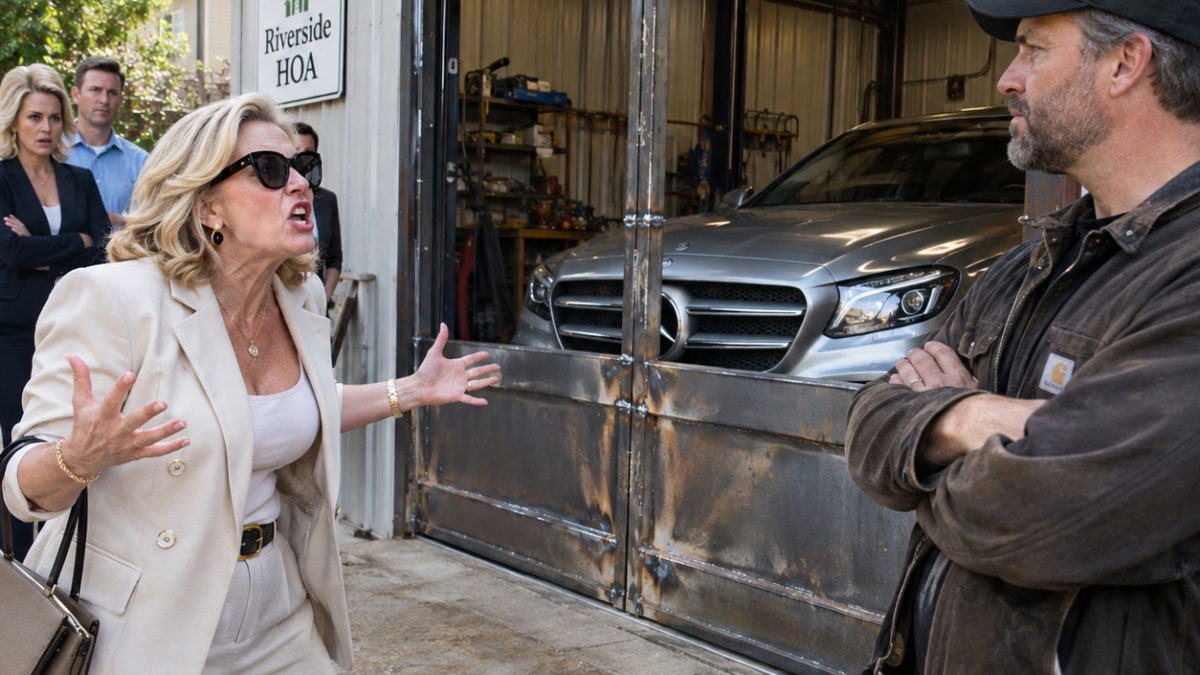
PART 2
The first time Brittany walked into my workshop without permission, I was holding a hot brazing rod.
Her Mercedes rolled across the gravel outside.
The engine stopped.
A door slammed.
Then I heard her voice.
“Wesley!”
I put the rod down.
Brittany walked straight into the open bay wearing a salmon-colored linen blazer, white sneakers, oversized sunglasses, and carrying a clipboard against her chest.
The clipboard was always a bad sign.
“We need to talk about your situation.”
“My situation?”
“Your commercial operation.”
She kept walking.
I stepped in front of her.
“You need to stay outside.”
Her eyebrows rose.
“I’m conducting a community compliance inspection.”
“You’re conducting it on private property.”
“The association has received multiple complaints.”
“From you?”
Her lips tightened.
She pulled a typed letter from beneath the clipboard.
“Consider yourself formally notified.”
I took it.
At the top were the words:
CEASE AND DESIST.
According to the letter, I had thirty days to remove all “commercial fabrication equipment” from my workshop.
I read it twice.
Then I looked around.
My welders.
My lathe.
My press.
My plasma cutter.
The fabrication table.
Everything I used to make a living.
Everything that paid the mortgage.
Everything that would eventually help send Cassie to college.
I looked back at Brittany.
“Who issued this?”
“The association.”
“You mean you.”
“You really don’t want to make this difficult, Wesley.”
I walked to my office.
When I came back, I carried two documents.
My deed.
And the recorded plat map.
I spread them across the hood of her Mercedes.
“See this line?”
She stared down.
“That’s the Spruce Hollow boundary.”
She said nothing.
I pointed again.
“See where the road bends?”
“Yes.”
“My property begins east of that point.”
“I’m aware of where your property is.”
“Then you’re aware it isn’t in your HOA.”
Brittany folded her arms.
“We consider your parcel functionally part of our jurisdiction.”
I looked at her.
“Functionally?”
“Yes.”
“That’s not a legal term.”
“It doesn’t have to be.”
“It absolutely does.”
Her face hardened.
“You benefit from the surrounding community.”
“I maintain my own well, septic, fencing, trash service, insurance, frontage, driveway, and utilities.”
“That is not the point.”
“It’s exactly the point.”
Brittany stepped closer.
Her perfume was sharp enough to smell over machine oil.
“You don’t want to fight us.”
“There is no ‘us.’ Your HOA has no authority here.”
She lowered her voice.
“My husband sits on the county planning commission.”
I waited.
“Things can become difficult very quickly when planning gets involved.”
That was the first open threat.
Brittany had no idea the camera above my porch had captured every word.
That night, I saved the footage to two separate drives.
A week later, three sheriff’s deputies arrived before sunrise.
I was standing on the porch with coffee.
My workshop was dark.
One of the deputies was Caleb Sterns, a man I knew from a local softball league.
He looked toward the building.
Then at me.
“Morning, Wes.”
“Morning.”
“You running machinery at four-thirty?”
I held up my coffee mug.
“I’m barely running myself.”
Caleb exhaled.
“Brittany again?”
He gave me a look.
“This is her third complaint this month.”
“Third?”
“None checked out.”
“Then why are you here?”
“Because she keeps filing formal complaints.”
He lowered his voice.
“You should document everything.”
“I already do.”
Caleb smiled slightly.
“Good.”
Three days later, I found a bright yellow sticker glued across my gate.
VIOLATION.
UNAUTHORIZED COMMERCIAL ACTIVITY.
The adhesive was so strong it took nearly an hour with acetone and a razor blade to remove it.
Cassie stood nearby.
At sixteen, she already had Joanne’s stubborn jaw.
Her welding goggles rested on top of her head.
“Dad?”
“Yeah?”
“She’s not going to stop, is she?”
I peeled off another piece of yellow vinyl.
“No.”
“What are we going to do?”
I dropped the scrap into a bucket.
“We’re going to keep everything.”
“And then?”
“We wait.”
“For what?”
I looked toward the road.
“For her to make a mistake.”
By the third year, I had forty-one notices.
Not one had ever been recognized as valid by the county.
Brittany knew it.
So she changed tactics.
She started contacting my customers.
The first one to call me was Hal Vickers, a retired rancher who had ordered a custom double gate.
“Wes,” he said, “some woman came to see me.”
I already knew.
“Brittany?”
“Yeah. HOA president.”
“What did she say?”
“That your shop is under a safety investigation.”
I closed my eyes.
“She said anything I order from you might get seized as evidence.”
“There is no investigation.”
“I figured.”
“My property isn’t even in her HOA.”
“I figured that too.”
I pressed my fingertips against the cold edge of my workbench.
“She’s trying to scare customers away.”
Hal was quiet.
Then he said, “I’ve met people like that.”
“Yeah?”
“Spend their whole lives digging holes for everybody else.”
I waited.
“Eventually they forget where they’re standing.”
Despite everything, I laughed.
Hal didn’t cancel his order.
He paid me early.
He also offered to sign an affidavit describing exactly what Brittany had told him.
Not every customer stayed.
Over the next two months, four more clients received similar visits.
Two canceled.
My revenue dropped almost forty percent.
That summer, I started delaying tool purchases.
Then material orders.
Then lunches.
There were days I drank coffee until dinner because every spare dollar had to stay in the business.
Eventually, I had to make a choice.
Sitting in my garage was a cherry-red 1968 Norton motorcycle.
Joanne and I had restored it together.
She found the original headlamp.
I rebuilt the motor.
She redid the seat.
The first time we got it running, we rode twenty miles into the foothills.
Joanne laughed so loudly behind me I could hear her through my helmet.
I sold it for nine thousand dollars.
The buyer arrived from Fort Collins with a trailer.
Before he rolled the Norton up the ramp, I rested my palm on the fuel tank.
For one second, I could feel Joanne’s arms around my waist again.
“You sure?” the buyer asked.
“Yeah.”
I wasn’t.
When I got home, the empty space in the garage looked enormous.
Cassie saw it.
She looked at me.
Then at the empty space.
“You sold Mom’s bike.”
“I sold a motorcycle.”
“Dad.”
I looked away.
“It was either that or start pulling from your college savings.”
“I don’t care about—”
“I do.”
She stopped.
I rubbed my hands over my face.
“I promised your mother something.”
Cassie’s eyes filled.
She didn’t argue again.
A week later, Brittany arrived with a man wearing a navy polo shirt and a cheap badge clipped to his belt.
He introduced himself as an inspector from the Boulder Foothills Community Safety Authority.
“I’m here to conduct a fire-code inspection.”
“Certification number?”
He blinked.
“What?”
“Your certification.”
Brittany stepped forward.
“Wesley, don’t start.”
I ignored her.
“County ID?”
The man hesitated.
“Inspection warrant?”
Nothing.
I took out my phone.
“I’ll call the sheriff and they can help us sort this out.”
The man suddenly decided he had somewhere else to be.
So did Brittany.
Later, I discovered the so-called authority wasn’t a government agency at all.
It was a private LLC.
The badge looked like something anyone could buy online.
When Caleb came by and reviewed my security footage, he shook his head.
“Wes, this is getting stupid.”
“It passed stupid two years ago.”
He looked toward my office.
“How much do you have documented?”
“Everything.”
“Prosecutors like patterns.”
“What kind of pattern?”
“Twenty solid incidents would get attention. Dates, video, witnesses, documents.”
I walked into my office.
Counted the folder.
Then returned.
“Forty-three.”
Caleb stared.
“You’re serious?”
“Very.”
“Then keep going.”
That evening, I repaired a hinge on my front gate while Cassie watched sparks scatter across the gravel.
She brought me water.
“Dad?”
“Yeah?”
“You should start writing down the things that aren’t on paper.”
“What things?”
“Everything she says. Every customer she talks to. Every time she comes here. Everything.”
I shut off the grinder.
Cassie looked at me.
“What?”
“Your mother would be ridiculously proud of you.”
Her face softened.
“Then write it down.”
I did.
One yellow legal pad became two.
Then three.
Dates.
Times.
Names.
Witnesses.
Exact statements.
Photos.
Video file numbers.
What started as self-defense slowly became something else.
A case.
The following year, Brittany sent two men to cut through my gate.
I was in town picking up stainless rod when Cassie called.
Her voice was very calm.
Too calm.
“Dad?”
“What happened?”
“Two men are outside.”
I put down the box in my hands.
“What men?”
“They’ve got bolt cutters.”
“Where are you?”
“Inside.”
“Stay inside.”
“They said the HOA sent them.”
My stomach tightened.
“Lock the doors. Record through the window. Do not go outside.”
“I won’t.”
“I’m coming.”
“Drive safe.”
That was my daughter.
Sixteen years old.
Two strangers cutting into our gate.
And she was reminding me to drive safely.
I got home faster than I should have.
One man had a red beard.
The other looked younger and much less confident.
They had already cut through part of the keypad housing.
I stopped my truck.
“Step away from the gate.”
They froze.
Red Beard lowered the cutters.
“We’ve got a work order.”
“From who?”
“The HOA.”
“My property is not in the HOA.”
He held up a tablet.
“Court ordered removal.”
I walked closer.
The document carried Spruce Hollow letterhead.
The line where a judge’s signature should have been was blank.
“That isn’t a court order.”
Red Beard frowned.
“We got hired to do a job.”
“You were lied to.”
The younger man was already moving backward.
I pointed at the security camera.
“You’re being recorded.”
Neither man spoke.
“I’m calling the sheriff in thirty seconds.”
Red Beard tightened his grip on the cutters.
“If you’re still standing here when they arrive, you become part of the case.”
The younger man whispered, “Dude.”
“If you leave now and cooperate, you become witnesses.”
That made the decision for them.
They threw the cutters into their truck.
Before Red Beard got inside, he glanced toward the camera.
“The HOA lady hired us. Brittany said it was a compliance job.”
Perfect.
They drove away.
I stood beside the damaged gate.
Cassie came outside.
She looked at the cuts.
Then at the lower hinge.
Her face changed.
“They cut Mom’s gate.”
She was right.
I had built that gate the year after Joanne died.
Behind the lower hinge, hidden from normal view, I had welded three initials.
JLH.
Joanne Louise Hartwell.
Brittany didn’t know.
Cassie did.
“It’s steel,” I said.
My voice sounded strange.
“We can repair steel.”
Cassie looked at my hands.
They were shaking.
Something changed in me that day.
It wasn’t rage.
Rage burns hot and fast.
This was colder.
A decision settling into place.
When Caleb arrived, he watched the footage twice.
“This matters.”
“I know.”
“The fake order matters.”
“I know.”
“The contractors identifying Brittany matters.”
“I know.”
He studied me.
“You okay?”
“No.”
That answer surprised him.
I pointed toward the hinge.
“My wife helped design that gate.”
Caleb nodded slowly.
I stared at the damaged steel.
“I’m done reacting to her.”
“What does that mean?”
“It means I’m going to find out what she actually wants.”
Caleb raised an eyebrow.
“She doesn’t have a normal job,” I said. “Drew makes decent money with the county, but not enough for everything they’ve got. Two luxury SUVs. New pool. Renovations.”
“You think money is involved?”
“I think people rarely work this hard for free.”
That weekend, I started requesting records.
HOA compliance revenue.
Vendor payments.
Boundary expansions.
Consulting contracts.
Eight years of paperwork.
One company kept appearing.
Wildflower Strategy LLC.
The name had been printed in tiny letters on paperwork Brittany had sent me for years.
I had never paid much attention.
At the county clerk’s office, I asked who owned it.
The clerk looked at her screen.
“Drew Cole Whitfield.”
I stared at her.
“Brittany’s husband?”
“Sole member.”
Something inside me clicked.
Six days later, I received the records.
I sat on the porch with a box of documents and a mug of coffee.
The first hour was tedious.
The second was confusing.
By the third, I knew exactly what I was looking at.
Spruce Hollow had collected roughly $312,000 in compliance-related fees over eight years.
More than $200,000 had gone to Wildflower Strategy for consulting work.
Wildflower belonged to Drew.
Brittany ran the HOA.
Drew sat on the planning commission.
Then I found what was missing.
There was no recorded boundary expansion.
None.
The 1987 map had never changed.
Which meant Brittany had been claiming authority over land the HOA had never legally controlled.
Not just mine.
I traced the other addresses.
Nineteen properties outside the HOA had been billed.
Some owners had paid.
Some had fought.
Some had eventually moved.
I sat there until my coffee turned cold.
Then I carried the documents into the workshop.
Cassie was running a weld on a brake-pedal mount.
She shut off the torch.
“What?”
“I found it.”
Her hood flipped up.
“Found what?”
“The reason.”
“How bad?”
“About three hundred thousand dollars in compliance money.”
Her face went still.
“Where did it go?”
“A lot of it went to Drew’s company.”
“The husband?”
“Yeah.”
“And the boundary?”
“Never changed.”
Cassie sat down.
“So every notice she sent us…”
“She never had legitimate HOA authority over us.”
Cassie looked at the paperwork.
“What do we do?”
“Nothing.”
She snapped her head up.
“What?”
“Not yet.”
“Dad—”
“If we confront them now, records disappear. People change stories.”
She understood.
“So we wait.”
“We build.”
Cassie stared at the papers.
Then smiled sadly.
“Mom would have loved this.”
I laughed, but there was something wet in my eyes.
Joanne had worked as a paralegal for sixteen years.
She loved clean documentation.
She would have gone through every page with a red pen.
Circle this.
Copy that.
Save the original.
Never trust one backup.
“Yeah,” I said.
“She would’ve.”
For eight months, I built the case quietly.
I visited every non-HOA property on Brittany’s invoice list.
A retired rancher.
Teachers.
A mechanic.
A woman who restored old pianos.
A widow.
A Vietnam veteran named Earl Pendergast who kept bees.
Twelve families had paid fees they never legally owed.
Most had paid because they were tired.
Some because they were scared.
Two families had moved after years of complaints.
One elderly couple showed me a stack of letters nearly as thick as mine.
The wife cried at her kitchen table.
“We thought we had done something wrong.”
“You didn’t.”
“She made us feel like criminals in our own home.”
That sentence stayed with me.
A single complaint is easy to dismiss.
Nineteen families telling the same story is something different.
I took statements.
Dates.
Copies.
Signatures.
Photographs.
Then I hired an attorney named Pamela Whitcomb.
Pamela had gray hair cut into a short bob and the unhurried voice of someone who had learned long ago that she didn’t need to raise it.
She read my binder.
Three hours later, she called.
“Mr. Hartwell?”
“Yes.”
“I would like to represent you.”
“You found something?”
“I found quite a lot.”
“How bad?”
“Potentially very.”
She explained that the financial records, alleged false authority, intimidation, vendor relationship, and forged or misleading documents could become much bigger than a neighborhood dispute.
She knew someone in the district attorney’s office.
“Can they actually do anything?” I asked.
“If your documentation holds.”
“It does.”
“I noticed.”
She made the call.
Meanwhile, I reinforced the shop.
More cameras.
Battery backups.
Cloud storage.
A better gate.
Not because I wanted confrontation.
Because I was tired of being surprised.
Cassie spent that winter building something of her own.
A wrought-iron horse.
Almost four feet tall.
Raised front legs.
Arched neck.
A mane made from dozens of individually shaped strips of steel.
She was entering it in a regional youth metal-art competition.
The mane alone took nearly seventy hours.
Sometimes I would stop working and watch her.
When she concentrated, she pressed her tongue against the inside of her cheek exactly like Joanne used to.
Brittany saw an ugly workshop.
I saw the place where my daughter had survived losing her mother.
That difference mattered.
By February, I had started inviting the other affected homeowners to my property on Sundays.
At first, we talked about Brittany.
Then we talked about ourselves.
Someone joked that if she could invent an association, maybe we should create one.
We called ourselves the East Hollow Owners Association.
Mostly as a joke.
We never collected dues.
Never wrote rules.
Never fined anyone.
We ate chili.
Cornbread.
Brisket.
Pie.
And compared paperwork.
Earl became our unofficial chairman because he was seventy-four years old, had served in Vietnam, and possessed the unique ability to stop an argument merely by lifting one eyebrow.
Our little group changed something.
For years, Brittany had dealt with each person separately.
Isolation was part of her power.
Once we sat around the same table, nobody felt alone anymore.
In late March, Pamela called.
“The DA is reviewing the materials.”
I closed my office door.
“How serious?”
“Serious enough that they want you to keep quiet.”
“For how long?”
“Sixty to ninety days.”
“That long?”
“They want a clean case.”
I looked through the office window.
Cassie was sanding one hoof on the iron horse.
“Brittany can’t stay quiet for ninety days.”
“Do not provoke her.”
“I won’t.”
“I mean it.”
“So do I.”
Pamela sighed.
“Good.”
For a while, nothing happened.
I stopped responding to Brittany completely.
Letters were photographed and filed.
Stickers were removed.
Complaints documented.
No phone calls.
No arguments.
No satisfaction.
She hated it.
By April, Brittany could feel something had changed.
She just didn’t know what.
So she escalated.
Her first attack was public.
She posted about me in the neighborhood Facebook group.
According to Brittany, I operated an unsafe industrial hot-work facility near family homes.
She called the workshop an explosion risk.
Then she implied I was an unstable veteran raising my daughter in an unsafe environment.
That part nearly got me.
Cassie read the post over my shoulder.
Her face went red.
“Let me answer.”
“No.”
“Dad.”
“Pamela said we stay quiet.”
“She called you mentally unstable.”
“I know.”
“She talked about me.”
“I know.”
Cassie clenched her jaw.
Then something changed.
She took a screenshot.
Printed it.
Wrote the date across the top.
And added it to the binder.
I smiled.
“What?”
“You’re terrifying.”
She almost laughed.
The second attack came through a state environmental complaint.
An inspector named Lena Brock arrived to investigate allegations of hazardous chemical storage.
She checked everything.
Ventilation.
Labels.
Storage.
Fire suppression.
Waste containers.
Eye-wash station.
Records.
After nearly an hour, she closed her clipboard.
“I’m marking the complaint unfounded.”
Cassie smiled.
Lena looked around.
“This place is cleaner than a lot of professional facilities.”
“Thank you.”
She hesitated.
“Whoever filed the complaint has done this before?”
“Yes.”
“You’re documenting?”
“Everything.”
“Good.”
That report went into the binder.
Then Brittany crossed the one line I could never forgive.
On April seventeenth, a county social worker knocked on my door.
Her name was Teresa Halliburton.
She carried an iPad.
Her expression told me she didn’t want to be there.
“Mr. Hartwell?”
“Yes.”
“I’m following up on a child-welfare report.”
My stomach dropped.
Behind me, Cassie appeared in the hallway.
The complaint claimed she had been exposed to dangerous industrial chemicals.
That she worked around heavy machinery without supervision.
That I allowed her to weld without proper safety equipment.
It even claimed she had been seen barefoot near active welding equipment.
Cassie looked down at her steel-toed boots.
Then at me.
For the first time since Brittany’s campaign began, I saw real fear in my daughter’s eyes.
Not anger.
Fear.
Teresa asked to speak with her.
Cassie agreed.
She walked her through the workshop.
“This cabinet stays locked.”
She opened the chemical cabinet.
“Eye-wash station.”
She pointed.
“Fire suppression.”
Another point.
“Ventilation.”
Then her safety logs.
Training records.
Competition paperwork.
Protective equipment.
Teresa listened.
Eventually, she noticed Joanne’s photograph on the office wall.
“Your mother?”
Cassie nodded.
“She died when I was eight.”
“I’m sorry.”
Cassie looked toward the workshop.
“Afterward, the house got really quiet.”
Her voice softened.
“Dad spent time out here. I started sitting with him.”
I looked down.
“Then I started helping. Cleaning metal. Holding clamps. Learning.”
Teresa smiled slightly.
“You enjoy welding?”
Cassie looked at the iron horse.
“I like that you can take pieces that don’t look like they belong together and make them strong.”
That sentence almost broke me.
Teresa ended the interview early.
She looked directly at me.
“Mr. Hartwell, I’m required to investigate every report.”
“I understand.”
“But in my professional judgment, this appears malicious.”
Cassie’s shoulders dropped slightly.
“I’ll document that.”
“Thank you.”
After Teresa left, Cassie stood beside me on the porch.
She didn’t move for a long time.
“Dad?”
“Yeah?”
“She tried to take me away from you.”
There was no lie that would make that better.
“Yes.”
Her eyes filled.
“I can handle her calling the shop ugly.”
I waited.
“I can handle stupid notices.”
She wiped one eye angrily.
“I can handle her making fun of me.”
Her voice cracked.
“But she tried to make somebody think you were a bad father.”
I couldn’t answer.
Cassie stepped forward.
Then she hugged me.
She hadn’t done that during an argument or crisis in years.
I wrapped both arms around her.
“I want to be there,” she whispered.
“When?”
“When this ends.”
“You will.”
“Promise?”
I thought of Joanne.
“Promise.”
That night, I called Pamela.
When I told her about the child-welfare complaint, she went silent.
Then she said, “Wesley, listen carefully.”
“I’m listening.”
“The DA finished its pre-charging review.”
My grip tightened around the phone.
“They have enough?”
“They believe so.”
“For what?”
“Theft-related charges. Conspiracy. Forgery issues. False reports. Intimidation.”
I looked across the kitchen.
Cassie was sitting at the table listening.
“What are they waiting for?”
“One recent incident would strengthen the timeline.”
I almost laughed.
Pamela heard it.
“What?”
“Nothing.”
“Wesley.”
“We don’t need to provoke her.”
“Good.”
I looked at Cassie.
“She always does one more stupid thing.”
It happened on a Friday in early May.
I was twenty minutes away buying argon and welding tips.
Cassie was in the workshop finishing the patina on her iron horse.
The main bay door was open for ventilation.
The front gate was open because I had moved steel earlier that morning.
At 11:47 a.m., a pearl-white Mercedes GLS appeared on camera.
Brittany slowed near the gate.
She looked toward the workshop.
She saw Cassie inside.
And made a decision.
She drove onto the property.
Then straight into my workshop.
Not to the entrance.
Inside.
All the way.
The Mercedes stopped three feet from my welding bench.
Brittany put it in park.
Got out.
Then tossed her purse onto my workbench hard enough to knock a roll of wire onto the floor.
Cassie stepped backward.
“Ma’am?”
Brittany ignored her.
She walked around the iron horse.
Looked it up and down.
“This whole place is a violation.”
“Please leave.”
Brittany turned.
“Oh.”
Her mouth twisted.
“The little welding princess.”
Cassie kept her voice steady.
“You can’t be in here.”
“Where’s your father?”
“He isn’t home.”
Brittany smiled.
“Perfect.”
“Please get your car out of our workshop.”
Instead, Brittany lifted her phone.
She photographed the chemical cabinet.
The welding stations.
Finished customer projects.
Storage racks.
Cassie followed at a distance.
“You don’t have permission.”
“I’m documenting compliance issues.”
“We’re not in your HOA.”
“You really have been listening to your father too much.”
Brittany walked toward the MIG station.
Cassie’s voice sharpened.
“Don’t touch anything.”
Brittany kicked a coil of filler rod.
Then she deliberately knocked over the welding unit.
Metal hit concrete.
The feed jammed.
A small spark snapped against the floor.
Cassie didn’t move toward Brittany.
She moved toward the wall.
Her hand hit the bay-door control.
The chain motor engaged.
The fifteen-foot steel panel began descending.
Brittany spun around.
“What are you doing?”
Cassie said nothing.
“Stop that.”
The door continued downward.
“STOP THAT!”
Cassie walked toward the side exit.
Brittany rushed toward the Mercedes.
The door was already too low for the vehicle.
“Open it!”
Cassie stepped through the side door.
“You little brat!”
Cassie closed it.
Locked it.
Then locked the office entrance.
Then the rear access door.
She went into the house.
Picked up her phone.
And called me.
“Dad?”
I heard it immediately.
“What happened?”
“Brittany’s here.”
“Where?”
“In the shop.”
I nearly missed my exit.
“What do you mean in the shop?”
“She drove her Mercedes inside.”
My hands tightened around the steering wheel.
“Are you with her?”
“No.”
“Did she touch you?”
“No.”
“Are you hurt?”
“No.”
“Stay in the house.”
“She kicked over the MIG.”
“I’m coming.”
By the time I pulled into the driveway, Brittany had been inside for twenty-six minutes.
I could hear pounding against the steel bay door.
Cassie was sitting on the porch.
I went to her first.
“You okay?”
“I’m fine.”
“Show me the footage.”
She already had it open.
We watched the Mercedes enter.
Brittany get out.
The insults.
The photographs.
The kicked equipment.
Cassie closing the bay door.
I replayed it.
Then again.
I looked at my daughter.
“Cassie.”
“What?”
“You did exactly the right thing.”
She folded her arms.
“I know.”
I laughed despite myself.
Brittany started pounding again.
“WESLEY!”
Cassie looked toward the shop.
“I think she knows you’re home.”
“Apparently.”
“WESLEY HARTWELL! OPEN THIS DOOR!”
I walked to a side window.
Brittany was pacing.
Her Mercedes sat in the middle of my shop like a pearl-white monument to bad decisions.
I called Pamela.
“What happened?” she asked.
“You remember the one more incident?”
Silence.
“Oh, no.”
“She drove into my workshop.”
“She what?”
“Cassie was alone.”
Pamela’s tone changed instantly.
“Is Cassie okay?”
“Yes.”
“Brittany?”
“Fine.”
“Property damage?”
“Welder knocked over. We have video.”
Another silence.
Then Pamela laughed.
Just once.
“I’m sorry.”
“No, you’re not.”
“No. I’m really not.”
“She gave you what you needed?”
“She may have given the DA exactly what they wanted.”
“Good.”
“Call the sheriff.”
“I am.”
“Immediately.”
“I’m going to.”
“Wesley.”
“Pamela?”
“Do not improvise.”
I looked through the side window at the Mercedes.
“That depends on your definition.”
“Wesley.”
“I’m kidding.”
I wasn’t completely kidding.
I called the sheriff’s department.
Asked for Caleb.
Reported trespass.
Property damage.
An unauthorized vehicle inside my secured workshop.
Dispatch asked whether anyone was injured.
“No.”
“Any weapons involved?”
“No.”
“Is the suspect threatening you?”
I listened to Brittany screaming through the wall.
“She’s threatening my business, my attorney, me, my daughter, and possibly the entire state government.”
There was a pause.
“Deputies are responding.”
Before they arrived, I entered through the side door.
Brittany had climbed back into the Mercedes.
The windows were closed.
She was screaming into her phone.
She never saw me move along the far wall.
First, I documented everything.
Photos of the vehicle.
The floor.
The fallen equipment.
Her purse on my bench.
Cassie’s sculpture.
The closed bay door.
Then I looked at a stack of steel plates beside the fabrication table.
I had spent years being careful.
Patient.
Controlled.
Brittany mistook all three for weakness.
I did something I would later spend a very long time explaining to my attorney.
I secured removable steel plates across the Mercedes door seams.
Not to the vehicle’s paint.
Not permanently to the body.
The goal was simple.
The vehicle was not going anywhere until law enforcement documented exactly where Brittany had put it.
When I finished, I taped a notice to the window.
MATERIAL EVIDENCE.
DO NOT REMOVE WITHOUT CONTACTING THE BOULDER COUNTY SHERIFF’S OFFICE.
Then Brittany saw me.
Her eyes moved from my face to the plate beside her door.
“What did you do?”
I said nothing.
She pulled the handle.
The door wouldn’t open normally.
Her expression changed.
“What did you do to my car?”
“The windows work.”
“You welded me in?”
“The deputies are coming.”
“You psychopath!”
“You drove yourself into my workshop.”
“I’ll have you arrested!”
“Then you can tell the sheriff why your Mercedes is parked three feet from my welding bench.”
Her mouth opened.
Closed.
Opened again.
“You kidnapped me!”
“No.”
I gestured around the building.
“You entered my property.”
She screamed something I won’t repeat.
I walked out.
Caleb arrived with two deputies.
Body cameras running.
I showed them everything.
Camera footage.
The damage.
The timeline.
The previous complaints.
The binder.
Then I showed Caleb the Mercedes.
He stared through the glass.
Then at me.
Then at the Mercedes again.
“Wes.”
“Yeah?”
“What did you do?”
“Preserved the scene.”
He closed his eyes.
One of the younger deputies turned away.
His shoulders were shaking.
Caleb inspected the situation.
“You damage the vehicle?”
“No.”
“Permanent attachment?”
“No.”
“Removable?”
“Yes.”
He rubbed both hands across his face.
“You were not supposed to do this.”
“I suspected that.”
From inside the shop, Brittany screamed.
“OFFICER! ARREST HIM!”
Caleb looked toward the building.
Then back at me.
“This has been a very long day.”
“It’s not even two.”
“That’s what worries me.”
I looked toward the house.
Cassie stood on the porch.
The adrenaline had left her.
Now she simply looked tired.
“I’m taking my daughter camping.”
Caleb stared at me.
“Right now?”
“Yes.”
“For how long?”
“Three days.”
“You’re leaving that here?”
“If you’re preserving the scene.”
He looked toward the shop.
Then toward Cassie.
Something in his expression softened.
“For the record,” he said, “I think removing your daughter from the property while this is processed would be sensible.”
“That an official recommendation?”
“It is now.”
I held out my hand.
He shook it.
“Go.”
We packed in twenty minutes.
As I drove away, Cassie looked through the rear window.
“Dad?”
“Yeah?”
“Did you actually weld her Mercedes shut?”
“Technically, I—”
“Dad.”
“Yes.”
She stared at me.
Then she started laughing.
Not a small laugh.
Not polite.
She bent forward in the passenger seat and laughed so hard tears rolled down her face.
I tried to stay serious.
I lasted five seconds.
Then I started laughing too.
All the fear.
All the letters.
All the threats.
All the sleepless nights.
For a few miles, it came out as laughter.
Cassie wiped her eyes.
“Mom would call you an idiot.”
“She absolutely would.”
“She’d secretly think it was hilarious.”
“She absolutely would.”
We reached a fishing cabin near Poudre Canyon before dark.
There was barely any cell service.
No HOA.
No notices.
No cameras.
Just pine trees, cold air, running water, and a sky bigger than anything we had seen in months.
That first night, we ate canned chili.
Cassie beat me at cards.
Twice.
Then we sat outside.
Eventually, she said, “Dad?”
“Yeah?”
“When CPS came…”
I waited.
“Were you scared?”
I looked toward the dark river.
“Terrified.”
She was quiet.
“More scared than when Brittany cut the gate?”
“Yes.”
“More scared than losing the business?”
“Yes.”
She looked at me.
“Why didn’t you tell me?”
“Because you were already scared.”
“I thought you weren’t.”
I smiled sadly.
“Adults are scared all the time, Cass.”
She looked surprised.
“We just get better at carrying it.”
She picked at a loose thread on her sleeve.
“Sometimes I’m tired of being strong.”
That sentence hit me harder than anything Brittany had ever done.
I moved my chair closer.
“You don’t have to be strong for me.”
“But you’re strong for me.”
“I’m your father.”
“How is that different?”
“It means I’m allowed to be scared and stay beside you anyway.”
She thought about that.
Then rested her head against my shoulder.
We stayed there until the cold forced us inside.
The next morning, my phone found enough signal to download dozens of messages.
Pamela.
Caleb.
Earl.
Hal.
Then news alerts.
A photograph of my workshop appeared on a local news site.
Another showed the pearl-white Mercedes through the bay window.
The headline mentioned an HOA dispute, an ongoing investigation, and a vehicle secured inside a private workshop.
Cassie read it over breakfast.
“They make you sound crazy.”
“Give them time.”
She scrolled.
“Dad.”
“What?”
“The DA filed charges.”
I put down my coffee.
By Sunday, the investigation had moved fast.
Brittany faced multiple criminal counts connected to the financial scheme, false filings, intimidation, and related conduct.
Drew faced charges as well.
His planning position was suspended.
Wildflower Strategy was under investigation.
And, naturally, everyone on television wanted to talk about the Mercedes.
Cassie grinned.
“It is kind of iconic.”
“It’s evidence.”
“It can be both.”
On Monday, Pamela finally got through.
“You’ve seen the news?”
“Some.”
“Brittany is in custody.”
I exhaled slowly.
“And Drew?”
“His lawyer is handling surrender arrangements.”
I looked at Cassie across the cabin.
She was pretending not to listen.
“What about the Mercedes?”
“Still in your shop.”
Cassie’s head snapped up.
I almost laughed.
Pamela continued.
“The evidence team wanted the scene preserved until they finished documentation.”
“So my terrible idea helped?”
“Do not become proud of yourself.”
“Creative?”
“Wesley.”
“Lawful?”
“Do not.”
“Deeply ill-advised?”
“That is the phrase I will continue using.”
I smiled.
Then my voice became quiet.
“Is it over?”
“No.”
I knew better.
“Is the worst part over?”
Pamela paused.
“I think so.”
I looked at Cassie.
She had gone outside with two fishing rods.
For the first time in months, her shoulders looked relaxed.
“Good.”
On Tuesday morning, certified operators removed the temporary plates under law-enforcement supervision.
The Mercedes was documented and released.
No body panel had been damaged.
Cassie and I drove home that afternoon.
As we approached the property, I saw cars parked along the road.
My stomach tightened.
“Dad?”
“I see them.”
“Reporters?”
“I don’t know.”
I slowed.
Then Earl Pendergast walked toward the gate.
Vietnam veteran cap.
Hands in his pockets.
Huge smile.
I rolled down the window.
“Earl?”
“About time you came home.”
“What’s going on?”
He stepped aside.
People emerged from behind the parked cars.
Hal.
The piano restorer.
Teachers.
Neighbors.
People from East Hollow.
A few I barely knew.
Cassie climbed out.
She stared.
“Is this for us?”
I looked at Earl.
He shrugged.
“Who else?”
Then people started applauding.
I didn’t know what to do.
Cassie did.
She took my hand.
Hal came forward first.
“Where’s the Mercedes?”
“Gone.”
He shook his head.
“Shame.”
I laughed.
Then he hugged me.
“You kept the paperwork, Wes.”
“I did.”
“That’s what beat her.”
More people came over.
A widow Brittany had billed for a shed.
A couple who had paid hundreds in false compliance fees.
A man who almost sold his land because he thought he was the only person being targeted.
One woman hugged Cassie.
Then started crying.
“For years, I thought maybe I really was the problem.”
Cassie looked at me.
That was when I understood something.
I had spent years imagining revenge as Brittany losing.
But standing there, revenge didn’t feel like watching her fall.
It felt like watching everyone else stand back up.
The cases took months.
Courtrooms move slower than anger.
Brittany’s confidence disappeared gradually.
In photographs from hearings, the linen blazers were gone.
No oversized sunglasses.
No clipboard.
No Mercedes announcing her title.
Just a woman beside an attorney while prosecutors walked through eight years of records.
Drew lost his seat on the planning commission.
Wildflower Strategy collapsed.
Spruce Hollow was placed under outside supervision while its finances and bylaws were reconstructed.
The legal boundary was formally acknowledged.
Homeowners who had been improperly billed were reimbursed.
New elections were held.
Financial disclosure rules were strengthened.
Brittany eventually accepted responsibility on multiple counts and received an eighteen-month custodial sentence.
Drew lost the position that had made him seem untouchable.
When Pamela called me with the final civil settlement figure, I was standing in the workshop.
“Wesley?”
“Yeah.”
“It’s done.”
“Done done?”
“As done as litigation gets.”
“And the settlement?”
She told me.
A little over $240,000 between settlement proceeds and recovered money.
I sat down.
For years, I had counted every dollar.
Skipped meals.
Delayed equipment.
Sold the Norton.
Watched customers disappear because someone with a title had lied about me.
Now the number felt unreal.
Cassie came into the office.
“What happened?”
I told her.
Her mouth opened.
“Two hundred forty thousand?”
“Little more.”
“You could buy another Norton.”
I smiled.
“I could.”
“You should.”
“No.”
Her smile disappeared.
“Why?”
“Because I don’t want another one.”
“You loved that motorcycle.”
“I loved what happened on it.”
I looked at Joanne’s photograph.
“The memories weren’t sold with the bike.”
That evening, Cassie and I sat at our kitchen table.
Three hours.
We talked about her college.
The mortgage.
The business.
The people who had been hurt.
And Joanne.
Eventually, Cassie pulled one of her mother’s old legal pads from a drawer.
“What if we did something with the money?”
“That was always the plan.”
“No. I mean something bigger.”
I leaned back.
“What are you thinking?”
She glanced toward the workshop.
“Girls in trades.”
I stayed quiet.
“When I started welding, everybody thought it was cute.”
“It was cute.”
“Dad.”
“Sorry.”
“Then when I got good, people acted surprised.”
She looked at her hands.
“Like welding belonged to somebody else.”
I knew exactly what she meant.
“Mom wanted me to know how to make things.”
“She did.”
“What if we gave other girls that chance?”
One week later, we met with the principal at Niwot High School.
We proposed the Joanne Hartwell Trade Scholarship.
Two young women every year.
Tuition.
Certification costs.
Tools.
Protective equipment.
Welding.
Machining.
Electrical work.
Plumbing.
Automotive.
Whatever skilled trade program they qualified for.
The principal read our proposal slowly.
Then removed his glasses.
“You realize this could change somebody’s entire life.”
Cassie looked at me.
Then back at him.
“That’s the idea.”
The first scholarship was awarded the following spring.
A seventeen-year-old girl named Marisol Buchanan won it.
She wanted to become a diesel mechanic.
Her mother drove a long-haul truck.
Marisol had grown up around engines and truck stops and wanted to understand every sound a diesel motor could make.
When she opened the envelope, she cried.
Her mother cried.
Cassie cried.
Then I cried.
Afterward, Marisol came over.
“Mr. Hartwell?”
“Yes?”
“Why did you name the scholarship after your wife?”
I glanced at Cassie.
She answered.
“Because my mom believed knowing how to build something with your own hands makes it harder for the world to convince you that you’re helpless.”
I had never heard Joanne say those exact words.
But I knew they were true.
The next month, Cassie entered her wrought-iron horse in the regional competition.
She had nearly abandoned it after Brittany’s Mercedes incident.
One section of the base had been scratched.
The patina had been uneven where the tray fell.
Cassie repaired everything.
The horse won first place.
When they announced her name, she froze.
“Go,” I whispered.
She walked onto the stage wearing a simple black dress.
And her steel-toed work boots.
Joanne would have laughed until she cried.
The judges displayed the horse beneath the lights.
Four feet of shaped iron.
Front legs raised.
Head lifted.
Mane flowing backward.
It looked alive.
A reporter asked Cassie what the sculpture meant.
She glanced at me.
Then at the horse.
“Standing your ground without becoming what tried to hurt you.”
I looked away before anyone could see my face.
Two years later, Cassie went to the Colorado School of Mines to study materials engineering.
She still came home on weekends.
She still handled my office better than I did.
She still corrected my invoices.
Still complained about how I organized welding tips.
Still sent me links whenever she found an old Norton for sale.
I never bought another one.
The workshop is still standing.
Thirty by fifty feet.
Steel walls.
Hot iron.
Machine oil.
The faint smell of acetylene.
Joanne’s photograph remains on the office wall.
Her initials are still hidden behind the lower hinge of the gate.
Only now, there are more.
One weekend, Cassie crawled under the gate with a welding hood.
Beside JLH, she added:
CH.
WH.
Cassie Hartwell.
Wesley Hartwell.
Three names hidden in the same piece of steel.
One family.
Spruce Hollow changed too.
The new HOA board hung a copy of the actual boundary map inside its meeting room.
Earl suggested they frame one of Brittany’s old violation notices beside it.
I declined.
I kept those.
Every single one.
Sometimes people ask why.
Because memories soften.
Paper doesn’t.
Paper remembers exactly what somebody said.
Exactly what they demanded.
Exactly how far they were willing to go when they thought nobody would ever hold them accountable.
The East Hollow Owners Association never became a real HOA.
None of us wanted that.
Instead, it stayed what it had accidentally become.
Neighbors.
Every few months, we still gather at my place.
No dues.
No bylaws.
No fines.
No measuring fences.
Earl brings venison chili.
Hal usually brings something smoked.
The piano restorer makes cornbread.
Teresa, the social worker who investigated Cassie, sometimes brings her daughters.
Lena has stopped by too.
Kids run across the lawn.
People eat on folding chairs.
Nobody cares what color anyone’s shed is.
One Sunday afternoon, I sat on the porch while sunlight turned the foothills copper.
Cassie was home from college.
Her iron horse stood on a stone base beside the walkway.
She had received offers to sell it.
She refused every one.
“It belongs here,” she always said.
She came onto the porch carrying two glasses of iced tea.
Sat beside me.
For a while, neither of us spoke.
Earl was telling a story I had heard at least five times.
Someone laughed near the grill.
Children chased each other beside the workshop.
Then Cassie bumped my shoulder.
“Dad?”
“Yeah, sweetheart?”
“Mom would have loved this.”
I looked across the property.
The house.
The shop.
The gate.
Joanne’s initials.
The neighbors.
The horse.
For years, I thought keeping my promise to Joanne meant keeping the land.
Don’t let anybody take this place from you.
I thought she meant the deed.
The acreage.
The workshop.
But sitting beside my daughter that afternoon, I finally understood.
Joanne had been talking about more than property.
She meant our life.
The place where grief had slowly turned into purpose.
The workshop where an eight-year-old girl who had lost her mother discovered she could make something strong with fire and steel.
The gate carrying three sets of initials.
The porch where strangers became neighbors.
The scholarship carrying Joanne’s name into classrooms she would never see.
Brittany tried to take those things away from me one humiliation at a time.
A violation notice.
A threat.
A customer.
A fake inspection.
A damaged gate.
A malicious complaint.
Then my daughter.
She believed power meant making people scared enough to obey.
For a while, she succeeded.
I lost business.
I lost sleep.
I sold something I loved.
I watched my daughter learn far too young that adults sometimes weaponize systems designed to protect people.
But Brittany made one mistake over and over again.
She mistook silence for surrender.
Every time I refused to scream back, she thought she had won.
Every time I quietly filed another document, she thought nothing had happened.
Every time I chose patience over rage, she thought I was weak.
Then one Friday morning, she drove her pearl-white Mercedes through my open gate and parked it inside the workshop she had spent years trying to destroy.
People still ask me about that Mercedes.
Pamela calls the whole thing “the most creative bad idea I’ve ever had to defend.”
Caleb refuses to discuss it without laughing.
Cassie keeps a framed photograph of the Mercedes inside the workshop in her college apartment.
Me?
I wouldn’t recommend doing what I did.
But I don’t regret the moment.
Not because Brittany was humiliated.
Not because the story ended up on television.
Not because people laughed about an HOA president finding her Mercedes trapped inside the workshop she hated.
I don’t regret it because for once in her life, Brittany couldn’t simply create chaos and drive away before anyone caught up with her.
The car stayed exactly where she put it.
The cameras kept recording.
The evidence stayed untouched.
The truth stayed in the room.
And while Cassie and I spent three quiet days beside a mountain river, the little kingdom Brittany had built from fear, false authority, and other people’s exhaustion finally collapsed.
Without us doing anything else.
That was the part I eventually understood.
The Mercedes wasn’t the revenge.
Her prison sentence wasn’t the revenge.
The settlement wasn’t the revenge.
Even watching Drew lose his position wasn’t the revenge.
The real revenge was that she failed.
She failed to take my land.
She failed to destroy my workshop.
She failed to break my business permanently.
She failed to separate me from my daughter.
She failed to make our neighbors stay afraid.
She failed to erase Joanne from the place we had built together.
Cassie still became an engineer.
The workshop is still there.
The gate still has Joanne’s initials.
The neighbors still gather on the porch.
And every year, two young women receive an envelope bearing my wife’s name and get the chance to build a life with their own hands.
That is what survived Brittany.
That is what she could never take.
Some mornings, I arrive at the workshop before sunrise.
The property is quiet.
Cassie is away at school.
The neighbors are asleep.
I unlock the gate.
Walk into the shop.
Turn on the lights.
And for a few seconds, before the machines start and the day gets loud, everything is still.
The first sunlight comes through the eastern windows Joanne insisted we put there all those years ago.
It falls across the welding bench.
Across the floor.
Across the place where Cassie learned her first bead.
Sometimes I look at Joanne’s photograph.
And I can almost hear her voice.
Finish the workshop.
Raise our girl.
Don’t let anybody take this place from you.
I smile.
Because I finally kept all three promises.
Then I lower my welding hood.
Strike the arc.
And get back to work.








