PART 2: HOA KAREN Drilled an Illegal Well 40 Feet From My Property—Six Weeks Later, 217 Trees Were Dead and Her Secret Deal Was Exposed
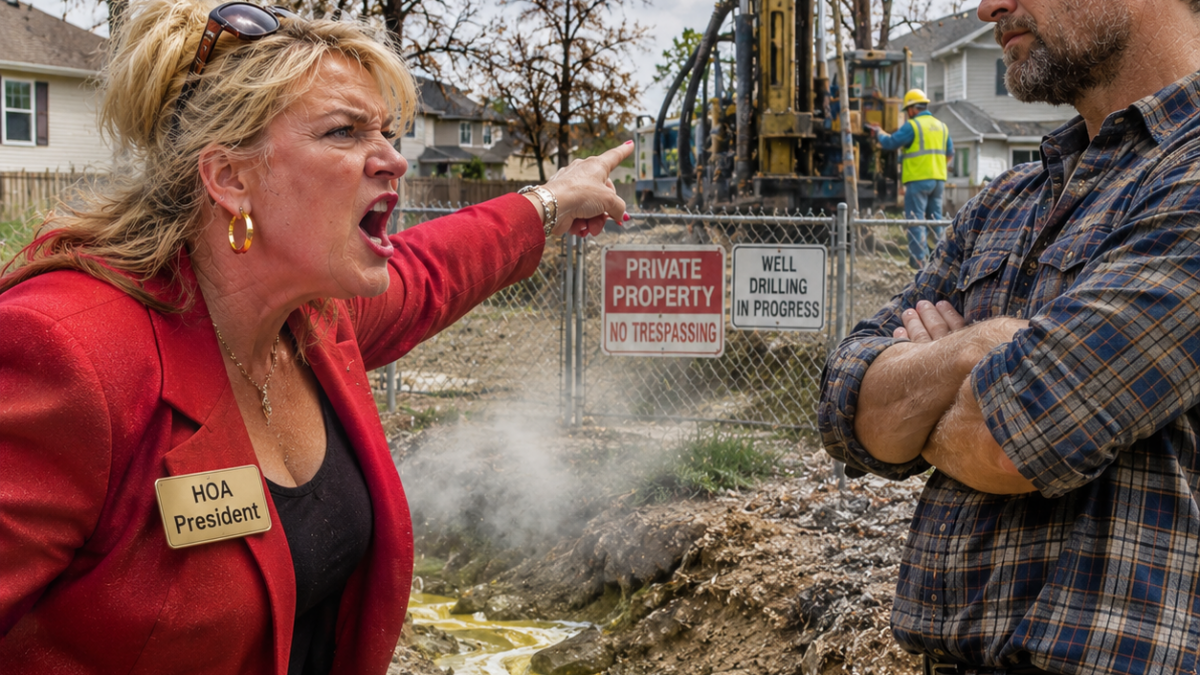
PART 2
Arizona was in the third year of a brutal drought.
Nobody needed to explain water anxiety to people living outside Phoenix.
Municipal restrictions had tightened.
Landscape irrigation schedules were limited.
Pressure dropped during high-demand periods.
Every board meeting contained at least one argument about lawns.
Darlene saw an opportunity.
At the January meeting, she stood beside a presentation board displaying a photograph of a sparkling stainless-steel wellhead against a sunset.
The title read:
**MAPLEWOOD WATER INDEPENDENCE INITIATIVE.**
I stared at it for a while.
Then at Lenora.
She whispered:
“That sounds expensive.”
“It sounds worse than expensive.”
Darlene began.
“Our community currently relies entirely on municipal supply.”
Technically true.
“With prices increasing every year and restrictions growing more severe, the board has explored alternatives.”
Slide.
Projected savings.
Slide.
Property values.
Slide.
“Independent irrigation water source.”
That got people’s attention.
Darlene smiled.
“We have consulted a drilling contractor who believes Maplewood is ideally situated for a community well.”
I raised my hand.
She kept talking.
I raised it again.
Finally:
“Mr. Flynn?”
“Has a geological site assessment been completed?”
She blinked.
“A what?”
“Subsurface formation review.”
“Our contractor has reviewed conditions.”
“What kind of review?”
She looked toward Stan.
Stan looked at Brock.
Brock studied the ceiling.
I continued.
“This basin isn’t uniform.”
People turned toward me.
“We have fractured formations, mineralized zones, variable water quality and fault-controlled flow. You don’t choose a deep well location by looking at an aerial photograph.”
Darlene smiled.
“We have professionals.”
“Who?”
“Our contractor.”
“Is he a geologist?”
“I don’t believe that credential is necessary.”
“It isn’t always.”
I kept my voice calm.
“But if you’re planning a deep community well, you need to understand what formations you expect to encounter.”
She waved one hand.
“Garrett, we’re not drilling for oil.”
A few people laughed.
I didn’t.
“No.”
I leaned forward.
“You’re drilling for something more important.”
Silence.
“Water.”
Her smile tightened.
“We appreciate your perspective.”
“I’m not giving you a perspective.”
I pointed toward the presentation.
“I’m telling you to do the geology before the drilling.”
Darlene sighed theatrically.
“Unless your hobby vineyard has somehow turned you into an expert on groundwater—”
“Twenty-five years in petroleum geology.”
That stopped her for half a second.
I continued.
“Wells in four continents.”
The room got quieter.
“Formation evaluation. Drilling hazards. Water-bearing zones. Sulfur-bearing formations.”
Darlene’s nails clicked.
“Then perhaps you can volunteer your services.”
“I will.”
That surprised her.
“For free?”
“For the preliminary review.”
Lenora looked at me.
I nodded.
“I’ll review county geology, nearby well logs and any site data you have. No charge.”
The room liked that.
Darlene did not.
“We already have professionals handling the project.”
“Then give them my number.”
She moved on.
I told myself permitting would catch anything serious.
County forms.
State review.
Drilling records.
Insurance.
There were layers of safeguards.
I had spent my career working inside regulated drilling operations.
People don’t simply drive a rig into a neighborhood and punch a hole hundreds of feet deep because somebody with a visor says it sounds useful.
Or so I believed.
Early May.
Six-ten in the morning.
A diesel engine woke me.
Not a pickup.
Heavy rig.
I sat up.
Lenora groaned.
“What is that?”
I already knew.
I went to the window.
Drilling mast.
Maybe forty feet beyond our fence.
On the narrow common strip beside my property.
Workers setting pipe.
Mud tanks.
Compressor.
Rig engine growling.
I pulled on boots.
Didn’t bother changing out of my bathrobe.
Lenora followed me to the door.
“Garrett.”
“I just want to see paperwork.”
“That sentence has never ended peacefully.”
I walked outside.
The foreman was sunburned and smoking.
Country music came from a truck.
“Morning.”
He barely looked at me.
“Morning.”
“Who’s running this job?”
“I am.”
“Permit number?”
He stared.
“What?”
“County or state well permit.”
“Lady who hired us says everything’s approved.”
“Who hired you?”
He pointed at the HOA sign.
“Board.”
“Company?”
“High Desert Drilling.”
That name meant nothing to me yet.
“How deep are you planning?”
“Three-fifty, four hundred depending what we hit.”
“Formation log?”
He shrugged.
“Driller keeps it.”
“Pre-drill geologic review?”
He shrugged again.
“Buddy, I just run the crew.”
Fair.
“You mind showing me the permit posted at the site?”
“Don’t have one.”
My stomach tightened.
“Why not?”
“Office handles that.”
I walked back home.
Called county permitting.
Gave them the parcel.
HOA name.
Contractor.
The woman on the phone typed.
Then:
“I don’t see an active well permit.”
“Could it be under another parcel?”
She checked.
“No.”
“Pending?”
“Nothing.”
I asked again because I wanted to be certain.
Nothing.
I called Darlene.
Voicemail.
Sent email.
No response.
The rig kept turning.
By sunset, they were hundreds of feet down.
I stood near the fence listening.
Drill steel.
Hydraulics.
Engines.
Every geologist recognizes the smell of fresh cut formation.
Dust.
Rock.
Mud.
Diesel.
But underneath it was something else.
Faint.
Sulfur.
Rotten egg.
I walked closer to the fence.
Breathed again.
There.
Not strong.
Enough.
I called to the foreman.
“You smelling sulfide?”
He shouted over the rig.
“What?”
“Sulfur!”
He waved.
“Rock smells weird sometimes!”
I didn’t like that answer.
Three days after the rig left, my koi died.
All six.
One morning.
Floating.
I had fed them the night before.
Healthy.
Active.
By sunrise, every one was belly-up.
Lenora found them first.
I heard her call my name.
Not yell.
Worse.
That tone couples develop when something is genuinely wrong.
I went outside.
The pond surface had a yellowish film.
Not thick.
But obvious.
I crouched.
Smelled.
My body knew before my brain finished processing.
Hydrogen sulfide.
I had encountered it during field operations.
Nobody who has smelled it at dangerous sites forgets it.
Rotten eggs is the polite description.
At higher concentrations, it feels heavier.
Dirty.
Mineral.
Wrong.
Lenora stood behind me.
“What happened?”
“I don’t know yet.”
“You know something.”
“Yes.”
I walked to the Japanese maples.
Leaves curling.
Brown starting at the edges.
Roots wet from irrigation.
Vegetable beds looked wrong too.
Tomato leaves blackening.
Pepper plants wilted.
The grapevines had begun losing color.
I went to the workshop.
Pulled out an old field testing kit.
Basic screening only.
Not courtroom evidence.
But enough to tell me whether I was imagining things.
The reading came back wildly abnormal.
I tested again.
Same direction.
Lenora watched my face.
“How bad?”
“Bad enough that nobody uses this water.”
“Our irrigation?”
“Shut it off.”
“The house?”
“Municipal supply is separate.”
“You’re sure?”
“Yes.”
I turned every local irrigation valve I could isolate.
Then walked to the fence.
The new HOA well pump was running.
I could hear it.
Steady mechanical thrum.
Darlene had gotten her independent water.
I emailed the board.
Subject:
**EMERGENCY – POSSIBLE WELL CONTAMINATION**
Photographs.
Dead koi.
Damaged vegetation.
Field-screening results.
Request:
Stop pumping immediately.
Hire certified environmental laboratory.
Notify regulators.
Do not use well until cleared.
Six hours later, Darlene replied.
To the entire neighborhood.
Not just me.
**Mr. Flynn’s homemade testing is not certified. Our contractor assures the board that the well is safe. Residents should avoid unnecessary alarm. Some landscaping may experience temporary adjustment during the transition to new irrigation water.**
I reread one phrase.
Temporary adjustment.
I walked outside.
Picked up a brittle maple leaf.
It crumbled in my fingers.
“Temporary adjustment,” I said.
Lenora stood beside me.
“Don’t reply angry.”
“I know.”
“You’re thinking angry.”
“Very.”
“Then don’t type.”
I didn’t.
Two days later, Darlene held an emergency board meeting.
I was not invited.
Rex Albright attended.
Retired Army Corps engineer.
Gray crew cut.
Still carried himself like somebody might inspect his boots.
He texted me from the meeting.
**They activated full common irrigation.**
I stared at the message.
Called him.
“They what?”
“Four-zero.”
“On what test results?”
“Contractor assurance.”
“What analysis?”
“None presented.”
“Did you ask?”
“Yes.”
“And?”
“Darlene said proprietary.”
I almost dropped the phone.
“Water chemistry is proprietary now?”
“Apparently.”
Rex lowered his voice.
“She says you’re exaggerating because of the vineyard dispute.”
That was the moment I understood where this was going.
She wasn’t investigating.
She was positioning.
Her property sat uphill.
The well lay near my side.
Groundwater migration followed geology, not property lines, but the first visible effects were downhill from the drilling location.
My house.
Then the Morgans.
Then the Tran family.
Week two.
Mr. and Mrs. Morgan lost an orange tree.
Forty years old.
Mr. Morgan had planted it when they moved to Arizona.
Mrs. Morgan called Lenora.
We went over.
The tree stood behind their patio.
Leaves yellow.
Fruit dropping early.
Branches dying.
Mrs. Morgan touched the trunk.
“My husband planted this.”
Mr. Morgan was standing ten feet away.
He had survived cancer once and heart surgery twice.
The tree upset him more than either subject.
“We put it in our first week,” he said.
Mrs. Morgan looked at me.
“Can it be saved?”
I hate giving answers people don’t want.
“I don’t know.”
“You know trees?”
“Not enough.”
“But the water?”
“Yes.”
She looked toward their irrigation line.
“Is it the well?”
“I think so.”
“Think?”
“I need laboratory proof.”
She nodded.
“Then get it.”
The Trans lived farther down.
Mai and Daniel.
Young daughter.
Backyard play area.
Mai called because the grass smelled like a sewer after irrigation.
Their daughter refused to go outside.
“Bad bathroom,” she called the yard.
Yellow staining appeared along sections of white vinyl fence where sprinklers dried.
By week three, dead landscaping had become obvious.
Not one yard.
Several.
Palo verde.
Mesquite.
Desert willow.
Plants chosen specifically because they tolerate brutal heat.
I started sampling every forty-eight hours.
Photographs.
Dates.
Locations.
GPS.
Weather.
I didn’t want a pile of dramatic pictures.
I wanted a contamination timeline.
Then I hired Desert Pure Labs in Phoenix.
State-certified.
Twelve hundred dollars.
Out of pocket.
Lenora saw the invoice.
“Worth it?”
“It has to be.”
I collected samples from my pond, irrigation point, the Morgans and two other properties.
Chain of custody.
Sealed containers.
Delivered personally.
The lab called before the formal report arrived.
“Mr. Flynn?”
“Yes.”
“This is Andrea from Desert Pure.”
Her voice was different from normal lab calls.
Careful.
“How bad?”
“We’re seeing extremely elevated sulfur compounds and significantly acidic water in several of the samples.”
“How elevated?”
She gave me the numbers.
I stopped writing for a second.
“Are you sure?”
“We reran them.”
“Contamination profile consistent across locations?”
“Yes.”
“Spatial trend?”
“Strongest nearest the well area based on what you submitted.”
I sat down.
Andrea continued.
“I can’t determine source without a broader investigation.”
“Understood.”
“But these are not normal residential irrigation-water conditions.”
Formal report came the next day.
I filed a complaint with the Arizona Department of Water Resources and relevant county environmental officials.
Attached laboratory results.
Site map.
Timeline.
Photographs.
Drilling information.
Permit search showing none located.
I received acknowledgment.
Inspector assignment.
Estimated response:
Weeks.
Weeks.
Lenora read the email over my shoulder.
“Our trees don’t have weeks.”
“I know.”
Darlene sent another neighborhood message.
**Certain residents continue spreading unverified claims regarding the community well. The board requests patience while independent professionals review conditions.**
I called High Desert Drilling.
Asked for their water analysis.
The office manager said:
“We didn’t do water-quality testing.”
“Did you tell Maplewood HOA the well was safe?”
“We confirmed the well produced water.”
“That’s not the same thing.”
“No.”
“Did you perform sulfur analysis?”
“No.”
“pH?”
“No.”
“Metals?”
“No.”
“Any lab?”
“No.”
I documented the call.
Then came my violation notice.
Certified.
Official HOA paper.
My koi pond was described as an “unapproved water feature potentially contributing biological contamination to community groundwater.”
Thirty days to remove it.
Two hundred dollars a day afterward.
I sat in the workshop holding the letter.
The room smelled like cedar dust.
Sulfur leaked in through the open window despite everything.
My geological maps were spread across the bench.
Lenora brought coffee around midnight.
She placed it beside me.
“What are you thinking?”
“She needs a source other than herself.”
“For what?”
“The contamination.”
“You?”
“She already chose me.”
Lenora looked toward the violation letter.
“Can she really convince people your pond poisoned groundwater?”
“Not people who understand geology.”
“That isn’t everyone.”
Exactly.
I needed source attribution.
Not intuition.
Not my résumé.
Evidence.
The well pump started outside.
Even from hundreds of feet away, I could hear it.
Rhythmic.
I pictured contaminated water moving through fractures.
Each pumping cycle potentially changing hydraulic gradients.
Expanding the affected zone.
“I need to map the plume.”
Lenora nodded.
“Then map it.”
Week four.
Twenty-three properties reporting effects.
Half the development.
Walking Maplewood felt wrong.
Dead leaves underfoot in June.
Brown where green belonged.
Windows closed in ninety-degree heat because the outside air near freshly irrigated areas smelled foul.
Local television arrived.
Channel 7.
Ninety-second piece.
Dead trees.
Yellow fence stains.
Residents angry.
Then Darlene.
Tennis visor.
Pearls.
Calm smile.
“We’re investigating multiple potential sources.”
Reporter:
“Is the HOA well one of those sources?”
“Everything is being considered.”
“Was the well permitted?”
“Approvals are being finalized.”
I nearly shouted at the television.
Lenora grabbed the remote before I did.
“No.”
“She just lied.”
“I know.”
“Drill first, permit later is not a thing.”
“I know.”
“She said finalized.”
“Garrett.”
I sat.
“This is why we document.”
“Yes.”
I hated when my own advice came back at me.
I invited affected neighbors to my workshop.
Eleven households came.
Then fourteen.
I taped a geologic cross-section to the wall.
“No jargon tonight.”
Rex stood in back.
Mrs. Morgan sat beside Lenora.
Mai and Daniel came without their daughter.
I pointed at the diagram.
“Imagine the underground formations as stacked materials with cracks and pathways.”
“Not an underground lake?”
Someone asked.
“No.”
“That matters.”
I pointed to the well.
“The drill penetrated several hundred feet. If it encountered sulfur-bearing rock and created a hydraulic connection with water-bearing fractures, pumping can move dissolved contaminants outward.”
“How?”
Mr. Morgan asked.
“Pressure.”
I held up a sponge.
“Not perfect, but close enough.”
I compressed one side.
Water moved.
“Pump here, gradients change. Water moves toward lower pressure and along available pathways.”
Rex stepped forward.
“I can help map the surface expression.”
He still had surveying and conductivity equipment.
Over the next week, we measured affected zones.
Again, not pretending conductivity alone proved specific contamination.
It didn’t.
But changes in dissolved mineral content helped us define where further certified sampling should occur.
We overlaid lab results.
Dead vegetation.
Irrigation lines.
Well location.
The pattern radiated from the HOA well and extended primarily through the downgradient side of the neighborhood.
We called ourselves the Maplewood Restoration Group.
Lenora came up with the name.
“Better than Darlene Poisoned Us,” Rex said.
“I considered that,” Mai replied.
Nobody laughed much.
Darlene escalated.
The board expanded common-area well use.
Her logic appeared to be that continuing to pump would demonstrate confidence.
Instead, more landscaping showed damage.
Then seven coalition households received maintenance violations.
Dead plants.
Brown lawns.
Damaged trees.
The HOA was citing residents for conditions created after the HOA irrigation system started distributing contaminated water.
Rex handed me his violation.
“Do I laugh?”
“Keep it.”
“I wanted to frame it.”
“Later.”
Then came the proposed emergency assessment.
Five hundred dollars per household.
Official purpose:
**LANDSCAPE RESTORATION AND COMMUNITY RESPONSE FUND.**
I requested budget details.
Eighty percent was allocated to attorneys and consultants.
I stared at the spreadsheet.
Then started searching public records.
Contractor license.
Business filings.
Corporate registration.
High Desert Drilling LLC.
Owner:
Marcus Kopecki.
I froze.
Same last name.
I called Ramona Sky before I called anyone else.
Ramona was an environmental attorney in Phoenix.
We had met years earlier during a consulting case.
She was one of those lawyers who rarely raised her voice because everyone else usually became quieter when she spoke.
“Tell me you haven’t accused anyone publicly yet.”
“Not beyond what the records show.”
“Good.”
“Contractor is her nephew.”
“Source?”
“Business registration.”
“Send it.”
We obtained financial information through the legal process as claims developed.
One payment stood out.
Seven thousand dollars.
From the contractor.
To an entity using Darlene’s name.
Two days after the contract was signed.
Then more transactions emerged later.
Smaller.
Two thousand.
Fifteen hundred.
Another thousand.
Total:
Eleven thousand five hundred dollars connected to the arrangement.
The exact legal characterization would be up to investigators and courts.
But the appearance was devastating.
An HOA president.
No-bid or poorly reviewed well contract.
Nephew’s company.
No permit.
No pre-drill geological survey we could find.
Personal payments.
Ramona looked at me across her desk.
“You have a contamination case.”
“I know.”
“You also have potential self-dealing.”
“I know.”
“What do you want?”
“Stop the well.”
“Good.”
“Remediate the neighborhood.”
“Good.”
“Compensate families.”
“Good.”
“And?”
I hesitated.
“Make sure Darlene can’t rewrite this as my pond.”
Ramona leaned back.
“That part is going to require public evidence.”
“Court?”
“Eventually.”
“How long?”
“Longer than your trees have.”
Exactly.
The Morgans hired their own attorney.
Demanded compensation for the orange tree and property damage.
The HOA’s lawyer responded that contamination could be caused by other sources.
My pond floated into the argument again.
I was finished defending against fiction.
So we built the strongest source case we could.
Not a stunt.
Not an unsafe demonstration.
Certified samples.
Independent laboratory chain of custody.
A professional hydrogeologic review.
Rex’s mapped observations.
County records.
Pump timing.
Vegetation-loss chronology.
The contamination concentrations were highest nearest the well and followed the hydraulic direction expected from the formation structure.
My pond showed contamination consistent with being affected downstream—not producing the plume.
Ramona arranged for an independent environmental consultant to review the full dataset.
Their conclusion was careful:
The HOA well was the overwhelmingly likely source and required immediate shutdown and further investigation.
I sent that report to every board member.
Certified.
Darlene replied through counsel.
No admission.
No shutdown.
Then her people started suggesting my vineyard fertilizer might be responsible.
At the pool.
Book club.
Mailboxes.
Never quite in a signed letter.
Brock claimed he had seen me dumping “chemicals” behind my workshop.
The only blue barrels behind my building were rainwater collection barrels.
I photographed them.
Labels.
Contents.
Dates.
We answered every rumor with documentation.
Boring facts.
Unfortunately, boring facts move slower than fear.
Then Candace Ortiz from Channel 7 called.
She wanted a deeper investigation.
This time I agreed.
Camera crew came Wednesday.
They filmed my dead grapevines.
The pond.
Yellow staining.
The Morgans’ tree.
Certified lab results.
Permit searches.
Candace stood in my backyard.
“Darlene Kopecki says multiple sources remain possible.”
I held the lab report.
“Anything is possible until it’s tested.”
“Has it been tested?”
“Yes.”
“And?”
“Independent certified data shows a contamination pattern centered on the HOA well and spreading downgradient.”
“What about your pond?”
“It was clean before the drilling.”
I showed her historical maintenance records and water tests.
“It became contaminated after the well began pumping.”
“Did the well have a permit?”
“County records we obtained show no permit was filed before drilling.”
“Who drilled it?”
“High Desert Drilling.”
“Relationship to Darlene?”
“Public business records identify the owner as a relative.”
“Any financial relationship?”
“Records obtained through counsel show payments that investigators are reviewing.”
I didn’t call them bribes on television.
That would be for authorities to decide.
Candace did the responsible thing.
She verified.
The segment aired six minutes.
Long by local-news standards.
It included the county confirmation that no prior permit had been located.
Certified lab data.
Affected residents.
Mrs. Morgan holding an old photograph of the orange tree in bloom.
Then the current tree.
Bare.
She cried.
I hadn’t expected that footage.
Neither had Lenora.
She reached for my hand while we watched.
The next morning, the HOA’s law firm sent a cease-and-desist.
Defamation.
Interference.
Damages threatened.
Ramona read it.
Then said:
“Keep it.”
“That’s it?”
“Do not respond personally.”
“They’re threatening to sue.”
“They may.”
“Should I worry?”
“About litigation? Always.”
She tapped the certified reports.
“About truthfully describing documented conditions? Less.”
Darlene scheduled a special membership meeting.
Official reason:
Emergency governance and remediation.
Buried inside:
Proposed board indemnification language.
Proposed assessment.
Expanded authority for emergency legal spending.
Ramona read the package.
“This is the actual fight.”
“Why?”
“If residents hand the board broader authority while the contamination case is pending, unwinding it becomes much harder.”
“So we need the vote.”
“You need homeowners to understand what they’re voting on.”
Rex discovered something else.
A new permit application.
Second well.
Opposite side of Maplewood.
I stared at it.
“She wants another well.”
“Looks that way.”
“Why?”
“Clean source?”
“To replace the contaminated one?”
“Or dilute the issue.”
We didn’t speculate publicly.
Ramona filed for emergency relief based on the unresolved contamination and lack of site characterization.
A judge temporarily blocked further drilling until review.
Small victory.
The first well still ran.
Then Rex called me at six one morning.
“I found the deed.”
“What deed?”
“The common strip.”
Twenty minutes later he was in my workshop.
Paper spread over my bench.
The narrow acre where the well sat was not owned outright by Maplewood HOA.
It was leased.
Original developer:
Sunbelt Communities Incorporated.
One-dollar annual lease.
HOA maintained the strip.
But underlying ownership remained with Sunbelt.
Lease provision:
Significant improvements required owner consent.
Liability for unauthorized improvements remained with the lessee.
I read it twice.
“Did Darlene get owner approval?”
“No record.”
“If Sunbelt learns an unpermitted well contaminated the site—”
“They’re going to care.”
Very much.
Sunbelt’s parent company controlled interests in dozens of developments.
Environmental contamination at one could affect more than one balance sheet.
Ramona contacted them formally.
That changed the temperature again.
Then the insurance policy.
Subsurface contamination exclusions.
The HOA had limited coverage for certain liabilities, but well-related contamination was specifically problematic.
Board minutes months earlier recorded Darlene assuring directors that the project was adequately insured.
Whether that representation was intentionally false would be investigated.
But it was wrong.
I sat with Lenora that night.
Maps everywhere.
Letters.
Bills.
Dead vines visible through the workshop window.
She said:
“You look sick.”
“I’m tired.”
“No.”
She touched my face.
“Different.”
I looked at the financial records.
Contractor relationship.
Payments.
Insurance problem.
Lease.
No permit.
Damage.
“There’s enough here to destroy her.”
Lenora was quiet.
“And?”
“I don’t want to destroy Maplewood with her.”
She understood immediately.
If the HOA collapsed financially, homeowners paid.
If environmental panic permanently cratered property values, victims suffered twice.
If everything became criminal spectacle before remediation funding was secured, families might win morally and lose their homes financially.
“What do you want?”
“Darlene out.”
“Okay.”
“Board replaced.”
“Okay.”
“Well shut down.”
“Yes.”
“Remediation funded.”
“Yes.”
“Families compensated.”
“Yes.”
She smiled faintly.
“Anything small?”
“I’d like my vineyard back.”
Her eyes softened.
“Me too.”
We held a coalition meeting.
Fourteen households.
Packed into the workshop.
Mrs. Morgan.
Mr. Morgan.
Mai and Daniel.
Rex.
Others.
I laid everything out.
No theatrical language.
The leased land.
Insurance limitations.
Contractor relationship.
Financial transactions.
Certified contamination data.
Potential regulatory actions.
Mrs. Morgan said:
“What happens if this goes federal?”
“Depends.”
“What happens to our homes?”
“Depends.”
She looked frightened.
I hated that word.
“Could values collapse?”
“Temporarily. Maybe.”
“So what do we do?”
I picked up a jar containing a sealed sample from the affected irrigation line.
Yellowish.
Ugly.
“We make the meeting about facts.”
“What facts?”
“All of them.”
Ramona helped us structure it.
No vigilante theater.
No animal testing.
No entering restricted well sites ourselves.
No lock picking.
No threats.
Everything lawful.
Everything sourced.
We prepared large transparent display columns containing sealed water samples solely for visual comparison.
Certified lab readings displayed beside each.
My pond.
Municipal water control.
Affected irrigation water.
HOA well sample collected by authorized inspectors.
Maps showing the contamination plume.
Before-and-after photos.
Rex prepared engineering diagrams.
Ramona prepared motions.
Residents collected legitimate proxies according to the governing rules.
Candace Ortiz planned to attend.
So did another reporter.
Regulatory observers were notified.
County health officials received the newest lab results.
The night before the meeting, our workshop felt like a command center.
Not because we were going to attack anyone.
Because we couldn’t afford procedural mistakes.
Rex practiced the recall motion.
Ramona challenged every sentence.
“Objection.”
He answered.
“Improper.”
He corrected.
“Quorum?”
He cited it.
“Proxy validity?”
He had the forms.
Lenora taped labels to the sample display.
She looked at me.
“What do we call this?”
“Evidence board.”
“Boring.”
“Good.”
She wrote:
**WHERE THE WATER CAME FROM**
Better.
County officials finally conducted their own urgent sampling.
The results confirmed dangerously abnormal conditions associated with the well water.
That was the breakthrough.
Not my field kit.
Not my reputation.
Government samples.
Certified.
Independent.
The county issued preliminary restrictions pending final order.
Darlene called the meeting anyway.
Then attempted to postpone it.
Robocall.
“Scheduling conflict.”
Residents checked the bylaws.
Required notice procedures had not been followed.
The coalition requested the meeting proceed through proper homeowner procedures.
The clubhouse dispute almost became its own scandal, but Ramona insisted nobody force entry or create another problem.
We moved to the adjacent recreation hall that could legally be reserved by members.
Rex laughed.
“She thought one locked door stopped seventy homeowners.”
“Don’t gloat.”
“I waited sixty-eight years for this.”
“Still.”
Meeting night.
Seventy-plus residents.
Largest attendance Maplewood had seen.
People carried photographs.
Dead branches.
Lab reports.
Medical bills.
Not as props.
As their lives.
Channel 7 camera.
Arizona Republic reporter.
Environmental officials.
HOA counsel.
Darlene arrived in a cream pantsuit.
Pearls.
Escalade.
She entered smiling.
Then saw the room.
I watched the smile change.
Not disappear.
Darlene had too much practice for that.
But it became effort.
Seven o’clock.
Gavel.
“Meeting will come to order.”
Routine minutes.
I stood.
“Point of order.”
Her eyes found mine.
“We have valid homeowner petitions requesting emergency business concerning the well contamination.”
“That matter is under investigation.”
“Correct.”
“So discussion would be premature.”
Ramona stood.
“Residents may address ongoing association liabilities and emergency health conditions.”
The official observer confirmed the emergency matter could be heard.
Darlene’s fingers tightened around the gavel.
“Very well.”
She immediately tried to frame the issue.
“We have experienced unfortunate landscaping impacts during an unprecedented drought—”
Someone shouted:
“It’s the water.”
Darlene banged the gavel.
I raised my hand.
“Let her finish.”
People turned toward me.
I repeated:
“Let her finish.”
Darlene looked almost suspicious.
She continued.
“The board relied on licensed contractors and acted in good faith to secure a sustainable irrigation source for Maplewood.”
That sentence mattered.
Good faith.
Contractors.
Sustainable.
I wrote the words.
When she finished, Rex walked to the projector.
Slide one.
Well site.
“Maplewood’s community well was drilled to approximately 380 feet.”
Slide.
Permit search.
“No drilling permit was on file before construction.”
A county representative confirmed.
Darlene’s attorney whispered.
Slide.
Contractor.
High Desert Drilling.
Owner.
Marcus Kopecki.
Rex looked at the room.
“A relative of President Kopecki.”
Murmurs.
Darlene leaned toward the microphone.
“Family relationships are not prohibited.”
Ramona stood.
“Correct.”
That surprised everyone.
She continued.
“The issue is disclosure and financial interest.”
Next slide.
Transaction records.
The room went silent.
Ramona did not call it a bribe.
She said:
“Records obtained during the dispute show multiple payments associated with entities linked to the contractor and Ms. Kopecki. Investigators will determine their legal significance.”
Darlene’s face reddened.
“This is character assassination.”
Ramona held up the documents.
“These are bank records.”
“You have no context.”
“Then provide it.”
Silence.
Rex continued.
Lease.
Sunbelt ownership.
No documented landlord approval.
Insurance exclusion.
Board minutes recording Darlene’s representation that insurance was adequate.
Then geology.
No pre-drill formation survey we could locate.
No documented sulfur-risk evaluation.
No baseline water testing.
Darlene’s lawyer stood.
“My client relied on the contractor.”
I finally spoke.
“That’s part of the problem.”
Darlene turned toward me.
“You’ve wanted this project stopped from the beginning.”
“Yes.”
Gasps.
I continued before she could use it.
“Because I warned you before drilling that this geology required assessment.”
I displayed the meeting minutes.
My statement.
Date.
“You called my expertise a hobby.”
Her jaw tightened.
“I offered to review the site at no cost.”
No answer.
“You declined.”
No answer.
“The contractor proceeded.”
Still nothing.
County health official Deborah Krantz stood.
The room quieted.
“Independent sampling has confirmed severely degraded water quality associated with the well.”
She gave the verified findings.
High sulfide.
Acidic conditions.
Environmental and health concern.
“Effective immediately, the well is prohibited from further use pending closure and remediation orders.”
For the first time all evening, Darlene stopped moving.
“No.”
Deborah looked at her.
“Excuse me?”
“You can’t just shut down community infrastructure.”
“This system is not approved community infrastructure.”
Deborah’s voice remained calm.
“It is an unpermitted well associated with confirmed contamination.”
The room erupted.
Applause.
Shouting.
I raised my hands.
“Please.”
People gradually quieted.
I did not want anger to become the story.
Mrs. Morgan went next.
She carried two photographs.
First:
Her orange tree years earlier.
Branches heavy.
White blossoms.
Mr. Morgan standing beneath it twenty years younger.
Second:
The same tree now.
Bare.
Dying.
She stood at the microphone.
“My husband planted this tree forty-two years ago.”
Her hands shook.
“When he came home, we had almost nothing.”
She looked at Mr. Morgan.
“We bought this house because it was what we could afford.”
Her voice broke.
“He planted that tree our first week.”
Nobody moved.
“Every spring it bloomed.”
She held the photograph higher.
“We took our children’s Easter pictures under it.”
Mr. Morgan looked down.
“When my husband got sick, we sat under it.”
She swallowed.
“When he recovered, it bloomed again.”
She looked at Darlene.
“You called this a landscaping adjustment.”
Silence.
“You don’t get to call forty-two years of somebody’s life landscaping.”
Darlene opened her mouth.
Mrs. Morgan raised one hand.
“No.”
Darlene stopped.
“Just listen.”
Even Ramona looked down.
Mrs. Morgan returned to her seat.
Mai Tran spoke next.
She had medical paperwork.
Her daughter had developed skin irritation after contact with wet grass in an affected area.
Mai did not dramatize it.
That’s what made it worse.
“We bought our house after fifteen years of saving.”
Daniel stood beside her.
“We trusted that common areas were safe.”
Mai looked toward the board.
“We were told the well had been tested.”
Darlene finally answered.
“The contractor told us—”
“You were president.”
Mai’s voice remained level.
“Not the contractor.”
“You.”
Darlene looked down.
Candace Ortiz asked from the press area:
“Ms. Kopecki, were homeowners told before drilling that the contractor was owned by a family member?”
Darlene’s attorney stood.
“We’re not answering press questions during membership business.”
Fair.
The recall motion came next.
Rex read it.
Removal of Darlene.
Stan.
Brock.
For gross mismanagement, failure of oversight, undisclosed conflicts and actions exposing the association to substantial liability.
Kimberly stood.
Everyone turned.
She looked terrified.
“I second.”
Darlene stared at her.
“Kimberly.”
Kimberly’s voice shook.
“And I resign effective immediately.”
Darlene slammed the gavel.
“This is out of order.”
The independent observer spoke.
“The motion is in order if the membership requirements are satisfied.”
They were.
Ballots.
Validated proxies.
Physical votes.
The count wasn’t close.
Darlene lost.
Stan lost.
Brock lost.
No cheering at first.
Just relief.
Then applause built.
Darlene stood.
“You are making a catastrophic mistake.”
Nobody answered.
She grabbed her purse.
Her attorney followed.
At the door she turned toward me.
For a second, I expected anger.
Instead she looked frightened.
Not of me.
Of what came next.
Then she left.
The Escalade disappeared into the night.
I stood beside our display board.
Didn’t smile.
Lenora came to me.
“It’s over.”
“No.”
She knew what I meant.
The board fight was over.
The contamination wasn’t.
The next morning, the county red-tagged the well.
Pumping stopped.
Silence.
For weeks, that mechanical thrum had been part of our lives.
Then nothing.
I stood at the fence listening to absence.
Rex joined me.
“Feels weird.”
“Yeah.”
“Good weird?”
“Ask me when the water’s clean.”
A temporary board was elected through proper procedure.
I was asked to serve as president.
I said no.
Repeatedly.
Then Mrs. Morgan said:
“You don’t get to drag us this far and disappear.”
That was unfair.
Also effective.
I agreed to an interim role only until remediation contracts were established.
Rex became vice president.
Mai handled finances because she trusted no one and could read a spreadsheet like a prosecutor.
First rule:
Every dollar online.
Second:
Every contract independently bid.
Third:
No relatives without full disclosure and member approval.
Fourth:
No subsurface project without professional review.
We hired Terra Pure Solutions.
Actual environmental firm.
Licensed.
Insured.
Experienced.
They assessed the well.
Formation.
Affected soils.
Groundwater.
Their recommendation:
Permanently seal the well.
Remove highly contaminated soil zones.
Install temporary treatment where needed.
Monitor groundwater while natural recharge and remediation reduced contamination.
The well was sealed with professional materials under regulatory supervision.
Not dramatic.
Cement.
Bentonite.
Documentation.
A bad hole made safe.
The highest-impacted soil was removed by certified crews.
Treatment systems were installed at affected properties.
Monitoring wells tracked progress.
Insurance fights followed.
Bond claims.
Civil claims.
Personal liability.
Contractor responsibility.
Slow.
Expensive.
Necessary.
High Desert Drilling collapsed as a business.
Marcus Kopecki became subject to legal and regulatory proceedings.
Darlene faced investigations relating to the financial transactions, contracting decisions and representations made to the association.
The final criminal and civil outcomes were handled through attorneys and prosecutors.
She eventually accepted a negotiated resolution involving restitution and restrictions on future board service.
I didn’t attend every hearing.
At first, I wanted to.
Then one morning Lenora said:
“Do you want your life back?”
I looked at her.
“What?”
“You haven’t touched the Adirondack chairs in four months.”
I looked toward the unfinished cedar pieces.
“You wake up reading legal emails.”
“Necessary.”
“Some.”
“You eat dinner talking about sulfide.”
“Occupational hazard.”
“You dream about Darlene.”
That stopped me.
“How do you know?”
“You argue in your sleep.”
“I do?”
“Yes.”
“What do I say?”
“Mostly ‘chain of custody.’”
I laughed.
First real laugh in weeks.
Lenora smiled.
“The lawyers can finish punishing people.”
She pointed outside.
“We need to finish saving this place.”
She was right.
Restoration became my job.
The Morgans received compensation for the orange tree and related damage.
Before the original tree fully died, an arborist had managed to preserve viable material.
A young replacement was propagated from it.
When the sapling arrived, Mrs. Morgan called us over.
Tiny compared with the original.
Barely shoulder-high.
She touched one leaf.
“Same tree?”
“Genetically related,” I said.
She looked at me.
“Garrett.”
I stopped being a geologist.
“Yes.”
“Same tree.”
“Yes.”
Mr. Morgan dug the hole.
I helped.
Rex complained it wasn’t square enough.
Nobody listened.
Mrs. Morgan lowered the root ball.
Soil back in.
Water.
Clean water.
She cried.
Not the way she’d cried at the meeting.
Different tears.
Hope and grief together.
“You’ll never see it forty years old,” Lenora told her gently.
Mrs. Morgan smiled.
“No.”
She looked at the house.
“But somebody will.”
That sentence stayed with me.
Our own property looked terrible.
The Japanese maples never recovered.
The grapevines were gone.
Vegetable beds had to be rebuilt.
Koi pond drained.
Cleaned.
Tested.
For months it stayed empty.
I couldn’t bring myself to buy new fish.
Every time I looked at the pond, I saw the old six.
Lenora understood.
She planted water lilies first.
“Something alive.”
“That’s cheating.”
“Still alive.”
Later came two small koi.
Then four.
Not replacements.
You don’t replace living things.
New beginning.
The vineyard took longer.
I researched rootstocks better suited to the conditions and replanted.
Twelve vines again.
Same number.
Lenora watched me plant the final one.
“You know this wine will still be terrible.”
“Tradition matters.”
She laughed.
Tree restoration across Maplewood became a community project.
Not all exotic.
Mostly native and drought-resistant.
Mesquite.
Palo verde.
Desert willow.
Ironwood where suitable.
The first planting day brought more than a hundred residents.
Children with shovels.
Food trucks.
Music.
Rex walked around inspecting holes like a military engineer.
“You’re six inches shallow.”
“Rex, she’s eight.”
“Standards.”
Mai’s daughter carried a tiny watering can.
She stopped beside me.
“Mr. Garrett?”
“Yeah?”
“Will the bad water come back?”
I crouched.
“Not from that well.”
“Because you closed it?”
“Because everybody closed it.”
She thought.
“Even me?”
“You helped.”
“How?”
“You told your mom when the grass hurt.”
She nodded seriously.
“That counts?”
“Absolutely.”
She smiled.
“I want to be a scientist.”
“Good.”
“What kind?”
“One that stops bad water.”
Lenora heard that.
She turned away for a second.
Later, when settlement money remained after immediate obligations were funded, homeowners created the Maplewood Environmental Scholarship.
Geology.
Environmental science.
Water resources.
Environmental law.
We established a future education fund recognizing the Tran family’s experience while keeping the main annual award open to local students.
No child should need to be harmed to become interested in science.
But if something bad happens, maybe understanding can grow afterward.
Our bylaws changed completely.
Contracts above a defined threshold required competitive bids.
Family relationships disclosed.
Major environmental work required independent technical review.
Quarterly financial statements public to members.
Recall threshold reduced.
Board terms limited.
No one person chaired every committee.
I insisted on one provision.
Any board member approving technical work had the right to say:
**I don’t understand this. We need an expert.**
It sounds obvious.
It wasn’t.
Darlene’s greatest failure had not been ignorance of geology.
Most people don’t know geology.
Why would they?
Her failure was treating ignorance as something authority could overcome.
Experts warned her.
She interpreted warning as opposition.
That is a dangerous habit anywhere.
Especially underground.
Channel 7’s investigation continued.
Candace won an award for the reporting.
She called me afterward.
“Congratulations.”
“For what?”
“The story.”
“Your story.”
“You were in it.”
“I’d rather not have been.”
She laughed.
“Fair.”
Then:
“Do you regret going public?”
I thought about it.
“No.”
“Anything you’d change?”
“Earlier testing.”
“What else?”
“Earlier permit check.”
“What else?”
“Not assuming safeguards happen automatically.”
She paused.
“That sounds like the lesson.”
“Unfortunately.”
Our case became well-known in Arizona HOA circles.
More people contacted me.
Too many.
Some genuine.
Some angry neighbors who wanted me to tell them their HOA was criminal because of a mailbox fine.
I disappointed many.
“Read your documents.”
“But they’re harassing me.”
“Maybe.”
“What do I do?”
“Verify.”
“I thought you’d help me fight.”
“I’ll help you understand.”
Not everybody liked that.
Fine.
Anger is not evidence.
I knew too well what happens when somebody decides their conclusion first and shops for facts later.
I wasn’t going to become a reverse Darlene.
My workshop slowly became a community meeting place.
Saturday mornings.
Coffee.
Twenty people sometimes.
We covered:
How to request records.
How to read contractor insurance certificates.
When professional testing matters.
Difference between suspicion and proof.
How to preserve photographs.
How not to turn a legitimate dispute into personal harassment.
I always started the same way.
“Your goal is not to destroy your HOA.”
Someone would inevitably laugh.
I continued.
“Your HOA is you.”
That usually stopped them.
“If the association goes bankrupt, whose money pays?”
“The homeowners.”
“If the common property collapses, who loses value?”
“The homeowners.”
“If you humiliate every volunteer until nobody decent serves, who fills the vacuum?”
Silence.
“Usually the next Darlene.”
That was the uncomfortable lesson.
The answer to bad governance wasn’t permanent war.
It was better governance.
Rex hated that phrase.
“Sounds like a seminar.”
“We’re literally teaching a seminar.”
“Still.”
He became president after my interim term ended.
He also said no repeatedly.
Then everyone voted for him.
His first board meeting lasted forty-four minutes.
I congratulated him.
“Too long,” he said.
The old well site became a community garden after environmental clearance.
That was Lenora’s idea.
At first I resisted.
“Food?”
“Soil gets replaced.”
“Still.”
“Raised beds.”
“Maybe.”
“Clean imported soil.”
“Maybe.”
“Independent testing.”
I looked at her.
“Fine.”
She smiled.
“Geologists are easy.”
“No, we’re not.”
A plaque went near the entrance.
Nothing about Darlene.
No names.
Just:
**MAPLEWOOD RESTORATION PROJECT**
**Water. Soil. Trust.**
I preferred that to “Never Again.”
Communities shouldn’t organize their identities around enemies.
The first tomatoes grown there went to Mrs. Morgan.
She brought some to us.
Lenora sliced one.
Added salt.
Handed me half.
I stared at it.
“What?”
“Nothing.”
“Eat.”
I did.
Best tomato of my life.
Probably wasn’t.
Memory affects taste.
Years later, a young geologist named Aaron came to one of my workshops.
Fresh master’s degree.
Wanted to work environmental remediation.
He had read about Maplewood.
Afterward he stayed.
“Mr. Flynn?”
“Garrett.”
“Can I ask a technical question?”
“Always dangerous.”
He smiled.
“How did you know the well caused it so quickly?”
I thought.
“Pattern recognition.”
“From experience?”
“Partly.”
I pointed toward an old map on the wall.
“Timing.”
“Location.”
“Direction.”
“Chemistry.”
“Pumping.”
“Formation.”
“Then testing.”
“So you knew before the lab?”
“I suspected.”
“Difference?”
“Everything.”
He looked confused.
“Explain.”
“A professional suspicion tells you what to test.”
I tapped the lab report.
“It doesn’t give you permission to skip testing.”
He wrote that down.
Good.
That lesson mattered more than the scandal.
I had been right early.
But being right early can make people careless.
Confirmation bias loves experts too.
That’s why I hired Desert Pure.
Why Ramona brought in independent consultants.
Why county samples mattered.
Why we didn’t rely on my field kit.
If I was going to accuse a well of poisoning twenty-three properties, my résumé wasn’t enough.
Evidence had to survive me.
That’s what Darlene never understood.
She thought authority came from the person at the front of the room.
Real authority comes from something stronger than personality.
Law.
Evidence.
Consent.
Process.
Expertise properly used.
One afternoon, several years after the cleanup, I saw Darlene again.
I wasn’t expecting it.
A regional mediation session related to final property claims.
She walked in with her attorney.
No visor.
No pearls.
Hair shorter.
She looked older.
So did I.
We didn’t speak during the session.
Afterward, she found me near the elevator.
“Garrett.”
“Darlene.”
Silence.
Then:
“How’s the neighborhood?”
“Recovering.”
“The Morgans?”
“New orange tree is doing well.”
Her face changed.
“I heard.”
“Who told you?”
“Stan.”
I nodded.
She stared at the elevator numbers.
“I think about that tree.”
“So does Mrs. Morgan.”
“I know.”
The elevator arrived.
Neither of us got in.
Doors closed.
Darlene said:
“I was trying to solve the water problem.”
I waited.
“I know how that sounds.”
“Why your nephew?”
“He said he could do it cheaper.”
“Why no survey?”
“Cost.”
“Why no permit?”
She looked away.
“He told me we could file afterward.”
“You believed him?”
“I wanted to.”
That answer was more honest.
“Why the payments?”
Her jaw tightened.
“I can’t discuss the legal terms.”
“Fair.”
We stood quietly.
Then she said:
“I didn’t know people would get hurt.”
I believed that.
I also hated it.
“You didn’t know because you refused the steps designed to find out.”
She flinched.
“That’s cruel.”
“No.”
I kept my voice low.
“That’s the whole point.”
She looked at me.
“The permit.”
“The survey.”
“The water testing.”
“The conflict disclosure.”
“The insurance check.”
“Every one of those exists because people before us learned what can go wrong.”
She said nothing.
“You treated safeguards like obstacles.”
Her eyes filled.
Not much.
Enough.
“I know.”
That was the first time she said it without defense.
I exhaled.
Anger I had carried for years shifted slightly.
Not gone.
Less sharp.
“Why did you blame my pond?”
She closed her eyes.
“Panic.”
“That’s it?”
“I needed another possibility.”
“You knew it wasn’t likely.”
“Yes.”
“You sent me a violation.”
“Yes.”
“That almost turned neighbors against us.”
“I know.”
I looked toward the elevator.
“Mrs. Morgan’s tree died while you were writing that letter.”
Her eyes dropped.
“I know.”
Another elevator arrived.
This time Darlene stepped in.
Before the doors closed:
“I’m sorry.”
I did not say I forgave her.
Didn’t say I didn’t.
The doors closed.
I stood there.
Later I told Lenora.
“What did you say?”
“Nothing.”
“Good.”
“You think?”
“Apologies are sometimes for the person giving them.”
She took my hand.
“You don’t owe a performance.”
That helped.
Forgiveness is complicated.
People like clean endings.
Villain punished.
Hero triumphant.
Everybody learns.
Real life isn’t structured that neatly.
Darlene paid consequences.
Lost authority.
Paid restitution.
Faced legal penalties.
Could no longer lead an HOA.
But Mrs. Morgan’s original tree was still dead.
My original koi didn’t come back.
Mai’s daughter still remembered being afraid of grass.
Lenora and I lost three years of work in weeks.
No verdict rewinds biology.
That’s why restoration mattered more than punishment.
The new orange sapling.
New trees.
Clean water.
Children outside again.
Trust.
Those are slower victories.
Better ones.
Five years after the drilling, Terra Pure issued its final long-term monitoring summary.
Sulfide levels had fallen dramatically.
pH normalized across the monitored area.
The remaining affected groundwater continued improving.
Treatment systems could begin being phased out under testing.
I printed the report.
Took it outside.
Lenora was pruning grapevines.
“Guess.”
She looked up.
“Clean?”
“Clean enough to move to reduced monitoring.”
She put down the shears.
“Really?”
“Really.”
She hugged me.
No cameras.
No neighbors.
No lawyers.
Just us between rows of young vines.
That felt more like victory than the recall vote.
That evening, we opened a bottle from our first decent post-restoration vintage.
It was still mediocre.
Lenora took one sip.
“Terrible.”
“Mineral complexity.”
“Terrible.”
“Desert terroir.”
“Vinegar.”
We drank it anyway.
Rex came over later with a map.
Of course.
“Found another development.”
“No.”
“You haven’t seen it.”
“No.”
“Similar geology.”
“Rex.”
“Contractor wants review.”
I looked at Lenora.
She smiled.
“Go.”
“I retired.”
“So did he.”
Rex grinned.
“One site visit.”
I went.
Then another.
Before long I had a small consulting practice again.
Not oil.
Not international work.
Environmental site review.
Water.
Drilling-risk assessments.
Helping communities ask the right questions before rigs arrived.
Full circle.
I required one thing on every engagement.
Independence.
If a client wanted a report proving a conclusion they had already chosen, I declined.
Sometimes developers hired me.
Sometimes HOAs.
Sometimes homeowners fighting HOAs.
Didn’t matter.
Geology stayed geology.
The ground doesn’t care who signs the check.
The Maplewood Environmental Scholarship grew.
Five thousand dollars annually.
Students studying geology, environmental science, water-resource management.
The first full recipient after the fund matured was a community-college student who wanted to study groundwater remediation.
At the ceremony, she told me:
“I saw the Maplewood story when I was in high school.”
I groaned.
“Oh no.”
She laughed.
“It made me choose environmental science.”
“I’m sorry.”
“I’m not.”
She looked toward the audience.
“My parents thought this was just about trees.”
“It was partly.”
“She said the part that stuck with me was that nobody knew what was underground until it was too late.”
I nodded.
“That’s most geology.”
She smiled.
“I want to work on the before part.”
That sentence made every awful meeting feel a little more useful.
The before part.
That’s where real safety lives.
Before drilling.
Before contamination.
Before lawsuits.
Before somebody loses a forty-year-old tree.
People love stories about exposing corruption after the damage.
I understand.
They’re satisfying.
But I’d trade every dramatic board meeting for a boring Tuesday where Darlene had called me before drilling and said:
“Garrett, can you look at the geology?”
I would’ve gone.
Free.
Two hours.
Maybe I’d flag the sulfur-bearing formations.
Maybe recommend another location.
Maybe recommend abandoning the project entirely.
Maybe tests would show it was safe with precautions.
Any of those outcomes would have been cheaper than what happened.
That’s the tragedy.
The disaster was optional.
Pride made it expensive.
The annual Maplewood Tree Day became tradition.
First year:
150 trees.
Second:
More.
Not all survived.
Arizona is Arizona.
But enough did.
Children painted markers.
Food trucks.
Music.
Community tables.
Every year, Mrs. Morgan sat beside her young orange tree.
By year four, it produced its first small blossoms.
She called Lenora at seven in the morning.
“It’s blooming.”
We drove over.
Three blossoms.
Tiny.
Mrs. Morgan cried.
Mr. Morgan took pictures.
I stood back.
She waved me closer.
“Look.”
“I see.”
“Same tree.”
I smiled.
“Same tree.”
No geology correction.
Some truths don’t need scientific qualification.
Mai’s daughter grew older.
She stopped being afraid of the yard.
That mattered.
At nine, she attended one of my kid-friendly water demonstrations at the community garden.
No dangerous water.
No dead animals.
Just food coloring, gravel columns, clean models showing how contaminants move through porous materials.
She raised her hand constantly.
“What if pollution starts over here?”
“Depends on groundwater direction.”
“What if you dig deeper?”
“Depends on geology.”
“What if you seal the well?”
“Good question.”
At the end she said:
“I still want to be a scientist.”
“I remember.”
“Can I work with you?”
“When you’re sixteen.”
“Twelve.”
“Sixteen.”
“Thirteen.”
“Fifteen.”
“Deal.”
I got negotiated down by a child.
Darlene would have been proud.
The old well site sat beneath raised garden beds now.
The well itself permanently sealed far below.
A small plaque near one path.
Not dramatic.
No mention of corruption.
It said:
**THIS GARDEN EXISTS BECAUSE MAPLEWOOD CHOSE RESTORATION.**
That was Lenora.
I initially wanted:
**CHECK THE PERMIT FIRST.**
She vetoed me.
Correctly.
One evening, years later, I sat in an Adirondack chair I had finally finished.
The community park had six of them now.
Rex sat in another.
Sunset.
New trees casting longer shadows each year.
He said:
“Two hundred seventeen.”
“What?”
“Trees.”
“I know.”
“You still count them?”
“No.”
“You knew immediately.”
“I remember.”
We watched children run through grass that had been replanted.
Rex said:
“Darlene thought she could save a few bucks.”
“Probably more complicated.”
“Is it?”
“Yes.”
He looked at me.
“How?”
“She wanted control.”
“Same thing.”
“No.”
“Still bad.”
“Definitely.”
He leaned back.
“You ever wish we’d gone harder?”
“Harder?”
“Criminal complaints. EPA. Everything immediately.”
“Sometimes.”
“Why didn’t we?”
“Because homeowners live here.”
He nodded.
“That was the right call.”
“Maybe.”
“No.”
He pointed toward the houses.
“Still standing.”
That was the goal.
Not destroy the community to punish its president.
Separate the person from the institution.
Remove bad leadership.
Preserve good neighbors.
Repair what could be repaired.
Hold people responsible without setting fire to the house everybody shares.
That’s harder than revenge.
Revenge is simple.
You hurt me.
I hurt you.
Accountability asks:
Who actually caused what?
What can be restored?
Who pays?
What prevents recurrence?
How do innocent people avoid collateral damage?
Much less cinematic.
Much more useful.
My workshop changed too.
The pegboard still held tools.
Cedar still smelled good.
But one wall became education.
Maps.
Old lab reports.
Photographs.
Before and after.
Not the worst ones.
No need.
The center frame held a picture of Lenora and me planting a mesquite during the first Tree Day.
I was holding the trunk.
She was laughing at something.
Probably me.
Underneath, a small card:
**RESTORATION IS THE PART THAT MATTERS.**
Students notice it.
Homeowners notice it.
Some ask:
“What about justice?”
I say:
“Justice matters.”
Then point at the picture.
“But if justice leaves nothing alive afterward, you’ve only completed half the work.”
The next major HOA project at Maplewood was hilariously boring.
Shade structures at the playground.
Three competitive bids.
Engineer review.
Permit.
Insurance certificate.
Board disclosure.
Member vote.
The process took six weeks longer than Darlene would’ve tolerated.
Nobody cared.
When construction began, Rex called me.
“You want to inspect?”
“No.”
“Come on.”
“No.”
“You love this.”
I went.
Contractor had every document.
I almost hugged him.
He looked confused.
“Something wrong?”
“No.”
“Then why are you smiling?”
“Paperwork.”
He backed away slowly.
Fair.
Maplewood’s property values recovered.
Not immediately.
The contamination became a disclosure issue.
Some sales slowed.
But remediation records helped.
Transparency helped.
Independent monitoring helped.
People trusted evidence.
Within several years, sales normalized.
The neighborhood didn’t become a Superfund ghost town.
That fear never came true.
Regulators determined contamination could be managed and would continue dissipating after the source was sealed.
That was the best technical news we got.
The aquifer wasn’t permanently destroyed.
A terrible mistake had been made.
But geology gave us a path back.
Slow recharge.
Treatment.
Monitoring.
Time.
There is humility in remediation.
You can’t order water to become clean tomorrow.
You remove the source.
Control pathways.
Treat what you can.
Then wait.
Nature doesn’t care about your deadline.
That patience changed me.
I had spent twenty-five years drilling into the ground.
Always forward.
Advance the bit.
Make depth.
Reach target.
After Maplewood, I became more interested in what happened after people left.
Old wells.
Old pits.
Old contamination.
Legacy.
The ground remembers.
Not magically.
Chemically.
Physically.
Hydraulically.
You can remove the sign.
Sell the company.
Change the board.
Water still carries evidence.
Maybe that’s why Darlene’s attempt to blame my pond angered me so much.
She thought narrative could override flow direction.
It can’t.
Water tells its own story.
You just need enough measurements to read it.
One of my last consulting jobs before truly slowing down involved an HOA outside Tucson planning a community well.
Yes.
Another one.
The new board president called.
First sentence:
“We heard what happened in Maplewood.”
“Good.”
“We want to do the opposite.”
“Better.”
They hired independent hydrogeology.
Drilling contractor through competitive bid.
Permits first.
Baseline samples from surrounding wells.
Formation-risk review.
Insurance verification.
Community meeting.
I attended.
A homeowner stood.
“What if the geologist says don’t drill?”
Board president answered before I could.
“Then we don’t drill.”
I almost applauded.
Their final study recommended a different site.
They moved it.
Well produced clean water.
No scandal.
No news cameras.
Nobody knows their board president’s name outside that neighborhood.
Perfect.
That is success.
People remember disasters.
Professionals should study the quiet projects where nothing goes wrong.
Those are the real victories.
I told Lenora about it.
She raised her coffee.
“To boring wells.”
“To boring wells.”
Our vineyard eventually produced one bottle that was legitimately decent.
I labeled it:
**217**
Lenora hated the name.
“Too dark.”
“Memorable.”
“No.”
“Historical.”
“Garrett.”
Fine.
We renamed it:
**Second Growth.**
Better.
At dinner we opened a bottle with the Morgans and Trans.
Mrs. Morgan brought oranges from the young tree.
Only four.
Tiny.
She arranged slices on a plate.
Mai’s daughter drank sparkling water and asked geology questions.
Rex complained the wine needed another year.
Lenora told him he could go home.
We laughed.
For a while, no one mentioned Darlene.
Then Mr. Morgan lifted his glass.
“To things growing back.”
We all drank.
That’s the ending I remember.
Not the board meeting.
Not Darlene walking out.
Not the financial records.
Six people at a table.
New oranges.
New wine.
A child unafraid of the yard.
Trees outside.
That was enough.
I still have the first yellow water sample photograph.
Not the sample itself.
Obviously.
The photo.
Jar against white background.
Ugly color.
I keep it beside a photograph taken five years later.
Same location.
Clear monitoring sample.
You can put them side by side.
Before.
After.
Whenever somebody tells me a community can’t recover from institutional failure, I show those pictures.
Then I tell them:
Recovery requires truth first.
No remediation plan works if you’re still arguing about the source.
No governance reform works if nobody admits the contract was bad.
No compensation works if victims have to fight to be believed.
No trust returns while leadership is still hiding invoices.
Truth isn’t the whole repair.
It’s the excavation.
You have to expose what failed before you can rebuild.
Darlene spent weeks fighting that step.
That’s why everything got worse.
If she had shut down the well after my first email, damage would’ve been smaller.
If she had ordered independent testing after the koi died, smaller.
If she had stopped irrigation after the first certified lab report, smaller.
If she had admitted the contractor conflict, ugly but manageable.
Every denial added another layer.
Another yard.
Another tree.
Another family.
Another invoice.
By the time she finally lost control, the cost was enormous.
That’s a leadership lesson more than an HOA lesson.
Mistakes compound when protecting reputation becomes more important than correcting reality.
I tell that to every board now.
You can survive:
“We were wrong.”
You may not survive:
“We were wrong, knew we might be wrong, hid it, spent other people’s money defending it, and blamed the victims.”
Simple.
A few years after her case ended, I received a letter.
Handwritten.
No return address I recognized.
Darlene.
I considered not opening it.
Lenora said:
“Your choice.”
I opened it.
Short.
She wrote that she had completed environmental-service hours as part of her resolution.
She had spent time working with a nonprofit restoring desert habitat.
At first she hated it.
Then didn’t.
She wrote:
**I finally understand why losing the trees mattered to everyone more than the money did.**
I stopped.
Continued.
**I thought property could be repaired by writing checks. I didn’t understand that some things carried memory. Mrs. Morgan’s tree. Your vineyard. The park. I am sorry I treated those losses like numbers.**
No request for forgiveness.
No excuse.
At the bottom:
**I hope the new trees survive.**
I gave the letter to Lenora.
She read it.
“What do you think?”
“I don’t know.”
“Keep it?”
I looked toward the garden.
“Yes.”
Not in the legal file.
Different drawer.
That felt right.
People can be accountable and still change.
Allowing that possibility doesn’t erase what happened.
It simply refuses to let the worst version of someone become the only version forever.
I never wrote back.
I didn’t need to.
The next Tree Day, I planted one extra mesquite.
No plaque.
No dedication.
Just a tree.
Maybe that was my answer.
Today, Maplewood looks different from when we moved in.
Some old trees gone.
Young ones growing.
The community park chairs are weathered.
My vineyard is thicker.
Koi pond has fish again.
The Morgans’ orange tree is still much smaller than the original.
Mrs. Morgan sometimes complains it grows too slowly.
I tell her trees have their own schedule.
She tells me geologists are annoying.
Mai and Daniel’s daughter is older.
Still talks about science.
Rex moves slower but still carries a tape measure everywhere for no reason.
Lenora still puts too much food in the hummingbird feeder.
And I still walk outside some mornings, smell the air, and remember the first faint sulfur odor near that drill rig.
One breath.
That’s all.
One clue.
Then another.
Dead fish.
Yellow staining.
Trees.
Lab report.
Maps.
Financial records.
Permits.
Contracts.
Every disaster begins as small information somebody doesn’t want to hear.
That’s the lesson I carry.
Not that I defeated an HOA president.
Not that I exposed a contractor.
Not that a television reporter put our street on the evening news.
The lesson is smaller.
Listen early.
When the expert says test the geology, test it.
When the permit isn’t there, stop.
When water changes color, stop.
When an independent lab says the numbers are wrong, stop.
When one homeowner tells you his fish died, don’t call it hysteria before you look.
When one board member has a financial relationship with a contractor, disclose it before signing anything.
Stopping is not weakness.
Changing course is not humiliation.
It is cheaper than restoration.
Cheaper than attorneys.
Cheaper than replacing 217 trees.
Cheaper than explaining to a six-year-old why her own yard suddenly hurts.
Darlene thought leadership meant never backing down.
That belief cost Maplewood nearly everything we loved about it.
The board that replaced her learned something different.
Sometimes leadership means being the first person in the room willing to say:
“We need to stop.”
“We need to test.”
“We may have been wrong.”
Those are not dramatic words.
They save neighborhoods.
One summer evening, a monsoon rolled toward Maplewood.
Dark wall of cloud.
Dust lifting.
Lightning behind the mountains.
Lenora and I stood under the porch.
Rain hit.
Hard.
Creosote smell rose from the desert.
New trees shook in the wind.
Water ran through clean drainage channels.
I looked toward the community garden where the old well once stood.
Children had painted stones around the raised beds.
Tomatoes.
Peppers.
Native flowers.
No mechanical pump.
No sulfur smell.
Just rain.
Lenora slipped her hand into mine.
“Thinking?”
“Always.”
“About Darlene?”
I shook my head.
“No.”
“What then?”
“The first day.”
“The rig?”
“Yeah.”
“You wish you’d stopped them?”
“Every time I think about it.”
“You couldn’t.”
“I could’ve tried harder.”
She squeezed my hand.
“You warned them.”
“Not enough.”
“You offered help.”
“I know.”
“You checked permits.”
“I know.”
“You called.”
“I know.”
“Garrett.”
I looked at her.
“You don’t get to become responsible for somebody else’s refusal to listen.”
I was quiet.
Rain hammered the roof.
Then:
“That’s annoyingly wise.”
“I’ve been married to a geologist for decades.”
“Occupational exposure.”
“Exactly.”
We watched the storm.
A mesquite we had planted during the first Tree Day bent in the wind.
Then straightened.
Bent.
Straightened.
Still there.
That’s what Maplewood did.
We bent.
Hard.
Some things broke.
Some never came back.
But the neighborhood didn’t disappear.
We learned where authority had failed.
We rewrote the rules.
We cleaned what could be cleaned.
Replanted what could be replanted.
Paid what could be compensated.
Remembered what couldn’t.
That is why I no longer call what happened revenge.
Revenge would have ended with Darlene leaving the meeting.
Our story continued long after she drove away.
It continued through remediation crews.
Insurance negotiations.
New trees.
Clean samples.
Scholarships.
Children playing outside again.
A community well project in another neighborhood that got done correctly because somebody remembered ours.
That’s bigger.
The illegal well Darlene approved lasted only weeks.
The lessons it forced us to learn may last decades.
And whenever someone asks me how one bad HOA decision managed to kill 217 trees, poison ponds, ruin gardens and tear a neighborhood apart, I tell them the drilling itself was only the beginning.
The real disaster was every moment afterward when the people responsible were given another chance to stop and chose denial instead.
The sulfur-rich formation was underground long before Darlene arrived.
It wasn’t corrupt.
It wasn’t malicious.
It was geology.
The corruption happened above ground.
The shortcuts happened above ground.
The lies happened above ground.
And, eventually, so did the repair.
That is the part I choose to remember.
Because the ground beneath Maplewood carried contamination for years.
But the people above it decided what would grow there next.
And we chose trees.








