PART 2: HOA Karen Drained My Private Pond to Save Her Golf Course—72 Hours Later, Her Fairways Became a Swamp
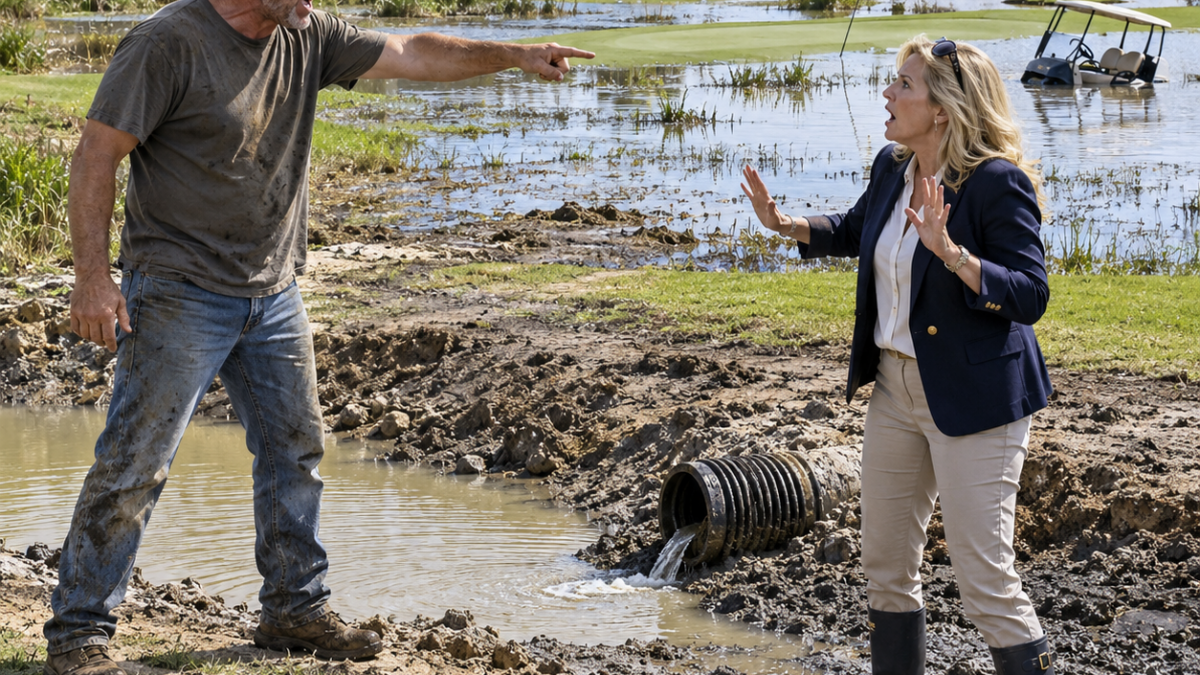
PART 2
I didn’t answer Karen immediately.
That bothered her more than anger would have.
People like Karen understood shouting. They understood threats. They understood the little theater of power where the loudest person in the room expected everybody else to retreat.
Silence made her uncertain.
I crouched beside the pond instead.
Ghost was still alive, but barely.
I stepped into the mud, ruining my boots instantly, and slid both hands beneath him.
He was heavier than I remembered.
His white scales were streaked brown. His gills moved rapidly against my palms.
“Come on, old man,” I whispered.
Behind me, Karen was still talking.
“You cannot intimidate this association.”
I ignored her.
“This community has attorneys.”
Still ignored her.
“You’ll regret making this difficult.”
That finally made me look back.
Karen had one hand on the steering wheel of her golf cart and the other pointed at me like she was issuing an executive order.
I stood there holding a dying fish against my chest.
“You came onto my property without permission,” I said. “You destroyed something that belongs to me. Now you’re threatening me because I stopped you.”
Her lips tightened.
“I protected hundreds of homeowners.”
“You watered a golf course.”
“It’s more complicated than that.”
“No, Karen. It really isn’t.”
Tim and another worker were already dragging the hose away from the pond.
Karen spun toward them.
“I did not tell you to pack up.”
Tim shook his head.
“I’m not touching this anymore.”
“You have a contract.”
“Not for trespassing.”
That landed hard.
For perhaps the first time that afternoon, Karen realized she was losing control of the scene.
She pointed at me.
“This isn’t over.”
“No,” I said.
I looked down at Ghost.
“It isn’t.”
She climbed into the cart, slammed her foot onto the accelerator, and tore away across the strip of grass separating my property from the golf course.
I watched her disappear behind a row of pine trees.
Then I went to work.
I had an old livestock tank behind the barn that I sometimes used for rainwater.
I scrubbed it, filled it from my well, added aeration pumps, and began carrying every surviving fish I could find.
Some made it.
Some didn’t.
Ghost lasted another forty minutes.
I sat beside that stock tank with one hand in the water while his breathing slowed.
People who have never kept fish might laugh at that.
I wouldn’t have cared.
Ghost had been there on mornings when I couldn’t sleep.
He had been there on anniversaries I preferred not to explain.
He had surfaced beneath my hand hundreds of times because he recognized the sound of my footsteps on the pier.
When he stopped moving, I stayed there for a long time.
Then I carried him back to the pond.
I laid Ghost beside Big Red and Sunshine beneath the willow tree.
Three beautiful fish on damp grass.
Three small casualties of somebody else’s arrogance.
By sunset, the pond looked like a crater.
That evening, I sat at my oak dining table surrounded by photographs, receipts, and mud-covered boots.
I made one phone call.
Dave Chen answered on the fourth ring.
“Please tell me you’re calling because you finally decided to come fishing.”
“Not exactly.”
Dave had served with me years earlier before leaving the military, finishing law school, and becoming the kind of property attorney developers hated seeing across a conference table.
We hadn’t spoken in several months.
But when I told him what happened, he stopped joking.
“She actually pumped your pond?”
“Until I stopped the contractor.”
“Does the HOA have an easement?”
“No.”
“Water rights?”
“Not that I know of.”
“Emergency order?”
“No.”
“Anything in writing?”
“Nothing.”
Dave went quiet.
Then he said, “Jack, listen carefully. From this point forward, you do not argue with her. You don’t threaten her. You don’t post anything online. You don’t touch their property. You document.”
“I already filmed the pump.”
“Good.”
“I got the company name.”
“Better.”
“And I have dead fish worth several thousand dollars lying under my willow tree.”
He exhaled slowly.
“Photograph everything before you move anything.”
For the next twenty minutes, Dave turned my anger into a checklist.
Aquatic biologist.
Property appraiser.
Receipts.
Water-quality samples.
Survey.
Deed.
County ordinances.
Historic plats.
Correspondence from the HOA.
The contractor’s information.
Every photograph.
Every minute of video.
“You know what discipline does to people like Karen?” Dave asked.
“What?”
“It scares them. Because bullies depend on you becoming emotional enough to make mistakes.”
I looked through the window toward the dark outline of the pond.
“I’m past emotional.”
“No, you aren’t.”
He knew me too well.
“But that’s okay,” he continued. “Just make sure your paperwork stays calmer than you are.”
The next morning, I started before sunrise.
By eight, I had arranged for an aquatic biologist from the state university to visit.
Dr. Ana Sharma arrived shortly after lunch.
She was a compact woman in hiking boots with the expression of somebody who disliked seeing ecosystems destroyed for stupid reasons.
She walked around the pond once without speaking.
Then she knelt near the exposed bottom and pushed a soil probe into the mud.
“How fast did they drain it?”
“I don’t know when they started. Maybe two or three hours.”
She stared at me.
“They pulled this much volume in a few hours?”
“Commercial pump.”
She muttered something under her breath.
She spent the next two hours collecting samples and photographing plants, dead amphibians, exposed root systems, damaged liners, and the remains of my koi.
When she reached Ghost, she stopped.
“How old?”
“About nine years.”
“You raised him?”
I nodded.
Her expression softened.
“I’m sorry.”
That was the first time anyone had said it.
Not because they were afraid of being sued.
Not because they wanted something.
Just sorry.
I had to look away.
Dr. Sharma stood.
“I’ll quantify what I can. Fish value, habitat loss, restoration, microbial recovery, vegetation, water quality, sediment disturbance. But you need to understand something.”
“What?”
“This isn’t a swimming pool someone emptied.”
She pointed toward the mud.
“A mature pond is an ecosystem. You can refill the hole in a few days. You cannot replace ten years in a few days.”
That sentence stayed with me.
She estimated the restoration could cost tens of thousands of dollars.
Possibly more.
The following morning, Frank Delaney arrived.
Frank was a rural property appraiser who looked as though he had been born wearing work boots.
He walked the acreage.
He photographed the pond.
He stood where the dock overlooked what had once been open water.
Finally, he shook his head.
“This was the centerpiece.”
“It was.”
“You buy this place without the pond?”
“Probably not.”
“That answers half my question.”
He explained that damages weren’t limited to fish and dirt.
A mature landscaped pond affected desirability, recreational use, aesthetics, wildlife habitat, and therefore property value.
“You can repair it,” he said, “but right now somebody tore the diamond out of your ring.”
That afternoon, I drove to the county records office.
I expected to spend an hour confirming what I already knew.
I stayed until they almost closed.
My parcel had once been part of a much larger farm.
When developers began assembling land for Prestigious Pines decades earlier, the old owner refused to sell five acres.
Those five acres were eventually sold to another family.
Then to me.
Prestigious Pines grew around it like a planned suburb wrapping around a stubborn island.
My deed contained no HOA covenants.
No shared-water agreement.
No irrigation easement.
Nothing giving Prestigious Pines the right to cross my property.
I ordered copies.
Then I ordered the HOA plats.
Then water permits.
Then old aerial surveys.
Then engineering drawings.
The clerk, an older woman named Margaret, eventually smiled across the counter.
“You planning to build another neighborhood?”
“Trying to figure out why the one behind me thinks it owns my water.”
Her smile disappeared.
“Oh.”
I spent the next hour looking through the HOA’s permits.
Their golf course relied on municipal water and two wells.
During drought restrictions, those sources were limited.
Yet the course remained absurdly green.
I pulled historical consumption numbers.
Something didn’t fit.
Their reported municipal use during dry summers was lower than I expected.
I wrote down the figures.
Maybe it meant nothing.
Maybe it meant Karen had found other private ponds before mine.
Then I opened an old topographic survey.
And everything changed.
A thin blue line crossed one corner of my parcel.
The notation beside it was faded.
HISTORICAL DRAINAGE EASEMENT.
I leaned closer.
The line originated at Miller’s Creek in the hills west of my property.
It crossed my acreage.
Then continued east.
Straight across land occupied today by the thirteenth and fourteenth holes of Prestigious Pines.
I pulled the modern development map over the old one.
The creek no longer followed that route.
It had been diverted into a concrete channel feeding the golf course reservoir.
I stared at the two maps for several minutes.
Thirty years earlier, somebody had changed the course of the water.
But according to the documents in front of me, they had never properly extinguished the original drainage corridor.
My anger became something else.
Curiosity.
Then possibility.
I went back to Margaret.
“How far back can we go on aerial photographs?”
“How far do you need?”
“Before Prestigious Pines existed.”
She brought out archived images.
There it was.
Miller’s Creek once crossed what was now a golf course.
The terrain itself made the reason obvious.
Prestigious Pines sat in a shallow basin.
The fairways weren’t just beautifully sculpted recreational land.
They were part of an old floodplain.
The development had taken a natural drainage system and forced it somewhere else.
I photographed everything.
That night, my dining table disappeared beneath maps.
I spread my original survey beside the old county documents.
Water seeks elevation loss.
It does not care about prestige.
It does not recognize HOA boundaries.
It does not understand property values.
And it never forgets gravity.
I traced the historical channel with my finger.
For the first time since seeing Ghost die, I smiled.
Not because I knew exactly what I was going to do.
But because I finally understood what Karen had done without realizing it.
She had picked a fight with a retired engineer over water.
The next morning, I called Dave.
“You need to see something.”
We met at his office that afternoon.
I carried enough documents to make his receptionist raise an eyebrow.
Dave cleared his conference table.
I started with the deed.
Then the water permits.
Then the aerial photographs.
Then the historical drainage easement.
By the time I finished, Dave was standing over the map.
“You’re sure this was never extinguished?”
“I couldn’t find anything.”
“That doesn’t mean it wasn’t.”
“I know.”
“So we verify.”
We spent two days doing exactly that.
Dave’s staff checked county filings.
Then state records.
Then development archives.
No termination.
No abandonment agreement.
No formal relocation of the drainage easement.
Prestigious Pines had diverted the creek physically.
Legally, the old drainage corridor still existed.
Dave called me late Wednesday afternoon.
“You sitting down?”
“No.”
“Sit down.”
I sat.
“The easement is valid.”
I said nothing.
Dave continued.
“And based on the language, maintenance of the historical drainage route is allowed where necessary for erosion control and management of natural runoff.”
I looked through my window toward the dead pond.
“What does that mean in plain English?”
“It means you have rights involving that channel.”
“How much?”
“That depends on permitting, environmental rules, downstream impact, and about fifty things I don’t want you improvising.”
“I wasn’t planning to improvise.”
“Good.”
He knew I was smiling.
“Jack.”
“Yes?”
“Do not touch a shovel until we clear this.”
“I heard you.”
“I mean it.”
“So what do we do?”
“We make them an offer first.”
I didn’t love that answer.
But Dave was right.
If this went to court, I needed to look reasonable.
Because I was reasonable.
I didn’t want their golf course.
I wanted my pond restored.
I wanted compensation for the fish they killed.
I wanted them off my land permanently.
Dave drafted the demand.
The final number, based on Dr. Sharma’s preliminary restoration estimate and Frank’s property-loss calculation, was just under seventy-five thousand dollars.
The letter demanded payment, restoration costs, written acknowledgment that the HOA had no right to enter my parcel, and reimbursement for legal fees.
Then Dave added one final section.
We informed the HOA that I intended to perform lawful erosion-control maintenance on my acreage, including restoration of documented historical drainage features.
We never mentioned their golf course.
We didn’t need to.
Their lawyer would understand.
The certified letter was delivered Friday.
Their answer arrived the following Wednesday.
Karen had hired Arthur Vance.
I knew his type before meeting him.
His letter used six pages to say what could have been expressed in one sentence:
Go away.
The HOA claimed it acted under an emergency need to preserve community property.
Dave read that paragraph twice.
“Community property?”
“My pond.”
“You’re not in the community.”
“I noticed.”
Then came the part that made both of us laugh.
They demanded reimbursement for the pump contractor because my intervention had prevented completion of the work.
“They’re billing you for stopping them from stealing more water?” Dave asked.
“That appears to be the theory.”
The letter also threatened immediate litigation if anything I did changed water flow onto HOA land.
I expected Dave to be irritated.
Instead, he looked pleased.
“Excellent.”
“Excellent?”
“They just acknowledged in writing that they received notice of your drainage-restoration plans.”
“So?”
“So if we proceed lawfully, they cannot later claim they had no warning.”
He folded the letter.
“Now we get permits.”
The county engineer assigned to review my proposal was named Bill Harper.
Bill had spent thirty years looking at subdivisions, drainage ditches, culverts, and developers trying to convince gravity to obey a budget.
I submitted a simple plan.
Clear approximately two hundred yards of an obstructed historical drainage channel located entirely on my property.
Stabilize its banks.
Install erosion-control fabric.
Use riprap at high-energy curves.
Restore natural drainage to reduce upstream pooling and soil loss.
Bill studied the map.
“You pulled this from the old county archive?”
“Yes.”
He placed the modern plat beside it.
“Huh.”
That “huh” lasted about thirty seconds.
Then he leaned back.
“Somebody moved this creek.”
“Three decades ago.”
“Why?”
“Golf course reservoir.”
Bill rubbed his jaw.
“That would explain the strange grades east of you.”
I waited.
“This isn’t small work.”
“No.”
“You’ll need bank reinforcement.”
“Already designed.”
“Sediment protection during excavation?”
I handed him another page.
He scanned it.
“You still doing engineering work?”
“Trying not to.”
He smiled.
“Doesn’t look like retirement.”
A few days later, the permit was approved.
I called Marcus Reed.
Marcus was a retired Navy Seabee who owned a small excavation company with his two sons.
He arrived in an old Ford truck that sounded as though it had been assembled from spare battleship parts.
We spread the plans across his hood.
He studied them silently.
Then he looked toward the golf course.
“You know where this points.”
“Yes.”
“You know what happens when we reconnect that creek.”
“Yes.”
He scratched his beard.
“And this is permitted?”
I handed him the document.
He read every page.
Then looked at me again.
“So officially, we’re clearing a historical drainage channel.”
“Exactly.”
“For erosion control.”
“Exactly.”
“And unofficially?”
“There is no unofficially.”
Marcus stared at me.
Then he burst out laughing.
“I missed working with engineers.”
We scheduled the work for Monday.
Weather reports showed a major storm system approaching later in the week.
That worried me.
Not because I wanted flooding.
I didn’t.
Whatever satisfaction I felt imagining Karen dealing with mud did not extend to putting people or homes at risk.
So before starting, I asked Bill specifically about the storm.
He reviewed the hydrology numbers again.
The channel would route storm water toward the historic low ground of the golf course.
No homes sat in that section.
The clubhouse was elevated.
The development’s residential streets were higher.
Bill’s bigger concern was upstream flooding if Miller’s Creek overtopped the existing diversion.
“Your restored corridor may actually give the system somewhere to go,” he said.
“Even with the storm?”
“Especially with the storm.”
That mattered.
I wanted consequences.
I did not want casualties.
Monday morning, Marcus arrived at seven sharp.
Behind his truck came a lowboy trailer carrying a Caterpillar excavator.
I heard the engine before I saw it.
The sound rolled across my property.
Heavy.
Mechanical.
Final.
Marcus unloaded the machine.
His sons began staking the alignment.
I stood with the permit folded in my pocket.
At 7:19, the first bucket of soil came out.
At 7:26, Karen appeared.
She came across the fairway so fast in her golf cart I thought she might drive straight into the trench.
Marcus saw her.
Without changing expression, he rotated the excavator and rested the bucket between her cart and the work zone.
Karen slammed on the brakes.
She jumped out.
“What are you doing?”
“Morning, Karen.”
“You were warned.”
“So were you.”
She stormed toward me.
I held up the permit.
“This work is authorized by the county.”
She grabbed at the plastic sleeve.
I pulled it back.
“Don’t.”
Her eyes moved across the official stamp.
“You went behind the HOA’s back.”
“I don’t report to your HOA.”
“This channel is going to send water onto our course.”
“This channel restores a documented historical drainage path.”
“You know exactly what you’re doing.”
“Yes. Following a county-approved engineering plan.”
Her face tightened.
“You are trying to destroy our golf course because you’re angry about a pond.”
For a second, I almost lost control.
I stepped closer.
“That pond was alive.”
She scoffed.
“It was fish.”
That sentence ended any remaining sympathy I might have had for her.
I pointed toward the property boundary.
“Leave.”
“No.”
“You’re trespassing.”
“I’m calling the sheriff.”
“Please do.”
Twenty minutes later, two patrol vehicles arrived.
Sergeant Peterson stepped out of the first.
I knew him casually from town and knew he had served years earlier.
Karen intercepted him before he made it ten steps.
“This man is constructing an illegal canal designed to flood private association property.”
Peterson looked at me.
“Jack?”
I handed him the permit.
“County-approved drainage restoration.”
Then the survey.
“Historical watercourse.”
Peterson read everything.
The younger deputy walked the marked work limits.
Marcus shut down the excavator while they inspected.
Karen followed Peterson everywhere.
“You need to arrest him.”
Peterson ignored her.
“This is retaliation.”
Still ignored her.
“I represent three hundred homeowners.”
Peterson finally turned.
“Ma’am, give me a minute to read.”
Karen opened her mouth.
He raised one hand.
“Please.”
She stopped.
Five minutes later, Peterson handed the documents back to me.
“Your excavation stays inside these stakes?”
“Yes.”
“No work on HOA property?”
“None.”
“County approved this?”
I pointed to the signature.
He nodded.
Then he faced Karen.
“Mr. Caldwell’s work is permitted and confined to his property.”
Her mouth dropped open.
“But the water—”
“I’m not the county engineer.”
“He is intentionally—”
“Ma’am, you’re currently standing on his property after being asked to leave.”
“I am the HOA president.”
“That does not change the property line.”
“I want him stopped.”
“I cannot stop lawful work because you dislike what may happen downstream.”
Karen’s face darkened.
“Do you know who I am?”
Peterson actually looked tired.
“Yes, ma’am. You’ve told me three times.”
Marcus coughed to hide a laugh.
Peterson continued.
“Return to HOA property. If you come back into this work zone after being told not to, I can cite you for trespassing. If you interfere with the equipment, we may have a bigger problem.”
Karen stared at me.
There are moments when a person realizes the authority they have been performing is not actual authority.
That was one.
She climbed into her golf cart.
Before leaving, she pointed at the excavator.
“If one blade of grass on that course is damaged, Caldwell, you will lose everything you own.”
I looked at the permit.
“Drive carefully, Karen.”
She sped away.
Marcus waited until she was out of hearing range.
“Friendly neighbor.”
“You should meet her lawyer.”
Work resumed.
For two days, the old channel emerged from beneath brush and sediment.
Marcus handled the excavator like a surgeon.
We found traces of stone stabilization from decades earlier.
Not enough to prove anything new legally, but enough to confirm the land remembered exactly what the maps said.
By Tuesday evening, the corridor stretched roughly two hundred yards across my property.
Twenty feet wide in sections.
Deeper where the old drainage depression had filled.
We reinforced curves and graded the banks.
Wednesday morning, loads of riprap arrived.
We laid erosion-control matting.
Installed sediment protection.
Checked grades.
Then checked them again.
I was not going to give Arthur Vance one technical flaw to exploit.
Around noon, a black sedan pulled into my driveway.
The man who stepped out wore a charcoal suit and shoes that probably cost more than my first truck.
Arthur Vance.
He walked across the uneven ground with visible regret.
“Mr. Caldwell.”
“Mr. Vance.”
“I believe we should speak privately.”
“My attorney’s number is in every letter you sent.”
“This is more immediate.”
He looked at the channel.
For the first time since this began, I saw concern on the HOA’s side that wasn’t performative.
“You intend to open this to Miller’s Creek?”
“That’s part of the approved plan.”
“There is severe weather forecast.”
“I’m aware.”
“You understand the potential consequences.”
“I understand hydrology.”
His jaw tightened.
“If this work damages my client’s property, you could face extraordinary liability.”
I handed him a copy of the county approval.
“My work has been reviewed.”
“County approval does not give you permission to weaponize water.”
“Interesting phrase.”
“It’s accurate.”
“No, Mr. Vance. What your client did with a diesel pump was deliberate extraction of water from property she did not own.”
“That matter is disputed.”
“I have video.”
His eyes hardened.
“You’re playing a dangerous game.”
“I’m not playing.”
I unfolded the historical map.
“This creek existed before my house.”
I pointed farther east.
“Before the golf course.”
Then at the drainage easement.
“Before Karen.”
He stared at it.
“The developers redirected water for their convenience. They never legally eliminated this drainage corridor. Your client built expensive grass over a natural floodplain.”
“That interpretation is debatable.”
“The county engineer apparently disagrees.”
“This could still be stopped.”
That caught my attention.
“How?”
“Voluntarily.”
“What are you offering?”
His hesitation told me the answer.
Nothing.
“At this stage, we are asking for cooperation.”
I folded the map.
“Two weeks ago I asked for cooperation. Your client sent me a bill for the pump she used to steal my water.”
“That was a negotiating position.”
“No. That was arrogance printed on law-firm letterhead.”
His face changed.
Slightly.
Because he knew I was right.
“If the HOA wants to pay for my pond, compensate the damage, acknowledge my property rights, and discuss a legal water-management solution, Dave’s phone works.”
“And if we don’t?”
“Then I finish my permitted project.”
I turned toward Marcus.
Vance called after me.
“You understand that once water starts moving, you may not be able to control it.”
I stopped.
“That’s something Karen should have considered before deciding water belonged to her.”
At three that afternoon, we reached the final earth plug separating the restored channel from Miller’s Creek.
Marcus lowered the excavator bucket.
“You sure?”
I looked over every stabilization measure one final time.
“Yes.”
The first scoop opened a narrow groove.
Water slid through.
The second widened it.
The creek entered hesitantly at first, a few inches deep.
Then gravity took over.
A ribbon of brown water curved into the historical channel.
It touched stone that had been buried for decades.
It moved past us.
Downhill.
Toward the property line.
No explosion.
No wall of destruction.
Just water doing the simplest thing on earth.
Following the land.
By sunset, the flow had stabilized.
I walked the entire channel twice.
Everything held.
The forecast predicted the first heavy rain before dawn.
I slept badly.
At 3:52 Thursday morning, rain hammered my metal roof.
I made coffee.
Then I turned on the weather radio.
Flash-flood watches covered the county.
Rainfall estimates had increased overnight.
I called Bill.
He answered groggily.
“Jack?”
“Forecast got worse.”
“I saw.”
“You still comfortable?”
“With your channel?”
“Yes.”
“Your channel isn’t the problem. The watershed is saturated already. Keep yourself out of low areas and don’t touch anything once flow rises.”
That was enough.
By sunrise, Miller’s Creek had doubled.
By eight, it had tripled.
I put on rain gear and walked out.
The restored channel was roaring.
Brown water rolled between the armored banks.
The riprap held.
The matting held.
The grade held.
I followed it to my eastern boundary.
Then I looked toward Prestigious Pines.
The water crossed into the low rough beside the thirteenth fairway.
At first, it formed a shallow sheet.
Then the shallow depressions filled.
A bunker disappeared.
Water spread across the fairway.
The golf course had been designed with gentle contours that looked beautiful from a cart.
Those same contours became miniature basins.
One filled.
Then spilled into another.
The old floodplain was waking up.
I stood there in the rain watching thirty years of landscaping lose an argument with geology.
At 9:15, Karen appeared.
She was riding with the course superintendent.
They stopped on higher ground.
Even at a distance, I could see her pointing toward my property.
The superintendent shook his head.
She pointed again.
He shook his head harder.
A maintenance tractor approached one of the low areas and stopped when water climbed over the tires.
Then it backed away.
The rain intensified.
By ten, the thirteenth fairway resembled a shallow lake.
By eleven, water had crossed part of the fourteenth.
The course drainage system began backing up.
Storm drains designed for normal runoff gurgled beneath volumes they had never been built to carry.
I went home.
At 11:23, my phone rang.
Arthur Vance.
I let voicemail take it.
“Mr. Caldwell, we have a developing emergency at Prestigious Pines. We need the channel closed immediately. The association is willing to provide equipment and labor. Please return my call as soon as possible so we can discuss a resolution.”
Resolution.
I played the message again.
Two weeks earlier, Karen had stood beside dying fish and told me it was “just water.”
Now water mattered.
I forwarded the voicemail to Dave.
He called thirty seconds later.
“Do not answer him.”
“I wasn’t planning to.”
“How bad?”
“Thirteen is partly underwater. Fourteen is getting there.”
“Any houses?”
“No.”
“Clubhouse?”
“Not yet.”
“Keep documenting. And Jack?”
“Yeah?”
“No celebration posts.”
I laughed.
“You really think I’m that stupid?”
“I’ve represented people after they won.”
“Point taken.”
The rain continued all afternoon.
Then all night.
Friday morning brought no relief.
County alerts warned residents to avoid low roads.
Miller’s Creek became a heavy brown current.
My channel continued functioning exactly as designed.
Later that morning, Sergeant Peterson called.
“The HOA is reporting you for intentionally flooding them.”
“And?”
“And Bill Harper already sent us copies of your permit and hydrology notes.”
“That saves time.”
Peterson sighed.
“They want us to order you to block the channel.”
“Can you?”
“No.”
“Then I guess we’re done.”
“Pretty much.”
He paused.
“For what it’s worth, county emergency management says the restored drainage corridor may be reducing pressure upstream.”
That gave me more satisfaction than seeing any sand trap disappear.
“Anybody in danger?”
“Not that we know of. Course took the brunt because it sits low.”
“Good.”
“Stay out of the water.”
“I will.”
By Friday afternoon, calls came every hour.
Karen.
Arthur.
An HOA board member I had never met.
The golf course manager.
I answered none of them.
Dave did.
Saturday morning, the storm finally moved east.
The sky opened into pale blue.
I walked toward the boundary.
Nothing prepared me for the view.
Prestigious Pines looked as if somebody had removed the golf course and replaced it with wetlands overnight.
The thirteenth fairway was gone beneath muddy water.
So was much of the fourteenth.
Several bunkers were invisible.
Branches, leaves, and debris had collected along cart paths.
The landscaped pond near eighteen had expanded until nobody could tell where the original shoreline had been.
The eighteenth green sat above the water like an island.
Sections of the clubhouse’s lower level had taken water despite frantic sandbagging.
Maintenance crews were already working.
Then I saw the pump.
The same type of pump they had used on my pond.
A worker stood beside it while a hose pulled brown water from the course.
The machine looked tiny against the flooded acreage.
I almost laughed.
They had stolen water because they didn’t have enough.
Now they had so much they couldn’t get rid of it.
But as I stood there, the feeling wasn’t as simple as triumph.
I thought about the homeowners.
Most of them hadn’t drained my pond.
Some probably didn’t know Karen had done it.
They were going to pay financially for her decision unless the board found another solution.
That mattered.
My fight was with abuse.
Not with every person whose house happened to stand behind a stone entrance marked Prestigious Pines.
Dave called.
“They want a meeting.”
“When?”
“Tomorrow. Two o’clock.”
“Who?”
“Entire board. Arthur. You. Me.”
“What do they want?”
His voice carried a smile.
“They used the phrase ‘global settlement.’”
“Sounds expensive.”
“For somebody.”
The meeting was held Sunday in the main ballroom of the clubhouse.
Parts of the lower floor still smelled like wet carpet.
About thirty homeowners attended.
Some wore golf clothes.
Others looked as though they hadn’t slept.
Through the huge windows behind the board table, everyone could see brown water stretching across what had once been perfect green turf.
Karen sat at the center.
She looked smaller.
No pink tracksuit.
No smirk.
Just a pale face and a stack of papers she kept straightening even though they were already aligned.
Arthur Vance sat beside her.
Dave and I took seats in the front.
Karen struck the gavel.
“This emergency meeting of the Prestigious Pines Homeowners Association is now called to order.”
Nobody responded.
She began reading.
She described the storm as extraordinary.
Unprecedented.
An act of nature.
She spoke about restoration.
Insurance.
Community resilience.
Everything except my pond.
Everything except the pump.
Everything except the channel.
Then Arthur stood.
“Our preliminary assessment indicates the golf course has suffered extensive damage. Certain insurance limitations may apply to flood-related losses.”
The room stirred.
Everybody understood what that meant.
Special assessments.
Homeowners paying the bill.
Arthur continued.
“We must also address recent excavation undertaken by the owner of the neighboring Caldwell parcel, which substantially changed drainage conditions immediately before the storm.”
There it was.
Blame.
Dave stood.
“Before you continue, Arthur, I think the homeowners deserve the complete timeline.”
Arthur’s jaw tightened.
“This is a board meeting.”
“And my client has been publicly identified as responsible. We will respond.”
People in the audience began murmuring.
One called out.
“Let him talk.”
Another said, “We’re paying for this. We deserve to hear it.”
The vice president nodded reluctantly.
“Proceed.”
Dave walked to the front carrying a large folder.
He didn’t start with the flood.
He started with a photograph of my pond.
Before.
Clear water.
Lilies.
The dock.
Koi visible beneath the surface.
Then he placed another photograph beside it.
After.
Mud.
Collapsed shoreline.
Dead fish.
A sound moved through the room.
Not quite a gasp.
Dave held up a still image from my video showing Karen beside the pump.
“On August fourteenth, HOA President Karen Miller authorized a contractor to enter Mr. Caldwell’s private property and remove water from his pond without permission.”
Every head turned toward Karen.
Her face stiffened.
Dave continued.
“Mr. Caldwell is not a member of this HOA. His parcel is not subject to its covenants. There is no water easement allowing Prestigious Pines to extract from his pond.”
An older man stood.
“Karen?”
She stared at Dave.
“Sit down, Harold.”
“No.”
The room changed.
Karen had probably told people to sit down hundreds of times.
This time somebody refused.
“Did you pump his pond?”
“It was necessary to protect community assets during drought conditions.”
Harold looked through the window at the flooded course.
“So you stole his water to save grass?”
“It was more complicated.”
“No,” I said quietly.
Everyone looked at me.
“It wasn’t.”
Karen’s eyes flashed.
“You know what you did.”
“Yes.”
I stood.
“I stopped you.”
“You flooded us.”
Dave raised one hand.
“We’ll get there.”
He displayed the old survey.
“This is a county-filed drainage map predating Prestigious Pines.”
Then the aerial photograph.
“This is Miller’s Creek before the golf course was built.”
Then the modern plat.
“The developer redirected the creek into an irrigation reservoir. But the historical drainage easement was never legally extinguished.”
Arthur shifted in his chair.
Dave continued.
“After the HOA trespassed on Mr. Caldwell’s property, he researched his property rights. He later applied for a lawful erosion-control project to clear and stabilize the historical drainage channel.”
He held up the permit.
“Approved by the county.”
Then engineering documentation.
“Reviewed before the storm.”
Then photographs of Marcus installing riprap.
“Constructed according to plan.”
A woman near the back raised her hand.
“Are you saying the water used to run across the golf course naturally?”
“Across the land where the golf course was later constructed,” Dave answered.
“So the developer redirected it?”
“Yes.”
“Was that legal?”
Arthur intervened.
“That question involves complex historical interpretations.”
Dave looked at him.
“The documents speak for themselves.”
The woman sat down slowly.
Dave turned toward the room.
“The storm did not create the floodplain. Mr. Caldwell did not create the floodplain. That geography existed before this community.”
Then he placed Arthur’s letter on the table.
“And the HOA received advance notice that Mr. Caldwell intended to restore drainage features on his property.”
Another murmur.
“We attempted to resolve the underlying dispute first,” Dave said. “Instead of compensating Mr. Caldwell for the destruction of his pond, the HOA rejected the demand, threatened litigation, and even sought reimbursement for the contractor hired to remove his water.”
That did it.
“You charged him for the pump?” someone shouted.
Karen looked at Arthur.
Arthur looked down.
A man on the left side stood.
“My dues paid for that?”
Another voice.
“How much did this cost?”
“Who authorized it?”
“Was there a board vote?”
That last question changed Karen’s expression.
Dave noticed too.
The vice president turned toward her.
“Karen?”
She said nothing.
“Was there a vote authorizing removal of water from Caldwell’s property?”
“It was an emergency operational decision.”
“That’s not what I asked.”
“I had authority to protect association assets.”
“Did the board vote?”
“No.”
The room erupted.
Years of resentment seemed to surface at once.
People shouted about landscaping contracts.
Selective fines.
Maintenance budgets.
Personal favors.
Karen slammed the gavel.
“Order!”
Nobody listened.
She slammed it again.
“ORDER!”
Harold shouted back, “You don’t get to order anybody around after this.”
Karen stood.
“You people have no idea what I’ve done for this community.”
A woman near the aisle laughed bitterly.
“We’re looking at it through the window.”
Even I felt that one.
Karen turned toward me.
“This is what you wanted.”
“No.”
My answer came fast.
The room quieted slightly.
I stepped forward.
“I wanted my pond left alone.”
She opened her mouth.
I continued.
“I wanted the fish I had raised for years to still be alive. I wanted to sit on my dock without seeing mud where there used to be water.”
My voice tightened.
“I asked you to stop.”
She looked away.
“You didn’t.”
I pointed toward the window.
“This isn’t something I planned the day you came onto my land. I found records. I followed the law. I got permits. I restored a drainage corridor your developer buried decades ago.”
“You knew it would flood.”
“I knew water would follow the historical low ground. So did the county.”
Karen stared at me.
I looked around the room.
“And I’m not here to punish three hundred families for something one person decided.”
That brought complete silence.
Dave stepped beside me.
“My client is prepared to settle.”
Arthur leaned forward.
“What terms?”
Dave opened one final folder.
“First, the HOA pays the documented cost of restoring Mr. Caldwell’s pond, replacing lost fish, ecological rehabilitation, property-value impact, and associated professional expenses.”
He stated the amount.
“Seventy-eight thousand four hundred fifty dollars.”
Nobody objected.
“Second, the HOA formally acknowledges that the Caldwell parcel is independent property and that no officer, employee, contractor, or representative of this association may enter or extract resources without written permission.”
More nods.
“Third, the HOA issues Mr. Caldwell a written public apology.”
Karen stared at the table.
“Fourth, an independent audit will examine association expenditures for the previous five years.”
That produced the loudest reaction yet.
Karen looked up sharply.
“No.”
Every board member turned toward her.
Dave continued as if she hadn’t spoken.
“Fifth, President Miller resigns from the board effective immediately.”
Karen stood.
“Absolutely not.”
The vice president spoke.
“Karen.”
She turned toward him.
“You don’t decide that.”
“No,” he said. “The board does.”
Her face went white.
“You wouldn’t.”
He looked through the window at millions of dollars’ worth of mud.
“I would.”
Dave waited.
“Finally, Mr. Caldwell will cooperate with an independent engineering firm retained by the HOA to design a permanent water-management system that respects his property rights while addressing the drainage problem.”
Arthur leaned toward Dave.
“You would allow modification of the channel?”
“Modification agreed upon by both parties. Not unilateral access.”
“And possibly permit some creek flow into the irrigation reservoir?”
“If engineers determine there is a lawful, environmentally responsible system and Mr. Caldwell agrees.”
Every homeowner in the room suddenly understood what was happening.
I wasn’t demanding the golf course remain underwater.
I was offering to help solve the problem.
Karen looked around.
The room that had once responded to her authority now barely acknowledged her.
The vice president whispered with the other directors.
One by one, they nodded.
He faced me.
“The board accepts those terms in principle, subject to final written agreement.”
Karen slammed both hands onto the table.
“I do not.”
He didn’t even look at her.
“Then resign.”
She froze.
“You owe me.”
“No,” he said. “Apparently we owe Mr. Caldwell seventy-eight thousand dollars.”
Someone laughed.
Karen’s face crumpled.
Not dramatically.
Not all at once.
It was smaller than that.
The realization that a person can spend years building power and lose it in minutes when everyone finally stops being afraid.
She removed the board identification badge from her jacket.
Dropped it onto the table.
Then walked toward the door.
Nobody tried to stop her.
The agreement was finalized three days later.
The payment arrived at Dave’s office shortly after.
But the story did not end there.
The independent audit began almost immediately.
At first, the new board expected sloppy bookkeeping.
They found much more.
Questionable reimbursements.
Association credit-card purchases with no legitimate community purpose.
Contracts repeatedly awarded to businesses connected to Karen’s friends.
Projects approved at inflated prices.
Maintenance postponed while cosmetic improvements received funding.
And several payments that auditors could not explain.
The matter was referred to investigators.
I stayed out of it.
That surprised Dave.
“You don’t want updates?”
“Not really.”
“She may face criminal charges.”
“That’s between her and the law.”
After what happened to my pond, I had spent weeks imagining consequences.
But there came a point when watching somebody fall stopped giving anything back.
Ghost was still dead.
Big Red was still dead.
No courtroom could reverse that.
I wanted to rebuild.
Dr. Sharma supervised the restoration.
First came removal of damaged sediment.
Then repairs to the basin.
A new clay seal.
Native plants.
Gravel shelves.
Habitat zones for frogs and insects.
We installed better aeration and an upgraded pump.
The first day clean water started flowing into the restored pond, I pulled up a chair and watched for six hours.
There wasn’t much to see.
Water entered.
The level rose by inches.
But after weeks of looking at an empty scar, even inches mattered.
Three days later, the reflection of the willow returned.
A week later, dragonflies appeared.
Dr. Sharma smiled when she saw them.
“First tenants.”
“Rent’s expensive.”
“They seem unimpressed.”
We waited before introducing fish.
The ecosystem needed time.
That was something Karen had never understood.
Living systems require patience.
So do communities.
Prestigious Pines hired an engineering firm to address Miller’s Creek.
I attended the first meeting expecting resistance.
Instead, the lead hydrologist unrolled the old maps and pointed at the fairways.
“This whole corridor wants to be wet.”
The new HOA president, Sarah Whitmore, frowned.
Sarah was a retired elementary-school teacher elected after Karen’s resignation.
Unlike Karen, she asked questions before making declarations.
“What does ‘wants to be wet’ mean?”
“It means previous development fought the natural drainage pattern. You can continue fighting it forever at enormous cost, or redesign around it.”
She looked at me.
“What would you do?”
Every face turned toward me.
Months earlier, Karen had demanded my water.
Now the HOA was asking for my opinion.
I considered that difference carefully.
“I’d stop pretending the land is wrong.”
The engineer smiled.
“That’s basically our recommendation.”
The proposal was ambitious.
My restored channel would remain.
At its upstream connection, a controlled weir would regulate normal flow.
During ordinary conditions, a legal portion of Miller’s Creek could feed the HOA reservoir.
During heavy rain, excess water would use the restored channel.
But instead of spreading uncontrolled across fairways, it would enter a series of engineered retention ponds and wetlands.
The lowest portions of thirteen and fourteen would be redesigned.
Not restored exactly as they had been.
Improved.
Wetland vegetation would slow floodwater.
Retention basins would hold storm runoff.
Raised cart paths would cross the new system.
The course would lose some traditional turf.
But it would gain something more resilient.
At the second design meeting, the golf superintendent looked almost excited.
“We could make fourteen a shorter par four with the wetlands on the left.”
Sarah blinked.
“You’re enthusiastic about losing a fairway?”
“I’m enthusiastic about never watching it disappear under six feet of muddy water again.”
Fair point.
Construction began that fall.
For several months, my property and the golf course looked like one enormous public-works project.
Excavators moved dirt.
Crews installed culverts.
Stone-lined spillways took shape.
Native grasses replaced sections of thirsty ornamental turf.
The HOA discovered that environmentally sensible design could also reduce irrigation costs.
Funny how fast principles change when a spreadsheet gets involved.
One Saturday afternoon, Marcus and his sons came over.
They brought lumber.
“What’s that for?” I asked.
Marcus looked toward the pond.
“You lost your dock.”
“I was going to rebuild it.”
“Good. We’re helping.”
The four of us spent the day building a simple wooden pier.
Nothing fancy.
Just enough space for two chairs and a fishing rod.
Near sunset, Marcus sat beside me with a beer.
Across the property, we could hear frogs.
“You miss those fish?” he asked.
“Every day.”
He nodded.
“My wife says I get too attached to animals.”
“There are worse things to be attached to.”
“Karen ever contact you?”
“No.”
He took a drink.
“Probably better.”
I thought so too.
Then, three weeks later, she came back.
I was planting water irises near the shoreline when an old sedan turned into my driveway.
I almost didn’t recognize her.
Karen stepped out wearing jeans and a plain gray sweatshirt.
No jewelry I could see.
No immaculate hair.
No golf cart.
No board badge.
She walked toward the pond and stopped several yards away.
“Mr. Caldwell.”
I put down the shovel.
“Karen.”
For a few seconds, neither of us spoke.
She looked at the restored water.
“It’s coming back.”
“Yes.”
“It looks good.”
“Eventually.”
She clasped her hands in front of her.
“I won’t stay.”
I waited.
“I wanted to apologize.”
I said nothing.
She swallowed.
“For what I did.”
“Which part?”
The question hurt her.
I could see it.
But I meant it.
“For the pond,” she said. “For going onto your property. For threatening you.”
She looked toward the water.
“For the fish.”
I crossed my arms.
“You told me they were just fish.”
“I know.”
“Ghost was nine years old.”
Her eyes dropped.
“I didn’t know their names.”
“You never asked.”
“No.”
She took a breath.
“I liked being important.”
That was not the answer I expected.
Karen stared at the ground as she spoke.
“At first, being HOA president was volunteering. People needed someone to organize things. Then they started calling me for every problem. Contractors answered when I called. Residents listened. People who used to ignore me suddenly needed my approval.”
She laughed once, without humor.
“I started thinking needing my approval meant I deserved control.”
I listened.
“The golf course became everything. Property values. Reputation. Events. When the drought got worse, I was terrified it would turn brown while the other clubs stayed green.”
“So you took my water.”
“Yes.”
“You knew it was mine.”
“Yes.”
That mattered.
Not because it excused anything.
Because it was finally truthful.
“What did you think would happen?”
“I thought you’d be angry.”
“That’s it?”
“I thought the HOA lawyer would scare you.”
Despite myself, I almost smiled.
She noticed.
“I know how stupid that sounds now.”
“Yes.”
Another silence.
“The audit found enough that investigators are involved,” she said.
“I heard.”
“My attorney thinks some of it could become criminal.”
I said nothing.
“My house is being sold.”
Still nothing.
“I lost friends.”
I watched a small frog climb onto a rock along the restored bank.
Finally, I said, “Karen, did you come here because you want forgiveness?”
She shook her head.
“No.”
That surprised me.
“I came because I kept telling myself you ruined my life.”
She looked at me.
“And then one morning I realized you didn’t make me use the HOA card. You didn’t make me hire friends. You didn’t make me enter your property. You didn’t make me threaten everyone who disagreed with me.”
Her eyes filled.
“I did that.”
The anger I had carried for months shifted.
Not gone.
Just different.
There was no queen of Prestigious Pines standing before me anymore.
Just a woman staring at the cost of her own decisions.
“I’m sorry,” she whispered.
I looked toward the pond.
“I appreciate you saying it.”
She waited, perhaps expecting more.
I didn’t give her more.
Forgiveness is not the same thing as pretending consequences never happened.
She nodded.
Then turned toward her car.
“Karen.”
She stopped.
I pointed toward the water.
“See those little fish near the reeds?”
She stepped closer but stayed outside the shoreline.
Three small koi moved beneath the surface.
One white.
One orange.
One patterned with black.
“I see them.”
“They’ve been here a week.”
“They’re beautiful.”
“They might live twenty years if nobody pumps the pond dry.”
She closed her eyes briefly.
“I understand.”
Then she left.
I never saw her again.
By the following spring, Prestigious Pines looked different.
The flood-damaged sections of the golf course had been rebuilt around water instead of against it.
The new wetland along fourteen filled with reeds, sedges, and native flowers.
Birds appeared.
Then turtles.
Then herons.
The HOA installed a walking trail with signs explaining how natural wetlands reduce storm flooding.
One sign showed an old map of Miller’s Creek.
It did not mention Karen.
It did not mention me.
That seemed right.
The new board also adopted policies requiring multiple approvals for major expenditures, competitive bidding for large contracts, and documented votes for emergency actions.
Sarah brought me a copy of the new rules one afternoon.
“You realize half of these exist because of you.”
“Because of Karen.”
“Fair distinction.”
She sat on the end of my rebuilt pier.
My pond was full again.
Not the same.
Never exactly the same.
But alive.
“What happened with the audit?” I asked.
“Still working through it.”
“Do I want to know?”
“Probably not.”
“Then I don’t.”
She laughed.
“You’re strange for somebody who accidentally started a revolution.”
“I cleared a drainage ditch.”
“Jack.”
“I had a permit.”
She laughed harder.
A few residents from Prestigious Pines eventually became friends.
Harold came over to fish.
The course superintendent sometimes asked me about water levels.
Marcus refused to call the restored channel anything except “Karen Creek,” though no map used that name.
One summer evening, about a year after the flood, the weather forecast warned of severe thunderstorms.
Years earlier, that would have made the HOA nervous.
This time, nobody called me.
Nobody panicked.
The rain came hard.
Miller’s Creek rose.
Excess water entered my channel.
I stood beneath the covered porch and watched it move exactly as designed.
Across the property line, the flow entered the new retention wetland.
The basin filled.
Native grasses bent beneath the current.
The water spread where engineers expected it to spread.
The thirteenth fairway stayed playable.
The fourteenth stayed above water.
The clubhouse remained dry.
By morning, the storm had passed.
The wetland slowly drained.
Nothing was destroyed.
That afternoon, Sarah sent me a photograph.
A great blue heron stood in the new marsh beside the golf course.
Her message read:
Looks like the new residents approve.
I walked down to my pond.
The rebuilt dock creaked beneath my boots.
The younger koi surfaced when they heard me.
The white one had grown the fastest.
I had never intended to name him Ghost.
For months, I deliberately avoided it.
Some things should not become replacements for what was lost.
But that evening, as the little fish rose beneath my hand, sunlight caught his scales and turned them almost silver.
“Hey, Ghost,” I whispered.
He took a pellet from my fingers.
For the first time, saying the name didn’t hurt.
I sat there until sunset.
The golf course beyond the trees was quieter now.
Less perfect, perhaps.
But more honest.
The community had learned an expensive lesson about authority.
Karen had learned an even more expensive one.
And I had learned something too.
When I first saw my pond destroyed, I wanted revenge.
I wanted Karen to feel helpless.
I wanted her precious golf course ruined the way my sanctuary had been ruined.
For a while, watching those fairways disappear beneath muddy water felt like justice.
But that wasn’t the part that stayed with me.
The part that stayed was everything that came afterward.
The pond returning.
The wetlands growing.
The HOA changing.
Neighbors who had once been separated by a property line learning to talk to one another instead of sending threats.
The sound of frogs returning at night.
The first dragonfly.
The first new koi taking food from my fingers.
Karen thought power meant being able to take something from another person because she had a title and a lawyer.
She learned that titles disappear.
Boards can remove you.
Lawyers cannot rewrite geography.
And water does not care how expensive the grass is.
Years later, I still keep the original drainage map framed in my workshop.
Not as a trophy.
As a reminder.
Beside it hangs a photograph of my old pond taken a few weeks before Karen drained it.
Ghost is visible near the dock.
Most visitors never notice him.
I always do.
Sometimes people from Prestigious Pines ask whether I regret opening the historical channel right before that storm.
I give them the same answer.
I regret that any of it became necessary.
I regret the fish.
I regret the damage.
I regret that one person’s arrogance forced hundreds of people into a crisis.
But I do not regret defending my property.
And I do not regret doing it legally, carefully, and with enough documentation that nobody could erase what really happened.
Because there is a difference between revenge and consequences.
Revenge is something you chase.
Consequences often arrive on their own.
Sometimes they arrive with a county permit.
Sometimes they arrive with thirty-year-old survey maps.
And sometimes, after seventy-two hours of rain, they arrive as several million gallons of muddy water flowing exactly where nature always intended it to go.
Karen drained my pond because she believed she controlled the water.
In the end, she discovered what every engineer eventually learns.
You can guide water.
You can store it.
You can redirect it for a while.
But if you ignore the land, ignore the law, and ignore everyone warning you that you have crossed a line, sooner or later the pressure finds the weakest point.
My pond is alive again now.
The koi are bigger.
The cattails are thick along the western bank.
Frogs sing beneath the dock every spring.
And beyond my trees, where a perfect green fairway once tried to pretend a floodplain wasn’t a floodplain, there is now a wetland full of birds.
Sometimes, just before sunset, I can hear them from my porch.
That sound means more to me than winning ever could.
It sounds like something broken becoming useful again.
It sounds like peace.
And every time I look across that water, I remember the afternoon Karen stood beside a diesel pump and told me it was “just water.”
She was wrong.
It was my home.
It was history.
It was gravity.
And in the end, it was the one thing she was never powerful enough to control.
[FULL STORY END]








