PART 2: HOA Karen Drained My Koi Pond While I Was Away—Then Learned the 15 Fish She Killed Were Worth $278,500
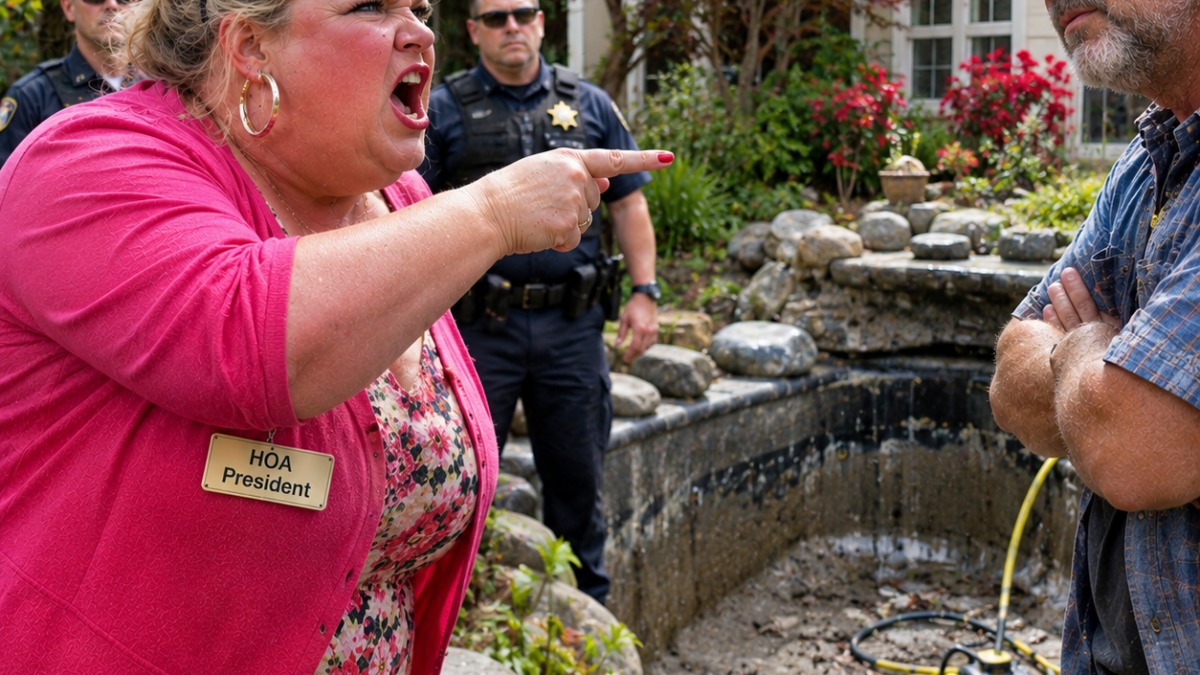
When I came home from a two-week trip to meet my newborn grandson and found my ten-thousand-gallon koi pond drained to the liner, fifteen championship fish lying dead in the mud, and the HOA president standing on my flagstone path telling me she had “cleaned up an eyesore,” I had to lock my hands behind my back to keep twenty-five years of Marine discipline from failing me in the one place that was supposed to be peaceful.
Karen Miller had trespassed while Sarah and I were away, hired a landscaping crew to pump out the pond without the notice, board vote, or competitive bids our own covenants required, destroyed part of the filtration system, and then had the nerve to leave a violation notice on my back door fining me for the damaged pond she had just created.
The strangest part was that Karen kept smiling until I told her the fish she had dismissed as “pet-store koi” were individually documented, insured specimens from Japanese bloodlines—and even then, the brief flicker in her face told me she still had no idea how much damage one smug decision had actually set in motion.
My name is Jack Davies, and that pond had been the quietest part of my life for almost a decade.
I bought my five acres before Oakwood Creek Estates swallowed the surrounding land. After twenty-five years in Marine logistics and engineering, I wanted a place where nothing depended on convoys, schedules, deployments, or somebody else’s orders. I designed the house myself, but the pond was different. It was personal.
During a tour in Okinawa, I became fascinated with nishikigoi—not just their colors, but the patience behind them. You didn’t buy a beautiful koi and call the job finished. You watched a fish develop over years. You learned its pattern, its body shape, its habits. You kept water records. You adjusted filtration. You waited.
Sarah used to joke that I knew the pond’s chemistry better than I knew my own blood pressure.
She wasn’t wrong.
The system held ten thousand gallons and included bead filtration, UV sterilization, a bog filter, redundant pumps, and plumbing I had overbuilt because overbuilding was a habit I never lost. The water stayed clear enough to see every stone on the bottom.
And the fish were not decorations.
Kami, a Kohaku, had won best in variety at a regional show two years running. Kenji was a Showa whose black sumi markings had taken years to develop. Others had certificates from breeders, lineage records, photographs, growth logs, and insurance documentation stored in a thick binder in my office.
Karen looked past all of that.
“They were just fish,” she said.
I stared at her.
Behind us, the liner sagged in the empty pond. Mud clogged the lower plumbing. One pump had burned itself out after running dry. The smell in the warm afternoon air made my stomach turn.
“You drained my pond,” I said.
“The architectural committee received a complaint.”
“From who?”
“That’s confidential.”
“You came onto my property while I was out of town.”
“We performed an emergency abatement.”
“Where’s the thirty-day certified notice?”
Her smile tightened.
“Health hazards don’t require one.”
“Where’s the board vote?”
“Jack, don’t make this difficult.”
That was the first time she used my first name.
Not kindly.
Like a teacher warning a child.
I stepped toward the back door and pulled down the paper she had tacked there. It was dated three days earlier and cited an “unaesthetic water feature” under a rule I didn’t recognize. Nothing about mosquitoes. Nothing about odor. Nothing about an emergency.
I held it up.
“This is your emergency?”
Karen’s eyes flicked toward it.
Then away.
That small reaction mattered.
I didn’t know how yet, but it mattered.
She recovered quickly.
“You’ll also receive an invoice for the abatement service.”
I actually thought I had misheard her.
“You’re billing me?”
“Twelve hundred dollars.”
“For destroying my pond?”
“And there will be a separate fine for the damaged liner. You’re responsible for maintaining your property.”
Sarah made a sound behind me—not quite a laugh, not quite disbelief.
Karen turned.
“I suggest you both calm down and read the bylaws.”
Then she started toward the side gate.
I looked again at the dead fish, at the muddy pipes, at the notice in my hand, and at the name printed beneath the landscaping company Karen had hired.
I knew that name.
And before Karen reached the gate, I was already walking toward the house to find out why.
PART 2
The invoice was lying underneath the violation notice.
**KAREN’S CLEAN CUT LANDSCAPING.**
I had seen the name before.
Not on a truck.
Not on a neighborhood sign.
In Sarah’s old Oakwood Creek directory.
I went into my office, pulled open the bottom filing drawer, and found the directory from three years earlier. Sarah followed me without saying anything.
I flipped through the family listings until I reached Miller.
There it was.
Karen Miller.
Spouse listed below.
Then her emergency contact.
Her sister.
Mrs. Gary Slater.
I stared at the name.
Sarah leaned over my shoulder.
“Gary Slater.”
“Yeah.”
“Isn’t that the name on the landscaping invoice?”
“Exactly.”
I pulled out my phone and searched the state corporation database.
The business registration appeared in less than a minute.
**Karen’s Clean Cut Landscaping LLC.**
Registered owner:
**Gary Slater.**
Sarah sat down slowly.
“She hired her brother-in-law?”
“To drain our pond.”
“With HOA money?”
“That’s what the invoice says.”
Neither of us spoke for several seconds.
Then Sarah looked through the office window toward the empty pond.
“Jack.”
“Yeah?”
“Don’t turn this into one of your campaigns.”
I knew exactly what she meant.
When something went wrong in the Marines, I survived by reducing chaos into objectives, timelines, resources, and documentation. It was useful overseas.
At home, it could make me difficult to live with.
“I’m not going after her,” I said.
Sarah gave me a look.
“You named the file already, didn’t you?”
I hesitated.
She closed her eyes.
“What did you call it?”
I turned the laptop toward her.
The new folder on the desktop read:
**POND INCIDENT — EVIDENCE.**
She stared at it.
“That’s surprisingly normal.”
“I’m growing.”
“Keep growing.”
Then she stood.
“Before you save the world, do something for the fish.”
That stopped me.
She was right.
I had gone straight into problem-solving because problem-solving was easier than grief.
Outside, the afternoon sun had begun to drop behind the trees.
Kami lay near the deepest section of the liner.
When she was alive, the red pattern across her back looked like wet paint brushed over snow. At feeding time, she was always first to the surface, pushing past fish twice her width with the confidence of something that had never understood the concept of personal space.
Kenji was beside her.
I remembered buying him as a fingerling.
His pattern had looked disappointing.
Too much gray.
Not enough black.
The breeder had told me, “Wait.”
So I did.
Years.
The black developed slowly.
First around the shoulder.
Then along the flank.
By the time he matured, he was one of the most striking fish in the pond.
That was koi keeping.
You learned to love what something might become.
I put on gloves.
Sarah brought a white tarp.
Together, we began lifting the fish from the cracked liner.
Fifteen.
One at a time.
I measured them.
Photographed both sides.
Recorded identification numbers from their certificates.
Tagged each specimen.
It was clinical because I needed it to be clinical.
When my hands started shaking, I pretended I was cold.
Sarah never called me on the lie.
We placed the fish in a chest freezer in the garage because I knew there might eventually be an insurance claim, a lawsuit, or both.
The thought disgusted me.
So did the necessity.
That night, neither of us ate much.
I sat at the dining room table with my koi journal.
Sarah put a blanket around my shoulders.
“I’m sorry,” she said.
I turned to the first page.
Kami.
Acquisition date.
Breeder.
Bloodline.
Length at purchase.
Show history.
Photos over the years.
Then Kenji.
Then the others.
Fifteen files.
Fifteen living things I had watched grow.
Six months earlier, because several had appreciated substantially, I had paid for a certified insurance appraisal.
I found it in the back of the binder.
The total value was **$278,500**.
Sarah read the number.
Then looked at me.
“She has no idea.”
“No.”
“You told her they were worth a quarter million.”
“She laughed.”
Sarah sat down.
“What are you going to do?”
I closed the binder.
“First, I’m going to read every word of the HOA rules.”
—
I had never liked Oakwood Creek Estates.
I didn’t hate it either.
When I bought our five acres, the area was still rural enough that I could stand in my backyard at night and hear almost nothing but insects and the occasional truck on the county road.
Then development arrived.
Roads.
Streetlights.
Uniform mailboxes.
Two-story houses.
Decorative entry monuments.
Eventually my property was caught inside the geographical boundaries of the association through an old zoning arrangement the developer’s lawyers had discovered.
I fought that annexation.
Lost.
So I paid the dues under protest.
For years, the HOA mostly left me alone.
My property was larger than the standard lots and already developed. The house existed before most of the covenants. The pond had been there for years.
Then Karen became president.
Things changed gradually.
At first she sent reminders.
Trash-can timing.
Mailbox appearance.
Parking.
Landscape “cohesion.”
Then notices became fines.
Fines became threats.
Karen liked rules most when she could interpret them.
I opened the covenants at eight that night.
By midnight, my dining room looked like a law-school study session.
Yellow highlighter.
Blue tabs.
Notes.
Cross-references.
The section Karen had relied on was Article 7.4(C), giving the Architectural Control Committee authority to address aesthetically objectionable features and actual health hazards, including stagnant water.
But Article 11 contained the procedure.
Thirty-day written notice.
Certified mail.
Opportunity to cure.
Documented majority vote of the board.
And for any abatement costing more than five hundred dollars:
Three competitive bids.
Karen had done none of that.
The notice she left on my door came after the pond had already been drained.
There was no thirty-day period.
No certified delivery.
No cure opportunity.
No evidence of a board vote.
And the $1,200 job had been given directly to her brother-in-law.
Sarah read the same paragraphs.
“So she broke her own rules.”
“Every important one.”
“What about the emergency exception?”
I searched again.
There was language allowing immediate intervention in a documented emergency involving imminent danger.
But the notice Karen left didn’t call the pond a mosquito hazard.
It called it unaesthetic.
And I had years of water tests.
Pump logs.
Maintenance records.
Photos.
The pond wasn’t stagnant.
It moved constantly.
Sarah tapped the table.
“Then make them explain it.”
That became the first objective.
Not Karen.
The whole board.
Because if she had acted alone, I wanted the others to know.
If they had approved it, I wanted them to say so on paper.
—
I drafted five copies of the same letter.
One to the official HOA address.
One to each board member’s home.
No insults.
No threats.
I laid out the date we returned.
The condition of the pond.
The dead fish.
The damaged filtration equipment.
The lack of notice.
The absence of a board vote I could identify.
The no-bid contract.
Then I asked for copies of the minutes authorizing emergency abatement.
I listed all fifteen koi by name and variety.
I described them as pedigreed and professionally appraised.
I did **not** include the dollar value.
Not yet.
Sarah read the draft.
“You sound calm.”
“I am calm.”
“You’ve used the phrase ‘documented procedural breach’ four times.”
“Three.”
She smiled despite everything.
“You’re terrifying when you’re calm.”
I mailed them registered.
Then I waited.
Two weeks.
Nothing.
On day sixteen, another HOA envelope arrived.
Inside:
A $1,200 bill from Karen’s Clean Cut Landscaping.
A $500 fine for failure to maintain the now-damaged pond.
And a separate violation notice regarding the chest freezer in my garage.
I read that one twice.
An “unapproved industrial appliance” had allegedly been observed from the street while my garage door was open.
The freezer containing the fish.
Sarah took the notice from me.
“She’s trying to make you get rid of them.”
“That was my first thought.”
“Can she?”
“No.”
“Are you sure?”
“I’m about to become sure.”
The HOA lawyer’s response came the same day.
According to them, the board had acted through Karen under emergency powers after reports of foul odor and mosquito infestation.
My claim that the koi were valuable was characterized as “unsubstantiated.”
They denied liability.
The fine stood.
The landscaping bill stood.
And the freezer had to go.
That night I made one phone call.
—
Dave Reynolds had served as a JAG officer with my unit years earlier.
He was one of those Marines who could sound friendly while explaining exactly why your legal position was about to collapse.
He answered after three rings.
“Jack Davies.”
“Dave.”
“Well, either somebody died or you need a lawyer.”
I looked through the kitchen window toward the empty pond.
“Both, in a way.”
His tone changed.
“What happened?”
I walked him through everything.
The vacation.
The pond.
Karen.
Fifteen koi.
Brother-in-law’s landscaping company.
No notice.
No board vote.
No bids.
Then the freezer violation.
There was silence.
Finally Dave said:
“Let me make sure I understand.”
“Go ahead.”
“Your HOA president entered your property while you were away.”
“Correct.”
“She hired her sister’s husband.”
“Yes.”
“They drained a ten-thousand-gallon koi pond.”
“Yes.”
“They killed fifteen pedigreed fish.”
“Yes.”
“They then billed you for the destruction.”
“Yes.”
“And now she’s fining you over the freezer where you preserved the dead fish as evidence?”
“Yes.”
Dave breathed out slowly.
“Jack.”
“What?”
“Please tell me she put all of this in writing.”
“Most of it.”
Another silence.
Then a soft whistle.
“Send me everything.”
“I will.”
“And don’t contact Karen directly.”
“Wasn’t planning to.”
“Don’t post anything online.”
“I don’t do social media.”
“Don’t discuss the fish valuation with neighbors yet.”
“Why?”
“Because I want to see what story she commits to before she knows the number.”
That made sense.
Then Dave asked:
“What’s the appraisal?”
“Two hundred seventy-eight thousand five hundred.”
He went completely quiet.
“Dave?”
“I’m still here.”
“Problem?”
“No.”
His voice changed.
“Now I’m interested.”
—
Dave came to our house the following weekend.
He took over half the dining room table.
CC&Rs.
Invoices.
Photos.
Business records.
Appraisal.
Water-quality logs.
He read Article 11 twice.
Then tapped the indemnification clause protecting board members for acts performed in good faith.
“This is important.”
“Why?”
“HOA directors usually have layers of protection when they’re actually doing board business in good faith.”
He pointed to Gary Slater’s business registration.
“But if Karen concealed a family relationship, skipped required bidding, acted without authorization, and invented a health emergency after the fact, she may have trouble calling that good faith.”
Sarah asked:
“What does that mean?”
“It means the association may have insurance.”
“And Karen?”
Dave looked at us.
“That depends on what she knew, what she disclosed, and how intentional the conduct was.”
He leaned back.
“We need facts.”
That was when he suggested an investigator.
I already knew who to call.
—
Mike Tanaka had been an intelligence analyst in the Corps.
Quiet man.
Dry humor.
Almost impossible to surprise.
He now ran a private investigative firm.
When I explained the case, he said:
“A corrupt HOA president?”
“Yes.”
“Jack, that’s not intelligence work.”
“No?”
“That’s Tuesday.”
He promised forty-eight hours.
I used those two days for something else.
Neighbors.
If Karen had abused the rules against me, I doubted I was the first.
Mrs. Gable lived two houses away.
Elderly widow.
Beautiful garden.
When I walked up with a plate of Sarah’s oatmeal cookies, she was moving a ceramic gnome behind a rose bush.
She looked embarrassed.
“I know, I know. Karen doesn’t approve.”
“I’m not here about the gnome.”
Her face tightened anyway.
Then I told her what happened to the pond.
Her hand went to her mouth.
“She did that while you were gone?”
“Yes.”
“No hearing?”
“No.”
Mrs. Gable looked toward Karen’s house.
Then lowered her voice.
“She fines me every month.”
“For what?”
The gnomes.
Garden decorations.
A birdbath.
The amounts began small.
Twenty-five dollars.
Then fifty.
Then one hundred.
She lived on a fixed income.
“What if I can’t pay?” she whispered.
That sentence bothered me more than the fine itself.
She genuinely believed a ceramic gnome could somehow cost her home.
I asked for copies.
She hesitated.
Then said:
“Will Karen know?”
“Not unless you decide to tell her.”
She disappeared inside and returned with a folder.
That was my first ally.
—
The Rodriguez family lived across from Karen.
Two boys.
Basketball hoop.
I knocked.
Mr. Rodriguez opened the door wearing work boots and a tired expression.
He saw my clipboard.
“Let me guess. Basketball.”
“I’m not with the HOA.”
He looked closer.
“You’re the pond guy.”
Apparently the story was already traveling.
I introduced myself.
He let me inside.
Karen had cited the basketball hoop as an attractive nuisance.
Then as a noise violation.
Then threatened a lien.
“All they do is play after school,” he said. “I work sixty hours a week so they can live somewhere safe enough to play outside, and now I’m supposed to make them sit inside because Karen doesn’t like hearing a ball bounce?”
His wife brought out a stack of notices.
I photographed them with permission.
Then recorded his account.
By the end of that week, I had spoken with twelve homeowners.
Wrong trim color.
Satellite dish.
Children’s toys.
Trash bins out too long.
Garden statues.
Parking position.
Everyone thought their fight was isolated.
That was Karen’s advantage.
People who believe they are alone are easier to manage.
Then Mike called.
—
“Bingo.”
That was the first thing he said.
“What did you find?”
“Karen’s Clean Cut has been the exclusive landscaping vendor for Oakwood Creek for three years.”
“No bids?”
“Not that I can find.”
“How much?”
“About eight grand a month.”
I whistled.
“For this neighborhood?”
“Exactly.”
Mike had compared market estimates.
The job should have cost roughly half.
Then he went quiet.
“There’s more.”
I waited.
“I found repeated payments from Gary Slater’s personal account into an account associated with Karen.”
“What kind of payments?”
“Monthly.”
“For how much?”
“Varies.”
“Description?”
“Consulting.”
I leaned back.
“You’re sure?”
“I’m sure enough to tell your lawyer, not sure enough to call it a crime in public.”
That distinction mattered.
“So what do we call it?”
“A pattern worth investigating.”
I called Dave.
He said essentially the same thing.
“Do not use the word embezzlement with neighbors.”
“Mike thinks—”
“I know what Mike thinks. Mike is an investigator. I’m a lawyer. We prove before we label.”
“Understood.”
“But Jack?”
“Yeah?”
“If these records authenticate the way they appear to, Karen’s problem just got substantially larger.”
—
Dave’s formal demand letter ran twenty pages.
The first half dismantled the health-hazard story.
My maintenance logs showed continuous circulation.
Water tests documented quality.
We obtained outside statements relevant to mosquito complaints.
No pattern supported Karen’s emergency narrative.
Then came damages.
Fifteen koi:
$278,500.
Lowest pond-restoration estimate:
$48,000.
Investigation costs.
Legal expenses.
Related damages.
Total demand:
$355,000.
Sarah watched me read it.
“Three hundred fifty-five thousand.”
“Yes.”
“Do you want that much?”
“I want the pond back.”
“That isn’t what I asked.”
I thought about it.
“I want accountability.”
She nodded.
“That sounds more like you.”
Then came Dave’s settlement offer.
It was simpler.
The association could resolve the direct loss for a reduced amount if two conditions were met.
Karen had to publicly acknowledge wrongdoing and apologize at the next HOA meeting.
And the association had to terminate the landscaping contract with Gary Slater’s company and adopt competitive bidding.
I looked at Dave.
“She’ll never do it.”
“That,” he said, “is why I wrote it.”
“You’re baiting her.”
“I’m giving her an exit.”
“She’ll see it as humiliation.”
“Then she has a choice.”
That distinction mattered to him.
If Karen accepted, the conflict could end.
If she rejected a reasonable settlement because she refused to admit error, that choice would belong to her.
—
Two weeks later, she rejected everything.
The lawyer’s letter called the koi valuation “laughably inflated.”
Called our demand extortionate.
Called the requested apology a publicity stunt.
Then Karen added something of her own.
A special HOA meeting.
One agenda item:
An amendment explicitly restricting ponds larger than five hundred gallons.
I read the notice.
Then laughed.
Sarah looked up.
“What?”
“She’s trying to make the rule after destroying the pond.”
Her face hardened.
“Can she?”
“Not retroactively.”
“Will that stop her from pretending?”
“No.”
I forwarded the notice to Dave.
His response arrived quickly.
**Perfect.**
Then to the neighbors.
Mrs. Gable.
Rodriguez.
Others.
We formed an informal group.
The Oakwood Creek Neighborhood Oversight Committee.
A grand name for people tired of being scared in their own homes.
We prepared.
Not slogans.
Documents.
—
The special meeting drew more than a hundred homeowners.
I had never seen the clubhouse full.
Karen sat at the head table looking energized.
She mistook attendance for support.
That was her first mistake that night.
She opened with ten minutes about property values, standards, strong leadership, and the danger of allowing “personal preferences” to degrade the neighborhood.
Then she referenced the “hazardous stagnant pond incident.”
She still didn’t use my name.
She didn’t need to.
Finally she called for a motion on the new pond restriction.
I stood.
“Point of order.”
Her eyes found me instantly.
“This is not public comment.”
“The bylaws incorporate Robert’s Rules.”
I held up the book.
“A proposed amendment requires discussion before a vote.”
Murmurs.
Karen’s mouth tightened.
She had spent years invoking procedure.
Now procedure belonged to everyone.
“You have five minutes.”
Dave, seated near the back, looked at his watch.
I smiled.
“I’ll be efficient.”
I connected my laptop.
First slide:
Mrs. Gable’s garden gnome.
A few people laughed nervously.
“This is a violation.”
Mrs. Gable raised her chin.
“Four hundred dollars in cumulative fines.”
Next slide.
Rodriguez driveway.
Basketball hoop.
“Threatened lien.”
Next.
Wrong trim shade.
Trash can.
Children’s play equipment.
Notice after notice.
People began recognizing their own stories.
I turned toward the room.
“How many of you thought you were the only one?”
Hands began rising.
That was the moment Karen’s expression changed.
Not when I showed my pond.
When she saw the hands.
—
I moved to the landscaping contract.
Karen’s Clean Cut Landscaping.
Annual cost.
No competitive bidding records we had found.
Then state business registration.
Gary Slater.
Then proof of the family connection.
Karen’s sister.
Mrs. Gary Slater.
The room went silent.
A man near the wall said:
“Your brother-in-law?”
Karen grabbed her microphone.
“This is irrelevant.”
I looked at her.
“It’s directly relevant to the company you hired to enter my property.”
“That vendor is qualified.”
“Then why weren’t there bids?”
“Emergency situation.”
“For three years of lawn mowing?”
A few people laughed.
Karen’s face reddened.
I didn’t present Mike’s suspected payment trail publicly.
Dave had forbidden it until further authentication.
Instead, I said:
“Our dues are paying nearly twice the market rate according to the comparison we’ve obtained. At minimum, this community deserves an independent financial review.”
That was enough.
People stood.
Questions came from every direction.
Karen struck the gavel.
“Order!”
Nobody listened.
Then she made the mistake Dave had predicted.
She stopped behaving like a president.
And started behaving like Karen.
—
“Lies!”
Her voice cut through the room.
“These are lies!”
The crowd quieted.
Karen pointed at me.
“This man is angry because I enforced the rules.”
I said nothing.
“His pond was disgusting.”
Still nothing.
“It smelled. It attracted insects. It was a hazard.”
Mrs. Rodriguez called from the side:
“I walked by his house every morning. It never smelled.”
Someone else added:
“My kids used to stop and look at the fish.”
Karen slammed the gavel.
“I did this community a favor!”
That sentence froze the room.
She was breathing hard.
“The bylaws gave me authority, and I used it. That pond was an eyesore, and if I had to make the same decision again, I would.”
Phones came up.
Mike’s included.
I watched Dave stand.
Slowly.
He buttoned his suit jacket.
Karen was still talking.
“And now he wants hundreds of thousands of dollars for fish anybody can buy at a pet store!”
Dave walked toward the front.
“Mrs. Miller.”
She stopped.
“Who are you?”
“My name is David Reynolds.”
He set his briefcase on the table.
“I represent Jack Davies.”
The room became very quiet.
Dave looked toward the phones.
Then at Karen.
“I believe you have just admitted in front of more than one hundred witnesses that you personally authorized the intentional destruction of my client’s property.”
Karen’s mouth opened.
“You have also accused my client publicly of extortion and fabrication.”
“I—”
Dave opened the briefcase.
“Those statements are false.”
He removed two packets.
“Karen Miller, you are hereby served.”
He placed the first in front of her.
“Civil complaint arising from the destruction of the pond, the koi, and associated property.”
Second packet.
“And a separate defamation action arising from your public statements.”
Karen stared down.
The color disappeared from her face.
Gerald, the board accountant, slowly moved his chair away from her.
Just a few inches.
But everyone noticed.
—
The meeting ended without a vote on the pond amendment.
Gerald called for adjournment.
The other board members seconded before Karen could object.
People crowded around me.
Mrs. Gable hugged me hard enough to hurt.
Mr. Rodriguez shook my hand.
“You gave us our neighborhood back.”
“No.”
I looked around at the homeowners talking to each other instead of whispering.
“You did.”
That mattered.
I had begun the fight because fifteen fish were dead.
But walking out of that clubhouse, I understood that Karen had been killing smaller pieces of peace for years.
One fine at a time.
One threat at a time.
One frightened homeowner at a time.
The pond was simply the act large enough to make everyone compare notes.
—
By morning, clips of Karen’s outburst were circulating locally.
I wasn’t thrilled.
Dave wasn’t either.
“Do not repost anything.”
“I haven’t.”
“Good.”
Local television called.
I agreed to speak only if the reporter also interviewed other homeowners.
They did.
Mrs. Gable stood in her garden holding one of her gnomes.
She didn’t rant.
That made her story stronger.
Mr. Rodriguez stood near the basketball hoop and talked about wanting his sons outside instead of glued to screens.
Then the camera came to my backyard.
The empty pond looked worse on television than it did in photographs.
I showed the koi records.
The certificates.
The appraisal.
I didn’t show the frozen specimens.
No need.
The reporter described the collection’s value.
Then played Karen’s recorded statement:
**I did this community a favor… and I would do it again.**
That sentence became the story.
Not my anger.
Hers.
—
The HOA’s insurance carrier reacted almost immediately.
Dave called me.
“Good news and complicated news.”
“Go.”
“They’re prepared to address the association’s exposure on the property-damage claim.”
“And Karen?”
“Different issue.”
The carrier had reviewed the meeting videos, the family-vendor relationship, and the pleadings.
They reserved rights regarding Karen personally, particularly conduct alleged to be willful, malicious, or fraudulent.
In practical terms, the HOA might have coverage for negligence.
Karen could not assume the same protection for her personal actions.
Sarah was sitting across from me during the call.
When I hung up, she asked:
“Does that mean she loses her lawyer?”
“Maybe coverage for some of it.”
“And the HOA?”
“Settlement talks.”
She looked toward the backyard.
“Can they bring Kami back?”
“No.”
“Then don’t act happy when the check comes.”
I didn’t.
—
The other board members finally discovered courage.
Gerald and the two others held an emergency meeting without Karen.
First vote:
Remove Karen as president.
Unanimous.
Second:
Remove her from board responsibilities pending formal member action.
Unanimous.
Third:
Terminate the relationship with their existing counsel and obtain independent advice.
Fourth:
Open settlement negotiations with us.
Meanwhile, the neighborhood oversight committee circulated a recall petition.
Nearly two-thirds of homeowners were already communicating with the group.
The necessary signatures came in one afternoon.
Karen’s formal recall became almost symbolic.
Her authority had already disappeared.
Still, the vote mattered.
People needed to take back what they had once surrendered through silence.
She was removed.
Officially.
No gavel.
No title.
No committee.
Just Karen Miller.
—
The property claim settled first.
The carrier agreed to pay the appraised value of the fish and the lowest restoration estimate.
$278,500.
Plus $48,000.
Total:
**$326,500.**
The check sat on our kitchen table.
Sarah stared at it.
“So that’s what fifteen lives are worth?”
“No.”
She nodded.
We both knew the distinction.
It was compensation for financial loss.
Nothing more.
Money could replace equipment.
Liner.
Plumbing.
Stone.
Fish of comparable pedigree.
It could not replace years.
It could not reproduce the afternoon when Kami first surfaced to eat from my hand.
It could not give me back the seasons I’d watched Kenji’s pattern develop.
I deposited the check.
Then sat in my truck outside the bank for fifteen minutes.
I didn’t feel victorious.
Mostly, I felt tired.
—
Karen’s defamation case remained separate.
Without the same insurance protection, the pressure on her increased.
Her counterclaim accused me of orchestrating a smear campaign.
Dave dismantled it methodically.
Everything we had said publicly was tied to documents, recordings, or firsthand accounts.
Her own words were the strongest evidence against her.
Eventually that dispute settled too.
The terms required payments that, according to Dave, Karen would be making for a long time.
I didn’t ask for every detail.
By then, I wanted less Karen in my life, not more.
But there was still Mike’s investigation.
And that part couldn’t simply disappear through civil settlement.
—
Mike came to the house with a hard-sided case.
Inside:
Vendor contracts.
Invoices.
Corporate registrations.
Bank records.
Payment summaries.
A timeline.
He had strengthened the trail considerably.
The landscaping company received inflated HOA contracts.
Gary Slater was Karen’s brother-in-law.
Records showed recurring transfers from Gary’s account to one associated with Karen.
Some were described as consulting payments.
Dave reviewed the package.
“Now?”
I asked.
He nodded.
“Now you take it to law enforcement.”
I went to the district attorney’s office.
White-collar investigator.
Small interview room.
I handed over the file.
Then gave a statement.
I was careful.
I didn’t say:
Karen stole.
I said:
Here are the records.
Here’s the relationship.
Here’s what we found.
Here are the contracts.
Here are the transfers.
The investigator asked questions for nearly two hours.
At the end, he closed the folder.
“We’ll take it from here.”
That was all I needed.
—
Meanwhile, Oakwood Creek had to figure out how to exist without Karen.
That turned out to be easier than Karen had trained everyone to believe.
Mr. Rodriguez became one of the central organizers of the new board.
Gerald chose not to seek reelection.
I didn’t blame him.
He apologized to me personally.
“I should have asked more questions.”
“Yes.”
He looked surprised.
Maybe he expected me to make him feel better.
I didn’t see the point.
“You signed the letters, Gerald.”
“I know.”
“You voted.”
“I know.”
“But you’re fixing it now.”
He nodded.
“That counts too.”
Responsibility isn’t erased by regret.
But regret can still change what someone does next.
—
The new board hired a property attorney to rewrite the worst parts of the covenants.
Subjective phrases like “aesthetically displeasing” were narrowed.
Fine schedules became corrective instead of punitive.
Notice and appeal procedures were clarified.
Any vendor contract over five hundred dollars required multiple competitive bids and conflict disclosure.
Mrs. Gable received a formal apology.
The first time I saw her after that, there were five gnomes in her front garden.
Five.
I stopped beside the walkway.
“You’re escalating.”
She smiled.
“I’ve become dangerous.”
One gnome held a tiny watering can.
Another had a fishing pole.
I pointed.
“Careful. That one looks industrial.”
She laughed so hard she had to hold the porch rail.
That sound alone made the fight feel worthwhile.
—
The Rodriguez boys got something better than a tolerated driveway hoop.
The new board used money no longer being wasted on inflated landscaping contracts to build a small basketball court in the community park.
The first Saturday it opened, I heard balls bouncing from my backyard.
For years Karen had treated that sound like a nuisance.
Now it mixed with children yelling, parents talking, dogs barking, and normal life.
Sarah stood beside me near the ruined pond.
“Sounds terrible.”
“Awful.”
“Property values must be collapsing.”
“Any minute.”
We smiled.
Then she looked down at the empty basin.
“When are you going to rebuild?”
I didn’t answer.
Because that question had been waiting for months.
—
I had delayed reconstruction even after the settlement.
Every contractor who came out asked what I wanted.
Same layout?
Bigger?
More expensive?
Champion-fish system?
I couldn’t decide.
Part of me wanted the exact pond back.
Same stones.
Same waterfall.
Same shelves.
Same everything.
But every time I imagined filling it, I saw fifteen bodies on the liner.
Sarah understood before I did.
One evening she sat beside me on the old bench.
“You’re trying to rebuild the past.”
“I’m rebuilding a pond.”
“No.”
I looked at her.
“You keep asking contractors how close they can make it to the old one.”
“It worked.”
“So did our daughter’s crib.”
“What?”
“We didn’t keep using it after she grew up.”
“That makes no sense.”
“It makes perfect sense. You just don’t like it.”
She rested her head against my shoulder.
“Kami is gone.”
I stared into the empty basin.
“I know.”
“Kenji is gone.”
“I know.”
“You don’t honor them by pretending you can recreate them.”
That hurt.
Because it was true.
“What do I do?”
“Build the next pond.”
—
I hired the best pond company I could find in the state.
Not to reproduce what Karen destroyed.
To build something new.
They removed the damaged liner.
Regraded shelves.
Rebuilt stone edges where the landscaping crew had torn through them.
Installed a commercial-grade forty-five-mil EPDM liner.
New bead filtration.
UV clarifier.
Nexus system.
Automated water-change controls.
Fail-safe overflows.
Redundant pumps.
The engineer in me loved it.
The sentimental part of me resisted every change.
Then the waterfall ran for the first time.
Water spilled over the same moss-covered stones I had placed years earlier.
The sound stopped me in the yard.
Sarah came out.
Neither of us said anything.
For months, the backyard had been too quiet.
Now the water was back.
Not the old pond.
The new one.
That distinction began to feel less painful.
—
I spent weeks deciding what fish to buy.
Insurance money could have purchased mature show-quality koi.
I could have found fish close to the old ones.
Another Kohaku like Kami.
Another Showa like Kenji.
I decided against it.
They wouldn’t be Kami.
They wouldn’t be Kenji.
Trying to make them replacements would be unfair to the new fish and dishonest with myself.
So I bought young koi.
Tosai.
One year old.
High potential.
Unfinished.
A new generation.
A breeder in California sent them by specialized transport.
The truck arrived early one morning.
I stood beside the pond while the bags floated for temperature acclimation.
Young Kohaku.
Showa.
Metallic varieties.
And one little Gin Shiro Utsuri with enough attitude for a fish half the size of my hand.
Sarah crouched beside me.
“They look tiny.”
“They are.”
“Are you disappointed?”
I thought about it.
“No.”
I watched one turn inside its bag.
“For the first time, no.”
—
The bags opened.
One by one, the koi entered the water.
At first they stayed together.
Nervous.
Then curiosity won.
They moved beneath the waterfall.
Across the shelves.
Through sunlight.
Not replacements.
Successors.
That word felt right.
I sat on the new teak bench for almost an hour.
No binder.
No phone.
No legal documents.
Just water.
Fish.
Quiet.
Then a moving van stopped across the street.
Karen’s house.
I hadn’t known the sale was closing that day.
Movers began carrying boxes.
Furniture.
Lamps.
Her oversized dining table.
The same house from which she had watched the neighborhood for years was slowly becoming empty.
I didn’t enjoy it.
But I watched.
Eventually Karen came out.
She looked different.
Not physically transformed.
Just diminished.
No clipboard.
No board badge.
No crowd waiting for instructions.
She got into her car.
Started the engine.
Then rolled slowly past our house.
The car nearly stopped.
Our eyes met.
For months, I had imagined that moment.
I thought I might smile.
Maybe wave.
Maybe say something.
I didn’t.
I simply held her gaze.
Then gave one small nod.
Nothing triumphant.
Nothing cruel.
Finished.
Karen looked away first.
Her car accelerated.
At the end of the street, she turned.
And disappeared.
—
Dave called a few weeks later.
“Final update.”
I was feeding the new koi.
“Go.”
Karen had resolved the criminal matter described in the investigation with a misdemeanor plea involving fraudulent schemes rather than risk exposure to more serious felony charges.
Probation.
Restitution to the HOA.
Other conditions.
I listened.
“That it?”
“For the criminal side as it relates to what we’ve been tracking.”
“And the civil?”
“Settlement remains in place.”
I looked at the water.
“Okay.”
Dave laughed softly.
“That’s all?”
“What do you want me to say?”
“I don’t know. Something Marine-like.”
“Mission complete?”
“There you go.”
But it didn’t feel like that.
Not exactly.
Missions end when objectives are achieved.
Grief doesn’t.
—
A few months later, I opened the chest freezer in the garage one final time.
The legal need to preserve the fish had ended.
I had dreaded that day.
Sarah stood beside me.
We had arranged for proper handling afterward.
Before closing the containers, I took out Kami’s file.
Then Kenji’s.
Then the others.
Fifteen names.
Fifteen histories.
I didn’t read the appraisal.
The money no longer mattered.
I read the first dates.
The breeder notes.
The photos.
Sarah touched my arm.
“You okay?”
“No.”
“Good.”
I looked at her.
She smiled sadly.
“I’d be worried if you were.”
I laughed once.
Then cried.
Not dramatically.
No collapse.
Just tears I had postponed because documents were easier.
Sarah stayed beside me.
That was enough.
—
The neighborhood changed in small ways.
Mrs. Gable’s garden became louder.
The Rodriguez boys played basketball.
People stopped whispering before criticizing the board.
Meeting attendance actually increased for a while.
Then, as trust returned, it dropped again.
Dave said that was a healthy sign.
“Good governance is boring.”
I thought of Karen’s packed confrontations.
“Then Oakwood Creek is becoming excellent.”
The new board published vendor bids.
Financial reports.
Meeting minutes.
Appeal procedures.
Nothing revolutionary.
Just transparent.
Residents learned where their dues went.
That should never have felt radical.
But after Karen, it did.
—
One afternoon, Mr. Rodriguez came over carrying a small box.
“What’s this?”
“Open it.”
Inside was a ceramic koi.
Painted red and white.
Not expensive.
Probably bought at a garden center.
I stared.
He suddenly looked worried.
“If it’s stupid, my wife said—”
“It’s perfect.”
“You sure?”
I turned it over.
On the bottom, somebody had written:
**FOR KAMI AND THE OTHERS. — OAKWOOD CREEK**
My throat tightened.
“You all did this?”
“A few families.”
He shrugged.
“Mrs. Gable picked it.”
“Of course she did.”
I placed the ceramic fish near the waterfall.
Not in the pond.
Beside it.
A small marker nobody outside our neighborhood would understand.
—
The strangest part of the aftermath was realizing Karen had accidentally created the opposite of what she wanted.
She wanted uniformity.
Instead, residents became more individual.
She wanted quiet.
Now kids played basketball.
She wanted gnomes gone.
Mrs. Gable had an entire colony.
She wanted complete control over vendors.
Now every significant contract was bid publicly.
She wanted my pond erased.
The new one was stronger than the old one.
But the most important reversal wasn’t visible.
Karen had made everybody afraid of one another.
By the time she left, we knew each other’s stories.
That was harder to destroy.
—
Mike and I had lunch months later.
He looked almost disappointed.
“You’re boring now.”
“Good.”
“No covert financial investigation?”
“No.”
“No corrupt landscaping empire?”
“No.”
“No emergency coalition?”
“No.”
He sipped coffee.
“You still have the koi files?”
“Yes.”
“Of course you do.”
“You’d keep them too.”
“Absolutely.”
We sat quietly.
Then he said:
“You know the kickback investigation mattered more than your pond.”
I looked at him.
“Legally maybe.”
“No. Community-wise.”
He explained.
People could dismiss one destroyed pond as a crazy dispute between two homeowners.
The financial records showed that Karen’s behavior had a system behind it.
Power.
Family benefit.
Money.
Once residents saw their dues connected to her decisions, fear turned into anger.
I nodded.
“But the fish made people look.”
“Exactly.”
Neither thing alone would have produced the same result.
—
I sometimes wondered what Karen believed.
Did she genuinely think the pond was ugly?
Probably.
Did she convince herself it was unhealthy?
Maybe.
Did she understand the fish were valuable?
Definitely not.
But her worst mistake wasn’t failing to recognize their value.
That was only ignorance.
Her real mistake was believing she had the right to destroy something because she personally disliked it.
If she had sent a notice, I could have answered.
If she had raised a real mosquito concern, I could have shown water circulation.
If she had requested inspection, I would have agreed.
If she had followed Article 11, there would have been time for facts.
She skipped every safeguard designed to stop one person from doing exactly what she did.
Thirty-day notice.
Board vote.
Competitive bids.
Those weren’t bureaucratic inconveniences.
They were brakes.
Karen removed the brakes because she was certain she was right.
Then blamed everyone else when the crash came.
—
Sarah eventually convinced me to retire the original koi journal from daily use.
I started a new one.
Different binder.
Different color.
On the first page:
**NEW POND — YEAR ONE.**
The little Gin Shiro Utsuri was first.
No show history.
No pedigree legend yet.
Just size.
Date.
Photo.
Notes:
**Aggressive eater. Fearless. Comes to hand quickly.**
Sarah leaned over.
“Name?”
“I’m thinking.”
“Do not name it Karen.”
I looked offended.
“I would never do that to a fish.”
She laughed.
Eventually we called him Sarge.
Not subtle.
He grew quickly.
Within months, he recognized feeding time and shoved through the others exactly the way Kami once had.
Different fish.
Same audacity.
I loved him for it.
—
The first anniversary of the pond destruction came without ceremony.
I noticed the date only because an old photo appeared in my phone.
Kami at the surface.
Sunlight across her scales.
For a few minutes, the grief returned sharply.
Then I walked outside.
Sarge came immediately.
The young Kohaku followed.
Water moved over the rocks.
Behind me, from somewhere in the neighborhood, I heard a basketball bounce.
Then laughter.
A lawn mower.
Mrs. Gable calling to someone.
Ordinary sounds.
That was what Karen had almost destroyed in more ways than one.
Peace isn’t silence.
I had misunderstood that for years.
Peace is being able to hear your neighbors living without feeling like their existence threatens yours.
—
The new HOA president stopped by one afternoon.
Not with a violation.
With a question.
“We’re reviewing the old architectural language.”
“Okay.”
“Would you be willing to look at the water-feature section?”
I laughed.
“Dangerous choice.”
“I know.”
I read it.
The new rules were objective.
Ponds had to meet basic safety and maintenance requirements.
No arbitrary gallon cap.
No vague “aesthetic displeasure.”
Due process before enforcement.
Emergency action only when an actual emergency was documented.
I handed it back.
“Looks reasonable.”
“That’s the goal.”
She glanced toward the koi.
“Can I ask how much those are worth?”
I smiled.
“Don’t.”
She laughed.
“Fair.”
—
The settlement money did not make me rich.
A large portion restored what had been destroyed.
Legal costs consumed more.
Taxes and professional expenses took their share.
The rest went into savings and improvements.
People online assumed I’d somehow profited from Karen’s mistake.
I didn’t think that way.
If someone offered me every dollar back in exchange for Kami, Kenji, and the others alive again, I would have taken the fish.
Immediately.
That was the difference Karen never understood.
Price is not value.
Appraisal measures replacement economics.
It doesn’t measure attachment.
—
One summer evening, our daughter visited with the grandson we’d traveled to see when the pond was destroyed.
He was old enough to walk now.
I carried him into the backyard.
He saw the koi.
His entire body leaned toward the water.
“Fish!”
“Yes.”
“Big fish!”
“Getting there.”
Sarah came behind us.
“He has your obsession.”
“Good genetics.”
Our daughter rolled her eyes.
I sat him on the bench.
Sarge surfaced.
My grandson squealed.
The sound hit me harder than I expected.
The last time Sarah and I had returned from visiting him, this place was death and mud.
Now he was sitting beside me watching the next generation move through clear water.
I looked at Sarah.
She understood.
She always did.
No words necessary.
—
Karen’s old house changed too.
A young couple bought it.
Nice people.
They introduced themselves.
Never mentioned her at first.
Eventually the husband asked:
“Is it true the previous owner drained your koi pond?”
“Yes.”
He looked horrified.
“Why?”
“Long story.”
He glanced at the water.
“I’m sorry.”
“You didn’t do it.”
“I know.”
Then he smiled.
“My wife loves fish.”
“Tell her she’s welcome to look.”
That was it.
No inherited grudge.
Houses shouldn’t be punished for former owners.
Neither should new neighbors.
—
Mrs. Gable became something of a local celebrity after the news story.
She hated it.
People mailed her gnomes.
For six months.
She ended up with more than thirty.
Eventually she donated most to a charity shop.
Kept seven.
“Seven is tasteful,” she told me.
“Of course.”
“One for every day.”
“That’s not how tasteful works.”
She ignored me.
The HOA never mentioned them.
—
The basketball court became the neighborhood’s busiest feature.
Mr. Rodriguez sometimes sat on a bench after work watching his boys.
One evening he waved me over.
“Remember when Karen said the noise ruined the neighborhood?”
“Yeah.”
He nodded toward the court.
Teenagers laughing.
Sneakers squeaking.
Balls hitting pavement.
“I’d pay extra dues for this noise.”
I understood.
Rules are supposed to protect life.
Not squeeze it out.
—
Gerald resigned from the board after the transition.
Before leaving, he gave investigators his records.
That helped.
He also apologized publicly.
Not an excuse.
An apology.
“I allowed myself to believe Karen understood the bylaws better than I did,” he told the room. “That does not relieve me of responsibility for the votes I cast.”
I respected that.
Leadership failure isn’t always dramatic corruption.
Sometimes it’s a decent person deciding it is easier to nod than question.
Enough nodding can make one reckless person powerful.
—
Dave visited once the new pond had matured.
He stood beside it in dress shoes worth more than my first truck.
Sarge surfaced.
Dave leaned over.
“How much is that one?”
“Not telling you.”
“I’m your lawyer.”
“Former lawyer on this matter.”
“Still privileged.”
“Go away.”
He laughed.
Then grew serious.
“You good?”
I looked at the pond.
“Getting there.”
“Karen?”
“Gone.”
“Case?”
“Done.”
“Fish?”
I watched the young koi circle.
“Growing.”
Dave nodded.
“That’s probably the best answer.”
—
The district attorney’s case took longer than the civil dispute.
Criminal matters often do.
I stayed out of it except when investigators needed clarification.
Eventually Dave informed me Karen had accepted the misdemeanor plea described in the case outcome, avoiding greater exposure while receiving probation and a substantial restitution obligation to the HOA.
I didn’t attend the plea hearing.
Didn’t need to watch.
She had already lost the thing she valued most.
Control.
The rest belonged to the justice system.
—
People sometimes asked whether I regretted not pushing harder.
For a harsher criminal result.
For a bigger civil judgment.
For more public humiliation.
No.
Once the pond was restored, the HOA reformed, the financial misconduct exposed, and Karen removed, I wanted the conflict to stop.
Revenge without an endpoint becomes another kind of obsession.
I had spent too many years letting conflict dictate my life.
I wasn’t going to give Karen that much space after she was gone.
—
What I did keep was the first violation notice.
The one Karen left on my back door.
I slipped it into the old koi journal.
Not because I wanted to remember her.
Because of the wording.
**UN-AESTHETIC WATER FEATURE.**
That phrase now sat beside photographs of Kami winning best in variety.
It was almost funny.
Almost.
One sheet of cheap paper declaring something ugly.
A decade of photographs proving what it meant to me.
The contrast was useful.
Authority can describe reality.
It cannot redefine reality just by printing a form.
—
The landscaping company lost the HOA contract immediately.
The new board requested a full accounting.
Invoices were reviewed.
Competitive bids showed how much the neighborhood had been overpaying.
Dues eventually stabilized because money was no longer leaking into inflated vendor costs.
Residents noticed.
For years Karen had claimed harsh enforcement protected property values.
What actually improved the neighborhood was transparency.
Repairs.
Recreation.
Reasonable reserves.
Normal governance.
Less dramatic.
More effective.
—
One Saturday I found Sarge waiting near the pond edge.
He had learned the vibration of my footsteps.
I crouched.
He came straight to my hand.
Sarah stepped onto the patio.
“You’re smiling.”
“No.”
“You are.”
“I’m feeding fish.”
“You can smile while feeding fish.”
“I know.”
She sat beside me.
For a while, neither of us spoke.
The waterfall filled the silence.
Then she said:
“Do you miss the old pond?”
“Yes.”
“The old fish?”
“Every day.”
“Do you like this one?”
I watched the young Kohaku turn beneath the surface.
“Yes.”
She slipped her hand into mine.
Both answers were allowed.
That took me longer to understand than any legal document in the case.
—
The original pond had been my refuge after the Marines.
But I had built it partly because I thought peace meant control.
Perfect water parameters.
Engineered filtration.
Predictable circulation.
Everything balanced.
Karen shattered that illusion.
The second pond taught me something different.
You can design carefully.
Maintain diligently.
Protect what matters.
And still lose things.
Peace isn’t knowing nothing bad will happen.
It’s knowing loss won’t be allowed to turn you into someone you don’t recognize.
I came close.
The day I saw those fish dead, I wanted to walk across the street and scream until Karen understood what she’d done.
Had I done that, maybe she would have called police.
Maybe a phone camera would have captured the angry retired Marine threatening the HOA president.
Maybe her story would have become the story.
Sarah stopped that before it began.
Documents did the rest.
—
Karen’s greatest mistake wasn’t underestimating how expensive koi could be.
That made a good headline.
It wasn’t even hiring her brother-in-law.
That exposed a bigger problem.
Her greatest mistake was believing process existed only for other people.
She loved notices when she wrote them.
Hated documentation when I used it.
Loved bylaws when they gave her discretion.
Ignored Article 11 when it restricted her.
Loved fines when they frightened homeowners.
Called lawsuits bullying when they targeted her.
Loved authority until authority required accountability.
That’s what ended her.
Not me.
Her own record.
Her own contract.
Her own invoices.
Her own speech at the meeting.
Her own recorded words:
**I would do it again.**
There are sentences you cannot take back.
That was one.
—
Years later, people in Oakwood Creek remember the story differently.
Mrs. Gable remembers the gnomes.
Rodriguez remembers the basketball hoop.
Gerald remembers signing papers he should have questioned.
Sarah remembers the empty pond.
I remember the silence.
That first afternoon.
No pump.
No waterfall.
No fish breaking the surface.
Nothing.
Just heat.
Decay.
Karen’s voice telling me she had tidied up.
That’s why the sound matters most now.
Water spilling over mossy stone.
Filtration humming.
Children playing in the distance.
Sarge splashing because he still thinks every movement near the edge means food.
Life making noise.
—
The little ceramic koi from the neighbors still sits near the waterfall.
Its paint has faded.
One winter freeze put a hairline crack along the base.
I could replace it.
I won’t.
Kami’s name isn’t written on it.
Neither is Kenji’s.
No plaque.
No dramatic memorial.
Just a small fish made of clay beside living fish in clear water.
My grandson always points at it.
“Why doesn’t that fish swim?”
“Because it’s watching.”
“Watching what?”
“The others.”
He accepts that answer.
Children are generous that way.
—
One afternoon he asked me whether the biggest koi was the most expensive.
I laughed.
“No.”
“How much?”
His mother groaned.
“Dad, don’t start.”
I looked into the pond.
There had been a time when I knew every fish’s appraisal value almost to the dollar.
Now I knew different numbers.
How many pellets Sarge ate before the others arrived.
Which fish preferred the shaded corner.
Which one came up when my grandson tapped the bench.
Value had returned to being personal.
Where it belonged.
—
If Karen had simply complained, none of this would have happened.
I would have shown her the filtration system.
The water records.
The permits.
Maybe invited her to sit beside the pond.
Maybe she still would have hated it.
People are allowed to dislike things.
What they are not allowed to do is destroy someone else’s property because dislike feels like authority.
That’s the line she crossed.
Once.
Then again.
And again.
Trespass.
Destruction.
Fake emergency justification.
Family contract.
Invoice.
Fine.
Freezer violation.
Public accusations.
Every escalation narrowed her exits.
By the time Dave put the lawsuits in front of her, I didn’t need to trap Karen.
She had constructed the trap herself.
We simply stopped her from walking away from the paperwork.
—
That is the part people miss when they call it revenge.
I never drained Karen’s pool.
Never damaged her garden.
Never fined her.
Never threatened her family.
Never posted her address.
Never followed her around with a camera.
I documented what happened.
I hired professionals.
I spoke to neighbors.
I preserved evidence.
I let her talk.
And when she talked long enough, she told everyone exactly who she was.
The consequences followed.
Her presidency ended.
Her vendor arrangement collapsed.
Insurance protections narrowed.
Civil claims cost her.
The criminal investigation brought probation and restitution.
Her house went on the market.
Eventually she left.
None of those things required me to become cruel.
That matters to me.
—
The first koi Karen called “just fish” were worth a great deal of money.
Some individually could be worth around the amount in the title, others more or less depending on quality, age, bloodline, and show history; the documented collection itself was appraised at $278,500.
But if Karen had known the number beforehand, I don’t think the real lesson would have changed.
Maybe she would have hesitated because the financial risk scared her.
Maybe she would have left the pond alone.
But that would only mean she respected expensive property more than ordinary property.
That isn’t enough.
Mrs. Gable’s gnome wasn’t worth $15,000.
It still mattered.
Rodriguez’s basketball hoop wasn’t worth $15,000.
It still mattered.
A child’s toy.
A widow’s flowers.
A welcome mat.
A fish pond.
The principle doesn’t become valid only when the price tag becomes impressive.
People deserve peace in their own homes even when what they love has no resale value at all.
—
One evening, years after Karen left, I sat beside the pond as the sun dropped behind the oaks.
Sarah brought two glasses of iced tea.
Our grandson was visiting and had spent the afternoon tossing food into the water one pellet at a time.
The new koi had grown.
Sarge was no longer small.
The Kohaku had begun developing a pattern that might become something special.
Or maybe not.
I didn’t care as much as I once would have.
Sarah sat.
“You know what tomorrow is?”
I thought.
Then remembered.
The anniversary.
The day we came home.
I looked at the pond.
“I almost forgot.”
“Good.”
That surprised me.
“Good?”
She nodded.
“Forgetting for a minute doesn’t mean you loved them less.”
The waterfall moved steadily.
A dragonfly hovered above the surface.
Across the neighborhood, a basketball hit pavement.
Someone laughed.
I looked at the ceramic koi by the rocks.
Then at the living ones.
“No,” I said. “I guess it doesn’t.”
—
The pond Karen destroyed was gone.
That had taken me years to say without mentally correcting myself.
Gone.
Not restored.
Not replaced.
Gone.
The pond in front of me was another pond.
The koi were another generation.
Oakwood Creek was another neighborhood too, in a way.
Same streets.
Same houses.
Different culture.
People talked.
Questioned.
Voted.
Asked where money went.
Disagreed without fear.
The changes Karen once claimed would destroy property values—basketball, garden decorations, ordinary signs of family life—did nothing of the sort.
The neighborhood became less sterile.
More alive.
That was fitting.
—
The old koi journal remains in my office.
Sometimes I open it.
Not often.
Kami.
Kenji.
The others.
Fifteen histories.
The appraisal is still there.
So is Karen’s first violation notice.
But the last page contains something different.
A photograph Sarah took the day the new fish were released.
I’m sitting on the edge of the teak bench.
The water is clear.
My shoulders are relaxed.
A small koi is approaching the edge.
On the back of the photograph, Sarah wrote one sentence:
**You finally came home again.**
I didn’t understand what she meant the first time I read it.
Now I do.
The Marines taught me how to defend ground.
Karen taught me how easily people can abuse small amounts of power.
Dave taught me to let evidence speak.
Mike taught me that corruption often hides inside ordinary invoices.
My neighbors taught me that fear becomes weaker when people compare stories.
But Sarah taught me the hardest lesson.
Winning the fight isn’t the same as getting your peace back.
You have to rebuild that yourself.
—
On the last warm evening of that summer, my grandson and I sat beside the pond.
Sarge surfaced.
The boy threw a few pellets.
Too many.
Of course.
“Grandpa?”
“Yeah?”
“Did you have fish here before?”
I looked at him.
His mother must have told him part of the story.
“I did.”
“Where are they?”
I could have softened it.
Children understand more than adults think.
“They died.”
His little face changed.
“All of them?”
“Yes.”
“Were you sad?”
“Very.”
He stared into the water.
Then asked:
“Are these fish happy?”
I looked at the new koi moving through the late sunlight.
“I think so.”
He nodded.
Then held out a pellet between two fingers.
Sarge came up and took it.
My grandson laughed.
I heard the waterfall.
The pumps.
The basketball court somewhere beyond the trees.
Mrs. Gable calling goodnight to a neighbor.
Sarah moving dishes in the kitchen.
All the small sounds Karen once tried to organize into silence.
I sat there and listened.
That was the real settlement.
Not the $326,500.
Not the lawsuits.
Not Karen losing her presidency.
Not even seeing her drive away.
This.
My home sounding like home again.
Karen Miller drained my pond because she thought the authority printed beneath her name gave her the right to decide what belonged in my backyard.
She thought the fish were cheap.
She thought my grief was dramatic.
She thought the bylaws protected her.
She thought the other homeowners were too frightened and isolated to compare stories.
She thought her brother-in-law’s contracts would never be examined.
She thought no one would read Article 11 closely enough to notice that she had ignored nearly every safeguard it contained.
She thought wrong about all of it.
But the one thing she underestimated most wasn’t the price of my koi.
It was what people will do when something they love is destroyed and they decide to answer with patience instead of rage.
I couldn’t save Kami.
I couldn’t save Kenji.
I couldn’t undo those two weeks away or come home one day earlier.
What I could do was make sure the person who destroyed them never had the unchecked power to do something like that to another family again.
And years later, when a broad silver fish rises through clear water and takes food from my grandson’s hand, I don’t think about Karen very often.
I think about waiting.
About growth.
About how the finest koi are never finished when you first bring them home.
You give them clean water.
Room.
Time.
You protect them.
Then you see what they become.
The same turned out to be true of a neighborhood.
And, maybe, of me.
[END OF STORY]








