PART 2: HOA Karen Drained My Koi Pond While I Was Away—She Had No Idea She’d Just Destroyed $278,500 Worth of Fish
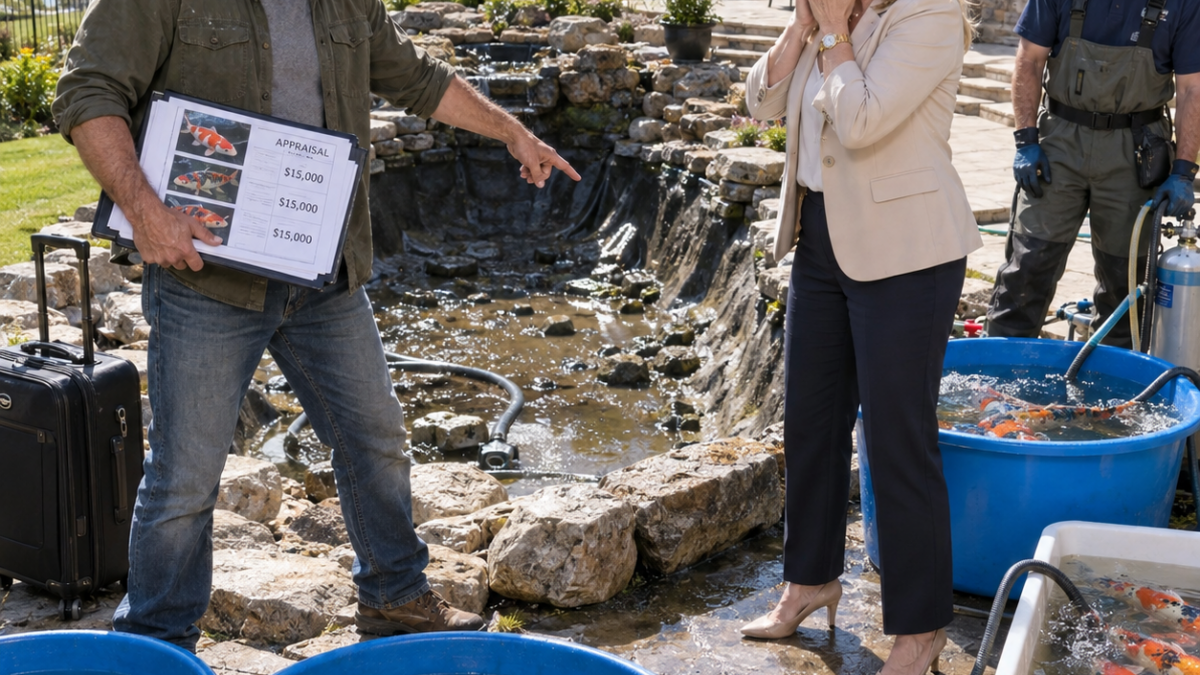
The first thing I noticed when I stepped into my backyard wasn’t the empty pond—it was the silence where fifteen living things had greeted me every morning for nearly a decade. The second thing I noticed was the HOA violation notice nailed to my back door, dated three days earlier and signed by the one neighbor who had spent years insisting she knew what was best for everyone else. By the time Karen walked across the street wearing that little satisfied smile, she had no idea the worst mistake of her presidency was already lying at the bottom of the hole she’d created.
“My little fish were making the neighborhood untidy?”
I repeated her words slowly because I honestly couldn’t believe what I had heard.
Karen Miller, president of the Oakwood Creek Estates HOA, stood on my flagstone path with her arms folded over a pink tracksuit and looked past me toward the wreckage of what had once been the most peaceful place on my five-acre property.
The pond was empty.
Ten thousand gallons of water were gone.
The waterfall was silent.
My filtration system lay clogged with mud and silt. One pump had apparently run dry long enough to burn itself out. Sections of the custom liner had been cut and folded back like somebody dismantling a cheap backyard pool.
And on the bottom were the fish.
Fifteen koi.
Not pet-store goldfish.
Japanese nishikigoi that I had spent years selecting, raising, documenting, showing, and protecting.
Kami, my Gin Rin Kohaku, lay near the deepest section, the pearlescent scales that had once flashed under the morning sun now dull against the cracked liner.
Kenji, a Showa whose black markings had changed every season since I bought him as a fingerling, was beside her.
There were thirteen more.
Every one had a name.
Every one had a pedigree.
Every one had a story.
My wife, Sarah, had stopped several feet behind me when we came home from our two-week trip to see our daughter and newborn grandson.
Neither of us spoke at first.
We had left this place alive.
We came home to something that looked like a crime scene.
Then I saw the paper on the back door.
EMERGENCY ABATEMENT ACTION.
Karen claimed the pond violated an HOA rule concerning “aesthetically objectionable water features and possible stagnant-water hazards.”
Possible.
Not inspected.
Not tested.
Not documented.
Possible.
And now the woman responsible was standing ten feet away acting as though she had done me a favor.
“You came onto my property while I was gone,” I said.
Karen shrugged.
“The association authorized corrective action.”
“You drained my pond.”
“It was becoming an eyesore.”
“You destroyed the filtration system.”
“That’s maintenance equipment.”
“You killed fifteen fish.”
She rolled her eyes.
“Jack, please. They’re fish.”
My hands closed into fists.
Twenty-five years in the Marine Corps, much of it in logistics and engineering, had taught me something anger never learns on its own.
The first person to lose control usually gives the other side an advantage.
So I opened my hands again.
Slowly.
“Those fish were certified Japanese specimens.”
Karen gave a theatrical sigh.
“You can buy more.”
“Some of them were champions.”
“Then buy expensive ones.”
“Karen.”
Something in my voice finally made her stop.
“The collection was appraised six months ago.”
She hesitated.
“How much?”
I looked at Kami lying motionless in the mud.
“Two hundred seventy-eight thousand five hundred dollars.”
For the first time, Karen’s face changed.
Only for a second.
But I saw it.
Then the arrogance returned.
“Oh, please. Nobody pays that kind of money for fish.”
“My insurance appraiser would disagree.”
Her arms uncrossed.
Then she recovered.
“Well, the HOA acted under its authority, and frankly, you should be more concerned about the bill.”
“What bill?”
“The contractor.”
She smiled again.
“Twelve hundred dollars for draining and decommissioning the pond. You’ll also receive a fine because the damaged liner is now considered an unsafe condition.”
I stared at her.
She had entered my land.
Destroyed my property.
Killed my fish.
And now she intended to fine me for the damage she had caused.
Sarah stepped beside me and quietly touched my arm.
Karen mistook that gesture for restraint born from fear.
She turned toward the sidewalk.
“Get the hole cleaned up, Jack. We do have standards here.”
I watched her walk away.
Then I looked down at the fifteen bodies in the mud.
The anger was still there.
But it was changing.
Becoming colder.
Cleaner.
Useful.
Karen thought she had destroyed a pond.
What she had actually done was give me a reason to start reading every page of the HOA records she had spent years hoping nobody would examine.
And before I finished, that twelve-hundred-dollar landscaping bill was going to become the most expensive invoice she had ever approved.
PART 2
Sarah found me sitting beside the drained pond almost three hours later.
The sun had dropped behind the tree line, and the shadows from the pines stretched across the yard until the empty basin looked even deeper than it actually was. I had not changed clothes. I had not unpacked from our trip. My suitcase still sat inside the mudroom beside hers, but the man who had returned from visiting his grandson that afternoon already felt very far away.
Sarah carried a blanket and draped it around my shoulders.
“You’re going to freeze out here.”
“I’m fine.”
“You always say that when you’re not.”
I did not answer.
The koi journal was open across my knees.
Most people who saw the binder laughed when they first learned what it was.
I understood.
To anyone who had never raised serious koi, the level of documentation seemed absurd.
But each fish had a section.
Breeder.
Bloodline.
Date of purchase.
Size at acquisition.
Annual growth measurements.
Water-temperature notes.
Health records.
Show history.
Photographs taken every few months.
Some had original breeder certificates from Japan.
Others had import documentation and independent valuations.
Kami’s file was nearly an inch thick.
I opened to one photograph taken two summers earlier.
She was swimming beneath the lily shelf with sunlight scattered across her back.
Perfect white.
Deep red pattern.
Silver glitter catching between the scales.
Sarah sat beside me.
“She was your favorite.”
“I wasn’t supposed to have favorites.”
“You absolutely had favorites.”
I looked at the photograph again.
“She won best in variety twice.”
“I remember.”
“You complained about the judging the year she came second.”
“The winning fish had weaker body conformation.”
Sarah gave me a tired smile.
“You complained for three months.”
“Because I was correct.”
“That isn’t the point.”
For a moment, I almost smiled.
Then my eyes went back to the pond.
The bodies were still there.
The joy of our trip had vanished so completely that I could barely remember holding my grandson three days earlier.
I closed the binder.
“She said they were just fish.”
Sarah reached over and took my hand.
“Don’t let her decide what they meant to you.”
“That isn’t what I’m thinking.”
“I know exactly what you’re thinking.”
“No, you don’t.”
“You’re planning.”
I looked at her.
Sarah had been married to a Marine for thirty-two years.
She knew the signs.
She squeezed my hand.
“Just promise me you don’t become like her.”
That irritated me.
“I’m nothing like Karen.”
“I didn’t say you were.”
“Then why say it?”
“Because righteous anger is still anger, Jack.”
I looked away.
Sarah leaned closer.
“Make her answer for what she did. Absolutely. But don’t build the rest of your life around destroying somebody.”
“I’m going to hold her accountable.”
“Good.”
“And if accountability destroys her?”
Sarah considered that.
“Then let the truth do it.”
That sentence stayed with me.
I had spent a quarter century in logistics and engineering for the Marine Corps. I had managed supply chains in places where a missing component could ground aircraft, halt convoys, or put Marines in danger. I had learned early that the dramatic part of any operation was usually the smallest part. Real success lived in preparation: inventories, redundancy, documentation, timelines, and knowing exactly which person had signed which piece of paper.
Karen’s mistake was believing my quietness meant passivity.
Quiet people are often underestimated because they do not advertise what they are doing.
The next morning, I began.
The first task was evidence preservation.
I photographed everything.
Not ten photographs.
Not fifty.
By the time I finished, I had taken more than a thousand high-resolution images.
Wide shots showing the entire backyard.
Close-ups of the liner.
Cut plumbing.
Mud inside the filtration chambers.
Burn marks on the pump motor.
Tool marks where connections had been forced apart.
The position of each fish exactly where we found it.
I placed a measuring scale beside every koi and photographed both sides.
Then I recorded video.
I walked the entire pond perimeter while narrating what I saw.
“This is the west filtration line. Connection separated approximately twelve inches from bead-filter inlet. Mud intrusion visible.”
Calm.
Neutral.
No shouting.
No speeches about revenge.
Just facts.
Sarah stood near the patio watching me.
At one point she said, “You sound like you’re giving an after-action brief.”
“That’s the idea.”
We moved the koi carefully.
It was one of the hardest things I had ever done.
I had a large chest freezer in the garage that I normally used for bulk meat and bait during fishing season.
Now it became evidence storage.
Every fish went into a separate heavy bag.
Each bag received a number.
The number matched its individual file.
Species.
Name.
Approximate weight.
Photographs.
Time recovered.
I hated every second.
But if Karen intended to claim they were worthless fish from a garden store, then I wanted physical proof preserved.
Once that was finished, I showered and sat at our dining table with coffee.
Then I brought out the Oakwood Creek Estates governing documents.
My relationship with the HOA had always been unusual.
I owned five acres.
The house and much of the landscaping predated Oakwood Creek Estates.
I bought the land when this part of the county still felt rural. The subdivision arrived later, spreading around us one phase at a time until our property looked like a small island inside a sea of newly built homes.
When the developer annexed surrounding land, my parcel was eventually swept into the HOA’s geographical boundaries through a zoning arrangement that lawyers had assured me was technically valid even though I opposed it.
For years, the dues were modest and the interference minimal.
I paid.
I ignored them.
They mostly ignored me.
Then Karen became president.
The tone changed gradually.
A notice about the color of my equipment shed.
A warning about a trailer parked overnight.
Questions about the pond lights.
Nothing serious.
I complied when the request was reasonable and challenged it when it wasn’t.
Karen disliked that.
She did not want compliance based on whether rules actually applied.
She wanted obedience.
Now I read every word of the covenants.
Article Seven dealt with architectural controls.
Section 4-C was the provision she cited.
It allowed the architectural committee to address property features deemed aesthetically objectionable or hazardous, including stagnant water capable of creating health risks.
Karen had apparently stopped reading there.
I kept going.
Article Eleven.
Abatement procedures.
Thirty days written notice.
Certified mail.
Opportunity to cure.
Right to appeal.
Majority vote of the board.
Official minutes documenting the vote.
And for contracted work above five hundred dollars?
Three bids.
I read it again.
Then once more.
No thirty-day notice.
No certified mail.
No hearing.
No board vote that I knew of.
No competitive bids.
No emergency inspection.
No vector-control report.
No environmental-health determination.
Karen had created her own procedure and called it law.
I opened the contractor invoice attached to the violation notice.
KAREN’S CLEAN CUT LANDSCAPING.
That name seemed almost too convenient.
I searched the company through the state’s business registry.
Owner: Gary Slater.
The name bothered me because I had heard it before.
Sarah found an old printed neighborhood directory in a kitchen drawer.
Gary Slater.
Spouse: Denise Slater.
Denise Miller Slater.
Karen’s sister.
I leaned back.
Sarah looked over my shoulder.
“Her brother-in-law?”
“Yes.”
“She hired her brother-in-law to destroy our pond?”
“Yes.”
“With HOA money?”
“Apparently.”
“And then billed us?”
“Yes.”
Sarah folded her arms.
“Now I’m angry.”
I almost laughed.
“Welcome aboard.”
I printed the corporate record.
The battle had changed.
Karen had not simply made a bad judgment call.
She had bypassed mandatory procedure and awarded work to a close relative.
That potentially exposed both her and the association.
But potential was not proof.
I needed records.
My first letter went to every board member individually.
Not an email.
Certified mail.
I described the event.
Listed the procedural requirements.
Requested the board minutes authorizing the abatement.
Requested all bids.
Requested the health complaint Karen had referenced.
Requested inspection reports.
Requested vendor-selection documentation.
I attached a preliminary schedule of damaged property.
I listed every koi by name and variety.
But I did not put the value.
Not yet.
Sometimes the most useful number in a negotiation is the one the other side does not know.
Two weeks passed.
Nothing.
Then an envelope arrived.
Inside was the $1,200 landscaping invoice.
A $500 HOA fine.
The stated reason?
Failure to maintain the pond area in safe condition.
Sarah read it twice.
“They damaged it.”
“Yes.”
“They’re fining us because it’s damaged.”
“Yes.”
“This is insane.”
“Insanity is not a legal category.”
“Jack.”
“Sorry.”
There was more.
The HOA’s attorney enclosed a letter claiming the pond had created an immediate health emergency involving mosquitoes, odor, and stagnant water.
Because of the alleged emergency, they argued, normal notice rules did not apply.
I reread that part several times.
The waterfall pump circulated thousands of gallons per hour.
The bead filter operated continuously.
A UV sterilizer ran twenty-four hours a day.
A separate bog filter circulated additional water through plant roots.
Mosquito larvae would have had better luck breeding in the Atlantic Ocean.
But Karen’s attorney had committed the story to writing.
Good.
Every false statement becomes more valuable once someone signs it.
Then I reached the last enclosure.
Another violation.
This one concerned my chest freezer.
The HOA claimed an “industrial appliance” had been visible inside my garage while the door was open and therefore violated aesthetic standards.
The freezer contained the koi bodies.
I sat completely still.
Sarah noticed.
“What?”
I handed her the notice.
She read it.
Then looked toward the garage.
“She wants the freezer gone.”
“Yes.”
“Because she knows what’s inside?”
“I don’t know what she knows.”
“But if we disposed of them—”
“We lose evidence.”
Sarah put the paper down.
“She’s trying to make you throw away proof.”
“Maybe.”
“What are you going to do?”
I picked up my phone.
“Call Dave.”
David Reynolds answered on the third ring.
“Tell me you finally bought that fishing boat.”
“Not yet.”
“Then I don’t want to hear from you.”
“I need a lawyer.”
Silence.
The joking stopped.
“What happened?”
Dave and I had served together years earlier.
He was a JAG officer while I was handling logistics operations. After leaving the Corps, he built a respected civil-litigation practice specializing in contracts, property disputes, and commercial fraud.
More importantly, he hated bullies.
I gave him the short version.
Pond.
HOA.
Trespass.
Fifteen koi.
Brother-in-law contractor.
Fake emergency.
Freezer notice.
When I finished, he was silent for several seconds.
Then he said, “How much are the fish worth?”
“Two hundred seventy-eight thousand five hundred.”
Another pause.
“Jack.”
“Yes?”
“These aren’t koi.”
“They are koi.”
“These are swimming Ferraris.”
“I wish people would stop saying that.”
“Did Karen know the value?”
“Not until after.”
“And she admitted authorizing the draining?”
“To my face.”
“Witness?”
“Sarah.”
“Anything in writing?”
“Abatement notice. Contractor invoice. HOA response.”
“Send me everything.”
“I will.”
“Do not speak to Karen alone again.”
“That seems dramatic.”
“You called me because you wanted a lawyer. Let me lawyer.”
“Fine.”
“And Jack?”
“What?”
“Do not dispose of those fish.”
“I wasn’t planning to.”
“Good.”
Dave came to the house two days later.
He spent four hours reviewing my documentation.
At the end, he leaned back from the dining table.
“This is astonishing.”
“Helpful astonishing?”
“Very.”
He tapped Article Eleven.
“She ignored nearly every procedural safeguard.”
“I know.”
“Then she used a related-party vendor.”
“Yes.”
“And the board’s attorney is relying on an emergency exception.”
“Yes.”
“Which means they’re going to have to prove the emergency.”
“Yes.”
Dave smiled.
“You really did miss having something to do, didn’t you?”
“My wife says I’m difficult in retirement.”
“Sarah is correct.”
He started making notes.
“The HOA may carry directors-and-officers coverage.”
“I assumed.”
“That will matter. Those policies generally protect board members for good-faith governance decisions. But deliberate misconduct, fraud, self-dealing, malicious property destruction—that can create coverage problems.”
“How serious?”
“Depends on the policy.”
He tapped the contractor record.
“Her brother-in-law is the interesting part.”
“There’s more.”
I told him about years of Karen pushing landscaping work toward the same company.
Dave stopped writing.
“How do you know?”
“Observation.”
“That isn’t enough.”
“I know.”
“We need documents.”
“I have someone.”
Dave looked up.
“Who?”
“Mike Tanaka.”
He started laughing.
“You’re bringing Mike into an HOA dispute?”
“If Karen wanted privacy, she should not have drained the pond.”
Mike Tanaka had served as an intelligence analyst before leaving the Marines and starting a private investigative firm.
He answered my call with the same calm voice I remembered.
“Jack Davies.”
“Mike.”
“You dead?”
“Not yet.”
“Then why are you calling me after seven years?”
“I have an HOA president.”
He laughed.
“Say no more.”
“I’m serious.”
“I know. That’s why it’s funny.”
I explained.
Mike listened.
Then said, “Give me forty-eight hours.”
He called thirty-six hours later.
“Your woman is busy.”
“That doesn’t sound good.”
“It isn’t.”
Karen’s Clean Cut Landscaping had been the exclusive HOA landscaping vendor for three years.
No meaningful bidding process.
Monthly payments far above comparable local contracts.
Additional invoices for trimming, mulch, tree work, irrigation repairs, seasonal flowers, and “emergency landscape response.”
Over three years, the money was substantial.
Then Mike found recurring transfers.
Money moving from Gary Slater’s accounts to Karen.
Descriptions such as CONSULTING.
ADVISORY.
MANAGEMENT SUPPORT.
“Kickbacks?” I asked.
“I’d call them suspicious transfers until somebody with subpoena power proves the underlying purpose.”
I appreciated that.
Mike never confused a theory with a fact.
“But Jack?”
“Yes.”
“There’s enough here that somebody should look.”
He prepared a report using lawfully obtained public records and financial information available through legitimate investigative channels.
No hacking.
No theatrics.
Just documents.
While Mike handled financial intelligence, I began talking to neighbors.
Sarah baked oatmeal cookies.
“You’re weaponizing my cookies.”
“I’m building community.”
“You’re weaponizing my cookies politely.”
“Correct.”
Mrs. Gable lived two doors down.
She was in her late seventies and had one of the most cheerful front yards in Oakwood Creek.
Flowers.
Birdhouses.
Small ceramic animals.
When I walked up, I saw her grab a garden gnome and move it behind a rose bush.
“Why are you hiding that?”
She froze.
“Oh.”
“It’s a gnome.”
“I know.”
“Is it dangerous?”
She looked embarrassed.
“Karen doesn’t approve of them.”
I stopped smiling.
“What does that mean?”
“She says decorative statuary visible from the street requires architectural approval.”
“Have you applied?”
“She denied it.”
“For a gnome?”
“Three of them.”
“How much?”
Her voice lowered.
“The fines?”
“Yes.”
“Four hundred dollars.”
My jaw tightened.
“Mrs. Gable, I’m not here about your gnome.”
I told her about the pond.
Her hands covered her mouth.
“She did that while you were gone?”
“Yes.”
“She didn’t even call?”
“No.”
“She can’t do that.”
“That is what I’m investigating.”
The words unlocked something.
Mrs. Gable went inside and returned with a folder.
Violation letters.
Gnome.
Birdbath.
Wind chime.
Holiday wreath.
A decorative bench.
One notice claimed flowers near the sidewalk created a “visual-density concern.”
That phrase almost impressed me.
“Why didn’t you fight these?”
“I live alone.”
That was the whole answer.
Not cowardice.
Not ignorance.
Loneliness.
Karen had understood that beautifully.
She chose conflicts people were too tired or too isolated to fight.
The Rodriguez family lived across from Karen.
Two boys.
Basketball hoop in the driveway.
Mr. Rodriguez opened the door and looked at my clipboard.
“If this is about the hoop, I’m not taking it down.”
“I’m not from the HOA.”
His expression changed.
“Oh.”
“I’m Jack Davies.”
“The pond guy?”
Apparently news traveled.
“Yes.”
He invited me inside.
Karen had fined them repeatedly for the basketball hoop.
Attractive nuisance.
Noise.
Temporary structure.
Visual obstruction.
One letter threatened a lien if accumulated penalties were not paid.
“I work sixty hours a week,” Rodriguez said. “I bought this house because I wanted my kids to have somewhere safe to grow up. She’s acting like bouncing a basketball at four in the afternoon is criminal.”
His wife showed me notices.
I photographed them with permission.
Then came another homeowner.
Wrong trim color.
Another.
Satellite dish dimensions.
Another.
Trash containers visible forty minutes too long.
Another.
A child’s bicycle.
Another.
An American flag installed on a bracket Karen deemed decorative instead of functional.
Nobody knew everyone else had been targeted.
That was Karen’s greatest weapon.
Isolation.
By the end of the week, I had spoken with twelve families.
Not one liked her.
But almost every one thought everyone else supported her.
That realization was more important than any single fine.
When Mike’s report arrived, Dave came over again.
We spread everything across the table.
Mike’s findings.
Neighbor violations.
Vendor contracts.
Karen’s transfers.
My pond photographs.
The koi appraisals.
Dave pointed toward the insurance appraisal.
“Time to reveal this.”
“You sure?”
“She dismissed the fish as worthless. Let’s correct the record.”
We built a demand package.
Twenty pages.
Precise.
No insults.
No threats.
The value of the fifteen koi: $278,500.
Estimated pond reconstruction: approximately $48,000 based on contractor quotes.
Damaged filtration equipment.
Pump replacement.
Professional cleanup.
Inspection.
Legal expenses.
Investigation expenses.
The total potential civil exposure exceeded $350,000 before punitive or additional claims.
Dave proposed a settlement.
Not because we expected Karen to accept it.
Because reasonable offers matter.
We offered to resolve the direct property dispute for substantially less than the potential total if two things happened.
First, Karen publicly acknowledged that the abatement process had been improper and apologized at an HOA meeting.
Second, the landscaping contract with her brother-in-law would be terminated and future vendor contracts would go through transparent competitive bidding.
I looked at Dave.
“She’ll never agree.”
“That’s why I wrote it.”
“That sounds manipulative.”
“It’s called giving someone a reasonable choice.”
“Which you know she’ll reject.”
“Her personality is not my legal strategy.”
I laughed.
“She’s going to call it extortion.”
“She can call it Christmas.”
Two weeks later, Karen’s attorney responded.
The koi valuation was “fantastical.”
Our damages were “grossly inflated.”
Our allegations of procedural misconduct were “without merit.”
The proposed apology was “an unacceptable attempt at public humiliation.”
Karen accepted no responsibility.
Then she made the mistake that changed everything.
The HOA announced a special meeting.
Agenda: proposed amendment expanding architectural-control authority over landscape water features.
Maximum pond size: five hundred gallons.
My pond had been ten thousand.
Sarah read the notice.
“She’s trying to rewrite the rule after she destroyed it.”
“Yes.”
“Can she?”
“Going forward, if properly adopted, maybe. Retroactively? Not to make past conduct lawful.”
“Why would she do this?”
“Because she thinks everyone is afraid of her.”
Sarah looked at me.
“Are they?”
“Not anymore.”
The neighborhood had been talking.
Mrs. Gable talked to three friends.
Rodriguez talked to families with children.
The trim-color homeowner talked to his block.
People compared fines.
Compared letters.
Compared stories.
Within days, our informal group represented dozens of homes.
We gave it a boring name on purpose.
Oakwood Creek Neighborhood Oversight Committee.
Karen loved calling critics radicals.
Nothing sounded less radical than “Neighborhood Oversight Committee.”
We prepared for the special meeting.
Not a mob.
A presentation.
I asked homeowners to bring copies of notices.
Dave reviewed every slide.
Mike verified every public record.
We removed anything we could not substantiate.
If a number was estimated, we labeled it estimate.
If something was allegation, we called it allegation.
If evidence proved it, we showed the evidence.
The night of the meeting, more than a hundred homeowners entered the clubhouse.
Karen sat at the head table smiling.
That smile told me she did not understand why they were there.
She thought turnout meant support.
People with authority often make that mistake.
They confuse attention with admiration.
Karen opened with a speech about community standards.
Property values.
Order.
Protecting investments.
Then she referred to an “unfortunate recent situation involving a hazardous and improperly maintained pond.”
Sarah squeezed my hand.
“Easy.”
“I’m fine.”
“You’re grinding your teeth.”
“I’m still fine.”
Karen proposed the amendment.
A board member moved for a vote.
I stood.
“Point of order.”
Karen’s smile disappeared.
“Mr. Davies, public comment will occur after the vote.”
“The bylaws incorporate parliamentary procedure requiring debate before adoption of an amendment.”
“You’re not parliamentarian.”
“No.”
I held up the bylaws.
“But I can read.”
Laughter moved through the room.
Karen’s face tightened.
“You may have three minutes.”
“I’ll need longer.”
“No.”
A homeowner shouted, “Let him speak!”
Another joined.
Then several.
One board member leaned toward Karen and whispered something.
She looked furious.
“Ten minutes.”
“I’ll try to be efficient.”
I walked to the projector.
The first slide showed Mrs. Gable’s gnome.
People chuckled.
“This is currently considered an HOA problem.”
Mrs. Gable sat in the second row.
I explained her fines.
Then the Rodriguez basketball hoop.
Then trim.
Trash bins.
Bicycles.
Birdbaths.
A dozen examples.
No dramatic adjectives.
Just dates and amounts.
The room changed gradually.
People saw themselves.
Not literally.
Emotionally.
Every private humiliation had cousins.
“This proposed amendment is being presented as a way to protect Oakwood Creek,” I said. “Before giving the board more authority, I believe homeowners should understand how existing authority has been exercised.”
I changed slides.
Karen’s Clean Cut Landscaping.
Three years of HOA payments.
Then the business registration.
Gary Slater.
I displayed a public record establishing the family relationship.
A sound moved through the room.
Not shouting.
Recognition.
I showed contract costs.
Comparable market estimates.
Lack of competitive bidding documents.
Then Mike’s summary of suspected related-party transfers.
I did not call them bribes.
I called them transactions requiring independent review.
Karen stood.
“This is defamatory.”
Dave, seated near the rear, made a note.
I continued.
“The same contractor was paid twelve hundred dollars to enter my property and drain my pond.”
Next slide.
Article Eleven.
Thirty-day notice.
Board vote.
Competitive bidding.
Then the notice Karen had left on my door.
Dated three days before we returned.
I turned toward the room.
“Regardless of whether you like koi ponds, basketball hoops, garden gnomes, or any other feature shown tonight, the question is whether our elected board must follow the rules it enforces against us.”
That landed.
Because it was bigger than me.
Karen grabbed the microphone.
“My actions were authorized under the emergency-health clause.”
I nodded.
“Then please show the inspection establishing the emergency.”
Her face tightened.
“There were complaints.”
“Please show them.”
“Confidential.”
“Then show them with the names redacted.”
Silence.
“Vector-control report?”
“Not required.”
“Water test?”
“Not required.”
“Photographs showing stagnant water?”
“You know perfectly well what that pond looked like.”
“Yes.”
I changed slides.
A photograph taken the morning before Sarah and I left for vacation.
The water was crystal clear.
Kami and Kenji visible beneath the surface.
Waterfall running.
Timestamp on the image.
The room murmured.
Karen’s voice rose.
“That proves nothing!”
I looked at her.
“You’re correct. One photograph doesn’t establish every condition over two weeks. That is why I am asking for the evidence supporting the emergency determination.”
She had none.
Karen did what people like Karen often do when facts stop cooperating.
She got louder.
“That pond was disgusting!”
The room went silent.
“It smelled!”
“No.”
“It was crawling with mosquitoes.”
“No.”
“I did this neighborhood a favor!”
Dave stopped writing.
Phones came up.
People started recording.
Sarah whispered, “There it is.”
Karen pointed at me.
“I had every right to remove it, and if I had to make the decision again, I would do exactly the same thing!”
I stood completely still.
The confession was not legally perfect.
Few angry statements are.
But it established intent.
Karen kept going.
“You think because you were a Marine everybody has to be afraid of you?”
“No.”
“You’re trying to extort this association with fake fish prices!”
Dave stood.
His suit suddenly made sense to everyone who had assumed he was another homeowner.
“My name is David Reynolds.”
Karen stopped.
“I represent Mr. Davies.”
Her face changed.
Dave walked forward.
“Mrs. Miller, your statement that my client fabricated the valuation is false. The valuation was completed by a qualified independent specialist before this dispute existed. You have also now publicly stated that you intentionally authorized the destruction of his pond and would do so again.”
“You’re threatening me.”
“No. I am identifying the record you are creating.”
The room was silent enough to hear the air conditioning.
Dave placed a document envelope on the table.
“You have already declined our attempt to resolve the matter privately.”
He set down the first complaint.
“This is a civil action concerning property damage and related claims arising from the destruction of Mr. Davies’s pond and koi collection.”
Second document.
“This concerns defamatory statements made regarding my client.”
Karen stared down.
The color disappeared from her face.
One board member physically moved his chair several inches away from her.
That tiny movement was more devastating than shouting.
Karen looked around.
“You’re all going to let him do this?”
Mrs. Gable stood.
Her voice shook.
“Yes.”
Karen stared at her.
Mrs. Gable clutched one of her garden gnomes against her chest.
It was ridiculous.
And magnificent.
“You fined me four hundred dollars because you didn’t like this little man.”
A few people laughed softly.
Mrs. Gable did not.
“I’m seventy-nine years old. My husband is dead. I live alone. Every envelope from the HOA made me afraid I was going to lose my house.”
Karen rolled her eyes.
“Nobody was taking your house over a gnome.”
“You threatened a lien.”
“That was standard language.”
Mrs. Gable’s voice strengthened.
“Then you shouldn’t use words you don’t mean.”
Karen had no response.
Rodriguez stood.
“My boys should be able to bounce a basketball at four in the afternoon.”
Another resident stood.
“My daughter should be able to leave a bicycle outside while she eats dinner.”
Another.
“I shouldn’t need your cousin’s contractor to build a fence.”
Another.
“Why did your brother-in-law get every landscaping contract?”
The room erupted.
Karen banged the gavel.
Nobody stopped.
For years, that sound had ended arguments.
Not anymore.
The other board members requested an immediate executive session.
Karen protested.
They outvoted her.
The proposed pond amendment died without a vote.
And Oakwood Creek changed that night.
Not because Karen had lost yet.
She had not.
But fear had.
That was the real turning point.
Dave and I drove home separately.
When I arrived, Sarah was sitting near the empty pond.
I joined her.
“Did that feel good?” she asked.
“What?”
“Serving her.”
I considered.
“Less than I expected.”
“Good.”
“Why good?”
“Because maybe you still remember this isn’t entertainment.”
I looked down into the darkness.
“I want her to pay.”
“She will.”
“I want her to understand.”
Sarah shook her head.
“That part you don’t control.”
The HOA’s insurance company became involved within days.
Its lawyers reviewed the claim.
The board’s records.
Karen’s public statements.
The related-party vendor issue.
Dave called me after speaking with coverage counsel.
“The association has potential coverage for negligent board actions.”
“And Karen?”
“Separate problem.”
“Meaning?”
“The carrier is questioning whether intentional or fraudulent conduct by her personally falls outside protection.”
I was quiet.
Dave continued.
“Jack, this is where you stay disciplined. Let them investigate. Do not contact her. Do not celebrate.”
“I wasn’t going to.”
“You absolutely were.”
“I was considering a small cigar.”
“Denied.”
“What authority do you have over cigars?”
“Counsel authority.”
“That’s not real.”
“It should be.”
The other board members moved quickly once they understood their own exposure.
An emergency meeting removed Karen as president.
Then from her board position.
A neighborhood recall petition gathered enough signatures almost immediately.
The old HOA attorney was replaced.
Independent counsel was hired.
A forensic review of contracts began.
Karen’s brother-in-law lost the landscaping contract.
Competitive bids were ordered.
Oakwood Creek discovered that it had been paying dramatically more than necessary for routine maintenance.
Mike’s information concerning financial transfers went to appropriate investigators.
The criminal side moved slowly.
As it should.
Accusations were not convictions.
Documents had to be authenticated.
Transactions traced.
Witnesses interviewed.
Intent established.
I stayed out of that process except when asked for evidence directly related to my property.
My civil case moved faster.
The koi valuation survived scrutiny.
That mattered.
The insurer hired its own expert.
He reviewed breeder records.
Awards.
Photographs.
Bloodlines.
Growth data.
Prior sales of comparable koi.
When he finished, his valuation was close enough to mine that the argument over whether the fish had been “fake overpriced pets” effectively ended.
The association settled the direct property claim.
Koi value.
Pond reconstruction.
Destroyed equipment.
Associated costs.
The number was enormous.
When the check arrived, I left it sitting on the dining table unopened for almost an hour.
Sarah finally said, “You going to open that?”
“I know what’s inside.”
“That’s never stopped you from opening mail.”
I tore the envelope.
The amount compensated us financially.
But looking at it made me angry all over again.
Money assigns value.
It does not replace history.
You cannot write a check for ten years.
You cannot purchase the exact morning when a certain fish first took food from your hand.
You cannot recreate the pattern changes you watched season after season.
You cannot replace familiarity.
Sarah sat across from me.
“You look disappointed.”
“I thought this would feel like winning.”
“It’s a check.”
“It’s justice.”
“No.”
I looked at her.
“It’s compensation.”
She reached across the table.
“Justice is what happens next.”
The new board suspended disputed fines.
Then reviewed old enforcement cases.
Mrs. Gable received a refund and a formal written apology.
She immediately placed six garden gnomes across the front flower bed.
Six.
I walked over the next morning.
“You had three.”
“I’ve expanded.”
“This feels provocative.”
“I’m radicalized.”
I laughed so hard my stomach hurt.
The Rodriguez basketball-hoop fines were canceled.
Then the new board did something Karen would have considered an act of civilization-ending anarchy.
They built a permanent basketball court in the neighborhood park.
The opening afternoon sounded like a war zone if the war involved ten-year-olds missing free throws.
Karen would have hated it.
That alone made Rodriguez smile.
The governing documents were rewritten.
Vague language about “aesthetic harmony” was replaced with clearer standards.
Fine procedures required notice.
Hearings.
Appeals.
Documented board decisions.
Contracts above modest thresholds required multiple bids.
Related-party transactions required disclosure and recusal.
No one person could dominate the architectural committee.
Meeting minutes became accessible.
Financial reports were published.
The system was deliberately made boring.
That was the point.
Good governance is usually boring.
Tyranny requires drama.
Meanwhile, my pond remained a hole.
For months I could not rebuild it.
Contractors were ready.
Money was available.
Plans were drawn.
But I kept delaying.
Sarah knew why before I did.
One evening she found me standing beside it.
“You think filling it means replacing them.”
I looked at her.
“I don’t want replacement fish.”
“Then don’t replace them.”
“What do you mean?”
“Build a new pond.”
“It’s the same hole.”
“That isn’t what I meant.”
I looked toward the dry basin.
Sarah put both hands in her jacket pockets.
“You’re trying to reconstruct the exact thing Karen destroyed.”
“Yes.”
“You can’t.”
“I can improve the filtration.”
“Jack.”
“I can rebuild the stonework.”
“Jack.”
I stopped.
She looked at me.
“You cannot build yesterday.”
That hurt.
Because it was true.
Sarah continued.
“Kami is gone.”
I looked away.
“Kenji is gone.”
“Enough.”
“No. You need to hear it.”
“I know they’re gone.”
“Then stop designing a museum.”
I stared at her.
She gestured toward the pond.
“Build something alive.”
The next morning, I called the contractor.
We changed the plan.
The rebuilt pond would keep the spirit of the original but not imitate it.
New liner.
New plumbing.
Redundant pump system.
Automatic water-level protection.
Remote alarms.
Upgraded UV.
A Nexus filtration system.
Emergency overflow.
Independent electrical isolation.
Cameras.
Not because I expected another Karen.
Because redundancy had been my religion for twenty-five years and I was embarrassed the first design did not have enough.
Construction began in early spring.
The sound of excavators returned to the yard.
For the first time since the draining, the hole looked like a project instead of a grave.
Neighbors stopped by.
Rodriguez brought coffee.
Mrs. Gable supervised without being asked.
“Those rocks are crooked.”
“They’re supposed to look natural.”
“They look crooked.”
“Nature is crooked.”
“That sounds like an excuse.”
Children from three houses down watched the workers install filtration pipes.
One asked me how expensive the new fish would be.
“I don’t know.”
“Are they going to be fifteen thousand dollars?”
“No.”
“Why not?”
Because that number from the title people later used for the story was only a rough way outsiders tried to understand the value of the collection. Some of my old koi were worth less than that, some far more, and the certified total had been $278,500. But what mattered to me now was that I did not want fifteen mature show fish purchased as substitutes for fifteen animals I had known.
So I told him the truth.
“Because I’m starting younger.”
“Baby koi?”
“Pretty much.”
“Will they get expensive?”
“Maybe.”
“Can I name one?”
“No.”
“Why?”
“Because children give terrible names.”
“I’d name one Shark.”
“Exactly.”
He looked offended.
The pond filled in June.
Clean water slowly covered the new black liner.
The waterfall started.
That sound stopped me.
For months, silence had defined the backyard.
Now water moved over stone again.
Sarah stood beside me.
Neither of us spoke.
The pump hummed.
The waterfall settled into its old rhythm.
Birds came closer.
Wind moved through the grasses.
I closed my eyes.
Peace did not return all at once.
But I could hear where it might live.
A week later, the koi breeder arrived.
Not fifteen champions.
Young fish.
Potential.
A Kohaku with a bold red pattern.
A Showa with markings not yet settled.
A metallic Ogon.
A Gin Shiro Utsuri with sharp contrast.
Several Tosai selected because their body structure suggested they might develop beautifully over time.
No trophies.
No enormous appraisals.
No attempt to purchase history.
The breeder floated the bags.
Children gathered outside the fence.
Mrs. Gable brought lemonade.
Rodriguez pretended not to be fascinated and asked more questions than anyone.
When the first koi entered the pond, it vanished beneath the surface.
Then came back.
Small.
Fast.
Alive.
Another followed.
Then another.
Sarah slipped her arm through mine.
“Better?”
I watched the young fish explore.
“Different.”
“That’s allowed.”
The smallest Gin Shiro swam directly toward the edge.
I crouched.
It opened its mouth.
“Hungry already.”
Sarah smiled.
“You’re in trouble.”
“Probably.”
I did not name them immediately.
That surprised everyone.
The old koi had earned their names gradually.
These would too.
The criminal investigation into Karen continued in the background.
I heard updates from Dave when they affected our case.
Karen’s financial problems grew.
Her personal legal-defense costs were no longer covered the way she had expected.
The defamation suit remained.
She countersued.
The counterclaim went nowhere.
Eventually, her attorney approached Dave about settlement.
I asked him the terms.
He told me.
Then said, “You could force this longer.”
“Would it accomplish anything?”
“Cost her more.”
“That wasn’t my question.”
“No.”
“What does Sarah think?”
Dave laughed.
“She isn’t my client.”
“She’s smarter than both of us.”
“That is unfortunately true.”
The defamation claim settled.
Karen agreed to financial terms and formal retractions.
I could have pursued more.
Maybe won more.
But by then, every additional courtroom battle felt less like justice and more like staying connected to someone I wanted out of my life.
So we closed it.
The criminal side eventually ended with a plea resolving fraud-related conduct, probation, restitution obligations, and other consequences.
Some neighbors complained the punishment was too light.
Rodriguez came to my backyard one evening furious.
“She should be in prison.”
“Maybe.”
“Maybe?”
“The prosecutor knows the evidence better than I do.”
“She stole from everybody.”
“Yes.”
“She used the HOA like her personal business.”
“Yes.”
“She destroyed your fish.”
“That was handled separately.”
He shook his head.
“You aren’t angry?”
I pointed toward the pond.
“Look.”
He did.
Young koi moved beneath the water.
The waterfall ran.
Across the street, his sons were playing basketball.
Mrs. Gable had so many garden gnomes now that her flower beds looked occupied by a small ceramic nation.
“The neighborhood is ours again,” I said.
Rodriguez looked at me.
“That doesn’t answer my question.”
“It does for me.”
He stayed quiet.
I continued.
“If the only way I can feel whole is by knowing Karen is miserable, then she still controls something in my life.”
Rodriguez sighed.
“You’ve been talking to Sarah.”
“Constantly. It’s exhausting.”
He smiled.
Then the moving truck arrived.
It was a Saturday.
Karen’s house had sold.
Legal bills, restitution, settlements, and the collapse of her position in Oakwood Creek had made staying impractical.
I was sitting on the teak bench beside the pond when the truck stopped across the street.
Movers carried boxes.
Furniture.
Lamps.
The same dining set I had once seen through Karen’s windows during HOA holiday parties.
Her life was being reduced to labeled cardboard.
I did not feel sorry for what she had done.
But I felt something complicated watching the physical consequences arrive.
Sarah came outside.
“She’s leaving.”
“I see.”
“You going over there?”
“No.”
“Good.”
“Were you worried?”
“A little.”
“I’m insulted.”
“You practiced an entire speech in the shower last month.”
“That was unrelated.”
“It included the phrase ‘you mistook patience for weakness.’”
“That could apply to many situations.”
Sarah sat beside me.
Eventually Karen came outside.
No pink tracksuit.
No clipboard.
No styled helmet of hair.
Just jeans, a sweater, and exhaustion.
She looked older.
She gave the movers instructions.
Then got into her car.
The engine started.
She pulled away from the curb.
When she reached our driveway, she slowed.
I knew she would.
Maybe she wanted one final confrontation.
Maybe she simply wanted to see the pond.
Our eyes met.
For a second, I imagined standing.
Walking toward the road.
Telling her every thing she had lost.
Presidency.
Influence.
Money.
Home.
Reputation.
Her brother-in-law’s contract.
The little kingdom she had spent years building.
I imagined explaining that all of it began because she could not leave my fish alone.
It would have been satisfying.
For approximately ten seconds.
Then I remembered Sarah’s first warning.
Let the truth do it.
So I stayed seated.
Karen looked at the water.
The new koi swam below the waterfall.
One broke the surface.
I gave Karen a single nod.
Not forgiveness.
Not friendship.
Acknowledgment.
This was finished.
Her jaw tightened.
Then she looked away.
The car accelerated.
She disappeared around the corner.
I never saw her again.
For several seconds, neither Sarah nor I spoke.
Then she asked, “What happened to the speech?”
“I decided it was too good for her.”
Sarah laughed.
“That is still arrogant.”
“I’m improving slowly.”
“You’re seventy.”
“Plenty of time.”
She rested her head against my shoulder.
The pond moved in front of us.
Water over stone.
Light across scales.
Living things growing into whatever they were going to become.
That autumn, Oakwood Creek held its first neighborhood festival under the new board.
Calling it a festival was generous.
It was mostly barbecue, folding chairs, basketball, and people pretending store-bought cookies were homemade.
But nearly everyone came.
The new board president was Rodriguez.
He hated meetings.
That alone made him perfect.
Mrs. Gable chaired community beautification.
Her first official proposal was allowing “tasteful decorative garden statuary.”
Nobody dared ask her to define tasteful.
The provision passed unanimously.
The landscaping contract was rebid.
The winning company charged roughly half what the HOA had previously been spending.
Some of the savings went toward rebuilding reserves.
Some repaired neglected common areas.
And part funded the basketball court.
For years, Karen told everyone control protected property values.
What actually protected the community was transparency.
People knew where money went.
They attended meetings.
They argued.
Sometimes loudly.
But arguments were no longer treated as disloyalty.
One night after a board meeting, Rodriguez came to my house.
“You created a monster.”
“What happened?”
“Mrs. Gable wants decorative seasonal lighting along the entrance.”
“Sounds reasonable.”
“She has nineteen pages of proposals.”
“That sounds like governance.”
“I hate governance.”
“You volunteered.”
“You manipulated me.”
“I nominated you.”
“Same thing.”
I poured coffee.
He sat at the kitchen table.
“Seriously, Jack.”
“What?”
“You should’ve been president.”
“No.”
“Why?”
“I already had a career telling people what to do.”
“You would be good at it.”
“That is not a reason.”
He considered.
“Fair.”
I looked toward the backyard.
“The point was never replacing Karen with somebody stronger.”
“What was the point?”
“Building a system where it matters less who the president is.”
Rodriguez nodded slowly.
“That sounds expensive.”
“It’s mostly paperwork.”
“Worse.”
We laughed.
Later that winter, I found the old koi journal.
I had put it in a cabinet after the settlement.
For months, I could not open it.
That night I carried it to the pond room.
Sarah followed.
“You sure?”
“No.”
I sat.
Opened Kami’s section.
Photographs.
Measurements.
Show ribbons.
Breeder certificate.
Medical notes from a minor infection six years earlier.
Everything.
The grief hit harder than I expected.
“They really were beautiful,” Sarah said.
“Yeah.”
She turned a page.
“Kenji.”
“Best development curve in the collection.”
“You said that about all of them.”
“No.”
“Yes.”
“Kenji’s sumi improved dramatically after year four.”
“I have no idea what that means.”
“You’ve lived with koi for ten years.”
“I live with you. That doesn’t mean I understand you either.”
I smiled.
Then reached the final appraisal.
$278,500.
There it was.
The number that had shocked Karen.
The number reporters had later obsessed over.
The number neighbors repeated.
But looking through the binder, I realized how incomplete it was.
Kami had a market value.
Her history did not.
Kenji had a replacement estimate.
His development could not be replaced.
Money had been necessary because courts and insurance require numbers.
Life rarely fits inside them.
I closed the binder.
Sarah asked, “What are you going to do with it?”
“Keep it.”
“Why?”
“Because it happened.”
That became enough.
A year after the pond was rebuilt, the young koi had grown dramatically.
Shark—the name I had absolutely prohibited—was now officially called Shark because children are relentless.
The boy who named him reminded me of this fact every time he visited.
“See? Good name.”
“It is objectively terrible.”
“He likes it.”
“He is a fish.”
“He comes when I call.”
“He comes because you have pellets.”
“Same thing.”
Shark was a Gin Shiro with an absurdly friendly personality.
He was always first at the edge.
Always first to feed.
Always investigating hands.
He would never be Kami.
That was the point.
One evening, my daughter visited with our grandson.
He had just started walking.
Sarah carried him toward the pond.
I immediately became nervous.
“Hold him.”
“I am holding him.”
“Closer.”
“He’s fine.”
“Water is deep.”
“You built it.”
“That makes me uniquely aware of its depth.”
Our daughter laughed.
“Dad, you survived wars but a toddler near a pond breaks you?”
“Yes.”
My grandson pointed.
“Fish.”
The word was imperfect.
More like “fiss.”
But I understood.
I crouched beside him.
“That’s Shark.”
My daughter raised an eyebrow.
“You named a koi Shark?”
“I did not.”
“Sure.”
Shark surfaced.
My grandson squealed.
The sound went straight through me.
For ten years, the old pond had stored my memories.
This pond was creating new ones.
I finally understood what Sarah meant.
Build something alive.
That night after our daughter left, I stood beside the water.
“You were right.”
Sarah was reading on the patio.
She looked up.
“About what? I need specifics. The list is extensive.”
“The pond.”
She smiled.
“I know.”
“That confidence is unattractive.”
“No, it isn’t.”
I watched Shark circle under the light.
“Karen thought she destroyed everything.”
“She destroyed a lot.”
“Yes.”
“But not everything.”
“No.”
That distinction mattered.
People like Karen often misunderstand damage.
They think if they break what someone loves, they own the ending.
They don’t.
They own the act.
The victim gets a say in what comes after.
I could not undo what she did.
I could decide what I built from it.
Oakwood Creek continued evolving.
More people ran for board seats.
Financial meetings became surprisingly well attended.
A retired accountant volunteered to review quarterly statements.
Contracts were posted online.
Fines fell dramatically.
Not because everyone became perfect.
Because enforcement became proportional.
If a trash bin stayed out too long, somebody usually knocked on the door.
If a tree needed trimming, homeowners received time.
If a genuine safety issue existed, the board documented it.
No manufactured emergencies.
No midnight threats.
No liens over basketballs.
The neighborhood looked slightly messier.
It also felt alive.
Children played.
People planted things.
Someone put up an enormous inflatable snowman one December.
It was hideous.
Mrs. Gable loved it.
One Saturday morning, I found an envelope clipped to my gate.
For one irrational second, my body reacted as though Karen had returned.
Then I saw the handwriting.
Rodriguez.
NOTICE OF VIOLATION.
I opened it.
PROPERTY: DAVIES RESIDENCE.
VIOLATION: EXCESSIVE BEAUTY OF WATER FEATURE CAUSING ENVY AMONG NEIGHBORS.
PENALTY: HOST ONE BACKYARD BARBECUE.
I walked across the street.
Rodriguez was washing his truck.
I held up the notice.
“You think you’re funny.”
“My board voted unanimously.”
“You cannot vote outside a meeting.”
“Emergency provision.”
“What emergency?”
“We’re hungry.”
“Appeal.”
“Denied.”
“You’ve become everything we fought against.”
He grinned.
“Saturday at five?”
I stared at him.
“Bring your own beer.”
The barbecue became annual.
Every spring, neighbors gathered near the pond.
People who had once avoided one another brought food.
Mrs. Gable’s gnomes appeared around the patio like spectators.
Children fed koi under supervision.
Very strict supervision.
Mine.
Dave came occasionally.
Mike once brought a bottle of whiskey and spent an hour denying he had enjoyed investigating Karen.
“You absolutely enjoyed it.”
“I enjoy my work.”
“You called it Tuesday.”
“It was Tuesday.”
Dave raised his glass.
“To the most expensive fish story I’ve ever handled.”
“They were not just fish.”
“I know.”
Sarah looked at him.
“Don’t start.”
He raised both hands.
“I learned.”
The pond became famous in a quiet neighborhood way.
Not because of its value.
Because everybody knew the story.
New residents heard fragments.
The former HOA president drained it.
The fish were worth hundreds of thousands.
The board collapsed.
There were lawsuits.
Kickbacks.
Gnomes.
Children always liked the gnome part.
Years later, the details blurred into folklore.
I corrected people when they exaggerated.
“No, Karen did not personally poison the fish.”
“No, the FBI did not arrest her during an HOA meeting.”
“No, I did not chase anyone with a shovel.”
“No, each koi was not exactly fifteen thousand dollars. The collection had a certified total appraisal.”
Facts mattered.
Even when fiction would have been more satisfying.
Especially then.
One evening, a new homeowner asked me the question I had been asked dozens of times.
“Would you do anything differently?”
We were sitting beside the pond.
I thought.
“Yes.”
“What?”
“I would have paid more attention before it happened.”
“To Karen?”
“To everybody.”
He frowned.
“I don’t understand.”
“I lived here for years while she was making other people miserable.”
“But she wasn’t bothering you.”
“Exactly.”
I looked toward Mrs. Gable’s house.
Her garden gnomes glowed under small solar lights.
“The gnome fines were happening before my pond.”
I pointed toward the park.
“The basketball fight was happening before my pond.”
I leaned back.
“I noticed Karen was unpleasant. I decided it wasn’t my problem.”
The new homeowner stayed quiet.
“Then one day she made it my problem.”
That was the uncomfortable part of the story.
I liked to think I had become the disciplined Marine who stood up to the tyrant.
But for years, I had also been the comfortable homeowner who ignored smaller injustices because they belonged to somebody else.
I regretted that.
Not dramatically.
Quietly.
It changed how I lived afterward.
When new neighbors had disputes with the board, I listened.
I did not automatically assume the board was wrong.
Sometimes homeowners were unreasonable.
Sometimes rules mattered.
But I made sure people knew the process.
Notice.
Hearing.
Appeal.
Evidence.
Fairness.
No one should feel alone simply because an official envelope arrived.
Mrs. Gable once asked why I kept attending meetings after everything settled.
“Insurance,” I told her.
“For what?”
“Democracy.”
She rolled her eyes.
“That is the most Marine thing I’ve ever heard.”
“I was logistics.”
“That somehow makes it worse.”
We sat together near her roses.
She had added more gnomes.
I stopped counting at twenty-three.
“Do you ever miss her?” she asked.
“Karen?”
“Yes.”
I stared.
“What kind of question is that?”
Mrs. Gable smiled mischievously.
“Meetings were shorter when everyone was afraid.”
I laughed.
“You’re becoming dangerous.”
“I’m eighty-two. What are they going to do?”
That was Eleanor Gable.
Still afraid sometimes.
But no longer alone.
By the third year, Shark had become a beautiful fish.
Not show-perfect.
I did not care.
He had a large body, strong contrast, and ridiculous behavior.
Whenever I approached, he surfaced.
Children insisted he recognized me.
I told them koi associate people with food.
They told me I was ruining the magic.
They were right.
One evening, Shark took a pellet from my fingers.
I remembered Kami doing the same thing.
The memory did not hurt the way it once had.
It simply existed beside the new moment.
That was healing, I realized.
Not replacing pain.
Making enough room that pain no longer occupied everything.
Sarah came outside.
“Dinner.”
“One minute.”
“You said that twenty minutes ago.”
“Shark is feeding.”
“He eats every day.”
“He has preferences.”
“He is a fish.”
I stared at her.
“You know better than to say that.”
She froze.
Then smiled slowly.
“That was deliberate.”
“Cruel.”
“Effective.”
I followed her inside.
Before closing the door, I looked back once.
Waterfall.
Lights.
Koi moving beneath the surface.
Safe.
The final legal letter concerning Karen arrived nearly four years after the pond was destroyed.
Dave forwarded it with one sentence.
THIS SHOULD CLOSE EVERYTHING.
Final restitution arrangements.
Settlement obligations completed under agreed terms.
No more active litigation involving us.
No pending claims.
I printed the message.
Then stared at it.
For years, some piece of Karen had existed in our filing cabinet.
Complaint.
Notice.
Claim.
Settlement.
Attorney correspondence.
Investigation.
Now there was nothing left to respond to.
Sarah found me holding the letter.
“Over?”
“Yes.”
“How do you feel?”
I thought carefully.
“Light.”
She nodded.
“That sounds better than victorious.”
“It is.”
I took the enormous Karen binder from the shelf.
Five inches thick.
Photographs.
Invoices.
CC&Rs.
Legal correspondence.
Appraisals.
Settlement paperwork.
I carried it into the garage.
Sarah followed.
“What are you doing?”
“Archiving.”
“You’re throwing it away?”
“No.”
“Of course not.”
“I’m putting it in storage.”
“Why keep it?”
“Because I’m me.”
She laughed.
I put the binder inside a plastic container.
Then I placed the old koi journal on top of it.
I hesitated.
That felt wrong.
The journal did not belong with Karen.
So I removed it.
The legal binder went into storage.
The koi journal returned to my study.
One documented conflict.
The other documented love.
They were not the same story.
Karen had merely interrupted it.
That distinction may have been the final victory.
The next morning, my grandson came over.
He was old enough now to remember the koi names.
He ran straight toward the pond.
“Grandpa! Shark!”
“Slow down.”
Shark surfaced.
My grandson laughed.
I crouched beside him.
“Want to feed him?”
“Yes!”
I handed him one pellet.
“One.”
He immediately took four.
“That is not one.”
“Shark is hungry.”
“Shark is always hungry.”
He held his hand near the surface.
Shark took the food.
My grandson squealed.
I laughed with him.
Sarah took a photograph.
Later she showed it to me.
My grandson kneeling beside the pond.
Me beside him.
Water sparkling.
Shark visible at the surface.
I stared at the image longer than I expected.
Sarah asked, “What?”
“Nothing.”
“That is clearly not nothing.”
I looked again.
“My father taught me to build things.”
“Okay.”
“The Marines taught me to protect systems.”
“Yes.”
“You taught me not to turn justice into revenge.”
“Constantly.”
“And Karen…”
Sarah raised an eyebrow.
“What did Karen teach you?”
I thought about it.
“That peace you refuse to defend is just temporary permission from whoever wants to take it.”
Sarah was silent.
Then she said, “That’s annoyingly good.”
“I have moments.”
“But maybe add something.”
“What?”
“Defending peace doesn’t always mean fighting.”
I looked toward our grandson.
He was trying to count koi and failing.
“What does it mean?”
“Sometimes it means making a place worth coming home to.”
I put my arm around her.
Oakwood Creek was never perfect after Karen.
That would have been another kind of lie.
Neighbors still argued.
Board members still made mistakes.
People still complained about dues.
Someone always hated the landscaping.
Another person always wanted more landscaping.
Basketballs rolled into flower beds.
Gnomes disappeared during storms.
Teenagers drove too fast.
Dogs barked.
Trash cans stayed out.
Ordinary life remained inconvenient.
But ordinary inconvenience is not oppression.
That was the lesson Karen never understood.
She wanted a neighborhood polished until nobody could leave a mark on it.
In trying to protect appearances, she destroyed trust.
The rebuilt community did the opposite.
It accepted fingerprints.
Noise.
Children.
Individuality.
Imperfection.
And accountability.
The pond became part of that.
Not a monument to the lawsuit.
Not a trophy of victory.
A living place.
That mattered.
Sometimes visitors asked whether I regretted spending so much time, money, and emotional energy fighting.
I always gave the same answer.
I did not fight because the fish were worth $278,500.
Their value made the financial consequences larger.
But if Karen had killed fifteen twenty-dollar fish through the same deliberate abuse of power, what she did would still have been wrong.
Property value determines damages.
It does not determine dignity.
She crossed onto private land.
Ignored required procedure.
Used a family-connected contractor.
Destroyed something she had no right to destroy.
Then attempted to fine me for the result.
The principle would have been identical if the pond held goldfish.
That was what eventually mattered most.
Not the headline number.
Not the lawsuits.
Not Karen’s downfall.
The principle.
Authority has limits.
Rules bind the people enforcing them too.
You do not get to hurt someone because you have a title.
You do not get to turn fear into compliance and call it community.
You do not get to steal peace from people and expect silence forever.
One late summer evening, years after everything happened, I sat alone beside the pond.
Sarah had gone inside.
The neighborhood was unusually quiet.
Even the basketball court was empty.
The koi moved slowly beneath the surface.
Shark was enormous now.
The young Kohaku had developed beautifully.
A Showa I once thought would be mediocre had surprised me, its black pattern deepening into something striking.
None had been purchased as champions.
Some might become show fish.
Most probably would not.
I no longer cared as much.
I cared that they were healthy.
I cared that I knew their habits.
I cared that my grandson had favorites.
I cared that Sarah sat beside me some mornings drinking coffee while the waterfall ran.
I cared that nobody walking past the house was afraid to stop and say hello.
A small movement near the patio caught my eye.
One of Mrs. Gable’s garden gnomes sat beside the pond.
I stared at it.
Red hat.
Blue coat.
Ridiculous smile.
She had planted it there without telling me.
I picked it up.
There was writing on the bottom.
PROPERTY OF OAKWOOD CREEK RESISTANCE.
I laughed.
Then carried it to the bench and placed it beside me.
I looked across the street toward the house Karen once occupied.
A young family lived there now.
Two children.
A dog.
A minivan.
One child had left a scooter on the front lawn.
Nobody cared.
The mother had planted sunflowers beside the mailbox.
Technically, the old Karen-era rules probably would have prohibited them.
The new rules did not.
Good.
The sun moved lower.
Light caught the pond.
For half a second, one of the koi flashed beneath the surface and the pattern reminded me of Kami.
Not enough to confuse them.
Just enough to remember.
I did not feel angry.
That surprised me.
For years, the image of Karen standing beside the empty pond had lived inside me like a splinter.
Now when I thought of that day, I remembered other things too.
Sarah wrapping the blanket around me.
Dave at the dining table.
Mike saying corrupt HOA presidents were “just Tuesday.”
Mrs. Gable holding a gnome like a revolutionary banner.
Rodriguez standing up for his sons.
A hundred neighbors finally realizing they were not alone.
Young koi entering new water.
My grandson saying “fish.”
Those memories had crowded Karen out.
Maybe that was the revenge Sarah wanted me to understand.
Not ruining someone.
Outliving what they did to you.
Building so much good afterward that their worst act becomes only one chapter.
Not the ending.
I leaned toward the water.
Shark surfaced.
“You hungry?”
Of course he was.
I tossed one pellet.
Then another.
The waterfall kept running.
Across the neighborhood, a basketball suddenly hit pavement.
Once.
Twice.
Then faster.
A child shouted.
Someone laughed.
Mrs. Gable’s ridiculous gnome stared across my pond with that painted grin.
I smiled back.
Years earlier, Karen Miller stood in this yard and told me she had simply “tidied up.”
She thought peace meant removing everything she did not approve of.
She thought authority meant nobody could tell her no.
She thought my quietness meant surrender.
She was wrong.
Peace is not an empty pond.
It is water running.
Fish growing.
Children playing.
Neighbors arguing and still showing up for each other.
It is knowing the rules protect you instead of waiting to punish you.
It is being able to leave home for two weeks and trust that the person across the street will watch your property rather than trespass onto it.
It is remembering the things you lost without letting the person who took them own the memory.
I had started the fight wanting Karen to understand the value of fifteen koi.
In the end, I was the one who learned something about value.
Kami had been valuable.
Kenji had been valuable.
The pond was valuable.
But so was Mrs. Gable feeling safe in her own garden.
So was Rodriguez watching his sons play basketball.
So was Sarah reminding me that justice did not require hatred.
So was my grandson kneeling beside the water with food in his tiny hand.
Those were things no appraiser could put on paper.
Karen had looked at living jewels and seen “just fish.”
That had always been her problem.
She looked at everything and saw only whether she could control it.
I looked down as Shark turned beneath the surface.
Then I heard Sarah calling from the patio door.
“Jack! Dinner!”
“One minute!”
She leaned outside.
“You said that yesterday.”
“I’m coming.”
“Now.”
I stood.
“Yes, ma’am.”
I gave Shark one final pellet.
Then I walked toward the house.
Behind me, the water kept moving.
I did not look back.
I did not need to.
I knew the pond was there.
Alive.
And this time, so was everything around it.
[END OF STORY]








