PART 2: HOA Karen Destroyed My $300,000 Lamborghini — She Had No Idea the Quiet Neighbor She Targeted Was a 20-Year Combat Veteran
PART 2
For the next two weeks, Karen disappeared.
No violation letters.
No photographs.
No orange notices taped to my garage.
No slow walks past my driveway pretending to inspect landscaping.
Nothing.
Most people would have relaxed.
I couldn’t.
Silence had never automatically meant peace to me.
Sometimes it meant somebody had finally lost interest.
Sometimes it meant somebody was thinking.
Duke noticed it too.
He stopped growling at the front window every afternoon because Karen wasn’t passing anymore, but some evenings he’d suddenly lift his head from the rug and stare toward the street.
I told myself I was being paranoid.
Then I remembered the shadow on the camera.
Saturday morning, I drove north to visit my sister.
She had two kids, a husband who traveled constantly for work, and a standing rule that I wasn’t allowed to bring the Lamborghini because her eight-year-old son would “accidentally” move into the passenger seat and refuse to leave.
So I took my Honda.
Before leaving, I backed it out of the garage and looked once at the Lamborghini.
Midnight-blue paint.
Perfect.
Untouched.
Duke stayed with a neighbor who had watched him during trips before.
As I reached the end of the street, I glanced toward Karen’s house.
Her curtains moved.
A flash of blonde hair vanished behind them.
I almost stopped.
Didn’t.
That was exactly the kind of thinking Tom had warned me about.
You couldn’t reorganize your entire life around one difficult neighbor.
I spent Saturday with my sister’s family.
Soccer practice.
Pizza.
A movie I barely followed because my nephew asked approximately seventy questions about military helicopters.
Sunday morning, I helped replace a loose railing on her back steps.
By afternoon, I’d almost forgotten Maple Ridge existed.
I got home Sunday shortly after seven.
Nothing looked wrong.
No police cars.
No neighbors outside.
No broken windows.
I parked the Accord, collected my bag, and went inside.
The house smelled exactly the way I’d left it.
Coffee.
Wood polish.
Duke came home ten minutes later and nearly knocked me backward when the neighbor released his leash.
“Missed you too.”
I fed him.
Sorted mail.
Put away clothes.
Then I walked toward the garage.
I still can’t explain why.
I hadn’t heard anything.
No alarm.
No obvious sign of forced entry from inside the house.
Just instinct.
I opened the door.
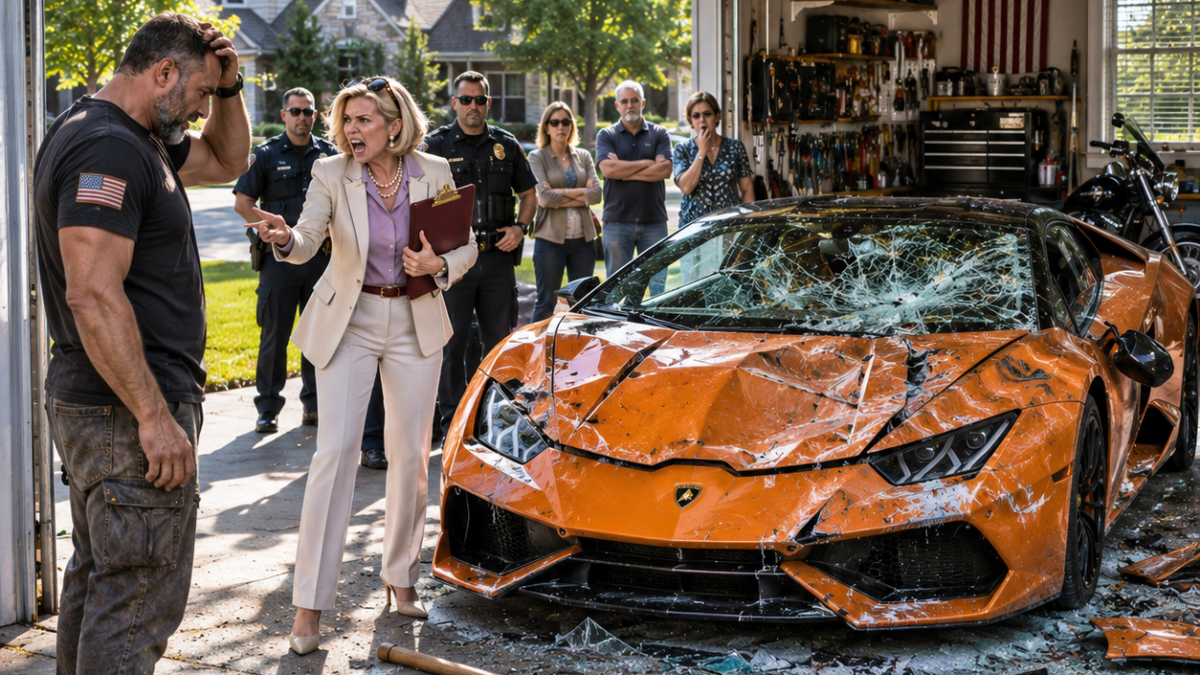
For several seconds, my brain refused to process what I was seeing.
The windshield was shattered into a white spiderweb.
The hood looked as if somebody had dropped concrete blocks on it.
Both side mirrors hung from their wiring.
The front bumper had been ripped partly free.
The passenger door was bent.
Two tires were flat.
The Lamborghini emblem was gone.
Not stolen carefully.
Ripped away.
I stepped forward.
Glass crunched beneath my shoe.
The garage smelled of coolant, oil, fractured plastic, and something electrical.
I remember looking around.
Tool chest untouched.
Television untouched.
My old photographs untouched.
A set of expensive cordless tools sat exactly where I’d left them.
Nobody had broken in for money.
Nobody had come to steal the car.
They had come to punish it.
Or punish me through it.
I moved closer.
My hands were shaking.
That bothered me.
I’d been through situations where shaking hands got people hurt.
I closed my fists.
Opened them again.
Slow breath.
Look.
Document.
Think.
Don’t touch anything unnecessarily.
Then I saw a small piece of glass near the rear wheel.
Something pink clung to one edge.
Nail polish.
Maybe meaningless.
Maybe not.
Karen wore bright pink polish constantly.
I stepped back.
Pulled out my phone.
Started photographing.
Wide shots.
Door.
Windows.
Vehicle.
Floor.
Every damaged panel.
Anything that might matter later.
Then I opened the camera app.
The driveway camera showed Saturday night.
Nothing at eleven.
Nothing at midnight.
1:00 a.m.
Empty.
2:06.
Movement.
2:07.
A figure entered the frame.
Karen.
No ambiguity.
No hood.
No mask.
No effort to hide.
Pink cardigan.
Hair pulled back.
Sledgehammer over one shoulder.
For a second, I just stared.
She walked to the garage.
Paused.
Looked toward the street.
Then worked at the door until she gained entry.
The interior camera picked her up seconds later.
She stood beside the Lamborghini.
Looked at it.
And swung.
The first strike hit the windshield.
The second hit the hood.
Then another.
Then another.
Twenty minutes.
She didn’t lose control in some sudden burst and stop.
She moved around the car.
Front.
Side.
Mirrors.
Tires.
Door.
Bumper.
At one point she stood back breathing hard.
I thought she was finished.
Then she walked forward and struck it again.
When she finally left, she turned at the garage entrance.
Looked at the car.
Smiled.
That smile hurt more than the damage.
Because it proved she hadn’t simply snapped.
She had enjoyed making sure I would find it.
I downloaded the footage immediately.
Phone.
Laptop.
Cloud account.
External drive.
Then I called 911.
The dispatcher asked whether the suspect was still present.
“No.”
“Are you injured?”
“No.”
“Was anything stolen?”
“Possibly an emblem. Mostly property damage.”
“What kind of property?”
“A vehicle.”
“Make and model?”
“Lamborghini Huracán.”
A pause.
“I’m sorry, sir. Did you say Lamborghini?”
“Yes.”
Another small pause.
Then professionalism returned.
“Officers are being dispatched. Please don’t confront anyone.”
“I won’t.”
That was an easy promise.
I didn’t want to see Karen.
Not then.
A patrol car arrived roughly twenty minutes later.
Officer Daniel Willow introduced himself.
Tall.
Early thirties.
Calm.
He walked into the garage, stopped, and let out one low breath.
“That’s bad.”
“Yes.”
“Anything else damaged?”
“No.”
“Tools missing?”
“No.”
“House entered?”
“Not that I can tell.”
He crouched near one of the slashed tires.
“This wasn’t theft.”
“No.”
“This is personal.”
“Yes.”
“You know who?”
I handed him the phone.
“Watch.”
He did.
His expression changed during the first strike.
By the fifth, his jaw tightened.
When the recording ended, he looked at me.
“That’s her?”
“Karen Whitmore. Lives across the street. HOA secretary.”
“You have an ongoing dispute?”
I almost laughed.
“You have time?”
He didn’t smile.
“Give me the short version first.”
I did.
The citations.
The filming.
The HOA suspension.
Her comments about the car.
The note I’d once found saying enjoy it while it lasts.
“You kept that note?”
“In a folder.”
“Good.”
I retrieved it.
Willow photographed everything.
Then he asked something I already knew was coming.
“You want to press charges?”
“Yes.”
“No hesitation?”
I looked at the ruined hood.
“No.”
He nodded.
“Okay.”
Then he looked toward Karen’s house.
“Has she contacted you?”
“Not since before I left.”
“Don’t contact her.”
I almost agreed immediately.
Then an idea occurred to him.
He looked at my phone.
“Did she know about the garage camera?”
“I don’t know.”
“The driveway cameras, yes?”
“Probably.”
He thought for a moment.
“I’d rather officers speak to her directly.”
“Good.”
“Don’t give her a chance to delete anything or start rehearsing.”
“Fine with me.”
That was more realistic than the fantasy of tricking her into confessing over the phone.
Honestly, I didn’t need a confession.
The footage was better.
Willow radioed for another unit.
Two officers walked across the street.
I stayed near my garage.
Karen opened her door.
At first she seemed confused.
Then offended.
I couldn’t hear everything, but her voice carried.
“I have no idea what you’re talking about.”
Willow showed her something on his phone.
Probably a still frame.
Her expression changed.
She looked across the street.
Straight at me.
Then she started shouting.
“This is harassment!”
One officer stepped between her and the sidewalk.
Karen gestured wildly.
“That car has been a violation from day one!”
Willow said something.
She shouted louder.
“He thinks he’s better than everyone because he has money and medals!”
That was enough for half the neighborhood to start looking through curtains.
Willow remained calm.
Karen did not.
At one point she turned toward her porch.
That’s when another officer noticed the sledgehammer leaning beside the railing.
He pointed.
Karen stopped moving.
Even from across the street, I could see the moment she understood how bad that looked.
They photographed it.
Then Willow spoke to her again.
This time her shoulders dropped.
She said something.
He answered.
A few minutes later, she was in handcuffs.
Karen saw me watching.
“You ruined my life!”
I didn’t respond.
She struggled against the officer’s grip.
“That thing cost more than people’s houses! He flaunts it every day!”
Willow guided her toward the cruiser.
She twisted around.
“He doesn’t deserve it!”
The door closed.
The car drove away.
I expected relief.
Instead I looked back into my garage and felt sick.
Not because of the money.
Insurance existed.
Cars could be repaired.
What bothered me was the violation.
Somebody had entered the space attached to my home while I was gone.
Stood where I stood every morning.
Touched things I cared about.
Destroyed something deliberately because she hated what it represented.
I’d spent years learning how to sleep in places where sleep wasn’t guaranteed.
The whole point of Maple Ridge was that I wasn’t supposed to live like that anymore.
That night, I didn’t sleep.
I sat at my kitchen table while Duke lay under my chair.
Every sound seemed louder.
An air conditioner cycling.
A passing car.
Someone’s garage door closing three houses away.
Around two, I walked through the house and checked every window.
Then I got angry at myself for checking every window.
War had taught me hyperawareness because there were places where hyperawareness kept you alive.
Home was supposed to be the place where you were allowed to turn it off.
Karen had switched it back on.
The insurance adjuster arrived Monday morning.
His name was Eric.
He looked young enough to still get excited when somebody told him what kind of car he was inspecting.
That excitement vanished when he saw it.
“Oh.”
“Pretty much.”
He walked around it slowly.
“You have police documentation?”
I gave him the report number.
“Video?”
“Police have copies. I have originals.”
“Good.”
He photographed every panel.
“Initial estimate will be ugly.”
“I figured.”
“You carrying agreed-value coverage?”
“Yes.”
“That helps.”
“How long?”
“Depends on parts availability and what we discover underneath. We need a specialist facility.”
“Repairable?”
He hesitated.
“Probably. But don’t make me promise anything until it’s stripped and measured.”
That was fair.
The first preliminary estimate exceeded eighty thousand dollars.
It climbed later.
New windshield.
Body panels.
Door components.
Mirrors.
Tires.
Sensors.
Paint.
Calibration.
Labor.
Transportation.
The car I’d bought as proof that I had finally reached peace was now leaving my house on a covered transporter because somebody couldn’t tolerate seeing it.
Tom came by after the Lamborghini left.
He looked toward the empty garage.
“I don’t know what to say.”
“Try ‘we should have removed Karen six months ago.’”
His face tightened.
“That’s fair.”
He sat on the porch.
Duke put his head on Tom’s knee.
Tom scratched behind his ears.
“We’re holding an emergency membership meeting tonight.”
“For what?”
“Removing her.”
“You couldn’t do that before?”
“We could suspend certain board functions. Full removal requires procedure.”
“Procedure.”
“I know how that sounds.”
“No, Tom. Procedure is good. Pretending procedure means doing nothing is bad.”
He nodded.
“I know.”
I looked at him.
“Do you?”
That was harsher than I meant.
Tom absorbed it anyway.
“We let her exhaust us.”
I said nothing.
“She issued stupid letters. We canceled them. She issued more. We told ourselves it wasn’t worth a larger fight. She bothered Bob, Sarah, the Burgers, the Johnsons, you.”
“And every time you backed away.”
“Yes.”
“Until she walked into my garage with a hammer.”
Tom looked down.
“Yes.”
It wasn’t satisfying hearing him admit it.
Mostly it made me sad.
A group of decent adults had allowed one person to dominate them because she was willing to create more misery than anyone else was willing to endure.
That night, Maple Ridge removed Karen Whitmore from the board.
Unanimously.
Even before her criminal case moved forward, the members had enough.
Tom delivered the official notice to me the next morning.
“She’s out.”
“Good.”
“You don’t sound happy.”
“I’d be happier if she had been removed before my car needed six figures of work.”
He winced.
“Fair.”
Then he handed me another page.
Formal HOA apology.
Signed by the remaining directors.
It acknowledged that several violation notices against me had been issued without proper authorization.
It also stated that the association did not consider ordinary personal automobile ownership or private vehicle maintenance to constitute a commercial activity.
I read it.
“Frameable?”
Tom asked.
“Maybe in the garage.”
For about forty-eight hours, things almost felt under control.
Then Sarah called.
“John?”
“Hey.”
“Karen got released pending trial.”
My body tightened before my mind caught up.
“When?”
“Yesterday.”
“I thought the damage was felony-level.”
“It is.”
“Then why is she home?”
“Bail isn’t a determination of guilt.”
I knew that.
Didn’t mean I liked it.
Sarah lowered her voice.
“She is calling people.”
“About me?”
“About everyone.”
“What is she saying?”
“That the board conspired with you.”
“Of course.”
“She says the camera footage was manipulated.”
“Police have the originals.”
“I know.”
“She says anything else?”
Sarah hesitated.
“She keeps bringing up your military service.”
My jaw tightened.
“How?”
“She says you’re unstable. Dangerous. That people are afraid to challenge you.”
“Who is afraid of me?”
“John, I’m telling you what she’s saying, not agreeing.”
“I know.”
“She even sent an email to the association’s insurance representative implying your combat background creates a safety concern.”
I closed my eyes.
That one landed differently.
Karen wasn’t merely insulting me.
She was taking the part of my life I had worked hardest to put into perspective and trying to turn it into a weapon against me.
“I’ve never threatened her.”
“I know.”
“I’ve never threatened anybody here.”
“I know that too.”
“You have the board emails?”
“Yes.”
“Save them.”
“I already did.”
“Thank you.”
After we hung up, I sat in the garage.
Empty spot where the Lamborghini had been.
Duke beside me.
My old deployment trunk sat against the wall.
I hadn’t opened it in months.
Inside were photographs.
Medals.
Letters.
A notebook from my last deployment.
I pulled it out.
On the inside cover I’d written something my old commanding officer used to say:
Preparation gives anger somewhere useful to go.
I read it twice.
Then put the notebook away.
I upgraded the camera storage.
Changed the garage access code.
Changed every exterior lock.
Added a sensor to the side gate.
I also contacted Officer Willow.
“She’s home.”
“I know.”
“She is spreading claims that I’m dangerous.”
“Don’t engage.”
“Wasn’t planning to.”
“Good.”
“Anything I should do?”
“Save threats. Save contact attempts. If she enters your property, call immediately.”
“I will.”
“And John?”
“Yeah?”
“You have strong evidence on the car case. Don’t weaken it by getting dragged into neighborhood arguments.”
That made two professionals telling me the same thing.
I listened.
For almost a week.
Then Karen came to my driveway.
I was repairing a garden light near the garage.
Her voice hit me from behind.
“John Davis.”
I stood.
She stopped at the sidewalk.
At least she had learned one boundary.
“You destroyed me.”
I looked around.
“Pretty sure your hammer handled most of that.”
“You set me up.”
“I was two hours away.”
“You put cameras everywhere because you wanted something to happen.”
“No. I put cameras everywhere because you kept coming onto my property.”
She laughed bitterly.
“You enjoy this.”
“Enjoy what?”
“Everyone looking at me.”
“I would have preferred nobody ever knew your name.”
“You got me removed from the board.”
“You got arrested for destroying my car.”
“You’ve been undermining me for months.”
“Karen.”
I kept my voice low.
“You went into my garage at two in the morning with a sledgehammer.”
Her face trembled.
For a second, I thought she might cry.
Instead she pointed at me.
“You think because you wore a uniform you’re better than everybody.”
“No.”
“You think that car proves something.”
“To me, it did.”
“Oh, please.”
She laughed.
“A three-hundred-thousand-dollar toy parked where everyone has to look at it.”
“My garage?”
“You displayed it constantly.”
“I drove it.”
“Same thing.”
“No. It isn’t.”
Her anger sharpened.
“You don’t deserve the way people treat you.”
I frowned.
“What does that mean?”
“Everyone gives you respect because you’re a veteran. Everybody listens to you. Everybody thinks you’re some hero.”
“Nobody in this neighborhood knew anything about my deployments until you started bringing them up.”
She looked away.
There it was.
Something deeper than bylaws.
Not simply jealousy of the car.
Jealousy of status.
Attention.
Respect she believed belonged to her.
I stepped back toward my garage.
“Go home, Karen.”
“You don’t order me around.”
“I’m not. I’m ending the conversation.”
“You’ll regret humiliating me.”
“Is that a threat?”
She noticed the camera mounted above the garage.
Her eyes shifted.
She smiled thinly.
“Of course not.”
Then she walked away.
I saved the footage.
Two hours later, I noticed something on the driveway.
A metal key.
Small white sticker.
GARAGE.
I didn’t touch it immediately.
I photographed it.
Then used gloves to pick it up.
My stomach tightened.
Years earlier, when the HOA had standardized emergency contact information, homeowners had been encouraged—not legally required, encouraged—to provide gate codes or emergency access details for certain maintenance situations.
I had once given the association a spare exterior garage key because my water shutoff was accessible through that area and I traveled regularly.
I’d forgotten about it.
Karen had processed those forms.
Had she copied it?
Used it during the Lamborghini attack?
Officer Willow came over.
He examined the key.
“You recognize it?”
“Same blank as mine.”
“Does it work?”
“I haven’t tried.”
“Let’s document before we do.”
We did.
It opened the exterior garage access door.
Not the main vehicle door.
But enough.
Willow’s expression hardened.
“This helps explain entry.”
“Could she legally still have this?”
“No reason I can think of.”
“I changed the locks already.”
“Good.”
He bagged the key.
“I’ll add it to the case.”
That night, Duke barked around one in the morning.
Not normal barking.
Low.
Urgent.
The kind that makes every muscle in your body pay attention.
My phone vibrated.
SIDE DRIVE MOTION.
I opened the camera.
Karen stood near the driveway.
I stared.
She was holding something long.
For one sick second, I thought it was another hammer.
Then she stepped into the security light.
Sledgehammer.
Same kind.
Maybe the same one.
My first instinct was to go outside.
Old instinct.
Wrong instinct.
I called 911.
“This is John Davis. The woman charged in the vandalism case is outside my house with what appears to be a sledgehammer.”
“Are you inside?”
“Yes.”
“Stay inside. Lock the doors.”
“Already done.”
“Do not confront her.”
“I won’t.”
Duke barked again.
Karen moved toward the house.
She shouted something.
The microphone picked it up.
“You ruined my life!”
I stayed away from the windows.
The dispatcher remained on the line.
“Units are close.”
Then Karen struck the front door.
The sound boomed through the house.
Duke lunged toward the hallway.
I grabbed his collar.
“Stay.”
Another strike.
Wood cracked.
My pulse slowed.
Not because I was calm emotionally.
Because training does strange things.
It narrows the world.
Door.
Dog.
Phone.
Distance.
Escape route.
Police coming.
Do not go outside.
Do not turn this into something worse.
Karen screamed again.
“I’ll finish what I started!”
A third impact hit near the lock.
I backed toward the kitchen.
I had another exit if the front door failed.
That mattered more than ego.
For years afterward, some neighbors told the story as if I threw open the door and “used combat training” to take her down.
That isn’t what happened.
I did not want a fight.
I wanted police.
The door held.
Barely.
Then sirens approached.
Karen heard them.
She stepped back.
The driveway camera caught her turning.
For a second, I thought she might run.
She didn’t.
She raised the hammer again.
Officer Willow’s cruiser entered the street.
He got out behind his door and shouted commands.
Karen froze.
Another officer arrived from the opposite direction.
“Put it down!”
She screamed something I couldn’t understand.
The hammer remained raised.
I watched from inside through the camera feed, barely breathing.
“Karen!” Willow shouted. “Drop it!”
She looked toward my house.
Then toward the officers.
Her shoulders sagged.
The sledgehammer hit the pavement.
They arrested her without me ever stepping through the door.
Only after Willow knocked and identified himself did I come outside.
He looked at the damaged door.
Then at me.
“You okay?”
“Yes.”
“Dog?”
“Fine.”
“You did exactly what you were supposed to do.”
“Didn’t feel heroic.”
“Good. Heroic gets people hurt.”
I appreciated that.
Karen sat in the back of a cruiser.
When she saw me, she slammed one hand against the window.
I couldn’t hear her.
Didn’t need to.
Willow showed me where the hammer had damaged the door.
“This is serious.”
“She said she’d finish what she started.”
“Dispatcher has the recording?”
“Yes.”
“So do your cameras.”
“Yes.”
“Good.”
He paused.
“She’s in much worse shape legally now.”
I nodded.
Then went back inside.
I replaced the door the next day.
Stronger frame.
Better lock.
I hated doing it.
Not the carpentry.
I liked carpentry.
I hated the reason.
Karen had now managed to damage my Lamborghini and my front door.
More importantly, she had made me think about angles of approach inside my own house.
That was unforgivable in a way insurance could never calculate.
This time bail became much more difficult.
There were new allegations involving the weapon, threats, attempted forced entry, and violation of release conditions.
Her attorney pushed back hard.
There was also a mental-health evaluation ordered during the process.
I was fine with that.
Justice didn’t require pretending Karen was a monster with no internal life.
People can be unstable, desperate, jealous, angry, and still responsible for dangerous choices.
Weeks passed.
The Lamborghini remained at the specialty shop.
I visited once.
I almost regretted it.
Seeing the car stripped apart was worse than seeing it damaged.
Doors removed.
Glass gone.
Panels off.
Wiring exposed.
Eric, the insurance adjuster, walked beside me.
“They’re doing it correctly.”
“I know.”
“Frame measurements are good.”
“Good.”
“No structural issue serious enough to total it.”
I exhaled.
“That’s good.”
“They’re replacing more than we initially estimated.”
“How much?”
He named a number.
I stopped walking.
“That much?”
“Exotic car.”
“Still just bolts and paint.”
“Very expensive bolts and paint.”
I laughed for the first time in days.
The technician working on it was named Marco.
He had probably forgotten more about Italian cars than I would ever learn.
He ran one hand over the damaged hood.
“We make it right.”
“Better than right?”
He shrugged.
“Factory right.”
That phrase helped.
Factory right.
Not erased.
Restored.
The neighborhood changed while Karen remained in custody.
People started talking.
Not gossiping.
Talking.
The Burgers told Tom Karen had called police on their children four times.
The Johnsons produced emails where she threatened solar-panel fines before the board had even reviewed their application.
Bob Carter, the Vietnam vet on the maintenance committee, admitted Karen once tried to remove him because he refused to repaint utility boxes that weren’t even HOA property.
Sarah brought the board screenshots of Karen contacting local realtors about me.
“She was telling them John’s property might become a litigation risk,” Sarah said during a meeting.
I sat in the back.
Karen’s seat at the board table was empty.
Tom looked sick.
“Why didn’t we know?”
Sarah stared at him.
“We did.”
That silenced the room.
“We knew pieces,” she continued. “We kept calling each one a misunderstanding.”
Bob nodded.
“Same way you ignore rattling in an engine until something breaks.”
Tom looked at me.
I didn’t rescue him.
He needed to sit with that.
The board rewrote its enforcement process.
No single officer could issue substantial fines.
Complaints required documentation.
Board members couldn’t enter private property under the vague excuse of “inspection.”
Emergency access keys were returned or destroyed unless homeowners opted into a specific documented program.
Every owner received a written inventory of what information the HOA held.
I got mine.
My old garage key had been logged as returned.
Two years earlier.
It hadn’t been.
That became evidence too.
The association’s insurer got involved once Karen’s actions were tied to her HOA role.
So did attorneys.
My lawyer advised me to separate the issues.
“Criminal case is the state versus Karen.”
“Okay.”
“Insurance handles vehicle restoration.”
“Okay.”
“Civil claims address property damage, security expenses, and potentially defamation.”
“Okay.”
“HOA governance is another lane.”
“That is a lot of lanes.”
He smiled.
“Welcome to litigation.”
I didn’t enjoy any of it.
I did what I’d done in the Army when a mission became too complicated to carry in your head.
I made folders.
Dates.
Names.
Evidence.
Tasks.
Things I could control.
Things I couldn’t.
Most importantly, I stopped driving past Karen’s empty house.
For a while, I found myself doing it unconsciously.
Looking.
Checking.
Waiting for movement.
Then one day I realized I was giving an empty building power over me.
I stopped.
Six weeks after the vandalism, Marco called.
“Your car is ready.”
I drove to the repair facility with Duke in the Accord.
Duke stayed outside with Eric while Marco walked me into the shop.
The Lamborghini sat beneath white lights.
Midnight blue.
Perfect.
For several seconds, I didn’t move.
New windshield.
New hood.
Repaired door structure.
Mirrors.
Bumper.
Wheels.
Paint blended so cleanly I couldn’t find the transition.
Marco handed me the keys.
“Check everything.”
I did.
Not because I distrusted him.
Because that’s who I am.
Panel gaps.
Glass.
Mirrors.
Paint.
Interior.
Engine start.
The V10 came alive behind me.
That sound hit harder than I expected.
I sat in the driver’s seat.
Hands on the steering wheel.
Engine idling.
For one moment, the garage disappeared and I was back in my own destroyed garage staring at broken glass.
Then Duke barked outside.
I laughed.
Marco smiled.
“You good?”
“Yeah.”
“You don’t look good.”
“I will be.”
He nodded as if that made perfect sense.
I drove home slowly.
Not because the car needed it.
Because I did.
When I turned onto Maple Ridge, people noticed.
Kids ran toward the curb.
Bob stood in his driveway and gave me a salute.
I rolled my eyes at him.
Tom clapped.
Sarah lifted both hands.
I pulled into my garage.
Stopped.
Turned the engine off.
Nobody cheered after that.
I’m glad.
It wasn’t a parade.
It was just my car coming home.
Duke walked around it twice.
Sniffed one tire.
Then sat.
“Approved?”
He wagged his tail.
Karen’s criminal proceedings began several weeks later.
I testified.
That was harder than I expected.
Not because I was afraid of Karen.
Because court turns personal damage into sterile language.
Exhibit twelve.
Video file.
Repair invoice.
Photograph.
Threat statement.
Garage key.
Door damage.
The prosecutor played the footage of the Lamborghini attack.
I had watched it dozens of times.
Seeing it on a courtroom monitor was different.
Karen sat at the defense table.
She didn’t look at the screen.
At one point the video showed her swinging the hammer into the windshield.
A juror flinched.
Karen stared down.
Then came the footage from my front porch.
The hammer hitting the door.
Her voice:
I’ll finish what I started.
Her attorney argued that Karen had undergone an acute emotional collapse fueled by obsession, resentment, alcohol, and the loss of her HOA position.
He presented treatment records.
He asked the court to consider rehabilitation.
I didn’t object to that.
Wanting accountability isn’t the same as wanting someone destroyed.
The prosecution focused on repetition.
Planning.
Escalation.
The first attack occurred while I was away.
The second happened after charges had already been filed.
The threats continued after release.
The spare key suggested she had kept access she was not supposed to possess.
The court ultimately convicted her on multiple charges arising from the vandalism and later armed confrontation.
The precise counts were more complicated than neighborhood gossip ever admitted.
Property destruction.
Unlawful entry.
Threat-related charges.
Violation of release conditions.
The second incident significantly worsened the outcome.
At sentencing, the judge spoke directly to Karen.
“You had numerous opportunities to stop.”
She cried quietly.
“You had opportunities after the HOA dispute. After warnings from fellow board members. After the first police investigation. After your initial arrest. Instead, each consequence became, in your mind, justification for escalation.”
I watched her.
The judge continued.
“Mr. Davis’s military service is not the issue before this court. His car is not the issue except as property you intentionally damaged. His income is not the issue. Your resentment toward him did not create permission.”
Karen wiped her face.
The sentence included several years in state custody, restitution, treatment requirements, and post-release restrictions.
The total custodial sentence was five years.
People later told me I must have felt incredible.
I didn’t.
I felt finished.
There is a difference.
Outside the courthouse, Tom and Sarah waited.
Duke wasn’t there, obviously, though I would’ve preferred his company to most humans by that stage.
Tom approached carefully.
“You okay?”
“Yeah.”
Sarah hugged me.
I usually hate surprise hugs.
I let her.
Tom looked back at the courthouse.
“Five years.”
“Yep.”
“Does that feel like enough?”
I thought about the car.
The door.
The cameras.
The nights checking windows.
The things Karen had said about my service.
“I don’t know what enough means.”
Tom nodded.
“Fair.”
He handed me an envelope.
“What?”
“HOA letter.”
“Another violation?”
He laughed.
“Not unless having a sense of humor violates community standards.”
I opened it.
The board had voted to adopt new governance rules.
No unilateral citations.
Independent review for complaints involving board members.
Explicit restrictions on retention of homeowner keys.
Written appeal procedures.
Recorded votes for enforcement changes.
And one paragraph addressed veterans and medical information.
Board members were prohibited from speculating about or invoking a homeowner’s health or service history as an enforcement justification without legitimate, legally relevant documentation.
I read that paragraph twice.
“Sarah wrote it?”
Tom smiled.
“Mostly.”
I folded the letter.
“Good.”
Tom put his hands in his pockets.
“We should have protected you earlier.”
I looked at him.
“I don’t need protecting because I’m a veteran.”
“I know.”
“You needed to protect the rules.”
He nodded slowly.
“That’s what I meant.”
“Then yes.”
I looked toward the courthouse.
“You should have.”
Months passed.
Karen’s house went on the market.
At first, nobody wanted to talk about it.
Then a FOR SALE sign appeared.
The lawn she once measured obsessively began growing unevenly.
A weed pushed through the flower bed.
Bob sent me a photograph.
I called him.
“You’re a terrible person.”
“Four and three-quarter inches,” he said.
“What?”
“Grass height.”
“You measured it?”
“Felt appropriate.”
I laughed so hard Duke started barking.
Eventually a young family bought the house.
They had two little girls.
Within a week, the porch was covered in chalk drawings.
Karen would have hated it.
That made me like them immediately.
The new owner, Daniel, introduced himself while I was washing the Lamborghini.
He pointed.
“Is that…”
“Yes.”
“The car?”
“Yes.”
He looked uncomfortable.
“We heard some stuff.”
“I bet.”
“Don’t worry. We’re not HOA people.”
I raised an eyebrow.
“You bought a house in an HOA.”
“You know what I mean.”
I did.
His oldest daughter stood behind him.
Maybe nine.
“Can I see it?”
Daniel looked horrified.
“Emma.”
“What?”
“Don’t bother him.”
“She isn’t bothering me.”
I opened the passenger door.
Emma stared inside.
“Whoa.”
“Don’t touch anything,” Daniel said.
“She’s fine.”
Emma looked at me.
“How fast does it go?”
“Faster than I need.”
“Did a bad lady really smash it?”
Daniel closed his eyes.
“Emma.”
I laughed.
“Yes.”
“Why?”
There are questions adults complicate that children don’t.
“She was angry at me.”
“So she broke your car?”
“Yes.”
“That’s stupid.”
“Very.”
Emma nodded as if the case was resolved.
Then she pointed at Duke.
“Can I pet him?”
“Ask him.”
“How?”
I showed her how to let Duke approach.
He sniffed her hand.
Then accepted the attention like royalty.
Watching that little girl beside the Lamborghini, I realized something.
For months, Karen had turned everything into a symbol.
The car symbolized wealth.
My military service symbolized unfair respect.
My cameras symbolized hostility.
My garage symbolized rebellion.
My dog symbolized danger.
She couldn’t see anything without attaching resentment to it.
Emma saw a cool car and a dog.
That was healthier.
Life at Maple Ridge became boring again.
I loved boring.
Trash cans came out Thursday.
Kids rode bicycles.
Bob fished.
Sarah sold houses.
Tom finished his term and refused to run again.
When I asked why, he said, “I’ve aged nine years.”
“It’s been eighteen months.”
“Exactly.”
The new board president was a woman named Melissa Reed.
She had twins, a full-time job, and absolutely no interest in becoming important.
At her first meeting, she said:
“If you catch me measuring anybody’s grass personally, remove me immediately.”
People laughed.
That was the first HOA meeting I’d attended where nobody raised their voice.
Afterward, Melissa stopped me.
“John?”
“Yeah?”
“I wanted to ask something about the Lamborghini.”
I sighed.
“Here we go.”
She laughed.
“No. My son wants to know whether you’d bring it to the neighborhood picnic.”
I stared.
“Seriously?”
“He’s ten.”
“That’s your defense?”
“Yes.”
I brought it.
Kids took photographs.
Parents asked questions.
Nobody complained about property values.
I even let Tom sit in it.
He climbed out and said, “My knees are too old for wealth.”
Bob said, “Your knees were too old before the car.”
For the first time, the Lamborghini felt like mine again instead of evidence.
That’s difficult to explain.
Objects absorb memories.
A song can become a funeral.
A chair can become somebody who used to sit there.
A car can become the sound of a hammer against glass.
For months, every time I approached the Huracán, part of me saw the damaged windshield.
Eventually that stopped.
One afternoon, I noticed I’d parked it and walked inside without checking the cameras first.
That was progress.
Officer Willow stopped by maybe six months after sentencing.
I was washing the car.
He leaned against his cruiser.
“Looks good.”
“Better than your cruiser.”
“Everything looks better than my cruiser.”
I laughed.
He watched me rinse soap off the hood.
“You doing okay?”
“Yeah.”
“Actually?”
I looked at him.
“Actually.”
“Good.”
He hesitated.
“There was one thing I never told you.”
“That sounds ominous.”
“Not really.”
He folded his arms.
“During the investigation, several people mentioned Karen had talked for years about wanting an exotic car.”
“Okay.”
“She’d worked at a luxury dealership briefly when she was younger.”
“That I didn’t know.”
“Nothing criminal came from that period that mattered to your case. Mostly employment disputes. But apparently cars like yours were a fixation.”
I looked at the Lamborghini.
“So it was jealousy.”
“Partly, probably.”
“Not exactly a revelation.”
“No.”
He smiled.
“People keep trying to find complicated motives for simple emotions.”
He pushed away from the cruiser.
“Anyway. Stay out of trouble.”
“I have an HOA. No promises.”
He laughed and left.
That evening, I sat on my porch with Duke.
The Lamborghini was visible through the open garage.
For a while, sunlight rested across the hood.
Exactly the kind of thing Karen used to complain about.
Displaying it.
Flaunting it.
I thought about closing the door.
Then didn’t.
Not as defiance.
Because it was my garage.
Sometimes the smallest sign you’ve recovered is doing something without thinking about the person who once made it complicated.
I opened a beer.
Duke rested his head against my boot.
Across the street, Emma and her younger sister drew chalk flowers on the sidewalk.
Daniel called for them to stay out of the road.
A sprinkler clicked.
Someone’s lawn mower started.
Normal.
I had spent twenty years in the military.
People heard that and imagined bravery.
Gunfire.
Deployments.
Medals.
The truth is, courage is often boring too.
Following procedure when anger feels better.
Waiting for backup.
Documenting instead of retaliating.
Standing inside your own house while someone attacks the front door because going outside would turn danger into disaster.
Going to court.
Answering questions.
Letting strangers decide consequences.
Those things didn’t feel powerful.
They felt frustrating.
But they kept me from becoming part of Karen’s destruction.
She destroyed the Lamborghini.
Insurance rebuilt it.
She damaged my front door.
I replaced it.
She attacked my reputation.
Her own recordings and actions answered that.
She tried to make my military history into proof that I was dangerous.
In the end, the most important thing I did was refuse to prove her right.
One Saturday morning, I decided to drive nowhere.
That sounds ridiculous when you own a Lamborghini.
But sometimes driving nowhere is the whole point.
I took the back roads beyond Maple Ridge.
No destination.
Duke couldn’t come because he’d never forgive me for making him squeeze into a Huracán.
The road curved through farmland, then pine forest.
I kept the speed reasonable.
Mostly.
At a red light, a minivan stopped beside me.
A boy in the back seat pressed his face against the glass.
His window lowered.
“Hey!”
I lowered mine.
“Nice car!”
“Thanks.”
“Is it really a Lamborghini?”
“No. It’s a very convincing Honda.”
He stared.
Then realized I was joking.
His mother laughed.
The boy pointed.
“Go fast!”
His mother shouted, “No!”
I laughed.
The light changed.
I pulled away normally.
For once, I didn’t need to prove anything.
About the car.
About myself.
About surviving.
I drove until the sun started dropping.
Then turned home.
When I reached Maple Ridge, Emma was riding her bicycle near the entrance.
She waved.
Tom was walking his dog.
He waved too.
Bob sat in a lawn chair in his driveway with a fishing rod he was repairing even though there wasn’t water within half a mile.
He lifted one hand.
I pulled into my garage.
The engine settled into a soft ticking sound as it cooled.
For a few moments, I remained behind the wheel.
That sound had been there the night I discovered the damage too.
Tick.
Tick.
Tick.
Back then, I’d stood in broken glass listening to it while anger built inside me.
Now the windshield was clear.
The hood smooth.
The mirrors perfect.
No shattered glass.
No hammer marks.
No fear.
I turned off the remaining electronics.
Duke barked from inside the house because apparently I’d been gone for three years instead of three hours.
I opened the door.
Before stepping out, I rested one hand on the steering wheel.
Not because the Lamborghini was the most important thing I owned.
It wasn’t.
If anything, Karen had cured me of believing expensive things were permanent.
Metal bends.
Glass breaks.
Paint scratches.
Money disappears quickly when lawyers get involved.
What mattered was that she had tried to turn my success into something shameful.
She had looked at the life I’d built after twenty years of service and decided that because she resented it, I shouldn’t be allowed to enjoy it.
For months, I thought the satisfying ending would be seeing her punished.
It wasn’t.
The satisfying ending was that eventually I stopped needing to think about her at all.
I stepped out of the car.
Duke met me at the kitchen door, tail swinging.
I walked back to the garage and pressed the wall button.
The door began descending.
Halfway down, I stopped it.
For years after retiring, I’d loved leaving the garage open in the evening while I worked.
Karen had taken that habit from me.
First with complaints.
Then cameras.
Then violence.
I looked out at the street.
Emma’s chalk drawings.
Bob’s chair.
Tom’s dog.
The new neighbors’ porch plants.
Nothing threatening.
Nothing waiting.
I pressed the button again.
But instead of closing it, I raised the garage door all the way.
Then I pulled a stool beside the Lamborghini and sat down with a cold drink.
Duke settled near my feet.
The sunset reflected across the midnight-blue hood.
Nobody measured how long the door remained open.
Nobody photographed me.
Nobody delivered a violation.
Nobody told me I didn’t belong.
The car was back.
The neighborhood was quiet.
And, finally, so was I.
[END OF STORY]








