PART 2: HOA Karen Demanded I Tear Down My Late Wife’s Fence for Her Mountain View—So I Built a 60-Foot Bulletproof Glass Wall and Charged Her Rent
PART 2
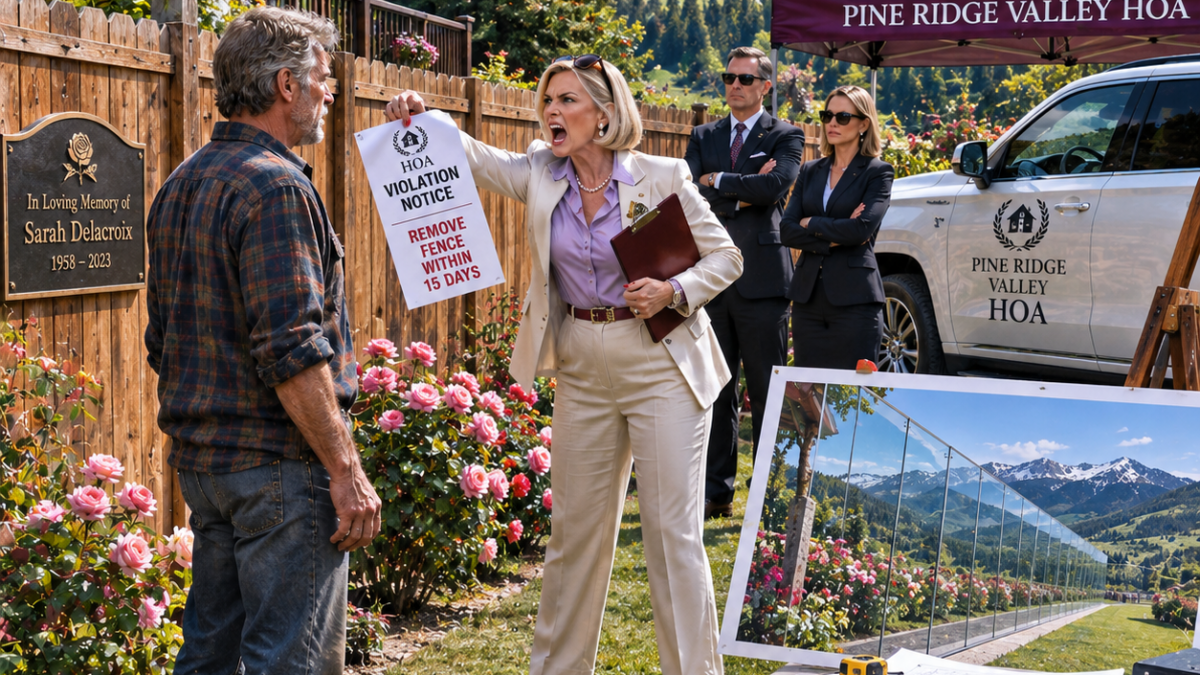
Bethany returned one week later.
No cookies.
This time she carried a folder.
Glossy photographs.
Printed diagrams.
A letter from the HOA.
“Several residents have expressed concerns.”
“Which residents?”
“That’s confidential.”
“Of course it is.”
She opened the folder.
Photographs of my fence from multiple angles.
Some had apparently been taken from Bethany’s upstairs windows.
Others from the road.
Red arrows pointed toward sections labeled:
**VISUAL OBSTRUCTION.**
**VIEW CORRIDOR INTERRUPTION.**
**PROPERTY VALUE IMPACT ZONE.**
I stared at one of the pages.
“You made a PowerPoint about my fence?”
“Professionals document problems.”
“So do engineers.”
She ignored that.
“We believe the fence interferes with Pine Ridge Valley’s community visual standards.”
“Show me the covenant.”
Bethany blinked.
“What?”
“The covenant or rule that limits a lawful fence on my lot because you want to see through it.”
“The HOA has broad aesthetic authority.”
“That wasn’t what I asked.”
Her fingers tightened around the folder.
“You’re being unnecessarily adversarial.”
“I’m asking you to identify the rule you’re enforcing.”
She smiled again.
Cold this time.
“There are easier ways to handle this.”
“I’m listening.”
“I’d be willing to contribute toward removal.”
“No.”
“Replacement?”
“No.”
“Landscaping?”
“No.”
She exhaled through her nose.
“This obsession with a dead woman’s garden isn’t healthy.”
I felt something hard move through my chest.
Not rage.
Not yet.
“Bethany.”
“Yes?”
“Leave.”
Her smile disappeared.
“Excuse me?”
“You’re on my property.”
“I’m the HOA president.”
“That does not make you my parole officer.”
She stepped closer.
“I’m trying to protect your investment.”
“No. You’re trying to improve yours.”
For the first time, her expression broke.
A small thing.
Barely visible.
But forty years in engineering meetings had taught me how much people reveal when something unexpected hits the system.
Bethany had expected grief.
Age.
Loneliness.
Maybe financial vulnerability.
She had not expected resistance.
She left.
That night, I started researching.
Not because I intended revenge.
Because Bethany’s behavior made no mathematical sense.
A wealthy woman does not repeatedly threaten a neighbor over a view unless the view represents money.
I searched property records.
Prior sales.
HOA complaints.
Real estate filings.
Bethany’s professional history.
Then a pattern emerged.
Four properties in three years.
Each owner had experienced escalating disputes with the HOA.
Noise complaints.
Landscape violations.
Parking disputes.
View obstruction issues.
Legal letters.
One elderly couple sold after six months of fines.
Another family moved after a dispute involving a wheelchair ramp.
A divorced man sold following a lien threat.
A widow sold after repeated claims that her trees endangered neighboring property values.
The sales prices caught my attention.
Below market.
Not by a little.
Then I checked who handled the transactions.
Cromwell Luxury Realty.
Bethany.
I sat at my kitchen table with the records spread around Sarah’s old gardening notebook.
“Well,” I said to an empty room.
“That’s interesting.”
Three days later, an emergency HOA meeting was announced.
The subject:
**VISUAL COMPATIBILITY AND PROPERTY VALUE PROTECTION.**
Translation:
My fence.
The meeting took place in Bethany’s living room.
I arrived with coffee.
Bethany sat at the front.
Beside her were Ted Morrison and Janet Hill.
Ted owned a small contracting business.
Nervous man.
Nice enough.
He kept checking his phone.
Janet was recently divorced.
Bethany had represented her during the sale of another property.
Bethany clicked on a projector.
My fence appeared on a sixty-inch screen.
“I appreciate everyone attending.”
There were only four of us.
“Multiple homeowners have raised concerns that Mr. Delacroix’s fence negatively affects scenic continuity.”
I looked around.
“Multiple?”
Ted stared at the floor.
Janet looked miserable.
Bethany advanced the slide.
Charts appeared.
Property values.
View premiums.
Colorado mountain real estate statistics.
“I estimate neighboring property value loss of nearly nine percent.”
“Based on what?”
“Comparable sales.”
“Which ones?”
Bethany paused.
“Professional data.”
“Then show the data.”
“You’re interrupting.”
“You’re claiming my fence costs you hundreds of thousands of dollars.”
“It could.”
“Then the methodology matters.”
She gave me a look normally reserved for insects that survive pesticide.
“Xavier, not everything is an aerospace project.”
“No.”
I took a sip of coffee.
“But numbers still need to be real.”
Then I opened my own notebook.
“Since we’re discussing community compliance, I have a few questions.”
Bethany leaned back.
“Of course you do.”
“Your rear deck.”
Her eyes changed.
“What about it?”
“No permit on file.”
Ted stopped checking his phone.
“The fountain beside your driveway.”
Silence.
“It sits within the recorded septic access area.”
Janet looked at Bethany.
“And the tree removal last year appears to have occurred without the forestry approval required for parcels bordering national forest.”
Bethany stared.
“Have you been investigating me?”
“I researched public records.”
“That is completely inappropriate.”
“Public records are public.”
Ted cleared his throat.
I looked at him.
“Ted, while I was doing that research, something else caught my attention.”
He froze.
“Your business loan.”
Bethany turned sharply.
I continued.
“Thirty thousand dollars. Bethany is co-signer.”
Ted’s face reddened.
“I don’t see how that’s relevant.”
“It becomes relevant when an HOA board member votes on an issue benefiting someone who controls his financing.”
Janet whispered:
“Oh my God.”
I looked at her.
“Your divorce settlement includes a property-sale agreement involving Bethany’s brokerage.”
Janet’s eyes filled.
Bethany stood.
“That is enough.”
“No.”
I closed my notebook.
“I think we’re finally getting somewhere.”
Bethany’s voice went hard.
“You are making accusations.”
“I’m identifying conflicts.”
“You have no idea how this neighborhood works.”
“I’m beginning to.”
I turned toward Ted and Janet.
“Has Bethany ever asked either of you to vote a particular way because of money you owe her or business she controls?”
Neither answered.
They didn’t have to.
Their faces did.
Bethany pointed toward the door.
“Leave.”
I stood.
“My fence remains.”
“We’ll see.”
I paused at the doorway.
“Bethany?”
“What?”
“You should be careful what you ask engineers to remove.”
She stared.
“We tend to replace things with improved versions.”
Three days later, her lawyers contacted me.
Morrison, Bradley & Associates.
Fifteen days to remove the fence.
Claims included unreasonable interference with property enjoyment, diminution of scenic value, and nuisance-like obstruction.
I read the letter twice.
Then called a construction attorney named Janet Morrison.
No relation to Ted.
Janet had done contract work for several aerospace companies and possessed the rare ability to explain property law without making it sound like anesthesia.
I sent her everything.
Fence permits.
Plat.
HOA declaration.
Bethany’s letter.
She called twenty minutes later.
“She’s bluffing.”
“Completely?”
“Not completely. Anyone can sue.”
“Can she win?”
“On this record? Her view isn’t a property right unless there’s an easement, covenant, or local ordinance protecting it.”
“There isn’t.”
“Then your fence is probably fine.”
“Probably?”
“Lawyers don’t say definitely unless they want to become defendants.”
Fair.
Then Janet asked:
“Why does she want your property?”
“I think she wants the view.”
“No.”
“What?”
“She wants more than a view.”
That matched my instincts.
I started digging deeper.
A former colleague from Lockheed, Jim Rodriguez, helped me with business-record analysis.
Not because of government connections.
Because retired engineers are dangerous when given spreadsheets and free time.
We traced Bethany’s investments.
Cromwell Luxury Realty.
Cromwell Development Partners.
Loans.
Failed projects.
Mortgage liens.
One development outside Aspen had collapsed after cost overruns.
Another partnership was in litigation.
Bethany carried nearly eight hundred thousand dollars in personal guarantees and high-interest obligations.
Then Jim found an appraisal.
My property.
Prepared before Bethany ever approached me.
The document assumed consolidation of her parcel with mine.
Combined luxury estate value:
Enormous.
Potential resale after redevelopment:
Enough to erase most of her debt.
I stared.
“She planned this before moving in.”
Jim whistled.
“Looks like it.”
“How does she get my property?”
“Make you hate living there.”
That was the same model I had seen in prior sales.
Bethany didn’t need to seize the land.
She only needed to make me tired enough to sell.
The harassment began almost immediately after that.
Landscapers blew debris toward Sarah’s garden.
Sprinklers mysteriously over-sprayed the fence.
Pressure washing started at seven every morning.
Bethany hosted outdoor exercise sessions beside my property.
Music.
Microphones.
Shouting.
A cement mixer once ran for forty minutes with no visible cement being mixed.
I documented everything.
Cameras.
Audio.
Dates.
Weather.
Witnesses.
One recording caught Bethany speaking to her landscaping foreman.
“Dump it along his side.”
The worker asked:
“The debris?”
“Yes.”
“And run the blower near the kitchen window.”
“What for?”
“So he gets tired of this place.”
There it was.
Intent.
I sent the clip to Janet.
She responded:
**Keep recording. Do not engage.**
Excellent legal advice.
Difficult human advice.
Ted showed up one morning.
No warning.
He stood on my porch looking like he hadn’t slept.
“You were right.”
“About?”
“Bethany.”
I let him in.
He refused coffee.
Bad sign.
“She guaranteed my loan.”
“I know.”
“She threatened to call it.”
“Can she?”
“She owns part of the note through another company.”
That was new.
Ted rubbed his face.
“She said if I didn’t support her fence complaint, my business financing could disappear.”
“And Janet?”
“Bethany controls part of her divorce property sale.”
“How many others?”
Ted laughed bitterly.
“Half the neighborhood.”
The structure was bigger than I thought.
Reverse mortgages.
Private loans.
Consulting contracts.
Real estate listings.
Business debts.
Bethany built leverage.
Then she converted leverage into obedience.
“Why are you telling me?”
Ted looked toward Sarah’s garden.
“My wife asked me what kind of man lets someone threaten old people because he’s afraid of a loan.”
“And?”
“I didn’t like my answer.”
That afternoon, I called Detective Sarah Lane with the county financial-crimes unit.
Not because I had some secret government phone number.
Ted had already spoken to an attorney who recommended reporting suspected financial coercion.
Lane listened.
Asked for documents.
Asked for recordings.
Asked me not to investigate beyond public records.
Finally.
Someone sensible.
I handed over copies.
Then something unexpected happened.
The fence dispute led me to old plats.
Very old plats.
1952.
Utility easements.
Survey notes.
Rights reserved during development.
One recorded easement crossed the boundary between my land and Bethany’s.
Twelve feet wide.
Part of the strip lay beneath the edge of her circular driveway.
The decorative fountain overlapped it.
So did a portion of landscaping.
The easement didn’t magically mean I owned her house.
The original story Bethany was telling herself would have loved that.
Property law is more complicated.
But the documents did give my parcel specific access and protection rights related to utility infrastructure.
And improvements on her side appeared to interfere with parts of that recorded area.
Janet ordered a professional survey.
Then another.
Both confirmed the same thing.
Bethany had built expensive features over an area burdened by old rights she had apparently missed during purchase.
Janet smiled when she saw the drawings.
“She has a problem.”
“How much of one?”
“Enough that she’d rather negotiate than remove improvements.”
“Can she be charged rent?”
“Not because you suddenly feel like invoicing her.”
There went the fun.
“But?”
“But if her improvements interfere with rights attached to your parcel, you can negotiate access compensation, maintenance obligations, restoration costs, or a written easement-use agreement.”
“Monthly?”
“If both sides settle that way.”
I looked toward the fence.
“Interesting.”
Janet narrowed her eyes.
“What are you thinking?”
“She wants the view.”
“Yes.”
“I can give her the view.”
“No explosives.”
“I’m an aerospace engineer, not Wile E. Coyote.”
“That’s not reassuring.”
I spent the next two weeks researching transparent barriers.
Not ordinary glass.
I wanted strength.
Wind resistance.
Snow load.
Fire behavior.
Optical quality.
Colorado temperature cycling.
Jim knew a supplier with surplus ballistic-rated transparent panels originally manufactured for government and aerospace applications.
Not classified.
Not stolen from NASA.
Legally surplused material.
Thick laminated transparent armor.
Clear enough to preserve the mountain view.
Strong enough to function as a security barrier.
I called Janet.
“Can I replace the cedar fence with transparent ballistic panels?”
Silence.
“How tall?”
“Eight feet.”
“Length?”
“Sixty.”
“Why do I feel like I should retire before answering?”
“Because you lack adventure.”
We checked zoning.
HOA provisions.
Building permits.
Wind-load requirements.
Setbacks.
Wildfire guidelines.
The existing fence was permitted.
A transparent replacement could be permitted too if engineered properly.
I hired a structural engineer even though I could have done much of the work myself.
I wanted independent stamps.
No ego.
No shortcuts.
Then I submitted the application.
**TRANSPARENT SECURITY AND WILDLIFE-VIEW BARRIER.**
The county review took longer than I wanted.
Which meant it was real.
Comments came back.
Foundation depth.
Snow shedding.
Reflectivity concerns.
Bird-strike mitigation.
Emergency access.
We revised.
Added subtle bird-safe patterning in selected zones.
Modified anchors.
Adjusted drainage.
Approved.
The HOA tried to object.
Their own written position said the cedar fence was unacceptable because it obstructed mountain sightlines.
The proposed barrier did not.
That made the objection awkward.
Bethany demanded an emergency meeting.
This time Ted refused to vote.
Janet Hill did too.
Without them, Bethany couldn’t manufacture consensus.
Her power was slipping.
Then I received the survey-based settlement letter from Janet.
Bethany’s driveway and fountain interfered with the old easement.
Our proposal offered three options.
Restore the affected area.
Relocate improvements.
Or enter a compensated easement-use agreement.
Bethany called me directly.
I didn’t answer.
She left voicemail.
“Xavier, this is extortion.”
I saved it.
Second voicemail.
“You cannot charge me for land I own.”
Saved.
Third.
“I’ll destroy you.”
Saved.
Janet handled the response.
The offer was based on documented easement rights, independent appraisal, and actual interference.
No fantasy numbers.
No $28,800 pulled from the sky because it sounded satisfying.
Professional valuation.
Negotiated compensation.
Eventually Bethany’s attorney advised her to settle.
The alternative involved removing part of an expensive driveway and relocating the fountain.
Monthly use payment:
$1,200.
Initial settlement covering documented past interference and legal costs:
$28,000.
Bethany signed.
Not happily.
But she signed.
That was the “rent.”
Technically, an easement-use payment.
Emotionally?
Rent.
Then construction began.
At seven on a Monday morning, concrete trucks arrived.
Not three military convoys.
One foundation crew.
One crane truck.
One delivery.
Bethany came outside in pajamas.
“What is that?”
I was standing beside Frank, the project foreman.
“Your view.”
She stared at the transparent panels.
“What?”
“You wanted the cedar fence removed.”
“No.”
Her face changed.
“Yes.”
“I wanted the fence gone.”
“It will be.”
“I didn’t approve this.”
“You don’t have to.”
She stormed toward the site.
Frank stepped forward.
“Ma’am, please remain outside the work area.”
“This is my neighborhood.”
“Still a construction zone.”
She pointed at the panels.
“Is that bulletproof glass?”
“Ballistic-rated transparent laminate,” I said.
Bethany stared.
“Why?”
“Security.”
“From what?”
“Unpredictable neighbors.”
Frank coughed into his fist.
Bethany looked ready to detonate.
The county inspector arrived later that morning.
Not because Bethany had magical power.
Because she had called.
He checked the permit.
Engineering stamp.
Footings.
Anchors.
Material specs.
He spent forty minutes.
Then said:
“Looks compliant.”
Bethany interrupted.
“This is obviously harassment.”
The inspector looked through the panel.
At the mountains.
Then at the former fence line.
“Doesn’t block the view.”
I nearly smiled.
Bethany did not.
Construction continued.
Panel by panel.
The cedar fence came down carefully.
I saved the wood.
Every board.
Sarah had touched some of them while we built the original garden.
Nothing went to waste.
The new wall rose in the same general line.
Sixty feet.
Clear.
Strong.
Quiet.
The mountains remained visible through it.
So did Sarah’s roses.
That mattered.
I had worried the transparent barrier would expose the garden emotionally.
It didn’t.
Light passed through.
The roses looked brighter.
The mountains framed them.
Sarah’s wind chimes moved exactly as before.
On the final afternoon, I sat on her bench.
For the first time in months, I wasn’t thinking about Bethany.
I was thinking about Sarah.
“She would’ve laughed at this,” I said.
Frank was packing tools nearby.
“At the glass?”
“At me spending this much effort because someone annoyed me.”
Frank grinned.
“Your wife sounds smart.”
“She was.”
Then something clanged outside the wall.
Bethany.
Crowbar.
I stood.
She was on her side of the boundary attempting to pry at one of the protective frame covers.
“Bethany.”
She jumped.
“What are you doing?”
“This thing is dangerous.”
“With a crowbar?”
“I’m documenting construction defects.”
“You’re hitting it.”
“I barely touched it.”
The camera above the workshop was recording.
Of course.
She struck the edge again.
The crowbar bounced.
Bethany cursed.
I didn’t laugh.
The material wasn’t indestructible.
Nothing is.
But it was much stronger than her temper.
“Put the crowbar down.”
“You’ve turned my backyard into a prison.”
“The wall is transparent.”
“Everyone can see me!”
That surprised me.
For months she had demanded visibility.
Now she hated it.
“You wanted the visual obstruction removed.”
“Not like this.”
There it was.
Not like this.
She had never cared only about the mountains.
The cedar fence had protected me.
The transparent wall still protected me physically, but it removed the psychological advantage she had imagined gaining.
She couldn’t force me out.
Couldn’t control the replacement.
Couldn’t hide behind the claim that she merely wanted a view.
And now the monthly easement payment arrived on the first of every month.
Bethany’s anger wasn’t about glass.
It was about losing control.
I called her lawyer.
Not police.
Not yet.
The lawyer arrived.
Reviewed the video.
Took Bethany home.
The next day, I received an apology written by counsel.
Not Bethany.
Counsel.
Good enough for the file.
Meanwhile Detective Lane’s financial investigation continued.
The state real estate board had received complaints from former clients.
Ted gave a statement.
Janet Hill did too.
Two previous Pine Ridge homeowners came forward.
Then three from Aspen Ridge.
Stories matched.
Bethany approached vulnerable owners.
Offered loans.
Brokerage services.
Consulting.
Sometimes legal referrals.
Then disputes appeared.
HOA pressure.
Fines.
Threats.
Owners sold.
Bethany profited.
One elderly couple had accepted almost forty percent below comparable market value because they believed they faced foreclosure.
Another family lost tens of thousands after a manufactured property dispute.
Financial records showed money moving between Bethany-controlled entities in ways investigators found difficult to explain innocently.
The white Escalade disappeared one morning.
Not seized dramatically by an FBI helicopter.
Repossessed.
That was somehow funnier.
Bethany’s luxury development debt had caught up with her.
Two weeks later, search warrants were executed on business records.
Agents removed boxes.
Computers.
Phones.
Bethany stood in her driveway shouting that she was being persecuted.
I watched from Sarah’s garden.
Through the transparent wall.
She saw me.
I raised my coffee mug.
Petty?
Yes.
Worth it?
Also yes.
But the criminal case wasn’t mine to run.
I stayed out of it.
Turned over evidence when asked.
Answered questions.
Let investigators work.
The wall became unexpectedly popular.
At first, neighbors wanted to see the material.
Then engineers.
Then a local architecture reporter.
Someone wrote an article about transparent security design in mountain environments.
A photography club asked whether they could use my property for sunrise shots.
I said no.
Then reconsidered.
Sarah had loved photography.
She had spent years trying to capture mountain light.
I built a small legal viewing deck entirely on my side.
Nothing overlooking Bethany’s private spaces.
No circus.
No tourists staring into her kitchen.
That would have crossed from clever into cruel.
The platform faced the national forest and mountain ridgeline.
I named it the Sarah Delacroix Memorial View.
Access was limited.
Reservation only.
Donations suggested.
Not required.
Money went toward a community legal-aid fund and local senior services.
That part grew organically.
I didn’t become some revenge-tourism millionaire.
Reality is usually less ridiculous than that.
But people donated.
Engineers volunteered.
A local school brought students to learn about transparent armor, structural loads, property boundaries, and ethical design.
One twelve-year-old asked:
“Why is the wall bulletproof?”
“Because the material was available.”
“Are you expecting bullets?”
“No.”
“Then isn’t that overkill?”
I looked at him.
“You’re going to be an engineer.”
His teacher laughed.
The kid was right.
It was overkill.
Sarah would have approved.
She always said my favorite solutions were thirty percent more complicated than necessary.
Bethany’s first monthly easement payment arrived by certified check.
$1,200.
I stared at it.
Then took it to the bank.
Part of me wanted to frame it.
Instead, I transferred the same amount into the new Pine Ridge Homeowner Legal Assistance Fund.
The second month too.
Then the third.
Ted noticed.
“You’re giving away the money?”
“Mostly.”
“Why?”
“Because I don’t need Bethany paying for my groceries.”
He laughed.
“So this isn’t revenge?”
“It absolutely started as revenge.”
“What changed?”
I looked toward Sarah’s garden.
“Sarah would’ve hated me becoming obsessed with making someone miserable.”
Ted nodded.
“She liked Bethany?”
I stared.
“No.”
He laughed.
“She had standards.”
The criminal case took nearly a year.
Bethany was eventually charged with fraud-related offenses tied to real estate transactions, coercive financial arrangements, false statements, and interstate business activity investigators had uncovered outside Colorado.
The exact list was less cinematic than neighborhood gossip.
More serious than Bethany expected.
Her attorneys negotiated.
Several victims testified.
Records mattered.
Emails mattered.
Bank transfers mattered.
The most damaging evidence wasn’t one dramatic recording.
It was the pattern.
Victim after victim.
Deal after deal.
Same sequence.
Dependency.
Pressure.
Sale.
Profit.
At the hearing where Bethany eventually entered her plea, I sat in the gallery beside Ted and Janet Hill.
Bethany looked smaller.
No Escalade.
No designer sunglasses.
No clipboard.
She saw me.
Then looked away.
One victim, Margaret Lewis, spoke during sentencing.
Seventy-four.
Widow.
Bethany had helped arrange a reverse-mortgage consultation for her years earlier.
Later, when Margaret resisted selling, HOA fines appeared.
She stood at the lectern gripping the sides with both hands.
“I believed she was helping me.”
The courtroom went silent.
“That was the worst part.”
Margaret looked toward Bethany.
“I told you I was afraid of losing my house.”
Bethany lowered her eyes.
“You used the fact that I was afraid to make money.”
Margaret stepped away.
No yelling.
No insults.
That testimony did more damage than any revenge speech.
Ted testified too.
“I voted the way she wanted because I was afraid she’d call my business loan.”
The prosecutor asked:
“Did Ms. Cromwell explicitly threaten that?”
“Yes.”
“When?”
Ted gave dates.
Messages.
Emails.
Janet Hill described similar pressure involving her divorce property.
The former Aspen Ridge homeowners told their stories.
Bethany’s attorneys argued that aggressive business conduct was not automatically criminal.
True.
They argued that some HOA disputes were legitimate.
Also true.
They argued Bethany had made poor decisions under financial pressure.
Probably true too.
But eventually the court accepted a resolution involving imprisonment, restitution, financial penalties, professional consequences, and restrictions tied to her future business activities.
Not twenty years.
Not life.
Real consequences.
Enough that Bethany’s life changed permanently.
Her real estate license was suspended and later effectively lost through the disciplinary process.
Assets tied to illegal proceeds were sold.
The McMansion went too.
Not because I took it.
Because debt, litigation, restitution, and Bethany’s collapsing finances made keeping it impossible.
A property-management company bought the house.
The easement agreement transferred.
Which meant the $1,200 monthly payment continued.
I almost felt guilty.
Almost.
The new owners had attorneys.
They reviewed the documents.
They understood the arrangement.
They paid.
No drama.
Funny how easy property relations become when nobody believes rules exist only for other people.
Six months after Bethany moved out, a family rented the house.
The father was a dentist.
The mother taught middle school.
Two daughters.
One dog.
The first time they came over, they brought actual homemade cookies.
I inspected them.
The mother laughed.
“What?”
“Long story.”
They loved the view.
Of course they did.
The wall was transparent.
The father asked:
“Is this really ballistic glass?”
“Close enough.”
“Why?”
“Longer story.”
Their youngest daughter pressed both palms against the panel.
“You can see everything.”
“Yes.”
“It’s like the fence isn’t there.”
I smiled.
“That’s what somebody wanted.”
Sarah’s garden changed too.
Roses climbed along independent trellises behind the glass.
The wind chimes remained above the bench.
I rebuilt one section of the original cedar fence inside the garden.
Not around it.
A small memorial wall.
I used the old boards.
Sarah’s handwriting was still faintly visible on one piece.
Years earlier, she had marked:
**TOP — DON’T LET XAVIER MEASURE THIS AGAIN.**
I laughed when I found it.
Then cried.
Grief does that.
It can wait inside wood for years.
One afternoon, while I was sanding the cedar, Janet Morrison came by.
“You okay?”
“No.”
“Good answer.”
She sat on the bench.
We listened to the chimes.
After a while she said:
“You know the strangest part of this case?”
“What?”
“Bethany got what she asked for.”
I looked through the glass.
Mountains.
Perfectly visible.
“Yes.”
“No fence blocking her view.”
“No.”
“More transparent than she could’ve imagined.”
“True.”
“And she ended up paying for use of the easement.”
“Yes.”
Janet smiled.
“Engineers are terrifying.”
“Lawyers approved it.”
“We enabled you.”
“That makes you worse.”
The community changed after Bethany.
The HOA held new elections.
Ted refused to run.
Janet Hill did.
She won.
First thing she proposed:
Conflict-of-interest disclosures.
Second:
Independent financial audits.
Third:
No board member could vote on a matter involving a person to whom they owed money or from whom they received business services.
All very boring.
All very important.
Bethany had survived on hidden leverage.
Transparency killed that model.
The HOA also reviewed the fence rule.
There had never been a legal basis to demand mine come down.
The “visual standards” Bethany cited were vague architectural guidelines she had deliberately stretched.
The board repealed the language.
One neighbor objected.
“What if someone builds something ugly?”
Janet Hill said:
“Then we survive ugliness.”
Excellent answer.
Pine Ridge Valley became less perfect after Bethany.
Which made it far more pleasant.
People planted different flowers.
One homeowner painted a shed blue.
Nothing collapsed.
The mountains remained.
Property values continued rising because apparently buyers care more about safety, scenery, and good neighbors than identical fences.
Shocking.
The Sarah Delacroix Memorial View became a small local attraction.
Not thousands of tourists a week.
A few hundred visitors a year.
Photography students.
Engineering clubs.
Veterans.
Widows.
People who had read about the dispute.
Donations funded consultations for residents dealing with abusive property associations.
The first person we helped was an eighty-year-old man named Henry.
His HOA had fined him over a wheelchair ramp installed for his wife.
He arrived carrying paperwork in a grocery bag.
I remembered the disabled veteran from Bethany’s earlier history.
That bothered me.
We connected Henry with an attorney.
The association backed down after reviewing disability-accommodation requirements.
Henry kept the ramp.
His wife kept access to her house.
He sent me a note:
**Thank you for helping us stay home.**
I put it beside Sarah’s photograph.
That meant more than the easement checks.
More than Bethany losing her license.
More than the wall.
One year after her sentencing, I received a letter.
No return name.
Prison mail markings.
Bethany.
I sat at the kitchen table.
For several minutes, I didn’t open it.
Then I did.
The first paragraph was exactly what I expected.
She complained about prosecutors.
The media.
Former business partners.
People who “misunderstood” her.
The second paragraph blamed me.
My investigation.
My cameras.
My attorney.
The wall.
Then came three sentences I did not expect.
**I thought everyone envied me.**
**Now I think most of them were afraid of me.**
**I don’t know why I ever believed those were the same thing.**
I read those sentences twice.
There it was.
Not a full apology.
Not redemption.
But awareness.
At the bottom she wrote:
**I am sorry about Sarah’s garden.**
That was the only part that made me angry.
She had never known Sarah.
Had never cared.
I almost tore the letter.
Then I looked toward the memorial wall.
Sarah would have said:
Don’t give someone permanent space in your head just because they once behaved badly enough to earn it.
She was annoyingly wise that way.
I folded the letter.
Put it in a drawer.
Didn’t respond.
Forgiveness is not always a conversation.
Sometimes it’s simply deciding the other person no longer controls your morning.
My mornings became quiet again.
Coffee.
Roses.
Pine trees.
Wind chimes.
The transparent wall catching sunlight.
Occasionally, a deer saw its reflection and became deeply confused.
That might have been my favorite unintended engineering consequence.
One morning, Jim visited.
He stood in front of the wall.
“Still ridiculous.”
“Still standing.”
“Completely unnecessary.”
“Structurally excellent.”
“Sarah would mock you.”
“Relentlessly.”
We sat on the bench.
Jim looked at the mountains.
“Do you miss the cedar?”
“Yes.”
“Regret changing it?”
I thought about that.
“No.”
“Why?”
“Because the cedar protected the garden from the outside.”
I touched the bench.
“This protects it from being erased.”
Jim looked confused.
I explained.
Bethany had tried to make Sarah’s memorial into something shameful.
An eyesore.
An obstruction.
A problem.
The fight forced me to explain why the garden mattered.
Neighbors learned Sarah’s name.
Students learned about her.
The small legal fund carried her name too.
The garden became more visible.
Not less protected.
Bethany’s demand for a better view accidentally made Sarah impossible to hide.
That irony meant more to me than the rent.
On the second anniversary of the wall, Pine Ridge Valley held a community picnic.
No media.
No ribbon cutting.
Just neighbors.
Ted grilled burgers badly.
Janet Hill corrected him constantly.
Children ran around.
A local engineering club brought a display explaining layered transparent armor.
One boy stared at the panel.
“Can it stop a bullet?”
“Yes, depending on the rating and projectile.”
“Can I test it?”
“No.”
“Why?”
“Because I enjoy my retirement.”
He seemed disappointed.
A woman approached me later.
Maybe sixty.
She pointed toward Sarah’s roses.
“Was your wife a gardener?”
“The gardener.”
“You weren’t?”
“I measured where she told me to dig.”
She smiled.
“My husband died last year.”
I looked at her.
“I’m sorry.”
“I don’t know what to do with his workshop.”
That sentence hit me.
Not because of the workshop.
Because grief leaves rooms behind.
“Don’t rush.”
She nodded.
“People keep telling me to clear it out.”
“People tell grieving people a lot of stupid things.”
She laughed softly.
“What did you do?”
“I built a fence.”
She looked at the glass wall.
“Apparently.”
“No. Before this.”
I told her about the cedar.
Sarah.
The bench.
The roses.
Bethany.
Not all of it.
Enough.
The woman touched one rose.
“I like that you kept something.”
“So do I.”
Maybe that was the real reason Sarah’s garden survived.
Not legal rights.
Not engineering.
Not permits.
Because grief sometimes needs a physical place to exist until your mind can carry it without help.
Bethany almost took that away.
I never forgave her for trying.
I did stop needing her to suffer for it.
There is a difference.
Years passed.
The monthly easement payment continued.
When the property changed ownership again, attorneys renegotiated the arrangement.
Eventually, we converted part of the compensation into a permanent maintenance agreement and one-time settlement.
That made more sense.
Even revenge needs accounting.
The homeowner fund had enough money to operate independently by then.
I stopped checking whether Bethany’s former property technically still “paid me rent.”
The joke had served its purpose.
What lasted was the boundary.
Not the glass one.
The other one.
Bethany had crossed into Sarah’s memory and tried to make it financially useful to herself.
I stopped her.
Then I learned not every boundary has to remain a battlefield forever.
At seventy-one, I finally considered selling Pine Ridge.
My knees disliked snow.
The workshop felt larger every winter.
I had grandchildren in another state who believed video calls were an acceptable substitute for physical presence.
They were wrong.
I showed the property to a young couple.
Engineers.
Of course.
The woman walked into Sarah’s garden.
She looked at the cedar memorial boards.
Then through the transparent wall toward the mountains.
“This is beautiful.”
“Thank you.”
Her husband asked:
“Is this the famous wall?”
“Unfortunately.”
He grinned.
“My professor used it in an ethics course.”
I stared.
“What did he say?”
“That technical skill doesn’t excuse spite.”
I laughed.
“Good professor.”
“But also that creative engineering can expose bad incentives without causing harm.”
“Better.”
The woman touched the bench.
“Would the garden stay?”
I looked at her.
“That would be part of the sale.”
“Absolutely.”
I knew then.
They bought the house six months later.
I kept one thing.
Sarah’s wind chimes.
Everything else stayed.
The roses.
The bench.
The memorial wall.
The transparent barrier.
The view.
On my final morning there, I made coffee.
Sat alone.
The mountains were blue in the early light.
No Bethany.
No lawyers.
No inspectors.
No reporters.
No contractors.
Just wind.
Chimes.
Roses.
I remembered Sarah standing beside the original cedar fence years earlier.
Hands on hips.
“You measured this three times.”
“Four.”
“Why?”
“To make sure it’s square.”
“Xavier, it’s a garden fence, not a spacecraft.”
“Standards matter.”
She laughed.
Then leaned against me.
“You know what your problem is?”
“Many people have theories.”
“You think everything needs to be permanent.”
I looked at the transparent wall.
She had been right.
The cedar wasn’t permanent.
The house wasn’t permanent.
My career wasn’t.
Grief wasn’t, at least not in the form it first arrived.
Even the glass would one day be removed.
What mattered wasn’t whether something lasted forever.
It was what it protected while it existed.
The cedar had protected my grief.
The transparent wall protected my boundary.
The legal fight protected other homeowners.
And eventually, all of it protected something larger:
My ability to let Sarah’s memory remain loving instead of turning it into a weapon against Bethany forever.
I finished my coffee.
Took down the wind chimes.
Walked to the driveway.
The young couple waited beside their car.
The woman smiled.
“Ready?”
“No.”
She laughed.
“Good answer.”
I handed her the keys.
Then looked back once.
Sixty feet of clear wall caught the morning sun.
The mountains shone through it.
No obstruction.
Exactly what Bethany had demanded.
I thought about that first morning.
Her finger pointed at the cedar.
“Tear it down today or I’ll ruin you.”
She had believed money made her powerful.
She had believed grief made me weak.
She had believed rules were weapons available only to whoever controlled the board.
She was wrong about all three.
I did tear the fence down.
I gave her the view.
I charged for the easement she had ignored.
Her own records helped expose the business she had built by controlling frightened neighbors.
And the woman who called Sarah’s garden an eyesore accidentally helped turn it into a place that paid lawyers to defend elderly homeowners, taught students about engineering ethics, and reminded grieving people that memory deserves room.
People still called the wall my revenge.
I understood.
It’s a better headline.
But revenge was only the beginning.
The real victory came when Bethany stopped mattering.
When the monthly checks became paperwork.
When the court case became history.
When I could sit beside Sarah’s roses again without imagining Bethany’s face.
That’s how I knew I had finally won.
Not when the transparent wall went up.
Not when Bethany signed the easement agreement.
Not when investigators carried boxes out of her house.
Not when a judge sentenced her.
I won the morning I drank my coffee, heard Sarah’s wind chimes, watched the mountains turn gold through sixty feet of clear ballistic glass…
and realized I hadn’t thought about Bethany once.
She had wanted an unobstructed view.
In the end, so did I.
I just needed mine to look forward instead of back.








