PART 2: HOA KAREN Demanded a Key to My Inherited House—So I Installed Biometrics and Told Her, “Bring Your Finger”
part 2
Section 4.2 did not say I had to surrender a brass key.
It didn’t say the HOA president was entitled to keep a copy of my house key in her desk.
It didn’t say Beverly Sinclair had unrestricted access to private residences.
The exact language required each homeowner to provide a “reliable method of emergency entry available to the association in accordance with authorized emergency procedures.”
That was different.
Very different.
I read the paragraph six times.
Then I read every cross-reference attached to it.
There was no requirement that the emergency-entry method be mechanical.
No requirement that it be portable.
No requirement that an HOA officer physically possess it.
So I drafted a response.
I kept it dry.
Professional.
No sarcasm.
No accusation.
I informed the board that I had installed a secure biometric emergency-access system and that, upon lawful authorization, an approved representative could be enrolled to satisfy Section 4.2.
Then I printed a copy, emailed another to the HOA, and sent the original by certified mail.
If Beverly wanted access so badly, she could have it.
She just had to identify herself every time she used it.
That was the part I suspected she would hate.
At 8:55 Thursday morning, I stood inside the front window with coffee and watched a black SUV turn onto my street.
A white locksmith van followed.
The SUV stopped in my driveway.
Beverly emerged first.
Two other board members climbed out behind her. One was a nervous-looking man in his fifties named Paul, whom I recognized from the HOA website. The other was Eleanor Price, the recording secretary, a small woman with tired eyes who looked like she wanted to disappear into the pavement.
A broad-shouldered locksmith stepped out of the van carrying a metal case.
At exactly nine, Beverly reached the porch.
I opened the door before she knocked.
“You’re late.”
She checked her watch.
“It’s nine.”
“Your notice said nine. You reached my porch at nine-oh-one.”
Paul glanced at his own watch.
Beverly ignored him.
“This is Mr. Henderson. Since you refused to provide the HOA with a compliant master key, he’s going to replace your lock with an association-approved cylinder.”
“No, he isn’t.”
She gave me that same polished smile.
“You’ve had sufficient notice.”
“I’ve complied with Section 4.2.”
“You have not.”
I held up my tablet.
The live interface for the biometric lock appeared on screen.
“Emergency access is available.”
Beverly stared at it.
“What is that?”
“Your access method.”
Her face changed.
I continued.
“I can enroll one authorized board representative right now. The system will record the date, time, identity, and duration of every use.”
“You want my fingerprint?”
“More than that, technically.”
“What?”
“The sensor also verifies vascular characteristics beneath the skin.”
She looked almost offended.
“I am not giving you my biometric information.”
“Then I suppose you don’t actually need emergency access.”
Her mouth tightened.
“I need a key.”
“No. The bylaw says reliable method of emergency entry.”
“I decide what the bylaws mean.”
That sentence came too quickly.
Even Paul looked at her.
I smiled slightly.
“That isn’t how contracts work.”
Beverly stepped closer.
“Give me the key.”
“There isn’t one.”
“Then Mr. Henderson removes the lock.”
I turned to the locksmith.
“If you physically alter that door without my consent or a valid court order, you’ll be doing it after I have expressly told you that I own this property and do not authorize entry.”
Henderson stopped opening his case.
Beverly snapped, “Ignore him.”
He looked from her to me.
Then to the biometric hardware.
“Ma’am, do you have a court order?”
“We have HOA authority.”
“That isn’t what I asked.”
Her face flushed.
“You’re under contract with us.”
“For locksmith work.”
“Then do your job.”
Henderson closed his case.
“My job isn’t breaking into somebody’s occupied house because you’re angry about the lock.”
Paul turned away as though trying to hide a smile.
Beverly saw it.
“You think this is funny?”
“No,” he said quickly.
She faced me again.
“You think you’re very clever.”
“No.”
I tapped the tablet.
“I think I complied.”
She leaned toward me.
“You’re not the first homeowner who thought he could outsmart this board.”
There was something cold in her voice now.
“And?”
“They always learn.”
“Learn what?”
“That living here becomes very expensive when you refuse to cooperate.”
The threat was almost identical to what I had expected.
I lifted the scanner interface.
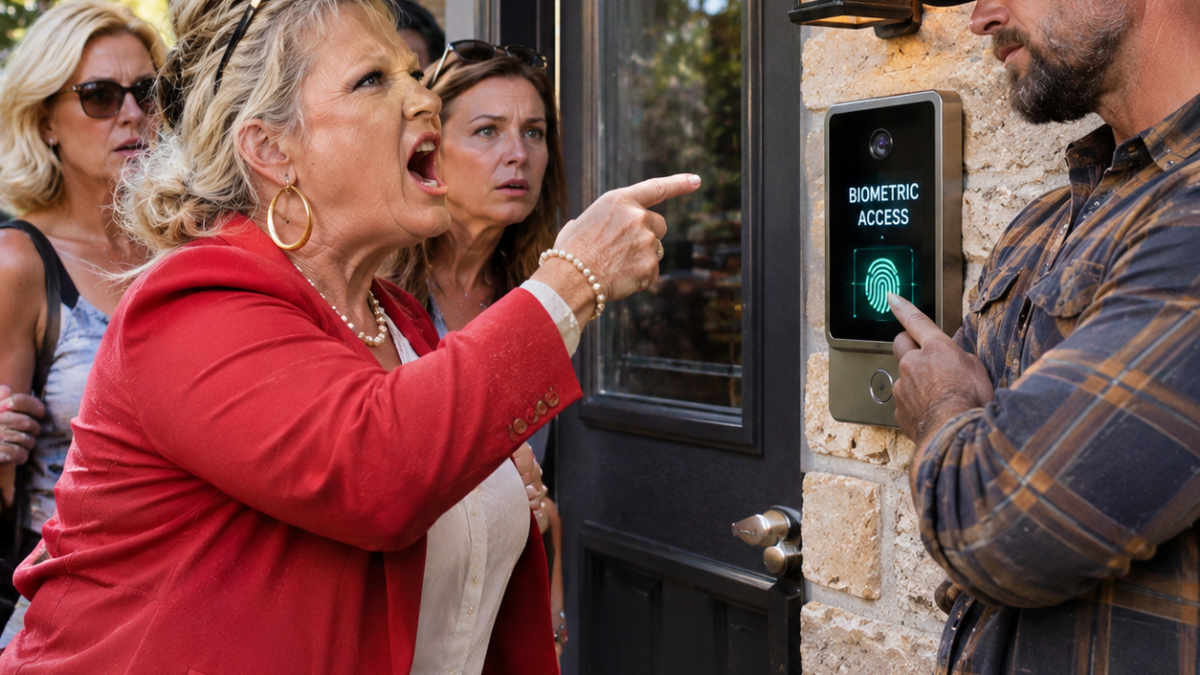
“Last chance. Bring your finger here, Beverly.”
Paul coughed.
Henderson looked down.
Eleanor’s eyes widened.
Beverly’s face turned crimson.
“I am not putting my finger on that thing.”
“Then we’re finished.”
She spun toward Henderson.
“Get your equipment.”
He shook his head.
“No.”
“I will terminate the association contract.”
“Then terminate it.”
He picked up his case.
“I do locks. I don’t do domestic wars.”
He walked back to his van.
Beverly followed him halfway down the driveway.
“Henderson!”
He got in.
The van started.
For the first time since I met her, Beverly looked powerless.
Only for a second.
Then the machine came back online.
She marched to her SUV, opened the rear hatch, and pulled out a compact mobile printer.
I almost admired the preparation.
She printed a second violation on the spot.
$750.
Obstruction of emergency inspection.
Contractor cancellation fee.
Administrative enforcement costs.
She slapped it against my mailbox.
“You now owe one thousand dollars.”
“I’ll add it to my collection.”
“I’m also freezing your HOA privileges pending compliance.”
“My heart is broken.”
“You won’t be joking when we place a lien on this property.”
There it was.
The weapon behind the fine.
I didn’t answer.
Beverly got into her SUV.
As it backed out, Eleanor looked at me through the passenger window.
For a moment, I thought she might say something.
Instead, she lowered her eyes.
Ten minutes later, my phone alerted.
A preliminary lien notice had been filed against Arthur’s house.
Exactly one thousand dollars.
The speed mattered more than the amount.
Liens don’t normally materialize from nothing within minutes unless the paperwork is prepared before the confrontation ends.
Beverly had expected me to refuse.
She had expected the locksmith.
She had expected the fine.
She had expected the lien.
This wasn’t enforcement.
It was choreography.
I printed the lien notice and laid it beside Arthur’s old ledger.
Then I looked at the severed security wires again.
The key demand no longer felt petty.
Someone had wanted access to this house badly enough to blind its cameras before Arthur died.
Beverly had shown up within forty-eight hours of my arrival demanding the same access.
I stopped worrying about the front door.
I started searching the house.
Arthur had been a retired Defense Department auditor.
His idea of casual organization involved color-coded tax receipts going back four decades.
If he had discovered something important, he would have documented it.
The question was where.
His study contained nothing obvious.
Desk drawers.
File cabinets.
Computer drives.
Bookcases.
I found pension statements, tax filings, property assessments, utility bills, HOA newsletters, and seventeen years of insurance records.
Nothing explaining the warning in his will.
Nothing explaining the cut cameras.
By late afternoon, I went downstairs.
The basement had always fascinated me as a kid.
Arthur called it his workshop.
My mother called it “the bunker.”
One side held tools.
The other housed wine racks, filing boxes, an old radio, soldering equipment, and shelves of technical manuals.
The fluorescent lights buzzed.
I searched the workbench first.
Then a cabinet.
Then behind electrical panels.
Nothing.
I was about to go upstairs when something along the wine-cellar wall caught my eye.
One limestone block sat slightly deeper than the others.
Maybe an eighth of an inch.
Most people wouldn’t have noticed.
Arthur would have.
So did I.
I pulled the wine rack aside.
The block moved.
Behind it was a narrow steel cavity.
A small fireproof safe had been bolted into the concrete.
I laughed under my breath.
“Of course.”
The lock was mechanical.
No biometric system.
No fancy electronics.
Arthur distrusted anything that could be remotely accessed.
It took me almost an hour to work through the combinations he might have used.
His birthday failed.
My mother’s birthday failed.
My birthday failed.
Then I tried the date he retired from federal service.
Click.
Inside was one manila envelope.
The handwriting on the front was Arthur’s.
**PROJECT WILLOW**
My pulse changed.
I carried it to the workbench.
Inside were spreadsheets.
Invoices.
Printed bank statements.
Photographs.
Copies of HOA contracts.
Handwritten notes.
Arthur had built a financial map.
At the center was a number written in red.
**$500,000+ UNACCOUNTED FOR**
I sat down.
The Capital Improvement Fund.
Willow Creek homeowners had paid into it for years.
Special assessments.
Reserve contributions.
Emergency maintenance fees.
Arthur had traced large portions of the money to a vendor called Sinclair Environmental Services.
Sinclair.
I opened corporate records Arthur had printed.
The company had been created by a distant relative of Beverly’s, then transferred through two administrative entities.
It shared mailing addresses with businesses connected to her family.
Invoices showed roof replacements that never occurred.
Sewer-line rehabilitation.
Storm-drain emergency repairs.
Pool-system modernization.
Tree-root mitigation.
Arthur had personally photographed many of the supposedly repaired areas.
Nothing matched.
One note read:
**Paid $38,400 — no work visible. Vendor address vacant.**
Another:
**$62,000 pool maintenance. Equipment appears original.**
Another:
**Emergency irrigation replacement billed twice under separate invoice numbers.**
Then there were photographs printed from Beverly’s public social-media pages.
Mediterranean cruise.
Luxury gala.
Kitchen remodel.
Designer jewelry.
Arthur had written dates beside each one.
I disliked where my mind went.
Lifestyle evidence alone proves very little.
Arthur knew that.
But he was following money.
At the bottom of the envelope was an original irrigation contract.
The document showed utility lines serving land outside the HOA’s approved development boundary.
Arthur’s notes suggested Beverly intended to use community-funded infrastructure to support a private development venture.
One sentence had been underlined three times.
**If this becomes public, zoning approval collapses.**
I finally understood.
Arthur hadn’t been fighting over a key.
He had been investigating the president.
And Beverly had known.
A sharp metallic noise came from upstairs.
I froze.
Not the settling of wood.
Not plumbing.
A forced latch.
I slid the Project Willow documents back into their envelope.
Another noise.
Guest bedroom.
The same room where I had found cut security wiring.
Someone was inside.
I switched off the basement light and moved behind the furnace-room partition.
Footsteps crossed the floor overhead.
Slow.
Deliberate.
Then the basement door opened.
Light swept down the stairs.
A man descended.
Tall.
Heavy jacket despite the Florida heat.
Flashlight in one hand.
He didn’t call out.
Didn’t ask whether anyone was home.
He went directly toward Arthur’s workbench.
That told me everything I needed to know.
This wasn’t a burglar searching randomly.
He knew where to look.
His flashlight found the moved wine rack.
Then the exposed safe.
He stopped.
I could hear his breathing.
A shape beneath his jacket suggested he might be armed.
My hand closed around a heavy pipe beside the furnace.
I didn’t want a fight.
Not in a basement.
Not with a man who had come here prepared.
He walked toward the furnace-room door.
One step.
Then another.
His fingers reached toward the handle.
A radio crackled at his belt.
A woman’s voice.
Sharp.
Urgent.
“Get out. Now.”
The man froze.
“Police responding to a perimeter alarm. Move.”
He turned instantly.
Ran upstairs.
Seconds later, I heard a car engine roar.
Tires screamed against pavement.
Then silence.
I stayed where I was for another full minute.
No sirens arrived.
No police cruiser.
Nothing.
I checked my new system.
The biometric lock had not triggered an alarm.
My external sensors had logged movement near the guest-bedroom window, but I had not configured an automatic police dispatch.
So who had warned him?
And why?
Either Arthur had left a secondary monitoring system I hadn’t found—
or somebody inside Beverly’s operation was watching both sides.
I called police.
I reported the break-in.
I did not speculate about Beverly.
I gave facts.
Forced window.
Unknown male.
Possible weapon.
Entry directly toward basement records.
By the time the officers left, Project Willow was no longer hidden in Arthur’s wall.
I photographed every page.
Created encrypted copies.
Placed originals in a secure off-site location.
For the first time, I stopped treating this as an HOA dispute.
Someone had entered my house looking for evidence.
The next morning, three legal notices arrived.
Beverly had shifted from intimidation to siege.
First:
Accelerated fines.
$750 per day.
Retroactive.
Current alleged balance:
$4,500.
Second:
Petition for injunctive relief seeking removal of the biometric lock.
Third:
Notice of intent to pursue foreclosure remedies if the debt and lien remained unpaid.
I read the last page twice.
The house Arthur had protected for decades was now being targeted through paperwork by the same organization he had spent his final months investigating.
I didn’t get angry.
I got methodical.
The most dangerous systems are rarely defeated by screaming at them.
You make them follow their own rules.
I formally requested official HOA records.
Not general statements.
Everything.
Five years of Capital Improvement Fund records.
Board approvals.
Vendor contracts.
Bank statements.
Invoices.
Minutes authorizing emergency expenditures.
Sinclair Environmental Services documents.
Insurance claims.
Records connected to the lien.
I sent the request in a form that established exactly when it had been received.
Then I filed a formal contest to the lien, forcing the association to defend it through proper procedure rather than allowing it to sit over the property indefinitely.
Beverly wanted a slow war.
I gave her deadlines.
By two that afternoon, another violation appeared.
Curtains.
Apparently, my neutral gray curtains violated Willow Creek’s approved exterior visual palette.
Fine:
$100.
Then an order arrived demanding that I disable infrared components of my security system because they allegedly interfered with Willow Creek’s “natural nighttime aesthetic.”
That one actually made me laugh.
Beverly wanted my cameras blind.
Again.
So I added three more.
Legally positioned.
Discreet.
Recording only areas I had a right to monitor.
The next afternoon, a city inspector knocked.
“Miller,” he said, showing identification.
“What can I do for you?”
“We got a priority complaint about an unauthorized structural alteration in the basement.”
I nearly smiled.
“What kind?”
“Hidden room.”
There it was.
The safe.
Beverly—or whoever was helping her—knew enough to tell the city exactly where to look.
“Do you have inspection authority today?”
He showed me the paperwork.
Unlike Beverly’s notices, his was real.
I let him in.
Aggressive transparency was safer than obstruction.
I showed him the biometric installation paperwork.
The basement.
The wine cellar.
The workbench.
The furnace room.
The wall where the safe had been.
Miller examined everything.
“No hidden room.”
“No.”
“Unpermitted structural work?”
“No.”
He checked.
“No.”
At the top of the stairs, he looked at the biometric control panel.
“You install that?”
“Yes.”
“What do you do?”
“Security engineering.”
He whistled.
“Better than what the city uses.”
“I didn’t hear that.”
“You definitely didn’t.”
When he stepped outside, Beverly’s SUV was parked across the street.
Miller saw it.
Looked at me.
Then shook his head.
“I hate neighborhood politics.”
“Join the club.”
He left.
Beverly remained in her SUV for another twenty minutes.
That evening, I received an anonymous encrypted message.
One attachment.
A bank statement.
Willow Creek HOA.
A transfer had occurred three hours earlier.
$50,000.
Destination:
An offshore account.
Description:
**Emergency Legal Retainer — Defense**
I stared at the screen.
The community reserve was financing Beverly’s war.
At least that was what the document appeared to show.
I did not assume it was authentic.
Arthur had taught me better than that.
I preserved it for verification.
Then another thought hit me.
Whoever sent the document had access to current HOA banking records.
Someone inside.
The same person who may have triggered or invented the warning during the break-in?
At midnight, an envelope slid beneath my door.
Black.
No postage.
Hand delivered.
Inside was a note written on thick paper.
**You have Arthur’s files.**
My throat tightened.
**You don’t have the encrypted bank logs.**
Then:
**If you want to know what really happened to him, meet me at the community pool house at 2:00 a.m. Come alone.**
The last line was worse.
**If you don’t, the drive disappears and Arthur remains a natural death forever.**
I read it four times.
Everything in me said trap.
That didn’t mean I could ignore it.
At 1:45, I made preparations.
I told one trusted attorney where I was going.
I enabled location tracking.
I set an automatic message to send if I failed to check in.
I did not go armed.
I did not plan to confront anyone.
At 1:58, I approached the pool house.
The community pool looked almost black beneath the security lights.
Chlorine hung in the air.
A side door opened.
“Elias?”
A woman stepped out.
Eleanor Price.
The HOA secretary.
The woman who had sat silently in Beverly’s SUV.
She was trembling.
“You wrote the note?”
“Yes.”
“Why perfume it like Beverly?”
“I wanted you to know someone close to her sent it.”
“That was unnecessarily dramatic.”
“Arthur said you’d say something like that.”
I stopped.
“You knew Arthur?”
“Better than Beverly realized.”
She looked toward the parking lot.
“We don’t have long.”
She handed me a ruggedized USB drive.
“What’s on it?”
“Backups.”
“Of what?”
“Everything she deleted.”
“Who is she?”
Eleanor gave me a look.
“You know.”
“Say it.”
“Beverly.”
I put the drive in my pocket.
“How did Arthur get involved?”
“He started asking about reserve money.”
“When?”
“Almost a year ago.”
“Did Beverly know?”
“Eventually.”
“And the cameras?”
Eleanor’s face changed.
“I don’t know who cut them.”
“Do you know who entered my house?”
“No.”
“Do you know who warned him?”
Silence.
“Eleanor.”
“I did.”
I stared at her.
“You called him off?”
“I used an internal security channel.”
“Why?”
“Because I saw the window sensor light up on the old HOA emergency-monitoring panel.”
“You still monitored Arthur’s house?”
“Beverly insisted on retaining emergency access permissions.”
My anger rose.
“You watched someone break in.”
“I called the police.”
“They never came.”
“I told the intruder police were coming because I needed him out immediately. Then I tried to call. Beverly’s people intercepted the internal report before dispatch completed.”
“That makes no sense.”
“I know.”
She gripped my sleeve.
“You don’t understand how many systems she controls.”
“Then help me understand.”
Eleanor looked close to tears.
“Arthur found money missing.”
“I know.”
“He found the zoning issue.”
“I know.”
“He found more.”
“What?”
“The emergency-medical monitoring system.”
The pool pump hummed behind us.
“What about it?”
“Willow Creek has an optional medical alert integration for elderly residents.”
Arthur had been enrolled.
I remembered seeing an old pendant in his desk drawer.
Eleanor whispered:
“The night Arthur died, an alert came through.”
I stopped breathing.
“What kind?”
“Cardiac distress.”
“And?”
“It should have automatically escalated.”
“Should have?”
“Someone delayed it.”
“How long?”
“Long enough.”
“Who?”
Eleanor looked toward the dark parking lot again.
“The drive.”
I wanted to grab her shoulders.
Instead, I forced my hands to remain at my sides.
“Why didn’t you go to police?”
“I didn’t have proof Beverly couldn’t destroy.”
“You had logs.”
“She controlled the system.”
“You’re the recording secretary.”
“I was scared.”
There it was.
The word that keeps bad systems alive.
Fear.
Eleanor stepped back.
“Arthur told me you worked security.”
“He shouldn’t have involved you.”
“He didn’t. I involved myself.”
She swallowed.
“Because I knew he was right.”
“Why now?”
“Because she sent somebody into his house.”
“Do you know who?”
“No.”
“If this drive proves what you say, you’re a witness.”
“I know.”
“You can’t disappear.”
“I won’t.”
A car turned onto the far road.
Eleanor flinched.
“Go.”
“Eleanor—”
“Go.”
I left.
Back home, I connected the drive only to an isolated forensic system.
I did not know whether it carried malicious code.
Arthur would have expected that caution.
The encryption architecture was layered and unusual, but the files included recovery material Arthur had clearly intended me to recognize.
He had left clues based on systems we had discussed years earlier.
It took time.
Then the first directory opened.
Bank logs.
Sinclair Environmental Services.
Payments.
Transfers.
Contract approvals.
Internal communications.
The scale was worse than the paper file suggested.
Hundreds of thousands had moved through fabricated maintenance projects.
Some money paid personal debts.
Some funded travel.
Some disappeared through intermediaries.
Then I found the audio folder.
I nearly skipped it.
I wish I had.
The first recording was mundane.
Beverly arguing about board minutes.
The second involved an invoice.
The third was dated three days before Arthur died.
Beverly’s voice.
Another man.
They discussed Arthur.
“He won’t stop digging.”
“He has copies.”
“Then get them.”
“What if he talks?”
“He’s already sick.”
The recording ended.
My hands went cold.
The next file was from the night Arthur died.
A system recording.
Automated alerts.
Time stamps.
A medical distress signal.
Then Beverly’s voice.
“Hold the escalation.”
Another voice:
“We can’t do that.”
“You can delay verification.”
“Why?”
“He triggers false alerts.”
“Mrs. Sinclair—”
“I said hold it.”
Minutes passed on the recording.
Too many.
Then:
“Now send it.”
I stopped playback.
Got up.
Walked away.
I stood in Arthur’s kitchen with both hands on the counter.
He had suffered a cardiac event.
A system intended to summon help had alerted.
Someone had intervened.
Whether earlier medical response would have saved him was not something I could know.
But Beverly had no right to make that decision.
No right.
I sat down.
For the first time since arriving, I cried.
Not loudly.
Not dramatically.
Just grief arriving with nowhere else to go.
I remembered Arthur teaching me how to solder when I was fourteen.
Arthur correcting my math homework without telling me the answer.
Arthur giving me my first computer security textbook and writing inside the cover:
**Trust is not a control. Verify.**
He had verified Beverly.
It may have cost him his life.
At 3:30 in the morning, I copied the evidence and sent it through counsel to appropriate authorities.
I also forwarded the banking evidence to the financial institution’s fraud team rather than touching funds myself.
Within hours, investigators began placing holds where legally authorized.
The $50,000 transfer became part of the review.
At four in the morning, my perimeter alerts activated.
Six figures moved across my front lawn.
Dark uniforms.
Breaching tools.
Private security contractors.
A vehicle idled near the curb.
And behind it—
Beverly’s SUV.
I watched through infrared cameras.
The lead contractor approached my door carrying a heavy ram.
I called 911.
Then I used the exterior speaker.
“You are being recorded.”
The man stopped.
“This property is occupied. You do not have permission to enter.”
He looked toward Beverly.
She shouted from the curb.
“We have HOA authority! Execute the emergency order!”
I zoomed the camera.
No police.
No sheriff.
No court officer.
Private contractors.
The lead man raised the ram.
I activated the external audio system.
Not with threats.
With evidence.
Beverly’s recorded voice came through the speakers.
**Hold the escalation.**
The men froze.
Then the second line.
**He triggers false alerts.**
Beverly screamed.
“Turn that off!”
Neighbors’ lights came on.
Curtains opened.
The audio continued.
The contractors backed away from my door.
One looked toward Beverly.
“What the hell is that?”
“Fabricated!”
Sirens appeared at the entrance to Willow Creek.
I spoke through the exterior system.
“Police are responding. Nobody needs to make this worse.”
The lead contractor lowered the ram.
Another stepped away entirely.
Beverly ran toward them.
“You’re being paid to do a job!”
One man answered loudly enough for my microphones to catch it.
“Not this job.”
Police arrived three minutes later.
Body cameras.
Questions.
Weapons holstered.
No theatrical raid.
No instant arrest.
Just the slow arrival of reality.
Beverly screamed that I had hacked the community.
That I owed thousands.
That the HOA had foreclosure authority.
That the biometric system was illegal.
That Arthur’s recordings were fabricated.
She talked too much.
The officers separated everyone.
I gave them video.
Documents.
My 911 call.
Evidence of the earlier break-in.
The court filings.
The audio was turned over through counsel.
By five, the contractors were gone.
Beverly left with her attorney’s number apparently being called repeatedly from her phone.
She was not arrested that morning.
That disappointed some neighbors.
It didn’t disappoint me.
Arthur had been an auditor.
He believed conclusions should come after evidence.
So did I.
By breakfast, Beverly launched her counterattack.
Every homeowner received an email.
She described me as a “cybersecurity extremist.”
Claimed I had infiltrated HOA networks.
Claimed I manufactured recordings.
Claimed the private security team had been dispatched to protect residents from an “unstable individual barricading an unsafe property.”
She called my biometric lock “military-grade obstruction technology.”
I almost admired that phrase.
Almost.
Instead of answering emotionally, I published only information I could document lawfully.
Vendor records.
Public filings.
Approved budgets.
Invoices Arthur had collected.
Photographs of work that had not occurred.
The lien contest.
Reserve-fund discrepancies.
No accusations about Arthur’s death.
That evidence belonged with investigators.
The numbers were enough.
Neighbors began asking questions.
One resident posted:
**Why did we pay $62,000 for pool modernization if the equipment is twelve years old?**
Another:
**Where did the $1,200 special assessment go?**
Another:
**Why does Sinclair Environmental Services share an address with a company connected to Beverly’s family?**
The comments changed tone.
Not all at once.
Fear rarely reverses cleanly.
Some residents defended Beverly.
She had served for years.
Organized holiday events.
Handled landscaping disputes.
Helped negotiate insurance.
People had built their understanding of Willow Creek around the assumption that she was competent.
Admitting she might be corrupt meant admitting they had trusted the wrong person.
That hurts.
Around noon, Henderson returned.
The locksmith.
This time alone.
He stood at the sidewalk.
“Can I come up?”
That simple question mattered.
“Yes.”
He approached.
“I owe you an apology.”
“You left before touching the lock.”
“I almost didn’t.”
“Why are you here?”
Henderson pulled an envelope from his pocket.
“Beverly wanted me to sign this.”
A safety affidavit.
It claimed my biometric lock interfered with firefighter access and violated local emergency standards.
“Is that true?”
“No.”
“Did you tell her?”
“Yes.”
“What did she say?”
Henderson looked embarrassed.
“She said the HOA contract represents almost twenty percent of my annual business.”
“Meaning?”
“Sign or lose it.”
“Did you?”
“No.”
“Why bring this to me?”
“Because last night I realized she was willing to send men with a ram to do what I wouldn’t.”
He swallowed.
“I don’t want my name anywhere near that.”
I copied the document.
Then asked if he would give a statement to my attorney.
He agreed.
Beverly’s power was beginning to collapse in the most predictable way possible.
The people around her had never been loyal.
They had been dependent.
There is a difference.
Dependence survives as long as the rewards remain greater than the risks.
Once Beverly became dangerous to stand beside, everyone began stepping away.
That afternoon, she announced an emergency town hall at the community park.
I attended.
Not on stage.
At the edge of the crowd.
Beverly stood behind a portable podium with Paul and another board member.
Eleanor was absent.
Beverly’s voice shook only slightly.
“We are facing an unprecedented attack on Willow Creek’s stability.”
She talked about property values.
Community safety.
Confidential records.
Outside agitators.
Me.
Then a woman near the back shouted:
“Where’s the money?”
Beverly stopped.
“What?”
“The Capital Improvement Fund.”
People murmured.
The woman held up her phone.
“It says the balance is nearly zero.”
“That information is stolen and misleading.”
“We paid a $1,200 special assessment six months ago.”
“Those funds were allocated.”
“To what?”
“Infrastructure.”
“What infrastructure?”
Beverly gripped the podium.
“Complex projects cannot be reduced to social-media spreadsheets.”
A man shouted:
“Then show us the real books!”
Another:
“Where are the invoices?”
Then:
“Why did you send security contractors to Elias’s house at four in the morning?”
Beverly raised both hands.
“Please.”
Nobody stopped.
“Why does your family company get HOA contracts?”
“Why did the reserve fund pay your legal fees?”
“What happened to Arthur?”
That question killed the noise.
Beverly looked toward me.
Hatred.
Fear.
Something else.
I did not answer.
Neither did she.
Paul leaned toward the microphone.
“I think the board should adjourn.”
“No,” Beverly snapped.
He recoiled.
She forced a smile.
“We will answer all appropriate questions through counsel.”
Someone yelled:
“We want an election!”
Another voice joined.
Then another.
The governing documents allowed members to trigger an emergency confidence process with sufficient written support.
I had already verified it.
A resident named Marcus had begun collecting signatures that morning.
I held nothing.
I led nothing.
This needed to be theirs.
Marcus stepped forward.
Former school principal.
Gray beard.
Calm voice.
“We have eighty-seven signatures requesting a no-confidence vote and emergency board election.”
Beverly laughed.
“Invalid.”
“Why?”
“Improper format.”
“We used the format from the bylaws.”
“Those bylaws require board certification.”
“Then certify them.”
“I will not recognize a petition based on stolen records and mob pressure.”
The crowd erupted.
Then the treasurer stood.
His name was Leonard Shaw.
For years he had appeared beside Beverly in newsletters.
Holiday photos.
Budget meetings.
Award ceremonies.
He climbed onto the stage carrying a leather folder.
Beverly turned.
“What are you doing?”
Leonard walked to the microphone.
“I’m resigning.”
Silence.
Her face changed.
“Leonard.”
“I’m done.”
“You cannot resign in the middle of an emergency meeting.”
“I just did.”
He placed the folder on the podium.
“These are original bank records.”
Beverly grabbed for them.
Marcus stepped between them.
Leonard continued.
“I signed reports I should never have signed.”
Someone gasped.
“I told myself Beverly had explanations.”
Her voice became low.
“Think very carefully.”
Leonard looked at her.
“I’ve been thinking carefully for ten years.”
He turned toward the residents.
“The reserve fund is depleted.”
Noise exploded.
“The contractors last night were paid from an emergency HOA check.”
Beverly shouted, “Stop talking!”
“The check bounced this morning.”
That did it.
Her remaining authority vanished in front of me.
Not because I defeated her.
Because the treasury she controlled could no longer buy obedience.
Leonard handed the folder to an attorney representing several homeowners.
Then looked toward me.
“Arthur was right.”
I felt that sentence in my chest.
Beverly heard it too.
She pointed at Leonard.
“You coward.”
He nodded.
“Yes.”
That answer silenced her.
“I should have stopped this years ago.”
He stepped off the stage.
By sunset, more than enough residents had signed the petition required to force formal board action.
Beverly’s lawyer called me that evening.
His voice sounded tired.
“Mr. Thorne.”
“Yes.”
“I represent Ms. Sinclair.”
“I assumed.”
“My client is prepared to resolve the property dispute.”
“What property dispute?”
“The lien, fines, access question.”
“I’m listening.”
“All fines withdrawn.”
“Continue.”
“Lien released.”
“Continue.”
“Written confirmation that your lock satisfies the HOA’s emergency-access requirements.”
“Good.”
“In exchange, you remove the online financial materials and return any confidential association documents belonging to Willow Creek.”
I laughed.
“Which documents?”
“Project Willow.”
So they knew its name.
That mattered.
“Who told you about Project Willow?”
Silence.
“My client is aware Mr. Arthur Thorne maintained unauthorized copies of association records.”
“He was a homeowner.”
“He possessed confidential materials.”
“Call my attorney.”
“We’re trying to avoid escalation.”
“Your client sent a breaching team to my house before sunrise.”
“That characterization is disputed.”
“Call my attorney.”
“Mr. Thorne—”
“Goodnight.”
I hung up.
Thirty seconds later, another message arrived.
State financial investigators had formally acknowledged receipt of the evidence package.
They intended to attend the next emergency HOA meeting.
I slept for almost seven hours.
The longest uninterrupted sleep since Arthur died.
The meeting was held the following evening in the Willow Creek Community Center.
Two hundred chairs.
All occupied.
People lined the walls.
Phones everywhere.
The remaining board sat behind a long table.
Beverly wore navy.
Of course.
Authority colors.
She opened with a gavel strike.
“This emergency session has been called to address unlawful dissemination of association information and the ongoing security threat created by Mr. Elias Thorne.”
I stood near the back.
Tablet in hand.
She spoke for fifteen minutes.
Fraud.
Cybercrime.
Manipulation.
AI-generated documents.
Fabricated audio.
She produced a certificate from a private security consultant claiming Sinclair Environmental Services was a legitimate vendor.
She accused me of attempting to destabilize property values to force a takeover.
It was elaborate.
Detailed.
Confident.
The old Beverly.
She was at her best when nobody interrupted.
So I didn’t.
I let her finish.
Then Marcus said:
“Elias has requested five minutes.”
Beverly snapped, “Denied.”
Residents shouted.
“Let him speak!”
“You talked!”
“Five minutes!”
She looked around.
The room no longer belonged to her.
Finally:
“Five minutes.”
I walked to the center microphone.
“Beverly, you’ve spent two weeks insisting this began because I refused to provide you with a house key.”
“It did.”
“Good.”
I placed my tablet on the podium.
“Then let’s start there.”
The projector came alive.
First screen:
Section 4.2.
The actual bylaw language.
Emergency-access method.
No physical-key requirement.
Second screen:
My certified notice offering biometric emergency enrollment.
Date.
Time.
Delivery confirmation.
Third:
Her refusal.
Fourth:
The lien.
Fifth:
The lien contest.
Sixth:
Henderson’s statement that she tried to force him to certify my lock as unsafe.
The room murmured.
Beverly shook her head.
“None of this proves financial misconduct.”
“I agree.”
That threw her.
“So let’s move on.”
I displayed public and lawfully obtained financial records.
Capital Improvement Fund balance history.
Special assessments.
Sinclair Environmental invoices.
Photographs.
Dates.
No dramatic graphics.
No accusation labels.
Just numbers.
“The association reported hundreds of thousands of dollars in maintenance projects.”
I pointed.
“Many do not correspond with observable work or available contractor documentation.”
Beverly interrupted.
“You are not an accountant.”
“My uncle was.”
Her face changed.
I opened Arthur’s handwritten reconciliation sheet.
“Arthur spent his final months comparing invoices against actual projects.”
“You have no right to possess that.”
“He left it in his house.”
“Those are stolen HOA records.”
“Then explain the payments.”
She looked toward her lawyer.
He whispered something.
She ignored him.
“The board relied on professional vendors.”
“Sinclair Environmental Services.”
“Yes.”
“Connected to your family?”
“Indirectly.”
“Did you disclose that?”
Her lawyer stood.
“I advise my client not to answer.”
I nodded.
“Fair.”
Then I changed the screen.
The medical-alert system logs.
Not the audio.
Not yet.
Just time stamps.
Arthur’s alert.
Delay.
Manual administrator intervention.
Beverly stood.
“You hacked those logs.”
“No.”
“Yes, you did!”
I held up a document.
“The state investigators sitting against the back wall are overseeing the digital evidence review.”
Every head turned.
Two investigators stood.
Not dramatic men carrying visible handcuffs.
Just professionals in suits with identification.
Beverly’s face drained.
“This is outrageous.”
One investigator spoke.
“Mrs. Sinclair, please allow the meeting to continue.”
She sat.
Slowly.
I displayed the failed access log from my biometric system.
Several attempts had been recorded during the period before the contractors arrived.
My system had also captured characteristics suggesting someone had attempted to spoof authorized identity material rather than simply use a key.
Investigators already had the technical data.
I did not explain methods publicly.
“Someone tried to defeat this lock before the breaching team arrived.”
Beverly crossed her arms.
“What does that have to do with me?”
“Maybe nothing.”
Her eyes narrowed.
“I mean that sincerely.”
The room waited.
“Digital evidence should not be treated like magic. It has to be verified.”
One investigator nodded slightly.
“So I gave the full logs to authorities.”
I looked at Beverly.
“They can determine who touched what.”
Her composure cracked.
Barely.
Then Marcus stood.
“We also have a witness.”
Eleanor walked into the room.
Beverly went white.
“No.”
Eleanor stopped near the front.
For weeks she had looked like someone expecting punishment.
Not tonight.
Tonight she carried a folder.
Beverly whispered:
“You stupid woman.”
Eleanor heard.
“So did everyone else.”
The microphone caught it.
Eleanor sat beside an attorney.
She spoke carefully.
“I was recording secretary for Willow Creek for nine years.”
No one moved.
“During that time, I observed financial records being altered before distribution.”
Beverly slammed her hand on the table.
“Lie.”
An investigator stepped closer.
Eleanor continued.
“I preserved backups.”
“Stolen records!”
“I also preserved internal communications.”
“Eleanor, stop.”
“And emergency-monitoring logs.”
Beverly stood.
“Stop.”
Eleanor looked at her for the first time.
“No.”
One syllable.
That was all it took.
Beverly stared at her.
Eleanor’s hands still shook.
But she didn’t look away.
“I was scared of you for years.”
People in the room were silent.
“I watched you threaten contractors.”
She swallowed.
“I watched you pressure board members.”
Another breath.
“I watched Arthur ask questions nobody wanted answered.”
Beverly’s lawyer said, “Mrs. Price, I advise you to stop making potentially defamatory statements.”
Eleanor turned.
“I have my own attorney.”
The room reacted.
Beverly sank back into her chair.
Eleanor continued.
“Arthur discovered the Capital Improvement Fund discrepancies. He also discovered the zoning problem involving the private development project.”
She held up the USB drive.
“He created backups because he believed records would be deleted.”
Beverly’s lawyer whispered urgently.
She shook him off.
“Arthur was obsessed.”
That was the mistake.
The investigator looked at her.
“You knew Mr. Thorne was investigating?”
Beverly realized too late.
“I knew he complained constantly.”
“About finances?”
“He complained about everything.”
“About Sinclair Environmental?”
She hesitated.
Her lawyer said:
“Do not answer.”
Beverly’s jaw clenched.
I should have stopped there.
The evidence was enough to turn over.
But the meeting had become bigger than me.
Residents needed to hear how fear had protected her.
Marcus asked Leonard to speak.
The former treasurer described payments.
Henderson described pressure to falsify a safety statement.
Another contractor admitted that jobs had been billed above cost.
A resident said she had been fined after questioning a reserve assessment.
Another said Beverly threatened a lien during an election dispute.
One story became six.
Then twelve.
Beverly kept shaking her head.
“You people loved this community.”
Nobody answered.
“I protected your property values.”
A man shouted:
“With our money?”
“You have no idea what leadership requires.”
Marcus replied:
“It doesn’t require stealing.”
That detonated something.
Beverly stood.
“I did what was necessary!”
Her lawyer closed his eyes.
The room went still.
She pointed toward me.
“Arthur was going to destroy everything over numbers on a spreadsheet.”
My heart stopped.
Her attorney grabbed her arm.
“Beverly.”
She pulled away.
“He was old. He was sick. He didn’t understand what would happen if the development collapsed.”
Nobody moved.
She was no longer defending herself.
She was defending her belief that the ends justified everything.
“He was going to ruin property values.”
I said quietly:
“So you delayed his medical alert?”
Her face changed.
Silence.
Her lawyer stood.
“This meeting is over.”
Beverly looked at me.
“I didn’t kill him.”
I had not said she did.
The room understood that too.
“I never said you killed him.”
She realized it.
Too late.
“I delayed one automated call because he had false alerts before.”
Eleanor covered her mouth.
Beverly continued as though she could still rescue herself.
“It was minutes.”
My voice came out lower than I expected.
“You heard him calling for help?”
“No.”
“Then why did you intervene?”
“He was using the system to create problems.”
“During a cardiac emergency?”
“I didn’t know it was real.”
“But you chose.”
She shook her head violently.
“No. No, you’re twisting this.”
I stared at her.
“Arthur had a medical alert.”
“Yes.”
“The system triggered.”
“Yes.”
“Someone told staff to hold escalation.”
She looked around.
Two hundred neighbors.
Phones recording.
Investigators listening.
Her own lawyer pale.
Finally, she whispered:
“I was protecting the association.”
Nobody spoke.
One of the state investigators stepped forward.
“Mrs. Sinclair.”
Her lawyer immediately moved between them.
“My client will not answer additional questions.”
The investigator nodded.
“She does not have to.”
He produced identification again.
“We need to speak with her regarding the financial investigation and potential evidence tampering.”
Beverly looked toward the exit.
Another investigator stood there.
Nobody cheered.
Not yet.
This wasn’t entertainment anymore.
They escorted her out for questioning.
Later, after formal review and additional warrants, she was arrested on charges tied to the financial scheme, wire transactions, fraudulent records, and evidence tampering.
The investigation into Arthur’s death expanded separately.
Medical experts could not say with certainty that an earlier response would have saved him.
That mattered.
I refused to let grief rewrite facts.
But investigators concluded the delay had been intentional and improper, and the evidence surrounding access to Arthur’s home, the removed records, and attempts to recover Project Willow created additional criminal exposure.
The biometric evidence became one part of a much larger case.
Not magic.
Not the single answer.
Just one log among many.
The lien on my house was vacated.
Every fine Beverly had imposed after my arrival was suspended, then dismissed after review.
The forced-access policy was rewritten.
The master-key requirement was eliminated.
Emergency access had to be handled through lawful, resident-controlled procedures.
No HOA officer would again hold unrestricted physical keys to hundreds of homes.
Beverly’s indictment eventually ran dozens of pages.
The financial charges covered years of transactions.
Investigators traced money through Sinclair Environmental Services and related accounts.
Assets were frozen.
Luxury purchases became exhibits.
The Capital Improvement Fund had been drained of roughly half a million dollars across the scheme Arthur had uncovered.
The $50,000 offshore transfer became part of the prosecution’s financial evidence.
Beverly’s defense tried to characterize everything as mismanagement.
Poor accounting.
Overdelegation.
Vendor confusion.
Then prosecutors introduced internal emails.
Instructions.
Approval records.
Deleted communications recovered from backups.
Leonard’s testimony.
Eleanor’s testimony.
Arthur’s files.
The pattern became difficult to explain as error.
The most painful hearing concerned Arthur.
I sat in the second row while a prosecutor described the delayed medical response.
Beverly sat at the defense table.
For once, I did not feel victorious looking at her.
I felt tired.
A doctor testified that Arthur’s heart condition was severe.
Earlier emergency care might have improved his chances.
Might.
Not would.
There was no honest way to say more.
That uncertainty stayed with me.
I wanted a clean answer.
Grief always does.
One minute sooner and he lives.
One villain responsible.
One moment that explains everything.
Life rarely gives you that.
What I knew was enough.
Arthur had asked for help.
A system had responded.
Beverly interfered because she cared more about controlling him than protecting him.
Whatever the medical outcome might have been, that choice belonged to her.
Eventually Beverly accepted a plea agreement covering the strongest financial and evidence-related charges rather than face every count at trial.
Other charges and investigations proceeded according to what prosecutors could prove.
The exposure was severe.
Years of imprisonment.
Restitution.
Asset forfeiture.
Permanent loss of authority inside Willow Creek.
The woman who once threatened me with a $250 fine now sat in court while lawyers argued over hundreds of thousands of dollars she had taken from people who trusted her.
I attended sentencing.
Not because I needed to see her suffer.
At least that was what I told myself.
When the judge asked whether any victims wished to speak, several residents did.
Henderson.
A retired couple.
Leonard.
Eleanor.
Then me.
I walked to the lectern.
I had written three pages.
I used none of them.
“My uncle Arthur believed records mattered because memory can be manipulated.”
Beverly stared at the table.
“He kept records because he expected someone would eventually tell him what he saw wasn’t real.”
I paused.
“He was right about the money.”
The courtroom was silent.
“He was right about the unauthorized access.”
I looked at Beverly.
“And he was right to be afraid of what happened when he questioned it.”
Her lawyer shifted.
I continued.
“I don’t know whether faster medical help would have saved my uncle. Nobody in this courtroom can honestly promise that.”
For the first time, Beverly looked at me.
“What I do know is that no HOA president, no board member, no neighbor has the right to decide that another person’s emergency can wait because that person has become inconvenient.”
Her eyes dropped again.
“I don’t want revenge disguised as justice.”
That sentence surprised me as I said it.
“But I do want consequences strong enough that nobody who learns this story mistakes her behavior for leadership.”
I returned to my seat.
The judge imposed the sentence.
Long.
Serious.
Not the maximum prosecutors had discussed publicly.
Enough that Beverly would lose years of her life and much of the financial comfort she had built through the scheme.
Restitution orders followed.
Assets tied to the fraud were sold.
Willow Creek began recovering money.
Her SUV.
Investment property.
Accounts.
A vacation home connected to the financial trail.
Not every dollar came back.
Fraud rarely ends neatly.
But enough did to keep the community from collapsing.
After Beverly was removed, Willow Creek faced a problem almost as dangerous as corruption.
Everyone wanted a savior.
Some residents wanted me on the new board.
I refused immediately.
“You took her down,” Marcus said.
“No.”
“You exposed her.”
“Arthur exposed her.”
“You finished it.”
“And now I’m finished.”
He smiled.
“You don’t mean that.”
“I absolutely mean that.”
The provisional committee hired an outside management firm and imposed financial controls requiring multiple independent approvals for substantial expenditures.
Every invoice above established thresholds was visible to members.
Audits became mandatory.
Conflicts of interest had to be disclosed.
No president could approve a vendor tied to family without independent review.
It was boring.
That was the goal.
I helped with security architecture.
Not control.
I specifically refused any system that would give one person unilateral access.
Marcus found that amusing.
“You built a biometric fortress.”
“For myself.”
“And you don’t want one for the HOA?”
“Especially not for the HOA.”
We created access systems with separate authorization, clear logs, and resident consent.
No master credential sitting in somebody’s desk.
Technology doesn’t fix bad governance.
It can only make abuse harder to hide.
Eleanor came to see me a week after Beverly’s sentencing.
She looked different.
Still quiet.
But she no longer glanced behind herself every few seconds.
We sat on Arthur’s porch.
She held a small microSD card.
“What’s that?”
“The last backup.”
“Of what?”
“Deleted emails.”
“Beverly?”
“And two local officials involved in the zoning approvals.”
I stared at the card.
“Why do you still have it?”
“I didn’t know who to trust.”
I held out my hand.
She gave it to me.
I immediately put it into an evidence envelope.
“You’re not going to read it?”
“No.”
“Why?”
“Because the criminal investigators are still working.”
She smiled slightly.
“Arthur said you’d be like that.”
“He complained about me?”
“Constantly.”
“That sounds more accurate.”
Eleanor looked toward the house.
“He knew you would inherit it.”
“I found the will.”
“No.”
She shook her head.
“I mean years ago.”
“Why me?”
“Because he said you understood boundaries.”
I laughed.
“I install locks.”
“He didn’t mean locks.”
That quieted me.
Eleanor continued.
“He said everybody thinks security is about keeping bad people out.”
“What did he think?”
“Knowing who you let in.”
I looked at the black biometric panel beside the front door.
For two weeks, I had treated it like a weapon.
Maybe Arthur would have seen it differently.
Not a wall.
A choice.
I handed the microSD card to investigators the next morning.
The additional records expanded the zoning inquiry.
Two local officials eventually faced investigation connected to approvals and undisclosed financial relationships.
I stopped following every detail.
That surprised me.
At the beginning, I wanted to know everything.
Every email.
Every dollar.
Every person.
Eventually, I realized that was another kind of trap.
Arthur had spent his final months consumed by Project Willow.
Necessary work.
Important work.
But I didn’t want Beverly to control my life after she was gone simply because I kept organizing every day around what she had done.
So I started turning the house back into a home.
First, I removed the temporary interior cameras.
Then some external redundancies.
Then the portable sensors.
Then the emergency speakers I had used during the attempted breach.
The main perimeter cameras stayed.
Reasonable.
The biometric lock stayed.
Personal.
The signal-monitoring equipment went into storage.
The house became quieter each weekend.
Arthur’s workbench remained untouched for months.
One Saturday, I finally went downstairs.
Project Willow was gone.
Investigators had returned the originals they no longer needed, and I had placed them in secure archival storage.
The safe behind the limestone wall was empty.
I sat at Arthur’s bench.
For the first time, I wasn’t looking for evidence.
I found one of his soldering irons.
Same model he had taught me on.
I remembered being fourteen and burning my thumb.
He laughed until my mother yelled at him.
Then he spent twenty minutes explaining heat transfer as though the burn had happened because I lacked sufficient engineering theory.
That was Arthur.
He didn’t comfort normally.
He explained.
I missed him.
I had been so angry for weeks that grief had barely fit inside me.
Now the anger was fading.
What remained hurt more.
I picked up his old ledger.
Not the HOA one.
Personal expenses.
Page after page.
Groceries.
Hardware.
Utilities.
Then a line from fifteen years earlier.
**Elias birthday — security textbook — $48.95**
I smiled.
He had recorded my gift as an expense.
Of course.
Under it, in smaller writing:
**Worth it if he reads it.**
I closed the book.
“Read it, old man.”
The basement was silent.
I didn’t need an answer.
A month later, Willow Creek held a neighborhood barbecue.
Marcus invited me.
I almost said no.
Then I remembered the first morning.
Beverly standing on my porch.
Demanding entry.
Everything in Willow Creek had felt transactional then.
Permission.
Fines.
Authority.
Control.
A barbecue was just a barbecue.
So I went.
Henderson was there.
The locksmith pointed at me with a hamburger.
“This is the guy who cost me my biggest HOA contract.”
“You quit.”
“Details.”
“You want it back?”
“Absolutely not.”
Eleanor laughed.
I barely recognized the sound.
Paul, one of the old board members who had stood behind Beverly during the lock confrontation, came over.
He held a soda.
“Elias.”
“Paul.”
“I owe you an apology.”
“That seems popular.”
He grimaced.
“I watched her do things I knew weren’t right.”
“Why?”
He looked toward the park.
“I had two daughters in college.”
I waited.
“My landscaping company got HOA referrals.”
“So you stayed quiet.”
“Yes.”
“Did you participate in the financial scheme?”
“No.”
Investigators had agreed.
“But I helped her look legitimate.”
That was also true.
“I’m sorry.”
I nodded.
“Then make the new system better.”
“I’m not running for anything.”
“Even better.”
He laughed.
The conversation ended there.
No dramatic forgiveness.
No hug.
Sometimes accountability is enough.
Several months later, I received a package from the state.
Evidence returned.
Inside was one of Arthur’s external drives.
The plastic was scratched.
There was a label in his handwriting.
**ELIAS — AFTER**
I stared at it.
After what?
I connected it carefully.
One video file.
Arthur.
Sitting at his desk.
Alive.
Older than I remembered.
Tired.
He looked directly into the camera.
“If you’re watching this, Elias, either I got dramatic in my old age or something went wrong.”
I laughed.
His recorded face did not.
“I hope I destroyed this myself and you never see it.”
He looked down.
Then back up.
“But if you inherited the house and Beverly Sinclair is still running Willow Creek, listen carefully.”
I leaned closer.
“Do not give her a key.”
I laughed again.
Then my throat tightened.
Arthur continued.
“She says it’s for safety.”
He shook his head.
“She likes access because access becomes information, and information becomes leverage.”
That sounded like an auditor.
“I spent too many years assuming somebody else would notice what she was doing.”
He paused.
“I should have acted sooner.”
I whispered, “You acted.”
Obviously, he couldn’t hear me.
“I’ve left records. Follow them. Verify everything. Don’t trust my conclusions just because I’m dead.”
I smiled through tears.
Perfect Arthur.
“Especially don’t trust them because I’m dead.”
Then his expression softened.
“I left you the house because your mother said you were the only person in the family stubborn enough not to sell it when someone annoyed you.”
I laughed.
“That sounds like her.”
He continued.
“But that’s not the real reason.”
He looked toward the door behind him.
“This place needs someone who understands that a locked door is not an insult.”
I stopped moving.
“People are allowed to have boundaries.”
His voice became quieter.
“Communities are allowed to have rules too. The trick is remembering that rules should protect boundaries, not erase them.”
Arthur leaned back.
“If Beverly broke the law, let the law handle her.”
I thought about everything that had happened.
“Don’t become obsessed with beating her.”
Too late.
“Don’t turn the house into a bunker.”
I looked at the cameras still visible on one monitor.
“Mostly too late.”
“And for God’s sake, don’t install anything that makes the place look like one of your contractor facilities.”
I stared at the biometric lock feed.
Then laughed so hard I had to pause the video.
When I resumed, Arthur was smiling faintly.
Almost as though he’d predicted exactly that.
“Live here, Elias.”
That was the last thing he said before the recording ended.
Not:
Avenge me.
Not:
Destroy Beverly.
Live here.
I sat alone for a long time.
Then I started making changes.
The following weekend, I took down two more cameras.
The month after that, I repainted Arthur’s study.
Not radically.
Same general color.
Just fresh.
I donated clothes I had kept because I couldn’t decide what grief allowed me to discard.
I kept his favorite jacket.
His ledgers.
His mug.
The security textbook.
The house stopped feeling preserved.
It started feeling inhabited.
I bought a new sofa.
Arthur would have hated it.
Too modern.
That was partly why I chose it.
I planted herbs behind the kitchen.
They mostly died.
I am excellent with encryption.
Basil remains beyond me.
Marcus became the new HOA treasurer after the transition period.
He had spent twenty years as a school principal and treated HOA budgets the way he had treated school lunch money.
Every dollar documented.
Every contract reviewed.
One evening, he walked past my house.
He stopped at the edge of my lawn.
Not on the porch.
Not in the driveway.
The property line.
“Elias?”
I stepped outside.
“What’s up?”
“Barbecue Saturday.”
“I heard.”
“You coming?”
“Probably.”
He pointed toward the lock.
“That thing still recognize me?”
“You were never enrolled.”
“Right.”
He laughed.
“I forgot.”
“That’s the idea.”
He looked at the titanium housing.
“Funny.”
“What?”
“That started everything.”
“No.”
I shook my head.
“Beverly started everything.”
“The lock made her show everyone who she was.”
That was closer.
Marcus waved.
“Saturday.”
“I’ll bring drinks.”
He left.
No demand.
No document.
No implied authority.
Just a neighbor inviting another neighbor to eat burned meat.
That was progress.
Before the next barbecue, I took the biometric unit apart.
Not because it had failed.
Because I wanted to make one modification.
I brought the titanium housing to my workbench.
Precision laser engraver.
Small letters.
Nothing flashy.
On the side, beside the sensor, I engraved:
**ARTHUR THORNE**
I stared at the name.
Then added two smaller words beneath it.
**VERIFY FIRST**
That would have made him happy.
Or irritated.
With Arthur, those were often the same emotion.
I reassembled the lock.
Mounted it.
Powered up.
Green light.
Steady.
I pressed my thumb to the scanner.
Recognition.
The bolt withdrew.
That sound had once meant defense.
Now it meant home.
I stepped inside.
Arthur’s mug sat on a shelf.
Not beside the sink anymore.
The Project Willow files were with the authorities and archives.
The HOA’s reserve accounts were under independent oversight.
Restitution payments were rebuilding what Beverly stole.
The revised bylaws no longer demanded physical keys from residents.
Other nearby associations had begun reconsidering similar policies after the Willow Creek case became public.
I wasn’t interested in becoming an anti-HOA celebrity.
I turned down interviews.
Ignored invitations to speak at homeowner conferences.
Declined an offer to consult on “HOA resistance technology,” which sounded like the fastest possible way to become the kind of person Arthur had warned me not to become.
I had a job.
A house.
A life.
That was enough.
Almost a year after Beverly first stood on my porch, Eleanor called.
“Are you home?”
“Yes.”
“Can I come by?”
“Sure.”
She arrived carrying a cardboard box.
“What is that?”
“Things Arthur stored in the HOA office.”
I opened it.
Old copies of meeting agendas.
A coffee thermos.
Two pens.
A framed photograph.
Arthur and Eleanor at a community cleanup day.
He looked annoyed.
She looked terrified.
I smiled.
“Accurate picture.”
Eleanor laughed.
At the bottom was a key.
Old brass.
A masking-tape label.
**ARTHUR — 118 OAK RIDGE**
My old front-door key.
The HOA master copy.
I picked it up.
Eleanor looked ashamed.
“Beverly kept all of them in a locked cabinet.”
“How many?”
“Almost every home.”
“Did residents know?”
“They knew the HOA had keys.”
“Did they know Beverly personally controlled them?”
“No.”
I turned Arthur’s key in my fingers.
“Did she use them?”
“Yes.”
The answer came quietly.
“How often?”
“I don’t know.”
“Without emergencies?”
“Yes.”
I closed my hand around the key.
That was the final proof of why she had reacted so violently to the biometric lock.
It wasn’t simply about one inherited house.
For years, Beverly had possessed invisible access to the private lives of Willow Creek residents.
A key meant she could enter without creating a digital record.
Inspect.
Search.
Learn.
Pressure.
Maybe sometimes she used it legitimately.
That wasn’t the point.
The system required trust without accountability.
And Beverly had exploited it.
“What happened to the others?”
“Residents collected them after the policy changed.”
“Good.”
Eleanor watched me.
“What will you do with Arthur’s?”
I looked toward the biometric lock.
“Keep it.”
“Why?”
“Reminder.”
“Of Beverly?”
“No.”
I placed the key in Arthur’s old ledger drawer.
“Of what happens when convenience becomes entitlement.”
Eleanor nodded.
Before leaving, she stopped.
“You know, Arthur liked you.”
“That is a very low standard for family affection.”
“No.”
She smiled.
“He was proud of you.”
I looked away.
Arthur hadn’t been a man who said things like that.
“Did he tell you?”
“Constantly.”
That surprised me.
“What did he say?”
“That you were impossible.”
“Sounds right.”
“That you never accepted a system just because somebody told you it was standard.”
I laughed.
“Also right.”
“And that someday it would either make you very successful or get you sued.”
“Both.”
Eleanor smiled.
Then her expression grew serious.
“He knew Beverly would hate that about you.”
“I wish he’d called me.”
“I know.”
“I would have come.”
“Would you?”
The question hurt.
I had been busy.
Deadlines.
Travel.
Projects.
Arthur and I spoke every few months.
Always brief.
Always:
How are you?
Fine.
Work?
Busy.
House?
Still standing.
Neither of us was good at saying we needed anything.
Would I truly have dropped everything if he’d called and said his HOA president was stealing money?
I wanted to say yes.
Instead:
“I hope I would have.”
Eleanor nodded.
“That’s probably the honest answer.”
After she left, I found Arthur’s final video again.
Live here.
I shut the laptop.
Then I walked outside.
Children were riding bicycles near the park.
Someone mowed a lawn.
Henderson’s van was parked two houses down while he replaced an elderly widow’s back-door lock.
He saw me and raised one hand.
I waved.
Willow Creek looked ordinary.
That might sound anticlimactic after everything that happened.
It wasn’t.
Ordinary was the victory.
No black envelopes.
No fabricated fines.
No tactical contractors.
No midnight meetings.
No reserve fund disappearing through shell companies.
No woman deciding that every door in the neighborhood should open for her.
At sunset, I sat on the porch with coffee.
The titanium biometric panel beside me blinked green.
One year earlier, Beverly Sinclair had stood in exactly the same place holding out her hand.
“Give me the key.”
I could still hear the certainty in her voice.
She believed the request was reasonable because nobody had refused it successfully.
She believed authority meant access.
She believed access meant control.
When I told her no, she didn’t see a homeowner setting a boundary.
She saw a system failure.
So she escalated.
The fine.
The locksmith.
The lien.
The foreclosure threat.
The break-in.
The contractors.
The smear campaign.
Every step was supposed to force one simple outcome.
My surrender.
Instead, every escalation left evidence.
That was Beverly’s real mistake.
Not underestimating my technology.
Not underestimating my legal strategy.
Not even underestimating Arthur.
She underestimated records.
A severed cable records intent if someone notices the cut.
A bank transfer records movement.
An invoice records a claim.
A lock records access.
A meeting records words.
A frightened witness remembers what happened.
A corrupt system survives by convincing everyone that no single piece of evidence matters.
Arthur had spent his life doing the opposite.
One receipt.
One ledger line.
One discrepancy.
Then another.
Eventually the pattern becomes impossible to deny.
That was how Beverly fell.
Not from one dramatic piece of evidence.
From hundreds of small truths she believed nobody would ever assemble.
I finished my coffee.
Marcus walked past with his dog.
He stopped at the sidewalk.
“Barbecue tomorrow.”
“I remember.”
“You said that last time and showed up an hour late.”
“Security incident.”
“You were installing a sprinkler.”
“It malfunctioned.”
“You don’t know how sprinklers work.”
“That is becoming clear.”
He grinned.
“Six o’clock.”
“I’ll be there.”
He continued down the street.
I stood.
Walked to the door.
Pressed my thumb to the scanner.
Green light.
Click.
The bolt retracted.
I paused before entering.
Arthur’s name was etched beside my hand.
**ARTHUR THORNE**
**VERIFY FIRST**
I smiled.
The first week I arrived, I had told Beverly:
“Want in? Bring your finger here.”
At the time, it was defiance.
A technical loophole.
A way of proving she wasn’t entitled to an anonymous master key.
Now the scanner meant something simpler.
Nobody entered because a title gave them automatic permission.
Nobody entered because a neighborhood had always done things that way.
Nobody entered because they threatened me with paperwork.
Access happened because the person who lived inside chose it.
I stepped through the door.
The lock closed behind me with a solid mechanical click.
For months, that sound had meant the perimeter was secure.
That night, it meant something better.
The house was finally mine.
Not because a will said so.
Not because Beverly was gone.
Not because a judge erased the lien.
Because for the first time since Uncle Arthur died, I could stand inside the home he left me without waiting for the next knock, the next threat, or the next person demanding a piece of it.
Outside, Willow Creek settled into evening.
Inside, I turned on a lamp, put Arthur’s mug beside mine, and let the silence remain exactly what it should have been all along.
Peace.
[END OF STORY]








