PART 2: HOA KAREN DECLARED MY FAMILY RANCH “COMMUNITY PROPERTY”—SO I ELECTRIFIED THE FENCE AND MADE HER HOA PAY
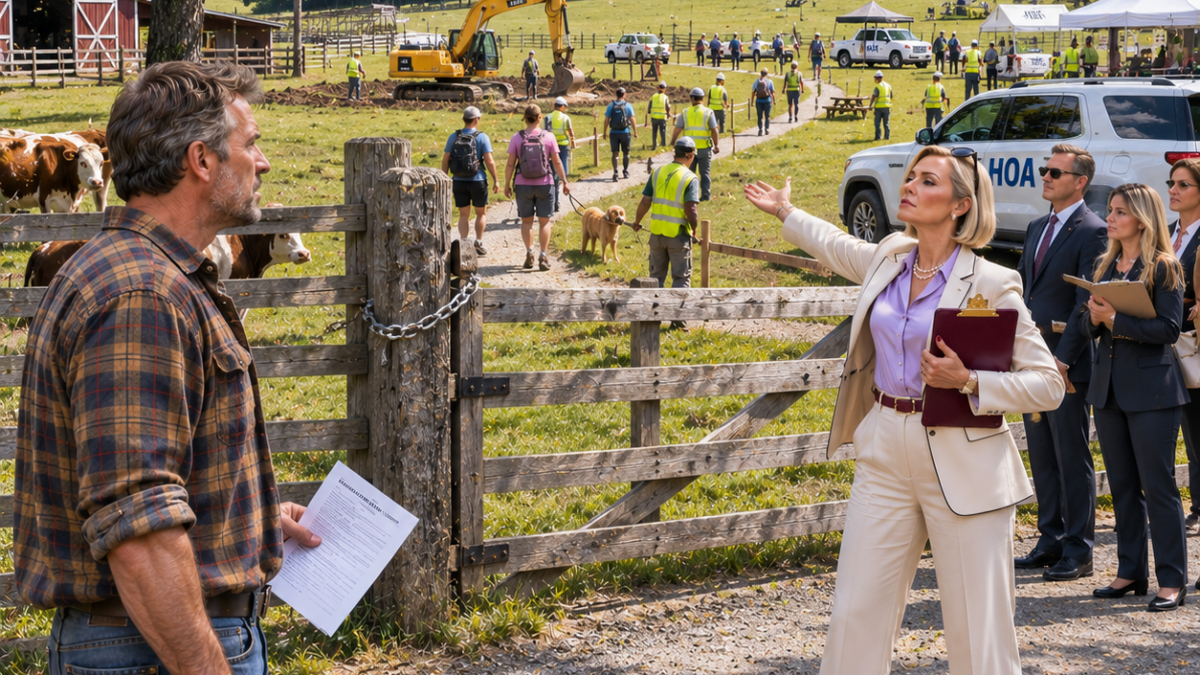
I woke up owning fifty acres that had belonged to my family for generations, and by breakfast, a woman with a clipboard had apparently decided they belonged to everyone else.
She hadn’t bought the land, inherited it, leased it, or even asked permission to step on it—she had simply held an HOA meeting, taken a vote, and announced that my ranch was now “community property.”
What happened after that began with one sheet of paper on my porch, but before it was over, an entire neighborhood would learn how expensive one woman’s arrogance could become.
My name is Jack Monroe, and the ranch sits just beyond the eastern edge of Willow Creek, a polished little subdivision full of stone mailboxes, decorative streetlights, manicured lawns, and people who pay monthly dues so someone else can tell them which shade of beige their garage door is allowed to be.
My grandfather bought our land decades before Willow Creek existed.
Back then there were no cul-de-sacs behind our eastern pasture. No swimming pool. No clubhouse. No homeowners association.
There were just fields, timber, cattle, a barn, and a narrow gravel road my grandfather maintained himself.
By the time the developers arrived, our family land was already well established.
They built around us.
We never joined them.
That distinction seemed painfully obvious to me.
Apparently, it was less obvious to Margaret Dawson.
I found her letter wedged beneath the brass clip on my front porch one Tuesday morning.
At first I assumed it was another advertisement or some neighborhood notice that had been delivered to the wrong address.
Then I read the heading.
WILLOW CREEK HOMEOWNERS ASSOCIATION
COMMUNITY LAND INTEGRATION NOTICE
I stood there holding my coffee while I read the same paragraph three times.
According to the letter, my fifty-acre ranch had been recognized as part of Willow Creek’s “historically shared recreational environment.”
My fields were supposedly available for hiking.
My eastern pasture was designated for community recreation.
My access roads were to remain unobstructed.
Even my existing PRIVATE PROPERTY signs were described as “inconsistent with community access standards.”
For several seconds, I genuinely wondered whether someone was playing a joke on me.
Then I reached the final page.
At the bottom was Margaret Dawson’s signature.
President, Willow Creek Homeowners Association.
I knew the name.
Anybody who lived within five miles of Willow Creek knew the name.
Margaret was one of those people who could turn a discussion about flower beds into a constitutional crisis.
She had spent years building a reputation for enforcement notices, special assessments, landscaping disputes, parking arguments, and letters written in the kind of language normally reserved for federal indictments.
But until that morning, none of it had been my problem.
I folded the letter, walked down the porch steps, and looked across my pasture.
The morning sun was still low.
Mist rested above the grass.
A few cattle moved slowly near the far fence.
The barn roof caught a thin stripe of orange light.
Everything I could see had been paid for with family money and maintained with family labor.
My grandfather had worked that ground.
My father had repaired those fences.
I had spent half my adult life keeping the place alive.
And somewhere behind the ridge, a group of strangers had apparently decided that none of that mattered because they wanted somewhere prettier to walk their dogs.
The sound of tires on gravel pulled me out of my thoughts.
A dark HOA sedan rolled up my driveway.
Not to the gate.
Not to the edge of the property.
All the way up.
It stopped about thirty feet from my porch.
Margaret Dawson stepped out carrying a clipboard against her chest.
Two board members followed her.
She wore a tailored blazer, spotless shoes, and the expression of someone arriving to inspect property she had already decided belonged to her.
“Mr. Monroe,” she said.
I stayed on the porch.
“Margaret.”
Her eyebrows lifted slightly.
Apparently she had expected more ceremony.
“We sent you formal notice regarding the community land designation.”
“I read it.”
“Excellent. Then this should be fairly straightforward.”
That sentence told me almost everything I needed to know.
I stepped down from the porch.
“What exactly do you think is straightforward?”
She opened her clipboard.
“Your ranch has been incorporated into Willow Creek jurisdiction based on longstanding community usage. We’ll need cooperation regarding access, signage, and barriers.”
I stared at her.
“My ranch.”
“Yes.”
“Has been incorporated into your HOA.”
“Yes.”
“Without my permission.”
Margaret smiled.
It was patient and condescending.
“The board voted.”
For a second, I thought I had misheard her.
Then I laughed.
Not because anything was funny.
Because sometimes a statement is so ridiculous the body rejects it before the mind can form an answer.
“You voted?”
“That is correct.”
“Among yourselves?”
“The board acted on behalf of the community.”
“And that vote transferred ownership of my land?”
Her smile tightened.
“Ownership is not the terminology we’re using.”
“Of course it isn’t.”
I walked closer.
“You didn’t buy one acre. You didn’t ask me for an easement. You didn’t ask permission. You held a meeting somewhere inside that subdivision and decided my ranch was yours to use.”
Margaret’s expression hardened.
“Mr. Monroe, resistance will only make the transition more difficult.”
I was still deciding how to answer when another vehicle entered my driveway.
A silver SUV.
A man, a woman, two children, and a golden retriever climbed out.
The father waved toward Margaret.
“We saw the announcement,” he called. “Figured we’d check out the new recreation area.”
I looked at Margaret.
She smiled.
That was the moment I understood the letter wasn’t a threat.
It was already happening.
The family started toward my pasture.
Behind them, another vehicle turned into the driveway.
Then another.
And another.
Margaret had not come to ask whether my land belonged to the community.
She had come to watch the community take it.
PART 2
For several seconds, I just stood there watching strangers unload picnic blankets from the back of a minivan.
A little boy ran toward the fence with a football tucked under his arm.
The golden retriever strained against its leash.
A woman opened the rear hatch of another SUV and pulled out two folding chairs.
I felt my pulse begin to pound in my temples.
“Everybody stop.”
The father with the retriever looked at me.
“Excuse me?”
“You need to leave.”
He glanced toward Margaret.
Margaret gave him a reassuring smile.
“This is exactly the misunderstanding we’re trying to resolve.”
“No,” I said. “There is no misunderstanding.”
I pointed toward the driveway.
“This is private property. Turn around and leave.”
The man frowned.
“The HOA said this was open.”
“The HOA lied.”
The woman beside him looked uncomfortable.
“But the announcement said—”
“I don’t care what the announcement said. I own this ranch.”
Margaret stepped beside me and lowered her voice as though she were trying to calm an unreasonable child.
“Jack, this kind of hostility isn’t productive.”
I turned toward her.
“Don’t call me Jack like we’re friends.”
Her expression cooled.
“Mr. Monroe, these residents have been informed that the land is available for responsible recreational use.”
“By you.”
“By the association.”
“Same thing today, apparently.”
Another family had started unloading a portable volleyball net.
I walked toward them.
“Put it back.”
A teenage girl looked at her father.
He shrugged.
“We were told this was community space.”
“It isn’t.”
Margaret followed me.
“You cannot obstruct authorized access.”
I stopped so suddenly she almost walked into me.
“Authorized by whom?”
“The board.”
“You keep saying that like your board outranks a deed.”
Her lips became a thin line.
“This land has been used informally by Willow Creek residents for years.”
“That’s called trespassing.”
A thin man standing behind her cleared his throat.
“I’ve walked through the eastern pasture many times.”
I stared at him.
He seemed strangely proud of the confession.
“You’ve walked through my pasture?”
“Yes.”
“Did I give you permission?”
“Well, no, but the community map—”
“Then you trespassed.”
His face changed.
Margaret immediately interrupted.
“Historical community use can establish certain expectations.”
“Expectations?”
I looked around at the people wandering across my driveway.
“Here’s an expectation. Anyone who comes onto my ranch without permission leaves.”
The father with the golden retriever finally began calling his children back.
A few others hesitated.
Margaret watched them.
Then she looked at me.
“You are making this unnecessarily difficult.”
“No, Margaret. You made this difficult when you told strangers they could use land you don’t own.”
She squared her shoulders.
“The community will continue with the integration process.”
“And I’ll continue removing trespassers.”
“We’ll involve counsel.”
“Please do.”
She tilted her head.
“You may want to think carefully before turning this into a legal matter.”
That almost impressed me.
A woman standing on property she had just tried to steal was warning me about legal consequences.
I leaned closer.
“Margaret, I have one piece of advice for you.”
She waited.
“Go back to Willow Creek, pull whatever paperwork made you think this was a good idea, and read it again before someone charges your HOA for the mess you’re creating.”
For the first time, uncertainty flickered across her face.
It vanished quickly.
“We’ll be in touch.”
“I’m counting on it.”
She turned sharply and headed toward the sedan.
Her two board members hurried after her.
Once Margaret left, most of the residents began packing up.
Not because they suddenly respected my property rights.
Because confusion had finally replaced enthusiasm.
The father with the golden retriever stopped beside me.
“Look, man, we honestly thought this was approved.”
“I believe you.”
His face softened.
“Margaret made it sound like the ranch had been donated or something.”
“It hasn’t.”
He looked toward the road where Margaret’s sedan had disappeared.
“That’s… pretty messed up.”
“Yes.”
He nodded, called his dog, and left.
Within twenty minutes, the driveway was empty.
The pasture was mine again.
But the anger remained.
I stood beside the fence long after the last vehicle disappeared.
My grandfather used to tell me there were two ways to lose land.
One was by selling it.
The other was by letting someone else behave long enough as if it were theirs.
At the time, I thought he was talking about neglected fence lines and old boundary disputes.
That morning, I finally understood.
I spent the rest of the day checking gates, photographing tire tracks, and saving the HOA letter.
That night, I slept badly.
Every time I closed my eyes, I saw strangers setting up chairs beside the barn.
I remembered Margaret saying, “The board voted,” with absolute certainty.
As if democracy among thieves could make theft legal.
At six the next morning, tires crunched on gravel again.
I stepped outside before the vehicle reached the house.
A bright blue minivan stopped near the eastern pasture.
The side door opened.
Four children poured out.
Their mother climbed down behind them holding two iced coffees and the leash of a large goldendoodle.
She waved.
“Morning!”
I didn’t wave back.
“Can I help you?”
“We’re here for the playgroup.”
I stared at her.
“The what?”
“The HOA morning playgroup.”
She pointed toward the field.
“They said this area was open.”
I closed my eyes for one second.
Margaret had doubled down.
“No playgroup.”
The woman blinked.
“But it was posted on the Willow Creek app.”
“The HOA does not own this ranch.”
Her smile disappeared.
“Margaret said everything was finalized.”
“Margaret is wrong.”
The children had already started running toward the fence.
“Please call them back.”
She looked offended.
“They’re not hurting anything.”
“This is a working ranch. There are animals, equipment, uneven ground, gates, machinery, and things children shouldn’t be climbing on. More importantly, it’s private property.”
She hesitated.
I pointed toward the minivan.
“Please.”
Finally she called the kids.
As they climbed back inside, she said, “I’m going to talk to Margaret about this.”
“I hope you do.”
She left.
Ten minutes later, a dented pickup arrived.
Three teenagers jumped out carrying backpacks and a drone.
I met them before they got twenty yards down the driveway.
“Turn around.”
The tallest one frowned.
“We have permission.”
“From whom?”
“HOA.”
“You don’t.”
He gestured toward the camera equipment.
“We’re just filming. They said this was a scenic community area.”
“It isn’t.”
“Dude, we’re not going to damage anything.”
“That doesn’t matter.”
He looked toward his friends.
“This is stupid.”
“On that point, we agree.”
They left.
Before noon, I turned away a dog-walking group, six people carrying yoga mats, a retired man with a metal detector, and another family who wanted to take photographs beside my barn.
Then came the smoker.
I was replacing a hinge when country music started somewhere beyond the equipment shed.
I walked around the corner and found a heavyset man arranging ribs inside a portable smoker.
He looked up cheerfully.
“Hey! You want one when they’re done?”
I stared at the smoker.
Then at him.
“Why are you cooking barbecue on my ranch?”
He laughed.
“HOA designated grill zone.”
I rubbed my forehead.
“There is no grill zone.”
“Margaret said—”
“I know what Margaret said.”
He finally noticed my expression.
“Oh.”
“You need to move that.”
“Right now?”
“Right now.”
He packed faster than I expected.
By midafternoon, I had stopped being angry at the residents individually.
Most of them had been lied to.
That realization mattered.
Margaret was using the neighborhood as a weapon.
Every person she sent onto my land created another confrontation between me and someone who believed they had permission.
Sooner or later, somebody would get hurt.
A child would open the wrong gate.
A dog would chase livestock.
Someone would walk behind equipment.
Then Margaret would probably blame me.
So I began documenting everything.
Photographs.
License plates.
Times.
Descriptions.
Copies of online notices residents showed me.
I made a handwritten log and placed it beside the kitchen phone.
At four thirty, a white Lexus came up the driveway.
Margaret stepped out.
I almost admired the confidence.
“Mr. Monroe.”
“What now?”
“We’ve received complaints.”
“Good.”
She blinked.
“Excuse me?”
“I’ve made complaints too. Mine involve trespassing.”
She ignored that.
“Residents say you’ve been hostile.”
“I’ve been removing people from my property.”
“You have obstructed community access.”
“There is no community access.”
She flipped a page.
“Several people described your conduct as intimidating.”
“Margaret, you sent strangers onto a working ranch after I told you the land was private.”
“You continue to use that word.”
“What word?”
“Private.”
I stared at her.
She actually looked serious.
“Yes,” she continued. “Because the board has formally recognized this acreage as integrated community land.”
“No.”
She sighed.
“Jack—”
“No.”
She stopped.
“My grandfather bought this land before Willow Creek existed. My family has paid taxes on it ever since. Your subdivision has no deed, no easement, no ownership interest, and no agreement with me.”
“You don’t know what documentation we have.”
That caught my attention.
“What documentation?”
Margaret smiled.
“Perhaps you should speak with the county.”
Then she turned.
That was the first useful thing she had said.
I watched her drive away.
Ten minutes later I called Curtis McGraw.
Curtis had represented ranchers, small business owners, homeowners, and one unfortunate man who accidentally bought a house inside an association whose board apparently believed federal law stopped at the decorative entrance sign.
More importantly, Curtis was my friend.
He answered on the second ring.
“Jack.”
“I have an HOA claiming my ranch.”
Silence.
Then:
“I’m sorry. Repeat that.”
“Willow Creek says my fifty acres are now community property.”
Another pause.
“Did you sell them fifty acres while drunk?”
“No.”
“Donate it?”
“No.”
“Lose a bet?”
“Curtis.”
“All right. Tell me everything.”
I did.
The letter.
Margaret.
The vote.
The picnic families.
The playgroup.
The drone kids.
The smoker.
When I finished, Curtis let out a long breath.
“Congratulations.”
“For what?”
“You may have found the stupidest HOA in the county.”
“That isn’t helping.”
“No, but this will. Stop arguing with Margaret.”
“I enjoy arguing with Margaret.”
“I know. Stop anyway.”
I sat at the kitchen table.
“What do you want me to do?”
“Documentation first. Cameras. Signs. Proper perimeter security. Everything lawful and obvious.”
“I already have fences.”
“Then make the boundary impossible to misunderstand.”
He paused.
“And go to the county records office.”
“She told me the same thing.”
“That worries me.”
“Why?”
“Because Margaret Dawson doesn’t strike me as the kind of woman who accidentally points an opponent toward evidence.”
“Maybe she thinks the evidence favors her.”
“Then I’d really like to know what she filed.”
That was enough for me.
The next morning I drove into town.
The county records building looked exactly as it had when my father took me there years ago—brown brick, fluorescent lights, institutional carpet, and enough paper to bury a horse.
I gave the clerk my parcel number.
He disappeared into the back.
When he returned, he placed a thick file on the counter.
I carried it to a table near the window.
The first documents were familiar.
Old deeds.
Boundary surveys.
Tax maps.
Transfer documents.
My grandfather’s name.
My father’s.
Mine.
Everything was exactly as it should have been.
Then I reached the newest filing.
Three weeks old.
ANNEXATION REQUEST FOR COMMUNITY INTEGRATION.
Applicant: Willow Creek Homeowners Association.
Submitted by: Margaret Dawson, President.
I stopped breathing for a moment.
I read the first page.
Then the second.
Then I started again.
Margaret had claimed the ranch had a history of recreational community use.
Walking.
Bird watching.
Children’s activities.
Scenic enjoyment.
Informal gatherings.
She described my property as functionally connected to Willow Creek’s recreational plan.
What she did not have was my signature.
There was no purchase agreement.
No easement.
No consent.
No transfer.
No legitimate instrument giving the HOA rights to my land.
Just Margaret’s signature and a stack of assertions.
I photographed every page.
Then I called Curtis from the parking lot.
“She filed something.”
“I was afraid of that.”
I explained it.
When I finished, he was quiet.
“Jack?”
“Yeah?”
“This is better than I expected.”
“Better?”
“For you.”
I leaned against the truck.
“She created a paper trail.”
“Yes.”
“She really thinks it works.”
“Apparently.”
Curtis chuckled.
“Let her keep thinking that.”
I looked back toward the records building.
“What are you planning?”
“If Willow Creek insists it has jurisdiction over your ranch, then jurisdiction comes with obligations.”
I smiled slowly.
“What kind?”
“Maintenance.”
“Go on.”
“Insurance exposure. Road costs. Fence obligations. Assessments. Historical costs. Depending on the argument they want to make, there are all sorts of financial consequences attached to pretending your property has belonged to their association for years.”
“How much?”
“I don’t know yet.”
“Estimate.”
“Enough to make a board meeting uncomfortable.”
That was the first moment since the letter arrived that I felt something other than anger.
Not victory.
But leverage.
Curtis continued.
“Do not invent numbers. Do not threaten anyone. We’ll calculate everything properly. But if they want the benefits of ownership or jurisdiction, we’re going to introduce them to the responsibilities.”
I laughed.
“Now you’re speaking my language.”
“Meanwhile, secure the ranch.”
That afternoon I visited a farm-supply company and arranged for upgraded fencing, warning signs, motion lighting, and additional cameras.
I also asked about a properly installed electric livestock deterrent.
Nothing improvised.
Nothing hidden.
Nothing designed to injure anybody.
A standard ranch system.
Clearly marked.
Professionally configured.
Legal for my property.
The technician walked the perimeter with me the next morning.
“This is mostly for livestock?”
“Livestock and people who don’t understand PRIVATE PROPERTY signs.”
He looked toward Willow Creek.
“HOA?”
“Unfortunately.”
He laughed.
“I’ve heard stories.”
“You’re standing in one.”
We spent the day reinforcing the perimeter.
At every likely access point, I posted large warning signs.
PRIVATE PROPERTY.
NO TRESPASSING.
ELECTRIC FENCE.
AUTHORIZED ACCESS ONLY.
Cameras covered the main entrance, side pasture, barn road, and the eastern boundary.
When everything was finished, the ranch looked less inviting from the subdivision side.
That was exactly the point.
I wasn’t trying to hurt anybody.
I was trying to make ignorance impossible.
That evening I stood near the barn watching the last light disappear.
The fence made a faint, regular sound.
The cameras blinked.
For the first time in three days, I felt as if my land had a boundary again.
Then a black sedan arrived.
A man in a dark suit stepped out holding a leather portfolio.
“Mr. Monroe?”
“Yes.”
“Jonathan Burke. Counsel for Willow Creek Homeowners Association.”
“Margaret sent a lawyer.”
“I represent the association.”
“Same difference today.”
His mouth twitched.
He almost smiled.
Then he opened the portfolio.
“I’m delivering a formal cease-and-desist notice concerning obstruction of community access.”
I took the paper.
“Community access to my private ranch.”
“The association disputes the private nature of the relevant recreational areas.”
“Does the association own them?”
“That issue is under review.”
“Does it have an easement?”
He adjusted his glasses.
“The association’s position concerns historical use and community integration.”
“That wasn’t my question.”
He said nothing.
I held up the notice.
“This tells me to remove my fences?”
“To refrain from obstructing access while the matter is resolved.”
“No.”
“Mr. Monroe—”
“No.”
He looked tired.
That surprised me.
I suddenly wondered how much Margaret had told him.
“Jonathan, have you personally reviewed my deed?”
He hesitated.
“I have reviewed materials supplied by my client.”
“That’s not what I asked.”
Another hesitation.
“No.”
“Have you looked at the annexation request Margaret filed?”
“Yes.”
“Did you notice my signature isn’t on it?”
His face remained neutral.
“Legal conclusions regarding that document are not something I’m discussing with you.”
Fair enough.
I handed the notice back.
“You can keep this.”
“You’re refusing service?”
“No. Photograph it if you want. I received it. I’m just not hanging it on my refrigerator.”
He placed it back in the portfolio.
“I’ll advise the board that you are not cooperating.”
“Tell them something else.”
“What?”
“My lawyer will be contacting you.”
Jonathan nodded.
“That would probably be best.”
That answer told me more than anything else he had said.
He left.
The next morning, Margaret returned.
This time she wasn’t alone.
Nearly twenty Willow Creek residents stood outside the eastern fence.
Some carried phones.
Others held printed notices.
Margaret had apparently called another gathering.
She marched toward me.
“Mr. Monroe, we need to discuss this fence.”
“No, we don’t.”
“It violates association safety rules.”
“I’m not in your association.”
“That remains disputed.”
“Only by you.”
A few people in the crowd laughed.
Margaret spun toward them.
Nobody volunteered to explain.
She pointed at one of the warning signs.
“This presents an unacceptable hazard.”
“It presents an extremely acceptable boundary.”
“There are children in this neighborhood.”
“Then I recommend they remain inside the neighborhood.”
Someone laughed again.
Margaret’s cheeks reddened.
“This attitude is exactly why the board acted.”
“Margaret, your board acted because you convinced them they could gain fifty acres without buying fifty acres.”
“That is false.”
“Would you like me to show everyone the county filing?”
The crowd became quiet.
Margaret froze.
I held up a folder.
“The one you signed.”
“What are you talking about?”
“The annexation request.”
Her eyes narrowed.
“That is legitimate association business.”
“Great.”
I opened the folder.
“Then we should discuss the financial side of that business.”
One board member behind her shifted nervously.
“What financial side?”
Margaret shot him a look.
I kept speaking.
“If the HOA wants to claim it has had jurisdiction over my ranch, my attorney is calculating what the association would owe for the obligations that supposedly came with that jurisdiction.”
A woman near the back frowned.
“Owe who?”
“Me.”
That got everyone’s attention.
Margaret laughed too quickly.
“This is nonsense.”
“Maybe.”
I shrugged.
“Let a judge decide.”
“How much?” someone asked.
“I don’t have the final figure yet.”
Margaret interrupted.
“There is no figure.”
I looked at her.
“Then withdraw your claim.”
Silence.
She didn’t answer.
I smiled.
“That’s what I thought.”
A man in a baseball cap stepped forward.
“Margaret, you said this wasn’t going to cost us anything.”
“It won’t.”
“You just heard him say his lawyer is calculating costs.”
“He is attempting to intimidate the community.”
“No,” I said. “I’m giving the community a choice. Either this is my private ranch, in which case stay off it, or the HOA wants to argue it belongs under HOA jurisdiction, in which case we’re going to talk about every financial responsibility that comes with that argument.”
A murmur spread through the crowd.
Margaret tried to regain control.
“Residents should not engage in speculation.”
The man in the baseball cap folded his arms.
“You should have told us this could turn into a lawsuit.”
“There is no lawsuit.”
“Your lawyer served him.”
“That is different.”
“How?”
Margaret’s mouth opened.
Nothing came out.
The meeting ended shortly afterward.
Not because Margaret dismissed anyone.
Because people stopped listening to her.
That afternoon, Curtis called.
“I’ve got preliminary numbers.”
“How bad?”
“For them?”
“Yes.”
“Bad enough.”
He walked me through the categories.
Historical maintenance.
Liability exposure.
Road access.
Boundary upkeep.
Association obligations created by their own theory.
Legal expenses.
Potential damages connected to repeated trespass after written notice.
The total could climb well beyond two hundred thousand dollars.
If the association continued pushing its broader jurisdiction argument, the projected exposure could move toward half a million.
I whistled.
“They’ll never agree to that.”
“That’s the point.”
Curtis’s voice became serious.
“Jack, understand something. We are not trying to trick them into owing money they don’t legally owe.”
“I know.”
“We’re forcing them to confront the contradiction in Margaret’s position. She wants authority without responsibility. Access without ownership. Control without liability.”
“And if she admits they don’t have authority?”
“Then your land remains yours and they stay off it.”
“And if she doesn’t?”
“Then we let the court examine every consequence of the position she chose.”
I looked through the kitchen window toward the pasture.
“I can live with that.”
The following Saturday, Margaret made her biggest mistake.
I woke to car horns.
Not one.
Dozens.
I walked outside and saw a convoy moving toward the ranch.
SUVs.
Minivans.
Pickup trucks.
Coolers strapped to roof racks.
Children leaning against windows.
Portable grills.
Folding chairs.
A volleyball net.
At the front was Margaret’s white Lexus.
She stood beside it with a megaphone.
I couldn’t believe what I was seeing.
She had organized a picnic.
Not near my ranch.
At my ranch.
The vehicles stopped outside the newly reinforced boundary.
People climbed out.
Most looked excited.
A few looked nervous.
Margaret raised the megaphone.
“Welcome, Willow Creek residents, to our first official community picnic on the newly integrated recreation property!”
A scattered cheer followed.
I walked toward the fence.
“Margaret.”
She ignored me.
“Today is about community unity!”
“Margaret.”
“About refusing intimidation!”
That made me laugh.
She turned.
“Mr. Monroe, please do not disrupt an official association event.”
“This event is on private property.”
“The community disputes that.”
“And the warning signs?”
She glanced toward them.
“They are unauthorized.”
“They’re mine.”
People were beginning to unload.
A few noticed the electric-fence warnings and stopped.
One man approached Margaret.
“Is that actually live?”
She waved dismissively.
“It’s a scare tactic.”
I heard her.
“Do not tell people that.”
Several heads turned.
I raised my voice.
“The fence is active. It is properly marked. Do not touch it. Do not cross it.”
Margaret lowered the megaphone.
“You’re frightening people.”
“I’m warning them.”
“This event was approved.”
“By the woman standing on the wrong side of my boundary.”
A few residents began putting chairs back into their vehicles.
Margaret saw them.
“Everyone remain calm. Mr. Monroe is attempting to undermine a lawful community gathering.”
Then a jogger came around the side of the crowd wearing headphones.
He had apparently been running the subdivision loop and decided to cut toward the pasture.
He never heard me.
His shoulder brushed the marked electric barrier.
He jumped backward with a shout.
The entire crowd went silent.
He ripped off his headphones.
“What the hell was that?”
I walked toward him.
“Are you okay?”
He rubbed his arm.
“Yes. What was that?”
“The electric fence.”
His face changed.
“That thing is actually on?”
I pointed toward the warning sign five feet away.
He looked at it.
Then at Margaret.
“You said it was just there to scare us.”
Margaret’s face drained.
“I did not say—”
“Yes, you did.”
A woman holding a picnic basket stepped closer.
“You told us he couldn’t legally activate it.”
“I said the HOA would challenge it.”
“That’s not the same thing.”
The jogger looked at me.
“Is this legal?”
“It was installed as a lawful ranch deterrent and is clearly marked. You need to stay away from it.”
He nodded slowly.
Then he looked at Margaret again.
“You knew it was active?”
She raised the megaphone.
“Everyone, please remain calm.”
That was when the picnic began collapsing.
Parents called children back from the fence.
A man stopped setting up a volleyball net.
Two women argued with a board member.
Someone shouted, “Why did you bring us here if this is still private land?”
Margaret tried to talk over them.
“This land belongs to the community.”
I held up my folder.
“Then pay the community’s bill.”
The crowd quieted again.
Margaret glared at me.
“Stop saying that.”
“Why?”
“Because it is misleading.”
“Then withdraw your annexation claim.”
“This is not the proper forum.”
“You brought half the neighborhood to my ranch with a megaphone. You made it the forum.”
Several people laughed.
Margaret’s composure cracked.
“This is harassment.”
“No. This is consequences.”
The man in the baseball cap from the previous gathering stepped forward.
“How much is the bill now?”
Margaret turned.
“Derek, this is none of your concern.”
“I pay HOA dues. It’s exactly my concern.”
I answered him.
“Depending on which jurisdiction theory Margaret keeps arguing, my attorney estimates the association’s exposure could eventually exceed half a million dollars.”
The reaction was immediate.
“What?”
“Half a million?”
“From our reserve?”
“Would dues go up?”
Margaret lifted the megaphone.
“That number is fabricated!”
I shook my head.
“Ask the association attorney.”
Several residents looked toward Jonathan Burke, who had quietly appeared near the Lexus.
Margaret looked at him too.
That was a mistake.
Jonathan did not defend her.
He simply said, “Residents should understand that litigation creates financial risk.”
The crowd erupted.
Margaret stared at him.
“You’re our attorney.”
“Yes.”
“Then tell them he’s wrong.”
Jonathan chose his words carefully.
“I cannot tell them there is no financial exposure.”
That was it.
The picnic was finished.
People stopped unloading and started packing.
One woman walked straight up to Margaret.
“You told us this was settled.”
“It is.”
“Your own lawyer just said it isn’t.”
“That is not what he said.”
“It’s exactly what he said.”
A father dragged a cooler back toward his SUV.
“This is insane.”
Another resident shouted, “We’re already paying too much.”
Somebody else yelled, “Why are we trying to take his ranch anyway?”
That question changed everything.
Until then, Margaret had framed the conflict as a neighborhood benefit.
A park.
Scenic space.
Community access.
But once one resident asked why they were entitled to it at all, others began looking at the situation differently.
The ranch wasn’t empty land.
It was someone’s home.
My home.
Within fifteen minutes, most of the vehicles were leaving.
Margaret remained beside the Lexus.
Her megaphone hung at her side.
I walked toward the fence.
“You could end this today.”
She looked at me.
“Withdraw the claim. Tell everyone the ranch is private. Stop sending people here.”
Her eyes were cold.
“You think you’ve won.”
“I think I still own what I owned before you decided you wanted it.”
“You embarrassed me in front of my community.”
“No, Margaret. You did that.”
Her jaw tightened.
“This isn’t over.”
I nodded.
“I know.”
She drove away.
That night I reviewed the camera footage.
The important part wasn’t the fence contact.
It was everything around it.
Margaret dismissing the warnings.
Residents asking questions.
Jonathan refusing to promise there was no financial risk.
People leaving.
I saved copies.
Two days later, the HOA escalated.
Margaret filed a formal complaint against the county for failing to recognize Willow Creek’s supposed jurisdiction over the ranch.
When Curtis sent me the document, I thought he was joking.
He wasn’t.
The complaint accused county officials of obstructing “community development integration.”
It claimed I was preventing lawful recreational access.
It described my security measures as hostile.
And once again, Margaret’s signature sat at the bottom.
I called Curtis.
“She filed against the county?”
“Yes.”
“Is she trying to lose?”
“I’ve stopped trying to understand her goals.”
“What now?”
“Now we file.”
The counterclaim was simple in concept.
If Willow Creek wanted to insist the ranch had been integrated into the HOA’s authority, then the association had to confront the legal and financial consequences of that position.
Curtis attached property records.
Tax records.
Photographs.
Trespass logs.
The annexation filing.
Copies of community notices.
Documentation of the picnic.
Our request included damages and costs associated with repeated unauthorized use and the expenses generated by the association’s actions.
It also laid out the broader potential obligations the HOA’s own theory could create.
When residents received copies through the dispute process, panic spread through Willow Creek.
The first group came to see me that afternoon.
They stopped outside the fence.
Nobody crossed.
That alone felt like progress.
Derek was with them.
So was an older woman named Mrs. Green and several people I recognized from the failed picnic.
Derek held a stack of papers.
“Jack?”
“Yeah?”
“Can we talk?”
I walked to the gate.
“What’s up?”
He lifted the counterclaim.
“Is this real?”
“Yes.”
“Could the HOA actually be responsible for this much?”
“That depends on what position the HOA continues taking and what a court decides.”
Mrs. Green looked worried.
“Margaret said there was no financial risk.”
“Margaret has said a lot of things.”
A younger woman stepped forward.
“My dues went up last year. I can’t handle another special assessment.”
“I’m not trying to raise your dues.”
“But if the association loses—”
“Then ask why your president keeps expanding the fight.”
Nobody answered.
Derek looked toward the ranch.
“Jack, did you ever tell Margaret she could use this land?”
“No.”
“Your father?”
“No.”
“Grandfather?”
“Not according to anything I’ve ever seen.”
“So the whole historical-use thing…”
“People may have walked across occasionally without permission. That doesn’t mean my family donated the ranch.”
Mrs. Green shook her head.
“This is madness.”
I agreed.
Derek sighed.
“What do you want from us?”
That question surprised me.
“I don’t want anything from you.”
“You have to want something.”
“Yes.”
I looked at the group.
“I want people to stop coming onto my property without permission.”
“That’s it?”
“That’s it.”
Derek stared at me.
“Then why is Margaret acting like you’re trying to destroy Willow Creek?”
“You’ll have to ask Margaret.”
He looked at the papers again.
Then he said quietly, “Maybe we will.”
The rebellion began there.
Not dramatically.
Not with shouting.
With questions.
Residents began asking for meeting minutes.
They wanted copies of the annexation vote.
They wanted to know what legal advice Margaret had received.
They wanted to know whether the board had authorized the county complaint.
They wanted financial projections.
They wanted Jonathan Burke to speak directly.
The more they asked, the worse things became for Margaret.
Two board members claimed they had believed the annexation filing was preliminary.
Another said Margaret had described it as routine.
One admitted nobody had obtained my consent.
Then someone discovered Margaret had visited the county offices more than once before filing.
She had been warned that her paperwork did not establish ownership.
She filed anyway.
Derek texted me on Tuesday afternoon.
Emergency meeting tonight. You should come.
I almost stayed home.
The HOA had never been my organization.
I wanted nothing from it except distance.
But Margaret had spent weeks claiming my ranch was inside its jurisdiction.
If she wanted to make me part of Willow Creek when it benefited her, I decided I could at least attend the meeting where residents questioned how she had done it.
The clubhouse parking lot was full.
Cars lined both sides of the street.
People stood outside holding folders and printed emails.
I parked a short distance away and walked toward the entrance.
The conversations stopped when people noticed me.
Not all of them looked friendly.
But nobody looked hostile either.
Mostly they looked tired.
A man near the door nodded.
“Jack.”
I nodded back.
Inside, every chair was occupied.
Margaret stood near the front whispering with two board members.
She looked different.
Her hair wasn’t perfect.
Her face was flushed.
Her movements were sharp and hurried.
When she saw me, her entire body stiffened.
“Mr. Monroe.”
“Margaret.”
“This meeting is restricted to Willow Creek association members.”
Several people turned toward us.
I looked around the room.
Then I smiled.
“According to you, I am one.”
The silence lasted half a second.
Then somebody laughed.
Another person clapped.
Margaret went pale.
“You know very well that is not what—”
“Your position is that my ranch was integrated into the HOA.”
“That concerns land-use jurisdiction.”
“And I’m the landowner.”
She gripped the edge of the table.
“This is not productive.”
Derek called from the second row.
“Let him stay.”
Several people agreed.
Margaret looked toward the board.
Neither member defended her.
Finally she turned away.
“Fine.”
I took a seat in the back.
She struck the gavel.
“This special meeting will come to order.”
Someone shouted, “Did you file the annexation without approval?”
Margaret struck the gavel again.
“We will proceed in an orderly fashion.”
“Answer him.”
“Did you know about the legal costs?”
“Why did you tell us it was settled?”
“Did the county warn you?”
Margaret’s voice rose.
“One at a time!”
Eventually, Derek stood.
The room became quieter.
“Margaret, did you personally file the annexation request?”
“Yes.”
“Did Jack Monroe sign it?”
“No.”
“Did he consent?”
Margaret hesitated.
“The property had longstanding community—”
“Yes or no?”
Her eyes flashed.
“No.”
The room erupted.
I stayed seated.
There was nothing I needed to add.
A woman near the front held up the counterclaim.
“Did you know the association could face this kind of financial exposure?”
“The document exaggerates several issues.”
“That isn’t what I asked.”
“The association’s counsel—”
Jonathan was seated against the wall.
She looked at him.
He did not move.
The woman continued.
“Did you know?”
Margaret swallowed.
“I knew litigation was possible.”
Someone shouted, “You told us there wouldn’t be litigation!”
Another resident stood.
“My dues went up twice in three years.”
Another:
“You spent twelve thousand dollars on those entrance planters!”
“They were capital improvements,” Margaret snapped.
“They’re giant flower pots!”
The room burst into laughter.
It was the wrong response for Margaret.
She slammed the gavel.
“This community has standards!”
Derek remained standing.
“This isn’t about flower pots.”
The room settled.
“This is about a president who decided she could make a fifty-acre decision without telling the people who would pay if it went wrong.”
Margaret glared at him.
“I acted in the community’s best interest.”
I finally stood.
Every head turned.
Margaret pointed at me.
“You do not have the floor.”
I looked at her.
“You claimed my land because you thought no one would stop you.”
“That is false.”
“You sent families there after I told you it was private.”
“Because the board—”
“You held a picnic against explicit warnings.”
“That event was lawful.”
“Your own attorney won’t say that.”
Jonathan looked at the floor.
I continued.
“You filed documents without my consent. You told residents the issue was settled when it wasn’t. And every time somebody questioned you, you escalated.”
Margaret’s face trembled with anger.
“You are manipulating these people.”
“No.”
I looked around the room.
“They’re reading.”
Several residents laughed.
Margaret lifted her chin.
“This is a coordinated attack on association leadership.”
A board member suddenly stood.
Her name was Susan.
She had barely spoken during the previous encounters.
“Margaret.”
Margaret turned.
Susan’s hands were shaking.
“Did the county clerk warn you that the annexation filing didn’t establish jurisdiction?”
Silence.
Margaret looked at Jonathan.
He didn’t help her.
“Margaret?” Susan repeated.
“It was more complicated than that.”
“That’s not an answer.”
“It was an informal conversation.”
Susan’s expression changed.
“You told the board the county had accepted the community-use basis.”
“They accepted the filing.”
“That is not the same thing.”
Margaret said nothing.
Susan looked at the room.
“I wasn’t told this.”
A man stood.
“Neither were we.”
Another voice came from the back.
“Motion to remove Margaret Dawson as president.”
The room froze.
Then someone immediately said:
“Seconded.”
Margaret slammed the gavel.
“That motion is out of order.”
Jonathan finally spoke.
“No, it isn’t.”
Every face turned toward him.
Margaret stared.
He continued carefully.
“The bylaws allow a removal motion during a properly noticed special meeting under the current circumstances.”
Her face collapsed.
Not dramatically.
Just enough.
The certainty left her eyes.
For the first time since she had walked onto my ranch, Margaret looked like someone who understood she might actually lose.
The vote happened quickly.
Hands went up across the room.
Then more.
Then nearly all of them.
Margaret stood behind the table staring at the people she had spent years ordering around.
The count was announced.
She had been removed.
No speech.
No appeal.
No grand defense.
Just a vote.
The same mechanism she had treated as magical when she tried to claim my ranch had finally been used against her legitimately.
Her clipboard slipped from her fingers.
It hit the floor.
For one brief moment, I felt sorry for her.
Not because she had been right.
Not because she deserved another chance.
Because I saw what happens when someone builds their identity entirely around control and then loses it in public.
Her face looked older.
Smaller.
Human.
Then I remembered the children she had encouraged onto a working ranch.
The false notices.
The annexation filing.
The lawsuit.
The neighbors she was willing to burden financially rather than admit she had been wrong.
My sympathy disappeared.
Margaret gathered her things and walked out.
No one followed.
Outside, the night air felt colder than I expected.
I stood beside my truck.
Derek came out a few minutes later.
“Well.”
“Well.”
He rubbed the back of his neck.
“I owe you an apology.”
“For what?”
“The picnic.”
“You weren’t the one who planned it.”
“I still believed her longer than I should have.”
I shrugged.
“She was your HOA president. People assume leaders know what they’re talking about.”
“That’s a dangerous assumption.”
“Yes.”
He looked back toward the clubhouse.
“What happens to your lawsuit?”
“If the HOA withdraws the claim, recognizes the ranch as private, and resolves the damages and costs with Curtis, most of this can end.”
“You’re not trying to bankrupt everybody?”
“No.”
He looked relieved.
“I wish more people understood that.”
“Tell them.”
“I will.”
The next morning, a moving truck stopped in front of Margaret Dawson’s house.
Word spread faster than anything else in Willow Creek.
By noon, people knew she was leaving.
I didn’t drive over.
I didn’t celebrate outside her home.
I didn’t need to.
I stood on my porch with coffee and watched the truck disappear behind the trees.
I thought the fight was finished.
I was wrong.
Not because Margaret returned.
She didn’t.
The problem was what came next.
An HOA without Margaret still existed.
And within twenty-four hours, three board members were standing on my porch.
Derek was with them.
Susan too.
The third was a bearded man named Paul.
Derek held a folder.
I looked at them.
“If that contains another community-land notice, I’m moving to Montana.”
Susan laughed.
“No.”
“Then what?”
They exchanged glances.
Derek cleared his throat.
“We need a president.”
“Good luck.”
“We want you.”
I stared at him.
“You came all the way out here to make a joke?”
“No.”
“I have spent the last month fighting your HOA.”
“Exactly.”
“That sentence does not support your argument.”
Paul stepped forward.
“People trust you.”
“Half those people were trying to picnic in my pasture ten days ago.”
“Because Margaret lied to them.”
“And now you want the man with the electric fence in charge of architectural standards?”
Susan smiled.
“Not exactly.”
Something about her expression made me suspicious.
“What are you really asking?”
She looked at Derek.
Derek looked at Paul.
Paul finally said:
“We want to dissolve Willow Creek HOA.”
I stopped smiling.
“Can you do that?”
“With the required vote and the proper process.”
“And you need me because?”
“Because residents want someone they trust to oversee the transition.”
I laughed once.
“You want me to become HOA president so I can destroy the HOA.”
Paul nodded.
“Essentially.”
“That might be the first HOA proposal I’ve ever liked.”
Susan opened the folder.
“We’ve reviewed the governing documents. We can’t just bang a gavel and make everything disappear. There are common assets, contracts, reserves, insurance matters, maintenance responsibilities. It has to be handled properly.”
That was more sensible than the version I had imagined.
“So it takes time.”
“Some.”
“How much?”
“Long enough to do it legally. Short enough that no one has time to install another Margaret.”
I looked across the ranch.
My grandfather would have found the situation hilarious.
The HOA had tried to absorb his land.
Now his grandson might temporarily lead the HOA for the sole purpose of dismantling it.
“I have conditions.”
Derek nodded.
“Name them.”
“First, written recognition that my ranch is not HOA property.”
“Agreed.”
“Second, all community notices describing it as shared space are withdrawn.”
“Agreed.”
“Third, no resident is assessed a special fee just to punish Margaret for what happened.”
Susan answered.
“We can work with counsel on resolving existing expenses from reserves where lawful.”
“Fourth, the association pays the legitimate costs it caused me to incur.”
Paul nodded.
“Fair.”
“And fifth.”
They waited.
“If I do this, I’m not becoming the new Margaret. I’m becoming the last president Willow Creek ever has.”
Derek smiled.
“That’s why we came.”
The settlement with the association took several weeks.
It was far less dramatic than Margaret’s version of the conflict.
Lawyers exchanged documents.
The new board formally withdrew the land-integration claim.
The HOA acknowledged that my ranch had never been validly annexed.
The notices were deleted.
A letter went to every homeowner explaining that the property remained private.
My documented expenses and the damage caused by repeated unauthorized access were negotiated rather than dumped blindly onto residents.
The most important thing was that the financial nightmare Margaret had created stopped growing.
Then came the election.
I stood in the same clubhouse where Margaret had been removed.
This time the room felt different.
People talked quietly.
Some brought children.
Nobody looked frightened.
Nobody looked angry.
They looked tired.
Ready.
Derek nominated me.
Susan seconded.
I stood near the back wearing boots that still had dried mud on them.
“Before anybody votes,” I said, “I want something understood.”
The room quieted.
“I do not like homeowners associations.”
People laughed.
“I’m serious.”
More laughter.
“I’m not running because I want authority over your homes. I do not care whether your mailbox is black, brown, blue, or painted like a flamingo. I don’t care whether your grass is three inches or three and a quarter. I’m here because this organization forgot what authority is supposed to be for.”
Nobody interrupted.
“Margaret believed a title gave her ownership over other people’s decisions. It didn’t. She believed a board vote could replace consent. It couldn’t. And she believed the neighborhood existed to serve the HOA instead of the other way around.”
Mrs. Green nodded from the front row.
I continued.
“If you elect me, we begin the lawful dissolution process immediately. We settle contracts. We transfer or dispose of common assets properly. We protect whatever shared responsibilities need a replacement structure. And when that work is finished, this HOA ends.”
A man in the third row raised his hand.
“What happens if someday we need another one?”
“Then someday you can all decide what you want to build. But I suggest remembering this month before giving any future board more power than it needs.”
The vote was overwhelming.
I became president of Willow Creek HOA.
Curtis called that evening.
“I heard.”
“News travels fast.”
“You realize this makes you the thing you hate.”
“Temporarily.”
“That’s what every dictator says.”
“Goodbye, Curtis.”
He laughed.
“Congratulations, President Monroe.”
I hung up on him.
The dissolution process was not thirteen minutes of cheering.
Real life rarely works that cleanly.
It required boring meetings.
Financial reviews.
Insurance cancellations.
Contract negotiations.
A plan for the entrance landscaping.
An arrangement for private road maintenance where necessary.
Legal notices.
Votes.
Signatures.
More signatures.
At one point I seriously considered whether fighting Margaret had been easier.
But something changed during those meetings.
People started participating.
Actually participating.
Not sitting silently while one person spoke at them.
Derek organized a volunteer group for neighborhood maintenance.
Susan created a transparent expense report anyone could read.
Paul worked with residents to establish simple agreements for the few genuinely shared services people wanted to keep.
Mrs. Green brought cookies to every meeting.
A teenager redesigned the neighborhood email list so nobody needed permission from a board president to ask a question.
The community became more cooperative after we began dismantling the organization that had supposedly existed to create cooperation.
There was something beautiful about that.
Finally, the last vote arrived.
The clubhouse was full again.
I stood at the front.
The same gavel Margaret had used sat on the table.
I picked it up.
For a moment, I remembered the first morning she drove onto my ranch.
Her clipboard.
Her smile.
“The board voted.”
That phrase had made me furious because she had used democracy as camouflage for entitlement.
Now I was standing in a room where people had actually been informed, had actually debated the consequences, and were actually voting on something they had authority to decide.
That difference mattered.
Susan read the final resolution.
All remaining requirements had been satisfied.
The necessary threshold had been reached.
The association could formally dissolve.
I looked around the room.
“Any final objections?”
Nobody spoke.
Derek grinned.
“Do it, Jack.”
I brought the gavel down once.
“The Willow Creek Homeowners Association is dissolved.”
The room exploded.
People stood.
Applauded.
Whistled.
Somebody near the back shouted, “Freedom!”
Mrs. Green cried.
I’m not exaggerating.
Actual tears.
A man who had once yelled at me for blocking access to my own ranch came forward and shook my hand.
“I was an idiot.”
“You were misinformed.”
“No. I was also an idiot.”
I laughed.
“Fair enough.”
Susan hugged me.
Derek slapped my shoulder.
Paul held up a bottle of sparkling cider someone had brought for the occasion.
For years, many of these people had been told what flowers they could plant, where guests could park, what color their shutters could be, how long a trash can could remain visible, and how quickly every disagreement needed to become a violation notice.
Now they were simply neighbors again.
No president.
No board.
No clipboard monarchy.
Neighbors.
The following Saturday, I invited everyone to the ranch.
That detail made Derek laugh when he received the invitation.
“So now it is community property?”
“No.”
“Community recreation land?”
“No.”
“Historical-use scenic space?”
“Derek.”
He grinned.
“Just checking.”
“It’s still private.”
“Then why invite everybody?”
“Because permission changes everything.”
That Saturday afternoon, cars arrived one by one.
This time they stopped where I directed.
This time people waited at the gate.
This time nobody assumed.
I turned off the deterrent fence around the gathering area and opened the entrance myself.
Families carried food.
Children ran toward the open field I had chosen for them.
Dogs stayed leashed near livestock.
The same father with the golden retriever who had appeared on Margaret’s first invasion brought a tray of smoked chicken.
The yoga group brought desserts.
One of the teenagers who had tried to film with a drone asked me where he was allowed to fly.
I pointed toward the south field.
“Stay away from cattle and the barn.”
“Yes, sir.”
That simple question meant more to me than he probably understood.
Near sunset, Curtis arrived.
He carried nothing.
“You didn’t bring food?”
“I’m legal counsel. My contribution is wisdom.”
“Get back in your car.”
He laughed and produced two pies from behind his back.
We set them on the table.
Smoke from the smoker drifted over the field.
Children played football.
Someone brought a guitar.
Mrs. Green sat on the porch talking with Susan.
Derek and Paul argued about the proper way to cook brisket.
The golden retriever slept beneath a picnic table.
My ranch was full of people.
And I wasn’t angry.
That realization stopped me for a moment.
The people had never truly been the problem.
The assumption had been the problem.
The idea that wanting access was the same as deserving access.
The idea that a board’s decision could replace another person’s consent.
The idea that community meant everything belonged to everybody.
It didn’t.
Real community was what I was watching now.
People who had been invited.
People who respected boundaries.
People who helped clean up because they appreciated being there.
People who asked instead of taking.
Curtis walked up beside me holding a paper plate.
“You look emotional.”
“I’m not.”
“You absolutely are.”
“Eat your pie.”
He looked across the field.
“You know what’s funny?”
“What?”
“Margaret wanted this.”
I frowned.
“No, she didn’t.”
“She wanted the ranch full of neighbors. Kids playing. Dogs running around. Everybody enjoying the view.”
I looked at him.
“Difference is, she tried to force it.”
“Exactly.”
He took another bite.
“You gave them what she wanted only after they learned they weren’t entitled to it.”
I considered that.
“I guess so.”
Curtis smiled.
“Turns out property rights and hospitality can exist at the same time.”
“Careful. That almost sounded intelligent.”
“I bill by the hour for intelligence.”
The sun sank behind the ridge.
Golden light spread across the pasture.
For a moment I could almost see my grandfather standing near the fence, arms crossed, amused by the entire ridiculous story.
He had been stubborn about land.
As a kid, I thought it was because old ranchers were naturally suspicious.
As an adult, I understood it differently.
Land carries memory.
Every post replaced.
Every ditch cleared.
Every winter survived.
Every animal buried.
Every tree planted.
Every family argument settled at the kitchen table.
Every morning somebody got up before sunrise because the work needed doing.
A deed may describe ownership legally.
But the reason people fight for a place often has very little to do with paper.
That ranch contained my grandfather’s life.
My father’s.
Mine.
Margaret saw fifty acres.
I saw history.
That was why her letter had made me so angry.
She hadn’t simply challenged a boundary.
She had reduced generations of work to an item on an HOA agenda.
Community Recreation Expansion.
Three words.
One vote.
Done.
Except it wasn’t done.
Because sometimes all it takes to stop someone abusing authority is one person refusing to pretend the authority exists.
The barbecue lasted until dark.
People packed their chairs.
Parents collected tired children.
Trash went into bags.
Tables were folded.
One by one, the vehicles left.
Derek was among the last.
He stopped near the gate.
“Jack.”
“Yeah?”
“Thank you.”
“For the food?”
“For not destroying us when you probably could have.”
I leaned against the fence post.
“I never wanted to destroy Willow Creek.”
“I know that now.”
He looked down the road.
“Margaret convinced everybody you hated the neighborhood.”
“I hated strangers walking through my pasture.”
“Reasonable distinction.”
He smiled.
“You coming to the volunteer road meeting next month?”
“No.”
“Why?”
“Because I just spent weeks destroying your HOA so I wouldn’t have to attend neighborhood meetings.”
He laughed.
“Fair.”
Then his expression became serious.
“You think something like this could happen again?”
“Of course.”
“Comforting.”
“Power attracts people who like power.”
“So what stops them?”
“Other people paying attention.”
He nodded slowly.
“Guess we learned that part.”
“You learned it expensively.”
“Could have been more expensive.”
“Yes.”
He shook my hand and left.
I closed the gate behind him.
Then I walked the perimeter alone.
The electric fence remained around the ranch.
I kept it.
Not because I expected another invasion.
Because it served a legitimate purpose.
Cattle respected it.
Wildlife avoided certain sections.
And every twenty feet, the warning signs still made one thing perfectly clear.
There was a boundary.
Boundaries are strange things.
People often describe them as unfriendly.
Walls.
Fences.
Lines.
Rules.
But I came to understand that a good boundary doesn’t destroy relationships.
It makes healthy relationships possible.
Before the conflict, Willow Creek residents sometimes wandered onto the ranch because nobody stopped them.
That casual trespassing helped Margaret invent her “historical community use.”
Then she turned familiarity into entitlement.
Once the boundary became unmistakable, something unexpected happened.
People started asking.
“Can my son see the horses?”
“Yes. Saturday afternoon.”
“Could we take family photographs near the maple grove?”
“Sure. Call first.”
“Can I retrieve a ball that went over the fence?”
“Of course.”
Permission became normal.
Respect became normal.
And because people stopped treating access like a right, I became more willing to grant it.
Margaret had claimed she wanted unity.
Her methods created war.
A fence created peace.
Not because electricity solved anything.
Because the fence forced everyone to confront the line she had tried to erase.
Months passed.
The county dismissed the association’s baseless jurisdiction arguments after the HOA withdrew them.
The legal dispute formally closed.
The old HOA signs came down.
The clubhouse became a neighborhood-owned meeting space managed through a simple voluntary arrangement.
The ridiculous twelve-thousand-dollar entrance planters remained.
Nobody could agree what to do with them.
Derek suggested selling them.
Susan wanted to plant tomatoes.
Someone painted a tiny sign and stuck it between the flowers:
MARGARET’S LAST STAND.
I told them that was childish.
Then I took a photograph.
The best news came almost a year later.
A young couple bought Margaret’s former house.
They knew nothing about the ranch fight.
The husband came to my gate one afternoon.
“Mr. Monroe?”
“Jack is fine.”
“I’m Evan. We moved into Willow Creek.”
“Welcome.”
He shifted awkwardly.
“Our daughter loves horses.”
I waited.
He pointed toward the pasture.
“Would it ever be okay if she saw them up close?”
There it was.
A question.
Not a declaration.
Not a notice.
Not an HOA vote.
A question.
“How old is she?”
“Seven.”
“Bring her Saturday morning. Wear boots.”
His face brightened.
“Seriously?”
“Seriously.”
That Saturday, Evan arrived with his wife and daughter.
The little girl stood beside the fence staring at one of my older mares as if she were looking at something magical.
I opened the gate.
“Come on.”
She looked at her father before crossing.
He nodded.
That tiny moment nearly broke me.
Not because it was dramatic.
Because it represented everything Margaret never understood.
Respect is not submission.
Permission is not weakness.
Boundaries are not cruelty.
You can own something and still share it.
You can say no today and yes tomorrow.
You can welcome people without surrendering your rights.
The little girl fed the mare a carrot.
She laughed when the horse’s lips brushed her palm.
Her parents thanked me three times before leaving.
After they were gone, I sat on the porch.
The same porch where I had opened Margaret’s letter.
The morning was quiet.
My coffee was hot.
The pasture stretched toward the ridge.
Nothing about the view looked different from the morning this started.
But I was different.
For weeks I had thought the story was about revenge.
At times, revenge had felt good.
Watching Margaret’s picnic collapse was satisfying.
Watching homeowners question her was satisfying.
Watching her lose the presidency she had used as a weapon was satisfying.
Watching the HOA dissolve might have been the most satisfying administrative event of my life.
But eventually I realized revenge wasn’t the part that stayed with me.
What stayed with me was how close I had come to being forced into a fight simply because someone assumed I would be too tired, too intimidated, or too polite to resist.
Margaret’s greatest weapon had never been legal authority.
She barely had any.
Her weapon was confidence.
She behaved as though the issue had already been decided.
She printed notices.
She sent residents.
She hired counsel.
She filed documents.
She organized events.
Every action was designed to create the appearance that resistance was pointless.
That is how bullies often operate.
They don’t begin by proving they have the right to control you.
They begin by acting as though the question has already been settled.
If you accept the premise, they win half the fight before it begins.
I didn’t accept it.
Neither did Curtis.
Eventually, neither did Willow Creek.
And once people stopped confusing Margaret’s certainty with legitimacy, her entire system collapsed.
One evening, about a year after the barbecue, Derek came by with a six-pack.
We sat on the porch.
The pasture was dark except for moonlight.
“You ever miss being HOA president?” he asked.
I almost spit out my drink.
“No.”
“Not even a little?”
“Derek.”
“I’m just asking.”
“I would rather repair five miles of fence in August.”
He laughed.
“You were good at it.”
“I was good at ending it.”
“Same thing, maybe.”
“No.”
We sat quietly.
Then he said:
“You know Margaret moved to another planned community.”
I slowly turned my head.
“You’re lying.”
“Nope.”
“Does it have an HOA?”
“Apparently.”
I closed my eyes.
“Those poor people.”
Derek laughed so hard he nearly dropped his drink.
“Maybe she learned something.”
“Do you believe that?”
“No.”
“Neither do I.”
He raised the bottle.
“To boundaries.”
I tapped mine against his.
“To reading property records before declaring yourself emperor.”
“I’ll drink to that.”
After he left, I remained on the porch.
Crickets filled the darkness.
A cow shifted somewhere near the barn.
The electric fence gave its soft rhythmic pulse along the far boundary.
My grandfather’s land was still my land.
But that night, for the first time, I stopped thinking of the conflict as something that had almost taken the ranch away.
Instead, I thought about what it had given back.
Attention.
Gratitude.
Perspective.
For years, I had treated the ranch like something permanent.
The barn would always be there.
The pasture would always be there.
The old maples would always throw shade across the driveway.
Then one absurd HOA letter reminded me that nothing stays protected automatically.
Not property.
Not freedom.
Not relationships.
Not communities.
Anything valuable requires people willing to defend the line between stewardship and control.
Margaret crossed that line because nobody had stopped her early enough.
By the time she reached my ranch, she was accustomed to obedience.
Maybe that was why she chose me.
The ranch looked old-fashioned.
One man.
A few signs.
Fences that had been there for decades.
She probably assumed I would complain, then compromise.
Give up an easement.
Allow limited access.
Accept a committee.
She never understood the one thing my grandfather had taught me better than anything else.
You do not negotiate with someone over whether they are allowed to steal from you.
You make the answer clear.
Then you make the boundary clear.
Then you let the truth do the rest.
I finished my drink and walked to the edge of the porch.
The moon illuminated the eastern field.
Beyond it stood Willow Creek.
Dark houses.
Quiet streets.
No HOA patrol.
No compliance notices.
No president deciding what belonged to whom.
Just families sleeping in homes they owned.
And on my side of the fence stood a ranch that had survived another generation.
I smiled.
Margaret had wanted to turn my ranch into community property.
Instead, she accidentally taught an entire community what private property meant.
She wanted more power.
She lost every bit she had.
She wanted my land.
She lost her presidency.
She wanted the neighborhood to follow her.
They removed her.
She wanted the HOA to grow.
It disappeared.
And I never had to steal anything from her in return.
I only made her live with the consequences of the choices she made.
That was enough.
More than enough.
Because the best revenge wasn’t watching Margaret leave Willow Creek.
It wasn’t the electric fence.
It wasn’t the legal claim.
It wasn’t even the vote that removed her.
The best revenge was waking up the next morning, stepping onto my porch with a cup of coffee, and looking across fifty acres that were still exactly where they had always been.
Mine.
Protected.
Peaceful.
And finally respected.








