PART 2: HOA Karen Cut Through My Memorial Fence—Then Federal Pipeline Regulators Found What She’d Hidden in Her Own Backyard
PART 2
The violation notice arrived three days later.
Karen had chosen expensive cream-colored paper with the Eagle’s Crest logo embossed across the top.
Official-looking.
Heavy.
Designed to make a homeowner’s stomach tighten before they even read the first sentence.
Mine didn’t.
I spent twenty years in the Army Corps of Engineers.
Paperwork doesn’t scare engineers.
Bad paperwork interests us.
I carried the notice into my kitchen, poured another cup of coffee, and set it beside the HOA covenants I’d received when I bought the house six months earlier.
I had already read them.
Every page.
That’s another habit military service leaves behind.
Never sign something you haven’t read.
Never assume the person explaining the document actually understands it.
And never ignore the footnotes.
The violation cited Article 4, Section 7, Subsection B.
“Landscaping inconsistent with the harmonious aesthetic character of the community.”
I read it three times.
That was all.
No prohibited tree species.
No height restrictions.
No specific setback for trees.
No provision banning oak trees.
No requirement that every tree receive prior approval.
Just “harmonious aesthetic character.”
Meaning whatever Karen wanted it to mean.
I pulled out a plain manila folder.
On the tab, I wrote:
**HOA — MEMORIAL OAKS**
Inside went the violation notice.
Then my property survey.
Then photographs of the trees.
Then the covenants.
Then my closing documents.
Then I started reading.
Not skimming.
Reading.
Page by page.
Red pen in one hand.
Highlighter in the other.
I wasn’t looking for a clever loophole.
I was looking for procedure.
Bullies who rely on bureaucracy usually make one mistake.
They love the power of rules more than the discipline of following them.
Eventually I found Article 11.
Appeals.
A homeowner receiving a violation notice had ten days to request a formal hearing.
The board then had thirty days to hold that hearing.
The homeowner had the right to submit documentation.
The board had to place the appeal on the agenda.
Small provision.
Easy to miss.
Perfect.
I drafted the appeal that evening.
No anger.
No accusations.
No reference to Karen’s personality.
I stated that the trees were located entirely within my surveyed property.
I noted that they violated no explicit landscaping restriction.
I pointed out that the “aesthetic harmony” provision contained no objective standards.
I attached the survey.
Photographs.
Relevant covenant pages.
Then I added one paragraph.
The trees were memorial plantings dedicated to seven deceased members of my former military unit.
I wasn’t asking for sympathy.
But I wanted the board to understand exactly what Karen was demanding.
The next morning, I sent the appeal by certified mail.
Return receipt requested.
Three days later, the green receipt came back.
Signed:
**Karen Miller.**
Good.
Now there was a clock.
I could have spent the next month preparing only for the hearing.
Instead, I started walking.
Eagle’s Crest was the kind of neighborhood built to look peaceful.
Curving streets.
Identical mailboxes.
Fresh mulch.
Beige siding.
Lawns so uniform they looked printed.
The longer I walked, the more I noticed small signs of resistance.
A flowerpot slightly too bright.
A child’s bicycle left near a driveway.
A decorative flag that probably wasn’t on some approved list.
A garage door left open while someone worked on a car.
Nothing dramatic.
Just people trying to make identical houses feel like homes.
Karen walked too.
Always carrying that clipboard.
Always observing.
Sometimes writing.
She wasn’t enjoying the neighborhood.
She was inspecting it.
My neighbor George lived to the left.
Retired mechanic.
Sixty-something.
Gray beard.
Classic Mustang in his garage.
He spent hours working on that car.
One afternoon, I stopped while he was polishing a chrome bumper.
“Nice machine.”
He looked up.
“She’s temperamental.”
“So are most things worth keeping.”
That earned a laugh.
We talked for ten minutes.
Then he glanced toward Karen’s house.
“You’re the tree guy.”
Apparently I had a reputation.
“That’s me.”
He shook his head.
“She’s been talking about you.”
“What does she say?”
“That you don’t respect community standards.”
“I’ve been here six months.”
“That was enough.”
He reached into a drawer.
Pulled out a stack of notices.
“Garage door violations.”
I read one.
**Garage door left open for extended period.**
“How long?”
“Forty-two minutes.”
I looked at him.
“You timed it?”
“She did.”
Another notice.
Another.
“I work on the car. That’s what garages are for.”
“How much?”
“Couple hundred so far.”
“Ever appeal?”
George snorted.
“To Karen?”
That told me something.
She had turned procedure into theater.
People didn’t appeal because they assumed the answer was predetermined.
Two days later, I met the Patels across the street.
Their children were six and nine.
Normal kids.
Normal bikes.
Normal toys.
Mrs. Patel told me Karen had sent four violation notices in one month because toys were visible from the street.
“One time my son’s Big Wheel was outside for maybe an hour.”
“What happened?”
“She said repeated violations could be evidence of unsafe supervision.”
I stared at her.
“She threatened you over a toy?”
Mrs. Patel lowered her voice.
“She mentioned Child Protective Services.”
That was when this stopped being funny.
Karen wasn’t enforcing standards.
She was weaponizing fear.
Then I met Mr. Henderson.
He lived two doors down.
Eighty-seven years old.
Thin.
Stooped.
Always wore the same battered straw hat when working outside.
His front yard was beautiful.
Not Karen-beautiful.
Real beautiful.
Roses.
Lavender.
Irises.
Flowers that didn’t care about color palettes.
One afternoon, I helped him carry several bags of mulch.
He invited me into the backyard.
That’s where I saw the garden.
Rows of tomatoes.
Beans.
Cucumbers.
Peppers.
Squash.
Everything neatly maintained.
“You did all this?”
He smiled.
“My wife started it.”
Past tense.
I didn’t ask.
He told me anyway.
“She died five years ago.”
He touched one tomato plant.
“She used to say grocery-store tomatoes tasted like wet cardboard.”
I smiled.
“She wasn’t wrong.”
He laughed softly.
Then his expression changed.
“Karen wants this gone.”
“Why?”
“Says it’s agricultural use.”
I thought he was joking.
He wasn’t.
He went inside and returned carrying a shoebox.
Violation notices.
Dozens.
Three years.
Fines.
Late fees.
Enforcement fees.
Administrative charges.
More than ten thousand dollars.
Then he showed me the lien paperwork.
I looked at him.
“She put a lien on your house over tomatoes?”
“Apparently.”
His voice cracked slightly.
“I’ve lived here thirty-one years.”
He looked around the garden.
“My wife planted the first row right there.”
He pointed.
“This is what I have left of her.”
I closed the shoebox.
Something inside me changed.
The oak trees were no longer my problem.
They were simply my introduction.
Karen had built a system that worked because everyone suffered alone.
George thought his garage problem was just his.
The Patels thought the toy notices were just theirs.
Mr. Henderson thought the garden lien was just his.
Isolation protected Karen.
So I ended the isolation.
I created a private online group.
Nothing dramatic.
**Eagle’s Crest Homeowner Documentation Forum.**
I invited George.
The Patels.
Mr. Henderson.
At first, only four of us.
Then six.
Then ten.
Then fourteen.
People started uploading notices.
I built spreadsheets.
Date.
Resident.
Violation type.
Fine amount.
Appeal requested?
Appeal granted?
Board vote?
Supporting covenant?
Pattern.
The more data I entered, the clearer it became.
Karen used vague clauses most aggressively against people least likely to challenge her.
Elderly homeowners.
Young families.
Single parents.
Retirees.
People on fixed incomes.
This wasn’t random enforcement.
It was targeted intimidation.
The hearing for my trees came on the third Wednesday of the month.
The clubhouse smelled like chlorine.
Fifteen residents attended.
Apparently that counted as a crowd.
Karen sat in the center of a folding table.
Cynthia on her left.
Barry and Frank on her right.
At the far end sat David Reynolds, the treasurer.
David looked uncomfortable before the meeting even started.
That interested me.
Karen called my case first.
“Mr. Turner has planted disruptive landscaping without approval.”
Disruptive landscaping.
Seven oak trees.
I walked to the lectern.
Opened my binder.
“My property survey shows all seven trees are five feet inside my boundary.”
I placed copies in front of the board.
“The covenant cited by the president contains no objective restriction prohibiting these trees.”
Karen interrupted.
“The Architectural Review Committee interprets the covenant.”
“I understand.”
“Then you understand the violation.”
“No.”
A few people smiled.
Karen’s jaw tightened.
I continued.
“An interpretation still has to be consistent, predictable, and tied to written standards.”
I showed photographs of similar trees elsewhere.
Then I explained what the seven oaks meant.
No dramatic speech.
Just names.
Seven men.
Seven families that received folded flags.
Seven empty chairs.
The room became very quiet.
Karen shifted impatiently.
When I finished, she leaned toward her microphone.
“While we appreciate the emotional nature of your presentation—”
“It’s factual.”
She paused.
“Regardless, personal sentiment does not override neighborhood standards.”
I looked at her.
“Neither does personal taste.”
Someone coughed to hide a laugh.
Karen moved quickly.
“Do I have a motion to deny the appeal?”
Cynthia raised her hand.
“I move.”
Barry seconded.
Karen voted yes.
Cynthia yes.
Barry yes.
Frank hesitated.
Then yes.
“Opposed?”
For a moment, nobody moved.
Then David raised his hand.
“No.”
Karen turned.
David looked pale.
But he didn’t lower his hand.
“The rule is too subjective.”
Karen stared at him.
David swallowed.
“We can’t fine people based on what one person considers ugly.”
A murmur moved through the room.
Karen slammed her pen down.
“The motion carries four to one.”
She looked directly at me.
“Fines continue.”
I closed my binder.
I’d lost.
And somehow left encouraged.
Because Karen had just exposed her first crack.
Afterward, David approached me in the parking lot.
“I’m sorry.”
“You voted your conscience.”
“I should’ve done more.”
“What do you mean?”
He looked toward the clubhouse.
“Finances.”
I waited.
He lowered his voice.
“She spends money.”
“How?”
“Landscaping. Beautification. Consultants.”
“Authorized?”
“Technically.”
“That isn’t an answer.”
He sighed.
“Some contracts don’t have proper competitive bids. Some vendors are connected to people she knows.”
“Connected how?”
“Family.”
There it was.
“Would you help me review the records?”
He immediately shook his head.
“I can’t openly work against her.”
“Understood.”
Then he looked at me carefully.
“But homeowners have statutory inspection rights.”
I said nothing.
“As treasurer, if you formally request financial records, I would be required to provide them.”
“All of them?”
David nodded.
“Five years, if properly requested.”
“Thank you.”
He started walking away.
“David.”
He turned.
“You didn’t tell me anything.”
A faint smile.
“Good.”
The next morning, another certified letter went out.
Financial inspection request.
Five years.
Invoices.
Bank statements.
Vendor contracts.
Expense reports.
Meeting records.
While that clock ran, I returned to the covenants.
I wanted to understand every section.
One Sunday afternoon, buried near the back, I found a provision incorporating existing utility and public easements.
Boilerplate.
The kind of paragraph most people skip.
I didn’t.
Something about it triggered a memory.
My property survey.
Back easement.
I retrieved the county plat map.
There it was.
A fifty-foot-wide natural gas pipeline right-of-way.
It ran behind my lot.
Mr. Henderson’s lot.
George’s.
The Patels’.
And Karen’s.
I enlarged the document.
Small lettering followed the easement.
**No structures. No deep-rooted trees. No material alteration of grade without authorization.**
I walked to the back window.
Then I looked toward Karen’s property.
Her yard was famous.
She had won a regional landscaping award.
Tiered retaining walls.
Raised stone patio.
Large gazebo.
Ornamental trees.
Dense shrubs.
Everything manicured.
Everything expensive.
And almost all of it sat directly inside the pipeline easement.
I checked again.
Then again.
No mistake.
The woman threatening my memorial oaks over aesthetics had built half her backyard on a protected pipeline corridor.
I could have reported her that afternoon.
I didn’t.
That would stop Karen.
Maybe.
But it wouldn’t expose the larger problem.
And it wouldn’t help Mr. Henderson.
Or George.
Or the Patels.
I needed more.
Ten business days after my records request, Frank delivered a large box.
“Here.”
He looked annoyed.
“Everything?”
“Everything we could locate.”
Could locate.
Interesting phrase.
I spent two weeks sorting records.
David couldn’t sit beside me openly.
But occasionally an anonymous email would appear.
**Look at vendor 4B.**
**Compare invoice dates to board minutes.**
**Check landscaping ownership records.**
I did.
Karen’s brother-in-law owned one of the HOA’s preferred landscaping companies.
Invoices were inflated.
Descriptions vague.
“Community enhancement.”
“Beautification materials.”
“Landscape improvement.”
Then I found something that made me sit back.
HOA funds had paid for materials connected to Karen’s retaining wall.
Another invoice tied to gazebo installation.
Community money.
Private backyard.
Protected pipeline easement.
I now had two serious issues.
Potential financial misconduct.
And dangerous easement violations.
I still didn’t want to simply drop both on her.
Karen needed to overreach publicly.
I knew exactly how to encourage her.
A fence.
Ten feet long.
Dark-stained horizontal cedar.
Modern.
Tasteful.
Absolutely not on the approved HOA design list.
I built it five feet inside my property near the memorial oaks.
Saturday morning.
When Karen was home.
I hadn’t even finished the second post hole before I saw her upstairs curtain move.
Three minutes later, she came marching toward me.
“What do you think you’re doing?”
I leaned on the post-hole digger.
“Building a fence.”
“You cannot.”
“Seems to be going okay so far.”
“This design is not approved.”
“I know.”
She blinked.
“You know?”
“Yes.”
“Then why are you building it?”
“Privacy.”
Her face turned red.
“This is deliberate.”
“Most fences are.”
“Don’t be cute with me.”
She started writing.
“One hundred dollars a day.”
“For ten feet of fence?”
“Until you remove it.”
“I won’t.”
Her pen stopped.
“What?”
“I said I won’t.”
She stepped closer.
“I will make you comply.”
I looked at her.
That was what I wanted.
Not because I enjoyed provoking her.
Because Karen only revealed herself when control was challenged.
“See you at the hearing.”
I turned my back.
Her voice rose behind me.
“You’re going to regret this!”
I kept digging.
The fence notice arrived.
Appeal filed.
Hearing scheduled.
Meanwhile, Karen escalated outside official procedure.
Her car began appearing near my driveway.
Sprinklers somehow soaked my newspaper.
A dandelion generated a weed notice.
My trash can apparently remained visible eleven minutes too long.
Document.
Photograph.
Date.
Time.
File.
At the second hearing, the clubhouse was packed.
Not fifteen people.
More than fifty.
The coalition had grown.
Karen denied my fence appeal four to one.
David dissented again.
This time, the room erupted.
Mr. Henderson stood.
His hands shook, but his voice didn’t.
“You’re a bully.”
Karen snapped her head toward him.
“You’re out of order.”
“You put a lien on my home over my wife’s garden.”
“Sit down.”
“No.”
The Patels stood.
George stood.
Then three more families.
Then ten.
Then almost half the room.
Nobody shouted.
They simply stood.
Karen looked around.
For the first time, I saw fear.
Real fear.
Her authority had always depended on people believing they were alone.
Now they could see one another.
She banged the gavel.
“This meeting is adjourned!”
Nobody moved.
Karen left.
Cynthia followed.
Barry and Frank disappeared quickly.
David remained.
He looked at me.
“You know she’ll do something stupid now.”
“Yes.”
“How stupid?”
“I don’t know.”
But I suspected.
A week later, I found out.
At 6:43 in the morning, a truck woke me.
Commercial fencing contractor.
Two men unloaded chain-link panels.
Ten feet high.
Industrial.
Ugly.
Karen stood on the curb directing them.
I watched from the window.
She was going to build a spite fence along my boundary.
Worse, she was placing it as close as possible to the memorial trees.
I already had a surveyor positioned nearby because I knew she’d act.
My friend Paul had agreed to record from across the street.
I turned on my phone.
Karen pointed.
“There.”
The contractor studied the area.
“Property line?”
“Right there.”
It wasn’t.
Not exactly.
More importantly, it was inside the pipeline corridor.
The foreman noticed the yellow utility markers.
He pointed.
“Ma’am, there’s a marked line here.”
Karen barely looked.
“Cable.”
“Could be gas.”
“The HOA authorizes the work.”
“We still have to call—”
“I have already handled everything.”
She hadn’t.
“Dig.”
The foreman hesitated.
Karen raised her voice.
“I’m paying your company. Dig.”
The auger started.
Soil churned.
My heart rate increased.
Not from excitement.
Fear.
Because the trap had suddenly become real.
I wanted documentation.
I did not want a ruptured pipeline.
The auger went down.
Then bright yellow warning tape twisted out of the dirt.
The foreman killed the machine instantly.
Everyone froze.
He jumped away.
“Stop!”
Karen looked furious.
“What?”
“Gas line warning.”
“Keep going.”
“No.”
“I said keep going.”
The foreman shook his head.
“We are done.”
“You’re under contract.”
“I don’t care.”
He pointed to the exposed warning material.
“You want that neighborhood to explode?”
Karen stared at him.
“Don’t be ridiculous.”
He began loading equipment.
She followed.
“I’ll sue your company.”
“Go ahead.”
The second worker was already stacking tools.
Karen stood in the torn grass.
Chain-link panels lay beside her.
Half-dug holes.
Yellow tape visible.
Neighbors were emerging onto porches.
I walked outside.
Phone recording.
“Morning, Karen.”
She spun.
“This is your fault.”
“I didn’t hire them.”
“You forced me to do this!”
“No.”
“You and those disgusting trees and that fence—”
“Careful.”
She stepped toward me.
“You think this is funny?”
“No.”
“You’ve turned everyone against me.”
“I showed them their own violation notices.”
“You’ve undermined this entire association.”
“I asked questions.”
She pointed at my trees.
“These are coming down.”
“No.”
“And that fence.”
“No.”
“You don’t get to keep saying no!”
There it was.
The entire conflict in one sentence.
I looked at her.
“Actually, Karen, sometimes I do.”
She stormed toward her house.
I went inside.
Then I made the call.
Not to the HOA.
Not to county code enforcement.
Not to Karen’s attorney.
I reported unauthorized mechanical excavation directly on a marked high-pressure natural-gas pipeline right-of-way.
I provided the location.
Description.
Survey information.
Video availability.
Disturbed warning tape.
The response was faster than Karen imagined possible.
Pipeline operator trucks arrived first.
Then government vehicles.
Local police came to keep the scene secure.
Within an hour, our quiet street was full of officials carrying GPS equipment, maps, and inspection gear.
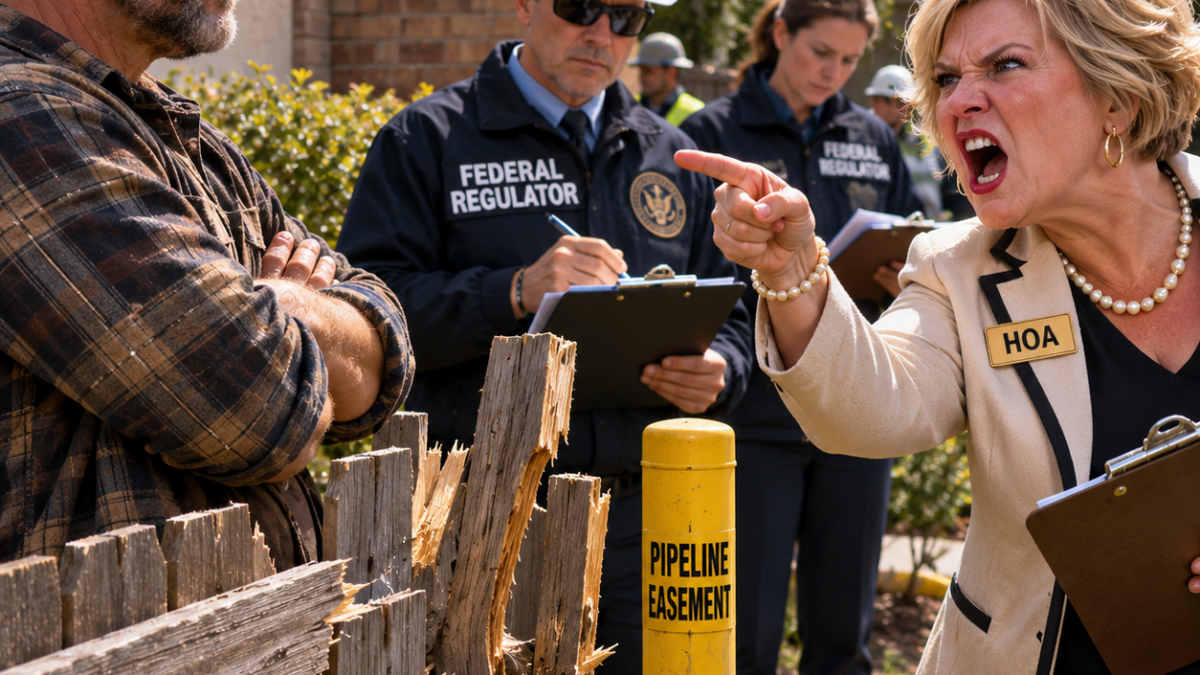
Karen emerged from her house.
She still had her clipboard.
I will never forget that.
A clipboard.
Against federal pipeline regulators.
She marched toward the lead official.
“What is the meaning of this?”
He looked at her.
“Karen Miller?”
“I am president of the Eagle’s Crest Homeowners Association.”
He didn’t react.
“We’re investigating unauthorized excavation inside a protected pipeline right-of-way.”
“This is community property.”
“No, ma’am.”
“I approved the work.”
“That may be part of the problem.”
Her expression changed.
Only slightly.
He walked toward the disturbed soil.
The operator’s technician carefully examined the exposed warning tape.
Everyone became more serious.
The regulator turned toward Karen.
“Who directed the excavation?”
She hesitated.
Then arrogance won.
“I did.”
I almost closed my eyes.
Never volunteer an admission before you understand the question.
He wrote something down.
“Were you aware of the pipeline markers?”
“I was told they were utility indicators.”
“So yes.”
“I didn’t know what kind.”
“The contractor raised a concern?”
Karen glanced toward the crew.
They hadn’t left yet.
The foreman immediately answered.
“I told her there might be gas.”
Karen shot him a murderous look.
The regulator wrote again.
“Thank you.”
Then he opened a rugged tablet.
Aerial map.
Red corridor.
Pipeline right-of-way.
He followed it across my property.
Mr. Henderson’s.
Then Karen’s.
He stopped.
Zoomed.
Looked at her backyard.
Then physically looked over the fence.
“What is that structure?”
Karen followed his gaze.
“My gazebo.”
“And retaining wall?”
“Yes.”
“Those ornamental trees?”
“Yes.”
Pride returned for a moment.
“My garden won an award.”
He looked back at the tablet.
“When were these approved by the pipeline operator?”
Silence.
“Excuse me?”
“Where are your encroachment approvals?”
“The HOA approved the landscaping.”
He stared at her.
Then said the sentence that ended her reign.
“Ma’am, your HOA does not own this easement.”
Karen blinked.
“This is a federal pipeline right-of-way.”
He pointed toward the map.
“Your retaining wall, gazebo, patio grade modification, and numerous deep-rooted plantings appear to be unauthorized encroachments.”
Her mouth opened.
No words.
“They interfere with inspection and emergency access.”
“The builder approved them.”
“That isn’t relevant.”
“The HOA approved them!”
He didn’t raise his voice.
“Your HOA cannot override pipeline safety requirements.”
Neighbors had gathered.
George stood in his driveway.
Mrs. Patel held her youngest child’s hand.
Mr. Henderson leaned against his cane.
Karen looked around.
She knew they were watching.
She tried to regain control.
“This is clearly an administrative misunderstanding.”
“No.”
The official’s tone remained flat.
“This is a safety matter.”
He handed her a document.
“Cease-and-desist order.”
She stared at it.
Then another packet.
“Preliminary notice.”
Her hands began trembling.
“What does this mean?”
“It means no additional excavation.”
He looked toward the backyard again.
“And the existing encroachments require immediate review.”
“You cannot make me tear apart my property.”
“We can require removal of unauthorized structures from the easement.”
Karen looked at me.
I said nothing.
She turned back.
“This is harassment. He called you because we’re in a private HOA dispute.”
The official glanced at me.
Then at the exposed warning tape.
“Ma’am, that tape doesn’t care about your HOA dispute.”
A few neighbors laughed.
Karen heard it.
Her face flushed.
He continued.
“A damaged transmission line can kill people.”
The laughter stopped.
That was the moment everyone understood this was no longer entertaining.
Karen had ordered a machine to dig above a high-pressure gas pipeline because she wanted to win an argument over a fence.
The official began listing potential enforcement consequences.
Daily penalties.
Mandatory inspection.
Excavation costs.
Remediation.
Removal of encroachments.
Potential liability for damage.
I won’t pretend I remember every number precisely.
Karen certainly did.
With every sentence, her face became whiter.
Then the regulator asked:
“Who paid for the retaining wall and gazebo?”
Karen froze.
That question had nothing to do with pipeline safety.
Not directly.
But I knew why it mattered to me.
The HOA had.
At least partly.
I stepped forward.
“I may have relevant documentation.”
Karen spun.
“You shut up.”
The regulator looked at her.
“Ma’am.”
“He has been harassing me for months.”
I almost laughed.
She pointed at me.
“He built an illegal fence just to antagonize the board.”
“Correct.”
Everyone looked at me.
Karen’s eyes widened.
“You admit it?”
“I built ten feet of unapproved fence.”
“See?”
I continued.
“Five feet inside my property.”
Karen smiled triumphantly.
Then I said:
“And I removed it yesterday.”
Her smile disappeared.
“You what?”
“The fence was temporary.”
She finally understood.
Not everything.
But enough.
It had been bait.
Not illegal excavation bait.
I had never expected or wanted her contractor to strike warning tape.
The bait was her obsession.
I knew she’d overreact.
I knew she’d demonstrate arbitrary enforcement.
I knew she’d act publicly.
But Karen had chosen the exact form her overreaction took.
That belonged to her.
The federal inspection expanded.
Pipeline technicians evaluated the disturbed area.
Fortunately, the actual pipe had not been struck.
That was the best outcome of the entire day.
Had the auger gone deeper in the wrong location, none of us would have cared about HOA politics anymore.
Karen’s yard became the next focus.
Records were requested.
Permits.
Easement agreements.
Approvals.
There weren’t any.
Her retaining wall had changed the grade over the corridor.
The gazebo foundation obstructed access.
Large shrubs and ornamental trees presented root issues.
Everything had to be evaluated.
Meanwhile, word spread about the financial records.
I gave copies to an attorney.
Other homeowners retained counsel.
David formally requested an independent audit.
That evening, Karen called an emergency board meeting.
Almost nobody came to support her.
I did not attend.
I had spent enough time watching Karen perform.
David called me afterward.
“Barry resigned.”
“That fast?”
“Frank too.”
“And Cynthia?”
“Crying.”
“Karen?”
“Blaming you.”
“Of course.”
David hesitated.
“The board records show HOA funds paid for some of her backyard work.”
“I know.”
“How long have you known?”
“Long enough.”
He sighed.
“You really are an engineer.”
“I’ve been accused.”
“The homeowners are furious.”
“They should be.”
“Mr. Henderson brought his shoebox.”
I smiled.
“What happened?”
“The room went silent.”
The next morning, I walked over to Mr. Henderson’s house.
He was watering tomatoes.
“How did it go?”
He looked at me.
“David says they’re removing the lien.”
I stopped.
“Already?”
“He says it was improperly imposed.”
His voice broke.
“They’re reviewing the fines.”
I saw tears in his eyes.
He looked embarrassed and turned away.
I pretended not to notice.
After a moment, he said:
“My wife would have been angry.”
“At Karen?”
“No.”
He smiled weakly.
“At me.”
“Why?”
“For worrying so much.”
He touched the tomato plant.
“She always said I worried before there was anything to worry about.”
I looked at the garden.
“You had something to worry about this time.”
“I thought I’d lose the house.”
That sentence hit harder than anything Karen had said to me.
Ten thousand dollars was annoying to some people.
To Mr. Henderson, it threatened the home where he’d spent three decades with his wife.
I put a hand on his shoulder.
“You’re not losing it.”
He nodded.
Then handed me a tomato.
“Take that.”
“Payment?”
“For legal services.”
“I’m not a lawyer.”
“Good. Lawyers don’t take tomatoes.”
I laughed.
That was the first time since the whole conflict started that I felt something resembling victory.
Not when Karen received federal papers.
Not when the contractors stopped.
When Mr. Henderson realized he could keep his home.
The following week, an emergency homeowner meeting filled the clubhouse.
Karen did not preside.
David did.
He stood at the front looking terrified.
“I have never wanted to be president.”
George shouted, “That’s why we trust you!”
People laughed.
David waited.
Then began.
The old board had resigned or been suspended pending investigation.
Karen’s authority to act for the association was revoked.
All contested fines would be reviewed.
Liens based on questionable enforcement practices would be suspended pending legal review.
An independent audit would examine association spending.
Vendor relationships would be disclosed.
Then came the item everyone was waiting for.
Karen.
David looked down at his notes.
“The association’s counsel has advised that actions taken by Mrs. Miller concerning the pipeline excavation appear to have exceeded any lawful authority of the association.”
A resident called:
“You mean she tried to blow us up over a fence.”
David winced.
“I’m trying to use careful language.”
“Try harder.”
More laughter.
David continued.
“The HOA will not use community funds to pay federal penalties arising from an individual’s knowing misconduct.”
There was applause.
I didn’t join.
Not because I disagreed.
Because personal destruction had never been the point.
Karen had a husband.
Family.
Maybe people who depended on her.
Consequences spread.
Justice should be precise.
Anger isn’t.
Then David addressed finances.
An independent accountant had already begun reviewing records.
Early findings showed troubling expenditures.
Contracts awarded without competitive bids.
Payments benefiting areas immediately surrounding Karen’s home.
Potential conflicts of interest.
And documented association money used toward private improvements.
One woman stood.
“So our dues paid for her gazebo?”
David looked uncomfortable.
“Partially, based on the records we’ve reviewed.”
The room exploded.
That gazebo became a symbol.
Mr. Henderson paid fines over tomatoes.
George paid fines over a garage door.
The Patels paid fines over children’s toys.
Meanwhile, community money helped build Karen’s private backyard showpiece on land where it should never have been built.
That hypocrisy destroyed whatever support she had left.
Federal and pipeline enforcement moved on its own schedule.
Inspectors returned.
Survey crews marked the entire corridor.
Karen fought.
Lawyers sent letters.
Engineers responded.
Pipeline representatives produced easement documents predating the HOA.
Karen’s attorneys argued about interpretation.
Safety requirements didn’t change.
Eventually, removal began.
The gazebo came first.
I watched from my backyard.
Not intentionally.
It was difficult not to notice.
Workers removed the roof.
Then posts.
Then flooring.
Karen stood inside her house.
Curtains closed.
Next came shrubs.
Dozens.
Some were mature.
Expensive.
Landscaping crews dug them out carefully because root systems had to be cleared without damaging the pipeline.
Then ornamental trees.
Then portions of hardscape.
The retaining wall was the most complicated.
Removing it meant regrading the land.
Engineers monitored the work.
Pipeline representatives supervised.
Heavy equipment arrived.
For years, Karen’s backyard had been her pride.
Perfect.
Layered.
Elevated.
Controlled.
Week by week, it disappeared.
The final result wasn’t ugly.
It was simply open.
Grass.
Safe grade.
Accessible corridor.
But Karen saw devastation.
One afternoon, I was checking my oak trees when she appeared near the property line.
No clipboard.
That was the first thing I noticed.
She looked tired.
Older.
“Happy?”
I kept inspecting a branch.
“About what?”
She laughed bitterly.
“Don’t.”
I turned.
“Don’t what?”
“Pretend you didn’t plan this.”
“I planned for you to reveal how you used HOA authority.”
“You called the federal government.”
“After you ordered excavation on a marked pipeline corridor.”
“Because of your fence!”
“You chose where to dig.”
“You built it to provoke me.”
“Yes.”
That stopped her.
I didn’t lie.
The fence was bait.
She stared.
“So you admit this was revenge.”
“No.”
“How is it not?”
“The fence didn’t force you to do anything.”
“You knew I’d enforce the rules.”
“Enforcement means notices, hearings, fines if they’re lawful.”
I pointed toward the pipeline corridor.
“It does not mean hiring contractors to dig wherever you want.”
“You set me up.”
“I gave you an opportunity to show everyone how you behave when someone says no.”
Her eyes filled with rage.
Then something else.
Tears.
I wasn’t prepared for that.
“You’ve destroyed my life.”
I lowered my voice.
“No.”
“You ruined my yard.”
“I didn’t build on the pipeline.”
“You turned the neighborhood against me.”
“I didn’t fine them.”
“You took my position.”
“I never wanted your position.”
“You exposed my finances.”
“Those were homeowners’ finances.”
She looked away.
For several seconds, neither of us spoke.
Then she said something surprisingly honest.
“You think they respected me?”
I didn’t answer.
“They feared me.”
“Yes.”
She nodded.
“At least fear worked.”
“For a while.”
She looked at the trees.
“Those stupid trees started all of this.”
My expression changed.
She saw it.
For the first time, she looked ashamed.
I walked toward the nearest oak.
“This one is Ben.”
She said nothing.
“He had two daughters.”
I touched the trunk.
“This one is Ramirez. His mother still sends me a Christmas card.”
I moved to the next.
“Cole loved baseball.”
Another.
“Mercer could sleep through artillery.”
Karen stared.
I continued through all seven.
Not loudly.
Not dramatically.
Just names.
People.
When I finished, I looked at her.
“You called them an eyesore.”
Her eyes dropped.
“I didn’t know.”
“You didn’t ask.”
That landed.
The whole neighborhood had lived inside that problem.
Karen rarely asked.
She declared.
She assumed.
She ordered.
Knowing people might have made control more difficult.
She turned away.
I thought she would leave.
Instead she whispered:
“I was trying to keep the neighborhood from becoming a mess.”
“That’s not what happened.”
“It started that way.”
I believed her.
That was the sad part.
Maybe years earlier, Karen really had wanted clean common spaces.
Reasonable standards.
Property values.
Then people complied.
Compliance felt good.
Influence became authority.
Authority became identity.
Eventually, disagreement felt like disrespect.
Disrespect felt like rebellion.
And rebellion had to be punished.
She asked:
“What happens now?”
“I don’t know.”
“That’s a lie.”
“I don’t control the pipeline operator.”
“What about the HOA?”
“I’m not on the board.”
“You control them.”
“No.”
“They listen to you.”
“Because I show them documents.”
She looked at me.
“I can’t afford all this.”
I felt sympathy.
Not enough to erase accountability.
But sympathy nonetheless.
“Get a lawyer.”
“I have one.”
“Then listen to them.”
She laughed without humor.
“You’d like that.”
“Yes.”
That surprised her.
“Why?”
“Because if you’d listened to qualified people earlier, none of this would have happened.”
She left without another word.
The financial audit took months.
It found more than sloppy accounting.
Several vendor contracts had gone to Karen’s relatives or friends.
Some lacked competitive bidding.
Some were overpriced.
Personal-benefit expenditures were mixed with community spending.
The exact legal classification of each expense went to lawyers and auditors.
But one conclusion was obvious.
Residents had not been given transparent information.
The new board responded aggressively.
Not vindictively.
Correctively.
Contracts rebid.
Budgets published.
Invoices available.
Meeting minutes detailed.
Conflicts disclosed.
Vague enforcement policies suspended.
Then came Mr. Henderson’s case.
David called me.
“You should be here.”
“For what?”
“Board meeting.”
“Why?”
“Just come.”
I arrived to find Mr. Henderson sitting in the front row.
David opened the meeting.
First resolution:
All fines relating to Mr. Henderson’s vegetable garden rescinded.
Unanimous.
Second:
Lien released.
Unanimous.
Mr. Henderson lowered his head.
His shoulders shook.
Mrs. Patel moved beside him and took his hand.
David waited.
Then said:
“Mr. Henderson, the association owes you an apology.”
Henderson looked up.
David’s voice became less formal.
“We treated your home like collateral in a power struggle.”
The room was silent.
“We can’t give you back the years of worry. But your home is yours. Your garden stays.”
Everyone stood.
Not because David asked.
Because somebody started clapping.
Then another.
Then the whole room.
Mr. Henderson cried openly.
So did several other people.
I looked down.
Military funerals teach you how to stand still while something inside you breaks.
That night, the feeling was different.
Not grief.
Release.
After the meeting, Mr. Henderson found me.
“My wife would have liked you.”
“You never know.”
“She liked stubborn people.”
“Then probably.”
He handed me a paper bag.
Tomatoes.
Of course.
The Patels’ fines were reviewed next.
Most voided.
George’s garage-door penalties.
Voided.
Dozens of other minor penalties.
Reviewed and rescinded.
The association didn’t eliminate rules.
That wasn’t the goal.
Parking still mattered.
Safety mattered.
Noise mattered.
Common property mattered.
But the rules stopped being weapons.
The new philosophy was simple.
Warnings before fines.
Objective standards.
Right to appeal.
Conflict disclosures.
No selective enforcement.
No retaliation.
Basic governance.
Boring governance.
Wonderful governance.
Then came the oak trees.
David put the issue on the agenda.
I didn’t ask him to.
“The original violation against Mr. Turner’s seven oak trees.”
He looked at the board.
“Motion?”
Mrs. Patel, now temporarily serving as a community representative, raised her hand.
“Rescind it permanently.”
“Second?”
George.
“Second.”
“All in favor?”
Every hand.
The room applauded.
I didn’t.
I just looked through the clubhouse window toward the direction of my house.
Seven trees.
Still standing.
That was enough.
A month later, the pipeline remediation at Karen’s property finished.
Her backyard looked bare.
She stopped attending HOA meetings.
Then a FOR SALE sign appeared.
George noticed first.
He called me.
“You seen it?”
“Yes.”
“Interesting company.”
I hadn’t noticed.
Then I looked.
The listing agent belonged to the same real-estate company Karen had previously tried to prohibit residents from using because it wasn’t “preferred.”
George laughed for nearly a minute.
I did too.
Sometimes irony needs no help.
Karen and her husband sold the property.
At a loss, according to neighborhood gossip.
I didn’t verify it.
Didn’t care.
The day they moved, I happened to be working outside.
A truck stood in the driveway.
Boxes.
Furniture.
The giant stone eagle remained beside the entrance.
Karen walked toward her car.
She saw me.
For a moment, I expected another confrontation.
Instead she crossed the street.
I put down my shovel.
She stopped several feet away.
“I wanted to ask you something.”
“Okay.”
“Did you ever consider taking the trees down?”
“No.”
“Not once?”
“No.”
“Even when the fines started?”
“No.”
“Why?”
I looked at them.
“You already know.”
She nodded.
Then she surprised me.
“I’m sorry about what I called them.”
I studied her.
This wasn’t enough to erase everything.
But it sounded genuine.
“Thank you.”
“I still think you manipulated me.”
“I did.”
She smiled faintly.
“At least you’re honest.”
“The fence was bait.”
“I know.”
“You still made your own decisions.”
“I know that too.”
She looked back at her house.
“I thought keeping control meant keeping standards.”
“What changed?”
“I don’t know.”
She thought for a long time.
“People stopped being neighbors.”
That was probably the most self-aware thing I’d ever heard from her.
“Yes.”
She nodded.
“My husband wanted me to resign years ago.”
I said nothing.
“I thought he was weak.”
Another pause.
“He was right.”
She looked toward my trees.
“Which one was your best friend?”
I pointed.
“That one.”
Ben’s oak.
She approached carefully.
Stopped several feet away.
“Ben?”
“Yes.”
“What happened?”
“Afghanistan.”
She lowered her head.
“I’m sorry.”
“So am I.”
Then she left.
No dramatic final threat.
No screaming.
No humiliation.
Just a woman walking away from the neighborhood she’d once controlled.
I watched the moving truck disappear.
George came outside ten minutes later.
“She’s gone?”
“Yes.”
“You okay?”
“Yeah.”
He looked disappointed.
“What?”
“I expected fireworks.”
“Sorry.”
“You could’ve at least played patriotic music.”
“Go home, George.”
He laughed.
Peace returned slowly.
Not instantly.
Fear leaves communities slower than dictators do.
For months, people still reacted nervously when official-looking envelopes appeared.
Homeowners still asked whether putting a flowerpot outside required permission.
Parents still rushed to collect toys.
George still closed his garage door whenever he heard a car slow down.
Habits formed under fear don’t disappear when the source leaves.
So the new board did something smart.
They stopped acting like a board whenever possible.
They organized a barbecue.
Not mandatory.
No agenda.
No speeches beyond “food’s ready.”
The Patels’ children left bikes scattered across the grass.
Nobody cared.
George brought his Mustang.
Hood open.
People gathered around.
Mr. Henderson arrived carrying boxes of tomatoes and cucumbers.
He gave produce away like Christmas gifts.
David manned the grill wearing an apron that said:
**ACCOUNTANTS DO IT WITH BALANCE**
I told him it was terrible.
“My daughter bought it.”
“Still terrible.”
He handed me a burger.
“You’re welcome.”
The seven oaks had grown.
Not dramatically.
But enough.
Ben’s tree was now taller than me.
That evening, several children played near them.
One little girl reached toward a leaf.
I almost told her not to touch it.
Then stopped myself.
Trees aren’t memorials because nobody can approach them.
They’re memorials because life continues around them.
Mr. Henderson stood beside me.
“Your boys are doing well.”
I looked at him.
“The trees?”
“Who else?”
I smiled.
“Yeah.”
He pointed toward the largest one.
“That one’s stubborn.”
“Ben.”
“Good man?”
“The best.”
Henderson nodded.
Then handed me a tomato.
“You always carry tomatoes?”
“Retirement privilege.”
Months later, David and the board began rewriting the covenants.
They asked me to join the committee.
I refused.
“You love documents,” David said.
“I love reading other people’s bad documents.”
“Perfect qualification.”
“No.”
George joined instead.
That was a mistake.
His first proposal was:
“Garage doors may remain open until morale improves.”
Rejected.
His second:
“All dandelions shall be treated with dignity.”
Rejected.
His third:
“No HOA president may carry a clipboard larger than twelve inches.”
Almost passed.
Eventually, the committee produced something reasonable.
Clear landscaping standards.
Specific definitions.
Appeal procedures.
Limits on discretionary fines.
Mandatory conflict disclosures.
Financial-transparency requirements.
Protection against selective enforcement.
And one provision I particularly liked:
Where utility easements or government safety regulations applied, no HOA approval could authorize conduct prohibited by the controlling authority.
David called it the Karen Clause.
I told him not to.
Everyone called it that anyway.
My temporary fence came down.
It had never mattered.
I saved one horizontal board from it.
George found out.
“You sentimental?”
“No.”
“Evidence trophy?”
“No.”
“Then why keep it?”
I thought about that.
“Reminder.”
“Of Karen?”
“No.”
“Of what?”
“That bait only works when someone chooses to bite.”
He nodded.
“That’s annoyingly wise.”
“Thanks.”
A year after the first violation notice, Mr. Henderson asked me to help in his garden.
We replaced some raised-bed boards.
His hands weren’t as steady as before.
I did most of the lifting.
At lunch, we sat beneath a patio umbrella.
He looked toward the row where his wife had planted tomatoes decades earlier.
“I almost sold the house.”
I stopped eating.
“When?”
“Before you moved in.”
“Because of the lien?”
He nodded.
“I had a realtor come.”
“What stopped you?”
He smiled.
“Couldn’t figure out where I’d put her garden.”
We sat quietly.
Then he said:
“You know what bothered me most?”
“What?”
“Not the money.”
I waited.
“It was feeling stupid.”
“For what?”
“For being scared of Karen.”
“You weren’t stupid.”
“I was eighty-six years old hiding violation letters from my daughter because I didn’t want her worrying.”
He looked at his hands.
“I’d been in Korea. Raised three children. Buried my wife.”
His voice cracked.
“And some woman with a clipboard had me afraid to open the mail.”
That sentence stayed with me longer than anything else in the story.
Fear doesn’t need to be rational to be real.
Authority doesn’t need to be legitimate to feel overwhelming.
Karen’s greatest weapon had never been fines.
It was convincing people resistance would cost more than surrender.
Once people discovered that everyone else was frightened too, the weapon stopped working.
I asked Mr. Henderson:
“Do you still have the shoebox?”
“Every notice.”
“Why?”
He smiled.
“Reminder.”
“Of Karen?”
“No.”
He used my own answer.
“Of what happens when people don’t talk to their neighbors.”
Fair enough.
Federal pipeline enforcement eventually concluded.
The line hadn’t been damaged.
That mattered enormously.
Inspection and remediation costs were still substantial.
Karen faced penalties and removal expenses tied to unauthorized encroachments and excavation.
How every dollar ultimately resolved involved agencies, operators, attorneys, and insurance questions I wasn’t part of.
I didn’t need the details.
The important point was safety.
The corridor was clear.
The pipeline accessible.
The dangerous excavation stopped before disaster.
Sometimes people retelling the story made it sound funny.
“Karen nearly blew up the neighborhood over a fence.”
It wasn’t funny.
Not really.
High-pressure gas doesn’t care about personality conflicts.
One unlucky strike could have changed everything.
That part still bothered me.
I’d wanted Karen to expose her abuse.
I’d anticipated she’d escalate.
But standing over that churned yellow warning tape taught me something.
Strategy has limits.
When safety enters the equation, being right isn’t enough.
After that, I became less interested in clever victories.
More interested in clean ones.
Document.
Report.
Let qualified authorities act.
No unnecessary risks.
I still believed in standing your ground.
I just understood better that people around you shouldn’t become collateral damage in your fight.
The seven oaks became neighborhood landmarks.
Not official ones.
Nobody installed signs.
But people knew.
New families would ask:
“What’s the story with those trees?”
Usually George told them.
His version became more ridiculous every year.
By year three, Karen apparently arrived with a bulldozer, three attorneys, a helicopter, and the governor.
I corrected him.
“Nobody believes you.”
“They like my version.”
“Your version has explosions.”
“Potential explosions.”
“No helicopter.”
“Creative license.”
“It’s my story.”
“Then tell it more interestingly.”
I couldn’t argue with that.
But when people asked me, I kept it simple.
“They’re for friends.”
That was still the truth that mattered most.
Ben’s daughters visited once.
They were adults now.
I’d stayed loosely in contact.
One summer afternoon, they stopped while passing through the state.
I took them outside.
“This one.”
They stood beside their father’s tree.
The older daughter put her palm against the bark.
“He’d laugh.”
“At what?”
“All this.”
I smiled.
“Yes.”
“He hated HOAs.”
I laughed harder.
“That sounds like Ben.”
The younger daughter asked:
“You really fought months over these?”
“I fought over more than trees eventually.”
“But it started here.”
“Yes.”
She looked at the oak.
“Thank you.”
There are moments when you don’t know what to say.
That was one.
I nodded.
She hugged me.
And suddenly all the paperwork, meetings, fines, federal vehicles, audits, arguments, and anger shrank into background noise.
The tree was still there.
That was enough.
Another year passed.
David was re-elected HOA president despite repeatedly insisting he didn’t want the job.
His campaign consisted entirely of:
“Please vote for somebody else.”
He won overwhelmingly.
George claimed that proved democracy was broken.
The Patels joined the social committee.
Mr. Henderson’s daughter began helping with his garden.
People started leaving garage doors open.
Children played outside.
Someone painted their front door dark blue.
No civil collapse followed.
A family installed a basketball hoop.
The earth remained in orbit.
The neighborhood didn’t become chaos when rules became reasonable.
It became a community.
One morning, I received an envelope from the HOA.
For half a second, my body reacted automatically.
That old tension.
Then I laughed.
Inside was a letter from David.
**Dear Mr. Turner,**
**This is formal notice that your seven oak trees are fully compliant with the current landscaping standards.**
Underneath, handwritten:
**Please stop laughing. The attorney made us send this.**
I framed it.
Not prominently.
It’s in my office.
Next to the original violation.
Sometimes visitors notice them.
Two letters.
Same trees.
Same land.
Completely different definition of authority.
The first says:
Remove them.
The second says:
They’re fine.
Nothing about the trees changed.
Only the people interpreting power.
That is why vague rules are dangerous.
A good rule should tell ordinary people what is allowed before enforcement begins.
A bad rule allows the enforcer to decide after the fact.
Karen thrived in ambiguity.
If a clause said “harmonious,” she decided what harmony meant.
If a garage couldn’t be “excessively open,” she decided how many minutes were excessive.
If landscaping had to remain “appropriate,” she decided what appropriate looked like.
The new board learned from that.
Specificity protects everyone.
Homeowners.
Boards.
Neighbors.
Even future presidents.
Because authority with boundaries isn’t weak.
It’s legitimate.
One autumn afternoon, years after Karen moved away, I sat on my porch.
Ben’s oak leaves were turning orange.
The others showed hints of red and gold.
Mr. Henderson walked slowly toward me.
He needed a cane full-time now.
I stood.
“You need something?”
He pointed to the trees.
“They’re getting big.”
“That’s usually what trees do.”
“Smartass.”
I brought him a chair.
We sat.
He looked toward his house.
“My daughter wants me to move in with her.”
I didn’t know what to say.
“Health?”
“Age.”
He shrugged.
“Apparently ninety is considered old now.”
“Government overreach.”
He laughed.
Then became serious.
“I think I’m going.”
I nodded.
“You’ll keep the house?”
“No.”
“What about the garden?”
“The buyers want it.”
“Good.”
He smiled.
“That’s why I’m selling to them.”
A week later, he brought me the old shoebox.
I recognized it immediately.
Violation notices.
Hundreds of pages.
“I don’t want this.”
“You should have it.”
“Why?”
“History.”
I opened the lid.
Karen’s signatures.
Fine amounts.
Warnings.
Threats.
Three years of fear.
“You sure?”
“Yes.”
I looked at him.
“What do you want me to do with it?”
“Burn it.”
I raised an eyebrow.
“Seriously?”
“After I leave.”
“Why?”
He smiled.
“Some paperwork deserves archiving.”
Then tapped the box.
“This deserves fire.”
I agreed.
The night before he moved, several neighbors gathered in my backyard.
George.
The Patels.
David.
Mr. Henderson and his daughter.
We put the notices into a metal fire pit.
Not HOA records.
Not anything legally necessary.
His personal copies.
One by one.
He threw the first.
It curled black.
Then another.
George added his old garage-door fine.
Mrs. Patel brought one about the Big Wheel.
David brought a copy of a ridiculous warning he’d received before joining the board.
We burned them.
Not out of hatred.
Release.
Mr. Henderson watched quietly.
Then said:
“My wife would have loved this.”
His daughter laughed.
“She would’ve brought marshmallows.”
So we did.
George found a bag.
We roasted marshmallows over the ashes of HOA violations.
Ridiculous.
Perfect.
Before leaving, Henderson stood beside his wife’s garden.
He took a handful of soil.
Put it into a small jar.
Then hugged me.
“Take care of your boys.”
He meant the trees.
“I will.”
He moved the next morning.
I cried after his car disappeared.
More than I expected.
The new homeowners kept the vegetable garden.
Every summer, they still put extra tomatoes by the curb in a little box marked:
**HENDERSON’S GARDEN — TAKE SOME**
When I see that sign, I think about how close fear came to erasing something beautiful.
And how easily people justify erasing things when they only see rules, not people.
Karen saw seven trees.
I saw seven men.
She saw vegetables.
Henderson saw his wife.
She saw bicycles.
The Patels saw childhood.
She saw an open garage door.
George saw purpose.
That was Karen’s failure.
Not the pipeline.
Not the finances.
Those were consequences.
Her deeper failure was reducing human lives to violations.
Years later, someone told me Karen had moved to another state.
I didn’t ask where.
Didn’t search.
Didn’t care.
I hope she changed.
I mean that.
A satisfying ending doesn’t require a person to suffer forever.
Consequences serve a purpose when they stop harm.
If Karen eventually learned that authority isn’t ownership, good.
If she didn’t, that’s no longer my problem.
Mine is here.
Seven oak trees.
A peaceful street.
Neighbors who talk.
A garden that survived.
A blue front door.
Kids’ bikes on lawns.
George’s Mustang with the garage door wide open.
And a fifty-foot strip of ordinary grass behind our houses where nobody builds anything anymore.
Every few years, pipeline crews inspect it.
They arrive with equipment.
Residents move aside.
Nobody argues.
George once walked over to an inspector and said:
“You know, we had a lady here who thought she outranked you.”
The poor man looked confused.
I dragged George away.
“You’re going to get us on a watchlist.”
“Worth it.”
One morning, I found a small yellow utility marker knocked over near my back fence.
I stood it upright.
That was all.
But I remembered the auger.
The warning tape.
Karen shouting:
“Keep going.”
For a second, I felt anger again.
Then I looked at the oak trees.
Their branches were thick now.
Their shade stretched across the grass.
Birds nested in them.
Children sometimes collected acorns.
Life had grown around memory.
Ben’s tree was the largest.
Of course.
He always had to win.
I sat beneath it.
Twenty years in the Army had taught me to think in terms of missions.
Objective.
Resources.
Threats.
Contingencies.
Success.
Retirement taught me something harder.
Not every victory needs an enemy lying defeated at your feet.
Sometimes victory is an old man keeping his garden.
Sometimes it’s children leaving bikes outside without their mother panicking.
Sometimes it’s an accountant reluctantly becoming HOA president.
Sometimes it’s a contractor having enough sense to stop an auger before hitting a gas pipeline.
And sometimes it’s seven trees still standing years after someone ordered you to cut them down.
Karen wanted me to believe power belonged to whoever sent the most intimidating letter.
She was wrong.
Power can come from paperwork.
But only when the paperwork reflects legitimate authority.
Her violation notices looked official.
The pipeline easement was official.
Her clipboard looked serious.
The federal safety order was serious.
Her board had rules.
The pipeline operator had rights that predated the neighborhood.
She spent years hiding behind ambiguity.
Then she ran headfirst into a boundary that was not ambiguous at all.
Fifty feet.
Recorded.
Mapped.
Protected.
No structures.
No deep-rooted plantings.
No unauthorized grade changes.
And most importantly:
Don’t dig into a marked high-pressure gas corridor because you’re angry about a fence.
In the end, federal regulators didn’t destroy Eagle’s Crest.
They exposed what Karen had done.
The residents did the rest.
They removed the leadership that enabled her.
They reviewed finances.
They rescinded abusive fines.
They repaired governance.
They chose cooperation over fear.
That distinction matters.
One abusive president does not make every HOA evil.
One set of rules doesn’t automatically make a community oppressive.
People do.
Systems do.
Silence does.
And people can change systems.
That’s the ending I care about.
Not Karen’s ruined garden.
Not the federal penalties.
Not the FOR SALE sign.
Mr. Henderson’s lien disappearing.
That’s the ending.
His tomatoes.
That’s the ending.
The Patels laughing while their children left bikes on the lawn.
That’s the ending.
George opening his garage door and leaving it open all afternoon because nobody was timing him.
That’s the ending.
David publishing the HOA budget online where anyone could read it.
That’s the ending.
And seven oak trees growing taller every year.
That’s the ending.
One evening, years after the conflict, I sat under Ben’s oak with a glass of iced tea.
Almost exactly like the afternoon Karen first arrived.
Same street.
Same house.
Same lawn.
Different neighborhood.
The sun was setting behind the rooftops.
Wind moved through the branches.
Leaves whispered overhead.
George walked past.
“Talking to your trees?”
“No.”
“Sure.”
He kept walking.
Then turned.
“You know, she did one good thing.”
“Karen?”
“Yeah.”
I stared at him.
“This should be interesting.”
“She got everybody talking.”
I thought about it.
He was right.
Before Karen attacked the trees, I barely knew my neighbors.
George was the man with the Mustang.
The Patels were the family across the street.
Henderson was the elderly gardener.
David was some accountant on the board.
Karen’s abuse gave us a reason to compare stories.
Those stories became evidence.
Evidence became solidarity.
Solidarity broke fear.
I looked up at the branches.
“Don’t tell her that.”
George laughed.
“Wouldn’t dream of it.”
He disappeared down the sidewalk.
I stayed beneath the tree.
Sometimes I still think about that first afternoon.
Karen pointing.
“Those have to go.”
If I had obeyed, she would have won something much larger than a landscaping dispute.
She would have confirmed the lesson she’d been teaching Eagle’s Crest for years.
Resistance is expensive.
Silence is easier.
Give in.
I didn’t.
Then Henderson didn’t.
Then David didn’t.
Then George.
Then the Patels.
Then dozens of others.
One person’s refusal became a neighborhood’s.
That’s why the trees matter beyond memory now.
Their roots run deeper than they did when I planted them.
So does everything else.
The community.
The friendships.
The courage.
The lesson.
I had wanted peace when I retired.
For a while, I thought peace meant nobody bothering me.
Now I know better.
Real peace isn’t the absence of disagreement.
It’s living somewhere disagreement doesn’t become domination.
It’s knowing a neighbor can say no without becoming an enemy.
It’s knowing rules apply consistently.
It’s knowing authority can be questioned.
It’s knowing your home is still yours even when someone with a clipboard wants to pretend otherwise.
I finished my iced tea.
The light faded.
Seven oaks stood above me.
I could name every one in the dark.
Ramirez.
Cole.
Watkins.
Mercer.
Bishop.
Franklin.
Ben.
Seven men who never made it home.
Seven trees Karen once ordered me to destroy.
Seven trees that outlasted her presidency.
Some battles are won loudly.
Ours wasn’t.
We won with certified letters.
Surveys.
Meeting minutes.
Bank records.
Neighbors standing together.
And one contractor smart enough to stop digging when yellow warning tape came out of the ground.
Karen spent years using rules to make people afraid.
In the end, she was undone by a rule she couldn’t bully, reinterpret, or vote away.
The pipeline stayed.
The garden changed.
The HOA changed.
The neighborhood changed.
And the trees?
The trees kept growing.
That’s all I ever wanted them to do.








