PART 2: HOA Karen Cut Off My Power and Water to Force Me Out—Then I Proved Her HOA Had Been Legally Dead for 10 Years
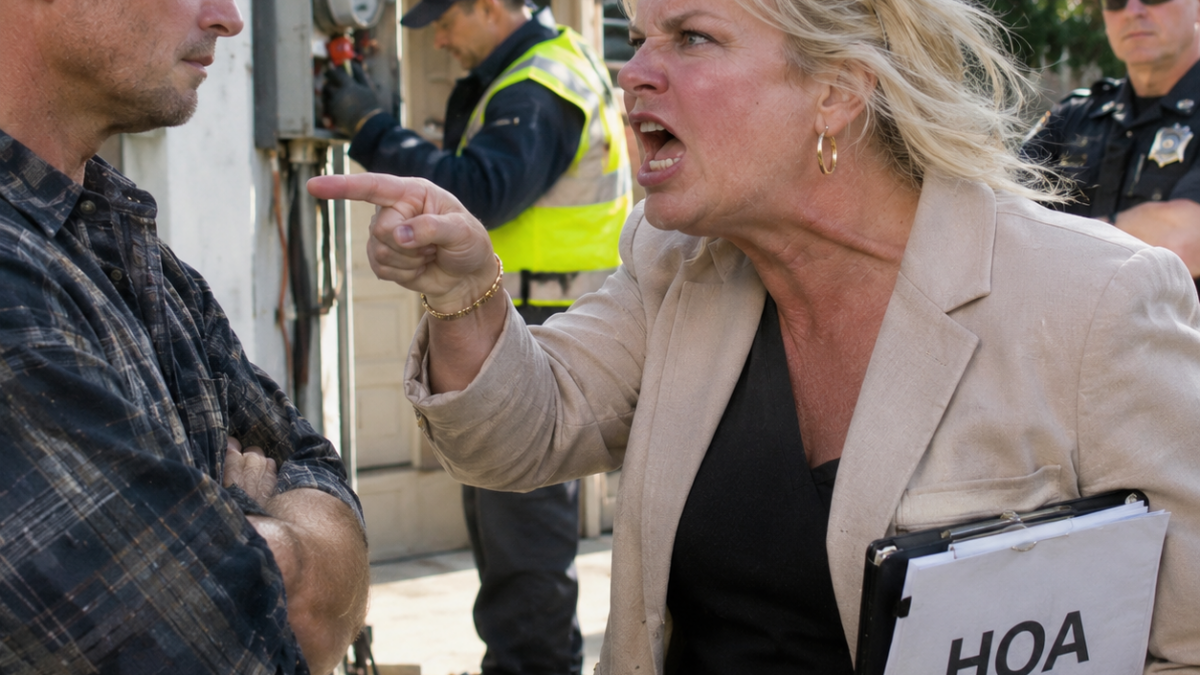
PART 2
I started a notebook the next morning.
Black Moleskine.
Nothing fancy.
Date.
Time.
Exact language.
What Brenda claimed.
What the actual governing documents said.
The first entry read:
Basketball hoop. Brenda cites “architectural harmony standard.” No such provision in recorded CC&Rs.
Five days later, the official fine arrived.
Cream-colored cardstock.
Gold Timber Falls crest.
Heavy enough to make nonsense feel expensive.
UNAPPROVED RECREATIONAL STRUCTURE — DRIVEWAY.
FINE: $500 PER DAY UNTIL REMOVAL.
I sat at the kitchen table with coffee.
Five hundred dollars.
Per day.
For a portable basketball hoop.
Khloe came through the kitchen wearing her school uniform.
She looked at the letter.
“Is that about my hoop?”
“Yeah.”
“Do I have to take it down?”
“No.”
She studied my face.
“Are you sure?”
“Yes.”
“Because I can.”
I looked at her.
That was what grief had done.
She had learned to surrender things before someone could take them.
“No.”
I folded the letter.
“You’re allowed to have something you like.”
She nodded.
Then grabbed her backpack.
After she left, I wrote a formal dispute.
Three pages.
Cited the actual recorded CC&Rs.
Page numbers.
Definitions.
Sections.
I pointed out that no architectural harmony standard existed.
I pointed out that a portable basketball hoop did not qualify as a permanent exterior modification under the governing documents.
Certified mail.
Return receipt.
Brenda signed for it personally.
Two days later, a man arrived to measure my grass.
I wish I were exaggerating.
Late forties.
Clipboard.
Ruler.
He walked the front yard.
Knelt in four places.
Measured.
Finally stood.
“Three-quarters inch over.”
I stared.
“You’re serious.”
He looked embarrassed.
“I’m just doing the inspection.”
“Who sent you?”
He didn’t answer.
He didn’t need to.
Tuesday:
$200 fine.
Excessive lawn height.
I mowed.
Not because Brenda was right.
Because when you’re building a case, you don’t feed the other side anything legitimate.
Then I walked across the street.
Tommy Griggs was washing his pickup.
Mid-thirties.
Plumber.
Two kids.
Garage so clean I suspected he vacuumed the concrete.
“Tommy.”
He shut off the hose.
“What’s up?”
“You ever get fined by Brenda?”
He laughed.
Not because it was funny.
“How much time you got?”
“Enough.”
He leaned against his truck.
“Two grand.”
“For what?”
“Garage door.”
I looked over.
Gray.
“What was wrong with it?”
“Wrong gray.”
“What color?”
“Coastal Fog.”
“What was approved?”
“Harbor Mist.”
I stared.
“Those are the same color.”
“That’s what I said.”
He shook his head.
“She showed up with a swatch like she worked for the FBI paint division.”
“You paid?”
“Everyone pays.”
“Why?”
Tommy looked toward Brenda’s side of the subdivision.
“Because nobody wants the fight.”
That phrase stayed with me.
Nobody wants the fight.
That evening, Ruth Emberly knocked on my door.
Early seventies.
Lived in Timber Falls longer than almost anyone.
She brought oatmeal cookies.
And information.
We sat on the porch while crickets chirped.
“She’s been doing this for years,” Ruth said.
“How many?”
“Families?”
“Yes.”
“At least three that left because of her.”
“Names?”
“Petersons. Daltons. Weavers.”
“What happened?”
“Different excuse every time.”
She counted on her fingers.
“Fence. Shed. Christmas lights. Noise. Parking.”
“Why didn’t anyone challenge her?”
Ruth gave me a tired smile.
“Because Brenda has the board.”
She paused.
“And Dale.”
“Her husband?”
“He sits on the county planning commission.”
That interested me.
Ruth brushed cookie crumbs from her skirt.
“People get tired, Garrett.”
She looked toward Khloe’s hoop.
“They decide moving is easier than asking permission to breathe.”
After Ruth left, I opened the notebook.
Entry Seven.
I wasn’t tired.
And Brenda had made one critical mistake.
She assumed patience meant weakness.
In electrical work, patience isn’t weakness.
Patience keeps you alive.
You don’t reach into a live panel because you’re angry.
You identify the source.
You isolate the circuit.
You verify.
Then you act.
Three weeks later, Brenda escalated.
I had spent ten hours rewiring a dental clinic in Concord.
When I turned into Timber Falls, the sun was low.
Every house on the street had porch lights.
Every house except mine.
My house was black.
Khloe sat on the front porch.
Flashlight beside her.
Library book in her lap.
My stomach dropped.
She looked up.
“It happened again, Daddy.”
“Again?”
“The lights.”
I parked.
Walked inside.
Refrigerator silent.
AC dead.
Ceiling fans still.
North Carolina in July.
Ninety-four degrees outside.
The inside temperature was already climbing.
I went to the electrical panel.
Main breaker:
On.
Branch circuits:
On.
No visible damage.
No fault.
No reason the house should be dead.
Which meant the problem was upstream.
I grabbed my multimeter.
Went to the meter box.
Opened the cover.
And knew immediately.
The load-side connections had been deliberately disconnected.
Clean work.
Intentional.
Not weather.
Not failure.
Not accident.
Somebody had physically interrupted power between the service equipment and my house.
I stood there for several seconds.
Twenty-two years as an electrician.
You develop an instinct for the difference between broken and touched.
This had been touched.
On the front door was another cream-colored letter.
ELECTRICAL SERVICE SUSPENDED PENDING RESOLUTION OF CODE VIOLATION 2024-0087.
UNAUTHORIZED ELECTRICAL MODIFICATIONS.
HOA COMPLIANCE OFFICE.
I laughed once.
No humor.
HOA Compliance Office.
There was no office.
There was Brenda.
A printer.
A clipboard.
And apparently enough confidence to believe she could shut off electricity.
I called Duke Energy.
The representative checked my account.
“No disconnection order.”
“Any work ticket?”
“No.”
“Service suspension?”
“No.”
“So nobody from Duke touched my meter?”
“No, sir.”
A technician arrived later.
He inspected.
Documented unauthorized tampering.
Reconnected the service.
I watched him work beneath a flashlight.
Khloe sat on the porch eating a peanut-butter sandwich.
The milk had warmed.
Ice cream melted.
The house was still hot.
When the AC finally started again, the compressor sounded like mercy.
Later, Khloe asked:
“Daddy?”
“Yeah?”
“Why does that lady hate us?”
I took my time.
“She doesn’t hate us.”
Khloe frowned.
“She acts like it.”
“She hates not being in charge of us.”
My daughter thought about that.
Then nodded.
The next morning, I filed a formal complaint with Duke.
Then bought three security cameras.
Front door.
Meter.
Backyard.
Installed them myself.
Clean wiring.
Cloud storage.
Motion alerts.
Entry Twelve:
Unauthorized power interruption.
Entry Thirteen:
Possible utility tampering.
Then I started listing statutes.
Brenda had turned a fake basketball-hoop violation into something criminal.
Ten days later, I woke up.
Went to the kitchen.
Turned on the faucet.
Nothing.
Not a drip.
Bathroom.
Nothing.
Laundry.
Nothing.
I walked outside to the curb.
Opened the water-meter box.
The curb stop was closed.
Fully.
Not stuck.
Not damaged.
Turned shut with a proper key.
On my front door:
Another letter.
WATER SERVICE SUSPENDED DUE TO NON-COMPLIANT EXTERIOR PLUMBING FIXTURE.
SECTION 9.3.
I stood on the porch and laughed.
The CC&Rs ended at Section Eight.
There was no Section Nine.
No 9.3.
Brenda had now cited multiple phantom sections of a document she apparently assumed nobody would ever read.
Khloe couldn’t shower.
Couldn’t brush her teeth at home.
Couldn’t fill a glass of water.
I packed a towel and clean clothes.
Drove her to Anna’s parents.
She sat in the passenger seat holding her basketball.
“Can I bring this?”
“Of course.”
She looked out the window.
“I can practice at Grandpa’s.”
That sentence hurt more than Brenda’s letters.
My daughter was adapting to having basic utilities taken away like it was bad weather.
I called the water utility.
No shutoff order.
No account issue.
A technician reopened the curb valve and documented the interference.
Before leaving, he said quietly:
“You might consider a locking cover.”
“I already am.”
I installed one that afternoon.
Stainless hardware.
Padlock.
Camera angle adjusted.
That evening, Ruth showed up with beef stew.
She sat at my table.
Then told me something that changed the entire shape of the problem.
“The Petersons.”
“What about them?”
“Brenda shut off their water.”
I stopped eating.
“When?”
“Three years ago.”
“Why?”
“Some violation.”
Ruth shook her head.
“They had a baby.”
I put down my fork.
“A baby?”
“Formula-fed.”
“No water.”
Ruth’s voice lowered.
“They left eight weeks later.”
I leaned back.
“Did Brenda do this to the others?”
“Utilities?”
“Anything similar.”
Ruth nodded slowly.
“Fines first.”
“Then?”
“Threats.”
“And then?”
“Whatever makes staying too hard.”
I stared at the table.
“It’s a system.”
Ruth looked at me.
“Yes.”
That word landed differently.
System.
Not temper.
Not personality.
Not an overzealous volunteer.
A process.
Fines.
Pressure.
Isolation.
Utilities.
Exhaustion.
Move.
That night Khloe slept at her grandparents.
I sat alone.
Opened the Moleskine.
Then stopped.
I didn’t want to keep documenting symptoms.
I wanted the source.
People like Brenda never have power in a vacuum.
There is always a document.
An office.
A statute.
A filing.
Something underneath.
So I opened the North Carolina Secretary of State business search.
Typed:
TIMBER FALLS HOMEOWNERS ASSOCIATION INC.
The result appeared.
Registered:
Registered agent:
Brenda L. Stovall.
Status:
ADMINISTRATIVELY DISSOLVED.
Date:
March 14, 2014.
I stared.
Read again.
Then a third time.
Failure to file required reports.
I opened the record.
Downloaded the certificate.
The HOA corporation had been dissolved ten years earlier.
I sat completely still.
For a decade, Brenda had been:
Collecting dues.
Issuing fines.
Recording liens.
Holding votes.
Threatening homeowners.
Calling herself HOA president.
But the corporate entity she claimed to represent had been dissolved.
I started calculating.
127 homes.
$150 per month.
Years.
Millions had passed through the name of an organization whose corporate status had been dead for a decade.
Then fines.
Assessments.
Late charges.
I looked around the dark kitchen.
For the first time since meeting Brenda, I felt no anger.
Just calm.
The same calm I feel when a failed circuit finally makes sense.
I printed the dissolution record.
Saved the PDF to my laptop.
External drive.
Cloud.
Backups.
Always backups.
Then I opened the notebook.
Entry Fourteen.
Charter dissolved. March 14, 2014.
Then beneath it:
Find lawyer.
Laura Kesler’s office was in Uptown Charlotte.
Ninth floor.
Glass walls.
City view.
Mid-forties.
Dark hair.
Reading glasses hanging from a chain.
She specialized in real-estate disputes and HOA litigation.
I placed everything on her desk.
CC&Rs.
Fake fines.
Utility reports.
Duke documentation.
Water documentation.
Secretary of State records.
Notebook.
She read silently.
Twelve minutes.
Then she removed her glasses.
“Mr. Langford.”
“Yes?”
“How long have you lived there?”
“A few months.”
She smiled.
Not warmly.
The kind of smile attorneys make when the other side has left fingerprints on every page.
“This is very interesting.”
“Interesting good or interesting expensive?”
“For Brenda?”
She leaned back.
“Potentially very expensive.”
Laura explained that the corporate dissolution created serious questions about every enforcement action Brenda had taken while holding herself out as president of an active incorporated HOA.
The exact legal consequences would have to be sorted by court and state authorities.
But that was no longer my job.
My job was evidence.
Laura outlined the plan.
Challenge the lien.
Notify the Attorney General’s Office.
Separate criminal utility tampering from the HOA dispute.
Preserve everything.
Then she showed me Brenda’s upcoming meeting notice.
Second Thursday of next month.
Main agenda:
Super lien against Garrett Langford.
Twelve thousand dollars.
Plus something called:
PROBATIONARY RESIDENCY STATUS.
I stared.
“What does that mean?”
Laura smiled.
“Nothing.”
“She invented it?”
“Apparently.”
“She wants to put me on probation for living in my own house?”
“So it seems.”
I laughed.
Laura didn’t.
“Let her hold the meeting.”
I looked at her.
“You serious?”
“Yes.”
“Why?”
“Because if she believes she has authority, let her demonstrate exactly how she uses it.”
I understood.
Documentation.
She continued:
“We don’t interrupt early.”
“Okay.”
“We let her state the fines.”
“Okay.”
“Let her propose the lien.”
“Okay.”
“Let her make the record.”
“And then?”
Laura smiled again.
“Then we correct the record.”
Over the next two weeks, I started talking to neighbors.
Not everyone.
Only those who already had stories.
Tommy Griggs.
Two thousand dollars over gray paint.
Ruth Emberly.
Nine years of dues and a lifetime of Brenda stories.
The Henderson family on Maple Court.
Fined for a garden gnome.
The Rayburns.
Eight hundred dollars over a trampoline.
The Coopers.
Threatened with a lien for Christmas lights installed too early.
We met in Tommy’s garage.
Folding chairs.
Beer fridge.
Motor oil.
Sawdust.
Six adults.
I placed certified copies of the dissolution record on the workbench.
Tommy read his.
Then looked at me.
“You’re saying I repainted my garage because of an organization that wasn’t even active?”
“I’m saying the corporate record shows it was dissolved years before your fine.”
He stared at the page.
“I paid two thousand dollars.”
“I know.”
Ruth whispered:
“I’ve paid eighteen thousand in dues.”
Nobody spoke.
The beer refrigerator hummed.
Finally, Tommy looked up.
“What do we do?”
“We attend the meeting.”
“That’s it?”
“We let Brenda speak.”
Ruth raised one eyebrow.
“That might take all night.”
A few people laughed.
I continued:
“Then Laura presents the documents.”
The room became quiet again.
“We do it in front of everyone.”
Laura handled the legal side.
Certified records.
Summary of disputed collections.
Copies of liens.
Attorney General referral.
Utility tampering complaints.
A sheriff’s deputy requested to be present.
And a reporter was notified.
Not because I wanted celebrity.
Because Brenda had controlled the story for years.
Sunlight matters.
Two weeks before the meeting, Brenda made another mistake.
She filed a twelve-thousand-dollar lien against my house.
Recorded at the county Register of Deeds.
Creditor:
Timber Falls Homeowners Association, Inc.
The same corporation listed by the Secretary of State as dissolved.
Laura called.
“She filed it.”
“I saw.”
“Garrett, this is almost helpful.”
“Almost?”
“She just turned a theoretical dispute into a recorded act.”
I smiled.
“She doesn’t know.”
“No.”
“Should we tell her?”
“Absolutely not.”
Then she went after Khloe again.
My daughter’s school called.
Her bus stop had been moved.
Instead of the corner two minutes from our house, Khloe would have to walk more than half a mile to an intersection with no sidewalk.
Reason:
Traffic-safety concern raised by community representative.
I knew.
Entry Thirty-One.
I drove Khloe to school.
She didn’t complain.
She brought her basketball.
Then Brenda attacked my reputation.
Every home on the street received a letter.
COMMUNITY SAFETY ALERT.
It claimed my property contained dangerous unauthorized electrical modifications.
Advised parents to keep children away.
Implied my house was a fire hazard.
I stood in my kitchen holding the letter.
Twenty-two years.
Master electrician.
Hospitals.
Schools.
Courthouses.
And Brenda was warning the neighborhood that my house had dangerous wiring.
Part of me wanted to print my license at poster size and staple it to the mailbox.
I didn’t.
You don’t grab a live wire because it insulted you.
You disconnect the source.
I sent the letter to Laura.
Her reply:
Keep original.
That afternoon, Khloe sat at the kitchen table doing math.
Her pencil stopped moving.
“Dad?”
“Yeah?”
“Maya can’t come over anymore.”
I looked up.
“Why?”
“Her mom says our house isn’t safe.”
There are moments when anger becomes so sharp it feels like silence.
I breathed slowly.
“Our house is safe.”
Khloe nodded.
“I told Maya.”
“Good.”
“But her mom said the HOA knows.”
I looked away.
That was Brenda’s real damage.
Not money.
Not paperwork.
She poisoned ordinary relationships.
Khloe had already lost her mother.
Now she was losing playdates because a woman wanted to punish me.
I walked over.
Tapped her worksheet.
“Number seven.”
She looked.
“You carried wrong.”
She erased.
Corrected.
Outside, her basketball hoop remained in the driveway.
I had never moved it.
Eleven days until the meeting.
One week before the meeting, I was working at a remodel when my phone vibrated.
Security alert.
Front driveway.
I opened the live feed.
Two men in reflective vests stood beside the basketball hoop.
White pickup idling at the curb.
Brenda stood on the sidewalk.
Clipboard.
Arms folded.
One man began dismantling the hoop.
I called Ruth.
She answered immediately.
“I see them.”
“Record everything.”
“Already am.”
I watched.
No warrant.
No court order.
No legal process.
They collapsed the pole.
Lifted it.
Threw it into the truck.
Metal clanged against the bed.
Brenda watched.
She never touched anything.
Of course not.
She gave orders.
Other people took the risk.
Khloe came home at 3:15.
The camera recorded it.
She walked up the driveway.
Stopped.
Where the hoop had been.
She stood there for forty-one seconds.
I know because I replayed the clip that night.
Forty-one seconds.
No crying.
No shouting.
She just looked at the empty concrete.
That hurt more than the power.
More than the water.
More than the lien.
I had bought that hoop because the sound of the ball was the first normal sound after Anna died.
Brenda didn’t know that.
Maybe she wouldn’t have cared.
I watched Khloe on the video.
Then wrote:
Entry Thirty-Seven.
Unauthorized removal of basketball hoop.
Underneath:
She’s going to answer for all of it.
Three days before the HOA meeting, Child Protective Services called.
Complaint:
Neglect.
House allegedly lacking running water.
Dangerous electrical conditions.
The logic was almost impressive in its cruelty.
Brenda had helped create the utility problems.
Then someone reported those problems as evidence that I was an unfit father.
The caseworker visited.
Checked refrigerator.
Khloe’s bedroom.
Bathroom.
Water.
Smoke detectors.
Electrical panel.
When she saw my panel, I opened it.
Explained the circuits.
She looked at the installation.
Then at me.
“What do you do?”
“Master electrician.”
She closed the panel.
At the door, she said:
“Mr. Langford, I have no concerns.”
“Thank you.”
“This case will be closed.”
Another entry.
Forty-one.
I called Laura.
“I’m done being patient.”
“No.”
I closed my eyes.
“Laura.”
“You are three days away.”
“They involved my daughter.”
“I know.”
“I want to go to Brenda’s house.”
“No.”
“You don’t understand.”
“I understand perfectly.”
Her voice stayed calm.
“And that’s why you are not going anywhere near her.”
I said nothing.
“Garrett.”
“Yes?”
“She wants you angry.”
I looked through the window.
Khloe was practicing dribbling with an old spare ball against the garage.
No hoop.
Just bouncing.
“She wants you to give her a reason to call you unstable.”
Laura continued.
“Don’t hand her one.”
I breathed.
“Three days.”
“Yes.”
“Everything ready?”
“Yes.”
“Deputy?”
“Yes.”
“Reporter?”
“Yes.”
“AG referral?”
“Yes.”
I looked outside again.
“Okay.”
That weekend, I drove to a sporting-goods store.
Bought the exact same basketball hoop.
Same brand.
Same model.
Brought it home.
Assembled it.
Put it in the exact same spot.
Khloe came outside.
Stopped.
Her face changed.
Then she ran into the garage.
Came back holding the basketball.
First shot:
Missed.
Second:
Hit rim.
Third:
Swish.
Thump.
Thump.
Thump.
The sound traveled down the cul-de-sac.
We’re still here.
Four days later, Brenda learned what that meant.
The Timber Falls Community Center was a beige building with fluorescent lights and folding chairs.
Sixty-three residents attended.
More than double normal turnout.
Brenda sat at the front.
Navy blazer.
Hair freshly styled.
Her normal clipboard had been replaced with a leather folder with a gold clasp.
Naen Prescott, HOA secretary, sat beside her with an expensive pen.
Dale Stovall sat in the front row.
Arms folded.
Uncomfortable.
At the back, I saw the reporter.
Near the side door:
Deputy Holt.
Plain presence.
No drama.
Laura sat beside me.
Brenda opened the meeting.
Five-minute speech.
Community standards.
Collective responsibility.
Property values.
Harmony.
Then:
“Agenda Item Four.”
She looked toward me.
“The matter of Mr. Garrett Langford, 2847 Creek Lane.”
She read my alleged violations.
Basketball structure.
Lawn height.
Electrical compliance.
Plumbing.
Community safety.
She described me as demonstrating a “pattern of defiance.”
Then:
“Persistent non-compliance.”
And:
“Demonstrated disregard for communal harmony.”
Tommy leaned toward me.
“Communal harmony?”
I whispered:
“Apparently I’m an international threat.”
He nearly laughed.
Brenda continued.
“I move that the association impose a super lien of twelve thousand dollars against the Langford property.”
Murmurs.
“And institute a probationary residency review.”
That phrase again.
She said it like it had existed since the Magna Carta.
Naen seconded.
Brenda looked around.
“All in favor—”
I stood.
The room quieted.
Fluorescent lights buzzed.
Someone shifted in a folding chair.
“Before you vote.”
Brenda stared.
“Mr. Langford, you will have an opportunity after—”
Laura stood beside me.
That changed Brenda’s expression.
Laura held stacks of packets.
She walked down the aisle.
Handed them out.
Residents passed pages from chair to chair.
Brenda looked toward Dale.
Dale looked toward the papers.
I waited.
Then:
“What you’re holding is a certified state record concerning Timber Falls Homeowners Association Incorporated.”
Paper rustled.
“It shows that the corporation was administratively dissolved on March 14, 2014.”
The room went still.
I continued.
“The reason listed is failure to maintain required corporate filings.”
Brenda’s face changed.
Pink.
Then pale.
“That doesn’t—”
Laura spoke.
“Let him finish.”
I looked around the room.
“For ten years, Timber Falls homeowners have received fines, assessments, liens, enforcement letters, and demands issued in the name of this corporation.”
Tommy looked at his paper.
Ruth held hers with both hands.
“The state record shows the entity Brenda has repeatedly claimed to represent was dissolved a decade ago.”
Brenda stood.
“We have always operated—”
Tommy stood too.
“You fined me two thousand dollars.”
Brenda pointed.
“Sit down.”
“No.”
His voice echoed.
“You made me repaint my garage from Coastal Fog to Harbor Mist.”
Somebody laughed.
Tommy held up the state record.
“And you weren’t even maintaining the organization properly?”
Ruth’s voice came from the back.
“I’ve paid one hundred fifty dollars every month for years.”
Another homeowner:
“What about my fence fine?”
Another:
“My trampoline?”
Another:
“The Christmas lights?”
Voices rose.
Brenda hit the table.
“Order!”
Nobody listened.
For nine years, maybe longer, Brenda had controlled every meeting because everyone accepted the premise that she had authority.
Now the premise had collapsed.
Laura walked toward the front.
“Mrs. Stovall.”
Brenda stared.
“My firm has filed appropriate civil action regarding the Langford lien.”
More murmurs.
“We have also provided documentation to the North Carolina Attorney General concerning collections and enforcement undertaken while the corporate entity was dissolved.”
Dale shifted in his chair.
Then the side door opened fully.
Deputy Holt stepped inside.
Brenda looked toward him.
He walked to the front table.
“Mrs. Stovall?”
Her face went white.
“Yes?”
“I have documents for you regarding the utility-tampering complaint.”
The room went silent again.
He handed her the papers.
Brenda stared at them.
Then at me.
“You did this.”
I shook my head.
“No.”
Her eyes widened.
“You did.”
“No, Brenda.”
I looked at the room.
“You did.”
Dale started standing.
Laura turned.
“Mr. Stovall.”
He stopped.
“Given your position on the county planning commission and the allegations surrounding your wife’s claimed enforcement authority, you may want independent counsel before making any statements.”
Dale sat down.
The reporter in the back wrote quickly.
Brenda looked around.
The people who had once avoided eye contact were now staring directly at her.
I walked toward the front.
Not close.
Just enough.
“You cut electricity to my house while my ten-year-old daughter was inside.”
Brenda said nothing.
“You shut off our water.”
Nothing.
“You invented rules.”
Her jaw moved.
“You had my daughter’s basketball hoop taken.”
Her face tightened.
“You sent letters telling families my house was dangerous.”
Laura touched my arm.
Enough.
She was right.
I stopped.
Then said one last thing.
“You spent years acting like this neighborhood belonged to you.”
The room remained silent.
“It doesn’t.”
I looked at the state document in Brenda’s hand.
“And whatever authority you thought that clipboard gave you ends tonight.”
Naen’s pen slipped.
Clattered against the table.
Nobody picked it up.
Four days later, the Charlotte Observer ran the story.
The headline focused on the dissolved HOA corporation and millions in collections over time.
Local television called.
Laura handled everything.
I refused interviews.
I didn’t want Khloe seeing me on television turning our life into entertainment.
Brenda’s attorney advised her not to make public statements.
For the first time since I moved to Timber Falls, Brenda went quiet.
Dale resigned from the county planning commission the following week.
Questions had started.
What did he know?
When?
Had his public role given Brenda credibility?
Were any county decisions connected to HOA board members?
He stepped down before the ethics inquiry got louder.
Laura filed suit involving dozens of homeowners.
The claims covered fines.
Fees.
Assessments.
Questioned collections.
Invalid liens.
The legal process took months.
Not every dollar was recoverable.
Not every grievance fit neatly into one claim.
But Brenda’s world had changed.
No clipboard walks.
No Escalade blocking driveways.
No phantom code sections.
No utility threats.
The lien on my house was cleared by court order.
Other homeowners challenged theirs.
Fines connected to Brenda’s disputed enforcement regime were reviewed and, where legally unsupported, nullified or settled.
Tommy got money back.
The Rayburns got money back.
The Coopers settled.
Ruth recovered enough that she bought herself a ridiculous new patio set and announced that Brenda had indirectly funded her retirement furniture.
I approved.
Brenda sold her house.
Within months.
One Tuesday morning, the white Escalade disappeared from Timber Falls.
No farewell.
No community message.
No inspirational quote.
Just an empty driveway.
A FOR SALE sign.
Khloe saw it on the way to school.
“Is she moving?”
“Yes.”
“Because of us?”
I thought carefully.
“Because of what she did.”
Khloe stared out the window.
Then:
“Can Maya come over now?”
Kids understand priorities.
“Yes.”
Maya came that weekend.
They played basketball for three hours.
The new HOA was formed properly.
Registered.
Corporate filings current.
Actual election.
Tommy Griggs became president.
The plumber with the immaculate truck and trauma from gray paint.
His first meeting was packed.
He stood at the front.
Held up the governing documents.
“These.”
He waved them.
“These are the rules.”
Laughter.
“If it isn’t in here, I’m not inventing it.”
More laughter.
Ruth became secretary.
She took minutes in a spiral notebook.
No pen on a chain.
Monthly dues were reduced.
Financial reports published.
Board votes recorded.
Homeowners allowed to review expenses.
Transparency.
It turned out, did not require intimidation.
Tommy’s first major policy change relaxed the paint rules.
Then, purely out of spite, he repainted his garage Coastal Fog.
The color Brenda had once fined him for.
He invited half the street to watch.
Walt from three blocks over brought lawn chairs.
Ruth brought lemonade.
I told Tommy the two gray colors still looked identical.
He said:
“That’s not the point.”
Fair.
I received a settlement refund.
Not life-changing money.
Enough.
I used some to replace spoiled food and damaged equipment from the utility incidents.
Some went into Khloe’s college account.
Then I did something Anna would have understood.
We started a scholarship at Khloe’s school.
The Fresh Start Scholarship.
One student each year who had lost a parent.
Small at first.
But enough for supplies.
Books.
Activities.
Things grief sometimes removes because surviving gets expensive.
Anna once told me:
“The best thing you can do with a hard season is make it mean something for somebody else.”
I heard that sentence every time I signed the scholarship check.
The first recipient was a twelve-year-old boy whose father had died in a workplace accident.
At the small school ceremony, his mother cried.
So did I.
Khloe sat beside me.
She whispered:
“Mom would like this.”
“Yes.”
“She’d probably say the name is cheesy.”
I looked at her.
“You know your mother too well.”
Khloe smiled.
Afterward, we drove home.
When we turned onto Creek Lane, I heard the basketball before I saw the hoop.
A neighbor kid had joined Khloe’s friends.
Thump.
Thump.
Thump.
The most ordinary sound in the world.
For me, it had become something sacred.
The first one Brenda tried to take.
The one thing I refused to move.
One evening, months after everything settled, Ruth came over.
No cookies.
Just two glasses of iced tea.
We sat on my porch.
“Quiet,” she said.
“Very.”
“I almost don’t trust it.”
I laughed.
“Same.”
She watched kids ride bikes.
“You know what bothers me?”
“What?”
“We all let her.”
I looked at Ruth.
“She had everyone scared.”
“I should have spoken sooner.”
“You warned me.”
“After years.”
I shook my head.
“Ruth.”
She looked over.
“People do what they can when they can.”
She stared down the street.
“I watched the Petersons leave.”
“I know.”
“I watched the Weavers leave.”
“I know.”
“And every time, I told myself it wasn’t my fight.”
I didn’t answer.
“Then she came after Khloe.”
Ruth’s voice changed.
“I felt ashamed.”
“Don’t.”
“Why?”
“Because shame doesn’t help anybody.”
She looked at me.
“What does?”
“Next time, speak sooner.”
Ruth nodded.
“I can do that.”
She did.
The new board tried to impose a questionable landscaping fee the following year.
Not malicious.
Just sloppy.
Ruth raised her hand.
“Show me the section.”
Tommy laughed so hard he had to sit down.
The fee disappeared.
That became our joke.
Show me the section.
But it was more than a joke.
It was the lesson.
Authority that can’t withstand questions isn’t healthy authority.
Khloe got older.
Eleven.
Then twelve.
She kept playing basketball.
The hoop got weathered.
Backboard scratched.
Net replaced twice.
One Saturday, I found her tightening a bolt with one of my wrenches.
“Need help?”
“No.”
“You sure?”
“Yes.”
I watched.
Anna would have smiled.
Khloe looked up.
“What?”
“Nothing.”
“You’re doing the Dad stare.”
“What Dad stare?”
“The one where you look sad and happy at the same time.”
Kids notice everything.
“I was thinking about Mom.”
Khloe nodded.
“I think about her when I play.”
That surprised me.
“Why?”
She bounced the ball once.
“Because you bought this after she died.”
I leaned against the garage.
“You remember that?”
“Of course.”
“I thought you were too young.”
“I was eight, Dad.”
“Feels younger.”
She dribbled.
“Why’d you buy it?”
I looked at the driveway.
“Because the house was too quiet.”
Khloe stopped.
“Was I sad?”
“Yes.”
“Were you?”
“Yes.”
She nodded.
“Did it help?”
I looked at her.
“Yes.”
She smiled.
Then shot.
Swish.
Years later, I opened the old Moleskine.
Forty-seven entries.
Basketball.
Grass.
Power.
Water.
Bus stop.
Defamation.
CPS.
Hoop removal.
Dissolution.
Meeting.
I flipped through.
At the back was the line I wrote the night I found the state record.
Charter dissolved. She has no authority.
At the time, that sentence felt like revenge.
Years later, it felt different.
Brenda’s greatest weapon had never been legal authority.
It was certainty.
She spoke with absolute confidence.
Most people assumed confidence meant someone had checked the rules.
Nobody checked.
That was how she survived for so long.
A fake Section Four works if nobody opens Article Twelve.
A fake utility authority works if nobody calls the utility.
A bad lien scares people if nobody challenges it.
A dissolved corporate record remains invisible if nobody searches.
People imagine corruption as something sophisticated.
Sometimes it is.
Sometimes it is simply one person behaving as though nobody will ever read page two.
I put the notebook in a drawer.
Kept it.
But stopped rereading it.
That was another lesson.
Evidence is useful while the fight is happening.
Afterward, it can become a chain if you carry it everywhere.
I didn’t want Brenda living in my kitchen drawer forever.
One afternoon, years later, Khloe came home from high school.
She dropped her backpack.
“Dad?”
“Yeah?”
“Can we replace the hoop?”
I looked outside.
The original replacement was worn.
“Why?”
“The rim bends.”
“We can fix it.”
“I want a better one.”
“How much?”
She showed me.
I nearly choked.
“That’s not a basketball hoop. That’s a mortgage.”
She laughed.
“It’s regulation.”
“You’re five-foot-three.”
“Temporarily.”
That sounded familiar.
We bought it.
Better backboard.
Stronger rim.
I installed it properly.
When I finished, Khloe stood beside me.
“You know what you should do?”
“What?”
“Put a plaque on it.”
“No.”
She laughed.
“Brenda Memorial Basketball Hoop.”
“Absolutely not.”
“Why?”
“Because she doesn’t get her name on anything we enjoy.”
Khloe stopped laughing.
Then nodded.
“That’s actually good.”
That was how I knew I had changed.
Early on, I wanted Brenda’s humiliation to be permanent.
Years later, I didn’t want permanence.
I wanted irrelevance.
Her name didn’t belong on our hoop.
Anna’s did.
Not literally.
But in meaning.
The scholarship grew too.
Neighbors contributed.
Tommy donated one year anonymously.
Ruth told everyone it was him.
Of course she did.
One recipient was a girl whose mother died of ovarian cancer.
Her name was Ava.
Khloe attended the ceremony with me.
Ava’s father shook my hand afterward.
“I don’t know what to say.”
“You don’t have to.”
He looked tired.
I recognized it.
The same exhaustion I carried after Anna died.
“I’m trying.”
“I know.”
“Some days I think I’m failing her.”
I glanced at Khloe across the room.
“No.”
He looked at me.
“You’re still there.”
He nodded.
“That counts for more than it feels like.”
On the drive home, Khloe was quiet.
Then:
“You say that because of Mom?”
“Yes.”
She looked out the window.
“Did you think you were failing me?”
“All the time.”
“You weren’t.”
“I know that now.”
She smiled.
“Good.”
The power incident stayed with me longer than I expected.
Not emotionally.
Professionally.
For years afterward, anytime I opened a residential meter box, I remembered finding my own disconnected.
The difference between failure and tampering.
The neatness of it.
Someone had known enough to be dangerous.
I never learned conclusively who physically performed every utility shutoff.
The complaints and records established unauthorized interference.
Brenda was held accountable for her role.
That was enough.
I stopped needing every mystery solved.
That surprised me too.
During the fight, you want every answer.
Who?
When?
How?
Why?
Afterward, sometimes knowing enough is freedom.
Ruth died many years later.
Eighty-three.
Peacefully.
Her daughter invited me to the memorial.
Tommy was there.
So were half a dozen Timber Falls families.
On a table near Ruth’s photograph sat her old spiral notebook.
The HOA meeting minutes.
Her daughter laughed.
“She kept everything.”
“Of course.”
Inside the front cover, Ruth had written:
IF IT ISN’T IN THE RULES, ASK QUESTIONS.
I smiled.
Tommy looked over my shoulder.
“She stole that from you.”
“No.”
“She improved it.”
We donated the notebook to the neighborhood archive.
Yes.
Timber Falls somehow developed an archive.
Homeowners become very enthusiastic about documents after surviving Brenda.
The neighborhood changed slowly.
Not aesthetically.
Same oak-lined streets.
Same fences.
Same suburban obsession with grass.
But people became less afraid of disagreement.
HOA meetings got louder.
In a healthy way.
Someone objected.
Someone asked for receipts.
Someone challenged a budget line.
Nobody called it disrespect.
Tommy served two terms.
Then stepped down.
No drama.
No coup.
No claim that only he could protect property values.
That may have been the clearest proof the place was healthy.
His replacement ran against another candidate.
Actual election.
Khloe was sixteen then.
I brought her.
She looked at the ballots.
“People actually want this job?”
“Apparently.”
“That’s concerning.”
I laughed.
She was Anna’s daughter.
Eventually, Timber Falls stopped being known as “that HOA neighborhood.”
New families moved in who had never heard of Brenda.
One new homeowner once asked me:
“Wasn’t there some scandal years ago?”
I looked toward the basketball hoop.
“Something like that.”
I didn’t tell the story.
Not every person needed it.
Some stories are useful until the lesson survives without the details.
The scholarship survived.
The transparent financial reports survived.
The reduced dues survived.
The rule requiring recorded citations on every violation survived.
That was enough.
One summer night, I sat outside alone.
Khloe was away at college orientation.
The house was too quiet again.
But different.
Anna’s absence had once made quiet unbearable.
Khloe’s growing up made it bittersweet.
I heard a basketball bouncing several houses away.
Thump.
Thump.
Thump.
I closed my eyes.
For a second, Khloe was ten again.
Brenda’s Escalade blocking the street.
Clipboard.
Threats.
Dark house.
Dry faucets.
Flashlight dinners.
Then the sound continued.
Thump.
Thump.
Thump.
And I realized something.
Brenda had spent all that energy trying to make us leave.
We stayed long enough for my daughter to grow up.
That was the best answer I ever gave her.
Not the state record.
Not the lawsuit.
Not the meeting.
Staying.
Khloe came home from college one weekend and found me in the garage.
“Still have the notebook?”
“Yes.”
“Why?”
“Evidence.”
“The case is over.”
“Sentimental evidence.”
She rolled her eyes.
“Can I see it?”
I handed it over.
She flipped pages.
Stopped at the utility entries.
“Power off.”
She looked at me.
“I remember this.”
“I know.”
“I remember Grandpa’s shower.”
I laughed.
“Grandma’s house.”
“Grandpa let me use the good towel.”
“Very generous.”
Then she found the basketball removal.
Her expression changed.
“I remember coming home.”
I said nothing.
“I thought you took it.”
“What?”
“The hoop.”
“You thought I did?”
“For a minute.”
“Why?”
“Because maybe you got tired.”
That hurt even years later.
“I wasn’t tired of you.”
“I know.”
She closed the notebook.
“Did you ever think about moving?”
“Yes.”
Khloe looked surprised.
“When?”
“After the water.”
“Why didn’t we?”
I thought.
“Your mom.”
She waited.
“I promised her I’d give you a fresh start.”
Khloe looked toward the driveway.
“And that meant staying?”
“At the time.”
She smiled slightly.
“Mom would’ve told you promises aren’t supposed to make you miserable.”
I laughed.
“That sounds like her.”
“She says something like that in one of her letters.”
Anna had written letters too.
For birthdays.
Milestones.
Khloe had kept them mostly private.
She handed the notebook back.
“Dad?”
“Yeah?”
“We stayed because you wanted to.”
“Yes.”
“Good.”
Then she hugged me.
She was taller now.
Almost Anna’s height.
For years, I had measured winning in court orders.
Refunds.
Removed liens.
Dissolution records.
But my daughter standing in that garage as a young adult, comfortable enough to remember the worst year of our lives without being trapped by it—
That was winning.
One day, Laura Kesler called.
We hadn’t spoken in a long time.
“Garrett.”
“Laura.”
“Still fighting HOAs?”
“No.”
“Good.”
“You?”
“It pays the mortgage.”
I laughed.
She told me she was teaching a continuing-education seminar on community-association litigation.
She wanted permission to use a redacted version of our case.
“Why?”
“Because it demonstrates what happens when governance goes unquestioned.”
I thought.
“Leave Khloe out.”
“Of course.”
“And Anna.”
“Done.”
“Then yes.”
Months later, Laura mailed me the seminar booklet.
One section was titled:
VERIFY THE ENTITY.
I laughed.
Twenty-two years as an electrician had taught me almost the same lesson.
Verify the source.
Never trust the label.
A breaker marked KITCHEN may feed the garage.
A wire someone swears is dead may be live.
A woman carrying a clipboard may be enforcing a rule that doesn’t exist.
A letter with gold foil may represent nothing but confidence and a printer.
You verify.
Always.
When Khloe graduated college, we held a party at the house.
The driveway filled with cars.
Kids.
Neighbors.
Tommy came.
Older.
Still obsessed with truck cleanliness.
Ruth was gone by then.
Her daughter came.
Laura even stopped by.
Khloe wore Anna’s necklace.
At one point, she picked up a basketball.
Walked toward the hoop.
“You still play?”
I asked.
“Watch.”
She shot.
Missed badly.
I laughed.
“College ruined you.”
“Shut up.”
Second shot.
Swish.
People cheered.
Khloe looked at me.
Then pointed at the rim.
“Still standing.”
“Still standing.”
That sentence meant more than the hoop.
After everyone left, I sat on the porch.
Khloe came out carrying two pieces of cake.
She handed me one.
“Dad?”
“Yeah?”
“Do you think Mom knows?”
I looked at her.
“About graduation?”
“Everything.”
I didn’t know what I believed.
Grief changes your certainty about things.
“I hope so.”
Khloe nodded.
“Me too.”
We sat quietly.
Then she said:
“You know the thing I remember most about Brenda?”
“What?”
“Not the power.”
I was surprised.
“Not the water?”
“No.”
“What?”
“The first hoop.”
I looked toward the driveway.
“She hated it.”
Khloe shook her head.
“No.”
“What?”
“She hated that I was happy.”
I thought about that.
Maybe.
Or maybe she hated anything she couldn’t regulate.
Either way, Khloe had understood something important.
“And you kept playing.”
“Yeah.”
She smiled.
“That probably annoyed her.”
“Immensely.”
We laughed.
Years later, I sold the house.
Not because of the HOA.
Not because of Brenda.
Because life changed.
Khloe had moved.
The house was too big for me.
I wanted a place with less grass.
Before closing, I walked through each room.
Kitchen.
Garage.
Khloe’s bedroom.
Back porch.
Then the driveway.
The basketball hoop was still there.
Weathered.
Strong.
The buyers had two children.
During the final walkthrough, their son pointed at it.
“Does that stay?”
I looked at his parents.
“If you want it.”
The boy’s eyes lit up.
“Yes!”
I smiled.
“It stays.”
The father offered to pay extra.
“No.”
“It’s worth something.”
“Not to me in money.”
He didn’t understand.
That was fine.
I left it.
Some things belong to the next kid.
At closing, I signed the papers.
No sadness like Raleigh.
Different.
Raleigh had felt like abandoning a museum.
Timber Falls felt like finishing a chapter.
Before driving away, I stopped at the cul-de-sac.
Looked back.
The new boy already had a basketball.
Thump.
Thump.
Thump.
I smiled.
Then drove away.
The Fresh Start Scholarship continues.
Khloe helps fund it now.
Every year, a student who has lost a parent gets something practical.
Books.
Technology.
Camp.
Tutoring.
Whatever helps life move forward.
Anna’s name is on the paperwork.
That matters to me more than Brenda’s name ever did.
People sometimes ask whether I regret not moving sooner.
No.
I regret what Khloe had to endure.
I regret the nights without utilities.
The lost playdates.
The CPS visit.
The forty-one seconds she stood on the driveway looking at an empty spot.
But I don’t regret proving the truth.
Because Brenda’s system had worked before us.
People got tired.
They left.
Their silence became Brenda’s evidence that her authority was legitimate.
We interrupted that cycle.
Not with violence.
Not with threats.
Not with some elaborate revenge.
With records.
Calls.
Reports.
Witnesses.
A state database.
A lawyer.
People standing up in a room.
Brenda cut my electricity because she wanted me to feel powerless.
She shut off my water because she wanted basic life to depend on obedience.
She removed Khloe’s hoop because she wanted my daughter to understand that enjoyment itself required Brenda’s permission.
But power built on fear has a weakness.
It only works while everyone agrees to be afraid separately.
The moment Tommy learned about Ruth—
The moment Ruth learned about the Petersons—
The moment the Rayburns realized their fine wasn’t unique—
The moment sixty-three neighbors held the same certified state document—
Brenda stopped controlling the story.
She became one person at a folding table.
That was all she had ever really been.
Years later, I still work with electricity.
Not as much.
My knees complain about ladders now.
I train younger electricians.
The first thing I teach them isn’t how to wire a panel.
It’s how to verify.
Test before touching.
Never trust assumptions.
Label clearly.
Document changes.
Know the source.
Sometimes I think Brenda accidentally reinforced the most important lesson of my career.
Every system has a source.
Electrical systems.
Water systems.
Legal systems.
Power systems.
Trace them.
One night, one of my apprentices asked why I was obsessive about documentation.
I laughed.
“You got an hour?”
He said yes.
I told him part of the story.
Not all.
At the end he asked:
“So the HOA didn’t exist?”
I thought about how to explain it accurately.
“The corporation had been dissolved.”
“And nobody checked?”
“Not for a long time.”
He shook his head.
“That’s insane.”
“Yes.”
“What happened to Brenda?”
“She lost the thing she cared about most.”
“Money?”
“No.”
“House?”
“No.”
“Then what?”
I smiled.
“People stopped believing her.”
That was the real ending.
Not the Escalade leaving.
Not the lien being cleared.
Not the lawsuit.
Not the newspaper story.
Authority like Brenda’s is made of belief.
She said she could fine you.
People believed her.
She said she could shut things off.
People were afraid.
She said the board had power.
Nobody asked which document.
Once everyone started asking:
Which rule?
Which section?
Which filing?
Which authority?
Show me.
Her world fell apart.
Anna used to say something whenever Khloe got frustrated with homework.
“Slow down. Read what the problem actually says.”
At the time, she was talking about math.
Turns out, it works for everything.
Read the problem.
Not the panic.
Not the person shouting.
Not the gold logo.
Not the clipboard.
The actual problem.
The night Brenda cut my electricity, she wanted me to react emotionally.
The day the water disappeared, she wanted me desperate.
The morning Khloe’s hoop vanished, she wanted me furious.
I was all three.
But eventually, I slowed down.
And read.
That was enough.
The last time I visited Timber Falls, Tommy invited me to a neighborhood cookout.
I almost declined.
Then Khloe said we should go.
So we did.
The neighborhood looked mostly the same.
White fences.
Oak trees.
Lawns still a little too perfect.
Tommy’s garage door was unmistakably Coastal Fog.
Ruth’s old house had a family with two dogs.
At the community center, the current HOA board had posted financial statements on a bulletin board.
Actual numbers.
Actual receipts.
Khloe nudged me.
“Look.”
“What?”
“Transparency.”
“Terrifying.”
She laughed.
Near the end of the evening, a basketball bounced from the old cul-de-sac.
We walked over.
The boy who inherited our hoop was older now.
His little sister was playing too.
He recognized me.
“Hey! You used to own our house.”
“I did.”
“The hoop’s still good.”
“I see that.”
He threw me the ball.
“Want a shot?”
I caught it.
Khloe smiled.
“Don’t embarrass yourself.”
I bounced once.
Shot.
Missed.
Badly.
Khloe doubled over laughing.
The boy retrieved it.
“You want another?”
“Absolutely not.”
We walked back toward the cookout.
The sun was setting.
Khloe linked her arm through mine.
“Dad?”
“Yeah?”
“You know what Mom would say?”
“No.”
“That your basketball skills violate community standards.”
I laughed so hard I had to stop walking.
“Section?”
Khloe thought.
“Fourteen.”
“There is no Section Fourteen.”
“Exactly.”
We stood there laughing.
And for a moment, everything felt connected.
Anna.
Khloe.
The hoop.
The notebook.
The dark house.
The dry faucet.
The meeting.
The scholarship.
The years afterward.
Brenda once told me:
Nobody wants you here.
She was wrong.
But even if she had been right, it wouldn’t have mattered.
A neighborhood is not one woman.
A community is not a clipboard.
Authority is not whatever the loudest person says it is.
And home is not a privilege another resident can revoke because she dislikes your basketball hoop.
I learned that the hard way.
So did Timber Falls.
Brenda tried to make my daughter and me feel powerless by turning off our utilities.
Instead, she forced me to look for the source of her power.
And once I found it, I discovered the truth she had spent ten years hoping nobody would bother to check:
Behind the fines, the threats, the fake code sections, the liens, the gold-letterhead notices, and the self-important speeches stood a woman demanding obedience from an authority structure that had already collapsed beneath her.
All it took was one homeowner finally asking the question she hated most.
“Show me the rule.”
And when she couldn’t, everything else followed.








