PART 2: HOA Karen Cut My Fence to Release My Bull—Then Her Own Rose Garden Became the $85,000 Evidence That Destroyed Her
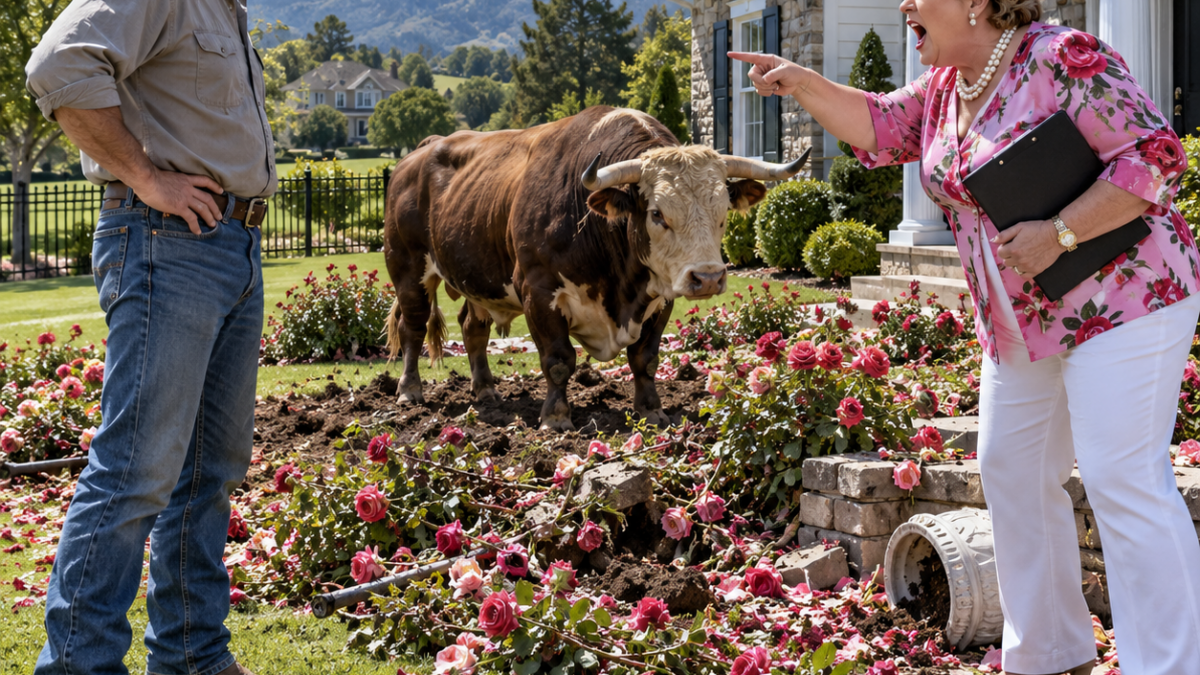
Karen stood beside the fence she had just cut, bolt cutters still in her hand, screaming that my bull had destroyed her award-winning rose garden and that she was going to take every acre I owned.
Fifteen hundred pounds of frightened Charolais bull stood bleeding among crushed roses because she had deliberately opened the only barrier keeping him safely inside my pasture.
What Karen didn’t know was that one security camera, one veterinary report, and one forgotten line in the HOA’s own founding documents were about to turn the trap she had built for me back onto herself.
“Don’t move.”
My voice came out quieter than I expected.
Karen Peterson stopped in the middle of her ruined backyard.
She wore a lavender tracksuit, white sneakers, and an expression that somehow combined fury with triumph.
In her right hand were yellow-handled bolt cutters.
Behind her, my bull Goliath stood in what had been one of the most elaborate rose gardens in Harmony Creek.
Broken wooden trellises leaned sideways.
Mulch had been kicked across the lawn.
Dozens of carefully shaped rose bushes had been flattened beneath fifteen hundred pounds of confused livestock.
And Goliath was bleeding.
That was the only thing I cared about.
“Your monster destroyed my property!” Karen screamed.
I stepped through her open side gate.
“Put the cutters down.”
“Don’t you order me around!”
“Karen.”
Something in my voice finally reached her.
She dropped them.
I moved slowly toward Goliath.
He was normally the calmest animal on my twenty acres.
Children had stood beside him at county livestock events.
Judges had handled him.
Veterinarians knew him by name.
But now his eyes were wide.
Thin streaks of blood marked his cream-colored hide where rose thorns had raked his legs, belly, and flank.
One cut sat frighteningly close to his left eye.
“Easy, big guy.”
He jerked when I approached.
I stopped.
Waited.
Then stepped closer.
“Easy.”
My wife Sarah had already called our veterinarian.
As I slipped the halter over Goliath’s head, Karen kept talking.
“You’ll pay for every rose.”
I ignored her.
“My garden has won three regional awards!”
Goliath took one hesitant step.
Then another.
“You allowed a dangerous animal into a residential neighborhood!”
That stopped me.
I turned.
“My fence didn’t fail.”
Karen’s face changed.
Just slightly.
I looked toward the pasture.
Four strands of high-tensile livestock wire had been cut cleanly near one post.
Not broken.
Not pushed down.
Cut.
I looked at the bolt cutters lying in Karen’s grass.
Then at her.
She folded her arms.
“That fence was a violation anyway.”
The words landed harder than any confession she could have planned.
My twenty-acre farm had been here years before Harmony Creek.
The subdivision eventually grew against my eastern property line, bringing manicured lawns, decorative streetlights, identical mailboxes—and Karen.
She had been HOA president for nearly six years.
From the beginning, she hated everything she could see from her second-floor windows.
My barn.
My gravel drive.
My F-250.
My livestock fencing.
And especially Goliath.
She had once called him “an agricultural eyesore.”
The problem for Karen was simple.
I didn’t belong to her HOA.
My land bordered Harmony Creek.
It wasn’t part of it.
I had shown her county plats.
My deed.
Tax maps.
She kept sending violation notices anyway.
I usually filed them away and went back to work.
Until that morning.
Because cutting a fence was different.
Releasing a bull was different.
And hurting an animal in an attempt to manufacture a lawsuit was something I would not ignore.
I led Goliath back across the property line and secured him inside a holding pen.
Twenty minutes later, Dr. Evans arrived.
He examined the scratches.
Then the deeper punctures.
Then the cut beside Goliath’s eye.
His expression became serious.
“This one worries me.”
“How bad?”
“If infection reaches the tissue around the eye, we’ve got a problem.”
He cleaned wounds for almost an hour.
Antibiotics.
Pain medication.
Anti-inflammatory treatment.
Protective dressing.
Follow-up imaging.
Specialized monitoring because Goliath was not simply livestock.
He was a prize breeding bull with genetics I had spent years developing.
When Dr. Evans finally handed me the treatment projection, I stared at the number.
Possible total care, rehabilitation, veterinary follow-ups, reproductive monitoring, and loss-of-value protection:
$85,000.
Sarah read it over my shoulder.
“Oh my God.”
I looked across the pasture toward Karen’s wrecked roses.
She had tried to create an escaped-livestock case that could force me off my land.
Instead, she had left the bolt cutters behind.
And when I checked the security camera mounted beneath the barn eave that afternoon, I watched Karen walk to my fence, look in both directions, and deliberately cut it herself.
That was when I stopped being angry.
I became organized.
PART 2
The video was thirty-seven seconds long.
I watched it four times.
Not because I doubted what I had seen.
Because training had taught me that before you act on anger, you remove anger from the equation.
I had spent twenty-five years in the Army Corps of Engineers.
Most civilians think that means bridges and construction.
It does.
But it also means planning.
Redundancy.
Documentation.
Understanding how small failures become catastrophic when somebody assumes nobody is watching.
Karen had assumed nobody was watching.
The camera had been installed six months earlier after somebody repeatedly opened the pasture gate at night.
Nothing had ever escaped.
The chain had simply been left hanging differently twice.
Sarah suggested teenagers.
I suspected nothing specific.
So I installed cameras.
That decision now mattered more than I could have imagined.
The footage began at 6:42 a.m.
Karen’s white crossover appeared along the access lane behind her home.
She parked beside the HOA walking path.
Got out.
Looked toward my house.
Waited.
Then walked directly to the fence.
No hesitation.
No accidental contact.
Yellow bolt cutters already in her hand.
She placed the jaws around the first wire.
Snip.
Second.
Snip.
Third.
Fourth.
Then she bent the wires back.
After that, she walked away.
Goliath appeared eight minutes later.
He followed the opening.
He did not charge.
He did not break free.
He simply encountered a gap where a fence had always been.
He crossed into the easement.
Then turned toward Karen’s backyard.
Why?
Roses.
Cattle investigate vegetation.
Especially unfamiliar vegetation.
Karen’s side gate had been left open.
Another coincidence that didn’t look like coincidence anymore.
Goliath wandered inside.
The rest happened off-camera.
But Karen’s plan seemed obvious.
A bull loose near subdivision roads.
Potential property damage.
Potential injury.
Potential automobile accident.
And, most importantly, a narrative.
Dangerous farmer refuses HOA standards.
Dangerous livestock escapes.
Community at risk.
Property should be declared nuisance.
Karen had spent months trying to create exactly that argument.
She had simply decided evidence was easier to manufacture than discover.
Unfortunately for her, she had manufactured mine instead.
Sarah stood behind me as I paused the video on Karen’s face.
“Call the sheriff.”
“I will.”
“Now, Jake.”
“I know.”
“No.”
She stepped around my chair.
My wife was not loud by nature.
That made her serious voice more effective.
“You’re doing that thing.”
“What thing?”
“The Army thing where you get quiet enough to scare everybody.”
“I’m calm.”
“That’s exactly what I mean.”
She pointed toward the screen.
“This woman could’ve gotten somebody killed.”
“I know.”
“She could’ve gotten Goliath killed.”
“I know.”
“Then don’t treat this like paperwork.”
I looked at her.
“You’re right.”
She crossed her arms.
“I usually am.”
“Let’s not ruin the moment.”
That got half a smile.
I called the county sheriff’s office.
Deputy Laura Mitchell arrived forty minutes later.
She was maybe thirty-five.
Hair pulled back.
No-nonsense.
She had responded once before when a drunk driver hit our mailbox, so we recognized each other.
“What happened?”
I showed her the fence first.
She photographed each cut.
The cutters were still where Karen had dropped them.
Karen had gone inside her house shortly after Dr. Evans arrived.
Mitchell put on gloves and bagged the tool.
Then we watched the camera footage.
She leaned forward.
“Play that again.”
I did.
She watched Karen look both directions before cutting.
“Any chance she had permission?”
“No.”
“Any easement rights?”
“No.”
“Emergency?”
“No.”
“Prior dispute?”
I laughed without humor.
“How much time do you have?”
She took out her notebook.
“Start at the beginning.”
So I did.
Harmony Creek began seven years earlier when a developer bought five hundred acres east of us.
Our farm had belonged to Sarah’s family for three generations.
Her father grew hay.
Her grandfather raised dairy cattle.
When the developer came through, they offered to buy our land.
We refused.
Politely.
Then less politely after the third offer.
Harmony Creek was built around us.
Not literally.
But close enough.
Our western boundary remained county farmland.
The east became suburban homes.
Karen bought one of the earliest houses.
Large two-story colonial.
Perfect lawn.
Perfect landscaping.
Perfect view directly across the HOA greenbelt toward my barn.
She started complaining before she became president.
Noise.
Odor.
Truck traffic.
Fence appearance.
Then she won an HOA board seat.
Two years later, she became president.
Her complaints acquired letterhead.
The first official demand involved my livestock fence.
Harmony Creek required white vinyl fencing.
My cattle fence used high-tensile wire.
Karen mailed me a notice giving thirty days to replace five hundred feet of livestock fencing with white vinyl.
I wrote back:
My property is outside Harmony Creek.
No response.
Second notice.
Fine threatened.
I sent county plats.
Third notice.
She claimed the fence was “adjacent to HOA common space” and therefore subject to aesthetic review.
My attorney at the time responded.
Karen backed down.
For three weeks.
Then came the barn.
Unapproved agricultural structure.
Built in 1979.
Then the truck.
Commercial vehicle.
Registered privately.
Then manure odor.
We composted according to county agricultural rules.
Then the mailbox.
Wrong color.
I did not even use Harmony Creek’s private roads.
It became absurd.
But absurdity doesn’t always remain harmless.
Karen realized she could not legally regulate my property.
So she started shaping public opinion.
At meetings, she called our farm a safety issue.
An incompatible land use.
A threat to property values.
She suggested the HOA should negotiate to buy us out.
I declined.
Then came Goliath.
He was four years old.
Charolais.
Almost fifteen hundred pounds.
Excellent bloodline.
Calm temperament.
Regional grand champion in his class twice.
Karen saw him from her upstairs window.
Apparently his existence offended architectural harmony.
Three months before the fence cutting, she came to our gate.
“That animal is dangerous.”
“He’s cattle.”
“He’s enormous.”
“That isn’t illegal.”
“There are children twenty yards away.”
“There are two fences between him and the walking path.”
“He could get out.”
“He hasn’t.”
“He could.”
“So could your dog.”
“My dog weighs eleven pounds.”
“Then Goliath would probably win.”
She did not appreciate that.
Deputy Mitchell wrote everything down.
Then asked the important question.
“Do you think she released the animal intending someone to get hurt?”
“I don’t know what she intended.”
That distinction mattered.
I refused to exaggerate.
“I know she intentionally cut the fence.”
“Good answer.”
Mitchell looked toward Karen’s house.
“Let me speak with her.”
Karen came outside five minutes later.
Different clothes.
White blouse.
Tan slacks.
Bolt cutters apparently forgotten.
She walked across the lawn as though she were the person who had called police.
“Deputy, thank goodness.”
Mitchell said nothing.
Karen continued.
“That animal destroyed thousands of dollars in landscaping.”
“We’re investigating how the bull left Mr. Thompson’s property.”
Karen looked at me.
“He failed to maintain his fence.”
Mitchell’s face remained neutral.
“We recovered bolt cutters.”
Karen blinked.
“So?”
“Near the cut.”
Karen shrugged.
“Anybody could have left them.”
Mitchell pulled out her phone.
“We also reviewed security footage.”
That changed everything.
Karen’s eyes moved toward my barn.
Then toward the camera.
She had never noticed it.
“That camera records my property.”
“It records Mr. Thompson’s fence.”
“It invades my privacy.”
“You’re visible while standing on his property line.”
“I was conducting HOA business.”
There it was.
Mitchell paused.
“What business required bolt cutters?”
Karen’s mouth opened.
Closed.
Then she straightened.
“That fence is dangerous and noncompliant.”
“Did you cut it?”
“I had authority to remediate a violation.”
I almost admired the answer.
Not intelligence.
Audacity.
Deputy Mitchell looked at me.
Then Karen.
“Are you saying yes?”
Karen’s confidence flickered.
“I’m saying the HOA has a responsibility to protect its residents.”
“That is not what I asked.”
“My attorney can explain our authority.”
Mitchell nodded.
“That may be best.”
Karen looked relieved.
Then Mitchell added:
“Because I’m documenting this as intentional property damage and possible livestock interference pending review.”
Karen’s face reddened.
“This is ridiculous.”
Mitchell remained calm.
“Do not enter Mr. Thompson’s property.”
“I have HOA authority.”
“Not according to the documents he provided.”
“You’re taking his side.”
“I’m taking notes.”
That line almost made Sarah laugh from the porch.
Karen turned to me.
“You’ll regret this.”
Mitchell immediately said:
“Ma’am, stop.”
Karen looked at her.
“Do not threaten him.”
“I’m not threatening anyone.”
“You just told him he would regret making a report.”
Karen’s mouth tightened.
“I meant legally.”
“Then let lawyers handle legally.”
Karen stormed home.
Mitchell waited until the door slammed.
Then exhaled.
“She’s something.”
“You should attend HOA meetings.”
“I’d rather direct traffic in a hurricane.”
Fair.
Before leaving, she gave me the case number and asked for copies of every relevant letter.
I already had a binder.
Sarah brought it out.
Deputy Mitchell stared.
“How long have you been waiting for this?”
“I like records.”
“No kidding.”
That afternoon, I called Mark Jensen.
Mark and I had served together years earlier.
He was my platoon sergeant before I became an officer.
That tells you our relationship.
He never stopped treating me like somebody who occasionally required supervision.
After the Army, Mark went to law school.
Eventually became a partner at a litigation firm downtown.
I had avoided calling him because asking friends for professional favors can damage friendships.
Now I needed professional help.
He answered with:
“If this is about borrowing money, I’m poor.”
“You’re a partner at Jensen Cole.”
“Exactly. Poor with cufflinks.”
“I have an HOA problem.”
He groaned.
“I withdraw.”
“Bull involved.”
Silence.
“Continue.”
I described everything.
At the end, Mark said:
“Send me the video.”
I did.
Ten minutes later he called back.
“Well.”
“That bad?”
“For her?”
“Yes.
“For you?”
“No.”
“What about the vet?”
“Send the report.”
Dr. Evans’s initial projection was not truly a bill.
That mattered.
The source story’s dramatic $85,000 number became more credible when Mark forced us to separate actual charges from potential losses.
Emergency care was only the beginning.
Goliath had wounds near the eye.
Risk of infection.
Possible fertility complications from stress and medication.
Temporary removal from breeding.
Loss of show eligibility while healing.
Daily care.
Specialist ophthalmology evaluation.
Bloodwork.
Medication.
And because he was insured as a high-value breeding animal, the insurer required aggressive treatment and documentation to preserve his value.
Mark reviewed everything.
“Don’t send Karen an $85,000 bill yet.”
“I already wanted to.”
“I know.”
“How?”
“You’re you.”
“So?”
“Send a demand for documented costs as they accrue, with reservation for additional veterinary and loss-of-value damages.”
“You make revenge boring.”
“I make revenge admissible.”
Good point.
Within seventy-two hours, Mark sent Karen and the HOA a formal demand.
It was surgical.
Preserve all documents.
No further entry.
No interference with livestock.
Acknowledge responsibility for the fence damage.
Notify insurers.
Reimburse emergency veterinary treatment.
Cease asserting HOA authority over my farm until jurisdiction could be established.
The letter also requested copies of every document Karen relied upon when claiming authority over my property.
That last part mattered more than I realized.
Karen responded herself.
Never a good idea when angry.
Her email said:
Harmony Creek retains enforcement authority over all parcels visually and functionally impacting the development regardless of formal membership status.
Mark called me laughing.
“What?”
“She just invented law.”
“Can she?”
“No.”
“She does it confidently.”
“That’s not a legal doctrine.”
Then the violation notices began.
Mailbox.
Barn.
Driveway.
Fence material.
Truck.
Farm equipment.
Exterior storage.
Agricultural odor.
Livestock noise.
She even cited a section prohibiting “commercial breeding activities.”
Within two weeks, claimed fines exceeded $18,000.
Within a month, projected penalties would exceed $50,000.
Mark told me:
“Pay nothing.”
“I wasn’t planning to.”
“Respond to everything.”
“That seems contradictory.”
“No. Silence lets them claim default. We dispute every notice and force them to create a record.”
So we did.
Every violation received a certified response.
Mailbox?
My mailbox sat on county right-of-way and complied with postal requirements.
Barn?
County permit from 1983.
Driveway?
Preexisting agricultural access protected under zoning.
Truck?
Farm-use vehicle legally parked on agricultural property.
Livestock?
Permitted use.
Fence?
Agricultural fence.
Each response ended the same way:
Please identify the recorded declaration or covenant giving Harmony Creek jurisdiction over the Thompson property.
They never did.
Karen sent more fines instead.
That told Mark something.
“She doesn’t have the document.”
“Obviously.”
“No.”
He leaned back.
“I mean she knows she doesn’t.”
That was different.
If Karen genuinely believed we were governed by Harmony Creek, she would simply produce the recorded covenant.
Her refusal suggested she was building pressure without legal foundation.
Mark sent a title examiner to the county records office.
Three days later, he called.
“Jake, you’re going to enjoy this.”
“I prefer enjoying things after verification.”
“Army ruined you.”
“What did you find?”
“The Harmony Creek declaration uses an old metes-and-bounds description.”
“And?”
“It stops at your eastern boundary.”
I waited.
“Mostly.”
“Mostly?”
“There’s a drafting error.”
“What kind?”
“Six inches.”
I thought he was joking.
He wasn’t.
An outdated survey line technically included a narrow sliver, roughly six inches wide along part of the boundary.
Nothing else.
No barn.
No driveway.
No mailbox.
No house.
No pasture.
No Goliath.
Mark sounded delighted.
“The HOA has spent months issuing violations against twenty acres because its declaration touches six inches of grass.”
“Can they regulate the six inches?”
“Potentially, depending on the documents.”
“So Karen can fine a weed.”
“Do not give her ideas.”
We ordered a certified boundary review.
Confirmed.
Harmony Creek’s recorded jurisdiction barely touched my property.
Karen had no authority over everything she had cited.
That discovery changed the case.
But Mark told me not to reveal it immediately.
“Why?”
“Because she’s escalating.”
“She’s threatening a lien.”
“Exactly.”
“You want her to?”
“I want her board to ask counsel before doing something stupid.”
“And if they don’t?”
Mark smiled.
“Then they become witnesses against themselves.”
Meanwhile, Goliath’s condition worsened.
Day four, swelling developed near the cut by his eye.
Dr. Evans called in a veterinary ophthalmologist from the state university.
They sedated Goliath.
Flushed the wound.
Imaged the area.
Removed embedded thorn fragments.
One had penetrated deeper than expected.
Fortunately, the eye itself was intact.
Then infection appeared in two punctures beneath his flank.
More medication.
More visits.
We had to suspend breeding.
A buyer backed out of a scheduled breeding contract.
The insurer demanded documentation.
Costs climbed.
$12,000.
$19,000.
$31,000.
Then additional projected economic loss.
By week five, the combined veterinary treatment, specialist care, lost breeding income, transportation, follow-ups, and documented diminished show opportunity approached $78,000.
Final verified damages eventually landed a little above $85,000.
The number that had sounded absurd on day one became horribly real.
Sarah handled most of the wound care.
Every morning before sunrise, we cleaned Goliath.
He hated the antiseptic.
Loved apples.
So Sarah created a system.
Clean wound.
Apple slice.
Medication.
Apple slice.
Bandage.
Two apple slices.
“I think he’s manipulating us,” I said.
Sarah scratched his forehead.
“He’s earned it.”
One morning, Goliath flinched as I treated a puncture.
My anger returned.
Hot this time.
“I could’ve lost him.”
Sarah looked at me.
“Yes.”
“She knew.”
“You don’t know that.”
“She cut the fence.”
“We know that.”
“She wanted something to happen.”
“Probably.”
“Sarah.”
She put the bottle down.
“Jake, don’t make your case bigger than your evidence.”
That sounded exactly like Mark.
I hated when my wife and lawyer agreed.
“We know she cut the fence,” Sarah continued. “We know she lied about it. We know she used what happened afterward to attack us.”
She touched Goliath’s neck.
“That’s enough.”
She was right.
The truth was already bad enough.
We didn’t need to embellish it.
That became our rule.
No exaggeration.
No rumor.
No claim we couldn’t prove.
Karen did not follow that rule.
Her community emails became increasingly dramatic.
She described Goliath as a “known aggressive animal.”
False.
She claimed I had ignored repeated safety warnings.
Misleading.
She said the bull “escaped through negligent containment.”
Provably false.
She called my farm a “commercial livestock operation incompatible with neighborhood safety.”
Our county agricultural designation predated Harmony Creek.
Then she announced an emergency HOA meeting.
Purpose:
Address ongoing public nuisance.
Impose cumulative penalties.
Authorize legal action.
And, most astonishingly, explore remedies against my land.
The notice implied foreclosure.
That got my attention.
Mark read it.
Then reread it.
“Does she understand your property isn’t in the HOA?”
“She understands what she wants.”
“No. I mean literally. Has anybody on that board spoken to a lawyer?”
“Apparently not.”
“We’re going to make sure they get the opportunity.”
Mark sent every board member an individual letter.
Not just Karen.
Gerald Finney.
Brenda Howe.
Two others.
Each received:
Certified survey.
Recorded HOA boundary.
My deed.
Video still of Karen cutting the fence.
Sheriff’s case number.
Veterinary report summary.
Notice that voting to impose fines or seek foreclosure against property outside association jurisdiction could expose the board and individual members to claims.
Three days later, one director resigned.
Another called Mark.
He claimed Karen had never shown them the survey.
That mattered.
Karen had been telling the board my farm was “subject to enforcement through adjacency.”
Mark asked:
“Did an attorney tell you that?”
“No.”
“Who did?”
“Karen.”
“Ask her for the legal opinion.”
Apparently he did.
None existed.
The emergency meeting remained scheduled.
Karen was committed.
Why?
Because backing down would mean admitting every threat had been empty.
People who build authority from certainty often cannot survive admitting uncertainty.
So they double down.
While Karen prepared her public attack, I started listening to Harmony Creek residents.
I did not go looking for dirt.
At first.
People came to me.
Mr. Henderson lived three houses from Karen.
Seventy-eight.
Retired electrical contractor.
He saw me repairing the fence one afternoon.
“You Thompson?”
“Yes.”
He looked toward Goliath.
“That him?”
“Goliath.”
“Looks calmer than Karen.”
I laughed.
We talked.
Then he told me about the Mustang.
1967 fastback.
Blue.
He had owned it since he was twenty-four.
Restored it with his son.
Kept it inside his garage.
Karen repeatedly fined him because she claimed an “unregistered classic vehicle” could sometimes be seen when the garage door was open.
“I fought for five years.”
“What happened?”
“Sold it.”
His voice changed.
“My son died six years ago.”
I said nothing.
“We restored that car together.”
He stared at the street.
“I couldn’t keep paying lawyers over a car.”
That story stayed with me.
Then the Millers visited.
Tom and Rebecca.
Their son Caleb had cerebral palsy.
They had built an adaptive playset.
Wide ramp.
Support rails.
Bucket swing.
Low transfer platform.
Karen’s architectural committee rejected it after installation because part of the ramp was visible above the privacy fence.
The family appealed.
Lost.
Fines began.
They removed it.
Rebecca showed Sarah a picture of Caleb sitting beside the dismantled pieces.
Sarah cried.
So did Rebecca.
More stories followed.
Some were legitimate disputes exaggerated by resentment.
We filtered those out.
Others had documentation.
Selective fines.
Different treatment for similar structures.
Applications delayed until penalties accrued.
A pattern.
Then came the rose garden.
Karen’s pride.
Before Goliath destroyed it, it was famous locally.
Hundreds of rose bushes.
Stone edging.
Irrigation.
Decorative trellises.
Small fountain.
Award plaques.
Nobody begrudged a person a beautiful garden.
The question was who paid for it.
Mr. Henderson remembered a “community beautification” project several years earlier.
So did Rebecca.
Sarah found archived HOA newsletters online.
One announced:
Harmony Creek Beautification Phase I, enhancement of high-visibility landscape features near eastern entrance.
Cost: $15,000.
Karen’s home sat near the eastern entrance.
Her rose garden occupied the “high-visibility feature.”
We requested records.
Invoices showed HOA funds paid a landscaper.
Delivery address:
Karen’s home.
Plant material:
Roses.
Trellises.
Irrigation.
Decorative stone.
It looked terrible.
But Mark cautioned us.
“Could be authorized.”
“On private property?”
“Yes, if the board approved an easement or community improvement agreement.”
“Did they?”
“We don’t know yet.”
So we did not call it theft.
We called it a question.
That distinction later destroyed Karen more effectively than accusation.
At the emergency meeting, the clubhouse was packed.
Harmony Creek usually drew fifteen people.
That night there were more than one hundred.
Karen sat at the front in a navy pantsuit.
Gerald sat beside her looking pale.
Brenda sat stiffly with a stack of papers.
The two newer directors sat farther away.
One had his own attorney in the back.
Interesting.
Sarah sat beside me.
Mark sat on my other side.
Goliath stayed home.
Probably the smartest participant.
Karen struck the gavel.
“This emergency meeting will come to order.”
Nobody spoke.
She began with sympathy.
Not for Goliath.
For herself.
“My home was violated.”
She paused.
“My private garden, cultivated over many years, was destroyed by a dangerous animal.”
Murmurs.
She continued.
“I have served Harmony Creek faithfully for six years.”
More pause.
“In response to a legitimate effort to protect this community, Mr. Thompson has engaged in intimidation, legal harassment, and refusal to comply with our standards.”
Mark wrote something on a yellow pad.
I glanced.
LEGITIMATE EFFORT = BOLT CUTTERS?
I almost laughed.
Karen described my farm as dangerous.
She displayed pictures of Goliath.
Then my barn.
Truck.
Gravel drive.
She showed the damaged garden.
No photograph of the cut fence.
Interesting omission.
Finally she presented the proposed resolution.
$250,000 punitive cumulative penalty.
Declaration of public nuisance.
Authorization for legal action seeking collection and “all available remedies against the Thompson property.”
Foreclosure was mentioned.
People gasped.
Karen looked directly at me.
“Mr. Thompson has repeatedly demonstrated contempt for community safety.”
Then she opened public comment.
A supporter spoke first.
Property values.
Children.
Livestock.
Uniform standards.
Then Karen asked:
“Anyone opposed?”
Mark stood.
“Madam President.”
Karen recognized him.
Her expression changed.
“My name is Mark Jensen. I represent Jake and Sarah Thompson.”
Karen’s hand moved toward the gavel.
“You have two minutes.”
“Your bylaws allow five.”
Silence.
Karen looked toward Brenda.
Brenda looked down.
“Fine. Five.”
Mark smiled.
“My client would like to respond personally.”
I stood.
Walked toward the front.
No shouting.
No insults.
That mattered.
I plugged a small drive into the computer.
The first image appeared.
Karen cutting my fence.
Ten feet tall on the projection screen.
The room went dead silent.
I let the still image remain.
Then pressed play.
Karen’s crossover.
Karen walking.
Karen checking the road.
Bolt cutters.
Snip.
Snip.
Snip.
Snip.
The footage ended.
Nobody moved.
Karen stood.
“That video is illegally obtained.”
Mark said:
“No.”
She turned.
“It invades my property.”
“The camera records Mr. Thompson’s fence.”
“It’s edited.”
“No.”
“AI can fake anything now.”
Mark smiled faintly.
“The original file has been preserved with law enforcement.”
That shut her down.
I faced the residents.
“My bull did not break through a neglected fence.”
I pointed toward the screen.
“My fence was deliberately cut.”
I clicked.
Next slide.
Photographs of Goliath’s wounds.
Not graphic.
But clear.
Scratches.
Punctures.
Bandaged eye area.
“The animal Karen describes as the aggressor required emergency veterinary treatment because he wandered through an opening somebody intentionally created.”
I clicked again.
Dr. Evans’s signed treatment summary.
Veterinary specialist invoices.
Medication.
Transportation.
Loss of breeding contract.
Documented costs.
“Current verified damages exceed eighty-five thousand dollars.”
The room murmured.
Karen shouted:
“My roses cost nearly that much!”
That was a mistake.
Mark looked at her.
“Interesting number.”
Karen realized too late.
I clicked.
HOA BEAUTIFICATION PHASE I.
$15,000.
Landscaper invoice.
Delivery to Karen’s address.
Rose varieties.
I did not accuse her.
I said:
“Residents may want the board to explain why association beautification funds paid for improvements delivered to the president’s private residence.”
That was all.
Questions erupted.
“What?”
“Our money?”
“Is that your garden?”
Karen slammed the gavel.
“This was an approved community-facing landscape project!”
Mark stood.
“Excellent.”
She glared.
“Then there should be board minutes, an agreement, an easement, and conflict disclosures.”
Karen’s face changed.
Mark continued.
“We’ve requested them.”
Brenda looked toward Karen.
Gerald stared at the invoice.
Then I clicked again.
County plat.
Harmony Creek boundary.
Our certified survey.
I pointed toward the thin highlighted strip.
“This is Harmony Creek’s recorded jurisdiction.”
People leaned forward.
I zoomed in.
“My farm is twenty acres.”
I indicated the boundary.
“Nearly every structure Karen has cited sits completely outside the association.”
Then the six-inch sliver.
“The declaration touches approximately six inches along part of this border because of an old drafting error.”
Laughter spread.
Not cruel.
Disbelieving.
Someone shouted:
“So she can fine his grass?”
Mark said:
“Perhaps one particularly rebellious blade.”
Even Sarah laughed.
Karen did not.
I put her violation letters on-screen.
Barn.
Mailbox.
Truck.
Driveway.
Fence.
Livestock.
All outside jurisdiction.
“Every one of these fines was disputed.”
I said.
“Every response asked the board to identify its legal authority.”
I displayed our certified letters.
“No authority was ever produced.”
Karen shouted:
“Because adjacency gives us enforcement power!”
Mark stood.
“Please identify the statute.”
Silence.
“The recorded covenant?”
Silence.
“An easement?”
Nothing.
Karen gripped the gavel.
Mark faced the room.
“Ladies and gentlemen, I am not asking you to believe my client.”
Good line.
“Believe your county recorder.”
He held up certified copies.
“Believe your subdivision declaration.”
He held up another.
“Believe the sheriff’s evidence file.”
Then:
“And before any director votes tonight, understand this.”
The room quieted.
“The board received written notice that the Thompson farm is outside HOA jurisdiction.”
Gerald looked physically ill.
“The board received proof that the fence was deliberately cut.”
Brenda’s face lost color.
“The board received notice of ongoing legal claims.”
He paused.
“If you knowingly vote to impose a quarter-million-dollar penalty and pursue another person’s land without legal authority, you should assume your decision will be reviewed by attorneys, insurers, and possibly a court.”
Not “millions.”
Not threats.
Reality.
The two newer board members immediately raised their hands.
One said:
“I move to table the resolution.”
Karen snapped:
“No.”
The director stared at her.
“You don’t control my vote.”
Something shifted.
That sentence mattered.
For six years, Karen had behaved as if board members were extensions of her office.
Now one resisted.
Brenda whispered:
“We should table it.”
Karen turned.
“What?”
Gerald nodded.
“We need counsel.”
Karen’s face became red.
“We have counsel.”
“No,” Gerald said.
“We have your interpretation.”
The room exploded.
Applause.
Karen banged the gavel.
“Order!”
Rebecca Miller stood.
“No.”
Karen froze.
Rebecca’s hands shook.
But her voice did not.
“No more.”
She held up a photograph of Caleb’s adaptive playset.
“You made us take this down.”
Karen tried to interrupt.
Rebecca continued.
“My son needed that ramp.”
The room quieted.
“You told us visibility mattered more than accessibility.”
Karen said:
“That case is not on the agenda.”
“It is now.”
Tom Miller stood beside his wife.
“We paid four thousand dollars in fines before we gave up.”
Mr. Henderson rose next.
He held a photograph of his blue Mustang.
“My son and I restored this car.”
His voice cracked.
“After my son died, Karen fined me until I sold it.”
Nobody laughed now.
One by one, residents stood.
Some grievances were small.
Some large.
A basketball hoop.
Flowers.
Holiday lights.
A wheelchair ramp.
A veteran’s flag display.
A widow’s peeling shutters while she was hospitalized.
The pattern filled the room.
Karen’s power had always depended on victims believing they were alone.
Now they were standing beside each other.
That was the moment her presidency truly ended.
Not the vote.
The isolation.
Priya Anand—different neighborhood, different story? Wait, no. I caught myself mentally importing names from another fight.
This was Harmony Creek.
Here, it was Rebecca Miller who made the motion.
“I move that tonight’s nuisance resolution be withdrawn and that Karen Peterson be immediately suspended from acting as president pending an independent audit and governance review.”
Mr. Henderson said:
“Second.”
Karen slammed the gavel.
“Out of order!”
One of the board members opened the bylaws.
“No. It isn’t.”
Karen stared at him.
“The board can suspend an officer by majority vote.”
“You wouldn’t.”
He looked around the room.
Then back at her.
“I should have months ago.”
The vote:
Four to one.
Karen was the one.
Suspended.
Not yet removed from the board.
That required membership procedure.
But her presidency effectively ended that night.
She remained seated.
The gavel lay in front of her.
No longer meaningful.
Sarah squeezed my hand.
I should have felt triumphant.
Instead, I thought about Goliath alone in his pen.
Arthur? Wrong story again.
Mr. Henderson’s Mustang.
Caleb’s empty backyard.
How long people had lived with this simply because challenging Karen felt harder than obeying her.
The meeting did not end in celebration.
It ended in work.
Temporary leadership.
Independent counsel.
Audit authorization.
Suspension of disputed fines.
A freeze on collection actions.
Formal preservation of all HOA records.
And a membership meeting scheduled thirty days later for a recall vote.
Karen left through a side door.
No one stopped her.
Outside, Mark said:
“You did well.”
“Didn’t feel like winning.”
“Good.”
“Why?”
“People who enjoy this too much become Karen.”
Sarah looked at him.
“I’ve been telling him that for years.”
“Traitors.”
The next month was ugly.
Karen hired counsel.
The sheriff’s investigation continued.
Veterinary costs finalized.
The HOA’s insurer entered the dispute.
The independent audit began.
We learned several things.
First, the garden.
The HOA had indeed paid $15,000 toward landscape improvements at Karen’s home.
Karen argued that her corner lot functioned as a “gateway property” and that beautifying it benefited Harmony Creek.
There was some board documentation.
But disclosures were incomplete.
Bids were weak.
Karen had participated in decisions directly benefiting her property.
The audit did not label it theft.
Important.
It called it an undisclosed conflict and governance failure.
That was enough.
Second, enforcement.
Karen had controlled the architectural committee.
She frequently initiated complaints herself.
Records showed disproportionate enforcement against residents who had publicly challenged her.
Mr. Henderson’s fines began two weeks after he questioned a landscaping contract.
The Millers’ appeal was denied during a meeting Karen personally chaired.
Third, my property.
Internal emails were devastating.
One message from Karen to Brenda said:
Jake’s farm must eventually be brought under community control or acquired. Continued nuisance enforcement may encourage cooperation.
There it was.
Not necessarily illegal by itself.
But clear motive.
Pressure me until I sold.
Another email after I sent the veterinary demand:
Increase enforcement. He needs to understand continued resistance will become financially impossible.
Mark read that twice.
Then handed it to me.
“She wrote the case for us.”
“Can we use it?”
“Absolutely.”
Fourth, the fence.
Karen’s lawyer initially suggested she believed she had authority to remove a “hazardous barrier.”
The video undermined that explanation.
So did the fact that she left the wire open rather than repairing or replacing anything.
So did her own email sent the previous evening to Brenda:
If his bull gets out once, county animal control will finally understand what we’ve been saying.
That sentence chilled me.
Mark did not react dramatically.
He simply said:
“Forward to the sheriff.”
Deputy Mitchell called later.
“Jake.”
“Yeah?”
“You were right to let the evidence speak.”
I knew what she meant.
Karen’s intent was becoming clearer without us ever overstating it.
The criminal case moved slowly.
As it should.
Intent must be proven.
Not assumed.
Then Goliath scared us again.
His left eye began watering.
Cloudiness appeared.
Dr. Evans came immediately.
The specialist returned.
Inflammation.
Not blindness.
Treatment intensified.
Sarah slept in the barn one night because she was afraid he would rub the area against a post.
I found her at 4 a.m. sitting on an overturned bucket.
Goliath lay nearby.
“You should be in bed.”
“So should you.”
“I’m checking on you.”
“I’m checking on him.”
We looked at the bull.
Then Sarah whispered:
“Remember when Dad bought his mother?”
I smiled.
“Ugliest calf at the sale.”
“She was.”
“Your father said she had character.”
“He always said that when he bought something ugly.”
Goliath lifted his head.
Sarah rested her hand on the gate.
“I don’t care about the money.”
“I know.”
“If his eye—”
“I know.”
She cried quietly.
That was the first time during the entire fight I truly hated Karen.
Not because of land.
Not fines.
Not threats.
Because my wife sat in a barn at four in the morning terrified that an animal she loved might lose an eye because another adult wanted leverage.
I wanted revenge then.
Real revenge.
Mark must have heard it in my voice the next morning.
“Do nothing stupid.”
“I’m not stupid.”
“Smart people are incredibly creative when angry.”
“What would qualify as stupid?”
“Anything you’re asking me about indirectly.”
I laughed despite myself.
“Fine.”
“Let the recall happen.”
“I want her to pay.”
“She will.”
“How do you know?”
“Because she already has.”
I didn’t understand until later.
Karen’s greatest asset had not been her house.
Money.
Garden.
Position.
It was certainty.
Everyone believed she always won.
Now every day she remained suspended was proof she could lose.
Residents stopped lowering their voices around her.
Board members questioned old decisions.
People requested records.
The association newsletter no longer carried her name.
Her authority disappeared before any court decided anything.
That was payment.
The recall meeting drew even more residents.
Ballots.
Neutral election inspector.
Membership verification.
No gavel.
Karen attended with her attorney.
She gave a speech.
Mostly defense.
Some apology.
She said her actions were motivated by concern for safety.
She admitted mistakes in process but denied malice.
She accused “outside legal pressure” of inflaming neighbor disputes.
Then Rebecca Miller spoke.
She did not mention me.
She talked about Caleb.
“Our son did not understand why the ramp disappeared.”
She held his hand.
Caleb was there this time.
Wheelchair beside her.
“He asked whether he had done something wrong.”
Karen looked down.
Rebecca continued:
“No homeowner should ever be made to feel like their family’s needs are an embarrassment to the neighborhood.”
Then Mr. Henderson.
He held a small framed photograph.
His son leaning against the Mustang.
“I can buy another car.”
He said.
“I cannot rebuild this memory.”
That ended any chance Karen had.
The vote was overwhelming.
Karen was removed from the board.
Not unanimously.
That mattered too.
Democracy does not require unanimity.
It requires legitimacy.
Some residents still believed she had improved property values.
Some thought the punishment excessive.
Some simply disliked the public spectacle.
They voted for her.
They had that right.
She lost anyway.
The new board elected Tom Miller interim president.
He looked horrified.
Rebecca laughed.
“You wanted reform.”
“I wanted someone else to do reform.”
Too late.
The first formal action was to withdraw every pending violation against our farm.
Second:
Recognize in writing that our twenty acres were not governed by Harmony Creek except for any rights tied to the technical boundary sliver.
Third:
Commission counsel to correct the six-inch drafting problem so nobody would ever fight over it again.
Fourth:
Review prior fines.
Fifth:
Adopt conflict-of-interest rules.
Sixth:
Restore accessible structures where prior enforcement had failed to account for disability accommodations and applicable law.
Caleb’s playset returned that fall.
Not the old one.
A better one.
Neighbors raised money.
I built the steel handrails myself.
Wide.
Rounded.
Powder-coated.
When we installed them, Caleb rolled up the ramp on his own.
Reached the platform.
Turned.
Raised both hands.
Everyone cheered.
Rebecca covered her face and cried.
Tom cried too, although he claimed dust.
There was no dust.
Mr. Henderson’s ending took longer.
His Mustang was gone.
Sold out of state.
We found it through an enthusiast registry.
New owner in Tennessee.
Mark contacted him.
Explained nothing dramatic.
Just asked if he would consider selling.
He wouldn’t.
Then he heard the story.
Still wouldn’t.
Fair.
Six months later, a blue 1967 fastback appeared online in Kentucky.
Same year.
Same trim.
Same engine.
Not his car.
But close.
Harmony Creek’s new board refunded a portion of improperly assessed historical fines.
Henderson used that money.
His daughter added some.
Neighbors secretly covered the rest.
We had the car delivered on his seventy-ninth birthday.
When the trailer door opened, Henderson stared.
Then sat down on his porch step.
Couldn’t speak.
Finally:
“My son would’ve liked this.”
That was enough.
As for Karen’s rose garden?
The destruction looked dramatic.
But plants regrow.
By spring, some survived.
New growth appeared from several roots.
The new homeowner eventually restored part of it.
Yes.
New homeowner.
Karen moved.
But not for the theatrical reasons people later claimed.
She was not bankrupted overnight.
Nobody seized her house because I mailed an invoice.
Real civil liability does not work that way.
Mark filed a civil suit seeking documented veterinary damages, fence repair, lost breeding revenue, and other provable losses.
The HOA’s insurer disputed coverage because Karen’s act appeared intentional.
Karen’s personal umbrella carrier became involved.
Attorneys negotiated.
The criminal case increased pressure.
Karen eventually accepted a plea on property-damage and trespass-related charges rather than risk trial.
Probation.
Restitution obligations.
Community service.
No jail.
People online later embellished it.
They said she was convicted of animal cruelty.
Not exactly.
The evidence clearly showed reckless harm resulted to Goliath, but the final charge resolution centered on what prosecutors could prove cleanly: intentional fence damage and unauthorized interference with my property.
That was enough.
The civil case settled later.
Total compensation reached the amount necessary to cover Goliath’s verified veterinary care and documented related losses.
Approximately $85,000.
Some came from insurance.
Some from Karen personally.
Some from the HOA’s insurer under a disputed reservation because she had repeatedly claimed she acted as president.
The exact allocation mattered less than one thing:
Dr. Evans got paid.
Specialists got paid.
Lost breeding income was compensated.
And Goliath’s future medical care was funded.
I did not receive a magical $85,000 revenge check to spend.
Most of it already represented money lost or owed.
That is another thing people misunderstand about damages.
Compensation is not a lottery ticket.
It attempts, imperfectly, to put you where you would have been if the wrong had never happened.
I would have preferred the wrong never happen.
Every time.
Karen listed her house several months after the recall.
Maybe financial pressure played a role.
Maybe humiliation.
Maybe she simply no longer wanted to live among people who had voted her out.
The house sold.
Not at some absurd half-price loss.
At a normal negotiated price.
She moved to another county.
The day the moving truck came, I was repairing the fence.
Same stretch.
New posts.
Stronger wire.
Karen stopped beside the road.
For several seconds we looked at each other.
She walked toward me.
Not onto the property.
She stopped at the line.
That mattered.
“Jake.”
“Karen.”
She looked past me.
“Is the bull alive?”
“Yes.”
“How is his eye?”
“Fine.”
She exhaled.
“I heard.”
I kept tightening the wire.
She watched.
Then said:
“I didn’t think he’d go into my garden.”
I stopped.
There it was.
Not an apology.
But admission.
“What did you think would happen?”
She stared at the grass.
“I thought he’d get out.”
“I know.”
“I thought somebody would call animal control.”
“I know.”
“I thought they’d make you change the fencing.”
I said nothing.
“And maybe…”
She stopped.
“Maybe what?”
“Maybe you’d finally decide this wasn’t worth it.”
The farm.
Our home.
My wife’s family land.
Goliath.
Years of work.
To Karen, “this” was an inconvenience she expected me to abandon.
I put the fencing tool down.
“You were trying to make me leave.”
Her eyes filled.
“Yes.”
That surprised me.
Not the answer.
The honesty.
“Why?”
She looked toward Harmony Creek.
“When we bought here, the developer promised a certain kind of neighborhood.”
“You bought beside a farm.”
“I know that now.”
“You knew it then.”
She nodded.
“I thought eventually the farm would sell.”
“Why?”
“Everything sells.”
“That’s not an answer.”
“My husband was a developer.”
I had never known that.
“He always said holdout parcels eventually surrender.”
There was that word.
Surrender.
She looked at the pasture.
“After he died, Harmony Creek became…”
Her voice broke.
She recovered.
“Mine, I suppose.”
“No.”
She looked at me.
“That was the problem.”
“Yes.”
Silence.
Then:
“I’m sorry about the animal.”
Not “bull.”
Animal.
Maybe she still could not say Goliath.
I considered Arthur’s lesson from another lifetime? Again, different story. But the lesson remained universal.
Don’t enjoy power.
Don’t become the bully because the bully finally became weak.
“I believe you regret what happened.”
Karen nodded.
“That isn’t the same as undoing it.”
“I know.”
“And I’m not telling Mark to abandon anything you agreed to.”
“I know.”
“But yes.”
She waited.
“I accept that you said you’re sorry.”
She wiped one eye.
Then looked at the repaired fence.
“You made it stronger.”
“I’m an engineer.”
That finally produced a small laugh.
Then she walked back to her car.
Before opening the door, she turned.
“Jake?”
“Yeah?”
“The roses are coming back.”
I looked toward her former garden.
A few green shoots had indeed emerged among the bare canes.
“Plants are stubborn.”
She nodded.
“So are bulls.”
“So are farmers.”
“Yes.”
Then she left.
That was the last time I saw Karen.
Goliath recovered.
Completely.
The eye cleared.
The flank wounds healed.
His show coat eventually covered most scars.
His first breeding evaluation after recovery was normal.
Dr. Evans stood beside him, shaking his head.
“Tough bastard.”
“Goliath or me?”
“Bull’s easier.”
Fair.
The following spring, Goliath returned to the county agricultural show.
Sarah almost refused.
“What if he gets stressed?”
“He’s calmer than we are.”
“That’s because he doesn’t understand humans.”
“Lucky.”
We took him.
People knew the story by then.
Not just Harmony Creek.
Local news had covered the recall and criminal case.
I hated the attention.
Goliath enjoyed apples.
At the show, an announcer mentioned his recovery.
Applause came from the stands.
I felt ridiculous.
This was cattle judging.
Not a movie.
Then Goliath won his class.
Again.
Sarah cried.
I pretended not to.
Dr. Evans stood beside us.
“Eighty-five thousand dollars well spent.”
I looked at him.
“You could’ve bought a boat.”
“I already have a boat.”
“Of course you do.”
We laughed.
Then Sarah took a photograph.
Me.
Goliath.
Blue ribbon.
One faint scar still visible beneath his left eye.
That photograph hangs in our kitchen now.
Not because of the ribbon.
Because it reminds us injury is not always the end of something.
Sometimes it becomes the mark of what survived.
Harmony Creek changed too.
The new board rewrote enforcement policies.
No single president could initiate fines without review.
Legal counsel had to confirm jurisdiction before liens or major enforcement.
Conflicts had to be disclosed.
Residents received real appeal hearings.
Board spending above a threshold required multiple bids.
Accessibility requests received separate review.
And the strangest change?
Harmony Creek created an agricultural-neighbor liaison committee.
I laughed for five minutes when Tom Miller asked me to join.
“No.”
“Jake.”
“I spent three years trying to convince your HOA I’m not part of it.”
“You’re not.”
“Then why would I serve?”
“Advisory.”
“No.”
“We provide coffee.”
“No.”
“Rebecca baked pie.”
“When’s the meeting?”
That’s how they got me.
The committee met quarterly.
Mostly boring.
Fence maintenance.
Pesticide drift concerns.
Farm equipment crossing the county road.
Noise during hay season.
Children wandering near livestock.
Real issues.
The kind neighbors solve when nobody is trying to dominate anyone.
One evening, a new Harmony Creek resident complained about cattle odor.
Old version of me might have rolled my eyes.
Instead I listened.
Her daughter had severe asthma.
Certain days were difficult.
We changed where compost piles sat during summer.
Problem improved.
Another resident complained about flies.
We added control measures.
I asked them to keep dogs from chasing calves along the fence.
They did.
That is community.
Not everybody getting everything.
Everybody acknowledging other people exist.
The old battle line between Harmony Creek and our farm became simply a property line.
Six inches of paperwork corrected by amended declaration.
Five hundred feet of stronger livestock fence.
Nothing more.
Years passed.
Mr. Henderson’s replacement Mustang became famous.
He drove it every Sunday.
Caleb grew.
The adaptive playset eventually became too small for him.
Instead of tearing it down, the Millers donated it to a local therapy center.
I helped move it.
When we removed the steel rails I had fabricated, Caleb ran his hand over one.
He was fourteen.
“Mr. Jake?”
“Yeah?”
“Mom says this exists because you fought Karen.”
“No.”
He looked confused.
“It exists because your parents fought for you.”
“But they lost.”
“First time.”
I pointed toward the ramp.
“Winning late still counts.”
He thought about that.
Then smiled.
I kept one bolt from the structure.
Not sentimental normally.
That one mattered.
Sarah’s garden expanded.
She planted roses.
That caused an argument.
“Absolutely not.”
She looked at me.
“You are banning roses now?”
“They’re dangerous.”
“To bulls.”
“Exactly.”
“Our garden is inside the house fence.”
“Still suspicious.”
She planted twelve.
Queen Elizabeth.
Mr. Lincoln.
Peace.
A variety called Veterans’ Honor.
I accused her of psychological warfare.
She said:
“Sometimes plants deserve a second chance.”
I knew she wasn’t talking about plants.
Those roses became beautiful.
One afternoon, Goliath stood at the pasture fence staring toward them.
I shouted:
“Don’t even think about it!”
Sarah laughed so hard she had to sit down.
That became our favorite joke.
Then came the day Goliath got old.
People forget bulls age.
He was no longer the enormous four-year-old champion who wandered into Karen’s yard.
White appeared around his muzzle.
He moved slower.
Still powerful.
Still Goliath.
But time is the one fence nobody defeats.
At eleven, arthritis began bothering his rear legs.
At twelve, breeding stopped.
At thirteen, Dr. Evans and I had the conversation livestock owners dread.
Quality of life.
Pain.
Winter.
I knew what the right decision would eventually be.
I hated knowing.
Sarah spent more time with him.
Apples.
Brush.
Talking.
One cold November morning, I found her leaning against the gate.
“Jake.”
I knew.
Goliath struggled to rise.
Dr. Evans came.
We made him comfortable.
No emergency.
No drama.
Just age.
We sat with him.
Sarah rubbed the scar near his left eye.
Almost invisible now.
“You caused a lot of trouble, big guy.”
Goliath breathed slowly.
I sat beside her.
“No.”
“What?”
“He exposed trouble.”
Sarah looked at me.
Even then, she smiled.
“Engineer.”
“Gardener.”
Dr. Evans gave us time.
We said goodbye.
Goliath died peacefully on the farm where he had lived nearly his entire life.
I thought the old anger at Karen might return.
It didn’t.
That surprised me.
Instead, I remembered the morning in the roses.
The blood.
The cutters.
The panic.
Then everything after.
The community meeting.
Caleb’s ramp.
Henderson’s Mustang.
Stronger governance.
Neighbors finally speaking.
None of that made what happened good.
Bad events do not become good merely because people build something meaningful afterward.
That distinction matters.
But we had refused to let Karen’s choice define the ending.
We buried Goliath beneath an old oak at the western edge of the pasture.
Not near Harmony Creek.
That felt right.
Sarah placed one stone.
I placed another.
No huge monument.
Just a small bronze marker.
GOLIATH
2012–2025
STRONGER THAN THE FENCE
Sarah read it.
“You’re ridiculous.”
“You married me.”
“I was young.”
Later that spring, something strange happened.
A package arrived.
No return address.
Inside:
A photograph of roses.
Beautiful.
Not Karen’s old garden.
A smaller garden somewhere else.
Behind the photograph, handwritten:
I never cut another fence.
—K
I sat at the kitchen table holding it.
Sarah looked over my shoulder.
“What are you going to do with that?”
“Don’t know.”
“Throw it away?”
“Maybe.”
She picked it up.
Read it again.
Then placed it beside Goliath’s show photograph.
“Keep it.”
“Why?”
“Because people should be allowed to become better than the worst thing they did.”
I looked at her.
“That sounds dangerously compassionate.”
“I grow roses now.”
“Corruption spreads.”
We kept the photo.
Not framed.
In the back of the farm binder.
Last page.
The binder had started with HOA violation letters.
Now it contained years of history.
Karen’s notices.
County maps.
Vet reports.
Police case number.
Recall records.
Settlement documents.
Photographs of Caleb’s rebuilt playset.
Henderson with his blue Mustang.
Goliath’s last blue ribbon.
And Karen’s new roses.
I occasionally speak to veterans transitioning into farming.
The county agricultural extension office asked me once to talk about neighbor relations near expanding suburbs.
I tell them the Goliath story.
Not the theatrical version.
The useful one.
Know your boundary.
Know your zoning.
Document your livestock containment.
Use cameras lawfully.
Carry adequate insurance.
Meet new neighbors before conflict starts.
Never assume an HOA knows its jurisdiction.
Never assume you do either.
Read everything.
Get counsel early.
And when somebody does something outrageous, do not become outrageous in return.
One young farmer once asked:
“What was the best revenge?”
He expected me to say Karen losing her house.
She didn’t lose it.
She sold it.
He expected court.
Money.
Recall.
None of those.
I told him:
“The best revenge was the fence becoming boring again.”
He laughed.
I didn’t.
For years, every time I looked toward that eastern fence, I saw a battlefield.
Karen’s house.
HOA letters.
Cut wire.
Goliath bleeding.
Eventually, I looked and saw fence.
Just fence.
Posts.
Wire.
Grass.
Cattle grazing.
People walking dogs on the other side.
Children riding bicycles.
No anger.
That is what healing looks like sometimes.
When the place where something terrible happened becomes ordinary again.
Harmony Creek still exists.
Property values did not collapse because my barn remained visible.
Children survived the sight of my truck.
White vinyl fencing coexists peacefully with high-tensile livestock wire.
People grow unauthorized-looking flowers.
Someone painted a front door dark green.
Nobody died.
Tom Miller eventually resigned as HOA president after three years.
His resignation speech:
“I have concluded that any sane person should leave this job before enjoying it.”
Standing ovation.
The new president is a woman named Linda Cho.
Accountant.
Calm.
Reads everything.
First time she visited the farm, she stood outside the gate and called.
“Jake?”
“Yes?”
“May I come in?”
That simple sentence nearly stopped me.
Permission.
I opened the gate.
“Absolutely.”
She wanted to discuss drainage along the shared boundary.
We solved it in twenty minutes.
When she left, Sarah said:
“You look emotional.”
“Dust.”
“There’s no dust.”
“Engineer dust.”
She kissed my cheek.
The old Harmony Creek would have turned that drainage issue into three notices, fines, accusations, and a meeting.
The new Harmony Creek asked.
That is the legacy I care about.
Not Karen’s defeat.
A better way of dealing with the next disagreement.
As for the $85,000?
People hear that number and imagine revenge money.
I remember invoices.
Specialist visits.
Medication.
The night Sarah slept in the barn.
The breeding contracts canceled.
The fear that Goliath might lose an eye.
Money can compensate.
It cannot erase.
I would give back every dollar to undo those weeks.
That is why the title people tell about this story always makes me smile.
“Karen released your bull and paid $85,000?”
Technically, she and insurers ultimately funded the damages attributable to what she did.
But the real bill was larger.
It cost her the presidency.
Trust.
Friends.
Her belief that authority was the same thing as ownership.
It cost Harmony Creek years of fear before people decided they had enough.
It cost us sleep.
Time.
Peace.
Some things never appear on an invoice.
The rose garden came back.
I drove past the property years later after Karen was gone.
New owners had restored it.
Not as elaborate.
Better, in my opinion.
Mixed flowers.
Native plants.
A few roses.
Children’s toys.
A soccer ball.
Imperfect.
Alive.
The new homeowner recognized my truck.
Waved.
I stopped.
He pointed toward the garden.
“You’re the bull guy.”
“I prefer Jake.”
He laughed.
“My realtor told us.”
“Of course.”
He looked toward the roses.
“Anything I should know?”
“Keep your gate closed.”
He laughed again.
Then his little girl came outside holding a watering can.
Maybe six.
She looked at me.
“Do you have cows?”
“Yes.”
“Can I see them?”
“From the fence, with your dad.”
Her eyes lit up.
The following Saturday, the family walked over.
I showed them the herd.
Not Goliath.
He was gone by then.
But his daughter and granddaughter remained in the breeding line.
The little girl fed one an apple through the safe chute.
Her father stood beside her.
No fear.
No war.
No property-value crisis.
Just neighbors.
That stayed with me.
Karen had seen my bull as a weapon.
Something useful for creating fear.
The child saw an animal.
Sometimes adults are the ones who need reminding how simple the world can be before we turn everything into control.
I’m older now.
Retired for real.
Sarah insists I was never good at retirement.
She is correct.
I still repair fence.
Still help neighbors.
Still keep records.
Some habits survive everything.
The yellow bolt cutters remained evidence for years.
Eventually the sheriff’s property unit called.
Case closed.
Did I want them back?
“They’re not mine.”
“They were recovered on your property.”
“I don’t want them.”
They were disposed of.
Good.
I didn’t need a trophy.
The lesson was already standing in the pasture.
Every morning, sun comes over Harmony Creek.
Light crosses the rooftops.
Hits the fence.
Then the barn.
Some mornings I drink coffee where I can see the spot Karen cut.
You cannot identify it anymore.
New wire.
New post.
Grass grew over the footprints.
That is fitting.
Scars should not always remain obvious.
Some heal so well you only remember because you know where to look.
Goliath carried thin scars beneath his coat.
Harmony Creek carried new bylaws.
Sarah and I carried a story.
Karen, wherever she is, carried consequences.
And maybe better judgment.
I hope so.
Not because she deserves an easy ending.
Because the world is better when people learn.
The morning she cut that fence, Karen believed power meant being able to force another person into the future she wanted.
She wanted me fined.
Sued.
Driven out.
She wanted our twenty acres absorbed into the clean lines of Harmony Creek.
She wanted control.
Instead, the fence opened in the wrong direction.
Her own act walked into her own garden.
Goliath trampled roses.
The camera recorded everything.
Residents started asking questions.
Board members stopped obeying.
The financial records came out.
The jurisdiction myth collapsed.
Her presidency ended.
The farm stayed.
Caleb’s playground returned.
Henderson drove another Mustang.
Goliath recovered.
And years later, the only thing left between our land and Harmony Creek was exactly what should have been there all along.
A fence.
Not a battlefield.
Not a symbol.
A boundary.
A simple reminder that decent neighbors can live beside each other without owning each other.
Karen once told me my world didn’t belong beside hers.
She was wrong.
The farm and the subdivision were always capable of coexisting.
The only thing that never belonged there was the belief that one person had the right to control both.
And in the end, it took a pair of bolt cutters, a fifteen-hundred-pound bull, and eighty-five thousand dollars in consequences to make that clear.








