PART 2: HOA Karen Cut My Fence Over a High-Pressure Pipeline Easement—By Sunset, Her Own Yard Was Under a Federal Safety Order
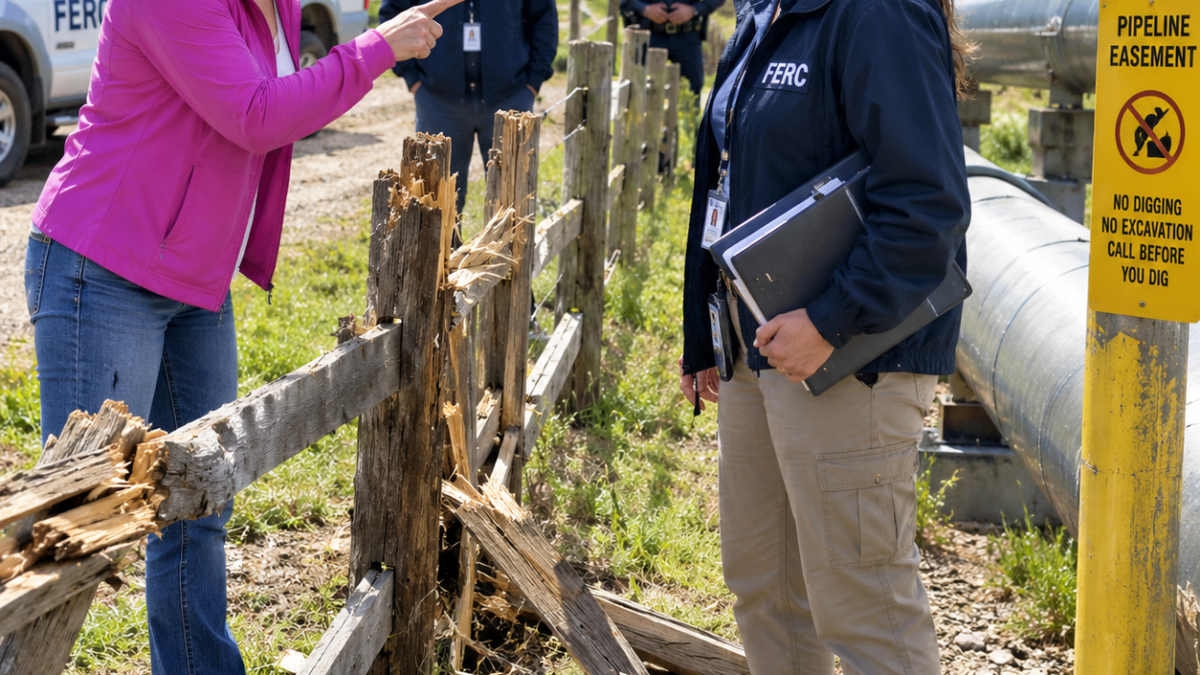
PART 2
The first pipeline truck arrived eleven minutes later.
Not federal agents.
Not police.
A white utility pickup carrying the logo of Dominion Interstate Transmission, the company that operated the line running beneath the back of our properties.
A field technician named Marcus Reed stepped out wearing a flame-resistant shirt, steel-toed boots, safety glasses, and the kind of expression that told me he had already received enough information over the radio to know this was not a routine locate request.
“Everybody stay where you are.”
Karen immediately walked toward him.
“I’m Karen Miller, president of the Eagles Crest Homeowners Association. These contractors are working on an HOA-approved boundary fence.”
Marcus didn’t care about her title.
“Who operated the auger?”
The foreman raised his hand.
“I did.”
“Did you contact 811 before excavation?”
The man’s eyes shifted toward Karen.
“We were told the HOA had handled all utility clearance.”
Marcus looked at Karen.
“Did you?”
She hesitated.
“We have approved plans.”
“That wasn’t my question.”
I almost smiled.
I had heard variations of that sentence from engineers, inspectors, commanders, and investigators my entire adult life.
Karen hated questions that demanded yes or no.
“We’ve performed community projects before,” she said.
Marcus turned to the foreman.
“Did you see paint or flags?”
“No fresh markings.”
“Yellow permanent markers?”
“Yes.”
“And you drilled anyway?”
The man swallowed.
“About eighteen inches before we saw warning tape.”
Marcus’s jaw tightened.
“Everybody backs away.”
He took photographs.
Measured.
Called his operations center.
Then opened a rugged tablet and pulled up the company’s right-of-way map.
I knew approximately where the transmission line sat.
He knew exactly.
“Mr. Miller?”
He looked at me.
“Daniel Mercer.”
I had introduced myself on the phone but not to him.
“Did you own the fence they cut?”
“Yes.”
“Where was it?”
I pointed.
“Five feet inside my surveyed property line.”
Karen interrupted.
“It was an unauthorized fence.”
Marcus looked at her.
“That has nothing to do with the pipeline.”
Her mouth closed.
For once.
He paced the corridor.
Stopped near my memorial trees.
Then looked back toward Karen’s property.
“Whose retaining wall is that?”
Karen straightened.
“Mine.”
“The gazebo?”
“Mine.”
“Raised patio?”
“Yes.”
“Mature ornamental trees?”
“Yes, and they’ve won—”
Marcus raised a hand.
“I’m going to need you to stop landscaping anything in this corridor until our right-of-way department reviews it.”
Karen stared.
“My backyard?”
“Yes.”
“That’s absurd.”
Marcus turned the tablet toward her.
A red band ran through the aerial photograph.
Fifty feet wide.
My rear yard.
Mr. Henderson’s garden.
Karen’s backyard.
Half of her retaining wall.
Almost all of the gazebo.
Karen shook her head.
“No. That map is wrong.”
I knew those words well.
Maps become “wrong” very quickly when they say something people do not like.
Marcus said, “This is our recorded transmission easement.”
“The HOA approved my improvements.”
“The HOA is not the easement holder.”
“The county issued permits.”
“That may matter for local construction requirements. It does not eliminate our property rights under the recorded easement.”
Her face reddened.
“You can’t just come onto my land and tell me to demolish things.”
Marcus remained calm.
“We can enter the right-of-way for inspection and maintenance under the easement terms. I haven’t told you to demolish anything yet. I’ve told you we’re conducting a review.”
Yet.
That one word did what my months of arguments never had.
It frightened her.
Another transmission-company truck arrived.
Then the county fire department.
Then a sheriff’s deputy.
Not because anyone had proven the pipeline was damaged.
Because unauthorized mechanical excavation near a high-pressure line was enough to take seriously.
Marcus used specialized locating equipment.
His second technician marked the actual pipe alignment.
Bright yellow paint appeared across the grass.
It passed much closer to the auger hole than I wanted to see.
“How close?” I asked.
Marcus didn’t answer immediately.
He measured.
“Several feet horizontally from the mapped centerline.”
Karen seized on that.
“See? They didn’t hit anything.”
Marcus turned.
“That is not the standard.”
“What standard?”
“You don’t excavate first and congratulate yourself afterward.”
Even the deputy looked down to hide his reaction.
The line itself did not appear to have been struck.
That was the good news.
The bad news was that excavation had occurred without a valid locate ticket and without the pipeline operator’s coordination inside a restricted corridor.
Marcus said the company would inspect the area and document the unauthorized excavation.
Because the pipeline crossed state lines, federal pipeline safety regulations applied to the operator.
The operator’s compliance department would determine whether the event needed to be reported to state damage-prevention officials, the state utilities commission, and the Pipeline and Hazardous Materials Safety Administration.
That was a lot less dramatic than Karen being handcuffed on her lawn.
It was also much more real.
Paperwork.
Engineering.
Recorded rights.
Compliance.
The same kind of systems she had abused against the rest of us.
Only now they belonged to organizations she could not intimidate.
I watched Karen standing beneath the stone eagle beside her driveway.
For the first time since I met her, her clipboard hung uselessly at her side.
But to understand why I was ready for that morning, you have to understand what she had done before it.
Six months earlier, I had moved into Eagles Crest because I was tired.
Not physically.
Thirty years of Army life, including twenty with the Corps of Engineers, had left marks on my knees and hearing, but those I could handle.
I was tired of temporary places.
Temporary offices.
Temporary quarters.
Temporary assignments.
Even the beautiful places never quite belonged to me because there was always another set of orders coming.
When I retired, I wanted one house.
One porch.
One piece of ground where nobody could tell me I was leaving next spring.
Eagles Crest looked ideal.
Quiet.
Tree-lined.
Forty minutes from the city.
Close enough to a VA clinic and grocery stores but far enough that I could hear owls behind the houses at night.
The HOA did not scare me.
I had read every governing document before closing.
I understood what I was buying.
Exterior modifications required approval in certain cases.
Lawns had maintenance standards.
Sheds were restricted.
Trailers were limited.
Nothing unusual for a planned development.
My mistake was assuming rules were the same thing as governance.
Rules are paper.
Governance is people.
Two weeks after moving in, I planted the seven oaks.
White oaks.
Native.
Strong.
Long-lived.
I spaced them carefully.
Five feet inside my surveyed boundary.
Well away from the rear utility corridor.
At least, that was what I believed then based on the simplified closing survey.
The full recorded plat showed the pipeline easement farther back.
The oaks themselves remained outside the no-tree portion identified by the operator after later review, though several would eventually need periodic root monitoring.
Each tree had a small brass disk at its base.
No giant memorial plaque.
No flag display.
Just initials.
TB.
JM.
EC.
DR.
LK.
AS.
MV.
Seven men.
We had served together at different times.
Some died overseas.
One died years later from injuries that never really healed.
Another took his own life after coming home.
I did not plant the trees because I wanted neighbors to ask questions.
I planted them because memory deserves work.
Watering.
Pruning.
Protecting something living.
Karen appeared on a Tuesday afternoon.
Pink tracksuit.
Huge visor.
Clipboard.
She pointed at the saplings.
“Those have to go.”
That was literally how she introduced herself.
No hello.
No welcome.
No name.
“Why?”
“They weren’t approved.”
“I didn’t see a requirement for approval of ordinary landscape trees.”
“They affect neighborhood harmony.”
“They’re oak trees.”
“They obstruct the cul-de-sac sightline.”
“From five feet tall?”
“They will grow.”
“That’s generally the hope.”
She did not appreciate that.
Then she introduced herself.
Karen Miller.
HOA president.
Architectural review committee chair.
Keeper of harmony.
She cited Section Four, Article Seven, Subsection B.
I later read it again.
It required exterior improvements to preserve the “harmonious visual character” of Eagles Crest.
No tree schedule.
No prohibited species.
No setback.
No height restriction.
No defined sightline.
Just harmonious.
A word broad enough for Karen to drive a golf cart through.
The violation notice arrived three days later.
Remove seven trees within fourteen days.
Fifty dollars per day after the deadline.
I created a file.
That was my instinct.
Not rage.
Not confrontation.
A file.
Survey.
Notice.
Covenants.
Photographs.
Certified correspondence.
I requested the formal hearing allowed under Article Eleven.
Karen signed for my letter.
That mattered later.
While I waited, I began talking to neighbors.
George Pritchard lived beside me.
Retired mechanic.
Widower.
Seventy-two.
He restored a 1969 Camaro in his garage.
Karen fined him repeatedly because the garage door stayed open while he worked.
“How long can it be open?” I asked.
“Thirty minutes.”
“What happens at thirty-one?”
“Civilization collapses.”
Across the street lived the Patels.
Ravi and Priya.
Two children.
Their son’s bicycle had generated eleven violation letters in one summer because it occasionally remained on the lawn.
Then I met Walter Henderson.
Eighty-seven.
Thin.
Stooped.
Hands swollen with arthritis.
His backyard vegetable garden was magnificent.
Tomatoes climbed eight-foot supports.
Beans curled around strings.
Squash leaves spread like green umbrellas.
Karen hated it.
“She says vegetables belong behind screening,” Walter told me.
“Do the covenants say that?”
“They say front yards should be ornamental. Mine is in back.”
“Then why the fines?”
He looked toward his tomatoes.
“Because she doesn’t like it.”
He showed me a shoebox.
Violation notices.
Late fees.
Attorney letters.
More than ten thousand dollars.
A lien had been recorded against his house.
My stomach tightened.
“How long have you lived here?”
“Forty-one years.”
“Before the HOA?”
“Before most of these streets.”
“Why keep fighting over the garden?”
Walter touched one of the tomato vines.
“My wife planted the first one.”
His voice became smaller.
“She died eight years ago.”
I understood immediately.
Seven oaks.
One garden.
Same language.
Different memorial.
“I’m going to need copies of these.”
He looked at me.
“For my trees?”
“For understanding the board.”
That night, my case stopped feeling personal.
I still wanted my oaks left alone.
But I had begun to recognize the system.
Karen used uncertainty.
Most people never read every covenant.
They didn’t know appeal deadlines.
They didn’t know what records they could request.
They didn’t know whether a lien threat was real.
Karen did.
Or at least she knew enough to sound certain.
That was usually sufficient.
My hearing came a month after the first violation.
The clubhouse smelled like chlorine and lemon cleaner.
Five board members sat behind folding tables.
Karen in the center.
Cynthia Lane beside her.
Barry Nolan.
Frank Dell.
And David Rosen, the new treasurer.
I presented the survey.
The covenant.
County definitions.
Photographs.
Then I told them what the trees were.
Not to win sympathy.
Because context matters.
“These seven oaks commemorate men I served with.”
Karen shifted impatiently.
I continued.
“They’re not commercial signage. They’re not structures. They create no present safety hazard. If the board believes Section Four prohibits them, I’m asking you to identify the objective written standard they violate.”
Silence.
Karen answered.
“The architectural committee determined they disrupt continuity.”
“Based on what standard?”
“Professional judgment.”
“Whose professional judgment?”
“My committee.”
“Do you employ a landscape architect?”
Her eyes narrowed.
“That’s irrelevant.”
“No.”
I closed the binder.
“That’s my question.”
Cynthia immediately moved to deny my appeal.
Barry seconded.
Karen voted yes.
Barry yes.
Frank yes.
Then David raised his hand.
“Opposed.”
Karen stared at him.
David cleared his throat.
“I don’t think this provision is specific enough to require removal of these trees.”
Karen’s face hardened.
“We discussed this.”
“I know.”
“Then why are you changing your position?”
“I’m not changing it.”
He looked uncomfortable but continued.
“I never agreed the trees had to go.”
The appeal failed four to one.
My fines continued.
But something else happened.
Everyone saw David tell Karen no.
Afterward, he caught me in the parking lot.
“She’s going to be furious.”
“Probably.”
“You seem happy about that.”
“I’m happy you voted honestly.”
He glanced toward the clubhouse.
“The finances are worse.”
That stopped me.
“What do you mean?”
“I shouldn’t be discussing board business.”
“Then don’t.”
He hesitated.
“If a homeowner submitted a formal records request for invoices, account statements, and contracts, state law and our bylaws require certain records to be available.”
I understood.
“Would the treasurer be responsible for producing them?”
“Yes.”
“Thank you, David.”
“I didn’t tell you anything.”
“No.”
The next morning, I sent the request.
Certified.
Five years of financial records.
Invoices.
Bank statements.
Vendor contracts.
Meeting approvals.
Reimbursements.
Karen delayed until the last day.
Then a box arrived.
Disorganized.
But complete enough.
David had quietly made sure of that.
The first thing I noticed was landscaping.
Eagles Crest spent far more per home on “beautification” than comparable communities.
The vendor was Green Horizon Design.
Owner:
Paul Miller.
Karen’s brother-in-law.
Maybe legitimate.
Related-party business is not automatically wrongdoing.
But I found no conflict disclosure in board minutes.
Then I found restaurant receipts.
Board strategy lunches.
Four people.
Expensive.
Association card.
Then an invoice for “West Entrance Enhancements.”
Except the west entrance sat near Karen’s property.
Another bill:
**Executive Landscape Demonstration Area — $18,420.**
Location:
Lot 14.
Karen’s address.
I called David.
“Was the HOA paying for her backyard?”
Silence.
“David?”
“That was described as a community landscape demonstration.”
“Is it open to the community?”
“No.”
“Can residents access it?”
“No.”
“Then demonstrate to whom?”
“I asked.”
“What did she say?”
“That her yard was visible from the walking path and therefore benefited community aesthetics.”
I nearly laughed.
Then I found the retaining wall invoice.
$11,800.
Patio grading.
$6,200.
Gazebo electrical preparation.
HOA account.
All on Karen’s lot.
That was when the financial case became serious.
Still not necessarily criminal.
Maybe the board approved it.
Maybe there was some absurd but authorized beautification program.
I needed minutes.
David supplied them in response to another records request.
The approvals were vague.
“Landscape enhancement.”
“Demonstration corridor.”
No lot number.
No owner disclosed.
Then, while reviewing my own plat against the county GIS, I noticed the easement.
**NATURAL GAS TRANSMISSION RIGHT-OF-WAY — 50 FT.**
I pulled the recorded instrument.
The easement had existed since 1963.
The pipeline operator retained broad access rights for inspection, maintenance, excavation, vegetation control, and emergency response.
Restrictions included structures and grade changes that could obstruct access or affect the line.
Deep-rooted plantings required operator approval.
Suddenly Karen’s backyard looked very different.
Her four-foot retaining wall changed grade across the easement.
Her gazebo had footings.
Her mature ornamental trees sat throughout the right-of-way.
I did not celebrate.
Pipelines are not revenge props.
If her construction compromised safe access, that needed review whether I liked Karen or not.
I called the pipeline company’s non-emergency right-of-way department.
A woman named Sheila Brooks answered.
I gave my parcel and described the improvements.
“Do you have a concern about active excavation?” she asked.
“No.”
“Damage?”
“None I know of.”
“Then email photographs and the address. We’ll review.”
I did.
Two days later, Sheila called back.
“Our mapping shows several potential encroachments.”
“What happens?”
“We contact the property owner and inspect.”
“Will you tell them I reported it?”
“If asked through a formal process, we don’t promise confidentiality.”
“Fine.”
I wanted this clean.
No anonymous complaints.
No tricks.
At least that was what I told myself.
Then Karen started targeting Walter Henderson more aggressively.
His lien amount climbed.
She sent the Patels another violation over bicycles.
George got a $300 fine because his Camaro was visible from the street while he replaced a carburetor.
And I received a second tree notice.
Now the HOA claimed root systems might threaten “community infrastructure.”
That was ironic enough to make me stare at the page for a long time.
Roots.
Infrastructure.
Pipeline.
The next board meeting drew thirty residents.
David again voted against my fines.
Walter stood up.
“Enough.”
Karen banged her gavel.
“You are not recognized.”
“I’ve been here forty-one years.”
“You still follow the rules.”
“So do you.”
That brought murmurs.
Karen pointed at him.
“Sit down.”
Ravi Patel stood beside Walter.
Then Priya.
Then George.
Then six more residents.
Nobody shouted.
They just stood.
Karen’s face went red.
“This meeting is adjourned.”
She fled.
That was the night I made a decision I’m not proud of.
I built the ten-foot fence section.
I told myself it was an experiment.
A legal test.
A way to force another formal appeal.
But if I’m honest, it was bait.
Dark-stained horizontal cedar.
Tasteful.
Modern.
Not on the approved fence list.
I placed it five feet inside my property and outside the pipeline’s restricted center corridor based on the operator’s map.
Karen saw it before lunch.
“What is that?”
“A fence.”
“You don’t have approval.”
“I know.”
Her face registered disbelief.
“You admit it?”
“Yes.”
“You will remove it.”
“I’ll appeal.”
“You think this is funny?”
“No.”
“You are deliberately provoking the board.”
“That sounds like an assumption.”
Her hand shook as she wrote.
The notice arrived that afternoon.
One hundred dollars per day.
I appealed.
Lost four to one.
Exactly as expected.
Then I removed the section.
Or tried to.
Before I got to it, Karen escalated.
At 6:42 on a Thursday morning, I heard metal cutting.
I looked out.
A contractor was at my fence.
One worker used a reciprocating saw to remove two horizontal boards and open access.
Karen stood beside him.
I went outside.
“What are you doing?”
She held up a work order.
“Corrective boundary screening.”
“You’re cutting my fence.”
“It’s an unapproved structure.”
“That doesn’t make it yours.”
“We’re replacing it with compliant association screening.”
“On whose property?”
“The boundary.”
I looked toward the rear.
Stacks of ten-foot chain-link panels.
An auger.
Metal posts.
“This is retaliation.”
Karen smiled.
“This is enforcement.”
I took out my phone.
“Say that again.”
Her smile vanished.
“I don’t consent to recording.”
“I’m on my property.”
The contractors shifted uneasily.
One asked Karen, “Where exactly do you want the posts?”
She pointed.
“Right along here. Close enough that those ridiculous trees disappear behind it.”
I knew the line she indicated.
It crossed the pipeline easement.
“Have you called 811?”
Karen rolled her eyes.
“The HOA knows the utilities.”
The foreman looked at me.
I said, “High-pressure transmission line runs through this corridor.”
Karen snapped, “Stop interfering.”
The foreman asked her directly.
“Do you have a locate ticket?”
She handed him a packet.
He flipped through it.
“This is architectural authorization.”
“It authorizes construction.”
“Not excavation.”
“Just start.”
He should have refused.
He told investigators later that he assumed the HOA’s packet meant utility clearance had already been handled.
That assumption almost became catastrophic.
The auger began.
I called the operator.
Then the warning tape surfaced.
Everything stopped.
By noon, Eagles Crest looked nothing like the place Karen had ruled the previous day.
Pipeline trucks.
Sheriff’s unit.
Fire apparatus.
Yellow paint.
Temporary cones.
Marcus Reed and two technicians performed leak surveys.
No gas detected.
No strike.
No damage.
Thank God.
But the pipeline company’s right-of-way manager arrived that afternoon.
Her name was Leah Grant.
She was not impressed.
Karen tried to explain that the HOA had authority over fences.
Leah replied, “You do not have authority to authorize excavation within our easement without complying with applicable damage-prevention procedures.”
Karen pointed toward me.
“He created this situation.”
Leah looked at my cut fence.
“Did he hire the excavator?”
“No.”
“Did he instruct them to drill?”
“No.”
“Then we’ll deal with him separately if necessary.”
Karen’s face tightened.
Leah walked her property with the easement instrument in hand.
The retaining wall concerned her most.
It changed grade.
It could interfere with access.
The gazebo footings needed engineering review.
Several trees were species the operator normally prohibited within certain portions of the maintained right-of-way.
By four that afternoon, Karen had received a written stop-work directive from the pipeline operator.
Not a federal fine.
Not an arrest.
Something more immediate.
No excavation.
No new fencing.
No grading.
No landscaping changes within the corridor until clearance.
Then the company notified the state’s damage-prevention enforcement authority about the unauthorized excavation.
Because the line was an interstate transmission line subject to federal pipeline-safety regulation, the operator also documented the encroachment through its federal compliance program.
Two days later, a regional PHMSA inspector contacted the operator as part of the follow-up review.
That was when Karen finally understood that this issue was not going away with a board vote.
But the event did something else.
It exposed the board.
Residents demanded to know why HOA money had paid for construction on Karen’s private property.
David stopped being quiet.
At an emergency meeting, he brought the invoices.
Not me.
That mattered.
He sat beside Karen.
Placed a stack of documents on the table.
Then said, “I can no longer certify these financial statements.”
The room went silent.
Karen stared at him.
“What?”
“The audit trail is inadequate.”
“We’ve discussed this.”
“You discussed it.”
“I’m president.”
“I’m treasurer.”
That sentence changed Eagles Crest.
Karen leaned toward him.
“Be careful.”
David looked around the packed clubhouse.
“No.”
Same tiny word.
Same enormous effect.
“I should have been careful three years ago.”
He opened the first invoice.
“Association funds paid $11,800 toward a retaining wall on Lot 14.”
Karen interrupted.
“Community beautification.”
“Your house.”
“Visible from common space.”
“Association funds paid for electrical preparation for your gazebo.”
“It hosts board events.”
“When?”
“We’ve held informal planning—”
David shook his head.
“No documented board vote authorizes private improvements at your residence.”
Cynthia tried to intervene.
Karen silenced her.
Then Walter Henderson stood.
“What about my lien?”
Karen banged the gavel.
“Not relevant.”
“It’s relevant to me.”
His voice trembled.
“You spent our money on your backyard and fined me ten thousand dollars for tomatoes.”
Applause erupted.
Karen shouted for order.
Nobody obeyed.
The Patels spoke.
George.
A widow named Marie Benson whose grandchildren’s swing set had generated thousands in fines.
The floodgates opened.
I sat in the back.
For months, I had imagined standing at the microphone exposing Karen.
I didn’t need to.
The community did it better.
David continued.
He had requested an independent audit.
The board’s insurer supported it.
Karen had tried to block it.
That email was displayed too.
Then Leah Grant from the pipeline operator stood.
She had attended because the HOA technically owned small common parcels affected by the same right-of-way.
Her statement lasted less than three minutes.
The transmission easement predated the subdivision.
The HOA did not own the pipeline corridor.
Individual homeowners did not control the operator’s easement rights.
Any HOA approval did not substitute for required utility-location and operator coordination.
Existing encroachments on Karen’s lot were under review.
The unauthorized excavation had been reported through the appropriate damage-prevention channels.
That was it.
No drama.
Karen’s face said enough.
Frank Dell, one of the board members who had spent months voting with her, suddenly cleared his throat.
“I move that Karen be suspended from presidential duties pending completion of the financial audit and legal review.”
Karen turned toward him as if he had stabbed her.
“You can’t.”
Barry seconded.
Cynthia stared at them.
David voted yes.
Barry yes.
Frank yes.
Cynthia abstained.
Karen voted no.
Three to one.
Suspended.
The woman who had ruled Eagles Crest through procedural intimidation was removed through procedure.
She sat motionless.
Then looked at me.
“This is what you wanted.”
I shook my head.
“No.”
“Don’t lie.”
“I wanted my trees.”
“You planned this.”
“Some of it.”
That was the truth.
I had built the fence section knowing she would react.
I wasn’t proud of that.
But I had not told her to cut it.
I had not told her to hire contractors.
I had not told her to skip 811.
I had not built her retaining wall.
I had not spent HOA money on her gazebo.
Those decisions belonged to Karen.
She gathered her papers.
“No one here understands what I’ve done for this community.”
Walter replied quietly.
“We understand now.”
Karen left.
No applause.
No cheering.
Just a hundred people watching the door close.
The audit lasted nine weeks.
It found poor controls.
Undisclosed related-party transactions.
Payments benefiting Karen’s property.
Restaurant expenses without adequate business purpose.
Procurement processes ignored.
Not all of it was theft.
Some expenditures had technically been approved, though badly documented.
Some were reimbursed after legal review.
Others became claims against former board officers and vendors.
The pipeline issue moved on its own track.
Engineers evaluated Karen’s backyard.
The line itself was safe.
That mattered most.
The wall had not damaged the pipe.
The gazebo had not compromised coating or depth.
But both materially interfered with the operator’s access rights.
Karen had two choices.
Negotiate modifications.
Or litigate the easement.
Her attorney advised negotiation.
The gazebo came down first.
Not because federal agents arrived with chainsaws.
Because the operator would not accept it within the maintained corridor.
The retaining wall was worse.
Removing it required a geotechnical plan so the excavation itself would not create another hazard.
Crews dismantled the wall in sections.
The raised patio disappeared.
Several ornamental trees were relocated.
Others could not be.
The ground was regraded.
The beautiful tiered yard Karen had displayed in newsletters became a broad, gently sloped grass corridor.
She hated it.
I knew because I saw her standing at the edge every morning while crews worked.
I never walked over.
Revenge is most satisfying in imagination.
In real life, watching someone lose something they loved is more complicated.
Even Karen.
The state damage-prevention authority cited the fencing contractor for beginning excavation without proper utility verification.
The contractor, in turn, produced the work order and Karen’s written representation that all approvals had been obtained.
Karen faced civil liability connected to that representation and the aborted work.
The HOA refused to pay.
Independent counsel concluded she had acted without a valid board authorization for the spite fence.
The association formally disavowed the project.
Karen was on her own.
Then came the special election.
She tried to run again.
That surprised everyone.
Her campaign flyer said:
**RESTORE ORDER TO EAGLES CREST.**
Frank laughed for a full minute.
David did not.
“She’ll get votes.”
He was right.
Some residents still supported her.
They liked strict enforcement.
They credited her with keeping lawns neat and home values strong.
A few thought the investigation had become personal.
That was fair to discuss.
So we discussed it.
At the candidate forum, Karen defended herself.
“I made difficult decisions because leadership requires courage.”
David sat beside her.
He was running reluctantly.
“Leadership also requires disclosure.”
She glared.
“You benefited from every improvement I made.”
“So did my accountant.”
People laughed.
Even David looked surprised.
Then Karen addressed me from the stage.
“Mr. Mercer built an illegal fence specifically to provoke me.”
That was partly true.
I stood in the audience.
“I built a non-approved test section and appealed it.”
“You admit it.”
“Yes.”
The room murmured.
I continued.
“I removed it after the appeal.”
Karen froze.
Several residents looked at me.
They hadn’t known.
“I don’t claim I handled every part of this perfectly,” I said. “I was angry. I wanted to expose selective enforcement. The fence was bait.”
Karen smiled triumphantly.
“There.”
I nodded.
“Yes. There.”
Then I looked around the room.
“But I didn’t authorize excavation over a transmission line. I didn’t spend HOA funds on my backyard. I didn’t sign my brother-in-law’s landscaping invoices. I didn’t put a lien on Walter’s house.”
Her smile disappeared.
“I made one provocative choice.”
I looked directly at her.
“She made years of governing choices.”
That was the difference.
David won seventy-one percent of the vote.
Karen received twenty-three.
The rest went to a third candidate.
Her political power ended that night.
David’s first board meeting lasted three hours.
He hated every minute.
He eliminated retroactive fines where procedures had been violated.
Not all fines.
That mattered.
Eagles Crest still had rules.
George still had to keep parts from spreading across his driveway.
The Patels still had to remove bicycles from sidewalks overnight.
People still needed approval for major additions.
But Walter’s garden lien was reviewed.
Independent counsel concluded several fines had been imposed under an interpretation not supported by the actual covenant language.
The lien was released.
David and I went to tell him personally.
Walter opened the certified release.
His hands trembled.
“Gone?”
David nodded.
“Gone.”
Walter sat at his kitchen table.
For a while he said nothing.
Then he started crying.
Not loudly.
Old men often cry quietly.
“I thought I’d lose Ruth’s house.”
David looked confused.
“Ruth?”
“My wife.”
Walter pointed through the window toward the garden.
“She picked this place.”
David swallowed.
“I’m sorry.”
Walter looked at him.
“You weren’t president.”
“I was on the board.”
“That’s different.”
“No.”
David shook his head.
“Not different enough.”
Walter reached across the table.
“Then do better.”
David nodded.
“I will.”
He did.
The new board rewrote the landscaping guideline.
Objective standards.
Setbacks.
Safety.
Visibility triangles.
Approved and prohibited species based on actual infrastructure concerns.
No more “harmonious” whatever Karen happened to imagine.
They adopted a conflict-of-interest policy.
Competitive bids above thresholds.
Two signatures for reserve transfers.
Published minutes.
Open financial reports.
Most important, they hired a utility-locate consultant to map every recorded easement in the subdivision.
That exposed more surprises.
Not corruption.
Just decades of homeowners and boards forgetting what existed underground.
Sheds.
Fences.
Trees.
One swimming-pool deck partially inside another utility corridor.
The board worked with operators.
Most problems were resolved without demolition.
Imagine that.
Cooperation.
Karen put her house on the market six months later.
The federal pipeline issue had not bankrupted her.
The truth was less cinematic.
Removing and modifying her landscaping cost a lot.
Legal fees cost more.
The HOA sought reimbursement for certain improperly funded private improvements.
Her brother-in-law’s company repaid part of disputed amounts through settlement.
Karen and her husband decided to sell.
The sign appeared in March.
Ironically, it belonged to the same real-estate company Karen had once cited another homeowner for using without architectural approval.
George noticed first.
“Beautiful.”
“What?”
“Cosmic symmetry.”
The day Karen moved out, I was pruning one of the memorial oaks.
They had grown nearly three feet.
The first flush of spring leaves had just opened.
Karen walked across the street.
No tracksuit.
No clipboard.
Jeans.
Gray sweatshirt.
She stopped outside my property.
“Daniel.”
“Karen.”
She looked at the trees.
“They’re bigger.”
“Yes.”
“I still think seven in a row is too many.”
I almost laughed.
“At least you’re consistent.”
She surprised me by smiling.
Barely.
Then she looked toward the rear of her former yard.
Grass now covered the pipeline corridor.
No gazebo.
No wall.
“Do you know how much that garden cost me?”
“No.”
“I do.”
I waited.
She looked at me.
“You reported it.”
“Yes.”
“You could’ve just told me.”
“I did tell you there was a pipeline.”
“That morning.”
“I mean before.”
That was harder.
She was right.
I had discovered the easement weeks before.
I could have walked across the street.
Shown her the plat.
Warned her.
Instead, I held it.
Partly because I wanted leverage.
“I could have.”
Karen looked surprised that I admitted it.
“Why didn’t you?”
I looked at the oaks.
“Because by then I didn’t trust you to listen.”
“That isn’t an answer.”
“It’s the only one I have.”
She folded her arms.
“You wanted me caught.”
“Yes.”
The word sat between us.
I didn’t enjoy saying it.
“But I didn’t want anyone hurt.”
“You think that makes it better?”
“No.”
Silence.
Then I said, “Karen, if the workers had kept digging, I would’ve spent the rest of my life wondering whether my little trap helped put people at risk.”
That changed her expression.
I had never admitted that to anyone except David.
The night after the incident, I barely slept.
Not because I feared Karen.
Because I kept replaying the auger.
Yellow tape.
Another foot.
Maybe less.
Engineers spend careers imagining failure before it happens.
That imagination is useful until three in the morning.
“I shouldn’t have built the bait fence,” I said.
Karen stared at me.
“No.”
“I shouldn’t have ordered them to dig.”
“No.”
We both looked toward the rear property line.
Finally she said, “I really thought I was protecting the neighborhood.”
“I believe you.”
She looked at me sharply.
“I do.”
“Then why did everyone turn against me?”
“Because somewhere along the way, protecting Eagles Crest became the same thing as obeying Karen.”
Her face tightened.
“That’s easy for you to say.”
“It’s also true.”
Her husband called from the moving truck.
She turned.
Then stopped.
“The trees.”
“What about them?”
“Who are they?”
I touched the nearest trunk.
“People I served with.”
“All seven?”
“Yes.”
She looked down at the brass disk.
**TB.**
“What happened?”
“Different things.”
“War?”
“Some.”
She nodded.
For the first time since I met her, she did not ask another question.
She walked back across the street.
Before getting into the car, she looked at me once.
Then left.
I stood beneath the oaks a long time.
Victory did not feel like I expected.
Quiet.
Complicated.
But peaceful.
Walter Henderson died the following winter.
He was eighty-eight.
Cancer took him quickly.
A month before he died, David and I visited.
Walter sat wrapped in a blanket by the kitchen window.
The garden outside was dormant.
Brown stalks.
Bare soil.
He handed me a small envelope.
“What’s this?”
“Seeds.”
Tomatoes.
Ruth’s favorite variety.
“Heirloom,” he said.
“You want me to plant them?”
“No.”
He pointed at David.
“I want the HOA president to plant them.”
David laughed nervously.
“I kill houseplants.”
“Learn.”
Walter smiled.
“Rules are easier.”
David took the seeds.
Walter looked at me.
“Your trees okay?”
“They’re good.”
“Keep them.”
“I plan to.”
He nodded.
“Good.”
At Walter’s funeral, David announced that Eagles Crest would create a community garden on unused common land.
Residents voted.
Properly.
Survey first.
Utility records reviewed.
Pipeline company consulted.
No easements.
No surprises.
They named it Henderson Garden.
David planted the first tomatoes.
Most died.
Walter would have enjoyed that.
The Patels saved the remaining plants.
The following summer, bags of tomatoes appeared on porches throughout Eagles Crest.
George left his garage door open almost every weekend.
Children’s bicycles occasionally stayed on lawns.
Nobody’s property values collapsed.
Cynthia eventually apologized for blindly supporting Karen.
Barry resigned and never attended another meeting.
Frank Dell became chairman of the architectural committee and hated it.
That made him surprisingly good at the job.
My seven oaks kept growing.
The pipeline operator inspected them.
Two sat close enough to the edge of its vegetation-management zone that I signed an agreement allowing pruning or removal if future root growth created an operational issue.
I didn’t like that.
But the rule had a reason.
A real one.
Safety.
Access.
Infrastructure.
That mattered.
One afternoon Marcus Reed returned during a routine right-of-way patrol.
He stopped near the trees.
“You’re the fence guy.”
“I prefer retired engineer.”
He laughed.
“Your trees look good.”
“Thank you.”
He checked the yellow marker.
Then the corridor.
I asked, “How close were they really?”
“To the pipeline that morning?”
“Yes.”
He looked at me.
“Close enough.”
“That’s not a number.”
“No.”
“Why not?”
“Because people hear a number and decide everything outside that number is safe.”
Fair.
“Could they have hit it?”
“If they’d kept excavating blindly? Mechanical excavation around transmission lines is exactly why damage-prevention rules exist.”
I stared toward the road.
“I knew better.”
“You stopped it.”
“After using the fence as bait.”
Marcus looked at me.
“You tell the contractor to skip the locate?”
“No.”
“Tell the HOA president to order digging?”
“No.”
“Control the auger?”
“No.”
“Then learn from what you controlled.”
Engineer advice.
I understood it.
That evening, I removed the last remaining piece of the little horizontal fence.
The bait.
I had kept one post standing.
A reminder.
I pulled it out.
Filled the hole.
Seeded the patch.
No trophy.
No monument to Karen.
The oaks were enough.
Years later, people who moved into Eagles Crest barely knew the story.
They saw yellow pipeline markers along the rear corridor.
Objective landscaping rules.
An online financial portal.
A thriving community garden.
Seven mature oaks along my side yard.
Sometimes a child asked why each trunk had initials.
I answered if their parents were comfortable.
Sometimes I didn’t.
Memorials do not always need explanations.
David remained HOA president for two terms.
Then stepped down voluntarily.
At his final meeting, somebody nominated him again.
He refused.
“Term limits,” he said.
Frank called from the back.
“You wrote those.”
“I know.”
“Seems shortsighted.”
Everyone laughed.
The board gave David a plaque.
He hated it.
After the meeting, we sat outside the clubhouse.
He asked me something I had not thought about in years.
“Do you still have the first violation?”
“The tree one?”
“Yes.”
“Of course.”
“You really keep everything.”
“Occupational damage.”
He shook his head.
“Karen signed it, didn’t she?”
“Yes.”
“What did it say?”
“Seven oaks disrupted aesthetic harmony.”
David looked toward my house.
From the clubhouse, you could see the upper branches now.
They were beautiful.
“Funny.”
“What?”
“They’re probably the best-looking thing in the neighborhood.”
I smiled.
“Careful. That sounds subjective.”
He laughed.
Then became serious.
“You know what bothered me most?”
“What?”
“I knew she was wrong before I voted against her.”
“You eventually did.”
“Eventually isn’t the same.”
“No.”
“I kept thinking someone else would challenge her.”
“Most people do.”
He looked at me.
“Why didn’t you?”
“I did.”
“No. I mean before me. Why didn’t you assume somebody else would do it?”
I thought about the seven brass disks.
“Because I’ve already known people who didn’t get another chance.”
David nodded.
Nothing else needed saying.
The first oak reached twenty feet a few years later.
I stood beneath it on Memorial Day.
No ceremony.
Just me.
I cleaned each brass disk.
TB.
JM.
EC.
DR.
LK.
AS.
MV.
Then I walked to Walter’s garden.
Children were planting tomatoes.
George supervised from a folding chair despite knowing almost nothing about vegetables.
Priya corrected him constantly.
Frank Dell tried to measure bed spacing until everyone told him to go away.
Normal life.
Messy.
Unregulated in all the right places.
At the edge of the garden stood a small sign:
**CHECK THE MAP BEFORE YOU DIG.**
Below it:
**CALL 811.**
David had added another line in tiny letters:
**YES, THIS MEANS YOU.**
I laughed every time.
The pipeline corridor itself was almost invisible.
Just grass.
Markers.
Open space.
Exactly what safety infrastructure often looks like when it is working properly.
Nothing dramatic.
No lights.
No sirens.
No federal agents.
That morning with Karen had taught everyone the wrong lesson at first.
People said federal regulators defeated her.
They didn’t.
Not really.
Her own decisions did.
The pipeline rules simply created a boundary she could not redefine.
The audit created records she could not explain away.
The residents created accountability she could not silence.
All the systems she once dismissed as obstacles became the things that protected us when her authority went too far.
And I learned something too.
Strategy can become arrogance if you start enjoying the trap more than the truth.
I had been right about Karen.
But I had come too close to treating a real pipeline as a chessboard.
That lesson stayed with me.
Years later, when the HOA proposed replacing an old walking path near another utility corridor, David’s successor called me.
“Daniel, can you look at this?”
“No.”
Silence.
“You’re the engineer.”
“I’m retired.”
“Please?”
I sighed.
“Call 811.”
“We haven’t started digging.”
“Good.”
“Then what?”
“Get the recorded easements.”
“Then?”
“Call the operators.”
“Then?”
“Hire someone who still gets paid for this.”
She laughed.
“Fine.”
That was progress.
Nobody assumed.
Nobody declared authority.
Nobody dug first.
I returned home and watered the oaks.
The seventh tree had developed a low branch that reached over the grass.
I thought about trimming it.
Then decided to wait until fall.
The sun dropped behind the houses.
Wind moved through thousands of leaves that once fit inside seven nursery pots.
I remembered Karen standing there years earlier saying:
Those have to go.
They never did.
Walter’s garden survived him.
The Patels’ children grew up.
George eventually finished the Camaro, then immediately began rebuilding it again because apparently that was the point.
The pipeline remained beneath us, carrying gas across states without anybody thinking about it most days.
And Eagles Crest finally became what I had wanted when I first bought my house.
Quiet.
Not the silence that comes from people being afraid to challenge someone.
The better kind.
The sound of sprinklers.
Garage radios.
Children arguing over bicycles.
Neighbors talking over fences.
Leaves moving above seven brass names.
One evening, I sat on my porch with iced tea.
Almost exactly where I had been the afternoon Karen first approached me.
A little boy from the new family across the street stopped beside the first oak.
His father called him back.
“Don’t touch Mr. Mercer’s tree.”
“It’s okay,” I said.
The boy pointed at the brass disk.
“What’s TB?”
“A name.”
“Whose?”
“A friend.”
“Where is he?”
I looked up into the branches.
For a second, I was young again.
Dust.
Heat.
Laughter in a temporary barracks.
Men who believed there would always be another morning.
“He died a long time ago.”
The boy became serious.
“Did you plant the tree for him?”
“Yes.”
He touched the trunk carefully.
“Then he got really big.”
I laughed.
“I suppose he did.”
His father smiled apologetically.
They continued down the sidewalk.
I watched them go.
Then looked at the oak.
Karen had seen seven violations.
I had seen seven men.
The pipeline company had seen a protected corridor.
Walter had seen land where things could grow.
David had seen numbers he should have questioned sooner.
Same neighborhood.
Same ground.
Different meanings.
That was why rules needed humility.
Nobody’s clipboard contained the whole truth.
As darkness settled over Eagles Crest, the path lights came on around Henderson Garden.
My oaks became silhouettes against the evening sky.
Far behind them, one yellow pipeline marker caught the porch light.
I raised my glass toward it.
Not as a trophy.
As a warning.
Know what is beneath your feet.
Know what is written in the documents.
Know where your authority ends.
And never mistake somebody else’s patience for permission.
Then the wind moved through the seven trees together, and the sound was so much like distant applause that, for once, I allowed myself to believe the men they represented would have understood why I stayed and fought for them.
Years passed, but the story did not end when Karen’s moving truck disappeared around the entrance to Eagles Crest.
For a while, I thought it had.
Her house sold.
The pipeline corridor healed.
Grass covered the scar where the retaining wall and gazebo had once stood.
David finished his two terms as HOA president and stepped away exactly when the bylaws said he should.
Walter’s garden became part of the neighborhood.
My seven oaks kept growing.
From the outside, everything that had happened seemed finished.
Then one November afternoon, a white envelope appeared in my mailbox.
No HOA logo.
No lawyer’s letterhead.
My name was handwritten across the front.
Daniel Mercer.
I recognized the handwriting immediately.
Karen.
I stood beside the mailbox for nearly a minute before opening it.
Part of me wanted to throw it away.
Another part remembered the morning she ordered workers to dig over a transmission pipeline.
The yellow warning tape.
The auger.
The fear I felt when I understood how close arrogance had come to becoming catastrophe.
I opened the envelope.
Inside was a single sheet of paper.
Daniel,
I don’t expect you to answer this.
I moved to North Carolina after we left Eagles Crest. I told myself for a long time that what happened there was because people turned against me.
I blamed you.
Then David.
Then the board.
Then the pipeline company.
Then my lawyers.
Then my husband.
It has taken me longer than I want to admit to understand that every time something went wrong, I found somebody else to blame because admitting I had caused it would have meant admitting I wasn’t the person I thought I was.
You once told me cooperation was not obedience.
I hated you for saying that.
I understand it now.
I still think you provoked me with that fence.
You admitted that yourself.
But you didn’t make me order those workers to dig.
I did that.
I wanted to win more than I wanted to stop and think.
That sentence stayed with me.
I wanted to win more than I wanted to stop and think.
I read it three times.
Karen continued.
I don’t know the names represented by your trees.
I should have asked before telling you to remove them.
I’m sorry.
There was no signature beyond:
Karen.
I folded the letter.
Put it back inside the envelope.
Then I walked to the seven oaks.
By then their trunks were thick enough that I could no longer circle any of them with both hands.
The brass markers at their bases had weathered dark.
I crouched beside the first.
TB.
Thomas Bennett.
Tommy.
He could make coffee from anything.
Water that tasted like diesel.
Powder that looked like dirt.
A dented metal cup.
Somehow it came out drinkable.
He died at twenty-nine.
Three kids.
The second tree was James Morales.
JM.
A terrible singer.
He sang constantly.
Country music mostly.
Always off-key.
I used to threaten to report him as psychological warfare.
He never stopped.
EC was Ethan Cooper.
DR, Daniel Ruiz.
LK, Lucas Kane.
AS, Aaron Sloan.
MV, Marcus Vega.
Seven trees.
Seven people Karen had once reduced to landscaping violations.
I touched Tommy’s brass disk.
“She apologized,” I said quietly.
The tree did not answer.
Probably for the best.
George’s garage was open next door.
He spotted me through the trees.
“You talking to vegetation again?”
“It listens better than you.”
“Low standard.”
He walked over wiping grease from his hands.
Even in his late seventies, George always had grease somewhere on him.
“What’s that?”
He nodded toward the envelope.
“Letter from Karen.”
George stopped.
“No.”
“Yes.”
“Our Karen?”
“The only one I know.”
“What does she want?”
“Nothing.”
“Nobody writes a letter for nothing.”
“She apologized.”
George stared at me.
Then at the envelope.
Then back at me.
“Is she dying?”
“George.”
“I’m serious.”
“No idea.”
“You going to answer?”
“I don’t know.”
He looked toward the oaks.
“I wouldn’t.”
“Why?”
“She tried to get them cut down.”
“That was years ago.”
“I maintain grudges professionally.”
“I’ve noticed.”
George folded his arms.
“She also fined me because my garage door was open.”
“It was open.”
“It’s open now.”
“Yes.”
“Exactly.”
I laughed.
Then he surprised me.
“Walter would answer.”
I looked toward Henderson Garden.
“What makes you think that?”
“He always thought people deserved another chance.”
“He complained about Karen until the day he died.”
“Those things are not mutually exclusive.”
George walked back toward his garage.
At the driveway he stopped.
“Don’t write anything angry.”
“I’m not angry.”
“That’s when you write the worst letters.”
He disappeared into the garage.
I hated how well my neighbors knew me.
That night I put Karen’s letter in the old HOA binder.
The binder had become ridiculously thick over the years.
Tree notices.
Survey maps.
Financial requests.
Meeting minutes.
Photographs.
Pipeline documents.
Audit summaries.
The cut section of yellow warning tape had never come into my possession, but I kept a photograph of it.
I turned through the pages.
For years those documents had felt like ammunition.
Now they looked like what they really were.
Paper.
The people mattered more.
The next afternoon, I wrote Karen back.
Only four sentences.
Karen,
I received your letter.
Thank you for writing it.
I accept your apology regarding the trees.
I hope wherever you live now feels like home.
Daniel.
I mailed it before I could overthink it.
That was the last time Karen and I communicated.
I never learned whether she joined another HOA.
For the sake of that neighborhood, I hoped not.
Five years after she left, the pipeline company announced a major inspection project through our area.
Not an emergency.
Routine integrity work.
The company planned to expose sections of the transmission line, inspect coating, conduct measurements, and replace several fittings farther downstream.
Eagles Crest residents received notices months in advance.
Temporary fencing.
Heavy equipment.
Access restrictions.
Some landscaping disruption.
For most residents, it was inconvenient.
For me, it was strangely reassuring.
They were doing exactly what the easement existed to allow.
David no longer served on the board, but his successor, a woman named Linda Carver, called me.
“Daniel.”
“No.”
“You don’t know why I’m calling.”
“Yes, I do.”
“We need help understanding the pipeline notice.”
“Call the pipeline company.”
“We did.”
“Excellent.”
“They’re holding a resident meeting.”
“Even better.”
“We want you there.”
“No.”
“Why?”
“Because I’m trying very hard not to become the retired man every committee calls because he once read a map.”
Linda laughed.
“You spent twenty years with the Corps of Engineers.”
“That was poor career planning.”
“Seven o’clock Thursday.”
“I didn’t agree.”
“See you then.”
She hung up.
I attended.
Of course I did.
Nearly sixty residents packed the clubhouse.
A pipeline engineer named Rebecca Shaw displayed maps.
Real maps.
Current maps.
Clearly marked easements.
She explained why access mattered.
Why deep-rooted vegetation could become a problem.
Why excavators needed proper locating procedures.
Why residents should never assume an HOA approval replaced utility coordination.
Nobody interrupted her.
Nobody shouted about property rights.
Nobody waved a clipboard.
When she finished, an elderly resident raised his hand.
“What happens to my roses?”
Rebecca smiled.
“We’ll evaluate each planting. We remove only what interferes with safe access or the work zone.”
Another resident asked about a shed.
Rebecca checked the map.
“Outside our required workspace.”
A third asked about a fence.
“We may need temporary removal of two panels. We’ll coordinate restoration.”
Simple.
Professional.
Reasonable.
I sat in the back thinking about how different the same situation could become when nobody treated information as an attack.
After the meeting Rebecca found me.
“You’re Daniel Mercer?”
“Depends who’s asking.”
She smiled.
“Marcus Reed told me about you.”
“That cannot be good.”
“The unauthorized auger excavation.”
“There it is.”
“He said you knew enough to stop work.”
“Contractor stopped first.”
“He said you called promptly.”
“I should have called sooner.”
Rebecca studied me.
“You mean before excavation?”
“I knew Karen had encroachments weeks earlier.”
“That’s different.”
“I used that knowledge strategically.”
“Did you know she planned excavation?”
“No.”
“Then don’t rewrite history because hindsight makes you uncomfortable.”
That sounded almost exactly like Marcus.
“Do pipeline people take the same philosophy course?”
“Yes. Right after map reading.”
I laughed.
Then she became serious.
“Most pipeline damage doesn’t happen because someone wants to cause damage.”
“I know.”
“It happens because somebody assumes.”
I looked toward the front of the room where residents were studying maps.
“Karen assumed.”
“So did the contractor.”
“So did the board.”
Rebecca nodded.
“That’s why systems matter.”
Exactly.
Systems.
Good ones assumed humans would occasionally be careless, arrogant, rushed, distracted, uninformed, or simply wrong.
The answer was not finding perfect people.
It was creating enough checks that one person’s mistake did not become everyone’s disaster.
That idea stayed with me.
When the pipeline work started, Eagles Crest handled it better than I expected.
Residents moved patio furniture.
Temporary gates were installed.
The community garden lost one narrow strip of unused grass.
George complained about construction noise despite having spent decades revving engines in an open garage.
The Patels’ youngest son, now home from college, volunteered to help elderly neighbors move backyard furniture.
Linda posted updates online.
No rumors.
No panic.
No secret decisions.
The excavation area eventually reached the section behind Karen’s former house.
The new owners, Matt and Emily Saunders, had planted nothing substantial there.
Just grass.
A picnic table outside the easement.
Their twin boys stood behind temporary fencing watching the crews.
One recognized me.
“Mr. Mercer!”
I walked over.
“They found the pipe!”
“That’s usually where the map says it is.”
The boy pointed.
“Is that the pipe Karen almost blew up?”
His mother looked horrified.
“Evan.”
“What?”
“That is not how we tell that story.”
I laughed.
“No, she didn’t almost blow it up.”
“But they drilled.”
“They started drilling in the wrong place.”
“And you stopped them.”
“The workers stopped when they saw the warning tape.”
He considered this.
“So nobody was the hero?”
I liked that question.
“No.”
His brother frowned.
“Stories need heroes.”
“Sometimes the hero is everybody finally doing what they’re supposed to do.”
Both boys looked disappointed.
Children prefer explosions.
Adults should learn not to.
The pipeline passed inspection.
Crews restored the grass.
Within weeks, you could barely tell they had been there.
That summer, one of the memorial oaks was struck by lightning.
It happened during a violent thunderstorm around two in the morning.
The crack woke half the street.
When I looked outside, the fifth tree—Lucas Kane’s—had split from the upper trunk down nearly six feet.
By daylight, the damage looked terrible.
One major leader hung broken.
Bark had exploded off one side.
George came over.
“Oh, hell.”
I touched the trunk.
“Yeah.”
“You replacing it?”
“I don’t know.”
An arborist arrived that afternoon.
She examined the damage.
“Tree might survive.”
“Might?”
“Lightning is unpredictable.”
“Can you save it?”
“We can remove the damaged leader, reduce stress, monitor.”
“What are the odds?”
She shrugged.
“Better than zero.”
That was enough.
We pruned it.
Supported one heavy branch.
Watered deeply.
No fertilizer.
Then waited.
For weeks, the oak looked wounded.
Half the crown was gone.
The trunk carried a long pale scar.
I hated looking at it.
Part of me wanted to replace it with a perfect new tree.
Then I remembered my parents’ repaired headstone from another family story I had once heard Walter tell about his hometown—broken things did not always need to be replaced to retain their meaning.
So Lucas’s tree stayed.
The following spring, buds appeared.
Not everywhere.
But enough.
George called me outside one morning.
“Look.”
Tiny green leaves.
I stood beneath the scarred trunk.
“Well, I’ll be damned.”
George grinned.
“Ugliest tree in the row.”
I looked at him.
“That from the man with a primer-gray Camaro hood for eighteen months?”
“Temporary condition.”
“So is this.”
The tree recovered.
Never symmetrical again.
Never perfect.
Better, somehow.
A visible record of surviving something that should have ended it.
Henderson Garden changed too.
Walter’s original tomatoes became neighborhood tradition.
David learned to grow them eventually.
Poorly.
Priya remained the real expert.
Each spring, someone saved seeds from the strongest plants.
Each summer, children who had never met Walter carried tomatoes home.
A brass plate appeared on the garden fence.
WALTER & RUTH HENDERSON COMMUNITY GARDEN
GROW SOMETHING. SHARE SOMETHING.
No mention of Karen.
No mention of fines.
That mattered.
Communities should remember injustice.
But they shouldn’t build their entire identity around the person who caused it.
Otherwise the bully remains at the center forever.
One September evening, Linda asked me to speak at the HOA annual meeting.
I refused.
She asked again.
I refused again.
Then she tricked me by putting “utility safety update” on the agenda and asking me a question from the floor.
“Mr. Mercer, do you have any recommendations for residents considering fences, sheds, pools, or landscaping near recorded easements?”
I stared at her.
She smiled innocently.
“Three.”
People turned.
I stood reluctantly.
“One: read your survey.”
A few people laughed.
“Two: surveys don’t show everything, so check recorded easements and utility information.”
I paused.
“Three: before you dig, call 811 and coordinate with any operator whose right-of-way is affected.”
Linda nodded.
“Anything else?”
“Yes.”
I looked around the room.
“Do not assume this board has authority it doesn’t have.”
That got louder laughter.
Even Linda.
“Thank you.”
I sat down.
George whispered, “Inspirational.”
“Quiet.”
“No applause line?”
“I hate you.”
“Neighborhood harmony.”
Years turned into nearly a decade.
The oaks became the dominant feature of my yard.
Birds nested there.
Squirrels treated the branches as interstate highways.
Acorns appeared everywhere.
One autumn, I noticed small oak seedlings sprouting around the lawn.
Normally I mowed them.
Then I stopped beside one.
It grew several yards from Marcus Vega’s tree.
Maybe coincidence.
Maybe an acorn from that exact oak.
I dug it carefully.
Placed it in a large container.
The following spring, I drove it to Marcus’s daughter, Olivia.
She lived two counties away.
She had been twelve when her father died.
Now she had children.
I carried the little oak to her backyard.
“What is that?” she asked.
“A problem.”
She laughed.
Then saw my expression.
“From Dad’s tree?”
“Probably.”
Her hand covered her mouth.
“Probably?”
“I’m an engineer, not a geneticist.”
She hugged me.
Hard.
We planted it near the back fence.
Her son, eight years old, shoveled dirt around the roots.
“Was Grandpa a soldier?”
“Yes.”
“Was he brave?”
I looked at Olivia.
She looked away, crying.
“Yes.”
The boy packed soil with his shoe.
“Will this tree get as big as yours?”
“Bigger if you take care of it.”
He nodded solemnly.
That was when I finally understood what the seven oaks had become.
I had planted them because I was afraid memory would disappear.
But memory was not something you locked down.
It spread.
Seeds.
Stories.
Gardens.
Names.
The best memorials did not trap the past.
They carried it forward.
I returned to Eagles Crest near sunset.
The pipeline marker caught my headlights as I turned into the driveway.
Bright yellow.
Still there.
Once, I had viewed it as evidence against Karen.
Now it was simply part of the landscape.
A reminder that invisible things can still matter enormously.
Pipelines.
Easements.
Grief.
Fear.
Trust.
The things beneath the surface often determine what can safely stand above them.
One morning, almost twelve years after Karen first walked onto my lawn, I received a call from David.
His voice sounded strange.
“Daniel?”
“What happened?”
“It’s Karen.”
My stomach tightened.
“What about her?”
“She died.”
I sat down.
“When?”
“Last week.”
“How did you hear?”
“Her daughter contacted me.”
I had never met Karen’s daughter.
David continued.
“She was going through old papers. Found HOA documents. Your name was everywhere.”
“That sounds unfortunate.”
“She wanted to know if Eagles Crest had any records her mother’s attorney might need for estate purposes.”
“Okay.”
Silence.
Then David said, “She also asked about the trees.”
I closed my eyes.
“What?”
“Apparently Karen kept a photograph.”
“Of what?”
“The seven oaks.”
I had no answer.
“Daniel?”
“I’m here.”
“She took it after she moved. Somebody must’ve sent it to her later. Her daughter found it framed.”
That hit me harder than I expected.
“Why?”
“Don’t know.”
“Did it say anything?”
“On the back.”
I waited.
David read it.
I tried to make him remove these because I couldn’t understand why they mattered.
That was all.
I walked outside after the call.
The trees were enormous now.
Lucas’s lightning scar remained visible.
Tommy’s oak had the broadest canopy.
Marcus’s produced acorns constantly.
I stood among them.
I had spent years thinking Karen’s punishment was losing power.
Losing money.
Losing her garden.
Losing the house.
But maybe the consequence that mattered most had happened later.
When there was no board left to impress.
No argument left to win.
No Daniel Mercer standing across the street.
Just a woman looking at a photograph of seven trees and finally understanding that she had once been certain about something she did not understand at all.
I hoped that realization had brought her some peace.
I genuinely did.
That afternoon, I wrote a short note to her daughter.
I told her I was sorry for her loss.
Nothing about the HOA.
Nothing about the pipeline.
Nothing about her mother’s mistakes.
Children do not need strangers summarizing their parents by their worst chapter.
I added one sentence.
Your mother and I disagreed about many things, but years later she wrote me a sincere apology, and I was grateful for it.
That was enough.
That Memorial Day, I cleaned all seven markers.
I spent a little longer at Marcus’s.
Then Lucas’s scarred tree.
Then Tommy’s.
The neighborhood was waking behind me.
A lawn mower started.
Someone laughed near Henderson Garden.
George’s Camaro rumbled to life.
He had finally painted the hood.
Red.
Too red, probably.
Nobody measured it.
Linda walked past with her dog.
“Morning, Daniel.”
“Morning.”
She stopped.
“You coming to the barbecue?”
“Eventually.”
“That means no.”
“It means eventually.”
She looked at the trees.
“They’re incredible.”
“Yeah.”
“Hard to believe somebody wanted them gone.”
I smiled.
“People change.”
“So do neighborhoods.”
She kept walking.
I sat beneath the oaks.
The light came through their leaves in shifting patches.
Twelve years earlier, I had wanted quiet.
At first I thought quiet meant being left alone.
Then Karen taught me that isolation makes bullies stronger.
Walter taught me that memory could grow vegetables.
David taught me that good people could fail through silence and still choose to do better.
The pipeline crews taught me that rules mattered most when everyone respected the reasons behind them.
And the oaks taught me patience.
Slow growth.
Deep roots.
Weather.
Damage.
Recovery.
No shortcuts.
The same ground Karen once tried to control had become something neither of us could have designed.
A garden.
A community.
A line of trees.
A buried pipeline nobody ignored anymore.
And a neighborhood that had finally learned the difference between authority and responsibility.
Near sunset, I carried my chair closer to Lucas’s oak.
His tree still leaned slightly from the lightning strike.
The scar had darkened with age.
New bark had grown around its edges.
Not hiding the damage.
Holding it.
I ran my fingers along the rough trunk.
“You look terrible.”
Leaves shifted overhead.
I smiled.
“Still here, though.”
That mattered more.
Across the lawn, seven shadows stretched toward my house.
Behind them, Henderson Garden glowed in the last orange light.
Farther back, a yellow pipeline marker stood exactly where it had always stood, asking for nothing except that people notice before they dig.
I thought about Karen’s old letter.
I wanted to win more than I wanted to stop and think.
For years, I believed that sentence explained her downfall.
Eventually I realized it was a warning for me too.
The moment you become more interested in defeating someone than understanding what your choices can damage, you have started walking toward the same mistake.
That was why I removed the bait fence.
Why I never displayed Karen’s violation notices like trophies.
Why we named the garden after Walter instead of after the battle.
Why her name appeared nowhere beneath the oaks.
The victory was never supposed to be that Karen lost.
The victory was that, after she left, we learned how not to become her.
A breeze moved through the branches.
Acorns tapped softly onto the grass.
One rolled beside my boot.
I picked it up.
Small.
Brown.
Ordinary.
Inside it was another tree.
Maybe another hundred years.
Maybe nothing if nobody planted it.
I turned it in my palm.
Then carried it across the street to Henderson Garden.
Near the gate was an empty corner where one of David’s tomato plants had failed spectacularly.
I dug a small hole.
Dropped the acorn in.
Covered it.
George saw me from his driveway.
“What are you planting now?”
“Trouble.”
“HOA approved?”
I looked toward the clubhouse.
“No idea.”
George grinned.
“Some things never change.”
I brushed dirt from my hands.
“No.”
Then I looked back at the seven oaks.
“Some things do.”
The sun disappeared behind their crowns.
Porch lights came on.
Children were called inside.
George finally closed his garage.
Somewhere down the block, a sprinkler clicked across a lawn.
And beneath all of us, the pipeline continued doing its quiet work, protected not by fear, but by boundaries everyone finally understood.
I went home.
The oaks stayed behind me, moving together in the night wind.
Seven living memorials that Karen once called violations.
Seven trees that survived her.
One survived lightning.
All of them had outgrown the argument.
And that, more than any fine, lawsuit, election, federal review, demolished gazebo, or humiliating defeat, was the ending I wanted.
Karen was gone.
The anger was gone.
The trees were still growing.
So were we.
[END OF STORY]








