PART 2: HOA KAREN Cut My Business Fiber Over “Ugly Wires” — Then I Found the $340 Payment She Never Wanted Anyone to See
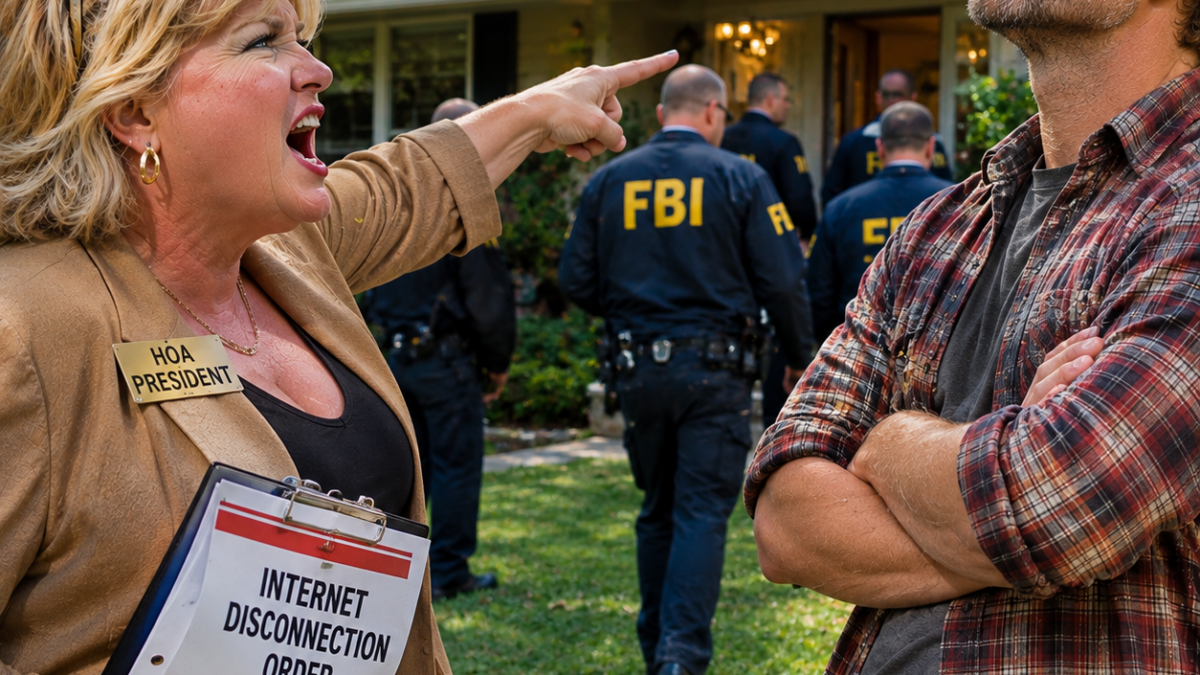
PART 2
“Business-class fiber,” I said.
“What kind of account?”
“Commercial.”
“Dedicated?”
“Yes.”
“Used for your consulting work?”
“Every day.”
There was a pause.
Not the kind people make when they don’t understand.
The opposite.
Meredith understood something I didn’t.
“Take photographs before anything changes.”
“I already started.”
“Wide angle. Close-ups. Both severed ends. Conduit path. Street view showing visibility. Fence line. Any tire marks.”
“Okay.”
“Call your provider.”
“I was going to.”
“Don’t just request repair. Ask them to document the physical cause of failure.”
I sat at the kitchen table.
Raymond was behind me trying to reboot the television remote as if persistence could reconnect a severed fiber line.
“Then file a police report.”
“Police?”
“Yes.”
“This is an HOA dispute.”
“No, Garrett.”
Her voice became very deliberate.
“An HOA dispute is a letter about paint color. Someone physically damaged private telecommunications infrastructure used by your business. Depending on exactly what happened and what federal or state statutes apply, that can move far beyond association enforcement.”
I looked through the kitchen window again.
Vivian was gone.
My side yard looked ordinary except for the cut conduit.
It bothered me how little destruction can look like from twenty feet away.
“Federal?” I asked.
“Potentially.”
That word changed the room.
Not because I suddenly imagined agents kicking down doors.
Because Vivian had believed she was operating inside a tiny universe where she wrote the rules, interpreted them, and punished anyone who disagreed.
Meredith was telling me she might have stepped outside that universe without realizing it.
“Do nothing dramatic,” she said.
“Wasn’t planning to.”
“You sound angry.”
“I am angry.”
“Good. Stay angry quietly.”
That was excellent legal advice.
—
Calling the internet provider took forty minutes.
The first representative thought I wanted an outage ticket.
“I need the technician to document intentional physical damage.”
“Sir, we can send someone to restore service.”
“I understand.”
“Then I can open a service request.”
“I need the repair report to describe why the connection failed.”
There was silence.
“Was there construction damage?”
“Yes.”
“Who caused it?”
“That is being investigated.”
Another silence.
That phrase worked.
Eventually I reached someone who understood.
A technician would come out.
Service report requested.
Physical damage noted.
I wrote down the ticket number.
Then I called Boise police on the non-emergency line.
The dispatcher asked:
“Estimated damage?”
“I don’t know yet.”
“Suspect known?”
I looked at Vivian’s HOA notice lying on my counter.
“I know who says she authorized it.”
That got recorded.
Dale remained outside while I made calls.
When I returned, he was standing with both hands in his jacket pockets, staring at the cut.
“Anything?”
“Police report started. Provider coming.”
“Lawyer?”
“Yes.”
He nodded.
“Good.”
I crouched beside the conduit.
“Do you think it was bolt cutters?”
“Could be a reciprocating saw. Depends on what they used to open the casing.”
“Can you tell?”
“Not reliably enough for court.”
I looked at him.
Dale smiled.
“What?”
“You sound disappointed.”
“I like certainty.”
“That’s why I worked utilities. Electricity is honest. People aren’t.”
He headed home.
Before leaving, he pointed at the conduit.
“Don’t let anyone tell you that was accidental.”
“I won’t.”
—
By noon, Vivian taped another letter to my door.
Apparently physically severing the line had not satisfied the aesthetic crisis.
The notice demanded that the remaining conduit be removed within ten days.
If I refused:
$100 per day.
I stood on the porch reading it.
The absurdity almost made me laugh.
She had cut the service.
Then fined me because the damaged conduit still existed.
The neighborhood received an email an hour later.
Subject:
**MAINTAINING OUR COMMUNITY STANDARDS**
No name.
No address.
But the message described an “unauthorized telecommunications installation” recently addressed by the board.
Everybody knew.
Vivian wrote that individual convenience could not override collective visual harmony.
That phrase—individual convenience—did something to me.
My business was not a convenience.
Petra’s schoolwork was not a convenience.
Raymond’s ability to use familiar devices in a house designed around his increasing limitations was not a convenience.
But I did not reply.
I forwarded the email to Meredith.
Three minutes later:
**Received. Preserve original. Do not respond.**
So I didn’t.
Instead, I walked the property with my phone.
Date.
Time.
North side of house.
Fence line.
Conduit location.
Street visibility.
Cut point one.
Cut point two.
No commentary.
No insults.
Just facts.
It felt like conducting a security audit.
That helped.
My anger became procedure.
—
Petra came downstairs holding her laptop.
“Dad?”
“Hotspot.”
“For how long?”
“Couple days.”
“What happened?”
I hesitated.
She was nineteen by then, not twelve anymore.
Old enough to understand.
“Vivian had the internet line cut.”
Petra stared at me.
“The HOA lady?”
“Yes.”
“Like… physically?”
“Yes.”
“She can do that?”
“No.”
I hoped the certainty in my voice was deserved.
Raymond shuffled into the kitchen.
His gait had become smaller over the years.
More careful.
He looked from Petra to me.
“Television’s broken.”
“Internet.”
“That woman?”
I smiled despite myself.
“How do you know?”
“I heard her outside.”
He lowered himself into a chair.
“Never liked her.”
“You’ve spoken to her twice.”
“Enough.”
Petra laughed.
That helped too.
I made Raymond a sandwich.
Then I connected my workstation through cellular backup and finished as much client work as I could.
The connection was slower.
Security tools timed out.
One encrypted transfer had to restart twice.
I emailed the affected clients.
Professional.
Brief.
Infrastructure outage.
Expected delay.
No HOA drama.
No emotion.
Every lost billable hour went into a spreadsheet.
When you work in cybersecurity, evidence becomes a reflex.
Vivian had spent nine months teaching me to document her.
Now I was grateful for the practice.
—
The provider technician arrived two days later.
His name was Nate.
He looked at the conduit.
Then at me.
“Who did this?”
“Someone hired by my HOA president.”
He stopped.
“Seriously?”
“Yes.”
He crouched.
Opened the exterior access point.
Inspected the fiber.
“This wasn’t an equipment failure.”
“I know.”
“You want that in the report?”
“Very much.”
He looked at me.
“Lawyer?”
“Yes.”
“Figured.”
Nate restored the service.
Then his final report arrived by email.
I opened it immediately.
**Physical cable severance consistent with external cutting tool.**
**Service disruption caused by intentional physical damage to customer-side route.**
I forwarded it to Meredith.
Then to my secure evidence folder.
Then printed it.
I almost framed it.
Dale would have understood.
—
Vivian’s ten-day deadline expired.
I removed nothing.
Instead, I submitted a twelve-page response to the HOA.
Eighteen separate provisions cited from the governing documents.
Installation records.
Permit.
Provider report.
Photographs.
Timeline.
Copies of previous correspondence.
Proof that the conduit could not be seen from any common area.
Vivian’s response:
The $100-per-day fines began anyway.
Day one.
$100.
Day two.
$200.
By the end of two weeks, the claimed amount was enough that the problem stopped feeling petty.
HOA fines can become more dangerous than their original dollar amount.
Unchecked, they can become account balances.
Then collection claims.
Then liens.
Then title problems.
Vivian understood that.
Meredith understood it better.
She sent a formal demand pointing to Creekside’s own hearing procedure.
The bylaws required a formal hearing before cumulative penalties crossed a certain threshold.
Vivian had never scheduled one.
Never offered one.
Never allowed me to present evidence to the board.
Meredith’s letter made clear that any attempt to record a lien before required procedures were exhausted would be challenged immediately.
Then, in the final paragraph, she mentioned the telecommunications incident.
One paragraph.
No bold letters.
No threats.
Just notice that separate legal issues arising from intentional service interference were being preserved.
That paragraph rattled the board.
I know because Cassandra Pruitt called me that evening.
—
Cassandra was not related to Vivian despite the surname coincidence.
She was a real estate agent and one of three board members.
I had always thought of her as Vivian’s quieter shadow.
Apparently I was wrong.
“Garrett?”
“Yes.”
“This is Cassandra.”
“I know.”
She hesitated.
“I voted against the fine schedule.”
I leaned back in my office chair.
“Two to one?”
“Yes.”
“Vivian and Hubert?”
“Yes.”
Hubert Scroggins was the third board member.
Retired.
Soft-spoken.
A man who had perfected the art of occupying a chair without altering the room.
“Why are you telling me?”
“Because she’s trying to remove me.”
That got my attention.
“For voting no?”
“She says I’ve undermined board cohesion.”
I almost laughed.
“Board cohesion.”
“She already drafted the notice.”
There it was.
Vivian was not merely enforcing rules.
She was removing resistance.
I looked at the piles of documents on my desk.
“Cassandra, can I ask you something?”
“Yes.”
“Have you reviewed the HOA finances?”
A pause.
“No.”
“You’re a board member.”
“I know.”
“Do you have access?”
“I should.”
“Does Vivian sign vendor payments?”
“Yes.”
“Does she authorize maintenance work?”
“Usually.”
“Did the board approve hiring somebody to cut my conduit?”
Silence.
“I never voted on that.”
“What about Hubert?”
“I don’t know.”
I thought about the contractor truck I heard the night before the cut.
“Can you see recent payments?”
“I think so.”
“Look for a contractor. Utility work. Exterior maintenance. Anything around the week my line was cut.”
Cassandra became quiet.
Then:
“I’ll call you.”
—
She called the HOA management company the next morning.
Creekside Property Solutions in Nampa handled bookkeeping and administrative records.
Vivian had grown accustomed to treating them like clerical staff.
Cassandra approached them as a board member exercising her right to inspect association finances.
They began pulling records before Vivian realized what was happening.
That mattered.
By the time Vivian objected, the request was already in motion.
Two days later, Cassandra called.
“Can I come over?”
“When?”
“Now.”
Twenty minutes later she sat at my kitchen table.
Raymond waved from his recliner.
Petra was studying upstairs.
Cassandra laid photographs of ledger pages between us.
Three vendor payments in sixty days looked wrong.
One landscaping expense.
Could have been routine.
One electrical supply purchase without a job description.
Then the third.
Four days before my fiber was cut.
**Exterior Maintenance Contractor**
$340.
Payee:
**Blackthorn Property Services LLC.**
No work order.
No board vote attached.
No bid.
No scope.
Nothing.
“What is Blackthorn?” I asked.
Cassandra shook her head.
“I don’t know.”
“When was it formed?”
“I haven’t checked.”
“Why cash?”
“I don’t know.”
“Did you approve this?”
“No.”
“Hubert?”
“Not that I know of.”
I called Meredith.
She answered on the second ring.
“We have a contractor payment four days before the cut.”
“How much?”
“Three-forty.”
“Payee?”
“Blackthorn Property Services.”
“Approved?”
“Cassandra says no board authorization.”
“Budget line?”
“No.”
“Work order?”
“No.”
Meredith went quiet.
Then:
“Send me copies.”
“What are you thinking?”
“That we stop guessing.”
—
Vivian seemed to sense the movement.
She sent another community email.
This one talked about “trust.”
She wrote that certain residents were trying to undermine volunteer leadership and prioritize personal interests over neighborhood stability.
Willa Beaumont replied to all.
Willa was a retired schoolteacher who had lived in Creekside for twelve years.
Her email said:
**With respect, I find this communication divisive. If a homeowner dispute exists, the board should use the formal hearing process established in our own governing documents rather than characterize residents through community-wide messages.**
Three people replied agreeing with her.
Vivian answered none of them.
That silence was different from her usual silence.
It was defensive.
—
Weeks passed.
My internet worked again.
The conduit remained.
The fines continued on paper.
Vivian stopped coming to my property.
Meredith investigated Blackthorn.
I kept working.
Raymond had good days and bad ones.
On good mornings he made his own coffee.
On bad mornings the tremor made carrying a mug difficult, so I used one with a lid.
Parkinson’s teaches you something about control.
You can plan.
You can organize.
You can fight.
But some things will still change.
Watching my father adapt made Vivian’s obsession with controlling garbage-bin shades and hedge heights feel even smaller.
One evening he joined me on the porch.
“You’re thinking too loud.”
I smiled.
“That a Parkinson’s symptom?”
“No. Father symptom.”
I handed him his decaf.
“You worried?”
“A little.”
“About the woman?”
“About what we’ll find.”
Raymond nodded.
“That means you already know there’s something.”
“Probably.”
He wrapped both hands around the mug.
His tremor made the surface ripple.
“Then find it.”
—
Meredith called me at ten one morning.
I was eating cereal because Raymond had finished the eggs.
“Sit down.”
“I am.”
“Blackthorn Property Services.”
I put the spoon down.
“What?”
“I pulled the formation record through a researcher.”
“And?”
“Registered agent is Deborah Hartwell.”
The name landed instantly.
“Vivian’s sister-in-law.”
“Yes.”
I stood anyway.
“You’re sure?”
“Yes.”
“Maybe coincidence?”
“Same Deborah Hartwell. Same family connection.”
I walked toward the window.
Vivian’s house was three lots over and across the rear greenbelt.
Meredith continued.
“And Blackthorn didn’t receive one HOA payment.”
“How many?”
“Four that we can identify over roughly eighteen months.”
“For what?”
“Vague categories.”
“How much?”
“A little over eleven thousand.”
I stopped moving.
“Eleven thousand dollars?”
“Yes.”
“To her sister-in-law’s LLC?”
“That appears to be where the payments went.”
“For what work?”
“That is the question.”
I thought about the $340 line.
“What does that mean legally?”
“It means we need to be careful.”
“That isn’t an answer.”
“It’s the correct answer.”
“Meredith.”
“If the records show HOA funds were routed to a family-connected entity without authorization and without legitimate work, you may be looking at misappropriation, fraud, or theft. But we prove facts first.”
“And the fiber?”
“If Blackthorn was the contractor involved, the two issues overlap.”
I sat back down.
Then Meredith said something I did not expect.
“I’ve already spoken with federal investigators.”
I stared at the cereal.
“What?”
“The telecommunications issue plus the financial pattern was enough for me to make an inquiry. They were interested.”
“FBI?”
“Yes.”
That word felt different when a lawyer said it.
“Are they investigating Vivian?”
“They are reviewing information. Do not tell neighbors that the FBI is investigating anyone.”
“Understood.”
“I’m serious.”
“So am I.”
“Preserve everything.”
“I have.”
“Good.”
That afternoon, Special Agent Donahue called me.
Short conversation.
Professional.
He asked me to preserve all communication involving Vivian, Blackthorn, the HOA, the conduit, and related vendor records.
He told me not to interfere with anyone or try to investigate beyond lawful access to documents.
I agreed.
After the call, I went outside.
Pine smell.
Warm dry air.
Raymond came out carrying two mugs.
We sat.
“You going to be okay?” he asked.
“Yeah, Pop.”
He watched me for a while.
Then said:
“I told you I never liked that woman.”
I laughed.
Really laughed.
First time in weeks.
—
From the outside, I became quiet.
No board meetings.
No replies to Vivian’s emails.
No public accusations.
No arguments.
No fines paid either.
Meredith built the civil case.
Property damage.
Business interruption.
Procedural HOA violations.
Potential interference with my client relationships.
And depending on what the financial evidence ultimately supported, broader claims tied to the pattern of transactions.
She warned me repeatedly that complicated fraud theories had to be proven, not imagined.
That discipline kept me sane.
I focused on what we could prove.
Line cut.
Service report.
Invoice.
Client delay.
HOA notices.
Vendor ledger.
Blackthorn connection.
No adjectives required.
—
Then I started talking to neighbors.
Quietly.
Dale first.
Willa.
The Pendergasts, who had received a noise violation after their daughter’s birthday party.
The Duncans, cited three times over a basketball hoop.
The Callaways, who had been fighting eight months over mulch color.
I did not ask them to hate Vivian.
I did not ask them to sign anything immediately.
I showed them documents.
The ledger page.
The board procedures.
My notices.
The technician report where appropriate.
People reacted in nearly identical ways.
First disbelief.
Then anger.
Then:
“Can she do this?”
That question became the center of everything.
Not:
Is Vivian mean?
Not:
Do we like the HOA?
Can she actually do this?
Twenty-two households eventually signed a petition demanding a special membership meeting.
Twenty-two of sixty-two.
More than a third of Creekside.
The petition also demanded an independent financial audit.
Cassandra filed the audit request through the management company.
By then the management company knew enough to protect itself.
They cooperated.
—
Dale created a technical report on my conduit.
Three pages.
Measurements.
Photographs.
Visibility angles.
Code references.
Installation details.
Restoration cost.
When he handed it to me, I flipped through it.
“You laminated the cover.”
“Professionalism.”
“You’re retired.”
“Standards don’t retire.”
I smiled.
Vivian would have hated that sentence.
Then I contacted Thea Forsythe, a reporter who covered local government and community issues.
I did not send accusations.
I sent records.
Court documents.
Financial pages available to members.
Meeting notice.
Told her there was a developing story and a membership meeting scheduled.
She responded:
**Very interested. Keep me updated.**
The board was forming.
Not Vivian’s board.
Ours.
Neighbors.
Documents.
A lawyer.
An audit.
A reporter.
A federal inquiry I wasn’t allowed to talk about.
And Vivian still thought the fight was about gray PVC.
—
She wasn’t stupid.
She felt something shifting.
Hubert stopped answering her calls.
Cassandra had her own attorney.
The management company began refusing instructions that lacked proper documentation.
Petition filed.
Audit underway.
Vivian responded by escalating.
First:
Lien.
Accumulated claimed fines had reached roughly $1,400 when she directed the management company to record a formal lien against my property.
That one shook me.
Not because I believed it would survive.
Because seeing a legal claim attached to your home feels different than seeing numbers on HOA letterhead.
That house was not merely an asset.
It was where Petra grew up.
Where Raymond had enough room to move safely.
Where I worked.
A lien makes a threat physical.
Meredith challenged it immediately based on the missing hearing procedure.
Within forty-eight hours, the lien was suspended pending review.
Then the management company’s counsel sent an advisory.
Further action on Vivian’s instructions connected to my dispute could expose the company to liability.
The administrative machine she relied on stopped obeying automatically.
That was the first real fracture.
—
Her second move was social.
Phone calls.
One neighbor at a time.
Garrett thinks he’s above the rules.
Garrett is damaging property values.
Dale is an outside agitator.
The financial records are misleading.
The petition is being manipulated.
Three households withdrew signatures.
I hated that more than I expected.
Not because we needed them numerically.
Because Vivian’s fear campaign still worked.
Willa responded perfectly.
She did not send an angry email.
She sent facts.
Date.
Call descriptions.
What multiple residents had been told.
Publicly available information.
No insults.
No accusation she could easily twist.
The withdrawals stopped.
—
Then Vivian dissolved Blackthorn.
Meredith called me.
“Guess what happened.”
“I hate that opening.”
“Blackthorn filed articles of dissolution.”
I sat back.
“She closed it?”
“Entity is being dissolved, yes.”
“Does that erase anything?”
“No.”
“Then why?”
“I’m not going to speculate about motive.”
I knew enough to hear what she wasn’t saying.
The records remained.
Bank transactions remained.
Ledger entries remained.
Formation records remained.
Federal investigators already knew the company existed.
Destroying the sign on the door does not erase the footprints behind it.
Donahue’s office learned about the dissolution almost immediately.
I did nothing.
That became one of my favorite activities.
Doing nothing while Vivian created evidence.
—
Work saved me.
Three days after the internet incident cost me billable time, I picked up a cybersecurity assessment contract for a municipal water authority.
Ironically, the replacement project paid more than the work I had lost.
One afternoon I spent three hours explaining access-control architecture on video while an HOA scandal grew quietly around me.
That mattered.
Vivian wanted the conflict to consume my identity.
I refused.
I was still a consultant.
Still a father.
Still a son.
Still the person who cooked dinner badly enough that Petra took pictures.
She came home one evening to garlic, ginger, chicken, and vegetables in a pan.
She stopped in the kitchen doorway.
“You’re cooking?”
“Yes.”
“Is Grandpa okay?”
“He’s fine.”
“Did something happen?”
“Several things.”
“Good several?”
“Complicated several.”
Petra put down her backpack.
“You seem better.”
I looked at her.
“I am.”
That was true.
Not because Vivian was losing.
Because I had stopped feeling helpless.
Different thing.
“Set the table,” I said.
“Grandpa’s already asking when we eat.”
From the living room:
“I can hear both of you.”
Petra smiled.
The house felt inhabited again.
—
Five days before the membership meeting, Vivian sued me.
Ada County District Court.
She alleged harassment.
Disruption of association operations.
Interference with community governance.
She attached fine schedules.
A statement from Hubert.
A declaration from a consultant Vivian had hired without normal board approval.
I sent everything to Meredith.
Twenty minutes later she called.
“This is pressure.”
“Can she win?”
“Not on what I’m reading.”
“Can we get it dismissed?”
“That’s the plan.”
“Can we recover fees?”
“We’ll seek them under whatever procedural and statutory protections apply.”
I paused.
“She wants me to cancel the meeting.”
“She wants you scared before the meeting.”
That angered me.
Not the lawsuit itself.
The timing.
Vivian wanted to make organizing expensive.
Make asking questions dangerous.
Make everybody else watch what happened to me and decide silence was cheaper.
“Then we’re going to the meeting.”
“I assumed.”
—
The lawsuit was public.
That was Vivian’s mistake.
Thea Forsythe no longer had to rely only on private records.
She had a filed court complaint.
The next morning, a short article appeared.
**BOISE-AREA HOA PRESIDENT FACES AUDIT DEMAND, FILES SUIT AGAINST RESIDENT**
Not front page.
Didn’t need to be.
It spread.
Within two days, Thea received calls from people outside Creekside who recognized Vivian’s name.
That was how I learned Creekside had not been her first HOA leadership role.
I did not know the details yet.
Neither did Thea.
But there were stories.
Similar enforcement style.
Similar complaints about vendors.
Nothing I could prove myself.
So I didn’t repeat them.
Vivian had spent months accusing me of undermining community trust.
I was not going to win by becoming careless with truth.
—
Four days before the special meeting, the independent CPA finished the audit.
Nine pages.
Cassandra sent me a copy because I was one of the homeowners whose documented complaint formed part of the review.
I read it alone in my office.
Unauthorized or inadequately authorized disbursements.
Connected entities.
Insufficient documentation.
Twenty-two months.
Approximately $14,200 identified for further investigation.
The phrase **apparent misappropriation** appeared more than once.
Not just Blackthorn.
Two other entities raised questions.
I called Meredith.
“You see this?”
“I have it.”
“Fourteen-two.”
“Yes.”
“Does Donahue?”
“Cassandra transmitted it through counsel.”
I leaned back.
For nine months, Vivian had fined people over hedges and garbage containers while money moved through accounts most of us never bothered to inspect.
That contrast infuriated me more than the cut fiber.
A hedge three inches tall mattered enough for a warning letter.
Fourteen thousand dollars could disappear into vague vendors without a meaningful member conversation.
That told me everything about the system she had built.
Rules flowed downward.
Accountability never flowed up.
Until now.
—
The night before the meeting, the house was quiet.
Petra stayed with a friend.
Raymond went to bed early.
Cold Idaho air had returned.
I sat on the back porch with coffee.
Wood smoke somewhere in the neighborhood.
An owl calling from the trees.
The cut fiber had been repaired weeks earlier, but I could still picture the severed ends lying in the dirt.
That image had haunted me.
Not because of the physical damage.
Because of Vivian’s face.
She had been so certain.
Certain my livelihood was hers to interrupt.
Certain my reaction would either be submission or anger she could weaponize.
Certain a title meant authority.
I thought about Dale arriving with coffee.
Cassandra whispering that she had voted no.
Willa documenting phone calls.
The Pendergasts.
The Duncans.
The Callaways.
Twenty-two households.
None of us had bought homes hoping to become neighborhood activists.
We just wanted ordinary lives.
That was what petty power never understood.
Most people do not fight because they enjoy fighting.
They fight when being left alone requires it.
I finished the coffee.
Went inside.
Slept.
—
Saturday morning was bright and cold.
The meeting started at ten in the Creekside community center beside the pool.
Glass walls.
Thirty chairs.
Forty-seven households represented.
People brought lawn chairs.
Dale had a thermos in the parking lot and was pouring coffee like he had been elected chaplain.
Willa brought fruit.
Thea parked across the road.
Notebook.
Camera.
Cassandra sat at the front beside the management-company representative.
Vivian’s usual chair was empty.
At 10:03, Cassandra called the meeting to order.
At 10:08, we heard Vivian’s Lexus.
People turned toward the windows.
White SUV.
Slow stop.
Vivian stepped out wearing a cream blazer.
She turned toward the building.
Then stopped.
Through the glass she could see everyone.
Forty-seven households.
Not eleven voters.
Not three board members.
Forty-seven.
Her step hesitated.
Then she straightened.
Walked inside.
Nobody spoke.
She took the empty chair.
Did not look at me.
I sat third row with a blank manila folder on my lap.
Something to keep my hands still.
Cassandra opened item one.
Independent audit.
CPA Halloran stood.
Projector on.
White screen.
No dramatic introduction.
Numbers.
Dates.
Vendors.
Documentation failures.
Connected entities.
Slide three:
**$14,200 — APPARENT MISAPPROPRIATION REQUIRING FURTHER REVIEW**
Vivian interrupted.
Cassandra said:
“Please let Ms. Halloran complete the presentation.”
Two minutes later Vivian interrupted again.
Cassandra repeated herself.
The dynamic had reversed.
Not through shouting.
Procedure.
The same weapon Vivian had used for years.
Only now procedure was real.
—
At 10:23, someone near the windows turned.
Two black Ford Expeditions entered Creekside.
Government plates.
They did not pull up to the clubhouse.
They continued toward the maintenance yard behind several properties.
Including an area investigators had become interested in because HOA-purchased equipment associated with vendor records was reportedly stored there.
A murmur spread through the room.
I recognized Special Agent Donahue when he stepped from the first vehicle.
Vivian turned.
For the first time all morning, she looked genuinely unprepared.
Confusion first.
Then recognition.
Then something deeper.
She understood those vehicles were not there because of mulch.
The room went silent.
Cassandra looked toward the windows once.
Then back at the agenda.
“Item two.”
Her voice was steady.
“Motion regarding removal of the current president pending financial and legal review.”
Vivian turned sharply.
“This meeting is compromised.”
Cassandra did not move.
“Why?”
“There are external law enforcement personnel outside.”
“They are not conducting this meeting.”
“This is intimidation.”
Dale spoke from near the doorway.
“They didn’t come with us.”
A few people laughed nervously.
Vivian pointed toward me.
“This is exactly what I warned all of you about. Garrett has escalated a neighborhood dispute into—”
I stood.
Meredith had told me not to discuss the federal inquiry.
So I didn’t.
“I did not invite federal agents here.”
That was all.
Vivian stared at me.
For months she had wanted me angry.
I gave her nothing.
Cassandra called for the vote.
Forty-one for removal.
Three against.
Others abstained.
Willa started clapping.
Dale joined.
Then more.
I didn’t.
I sat down.
Put the folder back on my lap.
And breathed.
Ten months.
I felt every one of them leave my chest at once.
Vivian’s face went pale.
She gathered her papers.
No speech.
No threat.
For once, no community standards.
She walked outside.
Donahue met her near the parking area holding documents.
They spoke.
Thea’s camera clicked from across the road.
Vivian did not immediately get into the Lexus.
That image would become the one people remembered.
Not the cut cable.
Not the ledger.
The woman who had spent years handing other people official papers standing beside her own vehicle while somebody else handed papers to her.
I expected to enjoy it more.
Instead, I felt tired.
Almost sad.
Not for Vivian exactly.
For how avoidable all of it had been.
She could have simply left the wire alone.
—
The legal cases unfolded over months.
That part rarely makes dramatic stories because court systems move at the speed of paper.
Vivian faced federal allegations arising from the telecommunications incident and financial transactions identified through the investigation, including fraud-related counts.
Deborah Hartwell cooperated and resolved her part through a lesser charge according to the case disposition we later learned about.
Hubert resigned.
His written apology to the membership was awkward.
Three paragraphs.
He said he had relied too heavily on the president’s representations and had failed in his obligation to independently review board actions.
I read it twice.
Dale read it once.
Then said:
“At least he wrote it.”
That was fair.
—
Vivian’s lawsuit against me did not survive.
Meredith moved aggressively for dismissal and attorney’s fees, arguing the filing was retaliation tied to my use of association procedures, records requests, and homeowner organizing.
The court dismissed the suit and required Vivian to bear the legal consequences ordered in the case.
When Meredith called, I was standing in the grocery store.
“Done.”
“What’s done?”
“Her case.”
“Dismissed?”
“Yes.”
I leaned against the freezer door.
“Fees?”
“We got them.”
I closed my eyes.
A woman pushing a shopping cart looked at me strangely.
I didn’t care.
“Garrett?”
“I’m here.”
“You okay?”
“Yeah.”
“You don’t sound happy.”
“I am.”
“What do you sound like?”
I looked at frozen vegetables through the glass.
“Finished.”
Meredith was quiet.
Then:
“That’s better.”
—
The civil side of my claim settled confidentially.
I can say what the outcome accomplished.
Every HOA fine against me disappeared.
The lien was formally released.
My conduit replacement was covered.
My documented lost billing was addressed.
Legal expenses were covered.
There was additional compensation.
Enough that after everything was paid, something meaningful remained.
Not millions.
Not fantasy revenge money.
Enough to repair what had been damaged and fund something better than anger.
That mattered.
—
Cassandra became HOA president at the next annual election.
Fifty-one votes.
Zero against.
Nobody challenged her.
When I teased her about being the most popular politician in Idaho, she looked horrified.
“Don’t call me a politician.”
“You won fifty-one to zero.”
“Because nobody else wanted the job.”
“Exactly how Vivian started.”
Cassandra pointed at me.
“Do not say that.”
I laughed.
Her first official act was ordering a full legal review of the governing documents.
A real HOA attorney went through every section.
Outdated rules.
Ambiguous language.
Provisions vulnerable to arbitrary interpretation.
Over the next year, twenty-one sections were amended or removed.
The new fine procedure required hearings at much lower thresholds.
Notice had to be clear.
Evidence available.
Appeal process written.
No more accumulating penalties behind closed doors.
Vendor contracts above designated amounts required multiple approvals and documentation.
Conflict-of-interest disclosures became mandatory.
Financial reports went online for members.
Boring reforms.
Beautiful reforms.
—
Dale joined the Architectural Review Committee.
I still think that was one of the funniest outcomes.
Vivian had spent years using aesthetics as a weapon.
Now a sixty-seven-year-old retired lineman sat in review meetings asking things like:
“Can anybody actually see it from the street?”
And:
“What code does it violate?”
And my favorite:
“Are we solving a problem or inventing one?”
Complaint volume collapsed.
Not because everyone suddenly obeyed more.
Because the committee stopped treating taste as law.
—
Raymond followed everything from his recliner.
Newspaper folded beside him.
Decaf.
Parkinson’s progressing.
Whenever Vivian appeared in an article, he had one response.
“I told you.”
“Yes, Pop.”
“Never liked her.”
“I know.”
“Told you first.”
“You met her twice.”
“Enough.”
Petra turned the case into an AP Government paper.
Title:
**Institutional Accountability Through Procedural Participation**
I told her it sounded like something designed to put a teacher to sleep.
She got an A.
Her teacher wrote:
**Unusual case study, but effective explanation of civic process, documentation, and institutional checks.**
Petra framed the comment.
Not the grade.
That made me proud.
—
The first spring after everything ended, the community center hosted a workshop.
Not an angry meeting.
A workshop.
That distinction mattered.
Willa Beaumont organized most of it.
Of course she did.
She could organize weather if given enough clipboards.
Part of my settlement money went into a community program.
Neighbors added donations.
The HOA contributed space and administrative support.
We called it the Creekside Community Skills Fund.
Not my name.
Not Vivian’s name.
Not some revenge title.
The program supported practical education.
Home maintenance.
Trades.
Financial literacy.
Homeowner rights.
Scholarships for residents and their families.
The first season included a session where a volunteer property attorney explained how to read CC&Rs.
Seventeen teenagers showed up.
I suspect most came because their parents made them.
Still counted.
A local credit union taught financial literacy.
Dale ran a maintenance and code-compliance clinic.
He laminated every handout.
Naturally.
I sat in the back during the legal-rights workshop.
Coffee in paper cup.
The room smelled like old books and carpet.
The attorney at the front explained assessments.
Hearings.
Records.
Liens.
The difference between an HOA notice and a court order.
I knew most of it by then.
I stayed anyway.
Because the room existed.
A year earlier, that community center had been where Vivian’s authority lived.
Now it was where people learned how authority worked.
That was better.
—
The biggest change came slowly.
Neighbors started talking to one another before problems became wars.
The Duncans wanted to replace their basketball hoop.
They checked the rules.
Committee approved it.
Seven days.
No drama.
The Callaways changed their landscaping.
Dale went over, looked at the mulch, shrugged.
“Looks like mulch.”
Approved.
Willa planted flowers that technically differed from the old preferred list.
Nobody cared.
Creekside did not collapse.
Property values did not vanish.
Children continued being noisy.
Garbage cans occasionally stayed outside too long.
The Republic survived.
—
One evening, Cassandra knocked on my door.
She held a folder.
I opened it.
“What now?”
“Nothing bad.”
“Suspicious opening.”
She came in.
Raymond was asleep.
Petra had moved into college housing by then and came home on weekends.
Cassandra put the folder on my kitchen table.
Inside was the final internal review of the Blackthorn work order.
The $340 payment.
The transaction that started the financial unraveling.
The work description recovered through the investigation was almost insultingly brief.
**Remove noncompliant exterior conduit — Winslow property.**
I stared at it.
There it was.
My address.
Paid with HOA money.
No vote.
No hearing.
No legitimate authorization.
Vivian had used everybody’s dues to damage my property.
Cassandra watched me.
“You okay?”
“Yes.”
“You look angry.”
“I thought I was finished being angry.”
“That’s probably not how it works.”
I ran my thumb along the photocopy.
“Can I keep this?”
“Copy’s yours.”
I almost put it in the evidence binder.
Then stopped.
Instead I folded it once.
Put it in a drawer.
Not everything needed a place of honor.
—
Raymond’s Parkinson’s got harder.
That became the real story of the next few years.
Not Vivian.
Not court.
Not the FBI.
Dad.
He needed more help walking.
Then dressing.
Then eating without spilling.
The man who had once rebuilt a lawn tractor engine on our driveway could eventually struggle with a zipper.
Watching that changes your definition of injustice.
Vivian’s behavior had infuriated me because she tried to control things that were not hers.
Parkinson’s taught me how much of life nobody controls at all.
One afternoon, I helped Raymond onto the back porch.
He looked toward the side fence.
The conduit was still there.
We had replaced the damaged section with new material.
Same gray.
Same route.
No attempt to hide it.
Raymond pointed.
“That the wire?”
“Yep.”
“Ugly.”
I stared at him.
He grinned.
I laughed so hard I nearly dropped his walking cane.
“You’ve been saving that?”
“Years.”
“You’re terrible.”
“Got you.”
His tremor had become more pronounced by then.
But his smile was the same.
I remember that afternoon more clearly than the federal vehicles.
That is how memory rearranges importance.
—
Petra graduated.
Her civics paper became a running family joke.
At graduation dinner, Raymond raised his glass with both hands.
“To systematic institutional… whatever.”
Petra laughed.
“Advocacy.”
“That.”
Then he looked at me.
“And ugly wires.”
We toasted ugly wires.
—
Vivian eventually resolved her federal case through the criminal process described in public records surrounding the investigation.
I followed less of it than people expected.
Thea called a few times.
“Want to comment?”
“No.”
“Nothing?”
“Nothing useful.”
“You were the homeowner whose line started the case.”
“I know.”
“People will want your reaction.”
“They can want it.”
Thea respected that.
My silence was not mercy.
It was distance.
There is a point where continuing to organize your emotional life around the person who harmed you gives them another kind of authority.
I had spent enough time on Vivian.
Let the courts have her.
I had Raymond.
Petra.
Clients.
Neighbors.
A dog I eventually adopted because Willa convinced me Raymond needed one.
The dog’s name was Packet.
That was Petra’s fault.
Packet liked sleeping under my desk and barking during video conferences.
He was terrible for cybersecurity professionalism.
Excellent for everything else.
—
The Creekside Community Skills Fund expanded.
One year it paid part of the tuition for a resident entering an electrical apprenticeship.
Another year, a high-school senior used a scholarship toward community college networking courses.
That one got my attention.
His name was Aaron.
Quiet kid.
Lived two streets over.
He came by one Saturday because Petra had told him what I did for work.
We sat in my office.
He looked at the network rack.
“What got you into security?”
“People doing things they weren’t supposed to.”
He smiled.
“Seriously.”
“So am I.”
I showed him some basic defensive concepts.
Nothing glamorous.
Logs.
Permissions.
Backups.
Verification.
At one point he asked:
“What’s the most important thing?”
I thought about Vivian.
Then answered:
“Never assume authority just because something says it has authority.”
Aaron frowned.
“Cybersecurity?”
“Everything.”
He wrote that down.
I laughed.
“Don’t quote me in school.”
He did anyway.
—
The original fiber-cut photographs remained in my evidence archive.
Years later, I opened the folder while cleaning old files.
The images surprised me.
I remembered the scene as enormous.
Vivian.
The cut.
The rage.
The helplessness.
But the photographs were small.
Gray conduit.
Brown dirt.
Fence.
Two severed ends.
No drama.
That is what evidence does.
It strips a memory down to what happened.
I stared at the first photograph.
Timestamp.
Tuesday morning.
The exact minute I had stopped being a homeowner responding to violation letters and started becoming someone willing to follow the paper wherever it led.
I almost deleted the pictures.
Didn’t.
Not because I needed them legally anymore.
Because Petra had once asked if I regretted fighting.
I wanted to remember what the alternative looked like.
A cut line in the dirt.
—
Cassandra served two terms as president.
Then she stepped down willingly.
That was another change.
Nobody treated the presidency like a throne.
Three different people ran.
Actual election.
Campaign statements.
Attendance.
Voting.
The winner was Willa.
Of course.
At her first meeting, she held up the old three-ring binder Vivian used to carry.
Apparently the management company had found it among archived HOA materials.
“We are not throwing this away,” Willa said.
I groaned.
“Why?”
“Historical value.”
“Burn it.”
“No.”
Dale raised his hand.
“I support fire.”
Willa ignored him.
She placed the binder on a shelf in the community-center office.
Then added a label:
**ARCHIVED — SUPERSEDED RULES. NOT CURRENT AUTHORITY.**
That was perfect.
Vivian’s old weapon became a museum piece with a disclaimer.
—
One Sunday, I saw Vivian’s former house listed for sale.
White sign.
Fresh landscaping.
The next month, movers arrived.
I did not see Vivian.
Her family handled most of it.
Packet barked at the truck.
Raymond slept through the entire thing.
By evening, the house was empty.
I walked Packet past it.
For nine months that property had felt like command headquarters.
Now it was just a house.
Windows.
Garage.
Mailbox.
Someone else bought it.
A family with two young children.
Their first week, the father knocked on my door.
“Hi. I’m Brian.”
“Garrett.”
“We’re the Hartwell house.”
I must have made a face.
He laughed nervously.
“I’ve heard.”
“Sorry.”
“No, I’m sorry.”
“You didn’t do anything.”
He pointed toward his side yard.
“We need fiber run. I work from home.”
I stared at him.
Then started laughing.
Brian looked confused.
“It’s a long story.”
A month later, his new conduit went in.
Gray.
Visible from one angle.
Perfectly code compliant.
Nobody cut it.
Nobody fined him.
I stood in the driveway with Dale.
He looked at the conduit.
“Ugly.”
“You and my father have the same joke.”
“Good joke.”
“Old joke.”
“Still works.”
We walked home.
—
Raymond died in early winter.
Quietly.
Hospital bed in my house.
Petra on one side.
Me on the other.
Packet asleep beneath the window.
His final weeks were difficult.
His final day wasn’t.
He slept most of it.
Woke once in the afternoon.
Looked at Petra.
Then me.
Asked for coffee.
Doctor had told us small sips only.
I gave him decaf.
He made a face.
“Still terrible.”
“Consistent.”
He smiled.
Later that evening, he was gone.
The house became quiet in a way no internet outage could imitate.
No television from the living room.
No shuffle of slippers.
No mug beside the sink.
No voice saying he had never liked Vivian.
For months, I would hear a floorboard creak and turn automatically.
Grief is a system running an old program after the hardware is gone.
Petra stayed with me for a while.
We sorted his things slowly.
In the recliner pocket, we found a newspaper clipping about the HOA meeting.
Folded.
On the photograph of Vivian standing near the federal agents, Raymond had written in shaky pen:
**TOLD YOU.**
Petra laughed and cried at the same time.
So did I.
I framed that.
Not the technician report.
Not the judgment.
That.
—
At the next Community Skills Fund event, Willa asked if we could create a small scholarship in Raymond’s memory.
I almost refused.
Dad hated attention.
Then Petra said:
“Make it practical.”
So we did.
A modest annual award for a student pursuing technology, trades, or accessibility-focused work.
No giant portrait.
No naming the whole program after him.
Just:
**Raymond Winslow Practical Skills Award**
The first recipient was a teenager who wanted to study assistive technology.
He had helped modify a gaming controller for his younger brother, who had limited hand mobility.
When he told me that, I had to look away.
After the ceremony, I handed him the check.
He said:
“Did your dad work in technology?”
“No.”
“What did he do?”
“A lot of things.”
“Why this scholarship?”
I looked at the student’s hands.
Then toward Petra.
“Because toward the end of his life, small pieces of technology helped him stay independent longer.”
The student nodded.
“That matters.”
“Yes.”
It did.
—
Years passed.
The conduit stayed.
Weather faded the gray slightly.
I could have buried it differently.
Replaced it with something prettier.
Never did.
Not out of spite.
Mostly because it worked.
One spring morning, a new member of the architectural committee came over during a neighborhood walk.
She pointed.
“Is that the famous cable?”
“Unfortunately.”
“I expected something worse.”
“So did Vivian.”
She laughed.
“Can I photograph it?”
“Why?”
“We’re doing a workshop on enforcement history.”
I stared at her.
“Creekside has enforcement history workshops now?”
“Willa.”
“Of course.”
I let her photograph it.
A month later, the community center had a presentation on how to distinguish code, covenant, preference, and personal taste.
One slide showed my conduit.
Caption:
**LEGAL INSTALLATION. POORLY HANDLED DISPUTE.**
That was perhaps the greatest understatement in Idaho history.
—
My business changed too.
The incident gave me an unexpected professional lesson.
Not because HOA drama belongs in cybersecurity.
Because governance failures repeat across systems.
Weak oversight.
One person accumulating unchecked authority.
People assuming someone else reviewed the logs.
Vendor access without proper approval.
Records nobody reads.
Conflicts of interest hidden in boring paperwork.
In cybersecurity, those conditions create breaches.
In an HOA, they created Vivian.
I started using anonymized versions of the governance lesson with corporate clients.
Not the names.
Not the neighborhood.
Just the principle:
Control without independent review eventually becomes risk.
One client executive asked:
“Is this about network architecture or management?”
“Yes.”
He laughed.
I wasn’t joking.
—
Dale eventually moved.
His knees couldn’t handle the house stairs anymore.
The day before he left Creekside, he came over with the original technical report he had written on my conduit.
“I found my copy.”
“I have one.”
“I know.”
“Then why give me yours?”
“Mine has notes.”
I opened it.
In the margin beside the visibility measurements, Dale had written:
**TOLD HIM THIS WAS GOING FEDERAL. HE LOOKED LIKE I’D SAID MARS.**
I laughed.
“You wrote this that day?”
“Yep.”
“You’re ridiculous.”
“Documentation.”
There was that word again.
I hugged him.
Dale was not a hugging man.
He tolerated about two seconds.
“Enough.”
“Sorry.”
“No, you’re not.”
He moved to a smaller place closer to his daughter.
We stayed in touch.
Whenever Creekside proposed a rule change, I texted him:
**Need retired agitator opinion.**
He always answered.
—
Willa finally retired from the board too.
At her last meeting, somebody asked what she thought Creekside had learned from the Hartwell years.
She looked across the room.
I was in the back.
Petra had come home for the weekend.
Willa said:
“That rules are useful when they prevent people from hurting one another, and dangerous when people use them to avoid thinking.”
That was all.
No speech.
Perfect.
—
After the meeting, Petra and I walked home.
She was older now.
Career.
Apartment.
Life of her own.
We passed Brian’s house—the former Hartwell property.
His children had chalk drawings all over the driveway.
A bicycle lay on the lawn.
Technically, under Vivian’s old interpretation, the bicycle probably constituted visual disorder.
I smiled.
Petra noticed.
“What?”
“Nothing.”
“You’re doing the weird old-man smile.”
“I’m not old.”
“You’re extremely old.”
“Go home.”
“This is your house.”
“Then you go home.”
She linked her arm through mine.
We reached the side yard.
The conduit ran beside the fence.
Petra stopped.
“You know what I remember about that morning?”
“What?”
“Grandpa being mad the TV didn’t work.”
I laughed.
“Of course.”
“I barely remember Vivian.”
That surprised me.
“She was standing right there.”
“I know. I remember her. Just not… strongly.”
She touched the fence.
“I remember you making us use the hotspot.”
“That was traumatic?”
“It was slow.”
“Children today.”
“I was nineteen.”
“Exactly.”
She looked at the conduit.
“You built your whole revenge story around this thing.”
I shook my head.
“Wasn’t revenge.”
“At first?”
“At first, maybe.”
“What was it then?”
I considered that.
“Proof.”
“Of what?”
“That she didn’t get to decide reality by writing a letter.”
Petra nodded.
Then said:
“Grandpa would say it’s still ugly.”
“He did.”
“I know.”
She smiled.
We went inside.
—
A few months later, I finally replaced the fence.
Not because the HOA asked.
Because the wood had rotted.
The contractor asked:
“What do you want to do with the conduit?”
I stood there staring at it.
We could conceal it better.
Run it differently.
Make it disappear.
For a moment, I felt strangely protective of the ugly gray PVC.
Then I laughed at myself.
“It’s infrastructure,” I said.
“Okay.”
“Do whatever is best technically.”
That was the final sign I was finished.
I didn’t need the conduit to remain visible as a monument.
I didn’t need a scar.
The new installation was cleaner.
Protected.
Still accessible.
Completely legal.
The original severed section had been stored in my garage for years as evidence.
After the fence project, I picked it up.
Two cut ends.
Scratches.
Dust.
I carried it toward the trash.
Stopped.
Then changed my mind.
Not sentimental.
Practical.
I cut a six-inch section.
Kept it in a drawer beside Raymond’s newspaper clipping.
Threw the rest away.
Enough history.
Not too much.
—
The Creekside Community Skills Fund held its tenth annual event on a Saturday morning.
The community center was packed.
Not angry packed.
Busy packed.
Students.
Parents.
Coffee.
Laminated handouts—Dale’s influence survived him moving away.
A volunteer attorney taught the CC&R class.
A network technician gave a short session on home connectivity.
The credit union taught teenagers about credit.
A local electrician brought training materials.
The Raymond Winslow award went to a girl building low-cost smart-home tools for elderly people living alone.
I sat beside Petra.
She squeezed my hand when the student’s name was called.
On the wall near the back hung a small Creekside history display.
One item was a copy of the old 2020s enforcement language.
Beside it:
The revised procedure.
No villain photograph.
No Vivian.
That was intentional.
The lesson did not need her face.
During a break, a teenager wandered over.
He read both documents.
Then asked me:
“Why did they change all this?”
I pointed toward the room.
“A lot of people started reading.”
“That’s it?”
“Mostly.”
He looked disappointed.
I understood.
People want dramatic answers.
Federal agents.
Lawsuits.
Fraud.
Secret vendors.
Those things happened.
But they were consequences.
The real change started smaller.
A homeowner asked for records.
A board member voted no.
A teacher replied-all.
A retired lineman measured a cable.
Twenty-two households signed their names.
A management company decided not to follow questionable instructions.
One person alone can expose a problem.
A community changes it.
—
The teenager pointed toward the practical-skills scholarship table.
“Were you the guy whose internet got cut?”
I sighed.
“Apparently I’m still famous.”
“My mom told me.”
“What did she say?”
“That the HOA lady cut your Wi-Fi.”
“Fiber.”
“What?”
“Never mind.”
“Did the FBI really come?”
“Yes.”
“Were you scared?”
That question stopped me.
Not angry.
Not victorious.
Scared.
I thought back.
The cut line.
The lien.
The lawsuit.
My business.
My house.
Petra.
Raymond.
“Yes.”
He looked surprised.
“You didn’t look scared in the picture.”
“What picture?”
“The meeting one.”
I remembered the blank folder on my lap.
My hands hidden beneath it because I didn’t want anyone to see them shaking.
“I was.”
“So why’d you keep going?”
I looked around the room.
“Because scared and wrong aren’t the same thing.”
He frowned, thinking.
I added:
“And because other people eventually stood next to me.”
That made more sense to him.
He nodded.
Then walked away.
—
I found Petra watching me.
“What?”
“That was very dad.”
“What does that mean?”
“Annoyingly sincere.”
“I can fix that.”
“No.”
She smiled.
“Keep it.”
—
That afternoon, after the event ended, I stayed behind to help stack chairs.
The community center emptied.
Sunlight came through the glass walls.
Same windows Vivian had looked through the morning she saw forty-seven households waiting.
I could still place her chair.
Still remember Cassandra at the table.
Still picture the black Expeditions entering Creekside.
But the memory had softened.
Willa passed me carrying a box.
“You leaving?”
“After chairs.”
“You don’t work here.”
“Neither do you anymore.”
“Habit.”
We put the last chairs against the wall.
She looked around.
“Different room.”
“Same room.”
“You know what I mean.”
I did.
We stepped outside.
The neighborhood looked ordinary.
Swimming pool.
Cars.
Mailboxes.
Children.
Someone trimming a hedge without a ruler.
Perfect.
—
I walked home alone.
Past Vivian’s old house.
Past Dale’s old place.
Past the Duncans’ basketball hoop.
Past the Callaways’ mulch.
Little monuments to arguments that no longer mattered.
When I reached my house, evening light hit the side fence.
The new conduit sat neatly along it.
Quiet.
Functional.
I unlocked the door.
Packet was waiting.
Older now.
Gray around the muzzle.
He followed me into the office.
My network status lights blinked.
Green.
Stable.
Clients connected.
Backups running.
Everything ordinary.
On the shelf above my desk sat Raymond’s clipping.
**TOLD YOU.**
Beside it, the six-inch piece of the old severed conduit.
I picked it up.
Lightweight plastic.
Nothing impressive.
A tiny object for something that had once felt enormous.
Then I put it back.
Petra once told me Vivian cut my internet and accidentally connected the entire neighborhood.
I thought that was too poetic.
I told her so.
She said:
“Still true.”
Maybe.
I know this much.
Vivian thought authority meant the ability to disconnect people.
Cut the wire.
Isolate the homeowner.
Scare the board member.
Punish the neighbor.
Control the story.
In the end, every move she made did the opposite.
The cut line brought Dale to my yard.
The fines brought Meredith into the case.
The secret payment brought Cassandra to my kitchen table.
The ledger brought investigators.
The lawsuit brought the reporter.
The audit brought the neighborhood together.
And the neighborhood built something stronger in the space her control used to occupy.
I sat down at my desk.
Packet curled beneath it.
Outside, somebody laughed in the street.
My connection indicator stayed green.
No warning.
No interruption.
No one standing in my yard deciding whether my livelihood was attractive enough.
Just a working line doing what it had always been meant to do:
keeping people connected.
[END OF STORY]








