PART 2: HOA KAREN Cut Down My 93-Year-Old Protected Oak — Then the Sheriff Parked Beside What She Left Behind
PART 2
Sheriff Brad Hanlin stepped out wearing a rain jacket over his uniform and looked up at the gray sky as if the weather itself had inconvenienced him.
I knew Brad.
Everybody in Oakview Hills did.
He had been a friend of Deborah’s late husband, Richard, for years. I’d seen him at neighborhood cookouts, Fourth of July parties, and more than one of Deborah’s backyard wine gatherings.
That didn’t make him corrupt.
It did make me cautious.
He walked toward me.
“Morning, Ethan.”
“Sheriff.”
“We got a call about a property dispute.”
I looked across the street.
Deborah stood beneath a floral umbrella on her porch.
Of course she had called first.
“Property dispute?”
Brad glanced toward what remained of my oak.
“She says you’re threatening legal action over removal of a hazardous tree.”
“I am taking legal action over the unauthorized destruction of a protected tree on my property.”
His eyebrows rose.
“Protected?”
“I sent the county documentation yesterday.”
“Deborah says it was dangerous.”
“Deborah isn’t an arborist.”
He looked toward her.
Then back at me.
“Did it lean toward her house?”
“Trees lean.”
“That wasn’t my question.”
“Yes. Some of the canopy extended in that direction. It had for decades.”
“Any dead limbs?”
“Normal pruning issues. Nothing that justified removal.”
He sighed.
“You know how HOA disputes get.”
That sentence irritated me immediately.
“No, Brad. This isn’t an HOA dispute.”
He frowned.
“It involves the HOA.”
“It involves somebody coming onto private property and cutting down something they didn’t own.”
“I’m not arguing.”
“Sounds like you are.”
His face tightened slightly.
I forced myself to slow down.
Getting angry at the sheriff would accomplish nothing.
“Come look.”
I led him around the house.
The rain had softened to a drizzle.
Where the oak had once filled the entire view, there was now open gray sky.
Branches lay stacked in rough piles.
The contractors had removed smaller limbs but left the main trunk partially standing because the county environmental office had called them directly and told them to suspend work pending an inspection.
That had happened after they’d already made a deep felling cut.
What remained was ugly.
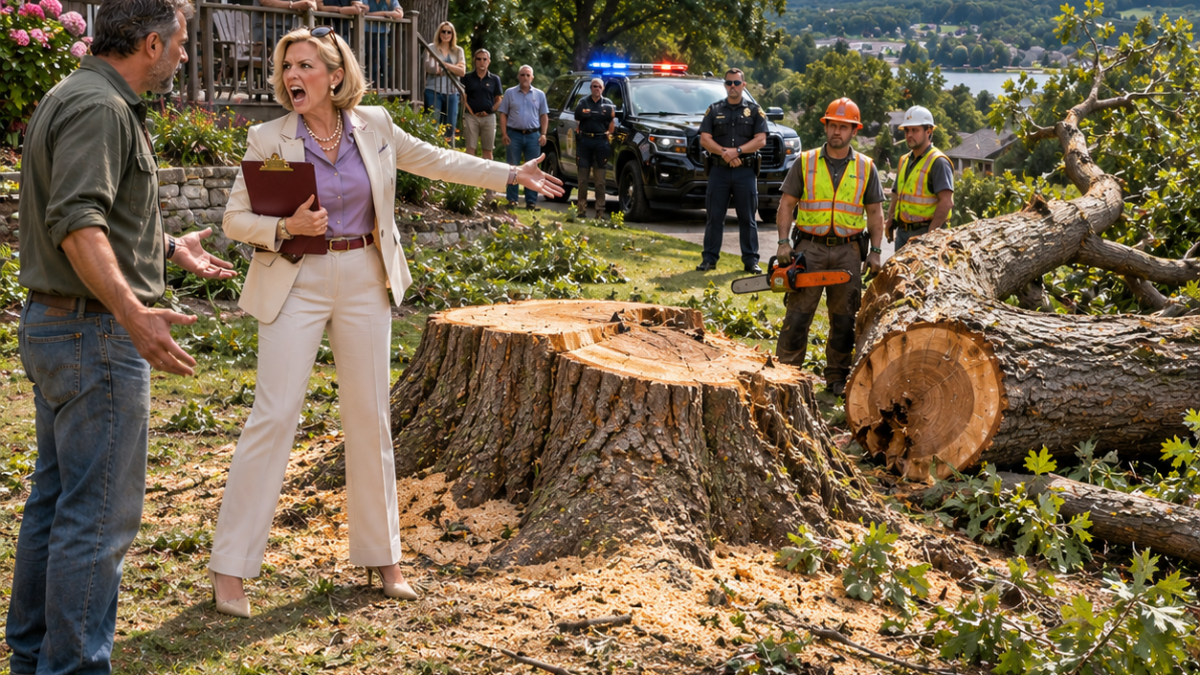
About thirty-five feet of trunk still rose from the severed root zone, stripped of most branches, with a visible notch cut into one side near the base.
The ground around it had been churned by boots, ropes, and equipment.
Brad stared.
“That’s quite a tree.”
“Was.”
I pointed toward the crack in the slope.
“And that’s new.”
He crouched.
Rainwater had collected inside the narrow opening.
“What am I looking at?”
“Movement.”
“From the tree?”
“From the disturbed soil and roots. That oak was part of the slope stabilization.”
“Part?”
I appreciated the question.
“One tree doesn’t magically hold up an entire hill. But a root system that size reinforces shallow soil, intercepts water, and reduces erosion. They cut roots, disturbed the ground, and left a compromised trunk in saturated clay.”
Brad stood.
“So you’re saying Deborah caused a landslide?”
“No.”
He looked almost disappointed.
“I’m saying there’s evidence the slope is becoming unstable, and someone qualified needs to inspect it.”
“You’re a landscape architect.”
“Yes.”
“Qualified?”
“To recognize danger? Absolutely. To certify geotechnical stability? No. That’s why I called the county.”
He studied me for a moment.
Then he looked toward Deborah’s property.
Her rear patio sat several feet above the lower part of my lot, supported by a stone retaining wall that had always looked more decorative than structural.
“Where’s her property line?”
I pointed.
“Other side of the fence. Most of the tree was mine. Some roots extended beneath both lots because roots don’t read surveys.”
That almost made him smile.
Then Deborah came down the path.
Pink blazer beneath a clear raincoat.
Umbrella in one hand.
Clipboard in the other.
Even during a storm, she had the clipboard.
“Brad.”
Her voice softened in a way it never did for me.
“Thank you for coming.”
He nodded.
“Deborah.”
She looked at the damaged oak.
“I’m glad you’re seeing this yourself.”
“So am I.”
Her expression changed slightly.
She continued.
“That tree has been a safety hazard for years. Ethan refused to cooperate.”
“I refused to let you cut it down.”
“Because you’re unreasonable.”
Brad held up one hand.
“Let’s keep this factual.”
Deborah smiled at him.
“Of course.”
I almost laughed.
Brad pointed toward the remaining trunk.
“Where’s the hazard assessment?”
Deborah blinked.
“The what?”
“You said the tree was dangerous.”
“It obviously was.”
“Who evaluated it?”
“The HOA.”
“Who at the HOA?”
She tightened her grip on the clipboard.
“We received complaints.”
“From who?”
“That information is confidential.”
I said, “From Deborah Frost.”
She glared.
Brad ignored us both.
“Did a certified arborist inspect it?”
Deborah hesitated.
“Not recently.”
“I had one six months ago,” I said.
I went inside and returned with the report.
Brad read the first page.
Then the second.
“Condition: good.”
“Yes.”
“Recommended pruning within eighteen months.”
“Yes.”
“No removal recommendation.”
“No.”
Deborah stepped closer.
“That doesn’t mean circumstances couldn’t change.”
I looked at her.
“In six months?”
“Storm damage.”
“What storm?”
She didn’t answer.
Brad folded the report.
“Deborah, did you have county authorization?”
“The HOA bylaws allow emergency vegetation removal.”
“That’s not what I asked.”
Her voice sharpened.
“We acted under our governing authority.”
Brad rubbed his jaw.
“This may end up being civil.”
“Exactly,” Deborah said quickly.
I turned to him.
“County environmental code protects heritage trees over fifty years old. I already sent the ordinance to Mark Dawson.”
Brad knew that name.
His expression shifted.
“The environmental officer?”
“Yes.”
“He coming?”
“At ten.”
Brad looked at his watch.
Forty minutes.
Deborah scoffed.
“Mark Dawson is an overzealous bureaucrat.”
“That’s one opinion,” I said.
She looked at me.
“You’ve been trying to turn this into some major environmental event because you’re angry you lost a tree.”
I stared at the stump.
I lost a tree.
As if it had wandered off.
“You hired people to destroy it.”
“I corrected a violation.”
“On my land.”
“For the benefit of the community.”
Brad sighed.
“You two need to stop.”
Then his radio crackled.
He walked toward his cruiser.
I watched him.
The vehicle was parked at the lower edge of my drive, perhaps fifteen feet from the remaining trunk.
The safest place would have been fifty feet farther uphill.
“Brad.”
He turned.
“You should move that car.”
“Why?”
I pointed.
“That trunk is compromised.”
He looked up at it.
“It hasn’t moved.”
“The base was cut yesterday, the roots were disturbed, and the ground is saturated.”
Deborah laughed.
“Oh, come on.”
I ignored her.
“Move it uphill.”
Brad stared at me.
Maybe it was pride.
Maybe inconvenience.
Maybe he genuinely didn’t think the risk was serious.
“I’ll be here twenty minutes.”
“That doesn’t matter.”
“Ethan.”
“Sheriff, I’m telling you because I don’t want anything happening.”
Deborah said, “He wants everyone panicking.”
Brad looked between us.
Then shook his head.
“I’ll move it if the inspector needs access.”
That was his decision.
Not mine.
I walked away.
At 9:42, rain intensified.
Not dramatically.
Just enough that the gutters started running harder.
I stood beneath the back porch awning checking my phone.
My security cameras were recording.
So was the small weather station beside my garage.
I took another photograph of the crack.
It had widened.
Barely.
Maybe an eighth of an inch.
Enough that I noticed.
“Brad.”
He was standing beside the cruiser talking to Deborah.
He looked up.
“The crack’s moving.”
He walked over.
This time, he didn’t dismiss me.
“Show me.”
I pointed.
He crouched.
Deborah remained five steps away.
“This was not here yesterday,” I said.
“You have photos?”
“Timestamped.”
Brad rose.
“Okay.”
Finally.
He started toward the cruiser.
Then a white county pickup turned into my driveway.
MARK DAWSON — ENVIRONMENTAL SERVICES was printed on the door.
Mark stepped out carrying a tablet and wearing a yellow waterproof jacket.
He looked at the oak.
Then at me.
Then at Deborah.
His face settled into the expression of a man whose morning had just become much longer.
“Mr. Cole?”
“That’s me.”
“Mark Dawson.”
We shook hands.
Deborah immediately moved toward him.
“Mr. Dawson, I’m so glad you’re here. There’s been a lot of misinformation.”
Mark didn’t even look at her yet.
“Everybody stay clear of that trunk.”
Brad stopped.
I didn’t say anything.
Deborah did.
“Why?”
Mark pointed.
“Because someone left a partially cut stem standing on saturated, disturbed ground.”
He opened his tablet.
“I reviewed the arborist report you sent.”
I nodded.
“Healthy tree?”
“According to the certified inspection, yes.”
Deborah said, “That report is old.”
Mark finally looked at her.
“Six months.”
“Conditions change.”
“They do.”
For half a second, she looked relieved.
Then he added:
“Which is why you obtain another assessment before removing protected vegetation.”
Her relief disappeared.
Mark walked toward the trunk but stopped well outside the fall zone.
He photographed the cut.
The ground.
The root disturbance.
Then the slope crack.
He turned to me.
“You said the retaining wall changed overnight?”
“Yes.”
Deborah interrupted.
“His drainage has always been poor.”
I looked at her.
“My drainage?”
“Yes.”
“Your patio drains toward my property.”
“That has nothing to do with this.”
Mark held up one hand.
“Enough.”
He walked toward the retaining wall.
Rain struck his hood.
I saw him stop.
“Sheriff.”
Brad looked over.
“Yeah?”
“Move your vehicle.”
Brad reached for his keys.
That was the exact moment the sound began.
Not a crack.
Not at first.
A groan.
Low and deep.
Wood under enormous stress.
Everybody froze.
Mark shouted:
“Back!”
I stepped away from the slope.
Brad turned toward the cruiser.
“Leave it!” Mark yelled.
The remaining oak trunk shifted.
Slowly at first.
Its cut base opened along the notch the tree crew had left.
Wet soil broke away around one side of the root plate.
The trunk leaned.
Deborah screamed.
Brad ran uphill.
Then gravity took over.
The thirty-five-foot trunk came down across the lower driveway with a sound I felt in my chest.
Its thickest section struck the roof and hood of Brad’s cruiser.
Glass burst outward.
Metal folded.
The suspension dropped.
The blue light bar shattered beneath the weight.
For one ridiculous second, the siren triggered.
Wee-oo.
Then stopped.
Rain hissed on the crushed hood.
Nobody spoke.
Brad stood ten feet away staring at what had been a county vehicle.
Mark’s mouth was slightly open.
Deborah had both hands pressed against her head.
And because the universe occasionally has terrible comic timing, the car horn gave one weak, sustained beep.
Brad closed his eyes.
I covered my mouth.
Not because I was shocked.
Because I was dangerously close to laughing.
He looked at me.
“Don’t.”
I lowered my hand.
“I didn’t say anything.”
“Don’t even think it.”
“Too late.”
Deborah spun toward me.
“This is your fault!”
That cured the humor immediately.
“My fault?”
“Your tree just destroyed a sheriff’s vehicle!”
“My tree?”
“You refused to maintain it!”
Mark looked at her.
“Ma’am.”
She pointed at me.
“He let that thing become dangerous.”
Mark’s voice became flat.
“I have video provided by Mr. Cole showing you directing contractors to cut this tree yesterday.”
She stopped.
Brad turned.
“You have video?”
Mark lifted his tablet.
“Security footage.”
Deborah’s face changed.
Not much.
Just enough.
I recognized the moment someone realizes the story they’ve been telling is about to collide with evidence.
She recovered quickly.
“That footage will show I was acting under HOA authority.”
“It shows you ordering removal after the property owner explicitly denied permission.”
“Because it was hazardous.”
Mark glanced at the crushed cruiser.
“It became considerably more hazardous after your contractors partially cut it.”
Silence.
Brad stared at her.
“You told me it was already unstable.”
“It was.”
“Then why did you let me park there?”
Deborah looked at him.
“What?”
“You told me this morning the stump was stable.”
“I said the situation was under control.”
“My car is under a tree.”
Even Mark looked away at that one.
Deborah’s voice rose.
“Brad, don’t turn this around on me because you parked in the wrong place.”
His expression hardened.
“I’m not turning anything around.”
Mark stepped between them.
“We need everybody off this slope.”
Another small section of soil had slipped beneath Deborah’s retaining wall.
He pointed toward her patio.
“That wall may be compromised.”
Deborah stared.
“My patio?”
“Yes.”
“You can’t be serious.”
“I am extremely serious.”
She looked at me.
I didn’t enjoy the fear in her face.
I wanted consequences.
I did not want her house sliding downhill.
Those are different things.
Mark called county engineering.
Brad radioed for another unit.
Within twenty minutes, my quiet street had two patrol vehicles, a county truck, caution tape, and enough flashing lights to convince every neighbor within three blocks that somebody had been murdered.
People appeared beneath umbrellas.
Phones came out.
I hated that part.
The oak deserved better than becoming entertainment.
A deputy began photographing Brad’s cruiser.
Mark documented the tree.
Then Jake Morales, one of the workers from the day before, arrived.
He had seen the emergency vehicles in the neighborhood and decided showing up voluntarily was better than waiting to be called.
He approached me first.
“Mr. Cole?”
“Ethan.”
He looked toward the crushed car.
“Oh, man.”
“Yeah.”
His face went pale.
“I told her we should stop.”
“I know.”
“You recorded that?”
“Yes.”
“Good.”
He swallowed.
“My brother and I thought she had permits.”
“Did you see one?”
“She showed us an HOA form.”
“That isn’t a permit.”
“I know that now.”
“Did she tell you it was?”
Jake nodded.
“She said county approval was already handled.”
Mark had walked close enough to hear.
“Mr. Morales?”
Jake turned.
“Yes, sir.”
“You part of the removal crew?”
“Yes.”
“I need your information.”
Jake handed over a business card.
Mark said:
“Did you verify the heritage-tree status before cutting?”
Jake looked ashamed.
“No.”
“Why?”
“Mrs. Frost told us it was an emergency hazard and the HOA had authority.”
“You normally rely on HOA presidents for county permits?”
“No, sir.”
“At least you’re honest.”
Jake rubbed his face.
“We screwed up.”
“Yes.”
Jake looked at me.
“I’m sorry.”
I believed him.
That didn’t erase anything.
But I believed him.
“Tell the truth when they ask.”
“I will.”
Deborah overheard.
“Jake, don’t you dare imply I misled you.”
He turned.
“Ma’am, you told us the county signed off.”
“They did.”
“Who?”
She froze.
Jake waited.
“Who at the county?”
Deborah’s mouth tightened.
“I don’t remember the name.”
Brad laughed once.
Not kindly.
By noon, the county declared the rear slope a temporary hazard zone.
Deborah was told not to use her patio or the lower half of her backyard until a geotechnical engineer evaluated it.
My own rear yard was partially restricted too.
The crushed cruiser stayed where it was until the tree could be stabilized and lifted safely.
Which meant every person driving through Oakview Hills saw it.
That became a problem.
By three, somebody had posted a photograph online.
By five, local news called.
By six, a video filmed from a neighbor’s upstairs window showed the trunk falling.
I hadn’t posted mine.
Didn’t need to.
Deborah’s humiliation had become public without my help.
That evening, I sat alone at my kitchen table.
No television.
No music.
Just rain.
I had imagined winning against Deborah.
A letter from the county.
An HOA vote.
Maybe a court order.
I had not imagined staring through my kitchen window at the remains of a tree older than nearly every house around it.
The cruiser didn’t matter to me.
The viral jokes didn’t matter.
The HOA gossip didn’t matter.
The tree was gone.
That fact remained after all the comedy had burned away.
I found one photograph from the first year I moved in.
The oak behind the house.
Full canopy.
Late afternoon light through the leaves.
I had been forty-two then.
Standing beneath it holding a rolled site plan.
I looked younger.
The tree looked exactly the same.
That’s the strange thing about old trees.
They make your own aging obvious because they seem not to participate in it.
Until suddenly they’re gone.
My phone rang.
Jim Sutton.
My attorney.
I had called him the previous day.
He was a land-use lawyer in his sixties with silver hair and the dry patience of a man who had spent thirty years listening to neighbors argue over fences.
“Ethan.”
“Jim.”
“I’ve seen the news.”
“Of course you have.”
“Did the sheriff’s car really get crushed?”
“Yes.”
A pause.
Then:
“I am professionally obligated not to find that funny.”
“Good luck.”
He laughed.
“Everybody safe?”
“Yes.”
“That’s what matters.”
“I know.”
“Now stop talking to reporters.”
“I haven’t talked to any.”
“Excellent. You’re already my favorite client this week.”
“What do we do?”
“Preserve everything.”
“Done.”
“Original camera files.”
“Cloud and local.”
“Certified arborist report.”
“Done.”
“County correspondence.”
“Done.”
“HOA notices.”
“I have all of them.”
“Contractor information?”
“County has it.”
“Get copies anyway.”
“Okay.”
“And don’t argue with Deborah.”
“That one may be difficult.”
“Then become better.”
I rubbed my forehead.
“What can I recover?”
“We need valuation.”
“For the tree?”
“Yes, and property restoration, slope damage, legal costs where available, trespass damages. State law may provide enhanced remedies depending on the circumstances, but don’t start spending hypothetical money.”
“I want the tree back.”
Jim was quiet.
“I know.”
That answer helped more than legal strategy would have.
The next morning, the rain stopped.
Oakview Hills smelled like wet leaves and clay.
County crews removed Brad’s cruiser after lifting the trunk with heavy equipment.
The roof was crushed.
Windshield destroyed.
Hood folded almost to the dashboard.
Brad watched the tow truck pull away.
I stood near the sidewalk.
He looked at me.
“Say it.”
“What?”
“You warned me to move it.”
“I did.”
“Go ahead.”
“I don’t need to.”
He gave me a tired smile.
“That somehow makes it worse.”
He started walking away.
“Brad.”
He stopped.
“You really thought I was making this up?”
He looked toward Deborah’s house.
“I thought you two were fighting.”
“We were.”
“I thought the truth was somewhere in the middle.”
“That phrase causes a lot of damage when one side has documents and the other has a clipboard.”
He looked down.
“Fair.”
I wasn’t ready to forgive him.
But at least he heard it.
Mark Dawson returned with a county arborist named Dr. Helen Wu and a geotechnical engineer named Carlos Ramirez.
Helen examined the cut surfaces.
She took samples.
Measured the trunk.
Counted rings from a clean cross section.
Ninety-three.
Exactly.
She straightened.
“Healthy core.”
I already knew.
Hearing her say it still hurt.
“Any significant decay?”
“Minor age-related cavity development. Nothing unusual for a mature oak.”
“Would you have recommended removal?”
She looked toward what remained.
“No.”
Deborah had come outside.
She heard.
“That’s your opinion.”
Helen turned.
“It is my professional opinion.”
Deborah crossed her arms.
“Experts disagree.”
“Which arborist recommended removal?”
Silence.
Helen waited.
Deborah walked back inside.
Carlos spent most of the day on the slope.
At four, he came to my porch.
“Good news and bad news.”
“Start good.”
“Your house is not in immediate danger.”
“Bad?”
“The slope needs stabilization.”
“How much of that is from the tree removal?”
He considered his words.
“You had mature root reinforcement, surface interception, and relatively undisturbed soil before. The removal crew disturbed the root zone during a period of heavy rainfall, and the partial cutting created a failure hazard.”
“So Deborah caused it.”
“I don’t write reports using people’s names.”
“Of course you don’t.”
“I can say the removal materially increased local instability.”
“That’s enough.”
“There’s more.”
He showed me photographs.
Deborah’s retaining wall had no modern drainage layer behind it.
Water pressure had been building.
“So the tree wasn’t the only issue.”
“No.”
“Important?”
“Yes.”
That mattered.
I wanted the truth.
Not the most satisfying version of it.
Deborah had caused serious damage.
I didn’t need to exaggerate.
Carlos continued.
“If this wall fails, her patio could shift.”
“How likely?”
“With another major rain before stabilization? Enough that I’m recommending temporary restrictions.”
“Can it damage my property?”
“Yes.”
“Great.”
“We’ll install monitoring points.”
That afternoon, county crews drove small reference pins and movement gauges into the hillside.
Deborah came outside halfway through.
“Who authorized this?”
Carlos looked up.
“County hazard order.”
“I don’t consent.”
He returned to his instrument.
“You don’t have to.”
She stared.
“Excuse me?”
He looked at her.
“Ma’am, gravity does not require your approval.”
I turned away before she saw me smile.
For three days, the neighborhood felt like a carnival built around my grief.
Cars slowed past the house.
Neighbors walked dogs they apparently had never owned before.
One teenager asked if he could take a photo with the stump.
“No.”
He seemed genuinely surprised.
The local Channel 7 reporter called twice.
I declined.
Then Deborah gave an interview.
That changed my mind.
She stood in her front yard wearing a beige raincoat and told the reporter:
“The tree was dangerous. The HOA acted in good faith to protect residents. Unfortunately, Mr. Cole has chosen to exploit a tragic accident to pursue a personal vendetta.”
I watched from my living room.
My jaw tightened.
Then she added:
“There are two sides to every story.”
I called Jim.
“I want to respond.”
“No.”
“She just lied on television.”
“Yes.”
“So?”
“So we respond through documents.”
“That’s not as satisfying.”
“Courts are rarely satisfying. They’re useful.”
“She said I exploited the accident.”
“Did you?”
“No.”
“Then relax.”
“I hate you.”
“Billable.”
I hung up.
The county responded for me the next morning.
Mark issued a formal preliminary finding stating that the removal had occurred without required heritage-tree authorization and that county records did not show an emergency removal permit.
The tree service workers gave written statements confirming Deborah represented that approvals were in place.
My video showed Deborah directing them after I objected.
Then the HOA attorney released something even more damaging.
A short statement:
“The Oakview Hills Homeowners Association did not authorize removal of the Cole property oak through a properly noticed board vote.”
I read it three times.
Then called Patricia Lane.
Patricia was assistant treasurer.
Quiet.
Widowed.
The kind of person Deborah tended to talk over.
She answered softly.
“Hello?”
“Patricia, did the board authorize that tree?”
Silence.
“Who told you that?”
“Your attorney.”
Another silence.
“Can we talk?”
She came over after dark.
Not because we were hiding.
Because she didn’t want Deborah seeing her cross the street.
She carried a folder.
We sat at my kitchen table.
Patricia looked exhausted.
“Deborah told everyone she had emergency authority.”
“Did she?”
“Not for a healthy tree on privately owned property.”
“Did anybody vote?”
“No.”
“Did she tell the tree company there was county approval?”
“I don’t know.”
I showed her the contractor statement.
She closed her eyes.
“Oh, God.”
“What?”
“This is worse than I thought.”
“How?”
Patricia opened her folder.
Inside were HOA invoices.
“Deborah submitted the tree removal bill to the beautification fund.”
I stared.
“What?”
“She charged the HOA.”
“How much?”
“Four thousand eight hundred dollars.”
“For cutting down my tree?”
“Yes.”
“Did the board approve that?”
“No.”
“Then why was it paid?”
Patricia looked ashamed.
“Deborah has signing authority under five thousand.”
Of course she did.
“Patricia.”
“There’s more.”
I leaned back.
She showed me three months of ledger entries.
Landscaping.
Decorative plant replacement.
Community enhancement.
Maintenance consulting.
Small amounts individually.
Thousands collectively.
“What am I looking at?”
“I don’t know yet.”
“You brought it.”
“I know what I suspect.”
“What?”
She lowered her voice.
“Some vendors don’t exist.”
That pulled me upright.
“Explain.”
“The board started reviewing Deborah’s discretionary spending after the county asked for proof that the tree removal was officially authorized.”
“And?”
“We found invoices from companies I’ve never seen.”
“Could be subcontractors.”
“Yes.”
“But?”
“One address is a mailbox store.”
I stared at the papers.
“Another?”
“Same phone number as a company owned by Deborah’s cousin.”
“Does that mean fraud?”
“I don’t know.”
“Good answer.”
She almost smiled.
“I’ve been treasurer long enough to know it means audit.”
“Have you told the board?”
“Tomorrow.”
“Why tell me?”
She looked at the dark window.
“Because Deborah is going to say you caused this.”
“I didn’t.”
“I know.”
Patricia touched the folder.
“And because I think people should stop letting her decide what reality is.”
The emergency HOA meeting happened two nights later.
The community room was full.
Nobody brought cookies.
Deborah sat at the center table.
Patricia sat three seats away with a binder.
The board’s attorney stood near the wall.
I remained in the back.
I didn’t need to be part of it.
Deborah called the meeting to order.
“We are here because outside pressure has created confusion regarding my lawful actions as president.”
A man near the front laughed.
She struck the gavel.
“This is not entertainment.”
Someone muttered:
“Tell that to the sheriff’s car.”
More laughter.
Deborah’s face reddened.
Patricia spoke.
“We need to address financial authorization.”
Deborah turned sharply.
“That is not on tonight’s agenda.”
“It is now.”
“No.”
The HOA attorney stepped forward.
“Mrs. Frost, the board has authority to amend the agenda.”
Deborah stared at him.
“You work for us.”
“I represent the association.”
“I am the association president.”
“Not the association.”
That sentence shifted the room.
Patricia opened her binder.
“The payment for the Cole tree removal was made without board authorization.”
Deborah said:
“Emergency expenditure.”
“For a tree the county says was protected.”
“County review is ongoing.”
Patricia continued.
“We also identified discrepancies in the beautification account.”
Deborah’s face changed.
“Those have nothing to do with Ethan.”
“No,” Patricia said quietly. “They have to do with you.”
The room went still.
Deborah stood.
“I will not sit here while a failed bookkeeper questions my integrity.”
Patricia’s hands trembled.
She kept going.
“Approximately sixty thousand dollars in payments over two years require independent review.”
A woman gasped.
Deborah laughed.
It sounded forced.
“This is ridiculous.”
The attorney said:
“An outside forensic accountant has been retained.”
“You had no authority!”
“The board voted this afternoon.”
She looked around.
One by one, board members avoided her eyes.
Her face lost color.
“You met without me?”
“It was a special session.”
“You can’t do that.”
The attorney responded:
“The bylaws permit it.”
For years Deborah had used that sentence against other people.
Now it landed on her.
I expected satisfaction.
What I felt instead was almost pity.
Almost.
Deborah pointed at me.
“This is him.”
Every head turned.
I stayed seated.
“He has manipulated all of you because of a tree!”
I said:
“I didn’t touch your accounts.”
“You started this.”
“You cut my tree.”
“Because you wouldn’t comply!”
Patricia said:
“Deborah.”
She didn’t stop.
“You think this neighborhood belongs to you because you have cameras and lawyers and some county bureaucrat feeding you information.”
I stood slowly.
“No.”
“Then what do you want?”
The question surprised me.
I looked at her.
“My backyard back.”
For once, she had nothing to say.
I continued.
“You keep acting like I’m trying to take your position, embarrass you, destroy you, whatever story you’ve told yourself.”
The room was silent.
“I wanted you to leave a ninety-three-year-old tree alone.”
Her mouth tightened.
“You’re enjoying this.”
“No.”
I looked around.
“I would trade every meeting, every video, every lawsuit, and every joke about the sheriff’s car to have Tuesday morning back before those chainsaws started.”
Nobody laughed.
Deborah looked away first.
The board voted fifteen minutes later.
Her enforcement authority was suspended immediately.
Her financial authority was frozen pending audit.
She remained technically on the board until formal removal procedures could be completed.
But the thing she cared about most—control—was gone.
She left before the meeting ended.
Three days later, rain returned.
Not the violent storm from before.
Moderate.
Steady.
Enough.
At 9:18 that evening, my slope sensor alert sounded.
County engineers had given me access to the monitoring dashboard because part of the system sat on my property.
Movement.
Small.
Then another alert.
I put on boots and stepped onto my porch.
Deborah’s retaining wall had begun bowing.
I called Carlos.
He was already on his way.
Then I called Deborah.
She answered with:
“What do you want?”
“Get out of your backyard.”
Silence.
“Excuse me?”
“The wall is moving.”
“You stay away from my property.”
“I am on my property.”
“I know what you’re doing.”
“Deborah, listen to me.”
My voice must have sounded different because she stopped.
“The monitoring points moved. Go inside and stay away from the patio.”
“You’re trying to scare me.”
“No.”
I looked at the wall.
Water was seeping through a joint.
“I’m trying to keep you from standing on it when it fails.”
She hung up.
I swore.
Then called 911.
Not because I thought the whole house was collapsing.
Because I wasn’t going over there.
A county unit arrived first.
Then Carlos.
Then Brad.
He got out of a borrowed cruiser.
I looked at it.
He pointed at me.
“Not one word.”
“Wouldn’t dream of it.”
We moved uphill.
Carlos inspected from a safe distance.
“Everybody back.”
Deborah came onto her deck.
Brad shouted:
“Deborah! Inside!”
She ignored him.
“What is all this?”
The retaining wall cracked.
A sharp sound.
Concrete on concrete.
Her face changed.
“Move!” Carlos yelled.
She ran toward the house.
Three seconds later, a six-foot section of wall tilted outward.
Mud and water spilled through.
Not a catastrophic landslide.
No house disappearing.
No Hollywood disaster.
But enough.
Patio furniture slid.
A planter toppled.
Part of the lower deck shifted.
Brown water spread across the damaged yard and into the drainage channel.
Deborah stood behind her glass door watching.
This time, nobody needed to explain cause and effect.
The county declared her backyard unsafe until stabilization.
Her homeowner’s insurer opened a separate investigation.
The HOA’s liability carrier sent reservation-of-rights letters.
The tree company notified its insurer.
The sheriff’s department filed a claim for the cruiser.
Everybody wanted to know who was paying.
Jim explained it to me in his office.
“Imagine a Thanksgiving dinner where everyone brings a lawyer.”
“That sounds expensive.”
“It is.”
He had my photographs spread across his desk.
“Our claim is straightforward compared with theirs.”
“Tree.”
“Tree, trespass, restoration, documented slope costs attributable to the removal, attorney fees where recoverable.”
“What about emotional damages?”
He looked at me.
“You want to spend two years arguing that?”
“No.”
“Good.”
“What about Deborah’s counterclaim?”
He smiled.
“What counterclaim?”
I frowned.
“She threatened one.”
“She filed yesterday.”
“Of course she did.”
He handed me papers.
DEBORAH FROST v. ETHAN COLE.
Defamation.
Intentional interference.
Negligence.
Emotional distress.
Environmental sabotage.
I stared.
“Environmental sabotage?”
“She alleges you deliberately failed to stabilize the tree after she ordered its removal.”
I looked at him.
Jim looked at me.
Then we both laughed.
“I didn’t order the removal.”
“I know.”
“I told them to stop.”
“I know.”
“There’s video.”
“I know.”
“Why would her lawyer file this?”
“Clients can be persuasive.”
“That was diplomatic.”
“I’m billing you for diplomacy.”
We countersued.
That was when everything became less entertaining.
Depositions aren’t dramatic.
Discovery isn’t cinematic.
You sit in conference rooms.
You answer questions.
You produce emails.
Lawyers argue over language.
Months pass.
Money disappears into billable hours.
But sometimes truth becomes more powerful precisely because it’s boring.
The contractor’s deposition was devastating.
Jake Morales testified first.
Deborah’s attorney asked:
“Who hired your company?”
“Mrs. Frost.”
“In what capacity?”
“She said she was acting as HOA president.”
“Did you understand the tree to be dangerous?”
“She told us it was.”
“Did you inspect it?”
“No.”
“Why not?”
“We aren’t arborists.”
“Did she tell you county approval existed?”
“Yes.”
Deborah shifted in her seat.
Her attorney asked:
“Could you have misunderstood?”
“No.”
“What exactly did she say?”
Jake looked at the transcript notes.
“She said, ‘County already signed off. I don’t pay people to ask the same question twice.’”
I remembered that phrase.
It sounded exactly like her.
Then my video played.
Me:
“You do not have my permission.”
Deborah:
“Then sue me.”
No interpretation needed.
No debate about tone.
No missing context.
Just her voice.
Jim leaned toward me.
“Never interrupt your enemy when the playback button works.”
I whispered:
“Did you steal that from Napoleon?”
“Billable.”
The county arborist testified that the oak was healthy before removal.
Carlos testified that cutting and disturbing the root zone contributed to localized slope instability, while acknowledging deficiencies in Deborah’s retaining wall also played a role.
That nuance mattered.
Deborah’s lawyer tried to use it.
“So Mr. Cole’s tree was not the sole cause of the slope failure?”
“Correct.”
Deborah smiled.
Carlos continued:
“But the removal materially reduced shallow-soil reinforcement and coincided with major root-zone disturbance immediately before heavy rainfall.”
Her smile disappeared.
“Would the wall have failed eventually?”
“Possibly.”
“When?”
“I don’t speculate.”
“Could it have failed without the tree removal?”
“Yes.”
“So Mrs. Frost didn’t cause it.”
Carlos looked at the attorney.
“That is not what I said.”
The room went quiet.
Brad’s deposition was worse for Deborah than I expected.
Her lawyer asked whether Brad had initially believed the tree was hazardous.
He said:
“I relied on Mrs. Frost’s description before inspecting the records.”
“Did Mr. Cole threaten Mrs. Frost?”
“No.”
“Did he appear hostile?”
“He appeared angry.”
“Dangerously?”
“No.”
“Did he warn you the remaining trunk was unstable?”
Brad paused.
“Yes.”
“Did you move your vehicle?”
“No.”
The lawyer hesitated.
“Why not?”
Brad looked at me across the table.
“Because I underestimated the risk.”
That cost him pride.
I respected him for saying it.
The sheriff’s department conducted an internal review too.
Brad wasn’t accused of corruption.
But investigators found he should have documented the conflict more carefully and should have referred the property and environmental questions sooner instead of casually treating the matter as a routine HOA disagreement.
He received a formal reprimand and additional conflict-of-interest training because of his friendship with Deborah’s family.
He kept his job.
That felt right to me.
Accountability doesn’t always need a career ending.
Sometimes it needs somebody being forced to admit:
I handled that badly.
The financial audit was another story.
Patricia called me late one afternoon.
“You sitting down?”
“Everybody keeps asking me that lately.”
“Sit.”
I did.
“The preliminary number is fifty-eight thousand seven hundred.”
“Missing?”
“Questionable.”
“Difference?”
“Accountants.”
“Fair.”
She continued.
“Personal lawn care billed to the HOA.”
I rubbed my forehead.
“Of course.”
“Pool maintenance.”
“HOA doesn’t have a pool.”
“Exactly.”
“Anything else?”
“Home improvement invoices.”
“What kind?”
“Bathroom fixtures.”
I closed my eyes.
“The community needed better toilets?”
Patricia laughed despite herself.
“Apparently Deborah’s community did.”
The audit found that not every questionable payment was theft.
Some were legitimate expenses with terrible documentation.
But enough were personal that the association referred the matter to law enforcement.
That investigation continued separately from my case.
Oakview Hills formally removed Deborah as president at the next special election.
She didn’t attend.
Patricia became interim president.
Her first announcement was simple:
“No one gets unilateral financial authority anymore.”
Her second:
“No board member may authorize entry onto private property without documented legal authority or the owner’s permission, except genuine emergencies.”
Her third:
“Please stop sending tree memes to the official HOA email.”
That one was aimed at Bob Reynolds, who lived three houses down and had apparently discovered the internet at age seventy-one.
The neighborhood slowly stopped treating the whole thing like comedy.
That mattered to me.
People began remembering there had been a living tree beneath the viral image.
Mrs. Angela Morris, the widow Deborah once cited for her wind chime, came to my house one morning carrying blueberry muffins.
“I liked that oak.”
I opened the box.
“You liked it more than I like blueberries?”
“Don’t be dramatic.”
We sat on my porch.
She looked toward the empty space.
“My husband proposed to me under an oak.”
“This one?”
“No. Kentucky.”
“That would have been a much better story.”
She smiled.
“Deborah made people afraid to say no.”
“Why?”
“Because she never stopped.”
I understood.
“You could beat her on one thing and she’d find another.”
Angela nodded.
“Mailbox. Flowers. Garbage cans. Holiday lights. Eventually people decided agreement was cheaper.”
“Until it wasn’t.”
She looked at the damaged slope.
“Until it wasn’t.”
County restoration crews stabilized the hillside with temporary drainage and reinforced terraces.
The work cost money.
A lot of it.
Insurance disputes determined who paid which portion.
Some expenses fell to Deborah personally.
Some to the tree contractor’s insurer.
Some to the HOA’s coverage after lawyers negotiated what qualified as association action.
My own claim remained separate.
Then the civil hearing arrived.
County courthouse.
Thursday morning.
Jim wore his dark blue suit.
I wore mine.
Deborah arrived fifteen minutes early, not late as gossip later claimed.
She wore a beige trench coat and large sunglasses.
She removed them before entering the courtroom.
She looked tired.
Not defeated.
Tired.
That mattered.
She was still a person.
An infuriating one.
A destructive one.
But a person.
Judge Sarah Whitfield read the filings.
Then looked over her glasses.
“Is this the tree case?”
Jim stood.
“Yes, Your Honor.”
The judge looked at the photograph attached to the complaint.
“The tree that landed on the sheriff’s cruiser?”
Jim paused.
“Partially, Your Honor.”
A few people laughed.
Judge Whitfield did not.
“Let’s keep county vehicle damage entertaining only outside my courtroom.”
That shut everyone up.
Jim presented the ownership records.
The heritage-tree ordinance.
The arborist report.
My certified letter to Deborah.
My video.
The contractor testimony.
The county environmental findings.
Deborah’s lawyer attacked causation.
He argued she sincerely believed the tree posed a hazard.
He argued the HOA provisions were ambiguous.
He argued the contractor should have independently verified permits.
Some of that was fair.
The tree company had responsibilities too.
Then the judge asked Deborah directly:
“Mrs. Frost, did Mr. Cole tell you not to remove the tree?”
She hesitated.
“Yes.”
“Did you possess a court order allowing removal?”
“No.”
“County emergency order?”
“No.”
“Certified arborist recommendation?”
“Not exactly.”
Judge Whitfield leaned forward.
“What does ‘not exactly’ mean?”
“We had resident concerns.”
“That isn’t what I asked.”
“No.”
“Did the HOA board vote to remove the tree?”
Deborah swallowed.
“I believed my emergency authority was sufficient.”
“Did they vote?”
“No.”
“Did county environmental services issue a permit?”
“I thought—”
“Yes or no.”
“No.”
The judge looked down at the file.
“Then we can stop pretending this is complicated.”
Deborah’s shoulders dropped.
The ruling awarded me $8,500 in direct tree-related damages plus recoverable legal costs under the applicable provisions.
That number alone did not cover every consequence.
Separate insurance and restoration proceedings addressed other property and slope expenses.
County environmental penalties and sheriff’s vehicle claims were handled outside my judgment.
The combined documented exposure tied to the incident eventually exceeded sixty-three thousand dollars before attorneys and insurance adjustments.
I didn’t walk out rich.
I walked out with a judgment.
That was enough.
Judge Whitfield also issued a twelve-month no-contact and no-entry order after Deborah’s repeated claims and confrontations.
As we left, Jim put one hand on my shoulder.
“You handled yourself well.”
“I mostly sat there.”
“That’s how most lawsuits are won.”
“I thought lawyers won them.”
“We tell people that.”
Outside, Deborah stood at the bottom of the courthouse steps.
For a second, I thought she was waiting for me.
She wasn’t.
She was staring at her phone.
Then she looked up.
Our eyes met.
“You happy?”
Jim immediately shifted closer.
I raised one hand to show him I was fine.
“No.”
Deborah gave a bitter laugh.
“Of course you are.”
“I wanted my tree.”
Her expression changed.
Just slightly.
“You got money.”
“That isn’t a tree.”
“You got your reputation back.”
“I didn’t know I’d lost it.”
“You humiliated me.”
I stared at her.
“Deborah, I didn’t put the chainsaw in your hand.”
“I wasn’t holding it.”
“You were giving the orders.”
She looked away.
“That neighborhood hated me before this.”
“No.”
She looked back.
“They did.”
“They were afraid of dealing with you. That’s not the same thing.”
Her jaw tightened.
“You think you’re better than me?”
“No.”
“Everyone does.”
“That’s your problem.”
She flinched.
I immediately regretted the sharpness.
But I didn’t take it back.
“You had people listening to you,” I said. “You were elected. You could’ve done good things.”
She laughed quietly.
“Like what?”
“Anything that wasn’t about proving you could make people obey.”
Her eyes shone.
Anger or tears.
I couldn’t tell.
Jim touched my arm.
“Ethan.”
Right.
No-contact order.
Conversation over.
I stepped away.
Deborah called after me:
“This isn’t finished.”
I turned.
“For me, it is.”
It wasn’t.
Not entirely.
The criminal investigation into HOA finances moved forward.
The forensic accountant eventually identified roughly sixty thousand dollars in improperly diverted or unsupported association spending, including personal services disguised as neighborhood maintenance and reimbursements connected to improvements at Deborah’s home.
She denied intentional theft.
Her attorney argued sloppy governance, not embezzlement.
Prosecutors disagreed regarding part of the money.
The case ended in a negotiated plea.
Deborah admitted to felony-level misuse of association funds and falsifying supporting records for several transactions.
The sentence was not the dramatic decade in prison half the neighborhood predicted.
She received a county custodial term, part of it suspended, followed by probation, restitution, and a prohibition on serving as an officer or financial signatory for a homeowners association during the probationary period.
That sounded almost anticlimactic.
Until I remembered real justice isn’t written for television.
It doesn’t have to entertain anybody.
Her house went on the market.
Not immediately.
About two months later.
One afternoon, a moving truck arrived.
Boxes.
Furniture.
Her dog.
Patio items that survived the slope damage.
I stood behind my fence while workers loaded the truck.
I didn’t want to watch.
I watched anyway.
Deborah came outside last.
No pastel blazer.
Jeans.
Gray sweatshirt.
She looked toward the empty space where my oak had stood.
Then toward me.
I expected anger.
There wasn’t any.
Not that I could see.
She walked to her Range Rover.
Stopped.
Then came toward the property line.
Not onto my yard.
Just close enough to speak.
“Ethan.”
“Deborah.”
“I suppose this is what you wanted.”
“No.”
She smiled without humor.
“You keep saying that.”
“Because it’s true.”
“My house is being sold.”
“I know.”
“I lost the board.”
“I know.”
“I’m paying restitution.”
“I know.”
“My name is a joke online.”
I didn’t answer.
She looked at the stump.
“You really loved that thing.”
“Yes.”
“Why?”
That surprised me.
“You never understood?”
“It was a tree.”
I looked at her.
“Exactly.”
She frowned.
“That’s not an answer.”
“It didn’t ask anything from me.”
She waited.
I continued.
“It gave shade. Held soil. Fed squirrels. Cooled the yard. Caught rain. Dropped leaves. Grew.”
Deborah looked at the ground.
“You make it sound noble.”
“No. That’s the point. It didn’t need to be noble. It was just doing what it had done for ninety-three years.”
Her eyes moved toward her damaged backyard.
“I thought it made my house look smaller.”
There it was.
Not safety.
Not property values.
Not emergency authority.
Something embarrassingly human.
“I know.”
She looked at me.
“You knew?”
“You told me it blocked the view.”
“I hated seeing it from my front windows.”
“Why?”
She laughed once.
“My husband loved that house.”
I said nothing.
“He died three years before I became president.”
I had known he died.
Not much else.
“He designed the back garden. The roses. Patio. View.”
She swallowed.
“After he was gone, I kept changing things.”
That explained more than it excused.
“I thought if everything looked perfect…”
Her voice trailed away.
I waited.
She shook her head.
“Doesn’t matter.”
“It matters.”
“Not legally.”
“No.”
She almost smiled.
“For once we agree.”
Then she walked back toward her car.
“Deborah.”
She stopped.
“You could have asked me to prune it.”
She stood completely still.
“I know.”
Then she got in the Range Rover and drove away.
I watched until the vehicle disappeared.
That conversation bothered me for weeks.
Part of me didn’t want a reason for Deborah.
Reasons complicate anger.
It’s easier when people are simply monsters.
But most aren’t.
Most destructive people have some ordinary wound they decided entitled them to extraordinary control.
Loneliness.
Fear.
Grief.
Jealousy.
Pride.
None of those things excuses trespassing with chainsaws.
But understanding isn’t acquittal.
I could hold both truths at once.
The county restoration plan started in early spring.
Helen Wu helped select the replacement.
Not because any tree could replace the old oak.
It couldn’t.
A ninety-three-year-old canopy isn’t something you order from a nursery.
But we chose a young native oak with good structure and enough room to grow.
Six feet tall.
Maybe seven.
The root ball arrived wrapped in burlap.
Patricia organized a replanting day.
I told her I didn’t want a ceremony.
She ignored me.
Naturally.
Twenty neighbors showed up.
Angela brought lemonade.
Bob brought a shovel large enough to excavate a swimming pool.
Sarah brought her grandson.
Two children made a cardboard sign:
WELCOME HOME, LITTLE OAK.
That one got me.
I turned away before anyone saw.
Patricia noticed anyway.
She pretended not to.
That’s why I liked her.
We dug carefully.
Not too deep.
Wide hole.
Root flare visible.
No ridiculous mound of mulch against the trunk.
Bob watched.
“Tree people are fussy.”
“That’s why your maples look like telephone poles.”
“My maples are fine.”
“Your maples are begging for intervention.”
He laughed.
When the sapling was set, everyone took turns moving soil.
I added the last shovel.
Then water.
Patricia approached with an envelope.
“What now?”
“Open it.”
Inside was a small bronze plaque.
THE COLE OAK RESTORATION
Then, below:
ROOTS RUN DEEPER THAN RULES.
I looked at her.
“That’s dangerously sentimental.”
“Angela wrote it.”
Angela shouted from the porch:
“Liar!”
Everybody laughed.
I laughed too.
We mounted the plaque on a small stone beside the young tree.
Not on the tree.
I was very strict about that.
The HOA changed after Deborah.
Meetings became almost boring.
Patricia insisted financial statements be distributed every quarter.
Two signatures for discretionary spending.
Independent review above a set amount.
No board member could award contracts to relatives without full disclosure and competitive bidding.
Enforcement letters required board authorization instead of one person inventing violations from a kitchen printer.
The first time I received an HOA notice under Patricia, I nearly had a heart attack.
Then I read it.
NEIGHBORHOOD REPLANTING DAY — VOLUNTEERS NEEDED.
I called her.
“You could’ve used a different envelope.”
She laughed for thirty seconds.
The sheriff’s department repaired its relationship with me too.
Brad came by one afternoon.
No uniform.
No cruiser.
His personal pickup.
I was installing a drainage swale near the new oak.
He leaned on the fence.
“Need help?”
“Do you know how to use a shovel?”
“I’ve arrested people holding them.”
“Not the same skill.”
He came through the gate.
With permission.
Important detail.
We worked for nearly an hour.
Then sat on the retaining terrace.
Brad wiped mud from his boots.
“I owe you an apology.”
“You already said I was right about the car.”
“Bigger than that.”
I waited.
“I knew Deborah.”
“Yes.”
“I liked Richard.”
“I know.”
“When she called, I assumed this was neighbors fighting.”
“It was.”
“I treated your documents like they were one side of an argument.”
I looked at him.
“They were documents.”
“I know that now.”
“No. You knew it then.”
That landed.
He nodded.
“Fair.”
He picked at mud on his boot.
“I didn’t take you seriously enough because taking you seriously would’ve meant telling a friend she might’ve committed a crime.”
I didn’t say anything.
“That’s not how I’m supposed to work.”
“No.”
“The department made that very clear.”
“I heard.”
He smiled.
“Everybody heard.”
We sat there a while.
Then he pointed to the sapling.
“How long before that’s as big as the old one?”
“Ninety years.”
He stared.
“I’ll check back.”
“You’ll be a medical miracle.”
“County benefits are excellent.”
We laughed.
That was enough.
Summer came.
The slope stabilized.
The new drainage performed properly.
Grass returned.
Wildflowers filled some of the disturbed ground because I refused to replace everything with ornamental turf.
Patricia complained jokingly that my yard was becoming “visually interesting.”
I told her I’d file a complaint.
One afternoon, she came over with her grandson.
He was ten.
Maybe eleven.
He carried a small cardboard box.
Inside were acorns.
“From where?”
He pointed toward the county park.
“Big oak near the creek.”
Patricia said:
“He thinks you need backup.”
I knelt.
“You know most of these won’t become trees.”
He shrugged.
“Some will.”
That answer stayed with me.
We planted three near the rear property line.
Not because I expected to see them mature.
Because that’s not why you plant an oak.
Weeks later, the letter arrived.
The return address stopped me.
COUNTY CORRECTIONAL DIVISION.
Deborah Frost.
I carried it inside.
Placed it on the kitchen table.
Made coffee.
Came back.
The envelope remained there like something alive.
I opened it.
Her handwriting was careful.
Ethan,
I suppose you expect an apology.
For a long time, I didn’t think you deserved one.
I thought you won because people liked the story better with me as the villain.
I thought the tree fell on the sheriff’s car and suddenly everybody decided you were right about everything.
That was easier than admitting what I had done.
I’ve had enough time here to replay the video.
Your video.
I hate it.
Not because it embarrassed me.
Because I can hear myself.
You told me not to cut the tree.
The contractor asked for a permit.
I told him the HOA authorization was enough.
Then I said, “Cut it.”
There isn’t another version.
I kept thinking leadership meant being the person nobody could say no to.
I understand now that I had confused control with respect.
I don’t know when that happened.
Maybe before the oak.
Probably before the HOA.
You were right about one thing I never understood until after I left.
The tree wasn’t in my way.
I was.
I am sorry.
Deborah
I sat there a long time.
Coffee cooling.
Letter in my hands.
No triumph.
No anger either.
Just quiet.
I took the old HOA binder from a shelf.
The one containing her first violation notice.
UNAPPROVED VEGETATION STRUCTURE.
I placed Deborah’s letter behind it.
Then closed the binder.
I never wrote back.
Not because I wanted to punish her.
Because she hadn’t asked for anything.
The apology didn’t need an audience.
Three months later, Oakview Hills held a community replanting day.
Not just my yard.
Everywhere.
Street trees.
Native shrubs.
A rain garden near the clubhouse.
Pollinator plants along the walking path.
Kids got muddy.
Adults argued about mulch.
Bob tried to put three shrubs in the wrong place and claimed artistic freedom.
Patricia threatened to cite him.
Everyone laughed.
At one point Dale Miller, one of the new board members, handed me lemonade.
“You should run for president.”
I nearly inhaled the drink.
“No.”
“Why?”
“I’ve seen what that job does.”
“That wasn’t the job.”
“Still no.”
“You’d be good.”
“That’s exactly how these things start.”
He laughed.
“What’ll you do instead?”
I looked toward the new oak.
“Stick to trees.”
“Trees don’t argue?”
“They argue with wind.”
“Who wins?”
“Depends on the roots.”
By autumn, the oak had put on healthy growth.
Not much.
Maybe twelve inches.
But enough.
Its leaves turned bronze before falling.
The first winter, I wrapped the lower trunk against deer damage.
Bob called me overprotective.
I called him ignorant.
Normal neighborhood conversation.
Then spring returned.
New buds.
Small leaves.
Birds began using the branches.
Not nesting yet.
Too young.
But landing.
Testing.
One Sunday morning, I was drinking coffee beneath the porch when a white sedan stopped across the street.
A woman got out.
Jeans.
Gray hoodie.
Shorter hair.
I didn’t recognize Deborah immediately.
Then she turned.
My body tensed before my mind caught up.
She wasn’t supposed to contact me during the court order.
But that order had expired months earlier.
She didn’t approach.
She stood beside her old mailbox.
The house had been sold to a young couple with two children.
Someone had painted the front door blue.
Deborah looked at it for a long time.
Then she looked toward my yard.
Toward the oak.
Toward me.
We stood maybe seventy feet apart.
No shouting.
No clipboard.
No lawyers.
No sheriff.
She raised one hand.
Not quite a wave.
More acknowledgment than greeting.
I nodded once.
That was all.
She got back into the sedan.
Drove away.
I never saw her again.
The young family who bought Deborah’s house didn’t know much about the history.
I preferred it that way.
Their daughter hung a purple wind chime on the porch.
Angela noticed before I did.
She came over.
“Have you seen?”
“What?”
She pointed.
The wind chime moved gently in the breeze.
I started laughing.
“What?”
“Nothing.”
“Deborah would’ve exploded.”
“That’s why I’m enjoying it.”
A week later, the new homeowner knocked on my door.
His name was Matt.
“Hey, Ethan.”
“What’s up?”
He looked toward the tree.
“Can I ask something weird?”
“Sure.”
“People keep making jokes about our backyard and the sheriff.”
I sighed.
“So you’ve heard.”
“Bits.”
“What do you want to know?”
“Did a tree really crush a police car?”
“Sheriff’s cruiser.”
He stared.
“Seriously?”
“Yes.”
He looked at the oak.
“That tree?”
“No. Its predecessor.”
“Oh.”
He waited.
“Why?”
“Long story.”
“My wife said don’t ask.”
“Smart woman.”
He laughed.
Then his face became serious.
“One thing. We had the retaining wall inspected before buying.”
“Good.”
“They said the restoration work is solid.”
“It is.”
“Okay.”
He looked relieved.
Then:
“Also, if any branches from your new tree grow over our yard someday, that’s fine.”
I stared at him.
“You understand that may take twenty years?”
“I’m planning ahead.”
“Very responsible.”
He started walking home.
“Matt.”
He turned.
“If you ever want something trimmed, ask.”
He smiled.
“Deal.”
That one-word conversation meant more than most of the lawsuits.
Ask.
Such a small thing.
The following year, the county recognized the restoration project with an urban forestry award.
I almost refused to attend.
Patricia made me.
“You’re coming.”
“I hate ceremonies.”
“They have food.”
“What kind?”
“Free.”
“I’ll consider it.”
At the county hall, Mark Dawson presented the award.
Brad attended.
Helen Wu too.
Jake Morales, one of the tree contractors, came unexpectedly.
After the ceremony, he approached.
“You remember me?”
“Yes.”
He looked nervous.
“I started arborist certification.”
That surprised me.
“Really?”
“After what happened.”
“Good.”
“My brother thinks I’m crazy.”
“Your brother cut a protected oak without verifying permits.”
“That’s what I told him.”
We both laughed.
Then Jake became serious.
“I wanted to tell you something.”
“Okay.”
“That job changed how we work.”
“How?”
“Nothing comes down now without independent confirmation. Property owner. Permit. Utility check. Everything.”
“That’s how it should’ve been.”
“I know.”
He looked toward the stage.
“I’m sorry.”
“I know.”
“Still.”
I held out my hand.
He shook it.
Sometimes accountability produces something besides punishment.
Sometimes it produces better work.
I liked that.
Years passed.
Not many.
Enough.
The young oak thickened.
The canopy spread.
The plaque beside it weathered.
ROOTS RUN DEEPER THAN RULES.
Patricia eventually stepped down as HOA president.
The board gave her a cake.
She immediately handed me the gavel.
I dropped it on the table like it was radioactive.
“No.”
Everybody laughed.
The HOA survived.
That surprised me.
I once assumed the lesson from Deborah was that HOAs themselves were the problem.
It wasn’t that simple.
The problem was people surrendering responsibility because participating was inconvenient.
Under Patricia and the presidents after her, meetings remained dull.
Budgets got reviewed.
Contracts got bids.
Violations got appeals.
People argued.
Sometimes loudly.
That’s democracy too.
Not every disagreement became a war.
The community did not need a queen.
It needed neighbors willing to stay awake during meetings.
One late summer evening, I sat beneath the young oak with a beer.
It was nowhere near the size of the original.
Probably wouldn’t be in my lifetime.
That thought used to make me sad.
It didn’t anymore.
A squirrel ran along one branch.
Leaves moved overhead.
The setting sun broke through gaps in the canopy and scattered small patches of light across the grass.
I looked toward the spot where Brad’s cruiser had once been crushed.
No mark remained.
The driveway had been repaired.
The retaining slope was stable.
Deborah’s old house had children’s bicycles beside the garage.
A purple wind chime moved beneath the porch.
Normal life had covered almost everything.
Then Patricia’s grandson rode past on his bicycle.
He stopped.
“Mr. Cole!”
“What?”
“Look!”
He pointed toward the oak.
A bird had begun building a nest.
Tiny strips of grass.
Twigs.
One piece at a time.
He grinned.
“First one?”
“First one I’ve seen.”
He parked his bike and stood beside me.
We watched the bird make three trips.
“Think it’ll stay?”
“I hope so.”
He looked up.
“How old will this tree get?”
“If we’re lucky? A couple hundred years.”
His eyes widened.
“You’ll be dead.”
“Thank you.”
He laughed.
“I mean—”
“I know what you mean.”
He looked back at the branches.
“So you’ll never see it big?”
“Not like the old one.”
He thought about that.
“Then why’d you plant it?”
I almost answered quickly.
Then stopped.
The easy response would’ve been something sentimental.
For the future.
For the neighborhood.
For nature.
All true.
But the real answer was simpler.
“Because somebody should.”
He nodded.
That made perfect sense to him.
Kids are good at accepting truths adults overcomplicate.
He rode away.
I remained beneath the tree until the sun disappeared.
For a long time after Deborah cut down the old oak, I thought justice would be the thing that made the loss feel smaller.
The sheriff’s crushed cruiser.
County fines.
The court judgment.
Her removal from office.
The audit.
The criminal case.
The letter.
None of those brought the tree back.
They weren’t supposed to.
Justice isn’t restoration.
It can make somebody responsible.
It can stop the same behavior from continuing.
It can repair money.
Change rules.
Force truth into the open.
But some losses stay losses.
The only answer to that is what comes afterward.
I put my empty bottle beside the chair and walked toward the oak.
The trunk was still thin enough for both my hands to nearly wrap around it.
I rested one palm against the bark.
Cool.
Alive.
Above me, the bird returned with another twig.
Across the street, the new family’s wind chime sounded once in the evening breeze.
Then again.
Nobody complained.
Nobody measured it.
Nobody wrote a violation.
I looked up through the young leaves at the first stars appearing in the sky.
The old oak was gone.
The hill had healed.
The neighborhood had changed.
And in the exact place where Deborah once believed nothing should stand taller than her authority, a new tree was quietly growing beyond anyone’s control.
[END OF STORY]








