PART 2: HOA Karen Cut Down My 100-Year-Old Oaks to Punish Me—She Had No Idea My Husband Was the U.S. Attorney and Those Trees Were Federal Evidence
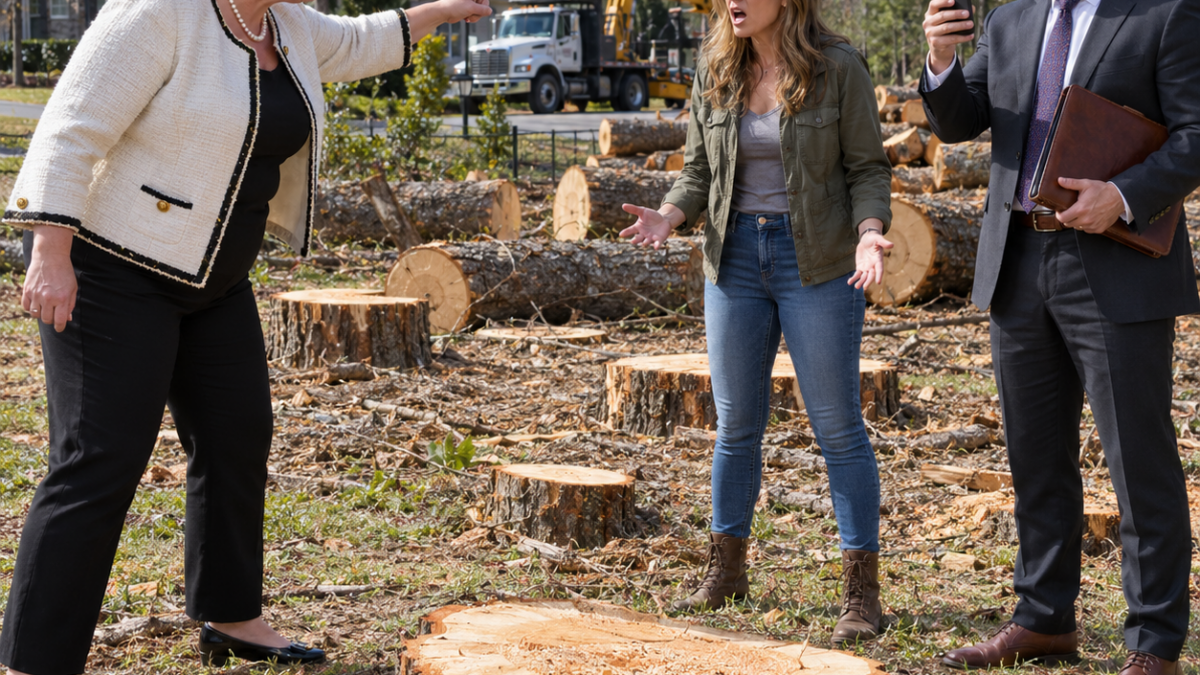
I came home to the sound of chainsaws and found six century-old oak trees lying across my pasture like bodies, while the HOA president stood beside the stumps smiling as if she had finally taught me a lesson.
Those trees had survived tornadoes, droughts, my father’s death, and three generations of my family—but Karen had destroyed them in less than forty minutes because I refused to sign away eight feet of my land.
What she didn’t know was why four of those trunks had been quietly photographed, tagged, measured, and placed under a preservation order two weeks earlier.
“Shut the saws off!”
My voice carried farther than I expected.
The last chainsaw sputtered down.
Three men in orange safety vests turned toward me.
Beyond them, Karen Bellamy stood beside a white SUV with her arms folded over an expensive cream-colored jacket.
She smiled.
Not nervously.
Not apologetically.
She smiled like she had been waiting for me.
My knees nearly gave out when I saw the largest oak.
My father called it the courthouse tree because its branches spread so wide that, when I was a child, he said a whole jury could sit beneath it.
The trunk was nearly four feet across.
Now it lay on its side, its roots exposed, leaves trembling in the October wind.
“You had no right,” I said.
Karen adjusted her sunglasses.
“I had every right.”
“This is my property.”
“This is Serenity Ridge property subject to association standards.”
I stared at her.
The six trees had stood twenty feet inside my recorded boundary.
She knew that.
We had argued about it for three months.
The HOA wanted to widen a decorative walking trail along the western edge of our land and install new ornamental fencing. Their proposed plan required taking a strip of my property that had belonged to my family since 1948.
I refused.
Karen responded with violation notices.
First she claimed the trees blocked neighborhood sightlines.
Then she called them hazardous.
Then she said falling limbs threatened the HOA trail.
I hired two certified arborists.
Both said the oaks were healthy.
I sent Karen the reports.
She sent me another violation.
My husband, Daniel, told me not to argue with her.
“Document everything, Claire.”
That was Daniel.
Calm when everyone else became loud.
He had spent most of his career as a federal prosecutor and had recently been appointed U.S. Attorney for our district.
At home, however, he was simply the man who forgot where he put his coffee and insisted he could repair a dishwasher despite overwhelming evidence to the contrary.
I had deliberately kept his position out of my fight with the HOA.
I didn’t want favors.
I didn’t want threats.
I wanted Karen to respect the same deed, survey, and property laws she expected everyone else to obey.
She didn’t.
Now my trees were on the ground.
One of the workers approached me.
“Ma’am, we were told the HOA had permission.”
“They lied to you.”
His face changed.
Karen stepped forward.
“Careful, Claire.”
I turned toward her.
“You entered my property.”
“We exercised the association’s emergency authority.”
“There was no emergency.”
“The board determined otherwise.”
“What board?”
Her smile tightened.
“The board I preside over.”
The foreman slowly lowered his helmet.
I could see doubt spreading across his face.
Then he pointed toward one of the fallen trunks.
“Ma’am?”
I followed his gaze.
A small metal tag was screwed into the back side of the bark.
Yellow.
Numbered.
FEDERAL EVIDENCE — DO NOT DISTURB.
Karen went still.
The foreman walked closer.
“There are more.”
My pulse began hammering.
I already knew.
Four of the six trees carried them.
Karen pulled off her sunglasses.
“What is that?”
I didn’t answer.
Two weeks earlier, federal investigators had spent an entire afternoon on our land with survey equipment, cameras, core samplers, and evidence bags.
Daniel had not participated.
In fact, because the property belonged to us, he had formally removed himself from the investigation.
But I knew enough to understand one thing.
Those four trees were connected to a much larger case involving falsified development surveys, fraudulent land transfers, and millions of dollars in property transactions stretching across three counties.
Their growth rings, embedded survey hardware, historic boundary scars, and precise locations were evidence.
Physical evidence.
Protected evidence.
Karen stared at the tag.
Then at me.
For the first time since I had met her, she looked uncertain.
“You put those there.”
“No.”
Her voice rose.
“This is some kind of trick.”
The foreman backed away from the trunk.
“Mrs. Bellamy, you told us these trees belonged to the HOA.”
“They do.”
“No,” I said quietly.
Karen pointed at me.
“You think because your husband works for the government you can intimidate me?”
I took out my phone.
“I haven’t mentioned my husband.”
Her mouth opened.
Then closed.
I dialed the number the federal investigator had given me specifically in case anything on the property was disturbed.
A man answered on the second ring.
“Special Agent Mercer.”
I looked at the ruined trees.
Then at Karen.
“This is Claire Whitaker.”
There was a pause.
“Yes, Mrs. Whitaker?”
“I think you need to come back to my property.”
Karen’s face lost its color.
“Why?”
I kept my eyes on her.
“Because somebody just cut down your evidence.”
PART 2
For three seconds, Agent Mercer said nothing.
Then his voice changed.
Not louder.
Sharper.
“Mrs. Whitaker, step away from the trees.”
“I’m already clear.”
“Do not touch the trunks, stumps, tags, equipment, sawdust, or any vehicle involved.”
I looked toward the crew.
The foreman was listening.
“Understood.”
“Is anyone still cutting?”
“No.”
“Keep it that way. Are the people who cut the trees still present?”
“Yes.”
“Do not detain anyone. Do not confront anyone. If they choose to leave, get license plates if you can do so safely.”
I looked directly at Karen.
“She’s still here.”
“Who?”
“The HOA president.”
A longer pause.
“Claire.”
“Yes?”
“Don’t discuss the investigation with her.”
“I won’t.”
“We’re coming.”
The call ended.
Karen stared at me.
“What investigation?”
I put my phone in my coat pocket.
“You heard him.”
“No, I heard you perform some ridiculous little drama.”
The tree-service foreman stepped between us without actually meaning to.
His name was stitched onto his jacket.
MIGUEL.
“Mrs. Bellamy,” he said carefully, “you told me you had written authorization from the owner.”
“I am president of the homeowners association.”
“That’s not what I asked.”
Her head snapped toward him.
“You were hired to remove hazardous trees.”
“Yes, ma’am. And your work order says Serenity Ridge HOA owns the easement.”
“It does.”
Miguel looked at me.
I shook my head.
“No easement permits tree removal.”
Karen laughed sharply.
“You don’t know what you’re talking about.”
Actually, I did.
By then, I knew our deed better than I knew some members of my extended family.
The western boundary had a twelve-foot utility easement dating to the 1970s.
It allowed access for water and electrical maintenance.
It did not transfer ownership.
It did not grant the HOA landscaping rights.
And it certainly did not allow Karen Bellamy to cut six mature oaks because I refused to donate land for her walking trail.
Miguel pulled a folded document from the cab of the truck.
“This is what she gave us.”
I did not take it.
Agent Mercer had told me not to touch anything related to the work.
“Put it back where you had it.”
He frowned.
“Why?”
“Because federal agents are coming.”
One of his workers muttered something in Spanish.
Miguel answered quietly.
Karen heard enough.
“Oh, for God’s sake. Everyone stop panicking.”
She marched toward the nearest trunk.
I moved instinctively.
“Karen, don’t touch it.”
She stopped.
“Excuse me?”
“Don’t touch the tree.”
“It’s a tree, Claire.”
“It’s evidence.”
Her eyes flashed.
“You keep saying that as though repetition makes it true.”
Miguel pointed toward the metal tag.
“That does.”
Karen’s face tightened.
For months, I had watched her control people with volume.
Not screaming exactly.
She preferred something more polished.
A clipped tone.
A raised eyebrow.
A perfectly timed threat involving fines, liens, attorneys, or “association remedies.”
She had reduced grown adults to apologizing for flowerpots.
But metal tags from a federal evidence team did not care about her tone.
Neither did Miguel.
Neither, for that matter, did I anymore.
She crossed her arms.
“If this were really federal evidence, I would have been notified.”
“No.”
“As president of the HOA, I absolutely would have been notified.”
“Why?”
“Because this affects association property.”
“It isn’t association property.”
“You’ve made that claim repeatedly.”
“It’s recorded at the county.”
She stepped closer.
“And I have repeatedly explained that our legal counsel considers the boundary disputed.”
That was new.
I had never received a letter from an HOA lawyer stating any boundary dispute.
“You have legal counsel challenging my deed?”
Karen hesitated.
Only for a fraction of a second.
But I saw it.
“So send me the letter.”
“This is not the time.”
“Name the attorney.”
She looked past me.
“You’re becoming hostile.”
I almost laughed.
Six trees were on the ground.
My pasture looked as if a tornado had sliced through one perfect line of my childhood.
And she was worried about my tone.
I looked back toward the courthouse oak.
When I was nine, my father hung a tire swing from its lowest branch.
When I was fifteen, I climbed halfway up that tree because I had failed my learner’s permit test and did not want Dad to see me crying.
He came outside carrying two bottles of Coke.
He never told me to come down.
He climbed up and sat beside me.
When Daniel proposed twenty years later, he did it under that same tree because he knew what the place meant to me.
The tree wasn’t just lumber.
It was geography inside my memory.
And Karen had reduced it to an obstruction she wanted removed before an HOA landscaping presentation.
My hands began shaking.
Not from fear.
From grief.
Daniel’s voice came back to me.
Document everything.
I took out my phone.
Not to call him.
Not yet.
I started recording.
Wide shots first.
The stumps.
The skid-steer.
The chipper.
The company trucks.
The untouched trees farther south.
The HOA stakes marking its proposed trail.
Karen’s SUV.
Miguel’s equipment.
The work order visible through the windshield.
Karen watched me.
“Are you recording me?”
“Yes.”
“I do not consent.”
“We’re outside.”
“This is harassment.”
“No.”
I took another photograph.
“This is documentation.”
Her cheeks flushed.
Those were Daniel’s words too.
The difference between accusation and evidence, he once told me, was documentation.
Eight minutes later, the first black SUV arrived.
Then another.
No sirens.
No dramatic lights.
Just federal plates and people who moved with the brisk efficiency of professionals who already knew what they were looking at.
Agent Thomas Mercer got out of the first vehicle.
He was in his late forties, tall, close-cropped gray hair, dark windbreaker.
Two other investigators followed him.
One carried a camera.
Another carried an evidence kit.
Mercer saw the trees.
His expression changed.
Not dramatically.
But enough.
“Mrs. Whitaker.”
I walked toward him.
“Agent Mercer.”
“You all right?”
“No.”
It was the first honest answer I had given anyone that afternoon.
His eyes moved toward the largest oak.
“I’m sorry.”
That almost broke me.
I nodded once.
“Thank you.”
He looked toward Karen and the crew.
“Who ordered the removal?”
Karen stepped forward before I could answer.
“I’m Karen Bellamy, president of the Serenity Ridge Homeowners Association.”
Mercer showed his credentials.
“Special Agent Thomas Mercer.”
Karen glanced at the badge.
I watched her posture adjust.
She had just realized that my phone call had not been theater.
“We were conducting lawful maintenance under association authority.”
Mercer did not respond to the explanation.
Instead he asked, “Who hired the tree company?”
“I did, in my official capacity.”
“Who selected these specific trees?”
“The board.”
“Names?”
Karen blinked.
“Excuse me?”
“Who participated in that decision?”
“I’m not going to conduct an interrogation on the side of the road.”
Mercer’s voice remained completely even.
“Mrs. Bellamy, you’re free to decline to speak with me.”
That frightened her more than anger would have.
“I’m simply trying to understand why federal agents are treating landscaping like a bank robbery.”
Mercer looked toward the evidence tags.
“Those trees were subject to a federal evidence-preservation notice.”
Karen’s mouth tightened.
“No one notified me.”
“You were not the property owner.”
Her eyes shot toward me.
I said nothing.
Mercer continued.
“We need the work stopped. Equipment stays where it is until we document the scene.”
Miguel nodded immediately.
“Yes, sir.”
Karen did not.
“I have a schedule.”
Mercer looked at her.
“A schedule?”
“The trail renovation begins Monday.”
“You may want to call your attorney.”
That was the first moment I saw genuine fear in Karen Bellamy.
Not because Mercer threatened her.
He didn’t.
Because he didn’t need to.
She took several steps away and began typing furiously on her phone.
Mercer walked me toward the house.
“Claire, I need to explain what happens next.”
I nodded.
He lowered his voice.
“Four of the trees were specifically documented as evidentiary objects. Their locations relative to buried survey monuments matter. We also took core samples and high-resolution photographs before today, so not everything is lost.”
“Can the trunks be used?”
“Probably.”
“Probably?”
“The destruction changes the evidence. It doesn’t automatically destroy its value.”
I looked at the stumps.
“Was this case about our HOA?”
Mercer hesitated.
“You know I can’t discuss the investigation beyond what you’ve been told.”
“I know.”
“But I can tell you this. We were examining historic boundary manipulation tied to development transactions. Your property contains some of the oldest undisturbed reference points in this part of the county.”
“The trees.”
“Among other things.”
I suddenly remembered Dad showing me a rusted piece of metal buried beside the courthouse oak when I was twelve.
A survey stake.
He told me never to pull it out.
“Is this about the old survey pins?”
Mercer gave me a look that meant I had already asked enough.
“Don’t discuss that with anyone.”
I understood.
Then I realized something.
“Does Daniel know?”
Mercer’s expression softened.
“He knows an investigation exists. He is recused from every aspect involving your property.”
“That was his decision?”
“It was required, and he requested it immediately.”
Of course he had.
Daniel had built his entire life around lines he refused to cross.
Even when those lines made things harder.
Especially then.
“What happens to Karen?”
“That depends on what she knew, why the trees were removed, what representations were made to the contractor, and whether any federal preservation notice was knowingly violated.”
“Could she be charged?”
“Claire.”
“I know.”
He gave me a sympathetic half smile.
“We follow evidence. Not revenge.”
I looked toward Karen.
“I’m working on that part.”
Mercer nodded.
“Good.”
Then he returned to the scene.
The next two hours were surreal.
Investigators photographed every stump.
They measured cuts.
They collected sections of bark.
They marked chainsaw positions.
They photographed the metal evidence tags before removing them into bags.
Miguel handed over the work order and email chain from Karen.
He looked sick.
“I swear to you, Mrs. Whitaker, I did not know.”
“I believe you.”
“We checked the county parcel map.”
“Which one?”
He showed me on his phone.
The map displayed a dotted line I had never seen before.
The HOA trail appeared to run directly along the trees.
“That isn’t the recorded boundary.”
“I know that now.”
“Where did you get this map?”
He pointed toward Karen.
“She sent it.”
I photographed his screen after Mercer approved it.
The image had a small footer.
SERENITY RIDGE COMMUNITY PLANNING MAP — REVISION 4.
Not a county document.
Not a survey.
An internal HOA planning map.
Someone had moved the line.
Only on paper.
But moved it.
That detail lodged in my mind.
At five thirty, Daniel arrived.
His government sedan stopped beside the mailbox.
He got out wearing the navy suit he had worn to court that morning.
He took three steps.
Then stopped when he saw the trees.
I watched his face.
Daniel was a prosecutor.
His job required emotional discipline.
He had stood in courtrooms describing murders, corruption, fraud, and unimaginable cruelty without losing control.
But the courthouse oak had been part of his life too.
He had asked my father for permission to marry me under that tree.
He had buried our first dog beneath a smaller maple twenty yards away.
He knew exactly what Karen had destroyed.
He walked toward me.
I met him halfway.
He put both arms around me.
That was when I finally cried.
Not loudly.
Not dramatically.
My forehead rested against his shoulder while the federal investigators worked behind us.
“They’re gone,” I whispered.
“I know.”
“She cut them all.”
“I know.”
“I should have been here.”
“No.”
“I should’ve—”
“No, Claire.”
His hand moved to the back of my head.
“You did nothing wrong.”
I stepped back.
“I want her destroyed.”
Daniel looked at me.
I had never said anything like that to him.
Not in twenty-four years.
Not even as a joke.
“I mean it.”
“I know you do.”
“She looked at me and smiled.”
Daniel’s jaw tightened.
“She stood there and smiled while they cut Dad’s tree.”
He looked toward Karen.
She was speaking rapidly into her phone thirty yards away.
Then Daniel turned back to me.
“Listen carefully.”
I wiped my face.
“If this becomes criminal, I cannot touch it.”
“I know.”
“I mean nothing, Claire. No calls. No suggestions. No conversations with investigators. Nothing.”
“I understand.”
“The fastest way for Karen to turn herself into a victim would be to claim the U.S. Attorney used federal power to settle his wife’s neighborhood dispute.”
“I know.”
“So from this moment forward, I am your husband.”
His eyes held mine.
“Only your husband.”
I nodded.
“And as your husband, I am furious.”
That mattered more than I expected.
“I want to do something.”
“Then help me save what’s left.”
He took off his suit jacket.
Together, under Mercer’s instructions, we moved patio furniture and livestock panels to create a wide perimeter around the evidence scene.
We did not touch the trees.
When darkness fell, portable lights illuminated the field.
Karen left around seven.
Before getting into her SUV, she walked toward me.
Mercer noticed and stopped a few yards away.
“This has gotten absurd,” she said.
I stared at her.
“You cut down six trees on my land.”
“Trees can be replaced.”
“Not those.”
“You are turning a landscaping disagreement into a federal incident because of who your husband is.”
Daniel was standing near the porch.
He heard her.
He did not move.
I said, “My husband hasn’t done anything.”
Karen laughed.
“Please.”
“He’s recused.”
That word caught her.
“What?”
“Ask your attorney what it means.”
Her confidence flickered.
She lowered her voice.
“You think this makes you powerful.”
“No.”
I looked at the stumps.
“This makes me sad.”
For once, she had no answer.
She drove away.
The next morning, Serenity Ridge exploded.
Someone had photographed the federal vehicles.
By eight, the neighborhood Facebook group contained thirty-seven comments.
By ten, Karen had shut comments off.
At eleven fifteen, the HOA sent an official email.
SUBJECT: CLARIFICATION REGARDING ROUTINE LANDSCAPE MAINTENANCE
I opened it at the kitchen table.
Daniel sat across from me.
“Do you want me to read it?”
“No.”
I read aloud.
“Yesterday, Serenity Ridge contractors performed routine removal of several hazardous trees adjacent to association common space. A homeowner has attempted to mischaracterize this maintenance as trespass and has involved outside governmental agencies due to personal connections.”
I stopped.
Daniel’s expression did not change.
“That sentence is for me.”
“Yes.”
I continued.
“The board acted in good faith and pursuant to its responsibility to protect residents from dangerous vegetation.”
I laughed.
“Dangerous vegetation.”
Daniel held out his hand.
“Keep reading.”
The email stated that “certain individuals” were creating unnecessary fear.
It insisted no laws had been broken.
It also claimed the property line remained “under legal review.”
I put the phone down.
“She’s doubling down.”
Daniel took a sip of coffee.
“People usually do when admitting the truth would require admitting intent.”
“What would you do?”
“As a husband?”
“Yes.”
“Save it.”
“Of course.”
“As a lawyer?”
“You didn’t ask a lawyer.”
I narrowed my eyes.
“You are deeply annoying.”
“Ethically annoying.”
I forwarded the email to my private account and printed two copies.
Then I called my own attorney.
Not Daniel.
Her name was Rebecca Sloan.
She had handled my mother’s estate and practiced property litigation.
When I finished explaining, she was silent.
“Rebecca?”
“I’m here.”
“How bad?”
“For whom?”
That was the first hopeful thing anyone said.
She asked me to send the deed, arborist reports, HOA notices, trail proposal, photographs, contractor work order if available, and every email from Karen.
By lunchtime, Rebecca had the entire file.
By four, she called back.
“Claire, there is no plausible reading of your deed that gives the HOA ownership of those trees.”
“I know.”
“The utility easement gives access for utilities. It does not authorize recreational trail expansion, ornamental fencing, landscaping, or removal of healthy trees.”
“I know.”
“And the internal map the contractor received appears inconsistent with the recorded survey.”
“I know.”
“Stop saying you know.”
“Sorry.”
She laughed.
“Good. You’re grieving. I’m litigating.”
“What do we do?”
“First, preservation notices to the HOA, every board member, its management company, and the contractor.”
“For what?”
“Emails. Texts. maps. Minutes. Tree assessments. Bids. Internal messages. Anything involving your property.”
“Second?”
“We notify the HOA’s insurance carrier.”
That sounded less dramatic than I wanted.
Rebecca knew it.
“Trust me.”
“Why?”
“Because insurance companies dislike surprises even more than lawyers do.”
“What else?”
“We demand that the board withdraw its claim to your land, suspend the trail project, and preserve all records relating to the altered boundary map.”
I leaned against the counter.
“And the trees?”
Her voice softened.
“We document replacement value, loss of mature canopy, landscape damage, restoration costs, trespass damages, and anything state law permits.”
“You can’t replace them.”
“No.”
That one word hurt.
“Money can’t fix this.”
“No.”
“Then why bother?”
“Because civil law is imperfect, Claire. It cannot make a hundred-year-old oak grow back tomorrow. What it can do is assign consequences to someone who destroys what belongs to another person.”
I looked through the window.
The stumps were visible from the kitchen.
“All right.”
Rebecca continued.
“And there’s one more thing.”
“What?”
“Do not underestimate that map.”
I thought of the dotted line.
“Why?”
“Because people don’t accidentally redraw property boundaries for fun.”
That night I pulled every HOA packet I had received since we moved in twelve years earlier.
Daniel helped.
We sat on the living room floor surrounded by binders.
Older landscaping proposals.
Budgets.
Trail plans.
Drainage maps.
Architectural committee minutes.
The Serenity Ridge master plan from eight years ago showed the trail ending fifty feet before our boundary.
A version from five years ago extended it slightly.
Three years ago, after Karen became president, the trail reached the edge of our property.
Then last year’s “community enhancement plan” showed the trail bending onto a strip labeled LANDSCAPE BUFFER.
Our land.
“Daniel.”
He looked over.
I laid the maps side by side.
The dotted line moved.
Not dramatically.
A few feet each revision.
By the newest version, the HOA had absorbed nearly eight feet along our entire western edge.
Eight feet over more than six hundred yards.
Almost an acre.
Daniel stared.
“Did you ever approve a boundary adjustment?”
“No.”
“Sell an easement?”
“No.”
“Grant the HOA anything?”
“No.”
He sat back.
“Then Rebecca is right.”
“About the map?”
“This isn’t about trees.”
The next morning, Rebecca filed a notice of dispute with the county recorder and sent a formal demand to Serenity Ridge.
Karen replied personally.
Rebecca forwarded it to me with one message:
DO NOT RESPOND.
Karen’s email was nearly four pages.
She called our claim “opportunistic.”
She accused me of using my husband’s office to “terrorize volunteers.”
She claimed the HOA possessed “historic rights of maintenance.”
She said the trees had become common-property fixtures because the association had landscaped near them for years.
Rebecca called thirty minutes later.
“She has no idea what she’s doing.”
“That bad?”
“She just made three factual admissions I would have spent months trying to prove.”
“What admissions?”
“That the board directed the work. That the board knew the trees were near the disputed boundary. And that the board relied on its own historic conduct rather than a recorded property right.”
“Good?”
“Very.”
For the first time since the chainsaws, I felt something besides grief.
Not happiness.
Momentum.
Then Agent Mercer called.
“I need to ask you a few questions.”
“Come over.”
“No. We’d prefer you come to the field office.”
Daniel looked at me when I hung up.
“Federal?”
“Yes.”
“I’m not coming.”
“I know.”
He hated saying it.
I could see that.
I touched his hand.
“You don’t have to protect me from this.”
“I know.”
“Then stop looking guilty.”
He managed a small smile.
“I prosecute people for a living. Looking guilty is professionally embarrassing.”
At the field office, Mercer and an attorney from another federal district sat across from me.
That was my first indication the matter had become more serious.
Her name was Assistant U.S. Attorney Maya Collins.
She explained that because Daniel was the U.S. Attorney and I was a potential witness and victim, the Department had put independent supervisory safeguards in place.
“He will receive no investigative information through his office,” she said.
“Good.”
“And we ask that you not discuss substance with him.”
“I haven’t.”
Mercer placed the contractor’s work order on the table.
“You’ve seen this?”
“From a distance.”
He turned it toward me.
The client was Serenity Ridge HOA.
Authorized by Karen Bellamy.
Scope: Remove six hazardous oak trees along HOA western trail expansion.
Then he showed me the attached map.
The altered boundary.
“Have you ever seen this map before Tuesday?”
“No.”
“Did you authorize the HOA to represent this strip as association property?”
“No.”
“Do you know who prepared the map?”
“No.”
He showed me an email.
FROM: Karen Bellamy
TO: Miguel Alvarez
SUBJECT: Whitaker Tree Removal
My stomach tightened.
The email was dated three days before the trees were cut.
Karen wrote:
“The homeowner has been difficult and may attempt to interfere. Do not engage her in debate. The board has final authority. Complete the removal in one visit before she has time to create another legal obstacle.”
I read it twice.
“She knew I objected.”
Mercer said nothing.
Maya Collins asked, “Did Karen Bellamy know federal investigators had been present on the property?”
“Yes.”
“How?”
“She drove by while they were here.”
“Did you speak?”
“She stopped at the mailbox.”
“What did she say?”
I closed my eyes.
The memory came back.
Karen had rolled down her window.
“What’s all this?”
I was standing near the barn.
“Survey work.”
“HOA business?”
“No.”
“Who are they?”
“Government investigators.”
Her face changed.
“Investigating what?”
“I don’t know.”
That had been true.
Daniel had told me nothing.
Mercer had only explained that old property features needed to be documented as part of an investigation.
I told Maya everything.
“Did she see the agents place tags on the trees?”
“I don’t know.”
“Could she have?”
“Yes.”
That mattered.
Mercer showed me another document.
An HOA board email thread.
Gerald Pike, the treasurer, had written:
Karen, should we hold off? Claire said the people on her property were federal investigators. I don’t want the association involved in anything.
Karen replied:
Stop being dramatic. They are probably there because of Daniel. Claire uses his position to intimidate people. Once the trees are gone, there will be nothing left for her to argue about regarding the trail alignment.
My skin went cold.
Once the trees are gone.
Nothing left.
Mercer watched me.
“Do you understand why we wanted you here?”
“Yes.”
The trees had not merely been cut despite the dispute.
Karen wanted them gone because they anchored the dispute.
Maya leaned forward.
“Claire, I need to be precise. We are not concluding her meaning from one sentence alone. But this is relevant.”
“Of course.”
“We will determine what she knew about the federal investigation separately.”
I nodded.
“What was the original federal case?”
Mercer glanced at Maya.
She answered carefully.
“You already know investigators were examining potentially fraudulent survey and development records.”
“Yes.”
“The Serenity Ridge boundary records may overlap with that investigation.”
“May?”
“That’s all I can tell you.”
I suddenly remembered the HOA maps creeping west year after year.
“How many properties?”
Neither answered.
That answer frightened me more than a number would have.
When I returned home, I told Daniel only what I was allowed to tell him.
“I’m officially a witness.”
He nodded.
“And?”
“And I can’t discuss details.”
His expression softened.
“Welcome to my marriage.”
I threw a couch pillow at him.
He caught it.
For ten seconds, we were normal.
Then the doorbell rang.
Arthur Boone stood outside.
Arthur lived across the street.
Seventy-four.
Retired surveyor.
I had known him casually for years.
He carried a cardboard tube.
“I heard about the trees.”
“Everybody has.”
“I think I need to show you something.”
We sat at the kitchen table.
Arthur opened the tube.
Inside was an old subdivision plat.
Not a photocopy.
A blue-line engineering print.
“Where did you get this?”
“I worked for the original developer.”
Daniel stopped halfway into the room.
Arthur looked at him.
“I don’t know anything about your cases.”
Daniel nodded.
“Good.”
Arthur unrolled the map.
“This is Serenity Ridge before it was Serenity Ridge.”
He pointed.
Our property sat on the western side.
The subdivision stopped at our line.
No landscape buffer.
No HOA strip.
No trail.
Nothing.
“My father always said they built around us.”
“They did.”
Arthur tapped a handwritten note.
“Your dad refused to sell.”
“I know.”
“What you may not know is that the developer came back three times.”
I stared at him.
“For what?”
“To buy a narrow strip.”
“The eight feet?”
Arthur looked surprised.
“You already know?”
“Karen’s maps.”
He nodded.
“Eight to twelve feet in different places. They wanted room for drainage and a continuous pedestrian loop. Your dad refused because of the oaks.”
My throat tightened.
“He said the trees marked the old line.”
“They did more than mark it.”
Arthur pointed toward several circles drawn on the survey.
“Back then, survey crews often used witness trees. You’d reference a tree relative to a monument so the boundary could be reconstructed if a pin disappeared.”
“The federal agents were studying scars and pins.”
Arthur’s eyes sharpened.
“What federal agents?”
I looked at Daniel.
He shook his head slightly.
“I can’t discuss that.”
Arthur understood immediately.
“All right.”
He tapped the blue-line map.
“But if someone wanted to claim those eight feet later, those trees would be inconvenient.”
“Because?”
“They’re old.”
I waited.
“So?”
“So a hundred-year-old tree standing twenty feet inside the Whitaker deed line makes it very difficult to pretend the HOA planted it or maintained it into ownership.”
He pointed again.
“And if old survey marks were tied to those trunks, they could prove where the line was long before Karen Bellamy arrived.”
I sat back.
Karen had called the trees dangerous.
Then obstructive.
Then HOA property.
But what if the real problem was simpler?
They proved she was wrong.
Arthur rolled the plan halfway closed.
“There’s something else.”
“What?”
“Karen asked me about this map two years ago.”
Daniel and I both looked at him.
“She knew you had it?”
“She knew I had worked for the developer. She wanted old survey records.”
“What did you give her?”
“Nothing.”
“Why?”
Arthur smiled without humor.
“Because she asked the wrong question.”
“What question?”
“She asked whether the western tree line could be legally treated as the subdivision boundary if the original markers were gone.”
My heart began pounding.
“What did you tell her?”
“That survey law doesn’t work by wishful thinking.”
“Then?”
“She asked how hard it would be to prove the old line if the witness trees no longer existed.”
Daniel went absolutely still.
Arthur looked from him to me.
“I thought she was asking hypothetically.”
Daniel spoke carefully.
“Arthur, you should tell that to Claire’s attorney.”
“And whoever is investigating the trees,” I added.
His face changed.
“Oh.”
“Yes.”
He rolled the map completely.
“Then I suppose I should make some phone calls.”
The neighborhood rebellion began two days later.
Not because I started it.
Karen did.
She sent another HOA notice.
EMERGENCY ASSESSMENT.
Every homeowner would be charged $650 to cover “unanticipated legal and environmental expenses arising from a hostile property dispute initiated by one resident.”
One resident.
Me.
The email did not name me.
It didn’t need to.
By noon, three neighbors had knocked on my door.
By three, there were eleven.
At six, we had twenty-two people in our barn.
Daniel stayed inside the house.
He did not attend.
He wanted no role that could be interpreted as using his office.
Rebecca came instead.
So did Arthur.
A young couple named Tasha and Ben Miller arrived carrying every HOA letter they had received for four years.
An elderly widow named Evelyn Shaw brought a grocery bag full of violation notices.
A contractor named Mike Dawson brought three disputed fines for parking his work truck overnight.
One by one, people talked.
Karen had fined the Millers because their daughter’s wheelchair ramp was visible from the street.
She eventually withdrew it after their doctor became involved.
Evelyn had been threatened over native flowers Karen called weeds.
Mike had received $4,800 in accumulated vehicle fines.
The Chens had been forced to remove a greenhouse.
Another family had been threatened because their fence was two inches too tall.
The stories were familiar.
But Arthur noticed something I didn’t.
“Where do you live?” he asked Mike.
“Western loop.”
“Evelyn?”
“Juniper Court.”
“The Chens?”
“Western loop.”
He looked at me.
“What?”
“Karen’s worst enforcement clusters along the west side.”
Rebecca leaned forward.
“Why does that matter?”
Arthur stood and walked toward a large paper map I had taped to the barn wall.
He placed small marks where each complaining family lived.
A pattern appeared.
A strip.
Running north to south.
Along the same side as my property.
“What’s there?” Tasha asked.
Arthur looked at the map.
“The old subdivision boundary.”
Silence.
Rebecca said, “Explain.”
Arthur told them.
The developer had tried to acquire additional western land decades earlier.
Failed.
But recent HOA planning maps showed the western boundary gradually expanding.
Not only across my property.
Across several parcels.
Mike frowned.
“My back fence moved.”
Everyone looked at him.
“What?”
“Not literally.”
He stood.
“When the HOA replaced the perimeter fence three years ago, they moved it toward my house.”
“How far?”
“I don’t know. Six feet? Maybe seven.”
“Did they ask?”
“They said the old fence was incorrectly located.”
Arthur’s face hardened.
“Who surveyed it?”
“No idea.”
Evelyn slowly raised her hand.
“They moved mine too.”
The barn went silent.
That night became the birth of what Sarah—our neighbor, not my husband—jokingly called the Eight-Foot Club.
Rebecca hated the name.
It stuck anyway.
Within a week, seven homeowners hired an independent surveyor.
The results were worse than we expected.
Serenity Ridge had installed fencing, trail sections, drainage features, landscaping, or lighting across privately owned strips of land on at least five western properties.
The encroachments ranged from three feet to nearly eleven.
Some had existed for years.
The HOA claimed maintenance rights.
The deeds said otherwise.
Then the surveyor found something disturbing.
Several newer HOA maps cited a professional survey company.
The company had never prepared them.
Its name had been copied from an older document.
Rebecca sent a preservation letter immediately.
The survey company sent back a sworn declaration.
They had not created the maps.
They had not authorized use of their seal.
Now we had something beyond an HOA argument.
Someone had manufactured survey documents.
Karen called an emergency board meeting.
I attended with Rebecca.
The clubhouse was packed.
Karen sat at the front beside Gerald Pike and secretary Susan Maddox.
Her face looked different.
Tired.
More makeup.
Less certainty.
She struck the gavel.
“This meeting will come to order.”
Someone shouted, “Where’s our six hundred fifty dollars going?”
Applause.
Karen ignored it.
“The board will address misinformation spreading throughout Serenity Ridge.”
Rebecca leaned toward me.
“Don’t react.”
Karen began.
She described the tree cutting as a good-faith safety decision.
She described the altered maps as “conceptual planning documents.”
She denied any attempt to change legal boundaries.
Then she blamed me.
“A particular homeowner has weaponized personal relationships with federal authorities.”
People began murmuring.
I felt Rebecca’s hand lightly touch my arm.
Stay seated.
Karen continued.
“This individual has caused unnecessary investigations, threatened our vendors, obstructed community improvements, and generated legal fees that all of you must now bear.”
I stood.
Rebecca whispered, “Claire.”
“I’m not yelling.”
I walked toward the microphone.
Karen’s eyes narrowed.
“You have two minutes.”
“I only need one.”
I faced the room.
“My husband has had no involvement in any investigation concerning my property.”
Karen rolled her eyes.
“He is formally recused.”
The room quieted.
“I have hired my own lawyer.”
I nodded toward Rebecca.
“I paid for my own independent survey.”
I held up the report.
“And the federal agents who came to my property came because evidence connected to an investigation was destroyed.”
Karen struck the gavel.
“You are discussing an active investigation.”
“No.”
I looked at her.
“I’m discussing six trees.”
Applause erupted.
Karen hit the gavel again.
I continued.
“This survey shows HOA improvements crossing five privately owned properties.”
That changed the room.
People started looking around.
“Five?”
“Whose?”
“How much land?”
Karen stood.
“That report is disputed.”
“By whom?”
“Our consultants.”
“Name them.”
“I will not turn this meeting into litigation theater.”
Arthur stood from the third row.
“You already did.”
Everyone turned.
Karen’s face tightened.
Arthur walked toward the microphone.
“I surveyed portions of Serenity Ridge before it had that name.”
Silence.
“The original boundary has not moved.”
He held up the old blue-line plan.
“The land moved only on your newer maps.”
Karen stared at him.
Arthur continued.
“And you asked me two years ago how difficult the old line would be to prove if the witness trees disappeared.”
The room exploded.
Karen went white.
“That is a lie.”
“No.”
Arthur’s voice remained calm.
“It is not.”
“You misunderstood a hypothetical discussion.”
“Maybe.”
He looked toward me.
“But those trees are gone now.”
The noise became unbearable.
Karen adjourned the meeting.
Nobody left.
Instead, people surrounded Rebecca.
“How do we get records?”
“Can we remove the board?”
“What about the assessment?”
“Who altered the maps?”
Gerald Pike slipped out through the side door.
I saw him.
So did Arthur.
Three days later, Gerald called me.
“I need to talk.”
“Call Rebecca.”
“I don’t want lawyers.”
“Then we don’t talk.”
“Claire.”
His voice shook.
“I didn’t know she would cut the trees.”
I said nothing.
“I need you to believe me.”
“Talk to Rebecca.”
“I signed things.”
My pulse quickened.
“What things?”
“Maps. Checks. Minutes.”
“Gerald.”
“I thought it was HOA nonsense.”
“Stop talking to me.”
“I’m scared.”
That softened me slightly.
But only slightly.
“Then get a lawyer.”
“What if I help?”
“That is a question for your lawyer and whoever is investigating.”
He exhaled.
“Karen told us the land would become ours if we maintained it long enough.”
I closed my eyes.
“I’m hanging up.”
“She said adverse possession.”
I froze.
That was the first time the words had entered the dispute.
Gerald kept talking.
“She said the homeowners wouldn’t fight because nobody wants to spend twenty thousand dollars over six feet of yard.”
My stomach turned.
“Gerald, stop.”
“She had a plan.”
“Stop.”
I hung up.
Then I called Rebecca.
She listened.
“You did the right thing.”
“Adverse possession?”
“Don’t jump.”
“He said—”
“I know what he said.”
“Can the HOA take land that way?”
“Not automatically, and the requirements are strict. But his statement suggests something more important.”
“What?”
“Intent.”
She paused.
“If Karen deliberately constructed a long-term encroachment strategy because she believed owners wouldn’t fight, this dispute is much larger than your trees.”
The next morning, Gerald Pike retained counsel.
Two days later, his attorney contacted federal investigators.
A week after that, Gerald resigned from the HOA board.
Karen sent a community-wide email calling him unstable.
Gerald responded with silence.
Then subpoenas arrived.
Not from Daniel’s office.
From the independently supervised federal team working with state investigators.
HOA emails.
Planning records.
Computers.
Invoices.
Survey files.
Vendor communications.
Gerald’s resignation suddenly made sense.
Karen hired a criminal-defense lawyer.
Serenity Ridge hired separate counsel.
The insurance carrier issued a reservation-of-rights letter.
Rebecca explained it to the neighborhood at our next meeting.
“What does that mean?” Mike asked.
“It means the insurer may refuse to cover conduct it determines was intentional, dishonest, fraudulent, or outside policy terms.”
Mike whistled.
“So if Karen intentionally did this…”
“Potentially personal exposure.”
Nobody cheered.
The situation had moved beyond satisfying HOA revenge.
People were realizing how much money was at risk.
Our money.
Our homes.
Our association.
Karen had wrapped her personal control around a legal entity funded by every homeowner.
If she had poisoned it, we would all help pay for the cleanup.
That angered people more than the fines ever had.
We launched a petition for a special membership meeting.
The bylaws required twenty percent.
We reached thirty-four percent in one day.
Fifty-eight percent by the end of the week.
Karen tried to reject the petition because three signatures used middle initials inconsistent with the ownership roster.
Rebecca sent a six-page response.
Karen scheduled the meeting.
Three weeks away.
During those three weeks, the federal investigation accelerated.
I knew only fragments.
Mercer returned twice to photograph the property.
A forensic survey team mapped every stump.
Sections of the fallen trunks were transported to a secure evidence facility after chain-of-custody documentation.
The rest remained on our land under order.
One morning, I watched specialists examine the courthouse oak’s cut surface.
A rust-colored line ran through part of the trunk.
“What is that?” I asked.
Mercer looked toward the technician.
The technician said, “Old metal staining.”
“Survey hardware?”
Mercer gave him a look.
The technician went back to work.
I smiled despite myself.
“You people are terrible conversationalists.”
Mercer almost laughed.
Two days later, one of the investigators used ground-penetrating equipment near the stump.
They found an old monument.
A steel pipe buried beneath decades of soil.
Its coordinates matched the historic Whitaker deed.
The HOA planning line was wrong by eight feet, four inches.
Not approximate.
Not debatable.
Wrong.
Rebecca nearly hugged the surveyor.
Then she became very serious.
“We now have objective proof.”
“Can Karen still fight it?”
“Anyone can fight anything.”
“Can she win?”
Rebecca looked at the monument.
“Not on this boundary.”
That evening, Daniel and I sat on the porch.
The western field looked empty without the oaks.
Sunset poured through space that had always been shaded.
“I hate seeing the sky there,” I said.
Daniel understood.
“It feels exposed.”
“Yes.”
We sat quietly.
Then he said, “Your father would be furious.”
I laughed through my nose.
“He’d already be at Karen’s house.”
“With a deed in one hand and pruning shears in the other.”
“He hated HOAs.”
“He hated committees.”
“He hated anyone who used the phrase architectural harmony.”
Daniel smiled.
I leaned against him.
“You know what hurts?”
“What?”
“I spent years thinking those trees would outlive me.”
His hand tightened around mine.
“I know.”
“I thought someday somebody else would sit under them.”
He didn’t try to fix the sentence.
That was one reason I loved him.
He knew grief was not a problem requiring a closing argument.
The special meeting arrived on a rainy Thursday.
The clubhouse capacity was one hundred twenty.
More than one hundred fifty homeowners came.
People stood outside under umbrellas.
Karen sat at the front with Susan Maddox.
Gerald’s chair was empty.
A temporary attorney for the HOA sat beside them.
Rebecca sat next to me.
Arthur carried his blue-line map.
Mike brought copies of the independent surveys.
The Millers brought photographs showing where their fence had been moved.
Karen opened the meeting.
Her lawyer whispered something.
She ignored him.
“I want to begin by saying the last several weeks have been among the most difficult of my life.”
A few people groaned.
Her lawyer leaned closer.
She continued.
“I have served this community without salary for seven years.”
“Except reimbursements,” someone shouted.
Laughter.
The lawyer closed his eyes.
Karen’s face flushed.
“I have acted only to protect Serenity Ridge.”
Arthur whispered, “Here we go.”
Karen blamed hostile residents.
She blamed lawyers.
She blamed contractors.
She blamed incorrect maps inherited from prior boards.
Then she made the mistake that ended her presidency.
“I had no knowledge that Claire Whitaker claimed those trees were evidence until after they were removed.”
The clubhouse became completely silent.
Rebecca slowly turned toward me.
Why?
Because Karen had just said claimed.
Not that she had no knowledge of federal involvement.
Not that she thought the workers were ordinary surveyors.
Only that she did not know I claimed the trees were evidence.
Arthur stood.
“Madam President.”
Karen glared at him.
“What?”
“You told me two years ago you wanted to know how difficult the boundary would be to prove without those trees.”
“I deny that.”
“Fine.”
Arthur lifted his phone.
“I wrote the conversation down that afternoon.”
Karen’s attorney whispered urgently.
She waved him away.
Arthur continued.
“October fourteenth, two years ago. You approached me near the mail kiosk. You asked about the western witness trees. I told you removing boundary evidence in a land dispute could create serious legal trouble.”
Karen stood.
“This is absurd.”
Arthur looked toward the room.
“I also emailed myself my notes that night.”
The murmuring intensified.
Rebecca stood.
“Claire will not discuss the federal matter. But we can discuss the civil property evidence.”
Karen’s lawyer finally took control.
“My client will not answer further questions relating to any investigation.”
That sentence changed everything.
My client.
Investigation.
Even Karen’s strongest supporters looked frightened.
Rebecca projected the independent surveys.
Five encroachments.
Then six.
Then eight.
More homeowners had joined.
She displayed recorded deeds.
Historic plats.
County GIS records.
The false planning maps.
The survey company’s sworn declaration denying authorship.
Then she displayed the contractor work order for my trees.
Authorized by Karen.
The line saying the homeowner might interfere.
The false representation that the HOA owned the strip.
No insults.
No speeches.
Just documents.
Karen shrank with every page.
Then Rebecca introduced the civil damages estimate for my trees.
A consulting arborist and landscape valuation expert had examined the evidence.
Six mature oaks.
Species.
Age.
Condition.
Landscape contribution.
Replacement limitations.
Loss of use.
Restoration.
The number was staggering.
Not because six young nursery trees were expensive.
Because you cannot buy a century.
The civil claim exceeded six figures before attorney fees or punitive exposure.
A woman behind me whispered, “Oh my God.”
Rebecca changed slides.
Insurance reservation of rights.
Potential uncovered conduct.
Special assessment risk.
That was when Karen’s supporters broke.
One man stood.
“I voted for you.”
Karen looked at him.
“I defended you.”
“Robert—”
“You told us Claire was trying to steal HOA land.”
“She is.”
“No.”
He pointed toward the surveys.
“That’s her land.”
Applause erupted.
Another homeowner stood.
“You fined my mother for her ramp.”
Then another.
“You threatened my contractor.”
Another.
“You moved my fence.”
The room filled with voices.
Karen struck the gavel.
Nobody listened.
Rebecca touched my arm.
“Now.”
I stood.
I had rehearsed a speech.
Three pages.
I left it folded in my bag.
Instead, I walked to the front and looked at the people I had lived beside for twelve years.
“For months, everyone has been asking me what I want.”
The room quieted.
“I wanted my trees back.”
My voice broke.
I hated that.
But I continued.
“I wanted to come home and see my father’s oak standing where it had stood my entire life.”
No one moved.
“I can’t have that.”
I looked at Karen.
“No court can give me that.”
Her face shifted.
For a second, something almost human appeared.
Then it vanished.
“So I had to decide what justice looks like when the thing you lost cannot be returned.”
I turned toward the homeowners.
“I don’t want revenge paid for by innocent neighbors.”
That surprised people.
“I don’t want Serenity Ridge bankrupt.”
I pointed toward the surveys.
“I want everyone’s property returned.”
Applause.
“I want every false boundary map withdrawn.”
More applause.
“I want every fence, trail, light, drain, or landscape improvement on private land reviewed.”
I looked toward the Millers.
“I want fines issued through retaliation audited.”
Toward Evelyn.
“I want rules that cannot be weaponized against elderly people, disabled residents, working families, or anyone else a board member decides is inconvenient.”
Then I looked at Karen.
“And I want no officer of this association to ever believe again that winning an election means owning the people who live here.”
Silence.
Arthur stood.
“I move for removal of Karen Bellamy from the Board of Directors.”
Mike stood.
“Second.”
Karen grabbed the gavel.
“You cannot—”
Her lawyer took her wrist.
Not violently.
Firmly.
“Karen.”
She looked at him.
He whispered.
Her face collapsed.
The bylaws allowed removal by two-thirds of members present and represented by valid proxy.
The count began.
Susan Maddox resigned before her name could be included.
The vote to remove Karen was not unanimous.
Nine homeowners opposed.
One hundred twelve supported.
Karen stared at the tally.
For months I had imagined this moment.
I expected satisfaction.
Maybe even joy.
Instead, I felt tired.
She placed the gavel down.
Very carefully.
Then she looked at me.
“This is what you wanted.”
“No.”
“Yes.”
“You wanted to humiliate me.”
“No.”
Her eyes filled.
Not with remorse.
Rage.
“You used your husband.”
Daniel was not even in the building.
I shook my head.
“You keep needing that to be true.”
“Because it is.”
“No, Karen.”
I stepped closer.
Not threatening.
Just enough that she heard me clearly.
“You did this without his help.”
Her face hardened.
“You sent the emails.”
I counted quietly.
“You approved the maps.”
Her mouth opened.
“You hired the tree company.”
She looked away.
“You signed the work order.”
She grabbed her purse.
“You ignored the surveys.”
She pushed back her chair.
“You told Arthur the trees were a problem.”
“Stop.”
“You moved against neighbors who wouldn’t fight.”
“Stop.”
“You did this.”
Her voice cracked.
“STOP.”
The room froze.
I stopped.
Not because she ordered me.
Because there was nothing left to say.
Karen walked out.
The rain had stopped.
Through the clubhouse windows, I watched her cross the parking lot alone.
The new interim board was elected that night.
Arthur reluctantly became president.
Maria Lopez, a CPA who had spent twenty years auditing municipal agencies, became treasurer.
Tasha Miller became secretary.
Their first action suspended the emergency assessment.
Their second froze all nonessential enforcement.
Their third authorized an independent review of every western-boundary improvement completed under Karen.
Their fourth hired separate counsel to cooperate with investigators.
Their fifth made Arthur miserable.
“What?”
He stared at the resolution.
“They want me to attend monthly board training.”
Maria smiled.
“You’re president.”
“I’m seventy-four.”
“Congratulations.”
“I retired to avoid meetings.”
The room laughed.
It felt strange.
Good strange.
The civil case moved faster after Karen’s removal.
Without her controlling records, the HOA produced email archives.
Thousands of messages.
Rebecca found a pattern.
Karen had spent years expanding what she called the “western beautification corridor.”
She believed the original developer had made a mistake by failing to secure enough land for the trail.
Instead of negotiating purchases, she had adopted a strategy.
Move fences during maintenance.
Install landscaping.
Mow the strips.
Place lights.
Treat private land as common space.
Then, if challenged years later, argue long-term association control.
Most homeowners never noticed.
Others noticed but assumed the HOA survey was correct.
One owner complained.
Karen fined him for an unrelated shed violation the following week.
Another threatened a survey.
Karen offered to waive two years of dues if he dropped the issue.
He accepted.
Rebecca called me.
“This isn’t random.”
“I know.”
“It’s systematic.”
“What does that mean?”
“It means your tree case may become the cleanest example of a larger civil scheme.”
I looked at the stumps.
“Dad’s trees finally got their day in court.”
“Not yet.”
“Lawyers ruin everything.”
“We improve billing opportunities.”
I laughed.
Then the criminal case broke open.
Gerald Pike had kept copies.
Karen had told board members to use planning maps rather than recorded plats because “homeowners never read deeds.”
She wrote that the western trail could be completed “one maintenance cycle at a time.”
Another email said:
If we treat the strip as ours consistently, resistance will fade.
Then investigators recovered the message that mattered most to me.
Karen to Gerald.
Four days before the trees were cut.
The federal people were at Whitaker’s again. We need those oaks handled before Claire gets another injunction. Once they’re down, the historic-line argument loses its emotional center.
Emotional center.
My father’s tree.
Reduced to litigation strategy.
Mercer told me about the message only after prosecutors disclosed it through proper process.
“Does that prove obstruction?” I asked.
“It’s evidence.”
“You always say that.”
“Because that’s how cases work.”
“Do you ever give satisfying answers?”
“No.”
Maya Collins was slightly more helpful.
“The government would need to establish what she knew about the federal evidentiary significance, not simply that she wanted the trees removed for the boundary dispute.”
“Did she know?”
Maya gave me the prosecutor look.
“I’ll see you at the appropriate proceeding.”
“You and my husband would get along.”
“I suspect that is why he hired me years ago.”
I blinked.
“You worked for Daniel?”
“Before he became U.S. Attorney.”
“Of course.”
She smiled.
“He’s very annoying about evidence.”
“Finally, common ground.”
Months passed.
Winter came.
The fallen trunks remained under federal control longer than I expected.
Then one January morning, Mercer called.
“The evidentiary hold is being partially released.”
“Meaning?”
“We’ve completed necessary examinations of several sections.”
“Can I keep the wood?”
“That was actually my next question.”
I swallowed.
“I don’t want it chipped.”
“I assumed not.”
The courthouse oak was cut into carefully documented sections.
I hired a local sawyer named Eli Brooks.
He arrived with a portable mill.
When he saw the trunk, he removed his cap.
“How old?”
“About one hundred twelve.”
“What do you want made?”
“I don’t know yet.”
“Then don’t decide today.”
We milled slabs from sections federal investigators released.
The grain was beautiful.
Dark lines.
Old scars.
History written in circles.
Eli stacked the slabs in a drying shed on our property.
“They’ll need time.”
“How long?”
“For furniture?”
He looked at the wood.
“Couple years if you want to do it right.”
I smiled sadly.
“I’ve waited this long.”
He touched the edge of one slab.
“Trees teach patience even after they’re gone.”
That sentence stayed with me.
Spring arrived.
Then came the indictment.
I learned about it from Rebecca, not Daniel.
He remained completely outside the case.
Karen Bellamy was charged federally with obstruction-related offenses tied to destruction and attempted concealment of evidence, along with fraud counts connected to falsified property documents.
Additional state charges concerned property damage, forgery-related conduct, and financial misconduct.
The precise charges were narrower than neighborhood rumors predicted.
That mattered.
Some residents wanted every bad act labeled a felony.
Law did not work that way.
Evidence mattered.
Elements mattered.
Proof mattered.
Gerald was not charged in the same way.
His cooperation and role were treated differently.
Susan faced civil consequences but no major criminal case.
The tree company was cleared of intentional wrongdoing after investigators confirmed Karen had provided false ownership documents.
Miguel came to my house the week the indictment became public.
He carried an envelope.
“I owe you something.”
“You don’t.”
“Yes.”
He handed me a check.
I looked at the amount.
“What is this?”
“My company’s insurance paid the claim portion we were responsible for.”
“That’s being handled through lawyers.”
“I know. This isn’t that.”
“Then what?”
“A donation.”
“To whom?”
He pointed toward the empty western field.
“Whatever you plant next.”
I started to refuse.
He shook his head.
“My men cut those trees.”
“Because she lied.”
“My saws did it.”
I understood.
Guilt does not always care who caused the mistake.
“Okay.”
His shoulders lowered.
“But I’m not planting six nursery oaks in the same spots.”
“What are you doing?”
“I don’t know yet.”
“Then use it when you know.”
We shook hands.
Karen’s criminal case did not end with a dramatic trial.
That surprised everybody.
After months of motions and negotiations, she entered a plea on several counts.
Other charges were dismissed as part of the agreement.
I attended sentencing because I had the right to speak.
Daniel did not sit with the prosecution.
He sat behind me.
As my husband.
Only my husband.
Karen wore a navy suit.
Nothing like her old HOA outfits.
No bright scarf.
No gold pin.
She looked older.
Smaller.
When the judge asked whether I wished to make a victim-impact statement, I stood.
My knees shook.
I walked to the lectern.
Karen looked at me.
For the first time since the trees fell, neither of us had documents in our hands.
I had written four pages.
I used none of them.
“My name is Claire Whitaker.”
My voice sounded too loud in the courtroom.
“Six trees were cut from my family’s property.”
I paused.
“That sentence sounds small.”
The judge waited.
“They were not small.”
A few people smiled sadly.
“One was planted before my grandfather was born. One shaded the place where my husband asked me to marry him. One held a tire swing my father made when I was a little girl.”
My throat tightened.
“I know this court cannot sentence someone for hurting my memories.”
Karen lowered her eyes.
“And I know this case is larger than my grief.”
I looked toward the judge.
“Those trees also preserved physical evidence connected to property records and a federal investigation. Cutting them changed that evidence. False maps harmed other homeowners. Abuse of association power frightened people who believed they had no money or authority to fight.”
Then I looked at Karen.
“I spent months wanting you to hurt the way I hurt.”
Her face lifted.
“I wanted revenge.”
The courtroom was still.
“But something changed.”
I thought of the milled oak slabs drying in the shed.
“I realized revenge would mean letting you decide what kind of person I became.”
Karen’s eyes filled.
“I don’t forgive what you did.”
A tear moved down her cheek.
“I may never forgive it.”
I took a breath.
“But I don’t need your destruction to prove my family mattered.”
I looked toward Daniel.
Then back at the judge.
“My father’s tree is gone.”
My voice broke.
“But the truth it helped preserve is not.”
I stepped away.
Daniel held my hand when I sat down.
The judge imposed the sentence.
Prison time.
Supervised release.
Restitution.
Restrictions involving association fiduciary roles.
The civil matters continued separately.
It was serious.
Not theatrical.
No cheering.
No handcuff spectacle designed for me.
Just consequences.
Karen was led away after the hearing.
Before she disappeared through the side door, she turned.
Our eyes met.
I expected hatred.
Maybe I wanted hatred.
Instead, she mouthed two words.
I’m sorry.
I did not answer.
Some apologies arrive after the place where they could have changed anything.
The civil settlement came the following summer.
The HOA’s insurer, Karen personally, and other responsible parties contributed under separate agreements.
The western boundary was permanently confirmed.
Encroaching HOA features were removed or relocated unless individual owners voluntarily granted easements.
Every affected homeowner received corrected records.
The false maps were formally withdrawn.
The HOA adopted a rule that no boundary-related work could occur without a licensed survey tied to recorded instruments.
No board member could approve work affecting property in active dispute.
No emergency tree removal could occur without documented arborist findings unless there was an immediate physical hazard.
And any board member with a personal, family, financial, or litigation interest had to disclose it and abstain.
Arthur called the package “The Karen Amendments.”
Maria refused to put that in the official minutes.
We called them the Property Integrity Rules.
Boring.
Beautifully boring.
The money from my settlement sat untouched for months.
Every time I considered using it, I felt angry.
It felt like a price.
How much is Dad’s tree worth?
How much for the afternoon Daniel proposed?
How much for a tire swing?
No amount made sense.
Then Evelyn Shaw gave me the answer without knowing she was doing it.
She invited me to a community picnic.
Children were running around the western green.
The Millers’ daughter, Lily, rolled past me in her wheelchair.
Her ramp had been rebuilt after Karen’s old enforcement action.
She stopped.
“Mrs. Whitaker?”
“Yes?”
“Are you planting new trees?”
“Eventually.”
“My teacher says oak trees live a really long time.”
“They can.”
“Longer than people?”
“Sometimes.”
She thought about that.
“Then you should plant them for people you don’t know yet.”
I stared at her.
“What?”
“For later people.”
She shrugged.
“Like whoever planted yours.”
Then she rolled away.
I stood there with lemonade in my hand and tears in my eyes.
Later people.
Dad had not planted the courthouse oak.
Neither had Granddad.
Someone before them had protected it.
My family inherited shade created by people who never knew us.
That autumn, I called Miguel.
“I know what I’m doing.”
He arrived with his truck.
Arthur came.
Maria.
Rebecca.
Evelyn.
The Millers.
Half the neighborhood.
Daniel stood beside me in jeans instead of a suit.
We did not plant six trees.
We planted twenty-four.
Native white oaks.
Burr oaks.
Two red oaks near the entrance.
Not directly on the old line.
The confirmed boundary stayed open and professionally marked.
Instead, we created a broad grove inside our property.
A place that could grow without becoming another legal argument.
At the center, we placed one stone.
No dramatic plaque.
No mention of Karen.
Just four words.
FOR THE LATER PEOPLE.
Lily helped shovel dirt around the first sapling.
“You have to water it a lot,” she informed me.
“I know.”
“Do you?”
“I grew up with trees.”
She considered that.
“Old trees.”
“Yes.”
“These are baby trees.”
“You’re right.”
“I should supervise.”
Daniel laughed.
“She’s already HOA president material.”
Arthur nearly dropped his shovel.
“Don’t curse the child.”
Life became quiet again.
Real quiet.
Not the tense silence Karen had created.
Normal quiet.
Lawn mowers.
Dogs barking.
Kids on bicycles.
Neighbors arguing mildly over holiday decorations and then forgetting about it.
The new HOA board held meetings at six thirty in the evening.
Agendas were posted early.
Minutes were published.
Financial records could be requested online.
Nobody loved the HOA.
Arthur considered that proof of success.
“If people stop talking about us,” he said, “we’re doing our job.”
Two years passed.
The milled oak slabs finally dried.
Eli called me.
“Time.”
We stood in his workshop beside the wood from the courthouse tree.
He ran his hand across one wide slab.
“What do you want?”
I knew now.
“A table.”
“How big?”
“Big.”
He smiled.
“How big?”
“Big enough for a community meeting.”
His smile widened.
“That’s a lot of irony.”
“No gavel.”
“Agreed.”
We built a long table.
Eli did most of the skilled work.
I sanded.
Daniel helped badly.
“You’re making waves in the grain,” I told him.
“I prosecute felonies.”
“That does not qualify you to use an orbital sander.”
“I’ve cross-examined experts.”
“The table does not care.”
He surrendered the machine.
The final tabletop carried every scar.
We did not hide them.
One dark line showed where old metal had stained the wood.
Another section held the faint shadow of the childhood branch where Dad had attached my swing.
Eli asked if I wanted the imperfections filled invisibly.
“No.”
“You sure?”
“Yes.”
“Good.”
When the table was finished, we donated it to the Serenity Ridge clubhouse.
Arthur cried.
He denied it.
Maria photographed him.
He threatened to remove her as treasurer.
She reminded him he no longer had that authority.
We placed the table in the same room where Karen had once issued fines, controlled votes, and told neighbors their property existed at her pleasure.
Now people sat around wood from the tree she had cut down.
At the first meeting, Lily—older, taller, still determined to supervise everybody—ran her hand across the tabletop.
“This came from your big tree?”
“Yes.”
“The one the bad lady cut?”
Her mother looked horrified.
“Lily.”
“What? She did.”
I smiled.
“Yes.”
Lily studied the grain.
“So the tree is still helping.”
I looked around the room.
Arthur.
Maria.
Mike.
Evelyn.
The Millers.
Neighbors I barely knew before the fight.
People who had learned each other’s stories because one woman convinced herself nobody would compare notes.
“Yes,” I said.
“It is.”
After the meeting, Daniel and I walked home.
The young oak grove was visible in the moonlight.
Most trees were barely taller than we were.
Nothing like the giants they replaced.
I still missed the old canopy.
I always would.
Grief and gratitude can occupy the same ground.
Daniel slipped his hand into mine.
“Do you ever think about the first day?”
“Every time I look west.”
“What part?”
“The smile.”
“Karen’s?”
“Yes.”
“When you came home?”
I nodded.
“She thought she had won.”
Daniel looked toward the young trees.
“She was wrong.”
“I thought winning meant making her pay.”
“And now?”
I stopped beside the first oak Lily had helped plant.
New leaves moved softly in the wind.
“Now I think winning is this.”
“What?”
“She’s gone.”
I touched the thin young trunk.
“But something is growing.”
Daniel kissed my forehead.
We kept walking.
Years later, people still ask me about the story.
Usually they focus on the dramatic parts.
The chainsaws.
The federal agents.
The altered maps.
The U.S. Attorney husband.
The indictment.
The courtroom.
They always expect me to say Karen’s biggest mistake was cutting down federal evidence.
It wasn’t.
That was a terrible mistake.
A legally serious one.
But her biggest mistake happened years earlier.
She assumed silence meant agreement.
She saw homeowners who paid fines rather than fight and decided they were weak.
She saw elderly neighbors who avoided confrontation and decided they were powerless.
She saw working families without lawyers and decided their deeds mattered less than her maps.
She saw my husband’s position and assumed either I would exploit it or she could blame him when I resisted.
She understood authority only as something held over other people.
What she never understood was community.
Community is Arthur saving an old survey because history matters.
It is Rebecca telling me the law cannot regrow an oak but can still defend what belongs to you.
It is Miguel returning to help plant trees after being deceived into cutting the old ones.
It is Gerald finally choosing to tell the truth when silence became too heavy.
It is Evelyn bringing thirty years of violation notices in a grocery bag because she suddenly realizes she was never the only one.
It is a little girl telling a grieving woman to plant something for people she will never meet.
And it is my husband sitting behind me in court as only my husband, because sometimes the most ethical use of power is refusing to touch it.
The young trees are taller now.
The first ones have begun making real shade.
Not much.
Enough for a bench.
We moved Dad’s old iron bench into the grove.
On warm evenings, Daniel and I sit there.
Sometimes children from the neighborhood ride bicycles past the fence.
Sometimes Lily stops.
Sometimes Arthur complains that the new board spends too much time discussing dog-waste stations.
Normal problems.
Wonderful problems.
One evening, nearly six years after the trees were cut, Daniel brought two bottles of Coke outside.
I laughed when I saw them.
“What?”
“My dad.”
He understood immediately.
We sat under one of the young oaks.
It was nowhere near large enough to climb.
Not yet.
Daniel handed me a bottle.
“You know,” he said, “someday this thing will be enormous.”
“I probably won’t see it.”
“Maybe not.”
“That used to make me sad.”
“And now?”
I looked at the branches.
Small leaves.
Young bark.
A trunk barely thick enough for me to wrap both hands around.
“Now I think that’s the point.”
He smiled.
The people who had planted Dad’s oak never knew me.
They never knew a little girl would cry in its branches after failing a driving test.
They never knew a young prosecutor would ask that girl to marry him beneath it.
They never knew a controlling HOA president would order it cut down.
They never knew federal investigators would study its rings, scars, and buried markers.
They never knew its wood would become a table where neighbors learned to govern themselves better.
They simply allowed something to grow.
Maybe that is the best answer to destruction.
Not pretending nothing was lost.
Not forgiving before you are ready.
Not confusing accountability with cruelty.
Not letting revenge become the only thing you plant in the empty space.
You tell the truth.
You preserve the evidence.
You defend the boundary.
You hold the people responsible for what they actually did.
And then, when the noise is over, you decide what deserves to grow where the damage happened.
Karen believed cutting down those trees would erase the line.
Instead, the stumps exposed it.
She believed destroying the evidence would end my argument.
Instead, it brought investigators, surveyors, attorneys, and neighbors together.
She believed my husband’s title would either frighten her enemies or become an excuse she could use against me.
Instead, Daniel stepped away and let the facts stand on their own.
She believed six fallen trees would prove she was powerful.
Years later, the only thing left of her power is a paragraph in old HOA minutes and a name people use when explaining why every board decision now needs documentation.
The trees are different.
They are becoming larger every season.
One day, long after Daniel and I are gone, someone may sit beneath them and never know why they were planted.
Maybe a child will climb one after failing a test.
Maybe somebody will propose marriage beneath another.
Maybe a tired neighbor will sit in their shade after a terrible day.
Maybe no one will ever read the old case file.
That would be fine with me.
Because the best ending was never Karen losing.
It was Serenity Ridge learning.
It was my family keeping our land.
It was our neighbors recovering theirs.
It was the false maps disappearing.
It was the fines being erased.
It was the old oak becoming a table.
And it was twenty-four young trees standing where six fallen ones taught an entire neighborhood exactly where the line had always been.
Karen cut down my trees because she believed once they were gone, there would be nothing left to prove.
She was wrong.
The truth was in the deed.
It was in the survey.
It was in the buried monuments.
It was in the emails.
It was in the rings of the fallen trunks.
It was in the memories of people who had been there before her.
And eventually, it was in all of us.
That evening, Daniel and I finished our Cokes beneath the young oak.
The sun disappeared behind the western property line.
A breeze moved through the grove.
Twenty-four trees answered.
Softly.
Like pages turning.
I rested my hand against the trunk beside me.
“Grow,” I whispered.
Daniel heard me.
He smiled.
And together, we walked home.








