PART 2: HOA Karen Charged Me $700 to Cross My Own Dam—So I Terminated All 52 Lakefront Leases Behind Her $4.4M Deal
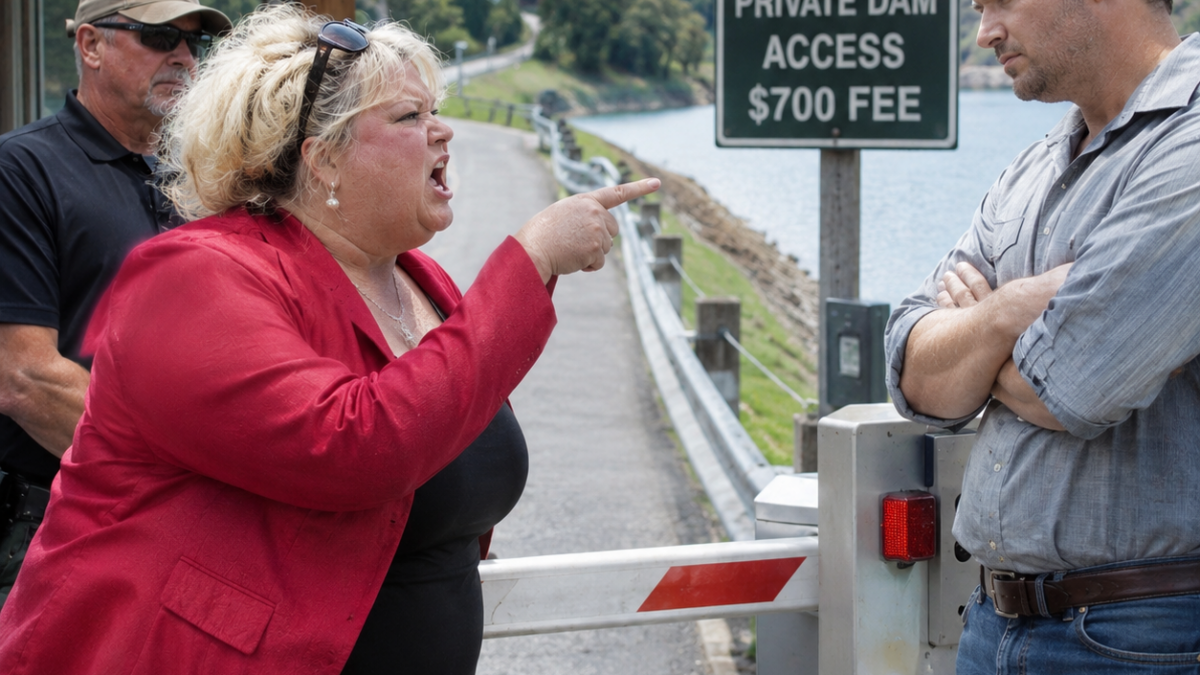
PART 2
Elliot Keane answered on the fourth ring.
He had inspected Halden Dam for almost twenty years.
Fifty-six years old.
Quiet.
Careful.
The kind of engineer who could make a room uncomfortable by staring at one number too long.
“Mason?”
“I have a problem.”
“Structural?”
“Possibly.”
That word got his attention.
“What happened?”
“HOA installed a gate on the crest.”
Pause.
“What kind of gate?”
“Steel barrier arm. Concrete post.”
“Mounted how?”
“Anchor bolts.”
Another pause.
“How many?”
“Six.”
“Location?”
“North side of centerline. Near seepage-monitoring hatch.”
Silence.
Then his voice changed.
“Don’t let anyone drill another inch into that dam.”
“I wasn’t planning to.”
“Do you have photographs?”
“Twenty-seven.”
“Send them.”
I did.
He called back ten minutes later.
“I’m coming out.”
“When?”
“As soon as I can get access authorization.”
“You need authorization from me?”
“No. County dam-safety authority.”
I understood.
“Elliot.”
“Yeah?”
“The gate is blocking me.”
“I saw.”
“She says the HOA controls the road.”
“She can say the moon is county property. Doesn’t make it so.”
That helped.
A little.
The next morning, I went to the Callaway County Recorder’s Office.
I carried everything.
Deed.
Boundary survey.
Original Halden Dam construction records.
Reservoir permit.
Shoreline maps.
State operating records.
The clerk, Marcy Talbot, had known my father.
She looked at my stack.
“What did somebody build?”
“How do you know somebody built something?”
“Your father only brought this many papers when he was angry.”
“I’m not angry.”
“You have the same face.”
She pulled the parcel files.
We laid them beside mine.
No ambiguity.
The dam sat entirely on Witcomb property.
So did the crest road.
No public easement.
No HOA right-of-way.
No recorded Silvermere traffic rights.
Nothing.
Marcy tapped the plat.
“Unless someone recorded something recently.”
“Laurel’s checking.”
“Laurel Voss?”
“Yes.”
“Good.”
“You know her?”
“Everyone who reads county records knows Laurel.”
That afternoon, Laurel called.
Thirty-nine.
Real-estate litigator.
She had handled a boundary issue for me once before.
Nothing dramatic.
Two neighbors arguing over a boat ramp.
This was different.
“Come in.”
“When?”
“Now.”
I drove to her office.
She had a county construction application on her desk.
At the top:
**SILVERMERE HEIGHTS HOA — DAM CROSSING ACCESS CONTROL IMPROVEMENT**
I sat.
“They filed this?”
“Yes.”
“As controlling authority?”
“That’s what they represented.”
“They aren’t.”
“I know.”
She slid another page across.
“Attached document.”
Title:
**SUPPLEMENTAL DAM ACCESS AGREEMENT**
Supposedly granting the HOA authority to regulate traffic, install controls, and collect access fees.
I had never seen it.
“Is this recorded?”
“No.”
“Then what is it?”
“That’s what I’m trying to find out.”
“It’s fake.”
Laurel looked at me.
“Maybe.”
I hated that word.
“My family never signed this.”
“You know every document your father ever signed?”
“Most.”
“Most is not all.”
I leaned back.
“You believe them?”
“No.”
“Then why—”
“Because if we walk into court screaming forgery before proving forgery, we weaken ourselves.”
She tapped the document.
“I’m requesting the certified filing copy, submission history, metadata if available, and every supporting page.”
“So we wait.”
“We build.”
I did not like waiting.
Blythe did not wait at all.
Two days later, a flatbed tow truck parked across the end of my driveway.
Driver got out.
Work order in hand.
“Mr. Witcomb?”
“Yes.”
“Silvermere HOA says vehicles using the dam road without permits are subject to seizure.”
I stared at him.
“You’re here to take my truck.”
“I’m here because they called.”
“Are you planning to tow it?”
He looked uncomfortable.
“I’d rather not.”
“Good answer.”
I called Sheriff Grant Bellamy.
Grant arrived fifteen minutes later.
Fifty-four.
Big shoulders.
No patience for nonsense.
He read the tow order.
Then looked at the driver.
“Where’s the court order?”
The driver looked at the paper.
“I have the HOA work authorization.”
Grant looked at me.
“Road ownership disputed?”
“Not by county records.”
Grant turned back to the driver.
“You’re not taking anything.”
“I’m just doing my job.”
“I know.”
Then he pointed down the road.
“Do your job somewhere else.”
The driver left.
Grant took a copy of the HOA order.
“Any threats?”
“Not direct.”
“Gate?”
“Still there.”
“You touch it?”
“No.”
“Good.”
“I could remove it.”
“You probably could.”
“It’s my dam.”
“I’m not arguing.”
“Then why not?”
“Because when property disputes start, people get stupid.”
I smiled.
“You calling me stupid?”
“I’m calling everybody stupid until paperwork proves otherwise.”
Fair.
He logged the tow threat.
Then said:
“If they try self-help enforcement again, call me before you do anything.”
I promised.
That night, I sat at the kitchen table looking toward Brier Lake.
Dad’s leather notebook lay beside me.
He wrote everything.
Rainfall.
Reservoir level.
Seepage.
Maintenance.
Names of contractors.
Dates.
Every month.
Sometimes I used to think he overdid it.
Now I understood.
People forget.
Paper doesn’t.
A week later, Laurel called.
“Certified copy arrived.”
I drove in.
She handed it to me.
The last page carried a signature.
**Raymond Witcomb.**
My father.
I stared.
It looked like him.
The same looping R.
The same slant.
Still, something felt wrong.
“What?” Laurel asked.
“I don’t know.”
“Signature familiar?”
“Yes.”
“Authentic?”
“I don’t know.”
“Date?”
I looked.
Nothing struck me yet.
My eyes kept returning to the signature.
Like seeing someone you know in a photograph taken somewhere they could not possibly be.
Then Laurel pulled another stack from her desk.
“Shoreline leases.”
That shifted the entire case.
Eleven years earlier, Dad entered into a leasing program covering fifty-two separate lakefront parcels.
The association was tenant.
We were landlord.
Each lease allowed Silvermere to operate limited resort amenities.
Docks.
Picnic areas.
Small cabins.
Boat slips.
Community recreation.
The leases were generous.
Dad wanted the lake used.
He believed the neighborhood and our family property could coexist.
But the agreements were strict.
No assignment.
No long-term transfers.
No third-party property rights.
No commercialization beyond approved resort recreation.
No interference with Halden Dam.
No interference with maintenance access.
No interference with safety equipment.
And one clause appeared in all fifty-two.
**Material breach not cured within thirty days after written notice permits termination.**
When Dad died seven years earlier, I inherited the property.
I renewed the leases under the same conditions.
For years, things worked.
Then Blythe became president.
Over the previous eighteen months, new signs had appeared.
**SILVERMERE EXCLUSIVE LAKEFRONT ESTATES**
I had noticed them.
Assumed marketing.
New branding.
HOAs love branding.
I did not understand what was happening underneath.
Until Vivian Pike knocked on my door.
She was forty-five.
Expensive coat.
Angry enough that she forgot to introduce herself before speaking.
“Are you Mason Witcomb?”
“Yes.”
“You’re trying to steal our cabin.”
“What?”
“Our North Shore holding.”
“I have no idea what you’re talking about.”
“Blythe said you’re canceling the lakefront program because you want the property back.”
I opened the door wider.
“Come inside.”
“I don’t need coffee.”
“I wasn’t offering.”
That almost made her smile.
Almost.
She placed a contract on my table.
Silvermere logo.
Blythe’s signature.
Ten-year exclusive use of one shoreline parcel.
Reserved dock.
Reserved parking.
Guaranteed dam access.
Transfer option.
I read it slowly.
Then again.
“What did you pay?”
Vivian crossed her arms.
“That’s private.”
“Then don’t tell me.”
I pushed the contract back.
“But keep every receipt.”
She frowned.
“Why?”
“Because Silvermere doesn’t have ten years to give you.”
“What?”
“The HOA’s lease on that parcel is shorter.”
“That’s impossible.”
“And it prohibits long-term assignments.”
Her face changed.
“Blythe said the HOA had master rights.”
“It doesn’t.”
“She said your father approved it.”
“He didn’t.”
“How do you know?”
“Because I renewed the lease myself.”
Vivian stood.
“You’re lying.”
“Maybe.”
That surprised her.
I continued.
“Take your contract to your own lawyer.”
“What?”
“Independent lawyer. Not Silvermere’s.”
“Why?”
“Because if I’m wrong, they’ll tell you.”
“And if you’re right?”
“Keep your receipts.”
She left angry.
But less certain.
Blythe responded three days later.
Press conference on the clubhouse lawn.
Local reporter.
Board members behind her.
She announced that “a greedy absentee landowner” was threatening fifty-two families who had invested in lake homes.
Absentee.
I lived twelve minutes away.
Still, the word worked.
By Wednesday, a dozen people stood at the end of my driveway.
Signs.
**SAVE OUR LAKE HOMES**
**STOP MASON’S LAND GRAB**
One man shouted:
“You already have enough!”
I looked toward Brier Lake.
Enough what?
Land?
Responsibility?
Taxes?
They didn’t want discussion.
They wanted a villain.
Blythe gave them one.
I went inside.
Laurel called.
“I saw the news.”
“I’m popular.”
“Do not speak to reporters.”
“I wasn’t planning to.”
“What about tenants?”
“Vivian came by.”
“What did you tell her?”
“To get independent counsel and keep records.”
“Good.”
I paused.
“Laurel.”
“Yes?”
“I don’t want these families thrown out.”
“I know.”
“They paid in good faith.”
“Most probably did.”
“If we terminate leases—”
“Slow down.”
“They could lose cabins.”
“Yes.”
“Docks.”
“Yes.”
“Money.”
“Yes.”
“I don’t want that.”
“Then if termination becomes necessary, we build protections into the remedy.”
I hated the phrase.
“Into the remedy.”
Lawyer language.
But she was right.
My fight was with the HOA.
Not people Blythe had deceived.
Three nights later, Vivian emailed me.
One attachment.
Marketing sheet she said the HOA office had accidentally sent her.
At the bottom:
**ALL 52 LAKEFRONT LEASEHOLDS AVAILABLE FOR INVESTMENT ACQUISITION**
I stared.
This was not about cabins.
Someone was selling something they did not own.
The following week, Elliot finally got onto Halden Dam.
Three-person inspection team.
Official county access order.
The HOA guards tried to stop the truck.
Elliot showed the paperwork.
“If you obstruct a state-required dam inspection, call your supervisor and the sheriff now.”
Gate opened.
I followed in my truck.
First time crossing my own dam since Blythe installed the barrier.
We stopped near the post.
Elliot knelt.
Measured bolt locations.
Then removed the cover from an adjacent cable channel.
His jaw tightened.
“Signal line is dead.”
“I know.”
“When?”
“Two days after gate installation.”
He looked at one of the bolts.
“Probably this.”
They opened another access point.
Couldn’t open the main inspection hatch.
Concrete foundation overlapped it.
Elliot stared.
“They poured the footing over the hatch.”
“Can we open it?”
“Not without cutting.”
“How bad?”
“Unknown until full review.”
He stood.
“But nobody alters a dam crest like this without engineering approval.”
“They didn’t ask.”
“I know.”
“Safety issue?”
“Potentially.”
“Immediate failure?”
“No evidence of that.”
I appreciated the distinction.
He continued.
“But monitoring equipment exists because we do not guess.”
County demanded construction plans.
Contractor files.
Names.
Permits.
Blythe refused.
Then filed a complaint accusing me of neglecting the dam.
Her letter described the gate as a necessary public-safety improvement.
That same week, weather forecast changed.
Slow-moving storm.
Several inches of rain.
Elliot issued a directive.
Gate foundation obstructing the hatch had to be modified under approved supervision.
Vehicle traffic over the crest restricted pending full assessment.
Blythe sent residents another letter.
Headline:
**PRIVATE OWNER’S DAM NEGLECT FORCES SAFETY RESTRICTIONS**
I almost admired the speed.
She could turn anything.
Gate damages dam?
My fault.
County restricts access?
Proof she needed gate.
Then Dale Hutchins called Elliot.
Foreman who installed the barrier.
His crew had seen conduit markings.
They warned the HOA not to drill at that exact location.
Vice President Wade Carver told them to continue.
Why?
Blythe wanted the gate finished before the “Exclusive Lakefront Estates” launch.
Moving the post six feet would delay installation.
Six feet.
That was all.
They risked damaging dam instrumentation because Blythe did not want a six-foot design change.
I gave Elliot Dad’s drawings.
Nine years of inspection logs.
Monthly photographs.
Sensor readings.
We could pinpoint the signal failure.
Before gate:
Normal.
After drilling:
Dead.
That paper trail mattered.
The county ordered hazard correction.
Temporarily closed vehicle traffic over crest.
I worked with Elliot to open alternate technical access near the spillway.
I did not want residents endangered.
Blythe told people I was trying to isolate them.
Meanwhile, Elliot’s preliminary report reached Laurel.
Page eleven.
One sentence:
**Unauthorized drilling, obstruction of monitoring instruments, and interference with dam inspections may constitute serious violations of lease provisions concerning structural safety.**
Laurel called.
“Bring all fifty-two leases.”
“Tonight?”
“Tonight.”
We spread them across her conference room.
Fifty-two folders.
One after another.
Beside them:
Vivian’s ten-year contract.
Marketing brochures.
Investor sheet.
Tollgate documentation.
Supplemental access agreement.
The pattern became obvious.
Blythe needed investors to believe Silvermere controlled access.
Think like a buyer.
Fifty-two lakefront properties.
High-end resort redevelopment.
First question:
How do people reach them?
If the answer was:
A private family owns the dam road and can restrict it under the lease terms—
Deal complicated.
Maybe dead.
But if you saw:
HOA gate.
HOA guards.
HOA $700 permits.
HOA fines.
HOA traffic rules.
Then Silvermere looked like owner.
The $700 fee wasn’t revenue.
It was theater.
Laurel said it first.
“This gate is a prop.”
I looked at her.
“A $700 prop.”
“The amount doesn’t matter.”
“It matters to me.”
“Not enough.”
She pointed at the investor sheet.
“This is title theater.”
I understood.
Make control look normal.
Then sell the appearance.
A prospective investor became nervous and voluntarily shared materials through counsel.
Buyer:
**Crestline Harbor Capital**
Proposed deal:
Approximately **$4.4 million.**
Acquire operating rights tied to all fifty-two shoreline parcels.
Redevelop into upscale lake resort.
Investment memorandum contained four promises.
Silvermere permanently controlled dam crossing.
All fifty-two leases transferable.
Landowner had approved long-term commercial development.
No dispute existed.
Every statement false.
Laurel and I went to Blythe’s office.
Formal demand.
Stop marketing rights.
Stop representing dam control.
Stop attempted transfers.
Blythe read the letter.
Folded it.
Dropped it on her desk.
“Sue me.”
Laurel didn’t react.
Blythe leaned back.
“By the time you get into court, those leases will belong to someone much bigger than you.”
We left.
In the parking lot Laurel stayed quiet.
“What?”
“She’s racing closing.”
“I know.”
“No, Mason. She just told us.”
“How?”
“She believes money moving first changes leverage.”
Like the glass pavilion.
Like the tennis courts.
Build reality before law catches up.
That afternoon, Garrett Lyle from Crestline called me.
Polite.
Professional.
“Mr. Witcomb, I’m confirming handover scheduling.”
“There is no handover.”
Pause.
“I’m sorry?”
“I have not agreed to transfer anything.”
“We have written authorization.”
“No.”
“We have an executed landowner consent.”
“Send it to my lawyer.”
“You’re saying you did not sign?”
“My father or me?”
“Your father.”
Cold sensation.
Laurel received the document within hours.
Scanned addendum.
Expanded lease rights.
Dam crossing control.
Transfer authority.
Commercial investment rights.
Signature:
**Raymond Witcomb.**
Date:
**April 15, seven years earlier.**
I stared.
Then everything clicked.
Dad died April 14.
I was there.
Hospital room.
Holding his hand.
He died at 11:22 p.m.
April 14.
The document claimed he signed April 15.
A dead man had supposedly authorized Blythe’s entire empire.
I sat in Laurel’s office.
Couldn’t speak.
She looked at me.
“That’s what bothered you about the signature.”
“Yes.”
“You recognized it.”
“Yes.”
“But something felt wrong.”
“He was dead.”
Laurel leaned back.
“We need more.”
I almost snapped.
“More?”
“Date may be attacked.”
“He was dead.”
“Clerical error. Copy date. Backdating. Mistake.”
“He couldn’t sign.”
“I know.”
She leaned forward.
“And we’re going to prove the page itself wasn’t signed.”
Forensic document examiner:
Patricia Holloway.
Three-state fraud cases.
She compared:
HOA addendum.
Dad’s estate documents.
Original leases.
Contracts.
County records.
Then found the source.
Eight years earlier, Dad signed an equipment-renewal agreement.
Same signature.
Not similar.
Same.
Same tilt.
Same tiny staple mark near the page edge.
Same slight ink skip in the W.
Digitally lifted.
Placed under new text.
Patricia’s report was devastating.
Authentic original leases had no toll rights.
No transfer rights.
No commercial investor rights.
No permanent dam control.
Blythe had a document signed by a dead man because someone had copied his living signature from something else.
I sat alone that night with Dad’s leather notebook.
Opened to his last year.
His handwriting.
Reservoir levels.
Rain.
Maintenance.
Small notes.
**North seepage drain clear.**
**Replace gauge cover before winter.**
Real handwriting.
Real life.
Then I thought about someone dragging his signature onto a fake page after he died.
That anger was different.
The gate made me angry.
This made me sick.
My father was not there to defend his name.
I was.
Inside the HOA, treasurer Hollis Trent started panicking.
Forty-eight.
Accountant.
Conflict-avoidant.
He had signed transfers under pressure.
Now he reviewed books.
Money from shoreline tenants had not all reached Silvermere’s accounts.
Large amounts routed to:
**BLUEWATER ADVISORY GROUP**
He asked Blythe.
She told him:
“Your signature is on the transfers too.”
Meaning:
If I fall, you fall.
That threat finally made him think about survival.
Meanwhile Blythe’s lawyers threatened me.
Interference with business.
Damages.
Defamation.
They claimed my documents might be forged.
Fine.
We answered with contracts.
No public screaming.
No social media.
Paper.
Then Laurel served formal default notices under all fifty-two leases.
One notice per parcel.
Specific breaches.
Unauthorized dam toll.
Unpermitted construction.
Obstruction of safety inspections.
Interference with monitoring.
Attempted assignment.
Long-term third-party rights.
Commercialization outside permitted resort recreation.
Thirty days to cure.
Exactly as Dad’s contracts required.
That night, Hollis called Laurel after eleven.
“The forged signature isn’t the worst.”
Next morning he met Laurel and Sheriff Bellamy.
He brought only records he was authorized to access.
Bank statements.
Payment ledgers.
Board minutes.
Loan paperwork.
The financial story was worse.
Five months earlier, Blythe approached **Northgate Bridge Finance**.
Short-term loan:
**$1.6 million.**
Collateral representation:
Projected revenue from fifty-two shoreline parcels.
Transferable operating rights.
Stable future income.
But the HOA did not own transferable rights.
Couldn’t mortgage the leases.
Couldn’t assign them.
Loan approval relied on the same forged addendum.
Then money moved.
Large portions left HOA accounts.
Bluewater Advisory Group.
Two other service companies.
Residents never saw those entities clearly disclosed in reports.
Bridge loan due in sixty days.
Blythe needed the $4.4 million Crestline sale to close before then.
Sale proceeds repay bridge lender.
Remaining money?
Fees.
Profits.
Consulting.
And Bluewater was scheduled to collect **$380,000** on closing.
Who benefited from Bluewater?
A trust.
Beneficiary:
Blythe Renshaw.
The entire machine became visible.
Gate.
Toll.
Control theater.
Lakefront marketing.
Fake transfer authority.
Bridge loan.
Investor sale.
Consulting fee.
She wasn’t defending an HOA.
She was manufacturing a transaction.
Then she tried to erase physical evidence.
Saturday.
Storm arriving.
Rain hammering Brier Lake.
Blythe sent a crew back to the dam.
Instruction:
Remove part of gate footing.
Patch drill holes.
Make the crest look undisturbed.
Dale refused.
Wade found another contractor.
Elliot saw trucks through a county remote camera.
He drove out in the rain.
Stopped work.
Technicians inspected.
I arrived with a deputy.
I stood there soaked.
Gate in front of me.
I had every legal reason to hate it.
I could have taken my truck and pulled it out.
I didn’t.
County documented everything.
Bolts.
Patching compound.
Work order.
Crew.
Time.
Vehicle plates.
That moment saved me later.
Blythe could never say I destroyed evidence.
She tried.
We preserved it.
Monday morning, Laurel filed emergency motion.
Stop transfer.
Stop assignment.
Stop pledging disputed leases.
Preserve HOA records.
Notify Crestline.
Notify Northgate.
Enclosures:
My deed.
Authentic leases.
Patricia’s forensic report.
Dad’s death certificate.
County dam report.
I also proposed tenant protection.
No immediate removals.
Good-faith families protected.
Time to transition.
Money preservation for refunds.
Judge Eleanor Whitfield issued temporary restraining order.
Sale frozen.
Blythe got served at her desk.
Witnesses said she read the order standing.
Then shouted that I had declared war on the whole community.
That wasn’t how I saw it.
I was thinking about thirty days.
Fifty-two leases.
Ticking.
Silvermere called a special meeting.
Blythe wanted to rally residents.
Resolution condemning me.
Legal war chest.
She stood at podium in navy suit.
Talked about defending property values.
Then side door opened.
I walked in.
Laurel beside me.
Vivian Pike.
Several shoreline tenants.
Blythe pointed.
“Security.”
Guards hesitated.
A retired pilot stood.
“We want to hear him.”
Another resident:
“Let them speak.”
Within a minute, the room chose.
Laurel went first.
County parcel map.
Dam entirely mine.
Road entirely mine.
Then Elliot’s report.
Unauthorized drilling.
Severed sensor.
Blocked inspection hatch.
Then fifty-two leases.
No assignment.
No long-term transfers.
No dam interference.
Then Patricia’s report.
Fake addendum.
And Dad’s death certificate.
Laurel placed the two dates on screen.
**Raymond Witcomb — Died April 14.**
**Purported Addendum — Signed April 15.**
Silence.
Someone whispered:
“Oh my God.”
Then questions exploded.
Reserve fund?
Loan?
Bluewater?
Tenant money?
Vivian stood.
She faced Blythe.
“I paid you for ten years.”
Blythe lifted one hand.
“This is active litigation.”
“Did you have ten years to sell me?”
“I won’t be interrogated—”
“Did you?”
Blythe refused.
Laurel then disclosed what investigators had confirmed about Bluewater within the information legally available.
Beneficiary connection.
$380,000 fee due at Crestline closing.
Board members turned toward Blythe.
They hadn’t known.
Wade started toward the exit.
Two residents stood in the aisle.
Not threatening.
Just refusing to move.
Someone shouted:
“Sit down.”
The board voted to begin formal removal proceedings.
Independent audit.
Full financial review.
I didn’t ask for money.
Didn’t threaten tenants.
I looked at Blythe.
She had charged me $700 to cross my dam.
Now the thirty-day cure period was nearly over.
I said:
“You charged me seven hundred dollars to cross my own dam.”
The room went quiet.
“Now you’re about to lose every lease you used to build this little empire.”
Blythe gripped the podium.
“You cannot take fifty-two parcels from this community.”
“They’re leased.”
“They’ve been ours for more than a decade.”
“No.”
I looked around.
“They’ve been rented for more than a decade.”
Laurel lifted the first lease.
Then the second.
Then another.
Fifty-two folders.
Each with termination clause.
Each signed by Silvermere’s authorized representative.
Blythe stared.
The thirtieth day came.
No cure.
They could not produce valid transfer consent.
Could not undo attempted $4.4 million sale.
Could not fully repair dam interference in time.
Could not explain forged documents.
Could not make the fake rights real.
Laurel filed petition to confirm termination of all fifty-two leases.
Blythe hired Preston Gale.
Expensive city litigator.
His argument was practical.
Terminating fifty-two leases would devastate Silvermere.
Hundreds of residents affected.
Cabins.
Docks.
Revenue.
Amenities.
People who did nothing wrong.
He called the gate dispute “routine community traffic management.”
Laurel almost smiled.
Then stood.
“This was never about a seven-hundred-dollar gate fee.”
She walked the court through everything.
Dam safety interference.
Unpermitted drilling.
Sensor cable severed.
Inspection hatch sealed.
Attempt to conceal evidence during storm.
Copied signature belonging to a dead man.
Unauthorized long-term contracts.
Attempted $4.4 million transfer.
Bridge loan secured using rights the HOA didn’t possess.
Thirty-day default notices.
Failure to cure.
Then my tenant protection proposal.
I was not asking to throw families out.
Good-faith occupants protected temporarily.
Orderly transition.
Refund rights preserved.
Funds held.
Judge Whitfield took two days.
Two very long days.
When court reconvened, I sat beside Laurel.
Blythe across the aisle.
Judge Whitfield read briefly.
Then:
The court confirmed termination of all fifty-two Silvermere Heights leases.
Lawful control returned to me.
No investor transfer.
No Crestline closing.
Good-faith tenants protected during transition.
Refund claims preserved.
Association assets remained under preservation orders.
That was it.
Fifty-two.
Gone.
Blythe didn’t move.
Preston leaned toward her.
Explained quietly.
No $4.4 million deal.
No transferable lease package.
No promised revenue stream.
No collateral base.
Bridge loan still due.
In the hallway, I walked toward stairs.
Blythe came after me.
“Mason.”
I kept walking.
“Mason!”
I stopped.
Her voice changed.
No podium.
No guards.
No audience performance.
Soft.
Reasonable.
“I’ll waive the crossing permit.”
I stared.
“All of it.”
She swallowed.
“The seven hundred.”
I said nothing.
“The fourteen-hundred-dollar fine.”
Nothing.
“Every citation.”
Nothing.
“Reinstate the leases.”
I looked at her for a long time.
“You still think this was about seven hundred dollars?”
Then I walked away.
By the time Blythe reached the Silvermere office that afternoon, two sheriff’s cruisers waited outside.
Grant Bellamy in lobby.
Three investigators from state financial crimes.
Search warrant.
Computers.
Bank records.
Loan documents.
Bluewater.
Lease program.
Investor deal.
Civil fight finished.
Criminal fight beginning.
Investigators followed money for months.
Tenant payments.
Northgate loan.
Bluewater.
Affiliated service companies.
Consulting invoices.
Transfers timed before resident reporting periods.
Fees never authorized.
Services never performed.
Blythe and Wade both came under investigation.
Hollis testified.
He admitted signing vouchers.
He did not pretend pressure erased responsibility.
That mattered.
Prosecutors reached a cooperation agreement with him.
He paid consequences.
But he helped unravel everything.
Residents removed Blythe as president by overwhelming vote.
Entire board structure changed.
Temporary board.
Independent financial monitor.
New elections later.
The consequences kept arriving.
Crestline sued Blythe personally over false representations.
Northgate sued over the loan.
Tenants sued for refunds.
County pursued dam-repair costs.
Assets tied to Bluewater frozen.
The $380,000 fee disappeared.
Not delayed.
Gone.
Then criminal charges.
Fraud.
Forgery.
Uttering forged instrument.
Misappropriation of association funds.
Wade faced his own charges.
The trial came the following year.
I testified only to what I knew.
Ownership.
Dam.
Road.
Leases.
Dad.
Patricia Holloway showed jury the copied signature.
Staple mark.
Ink skip.
Exact tilt.
Same source document.
Elliot explained dam damage.
Not theatrically.
Engineering.
Why six bolts mattered.
Why blocked inspection access mattered.
Why monitoring matters.
Hollis described transfers.
Bluewater.
Pressure.
Loan.
Residents.
Paper trail.
The jury convicted Blythe of fraud and forgery.
Wade accepted a plea on lesser charges.
Judge sentenced Blythe to five years in state prison.
Restitution to tenants and association.
Assets connected to her companies sold where lawful to satisfy judgments.
People expected me to feel triumphant.
I didn’t.
Five years is five years.
A person’s life.
A community damaged.
Families lied to.
Money gone.
Dad’s signature stolen.
My dam drilled.
There was nothing clean about it.
But accountability mattered.
And so did what came next.
I could have used the lease ruling like a weapon.
Fifty-two parcels under my control.
I could have shut every dock.
Closed every cabin.
Removed everyone.
I didn’t.
That would have punished the wrong people.
We worked with the court-appointed board.
Good-faith families remained temporarily.
Their belongings protected.
Contracts unwound.
Refunds processed through court.
Vivian Pike eventually got her money back.
She came to my house again.
This time no anger.
She stood on the porch holding an envelope.
“I owe you an apology.”
“You were lied to.”
“I still called you a thief.”
“I remember.”
“I stood at the end of your driveway.”
“I remember that too.”
She looked embarrassed.
“I should’ve checked.”
“Yes.”
She looked surprised.
I smiled.
“But Blythe knew exactly what she was selling you.”
Vivian nodded.
“Thank you for not kicking us out.”
“You paid in good faith.”
“You didn’t have to protect us.”
“Maybe not.”
“Why did you?”
I looked toward the lake.
“Because this was never about hurting families.”
She nodded.
Then left.
The new board eventually approached me about leasing some shoreline back.
I agreed.
Not all in the same way.
New contracts.
Shorter terms.
Clear rights.
No assignment without written consent.
Annual audit.
No commercial transfers.
No dam access promises.
No toll authority.
Independent review.
Some residents complained.
Too much paperwork.
I told them:
“Paperwork is cheaper than prison.”
Nobody laughed.
Maybe too soon.
Elliot’s team completed full Halden Dam engineering review.
Drainage conduit inspected.
Bolt penetrations evaluated.
Severed sensor cable replaced.
Inspection hatch cut free.
Concrete repaired to engineering specification.
Gate removed.
Barrier post removed.
Electronic sign removed.
No one ripped anything out recklessly.
Licensed contractor.
County supervision.
Repair drawings.
Inspection.
Monitoring.
Weeks later, Elliot called.
“Certified safe.”
I sat at my desk.
“Say it again.”
“Halden Dam is certified safe for normal operation.”
I closed my eyes.
That mattered more than the court ruling.
More than the leases.
More than Blythe.
Because people lived downstream.
Dam safety is never a game.
A few months later, early autumn.
Clear morning.
I drove my pickup up the service road.
Same route.
First Monday.
6:40.
No gate.
No guards.
No white SUV.
No amber sign.
Only a small engineering placard installed well away from monitoring equipment.
**HALDEN DAM — PRIVATE PROPERTY
AUTHORIZED ACCESS ONLY
NO HOA TOLL AUTHORITY**
Elliot thought the last line was funny.
Laurel thought it was childish.
I kept it.
I parked.
Opened the inspection hatch.
Read the piezometers.
Checked water level.
Seepage drain.
Everything normal.
Then I opened Dad’s leather notebook.
Same pages.
Same handwriting before mine.
I recorded the readings.
My phone rang.
Laurel.
“Last tenant refund cleared.”
“Good.”
“New board transition looks stable.”
“Good.”
“Crestline case is separate but mostly resolved on our side.”
“Good.”
She paused.
“That’s all you have?”
“I’m checking gauges.”
She laughed.
“Of course you are.”
Then:
“Can I ask you something?”
“Sure.”
“After everything Blythe lost—presidency, sale, leases, money, criminal case—do you feel satisfied?”
I looked down the crest.
Where the barrier had stood.
Where she told me my deed was old.
Where guards blocked my truck.
Where she charged me $700.
I smiled.
“She tried to sell me permission to cross my own dam.”
Laurel laughed softly.
“And?”
“All I did was remind her she was the one renting.”
I hung up.
Then stood at the edge of the dam.
Brier Lake stretched below.
Fifty-two shoreline parcels.
Docks moving gently.
Early fishermen.
Cabins.
Families.
Life continuing.
No one paying a toll.
No one being told the HOA owned something it didn’t.
That should have been enough.
But the emotional part took longer.
Dad died seven years before the gate.
I had processed that grief.
Or thought I had.
Then Blythe dragged his signature into the case.
Suddenly I was back in the hospital room.
April 14.
Dad’s hand cold.
Machines quieting.
Me sitting beside him.
Then a fake contract says:
April 15.
Signed.
Authorized.
Approved.
For a while, that anger consumed me.
Not because she fooled investors.
Because she used a dead man’s name as a tool.
I went through Dad’s files differently afterward.
Not as evidence.
As memory.
One old envelope held photographs from when Halden Dam was upgraded.
Dad younger than I remembered him.
Hard hat.
Mud.
Standing with county engineers.
Another photo showed Brier Lake first filling.
He wrote on the back:
**Water always finds the truth.**
I had forgotten that.
Maybe it was just Dad being poetic.
Maybe he meant leaks.
Either way, it fit.
Water found the truth.
So did the leases.
So did the signature.
The new Silvermere board invited me to a meeting six months later.
I almost declined.
Vivian convinced me.
“They need to hear from you.”
“They’ve heard enough.”
“Not about Blythe.”
“What then?”
“How you want the lake managed.”
I went.
Different atmosphere.
No giant glossy map.
No guards.
No resolution condemning me.
Temporary president stood.
“We owe you an apology.”
I looked around.
“You owe your own residents transparency first.”
That surprised them.
I continued.
“Then the tenants.”
Then:
“Then maybe me.”
A man asked:
“What would have prevented this?”
“Read the leases.”
Some laughter.
I didn’t smile.
“I’m serious.”
Silence.
“Fifty-two contracts existed. They all said the same thing. No assignment. No long-term transfer. No dam interference.”
A woman raised her hand.
“Most homeowners never saw them.”
“Then don’t approve deals based on documents you haven’t seen.”
Simple.
Painful.
New rules followed.
Major contracts independently reviewed.
Conflicts disclosed.
Reserve pledges required member notice.
Third-party transfers verified.
No board president signing investment memoranda without legal review.
No access-control changes involving private property without owner consent.
Again:
Boring.
Good.
Silvermere’s reputation took time to recover.
Property values dipped briefly.
Then stabilized.
The lake was still beautiful.
People still wanted to live there.
Turns out buyers care more about water and view than HOA scandal after enough years.
Families rebuilt trust.
I rebuilt mine slowly.
The new board asked before touching shoreline improvements.
Every time.
“Mason, dock repair on Parcel 18.”
“Fine.”
“Mason, cabin roof on Parcel 31.”
“Fine.”
“Mason, can we stage equipment near the maintenance road?”
“How close?”
“Fifty feet.”
“Send map.”
They sent map.
I approved.
No lawsuits.
Amazing.
One afternoon, a new board member asked:
“Why did your father lease these parcels in the first place?”
I thought.
“He liked the idea of people enjoying the lake.”
“Even though it was private?”
“Private doesn’t mean unused.”
“He trusted the HOA?”
“Yes.”
“Was that a mistake?”
I looked at him.
“No.”
He seemed surprised.
“Why not?”
“Trust isn’t a mistake because one person abuses it.”
That mattered to me.
I didn’t want Blythe to rewrite Dad’s generosity into stupidity.
His leases worked for years.
The problem was not leasing.
The problem was deception.
The new agreements preserved the original spirit.
People could use the lake.
HOA could maintain limited amenities.
I retained ownership.
Everybody knew boundaries.
That was better than permanent war.
Vivian became part of an advisory committee.
She joked once:
“I paid ten years for a parcel you owned.”
“You got a refund.”
“Still embarrassing.”
“You have a good dock now.”
“Short lease.”
“Very short.”
She laughed.
“You really learned something.”
“Yes.”
“So did I.”
One evening she sat on my porch overlooking Brier Lake.
Sunset.
“Do you hate Blythe?”
That question again.
“I hated her for a while.”
“And now?”
“I don’t think about her often.”
“Is that forgiveness?”
“No idea.”
She took a drink.
“I thought I’d hate her forever.”
“Do you?”
“No.”
“What changed?”
“I got my money back.”
I laughed.
“Practical.”
Then she became serious.
“And I realized she didn’t steal my future.”
That stayed with me.
Blythe nearly stole a lot.
Money.
Trust.
Dad’s name.
Control.
But she didn’t get the future.
That was the real win.
Halden Dam remained.
Brier Lake remained.
Families remained.
Even Silvermere remained.
One criminal leader doesn’t have to destroy an entire community forever.
That is a choice too.
The bridge loan created the hardest financial problem.
Northgate wanted repayment.
Association reserves damaged.
Special assessments became necessary.
Residents were furious.
Understandably.
Some blamed Blythe.
Some blamed board oversight.
Some blamed themselves.
One man cornered me at the marina.
“You could reinstate all the old leases and help us avoid assessments.”
“I already leased portions back.”
“Not enough.”
“I’m not collateralizing your debt.”
“We’re suffering for something we didn’t do.”
“I know.”
“Then help.”
I understood his anger.
But there is a difference between compassion and surrender.
I said:
“I protected your neighbors from eviction.”
“Yes.”
“I agreed to new shoreline leases.”
“Yes.”
“I supported refund preservation.”
“Yes.”
“But I will not sign away permanent transfer rights because your old board borrowed money it couldn’t repay.”
He looked frustrated.
“That sounds cold.”
“Maybe.”
Then:
“But repeating the original mistake won’t fix it.”
He left angry.
Months later he apologized.
Not everyone does immediately.
That’s okay.
Boundaries do not become wrong because people dislike them.
I learned that too.
The county inspected Halden Dam every spring for years afterward.
Elliot usually came.
Sometimes junior engineers.
Every inspection began near the former gate location.
One young engineer asked:
“Why was someone drilling here?”
“HOA gate.”
He stared.
“On a dam?”
“Yes.”
“For traffic?”
“Yes.”
“Without drawings?”
“Yes.”
He shook his head.
“People are incredible.”
“Engineers say that a lot.”
He laughed.
They eventually replaced some monitoring equipment.
Updated remote telemetry.
New protective housings.
I paid part.
Responsible parties and insurance covered portions through the legal process.
Everything documented.
Nothing hidden.
That became almost sacred to me.
No hidden work.
No undocumented changes.
No shortcut.
If you touch a dam, somebody signs.
Engineer reviews.
As-built drawing exists.
Period.
The old $700 sign became evidence.
After the case closed, the sheriff’s office offered to release certain items.
Grant called.
“Want the sign?”
“No.”
“Really?”
“What would I do with it?”
“Hang it in your barn.”
“Why?”
“Conversation piece.”
“I’ve had enough conversation.”
He laughed.
“Fair.”
The sign eventually went where evidence goes when no longer needed.
I never asked.
I preferred the empty space.
One autumn, my nephew visited.
He was eleven.
He rode with me across the dam.
Halfway, he asked:
“Where was the gate?”
I pointed.
“There.”
“Someone charged you seven hundred dollars?”
“Tried.”
“Did you pay?”
“No.”
“Why didn’t you just drive through?”
“Barrier.”
“Break it.”
I laughed.
“That would’ve been stupid.”
“Why?”
“Because being right doesn’t mean every action is smart.”
He thought.
“So what did you do?”
“Paperwork.”
His face fell.
“That’s boring.”
“Exactly.”
“Then how did she go to prison?”
“More paperwork.”
He shook his head.
“Adults are weird.”
Correct.
But I wanted him to remember.
Strength isn’t always force.
Sometimes strength is refusing to make the mistake someone is waiting for.
Blythe wanted me angry.
One shove.
One broken gate.
One security confrontation.
Then she could say:
Dangerous private dam owner.
Unstable.
Threat.
She never got it.
I turned around.
Photographed bolts.
Called engineer.
Called lawyer.
Preserved records.
That felt weak in the moment.
It won everything that mattered.
Years later, Laurel reminded me.
“If you had torn that gate out yourself, we still probably win ownership.”
“Probably?”
“Yes.”
“But?”
“But she’d have photographs of you destroying a structure her lawyers claimed was authorized.”
I nodded.
“And the dam damage evidence?”
“More complicated.”
“Glad I waited.”
“Me too.”
She smiled.
“First time you’ve admitted I was right.”
“Don’t get used to it.”
The forged signature remained the part jurors remembered most.
Not $4.4 million.
Not $1.6 million loan.
Not $380,000 Bluewater fee.
Dead man signing next day.
Simple.
Human.
Impossible to explain away.
Patricia once sent me a copy of her enlarged comparison.
Dad’s real signature.
Fake page.
Tiny staple mark.
Ink skip.
I almost threw it away.
Then filed it.
Why keep something painful?
Because one day my family may need to understand what happened.
Memory can soften too much.
People say:
“HOA misunderstood a lease.”
No.
A signature was copied.
A dead man was made to authorize something he never saw.
That truth matters.
Not for revenge.
For accuracy.
The court ruling on the fifty-two leases mattered too.
Some residents called it “Mason canceled our lake access.”
Wrong.
The court confirmed lease termination after material breaches and failure to cure.
Then I deliberately restored access through new lawful agreements.
That distinction matters.
I was not taking toys away.
I was reclaiming control so the rules could be rebuilt honestly.
One summer, Silvermere held a lake festival.
New board asked:
“Can we use three shoreline parcels?”
“For what?”
“Food booths. Kids’ activities. Kayak staging.”
“No commercial subleases?”
“No.”
“No dam traffic?”
“No.”
“Insurance?”
“Attached.”
I approved.
Festival was great.
I attended.
People were surprised.
One resident joked:
“You’re at an HOA event.”
“I was promised no tollgate.”
He laughed.
Kids played near shore.
Vivian ran a volunteer table.
The new president introduced me.
Not as hero.
Not as victim.
“Landowner.”
Perfect.
That was all I wanted.
I stood looking across the water.
For a second I imagined Dad there.
He would have liked the festival.
He liked people using the lake.
He would have hated what Blythe did.
But he would have hated me turning bitter even more.
Dad believed landownership came with stewardship.
That meant protecting the dam.
Protecting shoreline.
Protecting people.
Even people who once protested at your driveway.
That is harder than revenge.
Revenge is simple.
Stewardship keeps showing up tomorrow.
The criminal sentence didn’t magically repair Silvermere.
Five years sounded final.
It wasn’t.
Residents still paid assessments.
Board still rebuilt finances.
Some tenant refunds took time.
Lawsuits settled.
Insurance disputes dragged.
Wade’s plea created its own proceedings.
Hollis rebuilt his life.
He came to see me once.
We sat outside Laurel’s office after a hearing.
“I’m sorry.”
“For?”
“Signing transfers.”
“You were pressured.”
“That isn’t enough.”
“No.”
He nodded.
“I kept telling myself the next one would be the last.”
“That happens.”
“I knew some numbers didn’t make sense.”
“Why sign?”
“Fear.”
“Of Blythe?”
“Of being blamed.”
I thought about that.
“And in the end?”
“She blamed me anyway.”
Exactly.
People like Blythe weaponize loyalty until trouble comes.
Then loyalty becomes liability.
Hollis asked:
“You think I deserve what happened?”
“I don’t know everything that happened.”
“My settlement.”
“Not my call.”
He nodded.
“I appreciate that.”
He testified honestly.
Accepted consequences.
I respected that.
Accountability creates room for forgiveness more than denial does.
Blythe never apologized to me.
Not once.
Closest was courthouse offer to waive $700.
Even then she still thought everything was transactional.
Reinstate leases.
I waive fee.
As if we were bargaining over parking.
That was Blythe’s tragedy.
Everything had a price.
Land.
Access.
Signatures.
Loyalty.
Board votes.
Even truth.
If price wasn’t enough, pressure.
If pressure wasn’t enough, paperwork.
If paperwork wasn’t enough, forge it.
Dad thought differently.
Some things were obligations.
Dam safety.
Your word.
Property lines.
Contracts.
You don’t monetize everything.
You keep it because that’s what you agreed to do.
The first new shoreline agreements I drafted with Laurel were almost painfully clear.
Parcel.
Term.
Use.
Fee.
No assignment.
No security interest.
No long-term promise.
No dam crossing guarantee.
No representation of ownership.
Annual audit.
Termination rights.
Tenants received copies.
Board minutes referenced them.
Transparency.
People complained about legal fees.
I told them:
“Think of it as buying peace.”
Cheaper than $4.4 million fraud case.
They stopped complaining.
A couple years later, Crestline Harbor Capital approached again.
New proposal.
Smaller.
Legitimate.
They wanted to develop a resort on land they could actually buy elsewhere near the lake.
They asked whether I would grant limited access to a service road.
I said no.
They accepted it.
Built alternate route.
Project succeeded.
No war.
That fascinated me.
Blythe made every “no” sound like catastrophe.
Professionals hear “no” and redesign.
That’s what adults do.
One engineer from Crestline said:
“We should have called you directly the first time.”
“Yes.”
“We relied on HOA representations.”
“Yes.”
“We learned.”
“Expensive lesson.”
He smiled.
“Very.”
Then:
“Why did you cooperate with us now?”
“Because you asked.”
Simple.
Consent transforms conflict.
The dam road remained closed to general vehicle traffic after repairs.
Authorized only.
My maintenance.
County.
Emergency.
Specific permitted uses.
Some shoreline residents disliked that.
They had gotten used to Blythe promising access.
We provided alternative routes.
Safer.
Legal.
No toll.
Again:
Boundaries do not equal punishment.
A few years later, the county replaced the engineering placard.
The old one weathered.
They asked if I wanted the “NO HOA TOLL AUTHORITY” line again.
Elliot had retired by then.
I thought.
“No.”
The new sign read:
**HALDEN DAM
PRIVATE PROPERTY
AUTHORIZED MAINTENANCE ACCESS ONLY**
Cleaner.
Why remove the joke?
Because Blythe no longer deserved permanent space on my dam.
That felt like progress.
Elliot visited after retirement.
No clipboard.
Still looked at everything.
“Gate used to be right there.”
“I remember.”
“You miss it?”
“No.”
“Made my career interesting.”
“It nearly damaged my dam.”
“Details.”
We laughed.
He looked at the reservoir.
“Your father would’ve been furious.”
“Yes.”
“Would he have handled it like you?”
I thought.
“No.”
“What would Raymond do?”
“Probably chain the gate to his tractor.”
Elliot laughed.
“Then spend ten years in court.”
“Exactly.”
“Good thing you became engineer.”
“Good thing I hired Laurel.”
“Also true.”
Dad was hot-tempered sometimes.
I loved him.
I didn’t have to imitate every part.
Maybe maturity is inheriting values without inheriting mistakes.
The lake was calm that day.
Boats.
Families.
Nothing dramatic.
Elliot said:
“Funny how normal it looks.”
“Best thing about it.”
That became a theme.
Normality.
No one blocking me.
No one lying in newsletters.
No protests.
No court calendars.
No investors calling.
Just lake.
It took years for that calm to feel ordinary again.
At first, every HOA envelope raised my pulse.
Every white SUV made me look twice.
Every contractor near the dam triggered suspicion.
Then one day, none of that happened.
I realized I had stopped living inside the case.
That was the real ending.
Not five-year sentence.
Not lease termination.
Not sale collapse.
Peace.
One spring, Silvermere’s new treasurer sent annual shoreline audit.
Everything balanced.
Tenant money accounted.
No Bluewater.
No mystery services.
I emailed:
**Looks good.**
She replied:
**That is the nicest thing anyone has ever said about an HOA audit.**
I laughed.
Boring honesty deserves praise.
Vivian eventually bought a small cabin under one of the new leases.
Short term.
Legitimate.
She teased:
“I finally have something real.”
“You’re renting.”
“I know.”
“Say it.”
“I’m renting.”
“Good.”
She rolled her eyes.
“Trauma.”
We became friendly.
Not close.
But enough.
She once brought her grandchildren fishing.
I showed them where deeper water was.
One asked if I owned the lake.
“Technically the reservoir and underlying property, yes.”
“Can you make everybody leave?”
Kids ask brutal questions.
“No.”
“Why?”
“Because owning something doesn’t mean you do whatever you want.”
Vivian looked at me.
“That sounds aimed at someone.”
“Educational moment.”
The kid asked:
“Then what does owning mean?”
I thought.
“It means you’re responsible for deciding how it’s used.”
That was the lesson.
Rights and responsibility.
Blythe wanted rights without responsibility.
Control without ownership.
Money without authority.
Prestige without accountability.
Eventually reality collected the debt.
The old leather notebook filled.
I started a new one.
But I kept Dad’s.
Last page I used in his book carried a normal monthly inspection.
Reservoir elevation.
Seepage.
Sensor readings.
Weather.
At bottom, I wrote:
**Barrier removed. Dam restored. Normal access resumed.**
No mention of Blythe.
No lawsuit.
No prison.
Just engineering fact.
That seemed appropriate.
Dad’s notebook was never a diary.
It recorded what mattered to the dam.
And the dam didn’t care about Blythe’s name.
It cared that the hatch opened.
Sensors worked.
Concrete sound.
Water controlled.
Sometimes I imagine future owner reading that line.
“Barrier removed.”
Maybe they won’t know story.
Good.
Not every generation needs to inherit our anger.
They need the lessons.
Check documents.
Protect safety.
Don’t ignore easements.
Never let someone turn appearance into authority.
And if somebody charges you $700 to cross your own dam?
Photograph the bolts first.
One late summer morning, nine years after the case began, I stood at the crest with my nephew—now twenty.
He was helping manage property.
I showed him inspection procedure.
He asked:
“Was it really fifty-two leases?”
“Yes.”
“All canceled?”
“Yes.”
“And then you leased some back?”
“Yes.”
“So why cancel?”
“Because the old relationship was broken.”
“Couldn’t you amend?”
“Not safely.”
He thought.
“Like resetting system.”
“Exactly.”
“You could have kept everything.”
“I owned everything anyway.”
“I mean kept residents out.”
“Yes.”
“Why didn’t you?”
“Because they weren’t Blythe.”
He nodded.
Good.
That distinction matters enough to pass down.
Don’t confuse organization with every member.
Don’t confuse leader with community.
Punish wrong people and you become part of problem.
The new Silvermere board eventually named a small lakeside trail after Raymond Witcomb.
They asked me first.
I hesitated.
Dad would have hated it.
Then Vivian said:
“Let them.”
So there is now a small sign:
**RAYMOND WITCOMB SHORELINE TRAIL**
No statue.
No grand ceremony.
Just path.
I stood there after installation.
Thought about his stolen signature.
For years, Blythe used Dad’s name to justify theft.
Now his actual name marked a trail people could use legitimately.
That felt right.
Not revenge.
Correction.
Blythe served her sentence.
I heard she was released eventually.
I did not attend.
Did not ask where she lived.
Did not search.
Laurel once asked:
“You don’t want to know?”
“No.”
“Really?”
“What would it change?”
“Nothing.”
“Then no.”
I meant it.
Accountability happened.
I didn’t need surveillance of her future.
She was allowed to have one.
That may sound generous.
It wasn’t.
It was self-preservation.
I wanted my attention back.
People who hurt you can keep taking from you if you spend years watching them suffer.
I had better things to watch.
Water level.
Sunrise.
Families fishing.
My nephew learning inspection logs.
One morning, I crossed the dam in my pickup.
Stopped at center.
Looked toward shoreline.
Fifty-two parcels.
Some with new docks.
Some empty.
Some cabins.
All under clear agreements.
No one pretending they owned forever.
No one selling them to investors without consent.
The $4.4 million deal was ancient history.
Silvermere survived.
That mattered.
Communities can recover from bad leadership if they admit what happened.
The special assessments ended eventually.
Reserves rebuilt.
New financial oversight became normal.
Homeowners complained about meetings being slower.
Good.
Slow boards sleep better.
One resident joked:
“We can’t buy a picnic table without three signatures now.”
I said:
“Does the picnic table sit on my dam?”
He laughed.
“No.”
“Then two signatures probably enough.”
We had reached humor.
That’s healing.
Sheriff Bellamy retired too.
At his retirement cookout, he told the tow-truck story.
“First time I ever had to explain to a driver that an HOA work order is not a court order.”
I said:
“Probably not last.”
He laughed.
“Unfortunately.”
He asked:
“You ever tempted to pay the seven hundred just to get through?”
“No.”
“Not even once?”
“No.”
“Why?”
“If I paid, she gets receipt.”
He nodded.
“Evidence of consent.”
“Exactly.”
That lesson mattered.
Sometimes resistance is not dramatic.
It is refusing to create the document someone needs.
One payment could become:
Landowner acknowledged HOA toll authority.
Maybe not legally decisive.
But useful propaganda.
I refused.
The entire case turned on documents.
Real ones.
Fake ones.
Missing ones.
Old ones.
That is why I became almost obsessive about records.
Laurel says I’m worse than lawyers now.
She may be right.
When Silvermere requests anything:
Email.
Map.
Written scope.
Simple.
No verbal ambiguity.
People sometimes call that distrust.
I call it memory.
Trust can coexist with documentation.
In fact, good documentation protects trust.
Dad’s leases proved that.
For years they let people enjoy the lake without conflict.
Because terms clear.
Blythe ignored terms.
Chaos.
The new board follows them.
Peace.
One of the last financial disputes involved Bluewater assets.
Court sold certain assets connected to judgments.
Tenant restitution paid in stages.
Association recovered portions.
Not everything.
Real fraud leaves holes.
People want stories where every dollar comes back.
It doesn’t.
Some money gone.
Some legal costs unrecoverable.
Some families waited years.
That is part of why prevention matters.
Justice repairs.
Rarely perfectly.
I never told people the ending was “everything fixed.”
It wasn’t.
Dad’s signature was still abused.
Residents still paid.
Dam still needed repair.
Trust still damaged.
But truth became official.
Control returned.
Safety restored.
That was enough to build from.
The most emotional day came unexpectedly.
Not court.
Not trial.
Not gate removal.
It was when I gave Dad’s leather notebook to my nephew for his first solo monthly inspection.
He looked nervous.
“Your book.”
“Granddad’s.”
“I don’t want to ruin it.”
“Use it.”
“But—”
“He used it.”
“You used it.”
“Now you.”
He took it.
We stood at pickup.
“First Monday?”
“First Monday.”
“6:40?”
“Don’t be obsessive.”
He stared.
“You literally leave at 6:40 every month.”
“Fine.”
He laughed.
Then drove off.
I watched his truck cross Halden Dam.
No gate.
No guards.
No toll.
For a moment, I remembered myself nine years earlier.
Stopped.
Humiliated.
Photographing bolts.
Thinking this was about a stupid HOA fee.
It never was.
It was about control.
Blythe needed the world to believe the road belonged to her because everything else depended on that illusion.
The leases.
The investors.
The loan.
The resort.
Her fee.
Her power.
One true deed threatened all of it.
So she hid truth beneath paperwork.
But lies that need fifty-two contracts, a forged dead man’s signature, a damaged dam, a bridge loan, and a $700 tollgate to survive are not strong.
They’re fragile.
They only look large.
I think about that whenever people say:
“How did you beat an HOA?”
I didn’t.
I enforced contracts.
County enforced dam safety.
Tenants asked questions.
Treasurer cooperated.
Investors paused.
Judge read documents.
Jury evaluated evidence.
Residents removed leader.
No magic.
No bulldozer revenge.
Systems working.
Late.
Messy.
But working.
That is more hopeful than one angry man winning.
It means ordinary people can resist abuse without becoming abusive.
My favorite moment remains a small one.
Several years after everything, I drove across the dam during sunrise.
Fog low on lake.
One fisherman waved.
I waved back.
Reached other side.
Nothing happened.
No charge.
No guard.
No confrontation.
Just crossed.
That is what ownership was supposed to feel like.
Ordinary.
Blythe turned ordinary into a privilege she could sell.
The court turned it back.
And I learned to value ordinary things.
Open road.
Working sensor.
Clear title.
Honest invoice.
Normal board meeting.
A gate where a gate belongs.
A road without one where it doesn’t.
Brier Lake looked silver under morning light.
The fifty-two parcels were quiet.
I parked near the gauges.
Opened Dad’s notebook.
Checked readings.
Everything within normal range.
I wrote numbers.
Then stopped.
Looked back toward the road.
There was a time Blythe Renshaw stood there and told me:
“Your name may be on an old deed. I’m the one who controls this road now.”
She was wrong.
But the best part wasn’t proving her wrong.
It was no longer needing to.
The deed remained.
The dam remained.
The lake remained.
The new leases worked.
People fished.
Families stayed.
And Blythe’s $700 sign was gone.
Her $4.4 million deal disappeared.
Her $1.6 million loan scheme collapsed.
Her $380,000 consulting fee vanished.
She lost the HOA presidency.
She lost the fifty-two leases she had treated like personal inventory.
And eventually, she lost her freedom.
I lost time.
Money.
Sleep.
A piece of trust in people I had known for years.
Dad’s name was dragged through forged documents.
There was no pretending that was fair.
But the dam was safe.
The lake was still there.
And the people who had paid in good faith were not punished just so I could feel powerful.
That mattered to me more as the years passed.
Revenge burns hot.
Responsibility lasts.
If I had used the court ruling to destroy every cabin and lock every family away from the shoreline, maybe some people would have called it satisfying.
I wouldn’t.
Blythe’s biggest mistake was believing control existed for its own sake.
I did not want to repeat it.
So I used control to rebuild something honest.
Short leases.
Clear rules.
Open books.
Protected dam.
No toll.
No fake authority.
That was the ending Dad would have respected.
Before I closed the notebook that morning, I added one final line beneath the inspection numbers.
Not official engineering language.
Just something for myself.
**Water level normal. Road clear. Everything where it belongs.**
Then I shut the hatch.
Climbed into my truck.
And drove back across Halden Dam.
No one stopped me.
No one charged me.
No one needed to.
Because the road had never belonged to Blythe Renshaw.
Not for one day.
Not when she installed the gate.
Not when the guards arrived.
Not when she printed the $700 permits.
Not when she fined me.
Not when investors believed her.
Not when she pledged lease revenue to a lender.
Not when she tried to sell all fifty-two parcels for $4.4 million.
The truth had been there from the beginning.
It was in the deed.
In the leases.
In Dad’s notebook.
In the county records.
In the concrete beneath her gate.
All I had to do was refuse to let her rewrite it.
She tried to charge me seven hundred dollars to cross my own dam.
In the end, I didn’t pay her a cent.
I canceled the fifty-two leases she used to build her empire, protected the families she had lied to, restored the dam she damaged, and watched every false promise collapse under the weight of the paperwork she thought nobody would ever read.
And after all the courtrooms, lawyers, investigators, angry meetings, and headlines, the thing that satisfied me most was not seeing her sentenced.
It was hearing nothing at all when my tires rolled across the crest.
No electronic sign.
No security guard.
No demand for money.
Just gravel beneath the tires.
Water below.
Morning light across Brier Lake.
And a road that was finally quiet again.








