PART 2: HOA KAREN Chained Shut Our Only Escape Bridge During a Fire — She Didn’t Know I’d Built a Legal Backup Route
PART 2
I stood in my garage holding the phone against my ear while the belt sander spun down behind me.
For several seconds, all I could hear was the fan inside the tool slowing.
“Exactly?” I repeated.
Wendell gave a dry little laugh.
“Let me phrase this carefully. Based on the documents they produced, the board appears to have adopted the beautification addendum without satisfying the participation requirement in the original covenants.”
“So all those fines—”
“Potentially unauthorized.”
“My porch?”
“Potentially unauthorized.”
“Priscilla’s rocks?”
“Garrison.”
“What?”
“I know you’re enjoying that one.”
“I paid seventy-five dollars over those rocks.”
“We’ll get there.”
I walked toward the workbench.
“Can they fix it now?”
“They can try.”
That should have warned me.
Instead, I did something I later regretted.
I wanted to be reasonable.
I wanted to give Delphine a chance to back down.
So Wendell sent a certified letter explaining that we had identified a serious procedural defect and asking the board to suspend enforcement while the matter was resolved.
I imagined Delphine reading it and finally understanding that this had gone too far.
Priscilla was less optimistic.
“You told her where the weak point is,” she said.
“She was going to find out eventually.”
“Eventually and before you’re ready are different things.”
“I’m not at war with her.”
Priscilla stared at me.
“No?”
I knew that look.
“Fine.”
“You spent three nights organizing exhibits.”
“I like exhibits.”
“You labeled them.”
“I label everything.”
“You have a tab called ‘Delphine—Retaliation Timeline.’”
“That’s efficient.”
She shook her head.
“You’re at war.”
—
Two weeks later, Delphine called an emergency board meeting.
Three people attended.
Delphine.
Randolph Keetch, the treasurer.
Opal Merriweather, a retired teacher who had developed the unfortunate habit of agreeing with whichever board member finished speaking last.
They voted unanimously to “ratify” the beautification addendum retroactively.
Wendell called me after reading the minutes.
“She cured a quorum problem by holding another meeting without quorum.”
I laughed.
He didn’t.
“Why is that funny?”
“It isn’t.”
“You laughed.”
“I’m a lawyer. Sometimes that’s how frustration escapes.”
“So it’s still invalid?”
“Very likely.”
The next day Delphine mailed all ninety households a notice announcing that the board had resolved a minor administrative issue and reaffirmed all existing fines.
My mailbox held something extra.
Another five hundred dollars.
Reason:
**Persistent harassment through legal correspondence.**
I carried the notice inside.
Priscilla read it at the kitchen counter.
“She fined you because your lawyer wrote to her?”
“Yes.”
“That seems healthy.”
“I’m beginning to think she doesn’t like me.”
Priscilla folded the notice.
“Stop joking.”
I looked at her.
She wasn’t smiling.
“What?”
“This woman keeps escalating every time you challenge her.”
“I know.”
“Do you?”
“Yes.”
“Then don’t underestimate her because she sounds ridiculous.”
That stopped me.
Priscilla had never served in the Army.
She didn’t need to.
She understood people.
And people were becoming the real problem.
—
Once word spread that Delphine’s signature amendment might never have been valid, neighbors started talking.
Quietly.
Never in front of her house.
Never in the HOA Facebook group.
Kitchen tables.
Garages.
Back porches.
I talked to fourteen households that had paid beautification fines.
One couple had paid nine hundred dollars over a fence stain.
A widow had paid four hundred because her trash cans remained visible for two days after she broke her ankle.
A family with three teenagers had paid twelve hundred after repeated vehicle notices.
Most had never appealed.
“Why not?” I asked one neighbor.
He shrugged.
“Because she doubles things.”
Exactly.
From records Wendell requested, we calculated that the board had collected roughly $41,650 under the disputed addendum over about two and a half years.
That was a lot of money in a ninety-home neighborhood.
So I asked the obvious question.
Where was it?
Randolph handled the books.
No detailed financial statement had been distributed in more than two years.
Wendell sent another formal records request.
Twelve days later, Randolph provided a one-page summary.
Current balance:
About $4,200.
Administrative expenses:
Roughly $37,400.
No itemization.
No receipts.
No vendor list.
Nothing that explained where nearly all the fine money had gone.
I showed Priscilla.
She read the page twice.
“Administrative expenses for what?”
“Good question.”
“Lawyers?”
“Not thirty-seven thousand before our case.”
“Insurance?”
“Should be separately budgeted.”
“Maintenance?”
“Different line.”
She looked at me.
“So where is it?”
“I don’t know.”
Wendell sent the information to appropriate state and county authorities for review.
He used careful language.
Possible financial irregularities.
Unexplained expenditures.
Potential conversion of association funds.
The lawyerly way of saying:
Somebody needs to look at this.
Delphine reacted before any investigator did.
She mailed all homeowners a letter warning that unnamed outsiders with financial motives were attempting to destabilize the community.
Nobody was named.
Everybody knew she meant me.
Then she attacked the porch.
Again.
—
The county zoning office called.
Delphine had challenged the permit.
She claimed my screened porch violated river setback requirements and asked the county to reconsider its own approval.
The inspector who had signed off on the construction sounded embarrassed.
“Your permit is valid.”
“Then why are we talking?”
“Because a formal complaint requires review.”
“How long?”
“Up to sixty days.”
“Can I work on the porch?”
“Not until the review closes.”
I looked through the kitchen door toward the unfinished trim.
“She found a way to stop it anyway.”
The inspector didn’t answer.
He didn’t need to.
That night, Thurston and Betty Hale came to my garage.
Thurston was seventy-four.
Betty seventy-one.
They had lived in Millbrook Crossing for eleven years.
Betty twisted her wedding ring while we talked.
“She stopped waving at us.”
I frowned.
“What?”
“Delphine.”
Thurston looked uncomfortable.
“She drives past our place. Used to wave. Now she doesn’t.”
It sounded absurd.
Then I saw Betty’s face.
Millbrook Crossing was her world.
Church friends.
Neighbors.
Morning walks.
Community dinners.
Delphine turning cold wasn’t a social inconvenience to Betty.
It felt like exile.
“Why?”
“We told Randolph we thought they should show the financial records.”
Thurston shook his head.
“Garrison, we paid every fine. We never fought them.”
Betty’s voice became quiet.
“We don’t want trouble.”
I leaned against the workbench.
“You’re not causing trouble.”
“That doesn’t matter if she thinks we are.”
I thought about Priscilla’s warning.
Don’t underestimate her because she sounds ridiculous.
“I’m working on it,” I told them.
That was true.
What I did not tell them was that my planning had already moved beyond lawyers.
—
I called Court Fenwick first.
We had served together.
He had gone into marine construction in Nashville.
Dex Bramley, another former Army engineer, was in Chattanooga.
I described Millbrook Crossing.
Peninsula.
One bridge.
Forty feet of river.
Fast current during wet months.
Limited bank access.
Court interrupted me.
“Why are you asking?”
“Contingency planning.”
“For what?”
“Bridge failure.”
“Structural?”
“Any kind.”
There was a pause.
“What kind are you expecting?”
I looked through the garage door toward the road.
“Human.”
Court understood.
We talked pontoon systems.
Temporary pedestrian crossing.
Portable sections.
Manual connection.
No dependence on heavy machinery.
Permitting.
Riverbank impact.
Current speed.
Emergency management.
I asked:
“Could civilians deploy one?”
“With training.”
“How fast?”
“Depends on equipment and crew.”
“Under two hours?”
“Yes.”
That was enough.
I began the permit process quietly.
No HOA announcement.
No neighborhood discussion outside a few trusted people.
I described it accurately:
Emergency secondary pedestrian access across the Colter River during temporary loss of the primary bridge.
The state environmental authorities asked questions.
So did county emergency management.
I answered all of them.
The permit eventually came back conditional.
Temporary.
Pedestrian use only.
Not a replacement road.
Notification requirements.
Removal deadlines.
Exactly what I needed.
—
Then Delphine announced a special assessment.
$1,800 per household.
Purpose:
Deferred infrastructure maintenance and legal defense.
Ninety homes.
Potentially $162,000.
I stared at the letter.
Priscilla stood beside me.
“She wants everybody to pay for lawyers fighting everybody.”
“Yes.”
“Can she?”
“Not without the membership vote required by the covenants for an assessment that large.”
Wendell moved fast.
He sought a court order preventing collection until proper voting procedures could be reviewed.
The judge granted temporary relief.
The HOA’s lawyers argued that the board could impose special assessments.
Wendell agreed in principle.
Then pointed to the amount.
The covenants required membership approval beyond a certain threshold.
Delphine had skipped it.
Again.
The order remained.
Her assessment froze.
For the first time, she lost something immediately.
That made her more dangerous.
—
Spring raised the Colter River.
I watched the water every morning.
Not because the concrete bridge was failing.
It wasn’t.
Because I could not stop seeing one choke point.
Court helped source eight surplus military-style pontoon sections.
Each had been inspected.
Twelve-foot modules.
Stable.
Designed for temporary crossings.
The configuration we planned would create a narrow pedestrian bridge wide enough for families, responders carrying gear, and an emergency litter if necessary.
Not cars.
Not fire engines.
That wasn’t the purpose.
The fire department still needed the main bridge.
The pontoon was for people trapped on either side if vehicle access failed.
Materials and logistics cost me $23,800.
Priscilla saw the number and nearly dropped her coffee.
“Twenty-three thousand eight hundred dollars?”
“Yes.”
“For a bridge you hope never to use?”
“That is generally the best kind of emergency equipment.”
“We have children.”
“I know.”
“We have savings.”
“I know.”
“We have a mortgage.”
“I know.”
“Stop saying you know.”
I sat across from her.
The windows were open.
The river made its low nighttime sound beyond the trees.
“I’m not doing this to prove something to Delphine.”
Priscilla looked at me for a long time.
“Promise?”
“Yes.”
“Because if this is revenge dressed up as preparedness, I’m not supporting it.”
“It isn’t.”
“Then why?”
“One bridge.”
She knew what that meant.
I continued.
“If an accident blocks it, if a tree falls, if a truck jackknifes, if the river damages an approach, if Delphine does something stupid—”
“She will.”
“—then ninety households have no redundancy.”
Priscilla looked toward the hallway where our kids were sleeping.
“How much did you already pay?”
“All of it.”
She closed her eyes.
“I knew there was a reason you waited to tell me.”
“VA home equity line.”
Her eyes opened again.
“Garrison.”
“I haven’t used it in six years.”
“Garrison.”
“I know.”
She pointed at me.
“You are going to survive the HOA just so I can kill you.”
Fair.
But she agreed.
On one condition.
“If you build it, people train.”
“Yes.”
“No hero nonsense where only you know how.”
I smiled.
“That’s exactly what I was planning.”
“Good.”
Then she added:
“And if this works someday, you’re admitting I was right.”
“About what?”
“Everything.”
“That seems broad.”
“It is.”
—
Court came to Crossville.
Dex joined us.
The warehouse smelled like grease, wet canvas, and metal.
We inspected every pontoon.
Flotation chambers.
Decking.
Pins.
Connectors.
Hand pumps.
Anchoring hardware.
Court crouched beside one section.
“These are old.”
“Bad?”
“Old isn’t bad.”
He hit the deck with his knuckles.
“Neglected is bad. These aren’t neglected.”
We spent four hours inspecting.
Then planned deployment.
Eight-person crew.
Trailer staged.
Cleared bank sixty yards downstream from the primary bridge.
Manual launch.
Sections joined in sequence.
Guide ropes.
Anchors.
Load test.
No shortcuts.
Court looked at me.
“Do not turn this into a speed contest.”
“I won’t.”
“I know you.”
“That’s why I called you.”
“Exactly.”
Five neighbors eventually trained with us.
Arlo Madsen, former pipe fitter.
Winifred Carroway, retired nurse.
Prescott and Barton Vail, brothers who worked construction.
Ula Marsh, high-school shop teacher who could seat a connector pin cleaner than anybody except Court.
We practiced on dry ground first.
Chalk.
PVC stand-ins.
Numbered sequence.
Commands.
Hand signals.
What happens if somebody slips.
What happens if a pin doesn’t seat.
What happens if current shifts a section.
Priscilla watched one Saturday with her arms folded.
Our youngest stood beside her eating cereal from a plastic cup.
“This is insane,” she said.
“Professionally insane?”
“Very.”
Court yelled from the driveway:
“Section four!”
Ula shouted:
“Ready!”
I looked at Priscilla.
“Useful insane?”
She tried not to smile.
“Ask me when it saves somebody.”
—
The legal case continued.
Delphine kept fighting the requested special membership meeting.
By then thirty-two households had signed.
Enough under the original documents to demand one.
Her attorney filed to stop it.
That pushed both sides into more formal document exchange.
And that was where Delphine’s own lawyers accidentally handed us the most important property document in the entire case.
Wendell called while I was grilling chicken.
“Turn your grill off.”
“That’s an odd opening.”
“Do it.”
I shut the burners.
“What happened?”
“Millbrook Bridge Road doesn’t belong to the HOA.”
I stared across the backyard.
“Say that again.”
“The bridge and the access road are held by a separate community trust.”
“What trust?”
“Created in 2003.”
I walked inside.
Priscilla saw my face.
“What?”
I put the phone on speaker.
Wendell explained.
The Community Access Trust was a separate legal structure.
Five trustees.
Elected by the full membership.
Staggered terms.
Its purpose was to hold and manage the bridge and primary road.
The trust had become dormant years earlier when trustees left or aged out.
Nobody replaced them properly.
But the trust itself had never been dissolved.
Meaning the road and bridge remained trust property.
Not HOA property.
Not Delphine’s property.
Not an asset she could regulate under a beautification amendment.
I thought about subsection 14C.
**Temporarily restrict access to shared community infrastructure.**
“She wrote a rule about property she didn’t control.”
“That’s our position,” Wendell said.
“And she has already used it?”
“Has she?”
My mind jumped backward.
Two months earlier, Delphine had briefly placed an “access restriction” sign at the dock parking lot during a dispute with another resident.
Then I remembered one winter when maintenance contractors complained that she had ordered a gate temporarily closed on the bridge approach during a fine dispute.
I told Wendell.
He became quiet.
“Document every instance you can.”
“What happens now?”
“We ask the Chancery Court to clarify title and authority, reconstitute the trust, and prohibit HOA interference.”
Priscilla sat down.
“So the whole time she has been threatening the bridge…”
“She may have had no authority over it at all.”
Priscilla looked toward the river.
“She really is going to do something stupid, isn’t she?”
I didn’t answer.
Because by then, I had the same feeling.
—
I called Burgess at County Emergency Management.
Former paramedic.
Built like a fire hydrant.
No wasted language.
I explained the bridge-title dispute.
Then the pontoon.
He took notes.
“Deployment time?”
“With trained crew, under ninety minutes.”
“Minimum?”
“Four. Prefer eight.”
“Load?”
“Pedestrian and responder equipment only.”
“Permit?”
“Approved.”
“Location?”
I gave him coordinates.
He wrote everything down.
Then looked at me.
“You think the HOA president might physically block the bridge?”
“I think she believes she has authority to.”
“That wasn’t my question.”
I hesitated.
“Yes.”
He stared at me.
“Then if it happens during an emergency, you call 911 first.”
“Yes.”
“Then me.”
“Yes.”
“You do not interfere with whoever is blocking it.”
“Yes.”
“You do not turn this into a confrontation.”
“I understand.”
“Bridge is a contingency, not a stunt.”
“Agreed.”
He wrote one line in large letters.
**CONTINGENCY BRIDGE — THOLT — MILLBROOK CROSSING**
I felt better walking out of his office.
Not because I expected to use it.
Because somebody official now knew it existed.
—
The community began changing.
Information did that.
I created a shared folder.
Meeting records.
Quorum requirements.
Financial summaries.
Legal opinions.
Court filings.
Plain-English explanations.
No insults.
No memes.
No anti-Delphine slogans.
Just documents.
Thirty-two households joined.
Then thirty-eight.
Forty-one.
Forty-seven.
More than half.
The more people understood, the less Delphine could frighten them.
That was the weakness in her system.
Not law.
Not personality.
Ambiguity.
She relied on everybody believing she knew something they didn’t.
Once they started reading, the spell weakened.
Even Opal began asking questions at meetings.
Randolph became harder to find.
Delphine became more rigid.
At one meeting, she slammed a binder shut and said:
“This community is becoming ungovernable.”
From the back, Theo—different Theo from another life, I sometimes joke now—well, in this neighborhood it was Thurston who answered:
“No. It’s becoming involved.”
People laughed.
Delphine didn’t.
—
June 14 started as an ordinary night.
Hot.
Humid.
River high enough to move fast but nowhere near flood stage.
I went to bed around eleven.
At 1:47 a.m., smoke woke me.
Not campfire smoke.
Not chimney smoke.
The ugly synthetic smell of insulation and wiring.
Priscilla sat up coughing.
“What is that?”
I was already moving.
I crossed the room.
Opened the curtain.
Orange glow above the trees.
“Hales.”
“How do you know?”
“Direction.”
I pulled on jeans.
Boots.
Shirt.
Our kids were awake by then.
Priscilla moved toward them.
“You go.”
“Get them downstairs.”
“I know.”
“Stay inside unless fire gets closer.”
“Garrison.”
I stopped.
She grabbed my arm.
“Come back.”
“I will.”
That promise mattered more than anything I did later.
—
At 1:50, I was in my truck.
I heard sirens somewhere beyond the river.
Good.
Then I saw headlights ahead.
A white Lexus.
Delphine’s.
It moved fast toward the bridge.
My stomach tightened.
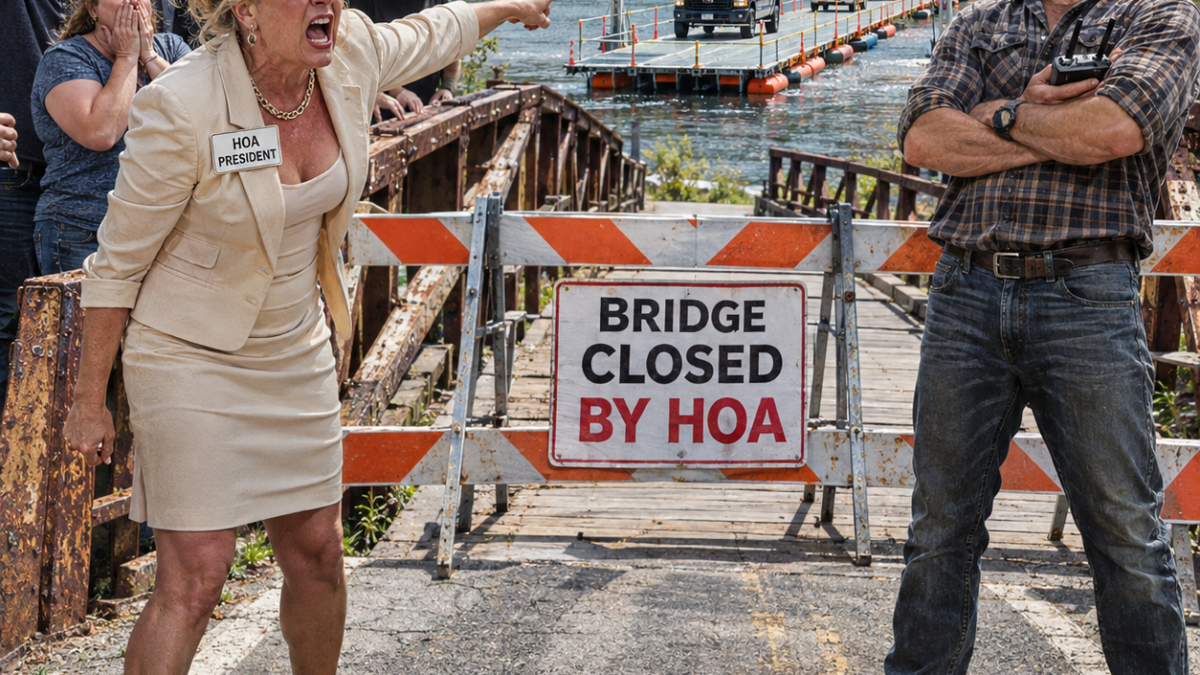
By the time I reached the approach, the SUV was parked diagonally across both lanes.
High beams blasting.
A heavy chain ran through the barrier posts.
Padlock.
Delphine stood beside the vehicle.
Fleece robe.
Slippers.
Hair pulled back.
Prepared.
That was the part I could never forget.
She hadn’t improvised.
She owned the chain.
Owned the lock.
Knew exactly where to place them.
She had been waiting for some moment when she could prove subsection 14C had teeth.
I stepped out.
“There’s a fire.”
“There is an active enforcement proceeding against your property.”
I stared at her.
“What?”
“Your access privileges have been temporarily suspended pending compliance.”
“Delphine, look behind me.”
She didn’t.
Orange light flickered through the trees.
“Section fourteen-C permits infrastructure restriction.”
“The Hales’ workshop is burning.”
“That is a fire department matter.”
“The fire department is on the other side of your chain.”
“They can coordinate access.”
“You locked the bridge.”
“You are not authorized to cross until—”
I held up one hand.
“Stop.”
She did.
Maybe because of my tone.
I didn’t shout.
That surprised me.
Twenty years as a combat engineer had taught me something strange:
The more serious the emergency, the less useful anger becomes.
“You’re trapping ninety households.”
“I’m enforcing board authority.”
“You don’t have authority over this bridge.”
Her expression shifted.
Only slightly.
She didn’t know I knew.
“You’re mistaken.”
“I’m not.”
“Move your vehicle.”
“No.”
“Unlock the chain.”
“No.”
I looked toward the far end.
Sirens.
Flashing red light beginning to appear beyond the trees.
“Last chance.”
She crossed her arms.
“Resolve your outstanding violations.”
That was it.
No more conversation.
I walked back to my truck.
Her voice followed me.
“Where are you going?”
I didn’t answer.
—
911 first.
“Emergency services, what is your location?”
“Millbrook Crossing Bridge Road. HOA president has chained the only vehicle bridge during an active structure fire.”
The dispatcher’s voice sharpened.
“Is anyone injured?”
“Unknown. Fire is at Hale residence. Fire department approaching west side. Bridge is blocked.”
“Do not confront the person blocking it.”
“I won’t.”
“Deputies are being notified.”
Next call.
Burgess.
He answered on the second ring.
“Burgess.”
“Millbrook Bridge blocked. Deploying contingency.”
No questions.
“Understood. I’ll notify sheriff and EMS.”
Eleven seconds.
Court next.
“Yeah?”
“Go.”
Silence.
Then:
“On my way. Dex?”
“You call him.”
“Done.”
Arlo.
“It’s time.”
“I’m dressed.”
Of course he was.
I drove back home.
Priscilla stood in the driveway with the children.
“You’re deploying it.”
“Yes.”
“Fire?”
“Still one property, maybe spreading.”
“Delphine?”
“Chained the bridge.”
Priscilla stared at me.
For one second, absolute disbelief.
Then none.
“She actually did it.”
“Yes.”
“Go.”
I backed to the trailer.
Hands steady.
Hitch.
Safety chains.
Electrical connector.
Pin.
Check.
The trailer tongue scraped once.
I corrected.
In the mirror, Priscilla stood with one hand on our son’s shoulder.
I pulled out.
Delphine was still near her Lexus when I passed the main bridge turn.
She saw the pontoons.
Saw the trailer.
Saw where I was headed.
Downstream.
Toward the cleared bank.
I will remember her face forever.
Not because she looked afraid.
Because she looked confused.
She had built her entire power around controlling the only door.
She had never considered somebody might build another.
—
The trailer descended the embankment.
Arlo was already there.
Waders.
Headlamp.
Gloves.
Ula arrived thirty seconds later.
Then Prescott and Barton.
Winifred pulled in with her medical bag.
“Where’s Court?” Arlo asked.
“Coming.”
“Dex?”
“Coming.”
We did not wait.
The first section went down the ramp.
Metal scraped.
Then flotation caught.
The pontoon slapped the water hard.
Arlo and Barton guided it.
“Hold!”
Ula brought the connector hardware.
Second section.
Align.
Pin.
Check.
No rushing the check.
The river reflected firelight upstream.
Every time I looked toward the trees, the sky seemed brighter.
I forced myself not to watch.
Task.
Section.
Pin.
Guide rope.
Anchor.
Next.
At 2:01, we had two linked.
At 2:07, four.
Court arrived nineteen minutes after my call.
He ran down the bank pulling on gloves.
“You started without me.”
“You taught me.”
He looked at the connection.
“Good.”
Then he took over river positioning.
Dex arrived seven minutes later.
Eight trained people.
Rhythm.
Sections five and six moved faster.
Seven.
Eight.
Cold water soaked through my waders at one knee.
Didn’t matter.
My hands hurt.
Didn’t matter.
Winifred stood on shore checking the growing crowd.
Residents had started arriving.
Some carrying bags.
Some children.
Some in pajamas.
Nobody knew yet whether they needed to evacuate.
But they knew the main bridge was blocked.
A man shouted:
“Is this safe?”
Court answered without looking up.
“It will be when we say it is.”
Best answer possible.
At 2:31, the full span was connected and secured.
Court walked it.
Slow.
Tested lateral movement.
Checked anchor tension.
Bounced once at center.
Then again.
He turned toward us.
“She’s good.”
Forty-one minutes from hitch to usable crossing.
Not four.
Forty-one.
And every one of those minutes mattered.
—
Betty Hale was the first person across.
I almost didn’t recognize her.
Nightgown.
One shoe.
Hair loose.
Face blackened slightly by smoke.
Winifred held one arm.
In Betty’s other hand was a cat carrier.
Orange cat inside.
She also clutched a photo album against her chest.
“Where’s Thurston?” I asked.
“Behind me.”
Her voice broke.
She stepped onto the pontoon.
It moved beneath her.
Not dangerously.
Just the small living movement of something floating.
She froze.
“I can’t.”
Winifred leaned closer.
“Yes, you can.”
Betty looked at me.
“Garrison?”
“I’m right here.”
“Will it hold?”
“Yes.”
“You promise?”
I thought about Priscilla telling me never to make emergency equipment depend on one person.
I thought about Court’s inspections.
Our drills.
Our permit.
Our load checks.
“Yes.”
Betty took another step.
Then another.
Halfway across, the orange cat made a sound from the carrier.
A ridiculous angry yowl.
Betty laughed.
Or sobbed.
Maybe both.
Then she crossed.
Thurston came behind her.
He had burns on one forearm.
Minor, thankfully.
He stopped beside me before stepping onto the bridge.
“You built this?”
“Community built it.”
“No.”
His eyes were wet.
“You built this.”
Then he crossed.
Eleven more residents followed.
A couple carrying an infant.
An eighty-year-old man.
Two teenagers.
A woman with three dogs somehow controlling all of them with one leash arrangement I still don’t understand.
The bridge worked.
—
Meanwhile, chaos continued at the primary bridge.
Deputy Tolliver arrived.
Body camera running.
Delphine was still arguing.
The volunteer fire department reached the opposite approach.
Their engine could not cross.
Tolliver ordered Delphine to produce the key.
She cited subsection 14C.
He told her private HOA language did not override emergency access requirements.
She cited it again.
He gave her a short deadline.
Unlock it or the chain gets cut.
The exact timing became confused in later retellings because everybody was working, filming, calling, shouting.
What mattered was this:
The chain came off.
The fire apparatus got through.
The Hales’ detached workshop was lost.
Their home was saved.
The fire did not spread.
Nobody died.
Nobody suffered serious injury.
And Delphine’s entire argument was recorded.
Deputy body camera.
Winifred’s dashcam.
Clark Jensen’s phone from his upstairs window.
Twenty-three uninterrupted minutes.
Delphine in headlights.
Fire glow behind her.
Fire engine waiting.
Her voice explaining why HOA enforcement justified blocking access.
And through trees in the lower corner:
Work lights.
People assembling a pontoon bridge because she had chained the real one.
—
By dawn, I was exhausted.
My clothes were wet.
Hands scraped.
Smoke hung low.
The Hales sat with EMS.
Governor—the orange cat—was furious but unharmed.
Priscilla found me near the pontoon landing.
She walked straight up.
Hit me once in the chest.
Not hard.
“What was that for?”
“You promised to come back.”
“I did.”
“You were gone three hours.”
“There was a bridge.”
She grabbed me and hugged me.
Our kids joined.
For the first time that night, I stopped functioning.
My knees actually felt weak.
Not from the work.
From what almost happened.
If I had not planned.
If Burgess had not known.
If Court hadn’t trained us.
If Arlo had ignored his phone.
If the chain had remained in place longer.
If the Hales’ fire had jumped.
Too many ifs.
Priscilla whispered:
“You were right about the one bridge.”
I almost laughed.
“You said you’d admit it.”
She pulled back.
“This is not the time to be smug.”
“Sorry.”
“You’re not sorry.”
“No.”
She kissed my forehead anyway.
—
Clark uploaded part of the video.
I wish he hadn’t.
Not because it was wrong.
Because once it went public, everything moved faster than we could control.
By the next day:
Thousands of views.
Then tens of thousands.
Then hundreds of thousands.
Local news.
Regional news.
People arguing online about HOA power, emergency access, property rights.
Some called Delphine evil.
Some claimed the video was staged.
Some accused me of planning the whole event.
That one almost made me throw my phone into the river.
Priscilla took it away.
“You don’t need this.”
“They’re saying I started the fire.”
“Random strangers.”
“One guy says retired military people create crises so they can look useful.”
“Garrison.”
“What?”
“Go sleep.”
Best advice I got all week.
—
The legal consequences were immediate.
The Chancery Court entered emergency orders requiring the stalled membership process to move forward and restricting interference with owner voting rights.
The bridge-title dispute also accelerated.
Interim trustees were appointed for the dormant Community Access Trust.
The trust’s first major action was simple:
The HOA had no independent authority to block the bridge.
No fines.
No landscaping dispute.
No enforcement action.
Only genuine structural or public-safety emergencies could justify restricting access.
Recorded.
Formal.
Public.
When Wendell sent me the order, I printed two copies.
One went into the case binder.
The other went into the emergency kit beside the bridge deployment documents.
Priscilla saw me.
“You’re enjoying that.”
“A professional amount.”
She rolled her eyes.
—
Eleven days after the fire, the special membership meeting finally happened.
County community center.
Parking lot full twenty minutes early.
Sixty-three of ninety households represented in person or by proxy.
The most participation Millbrook Crossing had ever seen.
Delphine sat at the front.
Blazer.
Pressed slacks.
Attorney beside her.
No fleece robe.
No Lexus blocking anything.
But she still carried herself like president.
That was the strange thing about power.
Sometimes the title disappears before the posture does.
Wendell opened.
No theatrics.
First:
Beautification addendum adoption defect.
Second:
Failed retroactive ratification.
Third:
Fines collected under disputed authority.
Fourth:
Financial records.
$41,650 collected.
$4,200 remaining.
$37,400 in unexplained administrative expenses subject to investigation.
Fifth:
Bridge and road trust.
Sixth:
Subsection 14C had been asserted over property the HOA did not own or control.
Twenty minutes.
Clean.
Documented.
Then he sat down.
People looked at me.
I didn’t want to speak.
Priscilla squeezed my hand.
I stood.
I had notes.
Three pages.
Never opened them.
“I want to talk about Betty.”
The room became quiet.
“She crossed the river at two-thirty in the morning wearing one shoe.”
Betty covered her mouth.
I continued.
“She had a photo album under one arm and Governor in a carrier.”
Someone laughed softly.
“Her workshop was burning. She didn’t know if her house would survive.”
I looked at Delphine.
“And the only reason she was standing on a temporary bridge instead of using the road built for this community was because somebody decided an HOA fine mattered more than emergency access.”
Delphine shifted.
Her attorney whispered something.
I looked back at the residents.
“I spent months fighting over a porch.”
A few people smiled.
“I spent nights reading rules that should never have been passed. My wife proofread legal letters instead of watching television with me. My kids watched me turn our kitchen table into an office.”
Priscilla’s eyes filled.
“I spent more than twenty thousand dollars building an emergency crossing I hoped nobody would ever use.”
Silence.
“I don’t say that because I want credit.”
I paused.
“I say it because none of this should have been necessary.”
I looked around.
“The rules were not complicated. The voting requirements were written down. The financial records belonged to the membership. The bridge belonged to a trust. The only thing that made this complicated was that most of us assumed someone else was paying attention.”
Delphine looked straight ahead.
“I was angry for a long time.”
I swallowed.
“Today I’m mostly tired.”
That was true.
“And I never want my kids to believe authority means whoever has the binder gets to decide what reality is.”
I sat down.
Nobody applauded immediately.
I appreciated that.
The silence mattered.
Then Clark stood.
“I have something.”
He connected his phone to the projector.
Delphine’s attorney turned toward him.
Clark played four minutes.
Night.
Fire glow.
White Lexus.
Chain.
Delphine.
Deputy Tolliver.
Her voice:
“I am acting under section fourteen-C.”
Tolliver’s:
“Ma’am, this is an active emergency.”
Then Delphine again.
Arguing.
Defending.
Insisting.
The camera shifted.
In the lower-right part of the projection, beyond trees, you could see our work lights.
Tiny figures.
Pontoon sections moving.
Two different ideas of community happening at once.
One person defending power.
Eight people building access.
Clark stopped the video.
The room remained silent.
Thurston stood.
He did not ask Delphine for an explanation.
Did not yell.
Did not insult her.
“I move that Delphine Harcourt, Randolph Keetch, and Opal Merriweather be removed from the board under the recall provision of the original covenants.”
Someone seconded before he finished sitting.
The vote was called.
Fifty-eight in favor.
Three against.
Two abstentions.
Delphine.
Randolph.
Opal.
Removed.
Delphine sat completely still.
Her attorney leaned close.
Spoke.
She stood.
Gathered her papers.
Looked at the room.
Then said:
“This community will regret this.”
Nobody answered.
She walked out.
The door closed behind her.
For years, she had made people afraid of letters.
That night, sixty-three households watched her leave with nothing but one.
—
The financial investigation moved separately.
Four days later, investigators searched Randolph’s home under warrant.
Public filings later referenced transfers of association money and suspected alteration of records.
Delphine was named in connection with aspects of the inquiry.
I did not celebrate.
Mostly because Wendell told me repeatedly not to discuss an active investigation.
Also because Randolph’s wife still lived in Millbrook Crossing.
So did Opal.
Winning did not erase the fact that neighborhoods are made of people who have to keep seeing one another afterward.
That part is harder than the dramatic meeting.
People want villains to disappear.
Usually they don’t.
They still collect mail.
Walk dogs.
Shop at the same grocery store.
Real consequences are slower and messier than applause.
—
Delphine’s attorney filed a defamation suit against Clark over the video.
That might have been her most foolish decision after the bridge.
The video showed what happened.
Clark had recorded from his own home.
The court dismissed the suit relatively quickly under Tennessee protections for speech involving matters of public concern, and Clark recovered legal costs.
The entire neighborhood learned a new phrase:
Anti-SLAPP.
Theo—sorry, Thurston—kept pronouncing it “anti-slap” like it involved violence.
Wendell corrected him twice.
Then stopped trying.
—
The new board election happened in August.
Five seats.
Someone wisely suggested an odd number.
Thurston Hale became president.
He was terrible at agendas.
Perfect for the job.
His first meeting lasted two hours and twenty minutes.
Forty minutes involved a discussion about dock ladders that should have taken six.
Another twenty somehow turned into a debate about whether the community picnic needed two kinds of potato salad.
Priscilla leaned toward me.
“You miss Delphine yet?”
“No.”
“Not even a little?”
“Ask me after hour three.”
Thurston eventually reached the actual business.
Every fine issued under the invalid beautification addendum would be waived.
Residents who had paid would be identified for refunds.
Amount owed:
$41,650.
Money available:
$4,200.
That hurt.
The investigation and civil claims would determine how much could be recovered and from whom.
In the meantime, fourteen households voluntarily contributed to a partial refund pool.
No assessment.
No pressure.
Just checks.
I wrote one.
Priscilla watched me sign it.
“How much?”
“Enough.”
“Garrison.”
I showed her.
She nodded.
“That’s fine.”
“No argument?”
“We spent twenty-three thousand on a bridge.”
“Fair.”
She smiled.
“This is cheap.”
—
The pontoon sections stayed in Crossville.
I extended the storage agreement.
Then Burgess called.
“County wants to formalize the contingency.”
That sentence made me happier than almost anything else.
We developed a written deployment protocol.
Who calls.
Who authorizes.
Where equipment is staged.
Who maintains training records.
Notification sequence.
Inspection schedule.
No dependence on me alone.
Exactly what Priscilla had demanded.
Eventually, Millbrook Crossing’s backup crossing became part of county emergency planning.
A civilian asset available for certain river emergencies.
The thing I had built because I didn’t trust Delphine became something larger than Delphine.
That mattered.
A lot.
—
The Community Access Trust was restored too.
Five elected trustees.
Staggered terms.
Independent from the HOA.
Bridge and road records cleaned up.
Maintenance authority clear.
First resolution:
No HOA or private entity could restrict member access except for legitimate active structural or public-safety conditions.
When the resolution was recorded, Wendell mailed me a copy.
On the top he had written:
**One bridge. Five trustees. Zero Karens with padlocks.**
I called him.
“Very professional.”
“I bill for professionalism. Humor is free.”
—
Betty and Thurston rebuilt the workshop.
Smaller.
Better wiring.
County inspected.
Governor the cat took possession of the back porch during construction and refused to move.
Betty insisted he had developed “emergency trauma.”
Thurston insisted the cat had been lazy before the fire.
They argued about it at every cookout.
One afternoon, Betty brought me the photo album she had carried across the pontoon.
“What’s this?”
“Open it.”
Inside were family photographs.
Children.
Grandchildren.
Christmases.
Old vacations.
Thurston with more hair.
Betty in a wedding dress.
Then one photo from the fire night.
Somebody had taken it from the far riverbank.
Betty on the pontoon.
Winifred beside her.
Cat carrier.
Photo album.
Behind them, work lights reflected in the Colter River.
She had written on the back:
**The bridge that was there when we needed one.**
I couldn’t speak for a moment.
Betty hugged me.
Then said:
“You’re still too stubborn.”
“Thank you.”
“That wasn’t praise.”
—
The neighborhood changed after that summer.
People started attending meetings.
Not everybody.
Let’s be realistic.
Half the neighborhood still found better things to do.
But thirty people at an HOA meeting stopped being unusual.
Budgets were published.
Minutes arrived on time.
Financials included actual line items.
When the board wanted to change rules, residents voted.
Sometimes changes failed.
Sometimes they passed.
The important part was nobody treated disagreement as disloyalty.
At one meeting, a resident argued for fifteen minutes against a landscaping rule Thurston supported.
Afterward, Thurston asked him if he wanted coffee.
That was it.
No violation letter.
No inspection campaign.
No social punishment.
Just disagreement.
Betty watched them leave together.
“That feels strange.”
“What?”
“Normal.”
I knew exactly what she meant.
—
At the August board meeting, someone suggested the community do something positive with the sudden increase in participation.
The conversation wandered.
Of course it did.
Dock improvements.
Emergency preparedness.
Food pantry.
Youth programs.
Eventually Winifred said:
“Scholarship.”
Everyone stopped.
“Why?” somebody asked.
“Because we spent three years teaching ourselves that civic responsibility matters.”
She looked around.
“Maybe tell a teenager that too.”
The idea stuck.
Voluntary donations.
Two-thousand-dollar annual award.
Graduating high-school senior.
Community service or civic engagement.
Administered through the trust.
Rotating selection panel.
No requirement to live in Millbrook Crossing.
That part was Thurston’s idea.
“If we want community to mean something,” he said, “we probably shouldn’t draw the line at our mailbox.”
For a man who couldn’t run a thirty-minute meeting in under two hours, he occasionally said something perfect.
—
The first recipient was Marcus Ellis.
Seventeen.
Organized food drives for elderly residents across several rural communities.
He arrived at the award ceremony wearing a tie that was slightly too short and the expression of someone convinced there had been a mistake.
Thurston handed him the check.
Marcus looked at it.
Then at us.
“I don’t live here.”
“We know,” Thurston said.
“I’ve never even been to Millbrook Crossing.”
“We know that too.”
Marcus looked more confused.
“Then why me?”
Winifred answered.
“Because community service shouldn’t require an HOA address.”
Marcus laughed.
Then his mother cried.
Then Betty cried because his mother cried.
Then Priscilla cried because Betty cried.
I maintained discipline for nearly thirty seconds.
Afterward, Marcus found me near the door.
“Mr. Tholt?”
“Garrison.”
“I heard about the bridge.”
Of course he had.
“Everybody hears about the bridge.”
“Did you know it would work?”
I thought about the question.
“I knew the engineering would.”
“What’s the difference?”
“I didn’t know people would show up.”
He frowned.
“The volunteers?”
“Yeah.”
I looked around the room.
“That’s always the uncertain part.”
Marcus nodded slowly.
Then said:
“They did.”
“Exactly.”
—
Delphine’s legal problems continued.
So did Randolph’s.
I won’t pretend I didn’t feel satisfaction when consequences finally reached them.
I did.
Especially after what happened at the bridge.
But the anger faded faster than I expected.
One afternoon, months later, I saw Delphine at a grocery store.
She was alone.
No blazer.
No binder.
No board members.
She saw me.
I considered turning away.
Didn’t.
We stood near the freezer section.
She spoke first.
“You ruined my reputation.”
There were a hundred possible answers.
Most would have felt good for ten seconds.
I chose none.
“The bridge was chained during a fire.”
Her face tightened.
“You had been violating community standards for months.”
I stared at her.
Even then.
Even after court orders.
After removal.
After investigators.
She still needed the rule to matter.
“Delphine.”
“What?”
“There were children behind that chain.”
She looked away.
“That was not my intention.”
“What was?”
“To enforce consistency.”
I almost felt sorry for her.
Not because she was innocent.
Because she still didn’t understand.
“Consistency isn’t the same as judgment.”
She looked back.
“You think because you were in the military you know everything about emergencies.”
“No.”
“I think spending twenty years around emergencies taught me rules exist to protect people.”
She said nothing.
“And when a rule starts endangering people, you stop hiding behind it.”
Her shopping cart was half full.
Milk.
Frozen vegetables.
Laundry detergent.
Ordinary things.
For years she had occupied so much space in my mind that seeing her reduced to another person buying groceries felt strangely anticlimactic.
I moved aside.
“Take care of yourself, Delphine.”
She didn’t answer.
I walked away.
That was the last real conversation we ever had.
—
Our kids remember the fire differently.
My son remembers smoke.
My daughter remembers Priscilla telling them to put shoes on.
Neither remembers the legal fight.
I’m glad.
A few years later, my daughter had a school assignment about someone in the family who had solved a problem.
She chose the bridge.
I found her draft on the kitchen table.
The title was:
**My Dad Built a Bridge Because a Lady Was Crazy.**
Priscilla laughed until she cried.
I did not.
“That is not accurate.”
“It’s pretty accurate,” Priscilla said.
“She was not crazy.”
“Fine.”
“She abused authority.”
“That doesn’t fit on the cover.”
My daughter changed it reluctantly.
The final title:
**The Emergency Bridge.**
Better.
In her essay, she wrote that I built it in four minutes.
I corrected that too.
“Forty-one.”
“That sounds less impressive.”
“It’s true.”
“But the story online says four.”
“The story online is wrong.”
“Can I say fast?”
“Yes.”
“How fast?”
“Fast enough.”
She wrote that.
I liked it.
—
The bridge became an annual training exercise.
County Emergency Management joined.
Firefighters.
EMS.
Volunteer teams.
Inspection crews.
We deployed it once a year whether we needed it or not.
Slow.
Methodical.
No heroics.
Eventually younger residents learned the process.
I deliberately stopped being team lead.
Arlo asked why.
“Because if it depends on me, it isn’t a system.”
He nodded.
“Army?”
“Marriage.”
Priscilla had taught me that.
The first year I watched somebody else command deployment, it was difficult.
Court stood beside me.
“You look miserable.”
“They’re slow.”
“They’re safe.”
“Section three is drifting.”
“They corrected it.”
“Pin six—”
“Garrison.”
“What?”
“Shut up.”
I did.
Bridge went live in fifty-three minutes.
Eleven minutes slower than our fire-night deployment.
Nobody cared.
Because nobody was running from flames.
That was the point.
—
Years later, the $41,650 refund issue finally closed.
Not every dollar came back from one source.
Insurance.
Civil recovery.
Recovered association assets.
Negotiated settlements.
It took time.
Residents eventually received the amounts they had paid under the invalid addendum.
Betty framed her refund check before depositing it.
I told her that made no sense.
She told me mind my business.
Thurston used theirs to buy a new grill.
“I thought you were going to save it.”
“For what?”
“Retirement?”
“I’m seventy-seven.”
Fair.
The first cookout on that grill lasted until dark.
Nobody mentioned Delphine.
That felt like progress.
—
One summer evening, Priscilla and I walked down to the river.
The original concrete bridge stood upstream.
Solid.
Ordinary.
Cars crossed.
Kids biked over it.
No chain.
No padlock.
The pontoon sections were in storage.
Hopefully useless.
Priscilla sat on a bench near the bank.
I joined her.
“You still scan the bridge every time you drive home.”
“I do not.”
“You absolutely do.”
“Professional habit.”
“You retired a long time ago.”
“So?”
She leaned against me.
The river moved past.
“Do you ever wish we hadn’t bought here?”
I thought about it.
Delphine.
Lawyers.
Fines.
Twenty-three thousand dollars in pontoon equipment.
Smoke.
Betty in one shoe.
The membership meeting.
Marcus holding a scholarship check.
County crews deploying the bridge during training.
Thurston derailing HOA meetings with potato salad debates.
“No.”
Priscilla smiled.
“That took too long.”
“I was thinking.”
“You’re allowed to say no quickly.”
“I like accuracy.”
She laughed.
Then grew quiet.
“You know what scared me most that night?”
“The fire?”
“No.”
“What?”
“That you weren’t angry.”
I looked at her.
“At the bridge.”
“You looked at Delphine, and I could tell you were done arguing.”
“That’s when I’m useful.”
“I know.”
She squeezed my hand.
“That’s what scared me.”
I understood.
There are kinds of anger that make noise.
And there is the kind that gets organized.
Mine had spent six months becoming permits, training schedules, court filings, bank records, pontoon sections, and phone numbers.
Delphine saw silence and assumed weakness.
She was wrong.
But Priscilla had been right about something too.
Preparation without community is just equipment.
The bridge worked because people came.
—
The scholarship grew.
The second recipient volunteered with a rural fire department.
The third had organized river cleanups.
The fourth helped build wheelchair ramps for elderly residents.
Each year, the ceremony happened at the community center.
The same kind of folding chairs.
Same fluorescent lights.
But the feeling had changed.
I kept thinking about that first removal meeting.
Sixty-three households.
Anger.
Fear.
Documents.
Fire video on the wall.
Now the room held parents, teenagers, cookies, scholarship applications.
Same community.
Different reason to gather.
That was the part I wanted my children to remember.
Not that their father beat an HOA president.
That is too small.
We built a second way across a river.
Then we built a better way to govern ourselves.
The physical bridge was easier.
—
One November afternoon, Marcus came back.
College freshman now.
He had used part of the scholarship for textbooks.
The rest toward tuition.
He found me in the garage.
“You remember me?”
“Of course.”
He handed me an envelope.
Inside was a photograph.
Marcus in a reflective vest beside a volunteer emergency-management team.
“What’s this?”
“I joined the county reserve program.”
“Why?”
He shrugged.
“The bridge story.”
I looked at him.
“You’re blaming me?”
“Pretty much.”
I laughed.
Then he became serious.
“You said once you didn’t know if people would show up.”
“I remember.”
“I wanted to be somebody who does.”
That got me.
I looked away and pretended there was something very interesting on the workbench.
Marcus smiled.
“Mrs. Tholt said you do that.”
“Priscilla talks too much.”
“She said that too.”
Of course.
—
There is still a copy of subsection 14C in my file cabinet.
I keep it beside the trust deed.
Two pieces of paper.
One tried to create power that didn’t exist.
The other quietly showed where the actual authority had been all along.
That may be the entire story in miniature.
Delphine believed writing something down made it true.
I learned that documents only matter when they rest on legitimate authority.
The bridge didn’t belong to the loudest person.
The HOA didn’t belong to the board.
The neighborhood didn’t belong to anyone.
It belonged to all of us in different ways, with different responsibilities, and that turned out to be much stronger than one person’s control.
—
Another fire happened years later.
Not a house.
Brush fire outside the peninsula.
No immediate danger.
The county temporarily closed one side of the bridge while crews worked.
Burgess had retired by then.
His replacement called me.
“Mr. Tholt?”
“Yes.”
“We’re not deploying. Just giving you a heads-up.”
I smiled.
“Understood.”
“We have the contingency bridge listed.”
“Good.”
“Current inspection?”
“Last month.”
“Crew?”
“Twelve qualified.”
“Excellent.”
We never launched it.
Didn’t need to.
But that call meant more to me than deployment ever had.
The backup existed.
The system remembered.
It no longer depended on my fear.
That was success.
—
Thurston eventually stepped down as HOA president.
He said he was tired of email.
Betty said he had always been tired of email.
Winifred ran.
Won.
Her meetings started exactly on time.
Ended exactly on time.
People feared her agenda more than they had ever feared Delphine’s fines.
Healthy fear.
At her first meeting, she recognized me during public comment.
“Mr. Tholt.”
“Yes?”
“You have three minutes.”
“I don’t need three.”
“Everyone says that.”
I suggested increasing the emergency fund contribution.
She nodded.
“Useful.”
Then moved on.
No drama.
I sat beside Priscilla.
“She likes me.”
Priscilla whispered:
“She tolerated you for forty-three seconds.”
“Progress.”
—
Millbrook Crossing is still beautiful.
Pine resin.
River clay.
Morning current.
Kids on bicycles.
Mailboxes.
Dogs.
People arguing about dock repairs.
Exactly the boring life I thought I was buying.
The main bridge still stands.
The pontoon bridge spends almost all its life stacked in a warehouse.
Which is where I hope it stays.
Every June 14, I wake earlier than usual.
Not intentionally.
The body remembers dates.
I walk outside.
Sometimes smoke from somebody’s chimney or grill makes my chest tighten for half a second.
Then I look toward the river.
The bridge is open.
Always.
One year Betty found me standing near the access road around sunrise.
She was walking Governor in a pet stroller.
I wish I were joking.
“That cat can walk,” I told her.
“He’s elderly.”
“He’s manipulative.”
Governor stared at me from the stroller.
Betty stopped.
“You thinking about that night?”
“Maybe.”
She looked at the bridge.
Then at me.
“Thurston still has the photo.”
“What photo?”
“Me crossing.”
“I know.”
“He says it’s the bravest he’s ever seen me.”
I smiled.
“You were terrified.”
“I was.”
“That’s usually where bravery starts.”
She looked at me.
“Army wisdom?”
“No.”
“Then what?”
“Watching you.”
Betty became quiet.
Then she pushed the stroller onward.
Governor glared back at me like I had insulted his lineage.
—
The neighborhood added a plaque near the river access eventually.
I argued against it.
Lost.
It does not have my name.
That was my condition.
It reads:
**MILLBROOK CROSSING EMERGENCY RIVER ACCESS**
**ESTABLISHED BY RESIDENT VOLUNTEERS AND COUNTY EMERGENCY MANAGEMENT**
**PREPAREDNESS IS A COMMUNITY RESPONSIBILITY**
That’s all.
Good enough.
No Delphine.
No fire.
No fines.
No story about defeating somebody.
Because emergency infrastructure should not become a monument to a feud.
It should become ordinary.
—
Our youngest once asked:
“If Mrs. Harcourt hadn’t locked the bridge, would the neighborhood still have changed?”
I thought about that for a while.
“We were already changing.”
“Would she still have lost the board?”
“Probably.”
“Then why does everybody remember the fire?”
“Because people understand danger faster than paperwork.”
He nodded.
“That’s kind of sad.”
“Sometimes.”
“So the money wasn’t enough?”
“Forty-one thousand dollars should have been enough.”
“The illegal fines?”
“Should have been enough.”
“The fake rule?”
“Should have been enough.”
“But it took the bridge.”
“Yes.”
He looked toward the river.
“That’s really sad.”
He was right.
Communities often tolerate bad governance while consequences remain abstract.
Money.
Letters.
Rules.
Then one night someone stands between a fire truck and a burning home.
Suddenly abstract becomes visible.
I wish we had acted sooner.
That regret stays with me.
—
If I could replay one moment, it wouldn’t be the meeting.
Wouldn’t be the vote.
Wouldn’t be watching Delphine walk out.
It would be the first time Thurston and Betty came to my garage and said they were afraid.
I told them:
“I’m working on it.”
What I should have said was:
“We’re working on it.”
I learned that distinction slowly.
At first, I treated the HOA like an engineering problem.
Find defect.
Document defect.
Fix defect.
But neighborhoods aren’t structures.
They are relationships.
People need permission to stop being afraid of one another.
Sometimes that permission comes from one person standing up.
More often it comes from realizing fifty other people were waiting for the same moment.
—
The final time I saw Delphine was years later.
She was moving.
A rental truck outside her house.
I drove past slowly because workers were loading furniture.
She stood near the driveway.
Our eyes met.
I kept going.
No wave.
No confrontation.
Nothing left to say.
Priscilla was beside me.
“That’s it?”
“What?”
“You’re not stopping?”
“Why would I?”
“Five years ago, you would have.”
“Five years ago I had tabs labeled with her name.”
“You still have those.”
“Archive purposes.”
She laughed.
We crossed the bridge.
No chain.
Traffic moving normally.
On the far side, the county had installed a new emergency-access sign.
I looked in the mirror.
Delphine’s house disappeared behind the trees.
I felt nothing.
That was better than satisfaction.
—
That evening, I took Priscilla down to the river.
The sun was low.
Water looked copper in the light.
We sat where we could see both crossings.
The permanent bridge upstream.
The empty emergency landing downstream.
She leaned her head on my shoulder.
“Do you know what’s funny?”
“Dangerous question.”
“You bought twenty-three thousand dollars of floating metal because you didn’t trust one woman.”
“I bought it because there was one bridge.”
“Sure.”
“Priscilla.”
“I’m agreeing with you.”
“That tone is not agreement.”
She laughed.
Then pointed downstream.
“But it isn’t yours anymore.”
I looked at her.
“The county plan?”
“The whole thing.”
She gestured toward the emergency landing.
“The volunteers. Training. Scholarship. Trust. All of it.”
She was right.
The pontoon bridge had stopped belonging to my fight.
It belonged to the community.
That was probably why I finally felt finished.
Delphine had spent years trying to make community authority smaller and smaller until it fit inside her binder.
We did the opposite.
We spread authority out.
Five trustees.
Five board members.
Resident votes.
Published accounts.
Volunteer teams.
County coordination.
A bridge no single person could control.
That was the real answer to her.
Not revenge.
Redundancy.
—
A storm moved in while we sat there.
Clouds over the river.
Wind through pine branches.
Priscilla stood.
“Rain.”
“Looks like it.”
“You checking the bridge?”
I looked upstream.
Concrete span.
Open.
Lights beginning to come on.
“No.”
She smiled.
“Look at you.”
We walked home.
Rain began before we reached the driveway.
Our kids were inside.
Dinner smelled good.
Somewhere across the peninsula, Thurston was probably ignoring email.
Winifred was probably preparing an agenda.
Betty was probably giving Governor food he didn’t need.
And the Colter River kept moving beneath a bridge no HOA president could ever chain shut again.
For twenty years in the Army, I thought bridges were mostly about getting from one side to another.
I was wrong.
Sometimes a bridge matters because it gives people a choice.
Sometimes it matters because one route isn’t enough.
And sometimes the most important thing you build isn’t the crossing itself.
It’s the certainty that when somebody tries to close the only door, the community already knows how to open another one.
[END OF STORY]








