PART 2: HOA Karen Chained My Boat to the Dock as “Illegal” — She Had No Idea What She’d Just Damaged
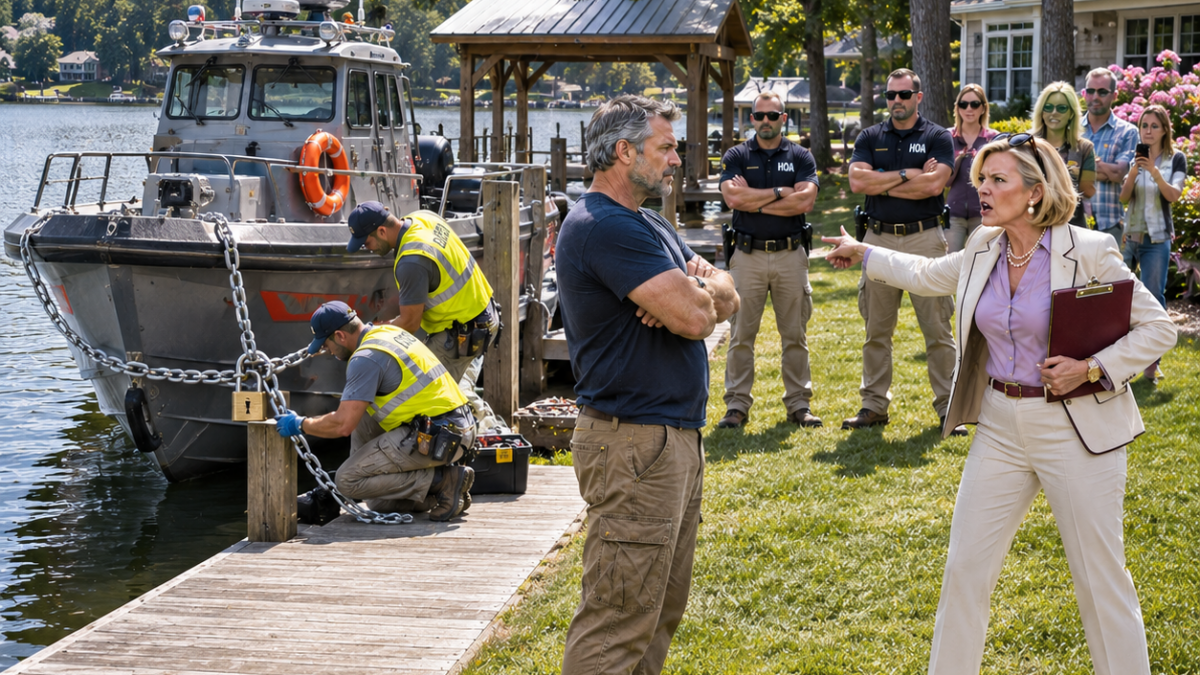
I came home after a summer squall and found my twenty-eight-foot response boat chained to its own dock, a bright red ILLEGAL VESSEL notice bolted into the structure beside it, while the president of the Lake Haven Shores HOA stood on the grass with a clipboard and announced that she had “secured unauthorized military equipment” for the safety of the neighborhood.
I told Karen Simmons calmly that she had crossed onto a restricted section of my property, interfered with a vessel carrying federal registration and inspection markings, and apparently authorized somebody to drill, chain, photograph, and publicly accuse equipment that had spent years supporting real search-and-rescue work, but she only smiled and said HOA jurisdiction came first inside Lake Haven.
What Karen still didn’t understand was that I had spent three decades working inside the exact system she was pretending to outrank, and before I showed her the identification in my wallet, I wanted to know just how far she was willing to go once a clipboard stopped getting her the answer she wanted.
My name is Robert Miles.
My wife Linda and I moved to Lake Haven Shores because after thirty years in the Coast Guard, I wanted fewer alarms in my life.
I was still serving in a regional command role, but my days of sleeping aboard cutters and racing into hurricanes at two in the morning were mostly behind me. Lake Haven looked like the right place to finish that chapter quietly: small lakefront house, old wooden pier, covered boathouse, deep-water slip, and enough distance between neighbors that nobody needed to know what kind of coffee I drank.
The Sentinel was the only part of my old life I brought home with me.
She was a twenty-eight-foot response craft assigned for authorized training, inspections, and emergency readiness in our region. Fast, ugly, dependable. Gray hull. Rescue rails. Communications gear. Nothing about her was designed to impress an HOA architectural committee.
Karen noticed her on our second day.
She arrived in a red blazer carrying a clipboard.
“Welcome to Lake Haven Shores,” she said.
“Thank you.”
Her eyes moved past me toward the dock.
“Is that your boat?”
“It’s assigned to me.”
“We’ll need the registration.”
“For what?”
“HOA marine approval.”
I thought she was joking.
She wasn’t.
“All watercraft must meet our appearance, noise, and environmental standards.”
I smiled.
“The Coast Guard has already handled most of that.”
Her expression tightened.
“Well, federal agencies don’t set Lake Haven community standards.”
That sentence told me everything I needed to know.
Within a week, notices started appearing.
Dock light too bright.
Flag mounted too high.
Mailbox lettering not uniform.
Then came:
UNAUTHORIZED MARINE EQUIPMENT — POSSIBLE ENVIRONMENTAL VIOLATION.
Linda found me reading it over breakfast.
“She’s serious?”
“Very.”
“What are you going to do?”
“Nothing yet.”
“That worries me.”
“It should.”
Our next-door neighbor Greg laughed when I showed him.
“You’re her new project.”
“Excuse me?”
“Every few months Karen picks somebody. Last year she tried to make the Johnsons remove two ducks because they were a ‘waterfowl nuisance.’”
“They were wild ducks.”
“I know.”
Three days later, Karen arrived with two HOA board members carrying cameras and measuring tapes.
She pointed toward the Sentinel.
“The board has determined this vessel violates Sections Twelve through Fifteen of our marine policy.”
“Which part?”
“Industrial color. Engine noise. Oversized communications equipment. Unapproved flag height.”
I stared at her.
“You measured my antenna?”
“Community standards matter.”
“You may want to check which jurisdiction applies before touching that boat.”
She wrote something on her clipboard.
“You have seventy-two hours to remove it.”
“Or?”
“The association will take corrective action.”
That night, Linda asked whether I planned to call legal counsel.
“Not yet.”
“Why?”
“Because she hasn’t done anything irreversible.”
Two days later, she did.
A storm rolled across the lake that afternoon. When the rain eased, Linda called me from the kitchen.
“Robert.”
Something in her voice got me moving.
I stepped outside.
Yellow chain stretched across my dock.
Fresh padlock.
Metal violation plate.
And beside the Sentinel, Karen stood proudly with two board members in raincoats.
I walked down without hurrying.
She lifted her chin.
“Community safety measure.”
I looked at the new hardware.
Then at her.
“Who authorized this?”
“The HOA.”
“That isn’t what I asked.”
Her smile vanished.
I crouched beside the chain, photographed the mounting points, then looked up at her.
“Karen, nobody touches anything else.”
She laughed.
“Or what?”
I stood.
Then reached for my wallet.
PART 2
I didn’t open it.
Not yet.
Karen stared at the leather ID case in my hand and gave me a small, impatient smile.
“What is that supposed to be?”
“Something you probably should have asked about before you started drilling and chaining things.”
One of the board members behind her shifted his weight.
His name was Todd Mercer. I had seen him at one neighborhood meeting. Quiet guy. Accountant, according to Greg.
The other was Martha Keene, chair of what the HOA dramatically called the Lake Compliance Committee.
Karen pointed toward the Sentinel.
“You were given written notice.”
“I was given HOA letters.”
“Which you ignored.”
“Yes.”
She blinked.
People like Karen are accustomed to resistance being emotional.
Shouting.
Threats.
Doors slammed.
A calm yes often unsettles them more.
I continued.
“I ignored them because your board has no authority to regulate the federal registration, operational equipment, or safety configuration of that vessel.”
“This lake is private.”
“Parts of the shoreline are privately owned.”
“The HOA controls the water.”
“No.”
“Yes.”
“No, Karen.”
Her face reddened.
“You cannot simply say no because you work for the government.”
“I’m saying no because the documents say no.”
She pointed at the chain.
“That vessel is secured until the board determines compliance.”
I looked at Todd.
“Did you install this?”
His eyes moved toward Karen.
“I was here.”
“That wasn’t my question.”
Karen stepped between us.
“All action was taken under my authority.”
Todd looked relieved.
That answer would matter later.
Linda came down the steps carrying an umbrella.
She stopped beside me.
“Is she admitting she ordered this?”
Karen snapped:
“I am standing right here.”
Linda smiled.
“I know.”
I had learned in marriage that Linda’s calmest voice usually meant somebody else was about to regret talking.
Karen continued.
“We have residents concerned about military equipment operating in a residential environment.”
“The Sentinel is rescue equipment.”
“It looks military.”
“That is not a legal category.”
“It intimidates people.”
Greg’s voice floated over from his dock.
“Doesn’t intimidate me.”
Karen turned.
“Greg, this does not concern you.”
He raised a coffee mug.
“Hard not to notice the chain, Karen.”
She ignored him.
I finally opened my wallet.
My Coast Guard identification caught the gray light.
Karen glanced at it.
Then back at me.
“So?”
“So I’m Commander Robert Miles.”
She stared.
I continued.
“The Sentinel is documented under a Coast Guard regional training and readiness assignment. That dock includes a recorded emergency-access designation that predates your HOA.”
Her eyes narrowed.
“Anyone can buy a badge online.”
Linda actually laughed.
I looked at Karen.
“You think this is fake?”
“I think you’ve been using government connections to intimidate residents.”
“I’ve done nothing to any resident.”
“You refused inspection.”
“Correct.”
“You refused our vessel registration process.”
“Correct.”
“You threatened federal action.”
“I warned you not to interfere with federally regulated equipment.”
She smiled again.
“There. You admit it.”
“Admit what?”
“That you threatened the board.”
I looked at Todd.
He suddenly seemed fascinated by the dock planks.
Then I looked at Martha.
She was staring at my ID.
“Karen,” she said quietly.
“What?”
“Maybe we should verify this before—”
Karen spun around.
“We already verified the property.”
“Not the boat.”
“The boat is irrelevant.”
I almost admired the confidence required to say that while standing next to a boat she had chained because of the boat.
I closed my wallet.
“Here’s what happens now.”
Karen folded her arms.
“Oh, please.”
“Nobody removes the chain.”
She looked surprised.
“Nobody touches the plate.”
Her surprise deepened.
“You’re leaving it?”
“Yes.”
“Good.”
“No, Karen.”
I raised my phone.
“Evidence.”
For the first time, Todd looked alarmed.
Karen didn’t.
She still thought the only issue was whether I could force her to remove an HOA sign.
She had no idea I wanted the scene preserved exactly as it was.
I photographed the chain.
Padlock.
Plate.
Mounting hardware.
Scratches.
Drill points.
The dock.
The boat’s registration markings.
Every angle.
Then I called the county sheriff’s non-emergency line.
After that, regional legal.
Then Commander Hayes.
Robert Hayes and I had served together years earlier.
He now oversaw compliance and operations several districts over.
He answered with:
“Tell me you’re not calling about retirement paperwork.”
“Worse.”
“Impossible.”
“HOA.”
Silence.
Then he laughed.
“What did you do?”
“Nothing.”
“What did they do?”
“Chained the Sentinel.”
Silence again.
Different silence.
“To what?”
“My dock.”
“Why?”
“Illegal vessel.”
“Robert.”
“Yes?”
“Please tell me you’re joking.”
“I have photos.”
“Damage?”
“Possible drill and hardware damage around the mounting area. I’m not touching anything until it’s documented.”
His voice changed.
Professional now.
“Good.”
“I’ll send everything.”
“Registration current?”
“Of course.”
“Assignment letter?”
“In my office.”
“Dock easement?”
“Recorded copy.”
“Send all of it.”
Karen watched me through the entire call.
When I hung up, she said:
“Calling your friends doesn’t change the bylaws.”
“No.”
I put my phone away.
“But it does make the next conversation easier.”
The sheriff’s deputy arrived first.
Deputy Aaron Cole.
Mid-forties.
Patient expression.
The kind of man who had probably mediated hundreds of arguments about fences, dogs, parking, and property lines.
He looked at the chain.
Then Karen.
Then me.
“Okay.”
He took out a notebook.
“Who installed this?”
Karen answered immediately.
“Lake Haven Shores Homeowners Association.”
“Specifically?”
“I authorized the compliance action.”
Cole wrote that down.
“Who physically installed it?”
Karen’s jaw tightened.
“Our maintenance contractor.”
“Name?”
She hesitated.
Todd spoke.
“Eddie Voss.”
Karen glared at him.
Deputy Cole kept writing.
He asked me:
“Do you own the boat?”
“Operational ownership is federal. It’s assigned through my command for authorized readiness and training use.”
Cole stopped writing.
He looked up.
“Federal?”
“Yes.”
Karen scoffed.
“He keeps saying that.”
I handed Cole the identification.
Then the vessel documents on my phone.
He read them carefully.
His expression changed.
“Ma’am.”
Karen lifted her chin.
“What?”
“I strongly suggest nobody touch anything else.”
“That is exactly what we told him.”
Cole looked at her.
“I’m talking to you.”
Silence.
Greg, still watching from his dock, covered his mouth with one hand.
Cole continued:
“This is beyond an HOA parking dispute.”
Karen said:
“This association owns the dock line.”
“No.”
I answered before Cole could.
She snapped:
“Stop interrupting.”
Cole raised one hand.
“Enough.”
He looked at the bronze marker fixed to one of the older dock posts.
I had pointed it out when he arrived.
The marker referenced the recorded emergency access designation tied to the parcel.
Cole photographed it.
“Has anybody verified the HOA’s claim against county records?”
Karen said:
“Our attorney reviewed it.”
“Name?”
“Charles Whitman.”
Cole wrote again.
I knew Whitman.
Not personally.
Local real-estate attorney.
I doubted he had told Karen she could drill hardware beside Coast Guard markings.
That question would answer itself soon enough.
Cole took my statement.
Karen’s.
Todd’s.
Martha’s.
Then he said:
“I’m leaving everything as-is until the proper agency tells us how they want to handle it.”
Karen smiled.
“So the vessel stays secured.”
Cole looked exhausted.
“No, ma’am.”
He pointed at me.
“He has agreed not to disturb evidence. That is not the same thing.”
She opened her mouth.
Cole continued.
“If you or any HOA representative returns here and modifies the scene, you may create additional problems for yourself.”
That finally quieted her.
After he left, Karen walked toward the grass.
Then stopped.
“You did this to yourself, Commander.”
Linda leaned toward me.
“Did what?”
Karen ignored her.
“This neighborhood was peaceful before you brought that thing here.”
I looked at the Sentinel.
Then at the chain Karen had installed.
“Was it?”
She walked away.
Todd remained behind.
He waited until Karen was halfway across the lawn.
Then lowered his voice.
“Commander.”
“Robert.”
“Right.”
He swallowed.
“I didn’t know.”
“About?”
“The federal status.”
“What did she tell you?”
“That the boat was privately owned surplus.”
“Anything else?”
“She said the HOA attorney confirmed we had authority over the dock.”
“Did you see that opinion?”
“No.”
“Did the board vote to chain the boat?”
His silence answered.
“Did you?”
“No.”
“Who did?”
“Karen said it was administrative enforcement. Didn’t require full board approval.”
Martha had stayed too.
She stepped closer.
“She said it was like towing an unauthorized trailer.”
I looked at both of them.
“You drilled near a vessel because she compared it to a trailer?”
Martha looked embarrassed.
“No. Eddie did.”
“You watched.”
“Yes.”
I let that sit.
Then said:
“If investigators ask, tell them exactly what happened.”
Todd nodded.
“We will.”
Karen’s influence began cracking before anyone had filed a single charge.
That was the first sign.
The next morning, county code enforcement arrived.
Karen had called them.
Of course she had.
Officer Luis Lopez climbed out of a county vehicle holding a tablet.
He looked toward the boat.
Then toward the red HOA sign.
“Mr. Miles?”
“That’s me.”
“We received a complaint regarding an unsafe unregistered vessel.”
“From?”
He gave me the look government employees give when everyone already knows the answer.
“Lake Haven Shores HOA.”
Karen appeared from across the road.
I almost laughed.
She had been waiting.
Lopez walked to the dock.
I showed him documentation.
He checked registration numbers.
Photographed the federal markings.
Called somebody.
Waited.
Then came back up.
“Commander Miles?”
“Yes.”
“Everything I can verify from my end is current.”
“Thank you.”
He turned toward Karen.
She stepped forward.
“You haven’t checked the engine decibel level.”
Lopez blinked.
“We’re not doing that.”
“Section Twelve-B—”
“Ma’am, I enforce county code.”
“Our bylaws—”
“Are not county code.”
“The lake is private.”
“That does not give me authority to cite a federally documented response craft because you dislike the color.”
“I never said color.”
I raised an eyebrow.
She looked at me.
I said:
“Your letter did.”
Lopez sighed.
“Ma’am, if you have a civil issue with a homeowner, speak with your attorney.”
“He is contaminating the lake.”
That was new.
Lopez looked at me.
I spread my hands.
“First I’ve heard.”
Karen produced photographs.
Oil sheen.
Supposedly.
Lopez examined them.
“Where were these taken?”
“Near his dock.”
“When?”
“Tuesday.”
I looked.
Then zoomed in.
“Karen.”
“What?”
“That’s pollen.”
She stared.
“Excuse me?”
“Pine pollen.”
Lopez looked closer.
He smiled despite himself.
“It could be.”
Karen’s face reddened.
“You cannot dismiss environmental contamination visually.”
“That,” I said, “is the first correct thing you’ve said.”
She glared.
So Lopez referred the complaint to environmental services.
Which meant two more inspectors came the next day.
Water samples.
Bilge inspection.
Fuel-system check.
Everything clean.
One inspector, a woman named Dana Pierce, looked at the lab strip and said:
“Honestly, your dock water is cleaner than the community beach sample we took last month.”
Linda smiled.
“Please put that in writing.”
Dana laughed.
“I probably will.”
Karen had been watching from the sidewalk.
As the inspectors packed up, she marched over.
“You need to test again.”
Dana stopped.
“Why?”
“Because he knew you were coming.”
I said:
“I learned forty minutes before you arrived.”
“He could have flushed the system.”
Dana looked at Karen.
“Ma’am, what specific discharge are you alleging?”
Karen hesitated.
“Marine chemicals.”
“What chemical?”
“Military chemicals.”
Linda turned away because she was laughing.
Dana’s partner coughed into his sleeve.
I kept my face neutral.
Dana said:
“We’ll file our findings.”
Karen pointed at me.
“He’s using his position to intimidate everyone.”
“No,” Dana said.
“He let us inspect.”
Karen looked as if betrayal had become contagious.
The environmental complaint closed as unsupported.
The county vessel complaint closed.
The sheriff’s report remained open.
Then Lake Haven called an emergency board hearing.
The notice arrived on thick cream paper with gold lettering.
Linda read it aloud over dinner.
“COMMANDER ROBERT MILES IS HEREBY ORDERED TO APPEAR BEFORE THE LAKE HAVEN SHORES BOARD TO ANSWER ALLEGATIONS OF UNAUTHORIZED FEDERAL EQUIPMENT, ENVIRONMENTAL NONCOMPLIANCE, COMMUNITY DISRUPTION, AND POTENTIAL SECURITY CONCERNS.”
She looked up.
“Potential security concerns?”
“I’m dangerous.”
“You snore.”
“Classified.”
She laughed.
“You’re going?”
“Yes.”
“Why?”
“Because people need to hear what she’s claiming.”
“You could just let legal handle it.”
“I could.”
“But?”
“But then Karen controls the room.”
Linda studied me.
“Robert.”
“Yes?”
“You’re enjoying this a little.”
“No.”
“You are.”
“I’m professionally curious.”
“That is your military phrase for enjoying it.”
Maybe she was right.
That bothered me.
I didn’t want revenge.
But after weeks of absurd accusations, some part of me wanted the satisfaction of making Karen hear no in front of everyone she had convinced to say yes.
That was dangerous.
Not morally catastrophic.
Just human.
And I knew enough about command to recognize ego even when it wore my face.
So before the meeting, I promised myself one thing.
Facts only.
No humiliation.
No speeches.
No trap.
Just truth.
That promise lasted twelve minutes.
The clubhouse was packed.
Karen sat behind a folding table with five board members.
Tiny wooden gavel in front of her.
Greg whispered from the back row:
“She bought a gavel.”
Linda whispered:
“Please behave.”
Karen struck it.
“Emergency session is now in order.”
The room quieted.
“Commander Miles—”
She said Commander like she doubted every syllable.
“—has repeatedly refused to comply with established marine regulations.”
I sat in the second row.
She continued:
“His vessel presents aesthetic, environmental, security, and jurisdictional concerns.”
Todd stared down at the table.
Martha looked miserable.
Karen read several violations.
Then:
“Potential terrorist activity associated with an unverified military-style vessel.”
The room went silent.
I stood.
“Karen.”
She slammed the gavel.
“You will speak when recognized.”
I sat.
Fine.
She continued for another five minutes.
Foreign-style communications equipment.
High-powered radar.
Unapproved rescue winch.
Industrial markings.
She turned basic Coast Guard hardware into a spy thriller.
Finally:
“Mr. Miles, you may respond.”
I stood.
“Thank you.”
I carried one folder to the front.
Set it on the table.
“I have three questions.”
Karen folded her arms.
“Proceed.”
“First: what legal instrument gives this HOA authority over the operational configuration of federally documented response equipment?”
Her lips tightened.
“Our bylaws.”
“Which section?”
“Twelve through Fifteen.”
“Those regulate homeowner recreational watercraft.”
“All vessels.”
“Not federal equipment.”
“That is your interpretation.”
“Fine.”
I opened the folder.
“This is outside counsel’s interpretation.”
Todd’s head snapped up.
Karen looked at the paper.
“What?”
I had contacted Charles Whitman that morning.
Not for privileged advice.
To ask whether he had authored the opinion Karen kept referencing.
He had not.
He had written the HOA months earlier about ordinary dock maintenance.
Nothing about federal vessels.
Nothing about chaining boats.
Nothing about drilling.
His written clarification was short.
Very short.
Karen read it.
Her face changed.
I asked:
“Second question. Did the full board authorize the chain and sign?”
Silence.
Martha whispered:
“No.”
Karen turned.
“Martha.”
Martha looked at the residents.
“No formal vote occurred.”
People began murmuring.
Todd added:
“We were told it was administrative.”
Karen struck the gavel.
“Order.”
I asked the third question.
“Did anybody verify the Sentinel’s status before issuing an illegal-vessel notice?”
Karen said:
“We requested documents.”
“No. You requested HOA registration.”
“Which you refused.”
“Correct.”
“You see?”
“No, Karen.”
I opened my ID wallet.
Set it beside the vessel assignment documents.
The gold Coast Guard seal reflected the fluorescent light.
“My name is Commander Robert Miles. I’ve served in the United States Coast Guard for thirty years. The Sentinel is documented for regional readiness and training use. Its inspection status is current. The recorded emergency-access designation at my dock predates Lake Haven Shores.”
Silence.
Someone in the back whispered:
“Oh, no.”
Greg whispered:
“Oh, yes.”
I continued.
“You didn’t discover unauthorized military equipment.”
I looked at Karen.
“You chained a Coast Guard response vessel because you didn’t like how it looked.”
Her face went pale.
Then red.
Then pale again.
“This is intimidation.”
“No.”
I picked up my ID.
“This is identification.”
She stood.
“You deliberately withheld this.”
“I told you Coast Guard repeatedly.”
“You never said commander.”
“You never asked.”
The room reacted.
Not laughter exactly.
More like air leaving forty people at once.
Karen pointed at me.
“You wanted this.”
I stopped.
That accusation landed closer to truth than I liked.
“I wanted you to stop touching the boat.”
“You set me up.”
“No.”
Linda spoke from the second row.
“He asked you not to touch it.”
Karen turned.
“This is a board proceeding.”
Linda smiled.
“I know.”
Todd pushed his chair back.
“Karen.”
“What?”
“We need counsel.”
“You sit down.”
“No.”
That was the second crack.
He stood.
“I’m not continuing this without an attorney.”
Martha followed.
“Neither am I.”
Karen stared at them.
Then at the room.
Her authority was evaporating in real time.
She struck the gavel.
The head came loose.
Rolled across the table.
Greg made a choking noise.
I looked at Linda.
She stared at the ceiling.
Do not laugh.
Do not laugh.
Karen ended the meeting.
The next morning, she sent every homeowner an email titled:
UNVERIFIED FEDERAL ACTIVITY AT LAKE HAVEN SHORES.
She accused me of running an unauthorized military installation.
The email included photographs taken from my backyard.
That mattered.
Because one image could only have been captured from inside my property line.
I sent the email to Deputy Cole.
Then Hayes.
Then legal.
Hayes called.
“You know, I thought the chain was the peak.”
“Karen believes in continuous improvement.”
“Did she enter your yard?”
“Image angle suggests it.”
“Camera?”
“Checking.”
I reviewed footage.
At 12:43 a.m. two nights earlier, a flashlight moved near the boathouse.
Then a figure crossed briefly between camera zones.
Red jacket impossible to confirm.
Build similar.
Not enough for identification.
But enough for another report.
Hayes said:
“Robert.”
“Yeah?”
“You need to stop interacting with her directly.”
“I know.”
“Do you?”
“Yes.”
“Because you sound entertained.”
Linda pointed at the phone and mouthed:
THANK YOU.
I sighed.
“I hear you.”
Hayes continued.
“Federal property office wants a formal damage assessment.”
“When?”
“Tomorrow.”
“Good.”
“And regional legal wants the HOA records.”
“Karen won’t give them.”
“Then we ask properly.”
His tone said the word properly was about to become expensive.
The Sentinel inspection found minor damage.
Nothing catastrophic.
Mounting scratches.
Localized surface penetration near a noncritical section of associated equipment housing and dock hardware.
Repairable.
But still unauthorized.
That distinction mattered.
Karen had spent weeks arguing the damage was harmless.
Hayes’s legal officer, Lieutenant Commander Sarah Shaw, explained it perfectly.
“Severity affects consequence.”
She looked at the photographs.
“Authorization determines whether you had the right to do it.”
Karen had none.
The HOA did something surprising after that.
It began turning on itself.
Todd sent me an email.
COMMANDER MILES,
For the record, I objected verbally to physical enforcement against the vessel on the morning the sign was installed. President Simmons told the compliance group the association attorney had approved the action.
I have since learned this was inaccurate.
I will cooperate with any inquiry.
Martha sent something similar.
Then Greg gave us video from across the cove.
Karen directing Eddie Voss, the handyman.
Pointing.
Holding the sign.
Watching him install the chain.
No audio.
Plenty of context.
Then Eddie called me.
“I don’t want trouble.”
“You should call an attorney before you talk to investigators.”
“I just want you to know she said the boat was abandoned government surplus.”
“It wasn’t.”
“I know that now.”
“Did she tell you to drill anything into the hull?”
“No.”
That surprised me.
“Where did the holes come from?”
“Dock frame and mounting bracket. I refused to drill the boat itself.”
I exhaled.
That was good.
The source of actual hull scratches was chain contact and hardware, not direct drilling through the hull as Karen had claimed proudly.
Important correction.
“Why did you refuse?”
“Because I’m not stupid.”
Fair.
He continued.
“She wanted the sign attached to the vessel. I told her no.”
“Did anybody record that?”
“Todd heard.”
“Tell investigators.”
“I will.”
Reality was messier than the first angry scene had looked.
Karen had authorized vandalism.
But even her contractor had drawn a line.
That made the story more credible.
And worse for her.
Because Karen had been warned by multiple people before the chain ever closed.
Then she filed another complaint.
State environmental protection.
Chemical discharge.
Improper mooring.
Privacy surveillance.
I wondered whether she had a checklist.
Inspectors came.
Again.
Samples clean.
Again.
No violation.
Again.
Karen confronted them at the dock.
“You people are afraid of him.”
One inspector said:
“Ma’am, we took independent samples.”
“He knew you were coming.”
“We collected from multiple points.”
“He has connections.”
The inspector looked at me.
Then back at her.
“Being in the Coast Guard does not change the pH of lake water.”
Greg later said that deserved a plaque.
I agreed.
Local media picked up the dispute after Karen copied them on one complaint.
Reporter Ethan Cole arrived with a camera operator.
“Commander Miles?”
“Yes.”
“We were told you’re operating military surveillance equipment in a residential subdivision.”
Linda started laughing before I could answer.
Ethan looked confused.
I said:
“The suspicious surveillance equipment is a standard marine communications and navigation package.”
“Any classified operations?”
“Fishing.”
He smiled.
“Seriously?”
“Seriously.”
“Can we see the boat?”
“From the dock.”
I wore uniform because I had come directly from duty.
That changed the visual story instantly.
Not mysterious homeowner with military-looking craft.
Coast Guard commander beside clearly marked response boat.
Ethan filmed the chain.
The HOA violation plate.
The registered markings.
Then Karen appeared in the background.
She approached the reporter.
“I hope you’re documenting both sides.”
“Absolutely.”
She turned toward camera.
“This community has been subjected to intimidation by federal personnel.”
I stayed quiet.
Ethan asked:
“How?”
“He refuses local oversight.”
“Does the HOA regulate Coast Guard vessels?”
“It regulates all vessels.”
“Do you have legal documentation supporting that?”
Karen hesitated.
“We have bylaws.”
“Have you provided them to federal counsel?”
“We don’t answer to federal counsel.”
Ethan’s eyebrows rose.
That clip led the evening segment.
HOA VS. COAST GUARD: NEIGHBORHOOD DISPUTE ESCALATES.
By morning, Karen’s own supporters were asking questions.
Not because they suddenly loved me.
Because nobody enjoys discovering their leader has turned the neighborhood into a punchline.
At the next general assembly, Karen tried one final public offensive.
Slides.
Red circles around radar equipment.
Claims of “unauthorized federal influence.”
I attended in uniform.
Linda beside me.
Greg behind us whispering commentary until Linda threatened to move his chair.
When Karen opened the floor, I asked:
“Under which statute does your HOA claim jurisdiction over federally regulated navigation equipment?”
“Section Fourteen-B.”
“Of the HOA bylaws.”
“Yes.”
“That is not a statute.”
“It is binding community law.”
“No. It’s a private covenant.”
The room shifted.
I continued.
“Private covenants can bind residents within lawful limits. They do not replace state or federal law.”
Karen said:
“You think your badge makes you untouchable.”
I shook my head.
“No.”
That was the heart of everything.
“My badge makes me accountable to more rules, not fewer.”
Silence.
Then I laid the Coast Guard ID on the table.
Not dramatically.
Just visibly.
“Your board has spent weeks claiming I’m hiding my authority.”
I looked around the room.
“I am not asking this HOA for special treatment.”
“I am asking it to stop pretending its authority extends where it doesn’t.”
Karen stared.
“You humiliated me.”
The room froze.
There it was.
Not the environment.
Not safety.
Not community standards.
Humiliation.
I answered quietly.
“No.”
Her face tightened.
“You did that yourself.”
She left before the meeting ended.
I thought that might be it.
It wasn’t.
A week later, after Hayes reviewed the property situation, we scheduled a legitimate regional water-rescue training session.
Not to embarrass Karen.
At least that’s what I told myself.
Lake Haven’s cove was useful for small-craft drills.
The emergency-access designation already supported certain authorized operations.
Hayes made sure everything was cleared.
County notified.
Noise window established.
Safety zones posted.
Residents received advance notice.
Karen received the same notice.
Friday morning, Coast Guard trucks arrived.
Training crews.
Rescue gear.
Another patrol boat.
Karen came out before the second truck was parked.
“You cannot bring this convoy into Lake Haven.”
Lieutenant Shaw stepped forward.
“Good morning, ma’am.”
“This is private property.”
“Operations are taking place on Commander Miles’s property and within the authorized water-access zone.”
“You need HOA approval.”
“No, ma’am.”
“You people think you can do whatever you want.”
“No.”
Shaw held up the permit packet.
“We think we can do what this authorizes.”
That answer was so clean I almost smiled.
Karen turned toward me.
“You arranged this.”
“Yes.”
“To intimidate me.”
“No.”
“To prove something.”
I stopped.
Was that partly true?
Probably.
I could have chosen another training site.
Lake Haven was legitimate.
Useful.
Convenient.
But I would be lying if I said Karen’s behavior had nothing to do with my suggestion.
So I said:
“To establish the jurisdiction clearly.”
She laughed bitterly.
“Same thing.”
Maybe to her.
The training began.
Rescue swimmers.
Small-craft maneuvering.
Navigation drills.
Emergency towing.
Neighbors watched from lawns.
Kids asked questions.
Hayes turned part of the afternoon into a public safety demonstration.
That changed everything.
What Karen had described as an invasion became children trying on life jackets and learning why you never swim toward a distressed boat from the prop side.
Greg volunteered for a throw-rope demonstration.
He missed the target by fifteen feet.
I told him he had endangered the victim.
He told me to retire.
Linda brought lemonade.
By noon, Lake Haven looked less like a federal showdown and more like a neighborhood event.
Karen hated that.
She stood at the edge livestreaming.
“They’ve taken over our lake.”
Her camera captured everything.
Including Shaw explaining jurisdiction.
Including the county marine officer explaining emergency-access rights.
Including Hayes describing federal vessel markings.
Including Karen interrupting every five minutes.
Then came the dock inspection.
Official.
Documented.
Hayes’s property officer examined the chain damage.
The unauthorized sign.
The scratches.
Photographed them.
Asked Todd and Martha for board authorization records.
None existed.
Karen pushed forward.
“This was done under presidential enforcement authority.”
The officer looked at her.
“Where is that authority written?”
She pointed toward the bylaws.
He read.
Then said:
“This provision authorizes notice and hearing procedures for homeowner-owned recreational vessels.”
Karen said:
“Exactly.”
He looked at her.
“This is not a homeowner-owned recreational vessel.”
Her mouth opened.
He continued.
“And nothing here authorizes physical restraint or damage to the vessel.”
Karen looked around.
Cameras.
Residents.
Officials.
No place left to hide inside interpretation.
Then she made the mistake everyone expected eventually.
She grabbed the chain.
“This chain did not damage anything.”
The loose padlock swung.
Hit the dock.
Scraped the same area investigators had photographed.
Every camera caught it.
Hayes looked at me.
I looked at him.
Neither said a word.
Karen released the chain.
Too late.
The county investigator asked her to step aside.
She refused.
“This is harassment.”
“Ma’am.”
“I am the HOA president.”
“Ma’am.”
“You cannot detain me at my own community dock.”
“You are not being detained.”
That slowed her.
“We’re requesting a statement.”
“I’ll speak with my attorney.”
Finally.
The smartest sentence she had said in weeks.
She left.
That afternoon, formal record-preservation requests went to the HOA.
Emails.
Board minutes.
Compliance authorizations.
Payments.
Contractor records.
Vessel complaints.
Environmental reports.
Karen’s livestream became part of the evidence package.
So did the county inspection findings.
The unsupported pollution complaint.
The photographed damage.
Todd’s statement.
Martha’s statement.
Eddie’s statement.
Greg’s video.
Karen had created most of the case herself.
Linda said that night:
“She’s going to say you trapped her.”
“She’ll believe it too.”
“Did you?”
I looked at the lake.
“No.”
She waited.
I sighed.
“I gave her room.”
“That’s not what I asked.”
“Maybe I knew she’d use it badly.”
Linda leaned back.
“Robert.”
“I know.”
“You spent thirty years in command.”
“I know.”
“You don’t need to beat her.”
“I know.”
“You need to stop her.”
That landed.
There is a difference.
Beating someone is personal.
Stopping them is about the behavior.
Somewhere along the way, Karen had made it personal for me too.
I didn’t like that.
The next week I declined two local interviews.
Stopped responding to Karen’s emails directly.
Everything went through counsel.
No more clever lines.
No more public exchanges.
The case became boring.
Which meant it finally became dangerous for Karen.
Boring is where consequences live.
Paper.
Dates.
Invoices.
Witness statements.
Recorded votes.
Or, in her case, missing votes.
The joint administrative review happened Friday.
Not a trial.
Not a dramatic federal tribunal.
Just officials, attorneys, HOA representatives, residents, and a long table inside the clubhouse.
Hayes attended.
Shaw.
County investigator.
Sheriff’s representative.
HOA counsel.
Karen arrived with private counsel.
She looked composed again.
Red blazer.
Perfect hair.
Clipboard gone.
That was new.
Hayes opened.
“This proceeding concerns interference with a federally documented response vessel, unauthorized physical restraint, property damage, repeated unsupported regulatory complaints, and the Lake Haven Shores HOA’s asserted jurisdiction.”
Karen’s attorney spoke first.
“My client acted in good faith based on the governing documents.”
Todd stared at the table.
Martha stared at Karen.
The property officer presented photographs.
Chain.
Padlock.
Sign.
Damage.
Then board records.
No vote authorizing physical restraint.
Then Whitman’s clarification.
No legal opinion supporting federal-vessel enforcement.
Then county environmental findings.
No contamination.
Then code enforcement.
No registration violation.
Then Todd.
He took a breath.
“Karen told us counsel had approved action.”
Her attorney asked:
“Did you personally hear counsel deny that at the time?”
“No.”
“So you relied on President Simmons.”
“Yes.”
Martha testified next.
“She said the boat was privately owned surplus.”
I looked at Karen.
Her face didn’t move.
Eddie confirmed the same.
“I refused to drill the hull.”
“Why?”
“Because I didn’t want to damage a boat.”
“Did Mrs. Simmons ask you to attach the sign directly to it?”
“Yes.”
The room shifted.
Karen whispered to her attorney.
He looked unhappy.
Then Greg’s video played.
Karen directing placement.
Pointing toward the Sentinel.
Finally Karen’s own livestream.
“This community will not surrender its lake to federal intimidation.”
Then her voice at the dock:
“I authorized the enforcement.”
Then the chain in her hand.
Then the padlock striking the dock.
No one laughed.
That mattered.
Humiliation had stopped being entertainment.
Now it was accountability.
Hayes asked me whether I wanted to make a statement.
I stood.
Looked at Karen.
Then at the residents.
“I moved here because my wife and I wanted quiet.”
I paused.
“I have no interest in using federal authority to control this neighborhood.”
Karen looked up.
“I’m not asking anyone to choose between the HOA and the Coast Guard.”
I looked at the board.
“I’m asking the HOA to recognize its actual limits.”
Then I turned toward Karen.
“And I’m asking that the people responsible for physically interfering with the Sentinel be held accountable through the normal process.”
No clever ending.
No threat.
I sat down.
Hayes nodded.
That felt better than winning.
The final outcome came in layers.
Federal property claims required repair reimbursement.
The HOA’s insurer fought part of it, then settled.
The association paid for the Sentinel’s minor repairs and related inspection expenses.
County authorities issued penalties connected to unauthorized interference and nuisance filings.
The sheriff referred the property-damage evidence for review.
Because the actual physical damage was limited and nobody had been injured, prosecutors pursued a measured resolution rather than the dramatic felony spectacle Karen had spent months claiming I wanted.
That was fine with me.
Karen’s real consequence came from Lake Haven.
Her own board called a special election.
Full room.
Residents who once defended her now wanted answers.
She stood behind the same table where she had tried to put me on trial.
Todd made the motion.
“I move that Karen Simmons be removed as president for acting outside board authorization, exposing the association to liability, and repeatedly misrepresenting board authority.”
Silence.
Martha seconded.
Karen stared at them.
“You wouldn’t have a functioning board without me.”
Todd looked sad.
“Maybe that’s part of the problem.”
The vote passed.
Unanimous among eligible members present.
Karen didn’t scream.
I expected her to.
Instead, she sat down.
For the first time since I met her, she looked small.
Not weak.
Human.
The legal notice required the HOA to remove unauthorized signs, complete governance training, and adopt procedures for jurisdictional review before future enforcement.
Board members received training on private covenants.
State authority.
Federal preemption.
Property boundaries.
Due process.
Greg called it:
“Adult civics class.”
He was not wrong.
Karen’s house went up for sale two weeks later.
I saw her near the road while movers carried boxes.
She noticed me.
“You’re happy.”
“No.”
“You got everything you wanted.”
“I wanted you to leave my boat alone.”
She laughed once.
Bitter.
“Don’t pretend.”
“I’m not.”
“You embarrassed me in front of everyone.”
I walked closer, stopping at the edge of her property.
“You embarrassed yourself.”
Her face tightened.
“I built this community.”
“No.”
“I ran it for eleven years.”
“That’s different.”
She looked toward the lake.
“People used to respect me.”
“Some still might.”
She looked at me sharply.
I continued.
“Respect isn’t the same as obedience.”
For a moment, neither of us spoke.
Then she said:
“I was afraid.”
That surprised me.
“Of what?”
“Becoming irrelevant.”
There it was.
Not evil.
Fear.
She had turned control into proof that she mattered.
Every citation.
Every inspection.
Every rule.
Every person who asked permission confirmed her importance.
Then I arrived with a boat she could not regulate and a jurisdiction she could not command.
I hadn’t threatened her identity deliberately.
But that was how she experienced it.
She said:
“You walked in here with thirty years of rank behind you.”
“I left most of that at work.”
“You didn’t have to say anything.”
“What do you mean?”
“People listened when they found out who you were.”
I thought about that.
She wasn’t wrong.
Titles shape rooms.
Even when we wish they wouldn’t.
“That’s why I tried not to use it.”
She looked at me.
“Not very hard.”
Fair.
I let that sit.
Then said:
“You know the difference?”
“Between what?”
“Authority and control.”
She didn’t answer.
“Authority comes with limits.”
I looked toward her emptying house.
“Control pretends it doesn’t.”
Karen looked away.
“You sound like a training manual.”
“Thirty years.”
That almost made her smile.
Almost.
Then she said:
“I’m moving to my sister’s.”
“Good luck.”
“No HOA.”
This time I did smile.
“Probably wise.”
She drove away two days later.
Lake Haven immediately became quieter.
No compliance patrols.
No midnight emails.
No fluorescent vests.
The interim board sent one message:
ENFORCEMENT REVIEW IN PROGRESS.
COMMUNITY BARBECUE SATURDAY.
BRING A SIDE IF YOU WISH.
Greg showed up at my house.
“This may be the greatest HOA email ever written.”
“No mandatory side dish?”
“Freedom.”
Linda made potato salad.
The barbecue felt strange at first.
People who had spent months choosing sides now stood near the same grill.
Todd apologized.
Martha apologized.
Eddie stopped by and offered to repair the dock hardware at cost.
I told him the federal repair process had it covered.
He looked relieved.
Mrs. Ford from two houses down said:
“For what it’s worth, I thought your boat was scary at first.”
“Why?”
“It looks serious.”
“It is.”
“That didn’t help.”
I laughed.
She continued.
“But I never thought Karen should chain it.”
“That’s reassuring.”
Children ran along the grass.
Someone played music.
Greg raised a plastic cup.
“To Robert, who sank the HOA navy.”
“No.”
Everyone laughed.
“Seriously,” I said. “The board corrected itself.”
Todd called from the grill:
“After nearly bankrupting us.”
“Details,” Greg said.
Linda leaned against me.
“What now, Commander?”
I looked across the lake.
The Sentinel rested at the dock.
Unchained.
Quiet.
“Nothing.”
“Nothing?”
“I’m going to try it.”
That plan lasted three nights.
The storm came from the west.
Fast.
No gradual buildup.
Pressure dropped.
Wind slammed across the lake.
Rain followed.
The power flickered.
Linda and I were on the porch when I saw a white mast light moving wrong near the far shore.
Not steady.
Jittering.
Low.
Then gone.
I stood.
Linda already knew.
“Radio?”
“Kitchen.”
She moved.
I grabbed the dry bag.
Life jackets.
Medical kit.
Boots.
By the time I reached the dock, rain was striking the water hard enough to flatten the surface between gusts.
The Sentinel started immediately.
That sound still did something to me.
Low engine.
Steady vibration.
Purpose.
Linda handed me the radio.
“County marine channel notified.”
“Good.”
“You going alone?”
“Greg’s coming.”
As if summoned, Greg appeared in a rain jacket.
“What happened?”
“Possible small craft in trouble.”
He looked at the lake.
“I hate this already.”
“Stay on shore.”
“I can help.”
“You can help from shore.”
He opened his mouth.
I gave him the commander look.
He shut it.
“Fine.”
I pushed out.
The squall cut visibility.
The light disappeared.
I throttled down.
Listened.
Storms can make people imagine voices.
Then I heard one.
“Help!”
Young.
Another voice.
Closer.
I turned toward the big willow.
Found the boat half-swamped.
Small aluminum jon boat.
Three teenagers.
Two inside bailing with their hands.
Third clinging to the transom.
No life jackets visible.
“Coast Guard!” I shouted. “Listen to me!”
They looked up.
I threw flotation.
One boy missed.
Second throw.
Caught.
The third teenager barely responded.
I brought the Sentinel alongside carefully, bow into the worst of the chop.
Pulled him aboard.
He coughed water.
Trembling.
“I’m sorry.”
“Save it.”
“I’m sorry.”
“Breathe first. Confess later.”
The other two climbed aboard.
I secured the disabled boat for tow.
Then turned toward home.
Halfway back, I recognized one teenager.
Evan Simmons.
Karen’s nephew.
I had seen him once at a cookout.
He looked at me.
“You know my aunt?”
“Yes.”
His face fell.
“Am I dead?”
“Not today.”
He almost laughed.
Then started crying.
When the dock appeared through rain, two people waited.
Greg.
And Karen.
She had returned to town for the weekend.
I didn’t know why.
Didn’t matter.
The second Evan stepped onto the dock, Karen grabbed him.
He folded into her.
Sobbed.
She held his head against her shoulder.
I watched without saying anything.
Suddenly the entire HOA war felt microscopic.
Karen looked at me over Evan’s hair.
Not president.
Not adversary.
Just an aunt who had nearly lost someone.
“Commander.”
The word came out broken.
I nodded.
She tried again.
“Thank you.”
“You’re welcome.”
Rain ticked against the Sentinel.
Evan’s friends climbed into Greg’s truck to warm up.
Karen remained.
She looked at the boat.
Then at the repaired section near where the chain had rubbed.
“I’m sorry.”
I waited.
“For all of it.”
No qualification.
No explanation.
No “but.”
That mattered.
She touched the dock rail.
“I spent months calling this dangerous.”
“It can be.”
She looked surprised.
“Any boat can be dangerous.”
I nodded toward Evan.
“So can a small aluminum boat in a storm.”
She swallowed.
“I thought you were using the Coast Guard to make me feel small.”
“Sometimes I probably enjoyed proving you wrong more than I should have.”
Her eyes met mine.
That surprised her.
I continued.
“That part was mine.”
She nodded slowly.
“I was afraid of losing control.”
“You told me.”
“I was afraid of being irrelevant.”
The storm softened.
“Power gets loud when it’s scared,” I said.
She looked at me.
“And authority?”
“Usually quieter.”
She took that in.
Then reached into her coat.
An envelope.
“I was going to leave this with Todd.”
I opened it.
Bank draft.
Repair amount.
More than the invoice.
I looked at her.
“This is too much.”
“The extra is for the youth lake-safety program.”
“What youth lake-safety program?”
She looked toward Evan.
“The one you’re going to start.”
I laughed.
“Karen.”
“Please.”
That was the first time she had ever said please without wrapping it around a demand.
I accepted the envelope.
Not forgiveness.
Not yet.
But something honest.
The interim board used the extra money, plus donations from residents, to fund lake-safety classes.
Life jackets.
Boating basics.
Storm awareness.
Emergency communication.
The first class had twenty-two teenagers.
Evan sat in the front row.
Greg volunteered.
I immediately regretted allowing that.
He demonstrated how not to throw a rescue line by missing the target twice.
The kids loved him.
Karen attended quietly in the back.
No clipboard.
No blazer.
Jeans.
Coffee.
When the class ended, she walked out without trying to organize anything.
Progress.
The HOA eventually rewrote its marine rules.
No physical enforcement without legal review.
No board officer could enter private dock property without consent except genuine emergency.
Federal and state jurisdiction took precedence where applicable.
Environmental complaints required evidence.
Residents could appeal fines to an independent panel.
Todd became interim president because nobody else wanted the job.
His first meeting lasted thirty-seven minutes.
Greg called it historic.
Karen moved permanently.
Her sister lived near another lake.
No HOA.
She wrote Linda a Christmas card.
Not me.
Linda showed it to me anyway.
Tell Robert I still hate gray boats.
I laughed.
Underneath:
But I’m glad that one was there.
That was enough.
A year after the storm rescue, Evan completed a boating-safety certification.
Then volunteered with the county marine unit’s youth program.
Karen sent me a photograph.
He stood beside a rescue boat wearing a bright life jacket.
On the back she had written:
You were right about service.
I kept that one.
Not because I wanted proof that I changed her.
People don’t change because one adversary delivers the perfect sentence.
Life is messier.
The HOA fight cost Karen her position.
The legal consequences forced her to confront limits.
Her nephew’s rescue forced her to see the Sentinel as something other than a symbol of authority she couldn’t control.
Maybe all of it together moved her.
Maybe she would always be difficult.
Probably.
I was still me too.
Stubborn.
Too comfortable with procedure.
Too quick to turn conflict into a problem I could solve by documenting it harder.
Linda reminded me regularly.
One summer evening, she and I took the Sentinel out after dinner.
No training.
No inspection.
No rescue.
Just us.
We idled into the center of the lake.
Cut the engine.
Drifted.
The houses along shore looked peaceful from a distance.
Same roofs.
Same docks.
Same lawns.
But I knew better than to call them identical.
Behind every window was a different life.
Different fear.
Different pride.
Different reason somebody might cling too hard to control.
Linda rested her head against my shoulder.
“You’re really retiring this time?”
“Eventually.”
“That is not an answer.”
“Soon.”
“You said soon two years ago.”
“Government definition.”
She laughed.
The lake moved gently beneath us.
The Sentinel rocked.
No alarms.
No radio calls.
I looked toward our dock.
The old red HOA violation sign was gone.
The chain gone.
The scratches repaired.
If you didn’t know where to look, you would never know any of it happened.
That felt right.
“Do you miss command?” Linda asked.
“Sometimes.”
“What part?”
“Knowing what to do.”
She looked up.
“You always know what to do.”
“No.”
I smiled.
“I just learned to sound calm while finding out.”
She laughed again.
Then we sat in silence.
The stern flag moved once in the breeze.
I thought about Karen’s gavel.
My badge.
The Sentinel.
The board.
All the symbols people use when they want authority to be visible.
None mattered the night Evan went into the water.
The boat mattered.
Training mattered.
A radio mattered.
Life jackets mattered.
Calm mattered.
Nobody cared who was HOA president.
Nobody asked my rank before taking the rescue line.
That was the difference I had spent thirty years learning.
Titles can tell people what responsibility you carry.
They do not make you right.
Rules can create order.
They do not replace judgment.
And power, when it becomes more important than the people it is supposed to protect, eventually turns into something else.
Noise.
Linda nudged me.
“You’re thinking too hard.”
“Occupational hazard.”
“Start the engine, Commander.”
“Yes, ma’am.”
She pointed at me.
“Don’t call me ma’am.”
“Yes, Linda.”
Better.
I started the Sentinel.
We headed home slowly.
As we approached the dock, I saw something small hanging from one post.
For half a second, my stomach tightened.
Another sign.
Then I got closer.
A laminated card.
Evan must have left it after the safety class.
I tied up.
Stepped onto the dock.
Read it.
RESCUE EQUIPMENT — PLEASE DO NOT TAMPER WITH.
Underneath, handwritten:
SERIOUSLY. ROBERT GETS GRUMPY.
Greg.
Of course.
Linda laughed so hard she had to hold the railing.
I took the sign down.
Then thought about it.
Put it back.
The lake was quiet.
Cicadas in the trees.
Soft water against aluminum.
Nothing to defend.
Nothing to prove.
Just the same boat Karen once called illegal, resting where it had always belonged.
And for the first time since we moved to Lake Haven, I didn’t see the Sentinel as a piece of my old life I had dragged into retirement.
I saw it for what it had always been.
A tool.
Ready when needed.
Quiet when not.
Exactly what authority ought to be.
[END OF STORY]








