PART 2: HOA Karen Called the Sheriff to Stop Me Building on “Her” Land—Then My Deed Put Her in Handcuffs
PART 2
The older deputy was tall, broad-shouldered, and had the exhausted expression of a man who had spent years discovering that adults could behave worse than children whenever property lines were involved.
His name tag read **MILLER**.
No relation to Karen, as far as I knew.
His younger partner moved toward the excavator while Sergeant Miller held up one hand to slow Karen down.
“Ma’am, one thing at a time.”
“There’s nothing complicated about it,” she snapped. “He’s digging up protected common space.”
The younger deputy approached me.
“Sir?”
“Morning.”
“We received a complaint about possible destruction of property.”
“I figured.”
“I’m going to need the equipment shut down until we understand what’s happening.”
I looked toward Ray.
He had already killed the engine.
“Done.”
The sudden silence made Karen sound even louder.
She marched toward us carrying her enormous HOA binder against her chest.
“This man has been warned repeatedly.”
I didn’t look at her.
“He refuses to follow community regulations. He’s been fined. He’s been formally notified. This area is protected green space belonging to Harmony Creek.”
Sergeant Miller turned.
“Ma’am, please let me talk to him.”
“But he’s—”
“I heard you.”
That bought me about five seconds.
The sergeant looked at the excavation.
“Sir, do you own this parcel?”
“Yes.”
Karen actually laughed.
“No, he doesn’t.”
Miller glanced at her.
She opened the binder.
“I can prove it.”
She flipped immediately to a tab.
Of course she had tabbed it.
Karen loved paperwork as long as it said what she wanted it to say.
“Page forty-seven. Section B. Paragraph three.”
She held it toward him.
“All undeveloped land contiguous with Harmony Creek is designated HOA-managed common property.”
Sergeant Miller read the paragraph.
Then he looked at the excavator.
Then at me.
“This appears to support what she’s saying.”
Karen smiled.
That smile was the reason I’d spent six months preparing.
Not because I wanted revenge.
At least, that’s what I told myself then.
I wanted that moment.
The moment her certainty met reality.
I reached into my back pocket.
Karen noticed.
Her smile remained.
I unfolded the plastic sleeve and handed the documents to Sergeant Miller.
“That is the original recorded deed for parcel 7B-1, stamped by the county clerk.”
I pointed to the second document.
“Certified survey completed last week.”
Miller looked down.
I continued.
“The boundary runs fifty yards from the road along this corridor. The excavation is roughly twenty yards inside it.”
Karen scoffed.
“That document is outdated.”
“It was certified six days ago.”
“Then it’s wrong.”
The sergeant kept reading.
“It isn’t wrong,” I said.
“Our attorneys have reviewed the HOA charter.”
“Your charter doesn’t convey land.”
Karen’s head snapped toward me.
“It defines our common property.”
“No. A recorded deed defines ownership.”
Her voice rose.
“You don’t know what you’re talking about.”
Sergeant Miller held up one hand.
“Enough.”
Karen stopped.
He studied the plat.
Then walked toward the nearest orange survey flag.
The younger deputy followed.
I remained where I was.
Karen stood beside me breathing heavily.
“This little performance isn’t going to change anything.”
I finally looked at her.
“You sure?”
“Our attorneys have already established jurisdiction.”
“Which attorney?”
Her eyes narrowed.
“Excuse me?”
“I’ve asked you that three times in writing. You’ve never given me a name.”
“I don’t owe you confidential legal information.”
“You don’t have an attorney’s opinion, do you?”
Her cheeks reddened.
Sergeant Miller returned.
The expression on his face had changed.
He handed my documents back.
“Mr. Garrison?”
“Yes.”
“Based on the recorded deed and certified survey you’re correct. This excavation is on your property.”
Karen’s mouth fell open.
“No.”
Miller turned toward her.
“Ma’am—”
“No. Absolutely not.”
“The county record—”
“I don’t care what that says.”
I almost smiled.
Miller’s eyebrows rose.
Karen continued.
“Our HOA charter predates his purchase. Our rights run with the land.”
“Only if the land is subject to those rights.”
“It is.”
“The deed doesn’t show that.”
“Then the deed is wrong!”
Her voice echoed across the street.
That was when I noticed the audience.
Mr. Miller—the neighbor, not the sergeant—stood across the road watering the same patch of petunias he’d been watering for nearly twenty minutes.
Mrs. Garcia was pushing a baby stroller very slowly past the corner.
Two more residents had appeared on their porches.
Another stood near his mailbox.
Exactly as we’d planned.
Karen noticed them too.
Public embarrassment was one of her favorite weapons.
Now it was turning against her.
Sergeant Miller closed Karen’s binder.
“Ma’am, unless you have a court order or recorded property document contradicting this deed, there’s no law-enforcement action for us to take against him.”
“What do you mean?”
“He owns the land.”
“I’m the president of Harmony Creek.”
“Yes, ma’am.”
“I called you because he’s destroying HOA property.”
“And according to the county record, that isn’t what is happening.”
Her face had gone from red to pale.
Then red again.
“You can’t just take his side.”
“I’m not taking sides.”
“You haven’t even contacted our attorney.”
“This isn’t a courtroom.”
“Then arrest him until we can sort it out.”
Miller stared at her.
“That’s not how arrests work.”
She pointed toward me.
“He’s been harassing me for six months.”
I laughed once.
That was a mistake.
Karen spun toward me.
“You think this is funny?”
“No.”
“You’ve ignored every violation notice.”
“Because I’m not in your HOA.”
“You’ve been deliberately antagonistic.”
“I mailed you my deed.”
“You sent fabricated paperwork.”
Sergeant Miller looked at her.
“You believe his deed is fabricated?”
“Obviously.”
“Did you verify that with the county before calling us?”
Silence.
There it was.
A tiny opening.
I stepped through it.
“Sergeant?”
He looked at me.
“Before you leave, there’s another matter.”
Karen’s eyes shifted toward me.
For the first time that morning, I saw uncertainty.
“I want to make a formal complaint.”
“Regarding what?”
I pointed toward Karen.
“She knowingly made a false accusation of criminal property destruction in order to use law enforcement to stop lawful work on my property.”
Karen laughed nervously.
“That’s absurd.”
“And she’s currently standing on my land.”
The laughter stopped.
Sergeant Miller glanced down.
Karen looked at the grass beneath her shoes.
I continued.
“The property line is marked. She’s crossed it repeatedly after being told in writing not to enter. I’m withdrawing any implied permission for her to remain here.”
Karen’s mouth opened.
“I’m HOA president. I have inspection authority.”
“Not here.”
“I have every right—”
“No.”
My voice remained calm.
“You don’t.”
Sergeant Miller looked at me carefully.
“Sir, are you asking that she leave your property?”
“Yes.”
“Are you stating she is not welcome here?”
“Correct.”
Miller turned toward Karen.
“Ma’am, you need to return to the public road.”
She stared at him.
“I’m not going anywhere.”
“Ms. Miller.”
“This is still disputed land.”
“The deed says otherwise.”
“My attorney will—”
“Then your attorney can address it through the courts.”
She stepped toward him.
“You don’t understand how HOAs work.”
His expression hardened.
“I understand property boundaries.”
“I pay taxes in this county.”
“So does he.”
“My taxes pay your salary.”
Across the street, Mr. Miller lowered the garden hose.
Even Ray leaned halfway out of the excavator cab.
Sergeant Miller spoke slowly.
“Ma’am, I’m ordering you to leave private property.”
Karen jabbed one finger toward my excavation.
“Not until that machine is gone.”
“That machine is lawfully on his property.”
“I am not leaving.”
“Then you’re refusing a lawful order.”
“I am protecting my community!”
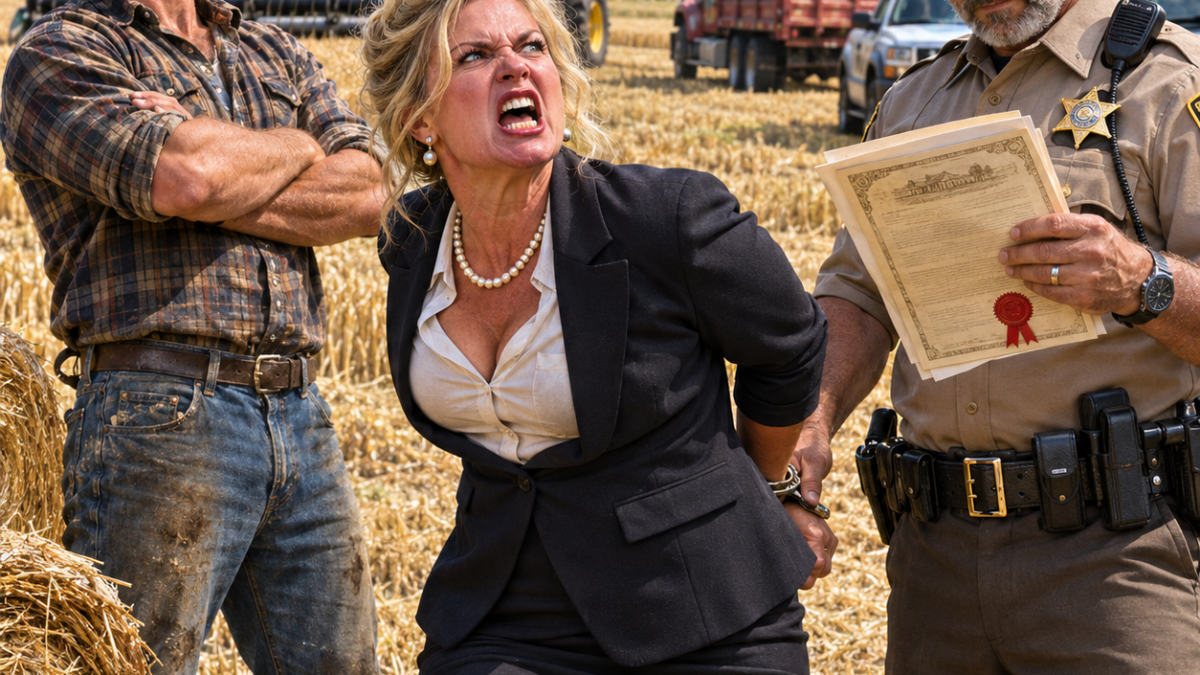
She reached out and poked the sergeant in the chest.
Everything stopped.
Even Karen seemed to realize she’d gone too far.
Miller looked down at her finger.
Then back at her face.
“Ma’am.”
His voice became completely flat.
“Turn around.”
Her eyes widened.
“What?”
“You are under arrest for criminal trespass.”
It took several seconds for the sentence to penetrate.
Then she laughed.
A strange, breathless sound.
“You’re joking.”
“No.”
“I’m Karen Miller.”
“I know your name.”
“I am the president of Harmony Creek.”
“Turn around.”
“You can’t arrest me.”
“I am arresting you.”
The younger deputy moved closer.
Karen backed away.
“Don’t touch me.”
“Ma’am.”
“You’ll lose your job.”
“Turn around and place your hands behind your back.”
“My husband knows the county executive.”
“Hands behind your back.”
“I’m warning you.”
The younger deputy reached gently for her arm.
Karen ripped away.
“GET YOUR HANDS OFF ME!”
That changed everything.
The deputies moved at once.
No anger.
No drama.
Training.
One took her right arm.
The other controlled her left.
Karen twisted and shouted.
“I’m not resisting!”
“Stop pulling away.”
“I am not resisting!”
“Ma’am, stop resisting.”
“You people are insane!”
Then came the sound.
Click.
Click.
Handcuffs.
Silver steel closed around Karen’s wrists.
For six months, I’d received letters telling me where her authority began.
That morning, two small clicks announced exactly where it ended.
Karen stared over her shoulder.
At me.
At the excavator.
At the neighbors.
Her face looked completely different.
The arrogance was still there.
But something had finally broken through it.
Fear.
“You did this.”
Her voice trembled.
I shook my head.
“No, Karen.”
“You planned this.”
“I documented my property.”
“You trapped me.”
“I told you where the property line was.”
“You set me up!”
“I gave you the deed six months ago.”
She stopped struggling for a second.
That was the truth she couldn’t answer.
I had warned her.
Repeatedly.
Every letter.
Every certified envelope.
Every survey.
She’d been given opportunity after opportunity to stop.
But stopping would have required something Karen almost never did.
Admit she was wrong.
Sergeant Miller guided her toward the cruiser.
More doors opened along Harmony Creek.
Neighbors came outside.
Nobody cheered.
Not yet.
The shock was too fresh.
Mrs. Garcia stood beside the stroller with one hand over her mouth.
Mr. Miller gave me the smallest thumbs-up I’d ever seen.
Karen saw him.
“Robert!”
He froze.
“You know this land belongs to Harmony Creek!”
For the first time since I’d known him, the old man didn’t lower his eyes.
“No, Karen.”
She stared.
Robert Miller shut off his hose.
“It doesn’t.”
The deputy placed her into the patrol car.
The door closed.
Karen disappeared behind the glass.
Sergeant Miller returned.
“Well.”
I waited.
“That escalated.”
Ray laughed from the excavator.
Miller almost smiled.
Then he became serious.
“You’re going to need to make a formal statement.”
“I expected that.”
“Regarding the false-report allegation, we’ll need evidence that she knowingly provided false information, not simply that she was mistaken.”
“I have six months of certified correspondence showing she received copies of the deed and surveys.”
His eyebrows rose.
“Six months?”
I walked toward my truck.
Pulled out the binder.
Handed it to him.
He looked at the thickness.
“You’re kidding.”
“No.”
He opened it.
Certified receipts.
Violation notices.
My responses.
Original plat.
Updated plat.
Photographs.
Emails.
Copies of county records.
He flipped through several pages.
“Did your attorney put this together?”
“I did.”
“Military?”
“Twenty years.”
He nodded as though that explained something.
“Keep all of this.”
“I have copies.”
“Of course you do.”
He gave me his card.
“We’ll contact you.”
“Thank you.”
He started toward the cruiser.
“Sergeant?”
He turned.
“Can I continue digging?”
He looked at the excavator.
Then at the survey marker.
Then smiled.
“Have a good day, Mr. Garrison.”
The cruisers pulled away.
Karen’s abandoned golf cart remained beside the road.
For a few moments nobody moved.
Ray leaned out.
“So.”
“Yeah?”
“Are we getting paid by the hour?”
I laughed.
“Start digging.”
The diesel engine roared back to life.
The bucket lowered.
Steel hit dirt.
Across the road, Robert Miller started clapping.
Slowly.
Once.
Twice.
Then Mrs. Garcia joined.
I raised one hand.
“Please don’t.”
Robert stopped.
“Why?”
“Because this isn’t over.”
He looked toward the road where the sheriff’s cars had disappeared.
“Son, something ended today.”
He was right.
I just didn’t understand yet how much.
Six months earlier, I’d moved into that house because I wanted peace.
After twenty years of military life, I’d had enough temporary addresses.
Enough packing.
Enough rooms that never really felt mine.
Enough waking up and needing half a second to remember what city, base, state, or country I was in.
I wanted roots.
Not metaphorical ones.
Actual roots.
Trees.
Soil.
A place where I could build something and know I’d still be there to see it weather.
The listing had looked ordinary.
Older house.
Half acre.
Nothing glamorous.
The strange part was the land behind it.
A rectangular corridor stretched beside Harmony Creek.
Fifty yards wide.
About fifty yards deep.
An artifact from an old farm subdivision.
The real-estate agent called it a flag lot.
I called it perfect.
The main house gave me a home.
The rear parcel gave me space.
I imagined the workshop immediately.
Timber frame.
Steel siding.
Two large doors.
Room for my woodworking bench.
Engine stand.
Motorcycle lift.
Welding table.
Shelves.
A wood stove in the corner.
A place where I could make things instead of spending my days remembering things.
I didn’t buy blindly.
I spent more on due diligence than my realtor thought necessary.
Two title searches.
County records.
A boundary survey.
I walked every line with the surveyor.
“Paranoid?” he asked.
“Thorough.”
“Same thing if you’re paying me twice.”
Everything was clear.
Harmony Creek surrounded part of the parcel.
It did not own it.
There were no HOA covenants recorded against my property.
No dues.
No architectural authority.
No shared maintenance obligation.
That independence mattered.
I didn’t hate HOAs.
I just didn’t want one.
I had spent most of my adult life inside organizations with strict rules.
In retirement, I didn’t need someone measuring my grass.
For the first few months, Harmony Creek barely registered.
I’d see residents walking dogs.
Golf carts.
Kids riding bicycles.
Everything looked immaculate.
Mailboxes matched.
Fences matched.
Roofs looked almost identical.
Lawns stopped at exactly the same height.
It wasn’t my style.
But it wasn’t my problem.
Then Karen arrived.
Saturday morning.
I was replacing fence boards.
White golf cart.
White tennis outfit.
White visor.
She stopped beside my driveway like she’d been dispatched by central command.
“Good morning!”
Her voice was sweet enough to cause diabetes.
“Morning.”
“You must be our new neighbor.”
“Jack Garrison.”
“Karen Miller. President of the Harmony Creek Homeowners Association.”
She said president the way some people say ambassador.
She lifted a basket from the passenger seat.
Muffins.
Wine.
A thick binder.
“We like to personally welcome every new homeowner.”
“Appreciate it.”
She handed me the basket.
Then the binder.
“Community covenants.”
I looked at it.
“Won’t need that.”
Her smile flickered.
“Oh?”
“My property isn’t in Harmony Creek.”
She laughed.
Not because I’d said something funny.
Because she thought I was confused.
“All adjoining parcels fall under Harmony Creek standards.”
“No.”
I kept my tone polite.
“This parcel predates the development. Developer never acquired it.”
“I’m sure that’s what your realtor told you.”
“It’s what the deed says.”
“Real-estate documents can be confusing.”
“Not this one.”
She studied me.
The warmth left her eyes.
“Our association maintains the standards of the entire contiguous area.”
“On property it governs.”
“Exactly.”
“Mine isn’t one of them.”
Silence.
Then the smile returned.
“Well, I’m sure we can clear that up.”
“Nothing to clear up.”
Karen put both hands on the steering wheel.
“You’ll want to read the architectural section before making any exterior improvements.”
“I’m planning a workshop.”
Her head turned sharply.
“A workshop?”
“Eventually.”
“Where?”
I pointed toward the rear parcel.
Her smile vanished.
“Absolutely not.”
I almost laughed.
“Excuse me?”
“That area is protected common green space.”
“That area is mine.”
“No.”
“Karen.”
“Mr. Garrison, you’re new here.”
“That doesn’t change the deed.”
She stared at me for several seconds.
Then started the golf cart.
“We’ll discuss this again.”
“I don’t think we need to.”
She drove away.
Two weeks later, the first violation notice arrived.
Unapproved fencing material.
$50.
Additional $10 daily.
I looked at the fence.
I’d replaced rotten cedar with cedar.
Same height.
Same design.
Same boards.
The absurdity was almost impressive.
I wrote a formal response.
Not angry.
Not sarcastic.
Facts.
My parcel was not subject to Harmony Creek HOA jurisdiction.
Attached were copies of the deed and plat.
I sent it certified mail.
Return receipt requested.
Karen signed for it personally.
A week later she came back.
No basket.
No smile.
“I received your letter.”
“I know.”
“And your little map.”
“County plat.”
“Whatever you want to call it.”
“It’s what the county calls it.”
She thrust another notice toward me.
“Your fine has increased.”
“I don’t owe you a fine.”
“That’s for a judge to decide.”
“Are you filing something?”
Her expression shifted.
“No need yet.”
“Then who’s the judge?”
She ignored that.
“Your grass also exceeds four inches.”
I looked toward the yard.
It had rained for three days.
The grass might have been four and a half.
She handed me another $50 notice.
“Pay them before we place a lien.”
That got my attention.
“You can’t lien property outside your association.”
“We’ll see.”
“Is that a threat?”
“It’s information.”
She dropped the paper onto the driveway.
Then drove away.
I picked it up.
Went inside.
And created a file.
I labeled it:
**HARMONY CREEK / KAREN MILLER**
I didn’t know it then, but that binder would eventually help destroy her presidency.
The next months followed a pattern.
Karen sent a violation.
I saved it.
She sent another.
I saved it.
I responded only when necessary.
Always certified.
Always factual.
No emotional language.
Then she threatened to stop my workshop.
That was when I started researching Harmony Creek itself.
County clerk.
Planning department.
Recorder.
Old development maps.
Original property acquisition documents.
I found the exact deed from when Harmony Creek’s developer assembled the subdivision.
They purchased almost every surrounding parcel.
Almost.
My strip of land remained with the old farming property because its owner refused to sell.
Harmony Creek built around it.
Then sometime later, somebody wrote overly broad language into an HOA charter describing “undeveloped contiguous property” as common ground.
But writing something in HOA paperwork didn’t magically transfer title.
Karen either didn’t understand that…
or didn’t care.
Then I found the Covington case.
A family whose backyard bordered Harmony Creek.
Karen had claimed part of their wooded property as an HOA nature buffer.
Letters.
Threats.
Legal fees.
They fought for months.
Eventually they sold.
Then another dispute.
A shed.
Property line.
Karen won again—not in court, but through exhaustion.
And another.
The pattern became impossible to ignore.
She wasn’t confused.
At minimum, she had repeatedly exploited uncertainty.
I started talking to residents.
At first they were terrified.
Robert Miller advised me to surrender.
“Just pay her.”
“I’m not in the HOA.”
“Doesn’t matter to Karen.”
“It matters to me.”
He sighed.
“Son, you don’t understand.”
“Explain.”
“She’ll keep going until you’re tired.”
I remember that sentence.
She’ll keep going until you’re tired.
“Has she done that to you?”
Robert looked toward his house.
“Bird feeder.”
“What?”
“Two-hundred-dollar fine because it attracted undesirable birds.”
I thought I’d misunderstood.
“What birds?”
“Pigeons.”
“There aren’t any pigeons here.”
“I know.”
“Did you appeal?”
Robert looked embarrassed.
“No.”
“Why?”
“Because my wife wanted it over.”
There it was.
Karen’s true weapon.
Not law.
Peace.
People paid her to get their peace back.
The Garcias had repainted their door three times.
First beige too warm.
Second beige too gray.
Third finally accepted.
A single mother was fined because her daughter’s sidewalk chalk was considered graffiti.
One retired couple removed a small wooden swing because Karen said it was an unapproved structure.
A veteran received warnings over a flag bracket.
Each story sounded insignificant by itself.
Combined, they formed a regime.
I asked people to document what happened.
Some refused.
Too scared.
Some agreed anonymously.
A few signed statements.
My binder got thicker.
By month five, I knew a conventional lawsuit wasn’t enough.
I could sue.
Spend a year.
Maybe two.
Win.
Karen would tell everyone I’d exploited a technicality.
Nothing would change.
And litigation cost money even when you’re right.
Karen’s strategy depended on that.
She assumed I would either surrender or enter a long legal fight she could use to exhaust me.
I wanted something undeniable.
Public.
Fast.
Then I realized what Karen couldn’t resist.
Construction.
If I started the workshop on the disputed parcel, she would escalate.
She’d call law enforcement.
Probably personally.
Maybe she’d enter my property.
And if she did it after receiving months of documentation?
Her own behavior would become the evidence.
I took the plan to an attorney named Michael Reeves.
Former prosecutor.
Property and criminal law.
His office wasn’t fancy.
That made me like him immediately.
I put the binder on his desk.
He opened it.
“How long have you been doing this?”
“Six months.”
“Did someone teach you evidence preservation?”
“Marine Corps.”
He nodded.
“That explains the tabs.”
For an hour, he read.
Then leaned back.
“This woman is either spectacularly careless or spectacularly arrogant.”
“Both.”
“Probably.”
I explained the plan.
Excavator.
Certified survey.
Witnesses.
Karen reacts.
Sheriff arrives.
Reeves stared at me.
“You’re baiting her.”
“I’m doing lawful construction.”
“You’re doing lawful construction at a specific time because you expect a specific unlawful reaction.”
“Correct.”
He almost smiled.
“Just so we’re clear.”
“I’m clear.”
He became serious.
“Do not manufacture a crime.”
“I won’t.”
“Do not encourage her onto your land.”
“I won’t.”
“Do not threaten her.”
“No.”
“Do not obstruct her leaving.”
“No.”
“Do not tell police she’s committed a crime you can’t support.”
“I’ll state facts.”
He tapped the binder.
“Good.”
Then he gave me the most important advice of the entire fight.
“When the deputies arrive, stop thinking about Karen.”
“What do you mean?”
“People lose cases because they start performing for the person they’re angry at.”
He pointed at me.
“Don’t argue with her. Don’t humiliate her. Talk to law enforcement.”
“Understood.”
“Your deed.”
“I’ll carry the original.”
“Survey.”
“Certified.”
“Markers?”
“High visibility.”
“Attorney’s number.”
“In my phone.”
“Then if she’s dumb enough to call the sheriff after all this?”
He closed the binder.
“Let her.”
The survey crew arrived the following Friday.
Karen appeared within thirty minutes.
Of course.
Three men were driving stakes when her golf cart stopped along the road.
“What are you doing?”
The surveyor looked at me.
I walked over.
“Marking my boundary.”
“You are not authorized to alter HOA common ground.”
“They’re not altering anything.”
“Those stakes are on our land.”
“They aren’t.”
She stepped toward the string line.
I raised my phone.
“Karen.”
She stopped.
“Don’t cross the line.”
Her eyes went to the phone.
“Are you threatening me?”
“I’m telling you where my property begins.”
“You cannot exclude the HOA president from common area.”
“This isn’t common area.”
She looked at the survey crew.
“I’m warning all of you that you may be personally liable.”
The chief surveyor shrugged.
“We’re working from recorded coordinates.”
“You’re wrong.”
“Take it up with the county.”
Her face turned crimson.
I nearly thanked him.
Instead, I recorded.
That clip would later matter.
Karen had been standing directly beside a marked boundary, hearing a professional surveyor explain the parcel.
She couldn’t credibly claim she had never known.
Tuesday morning came.
And she took the bait exactly as Reeves predicted.
After the arrest, I spent nearly three hours at the sheriff’s station.
I gave a statement.
Provided copies of correspondence.
Provided the survey video.
Provided certified-mail receipts.
The false-report issue wasn’t as automatic as I’d imagined.
Sergeant Miller explained that being wrong wasn’t necessarily criminal.
Intent mattered.
Knowledge mattered.
Karen’s attorney would argue she believed the HOA owned the land.
“That’s why the paper trail matters,” he said.
“I understand.”
“You really want to pursue it?”
“Yes.”
He studied me.
“This personal?”
“Yes.”
I surprised him.
Then added:
“But not only personal.”
I explained the Covingtons.
The fines.
The other property disputes.
Miller leaned back.
“That’s HOA business.”
“Most of it.”
“Some may be civil.”
“I know.”
“But you think this report was part of harassment.”
“I know it was.”
He nodded.
“We’ll send everything to the prosecutor.”
“What about trespass?”
“Cleaner.”
“Because she refused the order.”
“And because ownership was established before she refused.”
“Resisting?”
“Potential.”
I didn’t push.
I’d learned enough.
Let evidence work.
When I returned home, the workshop footing was half excavated.
Ray had stayed.
He handed me coffee.
“Thought you might need it.”
“Thanks.”
“Did they book her?”
“Yes.”
He whistled.
“I’ve dug swimming pools with less drama.”
“Please don’t tell my contractor that.”
“I’m definitely telling your contractor.”
By evening, Harmony Creek was buzzing.
Robert came over.
First time he’d crossed the street voluntarily.
He stopped at the property line.
“May I?”
I smiled.
“Yes.”
He stepped over.
For a moment, he looked down at the grass as though crossing that boundary had become symbolic.
“She got released.”
“I expected.”
“Her husband bailed her out.”
“Okay.”
Robert stared at the excavation.
“You actually did it.”
“Started the workshop?”
“No.”
He looked at me.
“You stood up to her.”
I didn’t know how to answer.
Robert continued.
“People are calling.”
“About?”
“Everything.”
“Everything?”
“Things she’s done.”
He shook his head.
“Jack, I knew people were angry. I didn’t know how angry.”
“You were all isolated.”
“Yes.”
That was exactly it.
Karen had dealt with every family privately.
One letter.
One fine.
One threat.
People thought they were alone.
Robert looked embarrassed.
“I told you to give up.”
“I remember.”
“I was wrong.”
“You were trying to protect yourself.”
“No.”
His voice hardened.
“I was scared.”
There are moments when a person doesn’t need comforting.
They need the dignity of being allowed to tell the truth.
So I didn’t say anything.
Robert looked toward Karen’s house.
“I don’t want to be scared of my neighbor anymore.”
“Then don’t.”
He nodded slowly.
“Garcias are having people over Saturday.”
“For what?”
“To talk.”
I looked at him.
“That’s new.”
“Very.”
Saturday afternoon, the Garcias’ backyard filled with folding chairs.
Thirty people came.
Then forty.
Someone brought lemonade.
Someone else brought cookies.
It could have been a neighborhood barbecue if not for the anger in everyone’s voices.
I brought the binder.
Not because I wanted to be the center.
Because they needed to see the evidence.
Robert held up one of Karen’s fines.
“This is mine.”
Bird feeder.
A woman behind him laughed bitterly.
“Mine was worse.”
She showed a notice over an oil stain.
Another man described a swing set.
Another a mailbox.
Another said Karen had threatened foreclosure over accumulated penalties.
Mrs. Garcia stood beside the patio table.
“How many of us thought we were the only ones?”
Almost every hand rose.
That was the most powerful moment of the afternoon.
Not anger.
Recognition.
People looked around and realized their private humiliations were shared.
I opened the binder to the property disputes.
“The Covingtons.”
Several people nodded.
One woman whispered:
“They moved because of her.”
“Yes.”
I showed the record.
“What happened to them wasn’t isolated.”
Someone asked:
“What do we do?”
I looked around.
“I’m not in your HOA.”
That drew a few laughs.
“I’m serious.”
I closed the binder.
“This is your association. Not mine.”
Robert said:
“But you beat her.”
“No.”
I pointed toward the street.
“The county deed beat her. Her own behavior got her arrested.”
Mrs. Garcia said:
“Same difference.”
“It isn’t.”
I looked at everyone.
“If all you do is replace Karen with somebody who likes power just as much, you’ll be back here in five years.”
The yard became quiet.
“You don’t need a hero.”
I continued.
“You need rules that apply to the people enforcing them too.”
A man near the fence said:
“The board won’t remove her.”
“Then remove the board.”
That sentence moved through the gathering like electricity.
A woman asked:
“Can we?”
Robert looked at her.
“We elected them.”
Someone pulled out a copy of the bylaws.
Within an hour, people were calculating petition thresholds.
Seventy-five percent of homeowners eventually signed.
The emergency meeting was scheduled for Wednesday.
Karen tried to stop it.
Of course.
First came an email claiming the petition was improperly formatted.
Then a letter warning that residents circulating “defamatory allegations” could face legal action.
That backfired spectacularly.
Mrs. Garcia posted the letter beside the petition.
More people signed.
On Tuesday, the day before the meeting, Karen came to my property.
She did not cross the line.
She couldn’t.
The temporary court order after her arrest prohibited contact and entry.
She stopped her car across the road.
I was standing near the workshop foundation.
Her window lowered.
I looked over.
“Jack.”
I didn’t approach.
She called again.
“Jack!”
I stayed where I was.
“You can’t speak to me,” I said.
“I’m across the street.”
“The order says no contact.”
“This is important.”
“So is the order.”
Her hands tightened on the steering wheel.
“Tell them tomorrow’s meeting is illegal.”
“No.”
“You caused this.”
“No.”
“You handed them that binder.”
“They asked.”
“You’ve poisoned everyone against me.”
I almost answered emotionally.
Then I remembered Reeves.
Don’t perform for the person you’re angry at.
I took out my phone.
Karen saw it.
Her expression changed.
I said:
“You’re violating the no-contact condition.”
The window went up.
She drove away.
That was the final direct conversation we had for months.
Wednesday night’s meeting was standing-room only.
I sat in the back.
Harmony Creek residents filled every chair.
The remaining board members sat at a long table.
Karen’s chair was empty because her attorney had advised her not to attend.
Without her, the board looked strangely ordinary.
Robert Miller stood.
His hands trembled.
I’d seen this man hide from Karen behind his flowers.
Now he faced more than a hundred neighbors.
“My name is Robert Miller.”
Someone chuckled.
“We know, Robert.”
He smiled nervously.
“For years, I paid fines I didn’t believe were fair because I was afraid fighting would cost more than surrendering.”
The room quieted.
“I told other people to do the same thing.”
He looked toward me.
“I even told Jack.”
I nodded.
Robert continued.
“I thought keeping quiet protected my family.”
His voice thickened.
“It didn’t. It only protected the people making us afraid.”
Nobody moved.
He held up Karen’s bird-feeder violation.
“This cost me two hundred dollars.”
Soft laughter.
“Sounds ridiculous, doesn’t it?”
More laughter.
“My wife cried when this letter arrived.”
The laughter stopped.
“Not because of two hundred dollars.”
He swallowed.
“Because every time we saw that HOA logo in the mailbox, we wondered what we’d done wrong now.”
That hit the room.
Karen’s power wasn’t in any individual fine.
It was anticipation.
The fear of the next letter.
Robert put the notice down.
“We are not here tonight to discuss flower beds.”
Applause started.
“We are here because our board allowed rules to become weapons.”
Louder applause.
“And because our president used this association to pursue property our association never owned.”
Someone shouted:
“Exactly!”
The board secretary tried to speak.
Robert raised one hand.
“You’ll get your turn.”
The room erupted.
Not because he was being disrespectful.
Because Robert had changed.
One by one, residents spoke.
The Garcias told the door story.
A single mother described her daughter’s sidewalk chalk.
An elderly man talked about dismantling a play structure his grandchildren loved.
Another family described being threatened over holiday decorations.
Then a former neighbor of the Covingtons stood.
“Karen drove them out.”
The room went silent.
“I watched it happen.”
He described legal threats.
Letters.
Boundary claims.
Eventually the Covingtons sold.
“I did nothing.”
His voice broke.
“I told myself it wasn’t my problem.”
He sat down.
That was the emotional center of the meeting.
Not Karen.
Us.
All the times decent people stay quiet because something bad is happening to somebody else.
The vice president eventually spoke.
“We acknowledge mistakes were made.”
The crowd groaned.
“Mistakes?”
Mrs. Garcia stood.
“She called the sheriff on a man for building on his own land!”
The vice president tried again.
“We did not authorize—”
Robert interrupted.
“Did the board know she was claiming Jack’s parcel?”
Silence.
“Yes or no?”
“Yes.”
“Did anyone check the county record?”
No answer.
Robert nodded.
“That’s why all of you need to go.”
The motion came from the floor.
Vote of no confidence.
Then removal procedures.
Whatever Karen had expected, she lost by an overwhelming margin.
The entire board was swept out.
Robert became interim president.
Mrs. Garcia became treasurer.
Two younger residents filled other seats.
Their first major vote was amnesty.
Outstanding discretionary fines from Karen’s tenure were suspended pending review.
People cried.
Actually cried.
One woman hugged Mrs. Garcia.
Another man tore up a violation notice outside.
I didn’t.
I stood near the door.
Watched.
When Robert saw me, he walked over.
“You did this.”
“No.”
“Jack.”
“You did.”
He looked around.
“We needed someone to show us.”
“Maybe.”
He held out his hand.
“Thank you.”
I shook it.
“Don’t become Karen.”
Robert laughed.
“That’s your congratulations?”
“Best advice you’ll get.”
My workshop went up slowly over the next four months.
Footings.
Foundation.
Frame.
Roof.
Steel siding.
Electrical.
Every stage felt more satisfying because I’d come so close to letting Karen make me abandon it.
One afternoon Ray came back to grade around the building.
He parked the excavator beside the foundation.
“Remember last time?”
“Unfortunately.”
“Best job I’ve ever had.”
“You spent half of it waiting while police arrested somebody.”
“Exactly.”
The criminal case moved more slowly.
Karen’s attorney argued she had acted in good faith.
They claimed the HOA documents created genuine confusion.
They argued her report was based on a reasonable belief.
My attorney wasn’t surprised.
“Good faith is their entire case.”
“What happens?”
“Prosecutor decides what they can prove.”
“And trespass?”
“Stronger.”
“Resisting?”
“Stronger still.”
Months passed.
Hearings.
Evidence requests.
Depositions.
Then an offer.
Karen would plead to a reduced charge of disorderly conduct.
Probation.
Fine.
Community service.
Formal apology.
No-contact order.
I met Reeves.
“You’re disappointed.”
“Maybe.”
“You wanted false reporting.”
“I wanted accountability.”
“This is accountability.”
“Feels small.”
He leaned forward.
“Jack, criminal court is not a morality play.”
I said nothing.
“She was arrested.”
“Yes.”
“Removed from office.”
“Yes.”
“Facing civil action.”
“Yes.”
“Under permanent restrictions regarding your property.”
“Yes.”
“Your workshop?”
“Almost finished.”
“Neighborhood?”
“Better.”
He spread his hands.
“What exactly are you trying to win now?”
That question bothered me.
Because I knew the answer.
I wanted Karen to hurt.
I didn’t say it.
Reeves saw it anyway.
“There’s a point where justice becomes revenge.”
“I know.”
“Do you?”
I looked out his office window.
“I spent six months being threatened.”
“I’m aware.”
“She tried to take my land.”
“I know.”
“Other families lost money.”
“I know.”
“One moved.”
“Yes.”
“Now she gets probation.”
“She gets consequences.”
“Not enough.”
“According to whom?”
Silence.
Reeves leaned back.
“If you want my professional opinion, accept the plea.”
“Why?”
“Because it locks in accountability without the uncertainty of trial.”
“And personally?”
He smiled faintly.
“Because you’re building a workshop, Jack.”
“So?”
“Go use it.”
I accepted.
The court hearing was less dramatic than Karen’s arrest.
No screaming.
No crowd chanting.
Karen wore a dark suit.
Her husband sat behind her.
I sat with Reeves.
The judge reviewed the agreement.
Karen stood.
“Do you understand the charge?”
“Yes.”
“Do you understand the plea?”
“Yes.”
“Are you entering it voluntarily?”
She hesitated.
Then:
“Yes.”
The judge looked at her over his glasses.
“I’ve reviewed the underlying reports.”
Karen stared forward.
He continued.
“Community associations serve legitimate purposes. They do not confer police powers on board officers.”
Her face tightened.
“And disputes over property must be resolved through lawful channels, not intimidation.”
I watched her shoulders.
They seemed smaller.
Probation.
$2,000 fine.
Two hundred hours community service.
No contact with me or my family.
No entry onto my property.
Formal written apology.
When it ended, Karen walked past me without looking over.
I expected satisfaction.
What I felt was exhaustion.
Reeves touched my shoulder.
“Go home.”
I did.
The workshop was nearly complete.
I opened the big double doors.
Walked inside.
Sunlight crossed the concrete floor.
My workbench stood against the wall.
Motorcycle frame on a lift.
Shelves half built.
The smell of fresh lumber filled the space.
I stood there for a long time.
This was what I’d wanted.
Not court.
Not handcuffs.
Not an HOA revolution.
A room.
A place to work.
A place nobody else controlled.
I realized then how close I’d come to letting Karen define the entire experience.
If my greatest satisfaction became seeing her punished, she still owned part of the story.
I didn’t want that.
The HOA’s new board filed its own civil action later.
Association records revealed Karen had spent thousands on attorney consultations and enforcement actions with questionable authorization.
The board sought recovery.
I wasn’t involved beyond providing documents.
Months later, Karen and her husband listed their house.
It sold.
They moved.
No farewell.
No confrontation.
One morning, I noticed the golf cart was gone.
That mattered more than I expected.
For years, residents had recognized that white cart the way occupied towns recognize a patrol.
It appeared.
People moved trash cans.
Put things away.
Closed garage doors.
Now it was gone.
Kids left bicycles in driveways.
Nobody died.
A house painted its front door dark blue.
Property values did not collapse.
Someone installed a basketball hoop.
Society continued.
Robert’s HOA meetings lasted forty minutes instead of three hours.
His guiding rule became simple:
“If it doesn’t affect safety, shared infrastructure, or another owner’s actual rights, think very carefully before turning it into association business.”
People loved him for it.
He hated being president.
That was probably why he was good at it.
One afternoon, he came into my workshop.
By then the interior was finished.
Pegboard.
Tools.
Welder.
Motorcycle lift.
Old radio.
Coffee pot.
Robert walked around.
“This is what caused all that?”
“This was what she tried to stop.”
He ran one hand over the workbench.
“Worth it?”
I thought.
“Yes.”
“Even everything else?”
“No.”
He looked at me.
“I wouldn’t choose the fight.”
I continued.
“But I would choose not surrendering.”
Robert nodded.
“Difference.”
“Big one.”
A year passed.
Life became ordinary again.
That’s what I wanted.
Then one afternoon I was restoring an old motorcycle when a county maintenance truck stopped along the road.
Several workers in orange vests climbed out.
Community-service crew.
I barely paid attention.
Then I saw her.
Karen.
Orange vest.
Work gloves.
Trash grabber.
For a second, I didn’t recognize her.
The polished image was gone.
No golf cart.
No clipboard.
No HOA binder.
She moved slowly along the shoulder collecting litter.
I stood near the workshop window.
She was less than fifty yards away.
Once, I’d imagined seeing this.
I thought I would enjoy it.
The mighty Karen reduced to picking trash from the roadside.
Instead, I felt almost nothing.
Maybe pity.
Mostly distance.
She didn’t look toward my property.
Not once.
She kept her eyes down.
A paper cup.
Plastic wrapper.
Another cup.
The crew moved on.
I went back to the motorcycle.
That was when I knew I’d actually won.
Not when Sergeant Miller read my deed.
Not when the cuffs closed.
Not when the board fell.
Not when the judge accepted the plea.
I won when Karen could stand fifty yards away and I no longer cared enough to watch.
I tightened a bolt.
Checked the torque.
Turned on the radio.
Outside, Harmony Creek continued without her.
Years of fear hadn’t destroyed the neighborhood.
They had only taught people to forget what a neighborhood was supposed to feel like.
Slowly, they remembered.
Robert planted another bird feeder.
The first morning I saw it, I walked across the street.
“Approved species?”
He grinned.
“Extremely dangerous pigeons.”
“I heard they’re coming over the mountains.”
“Any day now.”
Mrs. Garcia’s daughter covered the sidewalk in chalk.
Purple stars.
Blue houses.
A giant yellow sun.
One drawing reached almost twenty feet.
Her mother saw me looking.
“Think we need a permit?”
“Definitely.”
“Should I call Robert?”
“Call the sheriff.”
We both laughed.
That humor mattered.
For years, HOA rules had been something people whispered about.
Now they could joke.
The Covington property eventually sold to another family.
Robert personally contacted them.
He gave them every survey.
Every boundary record.
Every amendment.
He told them:
“If this association ever claims something that isn’t ours, make us prove it.”
That’s how institutions should work.
Not “trust us because we have authority.”
Make us prove it.
The new board rewrote portions of the governing documents.
Ambiguous language removed.
Enforcement deadlines.
Notice requirements.
Clear hearing process.
Limits on fines.
Recorded votes.
No unilateral property claims.
Residents approved the amendments.
Robert showed me the final version.
“What do you think?”
I skimmed.
“Too many words.”
He laughed.
“Anything else?”
“This section.”
I pointed.
Board members couldn’t initiate property enforcement involving disputed title without legal verification.
Robert smiled.
“We call that the Garrison Clause.”
“No.”
“Too late.”
“Absolutely not.”
“Already passed.”
“I’m suing.”
“Get in line.”
I never joined the board.
They asked.
Repeatedly.
No interest.
Some people thought that was strange.
“You basically started the reform.”
No.
I defended my dirt.
Other people did the reform.
I didn’t want a position.
I wanted the right not to need one.
That’s an important distinction.
Karen believed freedom meant being the person who gave permission.
I believed freedom meant not needing unnecessary permission in the first place.
The workshop became exactly what I’d imagined.
Maybe better.
I restored three motorcycles.
Built furniture.
Fixed neighbors’ lawn equipment.
Taught Robert how to use a welder badly.
He burned a hole in scrap steel and nearly set his sleeve on fire.
“Don’t tell the HOA.”
“I am the HOA.”
“That’s terrifying.”
On Saturdays, people sometimes stopped by.
Harmony Creek residents.
The same people who once avoided me because Karen had painted me as the dangerous outsider.
Coffee.
Tools.
Conversation.
One day an older man I barely knew came in carrying a wooden box.
“What’s this?”
“My father’s hand planes.”
He opened it.
Beautiful old tools.
“He died ten years ago.”
I touched one carefully.
“Why bring them here?”
“I heard you restore things.”
“Machines mostly.”
He smiled.
“Maybe these too.”
I spent weeks cleaning them.
Flattening soles.
Sharpening irons.
Removing rust without destroying the patina.
When I returned them, he cried.
That moment mattered more to me than Karen’s arrest.
My workshop, the building she wanted stopped, had become a place where neighbors brought broken things.
And sometimes they left repaired.
The irony wasn’t lost on me.
Harmony Creek itself had done something similar.
Broken things can be repaired.
Not erased.
Repaired.
Robert once asked whether I thought Karen was evil.
“No.”
He seemed surprised.
“Seriously?”
“Seriously.”
“After everything?”
“Bad behavior doesn’t require evil.”
“Then what was she?”
I thought.
“Someone who discovered people would obey if she pushed hard enough.”
“That’s it?”
“Then she started believing obedience meant she was right.”
Robert nodded slowly.
“Power.”
“Unchecked power.”
“Same thing?”
“No.”
I looked toward the subdivision.
“Power can build something.”
Then I looked around the workshop.
“Or destroy it.”
The problem wasn’t that Karen had authority.
HOA presidents have authority.
Limited authority.
Defined authority.
The problem was that everyone around her stopped enforcing the limits.
Board members rubber-stamped.
Residents surrendered.
Attorneys sent threatening templates.
Nobody wanted the hassle of saying no.
Eventually Karen stopped recognizing the word.
Until one Tuesday morning.
No.
That land isn’t yours.
No.
You can’t stop the excavation.
No.
You can’t disregard the county deed.
No.
You can’t stand on private property after being ordered to leave.
No.
Your title doesn’t put you above an officer’s lawful command.
Handcuffs were dramatic.
But “no” was what really ended her reign.
A couple of years later, I saw Sergeant Miller again.
He stopped by while off duty.
Pickup truck.
Jeans.
Baseball cap.
I almost didn’t recognize him.
“Jack.”
“Sergeant.”
“Mike.”
“Mike.”
He looked at the workshop.
“Finally got it built.”
“Despite your best effort.”
He laughed.
“Hey, I let you continue.”
“After shutting me down.”
“For approximately twelve minutes.”
“Traumatic.”
He walked inside.
Whistled.
“Nice.”
“Thanks.”
He looked around.
Then said:
“You know, that call gets discussed at the department.”
“Why?”
“Training.”
I stared.
“For what?”
“Property disputes. HOA calls. Deeds versus private association documents.”
“You use Karen as a training example?”
“Not by name.”
“Shame.”
He smiled.
“Also de-escalation.”
“That part didn’t go great.”
“No.”
He looked embarrassed.
“Actually that’s why I stopped.”
I waited.
“When I first arrived, I assumed you were probably the problem.”
I appreciated the honesty.
“Why?”
“Heavy equipment. HOA president acting confident. Thick binder.”
“Karen had a binder.”
“Exactly.”
He laughed.
“She looked organized.”
“She was organized.”
“Just wrong.”
“Frequently.”
Mike became serious.
“Authority signals influence people.”
“Badge too.”
He nodded.
“Exactly.”
That surprised me.
“I’ve thought about that.”
He continued.
“If you hadn’t had the deed in your pocket, we probably would’ve shut down the construction and told you to go to court.”
“Probably.”
“Which would’ve rewarded the false claim.”
“Yes.”
He looked toward the orange survey marker I’d kept near the workshop door.
“Documentation saved you.”
“Documentation and Karen’s inability to stop talking.”
He laughed.
“Mostly that.”
Before leaving, Mike shook my hand.
“Glad it worked out.”
“So am I.”
“Still pressing charges if somebody steps over the line?”
“Depends who.”
He looked down.
One boot was technically several feet onto my property.
I stared at it.
He stepped backward.
“Better?”
“Much.”
We both laughed.
That was peace.
Not the absence of conflict.
The ability to remember conflict without being trapped in it.
The original deed is framed now.
Not because the paper itself is beautiful.
It isn’t.
It’s an ordinary county document.
Legal description.
Parcel number.
Recording stamp.
But I hung a copy in the workshop.
Robert saw it.
“That’s dramatic.”
“Historical artifact.”
“Want me to get a plaque?”
“No.”
“Here lies Karen’s career.”
“Get out.”
He laughed all the way to the door.
Below the framed deed, I eventually hung something else.
A small wooden sign.
My own work.
Three words:
**BUILD. DON’T BULLY.**
Corny.
Maybe.
But accurate.
Karen spent years trying to make people smaller.
My workshop reminded me I preferred making things larger.
Tables.
Machines.
Skills.
Relationships.
Community.
That’s the difference between control and leadership.
Control asks:
How do I make you obey?
Leadership asks:
What can we build together?
Harmony Creek learned the difference the hard way.
So did I.
Because I wasn’t innocent of every bad instinct.
At the height of the fight, I enjoyed outmaneuvering Karen.
I enjoyed the trap.
I enjoyed watching Sergeant Miller read my deed.
I enjoyed the second when she realized her binder meant nothing.
And yes, when the handcuffs clicked, part of me felt satisfaction.
I’d be lying if I claimed otherwise.
But that feeling faded quickly.
The things that lasted were different.
Robert standing up.
Mrs. Garcia speaking publicly.
Residents tearing down years of isolation.
A child drawing chalk on a sidewalk.
The workshop doors opening.
Neighbors walking in.
Those were victories worth keeping.
One evening, Robert and I sat outside the workshop drinking coffee.
He was older now.
So was I.
“You know what I regret?” he asked.
“What?”
“Not fighting sooner.”
I looked at him.
“Maybe you weren’t ready.”
“That’s an excuse.”
“Sometimes.”
He stared toward his house.
“My wife used to ask me to challenge the fines.”
“And?”
“I’d tell her peace was worth more than being right.”
“Reasonable sometimes.”
“Not that time.”
He shook his head.
“I thought surrender bought peace.”
I knew exactly what he meant.
“It bought quiet.”
He looked at me.
“That’s not the same.”
“No.”
Quiet can exist because everyone is afraid.
Peace exists because people feel safe.
Harmony Creek had once been very quiet.
Perfect lawns.
Identical mailboxes.
No chalk.
No stray toys.
No unapproved birds.
It looked peaceful.
It wasn’t.
After Karen, it became noisier.
Children.
Different doors.
Neighbors debating.
Occasional messy lawns.
Actual life.
And somehow that felt far more peaceful.
The final strange chapter came years after the arrest.
A letter arrived at my house.
No return address I recognized.
Inside was one page.
Karen.
I almost threw it away unread.
Instead, I sat at my workshop bench.
The letter was short.
She did not apologize exactly.
At least not at first.
She wrote that she had spent years believing Harmony Creek would deteriorate if someone didn’t enforce standards aggressively.
She said every time somebody complied after a warning, she believed that proved her methods worked.
Every time someone fought, she assumed they were selfish.
Every time the board deferred to her, she took it as confirmation that she knew best.
Then came one sentence I read twice.
**I stopped being able to tell the difference between protecting the community and controlling it.**
I put the letter down.
Continued later.
She said losing the presidency had devastated her because she hadn’t realized how much of her identity was tied to being needed—or obeyed.
Community service had humiliated her.
Moving had humiliated her.
The criminal case had humiliated her.
But over time, she wrote, humiliation became something else.
Perspective.
At the end:
**You were right about the property, and you were right to stop me. I wish I had understood that before I forced everyone to pay for my refusal to admit I was wrong.**
Then:
**I’m sorry.**
I sat there for a long time.
No triumph.
No anger.
Just a strange sadness.
People can destroy enormous parts of their lives protecting an identity they should have abandoned years earlier.
I didn’t respond immediately.
A week passed.
Then two.
Eventually I wrote four sentences.
**I received your letter. Thank you for writing it. What happened affected many people, not only me, but I appreciate your acknowledgment of that. I hope wherever you are now, you’ve found something better to build.**
I mailed it.
No more letters came.
That was enough.
I didn’t tell many people.
Not because I was protecting Karen.
Because some endings don’t need an audience.
Her arrest had been public.
Her downfall had been public.
Her apology could remain quiet.
A few months later, Robert noticed me taking the framed deed down.
“Renovating?”
“Cleaning.”
“Thought maybe you finally got tired of celebrating.”
“I don’t celebrate.”
“You framed government paperwork.”
“Historical artifact.”
He grinned.
I dusted the frame.
Then put it back.
The deed remained important.
But not because it beat Karen.
Because of what it represented.
A boundary.
People hear that word and think walls.
Fences.
Keeping others out.
But healthy boundaries don’t only divide people.
They allow relationships to exist without domination.
This is mine.
That is yours.
Here is what you may decide.
Here is what you may not.
The physical line on my survey had become the clearest symbol of everything Harmony Creek had forgotten.
Karen stepped across because she believed her title erased it.
It didn’t.
No title should.
The workshop eventually needed a new roof.
Not because of Karen.
Time.
Weather.
Normal life.
I hired a young contractor from Harmony Creek.
He’d been a teenager during the original fight.
While we were discussing materials, he looked at the framed deed.
“My dad told me about that.”
“Did he?”
“Everybody knows.”
“Unfortunately.”
“He says you got the HOA president arrested.”
“I did not get her arrested.”
“That’s not how he tells it.”
“Your dad likes drama.”
“He says she called the sheriff to arrest you and left in handcuffs.”
“That part is accurate.”
He laughed.
“Legend.”
“No.”
“What?”
“It wasn’t a legend.”
I pointed through the open door toward the neighborhood.
“It was paperwork.”
He thought I was joking.
I wasn’t.
Most abuse survives because facts feel less exciting than confidence.
Karen spoke confidently.
Her binder looked official.
She had a title.
She used words like covenant, jurisdiction, enforcement, lien.
Those words scared people.
My response was boring.
Parcel number.
Recording date.
Boundary coordinates.
Certified mail.
Receipt numbers.
Survey monuments.
That’s what defeated her.
Not a dramatic speech.
Facts.
Facts can be painfully boring.
They can also be incredibly powerful.
The contractor eventually finished the roof.
Before leaving, he asked:
“Any HOA approval?”
I stared.
He laughed.
“Sorry. Couldn’t resist.”
“Get off my property.”
“Yes, sir.”
Decades after I’d first wanted a permanent home, I finally understood why that strange little strip of land mattered so much to me.
Not because it was large.
It wasn’t.
Not because it was especially beautiful.
It wasn’t.
It mattered because it was indisputably ours.
After twenty years of moving when orders said move, living where assignments said live, leaving when schedules said leave, I wanted one place where no institution could casually tell me the ground beneath my boots belonged to someone else.
Karen never understood that.
To her, it was fifty yards of undeveloped land.
To me, it was permanence.
The first thing I built there was a workshop.
But that wasn’t the foundation that mattered most.
The real foundation had been laid the morning the excavator arrived.
One bucket.
One survey line.
One deed.
One refusal to surrender something simply because somebody louder insisted it belonged to them.
The older I get, the less I like the phrase “fight to win.”
Winning can become addictive.
Then you’re no better than Karen.
I prefer something else now.
Fight until the principle is secure.
Then stop.
Don’t keep destroying after the danger is gone.
Don’t confuse justice with humiliation.
Don’t build your identity around defeating somebody.
Build something real.
For me, it was the workshop.
For Robert, it was a better board.
For Mrs. Garcia, it was a neighborhood where her children didn’t have to fear sidewalk chalk.
For Harmony Creek, it was trust.
For Karen, maybe eventually it was humility.
Everyone built something after that day.
That’s why the story never really ended with handcuffs.
The handcuffs were only the loudest moment.
The real ending took years.
It happened in hundreds of quiet scenes.
A bird feeder left standing.
A blue door nobody challenged.
A bicycle in a driveway.
A resident disagreeing with the board without fear.
A meeting where records were available.
A president who hated having power.
A former bully admitting she had been wrong.
And an old veteran standing in a workshop that smelled like sawdust and engine oil, realizing he hadn’t thought about the HOA for weeks.
That’s freedom.
Not revenge.
Not domination.
Not watching your enemy suffer.
The ability to return your attention to the life they interrupted.
Sometimes people still ask me what the most satisfying sound was.
They expect me to say the click of Karen’s handcuffs.
For a while, I probably would have.
Now I have a different answer.
The sound I remember most clearly happened after the patrol cars disappeared.
Ray looked down from the excavator.
“So, are we good?”
I looked at the orange survey markers.
At the neighbors.
At the hole where my workshop would stand.
And I said:
“We’re good.”
Then that diesel engine started again.
The bucket dropped.
Steel hit earth.
And construction continued.
That’s the sound.
Not punishment.
Progress.
Years later, I still hear versions of it whenever I open the workshop doors in the morning.
A wrench on metal.
A saw cutting wood.
An engine turning over after months of restoration.
Rain striking the roof.
Neighbors laughing.
Normal sounds.
Useful sounds.
Sounds of things being built instead of controlled.
The deed still hangs on the wall.
The property line is still exactly where it always was.
Harmony Creek still exists.
So does its HOA.
Kids still leave bicycles outside.
Robert still claims pigeons are planning an invasion.
Mrs. Garcia’s family still uses sidewalk chalk.
And sometimes, when the sun is going down and the workshop doors are open, I stand on the same patch of earth where Karen once pointed at me and demanded the sheriff arrest me.
I remember her certainty.
I remember Sergeant Miller tracing the boundary on my survey.
I remember the moment he looked up and said:
“It appears you’re correct, sir.”
Everything changed because of that simple fact.
Not because the land suddenly became mine.
It had always been mine.
The only thing that changed was that somebody finally forced Karen to confront a truth she’d spent six months refusing to accept.
A title cannot rewrite a deed.
A binder cannot move a boundary.
Threats cannot create ownership.
And authority ends exactly where another person’s rights begin.
Karen learned that lesson in the most public way possible.
Harmony Creek learned it with her.
So did I.
Because boundaries aren’t only for keeping people out.
Sometimes they’re there to remind us where we should stop.
The morning she was arrested, I believed my victory was watching her cross that line and finally face consequences.
I was wrong.
The real victory was everything that happened afterward.
The workshop.
The neighbors.
The repaired community.
The quiet.
The ordinary freedom to live on my own land without expecting another cream-colored envelope in the mailbox.
That was what I’d been fighting for from the beginning.
Not revenge.
Not power.
Not the satisfaction of seeing Karen lose.
Home.
And once I understood that, I could finally stop fighting.
One evening, long after the legal files had been closed and Karen had moved away, I switched off the workshop lights and stood outside.
Harmony Creek was quiet behind me.
Not the old fearful quiet.
A good quiet.
Somewhere, children were laughing.
A garage door opened.
A dog barked.
Robert’s sprinkler clicked across his lawn.
The workshop stood solid behind me, exactly where Karen once claimed no building could ever stand.
I looked toward the old orange survey marker I had saved beside the door.
Faded now.
Almost colorless.
Just plastic and wire.
I thought about throwing it away.
Then decided against it.
Not because I needed a trophy.
Because every once in a while, it’s useful to remember that one small line can matter.
A line on a survey.
A line in a deed.
A line between enforcement and harassment.
A line between leadership and control.
A line between keeping peace and surrendering it.
Karen crossed all of them.
I finally stopped her at the one she could not talk her way around.
My property line.
She called the sheriff that morning believing the badge would prove she owned my land.
Instead, the deputy read the deed.
The land stayed mine.
The workshop got built.
The neighborhood found its voice.
Karen lost the authority she’d abused.
And after years of orders, arguments, threats, meetings, fines, lawyers, sirens, and shouting, the thing I remember most about the end is how little noise it made.
I closed the workshop doors.
Turned toward the house.
And walked across my own ground.
Nobody stopped me.
Nobody measured anything.
Nobody demanded paperwork.
Nobody told me where I could stand.
The land beneath my boots was mine.
The life waiting inside the house was mine.
And for the first time since Karen rolled up in that ridiculous golf cart with a welcome basket and a binder full of rules that never belonged to me, I felt exactly what I’d been looking for when I bought the place.
Not victory.
Peace.








