PART 2: HOA Karen Called the Sheriff on My Legal Brush Burn—Then Learned I’m the Forestry Officer Who Approves Hers
PART 2
His name was Mark Ellison.
We had served together years earlier, although his war had mostly involved conference rooms, regulatory binders, and officers who suddenly became very polite when he entered the room.
After leaving active service, Mark built a private practice handling property disputes, municipal law, and regulatory cases.
I called him from my kitchen table.
The Whispering Pines violation letter lay open in front of me.
“Mark.”
“Jack Riley.”
“You sound disappointed.”
“I was having a good day.”
“I’ve got an HOA problem.”
His tone changed instantly.
“Oh, excellent.”
“Why excellent?”
“Because you’re not in an HOA.”
“Exactly.”
“Send me the letter.”
I scanned it.
Five minutes later he called back.
For several seconds, he said nothing.
Then:
“Jack?”
“Yeah?”
“Do not respond.”
“I was planning—”
“No.”
“Mark.”
“Listen carefully.”
I waited.
“This woman signed an official association letter claiming authority over a parcel that, from what you’re telling me, is not subject to the association.”
“Yes.”
“She assessed a fine?”
“Five hundred.”
“Based on covenants that don’t bind you?”
“Yes.”
“And threatened legal costs?”
“Yes.”
I heard him exhale.
“This isn’t just stupid.”
Pause.
“This is beautifully, litigiously stupid.”
I laughed.
“That’s encouraging.”
“Don’t ruin it.”
“What do you mean?”
“Don’t call her.”
“I wasn’t going to.”
“Don’t argue at the fence.”
“I probably will.”
“No.”
“Mark—”
“Jack, she just gave you a dated written record of the HOA intentionally asserting authority over land outside its plat.”
He paused.
“If she’s the personality type I think she is, she’ll do it again.”
“You want me to let her?”
“I want you to obey every actual law, maintain every permit, document every action, and let her keep signing her name.”
That made sense.
“Paper trail.”
“Exactly.”
I created a folder.
Heavy-duty black.
I labeled it:
**THE KAREN PROJECT**
The first letter went in.
Then the survey.
Deed.
Parcel map.
State burn permit.
Fire-management plan.
Weather records.
Photographs of my firebreak.
Photographs of the burn pile.
Water setup.
Everything.
I wasn’t just a landowner who occasionally burned brush.
After retiring from military service, I had taken a civilian public-service position with the forestry commission.
I served as county forestry officer for the region.
My work included wildfire mitigation, prescribed-fire planning, public education, landowner inspections, and reviewing certain burn-permit applications.
I was also certified for wildland fire operations.
Karen didn’t know any of that.
I hadn’t exactly hung a sign on my gate.
I didn’t think my neighbors needed my résumé.
For the next two weeks, I finished clearing another section of invasive brush.
Then I conducted another permitted burn.
Every condition was right.
Humidity.
Wind.
Fuel moisture.
Firebreak.
Water.
Notification.
The next cream-colored envelope arrived three days later.
One thousand dollars.
Second offense.
The tone had escalated.
She accused me of “willful disregard for community safety.”
I filed it.
No response.
Third burn.
Third letter.
Now the HOA threatened litigation.
Mark loved it.
“Keep them coming.”
“You know I’m eventually going to have to answer.”
“Yes.”
“When?”
“When we have enough rope.”
Military people talk about ammunition.
Lawyers talk about rope.
Same basic concept.
While Karen wrote letters, I started reading.
Her HOA documents were publicly accessible through the management portal and county records where applicable.
Covenants.
Bylaws.
Budgets.
Meeting summaries.
Vendor contracts referenced in minutes.
Insurance disclosures.
I wasn’t looking for gossip.
I wanted structure.
Why did Karen have so much control?
The answer became obvious.
Apathy.
Most homeowners didn’t attend meetings.
Karen did.
Most didn’t read budgets.
Karen did.
Most didn’t volunteer for committees.
Karen chaired several.
Most people were busy working, raising children, taking care of elderly parents, paying mortgages, and trying to enjoy their weekends.
Karen’s hobby was governance.
Nothing inherently wrong with that.
The problem was that over time, nobody checked her.
I learned that the association’s legal and administrative spending had grown steadily.
I also learned that next month the HOA planned a prescribed burn on several acres of common woodland behind the subdivision.
That caught my attention.
The common area backed up to state forest.
The understory was thick.
Pine needle accumulation.
Deadfall.
Ladder fuels.
A prescribed burn there could be useful.
Done professionally.
The HOA had apparently been discussing it for months.
I knew because the preliminary inquiry had crossed my desk through the forestry office.
No formal application yet.
Just planning.
I hadn’t connected the applicant with Karen until then.
I closed the file.
The irony was almost too perfect.
She was threatening me for doing on my own land what her board was preparing to request permission to do on theirs.
But I wasn’t going to weaponize the permit process.
That mattered.
Public authority can’t become revenge just because the target deserves embarrassment.
If Whispering Pines submitted a lawful, safe application, I would treat it like any other.
That would become important later.
First, I needed the HOA formally on notice.
With Mark’s help, I drafted a response.
No sarcasm.
No insults.
Parcel identification.
Recorded deed date.
Survey.
Map showing Whispering Pines boundary.
State burn authorization.
Fire-management credentials.
Applicable forestry guidance.
Then:
**The Estates at Whispering Pines Homeowners Association possesses no recorded jurisdiction over Parcel 22-184-R.**
Simple.
I addressed every board member individually.
Certified mail.
Return receipt.
The letter also asked the HOA to rescind all fines and cease representing to third parties that its covenants applied to my parcel.
Mark added a paragraph reserving legal claims if harassment continued.
“We’re not threatening them?” I asked.
“No.”
“Feels like a threat.”
“It is a notice of consequences.”
“Lawyer language.”
“Works better than Army language.”
“Debatable.”
I mailed it.
Then I waited.
Silence.
No rescission.
No apology.
But no new fine either.
Karen had hit something harder than a homeowner afraid of a fee.
She had hit documentation.
I used the lull to learn more about the people behind the fence.
My first real conversation was with Arthur Henderson.
He lived directly behind my northern pasture.
Retired accountant.
Late sixties.
Quiet.
One afternoon I saw him fighting with a lawn mower near the fence.
Engine sputtering.
He pulled the cord again.
Nothing.
I walked over with tools.
“You want help?”
He looked suspicious.
Then relieved.
“Please.”
Fuel line.
Old plug.
Minor issue.
We got it running.
While we worked, Arthur glanced toward my property.
“You’re the fire guy.”
“Depends who’s asking.”
He smiled.
“Karen hates you.”
“I gathered.”
He lowered his voice instinctively.
“She hates anybody who doesn’t scare easily.”
That got my attention.
“What did you do?”
“Left my garbage cans out.”
“How long?”
“Two hours after deadline.”
“Fine?”
“One hundred dollars.”
I stared.
Arthur shrugged.
“Paid it.”
“Why?”
“Because fighting would have taken longer.”
Then:
“Garden gnome too.”
I thought he was joking.
He wasn’t.
A small gnome beside his azaleas had been deemed aesthetically discordant.
He paid that fine too.
“Why does everyone pay?”
Arthur looked toward the houses.
“Because Karen enjoys the fight more than we do.”
There it was again.
Cost of resistance.
Not just money.
Time.
Stress.
Social isolation.
Arthur said:
“Annual meeting is next month.”
“You going?”
“Usually.”
“Many people?”
“Maybe twelve.”
“Out of?”
“Ninety-eight homes.”
That explained everything.
“Budget approved there?”
“Yes.”
“Board elections?”
“Yes.”
“Proxies?”
“Yes.”
I mentally filed that away.
Then Arthur added:
“You should see the legal and administrative line.”
“How big?”
“Too big.”
“Compared with what?”
“Everything.”
Accountants don’t say things like that casually.
“What do you have?”
“Five years of budgets.”
“I’d like to see them.”
He studied me.
“Why?”
“Karen likes paperwork.”
I smiled.
“So do I.”
The next family I met was the Garcias.
Miguel and Maria.
Two children.
Bright blue swing set.
Very bright.
I liked it.
Karen didn’t.
Maria told me they had been fined repeatedly because the blue wasn’t an approved earth tone.
“We can barely afford the mortgage,” she said.
“And now every month there’s another fine.”
“How much?”
“Thousands now.”
“Did you appeal?”
“Twice.”
“Result?”
Maria laughed bitterly.
“Karen chairs the committee.”
Of course.
Miguel said:
“We talked about taking it down.”
Their daughter overheard.
Started crying.
The swing set had been her birthday gift.
I understood something then.
Karen’s system worked because every individual object sounded trivial when removed from context.
Gnome.
Swing set.
Trash can.
Smoke.
But the object wasn’t the point.
The point was fear.
I started keeping notes.
Not to become a crusader.
At least that’s what I told myself.
Then Karen escalated.
Saturday morning.
Chainsaw.
I was clearing a firebreak along the southern edge of my property.
At around nine-thirty, a sheriff’s cruiser pulled into my driveway.
Karen’s white SUV followed so close behind it looked like she’d escorted him personally.
I shut down the saw.
Removed hearing protection.
The deputy stepped out.
Young.
Tired expression.
Nameplate:
MILLER.
Karen practically ran around him.
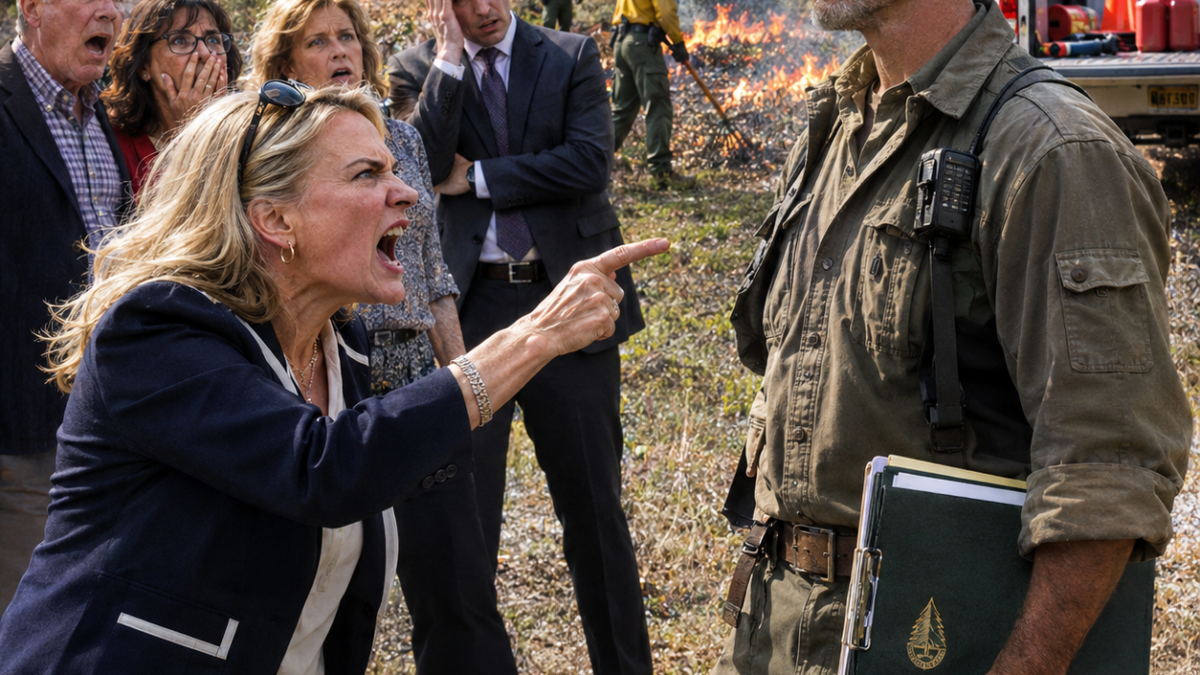
“That’s him!”
Deputy Miller looked at me.
I looked at him.
Then at Karen.
She pointed.
“He is operating prohibited machinery on a Saturday morning.”
Miller blinked.
“Ma’am—”
“And preparing another illegal burn.”
“Ma’am.”
“Look at the piles!”
She gestured toward stacked brush.
“Do something!”
Deputy Miller rubbed the bridge of his nose.
“Mrs. Miller, we’ve discussed this.”
“Not this.”
“His parcel is not within your HOA.”
“It affects our HOA.”
“That doesn’t make your covenants enforceable there.”
Karen’s face flushed.
“What about county noise law?”
Miller looked toward me.
“What time did you start?”
“Nine fifteen.”
He nodded.
“No issue.”
“The smoke!”
“No fire right now.”
“He’s preparing one!”
Karen said it like she’d discovered explosives.
I reached toward my back pocket slowly.
“Deputy?”
“Yes, sir?”
“Jack Riley.”
I handed him my driver’s license.
Then my forestry credentials.
“My state permit for today’s burn is in the truck. Valid burn window starts this afternoon, subject to weather check.”
Miller read the identification.
Looked at me.
Then again.
“County forestry officer?”
“Yes.”
Karen stopped moving.
I continued.
“Certified wildland firefighter. I’ve got a fifty-foot break to mineral soil around the burn area. Two water sources. Weather parameters are within prescription. You’re welcome to inspect everything.”
Miller looked toward the brush.
Then at Karen.
A tiny smile appeared.
Karen noticed.
“What?”
Miller handed my credentials back.
“Ma’am, he’s the forestry officer.”
“So?”
“He’s legally permitted.”
“He issues permits?”
I answered.
“I review and approve burn permits in this region.”
Karen’s mouth opened.
I added:
“Including applications from homeowner associations.”
The silence that followed was worth every cream envelope she’d sent.
Karen’s face shifted through confusion, disbelief, and fury.
Miller spoke before she could.
“Mrs. Miller, Mr. Riley is operating on his own property and appears to be in compliance with county and state requirements.”
“But—”
“This is not a criminal matter.”
“He is harassing our neighborhood!”
“With what?”
“Fire!”
“There is no fire currently.”
“His previous fires!”
“Were they permitted?”
I said:
“Yes.”
Miller looked at Karen.
“There you go.”
She pointed at me.
“He is deliberately antagonizing us.”
I kept my voice calm.
“I manage brush to reduce wildfire fuel.”
Miller nodded.
Then turned to Karen.
“I also need you to stop calling emergency resources for covenant disputes outside HOA property.”
Karen recoiled.
“You’re accusing me of misusing emergency services?”
“I am asking you to use the appropriate channels.”
His tone sharpened.
“If there is an actual uncontrolled fire, call. If Mr. Riley violates county law, call. But an HOA disagreement with a neighboring landowner is not automatically a sheriff’s matter.”
Karen stared.
Then at me.
“This isn’t over.”
I almost said something.
Didn’t.
Mark’s voice in my head:
Let her build the case.
Karen marched to her SUV.
Door slammed.
Gravel flew.
Deputy Miller watched her leave.
Then looked at me.
“You two having fun?”
“No.”
“Good luck.”
“Thank you.”
He drove off.
I stood in the driveway.
The anger came after.
Not during.
My professional role mattered to me.
I had spent years building credibility with landowners, fire departments, contractors, regulators, and public agencies.
Karen had tried to turn law enforcement into a weapon because she disliked smoke she could see from her patio.
That was bad.
But it wasn’t yet the worst thing she’d do.
News traveled through Whispering Pines quickly.
Arthur called before lunch.
“I saw the whole thing.”
“Of course you did.”
“She looked like she’d swallowed a lemon.”
“Arthur.”
“I’m old. Let me enjoy something.”
Then his voice became serious.
“I think it’s time.”
“For what?”
“The books.”
We met the following evening.
His dining table disappeared under five years of HOA financial statements.
Arthur had annotated them.
Colored tabs.
Handwritten calculations.
Vendor names.
Year-over-year changes.
Legal and administrative expenses had risen almost thirty percent each year.
But another line stood out.
Grounds maintenance.
Evergreen Solutions LLC.
Contract value:
Far above what I expected for the size of the common areas.
“Competitive bid?” I asked.
“No record.”
“Owner?”
Arthur turned his laptop.
David Miller.
Karen’s brother-in-law.
I stared.
“How much above market?”
“I requested three quotes.”
Arthur slid them across.
Evergreen was nearly twice the highest comparable proposal.
“Maybe they provide extra services.”
“That’s what I thought.”
He produced invoices.
Generic.
Mowing.
Pruning.
Seasonal cleanup.
No extraordinary work.
Then social committee expenses.
Catering.
Flowers.
Event consulting.
One consultant:
Karen’s sister.
I leaned back.
“That’s ugly.”
Arthur nodded.
“Could be disclosed related-party business if properly approved.”
“Was it?”
“No minutes I can find.”
“Illegal?”
“I’m an accountant, not a prosecutor.”
Good answer.
“What is it?”
“Enough for homeowners to demand an audit.”
Maria Garcia was organizing too.
Karen responded to the sheriff embarrassment by tripling the Garcias’ swing-set fines.
That was stupid even by Karen standards.
Maria stopped being afraid.
She created a private chat.
Young families joined.
Then older homeowners.
People compared letters.
A basketball hoop.
Sidewalk chalk.
Trash cans.
Garden ornaments.
A vegetable bed.
A flag bracket.
Most stories sounded ridiculous individually.
Together, they painted something darker.
Karen enforced aggressively against people she disliked.
Ignored similar conditions for friends.
Waived certain penalties selectively.
Used the board’s legal budget to intimidate appeals.
We built a shared folder.
Arthur:
Financials.
Maria:
Resident testimonies.
Me:
My violation letters, property documents, certified response, and sheriff incident summary.
Mark reviewed everything.
“Don’t become the HOA’s lawyer,” he warned me.
“I’m not.”
“You’re acting like one.”
“I’m organizing.”
“That’s how it starts.”
He was right about one thing.
I needed to stay in my lane.
I wasn’t a member.
I couldn’t vote.
I shouldn’t become their replacement authority.
My role was catalyst.
Their community had to fix itself.
The annual meeting was three weeks away.
Arthur and Maria started collecting proxies.
No emotional campaigning.
They showed numbers.
Documents.
Karen’s related-party vendor contracts.
Stories from residents.
The legal exposure of harassing a non-member.
People signed.
Karen was so focused on me that she apparently didn’t notice.
Then she made the mistake that changed everything.
She filed a formal complaint against me with the State Forestry Commission.
I received the email Monday morning.
**FORMAL COMPLAINT / REQUEST FOR REVIEW**
My stomach tightened before I opened it.
Not because I believed I’d done anything wrong.
Because professional accusations carry weight even when false.
Karen’s complaint was several pages.
She accused me of:
Abuse of office.
Unsafe burns.
Retaliation.
Using government authority to intimidate HOA residents.
Threatening to deny Whispering Pines future permits.
Creating deliberate smoke nuisances.
Endangering homes.
She requested my suspension pending investigation.
I read every line.
Twice.
Then called Mark.
“She’s gone professional.”
“What?”
I forwarded it.
Five minutes later:
“Jack.”
“Yeah?”
“Don’t write anything angry.”
“I know.”
“No jokes.”
“I know.”
“No phrases involving where she can put her binder.”
“I wasn’t going to.”
“You were thinking it.”
Maybe.
I spent two days preparing my formal response.
This wasn’t Karen anymore.
This was my employer.
Everything had to be exact.
Burn dates.
Permit numbers.
Weather conditions.
Wind speed.
Relative humidity.
Equipment.
Firebreak widths.
Water supply.
Photographs.
Post-burn monitoring.
Property survey.
HOA boundaries.
Copies of Karen’s original fines.
My certified legal notice.
Deputy Miller’s incident documentation where available.
Then I addressed the alleged threat regarding the HOA’s permit.
I wrote:
**At no time did I state or imply that a lawful permit would be denied as retaliation. I informed Ms. Miller only that prescribed fire applications are evaluated under applicable safety requirements and that the Estates at Whispering Pines would be subject to the same standards as every other applicant.**
That was the truth.
I also included a professional wildfire-risk assessment of the HOA common property.
Karen might not have appreciated it.
The common woodland had accumulated significant dead material.
Ladder fuels.
Overgrown understory.
Poor defensible-space maintenance in certain areas.
Their proposed burn wasn’t frivolous.
It was probably necessary.
But given the board’s demonstrated misunderstanding of burn regulations and Karen’s attempts to politicize fire safety, I recommended any future prescribed burn involve an independent certified burn boss.
Not as punishment.
As risk management.
My regional director called after reviewing the report.
“Jack.”
“Yes, sir.”
“We have to conduct formal due diligence.”
“Understood.”
“Until that’s done, don’t participate in review of their permit.”
“Already planned to recuse.”
“Good.”
That mattered too.
I would not personally decide Karen’s permit while she had filed a complaint against me.
Conflict avoided.
He continued.
“Your documentation is strong.”
“Thank you.”
“Very strong.”
“I learned from the best.”
“Don’t get sentimental.”
Then:
“Her complaint makes several serious claims.”
“I know.”
“So does your record.”
Pause.
“We’ll handle it.”
The review moved quickly.
My burns were compliant.
My permits valid.
No evidence I’d threatened retaliation.
The sheriff incident supported my version.
The commission dismissed the substantive allegations against me.
More importantly, it reviewed Whispering Pines’ planned burn independently.
The official response to the HOA said future prescribed-fire work on common land would require an appropriately qualified third-party burn professional and an approved safety plan.
The letter did not say:
**Karen is terrible.**
Government letters rarely do.
It didn’t need to.
The practical impact was expensive.
Arthur calculated options.
Hire qualified burn contractor and team:
Potentially fifteen thousand dollars or more depending scope and conditions.
Mechanically remove and haul brush instead:
Possibly much higher.
Either way, Karen’s personal feud had made the HOA’s already necessary fuel-management problem harder and more expensive.
The annual meeting was one week away.
We had:
Proxy votes.
Financial records.
Resident testimony.
My harassment file.
Forestry commission letter.
And ninety-eight homeowners who were finally paying attention.
The clubhouse normally held twelve people for annual meetings.
That night it held nearly a hundred.
Folding chairs filled every row.
People stood along walls.
Maria sat with several young families.
Arthur occupied the front row holding a binder like a weapon.
I stood in the back.
Invited guest.
No vote.
Exactly where I belonged.
Karen sat behind a long table with two loyal board members.
She looked delighted by attendance.
That almost made me feel sorry for her.
Almost.
She banged the gavel.
“Welcome, everyone!”
Silence.
“It is wonderful to see such engagement.”
Nobody smiled.
She moved through routine minutes.
Social committee report.
Catering.
Holiday decorations.
Then budget.
Arthur stood.
“Madam President.”
Karen’s smile tightened.
“Yes, Arthur?”
“Line item twenty-four. Landscaping and grounds maintenance.”
“What about it?”
“One hundred fifty thousand dollars proposed for Evergreen Solutions LLC.”
Karen glanced at her papers.
“Correct.”
Arthur raised three estimates.
“I obtained independent bids for comparable services.”
He read them.
Seventy-eight thousand.
Eighty-one.
Eighty-five.
Murmurs.
Karen said:
“Evergreen provides premium service.”
Arthur nodded.
“Is David Miller related to you?”
The room changed.
Karen’s face reddened.
“My family relationships are irrelevant.”
“So he’s your brother-in-law?”
“Yes.”
Gasps.
Arthur continued.
“Was that relationship disclosed before awarding the contract?”
“It was common knowledge.”
“That’s not what I asked.”
People shifted.
Karen reached for the gavel.
Maria stood.
“I have a question.”
Karen snapped:
“Wait your turn.”
Maria didn’t sit.
“My family owes more than three thousand dollars in fines over a swing set.”
Karen’s eyes narrowed.
“That matter is under enforcement.”
“My daughter is six.”
“Age doesn’t change the covenant.”
“No.”
Maria’s voice shook.
“But it changes what kind of person fines parents hundreds of dollars because children like blue.”
Applause.
Karen slammed the gavel.
“Order.”
Other residents stood.
“Why did my trash-can warning become a fine without hearing?”
“Why was Brenda’s basketball hoop approved when mine wasn’t?”
“Why are legal fees fifty thousand?”
“Who paid for the social committee dinners?”
“Why did you call the sheriff on the man next door?”
The questions came faster.
Karen shouted:
“This is not the proper forum!”
Arthur replied:
“This is literally the annual homeowners meeting.”
That earned laughter.
Karen lost more control.
Then Arthur presented the administrative expenses.
Vendor relationships.
Event costs.
Legal spending.
Not accusations.
Numbers.
People did the conclusion themselves.
Karen said:
“You are twisting everything.”
Arthur stayed calm.
“Then explain it.”
“I don’t have to justify every management decision to people who don’t understand governance.”
Wrong sentence.
The room went silent.
Then somebody near the side said:
“We pay for it.”
Another:
“It is our money.”
Karen realized too late.
I stayed in the back until Maria turned.
“Jack.”
Every face followed.
I didn’t want the moment.
But it was necessary.
I walked forward carrying one document.
The Forestry Commission letter.
I placed it on the table.
Karen’s face tightened.
“That letter exists because Mrs. Miller filed a complaint against me with my employer.”
People murmured.
Karen said:
“Because you abused your position.”
“No.”
I looked at the room.
“The formal review found my burns compliant and my conduct within policy.”
Then:
“The commission separately reviewed the circumstances surrounding your common-area fire management.”
I read the relevant section.
Future prescribed burn applications would require qualified third-party oversight and an approved plan because of the need to ensure clear professional management.
I lowered the page.
“That has a cost.”
Arthur stood.
“Minimum estimated fifteen thousand for a contractor-led burn.”
Someone shouted:
“Because of Karen?”
I answered carefully.
“Because your common land has a real fuel-management problem and your previous leadership created enough uncertainty that independent oversight is now the prudent path.”
No exaggeration.
No revenge.
Karen pointed.
“He did this!”
I looked at her.
“No.”
“Yes!”
“You filed the complaint.”
“Because you threatened us.”
“I did not.”
“You bragged that you control our permits.”
Deputy Miller wasn’t there.
But Arthur had a copy of the incident summary.
Mark had advised preserving it.
I said:
“I disclosed my job after you called the sheriff to stop lawful work on my property.”
Karen’s voice cracked.
“You were intimidating me.”
“I told you the truth.”
Then I addressed the homeowners.
“I don’t belong to your HOA.”
Silence.
“I cannot vote tonight.”
I looked at the board.
“I don’t want to run your community.”
Then toward everyone.
“But actions taken in the HOA’s name can create real financial and legal consequences.”
The resident lawyer in front raised his hand.
“May I?”
Karen snapped:
“No.”
Arthur said:
“Let him speak.”
The lawyer stood anyway.
Name was Daniel Hart.
He said:
“Directors-and-officers insurance is not a blank check. Coverage depends on policy terms and conduct. Intentional bad-faith acts can create coverage disputes and personal exposure for board members.”
People looked at Karen.
Daniel continued.
“If the association knowingly continues asserting jurisdiction over property outside the HOA after receiving legal notice, that’s a serious issue.”
Karen shouted:
“This is fearmongering!”
I almost admired the irony.
Arthur stepped into the aisle.
“I move for a vote of no confidence in the president and sitting board.”
Daniel Hart:
“Second.”
Karen froze.
“No.”
Arthur looked toward the management representative sitting near the wall.
The man stood.
“I’ve reviewed the bylaws.”
Karen stared at him.
“You work for us.”
“I work for the association.”
That distinction mattered.
He continued.
“The motion is permissible if quorum and proxy requirements are met.”
Arthur held up the proxy forms.
They were.
Karen’s face drained.
Paper ballot.
Secret.
Counted publicly.
Overwhelming.
Karen removed.
Her two closest board allies removed.
Nobody cheered wildly.
There was applause.
Mostly there was relief.
Karen sat behind the table holding the gavel.
For a moment, she didn’t move.
Then she placed it down.
Quietly.
That was more powerful than any shouting.
She gathered the binder.
Walked toward the door.
Stopped near me.
“You planned all this.”
Her voice was low.
“No.”
“You did.”
“I planned to protect my land.”
“You turned them against me.”
I looked around.
“Your neighbors did that themselves.”
She shook her head.
“You’ll regret this when this place falls apart.”
Then she left.
Arthur Henderson became interim president.
He tried to refuse.
Everyone ignored him.
Maria became secretary.
Daniel Hart joined the board temporarily to help with governance review.
Their first action:
Suspend collection of disputed aesthetic fines pending audit.
Second:
Rescind fines issued under questionable discretionary enforcement.
Garcia swing set:
Cleared.
Arthur’s gnome:
Returned.
Trash-can penalties:
Reviewed.
Their third action concerned me.
Arthur walked to the back of the room.
“Jack.”
“Yeah?”
“On behalf of Whispering Pines, I’m sorry.”
“You don’t owe me an apology.”
“The association does.”
He handed me a written resolution acknowledging that my property was outside HOA jurisdiction and rescinding every purported fine.
I took it.
“Thank you.”
“Can we start over as neighbors?”
That question landed.
“Yes.”
The next morning, Arthur called.
“Need your help.”
“Already?”
“The common woods.”
I laughed.
“You’ve been president twelve hours.”
“I hate this job.”
“Good sign.”
We walked the HOA land together.
No politics.
Just forestry.
I showed them deadfall.
Fuel ladders.
Overgrown shrubs.
Pines with low branches.
Areas where homes backed too closely into unmanaged vegetation.
Arthur looked worried.
“Karen spent years complaining about your fires.”
“Yes.”
“She never mentioned this.”
“She probably didn’t understand it.”
Maria joined us.
“What do we do?”
“Step one, mechanical cleanup.”
“Expensive?”
“Not if residents volunteer for appropriate work and professionals handle dangerous parts.”
“Then?”
“Reassess fuel load.”
“Burn?”
“Possibly.”
“Will you approve it?”
I stopped.
“I won’t personally approve an application where my involvement could look like revenge or favoritism.”
Arthur blinked.
“But you’re the officer.”
“I’ll recuse.”
“Why?”
“Because the system needs to be cleaner than Karen made it.”
He nodded slowly.
That became one of the most important choices I made.
Winning doesn’t give you permission to become the thing you fought.
The HOA submitted its land-management plan through normal channels.
Another qualified forestry officer reviewed it.
Independent burn boss.
Proper weather window.
Safety crew.
Resident notifications.
Everything Karen had accused me of ignoring.
The new board followed every requirement.
Permit approved.
On burn day, I volunteered.
Not as the approving official.
As a certified firefighter and neighbor.
Arthur wore gloves that were too new.
Maria wore an old baseball cap.
Several residents came with rakes.
Professionals established the lines.
The fire moved exactly as prescribed.
Low.
Controlled.
Consuming leaf litter and fine fuels.
Smoke rose through the pines.
I watched homeowners standing where Karen once had, except nobody was screaming.
Nobody threatened fines.
They asked questions.
“How fast should it move?”
“Why is that section smoking more?”
“What happens to the trees?”
“Why burn instead of haul?”
I explained.
Fire isn’t inherently destructive.
In the right ecosystem, under the right conditions, managed fire reduces dangerous fuel, recycles nutrients, and protects against catastrophic wildfire.
Context.
Control.
Knowledge.
That was what Karen had never understood.
The burn finished without incident.
Arthur walked over, black smudge on his cheek.
“I hate to say this.”
“What?”
“That’s kind of beautiful.”
I smiled.
“Don’t let Karen hear you.”
He laughed.
First time we’d joked about her.
Then we mostly stopped saying her name.
The financial audit continued.
Evergreen Solutions contract was terminated.
New landscaping bids came in around half the old cost.
Dues were reduced slightly the following year.
Related-party contracts now required disclosure and competitive bidding.
Social committee expenses got real limits.
Legal spending required full-board approval above a threshold.
Appeals became independent.
No person could issue a violation and then chair the appeal.
The changes weren’t glamorous.
Good governance rarely is.
Karen listed her house within a month.
I saw the moving truck one afternoon.
I was splitting wood near my fire pit.
She stepped into the driveway.
Different clothes.
No pink tracksuit.
No binder.
She looked older.
Power can do strange things to posture.
When she had it, Karen seemed physically larger.
Without it, she was just a tired woman standing beside a moving truck.
She saw me.
Walked toward the fence.
I put down the axe.
“Jack.”
“Karen.”
She stared at the burn pit.
Cold that day.
No fire.
“You got what you wanted.”
I thought about that.
“No.”
She frowned.
“You got me removed.”
“I wanted you to leave my property alone.”
“You destroyed my reputation.”
“I didn’t sign your contracts.”
Her mouth tightened.
“You dug through everything.”
“Your homeowners did.”
“Because you started it.”
Maybe.
I didn’t answer.
She said:
“I was trying to protect this community.”
“I believe you believed that.”
That surprised her.
“You do?”
“Yes.”
“Then why—”
“Because believing you’re protecting people doesn’t give you unlimited authority.”
She looked away.
“My rules kept property values up.”
“Some rules probably helped.”
She looked back.
That wasn’t the answer she’d expected.
“Some?”
“Standards aren’t evil.”
I pointed toward her neighborhood.
“You need common-area maintenance. Safety rules. Financial controls.”
Then:
“You don’t need to fine a family thousands because their children’s swing set is blue.”
Her jaw moved.
“They knew the palette.”
“Karen.”
Silence.
“You called the sheriff because I used a chainsaw outside your jurisdiction.”
She looked embarrassed.
“You filed a professional complaint because I wouldn’t let you control my land.”
“I thought you threatened our permit.”
“I told you what my job was.”
“That sounded like a threat.”
“Because you were already fighting me.”
She had no answer.
After a while she said:
“Everyone hates me.”
I felt something I didn’t expect.
Pity.
Not absolution.
Pity.
“Then maybe wherever you go next, don’t start by trying to control everybody.”
She almost laughed.
“That’s your advice?”
“Yes.”
“That’s terrible advice.”
“Free.”
She nodded.
Then walked away.
Her house sold.
New family moved in.
Young couple.
Two kids.
First week, they put a small soccer goal in the backyard.
Nobody fined them.
That became the best possible epilogue.
My land returned to quiet.
I continued fuel management.
Permits.
Burns.
Thinning.
Firebreaks.
Sometimes neighbors from Whispering Pines stopped by the fence.
Not to complain.
To learn.
Arthur became one of my closest friends.
He still hated being president.
Every few months he threatened to resign.
“Somebody complained because another homeowner’s trash can is visible from the upstairs bathroom.”
I stared.
“Why are they looking out the bathroom window?”
“I asked.”
“And?”
“They didn’t appreciate it.”
Maria served two years.
Then ran for president.
Won.
Her platform:
**Common Sense, Clear Rules, No Surprises.**
I teased her.
“Very exciting.”
“Boring is the point.”
Correct.
The Garcias’ blue swing set stayed.
Children grew.
Paint faded.
Nobody cared.
One summer, a wildfire started miles west during drought.
Lightning.
Wind pushed it hard through unmanaged timber.
My phone woke me at 2:17 a.m.
Dispatch.
I was dressed in minutes.
By dawn, crews were building lines.
Whispering Pines sat downwind.
Arthur called.
“Jack.”
“I know.”
“Are we in danger?”
“Possibly.”
His voice changed.
“What do we do?”
“Follow evacuation alerts. Clear cars from streets. Get residents ready.”
“What about the common woods?”
I looked at the incident map.
The prescribed burn area formed a dark patch on fuel maps.
Reduced understory.
Cleaner forest floor.
Less continuous fuel.
“We did the right work,” I said.
“What does that mean?”
“It gives firefighters a better chance.”
The wildfire never directly entered the subdivision.
Crews stopped the forward edge before it reached the houses.
But embers crossed.
Small spot fires ignited near the common forest.
Because fuel had been reduced, those fires remained manageable.
Suppression crews contained them quickly.
Afterward, one engine captain told Arthur:
“Whoever treated this understory did you a favor.”
Arthur called me immediately.
“You hear that?”
“Yes.”
“He said the burn helped.”
“I know.”
“You could sound more excited.”
“Firefighters get superstitious about celebrations.”
The wildfire changed Whispering Pines permanently.
Residents who once feared smoke now understood fuel.
They organized annual cleanup days.
Maintained defensible space.
Replaced dead ornamental shrubs near structures with safer landscaping.
The HOA established a wildfire preparedness committee.
Maria insisted I attend the first meeting.
I refused.
She brought cookies.
I attended.
No one person chaired every committee anymore.
Good.
Years passed.
Mark eventually retired from law.
He called once.
“You still have the Karen folder?”
“Attic.”
“Keep it.”
“Why?”
“Sentimental value.”
“You lawyers are strange.”
“You named it.”
Fair.
I did keep it.
But I stopped opening it.
That mattered.
Conflict has a way of becoming identity.
For almost a year, I had been:
The guy fighting the HOA.
Then:
The forestry officer Karen attacked.
Then:
The outsider who helped remove the board.
Those weren’t roles I wanted forever.
I wanted to be Jack.
Twenty acres.
Forest.
Meadow.
Old family land.
A fire pit.
Maybe a beer with Arthur.
Peace.
So one evening, I took the folder upstairs.
Placed it in a storage box.
Closed the lid.
Came back outside.
Lit a small recreational fire.
Legal.
Contained.
No brush pile.
Just split oak.
Arthur walked over twenty minutes later.
He leaned against the fence.
“Permit?”
“Don’t start.”
He laughed.
I handed him a beer.
We watched sparks rise.
“Think Karen would’ve fined us for this?”
“Absolutely.”
“Good thing she moved.”
Silence.
Then Arthur said:
“Do you ever feel bad?”
“About what?”
“Her.”
I thought.
“Sometimes.”
“Really?”
“She became awful.”
“Yes.”
“But nobody wakes up at five years old wanting to terrorize neighbors over trash cans.”
Arthur smiled.
“That’s philosophical.”
“I’m getting old.”
“Speak for yourself.”
He was older than me.
“What happened to her?” I asked.
“I don’t know.”
“Exactly.”
We drank.
The fire settled.
Eventually, Arthur stepped down from the board.
His replacement was a woman named Denise Caldwell.
Teacher.
Organized.
Calm.
She came to my property before assuming office.
“Mr. Riley?”
“Jack.”
“I wanted to introduce myself.”
“Dangerous tradition.”
She laughed.
“I’ve read the history.”
“My condolences.”
“I have a question.”
“Go ahead.”
“How much authority do you think an HOA should have?”
That wasn’t the question I expected.
“Enough to manage shared obligations.”
“That’s vague.”
“Because every community is different.”
She waited.
I continued.
“If your stormwater pond fails, homeowners need a system to fund repairs.”
She nodded.
“If somebody blocks a fire lane, you need enforcement.”
“Agreed.”
“If one person’s neglected roof damages attached units, standards matter.”
“Okay.”
“But if you need a ruler to decide whether somebody’s lawn is morally acceptable?”
She laughed.
“Probably too far?”
“Probably.”
She asked:
“What should I remember?”
I thought of Karen.
Then myself.
“Never confuse being allowed to make a decision with being automatically right about the decision.”
Denise wrote that down.
I groaned.
“Don’t quote me in a newsletter.”
“No promises.”
She did.
At least she removed my name.
The neighborhood changed culturally.
People attended meetings more often.
Not all.
Enough.
Budgets were readable.
Contracts accessible.
Residents understood proxy rules.
No one feared asking questions.
Children played outside.
The HOA still sent violations sometimes.
One homeowner stored three inoperable cars on the street.
Another built a shed over a drainage easement.
Rules applied.
They got notices.
Appeals.
Clear timelines.
No public humiliation.
No daily fines invented overnight.
No rulers in lawns.
That was the difference.
The most satisfying moment came years after the original fight.
Whispering Pines planned another prescribed burn.
Denise was president.
Their fuel-management plan was excellent.
Independent burn boss.
Certified crew.
Notifications.
Contingencies.
No special treatment.
The application came through the regional office.
By then I had moved into a supervisory forestry role and no longer personally issued the permit.
One of my younger officers reviewed it.
Name was Ethan Brooks.
Good kid.
He came into my office.
“Jack?”
“Yeah?”
“Whispering Pines burn plan.”
I looked up.
“What about it?”
“Everything checks.”
“Then approve it.”
He hesitated.
“You don’t want to look?”
“No.”
He knew the history.
Everybody did.
“What if I missed something?”
“Then follow the checklist.”
He nodded.
“Okay.”
At the door, I said:
“Ethan.”
“Yeah?”
“Don’t approve it because they’re my neighbors.”
“I know.”
“Don’t deny it because they used to be difficult.”
“I know.”
“Good.”
That was the real test.
Not whether Karen lost.
Whether the system remained fair after she was gone.
Permit approved.
The burn happened.
Safely.
No drama.
That’s what justice looks like after the revenge story ends.
Fair rules.
Even for people who once treated you unfairly.
My own property matured under better management.
The invasive thickets decreased.
Native grasses returned.
Oak regeneration improved.
Wildlife changed.
More turkey.
Deer.
Songbirds.
One spring, I found a patch of wildflowers in an area we’d burned two seasons earlier.
Purple.
Yellow.
White.
Karen would’ve hated the lack of color coordination.
I laughed alone in the woods.
My family history was tied to that land.
Grandfather had worked part of it before the parcel was sold.
My father talked about haying there as a boy.
Buying it back had felt like repairing something unfinished.
I built a small cabin near the meadow.
Not large.
Porch.
Wood stove.
Workshop.
No architectural committee.
Perfect.
Arthur visited.
Looked at it.
“Color isn’t approved.”
“Get off my property.”
He laughed so hard he had to sit down.
We became ridiculous old men.
The best kind.
Maria’s children grew.
The blue swing set eventually became too small.
They took it down voluntarily.
That bothered Maria more than Karen’s fines had.
She stood beside the dismantled pieces.
“After everything.”
“Kids grow.”
“I hate it.”
“You can fine them.”
She laughed through tears.
Her husband Miguel used some of the blue lumber to build a bench.
They placed it near the common walking trail.
Small plaque:
**PLAY HERE. GROW HERE. BELONG HERE.**
That line hit me harder than expected.
Because that had been the whole fight.
Karen believed belonging came from compliance.
Same paint.
Same landscaping.
Same behavior.
Same obedience.
The new neighborhood learned something better.
Belonging came from mutual responsibility.
From people respecting boundaries while still helping one another.
I had been an outsider.
Legally.
Geographically.
But eventually, those people became my neighbors in the actual sense of the word.
Not because I joined their HOA.
I never did.
Because community and jurisdiction are different things.
Karen never understood that either.
She believed if she couldn’t control me, I wasn’t part of the community.
Arthur understood the opposite.
He could share a beer across a fence without needing my signature on covenants.
That was enough.
One winter, Arthur had a heart attack.
Survived.
Barely.
Maria called before dawn.
I drove to the hospital.
Sat with his daughter.
Arthur recovered slowly.
When he came home, I cleared snow from his driveway.
Fixed his mower.
Brought firewood even though his gas fireplace didn’t need it.
He complained.
“You’re treating me like an old man.”
“You are an old man.”
“So are you.”
“I’m younger.”
“By three years.”
“Significant.”
Weeks later he walked to the fence.
“Beer?”
Doctor said no alcohol yet.
I gave him sparkling water.
He called me a traitor.
That’s community.
Not covenants.
When Arthur died six years later, his daughter gave me his old HOA binder.
“I think he’d want you to have this.”
I laughed.
“I already have enough HOA paperwork for two lifetimes.”
“There’s a note.”
I opened it.
Arthur had written:
**JACK — YOU TAUGHT US THAT SOMETIMES THE GUY OUTSIDE THE FENCE IS THE BEST NEIGHBOR INSIDE THE COMMUNITY. DON’T GET SENTIMENTAL ABOUT IT.**
Too late.
I sat alone that night beside the fire pit.
His empty chair on the other side.
No beer.
Just flames.
For once, the smoke felt heavy.
I thought about our first conversation.
Broken lawn mower.
Gnome fine.
Fear.
He had been afraid to challenge Karen.
Years later, he became president and helped rebuild everything she damaged.
People change when fear leaves.
That’s one reason bullies work so hard to keep it.
Denise later asked whether the HOA could name a small common meadow after Arthur.
I said:
“Ask his daughter.”
She approved.
Arthur Henderson Meadow.
No statue.
No expensive sign.
Just a wooden marker.
He would’ve liked that.
I retired from forestry eventually.
Fully this time.
My successor asked whether I planned to keep burning.
“Safely.”
“You know the rules.”
“I wrote half your training guide.”
“Exactly why I’m worried.”
Fair.
Retirement changed the fire ritual.
Without the office, permits felt different.
I became simply another landowner.
I liked that.
I still followed every standard.
Maybe more carefully.
There is humility in leaving authority.
The phone stops ringing.
People stop calling you “Officer Riley.”
You’re just Jack with twenty acres and a weather app.
Good.
One autumn afternoon, years after Karen left, a white SUV stopped near my gate.
For half a second my body remembered.
Then a young woman stepped out.
She introduced herself.
“I’m Natalie.”
“Okay.”
“My parents bought the Millers’ old house.”
Karen’s house.
I nodded.
“What can I do for you?”
She looked embarrassed.
“We’re new.”
“I guessed.”
“We got a notice from the HOA about clearing brush along our back property line.”
My stomach tightened slightly.
“What kind of notice?”
“Fire mitigation.”
I relaxed.
She continued.
“They said you might know someone who can help.”
I walked over.
Looked at the brush.
Legitimate.
Dead material.
Too close to fence.
No petty aesthetics.
Actual safety.
I said:
“Yeah. I know people.”
She smiled.
“Thank you.”
Then:
“Was Mrs. Miller really as bad as everyone says?”
I considered.
“Stories grow.”
“So no?”
“I didn’t say that.”
She laughed.
“What happened?”
I looked toward the old fence.
“Long story.”
“HOA fight?”
“Yes.”
“You won?”
I looked at her house.
Kids’ bicycles in driveway.
Soccer ball.
Planters that absolutely would not have met Karen’s aesthetic standards.
Then toward my land.
Trees.
Firebreak.
Quiet.
“I think everybody did eventually.”
She looked confused.
That’s okay.
Not every story needs to be retold.
The strangest thing about revenge is that once you’re truly healed, the revenge stops being your favorite part.
At the height of the conflict, I imagined Karen being humiliated.
Imagined court orders.
Imagined massive damages.
Imagined her finally understanding that she had no power over me.
Some of that happened in different forms.
She was removed.
Her contracts exposed.
Her complaint backfired.
Her house sold.
But years later, none of those images mattered as much as Arthur laughing at my fire pit.
Or Maria’s children playing on the blue swing set.
Or Whispering Pines residents working together on a safe prescribed burn.
That’s why I don’t think revenge is the right word anymore.
Correction.
Maybe.
Restoration.
Better.
Karen’s authority had distorted everything.
Remove the distortion and ordinary things became beautiful again.
A trash can without a fine.
A gnome under an azalea.
A child’s blue swing.
A small plume of smoke rising legally from a forest floor.
Ordinary freedom.
One evening, I sat outside while a contained brush burn settled into glowing coals.
The sun had disappeared behind the pines.
Wind calm.
Humidity rising.
No concern.
I heard footsteps.
Maria.
She was HOA president now.
“You have a permit for that?”
I stared at her.
She grinned.
“Too soon?”
“Ten years too late.”
She handed me a beer.
We stood near the fence.
“How’s the board?”
“Horrible.”
“Good.”
“Somebody complained about a mailbox.”
“Height?”
She laughed.
“No. Reflective numbers.”
“Legitimate safety issue.”
“I know.”
“See? Governance.”
“Don’t start.”
We watched the embers.
Maria said:
“Do you know what Karen’s biggest mistake was?”
“Which one?”
“She made people think rules were the enemy.”
I looked at her.
“That’s good.”
“Because some rules matter.”
“Exactly.”
“Firebreaks.”
“Yes.”
“Drainage.”
“Yes.”
“Emergency access.”
“Yes.”
“Blue swing sets?”
“No.”
She smiled.
“I’ve learned.”
We finished our beers.
Smoke curled upward.
Thin.
White.
Almost invisible in the dark.
I remembered Karen standing across the fence the first day, pointing at the same kind of smoke as if it were an attack.
She thought the fire threatened her neighborhood.
In reality, the fire was protecting it.
That was the whole story in one image.
She fought what she didn’t understand.
Then fought harder when facts challenged her.
Eventually, the fight consumed her authority.
I had spent my military career solving infrastructure problems.
Bridges.
Roads.
Logistics.
Then my forestry career managing a different kind of infrastructure.
Land.
Fuel.
Fire.
Forests don’t care about ego.
If you ignore dead material long enough, it accumulates.
Heat comes.
Wind comes.
One spark.
Then everything you’ve avoided becomes everybody’s emergency.
Communities work the same way.
Whispering Pines had years of accumulated resentment.
Fines.
Favoritism.
Fear.
Silence.
Karen thought silence meant control.
It actually meant fuel.
My brush fire wasn’t what burned down her presidency.
Her own choices did.
Arthur’s numbers.
Maria’s courage.
Residents finally speaking.
A sheriff who respected jurisdiction.
A commission that followed process.
A board vote.
Facts.
Those were the sparks.
What came afterward mattered more.
They didn’t replace Karen with another Karen.
They built firebreaks.
Independent appeals.
Transparent bids.
Competitive contracts.
Clear policies.
Term limits.
Open meetings.
They reduced the fuel that let one person accumulate too much control again.
That’s why the community survived.
If all we’d done was remove Karen, another version of her could have filled the chair.
Systems matter.
People matter more.
One final thing changed for me too.
At first, I had been proud that I knew more than Karen.
More about fire.
More about permits.
More about jurisdiction.
More about risk.
That pride was justified up to a point.
But expertise can become arrogance if you’re not careful.
Years later, a young forestry officer denied one of my burn requests.
Wind forecast had shifted.
I looked at him.
“You’re denying me?”
“Yes, sir.”
“Do you know who I am?”
He froze.
I heard the words as soon as they left my mouth.
Karen’s words.
Not exactly.
Same disease.
I stopped.
Then laughed.
The young officer looked terrified.
“You’re right.”
“Sir?”
“Deny it.”
“Forecast exceeds prescription.”
“I know.”
He relaxed.
I rescheduled.
That moment embarrassed me more than almost anything from the HOA war.
Because power isn’t something only bad people misuse.
Anybody can.
Even people who believe they’ve earned the right.
Especially them.
I called Maria that night.
“Remember Karen?”
“Unfortunately.”
“I almost became her.”
She laughed so hard she hung up.
Then called back.
“What did you do?”
I told her.
She said:
“Good.”
“Good?”
“You noticed.”
That’s the difference.
Maybe.
Karen could never tolerate correction.
I hope I always can.
My twenty acres are still outside Whispering Pines.
Always will be unless some future owner voluntarily changes that through lawful process.
The fence remains.
Not as a wall.
As a boundary.
Boundaries don’t prevent community.
They make respectful community possible.
Arthur taught me that accidentally.
Maria proved it.
The HOA learned it.
Karen didn’t.
At least not while I knew her.
Sometimes on cool autumn evenings, I still burn brush.
Permit when required.
Weather right.
Firebreak clear.
Water ready.
I stand near the flames with a rake.
The smoke rises.
Nobody screams.
Nobody photographs it from a bedroom window.
Nobody mails me a remittance slip.
Children in Whispering Pines sometimes smell the smoke and ask their parents what’s burning.
Their parents say:
“Mr. Riley is managing his land.”
That’s all.
No fear.
No drama.
Just understanding.
And every once in a while, when the HOA needs to manage its common woods, I see a controlled column of smoke rising from their side too.
Professionally planned.
Properly staffed.
Legally permitted.
The first time I saw it after retiring, I smiled.
Not because I approved it.
Someone else had.
That’s what made me smile.
The system didn’t need me anymore.
The community didn’t need an enemy anymore.
Everything worked.
That’s the ending Karen could never imagine.
She thought winning meant controlling the other side of the fence.
I learned winning meant reaching a point where neither side needed to control the other at all.
The sun went down behind the pines that evening.
My fire collapsed into a bed of coals.
I sprayed the edges.
Stirred.
Checked.
Sprayed again.
Old habits.
Good habits.
Then I sat in Arthur’s old chair.
The one his daughter had given me after he died.
A little weathered now.
Still solid.
Across the fence, I could hear children playing.
Farther away, somebody started a lawn mower.
A dog barked.
Wind moved through longleaf pine.
Normal sounds.
The kind of sounds I’d wanted when I bought the land back.
Twenty years of service had taught me how to operate in conflict.
Karen taught me something harder.
How to know when conflict is finished.
You don’t know because the other person loses.
You know because you stop needing them to.
The flames sank lower.
Smoke thinned.
No audience.
No board.
No deputy.
No lawyer.
No letter.
Just my land.
My fire.
And peace.
Karen had once promised me a world of financial pain because she could see smoke from her neighborhood.
Years later, that same neighborhood used controlled fire to protect its homes, neighbors worked beside one another instead of spying on one another, and the people who once feared a cream-colored envelope had learned how to govern themselves.
As for me, I had started the fight wanting only one thing:
To be left alone.
In the end, I got something better.
I got neighbors.
And on a cold autumn night, with the smell of wood smoke drifting through land my family had known for generations, that felt like the kind of victory no fine, lawsuit, board vote, or revenge could ever measure.
[END OF STORY]








