PART 2: HOA Karen Called the Sheriff on My Bonfire—Then the Deputy Looked at Me and Said, “Chief?”
PART 2
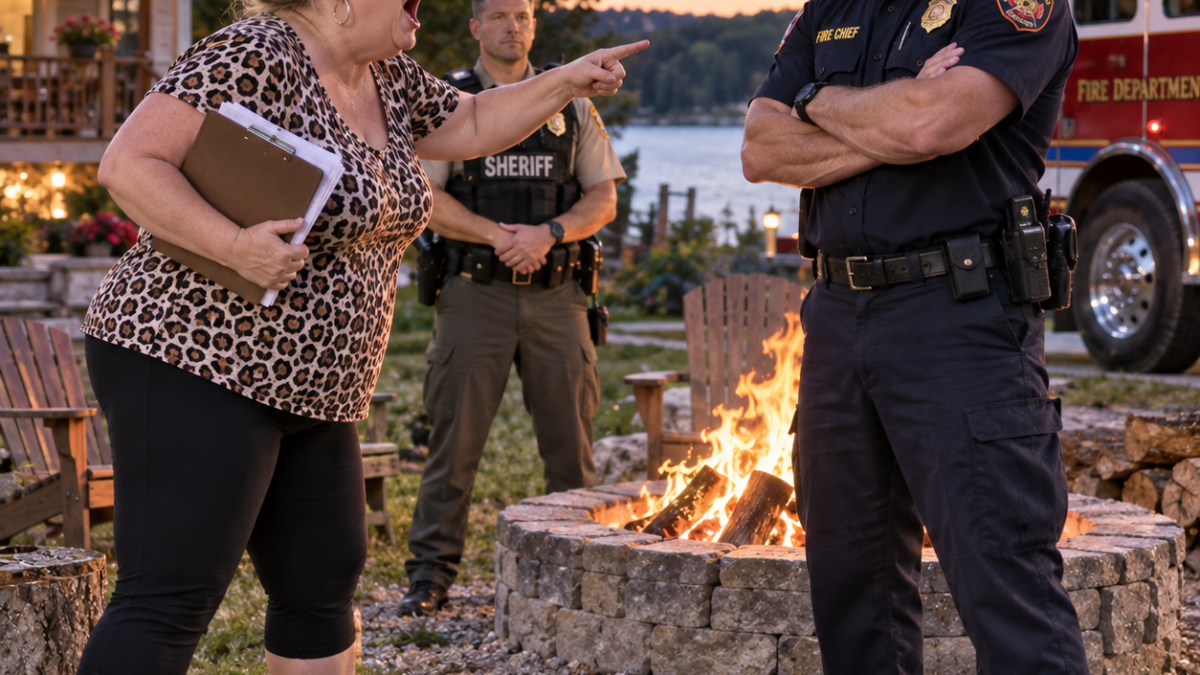
Karen recovered faster than I expected.
Not gracefully.
But quickly.
“Then this is obviously a conflict of interest,” she snapped.
Deputy Miller’s smile disappeared.
He had always been good at that.
Friendly one second.
Completely professional the next.
“Ma’am?”
“You know him.”
“Yes.”
“So you’re protecting him.”
Miller looked toward the fire.
Then at my hoses.
Then the cleared perimeter.
Then the two extinguishers sitting near the workshop wall.
“I haven’t made any determination yet.”
“You just called him Chief.”
“That is his title.”
Karen’s face tightened.
“He is violating fire code.”
Miller looked at me.
“Permit?”
I reached into my jacket pocket.
“Back pocket.”
He laughed once.
“Of course it is.”
I handed him the folded county burn permit.
He opened it beneath his flashlight.
Valid dates.
Parcel number.
Allowed burn window.
Safety conditions.
My signature.
County authorization.
Everything exactly where it should have been.
Miller walked around the burn pit.
He checked distances.
Wind.
Water.
Material.
No trash.
No construction debris.
No accelerants.
Only dead brush and seasoned wood.
Leo watched with obvious enjoyment.
Sarah nudged him.
“Don’t smile.”
“I’m not.”
He absolutely was.
Karen followed Miller around the perimeter.
“Deputy, the HOA prohibits open fires.”
Miller stopped.
“Is this property part of your HOA?”
Karen hesitated.
“It is surrounded by our community.”
“That wasn’t my question.”
“He benefits from our roads and neighborhood value.”
Miller looked toward the public county road.
Then back at her.
“Is his parcel governed by your association?”
Karen folded her arms.
“He refuses to join.”
Miller nodded slowly.
“So no.”
“He should be.”
“But he isn’t.”
Her face darkened.
“This fire is endangering our residents.”
Miller checked the wind again.
Barely moving.
Smoke rose almost vertically before drifting toward my upper pasture, away from Oakwood.
He looked at me.
“Chief, humidity?”
“Sixty-eight percent when I started. Wind under four.”
“Forecast?”
“Dropping temperature. No red flag warning. No inversion concern until after midnight.”
“Burn fully extinguished before then?”
“Long before.”
Miller turned to Karen.
“There’s no violation here.”
“You didn’t even call the fire department.”
For the first time, Leo made a choking sound trying not to laugh.
Miller glanced toward me.
I said nothing.
He answered instead.
“Ma’am, he is the fire department.”
Karen’s eyes flashed.
“This is exactly what I’m talking about. He thinks he’s above the law.”
“No,” Miller said. “He appears to be following it.”
He held up my permit.
“Actually, this is more prepared than most controlled burns I respond to.”
Karen pointed toward the flames.
“He could burn down Oakwood Estates.”
“No.”
“You can’t know that.”
Miller looked at the hundred feet of open cleared ground between the pit and anything combustible.
“I can make a professional assessment.”
“So can I.”
That was the first moment Miller looked genuinely tired.
“What fire training do you have?”
Karen blinked.
“I am HOA president.”
“That isn’t fire training.”
“I am responsible for community safety.”
Miller’s voice remained patient.
“Then you should be glad this brush is being disposed of under controlled conditions instead of remaining dry fuel during wildfire season.”
That landed.
Because it was true.
The burn wasn’t creating a hazard.
It was reducing one.
Every year I cleared dead limbs, fallen branches, dry brush, and fuel from the perimeter of the property.
It was one of the reasons our ridge had survived several ugly summers without becoming a tinderbox.
Karen didn’t care.
She needed to be right.
“This is outrageous,” she said.
Miller handed the permit back to me.
“Chief, everything looks fine.”
“Appreciate it.”
Then he faced Karen.
“Ma’am, I’m going to close this call as unfounded.”
“Unfounded?”
“Yes.”
“I reported an emergency.”
“There is no emergency.”
“I want your supervisor.”
“You may contact Sheriff Thompson.”
“I will.”
“Fine.”
“I will tell him exactly what you did.”
“Please do.”
She pointed toward me.
“And I’m filing a complaint against him too.”
Miller looked at me.
“For what?”
“Intimidation.”
I finally spoke.
“I’ve barely said ten words to you tonight.”
“Your entire attitude is intimidating.”
Leo turned away completely.
Sarah covered her mouth.
Miller pinched the bridge of his nose.
“Ma’am, unless there’s something else relevant to an actual criminal or public safety issue, I need to clear this call.”
Karen stared at him.
Then at me.
Then at Sarah and Leo.
She had imagined this ending differently.
Her video should have shown flashing lights.
A stern deputy.
Me being ordered to extinguish the fire.
Maybe even handcuffs.
Instead, it showed a lawful burn, a valid permit, and her slowly discovering that the man she had accused of reckless fire behavior happened to run the county fire department.
She lowered the phone.
“This isn’t over.”
I believed her.
“Good night, Karen.”
She turned so sharply her shoes slid on the gravel.
She recovered and marched toward Oakwood.
Miller waited until she disappeared around the hedge.
Then he looked at me.
“Chief.”
I raised an eyebrow.
“What?”
“Why do you always find the strange ones?”
“I thought you became a deputy to get away from my fire academy.”
“I was promised less yelling.”
“I never yelled.”
Miller laughed.
“You taught live-fire drills like Patton.”
Sarah stepped forward and hugged him.
“Good to see you, Alex.”
“You too, Mrs. Rivera.”
Leo grinned.
“Did Dad really train you?”
Miller pointed at me.
“That man made me carry hose up six flights of stairs because I forgot my gloves during an inspection drill.”
“You forgot PPE.”
“It was one glove.”
“One missing glove burns exactly as badly as two.”
Leo laughed.
Miller sighed.
“See?”
He became serious again before leaving.
“Chief, document tonight.”
“Already planning to.”
“That woman didn’t sound finished.”
“She isn’t.”
“Incident report will be available once processed.”
“Send it through normal channels.”
“Of course.”
He paused beside the cruiser.
“One more thing.”
“What?”
“She told dispatch flames were fifty feet high.”
“I heard.”
Miller looked at the fire.
The flames barely reached three feet.
“That’s going in the report.”
“Good.”
He left.
Sarah waited until the cruiser disappeared.
Then she exhaled.
“I hate this.”
I knew what she meant.
Not Karen specifically.
Conflict.
Sarah had watched enough of my career intrude into family life.
Late-night calls.
Wildfires.
Industrial accidents.
Structure collapses.
Holiday dinners interrupted by pagers.
When I finally became chief, the danger changed but never disappeared.
Coming home to the ridge was supposed to separate family life from public duty.
Karen had dragged public authority straight into our backyard.
I wrapped one arm around Sarah.
“I’m sorry.”
“You didn’t call her.”
“No.”
“But you know what comes next.”
I did.
Leo kicked a small stone.
“She looked stupid.”
“Leo.”
“She did.”
I looked at him.
“Never underestimate someone because they were embarrassed.”
His smile faded.
“Why?”
“Embarrassment can teach a reasonable person something.”
“And an unreasonable one?”
“It makes them dangerous.”
The fire burned down exactly as planned.
By ten thirty, everything was reduced to glowing coals.
By eleven, I had drowned them twice, stirred the ash, checked temperature, and soaked the area again.
I didn’t go inside until I could put my bare hand near the edge of the pit without feeling radiant heat.
Firefighters are annoying that way.
We preach until the habits become automatic.
The next afternoon, Karen proved me right.
A cream-colored envelope sat in my mailbox.
Oakwood Estates logo.
Heavy paper.
Official tone.
I opened it at the kitchen table.
NOTICE OF VIOLATION.
Unauthorized pyrotechnic display.
Public endangerment.
Nuisance smoke.
Adverse effect on neighboring property values.
Fine:
$500.
I laughed.
Sarah didn’t.
“You’re not in the HOA.”
“I know.”
“So how can they fine you?”
“They can’t.”
“Then throw it away.”
I looked at the letter.
“No.”
She already knew.
“You’re going to keep it.”
“Yes.”
“You’re making a file.”
“Yes.”
She leaned against the counter.
“What are you naming it?”
I stared at her.
She knew me too well.
During my Army years, every complicated operation eventually received a name.
Usually something unnecessarily dramatic.
“Operation Nightingale.”
Sarah blinked.
“Why Nightingale?”
“Because she screamed about a fire.”
“That makes absolutely no sense.”
“It doesn’t have to.”
Leo walked in.
“Operation Karen would be better.”
“No.”
“Operation Pink Flamingo.”
Sarah laughed.
I refused.
Operation Nightingale remained.
The first item was the fine.
The second was the envelope.
The third would be Deputy Miller’s incident report.
Then I pulled the title documents for our property.
Parcel map.
Legal description.
Recorded deed.
The history was simple.
My grandfather had once owned much of the ridge.
Over the years, surrounding acreage changed hands.
Developers eventually bought nearly everything except the ten-acre homestead parcel.
Oakwood Estates had been platted around it.
On the master subdivision map, my land appeared as a clean rectangular hole.
Excluded parcel.
No HOA covenants.
No assessment obligation.
No architectural restrictions.
No association authority.
Karen knew it.
The prior HOA board knew it.
Every competent attorney would know it.
So I answered her fine.
Not with anger.
With eleven pages.
The first paragraph stated that 1240 Ridge Road was not subject to Oakwood Estates covenants.
I cited the parcel number.
Recording date.
Subdivision plat.
I attached the title page.
Then the burn.
County permit.
Fire code compliance.
Weather conditions.
Safety provisions.
Distance from structures.
Suppression equipment.
I did not write that I was fire chief until page four.
There, I explained that I was not asking Karen to accept my personal opinion.
I was providing the exact county standards.
Standards I knew rather well because I had helped revise parts of the county’s vegetation-management burn guidance two years earlier.
I attached the permit.
Then Deputy Miller’s report arrived.
It documented the scene.
Controlled burn.
No hazard.
Valid permit.
Complaint unfounded.
And one particularly useful line:
Reporting party described flames as approximately fifty feet in height. Observed flame height approximately two to four feet.
I smiled.
Sarah saw it.
“That bad?”
“For her.”
I attached it too.
The final paragraph was simple.
Withdraw the fine.
Cease representing that my parcel falls under HOA jurisdiction.
Do not contact emergency services with knowingly exaggerated information.
Any future attempt to encumber my title or impose unauthorized penalties would be referred to counsel.
Certified mail.
Return receipt.
Karen signed for it.
A week later, an attorney wrote back.
Fincher, Belding & Croft.
Their letter did not defend the fire fine.
Interesting.
Instead, they changed targets.
My workshop.
The small red structure had been built by my grandfather in 1978.
Two hundred square feet.
Timber frame.
Concrete slab.
One roll-up door.
Recently repaired.
Recently painted.
The law firm called it an “unauthorized accessory building inconsistent with Oakwood Estates architectural standards.”
They demanded I repaint it one of three approved beige tones.
Sarah read the letter twice.
Then looked through the kitchen window toward the workshop.
“It’s not even in their neighborhood.”
“I know.”
“It existed before their neighborhood.”
“I know.”
“It’s three hundred feet from the nearest HOA house.”
“I know.”
“So what exactly is happening?”
“Karen lost the fire.”
Sarah shook her head.
“So now the shed.”
“Workshop.”
“Sorry. Workshop.”
I took the letter to my study.
This changed things.
Karen wasn’t confused.
She wasn’t mistakenly assuming I belonged to Oakwood.
Her attorneys had now been provided my deed.
The parcel map.
The exclusion.
And still someone had authorized another demand.
Maybe Karen had misrepresented the situation to them.
Maybe they had sent a form letter without reading.
Either way, I needed to know more.
The next day I went to the county records office.
I found Grandpa’s original 1978 permit.
Building approved.
Inspection complete.
Final sign-off.
Everything clean.
Then I pulled Oakwood’s original incorporation documents and master plat.
There was my parcel.
Explicitly outside.
I bought certified copies.
On the drive home, anger began shifting into curiosity.
The fire had been petty.
The workshop demand was malicious.
But legal letters cost money.
HOA money.
The residents were financing Karen’s obsession with me.
That made her behavior their business too.
So I started walking through Oakwood.
Not campaigning.
Listening.
The first person I met was David Jensen.
Retired Air Force master sergeant.
He was trimming the edge of his lawn with almost military precision.
An American flag flew beside his porch.
“Chief Rivera?”
“Mark.”
He shook my hand.
“I heard about the bonfire.”
“I’m becoming famous for all the wrong reasons.”
David smiled.
“My wife says Karen finally picked somebody meaner than she is.”
“I’m not mean.”
“Sure.”
He nodded toward his flagpole.
“See that?”
“Hard to miss.”
“Two feet too tall.”
“According to?”
“Oakwood.”
“How long have you been fined?”
“Six months.”
“How much?”
“Fifty a week.”
I looked at the flag.
Properly mounted.
No obstruction.
No safety concern.
“Why don’t you lower it?”
His expression changed.
“My son gave me that pole after my last deployment.”
That told me everything.
Then he added:
“Also because Karen can kiss my—”
“Understood.”
David told me about Maria Alvarez.
Single mother.
Two jobs.
Two children.
Behind on dues partly because fines had accumulated for dandelions, basketball equipment, parking, and minor landscaping issues.
Karen had threatened a lien.
Possibly foreclosure.
Then the Jacksons.
Robert and Elaine.
Both in their eighties.
Their offense was a rose garden.
Not weeds.
Not dead plants.
Roses.
Karen wanted the varieties replaced with those on an approved landscaping list.
Mrs. Jackson had been growing some of them for thirty years.
One had come from a cutting her mother gave her.
The pattern was familiar.
Different neighborhood.
Same mechanism.
Make every fight too expensive or exhausting to continue.
David looked toward my ridge.
“She can’t fine you legally.”
“No.”
“That probably drives her insane.”
“It seems to.”
He smiled.
“Good.”
That weekend, David came to our house.
Then Maria.
Then the Jacksons.
Sarah made coffee.
Leo disappeared upstairs after realizing the adults were about to discuss bylaws for hours.
Maria brought a shoebox full of notices.
David brought a binder.
The Jacksons brought photographs.
One showed their garden fifteen years earlier.
Elaine stood among roses in a straw hat.
Robert had his arm around her.
Another showed Karen’s violation tags clipped to the same bushes.
Elaine touched the photograph.
“My mother grew that red one.”
Her voice broke.
“I don’t understand why it bothers anyone.”
It didn’t.
That was the point.
Power needs no rational reason once people stop questioning it.
I spread my records across the table.
“My property is different from yours.”
Maria looked worried.
“I know.”
“I’m outside the HOA. You’re members. So the legal arguments aren’t identical.”
David nodded.
“But?”
“But procedure still matters.”
I looked at their files.
“Financial transparency matters. Consistent enforcement matters. Board authority matters.”
Robert Jackson spoke quietly.
“So what do we do?”
“For now?”
I closed the binder.
“We learn everything.”
That began the real investigation.
I requested association records connected to the dispute and reviewed publicly available corporate filings.
David, as an HOA member, formally requested full financial statements, contracts, minutes, budgets, reserve reports, and vendor records.
When the documents arrived, they filled a box.
Sarah looked delighted.
Before becoming a full-time mother, she had spent ten years doing forensic accounting.
There are people who see a box of financial statements and feel dread.
Sarah saw a puzzle.
She made coffee.
Pulled her hair back.
Sat beside me.
“Who are we hunting?”
“Nobody.”
“Mark.”
“We’re reviewing.”
“Who are we reviewing?”
“Karen.”
“Better.”
For the first two hours, nothing looked dramatic.
Insurance.
Pool utilities.
Landscaping.
Management costs.
Repairs.
Then Sarah stopped.
“KB Landscape and Design.”
“What?”
“Five thousand dollars every month.”
I checked the budget.
“Grounds maintenance.”
“For what?”
“Entrance landscaping. Pool. Common strips.”
She looked at me.
“Five thousand every month without variation?”
“Apparently.”
“No seasonal adjustment?”
“No.”
“No itemized hours?”
“Not here.”
She tapped the statement.
“Find the owner.”
I searched the state business registry.
Registered principals:
Karen Blevens.
Robert Blevens.
I stared.
Sarah leaned toward the screen.
“Blevens?”
“Karen’s married name legally.”
“And Robert?”
“Her husband.”
Sarah sat back.
“Your HOA president is paying her family landscaping company sixty thousand dollars a year.”
“Potentially disclosed.”
“Potentially.”
We searched board minutes.
No obvious conflict disclosure.
No competitive bidding record.
No recusal.
Nothing.
Sarah said:
“Keep going.”
Then came Oakwood Strategic Solutions LLC.
$2,500 quarterly.
Administrative consulting.
Ten thousand per year.
Who owned it?
Gerald Finny.
I didn’t recognize the name.
Sarah did a social media search.
Five minutes later she rotated the laptop toward me.
Karen at a July Fourth barbecue.
Beside her stood a man identified in the caption as her brother-in-law Gary.
Full name:
Gary Gerald Finny.
Sarah’s expression hardened.
“Interesting family business.”
I felt anger rising again.
Not because Karen had called 911 on me.
That seemed almost trivial now.
Maria was terrified of losing her home over HOA debts while Karen was directing association money toward family businesses.
The Jacksons were receiving fines over roses while Karen’s husband collected sixty thousand dollars annually.
David had paid weekly flagpole fines while her brother-in-law received “consulting” fees with no meaningful description.
“Could all of it technically be legitimate?” I asked.
Sarah nodded.
“If disclosed. Properly approved. Fair market value. Actual services. Conflict rules followed.”
“And if not?”
“Then somebody has a problem.”
We needed more.
The strongest lead came from a capital project buried in the meeting minutes.
Pool walkway repaving.
Contract:
$28,000.
Vendor:
KB Landscape and Design.
Karen’s husband.
I called David.
“Can you get estimates?”
“For what?”
I sent him the specifications.
He called three reputable contractors.
Same scope.
Remove old surface.
Prepare base.
Grade.
Install new asphalt walkway.
Quotes:
$11,500.
$12,200.
$13,500.
David called me.
“Mark.”
“I’m looking.”
“Twenty-eight grand.”
“I see it.”
“What do you call that?”
“Something the residents deserve explained.”
He laughed.
“You should have been a lawyer.”
“I have enough problems.”
Then we found Article Eleven.
Capital expenditures over $10,000 required board approval and presentation for community review at a regular quarterly meeting before work began.
The board had approved the contract in a special session.
But there had been no proper community presentation.
The next quarterly meeting was three weeks away.
Perfect.
Maria spread one message through the neighborhood:
Please attend the next HOA meeting. A major financial issue affecting member dues will be discussed.
No accusation.
No inflammatory language.
Just turnout.
David and I prepared a one-page handout.
POOL WALKWAY PROJECT
HOA CONTRACT: $28,000
Independent Quote 1: $11,500
Independent Quote 2: $12,200
Independent Quote 3: $13,500
Vendor receiving HOA contract:
KB Landscape & Design.
Principal:
Robert Blevens, husband of HOA President Karen Blevens.
At the bottom:
Article 11, Section 2.
Community review requirement highlighted.
We printed one hundred.
The night before the meeting, our little group gathered at my house.
David.
Maria.
Robert and Elaine Jackson.
Sarah.
Me.
Leo wandered through the kitchen.
“You guys look like you’re planning a coup.”
David smiled.
“Democracy.”
“Same thing but with paperwork?”
Sarah pointed upstairs.
“Homework.”
He disappeared.
Maria twisted her hands.
“What if she comes after me harder?”
That question silenced the room.
She had more to lose than any of us.
I leaned forward.
“Then we don’t let you stand alone.”
“She can lien my house.”
“Not secretly.”
“She has lawyers.”
“So do procedures.”
David added:
“And fifty neighbors.”
Maria looked down.
Elaine Jackson reached across the table and held her hand.
“You came here for our roses.”
Maria looked at her.
Elaine smiled.
“We come for you.”
That was the moment the fight changed for me.
This was no longer strategy.
It was community.
The quarterly meeting began at seven.
By 6:45, every chair was occupied.
People stood against the walls.
Karen sat at the front in a royal-blue blazer with an oversized PRESIDENT badge.
She looked thrilled.
A packed room.
She thought they had come because she mattered.
In a way, they had.
David and I stood near the back handing out our sheets.
People read them.
Whispered.
Passed them sideways.
One man looked at the $28,000 figure, then at Karen, then back at the page.
The mood transformed before the meeting even began.
Karen tapped the microphone.
“Welcome, everyone. I’m so pleased to see this level of community participation.”
David whispered:
“She has no idea.”
“Good.”
Karen moved through the agenda.
Trash cans.
Parking.
Landscaping.
Pool rules.
Then:
“Community improvement.”
She smiled.
“Our board is excited to announce the complete repaving of the pool walkway by our trusted vendor, KB Landscape and Design.”
That was the moment.
I waited.
David stood first.
“Point of order.”
Karen frowned.
“Mr. Jensen?”
“I would like to yield my member comment time to Mark Rivera.”
Her face changed instantly.
“He is not an association member.”
“I am.”
“You cannot yield time to outsiders.”
David raised the bylaws.
“Show me where.”
Karen looked toward her secretary.
He looked away.
The room waited.
Finally she said:
“Two minutes.”
I walked forward.
Not to the podium.
I stayed on the floor among the residents.
“I have one question.”
Karen folded her arms.
“The walkway contract is twenty-eight thousand dollars.”
“Yes.”
“Was it competitively bid?”
“We use trusted vendors.”
“That wasn’t the question.”
Murmurs.
I repeated:
“Did you solicit competing bids?”
“No. It wasn’t required.”
I held up the sheet.
“Three licensed contractors quoted the same scope at eleven-five, twelve-two, and thirteen-five.”
The room stirred.
Karen’s eyes narrowed.
“Your random quotes are irrelevant.”
“Maybe.”
I turned toward the residents.
“But the vendor receiving twenty-eight thousand dollars is owned by President Blevens’ husband.”
Silence.
Then noise.
“What?”
“Her husband?”
“Are you serious?”
Karen grabbed the gavel.
“Order.”
I continued.
“State business records identify Robert Blevens as a principal of KB Landscape and Design.”
A homeowner shouted:
“Did you disclose that?”
Karen banged the gavel.
“Order!”
David called:
“Answer him.”
Karen’s face reddened.
“This is defamatory.”
“No.”
I kept my voice calm.
“I haven’t accused you of a crime.”
Not yet.
“I am asking about governance.”
Then I held up the bylaws.
“Article Eleven requires capital expenditures over ten thousand dollars to be presented for community review before work begins.”
Several people already had that section highlighted on their handouts.
“You have not done that until tonight.”
Karen shouted:
“The board approved it.”
“That satisfies one requirement.”
I pointed toward the room.
“These people are the other one.”
The room erupted.
Maria stood.
“What about the ten thousand dollars going to Oakwood Strategic Solutions?”
Karen froze.
Sarah looked at me.
That wasn’t in our planned presentation.
Maria had decided.
Good for her.
Karen’s eyes widened.
“I don’t know what you’re talking about.”
Maria held up copies.
“Gerald Finny.”
Somebody shouted:
“Who is that?”
Maria answered:
“Her brother-in-law.”
The noise doubled.
Karen slammed the gavel repeatedly.
“This meeting is adjourned.”
David stood.
“No.”
She stared at him.
“I said adjourned.”
“And I move for a vote of no confidence in the current board and immediate preservation of all association financial records.”
Someone shouted:
“Second!”
Then another.
“Second!”
Then half the room.
Karen looked toward her fellow board members.
Brenda stared at the table.
Stan looked terrified.
Karen’s control evaporated in seconds.
She tried procedure.
David had read more carefully.
She tried volume.
Fifty homeowners were louder.
She tried fear.
Nobody was isolated anymore.
The vote was overwhelming.
Karen was removed.
So were the passive board members who had allowed her to operate unchecked.
David became interim president.
Maria joined the interim board.
A respected accountant named Henderson took the third seat.
Their first resolution:
Freeze questionable payments.
Secure accounts.
Preserve electronic records.
Turn suspected self-dealing over to independent legal counsel and appropriate authorities for review.
Their second:
Suspend Maria’s foreclosure activity pending audit.
She started crying.
Not dramatic tears.
Quiet ones.
She covered her face.
Elaine Jackson hugged her.
Their third:
Suspend disputed enforcement actions involving the Jackson rose garden and David’s flagpole.
David looked at me.
“Chief?”
“Yes?”
“Anything about a bonfire?”
The room laughed.
Even I did.
Karen did not.
She stood beside the board table without a title.
Without a gavel anyone respected.
Without fear protecting her.
Her eyes locked onto me.
“You did this.”
The room went quiet again.
I shook my head.
“You did.”
“You came into my community.”
“My property isn’t in your community.”
“You poisoned everyone against me.”
“No.”
I pointed toward the papers.
“I showed them numbers.”
“You’re obsessed with destroying me.”
“No, Karen.”
My voice softened.
“You called the sheriff because I burned brush legally on my own land.”
Her face twisted.
“That should have been the end of it.”
I looked at Maria.
The Jacksons.
David.
Then back at Karen.
“But you kept going.”
She left.
Nobody followed.
The investigation did not become dramatic overnight.
Real investigations rarely do.
There were no instant handcuffs.
No theatrical raid the following morning.
First came accountants.
Then document requests.
Then interviews.
The interim board recovered more records.
Invoices.
Emails.
Contracts.
Cancelled checks.
Sarah helped organize what residents could lawfully provide.
I kept Operation Nightingale separated by category.
My property dispute.
Resident complaints.
Vendor contracts.
Financial records.
Public filings.
No embellishment.
No assumptions.
Facts.
Two weeks later, official vehicles arrived at Karen’s house.
I happened to be outside thinning carrots.
That detail matters because Leo never stopped making fun of it afterward.
Two marked sheriff’s cruisers.
One unmarked vehicle.
Deputy Miller was among them.
He noticed me across the distance.
He gave me a small nod.
Nothing more.
Professional.
Exactly right.
The officers carried a warrant.
Karen appeared at her door.
Her face changed when she saw them.
Then she saw me.
For some reason, seeing me holding carrots enraged her more than anything.
She walked across her lawn until she reached the property boundary.
“You!”
I stood.
“You did this!”
I said nothing.
“You ruined my life.”
Behind her, officers began carrying boxes from the house.
She pointed at me.
“All because of a fire.”
That finally made me answer.
“No.”
She stopped.
“The fire was legal.”
Her mouth tightened.
“You know exactly what I mean.”
“I do.”
I looked toward the officers.
“This happened because of everything after the fire.”
“You turned them against me.”
“No.”
“You humiliated me.”
“No.”
“You investigated me.”
“Yes.”
“That’s what I said.”
“Karen, an investigation doesn’t create records that aren’t there.”
She stared.
“You wanted revenge.”
Maybe part of me had.
That first night?
Absolutely.
When she called 911 and lied while filming my family, I wanted her embarrassed.
When she fined me the next day, I wanted to beat her at her own game.
When the lawyer letter came, I wanted to crush the argument completely.
But somewhere between Maria’s shoebox of notices and Mrs. Jackson’s photograph of her mother’s roses, revenge stopped being enough.
“I wanted you to stop.”
Karen laughed bitterly.
“So noble.”
“No.”
I held up the carrots.
“I’m standing in dirt holding vegetables, Karen. I’m not pretending this is noble.”
She looked almost confused.
“I wanted peace.”
“You destroyed mine.”
“Your financial records did that.”
Her face contorted.
Deputy Miller walked over.
“Ms. Blevens, we need you back at the residence.”
She pointed at me one last time.
“He started this.”
Miller looked toward my ridge.
Then at her.
“I remember the call.”
So did she.
For the first time, Karen seemed to understand the symmetry.
The first official encounter between us had begun because she summoned law enforcement to my property.
Now law enforcement stood on hers.
But the situations were not the same.
I had a permit.
She had a warrant.
Miller escorted her back.
I returned to my carrots.
Leo later said that was the coldest thing I could have done.
It wasn’t intentional.
The rows needed thinning.
Months passed before the legal case resolved.
Investigators concluded that association funds had been routed through family-connected businesses under arrangements that had not been properly disclosed or competitively scrutinized.
The total disputed amount exceeded $140,000.
Karen and her husband ultimately accepted plea agreements involving serious fraud-related charges.
The agreement avoided incarceration but required restitution, financial penalties, probation, and surrender of assets if necessary to satisfy what they owed.
Their house eventually went up for sale.
I expected to feel something when I saw the sign.
Victory.
Justice.
Satisfaction.
Instead, I felt tired.
Sarah stood beside me at the kitchen window.
“That’s it?”
“What?”
“You’ve been fighting this for almost a year.”
“I know.”
“And you’re just staring.”
“What should I do?”
“I don’t know. Victory dance?”
I smiled.
“My knees aren’t what they used to be.”
She slipped her hand into mine.
“Do you feel sorry for her?”
I thought about it.
“No.”
“Good.”
“But I don’t enjoy it either.”
Sarah nodded.
“That’s probably healthier.”
Oakwood changed quickly after Karen.
David led a complete governance rewrite.
Major vendor contracts required multiple competitive bids.
Financial statements became accessible to members.
Conflicts of interest had to be disclosed.
Board members could no longer unilaterally create fines.
Lien and foreclosure procedures required multiple levels of review.
Appeals went before people who weren’t involved in the original decision.
The architectural committee was replaced with a less punitive review structure focused on mediation first.
David’s flagpole remained.
Maria’s children kept their basketball hoop.
The Jacksons kept every rose.
One Saturday, volunteers showed up at their house.
Not to remove plants.
To spread mulch.
I went too.
Robert Jackson was too frail to handle a shovel anymore, so he sat on the porch giving instructions.
“Not too close to the stems.”
David sighed.
“Yes, sir.”
“You’re piling too much there.”
“Yes, sir.”
Maria whispered to me:
“He’s worse than Karen.”
Robert heard her.
“I’m eighty-three. I earned it.”
Everyone laughed.
Elaine stood beside the red rose from her mother.
She touched one bloom.
“Thank you.”
I shook my head.
“You don’t have to thank me.”
“Yes, I do.”
“For mulch?”
“For making us realize we didn’t have to be scared.”
That stayed with me.
People often describe courage as running into burning buildings.
I’ve seen that kind.
It’s real.
But sometimes courage looks like an elderly couple bringing violation letters to a stranger’s living room.
Sometimes it’s a single mother walking into an HOA meeting knowing the woman at the front table has threatened her home.
Sometimes it’s a retired master sergeant refusing to lower a flagpole.
Sometimes it’s a room full of ordinary people raising their hands.
Oakwood’s infamous twenty-eight-thousand-dollar walkway was eventually repaved.
Final price:
About twelve thousand.
Properly bid.
Properly approved.
Properly reviewed.
It looked excellent.
David called me after completion.
“Want to inspect?”
“I’m fire chief.”
“You were an engineer.”
“Past tense.”
“Come inspect.”
So I did.
Good slope.
Clean edges.
Proper drainage.
I hated giving him the satisfaction.
“It’s fine.”
“Fine?”
“Very good.”
“Say excellent.”
“Don’t push it.”
Several months later, an envelope arrived from Oakwood.
I almost threw it into Operation Nightingale without opening it.
Then I noticed the handwriting.
David.
Inside was an invitation.
OAKWOOD ESTATES COMMUNITY RESTORATION BARBECUE.
Sarah read it.
“We going?”
“My property isn’t part of the HOA.”
She stared at me.
I sighed.
“Yes.”
Leo came downstairs.
“Is there food?”
“Yes.”
“I support community restoration.”
Saturday evening, we walked down the hill.
No patrol cars.
No clipboards.
No violation notices.
Just families.
Music.
Hamburgers.
Children running through the common lawn.
Maria stood near a table arguing with David about salsa.
The Jacksons sat beneath an umbrella.
The roses near their house were visible from the park.
David saw me.
“Chief!”
Half the crowd turned.
I hated that.
“Mark is fine.”
“Not tonight.”
He shook my hand.
“You’re guest of honor.”
“I’m leaving.”
Sarah blocked my retreat.
Traitor.
People came over.
Some thanked me.
Some apologized for ever assuming I was the strange man on the ridge.
One homeowner laughed.
“We honestly thought you were building some kind of militia compound up there.”
“It’s a vegetable garden.”
“I know that now.”
Leo said:
“The carrots are heavily armed.”
I gave him a look.
At dusk, David climbed onto a picnic bench.
Someone handed him a glass.
He tapped it with a fork.
The crowd quieted.
“I’ll keep this short because Mark hates speeches.”
Correct.
“This community had a rough year.”
Understatement.
“We learned that rules matter.”
Some people looked surprised.
David continued.
“They matter because good rules protect people.”
He paused.
“Badly used rules can hurt them.”
Heads nodded.
“We also learned that accountability doesn’t destroy a community.”
He looked toward Maria.
“It protects one.”
Then the Jacksons.
“And asking for help isn’t weakness.”
Finally me.
“And occasionally it takes the guy who isn’t even in your HOA to read your bylaws properly.”
Laughter.
I shook my head.
David waved me forward.
“No.”
The crowd started chanting.
“Mark. Mark. Mark.”
I looked at Sarah.
She was enjoying this far too much.
I walked over.
David handed me something wrapped in tissue paper.
Heavy.
Small.
I unwrapped it.
A miniature fire extinguisher.
Painted gold.
Mounted on wood.
The plaque read:
MARK RIVERA
CHIEF OF PUTTING OUT FIRES
WITH GRATITUDE — OAKWOOD ESTATES
I stared at it.
Then at David.
“You spent HOA money on this?”
The crowd erupted.
David raised both hands.
“Private donations! We have procedures now!”
I laughed.
Hard.
Harder than I had laughed in months.
When the noise settled, I looked around.
Maria.
Her children.
Robert and Elaine.
David.
Deputy Miller had even stopped by off duty with his wife.
People who once walked on eggshells around their own neighborhood were now teasing the HOA president openly.
That was progress.
I held up the tiny extinguisher.
“I appreciate this.”
David shouted:
“Speech.”
“No.”
More laughter.
I looked toward my ridge.
From there, I could just see the top of my workshop.
The bonfire pit was hidden beyond it.
“That whole mess started because Karen thought I had a dangerous fire.”
The crowd quieted.
“She was wrong.”
Pause.
“But she was right about one thing.”
David raised an eyebrow.
“She did find a fire.”
I looked around the community.
“It just wasn’t in my burn pit.”
People listened.
“It was here.”
I touched my chest.
“And in David.”
Then Maria.
“The Jacksons.”
I looked at everyone else.
“A lot of people were angry. Some were scared. Most thought their problems were private.”
I set the little extinguisher against my hip.
“Anger can burn down the wrong things if you feed it carelessly.”
That was something twenty-four years in emergency service had taught me.
“But controlled correctly, fire can clear dead fuel.”
I smiled.
“It can make room for something healthier.”
Nobody laughed at that.
I wasn’t trying to sound profound.
It simply happened to be true.
The burn Karen reported had been exactly that.
Removing dead brush so the next real wildfire had less to consume.
In a strange way, the neighborhood had undergone the same process.
The investigation had been ugly.
People were embarrassed.
Money had been lost.
Friendships had been damaged.
But once the dead weight was cleared, Oakwood had room to become something else.
I finished:
“The best thing any of us can do now is make sure none of this happens again.”
David nodded.
“That’s the plan.”
I raised the miniature extinguisher.
“And maybe stop calling 911 over legal bonfires.”
Deputy Miller shouted:
“Please.”
The crowd laughed.
Later, after sunset, Sarah and I walked home.
Leo stayed with friends.
Music from the barbecue faded behind us.
Sarah carried the ridiculous trophy.
“You’re putting this in your office.”
“No.”
“Yes.”
“It’s embarrassing.”
“That’s why.”
We reached our property.
The old stone house glowed warmly beneath the porch light.
The ridge was quiet.
I stopped near the bonfire pit.
Cold now.
Grass had grown thick around the cleared circle.
Hard to believe this patch of ground started everything.
Sarah stood beside me.
“You know what’s funny?”
“What?”
“You wanted to live somewhere without neighbors.”
“I have neighbors.”
“You wanted ten acres so nobody could bother you.”
“I remember.”
“Now half that subdivision has your phone number.”
I sighed.
“Terrible planning.”
She smiled.
“You like them.”
“Some.”
“All.”
“Absolutely not.”
She leaned against me.
I looked toward Oakwood.
Porch lights.
Children still outside.
A basketball bouncing.
Someone laughing.
David’s flag moving in the night breeze.
The Jacksons’ roses hidden in darkness but still there.
Nothing dramatic.
That was the point.
Ordinary life returned.
Months later, wildfire season arrived.
A dry lightning system crossed the valley.
Several small starts ignited outside town.
One became dangerous.
Wind drove it toward the northern ridge.
Not directly at Oakwood.
But close enough.
My phone rang at 2:14 a.m.
Dispatch.
I became chief again.
Not neighbor.
Not husband.
Not Karen’s enemy.
Chief.
Engines moved.
Crews staged.
Evacuation warnings went out.
By sunrise, the fire had grown across several hundred acres.
Oakwood residents could see smoke.
David called.
“What do we do?”
“Follow county instructions.”
“Anything specific?”
“Prepare. Don’t panic.”
Then I added:
“And clear anything combustible near fences.”
The work Karen once mocked suddenly mattered.
Brush management.
Defensible space.
Fuel reduction.
My ten acres created part of a buffer on the southern approach.
The fire never reached Oakwood.
Crews stopped it miles away.
But the community took the lesson seriously.
That fall, Oakwood created a volunteer wildfire-preparedness committee.
Not an enforcement committee.
Education.
Brush cleanup.
Evacuation planning.
Home assessments done voluntarily with the fire department.
David asked me to advise.
I agreed under one condition.
“No pink violation notices.”
He laughed.
“Deal.”
Deputy Miller attended the first safety day.
He stood beside a demonstration fire extinguisher.
Leo, now seventeen, whispered:
“Ask him about the glove.”
Miller heard.
“I hate your family.”
I smiled.
Three years earlier, I had trained him to enter a live-fire building safely.
Now he helped residents teach children how to call 911 responsibly.
Life has a sense of humor.
At one demonstration, a little boy raised his hand.
“Chief Rivera?”
“Yes?”
“Did somebody really call the police because you had a campfire?”
The adults nearby started laughing.
Miller answered before I could.
“Yes.”
The boy’s eyes widened.
“Did you get arrested?”
Miller said:
“No.”
“Why?”
“Because it was safe and legal.”
The boy thought about that.
Then:
“Did the lady get arrested?”
More laughter.
I shook my head.
“Not for the fire call.”
He seemed disappointed.
Children prefer neat endings.
Good guy.
Bad guy.
Handcuffs.
Real life is messier.
Karen’s downfall was not because she annoyed me.
It was not because she embarrassed herself in front of Deputy Miller.
It was not because she wanted a red workshop painted beige.
She lost power because she crossed boundaries repeatedly and eventually evidence exposed behavior that residents and authorities could no longer ignore.
That distinction matters.
If she had simply apologized after the bonfire, none of the rest may have happened.
Think about that.
One sentence could have changed everything.
“I was wrong.”
Instead, she sent a fine.
When that failed, a lawyer.
When that failed, more pressure.
Every off-ramp looked like humiliation to her.
So she kept accelerating.
I’ve seen that in emergencies too.
Bad decisions rarely become disasters because someone makes one mistake.
They become disasters because pride prevents correction.
A firefighter enters the wrong room.
That can happen.
The danger begins when he refuses to admit conditions have changed.
A commander misreads a map.
Correctable.
The catastrophe comes when ego becomes more important than new information.
Karen’s first mistake was calling about the bonfire.
Her fatal one was needing to win afterward.
Years passed.
Oakwood became boring.
Beautifully boring.
David served one full elected term as president.
Then stepped down voluntarily.
When someone suggested he continue, he said:
“No position should belong to one person long enough to feel like property.”
Good answer.
Maria eventually joined the board.
That terrified everyone far more than Karen ever had because Maria actually read financial statements.
The Jacksons’ roses became famous.
Every spring, Elaine hosted a little neighborhood afternoon tea in the garden.
Robert complained about too many guests.
Then spent three days preparing chairs.
The community harmony group solved disputes mostly by making people sit at a table and talk before anyone sent threatening letters.
Turns out most issues become smaller when everybody stops pretending they’re constitutional crises.
One resident painted his door a shade nobody could agree how to describe.
Blue.
Green.
Teal.
David called it ugly.
The board did nothing.
Democracy survived.
Our ten acres remained outside Oakwood.
That never changed.
I never joined.
They stopped asking.
But the border stopped feeling like a wall.
When a storm dropped a tree across one of their entrance lanes, I brought my chainsaw.
When our well pump failed, David brought tools.
When Sarah broke her ankle, Maria appeared with enough food to sustain a fire station for a week.
When Robert Jackson died quietly at eighty-seven, half the neighborhood attended his funeral.
Elaine placed one red rose on his casket.
Afterward, she asked me to walk her home.
We stopped beside the rose garden.
“You remember the first time I came to your house?” she asked.
“Yes.”
“I was afraid Karen would find out.”
“I remember.”
She smiled sadly.
“Robert thought you were trouble.”
“He was right.”
“No.”
She squeezed my arm.
“He thought you would make trouble.”
“Also right.”
She laughed.
Then looked at the roses.
“Thank you for helping us keep these.”
I thought about telling her again that I hadn’t done it alone.
Instead, I said:
“You’re welcome.”
Sometimes people deserve to hear that.
When I retired from the fire department several years later, Oakwood held another barbecue.
I should have expected it.
I didn’t.
Deputy Miller—now Sergeant Miller—gave a speech.
He opened with:
“My first memorable encounter with Chief Rivera after leaving the fire service was responding to reports of a fifty-foot wall of flame threatening a suburban neighborhood.”
Everyone laughed.
He continued:
“When I arrived, I found approximately three feet of flame, two hoses, two extinguishers, a valid permit, and the most annoyed fire chief in California.”
More laughter.
Then he became serious.
“Mark taught me something before I ever became a deputy.”
I looked at him.
“Authority is not the same as responsibility.”
He paused.
“If you have authority without responsibility, you become dangerous.”
The crowd went quiet.
“If you accept responsibility, sometimes you don’t need to prove your authority at all.”
That one got me.
Because Miller had understood the lesson better than the person who accidentally created it.
After the speech, he gave me another gift.
A framed copy of his original incident report from the bonfire.
He had highlighted one line:
Observed flame height: approximately 2–4 feet.
Below it, someone had added:
NOT 50.
Sarah laughed so hard she cried.
The first gold fire extinguisher still sits in my office.
I eventually surrendered.
Beside it now hangs Miller’s report.
Visitors ask about them.
Sometimes I tell the story.
Sometimes I don’t.
Depends how much time they have.
But when I do, I always start with Karen standing at the property line holding her phone.
Because everything that followed was already contained in that moment.
Two different ideas of authority.
Karen believed authority meant being able to force another person to obey.
I believed authority meant being accountable for what happened when people trusted your judgment.
She saw a fire and wanted control.
I saw a fire and thought about fuel, wind, humidity, escape routes, suppression water, permits, and consequences.
That difference became the whole story.
The night she called the sheriff, she wanted to prove that my title didn’t matter.
In a strange way, she was right.
My title wasn’t what defeated her.
The law mattered.
Records mattered.
Residents mattered.
Votes mattered.
Financial evidence mattered.
My being fire chief created one embarrassing moment for her.
Everything afterward came from her choices.
That is probably the most satisfying part of the ending.
I did not have to destroy Karen.
I did not have to invent accusations.
I did not have to threaten her.
I only had to document what was already happening and make sure the right people could see it.
She supplied the rest.
One evening, years after retirement, I lit another fire in the same steel ring.
Small.
Controlled.
Legal.
Sarah sat beside me beneath a blanket.
Leo was home from college.
He had grown into the kind of young man who acted embarrassed by his parents while voluntarily spending Saturday nights with them.
The flames rose gently.
Maybe three feet.
Leo took out his phone.
“What are you doing?” I asked.
“Calling 911.”
Sarah laughed.
“Leo.”
He grinned.
“I’m reporting a fifty-foot inferno.”
I threw a glove at him.
He ducked.
Across the dark valley, lights from Oakwood glowed between trees.
Somewhere down there were people I once thought of only as residents of the development surrounding my land.
Now they were David.
Maria.
Elaine.
Miller.
Families.
Friends.
Neighbors.
The fire popped.
A spark lifted.
Faded.
I looked at the flames.
Karen had believed the bonfire was dangerous because fire frightened her.
She never understood that fire itself is not the enemy.
Uncontrolled fire is.
Neglected fuel is.
Bad judgment is.
Panic is.
Arrogance is.
Fire handled with respect can warm a family.
Clear dangerous brush.
Cook food.
Bring people together.
Signal life in the darkness.
The same is true of anger.
Karen gave me plenty.
For a while, I wanted revenge.
What I eventually got was better.
Accountability.
A safer community.
Friends.
A stronger family.
And an HOA that finally understood the most basic rule of leadership:
You do not own the people you serve.
The boundary between my property and Oakwood still exists.
Survey stakes mark it clearly.
Legally, nothing changed.
Emotionally, everything did.
The night Karen stood on that line, it felt like a border between two hostile countries.
Now David sometimes crosses it carrying beer.
Maria crosses with tomatoes.
Elaine comes for coffee.
Sergeant Miller occasionally brings his kids up to see the fire trucks I keep photographs of in the workshop.
Nobody asks permission from an HOA president.
They knock on the door.
Like neighbors.
That may be the final irony.
Karen spent months trying to force my land into her community.
She failed.
But after she was gone, the community finally reached me anyway.
Not through covenants.
Not through fines.
Not through demands.
Through friendship.
The first time she tried crossing my boundary, she brought a clipboard.
The people who came later brought food.
I know which kind of community I prefer.
And every autumn, when the conditions are right and the permit is valid, I still burn the dead brush.
Two hoses.
Extinguishers.
Bare-earth perimeter.
Weather checked.
Every detail handled properly.
Old habits.
Sometimes someone from Oakwood sees the smoke.
Nobody calls the sheriff anymore.
Usually they wander up the hill carrying folding chairs.
By sunset, what began as brush disposal becomes a neighborhood fire.
Children roast marshmallows.
Adults tell stories.
David complains about politics until everyone tells him to stop.
Maria brings too much food.
Leo still exaggerates the flame height.
And inevitably somebody points at the old gold fire extinguisher visible through my office window and asks me to tell the story again.
So I do.
I tell them about the night Karen called 911.
I tell them about Deputy Miller stepping from his cruiser.
About the moment he looked at me and said:
“Chief?”
People always laugh there.
But that isn’t where I end anymore.
I end with Oakwood.
With the roses.
The basketball hoop.
The flagpole.
The repaired walkway.
The financial safeguards.
The barbecue.
The friends gathered around my fire.
Because the best part was never watching Karen discover who I was.
The best part was discovering who everyone else could become once they stopped being afraid of her.
Karen thought she was calling the sheriff to extinguish my fire.
Instead, she struck the match that finally lit a community.
And years later, sitting on my ridge with my family and neighbors gathered around the same little steel fire ring she once called a fifty-foot inferno, I realized something.
Some fires destroy.
Some expose what was already rotten.
And some, when handled carefully, leave enough warmth behind for everyone to find their way home.
The strange thing about peace is that you rarely recognize it when you finally have it.
For years, I had imagined peace as silence.
No sirens.
No radios crackling at two in the morning.
No smoke columns climbing over ridgelines.
No commanders asking how many engines I could put on a wildfire before sunrise.
No HOA president standing at my property line screaming into a phone about an imaginary fifty-foot inferno.
But one cool October evening, sitting beside that same steel fire ring with Sarah on one side of me and Leo on the other, I realized silence had never really been what I wanted.
I wanted safety.
I wanted trust.
I wanted the freedom to sit beside a fire without wondering who might turn it into a weapon.
Across the flames, David Jensen was telling a story I had already heard twice.
Maria was arguing with him about whether it had happened the way he remembered.
Elaine Jackson sat wrapped in a knitted blanket, smiling every time somebody mentioned Robert.
Sergeant Alex Miller had brought his wife and two kids.
His youngest daughter was trying to roast three marshmallows on one stick and losing all of them to the fire.
Nobody panicked.
Nobody reached for a phone.
Nobody measured the flames.
Nobody asked whether the chairs had architectural approval.
It was just a fire.
That should have been ordinary.
After everything that happened, ordinary felt extraordinary.
Leo leaned toward me.
“Dad.”
“What?”
He nodded toward Miller.
“Tell him you still think he forgot both gloves.”
Miller heard him.
“It was one glove.”
“Still unacceptable.”
“I was nineteen.”
“You were twenty-two.”
His wife laughed.
“You remember his exact age?”
“I remember every recruit who tried to burn himself.”
Miller pointed his roasting stick at me.
“You see what I had to deal with?”
His daughter looked horrified.
“Daddy tried to burn himself?”
The whole circle erupted.
Miller covered his face.
I sat back and watched them.
This was the part of the story nobody would have predicted the night Karen called the sheriff.
Back then, every relationship seemed defined by a boundary.
My ten acres versus Oakwood Estates.
HOA member versus outsider.
Board versus homeowner.
Authority versus resident.
Karen’s entire understanding of community was built on categories.
Compliant.
Noncompliant.
Approved.
Unapproved.
Inside.
Outside.
But real neighborhoods are messier.
Friendship does not care whether your deed includes HOA covenants.
Grief does not stop at a property line.
Neither does kindness.
After Robert Jackson died, David mowed Elaine’s lawn for almost a year without ever mentioning it.
Maria’s kids carried her groceries.
Sarah took her to medical appointments.
Elaine started baking pies for the fire station.
One of those pies nearly started a fight because Station 4 received peach while headquarters got apple.
That was community.
Nobody needed a bylaw for it.
Months after the barbecue, Oakwood invited me to help draft its wildfire-preparedness plan.
I nearly declined.
Not because I didn’t care.
Because I was tired of paperwork.
Then Elaine called.
“Mark?”
“Yes?”
“Are we safe here?”
The question changed my mind.
“What do you mean?”
“I mean if there’s a real fire.”
I looked out toward the ridge.
Oakwood had landscaping.
Sprinklers.
Wide streets.
But it also bordered open vegetation on two sides, and several properties had decorative shrubs planted directly against wooden fences.
“I think you can be safer,” I said.
“That means no.”
“It means we have work to do.”
So I agreed.
The first meeting was held in the same community room where Karen’s financial scheme had fallen apart.
That felt appropriate.
Thirty residents attended.
I placed a county wildfire map on the wall.
No dramatic speeches.
No scare tactics.
Just facts.
Prevailing winds.
Likely approach routes.
Evacuation roads.
Vegetation density.
Water access.
Defensible-space recommendations.
I expected people to lose interest after fifteen minutes.
They didn’t.
Maria raised her hand.
“What do we do first?”
“Stop thinking fire prevention begins when you see smoke.”
David nodded.
“Same as maintenance.”
“Exactly.”
I pointed toward the map.
“Wildfire preparation is mostly boring work done before anybody is scared.”
Clearing dead vegetation.
Maintaining access.
Trimming branches.
Knowing evacuation routes.
Keeping addresses visible.
Teaching families what to take and what to leave.
I paused.
“And understanding that calling emergency services early during a real emergency is very different from using them to settle a neighborhood dispute.”
People smiled.
Nobody had to ask what I meant.
Miller, sitting near the back, raised his coffee cup.
“Preach.”
We created evacuation zones.
Residents volunteered as block coordinators.
The fire department conducted voluntary home-risk assessments.
Oakwood installed better address markers.
The board funded vegetation clearing around common areas.
Instead of fining elderly residents who could not complete recommended work themselves, neighbors organized work crews.
That mattered to me more than any policy.
One Saturday, nearly forty people showed up at Elaine’s house.
Not because her roses violated anything.
Because dry brush had accumulated behind her back fence.
David brought a trailer.
Maria brought breakfast.
Leo brought two friends from school.
Miller came after his shift.
By noon, the brush was gone.
Elaine stood on the porch crying.
“You people have to stop making me emotional.”
Maria hugged her.
“You’re eighty-five. You’re allowed.”
“I am eighty-four.”
“Then you’re practicing.”
Elaine swatted her with a gardening glove.
I laughed.
That afternoon reminded me of something Grandpa used to say.
A strong fence is not the one with the tallest posts.
It’s the one where every section carries part of the load.
Oakwood had spent years depending on one person to control everything.
That had made the community weaker, not stronger.
Now responsibility was spread around.
The difference showed during the next serious wildfire season.
Late August.
Dry lightning.
High temperatures.
Wind forecast after midnight.
At 1:48 a.m., dispatch called.
Brush fire west of Highway 18.
Multiple reports.
Fast-moving.
I was technically retired by then, but the department still kept me on an advisory list during major incidents.
I dressed automatically.
Sarah sat up.
“Bad?”
“Could be.”
She nodded.
No panic.
She had done this too many times.
“Be careful.”
“I will.”
At the command post, the glow was visible over the western ridge.
By three, we knew the fire had crossed several drainage corridors.
By four, wind was pushing it east.
Oakwood wasn’t immediately threatened.
But it was close enough that I called David.
He answered on the first ring.
“We’re awake.”
“Good.”
“Evacuation?”
“Not yet. Stage one preparation.”
“I already sent the block message.”
That surprised me.
“You did?”
“We practiced, Chief.”
I smiled despite everything.
“Good.”
Residents moved cars out of narrow driveways.
Pets were secured.
Medication bags were packed.
Important documents were ready.
Nobody blocked streets to photograph smoke.
Nobody waited until flames were visible.
Nobody argued with firefighters.
At sunrise, the fire changed direction.
Crews held the eastern edge.
Oakwood was never evacuated.
By noon, the immediate threat had passed.
That evening, David called.
“You sound disappointed.”
“I’m exhausted.”
“Same.”
Pause.
“Mark?”
“Yeah?”
“It worked.”
“What?”
“The plan.”
I leaned against my kitchen counter.
“We didn’t need most of it.”
“That’s the best outcome.”
“I know.”
He became quiet.
“Three years ago, Karen called 911 because you had a legal bonfire.”
“I remember.”
“Last night fifty families prepared for a real wildfire without one person losing their mind.”
“That’s progress.”
“No.”
His voice softened.
“That’s what you gave us.”
I corrected him.
“That’s what you built.”
Because I had learned something important by then.
Heroes make good stories.
Systems make good communities.
If Oakwood’s safety depended on me forever, then we had failed.
The point was never to replace Karen’s authority with mine.
The point was to make sure nobody needed a Karen again.
That principle eventually became part of everything Oakwood did.
Board terms were limited.
Large contracts required disclosure.
Meeting minutes were posted promptly.
Residents could appeal decisions.
No single officer controlled enforcement.
Financial reviews happened annually.
People were encouraged to attend meetings even when nothing controversial was happening.
That last part mattered.
Democracy—whether in a country or an HOA—becomes vulnerable when everyone participates only during a crisis.
For the first time, Oakwood’s annual elections became boring.
People laughed when I said that was healthy.
I meant it.
One evening, Maria called because the board was deadlocked over a playground shade structure.
“What do you want me to do?”
“Tell us who’s right.”
“No.”
“Mark.”
“No.”
“You always know.”
“I absolutely do not.”
“The blue one or the green one?”
“I fought wildfires for thirty years so I would never have to answer questions like this.”
She laughed.
“You’re useless.”
“That is retirement.”
They chose green.
Nobody sued.
Karen’s old house eventually sold to a young couple named Ben and Rachel Cooper.
I avoided telling them its history.
They deserved to begin without inheriting somebody else’s battle.
Of course, David told them within forty-eight hours.
Rachel came up the ridge one Saturday carrying banana bread.
“So this is where the infamous fire happened.”
I looked at David.
He pretended to study a tree.
“It was a brush burn.”
“That’s not how David tells it.”
“David’s version involves helicopters now.”
Rachel smiled.
“We just wanted to say hello.”
That meant more than she knew.
Karen’s former house had once symbolized everything divided about the neighborhood.
Now the people living there showed up carrying food.
A year later, Ben joined the safety committee.
Rachel organized the community picnic.
History did not disappear.
It simply stopped owning the future.
I sometimes wondered what happened to Karen.
Not often.
Occasionally someone heard something.
A new town.
A smaller house.
Her husband working again.
I never checked.
There had been a time when I wanted to know whether she regretted everything.
Whether she finally understood.
Whether losing her house, her title, and her reputation changed her.
Eventually, I realized the answer didn’t matter.
Accountability is necessary.
Closure is optional.
Sometimes you never receive the apology that would make the story feel complete.
You still have to finish living it.
My closure came differently.
It came through small things.
Elaine’s roses surviving another winter.
Maria’s son making the high school basketball team.
David finally replacing his flag because the old one had faded.
Sergeant Miller being promoted.
Leo leaving for college.
Sarah and I learning what the house sounded like when it belonged to only two people again.
That last one was harder than the others.
The night before Leo left, he sat beside the bonfire with me.
No neighbors.
No party.
Just us.
He stared into the flames.
“You know I used to hate this place.”
“That’s encouraging.”
“When Karen first started bothering us.”
“I know.”
“I thought living here was embarrassing.”
I looked at him.
“Because of me?”
“Mostly.”
“Excellent.”
He laughed.
“I mean all the fighting. Everybody knew who you were. At school people asked about the HOA lady.”
“I’m sorry.”
“No.”
He poked the fire with a stick.
“It’s okay.”
Silence.
Then:
“I think I learned something from it.”
“That worries me.”
He ignored me.
“You didn’t win because you yelled louder.”
“No.”
“You mostly just kept records.”
“That’s less exciting, isn’t it?”
He smiled.
“And you let people make their own decisions.”
That surprised me.
“What do you mean?”
“You showed them what Karen did. You didn’t tell them what to think.”
I looked toward Oakwood.
“That matters.”
“Yeah.”
Then he said something I still remember.
“I think that’s why they trusted you.”
Of all the compliments anyone gave me during those years, that one mattered most.
Trust.
Karen wanted obedience.
I had spent much of my professional life learning they were not the same thing.
A firefighter obeying blindly can die.
A good crew trusts leadership because leadership has earned it.
They ask questions.
They speak when conditions change.
They challenge bad information.
The best incident commanders want that.
Karen never did.
Maybe that was why a neighborhood frightened her so much once people started speaking.
She had mistaken silence for respect.
They are not the same.
After Leo left, Sarah and I used the fire pit more often.
Sometimes neighbors came.
Sometimes nobody did.
One night snow began falling lightly while we sat there.
Sarah pulled the blanket tighter around herself.
“Do you regret any of it?”
“The bonfire?”
“Everything.”
I thought.
“I regret what Maria went through.”
She nodded.
“The Jacksons.”
“Yes.”
“The money stolen.”
“Yes.”
“Kinda avoiding the question.”
I smiled.
“Do I regret fighting?”
“Yes.”
“No.”
She looked at me.
“Not even a little?”
“I regret how angry I became.”
“That’s different.”
“I know.”
The fire shifted.
A log collapsed.
Sparks climbed into the snow.
“I wanted revenge at first.”
Sarah smiled.
“I remember Operation Nightingale.”
“You mocked the name.”
“It was stupid.”
“It was excellent.”
“It made no sense.”
“Classified reasoning.”
She laughed.
Then I became serious.
“I’m glad revenge wasn’t where it ended.”
She took my hand.
“So am I.”
That became the lesson I carried into retirement.
Winning a fight is not the same as building a good ending.
A good ending requires deciding what remains after the opponent is gone.
If bitterness remains, the fight continues inside you.
If fear remains, the system hasn’t changed.
If everybody waits for another hero to fix the next problem, nothing was learned.
Oakwood’s ending became good because people built something afterward.
Not perfection.
Something better.
Something sturdier.
Years later, the original gold-painted miniature fire extinguisher still sat on my office shelf.
The inscription had started fading slightly.
Leo once offered to repaint it.
I refused.
“Historical artifact.”
He rolled his eyes.
Sergeant Miller’s framed incident report hung beside it.
Observed flame height approximately two to four feet.
NOT 50.
Every new firefighter who visited my home eventually noticed it.
Some knew the story.
Some didn’t.
The younger ones usually laughed first.
Then I told them the serious part.
“Never let someone’s confidence replace your own assessment.”
They stopped laughing.
“People will sound certain when they’re wrong.”
That lesson applies everywhere.
Emergency scenes.
Command posts.
Boardrooms.
Neighborhood meetings.
Families.
The loudest person is not automatically the most accurate.
Authority does not make exaggeration true.
A uniform does not excuse poor judgment.
A title does not transform a personal preference into law.
And being right does not give you permission to humiliate somebody unnecessarily.
That last part took me the longest to learn.
Karen humiliated herself plenty.
I didn’t need to add more.
I think that is why, when people ask me now what my favorite moment was, I never say the sheriff arriving.
I never say the meeting where Karen was voted out.
I never say the warrant.
I never say seeing the FOR SALE sign.
My favorite moment came years later.
A little girl from Oakwood sat beside our fire with her mother.
She pointed toward the flames.
“Chief Mark?”
“Yes?”
“Is this the famous fifty-foot fire?”
Everyone laughed.
I looked at the little flame.
“Terrifying, isn’t it?”
She giggled.
Then she held out a marshmallow.
“Can you help me?”
I took the stick.
Together we held it over the coals.
Not too close.
Turn slowly.
Let the heat do the work.
Her marshmallow browned perfectly.
She looked delighted.
And standing there, teaching a child how to safely use the same fire someone had once tried to turn into a weapon against me, I finally understood how completely the story had changed.
The bonfire was no longer evidence.
No longer conflict.
No longer Karen.
It was simply warmth.
Behind us, Oakwood’s porch lights glowed across the dark ridge.
My property was still independent.
Their rules still stopped at my survey line.
But nobody standing around that fire cared where the legal boundary was.
There are boundaries worth defending.
And walls worth removing.
It took me years to understand the difference.
Karen crossed my boundary because she believed authority entitled her to it.
My neighbors eventually crossed because I invited them.
That difference was everything.
Sometimes I think back to the moment she stood there in that pink tracksuit, phone raised, telling dispatch there was a raging inferno.
She thought she was beginning my humiliation.
Instead, she accidentally exposed her own misuse of authority.
Then every choice she made afterward widened the crack.
The fine.
The lawyer.
The workshop.
The harassment.
The money.
The contracts.
The meeting.
None of it was inevitable.
At every stage, she could have stopped.
That may be the deepest lesson of the whole story.
Consequences often look sudden only because we ignore the dozens of chances someone had to choose differently.
Karen’s downfall did not happen in one night.
It happened one refusal to reconsider at a time.
And Oakwood’s recovery happened the same way.
One neighbor speaking.
One document shared.
One vote.
One rose garden saved.
One foreclosure paused.
One fair contract awarded.
One barbecue.
One wildfire drill.
One marshmallow beside a legal fire.
That is how communities break.
And how they heal.
Slowly.
Choice by choice.
Fire by fire.
So yes, I still light that bonfire.
Not every night.
Only when conditions are right.
Permit checked when required.
Water ready.
Wind low.
Brush cleared.
The old habits never left.
And when the first flame catches, I sometimes glance toward the road.
For years, part of me expected to see that pink tracksuit appear again.
I don’t anymore.
Now I expect David carrying chairs.
Maria bringing food.
Miller showing up late from shift.
Elaine wrapped in her blanket.
Leo, when he’s home, making another joke about fifty-foot flames.
Sarah beside me.
That is what I see when I look at the fire now.
Not the fight.
The people who remained after it.
Karen wanted the sheriff to come extinguish my bonfire.
Instead, she started something no extinguisher could have put out.
Not rage.
Not revenge.
Something better.
The moment ordinary people realized they did not have to be afraid of one loud voice holding a clipboard.
The moment neighbors stopped acting like isolated houses and started behaving like a community.
And after a career spent studying fire, that may be the most surprising thing I ever learned about it.
Sometimes fire destroys what you love.
Sometimes it warns you.
Sometimes it clears away what should have been removed years ago.
And sometimes, if you treat it with enough respect, it becomes the place where people finally gather close enough to see each other clearly.
That was what remained after Karen was gone.
Not ashes.
Not victory.
Warmth.
And for me, that was enough.
[FULL STORY END]








