PART 2: HOA Karen Called the Police to Force Me Off My Own Road—Then the Police Chief Had HER Escorted Off My Land
PART 2
Eleven more orange stakes.
Fresh brush cuts.
Tire ruts.
One small cottonwood branch still leaking sap where somebody had cut it back.
I checked the cameras.
Two people in reflective vests climbed over my side gate the afternoon before Vanessa confronted me.
Measuring wheel.
Survey stakes.
No permission.
No phone call.
No knock.
I backed up the footage.
Saved it in three places.
Photographed every stake.
Logged each location.
I did not pull them out.
That surprised my neighbor, Martin.
He saw them while driving past.
“Why are those still there?”
“Evidence.”
“I’d throw every one into the road.”
“That’s why you’re not my lawyer.”
He laughed.
I didn’t.
I called the survey company printed on the workers’ vests.
The office manager was polite.
Then nervous.
“Yes, Mr. Ralston, our team was contracted for preliminary access improvements.”
“By who?”
“Pine Hollow Estates.”
“On my land?”
Pause.
“We were provided a site plan.”
“What improvements?”
Another pause.
“Road widening.”
My grip tightened around the phone.
“Anything else?”
“Culvert replacement. Grading. Expanded turning area.”
I thanked her.
Hung up.
Sat in my shop.
Vanessa was not trying to borrow my road.
She was preparing to rebuild it.
Widen it.
Change drainage.
Remove my gate.
Create something permanent.
Then act as if the physical work itself proved the HOA had rights.
That afternoon, Pine Hollow sent a letter to every homeowner.
I got a copy from one of the residents.
It warned that an “outside landowner” was blocking an essential emergency evacuation route and threatening community safety.
No mention that the route crossed private property.
No mention that I was not an HOA member.
No mention that there was no recorded easement.
By evening, residents began appearing at my gate.
One man called through the bars.
“My wife has asthma. What happens if there’s a wildfire and we can’t get out?”
I walked toward him.
“Have you seen the approval for this road?”
“The HOA said it’s approved.”
“Have you seen it?”
“No.”
“Ask Vanessa.”
Another woman arrived later.
“You’re putting children in danger.”
“Who told you that?”
“Our board.”
“Did they show you the deed?”
She stared.
“What deed?”
“Exactly.”
I did not blame them.
Not yet.
People trust official letterhead.
Especially when fear is involved.
Emergency access.
Fire.
Evacuation.
Children.
Those words shut down skepticism.
That was why Vanessa used them.
The next day, I went to the Pine Hollow office.
Glass conference room.
Vanessa.
Two board members.
Security guard.
She unrolled a large map.
A red line ran straight across my parcel.
SECONDARY EMERGENCY ACCESS — APPROVED
I leaned closer.
Something was missing.
The lower corner had been trimmed.
That was where parcel references and recording numbers normally appeared.
I pulled out my phone.
Vanessa snatched the map away.
“No photography.”
“Why?”
“This is association property.”
“It describes my land.”
“This meeting is over.”
I stood.
“A colored line on a map does not transfer ownership.”
She smiled.
“By the end of the week, crews will open that road whether you cooperate or not.”
I went home.
Certified trespass notice.
To Pine Hollow.
To Vanessa.
To the contractor.
No entry.
No gate removal.
No machinery.
No road modification.
Then two calls.
First, Laurel Fenton.
Real-estate attorney.
Second, Owen Sterling.
Licensed surveyor.
I had worked alongside Owen on a highway job years earlier.
He knew maps.
More importantly, he knew how maps could be manipulated.
That evening, he sat at my kitchen table beneath an old hanging lamp.
Vanessa’s map enlarged on his screen.
He traced the red line.
Stopped.
“There.”
“What?”
He zoomed in.
Under the red marking was a faint reference code.
Old style.
Not a current approval.
“I’ve seen this format.”
“Where?”
“Temporary project permits.”
“How old?”
“Ten, maybe fifteen years.”
He promised to pull county records first thing.
He called me before I went to bed.
“You were right.”
“About what?”
“There was access.”
My stomach tightened.
“What kind?”
“Temporary.”
“How temporary?”
“Meet me at records tomorrow.”
The next morning, the file was waiting.
Previous owner.
Temporary access license.
Granted to a contractor working on water infrastructure.
Specific project.
Specific purpose.
Not transferable to HOA residents.
Not a public road.
Could not become permanent right-of-way.
Automatic expiration at project completion.
Absolute outside date:
Nine years expired.
No later permanent easement.
Nothing.
Owen put the original exhibit beside Vanessa’s map.
Same curve.
Same alignment.
But the old notation:
TEMPORARY CONSTRUCTION ACCESS
was gone.
The expiration language vanished.
The red line remained.
I stared at it.
“They took an expired construction route…”
“…and presented it as permanent emergency access,” Owen finished.
“Who changed it?”
“Can’t say yet.”
“Can you say her version is not the county record?”
“Yes.”
That was enough for now.
Then we found the reason.
Pine Hollow expansion.
Forty-six new home lots.
Planning condition:
Adequate emergency access required before occupancy.
The subdivision’s next phase depended on a second route.
Vanessa had told investors and board members my road satisfied that condition.
Without it?
Expansion stalled.
I called Fire Marshal Carter Lewellen.
Soft-spoken.
Careful.
He checked his file.
“No final approval exists for emergency access over your parcel.”
“Was one proposed?”
“Yes.”
“Approved?”
“No.”
“Why?”
“Applicant never demonstrated legal access.”
“Can the HOA remove my gate?”
“No authority from this office.”
“Can they cut my lock?”
“No.”
“Can they call it an emergency route anyway?”
“They can call it whatever they want in a brochure. It won’t make it approved.”
I liked Carter.
Vanessa heard I was digging.
Two days later, another letter came.
Official-looking seal.
Public agency header.
Warning that continued obstruction could result in law-enforcement referral.
Laurel studied it.
“Reference number’s wrong.”
“I noticed.”
She called the listed agency.
They had never issued it.
Laurel put it into a plastic sleeve.
“Do not mark this.”
“Why?”
“Original document.”
“It’s fake.”
“Maybe.”
She looked at me.
“Say ‘appears inconsistent.’”
“You lawyers really know how to ruin a good accusation.”
“We save good accusations for when they’re proven.”
Fair.
I called Vanessa.
“The 2013 license expired.”
Silence.
Then:
“That road has been part of our plans for years.”
“That isn’t ownership.”
“You don’t get to destroy a multi-million-dollar project.”
“So you’re admitting your project relies on land you don’t own?”
Click.
She hung up.
I wrote:
Date.
Time.
Exact words.
My incident log was getting thick.
Then Owen called.
“Come over.”
The latest developer submission had an appendix.
Small box:
LANDOWNER CONSENT VERIFIED
Underneath:
Gideon Ralston
I stared at it.
“I never gave consent.”
Laurel leaned closer.
“Did you sign anything remotely related?”
“No.”
“Ever provide access for surveying?”
“No.”
“Any old letter?”
“No.”
She removed her glasses.
“Then somebody may have submitted approval in your name.”
That changed everything.
Three days later, heavy equipment arrived.
Dump truck.
Excavator.
Flatbed.
Construction fencing.
Russell Avery stepped down from a pickup.
Broad-shouldered.
Hard hat.
Professional.
“Mr. Ralston?”
“Yes.”
“I’m project manager.”
“What project?”
“Emergency access improvements.”
He unrolled his scope.
My gate posts were circled.
EXISTING OBSTRUCTION — REMOVE
I went inside.
Returned with:
Deed.
Certified survey.
2013 license.
Expiration.
Trespass notice.
Laurel’s letter.
“Read these.”
Russell did.
Slowly.
His confidence faded.
“Your office received this notice?”
“Certified.”
He checked his phone.
Called legal.
Vanessa arrived while he was still speaking.
White SUV skidded to a stop.
She jumped out.
“Why is the excavator still on the trailer?”
Russell held up a hand.
“We have a title dispute.”
“No, we don’t.”
I said:
“We do.”
She ignored me.
“Russell, open the road.”
“I need legal clearance.”
“I am giving you clearance.”
“You are the client.”
“Exactly.”
“Not our attorney.”
Her face flushed.
She turned to me.
“I gave you an order.”
I almost smiled.
“You did.”
“Move the gate.”
“I refuse.”
She stepped closer.
“What part of this do you not understand?”
“What part of ‘my land’ do you not understand?”
She waved to a security guard.
He pulled bolt cutters.
Started toward my lock.
Russell stepped directly in front of him.
“No.”
Vanessa stared.
“Move.”
“Nobody on my crew is cutting anything until legal confirms access.”
“I’ll terminate your contract.”
“That’s your choice.”
While they argued, a flatbed driver backed toward the turnout.
Bad angle.
Rear corner caught my fence.
Metal screamed.
Panel bent.
Welded links popped.
“Stop!”
Driver braked.
I photographed everything.
Plate.
Position.
Fence.
Time.
Called sheriff non-emergency.
Vanessa leaned toward Russell.
The camera above the gate caught her voice.
“Don’t put this in the incident report. The HOA will take care of it.”
Russell said:
“No.”
She stared.
“I said we’ll handle it.”
“I document damage involving my crew.”
That moment mattered.
Russell had been hired by Pine Hollow.
Paid by them.
And now he was becoming an independent witness.
Laurel used the incident.
The trespass notices.
The false-looking documents.
Title records.
She filed emergency.
Forty-eight hours later:
Temporary restraining order.
Association barred from entering my property.
No structure removal.
No gate removal.
No road modification.
Vanessa personally served.
I remember thinking:
Good.
Done.
A reasonable person would stop.
Vanessa was no longer acting reasonably.
Beatrice Hensley, Pine Hollow’s treasurer, later told us why.
Funding.
The expansion had financing milestones.
A major disbursement depended on access being resolved.
Beatrice overheard Vanessa on speakerphone.
Financing partner said:
“Access must be confirmed before inspection.”
Vanessa answered:
“The gate will be open tomorrow. I guarantee it.”
That night, Pine Hollow emailed me.
Construction crew returning at 7:30 a.m.
Court order or not.
I printed three copies of the restraining order.
Put them in a folder.
7:20.
Engines.
Two SUVs.
Pickup.
Four guards.
Russell’s crew.
Vanessa holding papers.
I walked to the gate.
Phone recording in my shirt pocket.
Russell stayed by his truck.
“No machinery crosses without written legal confirmation.”
Vanessa waved a document.
“Emergency safety authority.”
I held up the court order.
“Court says no.”
“This is civil paperwork.”
“It is a restraining order.”
“It cannot override community safety.”
I raised my voice so everyone heard.
“This is private property. You have been formally notified. A court has ordered you not to enter. Nobody is authorized to open this gate.”
I passed Russell a copy.
He read.
Turned to his crew.
“Shut it down.”
Vanessa exploded.
“You’re breaching contract!”
Russell answered:
“My contract does not authorize me to violate a court order.”
She turned to me.
“Remove the padlock.”
“No.”
“Give me the code.”
“No.”
“Sign a one-day authorization.”
“No.”
She grabbed the restraining order from my hand.
Crumpled it.
Dropped it.
I opened my folder.
Pulled out another copy.
“You can destroy a copy.”
I held it up.
“It doesn’t make the order disappear.”
A guard moved toward the side gate.
“Step back.”
He paused.
Vanessa snapped:
“Keep moving.”
Russell said:
“My people stay out.”
Then Vanessa pulled out her phone.
“Fine.”
Her voice rose.
“I’m calling the police.”
I looked at her.
“Call them.”
She froze.
That was not the response she expected.
She wanted fear.
A scramble.
A negotiation.
I said:
“And tell them whose property you’re standing on.”
She dialed 911.
Her story changed.
Not property dispute.
Not easement dispute.
She told dispatch:
A man was blocking an emergency road.
Threatening association staff.
Obstructing public safety access.
I kept recording.
Vanessa ended the call.
Smiled at her guards.
“He’s finished.”
I said nothing.
Three patrol cars arrived.
Two officers stepped out.
The final door opened.
Chief Elias Hargrave.
Fifty-five.
Gray temples.
Manila folder under one arm.
Vanessa moved toward him like he had come to save her.
“Chief, thank God.”
Hargrave looked at the equipment.
The guards.
My gate.
Me.
“Separate everybody.”
Vanessa followed him.
“This man is obstructing emergency access.”
Hargrave examined her map.
Then the sealed letter.
“Who gave the association the right to use this property?”
“Our board approved it.”
He looked up.
“I didn’t ask who voted.”
Pause.
“I asked who owns the land.”
Her smile weakened.
She pointed at me.
“Ask him if he’s refused my orders.”
Hargrave turned.
“Mr. Ralston?”
“Yes.”
“Have you refused her instructions?”
“Yes.”
Vanessa smiled again.
I continued:
“Every one.”
She looked almost triumphant.
Hargrave asked:
“Are you an HOA member?”
“No.”
“Ever been?”
“No.”
“Did you sign their covenants?”
“No.”
I handed him:
Deed.
Survey.
Certified restraining order.
He opened his own folder.
Copies already inside.
Laurel had filed them with the department days earlier.
Trespass notice.
Fence damage report.
Proof of service.
Order.
He called dispatch.
“Confirm active status.”
Minutes later:
Valid.
Current.
Personally served.
Hargrave turned to Vanessa.
“You were served?”
“That’s a civil matter.”
“You called us.”
Her face tightened.
“The association’s attorney will address paperwork.”
“We’re establishing facts.”
She said:
“He threatened staff.”
Russell spoke.
“He did not.”
Vanessa turned sharply.
Russell continued:
“He showed us the court order. He asked us to stop.”
Hargrave looked at him.
“Any threats?”
“No.”
“Physical contact?”
“No.”
I handed Hargrave my phone.
Unedited footage.
He watched.
Vanessa demanding bolt cutters.
Me refusing.
Vanessa crushing the order.
Me producing another.
No threats.
No lunging.
No raised fist.
Then Hargrave asked:
“Why are you inside the boundary?”
Vanessa looked toward the gravel turnout.
“This is county land.”
That was when Owen arrived.
I had called him as soon as Vanessa dialed police.
He walked Hargrave to the brass survey pin.
Opened certified survey.
“County right-of-way ends here.”
Hargrave was careful.
He did not pretend to decide complicated title issues.
He did not need to.
Valid restraining order.
Verified service.
Certified survey.
Position of parties.
Enough.
He looked at Vanessa.
“You were ordered not to enter.”
Silence.
“And now you are asking police to help you cross the same boundary.”
Nothing.
Her guards stopped looking confident.
Russell’s crew watched.
Hargrave closed his folder.
“Officers.”
Two patrol officers stepped closer.
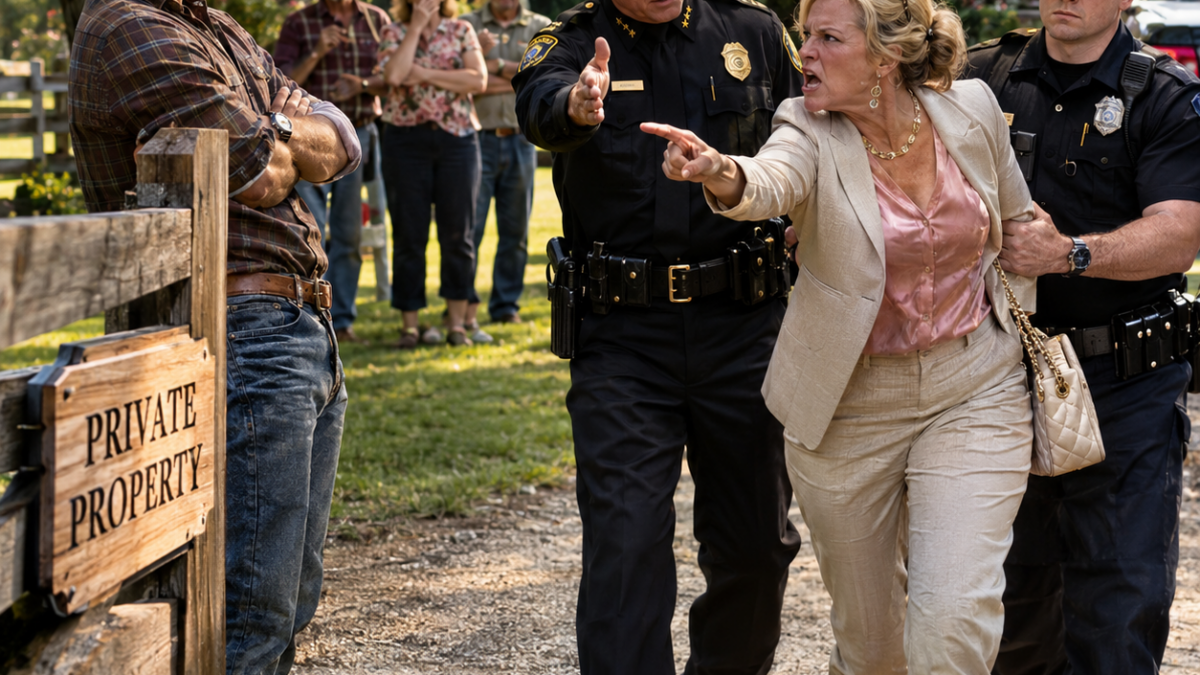
“Mrs. Brackett needs to leave Mr. Ralston’s property.”
Vanessa spun.
“Excuse me?”
“You heard me.”
“He is the one refusing my order!”
Hargrave said something I will never forget.
“Refusing your order is not a crime.”
Silence.
Vanessa looked around as if somebody might rescue her.
Nobody did.
“This refusal is costing our association millions.”
Hargrave answered:
“A financial problem does not give you authority over somebody else’s land.”
She started talking about the emergency plan.
The expansion.
The homeowners.
He stopped her.
“There is a court order.”
She pointed at me.
“He’s endangering families.”
I stepped to the gate.
Steel between us.
“You came here.”
She stared.
“You ordered me around.”
Nothing.
“You damaged my fence.”
Her jaw tightened.
“You called the police when I refused.”
I pointed toward the road.
“I’m telling you one final time.”
Pause.
“Leave my property.”
Hargrave formally instructed:
“Mrs. Brackett, leave the land covered by the order.”
She refused.
“I’m filing a complaint against you.”
Hargrave nodded.
“You have that right.”
“With the city council.”
“You have that right.”
“You’ll regret this.”
“You do not have the right to remain here.”
Then Vanessa made the decision that finished the scene.
She turned.
Walked toward the side-gate opening.
Straight deeper onto the maintenance road.
Officer:
“Ma’am, stop.”
She kept walking.
Hargrave’s voice sharpened.
“Stop. Turn around. Leave the property.”
Vanessa turned halfway.
“I am acting on behalf of this community!”
Hargrave looked at his officers.
“Escort Mrs. Brackett off Mr. Ralston’s land.”
Two officers moved beside her.
One placed a guiding hand near her arm.
She jerked away.
“Don’t touch me.”
The officer said calmly:
“Ma’am, stop resisting our direction.”
She froze.
Then let them walk her toward the county road.
Past Russell.
Past the workers.
Past her security guards.
Past the sign claiming my road belonged to Pine Hollow.
The woman who called police expecting me to be dragged away was escorted off my property by uniformed officers.
No handcuffs on me.
No arrest.
I stayed exactly where I had been.
On my land.
Behind my gate.
Hargrave ordered the guards out too.
They left.
Russell told his crew:
“Load everything.”
Vanessa stood on the shoulder.
White with rage.
“This isn’t over!”
I looked through the gate.
“No.”
Then:
“Now it gets serious.”
Hargrave told me body-camera footage would be preserved.
The department would take statements about the emergency call.
And the official-looking documents.
Then quietly:
“Investigators already have copies.”
“Of what?”
“The discrepancies.”
He did not accuse anyone.
Good police work rarely sounds dramatic.
He said:
“There are differences between the county record and what the association has circulated.”
I nodded.
“Thank you.”
“For what?”
“Treating it like law instead of influence.”
He looked toward Vanessa.
“That’s what it’s supposed to be.”
The patrol cars left.
I closed the gate.
Ran the chain.
Padlock clicked.
That sound felt enormous.
Vanessa stood outside.
Nobody left to command.
That evening, Laurel called.
“Email from Beatrice Hensley.”
HOA treasurer.
Attached document.
Months earlier, Pine Hollow’s outside law firm warned Vanessa:
Maintenance road private.
2013 license expired.
No permanent access.
Legal options:
Negotiate with Gideon.
Or design another route.
Vanessa knew.
Before the fake-looking letter.
Before the construction trucks.
Before the police call.
She knew.
Two days later, Beatrice met us at a diner.
She looked nervous.
“I can access these records as treasurer.”
She carried copies.
Board discussions.
Expansion budget.
Access issue.
Outside counsel warning.
She said:
“We talked about buying an easement from you.”
“No one contacted me.”
“Vanessa rejected it.”
“Why?”
“Too slow.”
“Alternative route?”
“Too expensive.”
I sat back.
“She told the board she had it handled.”
Beatrice nodded.
Then Laurel found the developer access agreement.
It carried a signature:
Gideon Ralston
It was not mine.
Did not resemble mine.
Date:
A day I had been working in another county.
Worksite gate logs confirmed.
Service invoices confirmed.
Witness:
Someone I had never met.
Laurel said:
“This is serious evidence.”
“Forgery?”
“Possible.”
“Looks obvious.”
“Evidence still gets tested.”
She pointed at me.
“You are not going online calling Vanessa a forger.”
“I wasn’t planning to.”
“Good.”
“Maybe a liar.”
“No.”
“Control freak?”
“Gideon.”
I smiled.
Then Beatrice brought expansion expenses.
Ridgeline Advisory Partners.
Consulting fee.
Principal owner:
Douglas Brackett.
Vanessa’s husband.
Success bonus:
$175,000.
Payable after expansion satisfied access requirements.
I stopped smiling.
There it was.
Not emergency safety.
Not children.
Not community.
Money.
Vanessa had a family financial interest tied directly to the project gaining approved access.
My road was the shortcut.
I told Laurel:
“Three things.”
She waited.
“Preserve everything.”
“Yes.”
“Send suspected documents to investigators.”
“Yes.”
“Notify planning, financing, everybody relying on the road.”
“Yes.”
I wanted no rumors.
No social-media war.
Documents.
Facts.
Vanessa called an emergency board meeting.
She blamed me.
Hostile neighbor.
Police overreach.
Anti-community obstruction.
Beatrice asked:
“Show us the Ridgeline contract.”
Vanessa refused.
“Show us the investor access agreement.”
Refused.
“Show us the original 2013 license.”
Refused.
Then Beatrice placed the attorney warning on the table.
“If you knew we had no legal right to Mr. Ralston’s road, why did you tell us everything was approved?”
Silence.
Harold Whitaker, another board member, flipped through the budget.
The road was still listed as:
SECURED ACCESS ASSET
Beatrice asked:
“Did you submit a document carrying Mr. Ralston’s signature?”
Vanessa stood.
“This meeting is adjourned.”
No one moved.
She looked around.
For years, people stood when she stood.
Followed when she walked.
Stopped when she said stop.
That night?
Nothing.
The next morning, developer counsel demanded proof.
Every access document.
Every approval.
Every easement.
Without lawful access:
Funding suspended.
Planning department formally said the expansion could not rely on my road.
Fire Marshal Carter agreed.
Forty-six lots frozen.
Costs climbed.
Russell turned over his logs.
Emails.
Requests for proof.
Vanessa repeatedly giving personal assurances.
His construction company withdrew from the road work.
Demanded payment for costs already incurred.
The contractor hired to remove my gate became a witness against the person who hired him.
That is the problem with dragging innocent professionals into a dishonest project.
Eventually, someone reads the paperwork.
Pine Hollow homeowners called a special meeting.
Packed community hall.
Vanessa spoke first.
“Everything I did was for this neighborhood.”
A man in the third row stood.
“Why were we told Gideon’s road belonged to us?”
A woman asked:
“Why did association money go to a firm connected to your husband?”
Vanessa pointed toward the back.
At me.
“None of this happens if he cooperates.”
I stood.
Did not raise my voice.
“I didn’t create your financial problems.”
The room quieted.
“I refused to surrender land you had no right to take.”
That was all.
No applause needed.
Vote.
Vanessa removed.
Beatrice appointed for transition.
Her office gone.
Security authority gone.
Board title gone.
She tried interrupting the meeting.
Nobody cared.
Afterward, she caught me in the hallway.
“You destroyed everything I built.”
I looked at her.
“No.”
She glared.
“You put my name on something I never signed.”
Her face changed.
“Then you called the police when I refused to play along.”
She said nothing.
Weeks later, my fence was repaired.
Bent steel replaced.
Welds ground smooth.
Paint matched.
Orange stakes removed under settlement terms.
The fake emergency-road sign disappeared.
New sign:
PRIVATE ROAD — PROPERTY OF GIDEON RALSTON
Settlement covered:
Fence repairs.
Survey costs.
Significant share of legal expenses.
Written acknowledgment Pine Hollow had no access right based on the documents it had relied upon.
The HOA could not market my road as subdivision access.
Could not show it in planning materials.
Could not call it emergency access.
I did not sell.
Did not grant an easement.
Did not fix their problem for them.
That decision remained mine.
Across the property line, Pine Hollow hired an independent engineering firm.
Designed a different emergency route.
Across land the development actually had the right to use.
Imagine that.
More expensive.
Longer approval.
But legal.
Beatrice published the financial review.
Members learned previous leadership had promised access without legal foundation.
Ridgeline contract went under separate review.
The suspected forged documents continued through investigators.
I did not control the criminal process.
Did not pretend I did.
If charges came, prosecutors decided.
My goal was never the maximum punishment.
My goal was boundary.
Simple.
Vanessa could never again use an HOA title to cross my property line.
That mattered more.
One afternoon, Chief Hargrave stopped by.
I had told him anytime patrol brought him nearby, he was welcome to see whether the order was being respected.
He looked at the new fence.
The sign.
The locked gate.
“Quiet?”
“First time in weeks.”
He glanced toward Pine Hollow.
“Funny thing about authority.”
“What?”
“Some people think making enough noise gives them more of it.”
I smiled.
“She made plenty.”
“Didn’t move the property line.”
“No.”
No handshake.
No victory speech.
He left.
I opened my gate.
Drove through.
Closed it.
Locked it.
Same thing I had done for years.
Across the field, surveyors were laying out Pine Hollow’s new route.
Not one crossed my land.
That should have been the end.
But the emotional part lasted longer.
People think once you win a property fight, everything feels normal.
It doesn’t.
For months, every vehicle slowing near my gate made me look up.
Every orange survey vest made my stomach tighten.
I checked the cameras too often.
I started carrying copies of the restraining order in my truck even after settlement.
Laurel noticed.
“You don’t need that anymore.”
“I know.”
“Then why is it in your glove box?”
“Habit.”
“That’s not healthy.”
“Neither is having four security guards at your gate.”
She smiled sadly.
“Fair.”
Trespass does something strange to a person.
It is not only land.
It changes how safe your own place feels.
Before Vanessa, the gate was just a gate.
After her, it became a boundary I watched.
Time fixed that.
Not completely.
Enough.
My equipment business returned to normal.
Excavators.
Loaders.
Hydraulic lines.
Machines have a comforting honesty.
When a hose leaks, it leaks.
It does not form a committee and tell you the oil belongs to somebody else.
I appreciated that.
One day, Russell Avery brought a skid steer for repair.
He hesitated outside.
Then called.
“Can I come through?”
I laughed.
“Russell, yes.”
He drove in.
That simple call meant more than he probably understood.
While I worked on the machine, he stood nearby.
“I’m sorry.”
“For what?”
“My crew damaged your fence.”
“You documented it.”
“I should have checked earlier.”
“You asked Vanessa.”
“I did.”
“She lied.”
“I still should’ve verified.”
I looked at him.
“Why didn’t you?”
“Contract was big.”
Fair answer.
“Schedule?”
“Yes.”
“Pressure?”
“Yes.”
He sighed.
“She kept saying legal had cleared everything.”
“That phrase should terrify you now.”
“It does.”
He changed company policy.
No access-right work without direct documentation reviewed by legal.
Good.
Painful lesson.
Useful outcome.
Owen stopped by later that summer.
We stood beside the brass pin.
“You know what bothered me most?”
“What?”
“The trimmed map.”
“Why?”
“Because it almost worked.”
He was right.
Take an old temporary route.
Remove expiration note.
Crop parcel information.
Add thick red line.
Put APPROVED beside it.
Most people never ask more questions.
Maps feel objective.
Lines feel official.
Vanessa understood that.
She did not need everybody to understand land law.
She just needed them to assume someone else had checked.
Residents assumed board checked.
Board assumed counsel checked.
Contractor assumed client checked.
Investors assumed developer checked.
Developer assumed access was secured.
Everybody trusted the person before them.
Except me.
Because it was my gate.
That is how weak systems fail.
Not always because everyone is dishonest.
Sometimes because one person lies and everyone else assumes verification happened somewhere else.
Pine Hollow changed its procedures after Vanessa.
Every land-use claim required:
Recorded instrument.
Independent legal review.
Board disclosure.
Conflict check.
No association officer could represent private property as HOA access without documentation.
Very basic.
Very late.
Still useful.
Beatrice eventually became president.
She resisted at first.
“I don’t want it.”
Members convinced her.
She called me before accepting.
“Do you think I’m insane?”
“Probably.”
“Helpful.”
“You asked.”
She laughed.
Then got serious.
“I don’t want Pine Hollow becoming Vanessa with a different name.”
“Then don’t.”
“That simple?”
“Mostly.”
“How?”
“Remember your vote stops at the property line.”
She went quiet.
“That’s good.”
“Free advice.”
“From you? Historic.”
She became a decent president.
Not because she agreed with everyone.
Because she understood limits.
One year later, Pine Hollow finished the new emergency road.
It crossed developer-controlled property.
Properly designed.
Fire marshal approved.
No need for mine.
They held a small ceremony.
I was invited.
Declined.
Then Carter Lewellen called.
“Come.”
“Why?”
“Because I want to watch you stand next to the road they should have built in the first place.”
I went.
The new route was wider.
Better drainage.
Safer turning radius.
Actually designed for emergency vehicles.
Carter looked pleased.
“This is better.”
“Than my road?”
“Yes.”
“Then why did they want mine?”
“Cheap.”
Of course.
Vanessa had risked everything to avoid doing the expensive correct thing.
That happens more than people admit.
Shortcuts become attractive when decision-makers believe consequences belong to someone else.
Her shortcut would have widened my private road.
Changed drainage.
Removed my gate.
Increased traffic.
And locked Pine Hollow into relying on land it did not own.
The new road cost more upfront.
But it belonged to them.
That is value.
Ownership is certainty.
Years later, a Pine Hollow resident named Daniel stopped me at a hardware store.
He had been one of the angry people at my gate.
“Mr. Ralston.”
“Gideon.”
He looked embarrassed.
“I owe you an apology.”
“For?”
“I called you selfish.”
“I remember.”
“I believed the emergency-road letter.”
“Most people did.”
“I should have asked.”
“Yes.”
He laughed nervously.
“You don’t make apologies easy.”
“I accepted it.”
He nodded.
“My wife still says you were too stubborn.”
“Your wife may be right.”
He smiled.
“But you were right.”
“Those can both be true.”
We shook hands.
That interaction meant more than any legal bill.
A community had been manipulated against me.
Having even one person admit that helped.
Not because I needed validation.
Because it meant the lie had ended.
Vanessa’s legal consequences unfolded slowly.
Investigators reviewed the agency letter.
The access agreement carrying my name.
Statements from employees.
Computer records.
I gave handwriting samples.
Answered questions.
Then went home.
Laurel repeatedly reminded me:
“Do not speculate.”
“I know.”
“Do not post.”
“I don’t post.”
“Do not talk to local Facebook groups.”
“I would rather eat gravel.”
“Good.”
Eventually, matters proceeded through the proper channels.
I never claimed more than the record supported.
That mattered.
When you have strong evidence, exaggeration only weakens it.
Vanessa’s reputation collapsed without my help.
Her own emails did that.
Her own documents.
Her own recorded statements.
Her own emergency call.
That was enough.
One afternoon, months after the settlement, I ran into Douglas Brackett.
Her husband.
Gas station.
He saw me.
Looked away.
Then walked over.
“You cost us a lot.”
I stared.
“Excuse me?”
“The project delay.”
“I didn’t build your access plan.”
“Vanessa was trying to make it work.”
“Using my road.”
He clenched his jaw.
“You could’ve negotiated.”
“You could’ve asked.”
“She thought you’d refuse.”
“That isn’t permission.”
He shook his head.
“Do you know what we lost?”
“No.”
He laughed bitterly.
“Of course not.”
I looked at him.
“You had a $175,000 bonus riding on access.”
His face changed.
So he knew I knew.
I continued.
“I wasn’t obligated to make your bonus happen.”
He said nothing.
“Your family’s financial plan was not my property obligation.”
He walked away.
That was the only conversation we ever had.
It clarified something.
People like Vanessa often say:
Everyone is counting on this.
Project.
Jobs.
Families.
Investors.
But hidden inside “everyone” may be a personal benefit nobody bothered to disclose.
That is why conflicts of interest matter.
Not because every connected contract is corrupt.
Because personal incentives distort judgment.
Would Vanessa have been so aggressive without the $175,000 success bonus?
Maybe.
Would she have forged ahead after legal counsel warned her?
Maybe.
But the financial interest helped explain the urgency.
It gave context.
Not proof of every allegation.
Context.
Beatrice understood that distinction.
During the first annual meeting after Vanessa, she stood before residents.
“No officer will ever again participate in a vendor or consulting arrangement involving a spouse, family member, or related business without written disclosure and independent review.”
Someone shouted:
“Should’ve been obvious.”
Beatrice answered:
“Yes.”
The room laughed.
Good.
Institutions improve when they can admit obvious failures without pretending complexity excuses them.
I kept the crumpled copy of the restraining order Vanessa destroyed.
Flattened it.
Put it in the case box.
Laurel saw it.
“You are sentimental.”
“No.”
“You saved garbage.”
“It’s evidence.”
“The case is closed.”
“Historical evidence.”
She laughed.
“Frame it.”
“I might.”
She shook her head.
I never framed it.
The new sign at my gate was enough.
PRIVATE ROAD — PROPERTY OF GIDEON RALSTON
People ask why I did not write:
NO HOA ACCESS.
I considered it.
Then decided against.
My property did not need to define itself in opposition to Pine Hollow forever.
Private road was enough.
Ownership was enough.
Silence was enough.
The first winter after everything, snow covered the maintenance road.
No tire tracks except mine.
I walked to the gate one morning.
Looked toward the neighborhood.
Nothing.
No Vanessa.
No construction trucks.
No guards.
No orange stakes.
I realized my shoulders were relaxed.
That felt like victory.
Not the escort.
Not the vote.
Not the financial exposure.
Peace.
That is what people misunderstand about revenge stories.
The satisfying ending is not always watching the other person fall.
Sometimes it is no longer thinking about them.
I reached that point slowly.
For a while, I replayed the police scene.
Vanessa calling 911.
Vanessa smiling.
Chief Hargrave asking:
“Who owns the land?”
Then her being escorted away.
It was satisfying.
I am not going to pretend otherwise.
But satisfaction fades.
What remained was the lesson.
Authority has a source.
A board vote gives an HOA power over matters within its governing authority.
It does not create ownership.
A public-safety label does not create an easement.
A colored map does not transfer land.
A document with my name is not consent if I never signed it.
And calling the police does not magically turn a civil demand into law.
Vanessa believed uniforms would validate her.
Instead, Chief Hargrave validated the boundary.
That was the twist she never saw coming.
A year later, Hargrave stopped again.
He was nearing retirement.
He leaned against his cruiser.
“Still quiet?”
“Yes.”
“Good.”
I asked:
“You knew about the case before she called?”
“We had the file.”
“Did you know she’d show up?”
“No.”
“Laurel sent everything.”
“Smart lawyer.”
“Expensive lawyer.”
He laughed.
Then:
“You handled that morning well.”
“I wanted to yell.”
“Yelling wouldn’t help.”
“I know.”
“You stayed behind the gate.”
“Yes.”
“Kept recording.”
“Yes.”
“Let us sort it.”
“Yes.”
He nodded.
“People think police calls are about who sounds most confident.”
“I noticed.”
“They’re supposed to be about facts.”
“Supposed to be?”
He smiled.
“We’re human.”
Fair.
I asked:
“What if Laurel hadn’t filed the order with the department?”
“We still verify.”
“But slower?”
“Probably.”
That became another lesson.
Preparation matters.
If you expect conflict, notify relevant authorities in advance through lawful channels.
Do not wait for the liar to tell the story first.
Vanessa called 911 thinking she controlled the narrative.
But Hargrave already had documents.
That destroyed the advantage she thought she had.
Not manipulation.
Preparation.
Huge difference.
My nephew came to work with me later.
Twenty-two.
Learning equipment repair.
One afternoon, he asked about the orange stakes.
“What would you have done if they started digging before you noticed?”
“Call sheriff.”
“What if they ignored you?”
“Court.”
“What if court was slow?”
“Document.”
He frowned.
“You’re boring.”
“Yes.”
“Wouldn’t you just block the excavator?”
“No.”
“You did stand there.”
“Before the restraining order.”
“So why not physically stop it?”
“Because being right does not make you bulletproof.”
He looked at me.
I continued:
“Construction equipment kills people.”
“Okay.”
“Security fights ruin cases.”
“Okay.”
“Cameras are cheap.”
He nodded.
“Boring is good?”
“Boring wins property disputes.”
He laughed.
Maybe he learned something.
Pine Hollow changed too.
The expansion eventually resumed.
Smaller delay than people feared.
New access road approved.
Forty-six lots developed.
Homeowners did not go bankrupt.
Property values did not collapse.
The community survived my refusal.
That fact exposed one of Vanessa’s biggest lies.
She always framed my road as the only possible solution.
It wasn’t.
It was the cheapest solution.
Those are different things.
People often use “only” when they mean “most convenient for me.”
The alternate route cost more.
It required redesign.
Additional grading.
New approvals.
But it existed.
Vanessa simply did not want to pay for doing it correctly.
My refusal forced them to.
Ironically, the new access was safer.
Carter told me the grade was better for fire apparatus.
Wider radius.
Cleaner sightlines.
Less conflict with private business traffic.
So the community ended up safer.
Not despite me saying no.
Partly because I did.
That mattered.
One resident later told me:
“We thought you were blocking safety.”
I replied:
“I was blocking unauthorized access.”
“Same thing to us at the time.”
“I know.”
She looked at the new road.
“I guess not anymore.”
Exactly.
Words matter.
Vanessa used emergency to make resistance sound immoral.
But emergencies do not erase ownership automatically.
They may create specific legal powers under specific conditions.
That is different from an HOA president declaring permanent access because a subdivision expansion needs it.
The real emergency route had to be designed and approved properly.
It was.
Everyone survived.
Vanessa’s office was eventually converted into a general board workspace.
No president got a private suite anymore.
Beatrice joked:
“Symbolic.”
I approved.
The old nameplate screw holes remained for months.
She told me they left them deliberately.
“Why?”
“Reminder.”
I laughed.
“Now who’s sentimental?”
She admitted it.
One spring, Pine Hollow invited neighboring landowners to a boundary-information session.
Sounded terrible.
I attended.
Maps.
Surveys.
Covenant lines.
Public roads.
Private roads.
Emergency plans.
Owen gave part of the presentation.
He said:
“The most expensive boundary dispute is usually the one someone assumed didn’t need verifying.”
I looked at him.
He smiled.
Afterward, an older homeowner approached.
“Were you the guy Vanessa called police on?”
“Yes.”
“Good for you.”
“Thanks.”
“She fined me $300 once because my trash can was visible.”
“That sounds irritating.”
“She treated that HOA like a kingdom.”
I said nothing.
I did not want every small grievance added to my story.
Vanessa’s treatment of others was their experience.
My case stood on its own.
That became important to me.
Once someone falls from power, people pile on.
Sometimes fairly.
Sometimes not.
I did not need exaggeration.
Her proven conduct was enough.
That is the best revenge against someone who manipulates facts.
Precision.
Do not become what they accuse you of.
Do not invent.
Do not embellish.
Do not smear.
Just preserve.
Date.
Time.
Video.
Document.
Signature.
Boundary.
Let the truth accumulate.
It usually weighs more than anger.
Laurel liked that philosophy.
“Finally,” she said.
“What?”
“You sound like a lawyer.”
“Take it back.”
She laughed.
I paid her final invoice.
Then wrote on the memo line:
For teaching an old inspector not to punch an HOA sign.
She sent me a photo.
Best client note this year.
We stayed friends.
Years later, I had reason to hire her again.
Not HOA.
Business lease.
She said:
“Please tell me nobody forged your signature.”
“No.”
“Disappointing.”
I laughed.
Normal legal work suddenly felt wonderful.
That was another sign I had moved on.
The old maintenance road remains private today.
I still grade it.
Still use it for equipment.
Gate still locked.
Sometimes Pine Hollow service vehicles stop at the county line because drivers assume it might connect.
They call.
If they have a legitimate reason and I agree?
I open it.
That surprises people.
“You let the HOA use it now?”
Occasionally.
With permission.
Specific purpose.
Specific time.
Written if needed.
That is the point.
I never hated cooperation.
I hated theft disguised as authority.
One day, Pine Hollow had a fallen tree blocking their drainage access.
Beatrice called.
“Can maintenance cross your road for thirty minutes?”
“Where?”
She sent a map.
I reviewed.
“Yes.”
Two trucks entered.
Removed tree.
Left.
No lawsuit.
No police.
No drama.
Why?
Because they asked.
That simple.
Vanessa could have asked.
She could have negotiated an easement.
Maybe I would have said no.
Maybe I would have said yes for terms.
We will never know.
She skipped consent entirely.
That was the unforgivable part.
People say her biggest mistake was calling police.
No.
That was merely the moment her mistake became visible.
Her biggest mistake happened earlier.
When she decided my answer did not matter.
Everything after was an attempt to convert that belief into reality.
Survey crews.
Maps.
Letters.
False authority.
Construction.
Police.
Once you refuse to respect consent, you need increasingly aggressive tools to force the outcome.
That is why the story escalated.
At the end, she was standing inside land she had been ordered to leave, still believing saying “community” loudly enough would change the boundary.
It did not.
The brass pin stayed where it had always been.
That pin became a symbol for me.
Small.
Unimpressive.
No flashing lights.
No board vote.
No title.
Just a piece of metal showing a line.
Vanessa had:
Two hundred homeowners.
Security guards.
Developers.
Construction equipment.
Investment partners.
Official letterhead.
She still could not move that pin.
That is the beauty of recorded property boundaries.
They do not care who is louder.
The last time I saw Vanessa was years later at a county building.
I was renewing a business permit.
She was walking out of an office with an attorney.
We recognized each other.
She stopped.
“Still locking that gate?”
“Yes.”
She gave a bitter smile.
“You won.”
I considered correcting her.
Then did.
“I kept what was already mine.”
She rolled her eyes.
“Same thing.”
“No.”
Her attorney looked uncomfortable.
Vanessa continued:
“You could have avoided all of it.”
“How?”
“By cooperating.”
“With your plan?”
“Yes.”
“You mean surrendering.”
“You always have to make it sound dramatic.”
I laughed.
“You called the police.”
Her face tightened.
“That was a mistake.”
“Yes.”
“At least you admit that.”
“I said calling them was a mistake.”
She looked at me.
“I should have handled it differently.”
“How?”
Silence.
That told me she still had not learned.
If “differently” meant a better way to force me, then nothing changed.
I said:
“The right answer was to ask.”
She looked away.
I continued:
“And accept that I might say no.”
She walked off.
That was closure.
Not apology.
Not reconciliation.
Understanding what she still could not accept.
Some people never learn the whole lesson.
Institutions can learn around them.
Pine Hollow did.
Years passed.
Chief Hargrave retired.
At his retirement dinner, Carter invited me.
I went.
Hargrave spotted me.
“Gate guy.”
“Police chief.”
We shook hands.
He laughed.
Someone at the table asked:
“What gate?”
Hargrave looked at me.
“Long story.”
I said:
“HOA president called police because I wouldn’t obey her.”
“What happened?”
Hargrave took a drink.
“I made her leave.”
Everyone laughed.
That was the short version.
The real version was deeper.
About preparation.
Documents.
Private authority.
Public authority.
Conflict.
Money.
Fear.
And one question:
Who owns the land?
That question cut through everything.
Vanessa’s board vote.
Her emergency claims.
Her maps.
Her threats.
Her number of homeowners.
The answer remained:
Me.
Once Hargrave established that and verified the court order, the performance collapsed.
That taught me something beyond property disputes.
When someone overwhelms you with complexity, find the core question.
Who owns it?
Who signed it?
Where is it recorded?
What authority created the rule?
Who benefits?
Simple questions expose complicated lies.
That became advice I gave anyone dealing with aggressive institutions.
Not just HOAs.
Ask for source authority.
Do not argue only about fairness.
Fairness is subjective.
Documents are stronger.
Vanessa said:
Two hundred families.
I said:
Show me the easement.
She said:
Emergency route.
I said:
Show me approval.
She said:
Board vote.
I said:
Show me ownership.
She never could.
Everything else was noise.
My settlement documents stayed in a fireproof safe.
Deed.
Survey.
Old 2013 license.
Restraining order.
Final acknowledgment.
I included a note for whoever owns the property after me.
If Pine Hollow ever claims access, start with these.
Maybe unnecessary.
Maybe not.
Institutions forget.
Leadership changes.
Records protect memory.
That was another reason I refused to create a permanent access deal just to end the dispute.
Once granted, an easement can outlive everybody involved.
Decades.
Generations.
I was not going to change my land forever because Vanessa created a temporary crisis.
Temporary pressure should not force permanent property decisions.
That lesson mattered.
Toward the end of my career, I stopped inspecting highway jobs.
Full-time equipment repair.
Less travel.
More peace.
Sometimes I still missed the field.
But not conference rooms.
Definitely not HOA conference rooms.
My nephew took more responsibility.
He learned the boundaries.
One day, a delivery driver asked whether he could cut through Pine Hollow to save time.
My nephew said:
“No.”
Driver asked:
“Why not? Road connects.”
He answered:
“Because connection doesn’t equal permission.”
I overheard.
Smiled.
He had learned.
Boundaries work both ways.
I expect Pine Hollow to respect mine.
I respect theirs.
That is fairness.
I would never drive through their private roads because it was convenient and then claim my business needed access.
That would make me Vanessa.
No thanks.
A few years later, Beatrice retired from the board.
At her final meeting, she sent me a letter.
Not official.
Personal.
It said:
The best thing that happened to Pine Hollow was being forced to admit we could not vote ourselves authority over somebody else.
I kept that.
Maybe I am sentimental.
Do not tell Laurel.
Beatrice also wrote:
I wish we had listened sooner.
That line mattered.
People sometimes ask whether I regret not compromising before things escalated.
No.
Compromise requires both sides have something they are entitled to bargain over.
Vanessa started by claiming a right she did not have.
If I “compromised” by giving half, I would reward theft.
Negotiation could have happened before.
Once she claimed ownership through false documents and tried to force construction, my priority became stopping interference.
Later, if Pine Hollow wanted to make a legitimate proposal?
Fine.
They never did.
They built another road.
Good.
That was the correct solution.
The property is quieter now than before Pine Hollow’s expansion.
Strangely.
The new emergency route moved internal traffic away from my boundary.
Less headlights.
Less service traffic.
More trees planted.
The fight resulted in better separation.
One Sunday morning, I sat outside with coffee.
No excavator open.
Nothing broken.
That felt suspicious.
I looked at the gate.
Sunlight on steel.
Private-road sign.
County road beyond.
A Pine Hollow resident jogged past.
Waved.
I waved back.
Normal.
That is the happy ending.
Not everyone hates each other.
Not eternal warfare.
Just ordinary neighbors.
A bad leader gone.
Clear rules.
A gate that stays closed unless I choose to open it.
People on social media still call it “the day the police chief destroyed an HOA Karen.”
Funny headline.
Not really what happened.
Hargrave did not destroy Vanessa.
He enforced a court order.
The board removed her because of documents.
Her financial interest damaged her credibility.
Her own decisions damaged her reputation.
My role?
I refused.
Recorded.
Verified.
Filed.
Waited.
There is something powerful about refusing to be rushed.
Vanessa used deadlines constantly.
Forty-eight hours.
Tomorrow.
Construction starts at 7:30.
Funding inspection.
Emergency.
Now.
Unlock the gate.
Urgency pressures people into surrender.
My answer became:
Show me the document.
That slowed everything.
Slow is dangerous to lies.
It gives people time to check.
Time exposed the 2013 expiration.
Time exposed the unapproved emergency route.
Time exposed the false consent.
Time exposed Ridgeline.
Time exposed the legal warning Vanessa already received.
That is why she kept accelerating.
She needed action before verification.
The morning she called police, she thought uniforms would finally create the irreversible moment.
Gate opened.
Trucks enter.
Road physically changed.
Then she could say:
See? It’s already being used.
Instead, the police froze the performance.
Asked questions.
Verified.
Then escorted her out.
Perfect irony.
But also perfect process.
I often think about the guard holding bolt cutters.
He was not some villain.
He was an employee.
Following instructions.
Russell stopped him.
That small decision mattered.
If he cut my lock, the conflict could have escalated badly.
I thanked Russell later.
He said:
“I almost didn’t step in.”
“Why did you?”
“Your documents.”
Not my anger.
Not my threat.
Documents.
Good.
That reinforced everything.
The day after Vanessa was removed from office, I found an envelope at the gate.
No return address.
Inside:
A photocopy of Pine Hollow’s original expansion presentation.
My road highlighted.
Words:
SECURED SECONDARY ACCESS
Written before anyone ever contacted me.
That was the mindset.
They treated consent as a final administrative checkbox.
Not a prerequisite.
That is a common development mistake.
Plan around something first.
Ask owner later.
Then owner’s refusal becomes “obstruction.”
No.
The refusal is information that the plan was premature.
I passed the document to Laurel.
It became part of discovery.
Again:
Paper.
Not shouting.
By the time final settlement was signed, Pine Hollow’s attorney had changed.
The new lawyer was straightforward.
He sat across from us.
“The association acknowledges it has no access rights.”
“Good.”
“We want mutual non-disparagement.”
Laurel looked at me.
I said:
“I’m not interested in attacking the HOA.”
The lawyer nodded.
“Fine.”
“But I won’t sign anything preventing me from truthfully describing what happened if required legally or professionally.”
He agreed.
Reasonable.
We finished.
No theatrical final demand.
No squeezing for maximum pain.
I wanted closure.
That makes some people disappointed when they hear the story.
They want me to bankrupt Vanessa personally.
Take her house.
Destroy Pine Hollow.
Make everyone beg.
That was never the point.
Accountability is strongest when proportionate.
Fence damaged?
Repair it.
Trespass?
Stop it.
Legal expenses caused?
Compensate where allowed.
False land claim?
Correct it.
Leadership abused?
Remove leadership.
Possible criminal acts?
Investigators handle them.
Clean.
No fantasy needed.
I slept better knowing I had not become cruel just because she had been arrogant.
That did not mean I felt sorry for her.
Consequences were deserved.
But consequences did not need embellishment.
One day, Martin—the neighbor who wanted to throw the survey stakes into the road—came over.
“You know, I still think I would’ve ripped them out.”
“I know.”
“Would’ve felt great.”
“For ten minutes.”
“Probably.”
“Then Vanessa would photograph you destroying survey markers.”
He paused.
“Damn.”
“Yes.”
“She’d call police.”
“Yes.”
“Make me look unstable.”
“Yes.”
He nodded.
“Fine.”
“What?”
“You were right.”
I smiled.
“Say it louder.”
“No.”
That was satisfying too.
A lesson from my highway inspection years:
Never give a bad contractor an excuse to blame your work.
Same with disputes.
Keep your side clean.
Vanessa’s entire strategy depended on portraying me as unreasonable.
Hostile landowner.
Anti-community.
Threatening.
If I had punched a guard?
She wins narrative.
If I destroyed the sign?
She gets property-damage photos.
If I blocked county road?
She gets an obstruction claim.
Instead, I stayed behind my gate.
The footage showed exactly that.
Chief Hargrave watched.
That was enough.
Video is unforgiving in the best way.
Vanessa’s emergency call said I lunged.
Video said no.
She said public road.
Survey said no.
She said emergency approval.
Fire marshal said no.
She said permanent access.
County file said expired.
She said landowner consent.
I said never signed.
Work records placed me elsewhere.
Every claim met a record.
That was why her story collapsed.
Not because I spoke better.
Because reality contradicted her repeatedly.
Years after, I met a young police officer who had been one of the two escorting Vanessa.
He recognized me at a diner.
“Mr. Ralston.”
“Gideon.”
He laughed.
“I was brand new.”
“That day?”
“Third month on patrol.”
“Good introduction.”
“I thought it was going to be simple trespass.”
“It was.”
He smiled.
“Not emotionally.”
True.
He said Hargrave talked about the call later during training.
“What did he say?”
“When someone demands police enforce private authority, ask where that authority comes from.”
I liked that.
“Sounds like him.”
The officer continued:
“And don’t let the loudest person define the scene.”
Even better.
Vanessa accidentally became training material.
Maybe useful legacy.
Pine Hollow’s new emergency route eventually got named Cedar Bend Road.
I drove past it once.
Nice road.
Proper shoulders.
Fire apparatus turn.
Drainage.
I stopped.
Carter happened to be there.
He said:
“Want to know something funny?”
“What?”
“This cost less than the total litigation.”
I laughed.
“Of course.”
If Vanessa had accepted the redesign early, everyone saved money.
That is another cost of ego.
People compare only immediate expenses.
Alternative road looks expensive.
Litigation looks invisible until invoices arrive.
Then:
Attorney fees.
Contractor standby.
Redesign delay.
Survey.
Insurance.
Financing costs.
Reputation.
Board upheaval.
Suddenly the “cheap” shortcut is the most expensive option.
Vanessa’s insistence on my road was never fiscally responsible.
It only looked cheap when she assumed my property could be taken for free.
Externalizing cost is not savings.
That lesson should be printed in every HOA budget meeting.
Beatrice would agree.
She once showed me the final cost summary.
I whistled.
“Don’t tell me.”
“You don’t want to know?”
“No.”
“Why?”
“I’ll get angry again.”
She laughed.
Good choice.
My land was worth more to me after the fight.
Not financially.
Emotionally.
Fourteen-point-six acres is not a huge ranch.
Mostly shop.
Road.
Trees.
Open ground.
But standing up for it connected me to every owner before me who had written terms carefully.
The 2013 temporary license was a perfect example.
The previous owner allowed infrastructure work.
But the document clearly said:
Temporary.
Project-specific.
Non-permanent.
Why?
Because he understood generosity can become a claim if not documented.
I never met him.
But I was grateful.
That one clause protected me years later.
Good paperwork is a gift to people you may never know.
I copied the license for my nephew’s records.
Told him:
“If you ever let somebody use land temporarily, write when it ends.”
He nodded.
“Because HOA?”
“Because humans.”
Better answer.
One summer, I replaced the gate.
Old steel had weathered.
I considered changing the style.
Then bought almost identical.
Laurel asked why.
“Tradition.”
“It’s a gate.”
“It survived Vanessa.”
“It literally got damaged.”
“Emotionally survived.”
She rolled her eyes.
New gate.
New lock.
Same chain style.
I stood back.
Liked it.
That evening, I found the old clip from the police day.
Did not watch the whole thing.
Just enough.
Vanessa:
“He refused my order.”
Hargrave:
“Refusing your order is not a crime.”
I stopped there.
That sentence had become locally famous.
Someone printed it on a coffee mug and gave it to me.
I hated the mug.
Used it anyway.
My nephew loved it.
He said:
“You should sell these.”
“No.”
“Could make money.”
“No.”
“Merch.”
“If you ever say ‘merch’ on my property again, I’ll revoke your access.”
He laughed.
Normal family nonsense.
Another sign life returned.
The most emotional moment came years later.
Not court.
Not police.
My mother, who had been living in assisted care during the dispute, asked me about it after seeing a local article.
She said:
“Your father would’ve been proud.”
I did not know what to say.
Dad had died before I bought the property.
He was a carpenter.
Hated bullies.
Loved rules when they protected people.
Ignored them when they were stupid.
Complicated man.
I asked:
“Why?”
“Because you didn’t let her make you angry enough to ruin yourself.”
That hit harder than anything.
I had thought strength meant standing at the gate.
Maybe it did.
But restraint was the harder part.
Mom understood.
She died two years later.
That sentence stayed.
You can be right and still ruin yourself if anger takes control.
Vanessa nearly did.
Actually, she did.
That was her tragedy.
She may have started with a genuine problem.
Pine Hollow needed access.
Maybe she believed expansion helped homeowners.
Maybe she thought my private road was the obvious solution.
At some early point, she could have negotiated.
But each refusal felt like an insult.
Each delay increased financial pressure.
Each shortcut made retreat harder.
Then personal money became tied to success.
Eventually, admitting she was wrong meant admitting everything.
So she doubled down.
That is how people trap themselves.
Not one giant evil decision.
A chain.
Assumption.
Misrepresentation.
Trespass.
False document.
Pressure.
Court order ignored.
Police called.
Then one final step onto land she had been ordered to leave.
When Hargrave told her to stop, she could have stopped.
Even then.
She didn’t.
Pride always offers one last exit.
She walked past it.
Years later, I told that to a county property-rights seminar.
They invited me as “affected landowner.”
I hated the title.
I spoke for ten minutes.
I said:
“The most dangerous moment wasn’t when the excavator arrived.”
People looked surprised.
“It was when people stopped asking for source authority.”
I explained.
Board vote.
Map.
Letter.
Emergency claim.
Everybody accepting the next person’s assumption.
Then:
“If someone tells you they have the right to use land, ask where the right comes from.”
That was all.
A planner asked:
“What should HOAs do when emergency planning depends on private land?”
“Negotiate before designing around it.”
A lawyer smiled.
“Simple.”
“Should be.”
Another asked:
“What should a landowner do when pressured?”
I answered:
“Document before arguing.”
That became my summary.
Document before arguing.
It would have saved me nothing from Vanessa’s first visit.
But it helped everywhere after.
The final criminal investigation produced outcomes I will not dramatize beyond what was established through proper proceedings.
Some matters resolved.
Some allegations narrowed.
Civil findings were separate.
That distinction always mattered to me.
I had no interest in saying Vanessa was convicted of something if she wasn’t.
Her proven conduct was enough.
She:
Entered despite an order.
Misrepresented access.
Directed work on disputed property.
Called police with claims contradicted by video.
Had financial interests connected to expansion.
Used documents investigators considered seriously problematic.
Lost the presidency.
Lost authority.
Paid through civil resolution.
That was plenty.
Truth does not need decoration.
Vanessa taught me that accidentally.
Pine Hollow eventually removed every old map showing my road as access.
Digital database corrected.
Marketing corrected.
Emergency plan corrected.
One old brochure survived online for a while.
A resident sent it.
“Should we demand removal?”
I looked.
Map.
My road.
Old expansion concept.
I called Beatrice.
She had it removed that afternoon.
No argument.
Progress.
The new board sometimes made mistakes.
Every board does.
But they stopped confusing mistakes with entitlement.
That was the real reform.
One afternoon, a landscaper accidentally crossed three feet onto my land.
Beatrice called.
“Our crew crossed your line.”
“How much?”
“Three feet.”
“Damage?”
“Grass.”
“Okay.”
“We’ll repair.”
“Fine.”
“No lawsuit?”
“Beatrice.”
She laughed.
“Just checking.”
That was trust rebuilding.
Not perfection.
Accountability.
The gate remained locked by default.
But the relationship softened.
I even attended a Pine Hollow summer barbecue once.
Only because Beatrice threatened to send Harold to drag me there.
I said:
“That sounds like trespass.”
She replied:
“Public park.”
Damn.
I went.
Residents were normal people.
Kids.
Dogs.
Food.
Not an army.
Vanessa had made the HOA feel like an enemy because she used the institution aggressively.
Once she was gone, I remembered institutions are made of people.
Most just want roads paved and grass cut.
That helped me avoid bitterness.
One older resident raised a beer.
“To the man who wouldn’t open the gate.”
I groaned.
“Don’t.”
People laughed.
I said:
“Seriously. Don’t make me a hero.”
He asked:
“Why not?”
“Because I was protecting my property. That should be normal.”
Silence.
Then he nodded.
Fair.
That was another thing I wanted.
Property rights should not require heroics.
You should not need viral videos or police chiefs.
A deed should be enough.
A valid court order should be enough.
Consent should be enough.
The fact that my story became dramatic was a failure of normal process.
Vanessa made it dramatic.
The system eventually corrected her.
But better leadership would have prevented everything.
I hope people understand that.
The most powerful person in the story was not me.
Not Hargrave.
Not Laurel.
Not Vanessa.
It was the boring county record.
The old license.
The survey pin.
The deed.
Those things waited quietly while people shouted.
Then won.
Years after the fight, the maintenance road needed resurfacing.
I hired a crew.
Russell’s company bid.
He called.
“Is that weird?”
“Yes.”
“Want me to withdraw?”
“No.”
“Really?”
“You learned.”
He got the job.
Before starting, he handed me:
Insurance.
Scope.
Property limits.
Written authorization form.
Blank signature line.
“Please sign.”
I laughed.
“What?”
“You verified.”
“Never again.”
I signed.
Crew did excellent work.
At the end, Russell said:
“Road looks good.”
“It does.”
“Any emergency HOA access included?”
“Get out.”
He laughed.
Humor is what remains after anger becomes history.
That felt good.
Chief Hargrave died several years after retirement.
Heart attack.
His family held a memorial.
I went quietly.
I did not know him well.
But one moment of his professionalism changed the course of my property dispute.
At the memorial, his daughter said:
“He always said authority should make you calmer, not louder.”
That sounded like him.
I remembered Vanessa shouting:
“I represent two hundred families.”
Hargrave answering with questions.
Calm beats noise when systems work.
I went home.
Unlocked the gate.
Drove through.
Locked it.
Thought about him.
That was my private thank-you.
Today, Pine Hollow’s roofs are visible through the trees.
Forty-six additional homes built.
New access road.
No crisis.
My 14.6 acres still mine.
Equipment shed expanded.
Maintenance road improved.
The old orange stake holes have vanished under grass.
If you did not know the story, you would never guess anything happened.
I like that.
Land heals.
So do people.
Mostly.
The only visible reminder is the sign.
PRIVATE ROAD — PROPERTY OF GIDEON RALSTON
Sometimes I stop and read it.
Not because I forget.
Because simplicity feels satisfying after chaos.
Vanessa arrived with:
Clipboard.
Board vote.
Security.
Construction vehicles.
Official-looking documents.
Emergency language.
Then police.
The sign answers all of it in six words.
Private road.
Property of Gideon Ralston.
No argument.
No speech.
Just fact.
If I could go back to that first morning, would I do anything differently?
Maybe call Laurel one day sooner.
Maybe install another camera angle.
Maybe make better coffee.
But open the gate?
No.
Not because I wanted conflict.
Because every time you surrender a right under false pressure, you teach the person applying pressure that the method works.
Vanessa had probably won many smaller fights that way.
Fines.
Letters.
Threats.
Deadlines.
People complied because fighting cost too much.
My road was different.
Permanent.
Once widened and integrated into the subdivision, reversing it would become harder.
She knew that.
I knew it.
So I said no.
People often say:
“You must’ve felt amazing when the police escorted her off.”
I felt relief first.
Then disbelief.
Then satisfaction.
Yes.
But the deeper satisfaction came later.
When the new route opened.
When my fence was repaired.
When Pine Hollow acknowledged no access right.
When residents stopped showing up angry.
When silence returned.
That was the ending I wanted.
Vanessa wanted the police to demonstrate her power.
Instead, the chief demonstrated its limit.
That is why the moment stays with people.
She stood at my gate believing authority flowed from confidence.
She had:
A title.
A board.
A crowd.
A logo.
I had:
A deed.
A survey.
A court order.
She thought hers looked stronger.
Chief Hargrave knew better.
He asked one question.
Who owns the land?
Everything after that was inevitable.
Vanessa could not answer.
Because she had spent months pretending ownership was a technicality.
It wasn’t.
It was the whole case.
The final image I keep is not her being escorted away.
It is later.
Late afternoon.
Repaired fence glowing in sunlight.
Gate shut.
My pickup inside.
Survey crew across the property line working on Pine Hollow’s new road.
They were close enough that I could hear equipment.
But not one tire crossed my land.
That picture meant the system finally worked.
Their project.
Their property.
My road.
My choice.
No threats.
No fake emergency.
No police.
Just boundaries.
Vanessa called the police because I refused to obey her.
She expected them to force my gate open.
She expected me to be the man standing on the county shoulder while her trucks rolled through.
Instead, Chief Elias Hargrave verified the record.
Confirmed the restraining order.
Checked the survey.
Watched the footage.
Then told her the one thing she had refused to hear from the beginning.
Her authority ended at my property line.
Two officers escorted her off.
I remained behind the gate.
Exactly where I belonged.
And when the lock clicked shut after the cruisers left, that sound did not feel like revenge.
It sounded like ownership.








