PART 2: HOA Karen Called the Police After I Towed Her SUV — Then Attacked the Officers and Walked Out on $375,000 Bail
PART 2:
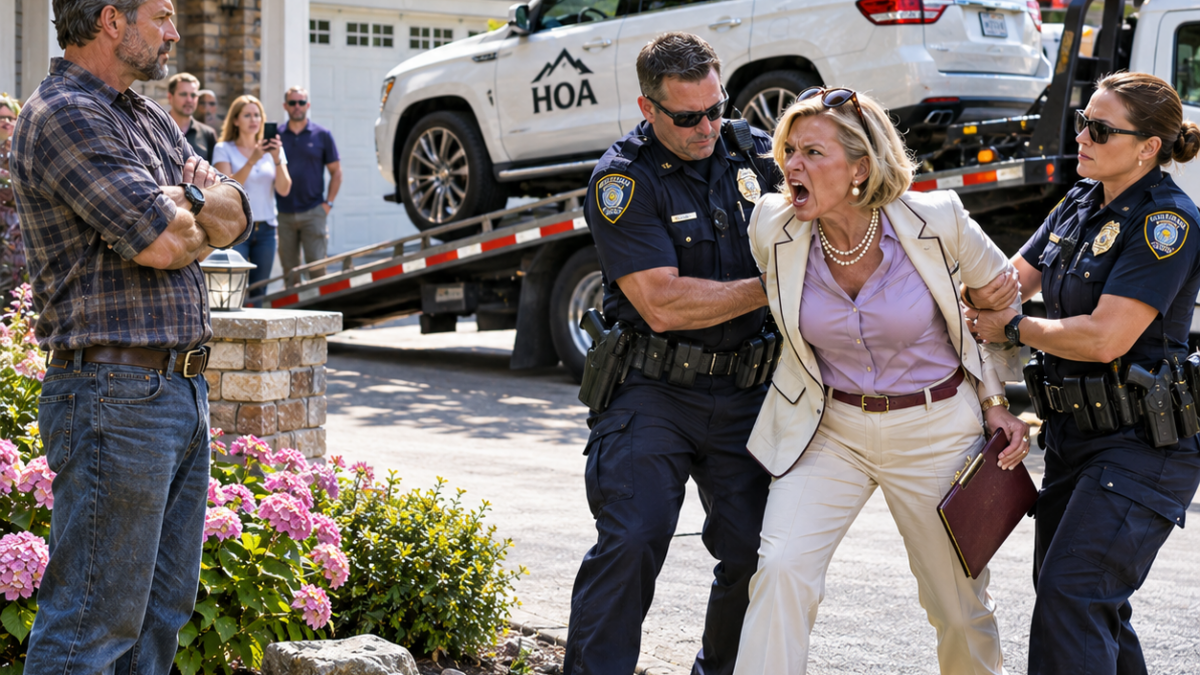
Her palm hit Officer Megan Chen high on the shoulder.
Hard.
Hard enough to make Chen stumble sideways into the edge of my lawn.
For half a second, everybody froze.
Deborah included.
It was almost as if even she couldn’t believe she had actually done it.
Then Officer Ramirez stepped forward.
“Ma’am, back up.”
Deborah swung around.
“Don’t touch me!”
“Put your hands where I can see them.”
“I said don’t touch me!”
Ramirez reached for her wrist.
That was when Deborah swung her purse.
It hit his forearm with a heavy thud.
He caught the strap before she could swing again.
“Deborah Callahan, you are under arrest.”
Her scream echoed across the cul-de-sac.
“You can’t arrest me!”
Chen had recovered by then.
“Yes, we can.”
“I am the HOA president!”
Ramirez stared at her.
“That is not a law-enforcement position.”
Neighbors appeared everywhere.
Curtains moved.
Doors opened.
Gary Thompson, the retired contractor across the street, stood on his porch with his phone already recording.
Deborah twisted as Chen brought her arms behind her.
“This is corruption!”
Click.
The first cuff closed.
“I know the county commissioner!”
Click.
Second cuff.
“My husband knows people!”
Ramirez guided her toward the cruiser.
“You can explain everything at booking.”
She looked back at me.
I had seen Deborah angry before.
Petty.
Smug.
Condescending.
This was different.
Her face was almost calm.
That scared me more than the screaming.
“You think this is over, Nicholas?”
Ramirez opened the cruiser door.
I didn’t answer.
She smiled.
Then got inside.
The car pulled away five minutes later.
I stood on my driveway with a coffee cup I no longer remembered picking up.
Caleb’s tow receipt lay crumpled near my shoe where Deborah had thrown it.
Gary crossed the street.
“Man.”
“Yeah.”
“I got the whole thing.”
“Don’t post it.”
He looked offended.
“I wasn’t going to.”
His phone buzzed.
He looked down.
Then back at me.
“Somebody else already did.”
Of course.
By nightfall, Maple Ridge knew.
By morning, half the county did.
The video showed Deborah shoving Chen.
Swinging the purse.
Screaming that an HOA president couldn’t be arrested.
Someone titled it:
MAPLE RIDGE HOA PRESIDENT ATTACKS POLICE OVER TOWED SUV.
I hated the attention.
Gary loved it.
“You’re famous.”
“I towed a car.”
“She attacked police.”
“Exactly.”
“Still counts.”
He held up his phone.
“There are twelve thousand views.”
“Please stop counting.”
“You know what the top comment says?”
“No.”
“‘Finally somebody towed the HOA.’”
I closed the door.
My grandmother would have found the whole thing funny.
That thought hurt unexpectedly.
Ruth Parker had fought Maple Ridge for years before I inherited the house.
Not dramatically.
No viral videos.
No police.
Just letters.
Appeals.
Survey maps.
Meeting after meeting where Deborah and her predecessors tried to extend “community standards” farther than the governing documents allowed.
Grandma kept every letter.
After she died, I found three banker’s boxes in the hall closet.
MAPLE RIDGE.
2011–2015.
2016–2020.
2021–CURRENT.
At the time, I thought it was excessive.
Now I understood.
When somebody builds power through paperwork, paper is how you fight back.
At nine that morning, Paul Bennett knocked on my door.
Paul was Maple Ridge’s treasurer.
Late fifties.
Round glasses.
Permanent look of somebody apologizing for something he hadn’t personally done.
“Mr. Parker.”
“Nicholas.”
“Right.”
He glanced toward my driveway.
“Can we talk?”
“If this is about Deborah, police already have my statement.”
“It’s about the board.”
That got my attention.
I let him sit on the porch.
He placed a folder on his lap but never opened it.
“We’re holding an emergency meeting tonight.”
“Okay.”
“Deborah is technically still president until the board takes action.”
“She assaulted two police officers.”
“I know.”
“I watched it.”
“I know.”
Paul rubbed his thumb along the folder edge.
“Hazel wants to suspend her.”
“Hazel?”
“Vice president.”
I knew Hazel Nelson only by sight.
Quiet woman.
Early sixties.
Retired school administrator.
Deborah usually spoke over her at meetings.
“Why are you telling me?”
Paul hesitated.
“Because there are board members who think you caused this.”
I actually laughed.
“I parked Deborah’s SUV on my driveway?”
“That’s not what I mean.”
“I shoved Officer Chen?”
“No.”
“I swung the purse?”
“Nicholas.”
“What exactly did I cause?”
He looked embarrassed.
“The embarrassment.”
I leaned back.
There it was.
Not the misconduct.
The embarrassment.
“That’s your board’s concern?”
“No. Mine isn’t.”
“Whose is?”
He wouldn’t answer.
That told me enough.
The emergency meeting was the most crowded HOA gathering I had ever seen.
Every chair filled.
People stood along the walls.
Phones were out.
Deborah’s nameplate sat at the center of the front table.
Her chair was empty.
Hazel Nelson tapped the microphone.
“We’re calling this meeting to order.”
Somebody yelled:
“Where’s Deborah?”
Another voice answered:
“Probably fighting the jail furniture.”
Laughter rolled through the room.
Hazel raised one hand.
“Please.”
The room settled.
“As everyone knows, President Callahan was arrested yesterday following an incident involving law enforcement.”
A man near the back shouted:
“She assaulted them.”
“We are aware.”
Hazel glanced at Paul.
Then at the secretary, Sophie Reynolds.
“Pending the outcome of the criminal matter, I move that Deborah Callahan’s executive authority be suspended immediately.”
Silence.
Then Sophie:
“Second.”
Hazel called the vote.
Three hands went up.
Paul waited.
Then raised his.
Four.
One member abstained.
The motion passed.
Applause exploded.
Hazel hit the gavel.
“This is not a celebration.”
That quieted people.
She looked around the room.
“This is a governance failure.”
I liked her immediately.
Deborah would have called it an attack.
Hazel called it failure.
There was a difference.
Afterward, she approached me.
“Mr. Parker.”
“Nicholas.”
She smiled faintly.
“Thank you for staying calm yesterday.”
“I had coffee.”
“I’m serious.”
“So am I.”
Her smile vanished.
Then she handed me a card.
“If Deborah or anyone acting for her contacts you, document it.”
“Why?”
Hazel looked toward the nearly empty room.
“Because she has loyalists.”
“Board members?”
“Residents too.”
“Why?”
“People benefited from her.”
That was something I hadn’t considered.
Deborah’s rules had harmed plenty of people.
But power rarely survives on fear alone.
Somebody gets exceptions.
Somebody gets a late fee waived.
Somebody gets a fence approved in two days while another waits three months.
Favor creates loyalty faster than principle.
“How many?” I asked.
Hazel shook her head.
“I don’t know.”
That answer stayed with me.
Two days later, Officer Ramirez called.
“Parker?”
“That’s me.”
“Just wanted you to know Callahan posted bond.”
I sat down.
“What?”
“She’s out.”
“I thought assaulting officers—”
“Bond hearing happened this morning.”
“How much?”
“Three hundred seventy-five thousand.”
I stared at the kitchen wall.
“She posted that?”
“Surety bond. Family assets and a bondsman from what I heard.”
“So she’s back in Maple Ridge?”
“She has release conditions.”
“That wasn’t my question.”
A pause.
“Yes.”
I looked toward the window.
The street suddenly felt smaller.
Ramirez continued.
“She’s ordered not to contact Officer Chen or me outside legal proceedings.”
“What about me?”
“You’re a witness, but there’s no full no-contact order yet.”
“Yet.”
“If anything happens, call.”
I almost laughed.
“Define anything.”
“You’ll know.”
He was right.
That evening, somebody knocked over both trash bins.
Next morning, my mailbox flag was bent backward.
The day after that, a stripe of dead grass appeared across my lawn.
It smelled like concentrated detergent.
I photographed everything.
Reported it.
No camera angle showed the culprit.
Then, at 1:07 the following morning, my phone vibrated.
MOTION DETECTED.
I opened the doorbell feed.
Deborah stood at the edge of my driveway.
No vehicle.
No clipboard.
No pearl necklace.
Just Deborah.
Arms folded.
Staring directly into the camera.
She stood there for twenty seconds.
Then pointed at my towing sign.
PRIVATE DRIVEWAY.
NO PARKING.
She smiled.
And walked away.
I didn’t sleep again.
Ramirez watched the clip the next morning.
“She didn’t cross the property line.”
“I know.”
“She didn’t speak.”
“I know.”
“She knows exactly what she’s doing.”
“That’s what worries me.”
He nodded.
“Keep recording.”
So I did.
My grandmother’s banker boxes came out of the closet.
I added a fourth.
DEBORAH CALLAHAN — CURRENT.
Three days later, an HOA violation letter arrived.
HARASSMENT OF BOARD OFFICIAL.
$200.
Signed:
DEBORAH CALLAHAN, PRESIDENT.
I called Hazel.
She answered on the first ring.
“Please tell me you didn’t pay that.”
“I’m offended you asked.”
“That notice is invalid.”
“She signed it as president.”
“She is suspended.”
“Apparently nobody told her.”
“We did.”
“So she ignored it.”
“Yes.”
I heard papers moving.
“She no longer has authority to issue citations.”
“She still has letterhead.”
“Not officially.”
“Hazel.”
“Yes?”
“Do you know where the HOA seal is?”
Silence.
That was not reassuring.
“We’re checking.”
The next day, another notice.
Then another.
Then anonymous letters.
YOU DON’T BELONG HERE.
WATCH YOUR BACK.
KAREN ALWAYS COMES BACK.
The last one used an embossed Maple Ridge seal.
Real seal.
Not printed.
I took it directly to Hazel.
She held it under the office light.
“Oh, God.”
“Real?”
“Yes.”
“How many seals exist?”
“Two.”
“Where?”
“One here.”
“The other?”
She looked at me.
“Deborah kept one for document signing.”
“Did anybody retrieve it?”
“No.”
We both stared at the paper.
That changed things.
Deborah wasn’t merely angry.
She still possessed tools that made fake orders look official.
Hazel called the HOA attorney.
I called Ramirez.
By afternoon, the prosecutor’s office had copies.
Then my garage was vandalized.
I heard a metallic scrape shortly after two in the morning.
I opened the interior door.
Garage light didn’t come on.
The bulb was gone.
I used my phone flashlight.
Red paint covered the inside of the garage door.
A rough Maple Ridge HOA crest.
Underneath:
GET OUT, LAW BREAKER.
I didn’t touch anything.
Called 911.
Ramirez arrived with Chen.
First time I had seen her since the assault.
“You okay?” I asked.
She gave me a tired smile.
“I’m not the one getting graffiti.”
“Still.”
“My shoulder bruised.”
She shrugged.
“I’ve had worse.”
Crime-scene photos.
Paint sample.
A broken spray-can nozzle.
Shoe impressions too partial to identify.
Ramirez stood beside me afterward.
“This is witness intimidation territory now.”
“You think Deborah did it?”
“I think somebody wants you to think about Deborah every time you open your garage.”
“That’s working.”
He nodded.
“If we link her to it, prosecutor may seek bond revocation.”
Two days later, Hazel called.
“Come to the office.”
“What happened?”
“Just come.”
When I arrived, she had documents spread across a conference table.
Fake HOA complaint.
Fake board resolution.
Fake notice accusing me of “community destabilization.”
Then something stranger.
A draft legal complaint in the association’s name.
“They’re suing me?”
“No.”
Hazel pushed it toward me.
“Deborah is trying to.”
“Through the HOA?”
“Without authorization.”
I read.
Nicholas Parker had allegedly caused emotional distress to board officers by posting unauthorized towing signage.
“Seriously?”
Hazel didn’t smile.
“She has been emailing residents under the subject line Reclaim the Ridge.”
“What does that mean?”
“We’re finding out.”
She pulled up an email.
MAPLE RIDGE MUST NOT FALL INTO DISORDER.
THE CURRENT BOARD HAS SURRENDERED TO OUTSIDE INTERESTS.
RESIDENTS WHO VALUE STANDARDS MUST STAND TOGETHER.
I looked at Hazel.
“She’s recruiting.”
“Yes.”
“To do what?”
“That’s what scares me.”
The following Saturday, I got the answer.
Three men showed up on my lawn.
Blue polo shirts.
One carried a sledgehammer.
Another held a sign.
PROPERTY UNDER HOA REVIEW.
UNAUTHORIZED STRUCTURE.
I came outside.
“Stop.”
The heavyset man didn’t.
“Following orders.”
“From who?”
“The president.”
“Hazel Nelson?”
He finally looked at me.
“Callahan.”
“There is no President Callahan.”
He drove the stake into the ground.
I took out my phone.
“You’re trespassing.”
“We’re authorized.”
“No, you’re not.”
The second man looked uncertain.
“Dan.”
The heavyset man ignored him.
“Call the board if you have a problem.”
I did.
Hazel arrived in eight minutes.
She got out of her car furious.
“Remove that sign.”
The men stared.
The heavyset one pointed at me.
“Deborah said—”
“I am the acting president.”
He hesitated.
Hazel continued.
“Deborah Callahan is suspended. She has no authority to order work, inspections, or entry onto private property. Remove that sign or I call the sheriff.”
The second man immediately pulled it up.
Dan glared at Hazel.
“She’ll be reinstated.”
Hazel stared back.
“No.”
Something in her voice ended it.
They left.
She watched the truck disappear.
“She’s still coordinating people.”
“Yeah.”
“From home?”
“Probably.”
“Through Paul?”
Hazel looked at me.
“What?”
“He came to my house the morning after her arrest.”
“He’s the treasurer.”
“He defended suspending her.”
“He also voted last.”
That was true.
Hazel crossed her arms.
“You think he’s helping her?”
“I think you should look.”
We did.
Not personally.
Professionally.
Hazel ordered an audit of access logs.
HOA email.
Document system.
Badge entries.
Printer history.
Paul’s credentials had opened the office at 11:42 p.m. twice after Deborah’s arrest.
He said he had been reconciling financial records.
Maybe.
But both nights, forged notices went out the following morning.
Hazel confronted him privately.
He denied everything.
The next day, he resigned.
Not suspicious at all.
I compiled every video.
Every letter.
Every forged citation.
The garage vandalism.
The men on my lawn.
The timestamps.
Paul’s visits.
I sent copies to ADA Thomas Grady, who was handling Deborah’s police-assault case.
His reply:
Received. Potential witness harassment and bond violations under review. Preserve originals.
The warrant came four days later.
Ramirez called.
“We’re picking her up.”
“For what?”
“Bond-condition violations, witness intimidation conspiracy, forged association documents. Prosecutor will sort exact counts.”
“Do you have enough?”
“Judge thought so.”
That evening, two patrol cars drove toward Deborah’s house.
I watched from my porch.
Again.
Red lights.
Blue lights.
Neighbors outside.
Again.
Deborah emerged between officers.
Perfect hair.
Dark coat.
No screaming this time.
She looked toward my house.
Then smiled.
That smile bothered me.
She knew something.
Or wanted me to think she did.
The next morning, Hazel called.
“Bond revoked.”
I exhaled.
“Good.”
“Also…”
There is no good sentence that begins with also in an HOA scandal.
“What?”
“Police found a file in Deborah’s house.”
“Okay.”
“Your name on it.”
I sat.
“What kind of file?”
“Photographs.”
My stomach tightened.
“Of what?”
“Your house. Driveway. Car. Mailbox. Property records.”
“Why?”
“We don’t know.”
Then she said:
“There were county parcel maps too.”
That brought Grandma back into the story.
Her old fights.
Her warnings.
The way she once told me when I was nineteen:
“They don’t want your house, Nick. They want the right to say it belongs under them.”
At the time, I thought she was exaggerating.
Now I opened her old boxes.
Found a letter from twelve years earlier.
MAPLE RIDGE BOUNDARY EXPANSION PROPOSAL.
The HOA had once tried to annex several parcels around Grandma’s street.
Grandma had refused.
The proposal died.
Or so everyone thought.
I called Hazel.
“Come over.”
She arrived with coffee and reading glasses.
We spread Ruth’s records across the dining table.
Old subdivision plats.
Board minutes.
County notices.
Boundary maps.
Then Hazel stopped.
“What’s this?”
A parcel diagram.
Grandma’s driveway highlighted.
Handwritten note:
ACCESS / VISUAL CONTROL ISSUE.
Initials:
D.C.
Deborah Callahan.
Dated eight years earlier.
Hazel looked at me.
“She’s been targeting this parcel for years.”
“Before I owned it.”
“Before your grandmother died.”
My stomach turned.
The driveway parking hadn’t been random.
Deborah had known exactly which driveway she was blocking.
Maybe she was testing me.
Maybe trying to create a history of HOA operational use.
I called Lacey Turner, my property attorney.
She came over that afternoon.
Looked at the documents.
Then at me.
“Do not assume intent we can’t prove.”
“Could parking there establish rights?”
“Not like this. Not automatically.”
“Then why?”
“Control.”
Hazel sighed.
Lacey continued.
“But there’s something else.”
She held up the expansion proposal.
“If Deborah later tried to revive this, she would need county filings.”
Hazel looked at me.
“County assessor.”
That phrase mattered.
The next strange thing arrived not through Deborah.
Through a stranger.
At 8:14 one evening, a dark blue sedan stopped near my mailbox.
A hooded figure stepped out.
Placed something inside.
Drove away.
I waited until morning before touching it.
USB drive.
No note.
I did not plug it into my main computer.
Lacey told me not to plug it into anything.
Police collected it instead.
Good call.
Forensics found scanned HOA documents.
Private emails.
Meeting records.
A folder called PARKER CASE.
Detective Ryan Colby handled that part.
He invited Hazel and me to the station.
“You’re going to want to see this.”
The folder contained my deed.
My grandmother’s correspondence.
Photos of the house.
Copies of my emails.
Then a draft county filing.
REQUEST FOR PARCEL RECLASSIFICATION / COMMUNITY OVERSIGHT.
Signed by Deborah.
Not approved.
Not filed properly.
But prepared.
Attached was a manipulated diagram making the association boundary appear to include the driveway strip.
I stared at it.
“So she really was trying to take it.”
Colby corrected me.
“Trying to create the appearance of regulatory authority.”
“Difference?”
“Legally, a big one.”
Emotionally, none.
Hazel went pale.
“She did this without a board vote.”
Colby looked at her.
“You’re certain?”
“Absolutely.”
“That matters.”
Then he asked:
“Who had access to archived board records?”
Hazel answered:
“Deborah. Paul Bennett. Me. Sophie.”
“Who visited Deborah after bond?”
“Paul.”
Colby nodded slowly.
They already knew.
The investigation widened.
Not because Deborah was a supernatural mastermind.
Because she had built a network of favors.
Paul had mailed notices.
Accessed databases.
Copied resident addresses.
Provided old letterhead.
Helped continue Deborah’s pressure campaign while she faced charges.
Why?
Money, partly.
Fear, partly.
Loyalty, mostly.
He had benefited from years of waived penalties and contract approvals.
Then Hazel’s office was burglarized.
Backup drive disappeared.
Paul vanished the next morning.
His wife said business trip.
His car was found near the county line that evening.
Inside:
HOA records.
Letters addressed to Deborah.
Copies of forged documents.
And a photograph of my house.
On the back:
HE DOESN’T DESERVE MAPLE RIDGE.
Colby called me.
“You were right about Bennett.”
“I wish I wasn’t.”
“He was acting as courier.”
“Where is he?”
“Not far.”
Paul surrendered through an attorney two days later.
He took a cooperation deal.
That was when the case finally stopped being an HOA feud and became a fraud case.
Paul explained the plan.
Deborah wanted residents to believe the old board still had legitimate authority.
She intended to challenge Hazel’s presidency.
Restore her control.
Revive the expansion effort.
Use association legal funds to pressure holdout properties.
Mine included.
According to Paul, my driveway confrontation had mattered because I publicly proved something Deborah could not tolerate:
Her authority had a boundary.
The tow had not cost her much money.
It cost her image.
That was why she exploded.
At Deborah’s next bond hearing, I testified.
Body-camera footage played again.
Chen being shoved.
Ramirez hit with the purse.
Then the post-release intimidation evidence.
The fake notices.
The sealed letters.
The three men on my lawn.
Paul’s statements.
Judge Marsha Whitaker listened without interruption.
Deborah sat beside her attorney.
No pearls.
No blazer.
No visible anger.
When prosecutors finished, her lawyer argued that she had never personally entered my property after release.
That supporters had acted independently.
That association documents were disputed.
Judge Whitaker looked over her glasses.
“Ms. Callahan was released on a substantial bond precisely because this court believed conditions could manage the risk.”
Silence.
“The allegations now before me suggest not only continued contact through intermediaries, but use of organizational resources to pressure a material witness.”
Deborah’s lawyer began:
“Your Honor—”
Whitaker raised one hand.
“I am not deciding guilt today.”
She looked toward Deborah.
“I am deciding whether release conditions remain adequate.”
Deborah finally looked worried.
“Bond is revoked.”
The room went still.
Deborah’s face drained.
She leaned toward her attorney.
Whispered rapidly.
Too late.
She was remanded pending further proceedings.
Outside the courthouse, reporters asked:
“How does it feel?”
I hated that question.
As though every legal consequence had to produce entertainment.
“Necessary.”
“Do you think HOA presidents have too much power?”
“No.”
That surprised them.
I continued.
“Power isn’t the problem. Entitlement is.”
That quote spread everywhere.
I wished my job interview had received that much attention.
Then, unexpectedly, the hiring manager from that original interview called.
Her name was Susan Blake.
“Nicholas?”
“Yes.”
“This may be strange.”
“Probably.”
“I saw the news.”
Of course.
“I remembered your interview appointment.”
I laughed.
“Not my finest day.”
“You emailed afterward and explained that your vehicle had been blocked.”
“I did.”
“We had already filled the position.”
“I know.”
“We have another opening.”
I sat down.
“You’re calling because I towed an HOA president?”
“I’m calling because your original qualifications were strong, and frankly, the way you handled yourself on camera suggests you don’t panic easily.”
That was the first good thing Deborah accidentally did for me.
I interviewed again.
On time.
Got the job.
When I told Gary, he laughed so hard he nearly dropped his beer.
“She cost you one job and got you another.”
“I got the job.”
“Let me enjoy the symmetry.”
“Fine.”
Meanwhile, the fraud case moved quietly.
County investigators found Deborah had used HOA letterhead and officer credentials to create draft submissions related to property oversight.
None legally transferred ownership.
None actually annexed my land.
That distinction mattered.
The danger was not that she had secretly stolen my house.
She hadn’t.
The danger was that she had tried to manufacture enough official-looking paperwork to make future disputes expensive and confusing.
My grandmother had understood that tactic decades before I did.
One evening I opened Ruth’s last Maple Ridge box.
Inside was a handwritten note.
Nick,
If you ever end up with this house, don’t let the board scare you just because they sound official.
Official and lawful are not the same word.
Love,
Grandma.
I sat at the dining table for a long time.
Then laughed.
“Could’ve mentioned Deborah by name, Grandma.”
The criminal proceedings took months.
Deborah eventually faced the original assault charges plus forgery-related counts, witness tampering allegations, fraud, obstruction, and conspiracy conduct connected to Paul.
Some charges were state.
Some of the mail-related allegations drew federal interest because official-looking documents had moved through the postal system as part of the scheme.
Paul cooperated.
That hurt her most.
At one hearing, prosecutors played a recorded jail call between Deborah and Paul.
Deborah:
“Keep the board together.”
Paul:
“Hazel controls it now.”
Deborah:
“Hazel controls a meeting room. I built the system.”
Paul:
“Nicholas has everything on camera.”
Pause.
Then Deborah said:
“Then make him look like the problem.”
That sentence silenced the courtroom.
I had heard versions of it for months.
But hearing it in her own voice was different.
She hadn’t wanted to beat me legally.
She wanted to make me expensive enough, difficult enough, suspicious enough that other people would stop listening.
It was the same strategy she had used against Grandma.
Grandma had survived it because she was stubborn.
I survived because she had taught me to keep paper.
Hazel permanently replaced Deborah after a full HOA vote.
First thing she did:
Open books.
Published minutes.
Recorded votes.
Independent appeals.
No president could issue fines alone.
No board officer could use association counsel for a personal dispute without approval.
The old towing policy was rewritten too.
Hazel read it aloud at a meeting.
“No HOA officer may obstruct a privately owned driveway except for a genuine emergency.”
Gary raised his hand.
“Can we call that the Deborah Clause?”
Hazel smiled.
“No.”
Everyone called it that anyway.
Paul pleaded guilty first.
He apologized publicly.
Not eloquently.
Not dramatically.
“I convinced myself I was protecting the neighborhood. Really, I was protecting my position.”
That was enough for me.
His cooperation reduced his sentence.
Deborah went to trial on the charges that remained.
The courtroom was packed.
Not because Maple Ridge loved justice.
Because Maple Ridge loved gossip.
I sat beside Hazel.
Officer Chen sat farther ahead.
Ramirez testified before me.
His body camera showed everything.
Deborah screaming.
The shove.
The purse strike.
Her repeated claim that HOA status gave her authority over the driveway.
Then Caleb Brooks testified.
He described the tow.
Legal sign.
Private property.
Documentation.
No drama.
Then me.
Prosecutor Grady asked:
“Why did you tow the SUV?”
“Because it was blocking my driveway after repeated warnings.”
“Did you intend to provoke Ms. Callahan?”
“No.”
“Were you aware she was HOA president?”
“Impossible not to be.”
A few people laughed.
The judge silenced them.
Grady continued.
“What happened after police told her the tow was lawful?”
“She attacked them.”
No embellishment.
Defense counsel tried another approach.
“Mr. Parker, you disliked my client.”
“Yes.”
“You had ongoing conflict.”
“Yes.”
“You deliberately researched how to tow her vehicle.”
“Yes.”
“You installed a sign specifically anticipating her return.”
“Yes.”
“You wanted her car removed.”
“Correct.”
“So this was retaliation.”
“No.”
“What was it?”
“A boundary.”
He paused.
I continued.
“She could park anywhere that legally allowed her to park.”
I looked toward Deborah.
“She just couldn’t park on me.”
That line ended up in the newspaper.
I hated that too.
Then came the fraud evidence.
Paul.
Hazel.
County records officer.
Digital access logs.
Draft boundary filings.
Resident databases.
Fake citations.
Letters.
Deborah’s own messages.
The prosecution’s strongest exhibit wasn’t dramatic.
A spreadsheet.
Dates.
HOA resources.
Personal disputes.
Legal expenses.
Payments.
Deborah had used association machinery to fight private battles.
Not embezzlement on the scale of some huge corporation.
Abuse of structure.
The thing my grandmother had warned about.
When Deborah finally testified in her own defense, her lawyer asked why she believed she had authority over my driveway.
“Historic community practice.”
“Did you believe Mr. Parker was undermining association safety?”
“Yes.”
“Did you intend to steal his property?”
“No.”
“Did you intend to injure officers?”
“No.”
She looked almost reasonable.
Then Grady cross-examined.
“Ms. Callahan, is this your email?”
He displayed:
I AM THE HOA. YOU DON’T MAKE THE RULES HERE.
“Yes.”
“Is that an accurate statement of law?”
“No.”
“Was it accurate when you wrote it?”
She hesitated.
“No.”
“Did Mr. Parker send you his deed?”
“Yes.”
“Did he install a towing warning?”
“Yes.”
“Did you park there afterward?”
“Yes.”
“Why?”
Deborah looked toward me.
“Because he was challenging authority.”
Grady stopped.
There it was.
Not parking.
Not safety.
Authority.
“Whose authority?”
“Mine.”
Her lawyer closed his eyes.
Grady let silence fill the room.
Then:
“No further questions.”
The jury convicted her on the core counts.
Not every allegation.
Real cases rarely end with every charge sticking.
But enough.
The later federal case built around the forged mailed materials and conspiracy ended in a plea.
The final sentence across the proceedings was substantial.
Years in custody.
Restitution.
Supervised release.
Permanent restrictions on serving in fiduciary HOA positions.
No-contact conditions covering me, Hazel, Chen, and Ramirez except through counsel.
When the judge asked Deborah if she wished to speak, she stood.
“I built Maple Ridge.”
Her attorney leaned toward her.
She ignored him.
“I made that neighborhood desirable.”
Nobody interrupted.
“I kept standards when everyone else wanted exceptions.”
Judge Whitaker watched.
Deborah pointed toward me.
“He came in and decided rules didn’t apply to him.”
The judge finally spoke.
“No, Ms. Callahan.”
Deborah stopped.
“The evidence shows the opposite.”
Silence.
“Mr. Parker repeatedly used lawful procedures.”
The judge glanced toward the trial exhibits.
“You repeatedly substituted your position for law.”
Deborah’s shoulders dropped.
Then Whitaker said something I never forgot.
“You did not preserve order.”
“You made your neighbors afraid of disagreeing with you.”
Deborah looked down.
The gavel fell.
No cheers.
No applause.
Just breath leaving a room.
Outside, Hazel touched my shoulder.
“It’s over.”
This time I believed her.
Mostly.
Maple Ridge did not collapse without Deborah.
That may have been the greatest insult to her ego.
Lawns still got mowed.
Trash still got collected.
Houses did not spontaneously turn neon green.
Children survived without mailbox inspections.
Hazel repealed half the old rulebook.
One section required residents to repaint mailbox posts every three years.
Gone.
Another limited holiday lights to a narrow approved color temperature.
Gone.
A third regulated visible garden hoses.
Gary proposed framing it.
Hazel threatened to assign him to the rules committee.
He withdrew.
My driveway remained private.
The HOA even reimbursed my towing-related legal costs after independent counsel determined Deborah had acted outside board authority.
I did something better with the money.
I resurfaced the driveway.
Not because Deborah had demanded it.
Because Grandma had wanted to.
I found her old contractor estimate in one of the boxes.
She had written:
SOMEDAY.
So I did it.
Fresh concrete.
Clean edges.
Cracks gone.
Hazel stopped by while the crew was finishing.
She looked at the surface.
“Deborah would be thrilled.”
“Leave.”
She laughed.
“Do you need architectural approval?”
“I have a tow operator on speed dial.”
“That’s fair.”
After the workers left, I stood where Deborah’s SUV had once blocked me.
It looked ordinary.
That mattered.
For months, every glance at that driveway had carried a memory.
Missing the interview.
Her car.
Police lights.
Her scream.
Handcuffs.
Now it was concrete again.
Just concrete.
The new job went well.
Six months became a year.
I stopped checking cameras every hour.
The threatening letters ended after Paul’s arrest.
The fake notices stopped.
No more HOA seal on my door.
No more strangers installing signs in the grass.
Gary still sent me every ridiculous HOA story he found online.
I ignored most.
One spring afternoon, Hazel knocked.
“No clipboard,” I said.
“I learned.”
She handed me an envelope.
“What is it?”
“Board nomination.”
“No.”
“You didn’t open it.”
“No.”
“We thought you might want to serve.”
“Absolutely not.”
“You complain effectively.”
“That is not governance experience.”
“You understand boundaries.”
“Exactly why I’m declining.”
Hazel smiled.
“Grandmother would be proud.”
That got me.
“You didn’t know her.”
“I’ve read her letters.”
Of course she had.
Ruth Parker’s paperwork had become part of the board reform history.
Hazel continued.
“She spent years keeping this place from confusing community with ownership.”
I looked toward the house.
“I wish she had seen how it ended.”
Hazel shook her head.
“She saw the important part.”
“What?”
“She knew the property was still yours.”
That evening, I opened Grandma’s boxes again.
Not for evidence.
For memory.
Among the old maps was a photograph of me at sixteen standing in the driveway beside Ruth’s faded Buick.
Grandma had written on the back:
NICK THINKS HE’LL NEVER WANT THIS OLD PLACE.
HE’S WRONG ABOUT A LOT OF THINGS.
I laughed until my eyes watered.
She had been right.
About the house.
About the HOA.
About me.
Years later, Deborah sent one letter.
It came through proper prison mail.
No fake seal.
No threat.
No perfume.
Just paper.
Nicholas,
I have had a great deal of time to think about the driveway.
I almost stopped reading because that opening was so perfectly Deborah.
She continued.
I know how ridiculous that sounds considering everything that followed.
But I think that is where I lost perspective.
I believed you towing the vehicle was a public declaration that I had no authority.
You were right.
I had authority where the documents gave it to me.
I had convinced myself I deserved authority wherever I thought it was useful.
There is a difference.
I kept reading.
She apologized to Chen.
Ramirez.
Hazel.
Then:
I do not expect forgiveness from you.
I treated your grandmother the same way years earlier.
That line froze me.
I read on.
She resisted because she understood something I did not: a community agreement is not ownership of the people inside it.
When you inherited the house, I expected you to be easier.
You weren’t.
I became obsessed with proving that resistance had a cost.
It did.
Mostly for me.
I set the letter down.
Walked outside.
My driveway glowed pale in late-afternoon sun.
No SUV.
No sign except the towing notice, still standing near the edge.
I had considered removing it.
Never did.
I went back inside.
Finished Deborah’s letter.
I am sorry I made your home feel unsafe.
Deborah Callahan.
I didn’t answer immediately.
A month later, I did.
Deborah,
I received your letter.
Thank you for acknowledging what happened.
My grandmother would have appreciated the part about ownership.
Maple Ridge is doing fine.
So am I.
Nicholas.
No friendship.
No dramatic reconciliation.
Enough.
Another year passed.
Hazel retired from the board.
Sophie became president.
First meeting, Gary nominated me again.
I threatened to tow him.
Motion withdrawn.
The neighborhood laughed.
That was what Maple Ridge sounded like after Deborah.
Not silence.
Not perfect harmony.
Disagreement without fear.
People argued over landscaping budgets.
Pool hours.
Snow removal.
Fence repairs.
Normal things.
Nobody believed losing a vote meant losing their home.
Nobody confused a president with a sovereign.
One Friday morning, I was leaving for work when a white SUV stopped near my driveway.
My body tightened before I could stop it.
Then the window lowered.
Caleb Brooks.
The tow operator.
He grinned.
“Still traumatized?”
“Get off my street.”
He laughed.
“Working a job nearby.”
“Sure.”
He pointed toward my old towing sign.
“You know that thing’s fading.”
“I know.”
“You replacing it?”
I looked at it.
PRIVATE DRIVEWAY.
NO PARKING.
The red letters had bleached pink.
One corner was rusting.
“No.”
Caleb looked surprised.
“Taking it down?”
“Eventually.”
“Brave.”
I smiled.
“I think they got the message.”
He drove away.
That weekend, I removed it.
Four bolts.
Ten minutes.
The post left two small holes near the edge of the driveway.
I filled them with gravel.
Gary watched from across the street.
“You sure?”
“Yeah.”
“What if somebody parks there?”
“I’ll call Caleb.”
“Good point.”
I carried the sign into the garage.
For a second, I thought about keeping it.
Evidence.
History.
A souvenir.
Then I remembered Grandma’s banker boxes.
Not everything needs to become an archive.
I put it beside the trash.
Monday morning, the sanitation crew took it.
I stood on the porch with coffee as the truck disappeared around the corner.
My driveway was empty.
Not defended.
Not contested.
Just empty.
A neighbor walked his dog past.
Two kids rode bicycles toward the school bus.
Gary waved.
I waved back.
Somewhere inside the house, my phone buzzed with a work email.
Normal life calling.
Before going inside, I looked at the spot where Deborah Callahan once stood screaming that she owned authority nobody had given her.
For months, I thought towing her SUV was the moment I took my property back.
It wasn’t.
That happened much later.
The morning I could look at the driveway without seeing her at all.
I finished my coffee, closed the front door, and left for work on time.
I finished my coffee, closed the front door, and left for work on time.
That sounds ordinary.
After everything Deborah Callahan had dragged through Maple Ridge, ordinary felt almost luxurious.
For months, leaving the house had meant checking the driveway before I opened the door, checking my camera before I backed out, wondering whether another fake violation notice would be taped to my mailbox or whether one of Deborah’s supporters would be waiting somewhere just outside the frame.
That morning, there was nothing.
No white SUV.
No HOA clipboard.
No police cruiser.
No envelope stamped with some authority Deborah had invented for herself.
Just sunlight on fresh concrete and Gary Thompson across the street trying to convince his Labrador not to drag a garbage bag out of the neighbor’s recycling.
Gary noticed me and waved.
“You’re late.”
I checked my watch.
“I’m seven minutes early.”
“That’s late for a famous defender of private driveways.”
“Find a hobby.”
“This is my hobby.”
I shook my head and got into the car.
As I pulled away, I glanced once into the rearview mirror.
My house looked smaller than it had during the fight with Deborah.
Not physically.
Emotionally.
For months, it had been the center of everything.
Police reports.
HOA meetings.
Threats.
Court hearings.
Neighbors gathering on sidewalks.
Cameras pointed toward the same stretch of concrete where Deborah’s SUV had once sat.
Now it was just Grandma Ruth’s old house again.
And for the first time since I inherited it, that was enough.
Work helped.
The new job was nothing glamorous, but I liked the predictability of it. I worked for a regional operations company coordinating logistics between field technicians and commercial clients.
Schedules.
Reports.
Budgets.
Problems that had solutions no one took personally.
Nobody threatened to condemn my house because I moved a Tuesday meeting.
Nobody claimed a spreadsheet belonged to the HOA.
The first few weeks, my coworkers knew me only as Nicholas.
Then one afternoon, a guy from accounting walked into the break room staring at his phone.
He looked at me.
Then the screen.
Then me again.
“No way.”
I kept pouring coffee.
“What?”
“You’re driveway guy.”
I closed my eyes.
“Please don’t.”
He laughed.
“You are.”
A woman near the microwave turned.
“What’s driveway guy?”
“Remember that HOA president who attacked police because her SUV got towed?”
Her eyes widened.
“That was you?”
“Unfortunately.”
Within thirty minutes, everybody knew.
I expected jokes.
I got some.
But what surprised me were the stories.
A project manager named Elise told me her parents had spent three years fighting an HOA over a wheelchair ramp for her father.
A technician named Ramon said his old association had fined him for parking his work truck at home even though his job required twenty-four-hour emergency response.
Even Susan Blake, the manager who had given me the second interview, admitted her brother had moved out of a neighborhood after a board dispute over a backyard shed.
“You know the weird part?” she said one afternoon.
“What?”
“Most people never hate the idea of an HOA.”
I looked at her.
“They hate what happens when one person starts believing the association belongs to them.”
That sounded familiar.
“Yeah.”
Susan smiled.
“Exactly.”
I stopped feeling embarrassed when people recognized me after that.
I still hated the viral videos.
Still hated that strangers had turned one of the most stressful months of my life into entertainment.
But I understood why the story traveled.
It wasn’t really about towing.
It wasn’t even about Deborah attacking police.
It was about watching somebody discover, in public, that authority had limits.
People liked seeing the limit.
Maple Ridge changed slowly.
Hazel’s reforms survived her retirement.
Sophie Reynolds, who replaced her, was almost aggressively boring.
She sent financial statements on time.
Published meeting agendas a week early.
Asked residents for input.
When somebody disagreed with her, she did something Deborah apparently considered impossible.
She listened.
At one meeting, two homeowners argued for twenty minutes over whether the community should replace the pool furniture.
One wanted aluminum.
One wanted recycled plastic.
Deborah would have turned it into a loyalty test.
Sophie finally said:
“Why don’t we get prices for both and vote next month?”
That was it.
No enemies.
No citations.
No threats.
Gary leaned toward me.
“I miss the drama.”
“No, you don’t.”
“A little.”
“You need television.”
“I have television. It’s less realistic.”
I stopped attending most meetings after that.
Not because I stopped caring.
Because I no longer had to care constantly.
That felt healthier.
Grandma Ruth’s boxes remained in the hall closet.
For years, those boxes had been her record of resistance.
Every warning letter.
Every disputed fine.
Every map.
Every appeal.
After the trial, Hazel had asked if the reformed board could scan some of them for its archives.
I agreed.
What I hadn’t expected was how much reading Grandma’s old correspondence would change the way people remembered her.
To me, she had always been Grandma.
She baked terrible oatmeal cookies.
Watched old detective shows too loudly.
Kept hard candy in a glass dish that had probably survived three presidential administrations.
But in those records, she was someone else too.
Precise.
Patient.
Unmovable.
One letter Deborah had sent her nearly nine years before I inherited the house read:
Your continued refusal to recognize association oversight undermines the aesthetic cohesion and administrative integrity of Maple Ridge.
Grandma had written below it in blue ink:
Still not your driveway.
I framed that page.
It hung in my kitchen.
Gary saw it one afternoon.
“Your grandmother was savage.”
“She was seventy-eight.”
“Still savage.”
“She would’ve liked you.”
“Everybody likes me.”
“That part she would’ve hated.”
He laughed.
Then he grew quieter.
“You miss her?”
“Every day.”
Gary looked at the framed letter.
“She’d be proud of you.”
That was harder to hear than I expected.
“I don’t know.”
“She fought the same fight.”
“She didn’t end up with police on her lawn.”
“She probably had better manners.”
“She definitely did.”
But after Gary left, I stood alone in the kitchen staring at Grandma’s handwriting.
Still not your driveway.
Four words.
A boundary.
A joke.
A philosophy.
Maybe that was what she had been trying to teach me long before Deborah ever parked there.
A home doesn’t become yours merely because your name is on the deed.
It becomes yours when you know what belongs inside your responsibility and what does not.
Deborah never understood that distinction.
She believed responsibility required control.
Grandma believed responsibility required boundaries.
I had spent most of my life somewhere between the two.
Six months after Deborah’s sentencing, another letter came from her.
I almost returned it unopened.
Instead, I placed it on the kitchen table and left it there all evening.
After dinner, I finally sat down.
Nicholas,
I know I already wrote once, and I know you do not owe me another response.
The first thing I want to say is that I have stopped referring to Maple Ridge as my neighborhood.
That sentence surprised me.
I kept reading.
It was never mine.
I lived there.
I served on a board there.
For a long time, people listened to me there.
Somewhere along the way, I changed those facts into ownership.
I told myself I was protecting standards because admitting I enjoyed controlling them would have required me to see myself differently.
Prison strips away a lot of flattering language.
I stopped.
Read that paragraph again.
Prison strips away a lot of flattering language.
That sounded like something Grandma would have appreciated.
Deborah continued.
I have been assigned to administrative work in the facility library.
They do not let me make rules.
Apparently I have a reputation.
I laughed.
Actually laughed.
Then I hated myself for laughing.
Then I decided it was fine.
Her letter wasn’t asking for pity.
At least not obviously.
She wrote about Officer Chen.
She had sent a formal apology through her attorney.
Chen had acknowledged receiving it but had not replied.
Ramirez had done the same.
Hazel had accepted an apology but refused any personal correspondence.
Then Deborah wrote:
I do not expect you to tell me that I am forgiven.
I think I used to imagine forgiveness as something the injured person gives the guilty person to make them feel better.
I understand now that might be another form of entitlement.
That line stayed with me.
I folded the letter.
Opened it again.
At the bottom, she had added:
Tell your grandmother, wherever she is, that she was right.
I know that probably sounds ridiculous.
But I mean it.
D.C.
I didn’t answer for three weeks.
Not because I was angry.
Because I didn’t know what forgiveness meant anymore.
People talk about forgiveness as though it is a dramatic decision.
A door opens.
A choir sings.
You say the words.
Everything becomes lighter.
Mine wasn’t like that.
I still remembered Deborah’s face when she blocked my driveway before the interview.
I still remembered sitting in the Uber watching the time slip away.
I remembered red paint inside my garage.
Anonymous notes.
The men hammering a fake HOA sign into my lawn.
The photographs of my house found in her file.
Her voice on recorded calls telling Paul Bennett to make me look like the problem.
None of that vanished because she wrote better letters from prison.
But something else had changed.
I no longer needed to imagine her suffering.
That was new.
At the beginning, I wanted consequences.
After the police assault, I wanted jail.
After the intimidation, I wanted the bond revoked.
After the fraud case, part of me wanted every possible charge to stick.
I wanted the system to crush the authority she had misused.
Now it had.
And I discovered something uncomfortable.
Once accountability had done its job, continuing to hate her required energy I no longer wanted to spend.
So I wrote:
Deborah,
You were right about one thing in your last letter.
Forgiveness is not something you are entitled to receive.
But anger is also not something I am obligated to keep.
I don’t know whether that means I forgive you completely.
I do know that I no longer wake up thinking about what you did.
That is enough for me right now.
My grandmother would have enjoyed hearing you admit she was right.
Take care of yourself.
Nicholas.
I mailed it.
Then I stopped thinking about whether she answered.
She did, eventually.
A Christmas card.
No HOA logo.
No lecture.
Just:
Thank you.
That was all.
The following spring, Gary announced he was selling his house.
I thought he was joking.
“You?”
“Yes.”
“You’ve lived here fifteen years.”
“Sixteen.”
“Why?”
He leaned against my porch post.
“My daughter’s having another baby in Arizona.”
“You’re moving to Arizona?”
“That is generally where Arizona babies are located.”
“You hate heat.”
“I hate missing grandchildren more.”
That made sense.
Still, the idea of Maple Ridge without Gary felt wrong.
“You’re really going.”
“House lists Friday.”
“Who’s going to spy on me?”
“Doorbell camera.”
“Who’s going to tell everybody my business?”
“Internet.”
“Who’s going to bring beer I don’t want?”
“That’s the hardest vacancy to fill.”
His house sold in nine days.
A young couple bought it.
Daniel and Priya Shah.
Two kids.
One enormous dog that believed squirrels were enemies of civilization.
On moving day, Gary stood beside his truck while the movers finished.
He handed me a small cardboard box.
“What’s this?”
“Emergency neighborhood equipment.”
I opened it.
Inside was a pair of binoculars.
I stared at him.
“No.”
“Yes.”
“I’m throwing these away.”
“You won’t.”
“Gary.”
“You have responsibilities.”
“I absolutely do not.”
He hugged me before I could insult him again.
That surprised both of us.
“Take care, man.”
“You too.”
Then he pointed toward my driveway.
“Watch the parking.”
“Leave.”
He laughed and drove away.
I watched until his truck disappeared.
Later that evening, Daniel Shah walked across the street.
“Hey, Nicholas?”
“Yeah?”
“Quick question.”
My body reacted before my brain did.
Neighborhood question.
Property question.
HOA question.
For one second, old tension returned.
“Sure.”
“We’ve got family coming Saturday.”
“Okay.”
“Would it bother you if somebody parked partly in front of your place? Not the driveway. Just along the curb.”
I stared at him.
Daniel immediately looked worried.
“Actually, never mind.”
“No.”
He stopped.
“I mean, it’s fine.”
“You sure?”
“Yes.”
“As long as the driveway’s clear.”
“Of course.”
He smiled.
“Thanks.”
That small conversation stayed with me.
Daniel asked.
That was all.
He asked.
No authority.
No assumptions.
No claim that his convenience overrode mine.
The difference between a neighbor and Deborah fit inside one sentence:
Would it bother you?
Saturday came.
His family parked along the curb.
Nobody blocked anything.
Kids played outside.
The dog barked at everybody equally.
I sat on my porch with coffee and realized I wasn’t watching the cars.
For nearly two years, I had unconsciously tracked every unfamiliar vehicle entering Maple Ridge.
Color.
Make.
Where it stopped.
Whether someone got out.
That afternoon, I forgot.
Healing can be embarrassingly boring.
No breakthrough.
No speech.
You simply notice one day that you stopped doing something fear taught you.
A year after Deborah’s conviction, Maple Ridge held a neighborhood picnic.
Voluntary.
That word appeared in bold on the flyer because Sophie thought it was funny.
VOLUNTARY COMMUNITY PICNIC.
NO ATTENDANCE REQUIREMENT.
NO APPROVED FOOD COLORS.
Someone had added:
NO DRIVEWAY INSPECTIONS.
I suspected Gary remotely.
The picnic took place near the creek.
Kids ran between tables.
Older residents played cards.
Somebody brought a portable speaker.
Nobody collected names.
Nobody inspected decorations.
I was carrying a plate when Hazel found me.
She had moved to a condo twenty minutes away but came back for the event.
“You look relaxed.”
“Don’t insult me.”
She laughed.
“I heard from Deborah’s attorney.”
I set the plate down.
“Why?”
“She asked whether the board would object if she eventually wrote a letter to the community.”
“What did you say?”
“That the board no longer decides who residents are allowed to hear from.”
I smiled.
“Good answer.”
Hazel looked toward the picnic.
“You know what’s funny?”
“What?”
“Deborah always said without strict enforcement Maple Ridge would fall apart.”
A child ran past holding three cookies.
Behind him, Daniel tried unsuccessfully to control his giant dog.
Someone near the grill shouted that they had run out of hamburger buns.
A woman laughed so hard she spilled lemonade.
Nothing was organized perfectly.
Everything worked.
Hazel smiled.
“Turns out people know how to live without being managed every hour.”
“I’m shocked.”
“You should join the board.”
“No.”
“Had to try.”
A few months later, Ruth’s house turned seventy.
I only knew because I found the original construction documents while cleaning the hall closet.
Grandma had bought it much later, but knowing the date made me look at the place differently.
Seventy years.
Owners.
Repairs.
Storms.
Paint.
Arguments.
Holidays.
An HOA rising around it.
Deborah trying to control it.
Me nearly selling after Grandma died because the mortgage and repairs felt overwhelming.
Still standing.
I decided to repaint the front door.
For years, Grandma kept it dark green.
Deborah once sent her a warning because the shade allegedly differed from the approved Maple Ridge palette.
Grandma appealed.
Won.
Naturally.
I went to the hardware store.
Standing in the paint aisle, I realized I had no idea what color I wanted.
A clerk approached.
“Need help?”
“I’m having an identity crisis.”
She looked at the paint chips.
“Door?”
“Yeah.”
“HOA restrictions?”
I laughed.
“Not anymore.”
She smiled.
“Then pick something you like.”
I chose blue.
Not dramatic blue.
Deep navy.
Simple.
When Sophie walked past the next evening, she stopped.
“Nice.”
“Thanks.”
“Did you submit the architectural modification form?”
I froze.
She held the expression for two seconds.
Then burst out laughing.
“You should’ve seen your face.”
“I hate you.”
“Worth it.”
Grandma’s old green door became blue.
Nothing bad happened.
Property values survived.
Civilization continued.
The first rain of spring hit that week.
I stood inside watching water run over the new paint.
For no particular reason, I thought about Deborah.
Not the woman screaming at police.
Not the defendant.
Not the HOA president.
The older woman sitting somewhere in a prison library learning to live in a place where her title meant nothing.
I wondered who she would be when she eventually came out.
I hoped she figured it out.
That surprised me.
Not because she deserved hope more than anyone else.
Because I wanted to live in a world where people could become something better than the worst thing they had done.
Grandma believed in consequences.
She also believed people were complicated.
Once, when I was sixteen, I asked why she still spoke politely to a neighbor who had sued her over a fence.
She said:
“Because I won the fence case, Nicholas. I don’t need to win breakfast too.”
I hadn’t understood.
Now I did.
Two years after Deborah went away, I received another letter.
This one told me she would soon move into a lower-security transitional program.
She had started assisting other inmates with basic paperwork and library forms.
The irony did not escape her.
Her final paragraph read:
I spent years using paperwork to frighten people.
Now I use it to help women understand what they are signing.
Maybe this is not redemption.
Maybe it is simply practice.
I thought you would appreciate the difference.
I did.
I wrote back:
Grandma would.
That was the entire letter.
On the third anniversary of the towing incident, I realized the date only because Gary texted from Arizona.
HAPPY TOWIVERSARY.
Underneath was a photograph of him wearing a shirt that said:
PRIVATE DRIVEWAY MEANS PRIVATE DRIVEWAY.
I called him.
“You need professional help.”
“My granddaughter bought it.”
“She’s three.”
“She has excellent judgment.”
“How’s Arizona?”
“Hot.”
“Obviously.”
“How’s Maple Ridge?”
I looked outside.
Daniel’s dog was asleep under a tree.
Priya was gardening.
Sophie was walking past with headphones.
Someone farther down the street was painting a fence an unapproved shade of red.
Nobody cared.
“Quiet.”
Gary laughed.
“Finally.”
“Yeah.”
“Worth it?”
That question took me longer.
Was everything worth it?
Losing the first job interview?
Police on the lawn?
The threats?
Court?
Fear?
Watching Deborah destroy herself?
No.
I wouldn’t choose any of it.
But life doesn’t ask whether suffering was worth the lesson before teaching it.
“Ask me something easier.”
“Miss me?”
“No.”
“Liar.”
We hung up.
That evening, I sat on the porch.
The driveway had small cracks again.
Tiny ones.
Weather.
Time.
Concrete doing what concrete does.
I noticed them and smiled.
Deborah had introduced herself by telling me cracks hurt property values.
Grandma had spent decades keeping people like her from turning ordinary imperfections into excuses for control.
For a second, I considered repairing them.
Then I didn’t.
Maybe next year.
Maybe not.
A delivery van stopped.
The driver placed a package near my door.
I watched him leave.
Then forgot about the box for almost an hour.
When I finally brought it inside, it was from Gary.
The binoculars.
He had apparently bought himself a better pair and decided I “needed upgraded neighborhood surveillance.”
I called him.
“You sent me binoculars from Arizona?”
“You need them.”
“I absolutely don’t.”
“Maple Ridge must remain secure.”
“You sound like Deborah.”
Silence.
Then:
“That was cruel.”
“Goodnight, Gary.”
I put the binoculars in the closet.
Right beside Grandma’s boxes.
Then stopped.
The shelf looked too full.
Four banker’s boxes of old HOA disputes.
Years of anger carefully labeled.
I pulled them down.
Not to throw everything away.
Some records mattered.
Legal documents.
Deeds.
Survey maps.
I kept those.
But warning notices about grass height from 2013?
Gone.
Deborah’s old complaint about Grandma’s door color?
I almost kept it for comedy.
Then threw that away too.
Fake notices Deborah sent me after her arrest?
Evidence retention period had passed.
I scanned what mattered.
Shredded the rest.
The machine ran for almost an hour.
Paper became strips.
Threats.
Fines.
Warnings.
Claims of authority.
Everything reduced to the same narrow pieces.
I carried the bags outside for recycling.
The closet finally had space.
That felt better than I expected.
Before bed, I stood in the kitchen looking at Grandma’s framed note.
Still not your driveway.
I touched the frame.
“You were right.”
Of course she was.
The next morning, I stepped outside with coffee.
A white SUV turned into Maple Ridge.
For the first time in years, my body did nothing.
No tightened chest.
No instinctive glance toward the plate.
The SUV passed my house and continued toward another street.
I barely watched it go.
That was when I understood the story had truly ended.
Not in court.
Not when Deborah lost the presidency.
Not when the judge sentenced her.
Not when the threatening letters stopped.
Not even when I removed the towing sign.
It ended when something that used to frighten me became ordinary again.
I looked down at the driveway.
Two new cracks ran near the edge.
I laughed.
Then went inside to get ready for work.
I left the cracks exactly where they were.
[END OF STORY]








