PART 2: HOA Karen Called the Cops While I Cleared My Own Land—Then a Deputy Read My Deed Out Loud
PART 2
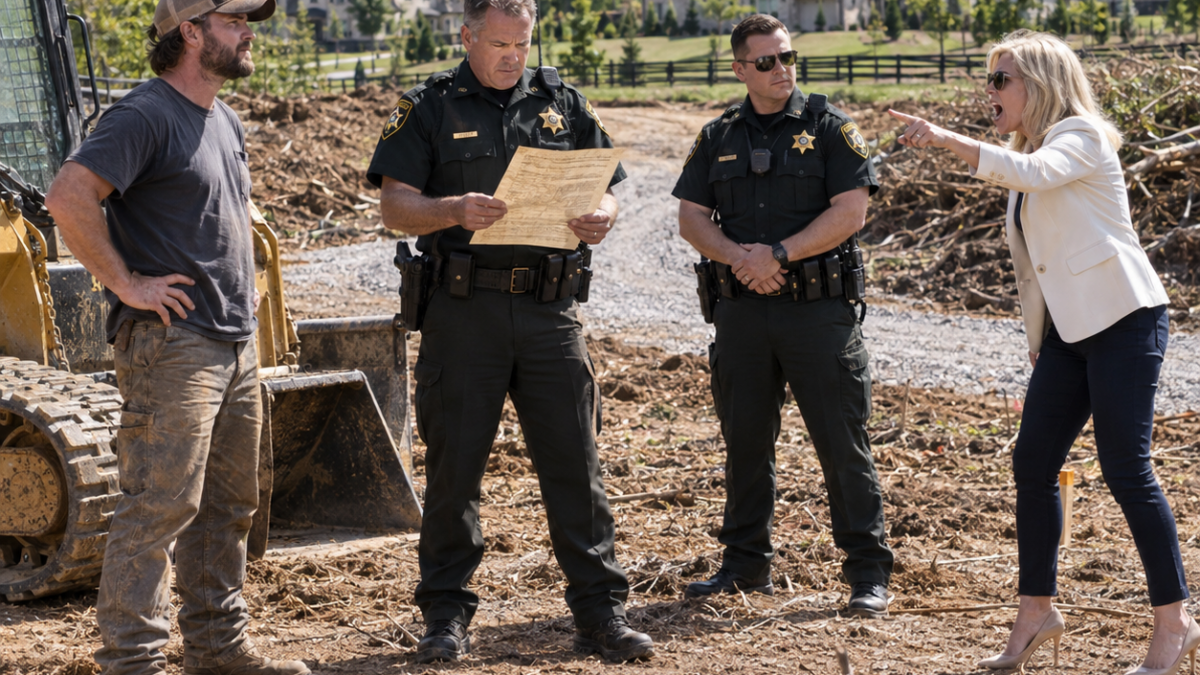
The sergeant took my phone and tilted the screen away from the afternoon glare.
The younger deputy stepped beside him.
Karen stayed three feet away, arms crossed, already wearing the expression of someone waiting for the authorities to confirm what she believed.
I watched the sergeant zoom in on the deed.
He read silently for maybe twenty seconds.
Then he glanced up.
“Parcel seven-A-thirty-four?”
“Yes.”
He looked back at the document.
“Ten acres?”
“Yes.”
Karen sighed dramatically.
“That’s the back parcel. We’re discussing the greenbelt.”
The sergeant ignored her.
He swiped to the survey plat.
The younger deputy leaned closer.
I had highlighted nothing.
I wanted the official document to speak for itself.
The sergeant traced the boundary line with one finger.
Then stopped at the narrow strip connecting my property to the county road.
“Fifty feet.”
“Yes.”
He zoomed further.
The official surveyor’s seal sat at the bottom.
Recording information.
Date.
Parcel number.
Legal description.
He looked toward the roadway.
Then toward the orange survey flags.
Then back at the screen.
Karen finally seemed uncomfortable.
“Our map is different.”
The sergeant handed my phone to the younger deputy.
“Let me see yours.”
Karen opened her purse and pulled out a folded photocopy.
It had been copied so many times that half the boundary lines looked gray.
She unfolded it across the hood of the cruiser.
“There.”
She pointed.
“That area.”
The sergeant looked at it.
“What is this?”
“The Oak Ridge development map.”
“Recorded plat?”
“It came from the developer.”
“That isn’t what I asked.”
Karen hesitated.
“It was provided to the board.”
The younger deputy handed my phone back to the sergeant.
“This county plat shows the access strip.”
Karen shook her head.
“No. That strip is an easement.”
I spoke.
“It isn’t.”
She whipped around.
“I wasn’t speaking to you.”
The sergeant looked at me.
“What is it?”
“Fee-simple property. Part of the parcel.”
He returned to my deed.
Then, slowly enough for everyone to hear, he read the relevant portion aloud.
“Beginning at the western boundary of parcel seven-A-thirty-four, thence extending in a strip fifty feet in width eastward to County Route Twelve…”
Karen’s expression changed.
The sergeant continued reading the calls.
Bearings.
Distances.
Reference monument.
Road boundary.
Nothing dramatic in the language.
Legal descriptions rarely sound dramatic.
But every dry word stripped another layer off Karen’s certainty.
When he finished, he lowered the phone.
“Ma’am.”
Karen shook her head.
“No.”
“This deed describes the strip.”
“No, because Oak Ridge has maintained it.”
“Maintenance doesn’t automatically transfer title.”
“You don’t understand.”
He looked at her.
“I understand what his recorded deed says.”
The younger deputy pointed at one of the orange stakes.
“And the plat lines up with the marked survey.”
Karen looked toward her two friends.
Neither said anything.
The sergeant continued.
“Based on what I’m looking at, Mr. Ryder is standing on his property.”
Karen’s cheeks went red.
“That can’t be right.”
“I’m not adjudicating a civil title dispute on the side of the road.”
His tone remained professional.
“But I do have a current deed, a recorded survey, and a tax parcel map all showing this strip as part of his property.”
Karen held up her photocopy.
“And I have this.”
He glanced at it again.
“You have a development illustration.”
“It is our official community map.”
“It isn’t a deed.”
Her lips parted.
Nothing came out.
Then the sergeant looked at the faded green-space sign.
“Who installed those?”
Karen straightened slightly.
“The HOA.”
“On whose authorization?”
“The board.”
“Did the board own the ground?”
“Of course.”
“How do you know?”
Her confidence returned for half a second.
“Because we have always treated it as ours.”
The sergeant took a slow breath.
“Ma’am, that’s not how ownership works.”
The younger deputy looked down, hiding what might have been a smile.
Karen pointed toward me.
“He cut trees.”
The sergeant looked.
Several small pines and scrub trees lay where I had begun clearing.
“On his land.”
“They were part of our landscape buffer.”
“On his land.”
“He destroyed community assets.”
“If they’re on his property, they aren’t your community assets.”
Her voice rose.
“This is absurd.”
The sergeant became firmer.
“No. What’s becoming a problem is that you called 911 reporting criminal trespass and property destruction without verifying ownership.”
Karen’s posture shifted.
“I acted on information available to me.”
“That may be.”
He didn’t threaten her with arrest.
Didn’t grandstand.
Didn’t call her a criminal.
He simply said:
“Next time, if the dispute is about property boundaries and nobody is in immediate danger, call the non-emergency line.”
That was more realistic than the punishment she wanted for me.
It was also more humiliating.
She had summoned authority.
Authority had told her to check her paperwork.
The sergeant looked at the two women behind her.
“Are you all on Mr. Ryder’s property right now?”
One of them immediately stepped backward.
Karen glanced down.
The survey flag sat two feet behind her.
The younger deputy pointed.
“Property line appears to be back there.”
Karen moved across it without another word.
Her friends followed.
The sergeant turned to me.
“Mr. Ryder, do you want them trespassed from your property?”
Karen stared.
I could’ve said yes.
Part of me wanted to.
But the smart move was not the satisfying move.
“Not today.”
The sergeant nodded.
“Good.”
Karen muttered:
“I apologize.”
The sergeant looked toward her.
“Was that directed at him?”
She stiffened.
Then faced me.
“I apologize for the misunderstanding.”
It wasn’t sincere.
I didn’t need it to be.
“Accepted.”
Her eyes narrowed.
“For now.”
I hadn’t meant that as a threat.
But she heard one.
She turned away.
The two deputies returned to their cruisers.
Before getting in, the sergeant walked over.
“Keep paper copies on site.”
“I will.”
“And photograph those survey markers.”
“Already did.”
He looked at me.
“Engineer?”
“Retired Corps.”
“That explains it.”
“Explains what?”
He nodded toward the perfectly organized digital folder on my phone.
“Normal people don’t have their deed ready in twelve seconds.”
I laughed.
Then he drove away.
Karen did not.
She stood on the HOA side of the property line watching me.
I climbed back into the excavator.
Started the engine.
The diesel rumbled.
I swung the boom.
Lowered the bucket.
And continued clearing my driveway.
Karen stayed there another five minutes.
Then she walked toward a golf cart parked down the road.
One of the women climbed in beside her.
The other whispered something.
Karen answered loudly enough for me to hear over the engine.
“This isn’t over.”
She was right.
That afternoon was only the first battle.
I got home around six.
Sarah stood at the kitchen counter with both hands flat on the granite.
She had seen the cruisers.
Our new house sat on the rear half of the acreage, where the old farm field opened between trees.
We had been married twenty-seven years.
Sarah taught American history at the county high school.
She had a gift for detecting nonsense at a distance.
“What happened?”
I set my keys down.
“Karen called the sheriff.”
“She did what?”
I told her everything.
The accusation.
The deed.
The survey.
The deputy reading the legal description.
The apology.
Sarah listened with increasing disbelief.
When I finished, she said:
“You’ve lived here one month.”
“Thirty-two days.”
“That makes it worse.”
She walked toward the window.
“You know she’s going to retaliate.”
“Yes.”
“And you’re smiling.”
“I am not.”
“You are absolutely smiling.”
“I enjoyed the deed part.”
She turned.
“Jack.”
The smile disappeared.
“I know.”
Sarah didn’t fear confrontation.
She feared bureaucratic conflict.
Not because she was weak.
Because she understood how exhausting systems could become when someone abused procedure.
Her father had spent years fighting a zoning dispute over family farmland.
Letters.
Hearings.
Appeals.
Legal bills.
Stress.
It had consumed dinner conversations for a decade.
She never wanted our life to become that.
“I came here to get you away from battles,” she said.
“I didn’t start this one.”
“That isn’t the same as not having one.”
She was right.
That night I barely slept.
Not because I thought Karen could win ownership.
The deed was too clear.
But ownership is only one part of peace.
Someone determined to make your life miserable doesn’t have to win in court.
They can bury you in notices.
Complaints.
Inspections.
Rumors.
Costs.
My entire military career had taught me one lesson above most others:
A weak opponent with persistence can still create damage.
The next morning, I drove into town.
County recorder first.
Planning office second.
Tax assessor third.
I got certified copies of everything.
My deed.
Survey.
Subdivision plat.
Oak Ridge declaration.
HOA articles of incorporation.
County road maps.
I also pulled the original development plan.
The more I read, the stranger the situation became.
My parcel wasn’t merely omitted.
It had been deliberately excluded.
An old note on the original subdivision plan identified it as:
EXISTING PARCEL—NOT PART OF DEVELOPMENT.
That phrase appeared twice.
The developer had designed Oak Ridge around it.
A buffer road curved around my western boundary.
Three cul-de-sacs faced portions of my woods.
The fifty-foot access finger had been drawn clearly.
So how had the HOA come to believe it was theirs?
I requested older plats.
Then I found a clue.
One preliminary marketing plan—never recorded—shaded my access strip green.
Not because it belonged to the HOA.
Because the developer had once hoped to acquire my parcel.
A dotted future-road line crossed it.
In the legend:
POTENTIAL PHASE II ACCESS / OPEN SPACE PENDING ACQUISITION.
Pending acquisition.
The farmer never sold.
The plan died.
But someone later copied that marketing map.
The dotted line vanished.
The green shading remained.
I stared at it.
That had to be Karen’s map.
A discarded dream had turned into neighborhood mythology.
I took a certified copy home.
Sarah found me at the dining table surrounded by paper.
“Oh no.”
“What?”
“You’ve made piles.”
“Categories.”
“You only make categories when you’ve declared war.”
“I haven’t declared anything.”
“You labeled a folder ‘HOA Governance.’”
“Administrative preparedness.”
She sat across from me.
“What did you find?”
I showed her the preliminary map.
Then the final recorded plat.
She compared them.
“They assumed this was theirs because of the old drawing?”
“That’s my guess.”
“Then show them.”
“I will.”
“You will?”
“I want this over.”
Sarah smiled.
“Good.”
Then the envelope arrived.
Not mailed.
Clipped to our mailbox.
Oak Ridge Estates logo.
NOTICE OF VIOLATION.
Five hundred dollars.
Unauthorized destruction of common landscaping.
One hundred dollars per day until restoration.
No parcel number.
No specific covenant.
No hearing date.
No appeal instructions.
Signed:
Karen Weatherly, President.
Sarah read it.
The hope left her face.
“She knows what the deputies said.”
“Yes.”
“She sent this anyway.”
“Yes.”
“You’re not in the HOA.”
“No.”
She looked at me.
“What are you going to do?”
I sat down.
“Answer once.”
My response was six pages.
First page:
Jurisdiction.
I attached the deed.
Second:
Survey.
Third:
Recorded subdivision plat.
Fourth:
Police incident report.
Fifth:
Preliminary marketing map versus final development plat.
Sixth:
Demand to cease enforcement against a nonmember parcel.
Then I added something I later admitted was unnecessary.
An invoice.
Three hours at county offices.
Time spent reviewing records.
Document costs.
Professional consulting rate.
Total:
$2,850.
Sarah read it.
“This part is petty.”
“It’s educational.”
“It’s petty.”
“It documents cost.”
“It documents that you’re enjoying yourself.”
“I am not enjoying this.”
She pointed at the invoice.
“You used a table.”
“Professional formatting.”
She rolled her eyes.
I sent the packet certified mail to the HOA.
Second copy to its registered agent.
Copies to all board directors.
No one could later claim they hadn’t known.
A week passed.
Nothing.
I finished clearing the driveway.
Installed temporary orange mesh along the access strip.
Not because I liked it.
It was ugly.
It was also impossible to miss.
Then security cameras.
Motion activated.
Cloud storage.
Date stamped.
Sarah watched me bolt one onto a tree.
“Subtle.”
“Effective.”
“Do you think Karen is going to invade Poland?”
“No.”
“You’ve prepared accordingly.”
The first neighbor who approached me wasn’t hostile.
Arthur Henderson was eighty-two.
Thin.
White hair.
Glasses too large for his face.
A trembling beagle named Chester.
He stopped at my orange fence while I was grading the driveway.
I shut down the tractor.
“You’re him.”
I climbed down.
“Depends.”
“The man Karen called the police on.”
“Unfortunately.”
Arthur smiled.
“Best thing I’ve seen in years.”
I laughed.
Then saw that he wasn’t really joking.
He told me his story.
His wife, Mary, died three years earlier.
For months, grief stripped him of energy.
His yard grew.
Six-inch weeds.
Uneven edging.
A ceramic frog by the porch.
Karen fined him.
Then fined him again.
Then threatened a lien.
Arthur paid using money his son sent.
“She said rules don’t stop because I’m grieving.”
His voice trembled.
I looked toward Oak Ridge.
“How much?”
“Almost eleven hundred.”
“For grass?”
“And the frog.”
He looked embarrassed saying it.
That angered me more than the amount.
A man who had buried his wife had been trained to feel ashamed about a ceramic frog.
“Did you appeal?”
“I tried.”
“What happened?”
“Karen chaired the appeal.”
Of course.
Arthur looked at the orange fence.
“She hates that.”
“Good.”
Then his expression changed.
“Be careful.”
“Why?”
“Because she isn’t really president.”
I frowned.
“What do you mean?”
“She is president.”
He lowered his voice.
“But Gary does contracts.”
“Gary who?”
“Gary Smith. Board vice president.”
“What contracts?”
“Landscaping.”
He looked down at Chester.
“And Karen’s sister owns the landscaping company.”
That was the first moment I realized the land dispute might not be the biggest problem inside Oak Ridge.
Arthur walked away before I could ask more.
That evening I pulled the HOA’s corporate filings.
Board members.
Karen Weatherly.
Gary Smith.
Susan White.
Two others.
Then vendor records weren’t public.
We’d need a homeowner.
Arthur was one.
I called him.
“Would you be willing to request HOA financial statements?”
Silence.
“Why?”
“Because you have inspection rights.”
More silence.
“Arthur, you can say no.”
“I’ve spent ten years saying no inside my head.”
His voice strengthened slightly.
“Maybe I should try saying it where someone hears.”
We drafted the request.
Seven years of available records where permitted.
Budgets.
Vendor contracts.
Legal expenses.
Fine collections.
Board reimbursements.
Arthur signed.
Certified mail.
Before those records arrived, the HOA’s lawyer entered the fight.
Bartholomew Finch.
His letter was twelve pages long and written as though every sentence had been charged by the syllable.
He dismissed my deed argument.
Claimed the HOA had established rights through long-term use and stewardship.
Asserted a potential prescriptive interest.
Demanded I stop clearing.
Remove the orange fence.
Restore vegetation.
Pay over five thousand dollars in accumulated assessments and legal fees.
Then came the threat:
Lien.
Litigation.
Injunctive relief.
Sarah read it at the dining table.
Her face became pale.
“Now there’s a lawyer.”
“Yes.”
“Do we need one?”
“Yes.”
Her eyes lifted.
That answer scared her more than anything else.
I reached across the table.
“I think we’re right.”
“Think?”
“I know the deed.”
“That’s not what I asked.”
I understood.
“You want certainty.”
“I want our life.”
The words were quiet.
That made them harder.
“We moved here because you were finally done fighting.”
I looked toward the window.
“I don’t want to fight.”
“You look alive when you’re fighting.”
That hit me.
“Sarah—”
“I’m serious.”
She pushed the lawyer’s letter toward me.
“You were miserable for six months after retirement.”
I didn’t answer.
“You woke up at five every morning with nowhere to go.”
“I had projects.”
“You reorganized screws.”
“They needed it.”
“You labeled extension cords by length.”
“That was efficient.”
She almost smiled.
Then:
“I don’t want Karen becoming your mission.”
That night I sat alone on the porch.
Sarah was right.
Partly.
Conflict was familiar.
A problem with documents and boundaries made sense to me in ways retirement didn’t.
That was dangerous.
I promised myself something.
I would defend the property.
I would help if the financial records exposed wrongdoing.
But I would not turn Karen into the center of my life.
The next morning I called Jessica Moreno.
Forty-one.
HOA and property attorney.
Sharp without being theatrical.
Her office was inside a renovated brick building downtown.
I brought the deed.
Plat.
Letters.
Police report.
Preliminary development map.
Jessica read.
Asked questions.
Read more.
Finally:
“Who told the HOA they had a prescriptive easement?”
“Their lawyer.”
She shook her head.
“Long-term use can create complicated claims under specific facts, but posting a sign on somebody else’s land doesn’t magically transfer ownership.”
“Good.”
“Don’t get comfortable.”
“Why?”
“Because they’ve threatened a lien.”
“They can’t lien non-HOA property.”
“That doesn’t mean someone won’t try.”
She tapped Karen’s violation letter.
“And this woman doesn’t appear especially cautious.”
Jessica sent Finch a formal response.
Much less funny than mine.
She demanded immediate withdrawal of all fines.
Warning against any lien.
Title interference.
Trespass.
Document preservation.
She also emphasized that continued enforcement after the sheriff incident and deed notice could support a bad-faith argument.
Then Arthur’s financial request became due.
The HOA stalled.
Overbroad.
Burden.
Privacy.
Records stored offsite.
Jessica answered.
Ten days later, they offered Arthur a two-hour inspection appointment.
No photocopies.
No removal of records.
Arthur called me.
“We’ll never read everything.”
“We don’t need everything.”
I called Marcus Thorne.
Not the developer.
My Marcus was an old Army buddy who had become a forensic accountant after leaving the Corps.
If spreadsheets could experience fear, they feared Marcus.
I told him the basics.
He laughed.
“HOA?”
“Yes.”
“Petty fines?”
“Yes.”
“Related-party vendor?”
“Possibly.”
“You know what I want.”
“Financial statements.”
“Contracts. Credit cards. Reimbursements. Legal bills.”
He paused.
“And never assume ugly equals illegal.”
That was one reason I trusted him.
We weren’t going hunting for a crime.
We were going hunting for facts.
The inspection happened Tuesday.
Arthur.
Jessica.
Me.
Three cardboard boxes.
The management-company office manager watched us like we’d arrived to steal the carpet.
“You have two hours.”
Jessica asked:
“Can Mr. Henderson take notes?”
“Yes.”
“Can counsel take notes?”
“Yes.”
“Can documents be imaged for review?”
“No copies.”
Jessica raised an eyebrow.
“Your bylaws allow inspection and reproduction at member expense.”
The manager stiffened.
“I was told inspection only.”
Jessica placed a printed provision on the table.
“Then perhaps you’d like to call counsel.”
Ten uncomfortable minutes later, imaging was allowed under supervision.
Not unlimited.
But enough.
We scanned vendor contracts.
Bank statements.
Legal invoices.
Board reimbursements.
Fine ledgers.
Lush Lawns LLC appeared everywhere.
Grounds maintenance.
Seasonal flowers.
Tree pruning.
Storm cleanup.
Amounts that seemed high.
Not proof.
Then registered address.
P.O. box.
Marcus checked corporate filings later.
Registered agent:
Brenda Weatherly.
Karen’s sister.
Conflict wasn’t automatically illegal.
But there was no disclosure in the meeting minutes we had.
That was a problem.
Then legal fees.
Nearly forty-eight thousand dollars in one year.
Many tied to homeowner enforcement.
Arthur stared.
“They used our dues to threaten us?”
“Yes.”
His hands shook.
Jessica said:
“Arthur, breathe.”
He looked at her.
“I paid Karen because I was afraid she’d put a lien on Mary’s house.”
His voice cracked.
“And I helped pay the lawyer who threatened me.”
Nobody had an answer.
Marcus reviewed the documents over the next three days.
He found anomalies.
Storage unit.
Furniture purchases.
Home improvement charges.
Repeated reimbursements.
Not enough to accuse anyone of theft.
Yet.
He requested more context.
Meanwhile, Finch escalated.
Lien notice.
They actually recorded it.
Over seven thousand dollars by then.
Fines.
Legal fees.
Interest.
Against my property.
I stood in the county clerk’s office holding the recording confirmation.
The woman behind the counter looked apologetic.
“We don’t determine validity at recording.”
“I know.”
“Your lawyer can challenge it.”
“I know.”
I called Jessica.
She was silent for three seconds.
Then:
“Okay.”
That calm tone meant she was furious.
“They were formally warned.”
“Yes.”
“They have the deed.”
“Yes.”
“They have the survey.”
“Yes.”
“They have the deputy report.”
“Yes.”
“And they still filed.”
“Yes.”
“Come in.”
We filed suit.
Declaratory judgment.
Quiet title relief where appropriate.
Release of lien.
Damages for wrongful interference with title.
Attorney fees where available.
Claims tailored to what Virginia law actually supported.
No legal fantasy.
No television language.
Jessica was explicit.
“We don’t need a hundred claims.”
“What do we need?”
“The ones we can prove.”
That was enough.
Discovery began.
And Karen made the mistake arrogant people often make.
She assumed paperwork would protect her because paperwork had always frightened everyone else.
It didn’t frighten me.
It bored me.
There is a difference.
Emails arrived.
Meeting minutes.
Invoices.
Internal notes.
Financial records.
Marcus found that some furniture charges matched deliveries to an address outside Oak Ridge.
Then storage records.
Then a business registration.
Karen operated a home-staging company.
The storage unit belonged to it.
The HOA card had paid recurring expenses connected to that location.
Again, Marcus refused to leap.
“Could be reimbursed.”
We checked.
No reimbursement.
Then Lush Lawns.
Brenda Weatherly admitted during questioning that she owned it.
Invoices lacked detail.
The amounts exceeded local estimates.
Still suspicious.
Then came the worst piece.
A payment trail suggesting a large portion of landscaping funds had been withdrawn soon after checks cleared.
Jessica didn’t call it theft.
Not yet.
She referred material to independent auditors.
The audit found unsupported transactions substantial enough to trigger board panic.
Two directors resigned.
Gary stayed.
Susan stayed.
Karen sent a neighborhood email accusing me of conducting a vendetta against “community volunteers.”
That email had consequences she didn’t anticipate.
Arthur forwarded it to the private group we’d quietly formed.
People began telling stories.
Garcias.
House paint.
Johnsons.
Basketball hoop.
Young couple threatened over a crying-baby “noise nuisance.”
Contractor fined for work van.
Widow cited after her husband died.
A dozen others.
I created files.
But Sarah stopped me one night.
“You said you wouldn’t make this your mission.”
I looked around.
Our dining room was covered.
Again.
Folders.
Scans.
Notes.
She wasn’t angry.
That was worse.
She looked tired.
“I know.”
“You haven’t touched the workshop in three weeks.”
“I’ve been busy.”
“With Karen.”
“With the lawsuit.”
“With Karen.”
I sat.
She took the chair opposite.
“Jack, I support fighting the lien.”
“I know.”
“I support Arthur.”
“I know.”
“I support exposing theft if there was theft.”
“Okay.”
“But when do you come home?”
I didn’t answer.
We were both sitting inside our house.
She wasn’t talking about geography.
I closed the laptop.
“Tonight.”
Sarah’s eyes softened.
“Good.”
We ate outside.
No files.
No Karen.
No HOA.
Just grilled chicken, a bottle of wine, and the sound of frogs in the creek.
I remembered why we bought ten acres.
Peace isn’t something you win once.
You have to protect it from the enemy and from yourself.
The next week, the annual HOA meeting approached.
Jessica advised us not to turn it into a mob scene.
“Evidence first.”
Marcus agreed.
Arthur became the organizer.
That surprised everyone, including Arthur.
The man who had whispered at my property line began walking door to door with Chester.
He didn’t rant.
He showed documents.
Vendor ownership.
Legal expenses.
Fine patterns.
Recorded lien against land the subdivision plat excluded.
People listened.
For absentee owners, lawful proxies were collected.
Quorum became possible.
Then likely.
Then certain.
The clubhouse held fifty comfortably.
More than a hundred showed.
Karen walked in smiling.
She thought turnout meant support.
I almost felt sorry for her.
Almost.
She sat behind the board table.
Gary on one side.
Susan on the other.
Two seats empty from the recent resignations.
Karen struck the gavel.
“Welcome.”
Silence.
She praised entrance landscaping.
Parking compliance.
Pool maintenance.
Petunias.
Then:
“Old business?”
I stood.
Her smile disappeared.
“You are not an association member.”
“Correct.”
“Then sit down.”
I held up Arthur’s proxy.
“I am here as Mr. Henderson’s authorized proxy and guest.”
Arthur stood beside me.
His hands trembled.
But his voice did not.
“I’d like to see the receipts.”
Karen blinked.
“Excuse me?”
Arthur lifted a paper.
“Thirty-five thousand dollars to Lush Lawns.”
Murmurs.
“Forty-eight thousand to Finch and his firm.”
More murmurs.
“Fifteen thousand in furniture and household purchases.”
Karen’s face changed.
“And I want to know why Lush Lawns is owned by your sister.”
Silence.
Then voices.
“What?”
“Her sister?”
“Karen?”
She struck the gavel.
“Order.”
Arthur continued.
“I asked for financial records.”
“You received them.”
“Yes.”
“And now an independent accountant has questions.”
Karen turned toward me.
“You.”
I didn’t answer.
She pointed.
“You have manipulated this man.”
Arthur straightened.
“No.”
She looked at him.
For years, he’d been afraid of her.
Everyone in that room knew it.
He said:
“You taught me what happens when I stay quiet.”
The room erupted in applause.
Karen hammered the gavel.
Gary whispered to her.
Susan stared at the table.
I stood.
“There’s another issue.”
Karen shouted:
“No.”
But Jessica stood behind me.
“My name is Jessica Moreno.”
Karen froze.
“I represent Mr. Ryder.”
The room quieted.
Jessica did not accuse Karen of crimes.
She explained what we actually knew.
Recorded deed.
Recorded survey.
Subdivision plat.
Sheriff incident.
Violation notice.
Formal legal warning.
Lien filed afterward.
Then financial records had triggered an audit.
Evidence had been referred to appropriate authorities for review.
She never said guilty.
Never said prison.
Never said embezzlement.
That restraint made her more credible.
Karen attacked anyway.
“This is defamation.”
Jessica looked at her.
“Which statement?”
Karen stopped.
Jessica waited.
“What specific statement I just made is false?”
Karen’s hand tightened around the gavel.
Jessica continued.
“The documents are available to association counsel.”
Then she sat.
Mrs. Garcia stood.
Then Mr. Johnson.
Then the contractor.
Then the young couple.
Then an older widow.
One after another.
Stories.
Letters.
Fines.
Fear.
The room changed.
What had been individual embarrassment became shared evidence.
Karen lost control because people stopped believing they were alone.
Finally Tom stood.
He wasn’t even an HOA member.
But a homeowner introduced the motion.
Removal.
Another seconded.
The bylaws allowed a membership vote under the circumstances.
Karen shouted.
Gary tried to adjourn.
Susan said:
“Let them vote.”
Karen turned on her.
“What?”
Susan’s eyes filled.
“I said let them vote.”
That was the moment Karen’s power broke.
Not when I beat her with a deed.
Not when Arthur exposed Lush Lawns.
When one of her own board members stopped being afraid.
Ballots.
Proxies.
Count.
Over ninety percent supported removal of the remaining board.
Karen sat motionless.
Gary looked at the floor.
Susan began crying.
The gavel remained in Karen’s hand.
Arthur approached.
“It’s over.”
She looked at him.
“You?”
He nodded.
“Me.”
Her lips trembled.
“I protected this neighborhood.”
Arthur answered quietly.
“No.”
“You controlled it.”
No cheering.
Not yet.
The room was too stunned.
Then two county investigators entered with an attorney from the management company.
Not to stage a dramatic arrest.
Real investigations don’t always work like television.
They had come because the board’s financial auditor had referred questionable transactions and requested records preservation.
Karen’s attorney stepped toward her.
They spoke privately.
She left through the side door.
Weeks later, search warrants were executed as the financial investigation developed.
The staging storage unit contained furniture purchased on the HOA card.
Records tied several transactions to Karen’s private business.
Brenda cooperated.
The landscaping arrangement unraveled.
The total unsupported or diverted amount grew past six figures after forensic review.
Criminal charges followed based on the financial evidence.
Not because Karen had been rude.
Not because she called police on me.
Because investigators found actual financial conduct supporting charges.
The lien against my property became part of the civil case and evidence of retaliatory behavior.
It was released by the new board almost immediately.
Arthur Henderson became interim president.
He tried to refuse.
The room wouldn’t let him.
His first meeting lasted eighteen minutes.
He opened with:
“I don’t own a gavel.”
Nobody bought him one.
The new board fired Finch.
Changed management companies.
Ordered a full financial audit.
Reviewed two years of fines.
Many were withdrawn.
Some legitimate violations remained.
That mattered.
We weren’t replacing arbitrary enforcement with no enforcement.
We were replacing fear with procedure.
Notice.
Evidence.
Hearing.
Appeal.
Conflict disclosures.
Competitive vendor bids.
No related-party contract without full disclosure and independent approval.
No lien without counsel reviewing jurisdiction and underlying debt.
Those rules mattered more than Karen losing.
My civil case settled months later.
Legal fees covered.
Damages paid.
Title cleared.
A permanent recorded acknowledgment confirmed my parcel was outside Oak Ridge’s declaration.
The orange fence came down.
I replaced it with young maples.
Sarah helped plant them.
We stood in the dirt together.
“You realize trees take years.”
“That is generally how trees work.”
“I preferred the orange fence.”
“Liar.”
She smiled.
“Maybe a little.”
I looked down the fifty-foot access strip.
The same land Karen once called community property.
Now the boundary was clear without looking like a war zone.
That was better.
Karen’s criminal case took longer.
Financial fraud.
Misuse of association funds.
False business records related to the vendor scheme.
She eventually accepted a plea arrangement that included restitution, probationary supervision after confinement, and a period of incarceration tied to the financial charges.
The exact sentence mattered less to me than people expected.
When neighbors told me the news, I felt almost nothing.
Sarah asked:
“Disappointed?”
“No.”
“Happy?”
“No.”
“What then?”
“Tired.”
She took my hand.
“Good.”
I looked at her.
“Good?”
“You’ve been angry for a year.”
She leaned against my shoulder.
“Tired means maybe you’re finally done.”
She was right.
Gary cooperated with investigators and avoided the worst consequences.
Susan testified.
Brenda entered her own agreement.
Finch’s firm faced scrutiny over its handling of HOA matters, though no dramatic conspiracy charge swallowed everyone in sight.
Real life is rarely that neat.
Some people were corrupt.
Some were cowardly.
Some were careless.
Some simply trusted the wrong person for too long.
That distinction mattered.
Arthur surprised me most.
Six months after becoming president, he walked onto my property with Chester and a six-pack.
The workshop walls were finally up.
Roof half finished.
He sat on my truck tailgate.
“You know what scares me?”
“What?”
“I like being president.”
“That is alarming.”
He laughed.
Then became serious.
“I understand Karen better now.”
I looked at him.
“Careful.”
“No.”
He scratched Chester behind the ears.
“People call me.”
“All day.”
“Trash cans. Dogs. Parking. Paint.”
He shook his head.
“And after a while, you start thinking every complaint is yours to solve.”
“That sounds awful.”
“It is.”
He looked toward Oak Ridge.
“Then people thank you when you make decisions.”
I understood.
“Power feels useful.”
“Yes.”
“And being useful feels good.”
Arthur nodded.
“I think that’s where she started.”
I said nothing.
“Maybe she wasn’t always like that.”
“Doesn’t excuse what she became.”
“No.”
He looked at me.
“But it explains why rules matter for boards too.”
That became Arthur’s obsession.
Term limits.
No unilateral fines.
Independent appeals.
Transparent expenses.
Board votes recorded.
He made himself harder to become.
That may have been his greatest achievement.
A year after the first confrontation, I finished the workshop.
Concrete floor.
Two bays.
Tool wall.
Lift.
Space for the RV.
Sarah bought me a ridiculous metal sign.
RYDER ENGINEERING COMMAND POST.
I refused to hang it.
She hung it.
Tom came over.
Arthur too.
Even the sergeant who had answered Karen’s original call stopped by one afternoon after hearing through a deputy friend that the place was done.
He stood in the driveway.
Looked at the maples.
“Where’s the orange fence?”
“Retired.”
“Shame.”
“You liked it?”
“It was hard to miss.”
I laughed.
He looked toward Oak Ridge.
“Heard things got complicated.”
“That is one word.”
He shook my hand.
“Glad the deed held up.”
I said:
“You read it better than the HOA.”
He smiled.
“Low bar.”
Then he left.
Sarah and I sat outside the workshop that evening.
Fireflies rose from the grass.
The maples were barely taller than me.
Oak Ridge houses glowed through the trees.
There was no wall between us.
No orange mesh.
No Karen.
Just a property line.
Clear.
Respected.
“That was what you wanted,” Sarah said.
“What?”
She pointed.
“Space.”
I looked.
Ten acres.
Workshop.
Trees.
Quiet.
“For a while I forgot.”
“I know.”
“Sorry.”
She leaned into me.
“You came back.”
Years later, people in Oak Ridge still told the story.
Usually badly.
In one version, I supposedly pulled a framed deed from my excavator and made the sheriff read it like the Declaration of Independence.
In another, Karen had been handcuffed on the spot.
Neither happened.
The truth was better.
A woman called the police believing authority belonged to whoever sounded most certain.
A deputy opened a recorded deed.
Read the legal description.
And certainty moved from her voice to a piece of paper she had never bothered to check.
That should have ended it.
Her refusal to stop exposed everything else.
The fines.
The fear.
The vendor contracts.
The money.
The culture she’d built.
Karen didn’t lose because I was tougher.
She lost because every step she took after being shown the truth required another person to accept something they could verify was false.
Eventually, people stopped.
Arthur stopped.
Susan stopped.
Neighbors stopped.
Even her own allies stopped.
That is how power like hers disappeared.
Not all at once.
One person at a time.
Arthur served two terms.
Then stepped down voluntarily.
His last act as president was a rule limiting future presidents to two consecutive terms.
At the meeting, somebody asked:
“Why?”
Arthur pointed toward my side of the neighborhood.
“We’ve already conducted one experiment.”
Everyone laughed.
Then he added:
“We don’t need another.”
Mrs. Garcia became president next.
Boring.
Competent.
Wonderful.
The association planted native grasses in some common areas to reduce maintenance costs.
The Johnsons moved their basketball hoop six inches voluntarily because it blocked a neighbor’s backing view.
Nobody fined them.
They just talked.
Susan stayed in Oak Ridge.
For months, people treated her coldly because she had been on Karen’s board.
One day she came to my workshop.
I almost didn’t recognize her without the board table in front of her.
“Can we talk?”
“Sure.”
She held an envelope.
Inside were copies of emails.
Karen had pressured board members repeatedly.
Threatened to publicly blame them if they questioned enforcement.
Used legal counsel as a weapon.
Susan’s messages showed hesitation.
Not enough to excuse her.
But enough to show she hadn’t been comfortable.
“Why give me these now?”
“Because I was scared.”
She looked down.
“And being scared doesn’t mean I wasn’t responsible.”
I respected that.
“What do you want from me?”
“Nothing.”
She swallowed.
“I just wanted you to know that when Karen called the police that day, I told her not to.”
That surprised me.
“She said she needed to establish authority immediately.”
I looked toward the access strip.
“She almost did.”
Susan nodded.
“I should’ve spoken sooner.”
“Yes.”
The answer hurt her.
But she nodded.
“Yes.”
Then she left.
I kept the emails.
Not for litigation.
That was over.
Because they reminded me how systems fail.
Rarely because one bully is unbelievably powerful.
Usually because five reasonable people decide today isn’t the day to challenge her.
Then tomorrow.
Then next month.
Eventually silence becomes structure.
Arthur died four years later.
Peacefully.
Chester had gone the year before.
The funeral was packed.
More than any HOA meeting he’d ever attended.
His son asked me to speak.
I told the story of the first day I met him.
Small old man.
Trembling beagle.
Soft voice.
“You’re the one who stood up to her.”
What I didn’t understand then was that Arthur was really asking whether standing up was possible.
Later he answered his own question.
He became the president Karen could never be.
Not because he loved rules.
Because he remembered fear.
After the service, his son handed me the ceramic frog.
The same one Karen had fined him for.
“Dad left instructions.”
I stared.
“He wanted you to have this.”
“I absolutely do not want this.”
His son laughed.
“He knew you’d say that.”
The frog sits outside my workshop to this day.
Ugliest thing on the property.
I will never move it.
One spring morning, years after everything, a young couple stopped at the end of my driveway.
New Oak Ridge residents.
Their realtor had apparently told them my property wasn’t part of the HOA.
The husband pointed toward the maples.
“Is this the famous strip?”
I groaned.
His wife laughed.
“People told us there was some huge property fight.”
“There was.”
“Was this really considered common land?”
“For years.”
She looked confused.
“How?”
“Someone put up a sign.”
She laughed.
Then saw I wasn’t joking.
“What fixed it?”
I pointed toward my house.
“Paperwork.”
Her husband smiled.
“That simple?”
“No.”
I looked at the maples.
“The paperwork was simple.”
Getting people to respect it took longer.
They thanked me and walked back.
I stood there thinking about the old faded green-space sign.
I’d kept it.
It hung inside the workshop.
Not as a trophy.
As a reminder.
COMMUNITY GREEN SPACE.
NO MOTORIZED VEHICLES.
Below it, Sarah had hung a small brass plaque:
VERIFY BEFORE ENFORCING.
That one I liked.
The workshop became what I’d hoped.
Repairing the RV.
Building furniture.
Helping neighbors weld brackets.
Fixing Arthur’s old lawn equipment before he passed.
Teaching Sarah’s students basic engineering projects during summer programs.
Oak Ridge homeowners sometimes came through the driveway.
Nobody asked whether they were allowed.
They asked.
I answered.
Boundaries became normal instead of hostile.
One afternoon a storm knocked down one of the maples.
It fell across the access strip.
I brought out the tractor.
As I cut it apart, an Oak Ridge golf cart stopped.
For one irrational second, my body remembered Karen.
Clipboard.
Police.
Pink tracksuit.
Then Mrs. Garcia stepped out.
“Need help?”
I laughed.
“What?”
“Nothing.”
She pointed at the tree.
“I’ve got a chainsaw.”
“You know how to use it?”
“Better than you, retired engineer.”
She was probably right.
We cleared the tree together.
No board approval.
No ownership argument.
No 911 call.
Two neighbors solving a problem.
That was the difference.
People often assume justice feels like triumph.
Sometimes it does.
The night Karen lost the vote, the room felt electric.
When the lien disappeared, I poured bourbon.
When investigators confirmed the money trail, there was satisfaction.
But the best part came years later when nobody talked about her anymore.
Children played.
People moved.
New families arrived.
Arthur’s reforms became ordinary.
Nobody remembered why certain safeguards existed.
That was fine.
Good systems shouldn’t depend on constant fear of the last disaster.
They should quietly prevent the next one.
Sarah eventually retired from teaching.
On her final day, students covered our porch in handmade signs.
Most were sweet.
One said:
THANK YOU, MRS. RYDER.
Another:
HISTORY IS COOL SOMETIMES.
My favorite:
ASK MR. RYDER ABOUT THE DEED.
Sarah blamed me.
“I never told them.”
“You told one person.”
“Possibly.”
She framed that sign.
Of course.
We got older.
The maples grew.
Their roots settled into the same fifty-foot strip Karen once insisted wasn’t mine.
By the tenth year, their branches formed a green corridor toward the road.
Sometimes I walked it in the evening.
No excavator.
No orange fence.
Just gravel beneath my boots.
The property pins were still there.
Small caps in the ground.
Most people would never notice.
That’s how boundaries should be.
Clear enough to matter.
Quiet enough not to dominate your life.
One evening Sarah and I walked to the road.
She stopped beside the survey stake nearest where Karen had stood.
“This the one?”
“The one what?”
“She stepped on.”
I looked.
“Maybe.”
“You don’t remember?”
“There were a lot of stakes.”
She nudged me.
“You remember everything.”
I did.
The pink tracksuit.
The finger pointing.
The smug smile when sirens approached.
The deputy reading the deed.
Karen stepping backward over the line she swore didn’t exist.
Sarah looked at me.
“What would you do differently?”
I thought.
“Nothing the first day.”
“And after?”
“Hire Jessica sooner.”
“That isn’t what I meant.”
I smiled.
“I know.”
We kept walking.
“I’d spend less time enjoying the fight.”
Sarah nodded.
“I’d come home sooner.”
She squeezed my hand.
“Good answer.”
We reached the road.
Oak Ridge stretched across the other side.
Landscaped entrance.
Houses.
Children on bicycles.
A dog barking.
Normal.
The HOA sign had been replaced years ago.
Smaller.
Simpler.
OAK RIDGE ESTATES.
No security language.
No threatening notices.
Just a name.
I looked back at my driveway.
Ten acres beyond.
Workshop roof visible through trees.
Arthur’s frog by the door.
Our house in the distance.
All because an old farmer once refused to sell.
All because a deed remained recorded correctly.
All because one afternoon I happened to keep a digital copy on my phone.
But when I think about that day now, the deed isn’t what I remember most.
I remember Karen’s face when the sergeant read it.
Not because humiliation was satisfying.
Though at the time, it was.
I remember the exact second certainty failed.
Until then, she believed her title—HOA president—made her interpretation reality.
Then another authority arrived.
Not louder.
Not angrier.
Just better informed.
He read a legal description.
And suddenly the land was what it had always been.
Mine.
The strange thing was that nothing physically changed.
The trees were the same.
The dirt was the same.
The orange stakes were the same.
My excavator hadn’t moved.
Only everyone’s understanding changed.
That was the real lesson.
Facts don’t become true when authorities recognize them.
They were true before.
But sometimes you still need to be prepared to prove them.
My deed didn’t defeat Karen.
Preparation did.
The surveyor who marked the line.
The county record that preserved the parcel.
The deputy who slowed the scene down instead of assuming.
Arthur asking to see receipts.
Jessica insisting on evidence.
Marcus refusing to call suspicious transactions crimes until the numbers proved it.
Susan finally speaking.
Homeowners finally voting.
Every important turn in the story came from someone deciding to verify instead of merely believe.
Karen’s world depended on the opposite.
Don’t verify.
Obey.
Don’t ask.
Pay.
Don’t compare stories.
Assume you’re alone.
That world disappeared the moment people started checking.
Years after Arthur died, I finally replaced the ceramic frog.
Not because I wanted to.
A freeze cracked it.
I found it in two pieces.
Sarah suggested glue.
I tried.
Didn’t hold.
I placed the broken frog on the workshop shelf beneath the old HOA sign.
Then bought a new one.
Worse.
Bright green.
Yellow eyes.
Huge red mouth.
Sarah stared at it.
“Arthur would hate that.”
“That’s why it’s perfect.”
I put it by the driveway.
A week later, someone left a note underneath.
UNAPPROVED ORNAMENT.
I laughed for five minutes.
Mrs. Garcia admitted later she’d written it.
That was Oak Ridge now.
We remembered.
But we could laugh.
That’s what healing looked like.
Karen Weatherly became a story.
Arthur Henderson became a standard.
And the fifty-foot strip of land became exactly what I’d wanted from the beginning.
A driveway.
Nothing more.
Nothing less.
On summer evenings, Sarah and I sometimes sat at the end near the road.
Cars passed.
Neighbors waved.
The maples rustled overhead.
No one argued about ownership.
No one measured anything.
No one carried a clipboard.
One night Sarah said:
“You know, for somebody who wanted privacy, you know half the neighborhood now.”
“Occupational hazard.”
“You helped build half their decks.”
“Structural safety.”
“You fixed three lawn tractors.”
“Community preparedness.”
“You’re basically in the HOA.”
I stared at her.
“Take that back.”
She laughed.
I did too.
Then we sat quietly.
Fireflies drifted through the trees.
The gravel road behind us disappeared toward the workshop.
I thought about the day I first lowered the excavator bucket into that soil.
I had believed I was clearing land.
That’s all.
I didn’t know I was cutting through ten years of fear.
I didn’t know an old man named Arthur would find courage beside that orange fence.
I didn’t know a financial investigation would grow from a property-line argument.
I didn’t know the woman who called police on me would ultimately expose the very system that had protected her.
And I certainly didn’t know I’d end up caring about the neighborhood wrapped around my land.
But that is what happened.
Karen called the cops because she believed the badge would prove she was right.
Instead, the deputies asked for documents.
Then one of them read my deed aloud.
Dry words.
Bearings.
Distances.
Parcel number.
Fifty feet to the county road.
Nothing heroic.
Nothing poetic.
But when he finished, the line beneath our feet became impossible for Karen to pretend she couldn’t see.
Years later, those words still sit in the county record exactly where they were that afternoon.
The maples are taller.
The workshop is older.
Sarah and I move slower.
Arthur is gone.
Oak Ridge has changed leadership several times.
But that legal description hasn’t moved an inch.
Neither has the property line.
And every time I drive down that narrow strip toward home, I pass the place where Karen once stood demanding that the sheriff remove me from my own land.
There is no marker commemorating it.
No plaque.
No sign.
Just gravel beneath the tires and trees growing on both sides.
That’s exactly how I want it.
Because in the end, the greatest victory wasn’t proving that Karen was standing on my property.
It was reaching the day when nobody needed to prove it anymore.
Years after Arthur died, I still found myself slowing down whenever I passed his old house.
The new owners were a young couple with two boys and a black Labrador that seemed determined to bark at every delivery truck in Virginia. They had painted the front door dark blue, replaced the rose bushes, and installed a basketball hoop beside the driveway.
Under Karen’s board, any one of those things might have produced a notice.
Now nobody cared.
Not because Oak Ridge had abandoned every rule.
The streets were still maintained. People still kept their properties reasonably clean. Dangerous structures still had to be fixed. Cars couldn’t block fire hydrants. Nobody had suddenly decided chaos was a form of freedom.
The difference was simple.
The board had learned to ask one question before enforcing anything.
Does this actually hurt someone?
A blue door didn’t.
A basketball hoop didn’t.
An old man’s ceramic frog certainly didn’t.
I kept Arthur’s frog beside my workshop entrance.
It was bright green, ridiculous, and cracked along one side after years of Virginia winters.
Sarah hated it aesthetically.
She loved what it represented.
One afternoon, she came outside carrying two glasses of iced tea and found me kneeling beside it.
“What are you doing?”
“Repairing Arthur.”
She stared.
“Arthur was taller.”
“The frog.”
“I know.”
I pressed epoxy into the crack.
Sarah sat on the workshop step.
“You’re sentimental.”
“I am not.”
“You kept a broken ceramic frog because a dead man got fined for owning it.”
“That is historical preservation.”
“Sentimental.”
“Go away.”
She laughed.
That sound still did something to me.
After everything with Karen, I had become painfully aware of how easily ordinary peace could disappear.
A phone call.
A letter.
A lien.
A person with enough authority and too little restraint.
For months, I had treated peace like something that needed defending with folders, cameras, lawyers, certified mail, and recorded plats.
Eventually I understood another truth.
Peace also needed to be lived.
Otherwise, what had I protected?
So I slowed down.
I stopped checking the security cameras every time my phone buzzed.
I stopped keeping a copy of my deed in the glove compartment.
The first year after the lawsuit, I carried one everywhere.
Sarah discovered it when we went out for dinner.
She opened the glove box looking for a napkin.
There it was.
Certified deed.
Survey.
County map.
She looked at me.
“Jack.”
“What?”
“We’re going to an Italian restaurant.”
“I know.”
“Do you expect Karen to annex the parking lot?”
“You never know.”
She stared until I laughed.
A month later, I removed the paperwork.
That felt like progress.
The maples I planted along the access strip grew quickly.
At first they were thin enough that every storm worried me.
By the fifth year, their branches reached toward each other above the gravel.
By the tenth, I drove through a tunnel of green every time I came home.
I liked that more than the orange construction fence.
The fence had said:
Stay out.
The trees said:
This is the line, but welcome anyway.
There was a difference.
Neighbors from Oak Ridge used the driveway sometimes when they came to my workshop.
I repaired lawn equipment, welded trailer brackets, fixed bicycle frames, and once spent an entire Saturday helping Mrs. Garcia’s grandson build a terrible wooden go-kart.
The thing leaned left.
I told him it was alignment.
Sarah called it personality.
The boy called it Lightning.
Nobody from the HOA inspected it.
That was probably for the best.
Susan visited occasionally too.
She had stayed in the neighborhood after Karen left.
For a while, some residents treated her almost as badly as they’d treated Karen.
I didn’t like that.
Susan had enabled things.
She had stayed quiet too long.
She had signed decisions she should have questioned.
But she had also eventually spoken.
People deserved consequences.
They also deserved a path back.
One afternoon she stood beside my workshop while I changed the oil in the tractor.
“I’ve been thinking about moving.”
“Why?”
She shrugged.
“People remember.”
“They should.”
“I know.”
She looked away.
“But sometimes I feel like I’ll always be one of Karen’s people.”
I wiped my hands.
“Were you?”
“For a while.”
“Are you now?”
“No.”
“Then don’t move because someone needs a permanent villain.”
She looked at me.
“You really mean that?”
“Yes.”
She stayed.
Years later, she ran for the architectural review committee.
Not president.
Not treasurer.
The least glamorous job possible.
At the first meeting, a homeowner asked permission to install a slightly oversized shed.
Susan reviewed the setback.
Confirmed it wasn’t dangerous.
Approved it.
Someone joked:
“Karen would’ve measured the roof pitch.”
Susan replied:
“Then it’s lucky she’s not here.”
Everyone laughed.
Including Susan.
That mattered.
The hardest part of winning a fight is deciding when to stop fighting.
Karen had moved away.
Her criminal case was finished.
Restitution payments continued through formal channels.
Her sister dealt with her own consequences.
The old management company lost Oak Ridge’s contract.
Finch’s firm was never retained again.
There was nothing left for me to destroy.
But anger doesn’t disappear just because the target does.
For a long time, I would wake up at three in the morning remembering her standing in front of my excavator.
Her confidence.
Her accusation.
The way she stepped on the survey ribbon and said my surveyor was wrong.
I would replay what I should have said.
Sharper lines.
Better comebacks.
Things that might have embarrassed her more.
Then one night Sarah rolled over.
“Stop arguing with Karen.”
I stared into the dark.
“What?”
“You’re doing it again.”
“Doing what?”
“Moving your mouth.”
“I don’t move my mouth.”
“You absolutely do.”
She reached over.
Put her hand against my chest.
“You won.”
“I know.”
“No.”
She whispered.
“Know it.”
That was different.
Winning on paper was easy to identify.
Lien released.
Settlement signed.
Board removed.
Investigators finished.
Karen gone.
Knowing the fight was over inside my own head took longer.
The next spring, I removed the last security camera pointed directly at the access road.
Not all cameras.
I’m not foolish.
We lived on ten acres.
Equipment gets stolen.
But I changed their purpose.
They weren’t there to catch Karen anymore.
That felt good.
Then life did what life always does.
It moved.
Sarah retired.
I got older.
The Kubota developed noises I pretended not to hear.
My knees started predicting rain.
Oak Ridge went through four presidents.
None became famous.
That’s probably the highest compliment I can give them.
One president was an accountant named Peter who spoke so softly nobody could hear him without the microphone.
Another was a young mother named Denise who ended meetings precisely at eight because she had to get her kids to bed.
Nobody drove around in a golf cart looking for violations.
Nobody called deputies over grass.
Nobody knew where the gavel had gone.
Arthur had hidden it.
We never found it.
I liked to imagine Chester buried it.
The financial reports became accessible online.
Major contracts required competitive bids.
Board members had to disclose family relationships with vendors.
Liens required independent legal review.
Every violation notice included the exact covenant provision, photographs where relevant, the appeal process, and contact information for questions.
Most disputes ended before hearings.
Not because residents became perfectly obedient.
Because somebody usually called.
“Hey, your trailer’s blocking the sidewalk.”
“Oh. Sorry.”
Problem solved.
It turned out civilization could survive without certified mail.
The old Karen era became something residents referenced whenever the board considered a new restriction.
A proposal to regulate backyard furniture?
“Do we really want to start measuring chairs?”
Dead.
A proposal to standardize mailbox paint again?
Mrs. Garcia said:
“No.”
Dead.
Someone once suggested banning vegetable gardens visible from the street.
The entire room laughed before the speaker finished.
Dead on arrival.
Rules still existed.
Fear didn’t.
That was the part I was proudest of.
Years after Karen left, I received a letter.
No return name.
Postmarked Richmond.
I almost threw it away as junk.
Inside was one sheet.
Jack,
I don’t expect you to answer this.
I have had a great deal of time to think about Oak Ridge and what happened.
I believed maintaining control meant protecting the community. I convinced myself that every challenge to my authority was a threat to the neighborhood.
That belief made me cruel.
You were right about the land.
You were right to fight me.
I am sorry.
Karen.
I read it standing at the kitchen counter.
Sarah noticed my face.
“What?”
I handed it over.
She read it.
Then placed it down.
“Well.”
“That’s all?”
“What do you want me to say?”
“I don’t know.”
Sarah read the letter again.
“Do you believe her?”
I thought about it.
“Yes.”
“Are you going to answer?”
“I don’t know.”
For two days, the letter sat on my desk.
I drafted three responses.
One angry.
One polite.
One cold.
Deleted all three.
Eventually I wrote four sentences.
Karen,
I received your letter.
I appreciate that you wrote it.
What happened cannot be undone, but Oak Ridge is in a much better place now.
I hope you are too.
Jack.
I mailed it.
No lecture.
No victory speech.
No reminder of the lien.
No list of everything she’d cost people.
She already knew.
If she didn’t, another letter wouldn’t teach her.
That was the last communication we ever had.
Sarah asked whether sending it felt good.
“No.”
“Bad?”
“No.”
“Then what?”
“Finished.”
She smiled.
“That’s better.”
It was.
The years softened everything.
Even the first confrontation became funny in memory.
At neighborhood cookouts, somebody would eventually ask me to tell the sheriff story.
I always corrected them.
“The deputy didn’t slam Karen against the hood.”
Someone would say:
“That’s not how Tom tells it.”
“Tom lies.”
“He says the deputy threatened prison.”
“He told her to use the non-emergency number next time.”
“That version isn’t as good.”
“It’s the true one.”
Then Arthur’s son would say:
“Tell the deed part.”
So I would.
Karen says the land belongs to the HOA.
Deputy asks for proof.
I show the deed.
He reads the legal description.
Fifty-foot strip.
County road.
My property.
Nothing cinematic.
But everyone loved that part.
Maybe because most people have experienced a moment when someone louder tried to replace facts with confidence.
We all want somebody to open the paperwork.
Slow things down.
Read the line.
Tell the truth.
One summer, the county resurfaced the main road.
A survey crew arrived.
Young guy named Caleb knocked on my door.
“We need to verify the right-of-way along your access.”
I laughed.
He looked worried.
“Something wrong?”
“No.”
“Do you have a recorded survey?”
“Caleb.”
“Yes, sir?”
“I have surveys you haven’t even dreamed about.”
Sarah yelled from inside:
“Do not show him the binder!”
I showed him the binder.
He looked impressed.
Sarah apologized to him afterward.
Before leaving, Caleb drove a new temporary stake near the road.
Bright orange ribbon.
I stood looking at it.
Same color as the first ones.
Sarah came beside me.
“You going to guard it?”
“Maybe.”
She laughed.
I left it alone.
Three days later, the crew removed it after finishing.
Nobody complained.
Nobody called police.
Nobody posted a green-space sign.
A survey marker had finally become what it was supposed to be.
Just a survey marker.
The workshop aged with me.
The sign Sarah bought remained above the door.
RYDER ENGINEERING COMMAND POST.
I stopped pretending I disliked it.
Arthur’s frog sat below.
The old green-space sign hung inside.
Beside it, Sarah’s little brass plaque:
VERIFY BEFORE ENFORCING.
Visitors always asked.
Sometimes I told the whole story.
Sometimes I just said:
“Long story.”
One afternoon my grandson Ethan stood beneath the sign.
He was eleven.
Mike had brought the kids for the weekend.
Ethan pointed upward.
“Dad says some lady tried to steal your land.”
“Not exactly.”
“She called the police.”
“That part’s true.”
“Were you scared?”
The question surprised me.
Kids always find the one angle adults ignore.
“A little.”
“You had the deed.”
“Yes.”
“So why were you scared?”
I looked toward the driveway.
Because being right doesn’t guarantee an easy outcome.
Because powerful people can make mistakes.
Because systems move slowly.
Because homes mean more than paper.
Because I had promised Sarah peace.
Instead I said:
“Because sometimes knowing you’re right and proving you’re right are two different things.”
He considered that.
“That’s dumb.”
“Very.”
“What happened?”
“The deputy read the deed.”
“And then?”
“Eventually everybody else did too.”
Ethan nodded as if that solved everything.
Maybe it did.
He ran outside.
I watched him disappear between the maples.
Sarah came into the workshop.
“You gave him the short version.”
“He’s eleven.”
“You usually need fourteen hours and visual aids.”
“I’ve matured.”
“Terrifying.”
We walked outside.
The access road was shaded now.
The maples Arthur had watched me plant were tall enough that their leaves met overhead.
Beyond them sat Oak Ridge.
Children riding bikes.
Someone washing a car.
Mrs. Garcia walking a dog.
Susan watering flowers.
Normal life.
I once believed my ten acres needed to be protected from Oak Ridge.
In some ways, they did.
The legal boundary mattered.
But by the end, isolation wasn’t what I wanted.
I wanted good neighbors who knew where the line was.
Arthur taught me that.
The line between property and community wasn’t a wall.
It was respect.
His house remained visible through the trees.
Sometimes I still expected to see him walking Chester toward me.
I missed the old man.
One evening I carried two beers to the tailgate where we’d sat after the workshop went up.
I opened one.
Set the other beside me.
Sarah found me there.
“For Arthur?”
“Maybe.”
She sat.
“He would’ve hated you wasting beer.”
“He would’ve drunk both.”
“That too.”
We watched fireflies.
Same as that first evening after the war ended.
Except there was no war anymore.
That was the thing about endings.
They rarely announce themselves.
Nobody had come to the door and said:
Today is the last day Karen will matter.
The anger simply appeared less often.
The folders gathered dust.
The cameras pointed somewhere else.
Arthur became a memory.
Trees grew where the fence had stood.
Then one evening you realize the problem that once occupied your entire life hasn’t crossed your mind in months.
That’s when it’s truly over.
When Sarah and I finally sold the main house decades later and moved into something smaller closer to Mike, I kept the ten acres.
Couldn’t let them go entirely.
We transferred most of it into a family trust.
Mike’s children would have it someday.
The workshop stayed.
So did the access strip.
At closing on our new house, the title attorney asked whether I had any particular concerns.
Sarah started laughing before I answered.
The attorney looked confused.
I said:
“Just make sure the deed is clear.”
Sarah laughed harder.
I never stopped checking deeds.
Some habits deserve to survive.
On our last night living full-time on the property, we sat at the end of the driveway beneath the maples.
No furniture.
Just two folding chairs.
The house behind us was mostly empty.
The workshop still smelled like oil and sawdust.
Sarah reached for my hand.
“You ready?”
“No.”
“Me neither.”
We sat longer.
Eventually headlights appeared on the county road.
Passed.
Darkness returned.
I looked down at the gravel.
Somewhere underneath were the old tire tracks from the excavator.
Long gone now.
Rain.
Snow.
Years of driving.
Nothing physical remained of that first afternoon.
The spot where Karen had stood looked like every other patch of earth.
That felt right.
I didn’t need a monument to the confrontation.
The absence of conflict was monument enough.
Sarah squeezed my hand.
“You know what I remember about that day?”
“The police?”
“No.”
“Karen?”
“No.”
“What?”
“You came home furious.”
I smiled.
“I remember.”
“And you said, ‘That woman has no idea what she’s started.’”
“Sounds like me.”
“I told you not to let her turn this into your whole life.”
I looked at her.
“You were right.”
“Obviously.”
“You’re enjoying this.”
“Very much.”
I looked toward Oak Ridge.
“But she also accidentally gave us Arthur.”
Sarah’s smile softened.
“And Susan.”
“And the Garcias.”
“And half the people you pretend not to like.”
“I tolerate them.”
“You fix their tractors.”
“Against my better judgment.”
She leaned against my shoulder.
“So maybe it wasn’t all bad.”
“No.”
Not all bad.
That was the strange truth.
Karen created pain.
Fear.
Expense.
Months of stress.
Nothing excused that.
But resistance created connections I never would’ve made otherwise.
Arthur would’ve remained an old man walking his beagle.
The Garcias would’ve been strangers.
Susan would’ve stayed silent.
I would’ve built a workshop behind a wall of trees and probably waved at nobody.
Instead, my private island became part of something larger without ever surrendering its boundary.
That was more valuable than I understood at the beginning.
The next morning, we loaded the last boxes.
Before leaving, I walked to the workshop alone.
Touched Arthur’s ceramic frog.
Then the old green-space sign.
Then Sarah’s plaque.
VERIFY BEFORE ENFORCING.
I smiled.
Locked the door.
Walked down the driveway.
At the road, I stopped at the property pin.
The same line Karen once refused to believe.
I nudged the small metal cap with my boot.
Still there.
Of course it was.
Property lines don’t move because people misunderstand them.
Truth doesn’t move because someone shouts louder.
A deed doesn’t become weaker because a clipboard disagrees.
I got into the truck.
Sarah waited in the passenger seat.
“You done?”
I looked back once.
Ten acres.
Trees.
Workshop.
Maples.
A road I had cleared with my own machine.
“Yeah.”
This time I meant it.
I pulled onto the county road.
In the mirror, the entrance grew smaller.
Then disappeared around the curve.
Karen Weatherly had once called the police because she believed that driveway belonged to her community.
Years later, I drove away knowing something much better.
The land had remained mine.
But the people around it had become ours.
And somewhere in a county record book, the same dry legal description a deputy once read beside my excavator was still waiting for anyone who ever needed to check.
Fifty feet wide.
Ten acres.
Parcel seven-A-thirty-four.
No argument.
No gavel.
No shouting.
Just the line.
Exactly where it had always been.
[END OF STORY]








