PART 2: HOA Karen Called the Cops When I Removed Her Fence—Then My Survey Put 14 Feet of Her $430K Garage on My Land
PART 2
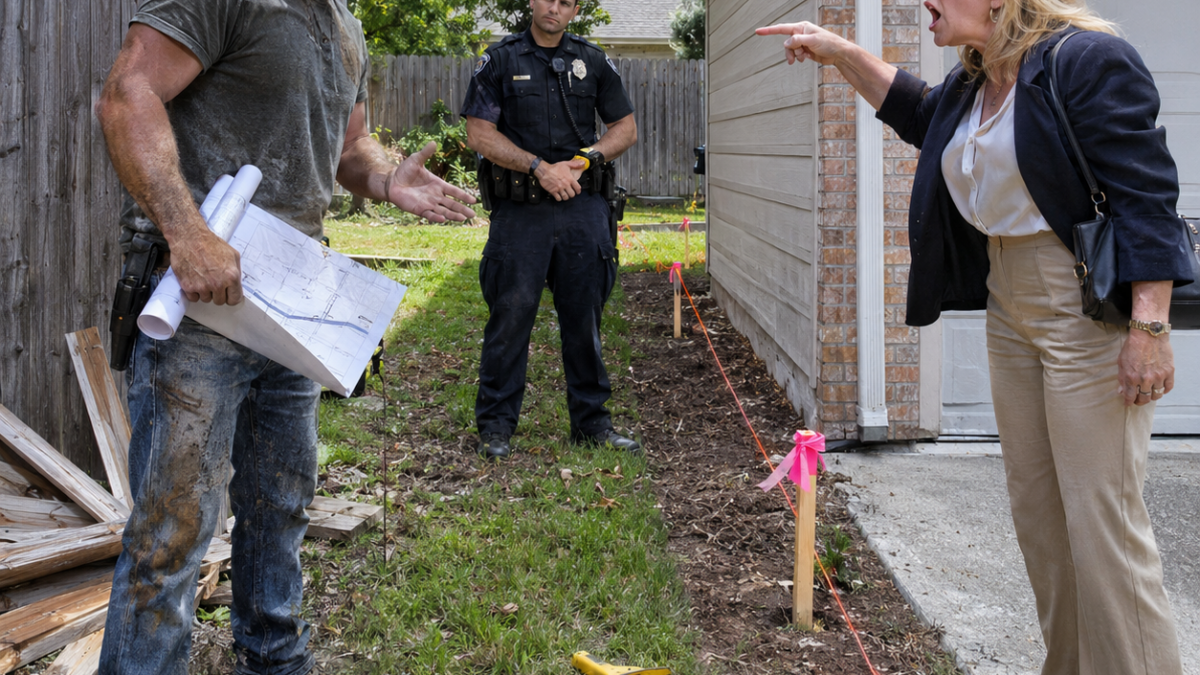
Officer Dugan walked over to the stack of fence panels.
He checked them carefully.
No cut metal.
No bent rails.
No crushed sections.
No damage at all.
I had even put the bolts in a bucket beside the first panel.
Karen followed him.
“He removed them.”
“I understand.”
“That is destruction.”
Pierce looked at the panels.
“Ma’am, they’re intact.”
“He interfered with community property.”
“That is a civil issue if ownership is disputed.”
“I want charges filed.”
“There isn’t a basis for an arrest here.”
Karen’s face changed.
Not disappointment.
Outrage.
She had called the police expecting authority to arrive on her side.
Instead, authority had asked for evidence.
She pointed toward me.
“He’s going to keep tearing things down.”
I answered before Pierce could.
“No.”
She turned.
“I removed the fence because it blocked my lane. I haven’t touched anything else.”
“You admit it.”
“I’ve never denied it.”
Pierce raised one hand.
“Both of you need to stop.”
Then he looked at Karen.
“If the association believes it owns this strip, prove that through the proper civil process.”
He turned toward me.
“Mr. Roland, don’t escalate this.”
“I won’t.”
Pierce photographed the panels.
He photographed the posts.
Then he took both statements.
Before leaving, he said something Karen clearly didn’t want to hear.
“Property boundaries are decided by records and survey evidence, not by whichever side calls the police first.”
Karen folded her arms.
“You’re making a mistake.”
Pierce closed his notebook.
“You’re free to seek legal advice.”
Then he got into his patrol car and left.
Karen waited until the vehicle disappeared.
Then she turned toward me.
“I’ll make sure you pay for every panel.”
“Nothing is damaged.”
“Twenty-six thousand dollars.”
“For twelve removable panels?”
“Installation. Materials. Security impact.”
I almost laughed.
She stepped closer.
“You don’t understand what you’re doing.”
“No, Karen.”
I looked toward the garage.
“I think I’m starting to.”
Her eyes followed mine.
Something flickered across her face.
Fear.
Small.
Fast.
But unmistakable.
Then she got into her SUV.
“You cross that line again, and next time I’ll make sure the sheriff understands exactly who you are.”
She drove away.
I stood at the gate watching her SUV climb toward Cedar Hollow.
And I kept thinking about the garage.
It was impossible not to notice.
Three bays.
Steel roll-up doors.
Stone veneer.
Architectural lighting beneath the roofline.
A detached luxury garage worth more than my first house.
Karen had built it in 2021, about a year after moving into Cedar Hollow.
I remembered the construction.
Concrete trucks.
Excavators.
Weeks of stonework.
I’d never cared.
People could build whatever they wanted on their own property.
That last part suddenly felt important.
That evening, an HOA email arrived.
SUBJECT: FINAL DEMAND — PROPERTY DAMAGE.
The association demanded $26,000.
It warned me not to cross the fence line again.
Attached was a new map.
I opened it on my computer.
Zoomed in.
Then sat back.
The boundary shown on Karen’s map didn’t match mine.
Not even close.
It pushed several yards into my farm.
The line curved around my eastern lane, then bent in a way that placed Karen’s garage safely inside Cedar Hollow.
Conveniently inside.
I checked the corner of the document.
COMMUNITY BOUNDARY ADJUSTMENT — 2023.
No county recording number.
No deed reference.
No parcel amendment.
Nothing.
I pulled my closing documents from a fireproof cabinet.
My deed.
Original plat.
Title policy.
Survey.
I laid them across my kitchen table.
The line on every recorded document was straight.
Karen’s line wandered.
Straight around her garage.
That wasn’t proof of fraud.
Not yet.
But I knew enough about construction drawings to recognize a convenient line when I saw one.
I called Cassidy Nolan the next morning.
Cassidy was a licensed land surveyor.
Thirty-eight.
Independent.
Direct.
The first thing she told me was:
“I don’t survey to prove your theory.”
“Good.”
“I survey to find the line.”
“That’s exactly what I want.”
“Send the deed.”
I did.
“Original plat?”
Sent it.
“Neighbor parcel description?”
“I can pull it.”
“Do that.”
She also requested historical surveys and subdivision records.
Before she even stepped onto the land, Karen learned I’d hired her.
I don’t know who told her.
Maybe someone at Cedar Hollow.
Maybe she saw Cassidy’s company truck.
Karen called Cassidy directly.
I only learned about it because Cassidy called me afterward.
“She told me not to enter HOA property.”
“What did you say?”
“That I don’t take access instructions from HOA presidents.”
I smiled.
“What else?”
“She said your survey is outdated.”
“It isn’t.”
“I know.”
“She also told me the boundary was adjusted.”
“Did she give you recording information?”
“No.”
“Because there isn’t any.”
“I’ll verify.”
Cassidy paused.
“Beckett.”
“Yeah?”
“She really doesn’t want this surveyed.”
That was becoming obvious.
The following morning, Cassidy started near the farm lane.
The HOA had planted thick shrubs along the disputed line over the previous few years.
Beautiful landscaping.
Dense enough to hide the ground.
Cassidy and her assistant cleared leaves and dead branches around one cluster.
Twenty minutes later, she called me over.
“Found something.”
A metal monument.
Old.
Buried several inches beneath soil.
I recognized it from photographs taken when I bought the farm.
Cassidy set up her equipment.
Measured.
Checked again.
Then looked toward Karen’s glossy map.
Her expression became serious.
“This isn’t close.”
“How far?”
“I need the full survey before I give you a number.”
Then she looked toward the garage.
“I need to run the line through there.”
Karen appeared outside within minutes.
She crossed her lawn fast.
“What are you doing?”
Cassidy barely looked up.
“Surveying.”
“You are on private community property.”
Cassidy checked her instrument.
“My setup is on Mr. Roland’s land.”
“You cannot point equipment at my house.”
Cassidy finally looked at her.
“I’m measuring a property boundary.”
“I’ll call the police.”
“That’s your choice.”
Karen pointed at me.
“This is harassment.”
I said nothing.
Cassidy returned to work.
That frustrated Karen more than arguing would have.
Measurements accumulated.
Control points.
Angles.
Distances.
Old monuments.
New coordinates.
For three days, Cassidy worked.
I watched colored flags appear.
Each one moved the theoretical line farther from Karen’s version.
The first final number concerned the fence.
Twenty-two feet.
The fence had been placed about twenty-two feet inside my farm.
Not twenty-two inches.
Twenty-two feet.
My lane wasn’t touching HOA property.
The HOA fence had crossed deep enough onto mine to block it deliberately.
Then Cassidy extended the boundary north.
Toward Karen’s garage.
I remember the exact moment.
She was standing beside her tripod.
Her assistant read a number.
Cassidy frowned.
“Run it again.”
They did.
Same result.
She moved to another control point.
Checked independently.
Then pulled the garage construction drawing from her truck.
She laid it across the tailgate.
I walked over.
“What is it?”
She didn’t answer immediately.
“Cassidy?”
She put one finger on the drawing.
“Where do you understand the garage property line to be?”
I pointed.
“Along the hedge.”
“No.”
She drew a red line.
“This is the record boundary.”
The line didn’t run beside Karen’s garage.
It ran through it.
I stared.
“How far?”
“Approximately fourteen feet.”
I thought I’d misheard.
“Fourteen?”
“Along about thirty-six feet of foundation.”
I looked at the stone wall.
“That can’t be survey error.”
“No.”
“Margin?”
“Less than a tenth of a foot with the control we’re seeing.”
She pointed toward the building.
“Fourteen feet isn’t uncertainty.”
“What is it?”
Cassidy met my eyes.
“A structure on the wrong parcel.”
Karen must have seen us looking.
She came outside again.
This time she wasn’t angry.
Not initially.
She walked toward the new stakes.
Then stopped.
One stake sat near my farm lane.
Another aligned frighteningly close to the garage foundation.
“What are those?”
Cassidy held out a preliminary drawing.
“The reestablished boundary.”
Karen snatched it.
Her eyes moved across the page.
Then toward the garage.
Back to the page.
“That is impossible.”
Cassidy remained calm.
“We’re still finishing documentation, but the measurements are consistent.”
“That garage was permitted.”
“A building permit doesn’t establish land ownership.”
Karen looked at me.
“This is your doing.”
“My doing?”
“You hired her.”
“Yes.”
“To manipulate the line.”
Cassidy’s face hardened.
“No.”
Karen turned on her.
“You work for him.”
“He pays for the survey.”
“Exactly.”
“I also sign it with my license number.”
Cassidy pointed toward her equipment.
“My coordinates, control data, field notes, and source records can be independently checked.”
Karen looked back at the garage.
Her voice became thinner.
“My contractor surveyed this.”
“Then I’d like to see that survey.”
Silence.
I stepped forward.
“You called the police because I removed twelve fence panels.”
Karen looked at me.
“So tell me something.”
I pointed toward the stone wall.
“How do you plan to explain fourteen feet of garage on my land?”
She said nothing.
That silence felt different from every previous one.
Karen had always possessed an answer.
Rules.
Authority.
Safety.
Community.
Progress.
Now she had a red line.
And no speech could move it.
Finally she said:
“I’ll hire my own surveyor.”
“Good.”
“This isn’t over.”
“I agree.”
She walked away.
That night, Cassidy emailed the completed survey.
The fence encroachment:
Approximately twenty-two feet.
Garage encroachment:
Approximately fourteen feet over a thirty-six-foot stretch.
I printed it.
Then stared at it in my kitchen.
When all of this started, I’d wanted one thing.
My lane.
That’s it.
Take down the fence.
Stop blocking my farm.
I didn’t want Karen’s garage.
Didn’t want her property.
Didn’t care about Cedar Hollow politics.
But now I had another question.
How does a $430,000 garage move fourteen feet across a recorded property line?
Concrete doesn’t accidentally wander.
Foundations don’t drift after pouring.
Someone placed it there.
I called attorney Bridget Fairbanks.
Bridget was forty-six and had spent most of her career handling title disputes.
She read everything in silence.
My deed.
Plat.
Cassidy’s survey.
Karen’s 2023 map.
Fence photographs.
Police report.
HOA demand letter.
Finally, she stacked the papers neatly.
“You have a strong case.”
“For the garage?”
“For confirmation of the boundary.”
“What about removing it?”
“Slow down.”
I didn’t like that answer.
She continued.
“We establish ownership first.”
“Cassidy established it.”
“Cassidy established a professional survey opinion. A court can confirm title if Karen refuses to accept it.”
I leaned back.
“What do I do meanwhile?”
“Nothing physical.”
“I’m not planning to demolish anything.”
“Good.”
She looked straight at me.
“Do not touch the garage.”
“I won’t.”
“Don’t block utilities.”
“Okay.”
“Don’t threaten contractors.”
“I haven’t.”
“Don’t even joke about bringing an excavator.”
I smiled.
“You know me already.”
“I know property cases.”
She tapped Karen’s demand letter.
“She wants to be the victim.”
“Why?”
“Because right now she’s the person whose building appears to be sitting on someone else’s land.”
Bridget sent formal notice.
Stop further encroachment.
Preserve markers.
Preserve construction records.
Negotiate a remedy.
Karen responded by suing first.
That surprised me.
Her attorney filed an emergency petition claiming I might sabotage the garage.
Block access.
Damage HOA property.
Create a safety crisis.
They asked the judge to order me away from the garage.
I read the petition twice.
“She called me dangerous?”
Bridget nodded.
“I’ve never touched the building.”
“I know.”
“She crossed onto my land.”
“I know.”
“And I’m the threat?”
Bridget smiled.
“Welcome to litigation.”
At the same time, Karen’s lawyer sent a private settlement offer.
$35,000.
For the disputed strip.
Confidential.
Permanent sale.
I pushed it back across Bridget’s desk.
“No.”
“You didn’t even think.”
“I don’t need to.”
“Why?”
“That strip controls my farm lane.”
“Correct.”
“If I sell it, Karen owns the edge of my access forever.”
“Yes.”
“So no.”
Bridget nodded.
“I agree.”
At the first hearing, Karen arrived dressed like she was attending a corporate board meeting.
She testified that she’d relied on HOA planning documents.
That the garage was permitted.
That I had become hostile.
Her lawyer asked the judge to preserve the garage.
Bridget stood.
“We don’t object.”
Karen turned.
She hadn’t expected that.
Bridget continued:
“Mr. Roland has no intention of taking matters into his own hands. We ask only that preservation apply equally.”
No new construction.
No moving monuments.
No new fencing.
No blocking access outside the genuinely disputed zone.
The judge agreed.
Temporary status quo.
No ruling on ownership.
Karen left the courthouse and immediately told Cedar Hollow she’d won.
According to a feed supplier who heard it from residents, Karen announced:
“The judge ordered Beckett away from my garage.”
Technically true.
Conveniently incomplete.
The order protected the structure from both sides.
It did not say she owned the dirt.
I wanted to issue a statement.
Bridget stopped me.
“Let her talk.”
“She is lying.”
“She is creating evidence.”
“Of what?”
“Of how she describes this case when nobody challenges her.”
I didn’t fully appreciate that yet.
Then the 2021 building-permit file arrived.
Bridget called me immediately.
“Come in.”
On her conference table sat two drawings.
First:
Approved garage site plan.
The garage was shown five feet inside Karen’s property.
Second:
Cassidy’s as-built survey.
Actual building location.
Fourteen feet over my line.
Bridget measured the difference.
“Nineteen feet.”
I looked at her.
“What?”
“The approved position and built position differ by nearly nineteen feet.”
I stared at the drawings.
“Contractors don’t miss by nineteen feet.”
“Exactly.”
“Could the site plan be conceptual?”
“No. This is the permit site plan.”
She tapped it.
“Someone either made a massive construction mistake or somebody intentionally built somewhere other than approved.”
“Who built it?”
“Denton Shaw.”
I’d seen his trucks.
Shaw Custom Construction.
Large local contractor.
Bridget contacted him.
He refused to cooperate voluntarily.
Confidentiality.
Client obligations.
Didn’t want a neighbor fight.
Bridget didn’t argue.
She used discovery.
Weeks later, boxes arrived.
Emails.
Invoices.
Site drawings.
Survey notes.
Foundation records.
Payment schedules.
Buried inside was a 2020 survey.
Karen’s survey.
Commissioned before construction.
It showed the true boundary.
It showed the chosen garage location crossing onto my farm.
I stared at it.
“She knew.”
Bridget raised a finger.
“Keep reading.”
Attached was an email from Denton’s office.
The proposed foundation location conflicts with the western boundary. Structure should be shifted inward before concrete placement.
And Karen’s reply:
Proceed with the marked location. The HOA has already handled the boundary.
I sat completely still.
There it was.
Not a theory.
Not memory.
Not inference.
Her own words.
Before the concrete.
Before the garage.
Before the fence.
Before the glossy 2023 map.
She had been warned.
And she told them to proceed.
“What boundary had the HOA handled?” I asked.
Bridget opened the county records search.
“None.”
No deed.
No sale.
No easement.
No boundary-line agreement.
No lease.
No license.
No signed permission.
Nothing.
Denton eventually testified in a deposition.
His crew set the foundation from stakes supplied by Karen and her project representative.
He had received the warning.
He asked about it.
Karen said the HOA had resolved the land issue.
Then she signed written responsibility for boundary disputes.
He built anyway.
That didn’t make Denton innocent.
Bridget told me:
“He had professional reasons to stop.”
“But he relied on her.”
“Yes.”
“Badly.”
“Very badly.”
Karen claimed she had misunderstood.
She said she believed the HOA could adjust boundary areas for landscaping and access.
Bridget pulled Cedar Hollow’s own meeting minutes.
Nothing.
No boundary vote.
No land purchase.
No negotiations with me.
No resolution authorizing the board to take private property.
Karen had chaired every meeting.
If Cedar Hollow had “handled” the boundary, Karen should have been able to produce a record.
She couldn’t.
Then the fence made sense.
The no-trespassing signs.
The shrubs planted over monuments.
The changed map.
The fence wrapping around the encroachment.
None of it was random.
The garage came first.
Then they built the visual world around it.
If someone looked at the landscaping, fence, signs, and glossy HOA map, they’d assume the garage stood safely inside Cedar Hollow.
And I had almost done exactly that.
For years, I hadn’t questioned it.
Then Karen blocked my lane.
Her greed for another twenty-two feet forced me to measure everything.
That irony stayed with me.
If she had left my lane alone, her garage might have remained unquestioned for years.
Then Bridget found the money.
She was reviewing contractor payments when she stopped.
“Beckett.”
“What?”
“Were HOA funds supposed to pay for Karen’s garage?”
“Not that I know.”
She turned the ledger toward me.
Several large site-work payments had come from Cedar Hollow Estates HOA.
Not Karen.
The descriptions were vague.
Access improvements.
Soil stabilization.
Emergency route preparation.
I felt my stomach tighten.
“How much?”
“We need the complete books.”
That was where Opel Gentry entered the story.
Opel was Cedar Hollow’s treasurer.
Fifty-seven.
Retired bookkeeper.
Quiet woman.
Karen had cut her off during the emergency meeting when Opel questioned the maps.
Apparently Opel hadn’t forgotten.
She started reviewing association expenses.
A special assessment stood out.
Ninety-two homeowners.
$2,000 each.
Total:
$184,000.
Residents had been told the money would fund an emergency access road.
Fire trucks.
Maintenance vehicles.
Safer entry.
But Opel walked the supposed route.
There wasn’t one.
No completed emergency road.
No fire-truck turnaround.
No shared route.
What existed instead?
Graded land leading toward Karen’s driveway.
Reinforced soil beneath her garage area.
Fence work.
Four invoices.
Exactly $46,000 each.
All paid to the contractor connected to the garage site.
Total:
$184,000.
Opel compared progress photos the board had shown residents.
Then photographs taken during Karen’s garage construction.
Same trees.
Same grading.
Same slopes.
Same work.
The “emergency access road” pictures were actually garage-site photographs.
She confronted Karen.
Karen claimed the garage stored HOA emergency equipment.
Opel asked for the board resolution.
None.
Agreement?
None.
Lease?
None.
Inventory?
Barely anything.
Then Karen threatened to remove her as treasurer.
That was the wrong move.
Opel requested an independent audit.
She also locked her financial records in a fireproof box.
And stored backup copies at her sister’s house.
The dispute wasn’t mine anymore.
It had crossed the fence.
Cedar Hollow homeowners began asking questions.
A special meeting filled the clubhouse.
Opel put the invoices on the screen.
Then the photos.
One homeowner stood.
“We paid for a fire access road.”
“Yes,” Opel said.
“Where is it?”
She didn’t answer.
She didn’t need to.
The man pointed toward Karen.
“Why was our money used under your garage?”
Karen slammed her palm against the table.
“That is a malicious characterization.”
Someone else shouted:
“Then show us the road!”
Another resident:
“Where did the $184,000 go?”
Karen accused Opel of leaking confidential material.
Opel responded:
“These are the members’ financial records.”
For the first time, Karen wasn’t fighting me.
She was fighting ninety-two people who had written checks.
Within twenty-four hours, her settlement offer changed.
$100,000.
Buy the disputed strip.
Dismiss my lawsuit.
Stop pursuing construction records.
Confidentiality.
Bridget read it.
Then looked at me.
“This isn’t just about buying land.”
“No.”
“She wants the records problem to disappear.”
I pushed the paper away.
“No.”
Karen tried public opinion next.
At a private homeowner gathering, she warned residents that my lawsuit threatened Cedar Hollow’s internal roads.
She claimed the same maps had been used for subdivision planning.
If her garage boundary failed, she suggested, roads might be challenged.
Common areas.
Property values.
Mortgages.
It was nonsense.
But effective nonsense.
Fear doesn’t require technical accuracy.
It requires uncertainty.
Karen collected petition signatures.
Then hired a public-relations firm.
A regional newspaper published a story framing her as a dedicated HOA president defending a family neighborhood from a hostile farmer.
The headline called me:
THE MAN WHO TORE DOWN CEDAR HOLLOW’S FENCE.
I read it in my kitchen.
My hands shook.
Not from fear.
Anger.
I wanted to respond.
Bridget said no.
“They’re lying.”
“Parts are misleading.”
“That’s a lawyer’s word for lying.”
“Yes.”
“So let me answer.”
“With what?”
“The survey.”
“Court.”
“The emails.”
“Court.”
“The money.”
“Separate audit and court.”
I stared at her.
“She gets a newspaper.”
“You get evidence under oath.”
Two days later, someone put a copy of the article in my mailbox.
THIEF.
Written across my face in red marker.
I photographed it.
Dated it.
Gave it to Bridget.
I didn’t post anything.
Didn’t knock on doors.
Didn’t retaliate.
Karen wanted me angry enough to make a mistake.
I wasn’t giving her one.
Then I noticed construction activity behind her garage.
Workers.
Tape measures.
Spray paint.
A concrete crew was scheduled.
Karen apparently planned to add another slab and screening wall across the disputed strip.
I took photographs from my property.
Sent them to Bridget.
Emergency motion.
That afternoon.
The court prohibited new construction in the contested area.
Then the county building inspector reviewed the garage.
Actual location didn’t match the permit.
Stop work.
Karen’s crew left.
That evening, she came to my farm.
Back to the same gate.
No police this time.
She got out holding papers.
“You need to sign.”
“What?”
“Sale agreement.”
“No.”
“You haven’t read it.”
“Don’t need to.”
Her voice sharpened.
“You will never get practical use out of that strip.”
“I already use it.”
“For farm traffic.”
“Yes.”
“You’re throwing away a six-figure offer over dirt.”
“My dirt.”
“You have an old farm.”
I stared at her.
“What?”
“I have money.”
She stepped closer.
“I have lawyers. I have an entire community behind me. You think one surveyor is going to destroy everything I’ve built?”
I let her finish.
Then I said:
“You had a map.”
She glared at me.
“You had a fence.”
Silence.
“You even had a police officer standing at my gate.”
Her jaw tightened.
“But you never had ownership.”
Her face went cold.
“I can bury you in legal fees.”
“Maybe.”
“You could lose this farm.”
I didn’t answer.
She wanted fear.
I closed my gate.
“Good night, Karen.”
She stood outside for several seconds.
Then drove away.
A few days later, Denton Shaw provided a supplemental declaration.
Attached:
The 2020 survey warning.
Proof Karen received it.
Her acknowledgment.
Proceed with the marked location.
The HOA has already handled the boundary.
Karen had told the court she knew nothing about a boundary problem.
Now we had her own email saying otherwise.
The night before trial, Bridget called.
“Sleep.”
“That’s not going to happen.”
“Try.”
“What happens tomorrow?”
“Cassidy proves the line.”
“Denton?”
“Explains the warning.”
“Opel?”
“Explains the money.”
“Karen?”
Bridget paused.
“Karen explains Karen.”
The courtroom was packed.
Cedar Hollow homeowners filled the back rows.
Some supported me now.
Some still supported Karen.
Most simply wanted to know what was true.
Karen arrived wearing a tailored suit.
Thick binder.
Perfect posture.
She looked like the leader described in that newspaper article.
I sat beside Bridget.
My documents were simple.
Deed.
Plat.
Survey.
Emails.
The truth had become less complicated as the case grew.
Judge Helena Ralston entered.
Sixty-one.
Experienced.
Bridget had warned me:
“She has very little patience for people who play games with facts.”
Karen’s attorney opened with the 2023 HOA map.
He argued that Karen had relied on community planning records in good faith.
Bridget stood.
“One question.”
The judge nodded.
“Does Cedar Hollow possess a deed signed by Mr. Roland transferring the disputed property?”
“No.”
“A recorded boundary-line agreement?”
“No.”
“An easement allowing the garage to remain?”
“No.”
“Any document bearing my client’s signature authorizing the garage?”
“No.”
Bridget sat.
That was the entire weakness in Karen’s case.
Everything else was decoration.
Cassidy testified.
She explained the monuments.
Control points.
Original records.
Independent checks.
Coordinates.
Field measurements.
Her conclusion:
The fence was approximately twenty-two feet inside my property.
The garage crossed roughly fourteen feet across the boundary along approximately thirty-six feet of foundation.
Karen’s attorney attacked her.
“You were paid by Mr. Roland.”
“Yes.”
“So he was your client.”
“Yes.”
“And he wanted a particular outcome.”
Cassidy looked at him.
“He wanted a survey.”
“He wanted the line moved.”
“No.”
“You expect us to believe—”
Cassidy interrupted calmly.
“The coordinates were supplied to your expert weeks ago.”
The attorney stopped.
“No contrary licensed survey has been filed.”
Silence.
“My measurements are reproducible.”
That was Cassidy.
No drama.
Numbers.
Then Officer Pierce Dugan testified.
I hadn’t realized his body camera would matter so much.
The video played.
Karen at my gate.
Glossy HOA map raised in one hand.
“I want him arrested.”
“This proves Cedar Hollow owns the land.”
“I am the president of this HOA.”
Then Pierce’s voice:
“Being president of an HOA doesn’t mean you own every piece of land around you.”
Several homeowners shifted in the gallery.
Bridget then showed Karen’s testimony from earlier proceedings where she had described the same map as merely an “internal planning document.”
Pierce wasn’t there to prove the boundary.
He was there to prove what Karen had claimed before the survey trapped her.
Her story changed.
The map didn’t.
Then Denton testified.
He looked uncomfortable.
Good.
He should have.
Bridget displayed the original warning email.
Structure conflicts with western boundary.
Foundation should be shifted inward.
Then Karen’s response.
Proceed with the marked location. The HOA has already handled the boundary.
The courtroom fell silent.
Karen stared at the table.
Her lawyer tried to suggest a project manager had handled the details.
Bridget displayed delivery confirmation.
Karen’s email address.
Her response.
Her written assumption of boundary responsibility.
Denton admitted:
“I warned her.”
“Before concrete?”
“Yes.”
“And you built anyway?”
“Yes.”
“Why?”
“She told us the boundary was resolved.”
“Did you verify?”
“No.”
“Did you see a deed?”
“No.”
“Boundary agreement?”
“No.”
“Permission from Beckett Roland?”
“No.”
Then Opel Gentry testified.
She brought the financial records.
Special assessment:
$184,000.
Four invoices:
$46,000 each.
Emergency access improvement.
Soil stabilization.
Then construction photos.
Garage excavation.
Same place.
Same grading.
Same work.
Karen’s attorney objected.
Judge Ralston clarified that this was not a criminal proceeding.
Any financial wrongdoing would require separate review.
But the evidence could be relevant to the history and motivation of the project.
Opel described asking for the emergency road.
None existed.
She described asking for a board resolution allowing Karen’s private garage to serve an HOA function.
None existed.
Then Bridget called Karen.
At first, Karen stayed composed.
She said she relied on professionals.
She believed the boundary was adjusted.
She believed the garage served some association purposes.
She believed my farm lane interfered with Cedar Hollow’s landscaped buffer.
Then Bridget asked:
“Why didn’t you approach Mr. Roland before building?”
“I believed we had authority.”
“From whom?”
“The HOA.”
“What document gave the HOA authority?”
“Our planning records.”
“Which recorded document?”
Karen hesitated.
“Community documents.”
“Deed?”
“No.”
“Easement?”
“No.”
“Sale agreement?”
“No.”
“Written permission?”
“No.”
Bridget held up the 2020 survey.
“You knew before construction that the proposed location crossed the Roland boundary, didn’t you?”
“I knew there was a discrepancy.”
“A discrepancy of approximately fourteen feet?”
“We didn’t know the exact number.”
“Enough to receive a written warning from your contractor?”
“Yes.”
“And what did you do?”
Karen’s voice tightened.
“I relied on our project team.”
Bridget displayed the email.
“Your words were, ‘Proceed with the marked location.’”
Karen looked at the screen.
“Yes.”
“You also wrote, ‘The HOA has already handled the boundary.’”
“Yes.”
“What exactly had the HOA done?”
Karen didn’t answer.
Bridget waited.
Judge Ralston looked at her.
“Mrs. Hargrove?”
Karen’s composure broke.
“He has nothing but an old farm.”
The sentence came out sharp.
Raw.
The courtroom froze.
Karen continued before her lawyer could stop her.
“I invested hundreds of thousands of dollars in that space.”
Bridget’s answer was almost quiet.
“The value of your building does not change whose name is on the land.”
Karen opened her mouth.
Her attorney put a hand on her arm.
“Stop.”
She did.
But it was too late.
That sentence told everyone exactly how she had viewed the dispute.
My farm was less valuable to her.
Therefore my ownership mattered less.
Her garage was expensive.
Therefore she believed it deserved the land beneath it.
Before closing, Karen’s side proposed a compromise.
Let the garage stay.
She would pay me for long-term use.
I refused.
Not because I wanted revenge.
Because that would reward the exact strategy that caused the dispute.
Build first.
Pressure later.
Then pay when caught.
If that worked, property rights belonged to whoever could pour concrete fastest.
Judge Ralston took the matter under review.
Karen left convinced no judge would order a $430,000 garage removed.
Weeks later, we returned.
I barely slept the night before.
Not because I doubted the survey.
Because court remedies aren’t always emotionally satisfying.
A judge could have ordered compensation.
An easement.
A forced sale in some circumstances.
There were possibilities.
Karen sat across the aisle.
Chin high.
Judge Ralston began reading.
She confirmed the legal boundary.
The accepted title evidence.
Cassidy’s survey.
Original monuments.
Recorded plat.
The 2023 HOA map had no authority to transfer ownership.
No deed.
No easement.
No boundary-line agreement.
No consent.
The disputed strip belonged to me.
I felt my chest loosen.
Then the garage.
Karen had failed to establish any lawful right to keep the encroachment.
The court ordered removal of the portion crossing onto my land within seventy-five days.
Safe engineering plan.
Karen responsible for removal cost.
Ground restored.
No new structures.
No interference with my lawful access.
Then the fence.
Karen’s $26,000 damage claim was dismissed.
Judge Ralston noted that the twelve panels had been removed only after written notice and had not been damaged.
Karen shot to her feet.
“You’re ordering me to destroy a four-hundred-thirty-thousand-dollar garage over a few feet of dirt?”
Her attorney grabbed her arm.
Judge Ralston’s expression hardened.
“Mrs. Hargrove.”
Karen sat.
The judge continued.
“The amount spent on a structure does not create ownership of land beneath it.”
That sentence ended everything.
At least legally.
Then came Cedar Hollow.
Within days, homeowners demanded a recall.
Karen refused to attend.
She sent a letter calling the effort a coup led by a disgruntled treasurer.
Opel read the letter aloud.
Then put it down.
No speech.
No argument.
Ballots were counted.
Ninety-two homes.
Seventy-four voted to remove Karen.
She was out.
The board stopped funding any part of her personal garage dispute.
Then the independent audit expanded.
Karen still believed she could save most of the garage.
She hired structural engineers.
Her plan was simple.
Cut off the fourteen-foot portion.
Rebuild the wall.
Keep the remaining bays.
The engineer’s report destroyed that hope.
The foundation was integrated.
Load-bearing framing tied the structure together.
Removing the encroaching section safely while leaving the remaining building standing under the existing design wasn’t feasible.
To comply with the court order, the entire garage had to come down.
Then she could rebuild a smaller one.
On her own land.
The demolition bid:
$65,000.
Karen now faced losing a $430,000 garage and paying another $65,000 to remove it.
Insurance reviewed the claim.
Denied coverage.
Why?
The written warning before construction.
She had knowingly proceeded despite documented boundary risk.
Then came the audit settlement.
The HOA pursued recovery of the $184,000 assessment money tied to site work.
Eventually Karen agreed to repay the full amount under a civil agreement.
Garage value:
About $430,000.
Demolition and restoration:
$65,000.
Repayment:
$184,000.
Roughly $679,000.
Before her own legal bills.
All over land she never owned.
Seventy-five days after the ruling, demolition trucks entered Cedar Hollow.
I knew they were coming.
Bridget called the night before.
“You don’t have to watch.”
“I know.”
“Probably better if you don’t celebrate.”
“I’m not bringing balloons.”
“Beckett.”
“I’m kidding.”
Mostly.
The next morning, I walked my farm lane.
Same lane Karen had fenced off.
The sun was barely up.
Across the boundary, the garage lights were still on.
For the last time.
Three beautiful steel doors.
Stone façade.
Perfect gutters.
Expensive roof.
Everything spotless.
Karen stood on her lawn.
Arms folded.
The exact pose she’d used the morning she called police on me.
Except there was no smile now.
Workers disconnected utilities.
Then removed the doors.
One by one.
The first steel panel went onto a flatbed.
Then the second.
Then the third.
By midmorning, stone veneer came down.
Chunks stacked on pallets.
Roofing removed.
Framing exposed.
It looked strangely fragile once the decorative shell disappeared.
Every building does.
Under enough finish, people forget structures are just materials held together according to lines.
And this one had been placed across the wrong line.
At noon, the roof framing came apart.
Karen stayed outside.
Didn’t leave.
Maybe she needed to watch.
Maybe she couldn’t look away.
By afternoon, the excavator began breaking the foundation.
That was when I felt something unexpected.
Not joy.
Grief.
Not for Karen.
For the waste.
Beautiful materials.
Good labor.
Hundreds of thousands of dollars.
Destroyed because one person decided asking permission was beneath her.
None of it needed to happen.
Move the garage nineteen feet before construction.
That’s all.
The contractor had warned her.
One redesign.
A little less lawn.
A smaller driveway.
No lawsuit.
No recall.
No demolition.
No $679,000 disaster.
But pride is expensive.
Especially when concrete gets involved.
By late afternoon, the final section of foundation came out.
For the first time in years, sunlight hit the strip of land beneath Karen’s garage.
My land.
I stood quietly.
No cheering.
No photographers invited by me.
No victory sign.
Just dirt.
Karen crossed toward the restored boundary after the workers left.
She stopped several feet away.
Her voice sounded exhausted.
“All of this happened because you couldn’t leave one fence alone.”
I looked at her.
Then at the bare ground.
“No.”
She stared.
“All of this happened because you decided your map mattered more than somebody else’s land.”
She looked away.
I continued.
“If you hadn’t blocked my lane, I might never have ordered another survey.”
Her face tightened.
“That sounds like a threat.”
“No.”
I shook my head.
“It’s irony.”
She had no answer.
A few weeks later, I reopened the farm lane fully.
Cassidy returned for the final monuments.
Permanent.
Visible.
Accurately recorded.
I planted a low row of shrubs near my side.
Not thick enough to hide markers.
Never again.
Enough privacy.
Enough separation.
But anyone standing there could see exactly where the line ran.
Opel, serving as interim president, mailed me a letter.
Cedar Hollow Estates hereby acknowledges that the Roland property is independent from and has never been subject to the Cedar Hollow Estates Homeowners Association.
I read it twice.
Then framed it.
Not because I needed Cedar Hollow to validate ownership.
My deed already did that.
I framed it because six months earlier, Karen had stood at my gate telling a police officer I was trespassing on subdivision property.
Now the association itself admitted the truth in writing.
Life started settling down.
Farm trucks used the lane.
Hay came through.
Feed came through.
Produce left.
Nothing dramatic.
That was the point.
The lane didn’t exist to make a statement.
It existed because farms need access.
I hadn’t spent months fighting for symbolism.
I fought for the practical right to use land I already owned.
Some Cedar Hollow residents apologized.
Not all.
One man named Raymond stopped at my gate.
“I signed Karen’s petition.”
“I figured.”
“I called you a thief at a meeting.”
“I heard.”
He looked uncomfortable.
“I believed her.”
“I know.”
“She had the maps.”
“Maps can be wrong.”
“She was president.”
“Presidents can be wrong.”
He nodded.
“My wife told me that.”
“Smart woman.”
He almost smiled.
Then he held out his hand.
“I’m sorry.”
I shook it.
“Thank you.”
Another homeowner wasn’t so gentle.
She told me the garage demolition had harmed property values.
I asked:
“Whose land should Karen have been allowed to keep instead?”
She had no answer.
That became my simplest response whenever people complained about the result.
Which fourteen feet of your property should someone be allowed to take because their building is expensive?
No one volunteered.
Funny how principles become clearer when applied personally.
Denton Shaw came by one afternoon.
He parked near the barn.
Got out slowly.
“I owe you something.”
“Money?”
He almost laughed.
“An apology.”
I waited.
“I should’ve stopped construction.”
“Yes.”
He looked surprised by the direct answer.
“I thought Karen had the authority.”
“You had a survey.”
“I know.”
“You sent the warning.”
“I know.”
“And then you poured concrete.”
He looked down.
“I’ve replayed that a thousand times.”
“Why’d you do it?”
“Big client.”
There it was.
Honest.
“Cedar Hollow gave us a lot of work.”
“Still?”
“No.”
“Because of this?”
“Partly.”
He rubbed his hands together.
“I convinced myself her written responsibility clause protected me.”
“Did it?”
“No.”
“What did you learn?”
Denton looked toward the restored line.
“If a client tells me they handled a boundary, I ask for the recorded document.”
I nodded.
“That sounds expensive to learn.”
“It was.”
We shook hands.
I didn’t hate him.
But consequences mattered.
He had seen the warning.
He chose money and schedule over verification.
Karen was responsible for Karen.
Denton was responsible for Denton.
That distinction kept me sane.
Opel’s audit changed Cedar Hollow more deeply than my lawsuit did.
The $184,000 assessment was only one issue.
Residents discovered how often Karen had controlled contracts through informal decision-making.
Not necessarily illegal every time.
But opaque.
She concentrated information.
Board members saw summaries.
Karen saw originals.
That was how the boundary map slipped through.
How the garage payments hid under “access improvements.”
How questions disappeared.
The new board created rules.
Full invoices attached to capital-project approvals.
Conflict disclosures.
Independent review of boundary changes.
No unrecorded maps used to establish legal property lines.
Imagine that.
A rule telling adults that a colorful drawing isn’t a deed.
Opel became president later.
She called me once.
“I want to ask you something strange.”
“Go ahead.”
“Would you come to a board meeting?”
“No.”
She laughed.
“You didn’t even ask why.”
“I’ve seen your board meetings.”
“We’re better now.”
“Still no.”
“We’re adopting a boundary policy.”
“That sounds healthy.”
“We want a neighboring landowner’s perspective.”
I sighed.
“When?”
Thursday.
I went.
The clubhouse was the same room Karen had used to call me a threat.
I sat in the back.
Opel stood at the front.
She didn’t give speeches about leadership.
She put documents on the projector.
County plat.
Survey.
Title policy.
Proposed rule.
Then she said:
“If we don’t own it, we don’t build on it.”
A resident laughed.
Someone else said:
“Should’ve had that rule three years ago.”
The room went quiet.
Opel answered:
“We should have.”
No defensiveness.
No excuse.
That impressed me.
Good leadership isn’t pretending mistakes never happened.
It’s making them harder to repeat.
Afterward, Opel walked outside with me.
“Thank you.”
“For sitting in a chair?”
“For not treating the whole neighborhood like Karen.”
“I was angry at some of you.”
“I know.”
“Especially when that article ran.”
She looked embarrassed.
“I should have spoken publicly sooner.”
“You were still collecting evidence.”
“True.”
We reached my truck.
“Did you ever think about selling?”
“The strip?”
“The farm.”
I laughed.
“No.”
“Even when Karen threatened legal fees?”
“Maybe for ten minutes.”
“Seriously?”
“Litigation is miserable.”
Opel nodded.
“She counted on that.”
“What?”
“Making resistance more expensive than surrender.”
That sentence stayed with me.
Because she was right.
Karen’s strategy wasn’t based on being legally correct.
It was based on creating a completed fact.
Fence installed.
Garage built.
Map printed.
Shrubs planted.
Community convinced.
Money spent.
Then if I objected, I faced the ugly question:
Is fourteen feet worth this fight?
She expected the answer to become no.
But that question is backwards.
The real question was:
Was her garage worth taking fourteen feet that didn’t belong to her?
She had made that decision for me.
That was the offense.
Not the feet.
The assumption.
Years earlier, when I managed construction projects, I’d watched disputes explode over inches.
People laughed about it.
“It’s only six inches.”
“It’s only a foot.”
But boundaries matter precisely because they stop endless bargaining over what is “only” something.
A property line says:
Yours ends here.
Mine begins there.
No personality required.
No status.
No wealth.
No HOA vote.
Just here.
Karen hated that.
She believed authority should bend the line.
Money should bend it.
Her garage should bend it.
It didn’t.
After the demolition, she stayed in Cedar Hollow.
That surprised people.
Her mansion remained.
She had enough property to build another garage legally.
For a long time, she didn’t.
The bare area stayed visible from my farm.
Grass slowly covered it.
The first spring, weeds appeared.
Then sod.
Eventually, if you didn’t know the story, you’d never guess a $430,000 structure had stood there.
I liked that.
Not because I wanted her forgotten.
Because land has a way of exposing how temporary our arrogance is.
The garage looked permanent.
Stone.
Steel.
Concrete.
Architectural lighting.
The boundary outlasted it.
One autumn afternoon, I was repairing a gate when Karen appeared near the line.
No SUV.
She walked.
That alone was unusual.
I kept working.
“Beckett.”
“Karen.”
She stood silently.
Then:
“I’ve been thinking about rebuilding.”
“Your property.”
“Yes.”
“I don’t need your permission.”
She almost smiled.
“No.”
She looked toward the survey monument.
“I hired Cassidy.”
That made me stop.
“You did?”
“For the new site.”
I couldn’t help it.
I laughed.
Karen’s face tightened.
“What’s funny?”
“Nothing.”
“It is.”
“I just didn’t expect you to hire my surveyor.”
“She was accurate.”
That was the closest thing to an apology I ever got.
“What are you building?”
“Two bays.”
“Smaller.”
“Yes.”
“Inside your line?”
“Twenty feet.”
“Sounds safe.”
She looked down.
Then said:
“I lost almost seven hundred thousand dollars.”
I didn’t answer.
“I lost the board.”
Still nothing.
“People I’ve known for years stopped speaking to me.”
I set down my wrench.
“Why are you telling me?”
Her eyes met mine.
“Do you think that was enough?”
The question surprised me.
Enough punishment?
Enough consequence?
Enough humiliation?
I thought about it.
“I don’t decide that.”
“You wanted the garage down.”
“I wanted my land back.”
“Same thing.”
“No.”
Her expression hardened.
“Don’t pretend you didn’t enjoy it.”
“I enjoyed seeing the line restored.”
“You watched the demolition.”
“Yes.”
“You could have sold me the strip.”
“Yes.”
“You chose not to.”
“Yes.”
“Why?”
I thought about every version of that answer I’d given attorneys.
Access.
Principle.
Farm operation.
Future control.
All true.
But there was something deeper.
“Because you built first so you could pressure me later.”
She said nothing.
“If I sold after that, your strategy worked.”
“I offered fair money.”
“After taking the land.”
“I didn’t think of it that way.”
“I know.”
That was the problem.
Karen looked toward the monument.
“For what it’s worth, the new garage won’t cross it.”
“Good.”
She walked away.
Her new garage went up the following year.
Two bays.
Nice building.
Fully inside her parcel.
Cassidy surveyed before excavation.
Then after foundation.
Karen probably paid more for survey work than she ever wanted to see again.
Nothing went wrong.
No lawsuit.
No police.
No demolition.
Proof that the original disaster had never been necessary.
All she had needed to do was respect the line.
One afternoon, Officer Pierce Dugan stopped at my farm.
Not official.
He was responding to a loose dog nearby and recognized the place.
“You still got those fence panels?”
I laughed.
“HOA picked them up eventually.”
“Too bad.”
“Why?”
“Thought you might make a sculpture.”
“Maybe call it Twenty-Six Thousand Dollars.”
He laughed.
Then looked toward Karen’s smaller garage.
“So that’s the replacement?”
“Yep.”
“On her property?”
“So I’m told.”
Pierce shook his head.
“That call was one of the stranger ones.”
“She really thought you’d arrest me.”
“I noticed.”
“Did you know about the garage?”
“No.”
He paused.
“But I noticed she kept looking that way.”
I stared at him.
“You too?”
“Yeah.”
“Why didn’t you say anything?”
“Police officers don’t usually tell people, ‘Your neighbor looks nervous about her garage.’”
Fair.
Pierce leaned against his patrol car.
“I saw the court result.”
“Made the local news.”
“Different headline this time.”
“Yes.”
The second article was far less flattering to Karen.
It described the confirmed encroachment.
The concealed survey warning.
The recall.
The demolition.
No one wrote THIEF across my face after that.
Funny how public opinion changes when coordinates get involved.
The original red-marked newspaper remained in my files.
Bridget asked once why I kept it.
“Evidence?”
“No.”
“Then why?”
I thought about it.
“To remember how sure everyone can sound before the facts arrive.”
That became another lesson.
The first article had looked authoritative.
Quotes.
Photographs.
Neighborhood concerns.
A headline.
It made me look guilty.
But it was published before trial.
Before Denton’s email.
Before Opel’s audit.
Before Cassidy testified.
Before Officer Dugan’s video played.
A story told early isn’t automatically the true story.
Sometimes it’s just the first person with a public-relations budget.
Years passed.
The farm changed.
I replaced part of the barn roof.
Added fencing.
Bought a used tractor.
Expanded vegetable production.
The lane stayed open.
That mattered more than anything.
Trucks came and went.
No gates.
No HOA signs.
No black fence.
The survey monuments remained visible.
Every spring, I trimmed around them myself.
Not because Cassidy asked me to.
Because I never wanted another shrub growing over that line.
One morning, my nephew helped.
He was fifteen.
He pointed at the metal monument.
“This is the famous stake?”
“One of them.”
“That got the garage torn down?”
“No.”
He looked disappointed.
“What did?”
“A lot of paperwork.”
“That’s boring.”
“Reality usually is.”
He laughed.
Then asked:
“Why did she build over here?”
“Because she wanted the space.”
“Didn’t she know it wasn’t hers?”
“She had reason to know.”
“Then why?”
I looked toward Cedar Hollow.
“Because she thought by the time anybody challenged her, it would be too expensive to undo.”
He considered that.
“But they undid it.”
“Yes.”
“That’s kind of awesome.”
I smiled.
“When you’re fifteen, maybe.”
He shrugged.
“I’d have bulldozed it.”
“That’s why you’re not my lawyer.”
He laughed and went back to trimming.
But his question made me think again about the strange logic of completed mistakes.
People often protect bad decisions because they’ve already spent money.
Construction people call it sunk cost.
Once the concrete is poured, everyone becomes emotionally committed.
Moving it feels like waste.
So the person who caused the mistake argues:
Leave it.
Work around it.
Accept it.
Compensate the victim.
Anything but undo the expensive thing.
Karen counted on that psychology.
She believed her $430,000 garage would outweigh my ownership.
In court, the judge rejected that idea in one sentence.
Money spent does not create ownership.
Simple.
Powerful.
True.
The HOA eventually finished its independent audit.
The $184,000 repayment agreement with Karen closed.
Some other expenditures were questioned.
Most were resolved.
No spectacular criminal ending came from my case.
And I was fine with that.
Real life isn’t improved by inventing punishment.
Karen repaid the documented amount.
Lost office.
Lost garage.
Paid demolition.
Paid lawyers.
Lost her reputation.
That was enough reality.
The contractor faced his own professional and financial consequences.
The HOA changed governance rules.
My land returned to me.
I didn’t need anything exaggerated.
Accountability is satisfying when it matches what happened.
One evening, Opel brought me a copy of the final HOA policy manual.
“Why?”
“Open page forty-three.”
I did.
BOUNDARY AND ADJOINING PROPERTY POLICY.
No HOA construction may extend beyond a recorded parcel boundary without a written, recorded agreement executed by the adjoining owner.
Licensed survey required.
Conflict review.
Board approval.
Recorded documentation.
I looked up.
“You wrote this?”
“Committee.”
“Long.”
“I wanted it impossible to misunderstand.”
“Karen would’ve found a way.”
Opel laughed.
“Maybe.”
Then she became serious.
“I wanted you to know the lesson stayed.”
That meant something to me.
More than seeing Karen removed.
More than the newspaper correction.
More than even the demolition, in a strange way.
Because punishment ends.
Rules can prevent repetition.
“Thank you.”
Opel nodded.
“Also, we’re never building a fence near you again.”
“Best policy in the book.”
She laughed.
After she left, I walked the lane.
Sun low.
Hay field gold.
Cedar Hollow quiet beyond the shrubs.
Karen’s new garage was visible in the distance.
Smaller.
Legal.
Unremarkable.
I preferred it that way.
There was no feeling of victory anymore.
Just normal life.
And normal had become valuable.
During the lawsuit, every sound from Cedar Hollow made me tense.
Truck?
Construction?
Survey crew?
Karen?
Another letter?
Another claim?
When you’ve been dragged into a boundary fight, you start seeing land differently.
Every stake matters.
Every fence.
Every hedge.
Every old iron pin.
Afterward, the anxiety faded.
A truck became a truck again.
A fence became a fence.
A garage became a garage.
Not evidence.
That was healing.
Bridget retired several years later.
At her retirement dinner, she invited a few former clients.
I went.
She introduced me to another attorney.
“This is Beckett.”
The attorney smiled.
“The garage case?”
I groaned.
“Apparently that’s my name now.”
Bridget laughed.
“You should be proud.”
“Of having a neighbor build a garage on me?”
“Of not touching it yourself.”
“That was your main contribution.”
“It was.”
She raised her glass.
“To clients who listen.”
I raised mine.
“To lawyers who stop clients from renting bulldozers.”
That got a laugh.
Later, Bridget asked if I had ever regretted refusing $100,000.
“No.”
“Not once?”
“Okay.”
I thought.
“Once.”
“When?”
“The day your invoice arrived.”
She laughed so hard she nearly spilled her drink.
But financially, the offer had been tempting.
One hundred thousand dollars for a narrow strip.
Most people would’ve taken it.
Maybe even I would have under different circumstances.
But the strip wasn’t isolated.
It controlled access.
It carried the farm lane.
Selling would have meant giving Karen permanent leverage over the eastern fields.
And after everything she had already done, trust was gone.
Land decisions outlive arguments.
A check disappears.
A recorded sale remains.
That is why emotional pressure is dangerous in property disputes.
Karen wanted urgency.
Sign now.
Settle now.
Accept the finished garage.
Forget the survey.
Move on.
Bridget gave me time.
Time usually helps truth.
Karen hated time.
It allowed records to surface.
Denton’s emails.
Old surveys.
HOA minutes.
Financial ledgers.
Body-camera footage.
Every week made her story harder.
That explained why she had called police so quickly when I removed the fence.
She wasn’t defending twelve panels.
She was defending the illusion that the fence represented the boundary.
Once I removed it, people could physically see the land differently.
My lane opened.
The old markers became accessible.
Surveyors could work.
The line could be rediscovered.
The fence wasn’t security.
It was camouflage.
That realization was probably the most chilling part of the story.
She had built physical certainty around a legal lie.
Fence here.
Shrubs there.
Sign there.
Garage behind it.
After enough time, memory changes.
People forget where old pins stood.
New homeowners accept the landscape they see.
Eventually, a false boundary can feel normal even when records disagree.
Karen seemed to understand that.
Maybe she thought years of appearance would defeat paper.
Instead, paper defeated appearance.
One morning, I received a letter from a young couple who had just bought a home in Cedar Hollow.
They wrote:
We reviewed our survey before closing because of what happened between your farm and the HOA. We found a fence issue with another neighbor and fixed it before purchase. Thank you for making everybody here take boundaries seriously.
I smiled.
Karen would have hated that legacy.
I loved it.
Her greatest attempt to blur a boundary caused an entire neighborhood to start reading surveys.
Sometimes consequences have a sense of humor.
Another year passed.
A severe windstorm knocked down part of my western fence.
Not the Cedar Hollow side.
Another boundary.
My neighbor came over.
“We can put the new fence where the old posts were.”
I laughed.
“What?”
“Nothing.”
I pulled out the survey.
“We’re finding the pins first.”
He stared at me.
“Seriously?”
“You haven’t heard the garage story?”
“Oh.”
He laughed.
“Right.”
We found the markers.
Built correctly.
No drama.
No lawyers.
No police.
That is what boundaries are supposed to look like.
Quiet.
Clear.
Respected.
I sometimes wonder what would have happened if Karen had simply asked me in 2020.
“Beckett, I want the garage a little wider. Would you sell me fourteen feet?”
My answer probably would’ve been no because of the farm lane.
But we could have discussed it.
Maybe adjusted the design.
Maybe sold a different corner.
Maybe found an easement.
Maybe done nothing.
Any of those options would’ve cost less than $679,000.
But asking requires accepting another person’s right to refuse.
Karen’s entire problem was that she couldn’t tolerate refusal.
My driveway.
My land.
The contractor’s warning.
Opel’s questions.
Police discretion.
Court orders.
She treated every no as an insult to overcome.
Eventually, she found a no she couldn’t bully.
The boundary.
A recorded line doesn’t care if you are persuasive.
It doesn’t care if ninety-two homeowners elected you.
It doesn’t care if your garage has imported stone.
It doesn’t care if the building cost $430,000.
It waits.
Quietly.
Until someone measures.
That’s why the final survey monument mattered so much to me.
Not because it was beautiful.
It was an ugly little metal cap.
But it represented something Karen spent years trying to replace with perception.
Fact.
One late summer evening, I was closing the barn when Karen walked past on the Cedar Hollow side.
We didn’t speak often anymore.
She stopped.
“Beckett.”
“Yeah?”
“I sold the house.”
That surprised me.
“When?”
“Closing next month.”
I looked toward the mansion.
“Where are you going?”
“Closer to my daughter.”
“Good.”
Silence.
Then she said:
“The buyers had three surveys done.”
I laughed.
Karen almost smiled.
“They know exactly where the line is.”
“Smart people.”
“They asked about you.”
“What did you say?”
She looked at me.
“That you’re stubborn.”
“Accurate.”
Another pause.
“And that if they respect the line, you’ll leave them alone.”
“Also accurate.”
She looked toward my lane.
“I was wrong about something.”
I waited.
She seemed to struggle with the words.
“I thought because Cedar Hollow was growing and your farm wasn’t changing, the subdivision had the stronger claim to the future.”
I said nothing.
“I thought your land was… underused.”
“That’s not the same as unowned.”
“I know that now.”
That was the closest she ever came to saying it.
Then she added:
“I still think tearing down the whole garage was extreme.”
I smiled.
“The engineer decided that.”
“You refused to sell.”
“Yes.”
“There it is.”
“What?”
“That stubbornness.”
I looked at her.
“Karen, you built fourteen feet onto my land after your contractor warned you.”
She sighed.
“I know.”
For once, no argument followed.
She walked away.
A month later, moving trucks arrived.
Her mansion sold.
New family moved in.
They came to my gate the first week.
Husband and wife.
Two kids.
The husband held a survey.
That made me smile immediately.
“Mr. Roland?”
“Beckett.”
“We wanted to introduce ourselves.”
“Welcome.”
He pointed toward the line.
“We’ve read everything.”
“That’s unfortunate.”
His wife laughed.
“We mostly wanted you to know we don’t plan to move any fences.”
“Best introduction I’ve had from Cedar Hollow.”
Their little girl asked:
“Is this your farm?”
“Yes.”
“Do you have cows?”
“Yep.”
“Can I see?”
Her parents looked embarrassed.
I opened the gate.
“Come on.”
That was how the boundary finally became ordinary again.
Kids looking at cattle.
Neighbors waving.
No maps.
No threats.
No police.
No lawsuits.
And maybe that was the most complete ending I could have asked for.
Karen spent years trying to turn my farm into an enemy of Cedar Hollow.
It never was.
She was the conflict.
Once she left, two properties went back to being neighbors.
Sometimes people ask what revenge felt best.
Watching the garage come down?
The recall?
The repayment?
The judge dismissing the $26,000 fence claim?
All of those moments were satisfying.
Especially the fence claim.
I admit that.
Karen had called 911 because I neatly unbolted twelve panels from my own land.
She demanded I pay $26,000.
Then that same boundary dispute cost her a $430,000 garage.
There is poetic justice in that.
But the most satisfying revenge wasn’t destruction.
It was refusing to become what she accused me of being.
I didn’t trespass.
Didn’t vandalize.
Didn’t threaten.
Didn’t forge maps.
Didn’t move markers.
Didn’t hide money.
Didn’t destroy her garage myself.
I kept documents.
Hired a surveyor.
Hired a lawyer.
Waited.
And let her decisions meet the consequences they had already created.
That distinction matters.
Because anger makes revenge feel like action.
Sometimes the strongest response is restraint.
Karen wanted a confrontation at the gate.
I gave her a deed.
She wanted police.
I gave the officer records.
She wanted a glossy map.
I hired a licensed surveyor.
She wanted public opinion.
I waited for sworn testimony.
She wanted to bury me in legal costs.
I kept preparing evidence.
She built her strategy around volume.
I built mine around proof.
Proof is slower.
But once it arrives, volume doesn’t matter.
Years after everything ended, I found the old bucket containing bolts from the HOA fence.
I’d forgotten about it.
Rusty now.
I picked one up.
A simple galvanized bolt.
Worth almost nothing.
That little piece of metal connected the beginning and the end.
Twelve panels.
A police call.
A survey.
A garage.
A hidden 2020 warning.
$184,000 in HOA money.
A court order.
A recall.
A demolition.
All because Karen couldn’t tolerate a man removing a fence that never belonged on his land.
I put the bolt back.
Then I walked outside.
The farm lane stretched open toward the eastern fields.
Late sun across gravel.
My truck tracks visible in the dust.
No fence.
No security sign.
No hedge hiding monuments.
At the boundary, the metal survey cap caught a little light.
On the other side stood Karen’s former mansion.
Its new owners had planted flowers near the legal line.
Not over it.
Near it.
Good neighbors understand the difference.
A farm truck came down the lane carrying hay.
I stepped aside.
The driver waved.
I waved back.
That was what I’d fought for.
Not a dramatic ending.
Access.
Ownership.
The right to use the ground beneath my own feet without asking permission from an association I had never joined.
Karen once stood at my gate and told a police officer that I was trying to steal Cedar Hollow land.
In the end, the survey showed exactly who had crossed the line.
Her fence was twenty-two feet onto my farm.
Her garage was fourteen feet over the boundary.
Her own contractor had warned her.
Her own email proved she told him to continue.
Her own HOA records exposed money residents believed had funded a community project.
And her own homeowners removed her from office.
I didn’t move the boundary.
Cassidy didn’t move it.
Judge Ralston didn’t move it.
The line had been in the same place all along.
Karen’s greatest mistake was believing that if she built enough around it, people would forget where it was.
She built a fence.
She planted shrubs.
She printed a map.
She poured a foundation.
She raised stone walls.
She installed steel doors.
Then she called the police when I disturbed the illusion.
But ownership isn’t an illusion.
A boundary doesn’t become false because someone hides the marker.
And somebody else’s land doesn’t become yours because your building is more expensive than whatever stood there before.
Karen tried to make me feel small because I had an old farm and she had a luxury community behind her.
She thought ninety-two homes outweighed one deed.
She thought $430,000 outweighed fourteen feet.
She thought being HOA president gave her authority beyond Cedar Hollow’s gates.
She was wrong about all three.
The court gave me back my land.
The survey gave me back the truth.
And time gave me something I hadn’t expected.
Peace.
I used to look toward that boundary and see Karen.
The police car.
The garage.
The lawsuit.
Now I see a row of low shrubs.
A metal monument.
An open lane.
That’s better.
Because the final victory wasn’t watching her garage disappear.
It was reaching the point where I could walk my own farm without thinking about her at all.
And every time a truck rolls freely down that lane, I remember one thing.
Karen called the police because I removed twelve fence panels she had placed on my property.
She thought the fence proved where her authority began.
Instead, removing it revealed exactly where her authority ended.








