PART 2: HOA KAREN Called the Cops When I Refused to Hand Over My Cabin Keys—So I Installed a Face-Recognition Lock She Couldn’t Control
PART 2
I woke at 5:42 the next morning because my phone wouldn’t stop vibrating.
Three emails.
All from Silver Pines.
The first:
**NON-COMPLIANCE REMINDER.**
The second:
**EMERGENCY ACCESS VIOLATION.**
The third:
**PRELIMINARY FINE ASSESSMENT — $200 PER DAY.**
I sat on the edge of the bed and read that last one twice.
Two hundred dollars.
Per day.
For refusing to give a woman who had walked into my house without knocking a permanent key to the same house.
I hadn’t even finished unpacking my clothes.
Half my kitchen was still in cardboard boxes.
Yet somehow I had already become a “non-compliant resident.”
I made coffee.
Strong.
Then opened my laptop.
The Silver Pines online portal had already added my address.
That bothered me.
When I bought the cabin, the title documents made something clear.
My parcel sat near Silver Pines.
It used the same mountain road for part of the approach.
But it predated the association.
The recorded HOA boundary bent around it.
I wasn’t a normal member.
There were some shared utility arrangements and easements in the broader mountain area, but nothing granting the HOA ownership of my home.
Nothing giving them a right to my keys.
Yet there was my address on their website.
Highlighted yellow.
**PERIPHERAL SAFETY ZONE.**
I stared at the phrase.
Peripheral.
Not member.
Not association parcel.
Just close enough for Lena to pretend proximity created power.
At noon, my phone rang.
Unknown number.
I answered.
“Mr. Carter?”
“Yes.”
“Lena Whitmore.”
“I recognized the tone.”
Silence.
“You’ve ignored multiple notices.”
“I read them.”
“That is not the same as compliance.”
“I agree.”
“You have until midnight to provide the association with a physical key.”
“No.”
Her breathing changed.
Subtle.
Controlled.
“Mr. Carter, the board is authorized to enforce emergency safety protocols.”
“Meaning what?”
“Consequences.”
“That’s not a legal term.”
“You think this is funny.”
“No.”
I looked toward the front door.
“I think it’s my house.”
“This community has survived for decades because residents cooperate.”
“I’m not a resident of your HOA.”
“You live inside the Silver Pines service area.”
“My deed disagrees.”
“The service area is broader than the recorded subdivision.”
“Does the service area own my front door?”
Another pause.
“You’re being deliberately difficult.”
“And you’re asking for a key to my bedroom.”
“To your home.”
“That doesn’t improve it.”
Her voice dropped.
“Do you know what happens if there’s a fire?”
“I call the fire department.”
“What if you’re unconscious?”
“They break the door.”
“What if you’re not home?”
“Then why would the HOA need to enter?”
“For safety.”
“Whose?”
She stopped.
Then said:
“Midnight.”
I hung up.
I sat there for several minutes.
My first instinct was anger.
My second was something more useful.
Engineering.
If Lena’s entire argument depended on a physical key, I could remove the key from the equation.
I used to build access systems for places where key management was the weak link.
Remote relay stations.
Utility sites.
Monitoring cabins.
Keys get copied.
Lost.
Borrowed.
Forgotten.
Biometrics don’t work perfectly either.
Nothing does.
But a properly configured local biometric system could provide access without giving anyone a piece of metal they could duplicate indefinitely.
So I pulled an old equipment case from my truck.
Inside were components I’d kept from consulting work.
Controller.
Biometric scanner.
Steel mounting plate.
Local processing unit.
Backup power.
Mechanical emergency release accessible only from inside.
By sunset, the traditional front-door cylinder was gone.
No keyhole.
No outside latch anyone could pick.
A flush steel plate replaced it.
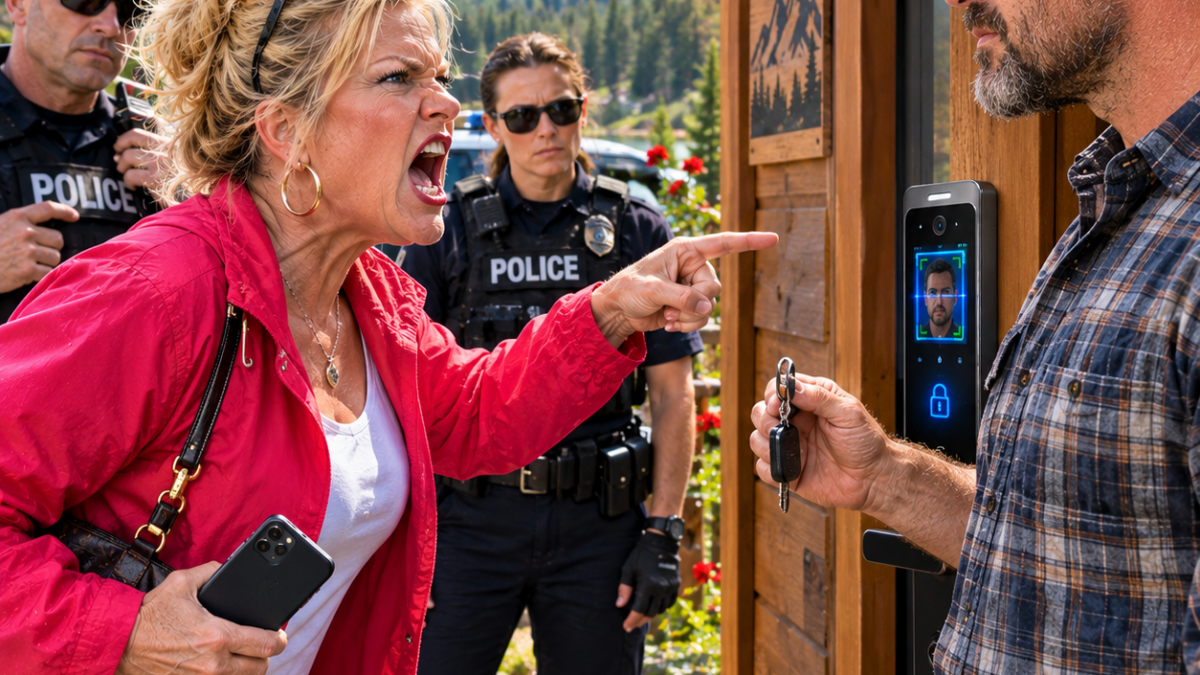
At eye level sat a facial-recognition scanner.
Small.
Clean.
Blue indicator light.
Processing stayed local.
No cloud connection.
No HOA access.
No vendor override.
If the system recognized you, the door unlocked.
If it didn’t, the door remained a wall.
I stood outside and tested it.
Blue light.
Camera scanned.
Green.
Click.
Door opened.
Simple.
I smiled for the first time all day.
Not because I thought I had beaten Lena.
Because suddenly her demand for a key had become technologically obsolete.
The next morning, gravel crunched outside.
White SUV.
Lena.
Of course.
But she wasn’t alone.
A gray van followed.
A man stepped out carrying a locksmith’s bag.
Mid-forties.
Work boots.
Baseball cap.
He looked at me, then Lena, then the cabin.
Something in his expression suggested he had not been told the entire story.
Lena pointed at my door.
“That’s it.”
The locksmith walked up.
He examined the steel plate.
Then the scanner.
He leaned closer.
“Where’s the cylinder?”
“There isn’t one,” I said.
Lena crossed her arms.
“Remove the obstruction.”
The locksmith looked at her.
“What obstruction?”
“The lock.”
He frowned.
“That is the lock.”
“Then open it.”
The man looked at me.
“You own the property?”
“Yes.”
He looked at Lena.
“You have authorization from him?”
“No.”
“She represents the HOA,” I added.
The locksmith stopped touching the door.
“Okay.”
Lena snapped:
“We have emergency access authority.”
“Do you have a court order?”
“No court order is necessary.”
He stared at her.
Then at me.
Then back at the lock.
“Lady, I’m not drilling into an infrastructure-grade biometric system on a private residence because somebody with a clipboard tells me to.”
Her face went red.
“Your company was contracted to provide service.”
“Locksmith service.”
“Exactly.”
“Not forced entry.”
She pointed at the scanner.
“This violates association rules.”
I stepped closer.
“Which rule?”
“The mandatory key rule.”
“No key exists.”
Her eyes flashed.
“That’s deliberate.”
“Yes.”
“You are intentionally obstructing emergency access.”
“No.”
I tapped the scanner.
“You want emergency access?”
She narrowed her eyes.
I smiled.
“Register your face.”
The locksmith coughed.
It might have been a laugh.
Lena stared at me.
“What?”
“If you’re genuinely worried about emergency access, I’ll add an approved emergency user.”
“You expect me to give you my biometric data?”
“You expect me to give you unrestricted access to my home.”
“That is completely different.”
“Feels similar from this side.”
The locksmith turned away.
I could see his shoulders moving.
Definitely laughing now.
Lena pointed at him.
“Do your job.”
He shook his head.
“I am.”
Then he looked at me.
“Nice system.”
“Thanks.”
“No mechanical bypass outside?”
“No.”
“Encrypted local controller?”
“Yes.”
He nodded approvingly.
Then zipped his bag.
“I’m leaving.”
Lena stared at him.
“You were hired.”
“For a locksmith call.”
He pointed at my cabin.
“This is not a locksmith call. This is a legal dispute.”
He walked back to his van.
Lena stood motionless.
The scanner pulsed blue between us.
Finally she said:
“This isn’t over.”
I leaned against the railing.
“It never is.”
She left hard enough to throw gravel.
I didn’t feel victorious.
I felt watched.
That night, the fines doubled.
Then tripled.
I received a notice threatening “water access review.”
Another alleging a “structural safety obstruction.”
Another warning that my electronic lock could interfere with first-responder access.
I sent each one to the deputy who had visited.
He replied once:
**These aren’t county notices.**
I knew.
But seeing him write it helped.
Then the black pickup started appearing.
First around dusk.
It parked halfway up my gravel drive.
Headlights pointed toward the cabin.
Sat there fifteen minutes.
Left.
The next night, a sedan appeared near the tree line.
Engine running.
Nobody got out.
Then came the welfare checks.
The first deputy arrived around 10:00 p.m.
“Anonymous caller reported you might be in distress.”
I stared at him.
“Do I look distressed?”
He glanced behind me.
Woodstove burning.
Coffee on the table.
Boxes still half unpacked.
“No.”
“Did the caller say why?”
“Concern about isolation and erratic behavior.”
I laughed.
“Erratic behavior meaning what?”
“They didn’t say.”
He looked uncomfortable.
“Everything okay?”
“It was until people started sending deputies to my house.”
He nodded.
“Fair.”
The second welfare check came three days later.
Different deputy.
Same story.
Concern about my mental stability.
That one didn’t make me laugh.
After the divorce, I had spent enough nights questioning myself.
I had come to the mountains because I wanted to rebuild some quiet structure inside my own life.
Now strangers were calling law enforcement and describing my privacy as instability.
It felt invasive in a way the fines didn’t.
The next morning, I called an attorney.
Her name was Rachel Knox.
Land use.
Property rights.
HOA disputes.
The receptionist told me she had an opening the following afternoon.
I said I’d take it.
Rachel’s office was in a small brick building downtown.
No oversized law-firm logo.
No marble lobby.
She wore reading glasses low on her nose and had approximately forty sticky notes attached to the folder before I finished explaining.
When I stopped, she sat silently.
“That bad?” I asked.
She removed her glasses.
“This isn’t about a key.”
“I know.”
“She’s trying to create enough pressure that either you comply or you leave.”
“Why?”
Rachel tapped her pen.
“That’s the interesting part.”
“I’ve lived there less than two weeks.”
“Exactly.”
“Maybe she’s just a control freak.”
“Possible.”
She leaned forward.
“But control usually has a purpose.”
“What should I do?”
“Stop talking to Lena directly.”
“Fine.”
“Save everything.”
“Already am.”
“Call logs?”
“Yes.”
“Emails?”
“Yes.”
“Camera footage?”
“Yes.”
“Sheriff reports?”
“I can request them.”
“Do it.”
Then:
“And read the association records.”
“I’m not a member.”
“Doesn’t matter. Some filings are public. Financial disclosures may be obtainable through the county or existing portal access.”
“What am I looking for?”
“Anything involving your parcel.”
I went home and started reading.
By midnight, my eyes hurt.
Most of it was boring.
Snow removal.
Road maintenance.
Water systems.
Insurance.
Landscaping.
Security.
Then one recurring line item caught my attention.
**VACANT LOT MONITORING — PARCEL C-17.**
My parcel.
I sat straighter.
Monthly payment.
Same amount.
Over and over.
I checked earlier years.
Still there.
My cabin hadn’t always been vacant.
But before I bought it, the previous owner had moved out nearly a year earlier while preparing to sell.
Silver Pines classified it as unoccupied.
That classification apparently triggered monthly security inspections.
I opened the inspection log.
Every entry had almost identical language:
**Inspection incomplete — access restricted.**
Next month.
Same.
Next.
Same.
Each incomplete inspection automatically renewed the monitoring contract.
Who received the money?
A company called:
**Whitmore Security & Property Services.**
I searched the business registration.
Owner:
**Evan Whitmore.**
Lena’s cousin.
I stared at the screen.
The monthly payment wasn’t enormous.
But multiply it by years.
Then add other properties.
The pattern began to form.
A property was labeled vacant.
Access supposedly required.
Inspection failed.
Contract renewed.
Money kept flowing.
Then I bought the property.
Now it wasn’t vacant anymore.
Meaning there was no justification for ongoing monitoring.
Unless Lena could maintain control.
Or maintain access.
Or maintain the fiction.
I called Rachel.
It was after midnight.
She answered anyway.
“You found something.”
“How do you know?”
“Nobody calls a property lawyer at 12:17 a.m. with good news.”
I explained.
She went silent.
Then:
“Send me every page.”
“Is this illegal?”
“Maybe.”
“That sounds comforting.”
“It means we don’t jump ahead.”
“But it looks bad.”
“It looks very bad.”
“What do we do?”
“Nothing tonight.”
“I hate that answer.”
“Get used to it.”
The next day, Rachel requested records formally.
That afternoon, Lena sent another fine.
Coincidence.
Maybe.
At 8:46 that night, my driveway camera alerted me.
Vehicles.
Not one.
Three.
Lena’s SUV.
Contractor van.
Utility trailer.
I stood up.
The biometric system log showed no access attempts yet.
I opened the exterior camera.
Lena stepped out.
Two board members followed.
Reflective vests.
A contractor climbed from the van.
Then another.
One started unloading a portable generator.
My stomach tightened.
I called Rachel.
“They’re here.”
“Who?”
“Lena. Contractors.”
“What are they doing?”
“Unloading cutting equipment.”
Rachel’s voice changed immediately.
“Call the sheriff.”
I did.
Then I started recording separately on my phone.
I stepped onto the porch.
Lena looked up.
No surprise.
Like she expected me.
“Daniel.”
“What are you doing?”
“Emergency abatement.”
“At nine at night?”
“You’ve ignored repeated safety notices.”
The contractor looked uncomfortable.
He carried a power cutter.
Another man rolled the generator toward my front steps.
I kept my voice calm.
“Do you have a court order?”
Lena lifted a folder.
“We have association authorization.”
“My property isn’t in your association.”
“We’ve already discussed the peripheral zone.”
“That isn’t a deed.”
“Move away from the door.”
I laughed once.
“No.”
The contractor stopped.
“Ma’am.”
Lena turned.
“What?”
“I need to see authorization from the property owner or law enforcement.”
“You have authorization.”
“From you.”
“I’m the association president.”
He glanced at me.
“Owner says no.”
Lena snapped:
“The structure poses an emergency-access hazard.”
The contractor looked at the biometric scanner.
“It’s a lock.”
“It prevents mandatory entry.”
“That’s what locks do.”
I almost liked him.
Lena pointed at the door.
“Start.”
The contractor hesitated.
Then, against his better judgment, powered up the cutting tool.
The generator roared.
The mountain quiet shattered.
Sparks flew as the blade touched the steel mounting plate.
And then headlights exploded through the trees.
One sheriff’s cruiser.
Then another.
The contractor released the trigger immediately.
Generator still roaring.
Deputies came up the drive fast.
“Everybody step away from the door!”
Lena turned.
“This is an emergency abatement.”
The older deputy stared at the cutting tool.
“At nine o’clock at night?”
“We have association authority.”
“Turn the machine off.”
The contractor did.
Silence fell hard.
The deputy looked at me.
“You the owner?”
“Yes.”
“You authorize this?”
“No.”
“Anybody have a court order?”
Lena spoke:
“We don’t require one.”
The deputy looked at her.
“You’re cutting into somebody’s front door.”
“It’s a compliance action.”
“With a power saw.”
“He has obstructed emergency access.”
The deputy turned to me.
“You okay?”
“Still recording.”
He nodded.
“Good.”
Then he faced Lena.
“Ma’am, step away from the property.”
Her face went red.
“You don’t understand the governing structure.”
“I understand private property.”
“You’re interfering with a lawful HOA action.”
“Show me the lawful authority.”
She held out the folder.
He took it.
Read.
His eyebrows lifted.
“This is an HOA notice.”
“Yes.”
“This isn’t a court order.”
“It doesn’t need to be.”
“According to who?”
“The association bylaws.”
“Your association boundary doesn’t include this parcel.”
For the first time, Lena looked scared.
Only for a second.
Then anger covered it.
She pointed at me.
“He’s creating a danger.”
The deputy looked toward my door.
“How?”
“No emergency key.”
The deputy stared.
Then:
“Do you have keys to every house in Silver Pines?”
“That’s policy.”
“That’s not what I asked.”
Lena said nothing.
One board member began backing away.
The deputy noticed.
“Everybody stay where you are.”
Neighbors had started appearing down the road.
Phones out.
Apparently a generator and multiple sheriff vehicles at night carried well across the mountain.
The contractor quietly said:
“I told her I needed authorization.”
Lena spun.
“Don’t.”
He looked at the deputy.
“I specifically asked.”
That did it.
The deputy stepped toward Lena.
“Turn around.”
Her eyes widened.
“For what?”
“Attempted unlawful entry. Possible property damage. We’ll sort out the rest downtown.”
“You cannot arrest me.”
“I’m not asking your permission.”
“Do you know who I am?”
“Yes.”
He took her wrist.
“Lena Whitmore.”
The cuff clicked.
“And right now you’re coming with us.”
She stared at me.
For the first time, all that polished certainty disappeared.
“You did this.”
I shook my head.
“No.”
“You set me up.”
“You brought a cutting torch to my house.”
“It’s a power cutter,” the contractor said quietly.
Everyone looked at him.
He raised both hands.
“Sorry.”
Even the deputy almost smiled.
Lena was taken away.
The two board members were questioned.
The contractor gave a statement.
I stood on my porch after midnight looking at the small fresh scar on the steel plate beside my scanner.
The damage was minor.
But emotionally, the cabin felt different.
Somebody had tried to cut through the only door I had specifically chosen to control.
After the divorce, I thought rebuilding my life meant learning to be alone.
That night I realized it also meant learning that protecting peace sometimes looked like conflict.
The next morning, my inbox was full.
Lena was out.
I knew that because the first email arrived at 5:12 a.m.
**EMERGENCY BOARD NOTICE.**
Then:
**PRELIMINARY ABATEMENT JUSTIFICATION.**
Then a formal complaint with the county claiming the sheriff had interfered with a lawful safety action.
Lena wasn’t retreating.
She was rewriting.
According to her filing, the attempted forced entry had been a scheduled emergency-access correction.
According to her, my biometric lock was an “experimental digital obstruction.”
According to her, the contractors had been authorized to “restore compliant access.”
I called Rachel.
She answered:
“She’s panicking.”
“She filed for forced entry.”
“I know.”
“How?”
“Emergency petition.”
“When?”
“Court hearing tomorrow.”
I stared at the mountain through the kitchen window.
“Tomorrow?”
“Tomorrow.”
“That’s fast.”
“Emergency filings are supposed to be.”
“What do you need?”
“Everything.”
The rest of the day became evidence.
Camera footage.
Access logs.
Emails.
Fine notices.
Call records.
Photographs of vehicles.
Sheriff incident report.
Contractor statement.
Financial records.
Parcel maps.
Deed.
The original closing documents.
The previous owner’s vacancy date.
The monitoring payments.
Every piece went into Rachel’s case.
Around noon, someone knocked.
Actually knocked.
That felt strange enough that I paused.
An older man stood outside.
Ball cap in both hands.
Gray beard.
“I’m Tom Wallace. Three lots down.”
“I’ve seen you.”
“We’ve waved.”
“Yeah.”
He looked uncomfortable.
“I’m not here officially.”
“Good start.”
He smiled nervously.
“People are talking.”
“About me?”
“About Lena.”
That surprised me.
Tom continued.
“What she tried last night crossed a line.”
Before I answered, another neighbor came up the drive.
Then another.
A woman named Carol.
A younger couple.
Nobody had coordinated.
Or maybe they had.
Tom said:
“She fined me because my utility trailer was visible from the road.”
Carol added:
“She threatened our water access after we questioned a fee.”
The younger man said:
“My father was charged for three inspections he never requested.”
Rachel’s words came back.
This isn’t about a key.
I invited them inside.
For the first time since Lena had invaded my cabin on day one, strangers entered because I asked them to.
That mattered.
We sat around my half-unpacked living room.
Tom told me Lena had controlled Silver Pines for almost nine years.
At first she had been good.
Organized.
Responsive.
She got the road resurfaced.
Negotiated lower snow-removal rates.
Helped establish wildfire evacuation procedures.
People trusted her.
Then the board changed.
Older members moved away.
Attendance dropped.
Residents stopped reading minutes.
Lena became the constant.
“Somewhere along the way,” Tom said, “she stopped asking.”
Carol nodded.
“She’d tell us the board approved something, but nobody remembered voting.”
“Why didn’t people challenge her?” I asked.
The room went quiet.
The younger woman finally said:
“Because when you did, something happened.”
“What?”
“Inspection.”
Tom:
“Fine.”
Carol:
“Water review.”
Another:
“Parking notice.”
One small inconvenience after another.
Nothing dramatic enough to cause outrage.
Just expensive enough to teach you.
I looked around the room.
“You all knew this?”
They exchanged glances.
Tom said:
“We knew pieces.”
That sentence stayed with me.
Bad systems survive because everybody knows a piece.
Nobody sees the whole machine.
Until somebody opens it.
The next morning, the courthouse was packed beyond what I expected.
Small county building.
Brick walls.
Old wood benches.
Lena sat at the plaintiff’s table in a navy suit.
Beside her sat a man I recognized from the business registration photographs.
Evan Whitmore.
Her cousin.
He looked nothing like the confident contractor I imagined from the payment records.
He looked nervous.
Their attorney looked less nervous.
Expensive suit.
Polished shoes.
Stacks of folders.
Rachel sat beside me.
“Don’t react.”
“To what?”
“Anything.”
“That sounds difficult.”
“You’re learning.”
The judge entered.
Everyone stood.
Lena’s lawyer spoke first.
Safety.
Emergency access.
Mountain wildfire risk.
Community evacuation protocols.
He described my lock as an “unapproved experimental access barrier.”
That phrase almost made me laugh.
Rachel’s hand touched my wrist.
Don’t.
He argued Silver Pines had historically exercised emergency authority over peripheral parcels.
The judge asked:
“Is this parcel inside the recorded association boundary?”
The attorney hesitated.
“Not entirely.”
The judge looked over his glasses.
“Is it inside or not?”
“No, Your Honor.”
That one answer changed the room.
“But,” the attorney continued, “the association provides shared services in the surrounding area.”
“Does the property owner pay HOA dues?”
“No.”
“Signed covenant?”
“No.”
“Recorded access agreement?”
“Not exactly.”
The judge leaned back.
“What does not exactly mean in this context?”
Rachel looked down to hide a smile.
Lena’s attorney changed direction.
Fire safety.
Emergency response.
Key-access tradition.
Then Rachel stood.
No dramatic voice.
No pacing.
She simply began laying out facts.
The deed.
Parcel map.
Boundary records.
Sheriff report.
The video.
The contractor statement.
The judge watched footage of Lena standing outside my cabin saying:
**Start the abatement.**
Then the cutter hit steel.
Then sheriff lights appeared.
When the video ended, silence filled the courtroom.
Rachel said:
“The association’s central argument is that forced entry was necessary because Mr. Carter refused emergency access.”
She placed another page in front of the judge.
“However, Mr. Carter offered conditional biometric emergency access.”
Lena’s attorney stood.
“That is misleading.”
The judge looked at Rachel.
“What do you mean biometric emergency access?”
Rachel actually glanced at me.
I tried not to smile.
“He offered to enroll the association president’s facial profile as an authorized emergency user.”
The judge stared.
Someone behind us coughed.
Rachel continued.
“Ms. Whitmore declined because she objected to giving my client unrestricted possession of her biometric data.”
A tiny sound moved through the gallery.
Almost laughter.
The judge looked at Lena.
“Is that accurate?”
Her face was rigid.
“The system itself was unauthorized.”
“That wasn’t my question.”
“Yes.”
The judge looked back at Rachel.
She continued.
“The HOA demanded unrestricted physical access to my client’s home while objecting to an access system that would have logged every entry and limited use to an identified person.”
That hit.
Then came the financial records.
Vacant lot monitoring.
Parcel C-17.
Monthly payments.
Evan Whitmore’s company.
The judge leaned forward.
“Ms. Whitmore, why was this property classified as vacant after deed transfer?”
Lena answered:
“Clerical oversight.”
Rachel placed another page down.
“Then perhaps Ms. Whitmore can explain why she personally approved three post-sale inspection renewals.”
Silence.
The judge looked at Lena.
She opened her mouth.
Closed it.
Rachel continued.
“Each failed inspection renewed a monthly security contract payable to a company owned by Ms. Whitmore’s cousin.”
The judge turned toward Evan.
He looked like he wanted the floor to open.
Rachel added:
“And when Mr. Carter moved into the property, that recurring revenue stream became difficult to justify without continued access.”
Lena’s attorney stood.
“We object to the implication—”
The judge raised one hand.
“I’m not interested in implications.”
He looked at the records.
“I’m interested in documentation.”
That sentence felt like the entire case.
Documentation.
Not personality.
Not HOA politics.
Not who sounded more official.
Paper.
The judge removed his glasses.
“This court will not authorize forced entry.”
Lena’s face drained.
“Furthermore, based on the financial records presented here, I am referring this matter for a full review of the association’s financial practices.”
Her attorney whispered something.
The judge continued:
“Until further order, all enforcement actions against Mr. Carter’s property are suspended.”
Gavel.
Done.
For several seconds, nobody moved.
Outside the courthouse, nobody cheered.
That surprised me.
People simply exhaled.
Tom hugged his wife.
Carol cried.
One man shook Rachel’s hand repeatedly.
I stood on the courthouse steps feeling almost nothing.
Rachel noticed.
“You okay?”
“I think so.”
“You expected fireworks?”
“Maybe.”
“This is usually what winning looks like.”
“What?”
“Paperwork and exhaustion.”
That afternoon, county auditors entered the Silver Pines records.
Within a week, the story became much bigger than my cabin.
They found more vacant-property monitoring contracts.
Some legitimate.
Some questionable.
Several tied to companies connected to Lena’s relatives or close associates.
Inspection fees.
Security fees.
Administrative charges.
Fines imposed on residents who questioned billing.
Nearly six figures in suspicious payments accumulated across multiple years.
Evan Whitmore became a central problem.
His company had billed Silver Pines regularly.
Sometimes for inspections residents said never happened.
Sometimes for monitoring lots that were occupied.
Sometimes for “access failures” that automatically triggered follow-up fees.
The elegant part of the scheme was how boring it looked.
Thirty-five dollars here.
Two hundred there.
Monthly contracts.
Quarterly renewals.
Nobody noticed because nobody wanted to read seventy pages of HOA accounting.
Lena counted on that.
The board called another emergency meeting.
This time, I went.
Not because I wanted to.
Because Tom asked.
“People need to see you.”
“Why?”
“Because for years she told us anyone who challenged her was unstable, difficult, selfish.”
“I don’t want to be a symbol.”
“I know.”
He paused.
“But sometimes symbols are just people who stayed in the room.”
So I went.
The clubhouse was overflowing.
Lena was no longer presiding.
A county-appointed administrator sat at the front.
Residents lined up to speak.
One after another.
A woman said she had paid thousands in penalties after questioning a drainage assessment.
An elderly man said Lena threatened legal action when he asked to review vendor bids.
A young mother said her water connection was “reviewed” after she criticized the board publicly.
Then Tom stood.
“My trailer fine was stupid.”
People laughed.
He smiled.
“But I paid it because I knew what would happen if I fought.”
The room quieted.
“That’s the part that bothers me now.”
He looked toward the empty chair where Lena usually sat.
“She didn’t need every rule to be legal. She needed us tired.”
That sentence settled over the room.
He was right.
Lena’s real weapon had never been authority.
It was exhaustion.
Make resistance expensive.
Make questions inconvenient.
Make every challenge cost time.
Eventually people comply.
Not because they agree.
Because they want their lives back.
That was exactly what she tried with me.
Daily fines.
Welfare checks.
Vehicles.
Emails.
Threats.
Forced entry.
She assumed I would eventually decide a key was cheaper than resistance.
Maybe I would have.
Before the divorce.
Before the cabin.
Before I reached the point where I needed one place in my life where the word no actually meant no.
That cabin became more than property to me.
It became evidence that I could rebuild something with clear boundaries.
Lena picked the worst possible door to demand access to.
The audit continued.
Evan Whitmore eventually cooperated.
That surprised everyone.
Especially Lena.
According to Rachel, investigators had enough records to show he benefited financially.
But they also had emails showing Lena directing classification changes.
Vacant.
Monitoring required.
Inspection incomplete.
Renew.
Repeat.
Evan apparently decided loyalty had limits.
One afternoon, I saw him outside the county building.
He recognized me.
For a second, he looked like he might walk away.
Instead, he approached.
“Daniel.”
“Evan.”
“I owe you an apology.”
“You owe a lot of people apologies.”
He flinched.
“Yeah.”
We stood awkwardly.
Finally he said:
“I didn’t know she was pushing this far.”
“You took the inspection money.”
“I know.”
“For a property you weren’t inspecting.”
He looked down.
“I’d drive past sometimes.”
I stared at him.
“That’s your defense?”
“No.”
“Good.”
He sighed.
“Lena told me the association had always treated C-17 as part of the safety zone.”
“Did you check?”
“No.”
“Why?”
He laughed bitterly.
“Because the checks cleared.”
At least that was honest.
“What changed?”
“You moved in.”
“So?”
“We couldn’t keep billing vacant monitoring.”
There it was.
Exactly what Rachel suspected.
“She told me we needed access records.”
“What kind?”
“Key log. Inspection log.”
“And when I refused?”
“She said you were obstructing contracted services.”
“Did you believe her?”
“At first.”
“And later?”
Evan looked toward the courthouse.
“Later I think I just didn’t want to know.”
That was another sentence that stayed with me.
I didn’t want to know.
Corruption survives inside that phrase.
Not everyone running a bad system is evil.
Some people just deliberately stop looking.
The charges came months later.
Fraud-related allegations.
Misuse of association funds.
False inspection records.
Other financial misconduct.
Lena and Evan both faced consequences.
The old HOA board dissolved under county supervision.
A temporary administrator took control.
Some residents wanted Silver Pines eliminated completely.
Others wanted a limited replacement.
Arguments followed.
Real democracy is messy.
Lena’s system had been simpler.
She decided.
Everyone else obeyed.
It was also rotten.
Eventually residents chose a much narrower association focused on road maintenance, snow removal, shared utilities, and clearly recorded common property.
No key repository.
No private home access.
No “peripheral safety zone.”
No automatic inspection authority outside recorded boundaries.
Every major vendor contract required disclosure.
Related-party contracts required independent review.
Financial reports became public to members.
And my parcel?
Removed completely.
No yellow highlight.
No safety-zone designation.
No monitoring.
Nothing.
One afternoon, workers arrived at the entrance road.
The big **SILVER PINES COMMUNITY ASSOCIATION** sign came down.
No ceremony.
Four bolts.
A lift truck.
Gone.
I watched from my porch.
For years, that sign had been a symbol of order to residents.
Then control.
Then scandal.
Now it was just painted wood in the back of a county truck.
That evening, I stood in front of my biometric lock.
The blue light pulsed softly.
It had worked perfectly.
Logged every attempt.
Protected the door.
Helped prove nobody had legitimate access.
But I no longer wanted it.
That surprised me.
For months, the scanner had felt like safety.
Now it felt like armor I no longer needed to wear.
So I removed it.
Steel plate.
Controller.
Camera.
Everything.
I restored the door.
Then installed a simple, heavy-duty deadbolt.
Nothing smart.
Nothing connected.
One key.
Mine.
I stood outside after dark.
Inserted the key.
Turned it.
**Click.**
That sound landed differently from the first morning.
Back then, locking the door felt like defiance.
Now it sounded like peace.
I went inside.
Made coffee even though it was too late for coffee.
Sat beside the woodstove.
For the first time since I bought the cabin, I didn’t check the driveway camera.
I simply listened.
Wind through pine branches.
Wood popping in the stove.
Nothing else.
I had come to the mountains looking for silence.
The irony was that I had spent months fighting harder than I had fought in years just to get it.
Recovery wasn’t immediate.
That part matters.
People imagine that once the villain loses, your body understands.
Mine didn’t.
For months, I still woke when gravel crunched outside.
Every unfamiliar vehicle made me look toward the window.
When someone knocked, my shoulders tightened before my brain caught up.
Once, a county worker came to inspect a power line easement.
He knocked.
Showed identification.
Asked permission.
Completely normal.
I still felt my heart hammer.
He noticed.
“You okay?”
“Yeah.”
Then I laughed.
“Long story.”
He looked at the deadbolt.
“HOA story?”
Apparently everyone knew.
“Something like that.”
He waited outside until I invited him onto the property.
That small courtesy meant more than he knew.
Permission.
Simple.
Respectful.
The thing Lena had refused from the beginning.
A few months after the audit ended, Rachel came to the cabin.
Not as my attorney.
As a friend.
Legal disputes have strange ways of creating temporary families.
She brought a bottle of wine.
We sat on the deck overlooking the valley.
She looked toward the front door.
“You really removed it.”
“The biometric lock?”
“Yes.”
“You sound disappointed.”
“It was impressive.”
“It was ridiculous.”
“It made a judge smile.”
“That alone was worth it.”
She laughed.
Then became serious.
“Any regrets?”
“About what?”
“Fighting.”
I thought.
“No.”
“None?”
“I regret how much time it took.”
She nodded.
“I regret that people got scared.”
“Yes.”
“I regret that some residents are paying higher fees now because the association finances were damaged.”
“That wasn’t your doing.”
“I know.”
She looked at me.
“But knowing doesn’t stop guilt.”
That was true.
People had lived quietly before I arrived.
Not honestly.
Not fairly.
But quietly.
Then I refused a key.
Months later, their president was charged, their HOA was in receivership, and years of financial misconduct had been exposed.
Some people thanked me.
Others blamed me.
One anonymous note arrived:
**We were fine before you came here.**
I kept it for weeks.
That sentence bothered me.
Were they?
Maybe some were.
Maybe ignorance genuinely felt peaceful.
Rachel eventually found the note on my counter.
She read it.
Then looked at me.
“This is nonsense.”
“Is it?”
“Yes.”
“They had lower fees.”
“They had money disappearing.”
“They didn’t know.”
“That isn’t the same as being fine.”
I stared at the valley.
Rachel continued.
“If your basement is flooding behind a wall and you don’t know, is the house fine?”
“No.”
“Exactly.”
Then she tore the note in half.
“Hey.”
“You weren’t keeping that.”
“Apparently not.”
The neighbors changed too.
Tom began stopping by for coffee.
Carol brought homemade bread.
A younger couple asked if they could hike across one edge of my property to reach a public trail.
They asked.
That alone made me say yes.
I gave them a specific route.
They followed it.
No problem.
That interaction taught me something about myself.
The fight hadn’t turned me against people.
It had turned me against entitlement.
There is a difference.
I didn’t want a fortress.
I wanted choice.
If I invited someone in, wonderful.
If someone demanded entry because they thought their title outweighed my consent, no.
That boundary became almost philosophical for me.
Maybe because of the divorce.
For years, I had confused compromise with peace.
Sometimes compromise is healthy.
Sometimes it is simply one person giving way because arguing costs too much.
By the time I found the cabin, I had lost the ability to tell the difference.
Lena taught me again.
Not intentionally.
A boundary you never enforce is not really a boundary.
That doesn’t mean every disagreement needs war.
It means the word **no** has to remain available.
A year after the court hearing, Silver Pines held its first annual meeting under the new structure.
Tom convinced me to attend as a non-member neighboring property owner.
The new chairwoman was a retired teacher named Susan Bell.
She began the meeting by projecting a map.
“This is the recorded boundary.”
My parcel sat outside it.
Plain white.
No yellow.
No labels.
Susan pointed.
“And because we apparently need to say this out loud, properties outside the recorded boundary are not subject to association enforcement.”
Laughter.
Someone called:
“What about peripheral safety zones?”
More laughter.
I actually laughed too.
Susan smiled.
“There are no peripheral safety zones.”
Another resident:
“What about mandatory keys?”
Susan held up her own house key.
“This one stays with me.”
Applause.
That was probably the closest Silver Pines ever came to a revolution.
After the meeting, an older woman approached me.
I recognized her as one of the residents who had spoken about water-access threats.
“My name is Janet.”
“Daniel.”
“I know.”
Of course.
She looked toward the meeting room.
“My husband used to tell me we should challenge Lena.”
“What stopped you?”
“He got sick.”
Her voice softened.
“Cancer.”
“I’m sorry.”
“He died two years ago.”
I didn’t know what to say.
Janet continued.
“After he died, I didn’t have energy for fights.”
“That makes sense.”
“I still felt ashamed.”
“For what?”
“For letting her push me around.”
“No.”
She looked at me.
“No?”
“You were surviving.”
Her eyes filled.
“That’s different.”
“How?”
“Because sometimes you know something is wrong and still don’t have enough left to fight it.”
She looked down.
“My husband used to say I was too nice.”
“Nice isn’t the problem.”
“What is?”
“People who see kindness as unused territory.”
She smiled sadly.
“I like that.”
We stood quietly.
Then she said:
“Thank you for staying.”
I almost asked what she meant.
Then I understood.
After the forced-entry night, I could have left.
Put the cabin up for sale.
Walked away.
Maybe that would have been easier.
But I stayed.
Not because I wanted revenge.
Because I had bought that place to rebuild something.
Leaving because Lena made me afraid would have turned her into the final author of the story.
I wasn’t willing to give her that.
Two years later, a real-estate developer offered to buy the cabin.
Silver Pines property values had climbed.
My parcel, being outside the new association restrictions, was especially attractive.
The offer was absurd.
Enough money to make me sit down.
I could sell.
Buy another cabin.
Farther north.
More land.
No history.
No Lena.
For a week, I considered it.
Then one evening I sat on the deck watching snow move over the valley.
The cabin had changed.
New roof.
Repaired deck.
Better insulation.
The boxes were long gone.
Pictures finally hung on the walls.
A bookshelf stood where Lena had once inspected the mantel for dust.
It looked lived in.
Mine.
I realized selling because the price was good would be one thing.
Selling because the memories were uncomfortable would be another.
I declined.
That winter, I planted two young pines near the drive.
Nothing symbolic at first.
The nursery had a sale.
But over the years, I watched them grow.
The first year they barely reached my shoulder.
Eventually they stood higher than the roofline.
Time does that.
It makes monuments out of things you didn’t know were monuments.
Lena’s case faded from local news.
Evan completed whatever legal obligations came from his cooperation and financial involvement.
I never spoke with Lena again.
Once, I saw her in a grocery store.
Different town.
She saw me too.
We stood at opposite ends of an aisle.
For a second, I expected something.
Anger.
Apology.
Accusation.
She simply turned her cart and left.
I felt nothing.
That surprised me.
For months, her name could raise my blood pressure.
Now she was just a woman pushing groceries.
That might have been the moment I finally understood what freedom from conflict actually looked like.
Not beating someone forever.
Becoming indifferent.
Her power over my life ended long before the court case.
But her power over my emotions took longer.
Eventually, that ended too.
I stopped saving every Silver Pines email.
Stopped checking county records.
Stopped asking Rachel whether Lena’s latest filing had gone anywhere.
Stopped keeping the biometric scanner in a box under my workbench like some trophy.
One spring, I found it while cleaning.
The steel plate.
Camera.
Controller.
Blue indicator module.
For a moment, I considered mounting it in the garage.
Then laughed.
I donated most of the components to a local technical program.
The instructor asked where they came from.
“Long story.”
“Security project?”
“Something like that.”
A group of students eventually used the parts to build a biometric access demonstration.
That felt better than keeping them.
Technology that had once represented resistance became education.
I liked that.
The simple deadbolt stayed.
It still does.
Heavy steel.
One key.
Sometimes the most satisfying solution is the least sophisticated one.
The neighborhood became almost normal.
Snowplows came.
Water bills arrived.
People complained about road maintenance.
Susan sent boring meeting summaries.
Nobody threatened anyone’s key supply.
No contractors appeared at night.
No black pickups idled in my driveway.
It was spectacularly dull.
Exactly what I had wanted.
One summer morning, a deputy knocked.
Different man.
Young.
I opened the door.
He immediately stepped back from the threshold.
“Mr. Carter?”
“Yes.”
“Wildfire-preparedness inspection. Voluntary.”
That word made me smile.
“Voluntary?”
“Yes, sir.”
“You’re welcome in.”
He looked confused by how amused I was.
We walked around the property.
He checked defensible space.
Wood storage.
Access width.
Then he pointed toward the deadbolt.
“Do emergency services have a key?”
“No.”
“That’s okay.”
I stared at him.
He continued.
“If needed, firefighters have forcible-entry tools.”
I laughed so hard he looked worried.
“Did I say something?”
“No.”
I wiped my eyes.
“You said exactly the right thing.”
He left thinking I was strange.
Fair.
That evening, I called Rachel.
“You’ll appreciate this.”
I told her.
She laughed.
“All that litigation and the fire department never needed your key?”
“Apparently not.”
“Shocking.”
“Very.”
Then she said something quieter.
“You know, that was never what Lena wanted.”
“I know.”
“What did she want?”
I looked at the deadbolt.
“Proof I would give her something because she told me to.”
Exactly.
The key was symbolic.
Access was money.
Control was power.
But beneath all of it was submission.
Once I understood that, the entire conflict made sense.
Lena could have accepted my biometric access offer if emergencies were genuinely her concern.
It logged entry.
It limited users.
It solved the stated problem.
She rejected it because it left control with me.
What she needed was my physical key in her box.
Something she possessed.
Something proving my boundary could be opened by her institution.
That was why the scanner enraged her.
It answered the safety argument without answering the power demand.
Years later, Tom and I were sitting on my deck.
He pointed toward the door.
“Do you still only have one key?”
“Two.”
He looked shocked.
“Who has the second?”
“Rachel.”
“Your lawyer?”
“Friend now.”
“That feels symbolic.”
“She waters the plants when I travel.”
“Less symbolic.”
“Usually.”
Tom laughed.
Then said:
“You know what everybody calls that whole thing now?”
“I’m afraid to ask.”
“The Key War.”
I groaned.
“That’s terrible.”
“Better than Facegate.”
I stared.
“Who calls it Facegate?”
“Carol.”
“I’m moving.”
He laughed.
The humor mattered.
For a long time, I couldn’t laugh about that year.
Every joke felt like it minimized what happened.
Later, laughter became proof the memory no longer owned me.
That was healing.
Not forgetting.
Changing the emotional weight of remembering.
I still have the original red notice Lena handed me.
**MANDATORY KEY SUBMISSION.**
It’s folded inside my property file.
I don’t display it.
Not interested in shrines.
But once every few years, when I’m looking for some deed document, I see it.
I remember that first morning.
Coffee.
Boxes.
Her walking through the door.
“Compliance precedes comfort.”
That phrase still bothers me.
Because it reveals a worldview.
Comfort.
Privacy.
Consent.
Those become luxuries once someone decides compliance matters more.
Good systems work the other way around.
Authority should justify intrusion.
It should be narrow.
Documented.
Reviewable.
Not a permanent key because somebody says “emergency.”
I learned that long before Silver Pines through my work in infrastructure security.
Never grant more access than necessary.
Least privilege.
Specific permissions.
Logging.
Revocation.
Basic security principles.
Lena’s key policy violated all of them.
Permanent physical keys.
Unlogged entry.
Unclear control.
No revocation guarantee.
No audit trail.
Ironically, my facial-recognition system was safer for both sides.
If Lena had entered, the system would have recorded exactly when.
If access needed revocation, one command.
No mystery copies.
No missing key.
But again, safety wasn’t really the point.
Possession was.
Once the audit proved the financial motive, that became undeniable.
Access failures generated invoices.
Invoices generated money.
My refusal threatened a mechanism that had worked quietly for years.
The funniest part, looking back, was how small the original money looked next to the damage caused trying to preserve it.
A few monthly monitoring payments.
Then legal fees.
Audits.
Criminal charges.
Dissolution.
Reputation.
All because Lena couldn’t allow one revenue stream to die.
Entitlement has terrible accounting.
One evening, Rachel asked me whether I thought Lena began corrupt.
I said no.
That surprised her.
“Why not?”
“Because nobody starts with cutting tools at nine p.m.”
She smiled.
“Fair.”
“I think it starts smaller.”
A favor.
A shortcut.
A contract to a cousin.
An inspection nobody verifies.
A fine nobody fights.
Then another.
If nothing happens, the boundary moves.
Eventually the person stops noticing there ever was one.
That was Lena.
By the time she walked into my cabin, she probably genuinely believed she was entitled to.
That did not excuse her.
If anything, it made the situation more dangerous.
People who know they’re doing wrong sometimes hesitate.
People convinced their authority is righteous rarely do.
That’s why systems need limits.
Not because every leader is evil.
Because humans are excellent at turning repeated permission into entitlement.
Silver Pines learned that painfully.
So did I.
I learned that privacy is not isolation.
For a while after the divorce, I treated those words as synonyms.
I thought being left alone would fix everything.
It didn’t.
The best part of the cabin eventually became the people I chose to invite in.
Tom.
Carol.
Rachel.
Janet.
Friends from town.
Neighbors.
My sister came one Christmas and stayed in the loft.
We cooked badly.
Snow buried the road overnight.
Nobody cared.
The front door opened often that week.
But every time, it opened because I chose.
That was the difference.
One Christmas evening, my sister noticed the old screw marks from the biometric plate.
“What happened there?”
I told her the short version.
She stared.
“Someone demanded your key?”
“Yep.”
“And you built a face scanner instead?”
“Yep.”
She laughed for five straight minutes.
“This is the most Daniel response imaginable.”
“What does that mean?”
“You were emotionally incapable of just saying no normally.”
“I did say no.”
“You engineered no.”
That line stuck.
Maybe she was right.
I had engineered no.
But sometimes that’s what boundaries need.
Structure.
Because words can be pressured.
Systems are harder.
The scanner didn’t get intimidated.
Didn’t feel guilty.
Didn’t care about Lena’s title.
It simply checked authorization.
That cold neutrality was comforting during a period when everything else felt personal.
Eventually, though, I no longer needed technology to hold the boundary for me.
The law had caught up.
The community had changed.
More importantly, I had changed.
The deadbolt became enough.
A simple mechanical click.
No facial data.
No logs.
No blue light.
Just:
Locked.
Unlocked.
Choice.
That was what I had wanted all along.
Years after the case, Silver Pines invited me to speak at a homeowner meeting about access control and privacy.
I almost refused.
Then Susan said:
“Not about Lena.”
That convinced me.
I stood in front of maybe forty residents.
No dramatic story.
I explained basic security.
Don’t share permanent keys unless necessary.
Know who controls duplicates.
Use temporary codes where possible.
Log contractor access.
Separate emergency access from convenience.
Document permission.
People asked questions.
One man raised his hand.
“So was your face-recognition system actually legal?”
I smiled.
“Ask Rachel.”
Everyone laughed.
Rachel, sitting in the back, called out:
“Yes.”
Another resident:
“Would you install one again?”
I thought.
“If I needed it.”
“Do you?”
“No.”
That answer felt good.
Afterward, Janet approached.
“You seem different.”
“How?”
“Less angry.”
“I was angry?”
She laughed.
“Daniel.”
“Fair.”
She looked toward the road.
“You know, we used to be scared every time Lena sent an email.”
“I remember.”
“Now Susan sends seventeen-page budget updates nobody reads.”
“That sounds healthy.”
“It’s extremely boring.”
“Perfect.”
She smiled.
“Exactly.”
The mountains remained.
That sounds obvious.
But it mattered.
During the worst months, the conflict filled everything.
Lena.
Emails.
Court.
Sheriffs.
Audits.
I sometimes forgot why I moved there.
Then seasons kept arriving.
Snow covered the driveway.
Spring runoff filled the creek.
Summer dried the grass gold.
Autumn turned the aspens bright yellow.
The mountains did not care about Lena.
They did not care about me.
That indifference was grounding.
Human conflicts feel enormous while you’re inside them.
Then snow falls.
A tree grows.
Years pass.
Eventually even the worst year becomes one ring inside a much larger trunk.
The two pine trees I planted near the drive are tall now.
When I planted them, I could carry each root ball myself.
Now birds nest in them.
One afternoon I stood underneath and realized they had grown during every year I had spent trying not to think about Lena.
They had not tried.
They simply grew.
I liked that.
Healing should probably work more like that.
Not a dramatic decision.
Repeated ordinary life.
Coffee.
Work.
Friends.
Snow.
Repairing a railing.
Cooking dinner.
Locking the door.
Sleeping.
Eventually the event that once defined every morning becomes something you remember only when somebody asks.
A new family bought a house near Silver Pines a few years later.
They stopped me on the road.
“Are you Daniel?”
“That depends.”
The husband laughed.
“Our realtor told us not to ask you for a key.”
I closed my eyes.
“Great.”
His wife grinned.
“She told us the whole story.”
“I doubt that.”
“She said you installed military face recognition.”
“Not military.”
“And the HOA tried to break in with a blowtorch.”
“Not a blowtorch.”
“They got arrested.”
“Closer.”
The husband pointed toward my cabin.
“So you’re not actually in the HOA?”
“No.”
“That was the whole problem?”
“That was the beginning.”
He shook his head.
“People are insane.”
“Sometimes.”
Then his wife asked:
“Would you mind if our kids sled near the edge of your lower hill this winter?”
She asked.
That was enough.
“Sure.”
“Really?”
“Stay east of the fence posts. There’s a drainage drop on the other side.”
“Thank you.”
All winter, their kids sledded there.
Laughed.
Dragged plastic sleds up the hill.
Not once did I resent them being on my property.
Because permission changes everything.
That lesson became almost embarrassingly simple.
Consent turns access into welcome.
Without it, access is intrusion.
Lena thought community erased that distinction.
It doesn’t.
Community depends on it.
You cannot build trust by demanding permanent entry to someone’s home.
You build trust by knocking.
That was what she failed to do on day one.
Knock.
Such a tiny thing.
Maybe the whole story would have been different if she had.
Imagine:
Knock.
“Hi, I’m Lena. Silver Pines has an old emergency-key policy. Your parcel may not technically be covered, but would you like to discuss voluntary options?”
Maybe I still would have said no.
Probably.
But there would have been no war.
No sheriff.
No biometric lock.
No audit.
No charges.
No dissolution.
Just two adults discussing access.
That is the tragedy of entitlement.
It takes situations that could be negotiated and turns them into battles because one person cannot tolerate the existence of another person’s choice.
I sometimes wondered whether Lena ever understood that.
I’ll probably never know.
And eventually, I realized I didn’t need to.
Closure is overrated when it requires the person who hurt you to become wise.
Sometimes they don’t.
You still have to live.
So I stopped waiting for her apology.
Stopped imagining the conversation.
Stopped rehearsing what I would say if she appeared.
She never did.
My life moved forward anyway.
That was enough.
The last time Rachel visited, we sat outside until after dark.
She had retired from private practice.
Partially.
Lawyers seem constitutionally incapable of actually retiring.
She asked:
“Do you still have the original cabin key?”
I smiled.
“Of course.”
“Show me.”
I went inside.
Opened a drawer.
The key was on a plain ring.
Nothing special.
I handed it to her.
She examined it.
“This caused all that?”
“No.”
“What did?”
I looked at the key.
“Someone thinking it belonged to them.”
Rachel nodded.
Then handed it back.
I put it in my pocket.
We sat quietly.
Wind moved through the pines.
Somewhere down the mountain, a dog barked.
Then nothing.
Rachel said:
“You got your quiet.”
I looked over the valley.
“Eventually.”
“Worth it?”
That was the question.
Months of stress.
Legal bills.
Sleep lost.
Fear.
Anger.
Neighbors dragged into conflict.
A community forced to rebuild.
Was the quiet worth the fight?
I thought about answering with something heroic.
Instead:
“I wish it hadn’t cost so much.”
Rachel nodded.
“That’s probably the right answer.”
“But yes.”
I held up the key.
“It was mine to keep.”
That was the heart of it.
Not the facial recognition.
Not the fines.
Not the arrest.
Not the audit.
A key.
A small piece of metal that represented a very large idea.
My home opened when I decided it opened.
Years earlier, after the divorce, I thought I needed a cabin because I wanted to disappear.
I was wrong.
I needed a place where I could choose who came close.
There’s a difference.
Isolation shuts everyone out.
Boundaries let the right people in.
Silver Pines taught me that in the most absurd, expensive way possible.
Today the cabin door still has the simple deadbolt.
No scanner.
No keypad.
No cloud system.
When I leave, I lock it.
When I come home, I unlock it.
Sometimes Tom has a spare key if I’m traveling.
Sometimes Rachel did.
My sister once had one.
Every one of those keys was given.
Never demanded.
That distinction remains everything.
The current Silver Pines board doesn’t contact me often.
Once a year, I get a road-maintenance notice because our parcels share part of the county access route.
It says exactly what fee applies to which recorded easement.
Nothing more.
No invented jurisdiction.
No “peripheral safety zone.”
No emergency key.
The boring clarity makes me smile.
Last winter, the road washed out after a warm storm melted snow too quickly.
Silver Pines called.
Susan said:
“We need temporary equipment access across the corner of your parcel.”
“What for?”
“Excavator turnaround.”
“How long?”
“Two days.”
“Any damage?”
“We’ll repair it.”
“Send me the plan.”
She did.
I approved it.
An excavator crossed my land the next morning.
No drama.
That experience made the entire old conflict feel even more ridiculous.
I wasn’t opposed to cooperation.
Never was.
I was opposed to being told my consent was irrelevant.
Ask.
Explain.
Document.
Respect the answer.
Civilization survives.
Amazing.
One summer evening, I replaced the deadbolt.
It had begun sticking.
Nothing dramatic.
Age.
I stood in the hardware store holding two options.
Smart lock.
Traditional deadbolt.
I laughed.
Bought the deadbolt.
At home, I installed it myself.
Old habits.
When I finished, I closed the door.
Turned the key.
**Click.**
Same sound.
Years earlier, that click had sounded like resistance.
Then safety.
Now it sounded like nothing more than a lock doing its job.
That might have been the final stage of healing.
When the symbol becomes ordinary again.
The cabin was just a cabin.
The door was just a door.
The key was just a key.
Lena had failed to permanently turn any of them into a battlefield.
That was the victory.
I still occasionally hear versions of the story.
People exaggerate.
Apparently I once built an “AI security bunker.”
Apparently Lena tried to send a SWAT team.
Apparently the judge ordered the HOA dissolved on the spot.
None of that happened.
Reality was slower.
Messier.
More bureaucratic.
But the real story matters more.
A woman with years of unchecked authority forgot there was a boundary.
One homeowner said no.
Instead of accepting it, she escalated.
That escalation exposed the financial incentive beneath the policy.
Once records were examined, the system collapsed.
There was no magic.
Just evidence.
Deeds.
Logs.
Emails.
Contracts.
Video.
And people who finally stopped being quiet.
That is why I don’t think of the story as revenge.
Revenge would have meant wanting Lena to lose because she hurt me.
For a while, I did.
I won’t lie.
The night the sheriff put cuffs on her, part of me felt satisfaction.
The morning the judge rejected forced entry, part of me enjoyed watching her face.
Human.
But that feeling passed.
The lasting satisfaction came from something else.
The lock came off.
The sign came down.
Neighbors spoke.
Money stopped disappearing.
People stopped being frightened by official-looking emails.
The community learned how to ask:
“Where is that written?”
That question became almost a motto.
Susan once told me residents asked it so often meetings took twice as long.
“Sorry,” I said.
“No, you’re not.”
“No.”
She laughed.
Long meetings are a small price for accountable power.
Today, if someone asks why I fought so hard over one key, I tell them the truth.
I wasn’t fighting over metal.
I was fighting over the right to decide.
Who enters my home.
Who has access.
Who defines an emergency.
Who gets to turn policy into entitlement.
Once someone else owns those decisions, the house may still have your name on the deed, but part of it no longer belongs to you.
I had already lived through one period of my life where I felt like I was constantly negotiating away pieces of myself to keep things calm.
I wasn’t doing it again.
Not there.
Not in the mountains.
Not behind the one door I had specifically chosen to close.
That cabin saved me in ways I didn’t understand when I bought it.
Not because it isolated me.
Because it forced me to learn the difference between peace and surrender.
Peace has boundaries.
Surrender doesn’t.
Years after everything, I woke one winter morning before sunrise.
Snow had fallen overnight.
Deep.
Soft.
The entire valley looked untouched.
I made coffee.
Opened the front door.
Cold air hit my face.
No tire tracks.
No SUV.
No sheriff cruiser.
No contractors.
No Lena.
Just snow.
I stepped onto the deck.
Behind me, the door slowly swung closed.
The new deadbolt caught.
**Click.**
I looked back.
For a second, I remembered the first morning.
Boxes everywhere.
Lena walking in.
“We need a copy of your house key.”
I remembered her saying people like me thought isolation meant freedom.
Maybe she had been right about one thing.
Isolation isn’t freedom.
Choice is.
Knowing you can open the door.
Knowing you can keep it closed.
Knowing the people inside are there because you wanted them there.
That is freedom.
I stood outside until my coffee started getting cold.
Sunlight slowly touched the mountains.
The pines threw long blue shadows across the snow.
Somewhere down the road, a plow engine started.
Ordinary life waking up.
I reached into my pocket.
My cabin key was there.
Still mine.
It always had been.
And after everything Lena had done to convince me otherwise, there was something deeply satisfying about how little the ending required.
No biometric scanner.
No courtroom.
No handcuffs.
No HOA notice.
Just a man standing outside his own mountain home with the key in his hand and absolutely nobody demanding that he surrender it.
That was the peace I had bought the cabin for.
It just took a fight to understand what it was worth.








