PART 2: HOA KAREN Called the Cops When I Came Back to My Ranch—Then Her Entire HOA Started Falling Apart
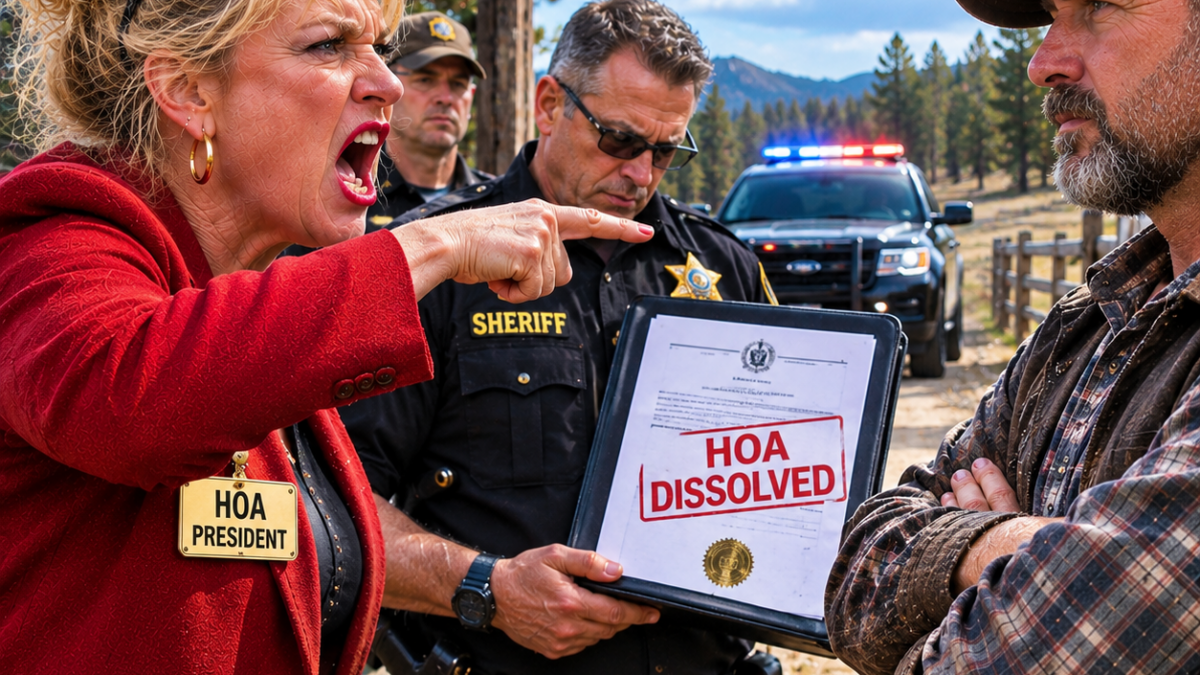
PART 2
Deputy Randy Wright arrived five minutes later.
He stepped out of his patrol car with the cautious expression of someone who had already been told two completely different versions of the same story.
Janet walked toward him before he had fully closed the door.
“Deputy, thank goodness.”
He looked at her.
Then at me.
Then at the gate.
“We received a trespassing complaint.”
“Yes,” Janet said quickly. “This woman is occupying HOA-managed land without authorization.”
I almost answered.
Then stopped.
Let her talk.
Randy looked at me.
“Ma’am?”
“My name is Rachel Dawson.”
Janet cut in.
“She claims to be the former owner.”
I looked at her.
“Former?”
Randy raised one hand.
“Let’s do one person at a time.”
I handed him the folder.
“My family has owned this ranch since 1952. Current property taxes are paid. I have never sold it, transferred it, abandoned it, or joined an HOA.”
He opened the deed.
Read.
Then the tax receipt.
Then the survey.
Janet stood beside him with her arms folded.
“Those documents are outdated.”
Randy looked up.
“This tax receipt is six months old.”
“The property was annexed afterward.”
“Into an HOA?”
“Yes.”
“By what process?”
“County Code 47.3.”
He frowned.
“What code is that?”
“Abandoned agricultural land annexation.”
I watched Randy’s face.
He did not recognize it either.
Janet sensed the hesitation.
“The county approved everything.”
“Do you have the approval?”
“Not with me.”
Randy handed the folder back.
“These documents show continuous ownership.”
Janet’s smile finally weakened.
“Appear to show.”
Randy looked at her.
“I’m not arresting someone for trespassing on land she appears to legally own.”
Janet stiffened.
“This is HOA property.”
“This is a civil title dispute unless somebody shows me something clearer.”
“She is violating community restrictions.”
“Again, civil.”
Janet pointed at the gate.
“She cut our lock.”
“I haven’t cut anything yet.”
I glanced at the padlock.
“Yet.”
Randy almost smiled.
Then regained his professional expression.
“Mrs. Evans, I’d strongly recommend you not alter disputed property until the recorder’s office confirms whatever claim you’re making.”
Janet’s face changed.
It was subtle.
She had expected enforcement.
She got caution.
Randy turned to me.
“Ms. Dawson, get the county recorder involved Monday morning. And probably a property lawyer.”
“I will.”
He nodded.
Then left.
Dust drifted behind his cruiser.
Janet and I stood on opposite sides of my gate.
“This isn’t over,” she said.
“No.”
I looked at the lock.
“It isn’t.”
I cut it five minutes later.
The bolt cutters were exactly where my father always kept them.
I opened the gate.
Janet watched from the road.
She did not try to stop me.
The house smelled closed up.
Dust.
Old wood.
A little mildew.
The barn was fine.
Horses were fine.
Deborah had clearly been feeding them until recently.
Nothing inside suggested abandonment.
That made Janet’s claim even stranger.
I slept in my childhood bedroom that night.
Or tried.
Every time I closed my eyes, I heard her saying:
**Declared abandoned.**
People like Janet depended on words sounding official.
Annexation.
Compliance.
Jurisdiction.
Authority.
Enough technical language, and most people assume the speaker knows something they do not.
I had spent enough years around ranch leases, estate paperwork, and county records to know one thing.
Land did not change ownership because someone laminated a sign.
Monday morning, a violation notice waited in my mailbox.
**UNPERMITTED STRUCTURE — BARN**
Fine:
$500.
I stared at it.
The barn had been built in 1968.
The HOA was allegedly two years old.
Tuesday brought another notice.
Fence material.
$300.
Wednesday:
Unapproved livestock activity.
$400.
Thursday:
Exterior property maintenance.
Friday:
Failure to comply.
By the end of the week, Janet claimed I owed $2,300.
I spread the notices across the kitchen table.
Something was wrong with them even before I knew exactly what.
Formatting changed between pages.
Article numbers repeated inconsistently.
The fine schedule did not match itself.
No registration number.
No county identifier.
Only the Pinewood Valley HOA logo and Janet’s signature.
Saturday brought the lawyer’s letter.
Houston firm.
Expensive stationery.
Aggressive language.
Pay within fourteen days or face lien action.
Continued occupancy without HOA authorization could lead to additional legal measures.
I sat at the kitchen table and read it three times.
I was tired.
My mother was still recovering.
Hospital bills were piling up.
The ranch needed repairs.
I did not have extra money for a long legal fight.
That was probably the point.
Pressure works best when life is already heavy.
Monday morning, I drove to the county recorder’s office.
Denise Ortega called my number after a forty-five-minute wait.
She was younger than I expected.
Mid-thirties.
Wire-rimmed glasses.
Alert eyes.
I explained everything.
The new lock.
Janet’s claim.
Code 47.3.
Violation notices.
Annexation.
Denise typed.
Stopped.
Typed again.
Then looked at me.
“Say the code number again.”
“Forty-seven point three.”
“Abandoned agricultural land annexation.”
“Yes.”
She shook her head.
“We don’t have that.”
“Maybe state?”
“No.”
“Another county ordinance?”
“Not that I’m finding.”
I leaned forward.
“So she invented it?”
“I’m saying I can’t locate any such provision in our county code.”
That distinction mattered.
Denise searched the HOA name.
The result confused her.
“Pinewood Valley Homeowners Association exists in our local filing system.”
“So Janet wasn’t lying about everything.”
“Wait.”
She clicked.
“This is filed under a commercial-business category.”
“Is that normal?”
“No.”
“Formation date?”
She studied the screen.
“Claims March fifteenth two years ago.”
“Claims?”
“The actual filing timestamp is January of this year.”
I stared at her.
“So someone filed this year and said the organization existed two years earlier.”
“That is what the entry suggests.”
“Can they do that?”
“Not like this without supporting documentation.”
“Annexation petition?”
She searched.
Nothing obvious.
Then another record appeared.
A scanned attachment referring to “incorporation of agricultural parcels through voluntary community agreement.”
My name was not on it.
Neither was any signature I recognized.
Denise frowned.
“I want the original file.”
“How long?”
“A few days.”
“I have fourteen days before they threaten a lien.”
She looked at the notices.
“I’m not giving legal advice.”
“I understand.”
“But you should get a lawyer.”
I almost laughed.
“That’s what the deputy said.”
“Smart deputy.”
I left with certified copies.
When I returned home, a county environmental notice was taped to my door.
Anonymous complaint.
Hazardous waste.
Potential groundwater contamination.
Inspection scheduled Wednesday.
I stood on the porch staring at it.
That was when the pattern became obvious.
Police failed.
Then fines.
Then attorney letter.
Now environmental enforcement.
Janet was not trying to win one argument.
She was trying to exhaust me.
Wednesday, the inspector arrived.
His name was Frank.
Late fifties.
Sunburned.
Tired.
He walked the ranch for two hours.
Barn.
Equipment shed.
Septic.
Creek.
Old fuel storage.
Nothing.
At the end, he signed the report.
“Unfounded.”
“Completely?”
“Your property’s cleaner than a lot of agricultural sites I inspect.”
He hesitated.
“What?”
“Nothing.”
“Frank.”
He sighed.
“We’ve had three anonymous complaints around here in six months.”
“Against who?”
“I shouldn’t discuss other property owners.”
“Same kind?”
He looked at his truck.
“All unfounded.”
“Same caller?”
His expression answered before he did.
He lowered his voice.
“Same originating number.”
Then left.
That evening, I found Deborah’s note under my door.
**Rachel,**
**I’m sorry I haven’t called. Janet has been watching everyone who talks to you. She threatened complaints against my property if I contacted you.**
**I never signed HOA formation documents. My name is on the founding list anyway. The signature is not mine.**
**Meet me at the diner on Route 12 tomorrow. 7 a.m. Come alone.**
**Deborah**
I read it three times.
Then my phone rang.
Denise.
“I found the file.”
Her voice sounded different.
“Good different?”
“No.”
“What did you find?”
“Formation documents.”
“And?”
“The dates don’t work.”
“How?”
She hesitated.
“The notary stamp predates the document.”
“How far?”
“More than a year.”
I sat down.
“Denise.”
“Yes?”
“You’re telling me somebody notarized HOA formation papers before the HOA supposedly existed?”
“That is what the document appears to show.”
“Can I see it?”
“Tomorrow.”
That night, I barely slept.
At seven the next morning, Deborah was already in a back booth at the diner.
She looked ten years older than she had four months earlier.
“I’m sorry,” she said as soon as I sat down.
“For what?”
“Not answering you.”
“You were scared.”
“I should’ve called.”
“Tell me what happened.”
Janet came to her house two months after I left.
New HOA.
Community standards.
Road maintenance.
Property values.
Shared services.
“She told me everybody was joining.”
“Did you sign?”
“No.”
“Anything?”
“No.”
“Petition?”
“Nothing.”
Deborah pulled out a photograph.
Signature page.
Her name.
**Deborah J. Phillips.**
Beside it she placed an actual bank signature.
Different slant.
Different T crossing.
Different ending stroke.
“That is not mine.”
I looked closely.
“You’re sure?”
“I’m seventy years old. I know how I write my name.”
“Who else?”
“Three neighbors told me the same.”
“Where are they?”
“Two moved.”
“Why?”
“Janet.”
The answer was immediate.
“The third is Harold Vance.”
“Who?”
“Retired notary.”
That caught my attention.
“He says the HOA papers are fake.”
I drove to Harold’s house that afternoon.
Eighty-two.
Small farmhouse.
Pecan trees.
Iced tea served without asking.
He laid three years of documents across his kitchen table.
Complaints.
Formation copies.
Signature comparisons.
Threat letters.
Property-sale records.
“Janet tried this before,” he said.
“With who?”
“Henderson property. Martinez land.”
“What happened?”
“People got tired.”
“Sold?”
“For less than value.”
“To who?”
He gave me two company names.
Both linked through property filings to people associated with Janet’s circle.
Nothing yet proved she owned them.
But the pattern was there.
“Why didn’t you stop her?”
Harold’s mouth tightened.
“Tried.”
He showed me complaints filed with the county.
Several had been marked incomplete.
One disappeared from the tracking system.
Another was misfiled.
“I’m old,” he said. “No money for a court fight.”
“You had evidence.”
“I didn’t have standing on the land she was trying to take.”
He looked at me.
“You do.”
That evening, Pinewood Valley’s community forum exploded.
Someone posted photographs of me.
My truck.
My barn.
My horses.
Headline:
**SQUATTER OCCUPYING HOA LAND.**
Comments came quickly.
Criminal.
Fraud.
Threat.
Someone suggested residents confront me if law enforcement refused.
I sat at my kitchen table reading people I had known for years describe me as dangerous.
That hurt more than Janet’s letters.
She had not merely created paperwork.
She had created a story.
And stories spread faster than deeds.
I held Deborah’s forged signature beside two others Harold had collected.
Three clear problems.
Janet claimed fifty-two founding members.
If three were fake, how many more?
I started calling.
Carefully.
No accusations.
“Did you sign HOA formation documents?”
Some people refused to talk.
Some hung up.
Some said yes.
Others:
“I signed a neighborhood safety petition.”
“Was it an HOA petition?”
“I don’t know.”
One woman said:
“Janet said it was for road improvements.”
By the next morning, I had doubts surrounding eleven names.
Denise asked me to arrive before the recorder’s office opened.
She met me in the parking lot.
No smile.
We went into a back room.
Blinds closed.
Papers spread across the table.
“Rachel.”
“Yes?”
“I found more.”
She showed me the articles of incorporation.
Formation date:
March 15, two years earlier.
Notary stamp:
December 3, three years earlier.
Impossible sequence.
Then Denise turned her computer.
State registration search.
No result.
“I checked multiple variations.”
“Meaning?”
“Pinewood Valley Homeowners Association does not appear in the state system as the type of legal entity Janet claims it is.”
“So it isn’t registered.”
“Correct.”
“Can it enforce covenants?”
“Not the way she’s presenting it.”
Then she showed me the signature work.
Seventeen names verified against authentic records.
Seventeen mismatches.
Not minor differences.
Fundamental handwriting differences.
I felt my stomach drop.
“All seventeen?”
“Yes.”
“Out of fifty-two?”
“Yes.”
Denise lowered her voice.
“If those are invalid, they may not have had enough valid approval to create mandatory obligations in the first place.”
“May not?”
“I’m not a judge.”
Fair.
She handed me certified copies.
“There’s more.”
Minutes.
Founding meeting.
Janet listed as president.
No documented election.
No verifiable vote count.
No consistent attendance record.
It looked less like a badly run HOA and more like something assembled backward to justify authority Janet had already decided she possessed.
Denise picked up her phone.
“I contacted Assistant County Attorney Linda Rivera.”
“You did?”
“I asked general questions first.”
“And?”
“She wants to see everything.”
That afternoon, I sat in Linda’s office with Deborah, Harold, and Denise.
Linda Rivera was calm in the way people become after years of watching others exaggerate.
She read slowly.
Asked questions.
Checked dates.
Never reacted dramatically.
Finally she closed the file.
“What you have here is serious.”
“What does that mean?”
“Potential forgery. False filings. Fraud. Possibly coercive conduct depending on what we can prove.”
“Can you dissolve the HOA?”
She looked at me.
“Courts make legal determinations. Government offices can challenge filings, seek declaratory relief, refer criminal evidence, and prevent unsupported enforcement.”
“So not instantly.”
“Nothing meaningful is instant.”
I thought about the title Janet had given herself.
President.
Authority.
Rules.
“What happens to my fines?”
“If the organization lacks legal authority over your property, those are vulnerable to challenge.”
“And the ranch?”
“Your deed remains extremely important.”
Linda looked at Harold.
“You’ve documented three years?”
“Yes.”
“Why keep going?”
“Because somebody eventually had to listen.”
She nodded.
Then looked at me.
“Janet scheduled an emergency HOA meeting Saturday.”
“I know.”
“Subject?”
“The squatter problem.”
Linda almost smiled.
“She invited the county into a room full of witnesses.”
“What are you suggesting?”
“I attend.”
“Officially?”
“Yes.”
“And I bring this?”
“All of it.”
The next three days were preparation.
No ambush tricks.
No edited videos.
No dramatic social-media campaign.
Documents.
Certified copies.
Authentic signatures.
Formation dates.
Registration records.
Witness statements.
Harold and I built side-by-side comparisons.
Deborah contacted original property owners.
Of the seventeen questionable signatures, eleven people could be reached.
Eight agreed to appear.
Two former residents provided notarized statements.
One refused to get involved.
That was his right.
One statement said:
**I believed I was signing a community-safety survey. I did not knowingly consent to membership in a mandatory homeowners association.**
Another:
**The signature shown on the Pinewood Valley formation petition is not mine.**
Linda arranged for a court reporter.
Two deputies would remain outside in case the meeting became disorderly.
Randy Wright was one of them.
Friday evening, I sat on my porch.
The ranch stretched toward the hills.
Forty acres.
Not huge.
Not valuable enough to change the world.
But valuable enough that my grandfather had spent a lifetime protecting it.
My mother was still in New Mexico.
Better now.
Stable.
She called.
“You sound tired.”
“I am.”
“What’s happening?”
I had avoided telling her everything.
She had enough to survive.
“Property issue.”
“With the ranch?”
“Yes.”
“Rachel.”
“I’m handling it.”
“That’s what your father used to say right before doing something stubborn.”
I smiled despite myself.
“Mom.”
“What?”
“You ever sign anything for Pinewood Valley HOA?”
Silence.
Then:
“What HOA?”
That answer helped.
Saturday afternoon, the community center parking lot was full.
Forty-plus vehicles.
Janet had advertised the meeting as a reckoning.
She arrived in a white sedan.
Parked in a space marked **HOA PRESIDENT**.
Navy dress.
Pearls.
Perfect smile.
When she saw me:
“Ms. Dawson.”
“Janet.”
“I’m surprised you came.”
“You invited me.”
“I invited property owners.”
“I am one.”
Her smile tightened.
“You continue to misunderstand your legal position.”
“We’ll see.”
She looked at Harold.
Then Deborah.
Then Linda.
Something passed through her expression.
Concern.
Gone quickly.
Inside, the room filled.
People stared at me.
Some hostile.
Some curious.
The banner behind Janet read:
**PINEWOOD VALLEY HOA — BUILDING COMMUNITY TOGETHER**
Janet called the meeting to order at two sharp.
“As you know, we are facing a serious threat to community stability.”
Her eyes found mine.
“An individual has illegally occupied property incorporated into HOA jurisdiction, refused lawful assessments, and spread malicious allegations against this organization.”
A few people nodded.
Someone muttered:
“Kick her out.”
Janet continued.
“Today we will vote on enforcement action.”
Linda raised her hand.
Janet stopped.
“Yes?”
Linda stood.
“My name is Linda Rivera. I’m with the county attorney’s office.”
The room shifted.
Janet’s smile froze.
“I wasn’t aware the county had been invited.”
“I’m attending regarding legal questions surrounding the organization’s filings and claimed authority.”
Janet recovered.
“We have nothing to hide.”
Linda opened the first folder.
“Good.”
She held up the articles of incorporation.
“Mrs. Evans, do you recognize this?”
“Yes.”
“Formation date March fifteenth, two years ago?”
“Yes.”
“And you maintain these filings are valid?”
“Absolutely.”
Linda turned the page.
“The notary stamp is dated fifteen months before the claimed formation.”
Silence.
Janet blinked.
“Clerical error.”
“Possibly.”
Linda produced another document.
“I contacted the notary.”
Janet’s face changed.
“She has no record of notarizing this document.”
Murmurs.
“Additionally, the stamp used here was reported missing years earlier.”
Janet stood straighter.
“That proves nothing about the community agreement.”
Linda nodded.
“Then let’s discuss the community agreement.”
She turned toward Deborah.
Deborah stood.
Her hands trembled.
“My name is Deborah Phillips.”
Janet stared at her.
Deborah continued.
“I’m listed as a founding member.”
“Yes,” Janet said quickly. “Because you signed.”
“No.”
The room went quiet.
Deborah held up two pages.
“This is the signature on the HOA petition.”
Then the second.
“This is mine.”
She faced the room.
“They are not the same.”
Janet interrupted.
“Signatures vary.”
Harold muttered:
“Not that much.”
Linda raised one hand.
“Please let the witness finish.”
Deborah swallowed.
“I never agreed to join this association.”
Another resident stood.
“Neither did I.”
A woman near the front turned.
“What?”
The second witness came forward.
Then another.
Eight people.
One by one.
Different stories.
Never signed.
Signed something else.
Told it was informational.
Signature not theirs.
Linda read the two written statements from former residents.
Janet’s face became red.
“This is coordinated.”
Nobody answered.
Linda showed the analysis.
Seventeen questioned signatures out of fifty-two.
Enough to destroy Janet’s claim that the required approval threshold had unquestionably been met.
Then came state-registration records.
No valid filing supporting Janet’s claimed legal status.
The room began changing.
People who had glared at me were now looking at her.
A man in the third row stood.
“Janet, you told us this was registered.”
“It is.”
“Then where?”
“Administrative processing delays—”
“For two years?”
“Sit down.”
He did not.
“You fined me twelve hundred dollars.”
“Your roof violated standards.”
“What standards?”
Janet banged the gavel.
“Order.”
Nobody listened.
Questions came from every side.
“What happened to our dues?”
“Were the liens real?”
“Did you forge my name?”
“Who voted for you?”
“Where are the bank records?”
Janet stood.
“This meeting is being hijacked.”
Linda remained calm.
“Mrs. Evans, did you personally collect founding signatures?”
Janet looked at her.
“Yes.”
“When owners refused?”
“People were confused.”
“What did you do?”
“They needed guidance.”
“That wasn’t my question.”
Janet’s voice rose.
“I built this community.”
Harold said from behind me:
“No, you built paperwork.”
Janet pointed at him.
“You’ve been undermining me for years.”
“Correct.”
A few people laughed nervously.
Janet’s hands began trembling.
Linda stepped closer.
“Did you sign or reproduce names of property owners who did not consent?”
Janet froze.
Every person in the room watched her.
“I did what was necessary.”
The air disappeared.
Linda did not react.
“What does that mean?”
“Some people don’t understand what protects property values.”
“Did you write their names?”
Janet’s jaw tightened.
“They would have benefited.”
“That is not consent.”
“Somebody had to create order.”
Linda looked toward the court reporter.
Then back at Janet.
“Thank you.”
Janet realized too late what she had said.
“No, that’s not—”
Linda raised the certified file.
“Based on the evidence already gathered, the county attorney’s office will seek immediate judicial relief declaring the claimed mandatory HOA authority invalid and voiding unsupported enforcement actions.”
Janet shouted:
“You can’t dissolve my organization!”
Linda’s expression remained flat.
“If an organization was never validly formed with required consent and legal filings, the question may be whether there is anything valid to dissolve.”
The room erupted.
Janet pointed toward me.
“This is her fault!”
I stood.
“No.”
“You came back here and poisoned everyone against me.”
“I came back to my ranch.”
“You abandoned it.”
“For four months.”
“You left.”
“To take care of my mother.”
“You let the property deteriorate.”
“The county inspector found no violations.”
That stopped her.
She had not known I knew about the complaints.
I continued.
“Same originating phone number for several anonymous complaints.”
Janet looked toward the door.
Randy Wright entered with his partner.
He did not arrest her.
Not then.
He simply stood beside Linda.
The change in Janet was immediate.
Power had been the foundation of her identity.
Every letter.
Every fine.
Every threat.
Every conversation started from the assumption that she was the person defining reality.
Now everyone in the room had seen the documents.
She could not put them back in the folder.
I walked toward the front.
My heart was pounding, but my voice stayed steady.
“My grandfather bought Dawson Ranch in 1952.”
Janet looked at me.
“My father built the barn you fined me for.”
Silence.
“My grandmother’s ashes are in that meadow.”
I pointed toward the windows, toward the hills beyond.
“I was gone because my mother had a stroke.”
Janet looked away.
“You put a lock on my gate and called the police because I came home.”
No answer.
“You cited a law that doesn’t exist.”
A woman whispered:
“My God.”
“You threatened liens through an organization that could not prove lawful authority over my property.”
Still nothing.
Then I said the only thing I really needed to say.
“You don’t own my ranch.”
Janet looked at me.
For the first time, she seemed unsure of her own answer.
The meeting ended without a vote.
There was nothing left to vote on.
Linda’s office moved quickly.
Not magically.
Not in minutes.
That part of the story became exaggerated later.
People said the HOA was “dissolved on the spot.”
What actually happened was more legally precise.
The public exposure destroyed Janet’s practical authority that afternoon.
Formal county action and court filings followed.
The alleged HOA’s enforceability was challenged.
Unsupported fines and lien threats were suspended.
The formation documents came under criminal investigation.
Within a short period, the organization Janet had operated as a mandatory HOA was legally dismantled and its unsupported claims voided through the proper process.
That was less cinematic.
It was also real.
Charges were filed the following Monday.
Forgery-related allegations.
Fraud.
False government filings.
Potential coercive property conduct.
The final charges changed as prosecutors reviewed evidence.
That was their job.
Janet posted bond.
Her husband, Billy, picked her up.
I did not go to the courthouse.
I went home.
The gate was open.
That mattered more.
The community forum transformed almost overnight.
Posts calling me a squatter disappeared.
In their place:
**Rachel, I’m sorry.**
**We didn’t know.**
**Janet told us you were trying to steal common land.**
Some apologies felt sincere.
Some felt convenient.
I accepted most quietly.
I did not need public humiliation from the same people who had already been misled.
Harold loved every second.
He called me.
“Have you read the forum?”
“No.”
“You should.”
“Why?”
“They’re apologizing.”
“Good.”
“Janet’s old supporters are deleting posts.”
“Also good.”
“One guy wrote four paragraphs about how he ‘always had concerns.’”
“That guy called me a criminal.”
“I know.”
“You enjoying this?”
“Immensely.”
Harold had earned it.
Three years of nobody listening.
Now everybody wanted copies of his files.
Linda’s office began restitution procedures.
Families who had paid dues, assessments, or fines under unsupported authority submitted claims.
At least twelve households pursued recovery.
Some amounts were small.
Others painful.
People had paid thousands because official-looking envelopes scared them.
Civil suits followed.
Property owners who sold after sustained pressure began talking to attorneys.
The Henderson and Martinez matters reopened questions about whether Janet’s tactics had contributed to distressed sales.
Those cases had their own facts.
Nobody promised outcomes.
But people finally had a place to present evidence.
Deborah came to my house a week after the meeting.
She stood on the porch holding a casserole.
“You don’t cook.”
“I bought it.”
“Good.”
She smiled.
Then started crying.
I set the dish down.
“Deborah.”
“I’m sorry.”
“You already said that.”
“I should’ve called you.”
“You were threatened.”
“I promised your father.”
“What?”
“When he got sick.”
She wiped her face.
“He made me promise if anything happened, I’d help watch the ranch.”
I leaned against the porch post.
“You did.”
“Not enough.”
“You kept my horses alive.”
“I let her lock your gate.”
“You didn’t put the lock there.”
“I watched her.”
“You were scared.”
“That isn’t an excuse.”
“No.”
She looked at me.
I continued.
“But fear explains things.”
We sat.
For several minutes, neither of us spoke.
Then she said:
“Your mother?”
“Improving.”
“Does she know?”
“Some.”
“Not all?”
“She’d get on the next bus to Texas and hit Janet with a purse.”
Deborah laughed through tears.
“That sounds like your mother.”
It did.
My mother eventually came home to the ranch six months later.
She walked slowly.
Cane.
Still weaker on one side.
When we reached the gate, she stopped.
The HOA sign was gone.
The brass padlock was gone.
I had put the original chain back.
She touched the wooden post.
“Your father built this.”
“I know.”
“He always made everything too heavy.”
“I know.”
She looked toward the barn.
“What happened while I was gone?”
I smiled.
“You don’t want the full version.”
“I absolutely do.”
We sat on the porch.
I told her.
Not everything at once.
The lock.
Janet.
Police.
Fake code.
Forged signatures.
Meeting.
My mother listened silently.
Finally:
“She called you a squatter?”
“Yes.”
Mom looked offended.
“On my father’s land?”
“Yes.”
“Is she stupid?”
“Mom.”
“What?”
I laughed harder than I had in months.
That was the first time the story felt less like a wound.
The criminal case moved slowly.
Harold testified.
Deborah testified.
Denise testified about the records.
The notary-stamp history was examined.
Financial records were subpoenaed.
Investigators looked at where dues went.
Not every suspicion became a charge.
That mattered.
Some community members wanted Janet blamed for every bad thing that had happened in Pinewood Valley.
That was emotionally understandable.
Legally irrelevant.
Evidence decided.
What did become clear was that Janet had built authority through documents that could not withstand scrutiny.
Her explanations changed.
First:
Clerical errors.
Then:
Volunteer mistakes.
Then:
Misunderstood consent.
Then:
She believed informal approval was enough.
Her own statement at the public meeting hurt her.
**I did what was necessary.**
Prosecutors used it with the documents.
Not as a magical confession.
As context.
The civil consequences arrived faster.
Her practical empire disappeared immediately.
No more HOA office.
No more violation notices.
No more fines.
No more laminated signs.
No more letters threatening ranch owners.
People still needed collective solutions.
Road maintenance.
Drainage.
Fire access.
Shared fences.
But they organized them voluntarily.
Specific agreements.
Actual signatures.
Clear costs.
No fake mandatory association.
Harold proposed the first road-maintenance agreement.
Four pages.
I looked at him.
“Only four?”
“That’s all it needs.”
“No bylaws?”
“No.”
“No architectural committee?”
“If you start one, I’ll burn your barn.”
“Good.”
The agreement listed who used the private road.
Who paid.
How repairs were approved.
What happened if someone declined.
Everybody read it.
Most signed.
Those who did not were not magically forced into membership.
Simple.
It made me realize how much of Janet’s power had depended on making ordinary cooperation look impossible without her.
One evening, Linda came to the ranch.
She brought a folder.
“Good news?”
“Depends.”
She handed me the paperwork confirming the enforcement claims against Dawson Ranch had been voided.
Fines:
Gone.
Lien threats:
Gone.
HOA jurisdiction:
No legal basis established.
I read every line.
My mother sat nearby.
She looked impatient.
“Well?”
“It’s done.”
She nodded.
“Good.”
That was all.
Linda smiled.
“Your mother has high standards for legal victories.”
Mom said:
“She shouldn’t have needed one.”
Linda’s smile disappeared.
“You’re right.”
That was the truth.
People congratulated me for winning.
But I should never have needed to prove that caring for a sick parent did not surrender forty acres of family land.
Winning does not make the original abuse reasonable.
It just stops it.
Three weeks after the meeting, I sat on the porch at sunset.
The pasture glowed orange.
Horses grazed near the far fence.
No laminated signs.
No unfamiliar cars.
No violation notices.
Harold drove up in an ancient pickup.
He climbed out holding a folder.
“What now?”
“I brought something.”
“If it says HOA, leave.”
He grinned.
“It doesn’t.”
Inside was a photocopy of the earliest Dawson property record he had found.
1952.
My grandfather’s purchase.
“You already have the deed.”
“I know.”
“Then why?”
“Look at the witness.”
I did.
**Walter Vance.**
I looked up.
“Your father?”
“My uncle.”
“You’re related to the witness?”
“Apparently.”
He sat.
“Small valley.”
I looked again.
My grandfather had bought the land before Janet Evans was born.
Before Pinewood Valley had a sign.
Before most nearby roads were paved.
Somebody from Harold’s family had witnessed it.
That made me smile.
“Think your uncle knew he’d be part of an HOA fight seventy years later?”
“He hated committees.”
“Probably.”
Harold looked across the ranch.
“You staying?”
“Yes.”
“Good.”
He nodded toward the barn.
“Needs paint.”
“Get off my property.”
He laughed.
Months passed.
The anonymous letters stopped.
Environmental complaints stopped.
Neighbors started waving again.
Some came slowly.
Not everyone was ready to admit they had been wrong.
That was fine.
I did not need universal approval.
The strangest apology came from a man named Peter Cole.
He had written the ugliest forum comment.
Called me dangerous.
Suggested residents should physically remove me if authorities refused.
He showed up one morning with a toolbox.
“I owe you an apology.”
“Yes.”
He seemed surprised.
“You’re not going to make this easy?”
“No.”
He looked at the barn.
“I heard you’re repairing the west wall.”
“I am.”
“I’m a carpenter.”
“I know.”
“How?”
“Small valley.”
He nodded.
“Can I help?”
I thought about the comment.
Then about what holding it forever would accomplish.
“Bring the ladder.”
We worked six hours.
At lunch he said:
“Janet told us you had forged the deed.”
“I figured.”
“She showed copies.”
“Of what?”
“Something saying the ranch had reverted.”
“Did you read it?”
He looked embarrassed.
“No.”
“Why not?”
“I trusted her.”
I nodded.
That was the whole story.
Trust is efficient.
Nobody can verify everything personally.
Communities require it.
Which means the person controlling trust carries enormous responsibility.
Janet had used that responsibility as leverage.
Peter looked at me.
“I’m sorry.”
“I know.”
We finished the wall.
No dramatic forgiveness.
Just two people with hammers.
Sometimes that is enough.
Janet’s criminal case eventually resolved through the courts.
Her reputation never recovered.
That was not a sentence imposed by a judge.
It was the result of years spent making neighbors afraid of her.
Once the authority disappeared, people stopped pretending admiration.
Some avoided her.
Others confronted her.
Civil claims followed her family for years.
I did not participate in every one.
My claim concerned my ranch.
I testified where necessary.
Provided documents.
Then stepped back.
I did not want Janet occupying another decade of my life.
That would have been a different kind of theft.
Deborah and I repaired the friendship.
Slowly.
She started coming over every Sunday.
My mother liked her.
Harold joined occasionally.
He complained about everything.
Coffee.
Weather.
Fence quality.
County government.
Young people.
Old people.
Once my mother said:
“Harold, is there anything you like?”
He thought.
“Pie.”
She baked one the next week.
That became routine.
A year after the meeting, we held a valley picnic at the community center.
Same building.
Same room.
No HOA banner.
Instead:
**PINEWOOD VALLEY COMMUNITY DAY**
Voluntary.
No fines for missing it.
I joked about that.
Nobody laughed harder than Harold.
Randy Wright came with his family.
He stood beside me near the food tables.
“I remember that first call.”
“So do I.”
“I thought Janet was going to demand I arrest you personally.”
“She basically did.”
“You looked exhausted.”
“I had driven from New Mexico.”
“I know now.”
He looked toward the crowd.
“You think any of this would’ve happened if I’d arrested you?”
“That’s a disturbing question.”
“I mean what if I had believed her documents?”
I thought.
“I’d have spent a night proving who owned my own ranch.”
He shook his head.
“That scares me.”
“Good.”
He looked at me.
“Why good?”
“Means you’ll check the next folder.”
He nodded.
“Fair.”
Denise Ortega received a county commendation later.
She hated attention.
I attended anyway.
Her careful review had mattered.
One clerk deciding a date looked wrong helped expose an entire false structure.
Afterward she said:
“I was just doing my job.”
I had heard that phrase before.
Often from people whose ordinary competence prevented extraordinary harm.
I told her:
“Keep doing it.”
My mother stayed with me until she died two years later.
Not another stroke.
Age.
Complications.
Quietly.
In the ranch house.
Her room faced the pasture.
After the funeral, I expected the same urge I had felt when my father died.
Run.
Leave the house.
Avoid every object carrying memory.
Instead, I stayed.
That surprised me.
Maybe the fight with Janet had taught me something I did not understand until then.
Leaving pain behind does not mean leaving the place where pain happened.
Sometimes staying is how the place becomes yours again.
I scattered part of Mom’s ashes in the meadow beside my grandmother’s.
The rest went with family.
Deborah stood beside me.
Harold too.
No speeches.
Wind.
Grass.
Texas evening.
Afterward Harold said:
“Your grandfather would be proud.”
I looked at him.
“You never met him.”
“My uncle did.”
“Still doesn’t count.”
He smiled.
“Let an old man be sentimental.”
Years later, the ranch still looks much the way it did before Pinewood Valley HOA claimed it.
Barn repainted.
Fence replaced in sections.
Same house.
Same oak tree.
Same gate posts.
I never put another padlock on the front chain.
Did not need one.
The land remained private.
People respected it.
And if they did not, I had signs backed by actual property rights instead of invented county codes.
Sometimes new residents ask about the old story.
They hear fragments.
“The fake HOA.”
“The woman who tried to annex Dawson Ranch.”
“The meeting where everything collapsed.”
People exaggerate.
Some say Janet was arrested in the community center.
She was not.
Some say Linda Rivera dissolved the HOA with one sentence.
Legally, it took filings and formal action.
Some say fifty-two signatures were forged.
We never proved that.
Seventeen were confirmed questionable enough to destroy the claimed formation threshold.
That was enough.
The truth is satisfying without improving it.
My favorite version is the simplest.
I came home.
Somebody had locked my gate.
She told me I no longer owned what my family had owned since 1952.
She called the police.
The documents did not support her.
Then we started reading everything else.
That was the part Janet never expected.
She believed people would see letterhead and stop asking questions.
Read a fine and pay.
See a threat and leave.
Hear “county code” and assume the code existed.
Hear “HOA president” and assume the HOA was lawful.
Enough people had done exactly that for long enough that she began believing her own performance.
Then I came home tired enough that I had no patience left for intimidation.
That might have saved me.
One evening, many years after the fight ended, I was repairing the gate hinge.
Same gate.
The brass lock Janet installed was long gone.
I had kept it for a while as evidence.
Eventually it was returned after the case.
I almost threw it away.
Instead, it ended up in an old toolbox.
Deborah walked over.
“You know most people hire someone for that.”
“For a hinge?”
“You’re getting old.”
“So are you.”
She ignored me.
“Remember when she put that lock there?”
“Yes.”
“You looked like you were going to hit somebody.”
“I had driven four hundred miles.”
“You looked worse than that.”
“My mother was sick.”
“I know.”
She leaned against the post.
“I still feel guilty.”
“Stop.”
“I can’t.”
“Then feel useful instead.”
She smiled.
“That sounds like your mother.”
“It is.”
We finished tightening the hinge.
The gate swung freely.
No resistance.
Deborah walked home.
I stood there for a while.
Sun dropping behind the hills.
The ranch road stretched toward the house.
Forty acres.
Not an empire.
Not “community-managed property.”
Not abandoned agricultural land.
Home.
Janet Evans had tried to redefine it with paper.
That was the thing I understood in the end.
Paper matters.
Deeds matter.
Records matter.
Signatures matter.
But paper does not become truth because the person holding it sounds confident.
Sometimes the most important thing anyone can do is read the date.
Check the signature.
Look up the law.
Ask who authorized it.
Ask whether the organization even exists.
Janet called the police because she believed authority was something she could print.
What destroyed her power was discovering that real authority leaves records too.
I closed the gate behind me.
No padlock.
Just the old chain resting over the post the way my father used to leave it.
Then I walked toward the house while the last light spread across Dawson Ranch.
For the first time in a long time, nothing on that land needed defending.
[END OF STORY]








