PART 2: HOA Karen Called the Cops on Me for Blocking My Own Driveway—She Had No Idea I Was a Lieutenant Colonel
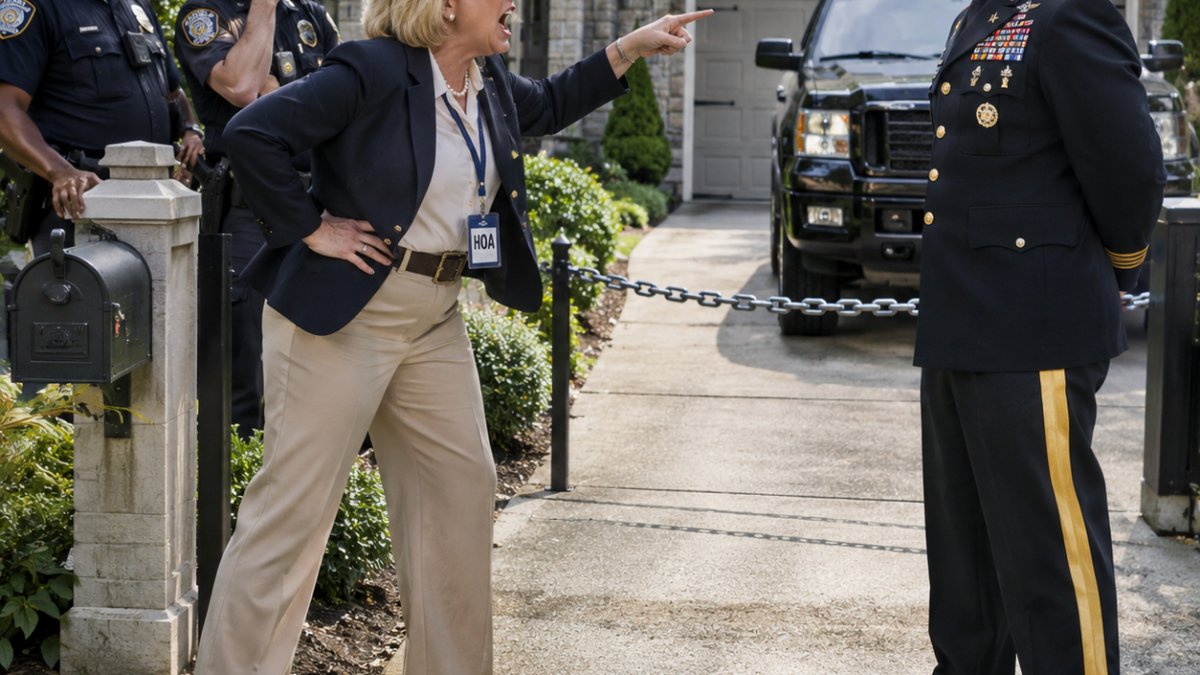
At 6:47 on a freezing Colorado morning, I stood on my own front porch with coffee in one hand and watched two sheriff’s cruisers roll toward the muddy F-250 parked entirely on my private driveway, while my HOA vice president stood on the sidewalk pointing at me like she’d finally found enough authority to have an inconvenient neighbor removed.
When the first deputy stepped out and Connie Riddell folded her arms, lifted her chin, and announced, “I pay your salary, arrest him,” I realized she wasn’t really angry about a truck, a driveway, or some imaginary neighborhood rule—she was angry because I had refused to let her decide what I was allowed to do on land I had spent most of my adult life dreaming about owning.
What Connie didn’t know that morning was that I had spent twenty-three years in U.S. Army Intelligence learning that the loudest person in a confrontation is rarely the most dangerous one, and I had absolutely no intention of telling her yet how badly she had misjudged the quiet man holding the coffee.
My name is Vance Hartwick.
Lieutenant Colonel, United States Army.
Twenty-three years active duty, recently transitioned to reserve status.
For most of my adult life, home had been whatever address the Army printed on my orders.
Fort Hood.
Fort Bragg.
Fort Carson.
Germany.
A collection of temporary quarters, government housing, rented townhouses, and deployment bunks where the walls were too thin and you never bothered hanging anything important because you knew another move was coming.
My wife, Marlena, had followed me through all of it.
She’s an ICU nurse.
And if you’ve never married an ICU nurse, let me explain something.
Military rank does not impress them.
You can spend all day briefing generals, then come home and get told you’re loading the dishwasher wrong.
Marlena had held our family together through deployments, birthdays I missed, holidays celebrated through video calls, and years when our children knew my voice through a computer speaker almost as well as they knew it across the dinner table.
Our son was at West Point.
Our daughter was studying engineering at the University of Colorado Boulder.
For the first time in decades, Marlena and I were mostly alone.
And we wanted peace.
So we bought four acres in Pinewood Estates outside Colorado Springs.
Trees.
Mountain air.
A long concrete driveway.
Room for my truck.
Enough distance between houses that I could drink coffee on the porch without hearing somebody else’s television.
The first morning after we moved in, frost covered the grass.
I stepped outside with my stainless-steel percolator mug and just stood there.
No generators.
No aircraft.
No radios.
No mortar alarms.
Only wind moving through pine branches.
Marlena came outside wearing my old Army sweatshirt.
“Well?” she asked.
“I think I’m unemployed.”
“You’re in the Reserve.”
“Part-time unemployed.”
She smiled.
“Think you can handle normal life?”
“I’ve survived worse.”
She laughed.
That sentence would age poorly.
Pinewood Estates had forty-seven homes.
The HOA was voluntary.
That part mattered.
It wasn’t one of those massive associations with contractual power over every square inch of private property.
Mostly, it existed to organize landscaping around the entrance, collect modest dues from people who chose to participate, schedule neighborhood events, and argue about Christmas lights.
At least, that’s what it was supposed to do.
Then there was Connie Riddell.
Fifty-two years old.
HOA vice president.
Married to Garrett Riddell, a real estate attorney.
Their house sat on a corner lot with a lawn so perfectly manicured it looked artificial.
Connie had a habit of walking the neighborhood every evening in expensive heels.
Click.
Click.
Click.
You could hear her before you saw her.
Two weeks after we moved in, she knocked on my door.
She handed me a welcome packet.
Then waited while I opened it.
One paragraph had been highlighted in yellow.
**Vehicles over 6,000 pounds should be garaged or parked behind the fence line whenever practical.**
My F-250 weighed roughly 6,400.
I looked at her.
She smiled.
“Just a courtesy reminder.”
“This HOA is voluntary, right?”
Her smile didn’t move.
“Of course.”
“And that’s a recommendation?”
“We prefer to call them community standards.”
I nodded.
“Good to know.”
When I closed the door, Marlena looked over from the kitchen.
“That woman is going to be trouble.”
“Maybe she’s just organized.”
Marlena stared at me.
I had seen that look before.
It meant *you have survived combat zones and somehow still don’t recognize danger when it’s wearing perfume.*
Eight weeks later, I came home from a reserve field exercise.
My truck was covered in mud.
I parked it on my own concrete driveway.
Ten feet inside the property line.
Completely off the street.
I intended to wash it the next morning.
Connie arrived before I could.
And less than twenty-four hours later, the sheriff arrived too.
PART 2
The taller deputy walked toward me while his partner stayed near the patrol cars.
His nameplate read **KRAUS**.
Mid-thirties.
Professional posture.
The kind of cop who looked at a scene before deciding what the scene was.
He glanced at the F-250.
Then at the roadway.
Then at the property line.
Then at me.
I was still wearing an Army PT shirt from the previous day because retirement had not improved my fashion sense.
“Morning, sir.”
“Morning.”
“We got a complaint about an illegally parked vehicle obstructing neighborhood access.”
I looked toward my truck.
Then toward the completely empty road.
“You mean that vehicle?”
“Yes, sir.”
“On my driveway?”
He exhaled.
“That appears to be where it is.”
Connie walked closer.
“Officer, the truck is in violation of community standards.”
Kraus turned.
“Ma’am, you reported that it was blocking access.”
“It is creating a safety problem.”
“How?”
“It obstructs sight lines.”
Kraus looked around.
The nearest intersection was fifty yards away.
“What sight line?”
Connie’s face tightened.
“The HOA has rules.”
“Is the vehicle on HOA property?”
“No, but—”
“Is it on a public street?”
“No.”
“Is the driveway illegally constructed?”
“No.”
“Then I’m not seeing a parking violation.”
Connie pointed at me.
“He has refused to comply.”
“With what law?”
“Community standards.”
Kraus paused.
“Is this a mandatory HOA?”
She hesitated.
“Membership is voluntary.”
His partner turned away.
I suspect to hide a smile.
Kraus looked back at my truck.
Then at me.
“Sir, you’re fine.”
“Appreciate it.”
He wrote an incident number on a card.
Connie’s voice sharpened.
“I want a report.”
“You’ll have an incident record.”
“I want enforcement.”
“There is nothing for us to enforce.”
“I pay taxes.”
“So does he.”
“I pay your salary.”
Kraus looked at her.
His face didn’t change.
“Ma’am, that’s not how this works.”
I almost felt sorry for her.
Almost.
Then she looked at me.
“This isn’t over.”
Marlena had come onto the porch behind me.
She sipped coffee.
“No,” she said softly. “It probably isn’t.”
Connie stormed away.
Click.
Click.
Click.
Kraus waited until she was out of earshot.
“You deal with this a lot?”
“First police call.”
“I meant neighborhood stuff.”
“She’s been interested in my truck since we moved in.”
He nodded toward the F-250.
“Nice truck.”
“Thanks.”
“Wash it when you get around to it.”
He left.
The patrol cars disappeared down the hill.
I stood there.
Marlena leaned against the porch railing.
“Well?”
“Well what?”
“You still think she’s just organized?”
I drank my coffee.
“I’m revising my assessment.”
“That’s Army for ‘my wife was right.’”
“Don’t get used to it.”
She smiled.
I washed the truck that afternoon.
Not because Connie told me to.
Because mud is murder on paint.
Monday evening, an HOA email arrived.
Subject:
**COURTESY REMINDER — VEHICLE PLACEMENT**
The sender was Dale Pemberton, HOA president.
Sixty-eight.
Retired insurance adjuster.
Good man.
Terrible conflict tolerance.
He had copied eighteen households.
The email talked about “shared community expectations” and “voluntary cooperation.”
Marlena read it over my shoulder.
“She is building a record.”
I nodded.
“Looks that way.”
“Answer.”
“I will.”
“And be nice.”
“I am always nice.”
She laughed so hard she started coughing.
I replied to everyone.
No insults.
No accusations.
Attached my survey.
Attached the county plat.
Noted that the truck was located entirely within my property boundary.
Noted that the HOA was voluntary.
Asked for any recorded covenant giving it authority to regulate privately parked vehicles.
Then I wrote:
**If such authority exists, please forward the recorded instrument and I will review it.**
Send.
Marlena nodded.
“That was annoyingly reasonable.”
“My specialty.”
The next morning, an orange traffic cone sat at the edge of my driveway.
Not county-issued.
Not mine.
My cameras showed a silver Lexus stopping at 11:03 p.m.
Garrett Riddell got out.
Placed the cone.
Drove away.
I carried it three houses down.
Set it on their porch.
Left a note.
**Believe you dropped this. — Vance**
Marlena saw me return.
“You’re poking the bear.”
“Bear placed traffic control equipment on private property.”
“Very official.”
“I’m returning municipal resources.”
“It came from Home Depot.”
“Details.”
The next escalation came from county code enforcement.
A truck arrived that afternoon.
Raul Espinoza stepped out.
County polo.
Clipboard.
Expression of a man who had already heard too many neighbor disputes before lunch.
“Mr. Hartwick?”
“Yes.”
“Complaint says you’ve done unpermitted grading.”
“Where?”
“That’s what I’m here to determine.”
I walked with him.
We checked slopes.
Drainage.
The back acreage.
Nothing.
He came back shaking his head.
“Did you alter anything since purchase?”
“No.”
“Nothing?”
“I filled two gopher holes.”
“That won’t collapse the Rockies.”
He closed his clipboard.
“This is the fifth complaint I’ve received from this street in a month.”
“Same caller?”
“Can’t tell you.”
“Anonymous?”
“Some.”
He looked toward Connie’s house.
Then lowered his voice.
“You can request the complaint history for your address.”
“Why?”
“If this turns into harassment, patterns matter.”
“How far back?”
“Years.”
“Cost?”
“Fifteen bucks.”
He wrote down a number.
I filed the request before dinner.
People assume military intelligence is about secrets.
Often it’s about patterns.
One event may mean nothing.
Five similar events in sequence mean something else entirely.
Three days later, vehicles began slowing in front of my home.
Unknown neighbors.
People staring.
Connie had started circulating a petition.
**VOLUNTARY COVENANT ENFORCEMENT INITIATIVE**
She told homeowners local property values were slipping because of “commercial vehicles” and “nonconforming exterior appearances.”
She had eleven signatures.
Not enough to create legal authority.
But enough to create social pressure.
Then I found the anonymous letter.
No stamp.
No envelope.
Just one printed sheet in my mailbox.
**MILITARY TYPES THINK THEY’RE ABOVE THE RULES. SELL AND MOVE BACK TO BASE HOUSING WHERE YOU BELONG.**
I read it once.
Then again.
Marlena came home from the ICU while I was standing in the kitchen.
“What is that?”
I handed it to her.
Her face changed.
“This was in our mailbox?”
“Yes.”
“Who?”
“No idea.”
She lifted the paper.
Sniffed it.
“What?”
“Lavender.”
I smelled it.
Strong hand lotion.
Familiar.
Connie wore something similar.
It wasn’t proof.
So I did what I always did.
Plastic sleeve.
Date.
Time.
Location.
Evidence folder.
Marlena watched.
“You aren’t mad?”
“I’m very mad.”
“You don’t look mad.”
“Looking mad doesn’t help.”
She nodded slowly.
“That Army thing.”
“What Army thing?”
“The part where you get quiet right before everybody else has a bad day.”
I smiled.
“I’m going to bed.”
Her own harassment began the following week.
First, a parking ticket near the hospital.
Legally parked.
Dismissed.
Annoying.
Then something worse.
An anonymous caller contacted the hospital and claimed an ICU nurse working Marlena’s shift was arriving intoxicated.
The caller identified her unit.
Her schedule.
Her car.
Hospital policy required immediate investigation.
Marlena was removed from the floor.
Drug and alcohol screening.
Supervisor interviews.
Review.
Cleared.
Completely.
She came home the next morning in blue scrubs.
I was making eggs.
She didn’t take off her coat.
Didn’t set down her bag.
Just stood by the kitchen table.
I turned off the stove.
“What happened?”
Her eyes filled.
“She went after my job.”
I walked toward her.
“The hospital cleared me.”
“Good.”
“They pulled me off the unit in front of everyone.”
“Marlena.”
“I had two patients crash last night.”
Her voice broke.
“And in the middle of that, security walks in and tells me I need to leave because somebody said I was drunk.”
I held her.
She cried against my chest.
Marlena rarely cried.
She had seen death in every form medicine could manufacture.
She had watched parents lose children.
Children lose parents.
She could walk out of a code blue, wash her hands, and go comfort the next family.
But humiliation is different.
Someone had weaponized the part of her life she was proudest of.
“I want her stopped,” she whispered.
“So do I.”
She pulled back.
“No, Vance.”
Her face hardened.
“I want her stopped.”
I understood.
That afternoon, I called Captain Lynette Torrance.
Old JAG friend.
Sharp enough to make contracts nervous.
She listened without interruption.
Then:
“Your neighbor is either stupid or very confident.”
“Maybe both.”
“False reports to an employer can create civil exposure.”
“Can we prove she made it?”
“Not yet.”
“So?”
“Paper trail.”
“I have one.”
“Create an official one.”
“Sheriff?”
“Yes.”
“Think they’ll care?”
“They don’t have to solve the whole thing today. You need a dated report showing what you reported and when.”
I filed the report with Kraus.
This time, he stopped looking amused.
He took the letter.
Hospital information.
Code complaints.
Vehicle call.
Cone footage.
“You believe Mrs. Riddell is responsible?”
“I believe there’s a pattern.”
“Evidence?”
“Some.”
“Enough for charges?”
“No.”
He nodded.
“Good answer.”
Then Lynette gave me another idea.
Financial records.
The HOA was registered as a nonprofit.
Public records.
Budgets.
Disclosures.
Payments.
I requested everything.
Two weeks later, Connie called an emergency HOA meeting.
Twenty-four hours’ notice.
The agenda said:
**DISCUSSION OF ENFORCEMENT MECHANISMS**
Nineteen homeowners showed up.
Connie had a PowerPoint.
Twenty slides.
My truck from six angles.
My flagging stakes.
My cameras.
Graphs about declining property values.
A proposal for $100 voluntary fines.
A proposal for private security patrols.
Forty dollars per month per household.
I sat in the back.
Honestly, the commitment was impressive.
Marcus Tillman raised his hand.
Postal worker.
Early fifties.
Lived four houses down.
“Connie?”
“Yes?”
“Why do we care where his truck is?”
She frowned.
“Because standards matter.”
“It’s on his property.”
“Visible neglect affects everybody.”
“His truck is clean.”
“It was dirty.”
“For one day.”
“That’s not the point.”
Marcus leaned back.
“What is the point?”
She looked toward me.
Then said it.
“People like him don’t respect community standards.”
The room changed.
Not loudly.
You could feel it.
Someone coughed.
A woman turned toward her husband.
Dale cleared his throat.
“Connie, maybe we should table—”
“No.”
Her voice sharpened.
“We keep compromising and the neighborhood keeps declining.”
Marcus asked:
“People like him means what?”
Her face tightened.
“You know exactly what I mean.”
“No. I don’t.”
She refused to answer.
Dale tabled the discussion.
People began leaving.
As I reached the door, Connie called:
“You think you’re untouchable.”
I stopped.
Looked back.
“No.”
She folded her arms.
“Then why are you acting like rules don’t apply to you?”
“Because recommendations aren’t rules.”
Her face reddened.
“And private authority isn’t law.”
I walked out.
The financial records were waiting at home.
Eighteen months.
Cheap copies.
Minimal detail.
Marlena and I spread them across the kitchen table.
Eight thousand four hundred dollars in administrative expenses.
Office supplies.
Consulting.
Community outreach.
Vague categories.
Then $1,200 to Garrett Riddell’s law firm.
**Covenant Review Services.**
Marlena circled it.
“Was there a vote?”
“No minutes show one.”
“Disclosure?”
“No.”
“Conflict?”
“Obviously.”
She sat back.
“This is self-dealing.”
“Maybe.”
“No. This is my world too.”
“What?”
“Hospital budgets.”
She tapped the page.
“You don’t pay a connected vendor without disclosure.”
I looked at her.
“You’re enjoying this.”
She smiled.
“A little.”
The next morning, Marcus stopped me at the mailbox.
“I’ve lived here nine years.”
“Okay.”
“Connie ran three families out.”
My expression changed.
“How?”
“Complaints.”
“Specifics?”
“Noise. Cars. Landscaping.”
He looked toward her house.
“But never everybody equally.”
“What does that mean?”
“Exactly what you think.”
He told me about himself.
Connie had filed noise complaints.
He listened to NPR on a clock radio.
No speakers.
The Montoya family had animal-control complaints over a beagle.
A veteran two streets over had been reported repeatedly because of his work van.
“White families?”
He shook his head.
“Not the same way.”
I didn’t answer.
He held out his hand.
“If you’re pushing back, count me in.”
I shook it.
That night, unable to sleep, I searched public records.
Property data.
Court filings.
Tax liens.
Garrett’s firm.
At 2:13 a.m., the pattern shifted.
The Riddells owed roughly $47,000 in property taxes.
Foreclosure proceedings had been paused.
Garrett’s law firm had recently paid a large malpractice settlement.
Their finances were collapsing.
Marlena came downstairs.
“You found something.”
“They’re in trouble.”
She read.
Her expression softened.
Almost pity.
“She’s scared.”
“Yes.”
“Does that change anything?”
“No.”
“Good.”
“Why good?”
“Because I was worried you’d humiliate her with this.”
“I won’t.”
She looked at me.
“You could.”
“I know.”
“Why not?”
“Because being broke isn’t the wrongdoing.”
That mattered.
Connie’s financial trouble explained her fear.
It didn’t excuse her behavior.
I didn’t want to win by turning private hardship into public entertainment.
I wanted the relevant truth.
HOA funds.
Harassment.
Abuse of process.
Nothing more.
That was one of the first times this stopped being revenge.
Not completely.
But enough.
I started applying pressure.
Legal pressure.
Visible independence.
My truck stayed in the driveway.
Clean.
Waxed.
Perfectly legal.
I installed a flagpole.
Permitted.
Proper setback.
American flag up at sunrise.
Down at sunset.
I placed a landscape boulder near the property edge.
Approved.
Irrationally expensive.
Completely legal.
Marlena watched Connie pacing on the phone across the street.
“You’re poking the bear.”
“I am giving her a choice.”
“What choice?”
“Accept that she doesn’t control me.”
“Or?”
“Prove she can’t control herself.”
Marlena smiled.
“That’s a very Army answer.”
The coalition formed quietly.
Marcus.
Yolanda Sims.
Single mother.
Elementary school teacher.
Connie had reported her trampoline as an “attractive nuisance.”
Gil Farnsworth.
Seventy-one.
Korean War veteran.
Connie had tried to make him remove a memorial flagpole.
We met at my kitchen table.
Marlena took notes.
“Objective?” Marcus asked.
I smiled.
“Stop Connie.”
“Very detailed.”
“Legally.”
“Better.”
“No personal attacks.”
Gil frowned.
“Why not?”
“Because anger feels good and looks bad in minutes.”
Yolanda nodded.
“So what?”
“Facts.”
I laid out the plan.
Financial complaint.
Special meeting.
Recall petition.
Public presentation.
No gossip.
No discussion of Connie’s tax debt.
No discussion of Garrett’s malpractice case unless directly relevant to HOA money.
Marcus looked surprised.
“You’re leaving good ammunition unused.”
“It isn’t ours.”
Gil studied me.
“You really were intelligence.”
“Sometimes.”
He smiled.
“How many signatures?”
“Ten.”
Twenty percent.
We gathered eleven.
Dale received the petition.
Meeting required.
Then Connie tried to kill it.
Dale emailed:
**POSTPONED INDEFINITELY.**
I called.
“Who told you to cancel?”
Long silence.
“Garrett advised—”
“Dale.”
Another pause.
“The bylaws require a meeting within fourteen days.”
“Vance—”
“We submitted a valid petition.”
“I don’t want a lawsuit.”
“Neither do I.”
That part was true.
“But if the board refuses to follow its own rules, homeowners have options.”
Silence.
Then:
“Thursday.”
“Seven?”
“Yes.”
“Thank you.”
I hung up.
Marlena raised an eyebrow.
“You have a lawyer?”
“Technically I know lawyers.”
“Vance.”
“I said homeowners have options.”
“You implied.”
“I communicated strategically.”
She laughed.
Three days before the meeting, my truck looked wrong.
Low.
All four tires slashed.
Clean sidewall cuts.
I stood barefoot in the cold.
Didn’t swear.
Didn’t kick anything.
Pulled camera footage.
2:17 a.m.
Dark hoodie.
Face hidden.
Person moved carefully.
Aware of camera angles.
Kraus arrived.
Watched the recording.
“Could be her?”
“Could be lots of people.”
“Height?”
“Similar.”
“Gait?”
“Maybe.”
He looked at me.
“You want me to say it’s Connie.”
“No.”
“Good.”
He documented the damage.
Then I handed him my timeline.
Four months.
Police call.
Cone.
Code complaints.
Letter.
Hospital accusation.
Social campaign.
Financial pressure.
Now vandalism.
He flipped through it.
“This is good.”
“Good?”
“Good documentation.”
“What happens next?”
“Depends on evidence.”
“You think she’ll escalate?”
“Yes.”
“So do I.”
Three days later, a fake Facebook profile appeared.
**Concerned Pinewood Resident.**
Posts described a new neighbor.
Aggressive.
Military.
Surveilling families.
Threatening.
History of violence.
No name.
Didn’t need one.
Yolanda took screenshots before the profile vanished.
Then my son called from West Point.
“Dad?”
“Hey.”
“What the hell is going on?”
“What did you see?”
“Someone tagged me.”
My stomach tightened.
“What did it say?”
“That you’re threatening neighbors.”
“No.”
“I know.”
“Good.”
He paused.
“Are you okay?”
I looked at the evidence boxes on my desk.
“Yeah.”
“Mom?”
“Angry.”
“That sounds normal.”
I smiled.
Then he said:
“You always told me facts beat emotion.”
“I did.”
“You doing that?”
“I am.”
“Then don’t get stupid now.”
I laughed.
“Was that advice to your lieutenant colonel father?”
“From a cadet.”
“Insufferable.”
“You raised me.”
He was right.
I hung up feeling calmer.
That was the first moment I understood this wasn’t simply my fight.
My children were watching.
Not the outcome.
The method.
Whether I used rank as a club.
Whether I humiliated Connie because I could.
Whether I lied because she lied.
Whether I allowed anger to decide strategy.
I had spent years telling young soldiers that integrity mattered most when cheating would be easier.
Now my son was watching me prove whether I believed it.
The meeting arrived Thursday.
Forty-one of forty-seven homeowners planned to attend.
Unheard of.
The parking lot was full.
Marlena walked beside me.
Marcus, Yolanda and Gil behind us.
“Feels like deployment,” I said.
Marlena looked at my polo shirt.
“You’re carrying three-ring binders.”
“Modern warfare.”
Inside smelled like floor wax and burnt coffee.
Connie sat at the front.
Navy blazer.
Pearls.
Stacks of documents.
Garrett beside her.
Dale called the meeting to order.
Deputy Kraus stood in the back.
Official witness.
Jenna Carlson from the Pinewood Gazette had a recorder.
Connie went first.
Volunteer service.
Community protection.
Newcomers who didn’t understand Pinewood values.
Attacks against hardworking board members.
She had almost completed her second paragraph when Marcus stood.
“Point of order.”
Dale looked terrified.
Connie stopped.
Marcus said:
“She’s lying.”
Gasps.
“Marcus,” Dale warned.
“No.”
Marcus turned toward the room.
“She has spent years doing this.”
Connie’s face reddened.
“How dare you?”
Marcus continued.
“She picks people.”
“You are out of order.”
“She picked me.”
“Dale!”
“She picked the Montoyas.”
“Sit down.”
“She picked Gil.”
“Enough!”
Dale looked at me helplessly.
I stood.
“Let’s keep this procedural.”
Marcus sat.
Connie smiled as though she’d won.
I carried a cardboard box to the front.
Dossiers.
One per household.
Not classified.
Not dramatic.
Timeline.
Records.
Photos.
Copies.
“I’m Lieutenant Colonel Vance Hartwick, U.S. Army Reserve.”
Connie rolled her eyes.
I saw it.
So did everyone else.
“I served twenty-three years on active duty.”
Then I paused.
“But my rank has no legal relevance here.”
That got attention.
“I don’t have more property rights because I’m an officer.”
I looked around.
“I don’t get extra votes.”
“Extra access.”
“Extra authority.”
I looked toward Connie.
“And nobody owes me special treatment.”
Then I clicked the first slide.
“My point is simple.”
Timeline.
Police call.
Code report.
Anonymous letter.
Marlena’s hospital complaint.
Traffic cone.
Meeting photos.
Fake social media.
Slashed tires.
“This began because my truck was parked legally on my private driveway.”
I clicked.
Sheriff incident report.
“Deputy Kraus found no violation.”
Kraus nodded.
I clicked.
Code report.
“County found no grading problem.”
Another.
“Marlena’s employer found no misconduct.”
Marlena sat in the front row.
Still.
Strong.
Another.
“Anonymous claims about my behavior have produced no evidence.”
I looked at the room.
“At some point, repeated mistakes stop looking random.”
Connie stood.
“This is defamatory.”
“No.”
I held up the reports.
“These are records.”
Then financials.
Eight thousand four hundred dollars.
Administrative expenses.
Twelve hundred to Garrett’s firm.
“No recorded conflict vote.”
Garrett finally looked up.
Connie’s voice cracked.
“You have no idea how nonprofit administration works.”
Marlena stood.
“I manage ICU budgets.”
People turned.
She continued.
“I’m familiar with disclosure and approval.”
Connie glared.
“This isn’t a hospital.”
“No.”
Marlena’s voice remained calm.
“But money still has numbers.”
A few people laughed.
Connie turned toward Garrett.
“Say something.”
Garrett didn’t move.
“Garrett.”
He finally said:
“Connie, stop.”
She stared.
“What?”
“Stop talking.”
The room whispered.
I continued.
“Marcus has filed a formal complaint requesting review of the HOA’s nonprofit financial practices.”
Connie shouted:
“This is retaliation!”
“No.”
I turned toward the residents.
“This is accountability.”
I paused.
“This community has spent years allowing one person to decide which residents belong.”
Yolanda stood.
“My daughter’s trampoline wasn’t unsafe.”
Gil stood.
“My memorial pole was legal.”
Marcus stood.
“I don’t play loud music.”
A Montoya family member raised his hand.
“Our dog wasn’t vicious.”
The room shifted.
Not toward me.
Toward them.
That was more important.
This was not Vance versus Connie.
It was Pinewood versus fear.
“I move for a recall vote of the current board,” I said.
Silence.
A woman I barely knew stood.
“Second.”
Dale closed his eyes.
Then opened them.
Read the procedure.
Called the vote.
“Those in favor of recall?”
Hands rose.
Thirty-eight.
Connie stood.
Her chair scraped loudly.
“This is ridiculous.”
No one answered.
“You people have no idea what you’ve done.”
She grabbed her purse.
Garrett stood slowly.
He looked at the floor.
Then followed her.
The door slammed.
For several seconds, nobody moved.
Then Gil started clapping.
I didn’t.
Not immediately.
Marlena touched my hand.
“You okay?”
“Yeah.”
“You don’t look happy.”
“I am.”
“Then?”
I looked at the door.
“I thought it would feel bigger.”
“What?”
“Winning.”
She smiled.
“This wasn’t winning.”
“What was it?”
“Stopping.”
That stayed with me.
Outside, Jenna Carlson from the Gazette stopped us.
“What do you want people to understand?”
I thought.
“HOAs aren’t automatically bad.”
Marcus laughed behind me.
I ignored him.
“They can organize good things.”
“Then what went wrong here?”
“Unchecked authority.”
“Did your military training help?”
I looked toward my son in my mind.
West Point.
Watching.
“It helped me stay organized.”
“Your rank?”
“No.”
I shook my head.
“Rank only matters inside the structure that grants it.”
The reporter waited.
“I didn’t win because I’m a lieutenant colonel.”
I looked toward the residents leaving together.
“I won because people finally compared notes.”
That became the article’s quote.
The new board election happened the following week.
Marcus became president.
Forty-two votes.
Yolanda treasurer.
Gil secretary.
They asked me to join.
“No.”
Marcus frowned.
“You’d be good.”
“That’s why I shouldn’t.”
“What does that mean?”
“I’ve spent twenty-three years in command structures.”
I smiled.
“I want to be a civilian neighbor.”
“You’re Reserve.”
“Mostly civilian.”
He shook his head.
“Fine.”
The audit results arrived three weeks later.
Improperly documented expenses.
Unauthorized payment to Garrett’s law firm.
Recommendations for reimbursement.
Referral for further review.
Not millions.
Not some massive criminal empire.
Something smaller.
Which felt more real.
Petty misuse.
Poor controls.
Conflict of interest.
The exact kind of thing that grows when nobody asks questions because the amounts seem too small to fight over.
Connie and Garrett listed their house.
Quick sale.
Thirty thousand under asking.
Foreclosure pressure still existed.
I never posted their tax liens.
Never told the newspaper.
Never circulated Garrett’s malpractice case.
Marcus once asked why.
“Would’ve buried her.”
“I know.”
“So?”
“Her financial trouble wasn’t HOA business.”
“She attacked your wife.”
“I know.”
“She slashed your tires.”
“We can’t prove that.”
Marcus frowned.
“You’re frustrating.”
“Correct.”
“You don’t want revenge?”
I looked toward Connie’s empty driveway.
“I did.”
“And?”
“I got enough.”
Truthfully, there were nights I wanted more.
I wanted Connie publicly humiliated.
Wanted her job prospects damaged.
Wanted every person she had lied to about me to see her exposed completely.
But revenge is greedy.
You feed it one victory and it asks what else you have.
At some point, if you don’t stop, you become the person inventing reasons to keep hurting someone.
I had spent enough years watching conflicts continue because both sides believed the last injury justified the next one.
I wasn’t bringing that home.
The new board changed Pinewood.
No voluntary fines.
No neighborhood surveillance.
No unofficial enforcement.
Quarterly barbecues.
Actual safety program.
Financial records posted.
Meeting agendas in advance.
People who never spoke began attending.
The first barbecue was awkward.
Then somebody brought a smoker.
That fixed most of it.
Marlena served potato salad.
Yolanda’s daughter organized soccer.
Gil brought folding chairs and complained about modern music.
Marcus grilled burgers.
I stood beside my truck.
Parked in my driveway.
Nobody cared.
Exactly as it should have been.
The Pinewood Unity Scholarship started that year.
Five hundred dollars.
Small.
Public service.
Teaching.
Nursing.
Military service.
Social work.
First pancake fundraiser raised more than two thousand dollars.
I worked the griddle.
Marlena poured coffee.
A little boy asked:
“Are you really a colonel?”
“Lieutenant colonel.”
“Is that higher?”
“Than some.”
“Can you arrest people?”
“No.”
“Can you order police around?”
“No.”
He looked disappointed.
“What can you do?”
“Make pancakes.”
He stared at the burned one in front of me.
“Not very well.”
Marlena nearly fell over laughing.
Two years later, Yolanda’s daughter won the scholarship.
Nursing school.
Yolanda cried during the ceremony.
Marlena cried too.
I pretended allergies.
Then came my son’s graduation from West Point.
Sitting in the stands brought back memories I hadn’t expected.
Cadets.
Uniforms.
Families.
Pride.
Fear.
I had spent his childhood leaving.
Now I watched him prepare for a life where he would leave too.
Afterward, he found me.
Dress uniform.
Straight posture.
Still somehow my kid.
He hugged Marlena first.
Then me.
“Sir.”
“Don’t start.”
He smiled.
We walked away from the crowd.
Then he said:
“Remember Connie?”
“Hard to forget.”
“When those Facebook posts went up, I thought you were going to destroy her.”
I laughed.
“So did your mother.”
“What you told me stuck.”
“What?”
“Facts and patience.”
I nodded.
He looked toward the parade field.
“You’ve always talked about courage.”
“Usually when you were doing something stupid.”
“Probably.”
Then his voice changed.
“But that was the first time I really understood what you meant.”
I looked at him.
“You could’ve used your rank.”
“Wouldn’t have mattered legally.”
“You could’ve made calls.”
“Maybe.”
“You didn’t.”
“No.”
He nodded.
“You let the process work.”
“Slowly.”
“And you didn’t publish her personal financial stuff.”
I smiled.
“Your mother told you that?”
“She tells me everything.”
“Traitor.”
He laughed.
Then became serious.
“I think about that now.”
“About Connie?”
“About power.”
He looked down at his uniform.
“This gives people authority.”
“Yes.”
“But not permission.”
I felt something tighten in my throat.
“No.”
He looked at me.
“That’s what you showed me.”
I’d been proud when he got into West Point.
Proud when he survived his first year.
Proud every time he called exhausted and kept going.
But that moment?
That one got me.
I put my hand on his shoulder.
“Remember it when someone is too afraid to challenge you.”
He nodded.
“Especially then.”
We hosted dinner at Pinewood after graduation.
Our daughter came home from Boulder.
Marlena cooked enough food for an infantry company.
Marcus and his family came.
Gil.
Yolanda.
Her daughter.
The young couple who had purchased Connie’s house.
They had a baby.
Nice people.
They joined the neighborhood watch.
The real one.
They also planted wildflowers where Connie’s perfect landscaping had been.
Marlena loved that.
My truck sat in the driveway.
Clean.
Waxed.
Visible from the road.
No ticket.
No police.
No cone.
Just a truck.
Later, after everyone left, Marlena and I cleaned the kitchen.
She handed me a wet plate.
“You really believe what you told the newspaper?”
“Which part?”
“That anybody could’ve done it.”
“Yes.”
She gave me a look.
“Anybody could build an evidence matrix?”
“With training.”
“Anybody could cite nonprofit conflicts?”
“Google.”
“Anybody could pressure Dale into holding a meeting?”
“I was persuasive.”
“You terrified him.”
“I spoke calmly.”
“That was the terrifying part.”
I dried the plate.
She smiled.
Then asked:
“What did your rank actually give you?”
I thought.
“Nothing Connie was afraid of.”
“What did the Army give you?”
“That is different.”
I set the plate down.
“Patience.”
She waited.
“Knowing when not to react.”
“Documentation.”
“Understanding that one incident is noise but five incidents are a pattern.”
“Knowing that if you’re angry, you don’t let the person making you angry write your next move.”
Marlena leaned against the counter.
“And stubbornness.”
“That came factory-installed.”
She kissed my cheek.
“Definitely.”
A month later, Gil mentioned another homeowner two streets over fighting a developer over access.
Marlena told me during breakfast.
I looked up.
“Recorded easement?”
She laughed.
“I knew it.”
“What?”
“You can’t help yourself.”
“I just asked a question.”
“You have that face.”
“What face?”
“Mission face.”
I drank coffee.
“Someone should make sure the guy knows what he owns.”
“Vance.”
“I didn’t say I was doing anything.”
She stared.
I smiled.
“I may make a phone call.”
“Of course.”
The funny thing is, Connie’s entire war began because she believed I thought I was above the rules.
She was wrong.
I respected rules.
Real ones.
Recorded ones.
Rules created through proper authority.
Rules that apply equally.
I had spent most of my life living inside one of the most rule-bound institutions in America.
The Army tells you how to wear your socks.
I wasn’t offended by rules.
I was offended by people calling preferences rules because they wanted obedience.
There’s a difference.
Connie never understood it.
She believed position created authority automatically.
HOA vice president.
Clipboard.
Meeting agenda.
Petition.
A lawyer husband.
Police call.
She assembled symbols of power and assumed nobody would examine what power actually sat behind them.
Then she met a deputy who asked what law had been broken.
A county inspector who checked the facts.
A nurse who understood financial controls.
A postal worker who was tired of being targeted.
A teacher who kept records.
A Korean War veteran who wouldn’t remove his memorial.
A frightened HOA president who finally followed his own bylaws.
And one lieutenant colonel who understood that the best way to defeat a bad claim was often to let it stand under enough light that everyone could inspect it.
Years later, Pinewood is still home.
Marlena still works ICU, though she cut back her hours.
Our daughter became an engineer.
Our son became an Army officer.
Marcus still runs the HOA.
He keeps trying to resign.
Nobody lets him.
Gil says that’s democracy.
Yolanda says it’s revenge.
The Pinewood Unity Scholarship grew.
Businesses began donating.
What started at five hundred dollars now awards several thousand each year.
One recipient became a firefighter.
Another became a teacher.
One entered nursing.
One joined the Army.
Every year, Marlena and I attend the ceremony.
Every year, somebody asks how the scholarship started.
Marcus tells the short version.
“A truck.”
I always correct him.
“A dirty truck.”
“On a driveway.”
“My driveway.”
“Police.”
“Unnecessary police.”
“Then paperwork.”
“Lots of paperwork.”
The kids usually look disappointed.
They expect something cinematic.
A judge slamming a gavel.
A dramatic arrest.
A corrupt mansion being seized.
Real life is usually less elegant.
Most victories are boring.
Forms.
Emails.
Public records.
Neighbors talking.
Votes.
That doesn’t make them smaller.
It makes them repeatable.
That’s what I want people to understand.
You don’t need a rank.
You don’t need military training.
You don’t need money.
Those things can help in certain situations.
But what stopped Connie was simpler.
People stopped treating her confidence as proof of authority.
They asked:
**Where is that written?**
**Who voted on that?**
**What law was broken?**
**Where did the money go?**
**Why does this rule apply to him and not her?**
Those questions are terrifying to someone whose power depends on nobody asking them.
The last time I ever saw Connie was almost a year after she moved.
Marlena and I were at a grocery store across town.
I was pushing the cart.
She was arguing with me about cereal.
Then I saw Connie.
Frozen-food aisle.
No pearls.
No HOA folder.
Just jeans and a sweater.
She saw me too.
For a second, neither of us moved.
Marlena noticed.
“Want to leave?”
“No.”
Connie walked toward us.
Slowly.
I prepared for something.
An insult.
An accusation.
Maybe nothing.
She stopped several feet away.
“Vance.”
“Connie.”
She looked at Marlena.
“Marlena.”
My wife nodded.
Connie looked tired.
Older.
That surprised me.
People freeze in your mind at the point of conflict.
Then life continues happening to them.
“I heard your son graduated.”
“Yes.”
“Congratulations.”
“Thank you.”
Silence.
Then:
“You cost us our house.”
Marlena stiffened.
I didn’t.
“No.”
Connie looked at me.
“You exposed everything.”
“I exposed HOA records.”
“You knew about the tax liens.”
“Yes.”
“But you didn’t publish them.”
“No.”
She looked genuinely confused.
“Why?”
“Because they weren’t relevant.”
She stared.
“For months I thought you were saving them.”
“For what?”
“To humiliate us.”
I shook my head.
“I didn’t need to.”
Her mouth tightened.
“That sounds arrogant.”
“Maybe.”
Then I said:
“Connie, I wanted you to stop.”
“You destroyed my position.”
“The homeowners removed the board.”
“You organized them.”
“Yes.”
“You could have stopped.”
“So could you.”
That landed.
She looked away.
People moved around us with carts.
Freezers hummed.
A child begged for ice cream nearby.
No dramatic music.
No witnesses who cared.
Finally, Connie said:
“I thought if the neighborhood started slipping, we’d lose everything.”
I knew what she meant.
Their finances.
The house.
Garrett’s firm.
“You were scared.”
She looked at me sharply.
“I wasn’t—”
“You were.”
Her eyes filled unexpectedly.
That changed the conversation.
Not because I forgave everything.
Because fear was the first honest thing she’d ever shown me.
“I couldn’t fix Garrett’s practice,” she said quietly.
“I couldn’t fix the tax situation.”
She swallowed.
“I could fix the neighborhood.”
“No.”
“I thought I could.”
“You tried to control it.”
“Yes.”
Her voice was almost a whisper.
I didn’t know what to say.
Marlena did.
“You hurt people.”
Connie looked at her.
“I know.”
“You tried to get me fired.”
Connie’s face tightened.
She didn’t deny it.
Marlena waited.
“So whatever you’re looking for here, don’t expect me to tell you it was okay because you were scared.”
Connie nodded slowly.
“I don’t.”
That answer mattered.
She looked back at me.
“Are you happy there?”
“In Pinewood?”
“Yes.”
“Yeah.”
She smiled faintly.
“Good.”
Then walked away.
Marlena watched her go.
“You okay?”
“Yeah.”
“Do you forgive her?”
I thought.
“I don’t know.”
“Good answer.”
We finished shopping.
I bought the cereal Marlena said had too much sugar.
Because rank has limits.
That night, I sat on the porch.
Black coffee.
Cold air.
Pines.
Same things I had wanted when we bought the property.
My truck was in the driveway.
Mud on the tires.
Reserve drill.
I had planned to wash it.
Then decided not to.
Marlena came outside.
She saw the truck.
Smiled.
“Connie would’ve hated that.”
“Probably.”
“You leaving it dirty?”
“Until tomorrow.”
“Rebel.”
I laughed.
The truth was, I no longer needed the truck to mean anything.
For a while, it had become a symbol.
My property.
My rights.
My refusal to move.
Now it was a vehicle.
Just steel.
Rubber.
Diesel.
A truck.
Which was exactly what it should have been from the beginning.
That’s the strangest part of these battles.
The thing you fight over becomes enormous because somebody refuses to leave it alone.
A driveway becomes a boundary dispute.
A truck becomes a symbol of class.
A flagpole becomes a test of authority.
A trampoline becomes a safety crisis.
A beagle becomes a threat.
A work van becomes an eyesore.
People like Connie build power by turning ordinary things into emergencies.
Eventually, everybody becomes too tired to challenge every new emergency.
That’s how control grows.
Not all at once.
One courtesy reminder.
One complaint.
One meeting.
One exception.
Until suddenly someone is calling police because a man parked his own truck on his own concrete.
The military taught me that power is only stable when people understand its limits.
A lieutenant colonel can’t wake up and decide he’s a general.
A commander can’t invent criminal law.
An officer can’t punish a soldier because he dislikes his truck.
Authority has boundaries.
Good organizations reinforce them.
Bad leaders blur them.
Connie blurred every line she could.
Voluntary became mandatory in her mouth.
Preference became standard.
Standard became rule.
Rule became enforcement.
Enforcement became harassment.
And harassment became something she believed she was entitled to do.
Her biggest mistake wasn’t calling the police.
It wasn’t the financial records.
It wasn’t even the attack on Marlena.
Her biggest mistake was assuming nobody would eventually ask her to prove where her power came from.
When we did, there was almost nothing underneath it.
A title.
A frightened president.
A weak set of voluntary guidelines.
And people who had been silent too long.
Once the silence ended, the whole structure collapsed.
My son once asked me whether I felt like I had defeated Connie.
I told him no.
“Why not?”
“Because she wasn’t an enemy position.”
“What was she?”
“A neighbor who abused a little power.”
“That sounds worse.”
“Sometimes it is.”
He laughed.
Then I told him the lesson I wish I’d understood sooner.
“You don’t need to destroy people to stop them.”
He listened.
“You stop the behavior.”
“You expose the lie.”
“You repair the system.”
“And then you go home.”
“That’s it?”
“That’s it.”
He frowned.
“That isn’t very dramatic.”
“Most good leadership isn’t.”
I think he understands now.
At least I hope he does.
Because one day he’ll have rank.
Real rank.
People will call him sir.
Young soldiers will watch his face to decide whether they should be afraid.
Someone will make a mistake.
Someone will challenge him.
Someone will disagree.
And he will have the choice Connie had every day.
Use authority to solve the problem.
Or use authority to punish the person.
That choice is where character lives.
Not in titles.
Not in uniforms.
Not in HOA positions.
Not in resumes.
Character shows up in what you do when you could hurt someone and nobody would stop you.
Connie failed that test.
I came closer than I like admitting.
There were nights I wanted to post her tax records.
Wanted the neighborhood to know her house was at risk.
Wanted everyone to laugh at the woman who spent years lecturing them about property values while her own finances collapsed.
I could’ve done it.
Public records.
True information.
Easy.
But truth can still be used cruelly.
The fact that something is legal to reveal doesn’t automatically make revealing it right.
That was a harder lesson than any of the HOA bylaws.
The Army had trained me to identify targets.
Life had to teach me that not every vulnerability is a target.
Sometimes restraint is the victory.
So no, I don’t tell people I beat Connie because I outranked her.
I didn’t.
Military rank doesn’t transfer to a Colorado driveway.
Deputy Kraus didn’t care whether I was a lieutenant colonel or a plumber.
And he shouldn’t have.
He looked at the truck.
Looked at the law.
Made the correct call.
That’s how systems are supposed to work.
The rank mattered only because of what twenty-three years behind it had taught me.
Stay calm.
Know the mission.
Separate facts from emotion.
Document.
Don’t waste force.
Don’t confuse pride with objective.
Protect your people.
And know when the fight is over.
Connie called the police because my truck was on my driveway.
Months later, the HOA board she had weaponized was gone.
The money was audited.
The harassment stopped.
The neighbors she had targeted were running the association.
My wife still had her career.
My family still had our home.
My truck still sat exactly where it had always belonged.
But the thing I’m proudest of came years later.
West Point.
My son standing in uniform.
Looking at me.
Telling me that he had learned authority was not permission.
That was the ending I never saw coming.
Not Connie leaving.
Not the recall.
Not the audit.
Not the newspaper article.
My son.
Because bullies leave damage.
But how you respond can leave lessons.
And if someday he commands young men and women with more fairness because he watched his father refuse to use power the way Connie did—
then every stupid complaint, every sleepless night, every slashed tire, every folder of paperwork was worth more than revenge ever could have been.
The sun was going down behind the pines when Marlena came onto the porch and sat beside me.
“You thinking again?”
“Dangerous habit.”
She looked at the truck.
Still muddy.
“Wash it tomorrow?”
“Maybe.”
She leaned her head against my shoulder.
“You know what I like most?”
“What?”
“She called two patrol cars because she thought that truck was ruining the neighborhood.”
“And?”
“Now nobody even notices it.”
I smiled.
“That was the objective.”
“Really?”
“No.”
She laughed.
“What was?”
I looked down the quiet street.
Marcus’s porch light.
Gil’s flag.
Yolanda’s daughter home from nursing school.
Children riding bikes.
The new family in Connie’s old house pushing a stroller.
No patrol cars.
No petitions.
No heels clicking through the neighborhood looking for violations.
Just people living.
“This.”
Marlena followed my eyes.
Then nodded.
“Yeah.”
We sat there until it got cold.
And for the first time in a long time, Pinewood didn’t feel like territory I had defended.
It felt like home.
That’s the difference.
Territory is something you hold.
Home is something people build together.
Connie wanted control.
We ended up with community.
She wanted obedience.
We ended up with accountability.
She wanted to prove I didn’t belong.
Instead, people who had spent years feeling like outsiders finally realized they belonged to one another.
And she called the police because I parked on my own driveway.
That’s still the funniest part.
Not because I was a lieutenant colonel.
Not because I knew people.
Not because I had military training.
Because at the end of the entire fight, the first deputy had already given us the answer in less than five minutes.
He looked at the evidence.
Then told Connie:
“There is no violation here.”
Everything after that happened because she refused to accept those six words.
I did.
And eventually, so did everyone else.








