PART 2: HOA KAREN Called Police to Throw Me Off My Family Ranch—Then Her Own Paperwork Started Destroying Her
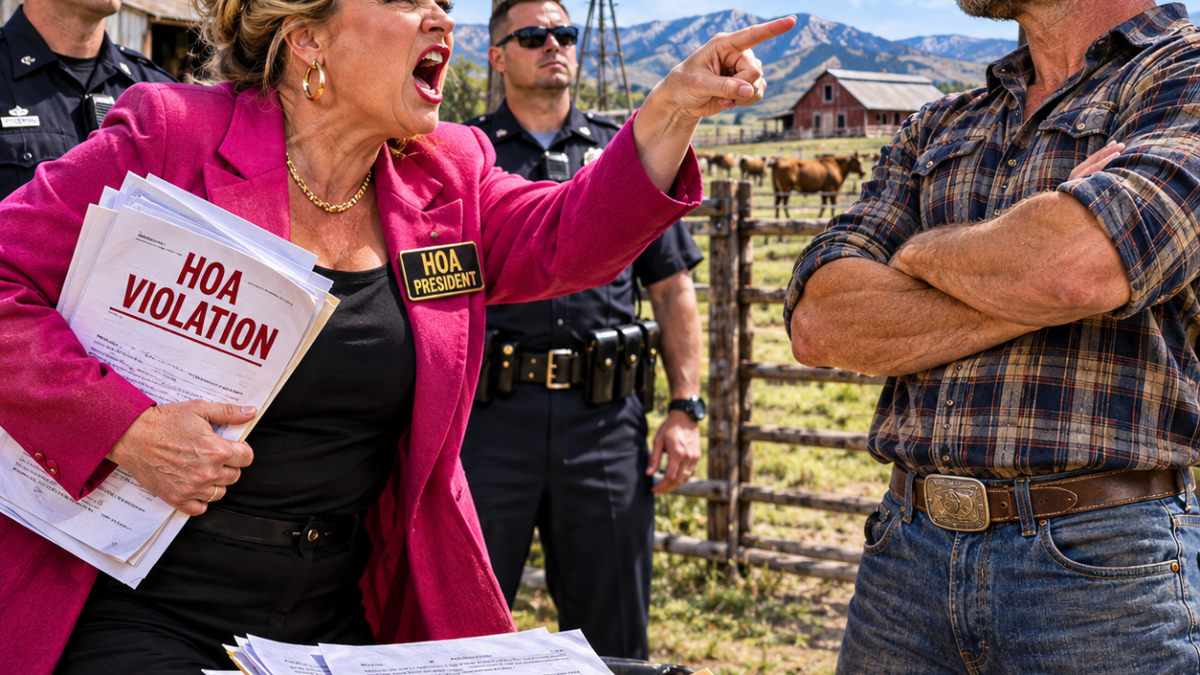
PART 2
Deputy Randy Wright pulled onto the shoulder and stepped out slowly.
He was in his early forties, sunburned across the nose and cheeks, with the cautious expression of a man who had learned that property disputes could become dangerous faster than bar fights.
Janet walked toward him before he had fully closed his door.
“Deputy, thank goodness.”
Randy looked at her, then at me, then at the padlocked gate.
“We got a call about a trespassing complaint.”
“Yes.” Janet pointed toward me. “This woman is refusing to leave HOA-managed property.”
I felt something hot rise in my chest.
I swallowed it.
Randy turned to me.
“Ma’am?”
“My name is Rachel Dawson.”
Janet cut in.
“She claims to be the former owner.”
I looked at her.
“Former?”
Randy lifted one hand.
“One at a time.”
I stepped out of my truck with the folder.
“My grandfather purchased this ranch in 1952. My father inherited it. I inherited it after he died. I never sold it, transferred it, donated it, joined an HOA, or signed anything giving Pinewood Valley authority over it.”
Janet exhaled through her nose.
“That’s simply not accurate.”
I handed Randy the deed.
He read the first page.
Then the legal description.
Then my tax receipt.
Janet stood beside him with growing impatience.
“Those documents predate the annexation.”
Randy glanced at her.
“This tax receipt is from six months ago.”
“Yes.”
“And Ms. Dawson’s taxes were paid?”
“That’s irrelevant.”
His eyes shifted back to the paper.
“Doesn’t feel irrelevant.”
Janet’s voice sharpened.
“The county approved our petition three months ago under Code Section 47.3.”
Randy looked up.
“What section?”
“Forty-seven point three. Abandoned Agricultural Land Annexation Provision.”
His brow creased.
“You have a copy?”
“Not with me.”
“County order?”
“At our office.”
“Recorded transfer?”
“The HOA has jurisdiction. Ownership is more complicated.”
Now I spoke.
“My name is still on the tax record.”
Janet looked at me.
“Because administrative systems take time to update.”
Randy flipped another page.
“These documents show continuous ownership.”
Janet’s smile finally cracked.
“They appear to.”
Randy returned the folder to me.
“Well, I’m not arresting somebody for trespassing on land she appears to own.”
Janet stepped closer.
“Deputy, I have bylaws.”
“That doesn’t determine title.”
“I have a resolution.”
“Then take it to the recorder.”
“She cut our lock.”
“I haven’t touched it yet,” I said.
Randy looked at the padlock.
Then at the bolt cutters visible behind the seat of my truck.
“Yet,” I added.
His mouth twitched.
Janet did not find it funny.
“This woman is threatening community property.”
Randy’s voice went flat.
“Mrs. Evans, until the ownership issue is clarified, I suggest you stop changing locks or taking additional action on the parcel.”
“I’m the HOA president.”
“And I’m a deputy who isn’t a judge.”
That ended it.
He turned toward me.
“Ms. Dawson, go to the recorder’s office Monday. Get a lawyer if this continues.”
“I will.”
He nodded.
Then drove away.
Dust rolled across the road.
Janet watched his cruiser disappear.
For several seconds, neither of us spoke.
Then the pleasant version of her smile vanished completely.
“This isn’t over.”
“No.”
I looked at the lock.
“It isn’t.”
I opened my truck.
Took out the bolt cutters.
Janet crossed her arms.
“You damage that lock and I’ll add it to your violations.”
I fitted the cutters around the shackle.
“My father bought these bolt cutters to repair fences.”
“Rachel—”
I squeezed.
The brass snapped.
The lock fell into the dust.
Janet’s face hardened.
I removed the chain.
Opened my gate.
Then looked at her.
“Send the bill.”
I drove past her.
She did not follow.
The ranch looked abandoned in one sense.
Not legally.
Emotionally.
Four months of dust coated the porch.
Grass had grown along the drive.
The barn needed paint.
But the horses were healthy.
Water troughs filled.
Someone had clearly been caring for them.
Deborah.
Despite everything.
Inside the house, nothing had been disturbed.
I walked through each room.
My mother’s old sewing basket.
My father’s boots still under the mudroom bench.
Family photographs.
The kitchen clock five minutes slow, just as it had been for twenty years.
I stood in the middle of that house and felt the weight of the last four months hit me all at once.
Hospital machines.
My mother struggling to lift one arm.
Doctors speaking quietly in hallways.
Sleeping in chairs.
Eating from vending machines.
Driving four hundred miles home because she had finally stabilized enough for me to leave.
And instead of coming home to rest, I had been told I no longer belonged there.
I sat on the kitchen floor.
For maybe five minutes.
Maybe twenty.
I don’t know.
Then I stood.
Grief and exhaustion were luxuries I could not afford yet.
That night I slept in my childhood bedroom.
Badly.
Every time I closed my eyes, I heard Janet.
**Declared abandoned.**
**Incorporated.**
**Proper administrative channels.**
People like Janet understood something important.
Words can intimidate long before anyone verifies them.
Jurisdiction.
Violation.
Lien.
Eviction.
Most people hear words like that and assume someone somewhere has already checked the paperwork.
I was beginning to suspect nobody had.
Monday morning proved how far Janet intended to go.
A white envelope waited in my mailbox.
Heavy paper.
Blue logo.
**PINEWOOD VALLEY HOMEOWNERS ASSOCIATION — NOTICE OF VIOLATION**
The violation:
**UNPERMITTED STRUCTURE — BARN**
Fine:
$500.
I stared across the yard at the barn.
My father built it in 1968.
Janet’s HOA supposedly formed two years earlier.
The barn had existed more than fifty years before her organization.
Tuesday another notice arrived.
**NONCOMPLIANT PERIMETER FENCING — $300.**
Wednesday:
**UNAUTHORIZED LIVESTOCK ACTIVITY — $400.**
Thursday:
**FAILURE TO MAINTAIN APPROVED LANDSCAPING — $350.**
Friday came three notices.
By the end of the week, she claimed I owed $2,300.
I spread them across the kitchen table.
Something jumped out immediately.
The formatting changed.
One notice cited Article 7, Section 3 for fencing.
Another cited Article 7, Section 3 for livestock.
The fine schedule changed from page to page.
One notice referred to a thirty-day cure period.
Another demanded payment in fourteen days for the same category.
No county filing number.
No recorded covenant reference.
No parcel attachment.
Only Janet’s signature.
Saturday brought a letter from a Houston law firm.
The stationery was impressive.
The language more so.
Pay within fourteen days or Pinewood Valley HOA would pursue a lien.
Continued occupancy without HOA authorization could lead to additional legal action, including possible eviction.
My hands stopped moving halfway through the second page.
I had spent the previous four months worrying about whether my mother would walk normally again.
I did not have money sitting around for property litigation.
I did not have the emotional energy for a war.
For the first time, Janet’s strategy worked.
Not because I believed her.
Because she made fighting look expensive.
I poured coffee and stared at the letter.
For maybe ten minutes, I imagined the easiest path.
Sell.
Take whatever the ranch was worth.
Move closer to Mom.
Never deal with Pinewood Valley again.
Then I looked through the kitchen window.
The barn stood at the edge of the field.
My father’s barn.
I had helped him replace the roof when I was sixteen.
My grandfather’s hand-cut fence posts still lined part of the western boundary.
My grandmother’s ashes were in the meadow.
Leaving because I wanted to leave was one thing.
Leaving because Janet Evans had frightened me off my own land was another.
I folded the letter.
Put it in the folder.
Monday morning I drove to the county recorder’s office.
The building looked as though nobody had spent money on it since the Carter administration.
Brown brick.
Buzzing fluorescent lights.
Plastic chairs.
I took a number.
Forty-five minutes later, a woman behind the counter called:
“Dawson?”
I walked over.
Her nameplate read **DENISE ORTEGA**.
Mid-thirties.
Wire-rimmed glasses.
Sharp eyes.
I explained the story.
She listened without interrupting.
When I finished, she typed.
“County Code forty-seven point three?”
“Yes.”
“Abandoned Agricultural Land Annexation?”
“Yes.”
She typed again.
Clicked.
Frowned.
“That’s odd.”
“What?”
“I don’t see it.”
“Maybe I gave you the wrong wording.”
“Give me the notice.”
I handed it over.
She searched the exact language.
Nothing.
Then the number.
Nothing.
“I’ve worked here eight years.”
“And?”
“I’ve never heard of this provision.”
“Could it be state law?”
“Not under the county citation she’s using.”
“So it’s fake.”
Denise looked up.
“I’m saying I cannot locate any county provision matching this notice.”
She was careful.
I respected that.
“Can you search Pinewood Valley HOA?”
She typed the name.
One result appeared.
Then her expression changed.
“What?”
“This is filed strangely.”
“How?”
“Commercial-business category.”
“Is that normal for an HOA?”
“Not like this.”
She clicked deeper.
“Formation date says March fifteenth, two years ago.”
“That matches what Janet claims.”
“Yes, but the county filing timestamp is January of this year.”
I stared at her.
“She filed documents this year saying the HOA was formed two years earlier?”
“That’s what the system is showing.”
“Could that be a correction?”
“Possibly.”
“Or?”
“Possibly something else.”
She searched for the annexation petition.
No recorded deed transfer.
No obvious judgment.
No document bearing my signature.
One attachment referenced a “community incorporation of agricultural parcels.”
But it had no clear legal mechanism changing ownership.
Denise sat back.
“I need the physical archive.”
“How long?”
“Couple days.”
“I have a lien threat.”
She looked at the letter.
“I’m not allowed to give you legal advice.”
“Everyone keeps saying that.”
“Probably because we enjoy keeping our jobs.”
That almost made me smile.
Then she became serious.
“I would talk to a property attorney.”
I thanked her.
Drove home.
And found a county environmental notice taped to my door.
**ANONYMOUS COMPLAINT — HAZARDOUS WASTE STORAGE / POTENTIAL GROUNDWATER CONTAMINATION**
Inspection Wednesday.
I stood on the porch holding it.
The timing was too perfect.
Police.
Violations.
Lawyer.
Now environmental enforcement.
Janet was creating pressure from every direction.
Not one problem I could solve.
Ten problems.
Each with its own office.
Each with deadlines.
Each costing time.
That was how you wear people down.
Wednesday morning, the inspector arrived at ten.
His name was Frank.
Late fifties.
Tired eyes.
He apologized before stepping off the porch.
“Anonymous complaints.”
“I guessed.”
“We have to inspect.”
“I understand.”
He spent almost two hours checking everything.
Barn.
Fuel storage.
Equipment shed.
Septic.
Creek.
Old tractor area.
He took samples.
Photographs.
Notes.
Finally he signed the report.
“No violation.”
“Nothing?”
“Nothing.”
“Groundwater?”
“No evidence of contamination.”
He walked toward his truck.
Then stopped.
“Can I ask you something?”
“Sure.”
“You fighting with a neighbor?”
“HOA president.”
“That tracks.”
“Why?”
He looked down the road.
“We’ve had three complaints in this area in six months.”
“Same type?”
“Different wording.”
“Same result?”
“All unfounded.”
“Same caller?”
He hesitated.
“I probably shouldn’t be telling you this.”
“Then don’t.”
He looked at me.
“Same originating phone number.”
He got in his truck.
Left.
I stood beside the porch until the dust settled.
That evening, Deborah finally contacted me.
Not by phone.
A note slid under my door while I was feeding the horses.
Her handwriting shook slightly.
**Rachel,**
**I’m sorry I haven’t called. Janet has been watching everyone who talks to you. She threatened to report my property if I helped you.**
**There’s something you need to know.**
**I never signed any HOA formation papers. My name is on their founding-member list anyway. The signature isn’t mine.**
**Meet me tomorrow at the Route 12 diner at 7 a.m. Come alone.**
**Deborah**
I read it twice.
Then a third time.
My anger shifted.
Until then, I thought Janet was intimidating people.
Now Deborah was saying something much worse.
Forgery.
My phone rang.
Denise.
“Ms. Dawson?”
“Yes.”
“I found the HOA formation file.”
“And?”
Long pause.
“There’s a problem.”
“What kind?”
“The file was misclassified in an older commercial batch.”
“Okay.”
“And the dates don’t line up.”
I sat at the kitchen table.
“What does that mean?”
“The articles claim a formation date two years ago.”
“I know.”
“The notary stamp is dated more than a year before that.”
I stopped breathing for a second.
“A notary certified the document before it supposedly existed?”
“That’s what the page says.”
“Clerical error?”
“Maybe.”
Her voice lowered.
“But documents don’t usually backdate themselves.”
“Can I see it?”
“Tomorrow.”
I looked at Deborah’s note.
“Denise.”
“Yes?”
“I think signatures may be forged.”
Silence.
“Come in early.”
The diner opened at six.
Deborah was already in the far booth when I arrived at seven.
She wrapped both hands around a coffee mug.
She looked exhausted.
“I’m sorry.”
“For what?”
“Not answering you.”
“I understand.”
“No.”
She shook her head.
“You don’t yet.”
Then she told me.
For the first two months I was gone, she checked the ranch every day.
Fed the horses.
Walked the fence.
Watched the house.
Then Janet appeared at her door.
New homeowners association.
Shared road maintenance.
Community services.
Higher property values.
“Everyone’s joining,” Janet told her.
Deborah was suspicious.
She asked for time.
Janet gave her a petition.
Deborah did not sign.
Two weeks later, she discovered she was listed as a founding member.
“I went to the recorder’s office.”
She pulled out a photograph.
Signature page.
**Deborah J. Phillips.**
Then another paper.
Her bank signature.
The differences were clear.
The false signature leaned right.
Deborah’s actual handwriting leaned slightly left.
The T cross.
The final flourish.
Different.
“That isn’t mine.”
“I believe you.”
“I never signed anything.”
“Who else?”
“Three neighbors.”
“Names?”
“Two already moved away.”
“And the third?”
“Harold Vance.”
“Who is that?”
“Retired notary.”
She leaned forward.
“He noticed the papers before anyone else.”
“Where is he?”
“Far side of the valley.”
“Why hasn’t he reported it?”
“He tried.”
“What happened?”
“His complaints disappeared.”
I stared at her.
“What do you mean disappeared?”
“Misfiled. Lost. System errors.”
“Janet?”
Deborah glanced around the diner.
“Janet has people who like her.”
“That’s not evidence.”
“I know.”
“Anyone at the recorder’s office?”
“I don’t know.”
She hesitated.
“That’s why Denise matters.”
“Why?”
“She’s new enough.”
“For what?”
Deborah’s voice dropped.
“For Janet not to own her.”
I spent the afternoon finding Harold Vance.
His house sat at the end of a dirt road beneath huge pecan trees.
Eighty-two years old.
Sharp eyes.
Sharper tongue.
He opened the door before I knocked twice.
“Rachel Dawson.”
“Yes.”
“Deborah said you’d come.”
He turned.
“Tea’s in the kitchen.”
Apparently that was my invitation.
His dining table looked like an investigation already underway.
Folders.
Copies.
Notes.
Dates.
Highlighted records.
Harold lowered himself into a chair.
“Janet Evans has been trying to steal your ranch.”
“You say that pretty casually.”
“I’ve watched her do versions of it before.”
“With who?”
“Henderson land.”
He handed me a file.
“Martinez property too.”
“What happened?”
“People gave up.”
“Sold?”
“For roughly half what they should’ve gotten.”
“To Janet?”
“No.”
“Who?”
“Companies associated with people she knows.”
“Proof?”
“Some.”
He tapped the papers.
“Not enough by itself.”
Harold had three years of material.
HOA notices.
Formation copies.
Signature comparisons.
Complaints.
Timelines.
Property transfers.
“Why keep all this?”
“Because somebody should.”
“Why didn’t county investigators care?”
“I didn’t have enough standing.”
“You live here.”
“That’s not the same as direct property harm.”
He looked at me.
“You do.”
I understood.
“They’re trying to take my land.”
“Exactly.”
He slid the folders toward me.
“If you’re willing to fight, take everything.”
“I’m willing.”
He watched me for a long moment.
“Then work fast.”
“Why?”
“Because Janet knows you’re asking questions.”
He was right.
By the time I reached home, Pinewood Valley’s online community forum had exploded.
A post showed photographs of me.
My truck.
My horses.
My barn.
The headline:
**SQUATTER ILLEGALLY OCCUPYING HOA PROPERTY.**
The post accused me of threatening residents.
Ignoring lawful orders.
Creating a safety risk.
People I had known for years commented beneath it.
Some defended me.
Most did not.
One wrote:
**If the county won’t remove her, the community should.**
Another:
**Protect our children from unstable people.**
I sat alone in the kitchen reading them.
That was the first night I seriously considered leaving.
Not because of Janet.
Because of everyone else.
I had grown up around some of those families.
Attended funerals with them.
Shared fence repairs.
Borrowed equipment.
Now they were calling me a criminal because Janet had posted an official-looking story before I could post the truth.
I shut the laptop.
The kitchen went dark except for the light above the stove.
For a moment, the ranch felt enormous.
Forty acres had never seemed lonely before.
That night it did.
I picked up Deborah’s forged signature.
Then Harold’s comparisons.
Then Janet’s violation notices.
The paper did not become stronger because people online believed it.
Tomorrow, I would keep going.
At seven the next morning, I was waiting outside the recorder’s office.
Denise arrived.
She waved me inside through a side door.
We went to a small back room.
She closed the blinds.
Then she spread documents across the table.
“I thought I’d seen every kind of filing problem.”
“Apparently not.”
“No.”
First:
Articles of incorporation.
Formation date:
March 15, two years earlier.
Notary stamp:
December 3, three years earlier.
“A notary cannot notarize a document fifteen months before the document exists.”
“So backdated.”
“That is what it appears to be.”
Then Denise turned the computer toward me.
State database search.
No registration.
No Pinewood Valley HOA under the claimed legal structure.
I stared at the screen.
“So Janet’s HOA doesn’t exist?”
Denise spoke carefully.
“I’m saying I cannot find the state registration required by the documents she’s claiming authority under.”
Then came the signature grid.
Seventeen names.
Two columns.
HOA signature.
Verified signature from another public record.
I started comparing.
The differences were impossible to miss.
Different slant.
Different letter shapes.
Different spacing.
“All seventeen?” I asked.
“Yes.”
“Out of fifty-two?”
“Yes.”
Denise sat down.
“Under the formation threshold they claim applies, losing seventeen of fifty-two signatures is a serious problem.”
“You mean they didn’t have enough valid approval.”
“That’s what it looks like.”
“Then every fine—”
“Needs legal review.”
“Every lien threat?”
“Same.”
“My ranch?”
“Rachel.”
She looked directly at me.
“Your deed is still your deed.”
I did not realize how badly I needed to hear that until she said it.
My throat tightened.
I looked down at the table.
Then Denise pulled out the meeting minutes.
“No recorded election for Janet.”
“What?”
“She’s listed as president from the first meeting.”
“Who elected her?”
“That’s the problem.”
“No vote?”
“Not one I can find.”
I laughed once.
A tired sound.
“She created an HOA using fake signatures and appointed herself president.”
Denise did not laugh.
“Allegedly.”
“Right.”
Her hand moved toward the phone.
“I contacted Assistant County Attorney Linda Rivera.”
“When?”
“Yesterday.”
“Why?”
“She handles property fraud and disputes.”
“And?”
“She wants to meet.”
That afternoon, four of us sat in Linda’s office.
Me.
Denise.
Deborah.
Harold.
Linda Rivera was younger than I expected.
Calm.
Direct.
She read everything.
Harold’s three-year timeline.
Deborah’s signature comparison.
Denise’s certified records.
My violations.
The lawyer’s letter.
Environmental complaint.
Forum screenshots.
She asked questions for almost two hours.
Finally she closed the main folder.
“This is serious.”
Harold snorted.
“Told you.”
Linda ignored him.
“Potential forged signatures.”
She looked at Denise.
“Questionable formation filings.”
Then me.
“Unsupported enforcement against a parcel that appears never to have been properly subjected to these restrictions.”
“Can you shut them down?”
Linda leaned back.
“Court process matters.”
“So no.”
“I didn’t say no.”
“What did you say?”
“I said process matters.”
She tapped the records.
“If the organization was never validly formed, then its claimed mandatory authority may be void from the beginning.”
“May be?”
“I’m not going to make absolute legal declarations from a conference table.”
I liked her immediately.
“What happens next?”
Linda glanced at another paper.
“Janet scheduled an emergency HOA meeting Saturday.”
“I know.”
“She calls it the ‘ongoing trespasser situation.’”
Harold smiled.
“That’s Rachel.”
“Thank you, Harold.”
Linda’s mouth almost moved.
“She has invited every property owner.”
“Probably to humiliate me.”
“Probably.”
“What are you thinking?”
Linda closed the folder.
“If I challenge her by letter, she hires counsel and we spend months arguing through filings.”
“And?”
“She has created a public forum where she intends to assert legal authority over you.”
I understood.
“You want to challenge her there.”
“With evidence.”
Deborah whispered:
“In front of everyone?”
“Yes.”
Linda looked at me.
“Are you comfortable with that?”
I remembered the online posts.
**Squatter.**
**Danger.**
**Remove her.**
“No.”
Linda waited.
I took a breath.
“But I’ll do it.”
Preparation took three days.
Linda arranged a court reporter.
Not for theater.
For a clean record.
Two deputies would remain outside the community center.
Randy Wright was one of them.
“We’re not asking law enforcement to intimidate anyone,” Linda explained.
“They’re present in case the meeting becomes unsafe.”
Harold and I built the evidence package.
Forty-seven pages.
Chronological.
Formation documents.
Notary mismatch.
State-registration search.
Signature comparisons.
Violation notices.
Environmental inspection.
Community posts.
Property records from previous families.
Deborah contacted eleven of the seventeen people with questionable signatures.
Eight agreed to attend.
Two former residents provided notarized written statements.
One declined.
We respected that.
One statement said:
**I believed I was signing a community safety petition. I was never told my signature would be used to create a mandatory homeowners association.**
Another:
**The signature on the Pinewood Valley formation document is not mine.**
Friday evening, I sat on my porch.
For the first time all week, I did nothing.
The sky turned orange.
Horses moved slowly across the field.
The barn cast a long shadow toward the house.
My phone rang.
Mom.
“How are you?”
“I’m okay.”
“You sound like your father.”
“What does that mean?”
“He used to say ‘I’m okay’ whenever everything was absolutely not okay.”
I smiled.
“How are you?”
“Physical therapist says I’m stubborn.”
“That’s genetic.”
“Rachel.”
“Yes?”
“What’s wrong at the ranch?”
I had avoided telling her.
She was still recovering.
The last thing I wanted was to raise her blood pressure.
“Property dispute.”
Silence.
“What kind?”
“HOA.”
“What HOA?”
I stopped.
That answer was perfect.
“You never joined Pinewood Valley HOA?”
“I’ve never heard of Pinewood Valley HOA.”
“Did Dad?”
“No.”
“Grandpa?”
“Rachel, your grandfather would have run an HOA off with a shotgun.”
“Mom.”
“An unloaded shotgun.”
“Much better.”
Her voice became serious.
“Are they trying to take the ranch?”
“Yes.”
A long silence.
Then:
“Don’t sell.”
“I wasn’t planning to.”
“Good.”
“Mom.”
“Yes?”
“I’m tired.”
Her voice softened.
“I know.”
“I don’t know if I can keep doing this.”
“Yes, you can.”
“How?”
“Tomorrow.”
“What?”
“You don’t have to win the whole thing tonight.”
I looked across the field.
“You just have to get to tomorrow.”
That was enough.
Saturday morning, Harold climbed into my truck carrying the evidence folder like it contained nuclear launch codes.
“You nervous?”
“No.”
“You’re lying.”
“Yes.”
“Good.”
“Why good?”
“Means you’re not stupid.”
Deborah was already at the community center.
Eight witnesses with her.
Linda arrived ten minutes later.
Court reporter.
Assistant.
Two boxes of documents.
Randy and another deputy parked across the road.
Visible.
Not hovering.
The parking lot filled.
Forty vehicles.
Then forty-three.
Almost everyone in the valley.
Janet arrived last.
White sedan.
Parked in a space marked:
**HOA PRESIDENT**
Of course she had her own parking space.
She stepped out wearing a navy dress and pearls.
When she saw me, her expression flickered.
Then the smile returned.
“Ms. Dawson.”
“Janet.”
“I’m surprised you had the nerve to attend.”
“You invited me.”
“This meeting is for property owners.”
“I am one.”
Her eyes sharpened.
“That remains disputed.”
“No.”
I held her gaze.
“It really doesn’t.”
She looked past me.
Saw Linda.
Saw Deborah.
Saw Harold.
For the first time, Janet’s confidence looked slightly forced.
Inside, folding chairs faced a long table.
A banner hung behind it.
**PINEWOOD VALLEY HOA
BUILDING COMMUNITY TOGETHER**
Harold leaned toward me.
“Subtle.”
“Behave.”
“No.”
The room filled.
Forty-three people.
Some stared openly at me.
Others whispered.
One woman who had known my mother for twenty years turned away when I looked at her.
That hurt.
Janet called the meeting to order at exactly two.
“Thank you for attending on short notice.”
Her voice filled the room.
“As everyone knows, our community is facing a serious threat.”
She looked at me.
“An individual has illegally occupied property incorporated into HOA jurisdiction.”
Murmurs.
“She has refused lawful assessments.”
More murmurs.
“She has spread false accusations concerning this organization and its leadership.”
Someone behind me said:
“Throw her out.”
Janet smiled.
“Today, we will vote on appropriate enforcement action.”
Linda raised her hand.
Janet paused.
“Yes?”
Linda stood.
“My name is Linda Rivera. Assistant County Attorney, property disputes.”
The room changed immediately.
Janet’s expression barely moved.
“I wasn’t aware your office had been invited.”
“I’m here in connection with several legal issues involving Pinewood Valley.”
“We have nothing to hide.”
Linda opened her folder.
“I’m glad.”
Harold whispered:
“Oh, that was beautiful.”
I elbowed him.
Linda held up the articles.
“Mrs. Evans, do you recognize this document?”
“Yes.”
“Articles of incorporation?”
“Yes.”
“Formation date March fifteenth two years ago?”
“That’s correct.”
“And you maintain the document is valid?”
“Absolutely.”
Linda turned it around.
“The notary stamp is dated December third of the previous year—approximately fifteen months before the date the document claims the organization was formed.”
Silence.
Janet blinked.
“That’s clearly a clerical error.”
“Could be.”
Linda pulled another page.
“I contacted the notary.”
Janet’s shoulders stiffened.
“She has no record of notarizing this document.”
Someone in the audience whispered:
“What?”
Linda continued.
“The stamp appearing on the document had also been reported missing years earlier.”
The room erupted into murmurs.
Janet raised her voice.
“That does not invalidate the underlying agreements.”
Linda nodded.
“Then let’s discuss those.”
She turned toward the state registration records.
“We searched for the legal registration supporting the mandatory authority Pinewood Valley claims.”
She held up a certified result.
“We found none.”
Janet interrupted.
“Administrative delay.”
Linda looked at her.
“For approximately two years?”
“County and state systems are notoriously slow.”
Denise spoke from the side.
“Not that slow.”
People turned.
Janet’s face hardened.
Linda continued.
“Now the signatures.”
Deborah stood.
Her hands shook.
She walked to the front.
“My name is Deborah Phillips.”
Janet stared at her.
“I’ve lived here fifteen years.”
“You’re out of order,” Janet said.
Linda replied:
“She’s a witness.”
“This is my meeting.”
Linda’s voice remained calm.
“And I’m asking her to speak.”
That was the first true crack.
Janet sat.
Deborah held up the HOA signature page.
“I’m listed as a founding member.”
She held up the bank signature.
“This is my real signature.”
Then the formation signature.
“This is not.”
Janet scoffed.
“People sign differently under different circumstances.”
Deborah looked at her.
“I never signed anything.”
“You signed a petition.”
“No.”
“You supported formation.”
“No.”
“You attended discussions.”
“I told you I wanted time.”
Janet’s voice sharpened.
“You benefited from community improvements.”
“That doesn’t make my forged signature real.”
A murmur went through the room.
The second witness stood.
Then the third.
Then the fourth.
Eight people.
Different handwriting.
Same claim.
Never consented.
Two written statements from former residents.
Linda read them aloud.
By the sixth witness, people stopped looking at me.
They were looking at Janet.
A man in the third row stood.
“Janet, you told us everyone approved.”
“Sit down.”
“Did you forge these?”
“No.”
“Then who did?”
“I said sit down.”
He did not.
Another woman called:
“I paid three thousand dollars in assessments.”
“Please wait your turn.”
“What organization did I pay?”
Janet banged the gavel.
“Order.”
The room grew louder.
Linda raised one hand.
People quieted faster for her than for Janet.
That had to hurt.
“We’ve independently identified seventeen signatures requiring serious scrutiny.”
Linda looked at Janet.
“Your own formation materials list fifty-two founding members.”
Janet crossed her arms.
“The remaining signatures establish community consent.”
“Not necessarily under the threshold your documents claim.”
“This is a technical attack.”
“Seventeen potentially invalid founding signatures is not a minor typo.”
“You don’t understand the history.”
“Then explain it.”
Janet stood.
Her chair scraped backward.
“I built this organization because nobody else would.”
Linda waited.
“People complained about roads.”
Janet pointed toward the room.
“About junk properties. Abandoned barns. Overgrown acreage. No standards.”
Her eyes found me.
“People like Ms. Dawson leave for months and expect everyone else to tolerate the consequences.”
My anger surged.
I stayed seated.
Linda asked:
“Did you personally collect the signatures?”
“Yes.”
“All fifty-two?”
“Most.”
“When property owners refused?”
Janet’s jaw tightened.
“Some people were confused.”
“What did you do?”
“I explained why cooperation was necessary.”
“Did you write names for people who had not signed?”
Silence.
The court reporter’s keys clicked.
Janet glanced toward her.
Then at Linda.
Then at the crowd.
“I did what was necessary.”
Nobody moved.
Linda’s voice dropped.
“What does that mean?”
Janet’s face flushed.
“Some property owners don’t understand what’s good for the larger community.”
“That wasn’t my question.”
“They needed guidance.”
“Did you sign their names?”
Janet looked around the room.
She had controlled these people through confidence.
She tried one more time to sound like the woman in charge.
“I provided the support required to create order.”
A woman gasped.
Harold whispered:
“There it is.”
Linda did not celebrate.
She simply looked toward the court reporter.
“Thank you.”
Janet realized what she had just done.
“No. That’s not what I meant.”
“Then clarify.”
“I meant administrative assistance.”
“Did you physically sign names belonging to other property owners?”
Janet pointed at Deborah.
“They would have joined anyway.”
Deborah said:
“No, I wouldn’t.”
Janet snapped:
“You don’t know that.”
“It’s my signature.”
The room exploded.
People shouting.
Questions.
Accusations.
Janet banged the gavel repeatedly.
Nobody listened.
“Where are our dues?”
“Did you forge mine?”
“Who elected you?”
“Are the liens valid?”
“Did you lie about Rachel?”
Janet stood behind the table shouting:
“Order!”
Linda finally turned toward the audience.
“What we have presented today raises substantial evidence that Pinewood Valley’s claimed mandatory HOA authority was never validly created.”
Silence returned in pieces.
Linda continued.
“My office is initiating immediate action to have the organization’s asserted mandatory status declared void from inception, invalidate unsupported fines and liens, and preserve records for investigation.”
Janet shouted:
“You cannot dissolve my HOA!”
Linda looked at her.
“If the legal entity you’re claiming never validly obtained the authority you’ve been exercising, the issue may be that there was never a lawful mandatory HOA here to begin with.”
Randy Wright entered from the side door.
His partner followed.
Janet went pale.
He stopped several feet away.
“Mrs. Evans, based on the statements made here and documentary evidence referred to our office, you should not destroy, alter, or remove any organizational records.”
“You’re arresting me?”
“Not at this moment.”
She looked almost relieved.
Then Randy continued.
“But I strongly suggest you speak to counsel before making additional statements.”
Janet looked at me.
Pure hatred.
“This is your fault.”
I stood.
“No.”
“You came back and turned everyone against me.”
“I came back because my mother finally stabilized.”
“You abandoned the property.”
“I left for four months.”
“You let it deteriorate.”
“The county inspector found nothing.”
That stopped her.
I continued.
“Three anonymous complaints in this area. Same originating number.”
Her eyes moved.
Tiny reaction.
Enough.
“You locked my gate.”
Silence.
“You called the police on me.”
Silence.
“You fined a barn built before your HOA supposedly existed.”
People looked toward her.
“You cited a county law nobody can find.”
Janet’s mouth tightened.
“You called me a squatter on land my family has owned since 1952.”
I took one step closer.
“My father built that barn.”
Another.
“My grandmother’s ashes are in that meadow.”
My voice almost broke.
I steadied it.
“My mother was in a hospital four hundred miles away while you were putting your lock on my gate.”
Janet looked away.
“You tried to take my family’s land with papers that fall apart the moment somebody reads the dates.”
The room was completely silent.
Then I said:
“You don’t own Dawson Ranch.”
Janet looked at me again.
This time, she had no answer.
The meeting ended without a vote.
There was nothing left to vote on.
The organization’s claimed authority had collapsed in front of the people it depended on.
Formal legal work followed immediately.
Linda’s office filed.
County records were secured.
Unsupported enforcement actions were frozen.
Within the process that followed, Pinewood Valley’s mandatory HOA claims were declared void.
The fines disappeared.
Lien threats disappeared.
The supposed annexation of Dawson Ranch disappeared.
The sign at my gate came down.
The organization Janet had ruled through fear stopped functioning almost overnight.
Charges against Janet were filed the following Monday.
Forgery.
Fraud-related allegations.
False filings.
Investigators also began reviewing whether the pressure campaigns against other landowners had been used to force sales.
Her husband, Billy Evans, posted bond.
Janet returned home.
But the woman who had walked around the valley as if she owned it no longer had the one thing she needed most.
People’s belief.
By Tuesday, the community forum looked completely different.
Posts calling me a squatter vanished.
Some were deleted.
Others were replaced by apologies.
**Rachel, I’m sorry.**
**Janet told us the county had already ruled against you.**
**I should have checked before repeating it.**
**My family paid fines for years. Who do we contact?**
Harold called me.
“You reading this?”
“No.”
“You should.”
“Why?”
“People who called you a criminal are discovering paragraphs.”
“Harold.”
“One man just posted six hundred words explaining how he ‘always suspected something.’”
“He suggested physically removing me.”
“I know.”
“You enjoying this?”
“Yes.”
“At least you’re honest.”
“I’m eighty-two. I don’t have time to fake maturity.”
Linda’s office created a process for restitution claims.
Families who had paid unsupported dues, assessments, and fines submitted records.
At least twelve households pursued recovery.
The amounts shocked me.
Hundreds here.
Thousands there.
Years of payments made because Janet had printed official-looking letters and nobody had wanted to risk a lien.
Civil attorneys began reviewing the Henderson and Martinez property sales.
Harold had warned me about them.
Those cases were complicated.
Nobody promised the families they would get land back.
But for the first time, someone was looking.
Harold came by one afternoon.
He stood at the gate staring at the empty spot where the HOA sign had been.
“Ugly thing.”
“The sign?”
“Janet.”
“Harold.”
“What?”
“You’re supposed to become kinder with age.”
“Who told you that?”
He followed me to the porch.
I brought coffee.
He complained it was weak.
Then handed me a folder.
“What’s this?”
“My original complaint.”
The one he filed three years earlier.
Stamped.
Received.
Then marked with three different administrative notes.
**REVIEW PENDING.**
**INSUFFICIENT JURISDICTION.**
**FILE CLOSED.**
“You knew.”
“I suspected.”
“You kept going.”
“Because the signatures were bad.”
“Why didn’t you move?”
He looked toward the valley.
“My wife is buried here.”
That answer silenced me.
Harold continued.
“People think old men stay because they’re stubborn.”
“Aren’t you?”
“Yes.”
“But?”
“Sometimes stubbornness is just grief refusing to relocate.”
I understood that better than he knew.
Deborah arrived a week later carrying a casserole.
“You didn’t cook that.”
“No.”
“Good.”
She set it on the table.
Then started crying.
“I’m sorry.”
I sat across from her.
“You were scared.”
“I promised your father I’d watch the ranch.”
“You did.”
“I let Janet put a lock on it.”
“You kept the horses alive.”
“I stopped calling you.”
“She threatened you.”
“That doesn’t make me feel better.”
I studied her.
“Would calling me from New Mexico have stopped Janet?”
“No.”
“Would confronting her alone?”
“Probably not.”
“Then stop punishing yourself for not winning a fight you couldn’t win alone.”
Deborah wiped her face.
“You sound like your mother.”
“That’s becoming an insult.”
“No.”
She smiled weakly.
“It’s not.”
I called Mom that evening.
Told her more.
Not everything.
She listened.
Then said:
“She called you a trespasser?”
“Yes.”
“On my father’s ranch?”
“Yes.”
A long silence.
“Rachel.”
“Yes?”
“When I’m strong enough to come home, I want to meet this woman.”
“No.”
“Why?”
“Because I don’t want to post bail for you.”
My mother laughed so hard she started coughing.
I regretted the joke immediately.
Then she said:
“Worth it.”
Six months later, she came home.
Still using a cane.
Still weaker on one side.
I drove slowly down Miller Road.
When we reached the ranch gate, she made me stop.
The brass lock was gone.
The laminated sign was gone.
The original chain rested on the wooden post.
Mom touched it.
“Your father made this post.”
“I know.”
“He used too much concrete.”
“I know.”
“Wouldn’t listen.”
“I know.”
She looked toward the barn.
“Tell me everything.”
So I did.
On the porch.
Over two hours.
Mom listened.
The fake code.
The police call.
The violations.
Environmental complaint.
Deborah.
Harold.
Denise.
Forged signatures.
Public meeting.
When I finished, she looked across the pasture.
“I leave you alone four months.”
“Technically I left you.”
“Same thing.”
Then she said:
“Your grandfather would have enjoyed that meeting.”
I smiled.
“Probably too much.”
Criminal proceedings moved slower than the public collapse.
That was fine.
Evidence needed examination.
The notary history.
Signatures.
County filings.
Financial records.
Communications.
Investigators interviewed former residents.
Not every accusation became a charge.
Not every complaint traced directly to Janet.
That mattered to me.
After being accused publicly of things I had not done, I did not want revenge built on things nobody could prove.
Janet’s own words caused enough trouble.
**I did what was necessary.**
Her lawyers argued she meant administrative help.
Other evidence suggested something more.
Courts sorted it out.
Civil consequences arrived faster.
Pinewood Valley residents stopped sending money into Janet’s operation.
New voluntary agreements replaced several shared functions.
Road maintenance.
Drainage.
Emergency access.
No enormous rulebook.
No mandatory architectural authority.
No Janet.
Harold drafted the first shared-road agreement.
Four pages.
I looked at it.
“That’s it?”
“That’s it.”
“Where’s Article Seven, Section Three?”
“Burned it.”
“Harold.”
“Metaphorically.”
“Good.”
“Mostly.”
People read every page before signing.
That was new.
One man asked:
“What if I don’t sign?”
Harold said:
“Then you don’t sign.”
The man looked confused.
“That’s allowed?”
I almost laughed.
That showed what Janet had done to the valley.
She had convinced people that saying no was misconduct.
Linda brought my final ranch paperwork personally.
She handed me a folder.
“Unsupported fines voided.”
I read.
“Lien threat?”
“Gone.”
“HOA jurisdiction?”
“No enforceable basis.”
I read the page twice.
My mother watched from her chair.
“Well?”
“It’s done.”
“Good.”
That was all.
Linda smiled.
“Your mother is difficult to impress.”
Mom looked at her.
“She shouldn’t have had to save her own ranch from people who never owned it.”
Linda nodded.
“No.”
People kept calling it a victory.
Mom was right.
I should never have needed one.
Three weeks after the public meeting, I sat alone on the porch at sunset.
The ranch looked almost exactly as it had before.
Same fence.
Same barn.
Same road.
Yet I felt different inside it.
For months, Dawson Ranch had been evidence.
Parcel numbers.
Signatures.
Title chains.
Violation exhibits.
Now the pasture was just pasture again.
Harold arrived without warning.
He carried a photocopy.
“What now?”
“Found something.”
“If it says Pinewood Valley, take it back.”
He handed it over.
1952.
Original Dawson purchase.
At the bottom:
Witness signature.
**Walter Vance.**
I looked up.
“Vance?”
“My uncle.”
“Your uncle witnessed my grandfather’s purchase?”
“Apparently.”
I stared at the page.
Small valley.
Old families.
Lives crossing each other decades before anyone knew those crossings would matter.
“Did he know Grandpa?”
Harold shrugged.
“Probably had a beer with him.”
“That’s your historical method?”
“More reliable than Janet’s.”
Fair.
He sat beside me.
“You staying?”
“Yes.”
“Good.”
“Why?”
“Barn needs paint.”
“Get off my porch.”
He laughed.
The apologies came slowly.
Some sincere.
Some awkward.
A few people never apologized.
That was okay.
Peter Cole eventually did.
He had written the worst forum post.
The one suggesting residents should “handle” me if authorities would not.
He showed up carrying a toolbox.
“I owe you an apology.”
“Yes.”
He blinked.
“You’re not going to say it’s okay?”
“It wasn’t.”
“Fair.”
He looked toward the barn.
“I heard the west wall needs repair.”
“It does.”
“I’m a carpenter.”
“I know.”
“Can I help?”
I thought about his post.
Then about what I wanted the rest of my life to feel like.
“Grab the ladder.”
We worked six hours.
At lunch, Peter sat on the tailgate.
“Janet showed us paperwork.”
“What?”
“Something saying your ranch reverted to the HOA.”
“Did you read it?”
He stared at his sandwich.
“No.”
“Why not?”
“I trusted her.”
There it was.
Not stupidity.
Trust.
People cannot personally audit every document around them.
Communities work because we trust other people to do their jobs.
That means the person controlling the information carries enormous responsibility.
Janet had turned trust into leverage.
Peter looked at me.
“I’m sorry.”
“I know.”
That was enough.
My mother lived another two years.
She stayed on the ranch.
Physical therapy helped.
She walked farther.
Still used the cane on bad days.
She and Harold became friends, mostly by insulting each other.
Deborah came every Sunday.
One afternoon, Harold complained about Mom’s pie.
She told him:
“You ate three slices.”
“Quality control.”
“You can leave.”
“It’s raining.”
“Walk faster.”
For the first time since my father died, the house sounded alive.
Mom died quietly.
Not another stroke.
Age and complications.
Her bedroom looked toward the pasture.
After the funeral, I expected to want to run again.
When Dad died, every object in the house hurt.
I had spent years learning to leave whenever grief became too loud.
This time, I stayed.
Maybe because Janet had accidentally taught me something.
A home does not become less painful by abandoning it.
Sometimes it becomes yours again only when you remain long enough for new memories to grow around the old ones.
I scattered part of Mom’s ashes in the meadow beside Grandma’s.
Deborah stood with me.
Harold too.
No speeches.
Wind through dry grass.
Texas sky.
Afterward Harold said:
“Your grandfather would be proud.”
“You never met him.”
“My uncle did.”
“That doesn’t count.”
“I’m eighty-four now. Everything counts.”
I let him have it.
A year after Janet’s HOA collapsed, the community held a picnic.
Same building.
Same folding chairs.
Different banner.
**PINEWOOD VALLEY COMMUNITY DAY**
No word HOA.
No mandatory attendance.
No forfeiture of voting rights if you stayed home.
I joked about that.
Harold almost choked laughing.
Randy Wright came with his wife and daughter.
He stood beside me near the barbecue tables.
“I still remember that first day.”
“So do I.”
“She expected me to arrest you.”
“I noticed.”
“You looked awful.”
“Thanks.”
“I mean exhausted.”
“My mother was in the hospital.”
“I know now.”
He looked toward the crowd.
“What do you think would’ve happened if I had believed Janet?”
I considered it.
“You might’ve removed me temporarily.”
“Maybe.”
“Then I would’ve spent a day proving I owned my own home.”
He shook his head.
“That bothers me.”
“Good.”
He looked at me.
“Good?”
“Means you’ll look harder at the next folder.”
He nodded.
“Fair.”
Denise Ortega received a county commendation the next year.
She hated every second of the ceremony.
I attended anyway.
Afterward she said:
“I only noticed dates.”
“You noticed dates nobody else checked.”
“That’s my job.”
“Exactly.”
Ordinary competence had stopped extraordinary harm.
I thought about that often.
Janet’s system worked because everyone assumed somebody else had checked.
County-looking logo.
Legal letterhead.
Notary stamp.
HOA title.
People saw symbols and stopped reading.
Denise read.
Harold read.
Linda read.
Eventually the whole valley did.
That was enough.
Years passed.
The barn got painted.
Fence sections were replaced.
The horses changed.
The ranch stayed.
No HOA appeared to take Pinewood Valley’s place.
People formed small voluntary agreements as needed.
Road.
Water.
Fire access.
Specific problem.
Specific cost.
Actual signatures.
Nobody tried to control the color of my barn.
Harold joked he might start an architectural committee just to annoy me.
I told him I knew where he lived.
One evening, long after the legal files had moved from my kitchen table into a cabinet, I found Janet’s old brass padlock in a toolbox.
Evidence had been returned after everything ended.
I picked it up.
Heavy little thing.
Shiny once.
Now scratched.
For months, I thought that lock represented what Janet tried to take.
My ranch.
My family history.
My home.
Holding it years later, I realized it represented something smaller.
Her mistake.
She thought authority was a lock you put on someone else’s gate.
A title you gave yourself.
A document you printed.
A rule you cited.
A room you controlled.
Real authority was harder.
It required consent.
Records.
Law.
Accountability.
Things she had treated as inconveniences.
I put the lock back in the toolbox.
Did not frame it.
Did not need a trophy.
Deborah walked over while I was repairing the gate hinge.
“You know people hire professionals for that.”
“It’s one hinge.”
“You’re getting old.”
“So are you.”
She leaned against the post.
“Remember when Janet put the lock here?”
“Yes.”
“You looked like you wanted to kill somebody.”
“I wanted to sleep.”
“You looked worse than angry.”
“My mother was sick.”
“I know.”
She grew quiet.
“I still feel guilty.”
“Deborah.”
“I do.”
“For what?”
“Being afraid.”
“That wasn’t a crime.”
“I should’ve stood beside you when the police came.”
“You helped later.”
“I should’ve done it sooner.”
I tightened the final bolt.
“Then use that feeling next time somebody else is standing alone.”
She looked at me.
“That’s it?”
“That’s it.”
She nodded.
Maybe forgiveness works better when it gives someone something to do.
The gate swung freely.
No new padlock.
Just the old chain resting across the post.
Deborah walked home.
I stayed by the entrance.
The ranch road stretched toward the house.
Forty acres.
My grandfather’s purchase.
My father’s work.
My grandmother and mother in the meadow.
Not abandoned.
Not annexed.
Not HOA-managed.
Home.
People in Pinewood Valley still tell the story.
They exaggerate parts.
Some say Janet was arrested at the meeting.
She wasn’t.
Some say the HOA vanished legally the second Linda finished speaking.
The formal process took additional filings.
Some say every founding signature was forged.
We proved enough were invalid to destroy Janet’s claimed authority; we never needed to invent more.
The truth was already dramatic enough.
I came home after caring for my mother.
There was a padlock on my gate.
A woman I had never authorized told me my ranch belonged to her organization.
She called the police.
The deputy read my deed.
Then we began reading her documents.
That was all it took.
One document at a time.
One date.
One signature.
One lie.
Then another.
Until the organization that had frightened people for years could no longer survive being examined.
Janet had believed nobody would look closely because nobody had before.
That was her real mistake.
The night I found the padlock, I thought I was fighting to recover property.
By the end, I understood I was fighting for something more basic.
The right to come home without having to ask permission from someone who had invented the authority to deny me.
I closed the gate.
The old chain slipped over the wooden post.
Behind me, the last light stretched across Dawson Ranch.
The barn stood where my father built it.
The meadow moved in the evening wind.
And there was no laminated sign anywhere telling me who I was allowed to be on my own land.
I walked back toward the house.
This time, nobody was waiting there to tell me I didn’t belong.
[END OF STORY]








