PART 2: HOA Karen Called My Working Dogs “Abused”—She Had No Idea I Was Vice President of the State Working Dog Federation
PART 2
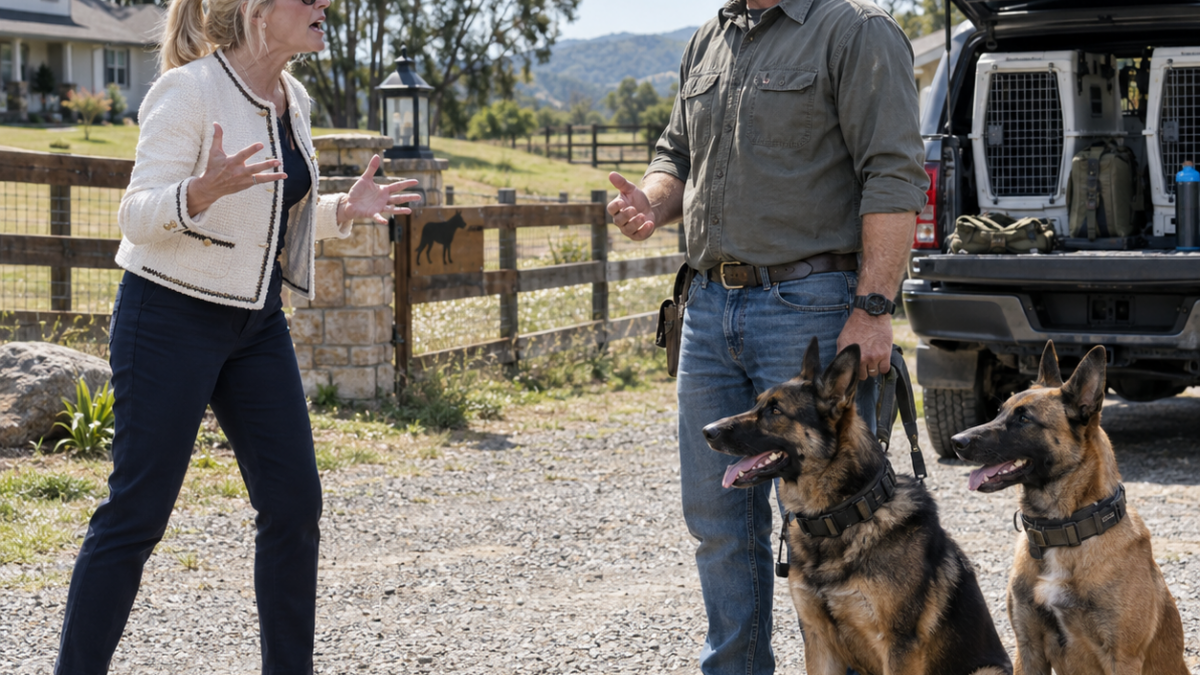
I had been unloading equipment from my F-250 when Karen drove up my driveway in a white golf cart with OAKWOOD PRESERVE BOARD stenciled across the windshield.
She didn’t introduce herself at first.
She simply looked at the truck.
“You’ll need to move that.”
“Move what?”
“The commercial vehicle.”
“This is my truck.”
“It has a toolbox.”
“So?”
“Commercial equipment.”
“It came from Home Depot.”
She pursed her lips.
Then she inspected the driveway.
Then the house.
Then me.
Eventually she said, “I’m Karen Hollis. HOA president.”
“John Miller.”
“I know.”
That should have warned me.
She already knew my name before introducing herself.
“You received your governing documents at closing?”
“I did.”
“You’ll want to review them carefully.”
“I already have.”
Her eyes narrowed.
“Then you know commercial vehicles are prohibited.”
“My truck isn’t commercial.”
“We’ll see.”
That became Karen’s favorite sentence.
We’ll see.
When I installed the kennels, she came again.
“They weren’t approved.”
“They’re behind my house.”
“That doesn’t matter.”
“They’re not permanent buildings.”
“They’re visible from the trail.”
“The trail is four hundred feet away through trees.”
“I can see them.”
“Because you walked onto the back of my property.”
That shut her up for about three seconds.
“I was inspecting.”
“You were trespassing.”
“HOA officers have inspection authority.”
“Not inside my fenced property without notice.”
Her cheeks went pink.
“You’re going to be difficult.”
“I’m going to follow the rules that actually exist.”
That was apparently the same thing.
The next month she complained about barking.
Then “aggressive canine activity.”
Then “unapproved professional-grade equipment.”
Then “suspected commercial use.”
The accusation of animal cruelty was the first time she reached outside the HOA.
That made it different.
Three days after Officer Miller’s visit, the official closure letter arrived.
**COMPLAINT UNFOUNDED.**
No evidence of malnutrition.
No evidence of neglect.
No evidence of improper confinement.
No evidence of cruelty.
Animals observed to be healthy, responsive, social, and well maintained.
I made three copies.
One went into the binder.
One to my attorney.
And one into an envelope.
Then I crossed the street.
Karen opened her door before I knocked.
She had probably been watching.
“What?”
I held out the report.
“This is the result of your complaint.”
She didn’t take it.
“I acted out of concern.”
“You accused me of starving my dogs.”
“They’re too thin.”
“According to who?”
“Anyone can see it.”
“Animal control couldn’t.”
Her eyes flicked toward the paper.
“Those agencies miss abuse all the time.”
“My veterinarian doesn’t.”
“I’m not arguing with you.”
“You already did.”
She folded her arms.
“The dogs are being worked excessively.”
“They’re working dogs.”
“They’re pets.”
“No.”
“They live in a residential community.”
“That doesn’t change what they are.”
Karen gave me a patronizing smile.
“Mr. Miller, just because you like playing soldier with animals doesn’t mean everybody has to tolerate it.”
For a second, I stopped breathing.
Not because she had insulted me.
Because that sentence brought back a dusty road outside Kandahar.
A different shepherd beside me.
A dog named Ranger.
Ranger had detected an explosive device buried beneath loose gravel less than thirty feet before our patrol reached it.
He had saved me.
Saved five other men.
Six months later, Ranger was killed during another deployment.
I carried his collar home.
It remained in the top drawer of my desk.
Playing soldier.
I looked at Karen.
My voice got quieter.
“That was a mistake.”
Her smile disappeared.
“What?”
“Talking about things you know nothing about.”
“Oh, please.”
“I handled military working dogs for twenty years.”
That got her attention.
“I trained explosive-detection teams. Patrol dogs. Search dogs. I’ve worked with law enforcement units across this state.”
She blinked.
Then recovered.
“Your resume doesn’t exempt you from community standards.”
“No.”
I held up the animal-control report.
“But facts exempt me from your imagination.”
Her face hardened.
“Your kennels are still in violation.”
“We’ll address that separately.”
“And your training operation.”
“Not a commercial operation.”
“We disagree.”
“Fine.”
She started closing the door.
I stopped her with one final sentence.
“You should also know I’m vice president of the State Working Dog Federation.”
The door stopped.
“What?”
“It’s a statewide professional association for working-dog handlers, trainers, veterinarians, law-enforcement K9 units, and search-and-rescue organizations.”
Karen said nothing.
“We have counsel.”
Her face changed.
Only slightly.
But enough.
“And now,” I continued, “they’re going to receive a copy of the complaint you filed.”
Karen recovered quickly.
“Is that supposed to scare me?”
“No.”
I stepped back from the porch.
“It’s supposed to inform you.”
Three days later, the HOA answered.
Certified mail.
Heavy envelope.
Oakwood Preserve letterhead.
Three violations.
First: unapproved exterior structures.
Second: commercial enterprise in residential zoning.
Third: nuisance barking and “aggressive canine behavior.”
Initial fines:
$1,500.
Fourteen days to remove the kennel system.
Fourteen days to cease all organized dog training.
The letter ended with a warning that continuing violations could lead to additional assessments and collection action.
I spread everything across my kitchen table.
Zeus lay beneath the window.
Apollo rested by the door.
My wife had died five years earlier, so there was nobody to tell me I was turning the dining area into an operations center.
That was probably fortunate.
My phone rang.
Tom Sheridan.
He had received the scans thirty minutes earlier.
“John.”
“Tom.”
“You realize normal retirees develop hobbies.”
“I have hobbies.”
“This is not a hobby. This is a woman trying to regulate German Shepherd cardio.”
I laughed despite myself.
Tom and I had known each other since Fort Benning.
He had started his Army career as an infantry officer, gone to law school, returned as a JAG, and eventually left service for civil litigation.
He had a gift for enjoying conflict without becoming reckless inside it.
“What’s our position?” I asked.
“First, we don’t assume everything Karen wrote is invalid.”
“Excuse me?”
“You bought inside an HOA.”
“I know.”
“Then structures may legitimately require approval.”
“They’re kennels.”
“Still structures.”
“Temporary modular kennels.”
“Which may or may not matter.”
I hated when Tom did this.
“You’re supposed to be my lawyer.”
“I am. That’s why I don’t tell you what you want to hear.”
“Commercial use?”
“Better for us if there’s no money changing hands.”
“There isn’t.”
“Noise?”
“Evidence.”
“I have it.”
“Good.”
“Cruelty accusation?”
“Potentially useful if she keeps repeating it after being told it was unfounded.”
I leaned back.
“So we answer calmly.”
“Yes.”
“That sounds boring.”
“Winning usually is.”
The following morning, I called Maria Flores.
Maria was general counsel for the State Working Dog Federation.
She had helped draft best-practice standards used by police and volunteer search teams across the state and understood the difference between service animals, working animals, sporting dogs, and pets better than almost anyone I knew.
I sent her the file.
She called an hour later.
“John.”
“Yes?”
“Do you want the professional answer or my personal answer?”
“Professional first.”
“Some of the legal language in your HOA’s letter deserves review. We should not claim working dogs automatically override every covenant. That depends on the dog’s role and applicable law.”
“Agreed.”
“Now personal?”
“Go ahead.”
“This woman is an idiot.”
I laughed.
“Thank you.”
“The cruelty complaint bothers me most.”
“Because it was false.”
“Because it weaponizes public misunderstanding.”
Maria’s voice sharpened.
“Lean working dogs are constantly mistaken for neglected pets by people used to overweight companion animals. More importantly, training is not cruelty simply because it’s physically demanding. Properly managed working dogs need work.”
“Exactly.”
“What certifications do Zeus and Apollo currently hold?”
I listed them.
Zeus had explosives odor recognition certification through a recognized civilian program and advanced obedience credentials.
Apollo had urban search certification, tracking qualifications, and temperament evaluations.
Both had current veterinary performance clearances.
Maria whistled softly.
“This is not going to go the way she thinks.”
The Federation’s board met by video that night.
I expected sympathy.
I got outrage.
A K9 commander from the state capital leaned toward his camera.
“She reported you for cruelty?”
“Yes.”
“After seeing the dogs?”
“She’s seen them from across the street.”
A veterinarian asked, “Did she ever request records? Ask about body-condition scoring? Contact you about care before filing?”
“No.”
Maria displayed the animal-control report.
Unfounded.
Then Karen’s HOA violations.
The discussion lasted forty-five minutes.
We agreed the Federation would not turn a neighborhood dispute into a public spectacle.
Not yet.
Instead, Maria would contact the HOA’s counsel privately.
Professional-to-professional.
The letter she sent was firm without being theatrical.
It explained that the animal-control allegation had been formally rejected.
It challenged statements implying my dogs were abused or dangerous.
It asked the board to separate legitimate architectural questions from unsupported accusations about animal welfare.
It requested withdrawal of the cruelty-related assertions and suspension of disputed penalties while the parties reviewed the kennel and training issues.
And it warned that continued publication of false allegations after notice could create legal exposure.
Copies went to the HOA’s law firm.
Board members.
Management company.
And insurer.
The response from the lawyer came two days later.
Cautious.
Measured.
Completely different from Karen.
He suggested a meeting.
Karen refused.
I know because she wrote her own letter.
That was her next mistake.
Her letter said the State Working Dog Federation had “no authority whatsoever over the private contractual governance of Oakwood Preserve.”
That part was true.
Then she went further.
She said the HOA was considering a covenant amendment prohibiting dogs above fifty pounds.
Not aggressive dogs.
Not uncontrolled dogs.
Any dog above fifty pounds.
She specifically cited Zeus and Apollo as examples of “military-style attack animals incompatible with family residential living.”
Maria called me.
“Please tell me this is authentic.”
“It came certified.”
“Do not respond.”
“Why?”
“Because I’m enjoying it.”
Tom was less amused.
“This is retaliation.”
“That helpful?”
“Potentially. Especially given the timing.”
“What happens if they pass it?”
“We evaluate enforceability then.”
“I’m not getting rid of my dogs.”
“I know.”
“No, Tom.”
His voice softened.
“I know.”
Zeus was nine.
Apollo seven.
They weren’t equipment.
They weren’t a legal theory.
They had slept beside my bed through the worst year of my life after Ellen died from ovarian cancer.
Zeus would lie with his nose against the bedroom door when I couldn’t sleep.
Apollo learned that if I sat too long at the kitchen table staring at nothing, bringing me a tennis ball could sometimes pull me out of it.
Karen wasn’t threatening property.
She was threatening family.
That night, I opened my desk drawer.
Ranger’s old collar sat where it always had.
Faded nylon.
Brass tag worn smooth.
I held it for a while.
Then I went outside.
Zeus and Apollo were on the porch.
“Walk?”
Both stood instantly.
We went through Oakwood Preserve.
Not because I needed exercise.
Because I wanted neighbors to see the monsters Karen was describing.
Zeus walked at heel.
Apollo stayed on my right.
Children rode bicycles past us.
Neither dog reacted.
A terrier behind a fence lost its mind.
Zeus glanced once and kept walking.
At first, neighbors avoided us.
Karen’s story had traveled.
I could feel it.
People watched through windows.
A mother pulled her child slightly closer when we passed.
That hurt more than I expected.
Then, one evening, an older man stopped his pickup beside me.
“Working line?”
I looked over.
He wore a faded USMC hat.
“West German and Czech lines.”
He nodded appreciatively.
“Knew it.”
He parked and got out.
“Frank Kowalski.”
“John Miller.”
“First Recon.”
“Army.”
He smiled.
“Nobody’s perfect.”
That was how Frank entered the fight.
Not because of dogs.
Because Karen had been fining him for six months over a flagpole that exceeded the HOA’s approved height by twenty-two inches.
“It was my son’s flag,” he told me.
We stood beside his driveway.
“He was killed in Helmand.”
I looked at the pole.
American flag.
Marine Corps flag beneath it.
“I’m sorry.”
“Karen told me grief doesn’t create an exemption.”
My jaw tightened.
“What did you do?”
“Paid three fines.”
“Why?”
“My wife begged me.”
He stared toward Karen’s street.
“Then I stopped paying.”
“What happened?”
“Collection letters.”
Frank looked at Zeus.
“She says your dogs are dangerous.”
“She says a lot.”
Zeus sat calmly.
Frank held out his hand.
“May I?”
“Zeus, greet.”
Zeus stepped forward.
Frank scratched behind his ear.
The older Marine’s eyes watered unexpectedly.
“My boy wanted one of these when he was little.”
He cleared his throat.
Then looked at me.
“You fighting her?”
“I’m challenging what she’s doing.”
“That means yes.”
He smiled.
“You need help?”
“I need facts.”
Frank became better than facts.
He became the neighborhood’s memory.
Everybody knew Frank.
He fixed lawn mowers.
Helped people jump dead batteries.
Took packages inside for neighbors on vacation.
He could ask questions without people feeling interrogated.
Within two weeks, my secure folder began filling.
A widow fined because her son’s RV remained in her driveway for forty-eight hours after her husband’s funeral.
A physician cited repeatedly for parking on the street after late hospital shifts.
A family ordered to remove a small Pride flag even though the governing documents had no rule banning it.
A couple penalized for a vegetable garden because Karen decided food plants were “inconsistent with ornamental standards.”
Some violations had technical merit.
Others didn’t.
The important thing was the pattern.
Residents who challenged Karen tended to receive more inspections afterward.
Hearings were delayed.
Minor fines accumulated fees.
Requests for board records went unanswered.
Then Frank found something else.
A landscaper named Dennis Moore.
Dennis had maintained Oakwood Preserve for nine years.
Then Karen terminated his contract.
According to Dennis, she had asked whether he could “help the board” with a personal consulting payment if his contract were renewed.
He refused.
Within two months, the work went to Pristine Lawns.
Owned by Karen’s nephew.
At a higher price.
Tom’s reaction was immediate.
“Slow down.”
“You don’t think it matters?”
“It matters. But one former contractor saying kickback is not proof of kickback.”
“He has emails.”
“Now I’m listening.”
Dennis had kept them.
The messages never said ten-percent bribe.
They were subtler.
Karen asking whether there was “room in the renewed contract for discretionary board-development compensation.”
Dennis asking whether she meant an HOA line item.
Karen replying:
**Not through association books. Easier separately.**
Tom read the exchange twice.
“That’s interesting.”
“Interesting?”
“Lawyers are paid to underreact.”
“Can we use it?”
“Maybe after we authenticate it.”
Maria was more direct.
“This woman is not only reckless. She’s sloppy.”
Then another former board member contacted Frank.
Her name was Evelyn Park.
She had served as treasurer three years earlier.
She resigned after seven months.
Why?
Because Karen maintained what she called a “contingency account.”
Money moved there from special assessments and late fees.
Evelyn had questioned it.
Karen told her she didn’t understand executive finance.
Evelyn showed us copies of old statements she had kept.
One account was absent from annual financial packets.
Several payments had gone to Pristine Lawns.
Others to a company called Community Solutions LLC.
Frank searched state corporate records.
Registered agent:
Karen Hollis.
My reaction was simple.
“You’ve got to be kidding.”
Tom held up one hand.
“A company owned by an HOA president receiving HOA money can be lawful if disclosed, approved, and properly documented.”
“Was it?”
“We find out.”
That became the strategy.
Records.
Not accusations.
I submitted a formal homeowner request for financial documents.
So did Frank.
Then ten other residents.
The HOA produced partial records.
No contingency account.
No Community Solutions invoices.
Tom smiled when I told him.
“Sometimes what’s missing is useful.”
Meanwhile, the insurance carrier contacted the board.
That changed everything.
Insurance companies dislike surprises.
Especially directors-and-officers carriers.
Especially when their insured receives letters mentioning retaliation, discrimination allegations, financial conflicts, and potential defamation.
Bill Thompson, the board treasurer, panicked first.
Frank got a call late Tuesday night.
The next morning, the three of us met at a coffee shop twelve miles away.
Bill arrived twenty minutes early.
He looked like he hadn’t slept.
He was a small man in his sixties with wire-rim glasses and a nervous habit of rubbing his thumb against the edge of his coffee cup.
“I never wanted this.”
I let him speak.
“Karen said your dogs were dangerous. She said animal control was going to seize them.”
“They closed the complaint as unfounded.”
“I know now.”
“You voted for the violations.”
Bill looked down.
“Yes.”
“Why?”
“She controls everything.”
“You’re treasurer.”
“On paper.”
Frank leaned forward.
“What about the contingency account?”
Bill went pale.
“How do you know about that?”
I said nothing.
Frank didn’t either.
The silence did more work.
Bill swallowed.
“I found it two years ago.”
“And?”
“Karen said it was board-controlled reserve money.”
“Was it on the financial statements?”
“No.”
“Who could access it?”
“Karen.”
“Anybody else?”
He hesitated.
“I technically could. But she kept the login.”
I looked at him.
“Bill, that makes no sense.”
“I know.”
“Did you challenge her?”
“Once.”
“What happened?”
His eyes lifted.
“She told me she knew about a tax mistake I made after my mother died.”
Frank sat back.
“What kind of mistake?”
“I filed part of the estate incorrectly. My accountant fixed it. I paid what was owed.”
“So nothing illegal.”
“No.”
“But she threatened to report you.”
“She said, ‘People who create problems often discover they have problems of their own.’”
There it was.
Control.
Not rules.
Not community standards.
Control.
“Do you have documents?” I asked.
Bill nodded.
“One statement.”
“Why keep it?”
“Insurance.”
“Against Karen?”
He looked at his hands.
“Yes.”
I felt anger rising.
Not at Karen.
At Bill.
“How many people got hurt while you kept insurance in a drawer?”
His face collapsed.
Frank touched my arm.
Easy.
I stopped.
Bill whispered, “I know.”
No defense.
That deflated me.
“I’m sorry,” he said. “I was scared.”
That sentence became something I heard often over the next months.
I was scared.
Fear explained a lot of Karen’s power.
She had no private police force.
No government office.
No army.
She had paperwork, fines, embarrassment, and people’s fear of conflict.
That was enough.
Until it wasn’t.
Bill agreed to turn over the statement to independent counsel.
He also agreed to demand a special board session.
Karen found out.
The retaliation was immediate.
Two days later, I received a new violation.
**Aggressive animal display visible from public roadway.**
The supporting photograph showed Zeus sitting beside my mailbox.
Sitting.
That was the aggressive display.
Then Karen filed a petition with the city to have both dogs classified as dangerous.
Her filing alleged that residents felt intimidated.
No bites.
No attacks.
No escapes.
No documented threats.
Just appearance.
Tom called me.
“This is good.”
“I’m starting to hate when you say that.”
“A dangerous-dog hearing requires evidence.”
“She’ll lie.”
“Under oath?”
“She might.”
“Then we document.”
The hearing took place in a municipal administrative room that looked like a DMV with microphones.
Karen arrived carrying a thick binder.
I arrived with Tom, Maria, Officer Ethan Miller, my veterinarian, and Sergeant Ray Coleman from the county sheriff’s K9 unit.
Zeus and Apollo stayed home.
Karen complained about that.
“The dogs should be present.”
The hearing officer looked at her.
“Why?”
“So you can see their behavior.”
Tom said, “My client did not think bringing two large dogs into a crowded government building would be helpful.”
The hearing officer nodded.
“Reasonable.”
Karen looked irritated.
The city presented her complaint.
Then asked for evidence of dangerous conduct.
Karen showed photographs.
Zeus running through the training field.
Apollo gripping a padded bite sleeve.
Both dogs behind kennel fencing.
One image of Zeus barking during controlled protection work.
“These are attack animals,” she said.
Sergeant Coleman testified next.
“What do you see in those photographs?” the hearing officer asked.
“Training.”
“Dangerous?”
“Not based on photographs.”
“Does bite work automatically make a dog dangerous?”
“No. Controlled apprehension training relies heavily on obedience and release behavior.”
He explained thresholds.
Control.
Temperament.
Handler command.
Karen interrupted.
“I’ve seen them attack people.”
Tom stood.
“Who?”
“The training assistants.”
“Protected decoys?”
“They attack them.”
“Have either dogs ever bitten an uninvolved person?”
“No.”
“Escaped?”
“No.”
“Killed another animal?”
“No.”
“Threatened you?”
Karen hesitated.
“They stare at me.”
Even the hearing officer blinked.
“Stare?”
“They watch me when I walk by.”
Sergeant Coleman looked down to hide a smile.
Officer Miller testified about the cruelty complaint.
Unfounded.
Veterinary records showed excellent health.
My vet explained body-condition scoring.
Then Karen said, “They’re too thin.”
Dr. Peterson replied calmly, “Zeus is a five out of nine. Apollo is approximately four and a half. Both are appropriate athletic weights.”
“They look starved.”
“No, ma’am.”
“You could be biased.”
“I’m their veterinarian.”
“That’s my point.”
The hearing officer finally removed his glasses.
“Mrs. Hollis.”
“Yes?”
“Do you have evidence of an actual dangerous incident?”
“They frighten people.”
“Which documented incident?”
“They’re bred for aggression.”
“That is not an incident.”
She had nothing.
Complaint dismissed.
Karen packed her papers furiously.
Outside, reporters were not waiting.
No applause.
No dramatic humiliation.
Just a government door closing behind us.
That made the defeat worse for her somehow.
It was ordinary.
Administrative.
Clinical.
Her authority meant nothing in a room where evidence mattered.
She caught up with me in the parking lot.
“This isn’t over.”
I stopped.
“Karen.”
“What?”
“You keep saying that like it’s a threat.”
“It is.”
“No.”
I looked at her binder.
“It’s becoming evidence.”
Her face changed.
I walked away.
The annual HOA meeting was eighteen days later.
By then, Karen’s position had become fragile.
The Federation’s counsel had refused to withdraw its objections.
The insurer had demanded the board retain independent counsel.
Bill had stopped signing checks without supporting invoices.
Carol Winters, the third board member and Karen’s longtime ally, had begun distancing herself.
Frank collected enough homeowner proxies to force financial questions onto the agenda.
Then came the statement from Pristine Lawns.
Not voluntarily.
Independent counsel requested vendor disclosures.
The company confirmed Karen’s nephew owned it.
Payments from Community Solutions LLC had also moved through the same bank.
Nobody yet knew exactly why.
That would require an audit.
But the conflict had never been disclosed in meeting minutes.
That alone was devastating politically.
I prepared a presentation.
Tom reviewed it.
Then deleted half of it.
“You’re not prosecuting her.”
“I have seventy-three slides.”
“You now have thirty-one.”
“You’re destroying art.”
“I’m preventing defamation.”
Maria reviewed it next.
She deleted four more.
“You people are brutal.”
“We’re expensive for a reason.”
The final presentation was simple.
Timeline.
Animal-cruelty accusation.
Official unfounded finding.
HOA retaliation.
Dangerous-dog complaint.
Dismissal.
Selective enforcement examples.
Financial-document inconsistencies.
Undisclosed related-party contractor.
Missing account.
Nothing labeled criminal.
Nothing labeled fraud.
Questions.
Records.
Dates.
Karen walked into the annual meeting believing she still had control.
That was obvious.
She wore a bright floral jacket.
Carol sat at her right.
Bill at her left.
Bill looked ill.
The clubhouse was packed.
Usually fifteen people attended.
That night more than ninety showed.
Karen smiled at the crowd.
“It’s wonderful to see such increased community participation.”
Frank whispered beside me.
“She has no idea.”
Tom sat behind us.
Not as a speaker.
As insurance against me doing something stupid.
The first twenty minutes were routine.
Minutes.
Budget summary.
Landscape report.
Architectural committee.
Karen spent six minutes explaining mailbox consistency.
Nobody cared.
Then she reached new business.
“Does anyone have a matter for the board?”
I stood.
“I do.”
Her smile disappeared.
“Mr. Miller, your compliance matter is being handled separately.”
“This isn’t only about me.”
“I’m not recognizing a personal grievance during annual business.”
Frank stood.
“I move that Mr. Miller be given twenty minutes to present documented concerns affecting association governance and finances.”
A woman across the room said, “Second.”
Karen looked at Carol.
Then Bill.
Bill stared at the table.
Karen said, “All opposed?”
A few hands.
“All in favor?”
A forest.
She had to allow it.
I walked to the front.
No uniform.
No medals.
Blue button-down shirt.
Jeans.
I connected the laptop.
First slide.
Officer Miller’s cruelty report.
**UNFOUNDED.**
“This began when a complaint accused me of starving and abusing my working dogs.”
Karen immediately interrupted.
“I acted based on concern.”
I turned toward her.
“I’m not debating your motive.”
Then back to the room.
“The investigation found the allegations unsupported.”
Next slide.
Karen’s letter threatening a fifty-pound dog limit.
The room murmured.
A woman near the back said, “That would ban my retriever.”
Another resident said, “My Lab is seventy.”
Karen tapped her microphone.
“That amendment was exploratory.”
I continued.
Next slide.
Dangerous-dog petition.
Next.
Dismissal.
Then my security footage of Zeus walking past a barking terrier without reacting.
A few people laughed.
Karen crossed her arms.
I moved on.
Frank’s flagpole violation.
The widow’s RV.
The doctor’s parking notices.
The Pride flag.
The vegetable garden.
I made one point.
“These cases aren’t identical. Some rules may have been valid. My concern is what happened after residents challenged the president.”
I displayed dates.
Original violation.
Resident objection.
New inspection.
Additional violation.
Fees.
Karen’s face reddened.
“This is cherry-picked.”
“Maybe.”
I clicked.
“Which is why we need independent review.”
Then finances.
Official annual report.
No contingency account.
Bill’s bank statement.
Contingency account.
A gasp.
Karen stood.
“That statement is confidential.”
I looked at her.
“Is it authentic?”
“That is privileged board information.”
“Is it authentic?”
“You have no right to display stolen financial records.”
Bill spoke.
“Yes.”
The word was quiet.
Nobody heard.
Karen turned.
“What?”
Bill lifted his microphone.
“It’s authentic.”
Silence.
Karen stared at him.
“Bill.”
“I made the copy.”
“You had no authority—”
“I’m the treasurer.”
That landed harder than anything I could have said.
Karen pointed at him.
“You don’t understand what that account was for.”
“Then explain it.”
Bill’s voice shook.
“For two years I asked.”
Karen looked at Carol.
Carol looked away.
I clicked to the next slide.
Payments to Pristine Lawns.
Then corporate registration identifying Karen’s nephew.
Then Community Solutions LLC.
Registered to Karen.
The room erupted.
Karen slammed her gavel.
“This presentation is defamatory.”
Tom stood from the back.
“My name is Thomas Sheridan. I represent Mr. Miller. Everything displayed tonight is sourced from association records, public corporate records, or authenticated correspondence. If the board disputes any record, independent auditors can determine the facts.”
Karen stared at him.
“You’re threatening us.”
“No.”
Tom smiled slightly.
“I’m encouraging accounting.”
Frank stood.
“I move that the association immediately retain an independent forensic accounting firm to review five years of financial activity.”
“Second,” someone called.
Karen said, “Denied.”
Bill looked at her.
“You can’t deny a properly made motion.”
Her head snapped toward him.
“I run this meeting.”
“You chair it.”
He sounded different.
Not frightened.
Still nervous.
But standing.
“That’s not the same thing.”
People applauded.
Karen’s face went crimson.
Frank spoke again.
“Second motion. Special removal vote regarding President Karen Hollis under the recall procedure in Article Six.”
Karen laughed.
“You don’t have signatures.”
Frank lifted a folder.
“Thirty-eight percent of owners.”
The requirement was twenty-five.
Karen stopped laughing.
“You’ve been organizing behind my back.”
“No.”
Frank looked around the room.
“I’ve been talking to my neighbors.”
Karen stood so abruptly her chair tipped backward.
“This meeting is adjourned.”
Bill said, “No.”
Karen froze.
Carol whispered, “Karen, sit down.”
“You too?”
Carol flinched.
Karen looked from face to face.
People she had fined.
People she had intimidated.
People she had convinced themselves they were alone.
Not alone anymore.
I did not smile.
That surprised me.
I had imagined this moment.
I thought I’d feel satisfaction.
Instead I felt tired.
Karen looked at me.
“You did this.”
“No.”
“You turned everyone against me.”
I shook my head.
“You filed the complaint.”
Her eyes narrowed.
“You made the threats.”
I pointed toward the financial documents.
“You controlled the accounts.”
Then toward the room.
“They did the rest.”
The recall process could not legally be completed by an improvised show of hands that night.
Tom had warned us.
So we didn’t pretend otherwise.
Instead, the petition triggered a formal special meeting two weeks later.
Between meetings, everything collapsed around Karen.
The insurer suspended her authority to communicate on its behalf.
Independent counsel advised the board to remove her access to financial systems pending audit.
Bill changed online banking credentials with board approval.
Carol resigned.
Karen sent an email to the entire neighborhood claiming she was the victim of a coordinated coup led by “outside militant dog organizations.”
That email became my favorite document in the file.
At the formal recall meeting, seventy-four percent of eligible owners voted.
Sixty-nine percent supported Karen’s removal.
Not unanimous.
She had supporters.
Some believed she had kept property values high.
Some thought residents were overreacting.
Some genuinely liked her.
That made the result more real.
Karen was removed.
Bill became interim president until elections.
Frank joined the temporary oversight committee.
The audit began.
My fines were suspended first.
Then rescinded after independent counsel found the board had failed to follow its own appeal procedure and had mixed unsupported animal-welfare allegations with architectural enforcement.
The kennel issue was settled through a simple agreement.
I added privacy screening along one section visible from a walking path.
The HOA acknowledged the structures as permitted accessory animal facilities.
No one lost.
That was how reasonable governance was supposed to work.
Karen couldn’t accept it.
A week after losing office, she stood at the edge of my driveway with her phone recording.
Zeus and Apollo were doing obedience work.
I walked toward her.
“Karen.”
“I’m on public property.”
“You are.”
“I’m documenting dangerous behavior.”
Zeus sat beside me.
Apollo downed.
Neither moved.
“Document away.”
“You think you won.”
“I wanted you to leave my dogs alone.”
“You destroyed my reputation.”
“No.”
Her eyes filled with fury.
“I gave five years to this community.”
“That doesn’t mean every decision was right.”
“You think those people can run it?”
“That’s their problem now.”
She looked toward Zeus.
“He’s staring at me.”
“He’s waiting for me to tell him what to do.”
“That’s not normal.”
“For him it is.”
I gave the command.
“Free.”
Zeus immediately broke eye contact, trotted to the grass, picked up a ball, and returned.
Karen stopped recording.
For a second, she looked confused.
Not defeated.
Just confronted with something her story could not explain.
A dog she called a weapon bringing me a rubber ball.
I tossed it.
Zeus ran.
Karen left.
The forensic audit took three months.
What it found was worse than I expected and less dramatic than neighborhood gossip claimed.
There was no secret offshore fortune.
No mansion bought with stolen dues.
There was, however, substantial self-dealing.
Undisclosed payments to Community Solutions.
Related-party contracts with her nephew’s company.
Improper transfers between designated assessment funds and discretionary accounts.
Expenses without adequate authorization.
Payments labeled “consulting” that auditors could not match to actual services.
The total questionable amount exceeded eighty thousand dollars.
The board turned everything over to law enforcement and the association’s insurer.
I stayed out of it.
That surprised Frank.
“You don’t want to know?”
“I want my dogs left alone.”
“That’s it?”
“That was always it.”
He shook his head.
“You’re a terrible revolutionary.”
“I’m retired.”
The district attorney’s office eventually charged Karen with theft-related and records offenses arising from specific transactions auditors identified.
Not every questionable expense became a crime.
That was important.
Bad governance and criminal conduct are not automatically the same.
Her lawyer negotiated.
Karen ultimately entered a plea to reduced charges involving misuse of association funds and false financial entries.
She avoided prison but received probation, restitution, and community service.
The civil side hurt more.
The HOA insurer denied coverage for certain intentional acts.
The association pursued reimbursement.
Vendors settled.
Karen sold her house less than a year after the first cruelty complaint.
The morning the moving truck arrived, I was outside with Apollo.
Zeus was beside the porch.
His muzzle had gone noticeably gray.
Karen walked from her front door carrying a small cardboard box.
She saw me.
Stopped.
For several seconds, neither of us spoke.
Then she crossed the street.
Not onto my property.
She stopped at the curb.
“John.”
“Karen.”
She looked older.
No clipboard.
No board polo.
No keys to the clubhouse.
Just a woman.
“I suppose this is what you wanted.”
“No.”
She laughed bitterly.
“Don’t insult me.”
“I didn’t want your house.”
“You wanted me ruined.”
“I wanted the complaint withdrawn.”
“You went after everything.”
“You kept escalating.”
Her mouth tightened.
“Because you wouldn’t cooperate.”
“With what?”
“The community.”
I looked toward Oakwood Preserve.
A child rode past on a bike.
Frank’s flagpole stood at the corner.
The Pride flag was back on the young couple’s porch.
Nothing looked ruined.
“Karen, cooperation isn’t obedience.”
She looked at Zeus.
“He really isn’t too thin?”
The question surprised me so much I almost missed its meaning.
“No.”
She stared at him.
“How much does he weigh?”
“Eighty.”
“My Labrador was ninety-five.”
“What should he have weighed?”
She frowned.
“I don’t know.”
There it was.
Almost a confession.
Not legal.
Human.
“I thought you were starving them,” she said.
“At first?”
She looked at me.
“And later?”
Karen didn’t answer.
Later, it hadn’t been about dogs.
We both knew it.
She had needed to be right more than she needed to know whether she was right.
The distinction had cost her everything.
Her husband called from the driveway.
“Karen.”
She turned.
Then looked back.
“I was good at running this place.”
“Sometimes.”
That hurt her.
But it was true.
She had organized storm cleanups.
Holiday drives.
Pool repairs.
She wasn’t incompetent.
She had simply reached the point where disagreement felt like insubordination.
“I hope they appreciate what I did.”
“Some of it.”
She nodded once.
Then walked away.
I watched her car leave Oakwood Preserve.
No neighbors cheered.
Nobody threw a party.
Her defeat had already happened.
The moving truck was just logistics.
The new board changed quickly.
Not everything.
Oakwood still had rules.
Grass standards.
Architectural review.
Parking restrictions.
Dues.
But the procedures changed.
Written appeals.
Published minutes.
Conflict-of-interest disclosure.
Competitive bidding above defined thresholds.
Dual authorization on reserve transfers.
Term limits.
Financial reports residents could actually understand.
Bill became president in the regular election.
Frank became vice president.
I refused a nomination.
“You’d be good,” Frank argued.
“No.”
“Why?”
“I have dogs.”
“That’s not an answer.”
“It is to me.”
The State Working Dog Federation helped create a simple education program for communities dealing with working animals.
Not a law.
Not a mandate.
Just information.
Body condition.
Training needs.
Noise management.
Difference between protection sport, police work, search work, service tasks, and irresponsible handling.
Officer Miller came to the first neighborhood demonstration.
So did Sergeant Coleman.
Parents brought children.
Zeus loved the attention.
Apollo loved the demonstrations.
I showed scent work.
Tracking.
Basic obedience.
A controlled bark.
Then a release.
People asked good questions.
One little girl named Sophie raised her hand.
“Does Zeus like working?”
I looked down at him.
His eyes were locked on the tug toy in my hand.
I laughed.
“Let’s ask him.”
I held the toy behind my back.
“Zeus, work?”
His ears shot forward.
His entire body vibrated.
The kids laughed.
“I think that’s a yes.”
Six months after Karen moved away, Bill came up my driveway carrying a wooden box.
I was working Apollo through a scent line.
Bill waited until we finished.
“I brought something.”
“If it’s another violation, leave.”
He grinned.
“Open it.”
Inside was a plaque.
Simple walnut.
No gold trim.
No dramatic language.
**To John Miller, Zeus, and Apollo
For Service, Patience, and Reminding Oakwood Preserve That Rules Exist to Serve a Community—Not Rule It.**
I stared at it longer than I expected.
“You people got sentimental.”
“Frank wrote it.”
“That explains the grammar.”
“I heard that.”
Frank stepped from behind Bill’s truck carrying a pot of chili.
“Neighborhood cook-off.”
“You brought chili to a dog-training field?”
“I don’t trust Bill alone.”
Bill rolled his eyes.
Frank looked at the plaque.
“You hate it?”
“No.”
“Good. Because we voted.”
I raised an eyebrow.
“Proper notice?”
“Seven days.”
“Quorum?”
“Eighty-two percent.”
“Conflict disclosure?”
“Shut up.”
I laughed.
Then Apollo nudged my hand.
Zeus stood beside Bill waiting for attention.
Bill scratched his chest.
“What Karen said about them…”
He shook his head.
“I believed some of it.”
“I know.”
“I’m sorry.”
“You already apologized.”
“Still.”
He looked toward the kennels.
“They’re remarkable.”
“They’re dogs.”
“Come on.”
“No. That’s the point.”
I looked at Zeus.
He was older now.
Slower getting up in the mornings.
Gray spreading across his muzzle.
Still brilliant.
Still eager.
Still himself.
“They’re dogs,” I repeated. “Highly trained dogs. They work because humans bred them for traits and because good handlers give those traits somewhere healthy to go.”
Bill nodded.
“Karen saw equipment.”
“Karen saw what she expected to see.”
That was the danger.
People rarely begin with cruelty.
They begin with certainty.
The certainty that a thin dog must be starving.
That training must be abuse.
That disagreement must be disrespect.
That leadership means being obeyed.
Once you become certain enough, evidence starts feeling like an inconvenience.
Zeus retired from hard work the following spring.
His hips were still good, but his recovery slowed.
My veterinarian recommended reducing impact drills.
I listened.
He had earned that.
Apollo took over most demonstrations.
I began training younger dogs for the county K9 unit through a formal contract approved by local zoning and disclosed to the HOA.
That last part made Frank laugh.
“Karen tried to shut you down, and now the county pays you.”
“The universe has terrible comedic timing.”
My favorite new dog was a Malinois named Rogue.
He was insane.
Not dangerous.
Insane.
He believed every moment of life was an emergency requiring sprinting.
His young deputy handler, Marcus Hill, was twenty-seven and convinced he knew everything.
I liked him immediately.
One morning Rogue ignored a down command three times.
Marcus grew frustrated.
“Down!”
The dog became more excited.
I stopped him.
“Take a breath.”
“He knows the command.”
“So?”
“He’s refusing.”
“No.”
“He is.”
“You’re angry.”
Marcus looked at me.
“So?”
“So now he’s reading pressure instead of instruction.”
I took the lead.
Waited.
Softened my posture.
“Rogue. Down.”
The Malinois dropped.
Marcus frowned.
“He likes you better.”
“No.”
I handed back the leash.
“I was clearer.”
That lesson stayed with me because it applied to more than dogs.
Karen had spent years increasing pressure whenever people did not obey.
More fines.
More letters.
More threats.
More control.
Eventually nobody heard the original instruction anymore.
Only pressure.
Good leadership was the opposite.
Clarity.
Consistency.
Trust.
Consequences when necessary.
But never domination for its own sake.
Zeus died two years after Karen left.
He was eleven.
Cancer.
Fast.
Unfair.
The veterinarian found a mass after he stopped eating breakfast.
Three weeks later, I sat on the floor of the clinic with his head in my lap.
Apollo lay beside him.
I had lost dogs before.
Military dogs.
Partners.
Retired dogs.
But Zeus had carried me through Ellen’s death.
He had been there the night the house felt so quiet I thought the silence might swallow me.
He had stood beside me when animal control came.
He had sat perfectly calm while Karen called him dangerous.
I rubbed the gray fur behind his ears.
“You did good, buddy.”
His tail moved once.
Barely.
I cried.
No shame.
No control.
Just grief.
Apollo pressed against my side afterward.
For weeks, he searched the house for Zeus.
That was worse.
The neighborhood surprised me.
Flowers appeared on the porch.
Children left drawings.
Frank brought bourbon.
Bill brought food.
Officer Miller sent a card.
Sergeant Coleman came in uniform after his shift and stood beside the small memorial stone I placed near the training field.
The plaque from the HOA went there too.
Not because Zeus belonged to Oakwood.
Because Oakwood had finally learned who he was.
Months later, Sophie—the little girl who had once asked whether Zeus liked working—came by with her mother.
She was ten now.
She carried a tennis ball.
“Mr. Miller?”
“Yes?”
“Can I leave this for Zeus?”
My throat tightened.
“Sure.”
She placed it beside the memorial.
“Was he scared when he died?”
“No.”
“How do you know?”
“Because I was with him.”
She nodded.
“That’s good.”
Then she looked toward Apollo.
“Is he sad?”
“Yes.”
“Dogs get sad?”
“Very.”
She walked to Apollo.
“Can I pet him?”
“Ask him.”
She held out her hand.
Apollo sniffed.
Then leaned into her.
Sophie smiled.
“He said yes.”
That evening, I sat on the porch with Apollo at my feet.
Oakwood Preserve was quiet.
Normal quiet.
Not the frightened quiet from Karen’s years.
Somebody was grilling down the street.
Children were arguing over a basketball game.
Frank’s flag snapped lightly in the wind.
A Labrador barked twice.
Nobody issued a violation.
Bill drove past and waved.
Apollo lifted his head.
Then rested it again.
I thought about the first afternoon Officer Miller had walked through my gate.
Karen believed the sight of government authority would terrify me.
She expected me to panic.
Hide something.
Lose my temper.
Instead, the complaint brought someone qualified onto my property.
Someone who looked.
Asked.
Documented.
And told the truth.
That truth exposed her retaliation.
Retaliation exposed her governance.
Governance questions exposed the finances.
The finances exposed the system she had built around fear.
Karen had wanted to prove two dogs were mistreated.
Instead, she forced an entire neighborhood to examine who had actually been mistreating whom.
Apollo looked up when I stood.
His muzzle had begun turning gray too.
“Walk?”
His tail thumped.
I clipped on the leash.
We went down the driveway.
Past Karen’s old house, now owned by a young couple with twin boys and an enormous Golden Retriever.
Their front door was blue.
Not approved-beige.
Nobody cared.
At the corner, Frank stood beneath his flagpole.
Still twenty-two inches too tall.
He raised his coffee mug.
“Evening, Army.”
“Evening, Marine.”
Apollo and I kept walking.
The sun dropped behind the trees.
Long shadows crossed the pavement.
For years, I had believed home was where nobody could tell you what to do.
I was wrong.
Any real community has rules.
Neighbors affect one another.
Noise matters.
Property matters.
Safety matters.
The difference is whether rules are administered with evidence, restraint, and respect—or wielded by someone who needs obedience more than fairness.
Karen chose the second path.
It cost her the board, her reputation, her money, and eventually her place in the neighborhood she had tried so hard to control.
I kept the dogs.
I kept my home.
Oakwood kept its HOA.
But the fear disappeared.
That was the real victory.
Apollo and I reached the edge of the state forest.
I unclipped his lead.
He looked up at me, waiting.
Old habit.
Always waiting for the command.
“Free.”
He bounded into the grass.
Not forced.
Not frightened.
Not abused.
Just a working dog who had spent his entire life doing exactly what he loved, running beneath an open sky while the man who loved him followed a few steps behind.
And for the first time in a long time, there was nobody across the street trying to tell us what that was supposed to mean.
The strangest part was that losing the presidency did not immediately stop Karen.
For a woman who had spent years defining herself by a title, becoming an ordinary homeowner seemed almost unbearable.
Three weeks after the recall vote, Bill knocked on my door just after eight in the morning.
He looked exhausted.
“What happened?”
He held up his phone.
“She’s emailing everyone.”
Karen had created a private mailing list using addresses copied from old HOA records before her access was removed.
The message had a dramatic subject line:
THE TRUTH OAKWOOD DOESN’T WANT YOU TO KNOW
I read the first paragraph.
Karen claimed she had been removed through an illegal conspiracy.
She accused Frank of manipulating elderly residents.
She accused Bill of stealing confidential financial information.
And she described me as “a professional attack-dog operator with political connections who intimidated the board into surrender.”
I handed the phone back.
“She really likes that attack-dog phrase.”
Bill didn’t smile.
“She included my home address.”
“You live here.”
“She included my personal phone number too.”
That changed things.
“Send it to Tom.”
“I already did.”
“Good.”
Bill stood there awkwardly.
A year earlier, he would barely have made eye contact with me.
Now he looked angry rather than frightened.
That was progress.
“What do you want to do?” he asked.
“Nothing.”
He frowned.
“Nothing?”
“Publicly.”
“You’re going to let her say this?”
“She wants us reacting.”
“But people will believe her.”
“Some will.”
Bill shook his head.
“I don’t understand how you stay calm.”
I looked toward the training field.
Apollo was carrying a tug toy around like a trophy.
Zeus was asleep in a patch of sun.
“I spent twenty years working with animals that notice every mistake you make with your emotions.”
Bill waited.
“If I lose control, they feel it before I do.”
“That’s your secret?”
“No.”
“What is?”
“I’m furious.”
He laughed.
“Okay. That makes me feel better.”
Tom sent Karen a formal notice that afternoon.
Not threatening language.
Just boundaries.
Stop using private contact information obtained through former board access.
Preserve all relevant records.
Do not repeat factual allegations already contradicted by official findings as though they had been proven.
Karen answered through a newly hired attorney.
The tone changed immediately.
Her lawyer stated that Karen denied wrongdoing but would cease direct mass communication while the dispute was pending.
Frank called me.
“She finally found an adult.”
“For now.”
The forensic audit continued.
Every few weeks, Bill learned something that made him look physically ill.
Invoices approved without competitive bids.
Expense reimbursements without receipts.
Late fees transferred into the separate account.
Community Solutions charging the HOA for “executive governance consulting.”
“What does that even mean?” Bill asked.
Tom glanced at the invoice.
“It means somebody got paid for words.”
“Four thousand dollars?”
“Expensive words.”
Then came the document that ended any lingering possibility that Karen could explain everything as sloppy bookkeeping.
An invoice from Community Solutions billed the HOA for twenty-six hours of “compliance strategy development” during a month when Karen herself, as president, had issued dozens of violation notices.
In other words, she was effectively billing the association through her own company for work she was already performing as HOA president.
Bill sat in my kitchen staring at the page.
“She approved payment to herself.”
“Through a company,” I said.
“She signed both sides.”
Frank whistled.
“That takes confidence.”
Bill looked sick.
“I signed the monthly financial summary.”
“You didn’t see the invoice,” I said.
“I should have.”
“Yes.”
He nodded.
No excuses.
That was another difference between him and Karen.
Bill could admit failure without interpreting it as death.
The neighborhood special election took place a month later.
For the first time in years, more than three-quarters of homeowners participated.
Bill reluctantly ran for president.
Frank ran for vice president.
Nancy Henderson joined the board as an at-large director.
A younger accountant named Melissa Grant became treasurer.
Before ballots were counted, Bill stood in front of the room.
“I need everyone to understand something.”
He gripped the podium.
“I was on Karen’s board.”
The room went quiet.
“I voted for things I should have questioned.”
No one interrupted.
“I told myself that keeping the peace was responsible.”
He looked toward me.
“It wasn’t.”
Then toward Frank.
“It was fear.”
His voice shook.
“I’m asking you to elect me after I failed to stop something I knew felt wrong.”
An older woman called from the third row.
“Why should we?”
Bill nodded.
“Fair question.”
He took a breath.
“Because I know exactly what happens when board members stop asking questions.”
That won more people than any campaign speech could have.
Bill was elected.
His first motion as president required two signatures on every transfer from association reserves.
His second created an online portal where homeowners could see monthly financial statements.
His third established a conflict-of-interest disclosure form for every board member.
Frank leaned toward me during the meeting.
“Boring.”
“Perfect.”
“You really are getting old.”
“Also perfect.”
My own case against Karen moved more slowly.
Tom warned me repeatedly.
“Civil litigation is mostly waiting.”
“For what?”
“Other people to send paper.”
“That sounds inefficient.”
“It’s civilization.”
Karen’s lawyers denied that she had intentionally defamed me.
They argued she believed the dogs were mistreated.
Fine.
Belief mattered.
But the more difficult issue for her was what she had done after animal control formally cleared me.
Her later letters still described Zeus and Apollo as abused.
Dangerous.
Aggressive.
Attack animals.
That was harder to explain as innocent concern.
Then discovery produced one email that Tom read aloud in his office.
Karen had written it to Carol two days after receiving the animal-control report.
I don’t care what that officer says. Miller needs to learn that living here is a privilege. If the dogs are the pressure point, use them.
I stared at the screen.
Tom leaned back.
“You okay?”
“She called them a pressure point.”
“Yes.”
For months I had suspected that eventually the dogs stopped being her concern and became her weapon.
Seeing it written was different.
Zeus and Apollo had trusted me absolutely.
Karen had identified that bond and decided it was useful leverage.
“What happens with that email?”
“It becomes evidence.”
“I want her to explain it.”
“She may.”
“When?”
“Deposition.”
Karen’s deposition lasted almost six hours.
I wasn’t in the room.
Tom wouldn’t let me attend.
“You add nothing.”
“I’m the plaintiff.”
“You add facial expressions.”
“I can control my face.”
“No human being who knows you believes that.”
He returned that evening carrying his briefcase and wearing the satisfied expression he tried to hide when something had gone well.
“Well?”
“She struggled.”
“With what?”
“The timeline.”
He sat down.
“She said she genuinely believed the dogs were abused when she filed the initial complaint.”
“Fine.”
“But when confronted with the animal-control report, she admitted she knew the county found no abuse.”
“And then?”
“She tried to distinguish between ‘legal cruelty’ and what she called ‘community cruelty.’”
I stared.
“Community cruelty?”
“Her phrase.”
“What does that mean?”
“Apparently making neighbors uncomfortable by training dogs.”
I rubbed my forehead.
Tom continued.
“Then we showed her the pressure-point email.”
“What did she say?”
“She claimed it was frustration.”
“That’s it?”
“That was enough.”
Settlement discussions became serious within two weeks.
Karen’s attorney did not want that email presented to a jury.
The insurer did not want years of board correspondence explored publicly.
I didn’t care about making Karen wealthy or poor.
I cared about three things.
My legal expenses.
A permanent retraction.
And protection from future harassment.
Tom pushed for more damages than I expected.
“Why?”
“Because you were accused of animal abuse.”
“I know.”
“Because she repeated it after being told it was untrue.”
“I know.”
“Because she attempted to use the HOA to remove your dogs.”
“I know.”
“So stop negotiating against yourself.”
The final settlement covered my legal costs and damages.
Karen agreed to a written retraction.
She agreed not to contact animal-control or municipal agencies about Zeus or Apollo absent a genuine new incident supported by facts.
She agreed not to enter my property.
And she agreed not to describe me publicly as an animal abuser.
The retraction was read at an HOA meeting.
Karen did not attend.
Bill read it.
The room was quiet.
The statement said the original cruelty allegation had been investigated and found unsupported.
It acknowledged Zeus and Apollo were healthy, professionally trained working dogs.
It withdrew statements implying that I intentionally harmed them.
When Bill finished, Frank looked at me.
“That what you wanted?”
I looked toward the empty chair where Karen once sat.
“Yes.”
“No fireworks?”
“No.”
“That disappoints me.”
“The fireworks were expensive.”
The criminal case involving HOA money proceeded separately.
I followed it through newspaper reports rather than attending court.
Karen eventually accepted a plea arrangement.
Probation.
Restitution.
Financial monitoring.
No prison.
Some residents complained the punishment was too light.
Frank asked me what I thought.
“I’m not the judge.”
“That’s annoyingly mature.”
“I practice.”
“What if she does it again?”
“Then somebody else documents it.”
He laughed.
Karen’s house went on the market shortly afterward.
The red front door stayed.
For years she had sent residents letters about approved colors while somehow never correcting her own.
The young couple who bought the place painted it dark blue.
Nobody complained.
One Saturday afternoon, several months after Karen moved, Oakwood held its first community open house.
Not an HOA meeting.
No podium.
No gavel.
Just food, folding tables, kids, and neighbors.
Bill asked whether I would bring Zeus and Apollo for a working-dog demonstration.
I hesitated.
“Why?”
“Because half these people still think working dogs spend their day biting criminals.”
“They don’t?”
He stared at me.
I smiled.
“I’ll come.”
Sergeant Coleman joined us.
We started with obedience.
Simple heel.
Down.
Recall.
Then scent work.
Five boxes.
One target.
Apollo found it immediately.
The kids cheered.
Then Zeus demonstrated article indication.
Controlled bark.
Stop on command.
Perfect.
A little boy near the front covered his ears.
“Is he mad?”
“No.”
“Why is he barking?”
“Because I asked him to.”
“Can you make him stop?”
“Watch.”
“Quiet.”
Zeus stopped instantly.
The boy’s eyes widened.
“That’s magic.”
“No.”
I crouched.
“It’s trust.”
That word stayed with me.
Trust.
Not dominance.
Not fear.
Not control for its own sake.
Trust.
Karen had misunderstood that about dogs.
Maybe because she misunderstood it about people too.
At the end of the demonstration, parents brought children forward one at a time.
Zeus sat.
Apollo lay beside me.
A little girl gently touched Zeus’s shoulder.
“He’s soft.”
“Yes.”
“I thought police dogs were mean.”
“They can do hard things.”
I looked at Zeus.
“That doesn’t make them mean.”
The girl thought about that.
Then hugged her mother’s leg.
Bill stood off to the side watching.
Later he said, “This whole thing started because Karen thought those dogs were a problem.”
“No.”
“What do you mean?”
“It started because she couldn’t tolerate being told she was wrong.”
Bill nodded slowly.
“That’s worse.”
“Usually is.”
That evening, after everybody left, I returned to the training field.
Zeus walked beside me more slowly than before.
Apollo carried the same battered tug he had used the day Officer Miller inspected us.
I sat on the low training wall.
Zeus leaned against my knee.
Apollo dropped the tug in my lap.
The sun was setting behind the state forest.
Across the neighborhood came ordinary sounds.
A lawn mower.
Children.
Somebody’s music.
A dog barking.
Nobody rushing to measure it.
Nobody preparing a violation.
Just life.
I scratched Zeus behind the ears.
“You two caused a lot of trouble.”
His tail moved once.
Apollo pushed the tug harder against my hand.
“All right.”
I stood.
He immediately came alive.
Eyes bright.
Body tense with anticipation.
Ready to work.
Not because anybody forced him.
Because this was what he loved.
I threw the tug across the field.
Apollo tore after it.
Zeus started after him, thought better of it, and looked at me as if age had finally taught him the value of delegation.
I laughed.
“Smart man.”
He leaned against my leg again.
For months, Karen had described these animals as victims.
Then threats.
Then weapons.
She never understood the simplest thing about them.
They were partners.
They worked because trust made work joyful.
And in the end, that was what Oakwood had to relearn too.
A community could have rules.
It could have boards.
Budgets.
Standards.
Disagreements.
But the moment leadership depended on fear instead of trust, everything underneath it began to rot.
Karen lost because eventually people stopped being afraid.
Bill asked questions.
Frank knocked on doors.
Neighbors compared letters.
Officers looked at evidence.
Lawyers read documents.
And two German Shepherds simply kept being exactly what they had always been.
Healthy.
Disciplined.
Loyal.
Alive.
Apollo returned with the tug and dropped it against my boot.
“Again?”
His tail whipped back and forth.
I picked it up.
Zeus watched from beside me.
The neighborhood behind us was finally quiet for the right reason.
Nobody was scared.
I threw the toy into the fading light.
“Go get it, boy.”
Apollo ran.
And this time, nobody called it cruelty.








