PART 2: HOA Karen Called My Tenant House “Unlivable”—Then Inspectors Found Toxic Mold in 14 of Her Own Townhomes
PART 2
I thought Marcus was joking.
Marcus Thorne was not a man who joked much.
He stood beside my fence with the thermal camera raised, staring across roughly fifty feet of grass at the end unit of Crestwood Bluffs.
The townhouse looked normal to me.
Beige siding.
White trim.
Stone veneer along the foundation.
Two decorative shrubs.
Nothing dramatic.
Then Marcus handed me the camera.
“Look.”
The screen transformed the ordinary wall into a field of colors.
Most of the siding showed warm, relatively uniform tones.
But from the lower corner upward spread an irregular blue-purple shape.
Like a bruise underneath skin.
“What am I looking at?”
“Temperature differential.”
“From?”
“Moisture, probably.”
“Probably?”
He took the camera back.
“Thermal imaging tells you where to investigate. It doesn’t convict the defendant.”
That sounded like Marcus.
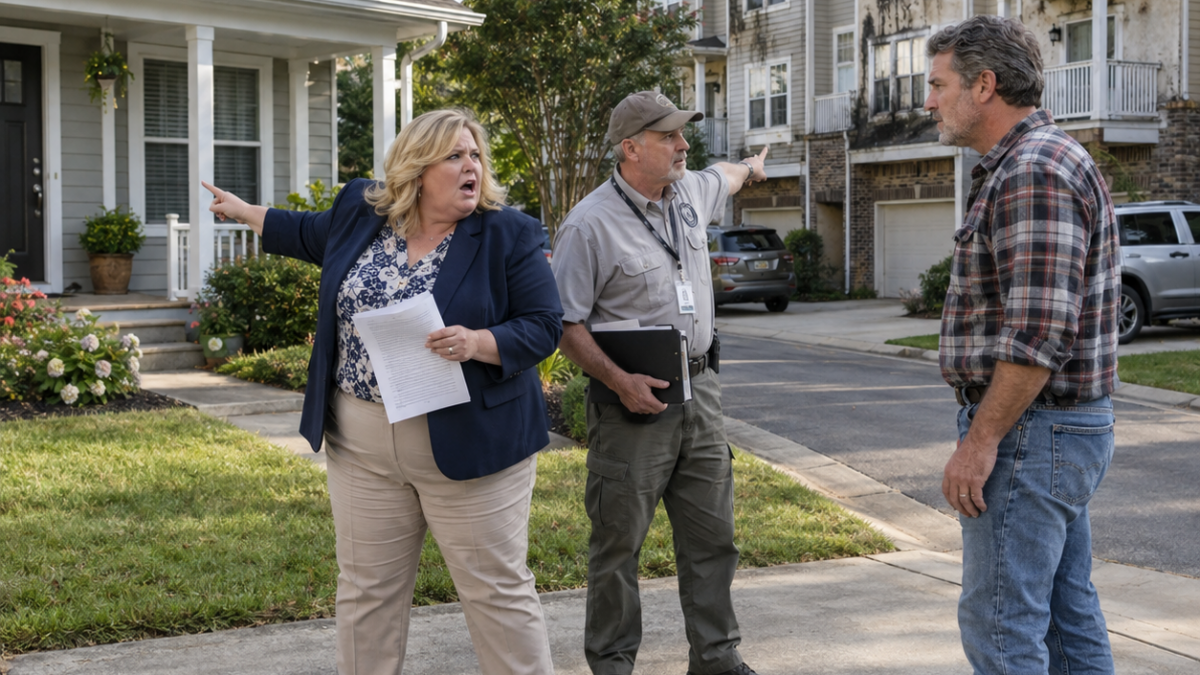
By then Dave Jensen, the county code supervisor, had joined us.
He had arrived halfway through the inspection of Maria’s house after I invited the county to observe.
Dave looked at the thermal image.
His eyebrows pulled together.
“That’s substantial.”
Marcus nodded.
“Could be a plumbing leak.”
“No plumbing on that wall,” I said.
Marcus looked at me.
“You have plans?”
“For the development?”
“The original site documents.”
“I can get them.”
“Good.”
He pulled an infrared thermometer from his belt.
Then another meter.
He took readings from my house first.
Dry baseline.
Then aimed toward the townhouse.
He frowned.
“Twelve here.”
He repositioned.
“Seventy-plus relative reading there.”
Dave stepped closer.
“From this distance?”
“Enough to concern me.”
“What do you think?”
Marcus looked toward the townhouse.
“Water is getting into that wall.”
Dave shoved his hands into his jacket pockets.
“You can’t know how far.”
“No.”
“One unit?”
“Maybe.”
“Construction defect?”
“Maybe.”
Marcus turned toward him.
“See, Jensen, unlike whoever filed that complaint against Sterling, I enjoy evidence before conclusions.”
Dave almost smiled.
I did.
Then Marcus looked back at the townhouse.
“If we find the same signature in non-adjacent units, that changes things.”
Dave became serious.
“My jurisdiction is the complaint at Sterling’s address.”
“Which you just closed.”
“I intend to.”
“You agree the tenant house has no violations?”
Dave looked at his notes.
“None that support the complaint.”
Marcus pointed across the fence.
“Then maybe somebody ought to complain about that.”
Dave lowered his voice.
“Officially, I cannot tell you to inspect private HOA homes without owner consent.”
“Wouldn’t dream of it.”
“Unofficially…”
He hesitated.
“My daughter has asthma.”
Marcus said nothing.
Dave stared at the blue-purple image.
“If residents invite you in and you find credible evidence, I want the report immediately.”
“You’ll have it.”
Dave looked at me.
“Mr. Sterling.”
“Jack.”
“Jack. I’m going to close your complaint as unfounded.”
“Thank you.”
“I also want a copy of Thorne’s full report.”
“You’ll get it.”
He started toward his county vehicle.
Then stopped.
“And Jack?”
“Yes?”
“If this turns out to be what he thinks…”
He looked toward Crestwood Bluffs.
“…don’t turn it into a neighborhood rumor before we have laboratory results.”
That mattered.
Fear spreads faster than mold.
“I won’t.”
After Dave left, Marcus packed his equipment.
“You know anyone over there?”
“A few.”
“How well?”
“Well enough to ask.”
“Ask permission for exterior scans first. No drama.”
“Thought you liked drama.”
“I like data.”
“You did say you enjoyed bureaucratic goat ropes.”
“That’s different.”
He slammed his truck compartment closed.
“Find me three units that are not beside each other.”
“Why three?”
“One wet wall means a leak.”
He held up two fingers.
“Two means coincidence is getting uncomfortable.”
A third.
“Three means we start talking about systems.”
I knew exactly who to call first.
Colonel Harold Whitmore lived in Unit 8.
Retired Air Force.
Seventy-one.
Perfect posture.
Pressed jeans.
American flag outside his townhouse every morning at sunrise.
We had never been close, but veterans have a way of recognizing one another even across property disputes.
He answered on the second ring.
“Sterling.”
“Colonel.”
“Don’t call me Colonel unless you want me to call you Major.”
“Fair.”
“What’s happening?”
“You heard about Karen’s complaint?”
“The whole development has heard.”
“And?”
“I think she’s an idiot.”
“That simplifies this.”
“What do you need?”
I explained the inspection.
My house had passed.
But my inspector had noticed abnormal moisture on an HOA building.
Whitmore went quiet.
“How abnormal?”
“We don’t know yet.”
“What do you want from me?”
“Permission to scan your exterior wall.”
“When?”
“Tomorrow morning.”
“0900.”
“Thank you.”
“Sterling?”
“Yes?”
“If you find anything, you tell me before Karen.”
“You have my word.”
The next call was to Frank Delaney in Unit 14.
Former Marine sergeant.
The first time we met had been at the VFW, where we argued for twenty minutes about whether Army engineers or Marine combat engineers complained more.
Frank claimed the Army.
He was wrong.
When I told him Marcus was a retired Marine, his response was immediate.
“Bring him.”
“That’s all?”
“Anything that irritates Karen is welcome on my patio.”
“This isn’t about irritating Karen.”
“Shame.”
“Frank.”
“All right. Serious. What are you looking for?”
“Moisture.”
Pause.
“How much?”
“Potentially a lot.”
His tone changed.
“My wife keeps saying the bedroom smells musty after rain.”
I straightened in my chair.
“How long?”
“Year or so.”
“Did you report it?”
“To Karen.”
I stopped breathing for half a second.
“When?”
“Last spring.”
“What happened?”
“She sent maintenance.”
“And?”
“They said humidity.”
“Do you have the email?”
“Probably.”
“Find it.”
The third family was younger.
Daniel and Rebecca Collins in Unit 12.
Their son Ethan had developed a persistent cough.
They had blamed school colds.
Then allergies.
Then the changing season.
When I mentioned hidden moisture, Rebecca’s voice became frightened.
“Could that cause coughing?”
“It can contribute to respiratory problems, but we don’t know what you have.”
“Can your inspector come?”
“Yes.”
“Please.”
The next morning Marcus and I started with Whitmore.
He was waiting at exactly nine.
Of course.
Marcus scanned the exterior.
The thermal bloom appeared immediately.
Lower wall.
Same shape.
Same location relative to the slab.
He took direct moisture readings.
His face tightened.
“High.”
Whitmore crossed his arms.
“How high?”
“High enough that I want interior access.”
“Do it.”
We entered.
The house smelled clean.
No obvious visible mold.
Marcus removed the baseboard from one discreet section near the wall.
Behind it, the drywall paper felt cool.
He pressed a meter against it.
The reading climbed.
Whitmore watched.
“Should I be worried?”
Marcus answered carefully.
“You should be informed.”
“That’s not the same thing.”
“No.”
“Am I in danger?”
“I don’t know yet.”
That was the right answer.
People imagine experts always speak with certainty.
Good experts know when certainty becomes dishonesty.
At the Collins home, the findings were worse.
Rebecca led us toward Ethan’s room.
“He coughs more at night.”
Marcus scanned the wall beneath his window.
Blue-purple.
Moisture.
He crouched near the baseboard.
Then looked at me.
“Jack.”
I heard it in his voice.
He removed a small section of trim with permission.
The paper backing behind the drywall was dark.
Not enough for a conclusion.
Enough for a sample.
Rebecca covered her mouth.
“Oh God.”
Marcus immediately raised one hand.
“Do not panic.”
“That’s mold.”
“It appears to be fungal growth. We test it before naming it.”
“My son sleeps here.”
“I know.”
Her eyes filled.
Daniel stepped beside her.
“What do we do tonight?”
Marcus looked around.
“Move him to another room away from this wall until we have results. Don’t tear anything open yourself. Disturbing material can spread spores.”
Rebecca looked at me.
“Did Karen know?”
“I have no evidence she knew about this house.”
Not yet.
At Frank’s unit, Marcus barely needed the camera.
The musty smell appeared the second we entered the back bedroom.
Frank grimaced.
“See? That.”
His wife Linda stood behind him.
“I’ve complained about it for a year.”
“To whom?” Marcus asked.
“HOA.”
“Written?”
“Yes.”
My stomach tightened again.
“Can we see the correspondence?”
Linda disappeared into the kitchen.
She returned with printed emails.
The first was dated eleven months earlier.
SUBJECT: MUSTY ODOR / POSSIBLE WATER LEAK.
Linda described dampness after storms.
Dark discoloration behind a dresser.
Persistent odor.
Karen’s response came two days later.
The association had “reviewed the matter” and found no evidence of common-area responsibility.
Residents were reminded to maintain proper interior humidity.
Linda had written again.
Karen replied that repeated unsupported complaints about association-maintained building systems could result in administrative charges if inspections continued to reveal “owner housekeeping issues.”
Marcus read that email twice.
His face became expressionless.
I knew that look.
It was worse than anger.
Frank asked:
“What?”
Marcus handed the email to me.
I read it.
Karen had threatened them for reporting the exact condition we were now measuring.
“Keep this,” I said.
Linda laughed bitterly.
“I kept everything.”
Good.
Marcus moved outside.
Behind an azalea, he took a small permitted core sample.
The material emerged damp.
Soft.
Dark spotting on the paper.
He sealed it immediately.
“Lab,” he said.
Frank stared.
“That’s black mold?”
“We don’t identify by color alone.”
“Looks black.”
“So do a thousand things.”
“What do you think?”
Marcus met his eyes.
“I think we need results.”
By sunset we had four separate townhomes with significant moisture signatures.
Not adjacent.
Different parts of Crestwood Bluffs.
Same basic pattern.
Marcus spent that night reviewing publicly available construction drawings.
At 10:40 p.m., my phone rang.
“You awake?”
“I am now.”
“It’s the slab detail.”
“What?”
“The flashing.”
I sat up.
Sarah beside me stirred.
“What’s wrong?”
I motioned that everything was fine.
Marcus continued.
“The original wall-to-slab transition is poorly designed. If the installer followed these drawings literally and didn’t add proper flashing protection, water can wick behind the cladding.”
“Across the development?”
“If they repeated the detail.”
“Sixty units.”
“Yes.”
I rubbed my forehead.
“Could that cause what we’re seeing?”
“It explains it beautifully.”
“Beautiful isn’t the word.”
“Forensicly, it is.”
“Marcus.”
“Fine. Catastrophically elegant.”
“Better?”
“No.”
He sighed.
“Lab results should come tomorrow.”
They arrived at 3:12 the next afternoon.
Multiple fungal species.
Including Stachybotrys in Frank’s sample.
Marcus called me immediately.
“It’s real.”
I sat in silence.
I had wanted vindication.
I had wanted Karen embarrassed.
I had wanted her to stop terrorizing Maria.
I had not wanted sixty families to discover their houses might be wet inside the walls.
That difference hit me hard.
Sarah found me at my desk.
“What happened?”
I told her.
Her face changed.
“The little boy with the cough?”
“I don’t know whether the mold caused it.”
“But he’s living with it.”
“Yes.”
She sat opposite me.
“And Karen?”
“We have emails showing residents warned her.”
“How many?”
“So far, Frank’s family.”
“That’s enough to ask questions.”
“Yes.”
She studied me.
“You don’t look happy.”
“I’m not.”
“I thought you wanted to beat her.”
“I wanted her to leave Maria alone.”
“That isn’t the same thing.”
“No.”
I looked toward Crestwood.
“What if all sixty have it?”
Sarah reached across the desk.
“Then they needed to know.”
That evening, Marcus completed his preliminary report.
He documented the four units.
Thermal readings.
Moisture readings.
Sampling.
Lab results.
Construction detail.
The report did not claim every home was contaminated.
It said evidence supported a high likelihood of a systemic water-intrusion defect requiring immediate wider investigation.
That distinction mattered.
I forwarded it to Dave at county code enforcement.
He called within twenty minutes.
“This is enough.”
“For?”
“Formal referrals.”
“What happens?”
“Health department. Building department. Potential state construction review.”
“Can you test all sixty?”
“Not overnight.”
He paused.
“But the HOA is going to have to take this seriously now.”
I almost laughed.
“You haven’t met Karen.”
That same evening, Crestwood Bluffs residents received an email.
SPECIAL EMERGENCY MEETING.
Tuesday.
7:00 p.m.
Subject:
Legal Action Concerning Nuisance Property at 125 Sterling Lane.
I stared at it.
Sarah read over my shoulder.
“She’s still going after Maria’s house?”
“Yes.”
“After the county closed the complaint?”
“Apparently.”
“What does she want?”
I opened the attached agenda.
There it was.
Proposed authorization of up to $50,000 in association funds to pursue legal remedies intended to force condemnation or demolition.
Sarah whispered:
“She is insane.”
“Not insane.”
I hated that word when people used it to avoid responsibility.
“She thinks she can still win.”
I called Ben Carter.
Ben was a former JAG officer working with a veterans legal clinic.
I had contacted him after the county complaint.
He had been waiting for the HOA to make its next move.
When I read the agenda, he laughed once.
“She gave us the stage.”
“That’s what Marcus said.”
“What does the new report show?”
I summarized it.
Ben became serious.
“Residents know?”
“Only the ones tested.”
“County?”
“Yes.”
“Good.”
“What do you suggest?”
“Do absolutely nothing publicly until the meeting.”
“That seems irresponsible.”
“The affected homeowners already know. County has the report. The proper agencies have it. I’m talking about Karen.”
He paused.
“Let her make her case.”
“Why?”
“Because right now she can claim misunderstanding.”
“And after?”
“If she publicly repeats claims the county has already determined are unfounded while asking for fifty thousand dollars to attack your property, she establishes exactly how reckless this has become.”
“You want her to talk herself into the ground.”
“I want everyone to hear her before they hear us.”
Tuesday came slowly.
Maria almost refused to attend.
“I don’t want people looking at us.”
“They’re voting whether to spend money trying to remove your home.”
“I know.”
“That’s why you should be there.”
She shook her head.
“What if they hate us?”
“Then they should have to look at the family they’re voting against.”
That sounded harsh.
Her face fell.
I regretted it.
“Maria, you don’t owe anybody bravery.”
She looked at her children playing outside.
“I’m tired of them making me feel ashamed.”
I waited.
“I didn’t do anything.”
“No.”
“My kids didn’t do anything.”
“No.”
“Then I’m going.”
The clubhouse was packed.
More than a hundred residents.
That surprised me.
Karen had spent days framing the meeting as an urgent defense of Crestwood Bluffs.
She had circulated photographs of Maria’s house.
Close-ups.
Selective angles.
A weed along the fence.
A child’s plastic slide.
A ten-year-old sedan.
She called it declining standards.
She implied renters brought instability.
That bothered me almost more than the structural lies.
Maria worked harder than most people I knew.
Her children were polite.
The rent was fair.
The house was safe.
But Karen needed an outsider.
Someone to blame.
Maria sat in the back between Frank and Linda.
Ben sat beside me in the second row.
Marcus stood near the wall carrying a hard case.
Whitmore was across the aisle.
Rebecca and Daniel Collins sat together holding hands.
Karen entered wearing a red blazer.
I swear some people choose clothing based on how they want history to remember them.
She sat at the center of the board table.
Four other board members surrounded her.
Not one looked comfortable.
Karen struck the gavel.
“This emergency meeting will come to order.”
The room quieted.
She began calmly.
That was strategic.
She described Crestwood Bluffs as a “premier residential community.”
Talked about protecting investments.
Protecting children.
Maintaining health and safety.
Then she introduced me.
Not by name.
As “the absentee landlord.”
I was sitting twenty feet away.
Ben glanced sideways.
I whispered:
“Let her.”
Karen displayed the first photo.
Maria’s children’s slide.
“This type of permanent play structure has never been approved.”
A few residents nodded.
Next image.
Maria’s car.
“This aging vehicle has repeatedly been parked in visible areas.”
Ben wrote something.
Then the dormant grass.
The porch fixture.
Satellite dish.
Karen slowly transformed ordinary life into evidence of decay.
Then she moved to the health allegation.
“This property has been the subject of serious concerns regarding structural integrity, rot, and possible biological contamination.”
That was the line.
Ben wrote another note.
Karen continued.
“Although county officials have failed to act with the urgency our residents deserve—”
I nearly stood.
Ben touched my arm.
“No.”
He was right.
Let her finish.
She held up the original complaint.
“This board cannot sit idle while a potentially uninhabitable rental property threatens the safety and value of Crestwood Bluffs.”
She turned toward the board.
“I am requesting authorization for up to fifty thousand dollars from reserves to retain specialized counsel and pursue every available legal remedy, including court action compelling the county to condemn and remove the structure.”
Murmurs.
Some supportive.
Some uncertain.
Karen’s closest ally made the motion.
Another seconded it.
Karen smiled.
“All in favor—”
“Point of order.”
Ben stood.
Karen’s smile disappeared.
“This is an association meeting.”
Ben remained polite.
“My client is the property owner directly targeted by your proposed expenditure.”
“You are not members.”
“Article Seven, Section Four of your own bylaws permits the subject of a proposed association legal action to respond before authorization.”
Several board members looked toward their copies.
Ben didn’t.
He already knew it.
Karen’s jaw tightened.
“You have five minutes.”
Ben smiled.
“Thank you.”
He did not walk forward.
Instead, he turned toward Marcus.
“Mr. Thorne?”
Marcus lifted his case and walked to the front.
Karen stared.
“Who is this?”
Marcus placed six bound reports on the table.
“My name is Marcus Thorne.”
He listed his credentials.
Retired Marine combat engineer.
Former chief building official.
Forensic building consultant.
Forty years of structural and environmental inspection experience.
Then he looked directly at Karen.
“Mrs. Blevens, I am the man who inspected the property you just spent twenty minutes describing.”
Her expression changed slightly.
Marcus connected his laptop to the projector.
Karen’s photo of Maria’s grass disappeared.
A clean exterior photograph of the tenant cottage filled the screen.
Marcus began.
“Foundation.”
Next slide.
“No distress.”
“Floor structure.”
Next.
“No deficiency.”
“Roof framing.”
Next.
“No deficiency.”
“Electrical.”
Next.
“Code compliant for applicable installation and upgrades.”
“Plumbing.”
“No concealed leakage.”
“Indoor moisture.”
“Normal.”
“Air sampling.”
“No elevated mold condition.”
Every slide was simple.
Photograph.
Measurement.
Conclusion.
Karen interrupted.
“This is a privately hired inspector.”
Marcus stopped.
“Yes.”
“You were paid by Mr. Sterling.”
“Yes.”
“So you are not independent.”
Marcus nodded slowly.
“I expected that question.”
He changed slides.
County Code Enforcement.
CASE CLOSED.
Complaint unfounded.
Dave Jensen’s signature.
The room shifted.
Marcus said:
“The county inspected alongside me.”
Karen’s face hardened.
“He has connections.”
I almost laughed.
Marcus did not.
“Mrs. Blevens, concrete doesn’t care who you know.”
A few people chuckled.
“Moisture meters don’t vote.”
More.
“Air samples don’t join HOAs.”
Louder laughter.
Marcus continued.
“The house at 125 Sterling Lane is safe.”
He paused.
“Your complaint describing pervasive decay, structural sagging, and biohazard conditions is unsupported by measurable evidence.”
Karen leaned toward the microphone.
“That is your opinion.”
Marcus stared at her.
“No.”
His voice was almost gentle.
“That is the data.”
The room went silent.
Then he changed slides.
A thermal image appeared.
Blue-purple moisture blooming across a townhouse wall.
“Now we discuss your actual problem.”
Karen looked confused.
Residents leaned forward.
“This is Crestwood Bluffs Unit 18.”
Next image.
“Unit 8.”
Next.
“Unit 12.”
Rebecca squeezed Daniel’s hand.
Next.
“Unit 14.”
Frank crossed his arms.
Marcus explained the readings.
Water intrusion.
Repeated wall pattern.
Construction details.
Samples.
Laboratory results.
Then he showed the photograph from behind Frank’s baseboard.
Dark fungal growth.
People began whispering.
One woman said:
“Oh my God.”
Karen stood.
“What is this?”
Marcus turned toward her.
“A real health and building concern.”
“This has nothing to do with this meeting.”
“It has everything to do with your fiduciary obligation before spending fifty thousand dollars pursuing a house the county has already cleared.”
Karen pointed toward me.
“He arranged this.”
Marcus nodded.
“He hired me to inspect his property.”
“So this is retaliation.”
“No.”
“Then why were you snooping around our homes?”
Homeowners started shouting.
“He had permission!”
“That’s my unit!”
“I invited him!”
Frank stood.
“He inspected mine because my wife reported moisture to Karen eleven months ago.”
The room froze.
Karen’s face changed.
Frank held up her email.
“She told us it was housekeeping.”
Someone shouted:
“You knew?”
Karen slammed the gavel.
“Sit down.”
Frank remained standing.
“You threatened to charge us if we kept complaining.”
“I said no such thing.”
Linda rose beside him.
“I have the email.”
That was the moment Karen lost control of the room.
Questions came from everywhere.
“How many houses?”
“Is it mold?”
“Are our children safe?”
“Why weren’t we told?”
“Does insurance cover this?”
Marcus raised both hands.
“Listen.”
His command voice cut through the noise.
“I have preliminary evidence from a limited sample.”
He emphasized every word.
“I am not saying every home contains dangerous mold.”
That calmed some people.
“I am saying repeated moisture signatures across separated units strongly indicate a systemic building-envelope defect.”
A woman asked:
“What does that mean?”
“It means you need a full professional assessment of this development immediately.”
“And the mold?”
“Testing found significant fungal contamination in at least one sampled wall cavity, including Stachybotrys.”
Rebecca stood.
“My son sleeps against that wall.”
Her voice broke.
Every head turned.
“He’s been coughing for months.”
Daniel put an arm around her.
Karen said:
“That doesn’t prove the house caused anything.”
Technically true.
But it was the worst possible moment to say it.
Rebecca stared at her.
“I asked your office about dampness last year.”
Karen looked away.
Another resident stood.
“So did I.”
Then another.
“We complained about the basement smell.”
Another voice:
“I reported condensation behind the wall.”
People began talking over one another.
I looked at Ben.
He whispered:
“This just became bigger.”
Much bigger.
Marcus held up the report.
“Copies of my findings were sent this afternoon to county code enforcement, county health officials, and the appropriate state construction authorities.”
Karen stared.
“You did what?”
“My job.”
“You had no authority!”
“I don’t need HOA authority to report a potential public health and building safety concern discovered with homeowner permission.”
The board members beside Karen began moving physically away from her.
Only inches.
But enough.
One of them, Susan Blake, looked at the report.
Then Karen.
“Did you know people had complained about moisture?”
“No.”
Frank raised the email.
Karen snapped:
“That isn’t what I said.”
Susan’s face hardened.
“Karen.”
“This meeting is about Sterling’s property.”
“No,” Susan said.
“Not anymore.”
Karen grabbed the gavel.
“We are voting on the original motion.”
Susan shook her head.
“I withdraw my second.”
The man who had made the motion stared.
“I withdraw the motion.”
Karen looked betrayed.
“You can’t.”
“I just did.”
A resident called from the back:
“Motion to suspend Karen pending investigation.”
The room exploded.
Karen stood.
“That is out of order!”
Whitmore rose.
Calm.
Military.
“Article Fourteen, Section Six.”
Karen stared at him.
He continued.
“A president may be temporarily suspended by board vote where alleged misconduct creates material risk to the association.”
One board member flipped frantically through the bylaws.
Found it.
Read.
Looked at Karen.
Susan made the motion.
Another board member seconded.
Karen’s voice rose.
“You people have lost your minds!”
The vote:
Four to one.
Karen was suspended.
The only no vote was hers.
She stood behind the table gripping the gavel.
Nobody looked frightened anymore.
That was the end of her presidency.
But it was nowhere near the end of what she had caused.
The independent testing began the following week.
Not Marcus alone.
The new acting board hired a large environmental and building-envelope firm.
County inspectors participated.
Health officials monitored the highest-risk units.
Walls were opened.
Cavities sampled.
Moisture mapped.
The findings grew worse by the day.
First six units.
Then nine.
Then fourteen.
Fourteen townhomes showed contamination severe enough that officials considered continued occupancy unsafe until professional remediation could be completed.
Families were told to leave.
Some had hours to gather essentials.
I watched children carry backpacks out of homes their parents had spent their life savings buying.
I watched elderly residents stand beside cars, crying.
This was where revenge stopped feeling satisfying.
These people had lived under Karen too.
They were not my enemies.
Maria understood that before I did.
One afternoon she came up the hill carrying coffee.
“You’re angry.”
“At Karen?”
“At everything.”
I looked toward Crestwood.
Temporary fencing surrounded several units.
Contractors in protective equipment moved in and out.
“I wanted her to leave you alone.”
Maria nodded.
“I know.”
“I didn’t want this.”
“You didn’t put mold in their walls.”
“No.”
“You didn’t hide complaints.”
“No.”
“You found it.”
“Marcus found it.”
“Because you protected our house.”
That shut me up.
Maria looked toward her little cottage.
“My kids are safe because you didn’t let someone scare us away.”
Then toward Crestwood.
“Maybe those kids will be safe because Karen tried.”
That perspective changed something.
The investigation expanded to all sixty townhomes.
Every one showed some degree of moisture intrusion related to the repeated wall-to-foundation detail.
Not every home had dangerous contamination.
Some required moderate repairs.
Some extensive.
Fourteen were the disaster cases.
Entire lower wall sections had to be removed.
Flooring discarded.
Insulation stripped.
Framing cleaned or replaced.
Ventilation systems evaluated.
Families relocated.
The preliminary repair estimates climbed into millions.
Eight million.
Then ten.
Then figures approaching twelve depending on full scope.
The financial consequences hit Crestwood like a second disaster.
Insurance coverage became disputed.
Then investigators found something worse.
Karen had received prior written complaints.
Not one.
At least two documented early complaints about dampness, odor, and possible leakage.
She had minimized them.
In one case, threatened further charges if residents continued demanding inspections without “substantiated evidence.”
The carrier argued the association had failed to disclose known conditions.
Coverage became a legal battlefield.
Then came the developer.
Karen had always spoken warmly about him.
A visionary.
The man who “created Crestwood.”
Turns out their relationship was closer than most residents understood.
He was a family acquaintance.
She had communicated with him privately after early complaints surfaced.
Investigators obtained emails suggesting he told her moisture was “normal settlement-phase humidity” and recommended avoiding broad inspections that might “alarm owners unnecessarily.”
Karen followed that advice.
Whether because she believed him, wanted to protect property values, or wanted to protect him became a major question.
Then the developer’s company collapsed.
Bankruptcy.
Litigation.
He became extremely difficult to reach.
Crestwood homeowners were left with homes they could not easily sell and repair costs they had never imagined.
Anger turned toward Karen completely.
But I refused to join the mob.
Local television called me.
Then state media.
Then national outlets.
The angle wrote itself:
HOA TRIES TO CONDEMN SAFE RENTAL—INSPECTION FINDS MOLD INSIDE HOA HOMES.
I gave one interview.
Only one.
The reporter asked:
“Do you feel vindicated?”
“Yes.”
“Do you feel Karen got what she deserved?”
I paused.
“That’s not the important question.”
“What is?”
“Whether the families living there get safe homes again.”
She seemed surprised.
I continued.
“This started because somebody confused authority with expertise.”
I pointed toward Maria’s cottage behind us.
“My responsibility as landlord is to make sure the people living in that house are safe.”
Then Crestwood.
“The HOA’s responsibility was to do the same for its members when warning signs appeared.”
“Do you blame Karen?”
“I blame documented decisions where the evidence supports blame. I’m not interested in performing anger for television.”
That quote made the segment.
So did Maria.
She almost declined.
Then she agreed on one condition.
Her children would not be filmed.
The reporter asked how Karen’s notices affected her.
Maria’s answer broke my heart.
“I believed her.”
“What do you mean?”
“When somebody with a title tells you your children are unsafe, you believe them.”
Her eyes filled.
“I spent nights wondering whether I was a bad mother because I couldn’t afford to move immediately.”
The reporter lowered her voice.
“And the house was safe.”
Maria looked directly toward the camera.
“Yes.”
That interview mattered more than mine.
Because it showed what Karen’s campaign had actually done.
The letters were not just paper.
They had frightened a woman who was already working fourteen-hour days.
They made her children ask whether they were losing their home.
They made her feel ashamed for living in a house that inspectors later described as exceptionally sound.
Karen’s power had always depended on making ordinary people question themselves.
Maria stopped doing that.
Crestwood’s acting board sent me a formal apology.
Then another addressed to Maria.
The second mattered more.
It acknowledged that the association had no jurisdiction over her rental, that its health allegations had been unfounded, and that direct communications telling her to seek other housing should never have been sent.
Maria framed it.
Not because she admired the HOA.
Because she wanted her children to remember something.
“What?”
I asked.
“That grown-ups can be wrong even when their letters look official.”
I laughed.
“That’s a good lesson.”
She smiled.
“I learned it late.”
Meanwhile, Marcus became a local celebrity.
He hated every second.
His phone never stopped ringing.
Building owners.
Attorneys.
Insurance companies.
Reporters.
One morning he called me.
“You ruined retirement.”
“You charged me five thousand dollars.”
“Not enough.”
“You enjoying yourself?”
“No.”
“You sound happy.”
“I found three more bad flashing installations yesterday.”
“Marcus.”
“Fine. Maybe a little.”
Ben Carter’s veterans clinic received more donations after the story ran.
He used the attention to create a small property-rights legal fund for veterans and low-income homeowners dealing with abusive association practices.
That made me proud.
If we were going to drag something ugly into daylight, something useful should grow behind it.
The criminal investigation into Karen moved more slowly.
Months.
Documents.
Depositions.
Interviews.
Accounting.
Construction records.
Emails.
The district attorney eventually alleged that she had knowingly concealed material building complaints while continuing to represent the development as free from systemic defects.
There were also questions regarding communications with the developer and financial decisions connected to delaying investigation.
Karen initially denied everything.
Then blamed the developer.
Then the board.
Then management.
Then homeowners for failing to maintain humidity.
Then Marcus.
Then me.
Her lawyer eventually stopped letting her speak publicly.
Probably wise.
The legal outcome was less theatrical than people expected.
No screaming courtroom confrontation.
No dramatic confession.
Just negotiations.
Evidence.
A plea agreement.
Karen accepted responsibility for serious fraud-related and endangerment offenses arising from the concealment and resulting harm.
She avoided prison under the negotiated disposition but received years of probation, ongoing restitution obligations, and a permanent prohibition against serving in HOA, corporate, or other fiduciary leadership capacities.
Her house was among the severely affected units.
She had spent years insisting that my little tenant cottage lowered Crestwood property values.
Then her own home became one of those people could not occupy until remediation.
I tried not to appreciate the irony.
I failed.
But the satisfaction didn’t last.
When her house eventually went through foreclosure, it looked sad.
Yellow notices.
Dead landscaping.
Curtains gone.
No pink flowers in the planter.
No clipboard.
Just another damaged townhouse among damaged townhouses.
Sarah and I stood near our driveway one morning watching contractors arrive.
“She wanted Maria homeless,” I said.
Sarah looked at me.
“And now?”
“She almost became the thing she threatened other people with.”
Sarah shook her head.
“Be careful.”
“With what?”
“Enjoying it too much.”
“I’m not.”
“Good.”
I knew why.
Because punishment without repair leaves everyone living inside the damage.
Crestwood had to rebuild.
That became the harder story.
Residents formed committees.
Not cosmetic committees.
Real ones.
Construction oversight.
Insurance.
Legal recovery.
Temporary housing.
Health communication.
Financial planning.
Whitmore helped coordinate logistics.
Exactly what you would expect from a retired colonel.
Frank somehow ended up leading contractor oversight.
He claimed it was because “Marines know when somebody is feeding them garbage.”
Rebecca Collins became involved in resident health communication after Ethan’s cough improved while their family stayed elsewhere during remediation.
She never claimed the mold definitively caused his symptoms.
Neither did I.
But she became relentless about making sure residents received testing results promptly.
“No mother should have to hear important information through neighborhood gossip,” she said.
That became policy.
Transparency.
Real transparency.
Not newsletters about approved mulch.
Board meetings changed.
Minutes were detailed.
Structural complaints required professional review.
Major health concerns automatically triggered outside inspection.
Conflicts of interest had to be declared.
And one rule, proposed by Frank, passed unanimously:
No HOA officer could retaliate against a resident for raising a safety concern.
Karen would have hated it.
That alone made Frank love it.
The remediation took more than a year.
Some sections of Crestwood looked like a construction zone.
Siding removed.
Plastic barriers.
Dumpsters.
Contractor trucks.
Families moving in and out.
The perfect beige appearance Karen had worshipped disappeared completely.
And something surprising happened.
People became closer.
When nobody could pretend everything was perfect anymore, they started helping.
Families hosted displaced neighbors.
Meal trains appeared.
Children shared rooms.
People stored furniture in garages.
Whitmore coordinated moving volunteers with military precision.
“Truck One to Building C.”
“Colonel,” I told him, “they’re couches.”
“Logistics is logistics.”
He was right.
Maria joined the meal rotation.
That impressed me.
She had every reason to resent Crestwood.
Instead, she made trays of enchiladas for displaced families.
One evening I found her loading food into my truck.
“Why are you doing this?”
She looked confused.
“They need dinner.”
“They were part of the HOA that harassed you.”
“Karen harassed me.”
“Some of them supported her.”
“Some didn’t know.”
She closed the tailgate.
“And hungry people are still hungry.”
That woman taught me more about victory than any military school ever did.
The Garcias stayed in the cottage.
Leo grew taller.
Sophia lost her front teeth.
Their plastic slide eventually cracked and was replaced by a small wooden playset.
Maria came to me with the catalog.
“Do I need approval?”
I stared at her.
She tried to keep a straight face.
I pointed toward Crestwood.
“Ask Karen.”
Maria laughed so hard she had to sit down.
The little house changed too.
Not because Karen was right.
Because time changes things.
I repainted it.
Replaced two windows.
Added insulation.
Built Maria a small covered patio.
When I finished, Marcus came by.
He walked around criticizing everything.
“That flashing is acceptable.”
“Thank you.”
“Don’t sound proud.”
“You’re standing on my land.”
“That deck ledger needs another fastener.”
“It has six.”
“Use eight.”
“Leave.”
He smiled.
That was Marcus’s version of friendship.
The repaired Crestwood townhomes gradually reopened.
Fourteen condemned units returned one by one after clearance testing.
Families came home.
The association sued multiple parties involved in development and construction.
Some claims settled.
Others dragged on.
Insurance litigation continued.
The final financial picture was painful, but not quite the total ruin residents had feared in the first chaotic weeks.
Still, people lost money.
Some moved.
Some refinanced.
Some delayed retirement.
That was the real cost of ignored problems.
People like Karen talked about property values as though they were abstract numbers.
They weren’t.
A home was retirement.
College savings.
Safety.
Memory.
Years of mortgage payments.
A bedroom where a child slept.
A kitchen where a spouse made coffee every morning.
Once I saw Crestwood families standing outside contaminated homes with suitcases, I stopped enjoying any joke about “property values.”
There was nothing funny about it.
A year after the meeting, the new Crestwood board contacted me.
Their new president was Susan Blake.
The same board member who had withdrawn her support for Karen’s lawsuit the night Marcus presented his findings.
Susan asked to meet at my house.
She arrived alone.
No clipboard.
Good start.
“Jack.”
“Susan.”
“I want to discuss the property boundary.”
My shoulders tightened automatically.
She saw it.
“Not like that.”
“All right.”
“We want to plant a privacy buffer.”
I waited.
“Mature evergreens,” she continued. “On our side of the line. Professionally maintained.”
“Why?”
“Because we spent years treating your property as though it were a problem we had to solve.”
She looked toward Maria’s cottage.
“We were wrong.”
I appreciated the word we.
Not Karen.
We.
Leadership includes owning what the institution allowed.
Susan continued.
“The board believes a physical landscape boundary would make something clear to future boards.”
“What?”
“That Crestwood ends there.”
I looked along the fence.
“And my land begins here.”
“Yes.”
“Who pays?”
“We do.”
“I don’t want association money wasted on a gesture.”
“It isn’t just a gesture. Privacy benefits our residents too.”
Fair.
“What species?”
She laughed.
“I was warned you’d ask.”
“Of course.”
“Evergreen screening varieties recommended by an arborist.”
“No invasive roots near the drainage line.”
“Already noted.”
I smiled.
“Someone did their homework.”
“We’re learning.”
I agreed.
The trees arrived two months later.
Huge root balls.
Tall evergreens nearly twenty feet high.
A crane lowered them into a prepared line along the Crestwood side of the boundary.
Maria’s children watched from the yard.
Leo asked:
“Are they building a wall?”
“No.”
“What are they doing?”
“Learning where their yard ends.”
He considered that.
“Adults need trees for that?”
“Sometimes.”
The evergreens changed the view.
From my porch, instead of beige walls, I saw green.
The trees softened noise.
Created privacy.
Marked the boundary without hostility.
I liked them more than I expected.
One Saturday afternoon almost a year later, I was checking drip irrigation near the tree line when an old sedan stopped on the Crestwood side.
A woman stepped out.
Thin.
Gray-brown hair.
Plain clothes.
For several seconds, I didn’t recognize her.
Then she looked toward Maria’s cottage.
Karen.
I stood.
She didn’t come closer.
Maybe she knew better.
Maybe the court told her to stay away.
Maybe she simply had nowhere left to stand with authority.
She looked at the evergreens.
Then the cottage.
Leo was in the yard hitting a baseball from a tee.
Sophia chased one that rolled toward the porch.
Maria came outside carrying laundry.
Ordinary life.
Karen stared.
Everything she had called a blight was still there.
The house.
The family.
The toys.
My land.
Healthy.
Occupied.
Safe.
Behind her stood Crestwood.
Repaired.
Changed.
No longer hers.
Our eyes met.
For a moment, I imagined every sentence I could say.
“Still think it’s unlivable?”
Too easy.
“Need a place to rent?”
Cruel.
“How are your property values?”
Crueler.
Months earlier, I might have said one.
Standing there, I didn’t want to.
Karen already knew.
Life had answered every question more thoroughly than I could.
So I gave her one slow nod.
Nothing friendly.
Nothing hostile.
Acknowledgment.
We had reached the end.
Her face tightened.
Then softened.
For half a second, I thought she might speak.
She didn’t.
She returned to the sedan.
Drove away.
I never saw her again.
That evening I sat on my porch.
Sunset turned the valley orange.
The new evergreens moved gently in the wind.
Maria came up the path carrying a foil-covered plate.
“Mr. Sterling.”
“Jack.”
“You’re my landlord.”
“You’ve lived here long enough to use Jack.”
She smiled.
“Fine. Jack.”
She handed me the plate.
“Tamales.”
“Your mother’s?”
“Of course.”
I opened the foil.
Steam rose.
“You’re trying to destroy my diet.”
“You don’t have a diet.”
“Exactly.”
Leo and Sophia ran behind her chasing lightning bugs.
They were laughing.
Safe.
Home.
That word caught me.
Home.
Karen had treated Maria’s house as an object.
A visual defect.
An obstacle.
A thing to demolish.
But houses are not just siding and foundations.
I knew that as an engineer.
I understood it better as a landlord.
A safe house gives people room to build a life.
Leo learned multiplication at that kitchen table.
Sophia lost her first tooth there.
Maria came home exhausted from two jobs and knew the key in her hand opened a door nobody could take from her on someone else’s whim.
That mattered more than whether a porch fixture matched an architectural palette.
Maria sat beside me.
“The kids asked something.”
“What?”
“Whether we have to move someday.”
“You planning to?”
“No.”
“Then why?”
She hesitated.
“They still remember the letters.”
I looked toward the cottage.
That hurt.
Children remember fear even after adults call the issue resolved.
“What did you tell them?”
“That this is our home as long as we take care of it and pay our rent.”
“Correct.”
Maria smiled.
“I knew you’d say that.”
Then she became serious.
“You protected us.”
“I protected my property.”
“No.”
She shook her head.
“Don’t do that.”
“What?”
“Pretend it was only engineering.”
I looked away.
Maria continued.
“When the HOA told me my children were living somewhere unsafe, I was ready to run.”
“I remember.”
“I didn’t have money to run.”
“I know.”
“You told me to stay.”
“Because I believed the house was safe.”
“You also said if it wasn’t, you would fix it.”
“That’s my job.”
“Exactly.”
She looked at me.
“You did your job when other people didn’t.”
I sat quietly.
That was a simpler explanation than all the legal fights.
Responsibility.
Karen had wanted authority without responsibility.
I had responsibility without authority over Crestwood.
Marcus had professional responsibility to report what he found.
Dave had responsibility as a public official.
Susan eventually accepted responsibility for repairing trust.
Maria carried responsibility for her children every day.
Maybe communities fail when too many people obsess over who has power instead of asking who is responsible.
The sun disappeared.
Lights came on beyond the evergreen screen.
For the first time in years, Crestwood no longer looked like an enemy.
Just neighbors.
Complicated neighbors.
People who had been fooled.
People who had been frightened.
Some who had supported Karen.
Some who had challenged her.
People rebuilding.
I had spent much of my life in the Army Corps of Engineers.
We liked things measurable.
Loads.
Stress.
Deflection.
Water pressure.
Soil density.
Bearing capacity.
But the hardest structures to repair are human ones.
Trust does not have a moisture percentage.
Fear does not appear on thermal imaging.
You cannot laser-level a community.
You rebuild it through repeated proof.
Tell the truth.
Follow procedure.
Admit mistakes.
Protect the vulnerable.
Fix what is broken.
Then do it again tomorrow.
Crestwood slowly did that.
Their new board held public meetings people actually attended.
Maintenance complaints were logged.
Safety concerns went directly to professionals instead of disappearing into somebody’s inbox.
Reserve funds were monitored.
Independent audits became annual.
Nobody threatened fines because residents asked uncomfortable questions.
A few years later, Susan invited me to a meeting.
“Why?”
“We’re reviewing building maintenance.”
“I’m not in your HOA.”
“I know.”
“Then no.”
“Marcus is coming.”
“When?”
She laughed.
I went.
The meeting lasted three hours.
Boring.
Detailed.
Moisture management.
Roofing reserves.
Drainage.
Insurance.
Nobody shouted.
Nobody waved violation letters.
I loved every terrible minute.
At the end Susan said:
“This is what HOA meetings are supposed to be.”
Marcus grunted.
“Needs better coffee.”
Some things never change.
Maria eventually reduced her second job after receiving a promotion.
Leo joined a youth baseball team.
Sophia became obsessed with animals and announced she intended to become a veterinarian.
The first thing she ever tried to “treat” was a squirrel that did not appreciate her professional ambitions.
The tenant cottage remained theirs.
I kept the rent reasonable.
Not charity.
Fairness.
There is a difference.
They took care of the house.
I took care of the structure.
We respected each other.
That arrangement lasted for years.
Then Maria came to my porch carrying another envelope.
My stomach tightened out of habit.
“What did the HOA do now?”
She laughed.
“Nothing.”
She handed it to me.
Mortgage preapproval.
I looked at her.
“You’re buying?”
She nodded.
Tears already gathering.
“A small place fifteen minutes away.”
“That’s wonderful.”
“I’m terrified.”
“That’s also normal.”
She laughed through tears.
“The kids want a dog.”
“Don’t buy a house.”
“Too late.”
We sat on the porch.
For years I had fought to keep Maria in the cottage.
Now I realized winning meant she eventually became strong enough to leave it on her own terms.
No threats.
No condemnation.
No fear.
Choice.
That is what a home should give you.
A foundation from which you can decide the next step.
When moving day arrived, half of Crestwood came to help.
Whitmore supervised.
Naturally.
Frank carried furniture.
Susan brought boxes.
Rebecca brought lunch.
Marcus appeared unexpectedly.
I stared at him.
“You move furniture now?”
“No.”
He pointed toward the cottage.
“I’m checking your flashing.”
“Go home.”
He grinned.
Leo, now almost as tall as me, carried the last box.
He stopped at the porch.
“You remember when that lady tried to kick us out?”
“I do.”
“I thought she owned everything.”
“A lot of people did.”
He looked toward the evergreens.
“She didn’t.”
“No.”
Then he asked:
“Why did everybody listen to her?”
I considered giving him a complicated answer.
Instead:
“Because they were busy.”
He frowned.
“What?”
“Most abuses of small power don’t begin because everyone agrees.”
I leaned against the railing.
“They begin because reasonable people have jobs, families, bills, and better things to do.”
Leo nodded slowly.
“And the person who wants control has more time.”
“Sometimes.”
“So what do you do?”
“Pay attention.”
That seemed to satisfy him.
He shook my hand.
Then surprised me with a hug.
“Thanks, Mr. Sterling.”
“Jack.”
“Still weird.”
“Go move your box.”
Maria cried when they drove away.
So did I.
I will deny that if asked.
The cottage sat empty for two months.
Not because I couldn’t rent it.
Because the silence felt wrong.
Eventually, I rented it to a young firefighter and his wife.
Before signing the lease, he asked:
“Is it true this is the famous mold house?”
I stared at him.
“No.”
“The news said—”
“The mold was across the fence.”
“Oh.”
“This is the famous house that didn’t have mold.”
He laughed.
“Right.”
“Important distinction.”
He signed.
Life continued.
The evergreens grew.
They no longer needed irrigation.
Their branches thickened until most of Crestwood disappeared behind green.
Not hidden in anger.
Buffered.
Separate.
Respectful.
Sometimes I walked the line and remembered Karen standing there years earlier promising splinters and sod.
She had intended those words as a threat.
Instead, they became a marker for everything that followed.
She wanted to erase my grandfather’s little house.
The house outlasted her presidency.
Her lawsuit.
Her accusations.
Her reputation.
It became a symbol of something I hadn’t understood when the fight began.
A good structure does not survive because nobody attacks it.
It survives because its foundation can carry the load.
That applied to the house.
To Maria.
To Crestwood.
To me.
Karen’s entire system looked powerful because it was polished.
But underneath, it had rot.
My tenant cottage looked modest.
Old.
Different.
But underneath, it had old-growth timber, sound joists, dry walls, and a foundation built by people who expected their work to last.
Appearance had fooled her.
That was almost poetic.
One spring morning, Marcus visited again.
No warning.
His truck pulled up while I was pruning trees.
“What are you doing here?”
“Passing through.”
“You live three hours away.”
“Long pass.”
He walked toward the cottage.
The firefighter tenant waved.
Marcus waved back.
Then stared across at Crestwood.
Repairs were complete.
Fresh siding.
Improved flashing.
New drainage.
“You know,” he said, “those buildings are probably better now than when they were new.”
“They should be for what it cost.”
“Painful way to get maintenance.”
“Yes.”
He looked toward me.
“Still angry?”
“At Karen?”
“Yeah.”
I thought.
“No.”
“Liar.”
“Sometimes.”
“Better.”
He leaned against the fence.
“I was angry for you.”
“I noticed.”
“Bullies irritate me.”
“Also noticed.”
“But that wasn’t the interesting part.”
“What was?”
Marcus pointed toward the cottage.
“She attacked the strongest building.”
I smiled.
“That still bothers you?”
“It’s funny.”
He looked toward Crestwood.
“She had sixty buildings under her authority. She ignored problems in those and spent her energy inventing problems over here.”
“That isn’t funny.”
“No.”
He nodded.
“It’s instructive.”
That word stuck with me.
Instructive.
There are people who spend their entire lives inspecting everyone else because self-examination terrifies them.
Organizations can do the same.
Karen obsessed over Maria’s car, toys, grass, porch light, satellite dish.
Visible things.
Easy things.
Things she could control.
Meanwhile water moved quietly behind Crestwood’s walls.
No dramatic warning.
No red violation tag.
Just slow damage.
Leadership often fails exactly like that.
It polishes what everyone can see while neglecting what requires uncomfortable investigation.
I thought about that often afterward.
When residents complained, Karen saw annoyance.
When evidence threatened property values, she saw a public-relations problem.
When my cottage refused to conform aesthetically, she saw an enemy.
She never asked the only question that mattered.
What is actually true?
Marcus did.
That saved people.
Years later, on a warm evening, I sat on my porch drinking a beer.
A new family had moved into one of Crestwood’s repaired townhomes.
Children rode bicycles along the sidewalk.
The development looked peaceful.
Different paint colors had gradually appeared.
The board relaxed some of Karen’s old cosmetic rules.
A blue front door.
A red bench.
Vegetable beds.
One outrageous garden gnome outside Frank’s place.
He had named it Karen.
I told him that was childish.
He bought a second one.
Across the boundary, my cottage lights came on.
Someone laughed inside.
The evergreens moved gently.
I thought about my grandfather.
He had built that little house without knowing it would become the center of a fight generations later.
He just wanted shelter for a man who worked beside him.
That simplicity mattered.
A house should shelter people.
A board should serve residents.
An inspector should report facts.
A landlord should protect tenants.
A leader should tell the truth.
Problems begin when simple responsibilities become secondary to ego.
The whole conflict started because Karen wanted to prove my cottage didn’t belong beside her neighborhood.
In the end, nobody cared whether it matched.
They cared whether walls were dry.
Whether children were safe.
Whether leaders lied.
Whether homes were sound.
Reality has a way of restoring priorities.
One evening Susan walked up my driveway.
No appointment.
She carried a folder.
I groaned.
“Please tell me that isn’t a violation.”
She laughed.
“Peace offering.”
Inside was a photograph.
It had been taken during the final phase of Crestwood’s remediation.
My tenant cottage stood in the foreground.
Behind it, rows of townhomes were wrapped in construction barriers.
The evergreens had not been planted yet.
On the back, someone had written:
THE HOUSE WE TRIED TO REMOVE WAS THE ONE THAT SAVED OURS.
I stared.
“Who wrote this?”
“The board.”
“All of you?”
“Unanimous.”
I shook my head.
“That’s too dramatic.”
“You started Operation Karen’s Overreach.”
“How do you know that?”
“Maria told us.”
“Traitor.”
Susan smiled.
“Keep it.”
I did.
It hangs in my workshop now.
Not because I enjoy remembering Karen.
Because it reminds me how wrong first impressions can be.
Her whole case depended on appearances.
The cottage looked older.
Therefore unsafe.
Crestwood looked new.
Therefore safe.
Maria rented.
Therefore less invested.
Karen owned.
Therefore more legitimate.
None of those assumptions survived contact with facts.
The old house was solid.
The new homes were wet.
The renter became one of the bravest people in the story.
The president became the person who had ignored the truth.
That is why, whenever somebody asks me what finally defeated Karen, I never say revenge.
Revenge made me start the binder.
Maybe.
Pride made me answer all thirty-seven violations.
But revenge didn’t discover the mold.
Inspection did.
Revenge didn’t expose the emails.
Documentation did.
Revenge didn’t remove Karen.
Her own board did.
Revenge didn’t rebuild Crestwood.
Residents did.
And revenge certainly didn’t give me peace.
That came later.
From the sound of children laughing in a safe house.
From Maria arriving with warm tamales.
From trees growing along a respected boundary.
From seeing families move back into repaired homes.
From knowing that when the next resident reports a musty smell, nobody will threaten them with a fine for asking questions.
That may be Karen’s most permanent legacy.
Not the scandal.
The safeguard built afterward.
Crestwood now treats complaints differently because everyone remembers what happened when one person tried to bury them.
Pain became procedure.
Failure became policy.
That is how responsible systems improve.
And somewhere inside that process, the revenge I once wanted became unnecessary.
Karen had threatened to leave my grandfather’s house as splinters beneath fresh sod.
Years later, the cottage still stands.
Solid foundation.
Dry walls.
Children occasionally playing in the yard.
Behind it rises a wall of evergreens that Crestwood planted itself.
Beyond those trees stand sixty repaired homes.
Fourteen families once forced out returned after their houses were cleared.
New residents moved into others.
Life resumed.
Not perfectly.
But honestly.
Sometimes, just before sunset, the light hits the cottage windows and the trees behind it.
For a moment everything looks still.
Safe.
Whole.
And I remember Karen standing at the line between us, convinced she could decide which home deserved to exist.
She was wrong.
The inspection she demanded did not destroy my tenant house.
It proved the house deserved to remain.
Then it crossed her property line and revealed what appearances had hidden.
Rot.
Water.
Mold.
Ignored warnings.
A leadership failure that had been spreading quietly behind beautiful walls.
Karen wanted an inspector to expose my home.
Instead, the inspector exposed her.
But that isn’t why I call it a victory anymore.
I call it a victory because Maria’s children slept safely that night.
Because fourteen other families eventually learned the truth before the damage grew worse.
Because Crestwood rebuilt.
Because complaints are heard now.
Because boundaries are respected.
Because the small house my grandfather built still gives somebody a place to come home to.
Karen tried to leave me with splinters and sod.
Instead, I ended up with deeper roots.
A stronger foundation.
And neighbors who finally understood that the healthiest community is not the one where every house looks perfect.
It is the one where, when somebody says something is wrong behind the walls, people are brave enough to look.
[FULL STORY END]








