PART 2: HOA Karen Called My Ranch “White Trash”—So I Put Her Court-Ordered Apology on a Giant Billboard Facing Her Mansion
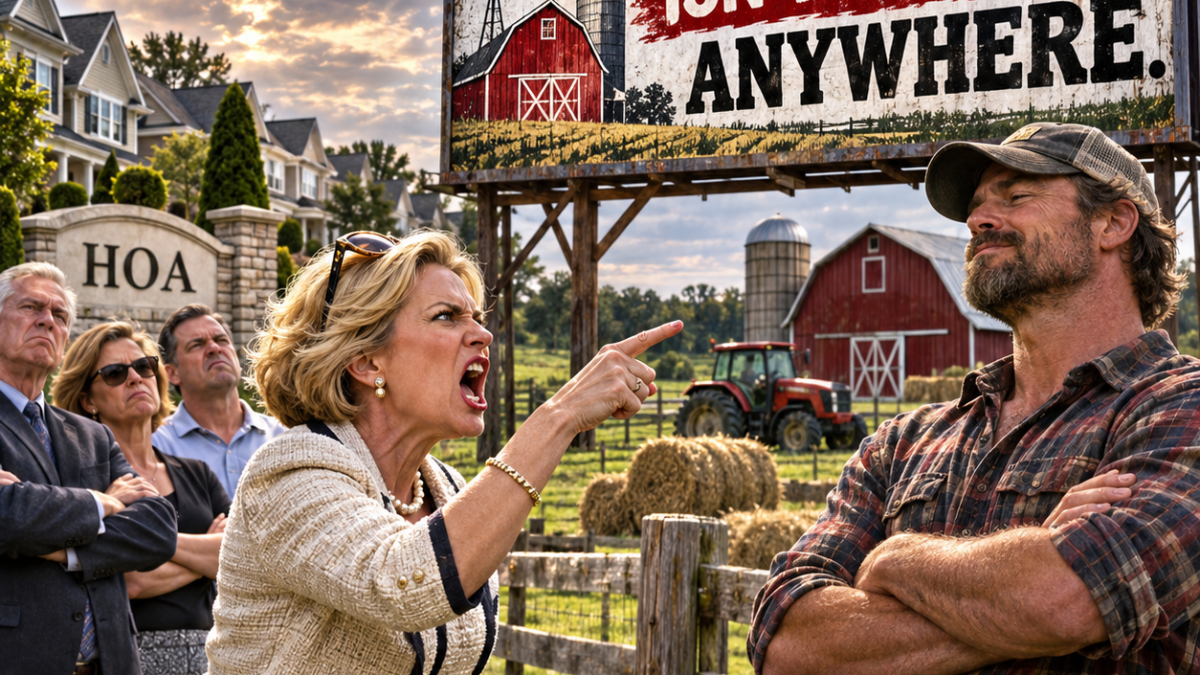
PART 2
Three days later, the first certified letter arrived.
It bore the Cedar Heights HOA logo.
That alone told me something was wrong.
My ranch was not part of Cedar Heights.
It predated the development by seventy-three years.
No covenants from their subdivision applied to my property.
No HOA dues.
No architectural committee.
No landscaping authority.
Nothing.
Still, the letter was written like an official violation.
**NOTICE OF AGRICULTURAL NUISANCE**
It accused me of creating excessive dust along the eastern boundary and demanded immediate mitigation.
At the bottom was a “civil compliance assessment.”
$750.
I read it twice.
Then I put it in a file.
I did not respond.
A week later, another arrived.
**UNAPPROVED FENCING MATERIAL**
$1,250.
I filed it.
Then:
**VISUAL BLIGHT**
$2,000.
Then:
**EXCESSIVE EQUIPMENT NOISE**
$1,500.
Then:
**COMMERCIAL AGRICULTURAL ACTIVITY INCOMPATIBLE WITH RESIDENTIAL CHARACTER**
That one made me laugh.
My ranch had been agricultural land while Cedar Heights was still a drawing on a developer’s desk.
I filed that too.
My ranch manager, Tom Avery, watched me place the letter in a cabinet.
Tom had been with me eleven years.
Former Army engineer.
Fifty-six years old.
Gray beginning at the temples.
The kind of man who didn’t waste words.
“How many?”
“Seven.”
“Total?”
“In pretend fines?”
“Yeah.”
“About nine grand.”
Tom shook his head.
“You going to answer?”
“No.”
“She’ll think you’re afraid.”
“Good.”
Tom looked at me.
“You have that look.”
“What look?”
“The one you get when somebody’s digging a hole and you’ve decided not to stop them.”
I closed the drawer.
“Am I that obvious?”
“To me.”
He leaned against the desk.
“You know she’s not going away.”
“I know.”
“You know why she wants that corridor?”
“I have theories.”
“What kind?”
“The kind I’m not ready to say out loud.”
Tom nodded.
That was one of the reasons I trusted him.
He knew when not to ask.
—
Vanessa escalated.
Not quickly.
That would have been easier.
She escalated like a person tightening a rope one inch at a time.
Cedar Heights security vehicles began parking near our eastern property line.
Black SUVs.
Tinted windows.
At first they stayed on association roads.
Then they began idling beside the fence for hours.
At night, high-powered lights swept across our barns.
One morning Luis found fresh tire tracks inside our boundary.
Another day a trail camera caught two security employees stepping over the fence and photographing our equipment.
I saved the footage.
Then survey stakes started moving.
Our southeast corner had been surveyed twice in ten years.
The markers were iron pins driven into the ground with bright orange caps.
One disappeared.
Then another.
Tom replaced them temporarily.
Two days later, they moved again.
“How far?” I asked.
“First one, eleven inches.”
“Second?”
“Three feet.”
“And the third?”
Tom looked at me.
“Almost six.”
That wasn’t landscaping confusion.
That was testing.
I installed better cameras.
Small.
Motion activated.
Infrared.
Placed where they couldn’t be seen from the road.
Every time someone crossed the line, I saved the file.
Date.
Time.
Location.
Vehicle.
Person.
Action.
I had spent much of my professional career doing exactly that.
Building timelines.
Establishing patterns.
Separating what I suspected from what I could prove.
Vanessa thought I was a rancher.
She wasn’t wrong.
But it wasn’t the whole truth.
—
I was also a Supervisory Deputy United States Marshal.
My family knew.
Tom knew.
A few close friends knew.
Most neighbors didn’t.
When I was home, I preferred it that way.
My ranch wasn’t an extension of my badge.
It was the place I went when I wanted to stop thinking about fugitives, warrants, protective details, organized crime, and the million small ways criminals convinced themselves they were smarter than evidence.
So when Vanessa began harassing me, I made a deliberate choice.
I did not use my position.
I did not call federal colleagues and demand intervention.
I did not flash credentials at HOA security.
I did not threaten anyone.
This was, at first, a private property dispute.
I intended to keep it that way.
But then things changed.
The notices started using forged notary stamps.
A document arrived claiming that Cedar Heights had obtained “temporary administrative authority” over disputed boundary land.
No county seal.
No court number.
No judge.
But it carried a notarization that looked real.
I knew enough about evidentiary fraud to recognize the danger.
People believed paper.
Especially paper with stamps.
Another notice claimed the HOA had the right to impose liens against my ranch.
That was nonsense.
But nonsense printed professionally could still frighten banks, contractors, vendors, or employees.
So I stopped treating the letters as harassment.
I started treating them as potential evidence.
Each envelope was photographed before opening.
Each document was handled carefully.
Everything was scanned.
Logged.
Stored.
I created a secure case chronology on a private system.
Not a federal case.
Not yet.
Just my own protection.
But criminals have a habit of telling you what kind of investigation they deserve.
You only have to listen.
—
Six months into the dispute, Vanessa came back.
This time she brought a man named Richard Sloan.
Chief development officer for Bellmont Strategic Properties.
He wore a charcoal suit.
Perfect teeth.
Shoes that cost more than most saddles.
We met on the porch.
Vanessa placed another folder on the table.
“Mr. Mercer, I think we began badly.”
“You called my ranch white trash.”
Richard looked uncomfortable.
Vanessa didn’t.
“I was frustrated.”
“That makes it better?”
“No. But we can move forward.”
Richard slid the folder toward me.
“We’re prepared to substantially improve the offer.”
I did not open it.
“How substantially?”
“Nearly triple appraised value for the corridor.”
Tom, standing near the office door, raised one eyebrow.
I asked, “Why?”
Richard smiled.
“Strategic value.”
“For what?”
“Access.”
“To where?”
He paused.
“A future project.”
“Show me.”
“We’re not prepared to disclose all development plans.”
“Then I’m not prepared to sell.”
Vanessa exhaled sharply.
“This is exactly the problem.”
I looked at her.
“What problem?”
“You refuse to negotiate in good faith.”
“I’m not negotiating.”
“Everyone negotiates.”
“No.”
Richard tried to recover.
“Mr. Mercer, a corridor sale could create generational wealth.”
“My family already has generational wealth.”
He looked surprised.
I gestured toward the ranch.
“This.”
He glanced around as if seeing dirt, cattle, fencing, and barns.
“That may have sentimental value.”
“It has value because nobody gets to buy it from people who don’t want to sell.”
Richard’s smile disappeared.
Vanessa leaned forward.
“You are obstructing economic development for the entire valley.”
“I’m owning my property.”
“You are one man.”
“Yes.”
“And hundreds of millions of dollars are being delayed because of you.”
That was the first honest thing she said.
I looked at Richard.
He stared at the folder.
Then I looked at Vanessa.
“How much are you getting?”
Her face didn’t move.
Richard’s did.
Barely.
But enough.
Vanessa stood.
“That accusation is defamatory.”
“I asked a question.”
“You implied corruption.”
“No.”
I remained seated.
“I asked how much you’re getting.”
She gathered the folder.
“You’ll regret making this difficult.”
I looked at her.
“There it is.”
“What?”
“The threat.”
She froze.
I smiled.
“Thank you.”
They left.
Tom waited until the Range Rover disappeared.
Then he said, “You recorded that, didn’t you?”
I tapped the small camera mounted under the porch beam.
“Every word.”
—
Two weeks later, the first financial lead arrived.
Not from me.
From inside Cedar Heights.
Their association attorney was named Michael Brennan.
I had never met him.
He was a corporate lawyer in his early forties with a reputation for being careful and painfully ethical.
At first he thought Vanessa was simply aggressive.
Then he began noticing invoices.
Large payments.
Consulting retainers.
Infrastructure studies that never seemed to produce studies.
Companies incorporated weeks before receiving six-figure transfers.
He asked questions.
Vanessa told him to stay in his lane.
He looked deeper.
That was her mistake.
Michael found payments routed through shell entities linked to Bellmont Strategic Properties.
He found draft access maps of my ranch.
Not public county maps.
Altered versions.
Boundary lines moved.
Ownership labels changed.
One version already showed the access corridor as belonging to Cedar Heights.
It didn’t.
He found digital notary stamps identical to the ones on the fraudulent notices sent to me.
Then he found a directory.
Password protected.
Buried inside a financial archive.
When he opened it, Michael stopped thinking about HOA governance.
He started thinking about prison.
There were internal emails.
Payment schedules.
Kickback percentages.
Draft land-transfer documents.
Instructions for increasing “compliance pressure” against Mercer Ridge Ranch.
One note read:
**Owner must be financially exhausted before Q4 acquisition window.**
Another:
**Security visibility should increase if refusal continues.**
Another:
**Boundary ambiguity can be created administratively.**
Michael copied everything.
Not because he wanted revenge.
Because he understood that destroying it after discovery could make him part of the crime.
Then he contacted federal authorities.
Not me.
That was important.
He went through proper channels.
Financial crimes investigators reviewed the material.
Bellmont’s involvement widened the case immediately.
Wire fraud.
Potential extortion.
Fraudulent instruments.
Conspiracy.
Financial transfers across state lines.
The investigation moved quietly.
And because I was personally involved as the property owner, I formally recused myself from any investigative decision connected to Vanessa Hale.
That decision would matter later.
My colleagues handled it.
Independent supervisors handled it.
Federal prosecutors handled it.
My job was simple.
Keep living my life.
Keep the ranch operating.
Keep documenting what happened on my property.
And don’t interfere.
For nearly fourteen months, that was exactly what I did.
—
Vanessa became more reckless.
People usually do when intimidation works for a long time.
She believed my silence meant weakness.
Her security team began following feed trucks.
A drone appeared over our calving pasture.
One night, somebody opened a livestock gate.
We caught it before cattle reached the county road.
Another morning, diesel fuel was found poured across the entrance to the equipment shed.
Not enough to burn anything.
Enough to send a message.
Tom stared at it.
“This has gone too far.”
“I know.”
“When?”
“Soon.”
He studied me.
“You know something.”
“I know enough.”
“Federal?”
I did not answer.
Tom nodded.
“Understood.”
—
Then came the fence.
The same timber fence Vanessa hated from the beginning.
Her surveyor claimed it crossed into Cedar Heights by eighteen inches.
My licensed surveyor said it was fourteen feet inside my property line.
Vanessa sent an “emergency correction order.”
I ignored it.
She sent another.
Then one morning she drove to the gate and spoke through the intercom.
“Mr. Mercer, if that fence isn’t removed within seventy-two hours, the association will take corrective action.”
“It’s on my land.”
“That is disputed.”
“No.”
“It is formally disputed.”
“By you.”
“By the association.”
“That doesn’t make it true.”
“You have seventy-two hours.”
“Vanessa.”
“What?”
“Do not enter my property.”
Silence.
“Do not send your employees onto my property.”
More silence.
“Do not touch my fence.”
She laughed.
“You don’t dictate terms to me.”
I looked at the camera over the gate.
“Goodbye.”
I ended the call.
Then I called Tom.
“Make sure every camera is live.”
“They are.”
“Backup power?”
“Tested.”
“Crew?”
“Normal operations.”
“You want extra people?”
“No.”
Tom paused.
“What are you expecting?”
I looked toward Cedar Heights.
“I don’t know.”
That was the truth.
But I knew one thing.
Federal warrants had been approved.
Search warrants.
Financial seizure orders.
Arrest warrants connected to several people in the broader conspiracy.
Timing was no longer mine.
Vanessa had no idea.
—
At 5:42 on a Thursday morning, Tom called me.
I was already off the ranch.
“Jack.”
His voice was calm.
Too calm.
“What?”
“Convoy at the east gate.”
“How many?”
“Nine SUVs.”
“Marked?”
“No.”
“Cedar security?”
“Some. Others I don’t recognize.”
“Stay inside.”
“They breached the gate.”
My hand tightened around the phone.
“How?”
“Ram.”
Then I heard shouting through his line.
Tom continued.
“They’re detaining the fence crew.”
“What kind of weapons?”
“Long guns. Less-lethal launchers. Sidearms.”
“Anyone hurt?”
“Not yet.”
“Listen carefully.”
“I am.”
“Do not resist.”
“I know.”
“Do not threaten them.”
“I know.”
“Do not tell Vanessa anything about me.”
Tom almost laughed.
“You think I’ve waited fourteen months to ruin the surprise?”
Despite everything, I smiled.
“Call me if it changes.”
“It’s changing now.”
“What?”
“She’s here.”
Of course she was.
—
Nine black SUVs crossed my ranch just after sunrise.
Security contractors spread across the yard.
Workers repairing the fence were forced to the ground.
Hands zip-tied.
Phones confiscated.
Luis later told me Vanessa stood ten yards away watching.
Not nervous.
Pleased.
She had spent fourteen months trying to make me submit.
This was her victory lap.
Tom came out of the barn.
Two armed men intercepted him.
He stopped.
“Who is in charge?”
One contractor pointed toward Vanessa.
Tom walked toward her.
She smiled.
“Mr. Avery.”
“Show me the warrant.”
Vanessa opened a leather folio.
“No warrant is necessary.”
“Then show me the court order.”
“This is an emergency community protection action.”
“Signed by which judge?”
“Our executive board authorized it.”
Tom stared at her.
“That’s not a court.”
“You have repeatedly ignored lawful HOA directives.”
“This ranch is not in your HOA.”
“Your agricultural operations threaten residents.”
“In what way?”
“Dust.”
Tom looked at the men with weapons.
“You brought armed contractors onto private property over dust?”
“And boundary encroachment.”
“The fence is inside the surveyed line.”
“That is disputed.”
“By you.”
Vanessa’s smile vanished.
“You people have been given every opportunity.”
“You people?”
She ignored that.
“You are now under administrative detention until the hazardous structures are removed.”
Tom almost smiled.
“Administrative detention.”
“Yes.”
“By a homeowners association.”
Vanessa stepped closer.
“You think this is funny?”
“No.”
Tom pulled back his sleeve and looked at his watch.
Then he looked at her.
“I think you picked the wrong morning.”
Her face tightened.
“Threatening me?”
“No.”
“Then what does that mean?”
“It means release my crew, return their property, put your men back in their vehicles, and leave.”
One contractor laughed.
Tom ignored him.
“Right now.”
Vanessa stared.
“You really think you’re in a position to give orders?”
“Yes.”
That answer enraged her.
“Restrain him.”
Tom did not resist.
Plastic cuffs went around his wrists.
Vanessa pointed toward the ranch office.
“Secure that building.”
Tom’s eyes shifted toward it.
Then back to her.
For the first time all morning, he smiled.
Vanessa mistook it for fear.
“Something funny?”
“No, ma’am.”
“What?”
Tom shook his head.
“Nothing you’d believe.”
—
The office door was locked.
Vanessa ordered it drilled.
Her contractors complied.
Inside, they searched filing cabinets.
Desk drawers.
Storage closets.
She entered personally.
That mattered.
Every camera recorded it.
She walked behind Tom’s desk and saw a folder.
A thick manila file.
Bellmont Strategic Properties.
**ACCESS CORRIDOR ACQUISITION LEDGERS**
She stopped.
Looked toward the doorway.
Then picked it up.
No warrant.
No consent.
No lawful authority.
She opened it briefly.
Whatever she saw convinced her it mattered.
She shoved it into her leather bag.
Then walked back outside.
At that exact moment, the sound changed.
Not shouting.
Engines.
Heavy.
Fast.
Coming from more than one direction.
Federal vehicles moved from staging positions beyond the tree line and county road.
They entered from three sides.
Vanessa’s security chief saw them first.
His name was Cole Brannon.
Former contractor.
Years of tactical experience.
Enough to recognize immediately that whatever fantasy operation Vanessa had hired him to perform was over.
He raised both hands.
“WEAPONS DOWN!”
His own men hesitated.
“DOWN!”
Rifles hit dirt.
Federal agents moved in.
Commands were clear.
Specific.
Controlled.
No chaos.
No confusion.
Contractors were separated.
Weapons secured.
Workers identified.
Medical personnel moved toward the zip-tied crew.
Then the lead vehicle stopped.
I stepped out.
I was wearing body armor.
Not ranch clothes.
Not boots covered in manure.
A federal tactical vest.
My badge was visible.
Yellow lettering across the vest identified the agency.
Vanessa saw me.
Her face changed so completely that for half a second I almost didn’t recognize her.
Confusion first.
Then disbelief.
Then fear.
I walked past the contractors.
Past Luis.
Past Tom.
Tom gave me one small nod.
I stopped in front of Vanessa.
She looked at my badge.
Then at me.
“You…”
“Yes.”
“You’re…”
“Yes.”
She swallowed.
“This is your doing.”
“No.”
“You called them.”
“No.”
“You used federal resources to settle a private dispute.”
“No.”
Her voice rose.
“This is illegal!”
I looked toward the agents executing signed warrants.
“No.”
She stared at me.
I spoke quietly.
“Ms. Hale, the investigation you are looking at predates this morning and has been handled by an independent federal team. I am not the case agent.”
She looked toward her security chief.
He was on his knees.
Hands visible.
“Tell them we had authority.”
Cole looked at her.
For the first time, his expression held nothing but contempt.
“We didn’t.”
“Cole.”
“There was no warrant.”
“Stop talking.”
“No court order.”
“I said stop.”
He looked at the federal agents.
“She hired us.”
Vanessa went pale.
“She told us the HOA had emergency authority.”
“Cole!”
“She ordered the detentions.”
“Shut up!”
“She ordered the forced entry.”
Vanessa’s mouth opened.
Nothing came out.
I looked at her bag.
“Ms. Hale.”
She clutched it tighter.
“What?”
“I need you to place the bag on the ground.”
“No.”
An agent stepped slightly closer.
I continued.
“You entered a locked office without consent.”
“It was part of the safety inspection.”
“You removed property.”
“I did not.”
“We have video.”
Her eyes flicked toward the office.
Tiny mistake.
Confirmation.
I nodded toward the bag.
“Place it down.”
She hesitated.
Then slowly opened it.
Her hands began shaking.
She pulled out the folder.
“I found this.”
“Inside my office.”
“It was evidence.”
“Evidence of what?”
“Your conspiracy with Bellmont.”
I almost felt sorry for her.
Almost.
“Open it.”
She stared at me.
“What?”
“Open the folder.”
One of the agents took it with gloved hands.
Preserved it.
Opened it carefully.
Inside was not a ledger.
Not the way Vanessa expected.
There was a photograph.
High resolution.
Vanessa.
Standing near my eastern property line three weeks earlier.
Handing an envelope to a heavy equipment operator.
Attached was a sworn affidavit.
The operator’s name.
Date.
Amount.
Instructions.
Payment in exchange for damaging fencing and moving equipment through disputed land under false pretenses.
Vanessa stared at the photograph.
Her lips parted.
“No.”
Nobody answered.
“This is fake.”
The agent turned another page.
Bank withdrawal records.
Another.
Messages.
Another.
Audio transcript.
Her breathing changed.
She looked at me.
“You set me up.”
“No.”
“You planted that.”
“The folder?”
“Yes!”
“I placed evidence where you had no lawful right to be.”
“That’s entrapment.”
“No.”
I kept my voice level.
“You chose to breach a locked office.”
“You knew I would take it.”
“I suspected you might.”
“That’s the same thing!”
“No.”
Behind us, agents were cutting zip ties from my workers.
Luis rubbed his wrists.
Tom refused medical attention until everyone else had been checked.
Vanessa looked around.
For fourteen months she had treated fear as proof of power.
Now every person she had brought onto my land was looking away from her.
Her security chief.
Her contractors.
Her own attorney wasn’t even there.
She was alone.
“You can’t arrest me,” she said.
The words were so quiet I almost didn’t hear them.
An agent stepped forward.
“Vanessa Hale, you are under arrest.”
Her head snapped toward him.
“No.”
He began reading the charges associated with the warrant.
Conspiracy.
Fraud.
Extortion-related offenses.
Additional charges connected to that morning would be evaluated separately.
“No.”
Her voice broke.
She stepped backward.
“You don’t understand who I know.”
No one moved.
“I know county commissioners.”
Nothing.
“I know judges.”
Nothing.
“My attorney will destroy this case.”
The agent reached for her wrists.
She jerked away.
“Don’t touch me!”
Two agents controlled her arms.
The cuffs closed.
Metal.
Heavy.
Final.
Vanessa Hale had spent fourteen months sending me official-looking papers because she believed appearances created authority.
That morning she finally met the difference between appearance and law.
—
The second raid began almost simultaneously.
Cedar Heights association headquarters sat less than five miles away.
Federal agents executed search warrants there.
Computers were seized.
Servers imaged.
Files secured.
Accounts frozen where authorized.
Michael Brennan, the association attorney who had turned over the internal evidence, cooperated fully.
He directed agents toward the hidden financial records.
They found original ledgers.
Shell-company payments.
Bellmont transfers.
Kickback agreements.
Forged instruments.
Altered property maps.
Draft deeds that attempted to transfer land I had never sold.
Most damaging of all were the emails.
Vanessa to Bellmont executives.
Bellmont executives to Vanessa.
Pressure strategies.
Payments.
Timelines.
Discussions about private security.
Discussions about exhausting me through fraudulent legal expenses.
One message described my refusal to sell as a “behavioral obstacle.”
Another recommended “administrative attrition.”
Another proposed escalating “visual and safety enforcement” until I became willing to negotiate.
It was all there.
People who believe they are untouchable are often terrible at destroying records.
Arrogance makes criminals sentimental about their own cleverness.
They save everything.
—
The next forty-eight hours were chaos.
News trucks appeared near the county road.
Reporters called.
Neighbors stared.
Cedar Heights residents demanded emergency meetings.
I gave no interviews.
Neither did Tom.
I returned to the ranch.
That first afternoon, Luis found me fixing the damaged gate.
“You’re doing that yourself?”
“Looks that way.”
He held up his wrists.
Red marks from the zip ties.
“You could at least let them fix the gate first.”
“Federal agents aren’t ranch maintenance.”
He laughed.
Then he became serious.
“You knew?”
“Knew what?”
“That they were coming.”
“I knew warrants existed.”
“That morning?”
“I knew things were moving.”
He shook his head.
“You should have told us.”
“No.”
“Why?”
“Because if you knew a federal operation was approaching, your behavior might have changed.”
“We got zip-tied, Jack.”
“I know.”
“You knew we might get hurt.”
My stomach tightened.
That was the part no victory fixed.
“I knew Vanessa might escalate.”
“That’s not an answer.”
“No.”
I set the wrench down.
“You’re right.”
Luis looked at me.
“I hated every second I was away from the ranch that morning.”
“Why were you away?”
“Because I’d formally removed myself from the operational side of the investigation. If I stayed here and federal agents arrived at the exact right moment, her attorneys would claim I orchestrated the whole thing personally.”
Luis rubbed his wrists.
“So you let it happen?”
“I let Vanessa make her own choices.”
“And if Cole’s guys had fired?”
I didn’t answer immediately.
Federal tactical teams had contingencies.
Surveillance.
Positions.
But contingencies weren’t guarantees.
“I would carry that for the rest of my life.”
Luis studied me.
Then nodded slowly.
“You already are.”
He was right.
That was the difference between fantasy revenge and real consequences.
When bad people make reckless choices, innocent people still feel the impact.
No arrest erases that.
—
Tom found me later.
“You and Luis okay?”
“We will be.”
“He had a point.”
“I know.”
Tom handed me coffee.
“You still made the right call.”
“That doesn’t mean every part of it feels right.”
“No.”
He leaned against the fence.
“That’s probably why I trust you.”
I looked at him.
“What’s that supposed to mean?”
“People who enjoy power too much scare me.”
We both looked toward Cedar Heights.
Vanessa had enjoyed it.
Too much.
—
Her defense team came out aggressively.
They accused federal investigators of overreach.
They claimed I had weaponized my position.
They called the investigation retaliatory.
They argued that every action Vanessa took had been motivated by legitimate community concerns.
Dust.
Safety.
Boundary ambiguity.
Aesthetic damage.
Then prosecutors produced the recusal documents.
Months old.
Signed before the federal case reached the warrant stage.
I had no control over charging decisions.
No control over searches.
No control over arrest plans.
Independent teams had handled the case.
Then came the money.
Bank records.
Bellmont retainers.
Consulting agreements.
Offshore transfers.
Vanessa’s claim of community protection collapsed.
The developer had promised her an enormous payout if she secured the corridor.
Not for Cedar Heights.
For herself.
The “infrastructure grant” was partly real.
The private consulting money was not.
Then prosecutors introduced internal messages.
One line made national headlines locally:
**Mercer will sell when the ranch costs more emotionally than it is worth financially.**
I read it alone in my kitchen.
For months, I had wondered whether I was imagining how personal Vanessa’s campaign felt.
I wasn’t.
She had wanted to wear me down.
Not persuade me.
Break me.
There is a difference.
—
Cole Brannon took a plea deal.
So did two members of Vanessa’s executive board.
Bellmont’s CEO eventually cooperated.
Not because his conscience improved.
Because federal prison had become more real than loyalty.
He turned over signed agreements.
Payment schedules.
Private communications.
He explained how the scheme began.
Bellmont needed my land.
Direct negotiations had failed.
They wanted someone with local influence.
Vanessa wanted money.
It should have been simple.
Pressure the rancher.
Create disputes.
Make the property difficult to operate.
Offer an easy exit.
She believed I would eventually choose peace over principle.
What she never understood was why my answer had been no from the beginning.
—
My father had died on Mercer Ridge.
Not dramatically.
Cancer.
Long illness.
Slow decline.
During his final months, we drove the ranch in an old truck because walking tired him.
One evening, we stopped near the access corridor Bellmont later wanted.
The grass was high.
Cattle were moving toward water.
My father looked across the valley.
“Developers will come someday.”
I laughed.
“You think?”
“I know.”
“Then what?”
“Your choice.”
He looked at me.
“Not mine.”
“That supposed to make me feel better?”
“No.”
He smiled.
“It’s supposed to remind you ownership isn’t about controlling land forever.”
“What is it about?”
“Being responsible while it’s yours.”
I remembered that conversation when Bellmont offered millions.
The land wasn’t sacred because no one could ever change it.
It mattered because I had a duty to decide for reasons larger than the number on a check.
The proposed corridor would fragment water access.
Increase erosion.
Cut cattle movement.
Destroy a section of riparian habitat.
And, yes, change the ranch forever.
I had the right to say no.
Vanessa believed wealth converted refusal into an insult.
That was where everything began.
—
The criminal case moved quickly because the evidence was overwhelming.
The financial case was larger than my ranch.
Investigators uncovered years of misused association funds.
Bid rigging.
Shell vendors.
Kickbacks.
Falsified invoices.
Vanessa had treated Cedar Heights residents the same way she treated me.
As resources.
Not people.
Some homeowners had defended her for years.
They felt humiliated.
I understood.
Nobody likes discovering that confidence was confused with competence.
At an emergency association meeting, residents elected an interim board.
Michael Brennan attended.
He looked exhausted.
Afterward, he came to the ranch.
Our first meeting.
He stood beside the old timber fence Vanessa hated.
“I owe you an apology.”
“For what?”
“I was their attorney.”
“You reported what you found.”
“Too late.”
“Why too late?”
“I signed letters before I understood what she was doing.”
“Did you send the fraudulent ones?”
“No.”
“Did you know about the kickbacks?”
“No.”
“Did you know Bellmont was paying her?”
“No.”
“Then why apologize for not knowing what someone concealed from you?”
Michael looked at the fence.
“Because I kept assuming she was merely difficult.”
“That’s common.”
“I told residents to comply with board decisions I now know were selectively enforced.”
“That’s different.”
He nodded.
“I should have looked sooner.”
“Maybe.”
He seemed surprised.
“You’re not going to absolve me?”
“No.”
A faint smile appeared.
“Fair.”
“But you looked when the evidence gave you reason.”
“Yes.”
“And when you found crimes?”
“I reported them.”
“Then live with what you did before and what you did after.”
He stared at me.
“That sounds harsh.”
“It is.”
“Useful, though.”
“Usually.”
—
The civil cases began after the criminal investigation became public.
Residents sued.
Contractors sued.
Former employees sued.
Bellmont faced claims.
My attorneys filed against Vanessa, Cedar Heights, and the entities involved in the land scheme.
Defamation mattered because she had repeatedly described my ranch publicly as dangerous, illegal, blighted, and harmful to residents.
Fraud mattered.
Trespass mattered.
Property damage mattered.
Emotional distress mattered.
The armed raid mattered most.
My workers had been detained.
Humiliated.
Threatened.
One developed panic attacks after the incident.
Another quit ranch work entirely.
That made me angrier than anything Vanessa did to me personally.
Money couldn’t undo it.
But accountability mattered.
The settlement negotiations became brutal.
Vanessa’s remaining assets were under enormous pressure.
Cedar Heights’ insurers argued over coverage.
Bellmont wanted distance.
Residents wanted reforms.
My lawyers asked what I wanted.
“Compensation for my crew first.”
They nodded.
“Property restoration?”
“Yes.”
“Damages?”
“Yes.”
“Confidentiality?”
“No.”
That caught their attention.
“Why?”
“Because she spent fourteen months publicly lying.”
My attorney leaned back.
“What are you asking for?”
“Any apology or admission resolving defamation stays public.”
“That may reduce settlement flexibility.”
“I know.”
“Anything else?”
I looked toward the window.
Beyond it stood the old timber fence.
Weathered.
Crooked in places.
Vanessa’s original “white trash eyesore.”
I smiled for the first time that day.
“Yes.”
—
The final civil settlement was complicated.
Multiple parties.
Multiple claims.
Insurance contributions.
Direct payments.
Restitution connected to criminal proceedings.
Legal fees.
Crew compensation.
Property restoration.
I won’t pretend every dollar came from Vanessa personally.
That would be dishonest.
But the settlement was substantial.
More than enough to repair every damaged area of the ranch.
More than enough to compensate my workers.
More than enough to make one final point.
The public apology was negotiated word by word.
Cedar Heights admitted its prior leadership had no authority over Mercer Ridge Ranch.
It acknowledged false and defamatory statements had been made about our agricultural operations.
It acknowledged the ranch was not subject to Cedar Heights covenants.
It acknowledged unlawful interference with our property rights.
It apologized to me.
My employees.
And my family.
Vanessa signed a separate statement as part of her resolution.
My attorney looked at me after the papers were complete.
“You still want to do the billboard?”
“Yes.”
He rubbed his forehead.
“I was hoping you’d forget.”
“Why?”
“Because lawyers spend our lives making conflict smaller.”
“I’m not making conflict.”
“You’re building a giant illuminated sign facing fifty-six luxury homes.”
“Correct.”
“That sounds like conflict.”
“It’s public information.”
“Technically.”
“Accurate?”
“Yes.”
“Legal?”
He sighed.
“Yes.”
“Then what’s the problem?”
“I’m starting to understand why Vanessa hated negotiating with you.”
“That hurts.”
“No, it doesn’t.”
He was right.
—
The old timber fence came down in October.
Luis stood beside me while the crew removed the first section.
“You sure?”
“About what?”
“This fence has been here longer than I have.”
“That’s not difficult.”
“I mean it’s part of the ranch.”
“So was the south barn.”
“You tore that down because it was falling over.”
“This fence has earned retirement.”
Luis looked toward Cedar Heights.
“You really doing it?”
“Yes.”
“How big?”
“Big enough.”
“That is not an answer.”
“Thirty-six feet wide.”
He stared at me.
“Jack.”
“Fourteen feet tall.”
“Jack.”
“Steel frame.”
“Oh, my God.”
“Solar lighting.”
Luis started laughing.
“You’re insane.”
“Potentially.”
“What does it say?”
I handed him the approved rendering.
He read it.
Then looked at me.
Then read it again.
“Oh, they are going to hate this.”
“That’s not the purpose.”
“Liar.”
I smiled.
“Not the primary purpose.”
—
We designed it carefully.
Nothing obscene.
Nothing threatening.
No personal insults.
No giant photograph of Vanessa in handcuffs.
I considered that for about four seconds.
Then rejected it.
The billboard was simple.
Dark background.
Large white lettering.
At the top:
**A PUBLIC NOTICE REGARDING MERCER RIDGE RANCH**
Below it were excerpts from the legally binding settlement.
**MERCER RIDGE RANCH IS PRIVATE AGRICULTURAL PROPERTY AND IS NOT SUBJECT TO CEDAR HEIGHTS HOA CONTROL.**
**THE ASSOCIATION ACKNOWLEDGES THAT PRIOR STATEMENTS DESCRIBING THE RANCH AS A NUISANCE, BLIGHT, OR THREAT TO PROPERTY VALUES WERE FALSE AND IMPROPER.**
**THE ASSOCIATION APOLOGIZES FOR UNAUTHORIZED ENTRY, HARASSMENT, DEFAMATION, AND INTERFERENCE WITH THE LAWFUL USE OF THE RANCH.**
At the bottom:
**PROPERTY RIGHTS APPLY ON BOTH SIDES OF THE FENCE.**
Then the date.
Settlement reference.
Nothing more.
It faced Cedar Heights.
Directly.
Twenty-three houses had a clear view.
Vanessa had once said those homeowners should not be forced to look at my fence.
Now they had something new to look at.
—
The sign went up on a Tuesday.
By noon, the first phone call came.
Interim HOA president.
His name was David Kim.
Reasonable man.
Exhausted man.
“Jack.”
“David.”
“Is that permanent?”
“The structure?”
“Yes.”
“Yes.”
Silence.
“The lighting too?”
“Solar.”
“That wasn’t what I meant.”
“I know.”
Another silence.
“We have residents upset.”
“I’m sure.”
“They say it’s embarrassing.”
I looked at the sign.
“It’s their association’s apology.”
“They know.”
“Then what’s embarrassing?”
“You know exactly what.”
“Yes.”
I let the silence work.
David sighed.
“Is there any chance you’d consider taking it down?”
“Eventually.”
“When?”
“When I no longer think the reminder is useful.”
“That could mean anything.”
“Correct.”
He laughed unexpectedly.
“You know, I inherited this mess.”
“I know.”
“I didn’t vote for Vanessa.”
“I know.”
“I actually think what she did was criminal.”
“The federal court agreed.”
“So you don’t need to punish us.”
That mattered.
I put down the wrench I was holding.
“David, I’m not trying to punish Cedar Heights residents.”
“It feels like it.”
“I understand.”
“Then why the sign?”
“Because for fourteen months, plenty of people watched.”
He said nothing.
“Security trucks harassed us.”
Silence.
“Survey stakes moved.”
Silence.
“Letters came.”
Silence.
“Vanessa publicly called the ranch white trash.”
Still silence.
“Some residents laughed.”
David exhaled.
“I wasn’t there.”
“I know.”
“Then why should my family look at it?”
“Because your association put its name on documents it had no right to send.”
“That board is gone.”
“Good.”
“So?”
“So the billboard isn’t forever.”
He paused.
“That’s the first time you said that.”
“I never said it was forever.”
“How long?”
“I don’t know.”
“Jack.”
“When this valley feels like neighbors again instead of two sides waiting for the next fight.”
David was quiet.
Then he said, “That’s annoyingly reasonable.”
“I work hard at it.”
—
Cedar Heights changed.
Not overnight.
Some residents hated me.
A few filed complaints with the county about the billboard.
It complied with every applicable rule.
One demanded a lighting study.
We had one.
Another complained about glare.
Solar fixtures were adjusted within code.
One argued the structure hurt property values.
My attorney nearly injured himself laughing.
Most residents eventually stopped fighting.
Some did something harder.
They apologized.
A woman named Caroline walked to the ranch one afternoon.
She lived in one of the homes directly facing the sign.
“I owe you something.”
“What?”
“An apology.”
“You personally?”
“Yes.”
She looked embarrassed.
“At a party two years ago, Vanessa pointed down here and called your place a junk farm.”
“I’ve heard worse.”
“I laughed.”
I didn’t say anything.
“She told us you were unreasonable. That you were trying to extort the HOA.”
“I wasn’t.”
“I know.”
“She said your cattle operation was contaminating the creek.”
“It wasn’t.”
“I know that too.”
Caroline looked toward the billboard.
“I hate that sign.”
“I figured.”
“But I understand why it’s there.”
That surprised me.
“I have to see it every morning from my kitchen.”
“You could plant a tree.”
She laughed.
“I considered it.”
Then she became serious.
“I think part of why it bothers me is because I know I laughed.”
I nodded.
“That’s probably part of it.”
She looked at me.
“You could make this easier.”
“For you?”
“For everyone.”
“I could.”
“But you won’t.”
“Not yet.”
She nodded slowly.
“Fair.”
As she walked away, I realized that conversation did more for me than any settlement check.
Not because Caroline suffered.
Because she chose to own her part.
That was all I had wanted from the beginning.
People to stop pretending they had no responsibility for what they tolerated.
—
My crew recovered slowly.
Luis stayed.
Tom stayed.
Three others stayed.
Eddie did not.
He had been one of the men forced to his knees during the raid.
Forty-two years old.
Two daughters.
Never had trouble with law enforcement.
Afterward, the sound of zip ties tightening became something he heard in dreams.
He resigned six weeks later.
“I can’t be here.”
I nodded.
“I understand.”
“No, I mean I know it’s safe.”
“I know.”
“But every black SUV…”
“I know.”
He looked ashamed.
I hated that.
“Eddie.”
“What?”
“You don’t owe me toughness.”
His eyes filled.
“I’ve worked here nine years.”
“And?”
“I feel like I’m running.”
“You’re taking care of yourself.”
“That what you’d call it?”
“Yes.”
He looked toward the barn.
“I’m sorry.”
“Don’t apologize.”
I gave him a severance package from the settlement funds.
More than the agreement required.
He protested.
I told him I would fire him again if he argued.
He laughed.
Then cried.
So did I.
Not all satisfying endings are clean.
People get hurt even when justice arrives.
That matters.
—
Vanessa eventually entered a guilty plea on several federal counts after key co-defendants cooperated.
Other charges were resolved through the broader case.
The exact sentence became less important to me than I expected.
For months, I had imagined watching her sentenced.
I did attend.
Not because I wanted to see her destroyed.
Because my workers deserved to see the process finish.
The courtroom was smaller than people imagine.
No dramatic music.
No screaming.
Vanessa wore dark clothes.
No designer jacket.
No leather folio.
No army of private security.
She looked older.
Her attorney spoke about her charitable work.
Her community involvement.
Her lack of prior criminal history.
The prosecutor spoke about planning.
Fraud.
Coercion.
Abuse of private authority.
Financial motive.
The judge spoke longest about something simple.
Choice.
Vanessa had been given repeated opportunities to stop.
She didn’t.
She had been told the ranch was outside HOA jurisdiction.
She continued.
She had been told the corridor was not for sale.
She escalated.
She had been warned about trespass.
She ordered forced entry.
She had alternatives.
She chose coercion.
When the sentence was announced, Vanessa did not look at me.
I was glad.
I didn’t want the ending reduced to two people staring at each other.
The case had become larger than either of us.
—
After court, reporters waited outside.
I walked past them.
One called:
“Mr. Mercer, do you feel vindicated?”
I stopped.
That word bothered me.
Vindicated.
Like the goal had been proving I was right.
I turned.
“I feel relieved.”
“Do you forgive Vanessa Hale?”
“That’s a personal question.”
“Do you regret the billboard?”
“No.”
“Is it revenge?”
I looked toward the cameras.
“For fourteen months, people saw false notices and heard false claims about my ranch.”
I paused.
“The billboard shows a true statement everyone involved agreed to in writing.”
“So yes?”
“So call it whatever makes your headline.”
Then I left.
—
My father’s old truck still ran.
Barely.
A faded green Ford with a cracked bench seat and a heater that worked only when you hit the dashboard twice.
One evening after the criminal case ended, I drove it to the upper pasture.
The billboard glowed in the distance.
Not bright enough to ruin the night.
Bright enough to read from the nearest Cedar Heights homes.
I parked near the creek.
My father had once told me ownership was responsibility while something was yours.
For fourteen months, I had thought that responsibility meant refusing to sell.
Now I understood more.
It also meant knowing when to stop fighting.
That was harder.
Winning creates momentum.
Every legal victory makes the next one easier to want.
Every apology makes you wonder whether you deserve another.
Every defeated enemy can become proof that you should keep pressing.
That’s how people become what they hate.
I didn’t want Cedar Heights destroyed.
I wanted boundaries.
Legal ones.
Human ones.
So I called David.
“About the billboard.”
He sounded suspicious.
“What happened?”
“Nothing.”
“Then why are you calling?”
“I’m thinking about a timeline.”
“For removal?”
“Yes.”
Long silence.
“Are you serious?”
“Yes.”
“When?”
“Not tomorrow.”
“Of course not.”
“But maybe after the association reforms are complete.”
David said nothing.
“You still there?”
“Yes.”
“What?”
“I thought you were going to leave it forever.”
“Why?”
“Because I probably would.”
“That’s why I’m calling.”
He laughed quietly.
“Fair.”
—
Cedar Heights adopted new governance rules.
Independent annual audits.
Conflict-of-interest disclosures.
No private security enforcement beyond the community boundaries.
No legal notice to neighboring parcels without attorney review.
All significant land transactions required membership approval.
Board meeting minutes became accessible.
Resident funds required dual signatures above certain thresholds.
Most importantly, the new documents expressly recognized Mercer Ridge Ranch as separate property with no HOA obligations.
They didn’t need that clause legally.
The law already said it.
But symbolism matters.
David brought me the signed copy.
We stood beside the billboard.
“Happy?”
“Getting there.”
“What’s left?”
I looked at the old fence line.
“Trust.”
“That’s not in the bylaws.”
“No.”
“Harder to amend too.”
“Yes.”
—
A year after Vanessa’s arrest, Cedar Heights held a community fundraiser for volunteer fire services.
That mattered to me because of the raid.
The private security operation had blocked one ranch route and created enough chaos that emergency access could have become a problem.
David asked whether Mercer Ridge would host part of the event.
I almost said no.
Then Tom said:
“If you want the valley to become neighbors again, eventually somebody has to unlock the gate.”
I hated when he used my own logic against me.
So I said yes.
We set up tables near the lower pasture.
Cedar Heights families came.
Children climbed onto a tractor.
Luis demonstrated how fencing worked.
People asked actual questions about cattle instead of complaining about them.
One little girl stared at my boots.
“Do cows really kick?”
“Yes.”
“Have you been kicked?”
“Yes.”
“Did you cry?”
“Possibly.”
Her mother laughed.
“Thank you for honesty.”
At one point, I saw Caroline standing near the billboard with a group of neighbors.
Nobody was arguing.
They were reading it.
One man shook his head.
“That really happened?”
Caroline said, “Yes.”
No excuses.
No “both sides.”
Just yes.
Something in me loosened.
—
We raised enough money to help the volunteer department replace equipment.
At sunset, Chief Reynolds walked over.
“Nice event.”
“Wasn’t my idea.”
“That makes it nicer?”
“Probably.”
He looked at the billboard.
“You taking that thing down?”
“Soon.”
“Really?”
“Don’t sound disappointed.”
He smiled.
“It’s become a landmark.”
“That is exactly the problem.”
“People give directions with it.”
“You’re lying.”
“I swear.”
“How?”
“Turn left after the giant HOA apology.”
I closed my eyes.
“You’re enjoying this.”
“A little.”
I shook my head.
—
Three weeks later, I called the sign company.
The billboard came down on a clear Monday morning.
No ceremony.
No press.
No announcement.
The steel frame took longer.
Luis watched beside me.
“I’m going to miss it.”
“No, you’re not.”
“I really am.”
“You mocked it for a year.”
“That’s different.”
“How?”
“I can mock something and love it.”
“Healthy relationship model.”
“Thank you.”
When the last section came down, the ridge looked strange.
Open.
Cedar Heights homes visible through the gap.
One resident came outside onto a balcony.
Then another.
Nobody cheered.
That surprised me.
A few days later, David drove down.
He brought something wrapped in brown paper.
“What is that?”
“A gift.”
“I don’t trust gifts from HOA presidents.”
“Good instinct.”
He handed it to me.
Inside was a metal plaque.
Small.
Maybe twelve inches wide.
Engraved:
**PROPERTY RIGHTS APPLY ON BOTH SIDES OF THE FENCE.**
I laughed.
“You kept the line.”
“We voted.”
“You voted on this?”
“Unanimous.”
“Where am I supposed to put it?”
“Your problem.”
I mounted it on the ranch office.
Still there.
—
We rebuilt the fence.
Not because Cedar Heights asked.
Because we needed a fence.
This time steel posts.
Heavy wire.
Strong corners.
Practical.
Luis looked at the finished line.
“Less white trash?”
I turned slowly.
He grinned.
I pointed at him.
“You waited a year to say that.”
“Worth it.”
Tom nearly fell off the tailgate laughing.
I laughed too.
That felt important.
There are insults that hurt only while someone else gets to define what they mean.
Vanessa used “white trash” to mean poor.
Ugly.
Inferior.
Unworthy of being seen.
I looked around at my ranch.
Crew laughing.
Cattle moving through late grass.
A fence built correctly.
Barn lights turning on as evening came.
If that was the life she had been insulting, she had never understood value in the first place.
—
Bellmont’s project never happened.
Without my corridor, costs became impractical.
Their leadership changed after the scandal.
Assets were sold.
Plans abandoned.
The valley behind Mercer Ridge remained undeveloped.
Some people called that my victory.
I didn’t.
Maybe someday development would make sense.
Maybe not.
What mattered was that no one stole the decision.
—
Years passed.
Cedar Heights became ordinary.
That was good.
Boards changed.
People moved.
New residents arrived who knew Vanessa only as a story.
The ranch kept working.
Drought year.
Wet year.
Calving season.
Hay season.
Fence repairs.
Equipment failures.
Normal problems are underrated.
One afternoon, a young couple from Cedar Heights walked down to ask whether their son could photograph the ranch for a school project.
“What kind of project?”
“Local history.”
I looked at the boy.
Maybe twelve.
“What are you writing about?”
He held up a notebook.
“The old billboard.”
I groaned.
His mother laughed.
“He found pictures online.”
“Of course he did.”
The boy asked, “Did you really put it up because someone called your farm ugly?”
“Partly.”
“Why?”
“Because they lied about a lot more than ugly.”
“What did you want people to learn?”
That question stopped me.
Not what happened.
What did you want people to learn?
I looked toward Cedar Heights.
Then back at him.
“That being powerful and being right are different things.”
He wrote it down.
“And?”
“Read before you sign things.”
He wrote that too.
“And?”
“Talk to your neighbors before assuming you know them.”
More writing.
“And?”
“Never call somebody’s ranch white trash unless you want to see your apology from half a mile away.”
His mother covered her face.
The boy laughed.
“That’s going in.”
“Please don’t.”
“It’s definitely going in.”
—
Tom retired before I did.
We held a dinner in the machine shed.
No dress code.
No speeches planned.
Naturally, everyone gave speeches.
Luis told the story about Tom facing Vanessa during the raid.
He exaggerated.
According to Luis, Tom had stared down forty armed mercenaries while drinking coffee.
Tom interrupted.
“It was nine SUVs.”
Luis said, “That’s what I said.”
“You said forty men.”
“Could have been.”
“There were not forty.”
“Story is better.”
When it was my turn, I stood.
Tom looked worried.
“Don’t get emotional.”
“Shut up.”
People laughed.
I looked at him.
“You kept this place running during the ugliest year we ever had.”
Tom nodded.
“You protected the crew.”
He looked down.
“You told me when I was wrong.”
“Frequently.”
“And you stood there when Vanessa thought a fake order made her queen of eight hundred acres.”
More laughter.
Tom said, “That part was entertaining.”
“It wasn’t at the time.”
“Little bit.”
I raised my glass.
“To the man who checked his watch before telling an HOA president she had picked the wrong morning.”
Everyone cheered.
Tom shook his head.
Afterward, he pulled me aside.
“You left something out.”
“What?”
“You were scared.”
I stared at him.
“That morning?”
“Yeah.”
“Of course.”
“People think you weren’t.”
“People are wrong.”
“You should tell them.”
“Why?”
“Because courage gets turned into a magic trick if nobody admits fear was involved.”
I thought about that.
Tom was right.
Again.
Annoying habit.
—
I had been terrified.
Not of Vanessa.
Of losing control of events.
Of a security contractor making one stupid decision.
Of a worker being shot.
Of federal agents having to use force.
Of spending the rest of my life wondering whether I had been too patient.
People like clean revenge stories.
Villain crosses line.
Hero reveals secret identity.
Bad guys arrested.
Audience cheers.
Real life doesn’t feel clean while you’re inside it.
It feels like calculating risk with incomplete information.
It feels like wondering whether patience is wisdom or cowardice.
It feels like looking at employees who trust you and asking whether your strategy endangered them.
That morning ended without gunfire.
Thank God.
It could have gone differently.
I never forgot that.
—
Years after Vanessa’s conviction, I received a letter.
No return name.
Prison mail.
I knew before opening it.
Vanessa.
I almost threw it away.
Then I remembered all those certified letters I had preserved.
So I opened it.
Her handwriting was smaller than I expected.
The first paragraph blamed me.
Federal power.
Humiliation.
Billboard.
Media.
Then something changed halfway down.
She wrote about Cedar Heights.
About walking through the development when it was first being built.
About believing she was creating something important.
About people respecting her.
Depending on her.
Then fearing losing that influence.
She didn’t fully apologize.
Not really.
But one sentence stayed with me:
**I stopped being able to tell the difference between protecting the community and protecting my position in it.**
I read that twice.
That was the closest Vanessa ever came to understanding.
She ended with:
**I know you will probably never forgive me.**
I folded the letter.
Put it in the old evidence file.
Did I forgive her?
I don’t know.
People talk about forgiveness as though it’s a switch.
On.
Off.
I stopped wanting revenge.
I stopped thinking about her daily.
I stopped measuring my peace by whether she was suffering.
Maybe that was close enough.
—
Caroline eventually became HOA president.
When she told me, I laughed.
“What?”
“You hated the billboard.”
“I still hate the billboard.”
“It’s gone.”
“I hate its memory.”
“Strong platform.”
She smiled.
“First thing I did was add a rule.”
I raised an eyebrow.
“No board officer may negotiate adjoining land purchases without full board authorization and independent counsel.”
“Specific.”
“I learned from history.”
“Good.”
“Second rule.”
“What?”
“No one is allowed to call neighboring agricultural property white trash.”
I stared.
She laughed.
“That one’s unofficial.”
“Probably wise.”
—
One spring, Cedar Heights residents asked whether they could help restore a section of creek bank damaged during the years of boundary harassment.
The old security trucks had created erosion near one crossing.
We organized a workday.
Forty people showed.
Cedar Heights residents.
My crew.
Local conservation volunteers.
We planted willows.
Installed erosion mat.
Moved rock.
At lunch, I sat beside a man named Harold who had once filed a complaint about cattle odor.
He didn’t know I remembered.
“I was an idiot,” he said.
“About what?”
“You know.”
“I probably do.”
He looked embarrassed.
“Vanessa told us the ranch was violating environmental laws.”
“It wasn’t.”
“I know now.”
“You complained.”
“I did.”
“County investigated.”
“Yes.”
“They found nothing.”
“Yes.”
“Then you complained again.”
Harold winced.
“Yeah.”
I took a bite of sandwich.
“Why?”
“Because I thought if Vanessa was still saying it, there must be something there.”
“That’s how repetition works.”
He nodded.
“I’m sorry.”
I looked at him.
“Help me move those stones after lunch.”
“That’s it?”
“That’s what needs doing.”
He smiled.
“Deal.”
Some apologies become real only when followed by work.
—
The billboard’s steel frame was reused.
I didn’t scrap it.
We cut it down and converted part of it into support beams for a covered equipment area.
Luis thought this was hilarious.
“Her apology is holding up the hay roof.”
“Recycling.”
“Poetic recycling.”
“Stop.”
“You know it is.”
Maybe it was.
—
When my daughter, Emma, came home one summer, she asked whether I ever considered selling.
“The corridor?”
“The whole ranch.”
She was thirty-one.
Smart.
Practical.
She had her own career.
No obligation to inherit cattle and broken tractors.
“Yes,” I said.
She looked surprised.
“You do?”
“Ownership means I’m allowed to consider anything.”
“Grandpa would haunt you.”
“No.”
“Really?”
“He told me the choice was mine.”
Emma looked across the pasture.
“What would make you sell?”
“Right reason.”
“What’s that?”
“I don’t know yet.”
She smiled.
“That’s annoyingly vague.”
“Family tradition.”
Then she became serious.
“Would you have sold to Bellmont if Vanessa hadn’t gotten involved?”
“No.”
“Why?”
“Bad plan.”
“The money was huge.”
“Yes.”
“You never regret it?”
“Sometimes I regret not taking the money.”
Her eyes widened.
“Seriously?”
“Of course.”
“Then why—”
“Regret doesn’t mean the decision was wrong.”
She thought about that.
“That’s depressing.”
“It’s adulthood.”
She laughed.
—
Emma eventually asked to build a small house on the western side of the ranch.
Not a mansion.
Not a subdivision.
A home.
I said yes before she finished the sentence.
When construction began, Cedar Heights residents could see it.
Nobody complained.
One evening Caroline called.
“Just so you know, the board received a question.”
“About Emma’s house?”
“Yes.”
“From who?”
“Doesn’t matter.”
“What was the question?”
“Whether ranch construction required aesthetic coordination with Cedar Heights.”
I started laughing.
“What did you say?”
“I said no.”
“And?”
“I included a map.”
“Good.”
“And a copy of the settlement clause.”
“Better.”
“And a photograph of the billboard.”
I stopped.
“You kept one?”
“Everyone kept one.”
“That thing will outlive me.”
“Probably.”
—
Emma’s house finished the next spring.
On move-in day, I stood beside her porch.
She looked toward Cedar Heights.
“You know, I remember when that ridge was empty.”
“So do I.”
“I remember Mom complaining about the construction lights.”
“She hated them.”
My wife, Rachel, had died years before Vanessa arrived.
Cancer too.
Different year.
Different grief.
Rachel had loved the ranch but never romanticized it.
She would have thought the billboard was petty.
Then she would have taken photographs of it.
I could almost hear her.
“Jack, this is childish.”
Pause.
“Move left. The sun is behind it.”
Emma smiled.
“You’re thinking about Mom.”
“Yeah.”
“She would have liked the billboard.”
“She would have pretended not to.”
“That’s true.”
We laughed.
Then Emma said, “You know what I think she would’ve liked more?”
“What?”
“That you eventually took it down.”
That landed deeper.
“Yeah.”
I looked toward the ridge.
“Me too.”
—
The ranch continued.
That is how most stories really end.
Not with a final confrontation.
With continuation.
Cattle need feeding after court victories.
Fences break after settlements.
Tractors don’t care whether you won a federal case.
Drought does not respect vindication.
Winter still arrives.
Life keeps demanding ordinary work.
I came to love that.
—
There was one final moment that made everything feel complete.
Not Vanessa’s arrest.
Not sentencing.
Not the billboard.
It happened years later at a Cedar Heights community meeting.
Caroline invited me because the association was discussing a conservation easement along the ridge.
They wanted to protect the view and wildlife corridor.
The irony was impossible to miss.
Years earlier, their president had tried to force a development road through my ranch.
Now residents wanted to preserve open land.
I sat in the back.
A young homeowner I didn’t know stood and said:
“We should approach Mercer Ridge about coordinating habitat protection.”
Another resident said:
“They’re private property. We can ask. We can’t assume.”
I looked up.
Such a small sentence.
We can ask.
We can’t assume.
That was it.
Everything had changed.
Not because they feared me.
Because they understood the boundary.
Caroline saw me smiling.
“What?”
“Nothing.”
“You’re doing the old mysterious rancher thing.”
“No.”
“What then?”
“I think we’re finally neighbors.”
She smiled.
“Took long enough.”
—
After the meeting, I drove home.
The ranch gate stood open.
Not because anyone was entitled to enter.
Because I had chosen to leave it open.
There is a difference.
I passed the spot where Vanessa’s SUVs once breached the property.
Grass had grown back.
No tire marks.
No broken gate.
No tactical contractors.
The ranch had absorbed the scar.
Near the office, the small metal plaque caught my headlights:
**PROPERTY RIGHTS APPLY ON BOTH SIDES OF THE FENCE.**
I stopped the truck.
Got out.
The night was quiet.
Cedar Heights glowed on the ridge.
Not enemy territory.
Just houses.
Families.
People.
Some good.
Some difficult.
Most somewhere in between.
Exactly like everywhere else.
—
I walked to the old billboard site.
Nothing remained except two concrete footings we had left below grade.
I remembered the day the sign first lit up.
Vanessa’s court-ordered apology shining toward the homes she had once claimed my ranch embarrassed.
At the time, I believed the billboard was my answer.
Maybe it was.
But only temporarily.
The real answer came later.
A rebuilt fence.
A restored creek.
A reformed association.
My crew being compensated.
A community learning to ask instead of order.
A ranch still operating.
Emma building a home.
Arthur—no, wrong story; there was no Arthur here. There was Tom retiring with dignity, Luis still laughing at me, Eddie finding work somewhere he felt safe.
The billboard was loud.
Healing was quieter.
—
I still have one photograph of Vanessa standing at the ranch boundary before everything collapsed.
Designer jacket.
Perfect posture.
That confident smile.
The woman in the picture believed authority meant never hearing no.
I keep another photograph beside it.
Taken years later.
Cedar Heights residents and my ranch crew working together along the creek.
Dirty clothes.
Work gloves.
Bad hair.
Nobody posing.
If someone asked which photograph represented power, I’d choose the second one.
Every time.
—
People sometimes ask whether the billboard was cruel.
Maybe.
I’ve thought about that.
It was legal.
Accurate.
Public.
Part of a settlement.
But legality isn’t morality.
I know that better than most.
Would I build it again?
Yes.
At that moment, yes.
Vanessa had spent more than a year weaponizing public shame against us.
The sign corrected the record publicly.
But would I leave it forever?
No.
That would have transformed accountability into humiliation for its own sake.
There has to be an end.
Otherwise revenge becomes a new form of control.
That was the lesson I came closest to learning too late.
—
The phrase “white trash” never bothered me after that first year.
Not because it stopped being ugly.
Because I understood what Vanessa meant by it.
She looked at people who worked with their hands and saw inferiority.
She looked at weathered equipment and saw failure.
She looked at old fencing and saw embarrassment.
She looked at land that wasn’t landscaped and saw waste.
She looked at money and saw permission.
I looked at the same ranch and saw my father teaching me how to repair a hydraulic line.
My mother bringing lemonade to hay crews.
Rachel riding beside me at sunset.
Emma learning to drive in an empty pasture.
Luis showing a new employee how not to get kicked by a cow.
Tom standing in front of armed contractors and asking for a judge’s signature.
Eddie showing up for work for nine years.
Those things had value no appraisal could measure.
Vanessa’s insult failed because she had no idea what she was looking at.
—
One morning, years after everything, I found a luxury SUV parked outside the gate.
For a split second, something old tightened in my chest.
Then a young woman stepped out.
Real estate agent.
She waved.
“Mr. Mercer?”
“Yes.”
“I’m representing a buyer interested in property near the valley.”
“Which property?”
“Not yours.”
“Good start.”
She laughed nervously.
“They’re looking at land west of Cedar Heights.”
“Okay.”
“We wanted to ask whether Mercer Ridge would consider granting temporary construction access if the project proceeds.”
I almost laughed at the symmetry.
“Do you have maps?”
“Yes.”
“Environmental review?”
“Preliminary.”
“Compensation proposal?”
“Yes.”
“Written insurance requirements?”
“Yes.”
“Then send it.”
She blinked.
“You’ll consider it?”
“I’ll consider anything presented honestly.”
“So you’re not opposed?”
“I didn’t say that.”
She smiled.
“Understood.”
Then she did something Vanessa never did.
She thanked me and left.
No threat.
No fake notice.
No assumption.
Maybe the valley really had learned something.
—
That afternoon, I sat with Tom on my porch.
Retired men have an annoying ability to appear whenever there’s coffee.
“You going to approve the access?” he asked.
“How did you hear?”
“Small valley.”
“I haven’t decided.”
“You’ll say no.”
“Maybe.”
“Why?”
“Bad route.”
“Then why review it?”
“Because they asked.”
Tom nodded.
“Imagine that.”
“Revolutionary.”
He looked toward Cedar Heights.
“You miss the billboard?”
“No.”
“Liar.”
“A little.”
He laughed.
“What did Vanessa call the ranch again?”
“Don’t.”
“White trash?”
“I’m warning you.”
Tom grinned.
“Multi-million-dollar federally vindicated white trash.”
I threw a napkin at him.
He laughed so hard he spilled coffee.
—
That is where I prefer to leave the story.
Not with handcuffs.
Not with agents.
Not with Vanessa’s face when she realized the stolen folder contained evidence against her.
Those moments were dramatic.
Necessary.
Unforgettable.
But drama is not peace.
Peace came later.
When the ranch gate could stay open because nobody mistook openness for surrender.
When Cedar Heights residents could look down at our barns without believing the view belonged to them.
When I could look up at their houses without seeing enemies.
When a new developer knew to ask.
When an HOA president knew she represented residents instead of ruling them.
When a child could write a school report about the billboard and laugh because the danger was old history.
That was the ending.
—
Vanessa once believed she could make my ranch so painful to own that I would sell it simply to escape her.
She tried paperwork.
Threats.
Fake fines.
Fraudulent documents.
Security patrols.
Moved boundaries.
Bribes.
Trespass.
And eventually armed intimidation.
Every time I refused to react the way she expected, she escalated.
She believed patience meant weakness.
She believed silence meant fear.
She believed wealth meant authority.
She believed a title meant jurisdiction.
She believed enough confidence could make a lie legal.
What she never understood was that every letter created evidence.
Every trespass created footage.
Every forged document created another charge.
Every payment created a financial trail.
Every threat created motive.
And every time she crossed another line, she wasn’t pushing me closer to selling.
She was building the case that would destroy her.
By the time she ordered armed men onto my land, the investigation was already moving.
By the time she broke into my office, warrants were already signed.
By the time she stole the folder she thought would save her, she was holding the evidence that proved how completely she had misread the situation.
She wanted my access corridor.
Instead, she lost her freedom, her position, her reputation, and the influence she had spent years building.
And the ranch?
Still here.
—
The old “white trash” timber fence is gone.
In its place stands a strong working fence.
Nothing decorative.
Nothing approved by Cedar Heights.
Nothing designed to impress anyone.
Near the office hangs that small plaque.
**PROPERTY RIGHTS APPLY ON BOTH SIDES OF THE FENCE.**
The giant billboard is gone too.
But I kept one panel.
Not the whole thing.
Just the bottom line.
It hangs inside the machine shed where visitors rarely see it.
Sometimes Luis points it out to new workers.
Sometimes Emma rolls her eyes.
Sometimes I stand there alone and remember the year one woman tried to turn money, fear, and bureaucracy into ownership.
She failed.
Not because I was stronger.
Not because I had a badge.
Not because federal agents arrived with more weapons than her private security team.
She failed because she crossed legal boundaries while convincing herself boundaries applied only to other people.
Eventually, reality catches up with that kind of arrogance.
—
My father used to say land remembers what people do to it.
I thought that was sentimental nonsense when I was younger.
Now I understand.
The east pasture remembers tire tracks for a season.
The creek remembers erosion until roots stabilize the bank.
A fence line remembers pressure until posts are replaced.
People remember longer.
But memory does not have to remain anger.
It can become instruction.
That is what I hope Mercer Ridge carries forward.
Not a story about destroying an HOA president.
A story about limits.
About patience.
About documenting truth.
About refusing to let humiliation turn you into the person humiliating you.
About knowing when to fight.
And, just as importantly, knowing when the fight is over.
—
One last time, I’ll tell you exactly what happened the morning Vanessa called the ranch “white trash.”
She looked at weathered timber.
Dust.
Old machinery.
Working people.
And she saw something beneath her.
Years later, after the criminal case, after the settlements, after the billboard, after Cedar Heights reformed, I stood in almost the same spot.
Luis was repairing fence.
Emma was driving toward her house.
A propane truck was crossing the lower road.
Tom was sitting on my tailgate pretending retirement meant supervising everyone for free.
The sun was dropping behind the valley.
Cedar Heights windows reflected gold from the ridge.
Nobody owned the view.
Nobody controlled the whole valley.
Nobody needed to.
And I realized Vanessa had been right about one thing.
There really was something on my side of that fence that didn’t belong in her world.
It wasn’t the cattle.
It wasn’t the barn.
It wasn’t the tractors.
It wasn’t even me.
It was the word **no**.
A simple boundary she could never accept.
A word money couldn’t purchase.
A word threats couldn’t erase.
A word fake authority couldn’t overrule.
She spent fourteen months trying to destroy the man who said it.
In the end, all she destroyed was the illusion that she had ever been as powerful as she believed.
And the giant billboard facing her community?
That was never the true revenge.
It was just the receipt.
The real victory was watching it come down because we no longer needed it.
The ranch remained.
The truth remained.
The people who mattered remained.
And every morning, when I open the gate and look across Mercer Ridge, I know exactly what my father meant.
You don’t own land forever.
You’re responsible for it while it’s yours.
I protected mine.
Then I learned how to let the anger go.
That was the part Vanessa never understood.
And in the end, that was the part that made me free.








