PART 2: HOA Karen Called My Marsh “Ugly” and Bulldozed It for Luxury Lots—Then Federal Agents Found Endangered Cranes Nesting There
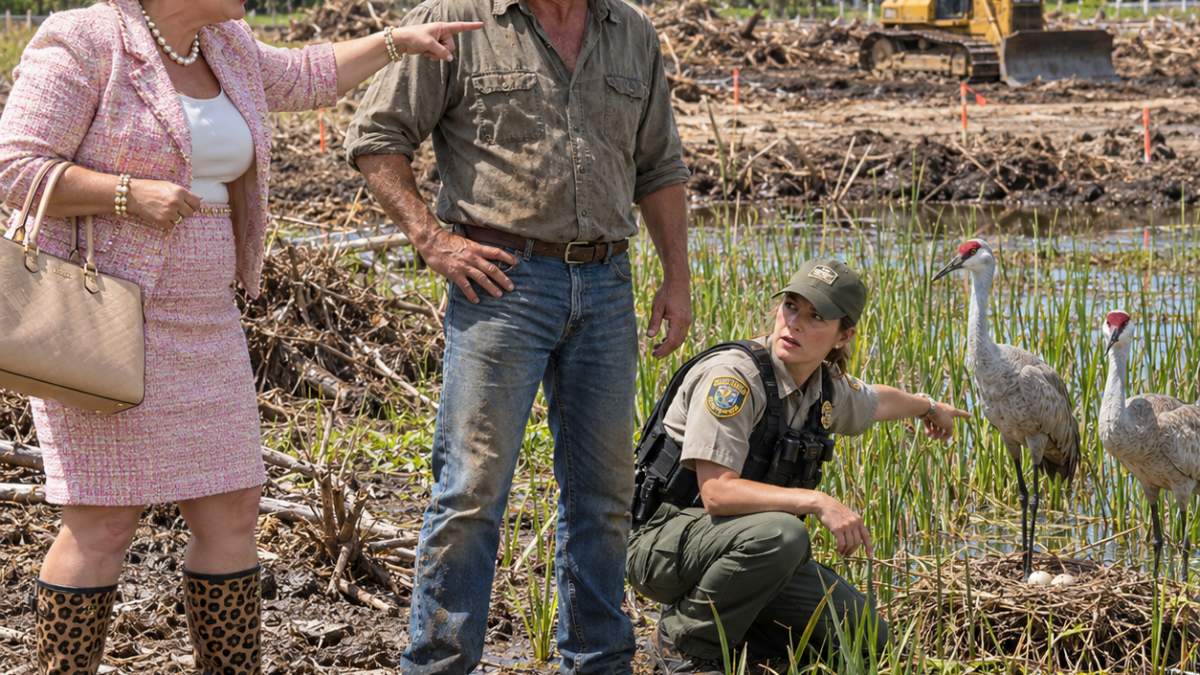
The first bulldozer blade had barely bitten into the marsh behind my house when HOA president Karen Johnson raised a chrome shovel for the photographer and called the wetland an “ugly waste of space.”
She thought she was clearing protected mud and sawgrass for a row of luxury lots that would make Oakwood Preserve richer, and she had already charged every homeowner—including me—$22,500 to help pay for it.
What she didn’t know was that the marsh was about to answer her in a way no board meeting, lawyer, or special assessment could silence.
The letter had arrived six weeks earlier.
Heavy white envelope. Gold HOA crest. Expensive paper.
NOTICE OF COMMUNITY ENHANCEMENT PROJECT AND CORRESPONDING SPECIAL ASSESSMENT.
I read the first page twice because I couldn’t believe what I was seeing.
Oakwood Preserve planned to clear and grade the undeveloped wetland behind my cul-de-sac, extend the internal road, and create a line of premium residential lots. The board described the marsh as an “underutilized land asset” that depressed neighborhood appearance and attracted mosquitoes.
My mandatory share of the preliminary work was $22,500.
Twenty-two thousand five hundred dollars to help destroy the place I had spent years protecting.
I walked through my house, opened the back door, and stepped onto the porch.
Morning mist hung low over the cypress knees.
A great blue heron lifted from the shallows.
Farther out, something tall and white moved behind the reeds.
That marsh was why I had bought the house.
After twenty years as a combat engineer, I had seen enough scraped earth, shattered concrete, blast craters, and places where people had turned living ground into geometry.
When I retired, I wanted green.
I wanted water.
I wanted a place where the loudest thing at dawn was a frog arguing with a bird.
Before purchasing the property, I had pulled every map I could find.
County plats.
State wetland inventories.
Army Corps jurisdictional records.
Recorded conservation restrictions.
The parcel behind Oakwood Preserve had been designated non-buildable wetland years before the subdivision existed.
I knew protected migratory birds used it.
I knew federal wetland restrictions applied.
And I knew no competent developer would touch it without serious permitting.
So at first, I assumed the HOA had made a mistake.
Then I met Karen Johnson.
She had been president of Oakwood Preserve for twelve years.
At the next board meeting, she sat beneath fluorescent lights in a tight pink blazer, holding a wooden gavel as if it were a judge’s hammer.
When new business began, she smiled and announced the “Oakwood Expansion Initiative.”
“Sixteen premium homesites,” she said. “A landscaped entrance extension, walking paths, and additional tax value for the entire community.”
Then she added, almost cheerfully, “We’ll finally clean up that swamp.”
I stood.
“My name is Jack Miller. I live at 412 Cypress End.”
Karen’s smile faded.
“The land you’re discussing is protected wetland.”
“We’ve addressed that.”
“I don’t think you have.”
A few residents turned toward me.
I opened the portfolio on my lap.
“I have the federal and county maps here. There are recorded conservation restrictions. At minimum, you’re looking at Clean Water Act permitting. There are also protected birds documented in that marsh.”
Karen actually laughed.
“Oh, Mr. Miller. Those maps are ancient.”
“They’re current.”
“We commissioned our own environmental review.”
“May I see it?”
Her eyes sharpened.
“The board’s planning documents are confidential.”
“That’s convenient.”
The room went still.
She leaned toward the microphone.
“Our consultant found no significant habitat and no environmental obstacle preventing responsible development.”
“Then your consultant should have no problem putting that conclusion in front of the agencies with jurisdiction.”
Karen’s face hardened.
“Are you an environmental attorney?”
“No.”
“Developer?”
“No.”
“Then I suggest you allow qualified professionals to do their jobs.”
I looked at the three board members beside her.
One avoided my eyes.
Another stared at his papers.
The third smiled.
That was when I understood.
This wasn’t an oversight.
Karen knew there was a problem.
She had simply decided the rules were something she could outvote.
“I’m asking you once,” I said. “Do not send equipment into that marsh until the permits and environmental status are independently verified.”
Karen lifted the gavel.
“Your objection is noted.”
Then she struck the table.
“The project will proceed.”
I sat down.
Three days later, the first retaliation notice appeared in my mailbox.
My mailbox, according to Karen, was one and a quarter inches too low.
Fifty-dollar fine.
Ten dollars for every day I failed to correct it.
I stood at the curb with a tape measure and stared at the number.
Then I looked back toward the cypress trees.
Karen believed she had changed the battlefield.
She hadn’t.
She had only convinced me to start documenting everything.
PART 2
I measured my mailbox three times.
Forty and three-quarter inches from the curb grade to the top of the box.
The HOA rule required forty-two.
Karen was right about the measurement.
That was the interesting part.
She had chosen a violation that was technically real.
So I walked the cul-de-sac.
Nine of twelve mailboxes were lower than mine.
One sat at thirty-nine inches.
Another leaned so badly that measuring it depended on which side you stood on.
Nobody else had a yellow violation notice taped to the post.
I photographed every box from the public street, wrote down the measurements, then went home and paid Karen’s fifty-dollar fine.
That decision surprised my neighbor, Eleanor Gable, though I wouldn’t meet her until later.
It surprised Karen too.
I didn’t appeal.
I didn’t shout.
I didn’t send an angry email.
I paid with a cashier’s check so there would be a clean record.
Then I dug out the mailbox post and reset it in fresh concrete.
Exactly forty-two and a half inches.
Not forty-two.
I wanted margin.
I took a photograph showing the tape measure.
Timestamped it.
Printed it.
Emailed it to the HOA.
Certified a paper copy.
Then opened a filing cabinet in my office and created a folder.
OAKWOOD PRESERVE—ENFORCEMENT.
My Army buddies used to joke that I could turn breakfast into an operations order.
They weren’t wrong.
Documentation had saved lives in my old career.
It could save a marsh too.
The second violation arrived eight days later.
Garden hose visible from the street.
Fifty dollars.
Ten dollars a day.
I walked outside.
The hose was neatly coiled on a hanger beside the house.
You could see perhaps eighteen inches of green rubber through an azalea if you stood at the far left edge of my driveway and leaned.
I took pictures.
Then I checked the rule.
Karen had quoted it accurately.
Hoses were supposed to be concealed.
So I bought the ugliest beige plastic hose box I could find.
The thing looked like a small municipal coffin.
I placed it exactly where the architectural guidelines permitted.
Then documented that too.
Third violation.
Fence stain.
My rear fence had faded from “Desert Sand” to what Karen’s letter called “unapproved weathered beige.”
I bought the approved stain.
Kept the receipt.
Photographed the can.
Photographed the fence.
Photographed myself applying it.
Not because I enjoyed surrendering.
Because I was building something more useful than an argument.
A pattern.
By the fourth notice, my office wall held a calendar.
Red circles marked HOA violations against me.
Blue circles marked project actions.
The red circles always appeared within days of something I did concerning the marsh.
I asked a question at the board meeting.
Mailbox.
I requested the environmental report.
Garden hose.
I wrote to the property-management company asking for the legal parcel description of the development site.
Fence stain.
Coincidence is possible.
Patterns are measurable.
So I measured.
My next move concerned the document Karen refused to show me.
The “independent environmental survey.”
That survey supposedly proved a protected wetland could suddenly be converted into buildable residential lots.
I wanted to read that miracle.
Oakwood Preserve was in Florida, and its governing documents incorporated state records-access requirements for association financial and official records.
I drafted a formal request for every document related to the Oakwood Expansion Initiative.
Board minutes.
Engineering studies.
Environmental reports.
Bids.
Consulting agreements.
Contractor proposals.
Correspondence concerning wetland permits.
Documents supporting the $22,500 special assessment.
I cited the applicable records provisions.
Certified mail.
Signature required.
Karen signed for it on a Monday.
Then silence.
Ten business days passed.
On day eleven, a letter arrived from Worthington, Pike & Heller, the HOA’s law firm.
Three pages.
Beautiful letterhead.
Expensive vocabulary.
The attorneys claimed my request was overly broad, commercially sensitive, burdensome, and partially protected by attorney-client privilege.
I read it twice.
Then laughed.
Not because the law firm was incompetent.
Because they had written a broad refusal to a narrow request.
A common intimidation tactic.
Make ordinary people believe that asking again would require a courtroom, twenty thousand dollars, and a second mortgage.
I put the letter in the file.
Then Saturday morning, while I was restaining the fence, an elderly woman stopped at my driveway.
Small white dog.
Wide-brimmed sun hat.
Silver hair.
She watched me brush Desert Sand onto a perfectly serviceable fence.
“You’re Jack Miller.”
I lowered the brush.
“That depends on whether I owe you money.”
She smiled.
“Eleanor Gable.”
I knew the name.
Her house was two streets over.
“Nice to meet you.”
“I was at the board meeting.”
That changed the conversation.
She looked at the fence.
“Karen?”
“Apparently sunlight altered the approved color.”
Eleanor snorted.
“She made me tear out my roses.”
I set the brush down.
“What?”
“My rose garden.”
Her voice changed.
Not louder.
More fragile.
“My husband planted the first bush when our daughter was born.”
She looked toward the subdivision.
“I added to it for thirty years.”
“Why did she make you remove them?”
“Not on the approved shrub list.”
I stared at her.
“You’re serious.”
“I wish I weren’t.”
“Did the rules actually prohibit roses?”
“No.”
“They didn’t?”
“They said substantial landscape changes required approval.”
“That’s different.”
“I know that now.”
She scratched her dog behind the ears.
“Karen said I had replaced more than thirty percent of my front landscaping and therefore needed retroactive architectural approval. Then the committee denied the roses because they weren’t consistent with the neighborhood palette.”
I looked at her.
“Who was on the committee?”
Eleanor’s expression told me before she answered.
“Karen.”
Of course.
“She fined me every week until I hired someone to remove them.”
“How much?”
“Almost thirteen hundred dollars between fines and landscaping.”
“What happened to the roses?”
Her eyes shifted away.
“Most died.”
That angered me more than the money.
I’d spent enough years around damaged landscapes to understand that people attach memory to living things.
A tree planted for a child.
A rose planted for an anniversary.
A garden tended with someone who isn’t there anymore.
Karen had reduced Eleanor’s thirty-year history to an architectural violation.
“Do you still have the letters?”
“All of them.”
“Would you let me see them?”
Eleanor smiled for the first time.
“That’s why I stopped.”
She came inside.
I made iced tea.
For the next hour, she told me stories.
The Patels.
Their son’s basketball hoop had remained visible over the fence.
Three months of fines.
A young couple named Evan and Rachel Bell had repainted their trim after Karen decided eggshell white was materially different from ivory.
A widower received warnings because his garbage cans stayed curbside until six p.m. on collection day.
A family was ordered to remove a handmade bench their daughter had built in high school shop class.
A veteran had been cited for a flag bracket that projected too far from his porch column.
Some violations had actual language behind them.
Others seemed creatively interpreted.
What connected them was the method.
Karen identified resistance.
Then pressure increased.
Letters.
Fines.
Hearing delays.
Threats of liens.
Eventually people surrendered because surrender cost less than fighting.
“Why does nobody vote her out?” I asked.
Eleanor looked almost embarrassed.
“Because nobody goes to meetings.”
“That simple?”
“She has her people.”
“How many?”
“Maybe twenty households.”
“How many homes?”
“Two hundred and forty-eight.”
I put my glass down.
“You’re telling me twenty households control the association?”
“Usually fewer.”
“And everybody else complains privately.”
“Pretty much.”
“Why?”
“Fear.”
The word sounded ridiculous in a manicured subdivision.
Then I looked at Eleanor.
Eighty years old.
Rose garden gone.
Thirteen hundred dollars poorer.
Not ridiculous at all.
Before she left, Eleanor wrote down three names.
“Talk to these people.”
The first was David Patel.
Dave worked in cybersecurity from a home office that contained six monitors and one chair that looked capable of launching a satellite.
His son, Arjun, was eleven.
The basketball hoop sat dismantled in the garage.
Dave touched the metal pole.
“He saved birthday money for this.”
I studied the HOA notices.
“Where was it?”
“Driveway.”
“Rule?”
“There wasn’t one when we installed it.”
I looked up.
“What do you mean?”
Dave opened a laptop.
“Here.”
He showed me a PDF.
HOA rules revised May 12.
Basketball equipment restrictions.
Then he showed me the first violation.
Dated April 28.
“You were cited before the rule existed.”
“Exactly.”
“And they still fined you?”
“Karen said the revision merely clarified an existing standard.”
“Did you appeal?”
“Twice.”
“What happened?”
“First hearing postponed. Second hearing chaired by Karen. Denied in seven minutes.”
I leaned back.
“Do you still have metadata for these files?”
Dave smiled.
That was when I knew we were going to get along.
“Oh, Jack.”
He turned another monitor toward me.
“I have everything.”
Over the next week, Eleanor introduced me to five families.
Then eight.
Then twelve.
I stopped seeing isolated disputes.
I saw a governance failure.
The marsh project was simply the largest expression of it.
I created a private online workspace with Dave.
Nothing public.
Nothing defamatory.
Residents uploaded documents they owned.
Violation letters.
Appeals.
Board notices.
Financial statements.
Photographs.
Meeting minutes.
We called the group Oakwood Residents for Responsible Governance.
Eleanor hated the name.
“It sounds like an insurance company.”
“What would you call it?”
“People Who Are Tired of Karen.”
Dave laughed.
I did not rename it.
Our thirteenth member appeared online one evening under the name Arthur Vance.
I knew Arthur by sight.
Late sixties.
Gray beard.
Always wore collared shirts even while walking his dog.
His introductory message changed everything.
I’m a retired attorney. Twenty-seven years in civil litigation and nonprofit governance. I have watched Karen Johnson abuse this association for a decade. I have also reviewed the records-request response sent to Jack Miller. Their legal position is much weaker than the letter suggests.
Five minutes later, Arthur was on a video call with us.
He held the law firm’s letter.
“This,” he said, “is ninety percent posture.”
Dave leaned toward his camera.
“What’s the other ten percent?”
“Posture with better punctuation.”
Eleanor laughed so loudly her microphone peaked.
Arthur became our legal strategist.
He didn’t promise miracles.
That made me trust him.
He explained what records the association likely had to produce and what genuinely privileged material could remain protected.
We narrowed the request.
Specified categories.
Specified dates.
Specified the capital project.
Specified contracts funded by the special assessment.
Five business days.
Then Arthur added one sentence.
Failure to provide nonprivileged official records would result in immediate pursuit of all available statutory remedies, including recovery of attorney fees where authorized.
The letter went to the managing partner of the HOA law firm.
Not Karen.
Forty-two hours later, a courier delivered a binder to my house.
Three inches thick.
Eleanor came over.
Dave brought a scanner.
Arthur joined by video.
We spent six hours reading.
The first problem appeared in contractor bids.
Site-clearing materials supplier:
Garrison Construction Supply.
Owner:
Gary Garrison.
HOA board member.
Landscaping and mitigation contractor:
Franklin GreenScapes.
Owner:
Frank Whitcomb.
HOA board member.
Both men had participated in votes advancing the project.
Maybe they had disclosed conflicts somewhere.
We searched.
Nothing obvious.
Dave whistled.
“They’re voting themselves contracts.”
Arthur corrected him.
“We need evidence before saying that.”
“There are their names.”
“There are companies. We still determine ownership, disclosures, recusals, and bidding procedures.”
That was Arthur.
Never use ten words when seven accurate ones will do.
We flagged the issue.
Then I found the document.
ENVIRONMENTAL ASSESSMENT—OAKWOOD PARCEL 7B.
Two pages.
That was all.
No species inventory.
No wetland delineation.
No hydrology analysis.
No seasonal observation.
No soil sampling.
No jurisdictional determination.
No agency consultation.
The author concluded the site displayed “limited ecological function,” lacked evidence of significant protected wildlife, and could be “responsibly improved” with ordinary stormwater controls.
Company:
Sunshine State Ecological Solutions LLC.
Dave started typing.
“Give me a minute.”
Thirty seconds later:
“Registered seventeen months ago.”
“Address?”
“Post office box.”
“Manager?”
Pause.
Then Dave looked up.
“Martin Gable.”
Eleanor frowned.
“Gable?”
“Any relation?” I asked.
She shook her head.
“Not mine.”
Dave kept searching.
Then stopped.
“Oh.”
“What?”
He rotated the screen.
A wedding announcement from years earlier.
Karen Johnson’s sister, Deborah.
Groom:
Martin Gable.
Karen’s brother-in-law.
Nobody spoke.
Arthur finally said, “Now we have a problem.”
I opened the environmental report again.
“Not just a problem.”
I tapped one paragraph.
“A lie.”
Arthur looked at me through the screen.
“Careful.”
“They say no protected wildlife.”
“Bad science is not automatically fraud.”
“I have photographs.”
That changed his expression.
“What photographs?”
I walked to my bookshelf.
Pulled down two external drives.
For three years I had photographed the marsh from my porch and the marked public conservation trail beyond the subdivision.
Herons.
Egrets.
Wood ducks.
Alligators.
Otters.
Owls.
And tall white cranes that appeared periodically during the cooler months.
I had assumed they were unusual visitors.
I had dozens of high-resolution images.
Some showed colored leg bands.
Arthur leaned toward his camera.
“What are those?”
“Cranes.”
“What species?”
“I’m not qualified to say.”
“Good answer.”
Dave zoomed in.
One bird stood nearly five feet tall.
White body.
Black wing tips.
Red crown.
Arthur went quiet.
“Jack.”
“Yes?”
“You need a real wildlife biologist looking at those immediately.”
The next morning, I sent representative photographs to Dr. Melissa Hart, an ornithologist at the state university who had previously worked on wetland-bird surveys.
I expected a reply in days.
She called me forty minutes later.
“Where were these taken?”
“Wetland behind Oakwood Preserve.”
“Exact location?”
I gave her the parcel information.
“When?”
I provided dates.
There was silence.
“Mr. Miller, these appear to be whooping cranes.”
I sat straighter.
“I thought those were almost gone.”
“They are federally endangered.”
My pulse changed.
“Are you certain?”
“I’m certain enough that I want the original files before making a formal identification.”
I sent them.
She called again that afternoon.
The bands were readable in several images.
One crane was part of a monitored reintroduction population.
Another appeared unbanded.
Several photographs showed the pair returning to the same shallow section of marsh over multiple seasons.
One recent image showed a smaller rusty-colored juvenile beside them.
Dr. Hart’s voice became very serious.
“You may have documented repeated use of this wetland by federally endangered cranes, including family-group behavior.”
I looked through my window toward the marsh.
The white shape I had noticed the morning of Karen’s letter suddenly mattered in a completely different way.
“What do I do?”
“Do not approach them.”
“I don’t.”
“Do not publicize exact nesting or roost locations.”
“I won’t.”
“And contact U.S. Fish and Wildlife immediately.”
That night, our private group met.
I put one photograph on the screen.
The room went silent.
Eleanor whispered, “They’re beautiful.”
The adult crane stood among amber reeds with its wings partially open.
Beside it, a younger bird walked through shallow water.
Dave looked almost frightened.
“So Karen’s fake report missed these?”
“Yes.”
“Or ignored them.”
Arthur raised a hand.
“We do not know which.”
I said, “Either way, we are out of HOA territory now.”
Everyone understood.
The next morning, with Arthur’s help, I assembled a package.
Federal wetland maps.
Recorded conservation restrictions.
The HOA project notice.
Board minutes.
The two-page environmental report.
Corporate records connecting the consultant to Karen’s family.
Contract bids.
My photographs.
Original metadata.
Dr. Hart’s preliminary identification.
Copies of my warning at the HOA meeting.
Everything.
We sent it to the regional U.S. Fish and Wildlife Service office and the appropriate Army Corps regulatory office.
Not as a threat.
As a request for immediate review.
Two days later, I received a call.
“Mr. Miller?”
“Yes.”
“Special Agent Daniel Cole, U.S. Fish and Wildlife Service.”
My stomach tightened.
“We received the material regarding Oakwood Parcel 7B.”
“Yes, sir.”
“We’ve also spoken with Dr. Hart.”
I waited.
“Our biologists want access for a site assessment.”
“Whatever you need.”
“Who owns the parcel?”
That question was more complicated.
The marsh itself was part of a conservation tract recorded during the original subdivision approval, held nominally by the association but burdened by a permanent preservation restriction and subject to government jurisdiction.
Karen apparently believed ownership meant freedom to develop.
It didn’t.
Cole understood immediately.
“Does the board have federal authorization?”
“Not that I can find.”
“We can’t either.”
He paused.
“Mr. Miller, do not interfere with construction equipment yourself.”
“They haven’t started.”
“Good.”
“If they schedule clearing?”
“Call me.”
The federal site visit happened discreetly.
No sirens.
No raid.
Two wildlife biologists.
One Army Corps wetland specialist.
Agent Cole.
They entered through an authorized access point with the property-management company notified through counsel.
Karen apparently believed they were routine agency reviewers responding to my complaint.
She complained in an email that I was wasting federal resources.
That email later became my favorite example of dramatic irony.
The biologists spent nearly five hours in the marsh.
At four seventeen that afternoon, Agent Cole called.
“We confirmed the cranes.”
I closed my eyes.
“How many?”
“Two adults observed today.”
“The juvenile?”
“Not today. But your photographs are consistent with a juvenile present earlier in the season.”
“Does that change anything?”
“The wetland was already regulated.”
He paused.
“The endangered-species evidence raises the stakes significantly.”
“Can the HOA develop it?”
“Not under the plan you sent us.”
I breathed out.
“Then it’s over.”
“Not necessarily.”
“What do you mean?”
“Agencies issue determinations. People sometimes ignore them.”
I thought of Karen.
“So what happens now?”
“Formal notice goes to the responsible parties.”
It did.
A federal letter advised the HOA that no dredging, filling, clearing, road construction, or habitat disturbance should proceed without required federal review and authorization.
The HOA’s law firm received it.
The management company received it.
Karen received it.
I know because she mentioned it at the next meeting.
Not accurately.
“Federal agencies have acknowledged receipt of our project materials,” she announced.
I almost stood up.
Arthur, seated beside me, touched my sleeve.
Wait.
Karen continued.
“Our consultants are handling routine environmental bureaucracy.”
Routine.
I looked at Gary.
He avoided my eyes.
Frank studied the table.
Karen smiled.
“Groundbreaking remains scheduled for September fourteenth.”
Arthur leaned close.
“She’s going ahead.”
“I heard.”
“After written federal notice.”
“Yes.”
“That matters.”
After the meeting, I cornered Karen in the hallway.
Not aggressively.
Public place.
Witnesses.
“Karen.”
She turned.
“What?”
“You received the federal notice.”
Her expression hardened.
“Our lawyers are handling it.”
“It says not to clear or fill the wetland without authorization.”
“It says agencies have concerns.”
“Read the second page.”
“I have.”
“Then postpone the groundbreaking.”
She laughed softly.
“You really cannot stand losing, can you?”
“This isn’t about losing.”
“It has always been about losing.”
She stepped closer.
“You moved in and decided you were guardian of a swamp nobody else wants.”
“I didn’t decide the law.”
“No. But you hide behind it.”
I stared at her.
“You have endangered cranes in there.”
She rolled her eyes.
“Birds fly.”
“These are federally listed birds.”
“Then they can fly somewhere else.”
I will remember that sentence until I die.
Arthur heard it.
So did Eleanor.
I felt something cold move through me.
Not rage.
Clarity.
“Karen,” I said quietly, “I am asking you one last time. Stop this project.”
She smiled.
“No.”
Then walked away.
The retaliation became uglier after that.
A violation for weeds near my mailbox.
A notice about my garbage container being visible for forty-five minutes too long.
A warning that binocular use from my porch might constitute invasion of privacy if directed toward neighboring homes.
That one would have been funny if it weren’t so revealing.
I photographed birds.
Karen knew that.
She wanted to make the act of watching the marsh feel dangerous.
I documented everything.
Then another letter arrived.
SPECIAL ASSESSMENT DELINQUENCY NOTICE.
I had not paid the $22,500.
On Arthur’s advice, several residents had placed their disputed assessments into separate escrow arrangements while challenging the project.
Karen threatened liens.
Arthur responded.
The association’s lawyers became noticeably quieter.
Then we discovered why.
The original firm withdrew from advising the development project.
No public explanation.
A new attorney appeared.
Younger.
More aggressive.
Apparently willing to accept Karen’s interpretation that the federal letters did not constitute a formal stop-work order.
Agent Cole would not discuss the HOA’s legal advice.
He said only:
“Do not assume bad legal judgment is the same as immunity.”
Groundbreaking morning arrived humid and bright.
I woke at five thirty.
Made coffee.
Walked onto the porch.
Mist covered the marsh.
The cranes were there.
Two white shapes near the far sawgrass.
One raised its head.
Then the other.
They moved slowly through the shallow water.
I watched them for twenty minutes.
No photographs.
No binoculars.
Just watched.
At seven thirty, diesel engines appeared at the end of Cypress End.
Bulldozer.
Excavator.
Dump truck.
Flatbed carrying erosion-control materials.
A construction trailer.
Then Karen’s SUV.
White.
Clean enough to reflect the sky.
She emerged wearing pressed khaki pants and a bright white hard hat with OAKWOOD PRESERVE PRESIDENT printed across the front.
A local newspaper photographer arrived.
Gary wore a hard hat too.
So did Frank.
Eleanor came to my porch.
Then Dave.
Then Arthur.
Nobody spoke.
The equipment staged beside the access road.
Residents gathered.
Some supported the expansion.
Most simply wanted to see what happened.
Karen placed a chrome shovel into a pile of ceremonial dirt.
There were balloons.
Actual balloons.
Green and gold.
She had even ordered a sign.
FUTURE HOME OF OAKWOOD PRESERVE EAST
16 EXCLUSIVE HOMESITES
LUXURY LIVING IN HARMONY WITH NATURE
Dave read it.
“You can’t make that up.”
Arthur shook his head.
“Unfortunately, somebody did.”
I called Agent Cole.
“They’re here.”
“We know.”
My eyes moved toward the road.
“Where are you?”
“Close.”
Karen tapped a portable microphone.
“Good morning!”
People quieted.
She smiled for the photographer.
“Today represents progress.”
I looked toward the marsh.
“Today we take an underutilized parcel and transform it into something families can enjoy, something that strengthens Oakwood Preserve for generations.”
Eleanor whispered, “She practiced that.”
“Definitely.”
Karen continued.
“For too long, misinformation and fear have attempted to stop responsible growth.”
Her eyes found me.
No ambiguity.
She smiled.
“But leadership means moving forward.”
Then came the sentence.
“We are replacing an ugly, mosquito-filled marsh with beautiful homes.”
My hands tightened against the porch rail.
Behind her, the crane pair lifted their heads.
I could see them between the reeds.
Karen raised the chrome shovel.
Camera shutter clicked.
She scooped dirt.
Applause from maybe twelve people.
Then she nodded to the bulldozer operator.
He hesitated.
I saw him look toward the wetland.
Then toward a site superintendent.
The superintendent waved him forward.
The engine deepened.
Tracks moved.
The bulldozer crossed the grass.
Arthur whispered, “Come on, Cole.”
The blade lowered.
Twenty feet from the wetland edge.
Ten.
Five.
I took out my phone and started recording.
Not for revenge.
For evidence.
The blade touched the first stand of sawgrass.
Dark soil rolled.
Water squeezed upward.
The machine moved another six feet.
Then suddenly the marsh exploded with wings.
Two white cranes rose from the reeds.
Huge.
Beautiful.
Their black wing tips opened against the morning sky.
Everyone looked up.
Even Karen.
One crane gave a loud, trumpeting call.
Then the other answered.
The sound cut through diesel noise.
The bulldozer operator stopped.
Not because anyone ordered him.
Because even he understood something important had just happened.
The cranes circled once above the damaged patch.
Then banked toward the far side of the marsh.
Someone whispered, “What are those?”
I heard Eleanor answer.
“The reason this is over.”
Three vehicles turned into the cul-de-sac.
White federal SUV.
Dark sedan.
Army Corps truck.
No dramatic sirens.
They didn’t need them.
Letters on the doors were enough.
U.S. FISH & WILDLIFE SERVICE.
U.S. ARMY CORPS OF ENGINEERS.
Agent Cole stepped out.
Two uniformed wildlife officers followed.
A Corps regulatory specialist climbed from the truck carrying a hard case and documents.
Behind them was Dr. Melissa Hart.
Karen lowered her microphone.
Her expression changed.
Not fear yet.
Annoyance.
She marched toward Cole.
“This is a private community event.”
Cole showed identification.
“Karen Johnson?”
“Yes.”
“President of Oakwood Preserve Homeowners Association?”
“Yes.”
“I’m Special Agent Daniel Cole with the United States Fish and Wildlife Service.”
Karen glanced toward me.
“This man has been harassing our board with complaints.”
Cole didn’t look at me.
“I’m not here regarding Mr. Miller’s personality.”
Dave covered his mouth.
Cole continued.
“I’m here because mechanized clearing has begun inside federally regulated wetland habitat after your association received written notice that federal review and authorization were required.”
Karen straightened.
“Our environmental consultant cleared this property.”
The Corps specialist stepped forward.
“Your private consultant does not issue Section 404 authorization.”
“Our attorney says—”
“Your attorney is welcome to contact agency counsel.”
Cole handed her a document.
“This is an immediate federal stop-work directive associated with an active enforcement investigation.”
Karen stared at it.
Then looked at the marsh.
“The machine barely moved.”
“Correct.”
“So there’s no damage.”
Dr. Hart spoke for the first time.
“There is documented habitat disturbance.”
Karen turned.
“And who are you?”
“Dr. Melissa Hart. Avian ecologist.”
“Oh, wonderful.”
Karen laughed sharply.
“Another bird person.”
Hart remained calm.
“We observed two federally endangered whooping cranes using this wetland during our survey.”
The smile vanished.
“What?”
“The two birds that just flushed from the clearing zone are consistent with the same identified pair.”
Karen stared toward the sky.
The cranes had landed again farther back in the marsh.
“They’re just birds.”
Nobody spoke.
Karen seemed to realize how the sentence sounded.
She tried again.
“I mean birds move. They aren’t permanently attached to this property.”
Dr. Hart’s eyes sharpened.
“Habitat use by an endangered species is not something a private HOA board gets to dismiss because the animals have wings.”
The newspaper photographer had stopped photographing Karen’s shovel.
Now he photographed Karen.
Cole looked toward the superintendent.
“All equipment remains where it is until released by the Corps.”
The operator climbed down immediately.
“I’m done.”
Karen spun toward him.
“You are under contract.”
He pointed at Cole.
“Not enough contract in the world for that.”
Gary backed away from the ceremonial dirt.
Frank began making a phone call.
Karen looked around as control slipped out of her hands.
“This is ridiculous.”
Cole’s voice remained quiet.
“Ms. Johnson, your board was warned.”
“We had a survey.”
“We have it.”
The words stopped her.
Cole continued.
“We are also aware of the ownership relationship between Sunshine State Ecological Solutions and your brother-in-law.”
Karen’s face drained.
Gary stopped dialing.
Frank lowered his phone.
Cole looked at all three.
“You will each receive instructions regarding preservation of records.”
“My brother-in-law is a qualified consultant.”
“That determination will be part of the investigation.”
“He told us there was no protected habitat.”
Dr. Hart looked toward the marsh.
“Then he missed two five-foot-tall endangered cranes.”
Someone in the crowd laughed.
Once.
Nervously.
Karen turned toward me.
There it was.
The hatred.
“You.”
I did not answer.
“You did this.”
Cole stepped slightly between us.
“Ms. Johnson, direct your attention to us.”
She ignored him.
“You wanted this.”
I finally spoke.
“I wanted the marsh left alone.”
“You set me up.”
“No.”
I looked at the torn strip of sawgrass.
“I warned you in public.”
Her mouth opened.
“You ignored me.”
I pointed toward the federal letter in her hand.
“They warned you in writing.”
She looked at it.
“You ignored them too.”
Her shoulders moved as if she had been struck.
That was the moment I had imagined for weeks.
Karen speechless.
Federal officers around her.
Her project stopped.
Her power cracking in public.
I expected satisfaction.
Instead, I heard one of the cranes call from the far marsh.
And all I felt was relief.
The habitat had taken a wound.
But it was still there.
The bulldozer had traveled maybe twenty feet into the regulated boundary.
Bad.
Not catastrophic.
Repairable.
The machines left two days later after documentation.
The balloons were gone by noon.
The sign remained for another week.
Someone eventually covered FUTURE HOME OF OAKWOOD PRESERVE EAST with a black plastic tarp.
The HOA sent an emergency email that evening.
PROJECT TEMPORARILY PAUSED PENDING REGULATORY CLARIFICATION.
Dave forwarded it with one comment.
“Temporarily?”
Arthur replied.
“Let attorneys translate denial at their own pace.”
The investigation widened.
Federal officials requested board minutes.
Contracts.
Consultant communications.
Permit records.
Emails.
Bidding documents.
The state environmental agency opened its own review.
The county examined land-development approvals Karen had implied were complete.
They weren’t.
The association’s insurer requested notice.
Then the board’s law firm requested independent counsel for Gary and Frank.
That frightened residents more than federal vehicles.
When lawyers begin hiring other lawyers, ordinary people pay attention.
Eleanor called an emergency residents’ meeting.
Not board meeting.
Residents.
The clubhouse overflowed.
Karen arrived anyway.
Pink blazer.
Gavel.
Arthur stood before she reached the table.
“This is not a board meeting, Karen.”
“I am president.”
“This is a homeowner petition meeting authorized under the bylaws.”
“I chair all association meetings.”
“Not automatically.”
“I have for twelve years.”
“That does not rewrite the document.”
The room murmured.
Karen stared at him.
“Who exactly are you?”
“Arthur Vance. Homeowner. Retired attorney.”
For the first time, she looked uncertain.
Arthur held up the petition.
“Forty-one percent of the membership requested this meeting.”
Karen looked at the crowd.
“What is the purpose?”
Eleanor answered.
“To find out how you nearly got us all sued over a swamp you were warned not to touch.”
A few people applauded.
Arthur raised his hand.
“No theater.”
That became his phrase.
No theater.
Facts.
Minutes.
Votes.
Documents.
The meeting lasted three hours.
Dave presented contractor relationships.
Gary’s supply company.
Frank’s landscaping company.
Both contracts tied to expansion work.
Gary claimed he had disclosed his interest verbally.
No meeting minutes reflected it.
Frank claimed his bid had been cheapest.
Nobody could produce competing bids for several scopes.
Karen defended them.
“They saved this community money.”
Dave displayed the proposed payment schedule.
“Gary’s materials contract alone included an eighteen-percent administrative markup.”
“That is industry standard.”
Gary muttered, “Not exactly.”
Every head turned.
Karen glared at him.
Gary looked down.
Then came the environmental consultant.
Arthur placed Sunshine State Ecological Solutions’ corporate registration on the projector.
Manager: Martin Gable.
Then a photograph of Karen at her sister Deborah’s anniversary party.
Martin beside her.
Karen’s brother-in-law.
People gasped.
Karen stood.
“This is disgusting.”
Arthur looked puzzled.
“Public corporate records?”
“You’re dragging my family into this.”
“Your family entered the record when a relative’s company was paid association money for an environmental report supporting your project.”
“Martin is qualified.”
“To conduct what kind of environmental assessment?”
“He has environmental experience.”
“What credentials?”
Karen hesitated.
Arthur waited.
“What license?”
Silence.
“What professional certifications?”
Silence.
“What wetland-delineation qualifications?”
Karen’s voice sharpened.
“He has been in land development for twenty years.”
“That was not my question.”
The room changed.
People stopped looking afraid.
Then Eleanor stood.
“You charged us twenty-two thousand five hundred dollars each.”
Karen pointed toward her.
“That assessment funded a project intended to increase every homeowner’s equity.”
“You tried to spend my retirement savings clearing a protected marsh.”
“The land has value.”
Eleanor’s voice cracked.
“So did my roses.”
Karen froze.
Nobody expected that.
Eleanor continued.
“You made me tear out thirty years of my life because you said rules were rules.”
She stepped closer.
“You told me it didn’t matter that my husband planted them.”
Karen looked away.
“And now federal rules don’t matter because you want sixteen houses?”
Nobody applauded.
The truth was too sharp.
Dave Patel stood next.
“My son’s hoop.”
Karen rubbed her forehead.
“Oh, for God’s sake.”
“No.”
Dave’s voice rose.
“You backdated a rule.”
“That is false.”
Dave put documents on the projector.
Original rules.
Revision date.
Violation date.
Metadata.
He had been waiting years.
Karen saw the dates.
She said nothing.
One by one, residents spoke.
Not all complaints were valid.
Arthur made sure of that.
When one man claimed Karen had “stolen” his fines, Arthur stopped him.
“Do you have evidence of theft?”
“No.”
“Then do not say theft.”
When another claimed every violation Karen issued was illegal, Jack—that’s me—stood.
“That isn’t true.”
People looked at me.
“Some rules are valid.”
A few residents groaned.
I continued.
“If we replace arbitrary enforcement with arbitrary forgiveness, we haven’t fixed anything.”
Karen actually laughed.
“Finally, something intelligent.”
I looked at her.
“This is not a defense of you.”
Her smile disappeared.
“Valid rules need valid process.”
I pointed toward the marsh documents.
“The problem isn’t that Karen enforced rules.”
I looked around the room.
“The problem is that she treated rules as binding when they gave her power and optional when they limited it.”
Silence.
Arthur nodded.
“That is the issue before the membership.”
Someone called from the back.
“Remove her.”
Another voice seconded it.
Arthur checked the bylaws.
A formal removal procedure required notice and ballot.
So we followed it.
No mob vote.
No gavel ripped from her hand.
No shortcuts.
Karen received notice.
Every homeowner received the evidence packet.
Not gossip.
Documents.
The federal stop-work directive.
The consultant relationship.
Contract disclosures.
Board minutes.
Records-request correspondence.
The special assessment.
The next meeting occurred seven days later.
Two hundred and eleven households voted.
One hundred eighty-seven favored removing Karen as president.
She remained technically on the board pending a separate director-removal process.
She resigned the next morning.
Gary resigned too.
Frank lasted three more days.
Then he resigned.
The special assessment was suspended.
Mine had never been paid.
Residents who had paid were furious.
The money remained in association accounts, minus preliminary project costs.
The new interim board froze nonessential spending.
Arthur became temporary president because everyone trusted him and nobody else wanted the liability.
His first words after election were:
“This is temporary.”
Eleanor said, “That’s what they all say.”
Even Arthur laughed.
The federal case took months.
That frustrated people.
They expected agents to arrive one morning and carry Karen away in handcuffs.
Real environmental enforcement rarely works like television.
There were interviews.
Engineering reviews.
Wetland delineation.
Habitat assessments.
Financial records.
Contract analysis.
Legal arguments over intent.
The disturbed marsh area had to be stabilized almost immediately.
Erosion matting was removed and replaced with appropriate restoration materials.
Native sedges were replanted under supervision.
The access rut was filled using methods designed to restore hydrology rather than simply dumping soil.
The association paid for the emergency restoration.
Then came the bigger negotiation.
Federal agencies had leverage.
The HOA had a serious problem.
But most homeowners had not participated in Karen’s decisions.
Punishing hundreds of families into financial disaster would not restore habitat.
Arthur pushed for a restorative settlement.
He spent weeks negotiating with agency counsel.
I attended only when asked.
The final framework was complicated.
The association paid a substantial civil penalty.
Not the cartoonishly enormous number people had spread online.
Enough to hurt.
Enough to matter.
But not enough to bankrupt every family.
Additional monetary penalties were partially offset through habitat restoration, long-term monitoring, and a permanent conservation commitment.
The marsh would no longer remain merely an association-owned “open parcel.”
It would be placed under a stronger conservation arrangement with independent oversight.
No future board could suddenly decide sixteen homes sounded profitable.
Oakwood Preserve agreed to fund multi-year ecological monitoring with the university.
That part mattered most to Dr. Hart.
“Habitat survives when somebody keeps watching after the scandal ends,” she told me.
She was right.
Karen faced separate consequences.
Investigators examined whether the environmental report had been knowingly misrepresented.
Martin Gable faced scrutiny over what services he represented himself as qualified to perform.
Gary and Frank’s undisclosed financial relationships became part of a state-level HOA governance investigation and later civil litigation by homeowners.
Karen hired counsel.
So did Gary.
So did Frank.
The board’s directors-and-officers insurer disputed portions of coverage tied to intentional acts and undisclosed conflicts.
That was where the consequences became personal.
Not because federal agents seized houses.
Because insurance does not always rescue people from conduct outside legitimate board duties.
Karen eventually settled the homeowners’ civil claims.
Terms were partly confidential.
What became public was enough.
She reimbursed a portion of association losses personally.
She waived claims to several disputed reimbursements.
She resigned permanently from Oakwood Preserve governance.
She sold her house the following spring.
Gary’s company lost the Oakwood contract.
Frank’s company did too.
Neither business vanished overnight, despite neighborhood rumors.
Reality is less tidy.
But both men paid legal costs, lost reputation, and learned that putting personal business interests inside community decisions without transparent safeguards can become extremely expensive.
Martin’s environmental company dissolved the next year.
The developer walked away.
No luxury lots.
No extension road.
No giant sign.
No bulldozers.
The marsh remained.
That should have been enough for me.
For a while, it wasn’t.
I had imagined revenge differently.
I pictured Karen losing everything.
I pictured Gary begging.
Frank bankrupt.
Martin prosecuted.
I pictured some spectacular closing scene where everyone who had dismissed me understood exactly how badly they had lost.
Those fantasies felt good when I was repainting a fence because sunlight had changed its shade.
They felt good when Karen threatened a lien.
They felt good when she called the marsh ugly.
But after the bulldozer morning, revenge became less interesting.
Because one afternoon Dr. Hart called me.
“You need to come outside.”
“I am outside.”
“To the marsh.”
I grabbed binoculars.
Walked to the observation edge.
She stood fifty yards away with a graduate student.
No talking.
She pointed.
The two adult cranes stood near the restoration zone.
Between them was the juvenile.
Rust-colored head.
Long legs.
Awkward movements.
Alive.
The family had returned to the same shallow area where the bulldozer had entered.
One adult pecked at the newly restored ground.
The juvenile followed.
I watched until my arms hurt from holding the binoculars.
Dr. Hart whispered, “They’re accepting the restored area.”
I swallowed.
“Is that good?”
“It’s encouraging.”
“Meaning?”
“Meaning ecosystems don’t read legal settlements.”
I looked at her.
She smiled.
“They respond to what we actually repair.”
That sentence stayed with me.
Oakwood Preserve had spent years pretending appearance was the same as value.
Perfect fences.
Approved shrubs.
Identical mailboxes.
Trim colors separated by distinctions visible only to Karen.
But behind all of that perfection sat a marsh many residents called ugly because nobody had taught them how to look at it.
The new board changed that.
Not because I asked.
Because Eleanor did.
“We’ve paid enough money learning what’s back there,” she said. “Maybe we should actually learn.”
The university organized a community wetland day.
I expected fifteen people.
Nearly a hundred came.
Children wore rubber boots.
Dr. Hart showed them frog eggs.
A graduate student explained cypress knees.
Another demonstrated how wetland soils hold and slowly release water.
Agent Cole attended off duty for twenty minutes and immediately regretted it when everybody wanted photographs.
Dave Patel’s son Arjun looked through my spotting scope at the cranes.
“They’re huge.”
“Yep.”
“How did Karen miss them?”
I laughed.
“She wasn’t looking.”
That was probably the most accurate answer in the entire story.
Eleanor stood near the restoration plot.
She had replanted roses at home.
The new board had reviewed the old landscaping case.
No rule actually banned roses.
Her fines were refunded.
Several neighbors helped rebuild the garden.
Dave Patel reinstalled Arjun’s basketball hoop.
The board checked the current rules first.
Then changed the bad ones through proper procedure.
Evan and Rachel Bell received an apology regarding their house trim.
Not every old fine disappeared.
One homeowner remained furious because his penalty for blocking a fire lane stood.
Arthur explained it at a meeting.
“The previous president being wrong about many things does not make fire access optional.”
The man called him “Karen with a law degree.”
Arthur replied, “I’m not offended, but I’m also not canceling the fine.”
Even I laughed.
Oakwood slowly became normal.
Normal is underrated.
People argued over pool hours.
Budget reserves.
Tree trimming.
Dog waste stations.
Whether the clubhouse needed new carpet.
No federal agents.
No fake ecological surveys.
No board members awarding themselves contracts.
Just boring community governance.
Arthur served one year.
Then refused reelection.
Eleanor somehow became president at eighty-one.
Her campaign speech was nine words.
“I do not want this job, which is why I should probably have it.”
She won overwhelmingly.
Dave became treasurer.
His first financial presentation included charts.
Too many charts.
Eleanor cut him off after seventeen minutes.
“David, we trust you.”
“You shouldn’t. That’s how we got Karen.”
“Fine. We trust you for another four minutes.”
The room laughed.
I declined every nomination anyone offered me.
“You started this,” people said.
“No.”
I would point toward the marsh.
“That started it.”
My role became unofficial.
When somebody wanted to know why conservation easements mattered, they called me.
When a resident believed the new board had too much authority, Arthur sent them my way.
When board members thought they had found a clever shortcut, Eleanor called and asked one question.
“What would Karen have done?”
That usually ended the shortcut.
A year after the bulldozer incident, the restoration scar was difficult to see.
Not invisible.
Nature remembers disturbance.
The sawgrass came back unevenly.
Young plants were lighter than the old growth.
A section of soil remained softer.
But frogs returned.
Dragonflies returned.
Fish moved through the shallow channels.
The cranes returned too.
Dr. Hart’s monitoring team documented them repeatedly.
That autumn, Oakwood Preserve held another wetland day.
This time the children named the adult cranes.
I opposed this.
Wildlife biologists opposed it.
The children ignored us.
The female became Pearl.
The male became Captain.
The juvenile became Rusty.
Dr. Hart looked at me.
“I’m blaming you.”
“I suggested nothing.”
“You own binoculars. That was enough.”
One cold morning, I found Eleanor on my porch before sunrise.
She carried two coffees.
“You’re eighty-one,” I said. “Why are you awake?”
“I could ask why you’re rude before caffeine.”
I took the cup.
We sat.
Mist moved across the marsh.
Eleanor looked toward the restoration area.
“You know what I hated most about Karen?”
“The roses?”
“No.”
I waited.
“She made me doubt myself.”
Her voice was softer.
“I knew those roses weren’t hurting anyone.”
She wrapped both hands around the coffee cup.
“But after enough letters, enough meetings, enough people saying ‘that’s the rule,’ I started wondering whether I was selfish for caring.”
I understood.
“Bullies don’t need to convince you they’re right.”
“What do they need?”
“For you to become tired enough to stop asking.”
Eleanor smiled.
“That sounds like something Arthur would say.”
“I’m insulted.”
“You should be.”
A crane called.
The sound rolled across the water.
Eleanor looked toward it.
“You saved those birds.”
“No.”
“You did.”
“I made phone calls.”
“You fought Karen.”
“I documented Karen.”
“Same difference.”
“No.”
I shook my head.
“That distinction matters.”
She waited.
“If this became Jack versus Karen, then whoever shouted louder would be the hero.”
I pointed toward the marsh.
“The maps mattered.”
“The permits mattered.”
“The birds mattered.”
“The law mattered.”
“The evidence mattered.”
Eleanor nodded slowly.
“And the homeowners?”
“They mattered most.”
“Why?”
“Because federal agents can stop one bulldozer.”
I looked toward the subdivision roofs.
“They can’t teach a neighborhood how not to create another Karen.”
That became the real work.
The board rewrote its governance policies.
Conflict-of-interest disclosures became mandatory and public.
Board members had to recuse themselves from votes benefiting their own companies.
Large capital projects required multiple competitive bids.
Environmental consultants for land-disturbance work had to meet specified qualifications.
Special assessments above a threshold required expanded homeowner approval.
Enforcement became standardized.
Written warning.
Time to cure.
Hearing.
Documented vote.
Appeal.
No president could simply wake up angry and create a fine.
Records requests received tracking numbers.
Meeting minutes were posted.
Financial statements became readable.
Dave hated that I used the word readable.
“They were always readable.”
“Not by humans.”
“That’s not my fault.”
The $22,500 assessment disappeared.
Residents who had paid received refunds from the unspent funds after restoration and settlement obligations were accounted for.
Mine had stayed in escrow.
When my money came back, I did something Eleanor called stupid.
I donated a portion to the university’s wetland-monitoring program.
Dave stared at me.
“You fought for a year to save this money.”
“Yes.”
“And now you’re giving some away.”
“Yes.”
“To watch birds.”
“Among other things.”
“You’re insane.”
“Possibly.”
He wrote a check too.
So did Eleanor.
So did forty-three other households.
The monitoring program lasted beyond the required settlement period.
That was how punishment became stewardship.
Not everyone changed.
Some residents still hated the marsh.
Mosquitoes were real.
Snakes were real.
Standing water was real.
One man told me the development would have looked better.
I didn’t argue.
He was allowed to prefer pavement.
The important change was that preference no longer overruled law.
Karen’s house remained listed for nearly four months.
I saw her once before she moved.
I was checking the mailbox—the perfectly measured mailbox—when her SUV stopped beside the curb.
Window lowered.
She looked older.
Not dramatically.
Just tired.
“Jack.”
“Karen.”
For a moment neither of us spoke.
Then she said, “You got what you wanted.”
I could have said yes.
Instead:
“What do you think I wanted?”
“To destroy me.”
“No.”
She laughed bitterly.
“Please.”
“I wanted you to stop the bulldozers.”
“You humiliated me in front of everyone.”
“You held a groundbreaking after receiving federal notice.”
“You sent the feds.”
“Yes.”
“At least admit it.”
“I did.”
She stared.
“I sent them evidence because you were about to clear protected wetland.”
“You could have come to me.”
“I did.”
Her face tightened.
“The board meeting.”
“Yes.”
“That wasn’t a conversation.”
“I showed you maps.”
“You challenged me publicly.”
“You announced the project publicly.”
“That’s different.”
“No.”
I walked closer to the curb but remained on my property.
“I asked you privately in the hallway too.”
She looked away.
I remembered it clearly.
Birds fly.
Then they can fly somewhere else.
“Karen, do you remember what you told me about the cranes?”
Silence.
“You said they could fly somewhere else.”
Her jaw moved.
“I was angry.”
“I know.”
“I didn’t believe those birds were actually endangered.”
“The federal letter told you the habitat issue was unresolved.”
“My consultant said—”
“Your brother-in-law.”
She flinched.
“Martin told us development was possible.”
“Did he tell you permits weren’t needed?”
No answer.
“Did he tell you federal agencies had no jurisdiction?”
No answer.
“Did he tell you the cranes didn’t matter after you knew they were there?”
Karen looked at me.
“You think this is so simple.”
“I think the decision to stop until the law was clear was simple.”
She gripped the steering wheel.
“You have no idea what pressure I was under.”
“To build sixteen houses?”
“To keep this community financially healthy.”
“By giving contracts to Gary and Frank?”
“That wasn’t my decision alone.”
“No.”
I nodded.
“You weren’t alone.”
That seemed to surprise her.
“I’m not saying Gary and Frank were innocent.”
The anger in her face shifted.
“You all make me sound like some dictator.”
“You ran unopposed for twelve years.”
“Because nobody else volunteered.”
“That part is true.”
She swallowed.
“I worked thousands of unpaid hours.”
“I believe you.”
That surprised her more.
“I kept vendors from overcharging us.”
“Probably.”
“I dealt with people screaming about trash cans and roof shingles.”
“I’m sure.”
“I organized storms. Insurance. Landscaping. Clubhouse repairs.”
“I know.”
Her eyes became wet.
“Then why am I the monster?”
There it was.
Not the HOA president.
Not Karen the enemy.
A tired woman asking the question she should have asked years earlier.
“You weren’t a monster.”
She almost laughed.
“That’s generous.”
“You became someone who couldn’t tolerate being questioned.”
I paused.
“And once that happened, every person who disagreed started looking like an enemy.”
Karen stared out through the windshield.
“I was trying to improve things.”
“I know.”
“That should matter.”
“It does.”
I looked toward the marsh.
“But good intentions don’t make bulldozers lighter.”
She closed her eyes.
For a few seconds the only sound was her engine.
Then she said, “I’m sorry about Eleanor’s roses.”
That was not what I expected.
“Tell Eleanor.”
“She won’t speak to me.”
“Write her.”
Karen nodded.
“What about you?”
“What about me?”
“Do I owe you an apology?”
“Yes.”
That startled her.
I continued.
“But you don’t need to give it for me to move on.”
Her eyes found mine.
“You really hate me.”
“No.”
“That’s worse.”
“Maybe.”
She started raising the window.
Then stopped.
“The cranes.”
“What about them?”
“Are they still there?”
I looked back toward the marsh.
“Yes.”
“The little one too?”
“Sometimes.”
Karen nodded.
Almost smiled.
Then drove away.
She moved two weeks later.
Eleanor received a letter after Karen left.
She showed it to me.
Karen apologized for the roses.
Not perfectly.
There were explanations.
Defenses.
A paragraph about community standards.
But there was one honest sentence.
I used rules to win arguments that should never have been fights.
Eleanor read that line three times.
Then folded the letter.
“Think she means it?”
“I think she meant that sentence.”
“Enough?”
“That’s your decision.”
Eleanor looked toward her new rose garden.
“I’m not forgiving her today.”
“Okay.”
“Maybe someday.”
“Also okay.”
She put the letter in a drawer.
Life moved.
Two years passed.
Oakwood Preserve looked different.
Not wildly.
The houses remained manicured.
Mailboxes still had standards.
People still submitted paint colors.
But there were signs of life Karen would have considered decline.
Basketball hoop at the Patel house.
Roses at Eleanor’s.
A turquoise front door at the Bells’.
Children’s bicycles sometimes visible after sunset.
Nobody’s property value imploded.
The wetland received a small conservation sign at the end of the public observation path.
OAKWOOD MARSH CONSERVATION AREA
NO ENTRY BEYOND MARKERS
PROTECTED WETLAND HABITAT
No mention of Karen.
No mention of me.
I preferred that.
One afternoon, Agent Cole visited without a badge or government vehicle.
Jeans.
Baseball cap.
His wife and daughter were with him.
“You working?” I asked.
“Absolutely not.”
“Then why are you here?”
“My kid wants to see the cranes.”
His daughter was maybe ten.
She held binoculars almost as large as her face.
I led them to the observation platform.
No cranes.
Ten minutes.
Nothing.
Twenty.
Still nothing.
Children have limited patience for conservation.
Then a white head rose above the sawgrass.
Cole’s daughter grabbed my sleeve.
“There!”
One adult stepped into view.
Then another.
Then, farther behind them, a younger bird.
Not the original juvenile.
A new one.
Dr. Hart confirmed later that the pair had successfully produced another young crane during the monitoring period.
Cole’s daughter whispered, “They have a baby.”
I smiled.
“Looks that way.”
Cole stood beside me.
“This is why enforcement matters.”
I shook my head.
“This is why habitat matters.”
He nodded.
“Fair correction.”
His daughter looked at us.
“Why did somebody want to build houses here?”
Cole glanced at me.
I answered.
“Because they thought empty land was wasted land.”
She looked through the binoculars again.
“It’s not empty.”
“No.”
That might have been the best ending.
But life rarely stops where stories should.
Three years after the bulldozer morning, Oakwood Preserve received a letter from an attorney.
Karen Johnson had died.
Stroke.
Sixty-three.
I sat with the news longer than I expected.
We had not spoken since the roadside conversation.
I felt no triumph.
No grief exactly.
Just the strange weight that comes when somebody who occupied a large chapter of your life disappears permanently.
Eleanor came over.
“You heard?”
“Yes.”
She sat.
For a while we watched the marsh.
“I forgave her last year.”
I looked at her.
“You never told me.”
“Didn’t seem like your business.”
“Fair.”
“I wrote her.”
“Did she answer?”
“Once.”
“What did she say?”
Eleanor smiled sadly.
“She asked what roses I replanted.”
I didn’t know what to do with that.
“So I sent pictures.”
“Did she like them?”
“She said the yellow ones were beautiful.”
The same roses she once ordered removed.
People are complicated.
That fact ruins simple revenge stories.
We want villains to remain villains because it makes justice emotionally tidy.
But consequences can be deserved while people remain human.
Karen damaged others.
She abused authority.
She ignored warnings.
She exposed her neighbors to financial risk.
She nearly destroyed protected habitat.
All true.
It was also true that she had spent years volunteering.
True that she cared about Oakwood Preserve in her own controlling way.
True that toward the end, she may have finally understood something about what she had become.
None of those truths erase the others.
The marsh did not care about any of them.
Rain fell.
Water rose.
Water dropped.
Cypress leaves changed.
Frogs laid eggs.
Cranes came and went.
The restoration plants thickened until even I sometimes had trouble identifying the exact path of the bulldozer.
One morning, five years after the project collapsed, I stood on my porch before sunrise.
I was older.
Knees worse.
Binoculars heavier.
Coffee stronger.
Oakwood Preserve was quiet.
Then the cranes called.
That sound is difficult to describe if you have never heard it.
Wild.
Ancient.
Too large for the body making it.
It rolls over water.
Through trees.
Through you.
Two adult cranes stood near the far cypress line.
A juvenile moved between them.
I thought about the groundbreaking.
The white hard hat.
Chrome shovel.
Karen calling the marsh ugly.
Gary waiting for his supply contract.
Frank waiting for landscaping work.
The fake environmental report.
My mailbox measured to the half inch while federal wetland law was treated like an inconvenience.
Then I thought about Eleanor’s roses.
Arjun’s basketball hoop.
Arthur correcting people whenever anger outran evidence.
Dave building financial spreadsheets nobody wanted to read.
Federal biologists standing knee-deep in water.
College students replanting sedges.
Children learning that mud can be habitat.
And Karen’s final question.
Are the cranes still there?
Yes.
They were.
That was the answer that mattered.
I once believed revenge would be watching Karen lose power.
For a while, it was satisfying.
I’d be lying if I said otherwise.
There is something deeply human about seeing someone who ignored every warning finally encounter a consequence she cannot bully, fine, postpone, reinterpret, or gavel into silence.
But revenge faded.
What remained was restoration.
The association got better.
The money came back.
Bad rules changed.
Conflicts became visible.
Residents learned to attend meetings.
The marsh received permanent protection stronger than what it had before.
The university gathered years of ecological data nobody would have funded otherwise.
And the cranes returned.
Karen wanted to turn the marsh into lots because she believed value meant something you could sell.
Sixteen houses.
Sixteen purchase contracts.
Sixteen tax bills.
Sixteen lawns.
Sixteen roofs visible on a spreadsheet.
She could calculate that.
What she couldn’t calculate was the value of shallow water at sunrise.
A pair of endangered cranes choosing the same place year after year.
A child seeing one for the first time.
Floodwater spreading safely through wetland instead of somebody’s living room.
Dragonflies.
Frogs.
Cypress roots.
Silence.
Some things look useless only when you measure them with the wrong tool.
I finished my coffee.
One crane lifted its wings.
The second followed.
The juvenile hesitated.
Then all three rose.
White bodies crossing the orange morning sky.
For several seconds their shadows passed over the very strip of ground where Karen’s bulldozer had once entered.
I watched until they disappeared beyond the trees.
Then I looked at the marsh.
No luxury homes.
No new road.
No chrome shovel.
Just water.
Reeds.
Mist.
Life.
Karen Johnson once told a room full of homeowners that the marsh behind my house was an ugly waste of space.
Five years later, the scar from her bulldozer was gone.
The cranes were still flying over Oakwood Preserve.
And that, more than any fine, lawsuit, resignation, or public defeat, was the ending I had wanted all along.








