PART 2: HOA karen Called Deputies to Shut Down My Vineyard — Then They Learned Her HOA Had Zero Authority Here
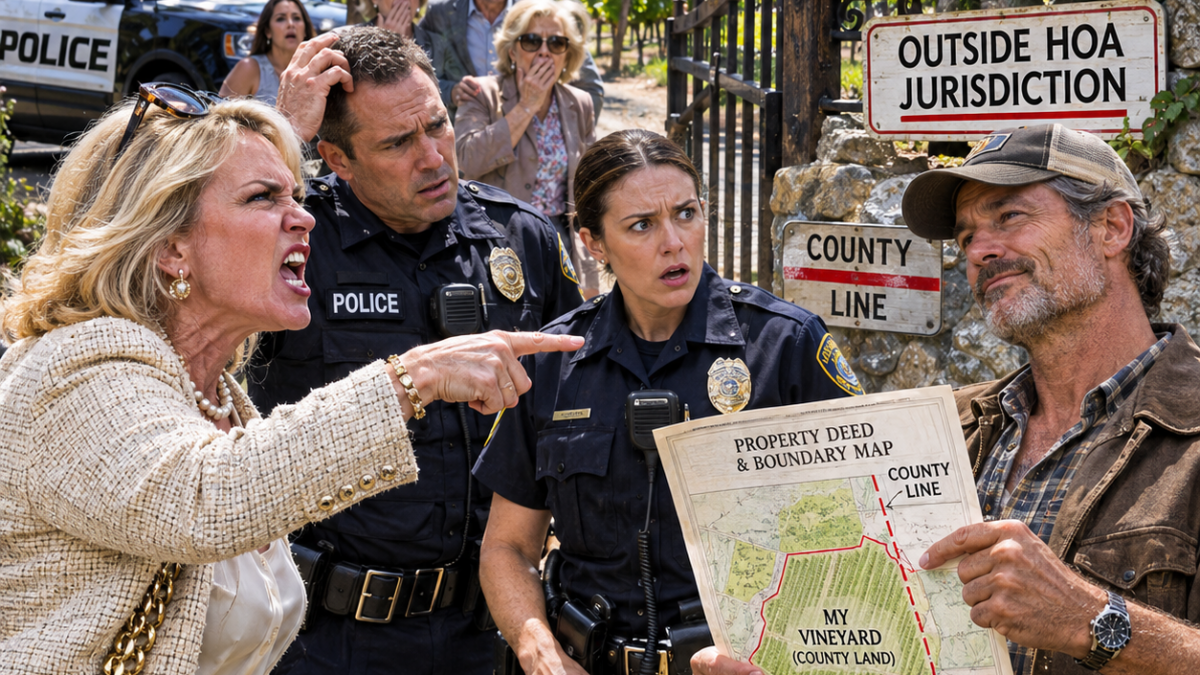
PART 2
I called Renata the next morning.
The vineyard was still wet with dew.
Spring mornings on that hillside have a smell I’ve never been able to describe properly.
Cold earth.
Grass.
Old oak barrels airing near the winery.
A little diesel from whatever tractor Boyd had already started before sunrise.
The air makes people generous.
That was probably why I began politely.
Renata answered on the second ring.
“This is Renata.”
“Ms. Holloway, my name’s Garrett Winslow. Winslow Ridge Vineyard.”
“I know who you are.”
Not hello.
Not good morning.
Straight to business.
“I received your letter.”
“Yes.”
“I think there’s been a misunderstanding.”
A pause.
Not uncertain.
Measured.
“What misunderstanding would that be?”
“Our property isn’t part of Ridgecrest Estates.”
Another pause.
Then, very calmly:
“Mr. Winslow, Ridgecrest community standards apply to operations affecting the quality of life of our residents.”
I looked at the vines in front of me.
“That isn’t how an HOA works.”
“Our counsel disagrees.”
“Your counsel believes HOA covenants apply to property that never joined the HOA?”
“The situation is more complicated than you’re presenting.”
“Then send me the documents.”
“What documents?”
“Anything showing Ridgecrest has legal authority over my parcel.”
“I’ll have my assistant follow up.”
“Good.”
She hung up.
No assistant ever contacted me.
Three days later, a second notice arrived.
**LEVEL TWO VIOLATION.**
More formal language.
More threats.
Possible legal remedies.
I showed it to Boyd.
He read it beside the bottling line.
“You going to call her again?”
“No.”
“Good.”
“Why good?”
“Because I’ve known people like this.”
He handed the paper back.
“If you explain something twice, they think you’re negotiating.”
I should have listened more carefully.
—
Our spring wine-club weekend was coming up.
Ninety guests.
Bluegrass trio.
Food truck.
New releases.
It was one of those events that reminded me why all the work mattered.
Friday afternoon, the smokehouse truck rolled in.
By four o’clock the property smelled like hickory, grass, and fermenting fruit.
Members arrived laughing.
People hugged staff they hadn’t seen since fall.
The band tuned up on the covered platform.
Grandpa would have loved it.
Then Renata arrived.
No ticket.
No reservation.
Clipboard.
Phone already recording.
Two Ridgecrest board members behind her.
Douglas Fitch and Pamela Sorrento.
Boyd intercepted them near the entrance.
“Private event.”
Renata didn’t slow down.
“We’re here on official HOA business.”
Boyd looked over his shoulder at me.
Then back at her.
“You don’t have HOA business here.”
“I need to document violations.”
“You need a ticket.”
“This is a compliance inspection.”
Boyd’s face did something I recognized immediately.
His old Army-sergeant expression.
The one that said somebody had just said something so ridiculous he needed to decide whether correcting them was worth the energy.
I walked over.
“Renata.”
“Mr. Winslow.”
She pointed the phone at the parking lot.
“Your vehicle volume is substantially above normal residential levels.”
“We aren’t residential.”
“Your music is clearly audible.”
“On my property.”
“You’re disturbing Ridgecrest residents.”
“Which resident complained today?”
“That information is confidential.”
She turned toward the food truck.
Recorded that.
Then the band.
Then several guests.
I stepped between the phone and a family sitting at a picnic table.
“Do not film my guests up close.”
“I’m documenting an active violation.”
“You have no authority to investigate anything here.”
Douglas shifted uncomfortably.
Pamela stared at her own phone.
One of our longtime members, Harlan Dietz, approached.
Harlan was a retired civil engineer.
He was seventy-something, mild-mannered, and almost pathologically incapable of allowing geography to remain imprecise.
“Excuse me,” he said.
Renata turned.
“Yes?”
“Who are you?”
“Renata Holloway. President of Ridgecrest Estates HOA.”
Harlan nodded.
“Where’s Ridgecrest Estates?”
Renata pointed east.
“Down the road.”
“How far?”
She frowned.
“What difference does that make?”
“Quarter mile?”
“I don’t know exactly.”
“I do.”
Harlan looked toward me.
“Your eastern property boundary is about a thousand three hundred feet from the Ridgecrest entrance, correct?”
“Approximately.”
Harlan looked back at Renata.
“So why are you inspecting this property?”
Renata ignored him.
She lifted the phone again.
“Mr. Winslow, I am formally notifying you—”
“Stop.”
She froze.
It was the first time I had interrupted her.
“You need to leave.”
Her eyes widened slightly.
“Excuse me?”
“You aren’t a customer.”
I pointed toward the entrance.
“You are not invited. This is private property. Leave.”
“I’m here in my capacity as—”
“You don’t have a capacity here.”
She lowered the phone.
For several seconds, neither of us moved.
Then she smiled.
A small smile.
Cold.
“You’re making a mistake.”
“Maybe.”
I pointed again.
“But you’re leaving.”
She did.
Slowly.
Recording every step back toward her car.
That evening, the footage appeared online.
—
Renata’s Facebook caption described Winslow Ridge as a commercial nuisance operating “in open defiance of community governance.”
Forty-seven people liked it.
Some actually lived in Ridgecrest.
Some didn’t.
I made mistake number two.
I responded.
Politely.
Factually.
I explained that Winslow Ridge was outside the HOA boundary.
I posted no insults.
No accusations.
Just facts.
The comment section immediately became a neighborhood courtroom.
Noise.
Traffic.
Property values.
Tourists.
Alcohol.
One man I had never met wrote:
“If you don’t like HOA standards, don’t operate beside an HOA.”
I almost replied that Grandpa had bought the vineyard land before most of those houses existed.
Then deleted the comment before posting.
By Monday morning, Renata had filed a complaint with county zoning.
She contacted our event insurer.
She sent a letter to the Virginia Department of Agriculture and Consumer Services questioning our agricultural classification.
That was when I understood.
This wasn’t going away because I explained jurisdiction.
Renata didn’t need to win.
She needed to make running the vineyard exhausting.
Every complaint required time.
Documents.
Phone calls.
Responses.
Insurance questions.
Agency emails.
One person with enough free time can create an extraordinary amount of work for another person who actually has a business to run.
So I called an attorney.
—
Cecily Drummond practiced agricultural property law out of Waynesboro.
A Farm Bureau friend recommended her.
“She likes fighting HOAs,” he told me.
That sounded promising.
Her office had framed soil maps on the walls.
Behind her desk was a needlepoint saying:
**EASEMENTS ARE FOREVER.**
I liked her immediately.
She listened to the entire story.
Then asked three questions.
“Do you have your deed?”
“Yes.”
“Parcel map?”
“Yes.”
“Ridgecrest covenants?”
“No.”
“I’ll get them.”
She did.
Within twenty-four hours.
When I returned, Cecily had my parcel map beside the recorded Ridgecrest plat.
She pushed both toward me.
“Good news.”
I looked.
“You don’t belong to them.”
“I know.”
“I mean legally, completely, beautifully, boringly, unquestionably not theirs.”
She traced the line with one finger.
“Ridgecrest ends here.”
Then tapped our parcel.
“You are here.”
The two did not touch.
“Your parcel is agricultural land in unincorporated county territory. No declaration. No annexation. No covenant extension.”
“So they have zero authority.”
“Correct.”
I exhaled.
“Then this should be over.”
Cecily leaned back.
“No.”
That wasn’t the answer I wanted.
“Why?”
“Because Renata probably knows they don’t have direct jurisdiction by now.”
I stared at her.
“Then what is she doing?”
“Using other systems.”
She counted them on her fingers.
“County zoning. Insurance. State agriculture regulators. Public pressure.”
“She can just keep filing?”
“Anyone can file a complaint.”
“Even a nonsense complaint?”
“Yes.”
“That seems insane.”
“It is also reality.”
She folded her hands.
“What concerns me is pattern.”
“What pattern?”
“She isn’t asking whether you’re compliant. She’s contacting everyone who can make your life expensive.”
Cecily’s voice became sharper.
“Garrett, this may not be about winning a legal argument. It may be about forcing you to spend enough money and energy that you change your business voluntarily.”
That sat differently.
I thought of Grandpa.
Not one inch.
“What do we do?”
“Document everything.”
She began making a list.
Every letter.
Every complaint.
Every agency response.
Every expense.
Every lost vendor.
Every hour staff spent dealing with the campaign.
“Why?”
“Because process can be used as punishment.”
She looked at me.
“If that becomes intentional interference with your business, I want a record.”
For the first time, I stopped thinking like a farmer under attack.
I started thinking like somebody building a case.
—
Cecily answered the zoning complaint.
Deed.
Parcel map.
Agricultural classification.
Event license.
Noise records.
The county closed it.
Then she wrote directly to Renata and Ridgecrest’s attorney.
Professional.
Cold.
The letter confirmed that the HOA held no jurisdiction over Winslow Ridge.
It also warned that continued interference with our business relationships could create civil liability.
Renata responded by holding a neighborhood meeting.
Of course she did.
I heard about it from Tilford Crane.
Tilford lived in Ridgecrest.
Retired electrician.
Wine-club member.
Loved our Cabernet Franc.
Disliked Renata almost as intensely as he disliked sweet red wine.
He called the next morning.
“She had a dossier.”
“A what?”
“Her word.”
“What was in it?”
“Traffic charts. Noise charts. Photos. Maps.”
I rubbed my forehead.
“She had your vineyard circled in red.”
“That’s comforting.”
“She told everyone you’re lowering property values.”
“How many people were there?”
“Thirty, maybe.”
“And they believed her?”
Tilford paused.
“Some.”
That hurt more than I expected.
“But not all,” he added.
“What happened?”
“She said you attract a certain type of visitor.”
I stopped.
“What does that mean?”
“She didn’t explain.”
“Tilford.”
“I know.”
We were quiet.
Our wine club included farmers, teachers, contractors, doctors, retired service members, couples from Richmond, locals who arrived in muddy boots, people with money, people without much money, every kind of person.
There was nothing threatening about them.
But I understood the implication.
People Renata didn’t consider “her crowd.”
I told Cecily.
Her response was immediate.
“Write down exactly what Tilford said.”
“Why?”
“Because if she ever says something similar publicly or in writing, I want context.”
Notebook.
Date.
Time.
Conversation.
That became my habit.
—
May became June.
The vines rose to chest height.
Everything turned green.
Renata went to the county Board of Supervisors.
She brought sixty-two signatures.
Requested a comprehensive review.
Event license.
Noise.
Traffic.
Supervisor Gerald Pruitt listened.
Sixteen years in local government had apparently taught him one principle:
The loudest constituent gets the chair closest to the microphone.
Cecily called me the day before.
“You need to be there.”
“I have bottling scheduled.”
“Reschedule.”
I did.
Renata spoke for eight minutes.
PowerPoint.
“Community character.”
“Undue burden.”
“Responsible growth.”
“Long-term residential interests.”
She was good.
I’ll admit that.
If you knew nothing else, she sounded reasonable.
Then I spoke.
Four minutes.
No PowerPoint.
Event license.
Noise records.
Agricultural classification.
Farm Bureau letter.
Property history.
Our sound meter had never exceeded sixty-five decibels at the boundary during events.
Our operation predated most of the development.
Cecily had prepared a legal memo explaining protections applied to agricultural activity.
I handed everything to the board.
The supervisors voted to take no action.
Renata’s mouth tightened.
Supervisor Pruitt looked irritated.
I thought we had won something.
We hadn’t.
We had merely survived another round.
—
A week later, Marcus Webb called.
Marcus owned Ridgeback Smokehouse.
His truck had been one of our best event partners for two seasons.
“Garrett.”
His voice was wrong.
“What happened?”
“I got a call from your HOA lady.”
“She isn’t my HOA lady.”
“You know what I mean.”
I leaned against the winery office door.
“What did she say?”
“She told me she’s documenting vendors.”
I closed my eyes.
“She contacted my commissary too.”
“What?”
“She asked whether my license covers winery events.”
“It does.”
“I know.”
“Then what’s the problem?”
He exhaled.
“My problem is I have three employees and two kids.”
I didn’t speak.
“If she keeps calling people, I’m going to spend money proving things I already know.”
“Marcus—”
“I can’t do summer events there.”
That hurt.
Financially.
Personally.
“I understand.”
“I’m sorry.”
“Don’t apologize.”
“I hate doing this.”
“Take care of your business.”
We hung up.
I stood in the office staring through the screen door.
Boyd appeared beside me.
“Bad?”
“Marcus pulled out.”
He understood instantly.
“Holloway?”
“Yep.”
Boyd leaned against the wall.
“You’re done waiting.”
It wasn’t a question.
Something had changed inside me.
Until then, I had been defending.
Responding.
Correcting.
Proving.
Renata picked the target.
I answered.
She filed.
I responded.
She spoke.
I explained.
I was tired of letting her decide where the fight happened.
“I’m done waiting.”
Boyd nodded.
“What do you want?”
I looked across the hillside.
Cabernet Franc rows stretching toward the ridge.
“Everything.”
“Meaning?”
“Every record.”
Boyd smiled.
“I’ll get boxes.”
—
Cecily had already started digging.
“People this persistent usually have a reason,” she told me.
Public corporate filings.
Property transactions.
HOA financial records.
County planning documents.
Developer records.
Three weeks later, she called.
“You need to come in.”
Her voice made me cancel lunch.
On her conference table sat a chain of documents.
The first was a deed.
Then LLC filings.
Then a development application.
“Ridgecrest Land Partners LLC,” she said.
I read the name.
“Who are they?”
“They own several undeveloped parcels around Ridgecrest.”
“Okay.”
“One member is a Richmond investment group.”
“And?”
She slid another page toward me.
“The other interest traces to Renata Holloway.”
I looked up.
“Renata owns development land?”
“Part of the entity that does.”
“Where?”
Cecily unfolded the plat.
Lot 47.
Across State Route 614.
Almost directly opposite my entrance.
My stomach tightened.
“What do they want to build?”
“Residential subdivision.”
I looked at the application.
Then at the traffic study.
A sentence had been highlighted.
The model assumed reduced commercial event traffic associated with the eventual cessation of Winslow Ridge Vineyard’s event operation.
I read it twice.
Then a third time.
“They assumed I would close?”
“Your event operation.”
“Why?”
“That is the question.”
I looked at Cecily.
“She’s been trying to make the assumption true.”
“Yes.”
The room became very quiet.
Ceiling fan.
Paper.
Nothing else.
Every complaint suddenly made sense.
Noise.
Traffic.
Insurance.
County board.
Agriculture agency.
If the vineyard continued hosting events, Lot 47’s traffic assumptions became harder to defend.
If I stopped events?
Her development became easier.
“How much is her stake worth?”
“Potentially substantial.”
“Did she disclose this to the HOA?”
“No record I can find.”
“County?”
“No.”
“Supervisor?”
“No.”
I felt anger.
Not hot anger.
That would have been easier.
This was cold.
Precise.
For months, she had told people she was protecting her community.
She had been protecting an investment.
“Can we prove motive?”
Cecily tapped the documents.
“We can prove financial interest.”
Then another page.
“We can prove timing.”
Another.
“We can prove she repeatedly used her HOA title while discussing a business whose operation affected her development assumptions.”
“Is that enough?”
“For questions?”
Cecily smiled.
“Oh, Garrett.”
She leaned back.
“We have a lot of questions.”
—
Cecily explained the angles.
Ridgecrest bylaws required board members to disclose conflicts.
Renata hadn’t.
Lot 47’s planning assumptions could be challenged.
Our business-interference case had a motive now.
The vendor calls mattered more.
Insurance calls mattered more.
Regulatory letters mattered more.
I asked the question I had been waiting to ask.
“When do we move?”
“Not yet.”
I stared at her.
“You enjoy saying that.”
“Yes.”
“Why wait?”
“Because we only get to reveal this once.”
She gathered the documents.
“If you expose it privately, she explains it privately.”
“If we do it publicly?”
“She has to answer publicly.”
I thought about Marcus.
About Tilford.
About Grandpa.
“Build it.”
—
The next six weeks were quiet.
That was the strange part.
The most important part of the fight looked like nothing from the outside.
We called it getting the house in order.
Boyd’s phrase.
Legal first.
Cecily drafted a tortious-interference complaint.
Renata personally.
Ridgecrest Land Partners.
Business contacts.
Insurance communications.
Vendor pressure.
Regulatory complaints.
Lost revenue.
Legal costs.
Staff time.
At first, estimated damages sat just below forty-seven thousand dollars.
Then higher.
We did not serve immediately.
Second:
FOIA requests.
County planning communications.
Emails.
Staff notes.
Lot 47 records.
One email stood out.
From an account linked to Renata.
It urged planning staff to scrutinize our event license because of “ongoing community concerns.”
No disclosure that she had a financial interest in Lot 47.
Added to the file.
Third:
Harlan.
My civil-engineer wine-club member.
I showed him the public traffic study.
He sat in the tasting room for forty minutes reading it.
Then looked up.
“This baseline is nonsense.”
“Why?”
“They assume your traffic disappears.”
“Exactly.”
“Based on what?”
“Renata’s optimism?”
He did not laugh.
Engineers rarely laugh when confronted with bad assumptions.
He wrote an eleven-page technical comment.
Cited state transportation standards.
Explained that an operating business could not simply be removed from the baseline model without legal and factual justification.
The planning department flagged Lot 47.
Administrative hold.
Renata didn’t know why yet.
Fourth:
The community.
Tilford started asking questions inside Ridgecrest.
Not accusations.
Questions.
“Has anyone seen the Lot 47 filings?”
“Does Renata own property nearby?”
“Does the board disclose conflicts?”
Good questions are dangerous when somebody’s power depends on nobody asking them.
People began looking.
Fifth:
Our annual Harvest Preview.
Late August.
One hundred fifty tickets.
Music.
Vendors.
Wine.
County agriculture people.
Press.
And, hopefully, Renata.
—
Marcus came back.
I called him personally.
“I found out why she’s doing this.”
Long silence.
“Tell me.”
I explained Lot 47.
When I finished, he said one word.
“Wow.”
“I want you at Harvest Preview.”
“Garrett—”
“Formal vendor agreement. Cecily will review it. If Renata contacts you, my attorney handles it.”
“You sure?”
“Yes.”
Another pause.
“My wife has been telling me I shouldn’t have let that woman scare me.”
“Your wife sounds smart.”
“She’s going to be unbearable when I tell her you said that.”
“Come cook brisket.”
Marcus laughed.
“Fine.”
That mattered more than I told him.
Renata had managed to make one of my friends feel unsafe doing business with me.
Getting him back felt like reclaiming something.
—
We invited County Planning Director Sybil Prather through a Farm Bureau contact.
Not as part of a trap.
As a guest.
We invited the Albemarle Register to do a feature on agricultural tourism.
Dex Holloway, a young reporter with no relation to Renata, came out.
She spent three hours walking the vines.
Asked Boyd about labor.
Asked me about event economics.
Asked customers why they came.
Good reporter.
Curious.
No agenda.
Ten days before Harvest Preview, Renata visited the newspaper.
Dex called me afterward.
“She asked my editor to kill the story.”
I stopped pruning a vine.
“She what?”
“Said it was biased.”
“Has it even run?”
“No.”
“What evidence did she bring?”
“Her own complaints.”
“That she filed?”
“Yes.”
“Did you explain that?”
“Yes.”
“How’d that go?”
“She requested the publisher.”
I laughed.
Dex didn’t.
“She left a voicemail suggesting our agricultural coverage demonstrates favoritism.”
“Your publisher enjoy that?”
“He’s been a journalist thirty years.”
“So.”
“The story’s getting longer.”
Good.
—
Then Renata contacted our insurer again.
This time, formal written allegations.
She claimed we were operating in violation of local ordinances.
Claimed active regulatory issues.
Claimed potential liability.
Our insurer requested documents.
Not cancellation.
Due diligence.
Still cost time.
Cecily prepared a response.
The county had already closed the complaints.
The violations Renata described were not active.
We obtained her written statement.
Cecily read it.
Then looked at me.
“This is useful.”
“I’m starting to hate that word.”
“You should love this one.”
“Why?”
“Because it’s written.”
The estimated damages climbed past fifty-two thousand dollars.
Five days before Harvest Preview, Douglas Fitch resigned from the Ridgecrest board.
Renata’s loyal lieutenant.
Tilford called.
“I know why.”
“What happened?”
“I was setting up chairs before the meeting.”
“And?”
“Douglas asked her whether she had a financial interest in nearby development.”
I stood still.
“What did she say?”
“None of his business.”
“And he resigned?”
“Forty-eight hours later.”
Interesting.
People can tolerate a lot when they think they are defending a principle.
The moment they suspect they have been defending somebody else’s wallet, loyalty changes.
—
The day before Harvest Preview, Renata called the sheriff.
Allegations:
Public nuisance.
License capacity violations.
Alcohol service to minors.
The sheriff’s office dispatched two deputies for observation.
Renata apparently told several Ridgecrest residents that law enforcement would “take action.”
She also called local television.
A camera crew agreed to come.
When I heard that, Boyd looked worried.
I smiled.
“You’re smiling,” he said.
“Little bit.”
“That usually means I need to start worrying.”
“No.”
I looked toward my office.
“Everything’s ready.”
The banker’s box contained:
Deed.
Parcel map.
Event license.
Noise logs.
Insurance.
Closed complaint letters.
HOA correspondence.
LLC records.
Lot 47 application.
Traffic study.
FOIA email.
Vendor communications.
Renata’s insurance statement.
Harlan’s technical analysis.
Cecily had a duplicate.
I also called the sheriff’s office.
Sergeant Dalton spoke with me.
Straightforward.
Professional.
I emailed him our license and boundary documents.
Twenty minutes later he called back.
“Mr. Winslow.”
“Yes.”
“Just confirming. Your property is not subject to Ridgecrest Estates HOA?”
“Correct.”
“And your event permit is current?”
“Yes.”
“Alcohol compliance?”
“Current.”
“Insurance?”
“Current.”
A pause.
“This complaint reads more like a neighbor dispute than a criminal matter.”
“I agree.”
“My deputies will observe.”
“Perfect.”
“They won’t act as HOA enforcement.”
“I wouldn’t expect them to.”
Another pause.
“Anything else?”
“Yes.”
“What?”
“If they’re comfortable, I’d appreciate it if they stayed for a while.”
“Why?”
“There may be context they’ll want to see.”
Dalton went quiet.
“Understood.”
—
Harvest Preview morning arrived gray.
Mist in the low ground.
Ripe fruit smell.
Boyd was out before dawn checking power lines for the lights.
Marcus’s smokehouse truck arrived early.
By noon, the sky turned blue.
Hot.
Virginia August.
By five, the vineyard had transformed.
Edison bulbs curved over the gravel paths.
Cab Franc rows glowed in late sunlight.
Music from the stage.
Smoked brisket.
Viognier.
Rosé.
Laughter.
One hundred forty-seven guests had checked in.
Four vendors.
No chaos.
No violation.
Just a good party.
The deputies arrived early.
Reviewed everything.
Spoke with Cecily.
One eventually bought brisket.
Channel 7’s crew arrived expecting a showdown.
They found families at picnic tables and a bluegrass trio.
The reporter began interviewing guests.
“What brought you here?”
“The wine.”
“Any problems with noise?”
One guest looked at the band.
“You mean the banjo?”
Not the footage Renata had imagined.
At 5:15, Boyd walked over.
“She’s here.”
I looked toward the entrance.
Renata Holloway.
Pamela Sorrento.
A man carrying a leather portfolio.
Attorney.
Renata wore confidence like perfume.
White dress.
Large sunglasses.
Red lipstick.
She walked through my entrance.
Onto my land.
Looked at the deputies.
Looked at the cameras.
Something shifted in her expression.
The deputies were relaxed.
Guests were smiling.
The news crew was filming wine, not disorder.
She had expected enforcement.
Instead, she had delivered an audience.
I set down my glass.
“Ready?” Boyd asked.
“No.”
He frowned.
Then I smiled.
“But we’re doing it.”
—
I let Renata walk twenty feet inside.
Then approached.
“Renata.”
“Mr. Winslow.”
She removed her sunglasses.
“I’m here to formally document—”
“I’m glad you came.”
That stopped her.
She looked around.
“I beg your pardon?”
“There’s something you should see.”
“I think you’re misunderstanding why we’re here.”
“Cecily?”
My attorney walked over carrying a folder.
Behind her, almost perfectly timed, Sybil Prather approached from the opposite direction.
The Channel 7 cameraman noticed movement.
Started filming.
Renata’s attorney stepped forward.
“Ms. Holloway is here regarding ongoing—”
Cecily smiled.
“Wonderful.”
Then handed him papers.
“I have something for you.”
He took them.
His eyes moved across the first page.
The expression changed.
Cecily spoke clearly.
“This is a civil complaint filed in Albemarle Circuit Court.”
Renata’s eyes narrowed.
“It names Ms. Holloway personally.”
The attorney kept reading.
“And Ridgecrest Land Partners LLC.”
Renata went still.
That was the first moment I knew she finally understood how much we knew.
“What is this?” she demanded.
“Documentation,” Cecily said.
Sybil looked between them.
“Ridgecrest Land Partners?”
Cecily turned slightly.
“Director Prather, since you are here, there is information relevant to Lot 47.”
Renata’s face changed.
“Cecily.”
It was the first time she used my attorney’s first name.
Cecily continued.
“One of the financial participants in Ridgecrest Land Partners is also the HOA president who initiated multiple complaints against this vineyard.”
Sybil’s expression became professional.
Very professional.
“The traffic study supporting Lot 47,” Cecily continued, “assumes reduced vineyard event activity.”
Renata’s attorney leaned toward her.
Quiet words.
She ignored him.
“That is an outrageous characterization.”
Harlan appeared beside us.
I had no idea where he came from.
He held a wine glass.
“The traffic study is public.”
Renata turned.
Harlan continued.
“The LLC filing is public.”
He sipped.
“So are your communications with planning staff.”
There was something uniquely devastating about being challenged by a retired civil engineer holding Viognier.
Tilford stood behind him.
Then several Ridgecrest residents.
People who had come because they wanted to know.
Not because they hated Renata.
Not because they supported me blindly.
They wanted answers.
Renata looked toward the deputies.
“Are you going to do something?”
That question said everything.
One deputy stepped forward.
“Ma’am, we reviewed the documentation.”
Renata pointed around.
“This event has been the subject of repeated violations.”
“Not law-enforcement violations.”
“They are operating against community standards.”
The deputy remained calm.
“Ridgecrest Estates HOA does not govern this parcel.”
Silence.
A beautiful silence.
Renata stared at him.
“Their operations affect our residents.”
“That’s a civil issue, ma’am.”
“They are serving alcohol.”
“They have the proper event documentation.”
“Noise?”
“Within the information provided to us.”
Channel 7’s reporter stepped closer.
“Just so I understand—does Ridgecrest HOA have jurisdiction over this property?”
I looked at the camera.
“No.”
Renata turned toward me.
I could see anger now.
Real anger.
“Never did,” I said.
That was all.
No speech.
No victory line.
I didn’t need one.
The band played behind us.
Warm guitar.
Fiddle.
Hickory smoke moved through the rows.
Guests watched from a respectful distance.
Renata stood on the vineyard she had spent months trying to shut down.
Her attorney held a complaint naming her.
A county planning director had just heard about her undisclosed interest.
Deputies had refused to act as her enforcement arm.
Her own neighbors were watching.
And the camera crew she had invited was recording all of it.
Her attorney touched her elbow.
“Renata.”
She didn’t move.
“Renata.”
Finally, she put the sunglasses back on.
Then left.
Pamela followed.
Attorney behind them.
The deputies stayed.
So did the camera crew.
And the party continued.
That part mattered.
We didn’t stop the music.
We didn’t gather around to celebrate her leaving.
Marcus kept slicing brisket.
Boyd poured wine.
The band finished its set.
Life continued.
Because the vineyard was never supposed to become a monument to defeating Renata.
It was supposed to remain a vineyard.
—
The Channel 7 segment aired three days later.
Not the segment Renata had planned.
Four minutes.
Local vineyard.
HOA dispute.
Financial interest in nearby development.
County records.
Lot 47.
Law enforcement confirming no enforcement action at the event.
Planning department reviewing the subdivision application.
The reporter used careful language.
No theatrics.
The facts were enough.
Renata declined an interview.
Her lawyer issued a statement calling the lawsuit meritless.
Cecily’s response:
“We look forward to resolving the matter through documented evidence.”
That was all.
Tilford called after the broadcast.
“You should see the Ridgecrest Facebook group.”
“I don’t want to.”
“Smart.”
“What’s happening?”
“Chaos.”
“Good chaos?”
“There’s no good HOA Facebook chaos.”
Fair.
Residents wanted records.
Minutes.
Financial disclosures.
Conflict statements.
Douglas Fitch’s resignation suddenly looked different.
Pamela became much quieter.
Two homeowners demanded a special meeting.
Then three.
Then enough.
Six weeks after Harvest Preview, Renata resigned as president.
Her letter cited personal and professional obligations.
Nothing about Lot 47.
Nothing about Winslow Ridge.
Nothing about the lawsuit.
She thanked residents for allowing her to serve.
Boyd read the letter at my desk.
“That’s it?”
“That’s it.”
“No apology?”
“No.”
“You mad?”
I thought about it.
“No.”
Boyd looked suspicious.
“Really?”
“She doesn’t owe me words.”
He nodded toward the vineyard.
“No.”
“She owed me leaving this alone.”
“That happen?”
“We’ll see.”
—
Settlement discussions began in October.
Ridgecrest’s counsel contacted Cecily.
I won’t give confidential terms.
I can tell you this:
Marcus Webb received a phone call from me on December 23.
“What?” he said after I told him.
I repeated it.
He laughed for thirty seconds.
Then went quiet.
“Garrett.”
“Yeah?”
“You didn’t have to do that.”
“I know.”
“I pulled out.”
“You had a family.”
“She came after my business.”
“Exactly.”
Silence.
Then Marcus said:
“Merry Christmas, man.”
“Merry Christmas.”
Lot 47 was withdrawn in January.
No subdivision.
No traffic assumption built around our disappearance.
As far as I know, the parcel remains undeveloped.
The vines stayed.
The tasting room stayed.
The music stayed.
Grandpa’s Viognier definitely stayed.
—
But that isn’t my favorite part.
My favorite part started with a conversation between me and Tilford.
We were sitting outside the tasting room after everything had calmed down.
Early spring.
Bare vines.
Wind off the Blue Ridge.
He said something that bothered me.
“She got people to believe her for a while.”
“I know.”
“Why?”
I had thought about that.
“Because she used familiar fears.”
“Noise.”
“Traffic.”
“Property values.”
“Visitors.”
That one hung between us.
Tilford looked down.
“I should’ve challenged that sooner.”
“You challenged her eventually.”
“Eventually is easy.”
He looked toward Ridgecrest.
“First time was harder.”
I understood.
Renata’s real power had never come from covenants.
She had no covenant authority over me.
Her power came from people assuming somebody else had verified her claims.
The HOA president said it.
So maybe it was true.
She brought a map.
Maybe it was true.
She said “community standards.”
Maybe she had authority.
She said “violations.”
Maybe an agency had found something.
Nobody asked where the findings were.
That bothered me more than the lawsuit.
So Cecily asked a question.
“What do you want the settlement to mean?”
I stared at her.
“What do you mean?”
“You can treat it as compensation.”
“That’s what settlements are.”
“Yes.”
She smiled.
“Or you can decide what part of this story survives.”
That stayed with me.
—
The Winslow Ridge Agricultural Community Scholarship launched that spring.
Two awards.
$2,500 each.
High-school students from anywhere in the county.
Agriculture.
Viticulture.
Food science.
Environmental conservation.
No Ridgecrest restriction.
No vineyard-family preference.
Any student.
We used part of the settlement.
Then the county extension office approached us about educational programming.
That became monthly workshops.
Soil science.
Water management.
Pest identification.
Small-scale fermentation.
Basic vineyard maintenance.
Equipment safety.
Boyd taught tractor maintenance.
I expected maybe twelve people.
Thirty-two showed up.
Boyd stood beside an old tractor explaining hydraulic lines with the seriousness of a surgeon.
A sixteen-year-old girl asked him a question about fuel contamination.
He stopped.
Smiled.
Then spent ten minutes answering.
Afterward, he came to the bar.
“You knew?”
“Knew what?”
“That people would come.”
“No.”
He stared at me.
“You’re lying.”
“Maybe a little.”
—
Our first scholarship recipients were announced at the fall harvest festival.
The same event where Renata had expected deputies to shut us down the year before.
The band returned.
Marcus brought the smokehouse truck.
Harlan complained about a poorly designed temporary sign near the entrance and then fixed it himself.
Tilford’s wife brought a pie.
Lasted eight minutes.
Sybil Prather attended.
Not as planning director.
Just as a person buying wine.
That mattered.
The first scholarship recipient was a young man named Ethan who wanted to study environmental conservation.
The second was a girl named Marisol whose family worked a small vegetable farm and who wanted to study food science.
I stood on the little stage.
Grandpa’s Viognier in my hand.
Looked at them.
Then at the crowd.
I had prepared remarks.
I didn’t use most of them.
I just said:
“My grandfather believed land was something you borrowed from the future.”
People became quiet.
“He taught me that owning land isn’t only having the right to keep people off it.”
I looked down the rows.
“It’s deciding what you’re going to leave behind.”
That was enough.
We handed them the awards.
No mention of Renata.
No mention of Ridgecrest.
No revenge story.
The night belonged to two kids.
—
Later, I walked the vineyard alone.
Dusk.
Rows stripped after harvest.
Cool air.
Wood smoke somewhere down the road.
Grandpa used to walk exactly that route.
Slowly.
He would touch vines as he passed.
Not because they needed touching.
Just habit.
I stopped near the original Viognier block.
The one everyone said wouldn’t work.
Those vines were older now.
Thick trunks.
Scarred wood.
Strong.
I remembered Grandpa at seventy-two.
Hands shaking slightly as he planted.
Too old to start a vineyard by any sensible standard.
He did it anyway.
“Land is an argument you make with time,” he once told me.
I had laughed.
Grandpa said things like that after two glasses.
Now I understood.
You plant because you believe somebody will harvest.
You build because you believe something will remain.
And you defend what matters because sometimes people look at something you built and see only what they could profit from if it disappeared.
Renata saw forty-three acres in the way.
Grandpa saw rows.
My father saw work.
Boyd saw responsibility.
I saw inheritance.
Ethan and Marisol might someday see possibility.
Same land.
Different eyes.
—
People ask me whether the deputies were embarrassed.
No.
They had nothing to be embarrassed about.
They were responding to a complaint.
They reviewed our paperwork.
They behaved professionally.
They made no attempt to enforce HOA rules.
That distinction matters.
The deputies were never the problem.
Renata’s mistake was believing a sheriff’s uniform could turn her HOA complaint into jurisdiction.
It couldn’t.
Police authority and HOA authority are not the same thing.
She called law enforcement expecting them to validate her power.
Instead, their neutrality exposed its limit.
That moment at Harvest Preview wasn’t satisfying because “the cops took my side.”
They didn’t take sides.
They looked at facts.
My licenses were current.
My boundary was clear.
The event complied.
There was nothing for them to enforce.
That was enough.
Sometimes impartiality feels like revenge when the other person has spent months depending on favoritism.
—
I also learned something uncomfortable about myself.
At the beginning, I was too polite.
Not kind.
Polite.
Those are different.
Kindness is choosing not to hurt somebody unnecessarily.
Politeness can become avoidance.
First letter?
I laughed.
Second?
Ignored it.
Renata at the wine-club event?
I hoped she would leave if I explained.
County complaint?
Respond.
Insurance inquiry?
Respond.
Every time she escalated, I treated each action as isolated.
That helped her.
Because if every complaint is treated separately, the pattern disappears.
Cecily taught me to stop asking:
“How do I answer this?”
And start asking:
“What does this action mean when placed beside all the others?”
Completely different question.
One zoning complaint can be concern.
One insurance contact can be concern.
One vendor call can be concern.
One agriculture letter can be concern.
One county presentation can be concern.
One development application can be business.
Put all of them together?
You begin seeing motive.
That is what paperwork does.
It turns memory into structure.
—
Boyd understood this earlier than I did.
One evening after settlement, we sat on the winery porch.
Sunset.
Cab Franc in glasses.
He said:
“You know what your problem was?”
“I have several.”
“You think reasonable people always recognize reason.”
“That’s optimistic.”
“That’s stupid.”
I laughed.
“Thanks.”
“In the Army, if somebody keeps advancing after three warnings, you stop assuming they didn’t hear.”
“Different context.”
“Same principle.”
He sipped.
“You told her three times.”
“More.”
“And kept hoping the next explanation would fix it.”
“Probably.”
Boyd stared across the vines.
“Some people don’t misunderstand boundaries.”
He looked at me.
“They’re testing whether you’ll defend them.”
That sounded like Grandpa.
Not one inch.
—
Tilford eventually joined the Ridgecrest board.
That surprised him more than anyone.
“I hate meetings,” he told me.
“Then you’re perfect.”
“How?”
“People who love HOA meetings should be monitored.”
He laughed.
Ridgecrest changed.
Not overnight.
Renata had spent years centralizing decisions.
Undoing habits takes time.
They added conflict-of-interest disclosures.
Published more financial records.
Required members with development interests to recuse themselves.
Updated complaint procedures.
More residents attended meetings.
Douglas Fitch never returned to the board.
I saw him once at the vineyard the following spring.
He came alone.
Ordered Cabernet Franc.
Sat outside.
When I passed, he stood.
“Garrett.”
“Douglas.”
He looked embarrassed.
“I owe you an apology.”
I waited.
“I should’ve asked questions earlier.”
“You resigned.”
“After four years.”
True.
“I voted with her.”
Also true.
“I believed she was protecting property values.”
“Maybe she believed that too.”
He shook his head.
“No.”
Then he surprised me.
“I think she believed anything that benefited her was automatically good for Ridgecrest.”
That was probably the best description of Renata I ever heard.
Not a cartoon villain.
Not somebody waking up every morning thinking:
How do I hurt Garrett?
That would almost be simpler.
She had convinced herself that her interests and community interests were the same.
Once people reach that point, every limit feels unfair.
Every disagreement feels personal.
Every rule becomes flexible.
For themselves.
Rigid for everybody else.
Douglas finished his wine.
Left a generous tip.
We never became friends.
But he came back several times.
That was enough.
—
Renata never returned.
At least not while I was there.
Sometimes I wondered whether she drove past.
The vineyard entrance is visible from State Route 614.
The sign is bigger now.
Not because of her.
We needed one anyway.
**WINSLOW RIDGE VINEYARD**
Below it:
**EST. 2009**
That date matters.
Years before Renata became HOA president.
Years before Lot 47.
Years before her complaints.
There is power in dates.
They remind people who came first.
Not morally.
Legally.
Historically.
Grandpa planted before Ridgecrest’s newest expansion dreams.
We didn’t build a vineyard beside a quiet suburb and then surprise them.
Residential development expanded toward existing agricultural land.
That is why right-to-farm protections exist.
Farms have smells.
Equipment.
Visitors.
Harvests.
Tractors before breakfast.
Sometimes music.
Agricultural communities cannot survive if every new development gets to treat neighboring farms as temporary inconveniences.
That lesson became part of every workshop we hosted.
Not as politics.
As planning.
Know the parcel.
Know zoning.
Know easements.
Know licenses.
Know what exists before you build beside it.
Good neighbors need boundaries as much as fences do.
—
A year later, Marisol came back from college for Thanksgiving.
She visited the tasting room with her parents.
I recognized her immediately.
“How’s food science?”
“Hard.”
“Good hard or bad hard?”
“Ask me after finals.”
Fair.
Her father shook my hand.
Then she pulled something from her backpack.
A lab report.
“I thought you’d like this.”
“What is it?”
“Fermentation project.”
She had used Virginia Viognier samples.
I read the title.
Then looked at her.
“You used our grapes?”
“Your scholarship made me interested.”
That hit me harder than I expected.
Grandpa Albert planted Viognier because somebody told him it wouldn’t survive.
Fifteen years later, a student was using fruit from those vines in a university fermentation project funded partly by money recovered from someone who wanted the vineyard gone.
Life has a sense of humor.
Quiet one.
But good.
I framed the first page of Marisol’s report.
It hangs beside the forty-dollar rosé review.
Grandpa would have loved that more.
—
Marcus’s business grew too.
Ridgeback Smokehouse added another truck.
He still jokes that Renata gave him his best advertising year.
Channel 7 used footage of his brisket line in the segment.
People recognized the logo.
Orders jumped.
“Maybe I should send her a thank-you card,” he once said.
“Don’t.”
“Fruit basket?”
“No.”
“Bottle of wine?”
“Absolutely not.”
He laughed.
“Fine.”
But beneath the joke, Marcus carried something for a while.
Guilt.
For pulling out.
One evening he told me.
“I feel like I abandoned you.”
“You protected your family.”
“I still left.”
“And came back.”
“After you had evidence.”
“Yes.”
He looked frustrated.
“Should’ve trusted you.”
“No.”
I shook my head.
“You should trust documents.”
He laughed.
But I meant it.
I didn’t want people following me because they liked me.
Renata had built her authority on exactly that kind of personal loyalty.
I wanted Marcus to know the situation was safe because there were contracts, counsel, licenses, evidence.
Personal trust is good.
Structures are better.
—
Cecily stayed our attorney.
That was not cheap.
But vineyard law is apparently like tractor ownership.
Once you have something complicated, preventative maintenance costs less than emergency repair.
She updated our vendor contracts.
Event notices.
Insurance file.
Boundary documents.
She also made me create what Boyd calls the “Renata binder.”
I hate that name.
It contains:
Deed.
Survey.
Parcel maps.
Zoning.
Agricultural exemption.
Event licenses.
Noise logs.
Insurance certificates.
Vendor agreements.
Agency closure letters.
Everything.
“Why keep it?” I asked.
Cecily looked at me like I was stupid.
“Because there will always be another person who thinks a letterhead is jurisdiction.”
Fair.
The binder sits in my office.
Blue tab:
Property.
Green:
Agriculture.
Yellow:
Events.
Red:
Insurance.
Boyd once labeled the final tab:
**PEOPLE WHO NEED MAPS**
I removed it.
Then put it back.
—
Grandpa’s farmhouse is renovated now.
Nothing fancy.
We preserved the porch.
Floorboards still creak.
His old workbench remains in the shed.
There is a mark on one post where he measured my height when I was twelve.
Another at fourteen.
Another at sixteen.
He stopped when I got taller than him.
Sometimes after events, I sit there alone.
The vineyard lights in the distance.
Cars leaving.
Quiet returning.
One night I found Grandpa’s old notebook in a cabinet.
Not business records.
Just notes.
Weather.
Planting.
Expenses.
Ideas.
One page from 2010:
**VIognier looks rough. Everyone says pull it. Wait one year.**
Next spring:
**Viognier survived. Told you.**
I laughed so hard Boyd came in.
“What?”
I showed him.
He shook his head.
“Your grandfather argued with notebooks.”
“He argued with everybody.”
“Genetic.”
Probably.
I turned more pages.
Near the back was one line:
**You don’t own land by standing on it. You own it by staying.**
I don’t know what he meant exactly.
Maybe debt.
Maybe work.
Maybe weather.
But after Renata, I had my interpretation.
Ownership is easy on closing day.
The hard part is everything after.
Taxes.
Maintenance.
Frost.
Disease.
Bad harvest.
Market changes.
And occasionally somebody with a clipboard deciding their plans matter more than your deed.
Staying is the argument.
—
People love the part where Renata arrived with deputies.
I understand why.
It’s cinematic.
Sirens.
Vineyard.
White dress.
Camera crew.
Lawsuit.
But the real turning point happened weeks earlier in Cecily’s office.
Quiet room.
Ceiling fan.
A corporate filing.
Lot 47.
No audience.
No music.
That is how most real victories begin.
Not with confrontation.
With discovery.
Somebody reads something.
Someone notices a number.
Someone asks:
“Why?”
The dramatic moment only works because the quiet work happened first.
If I had confronted Renata about Lot 47 the day we found it, she would have denied motive.
Warned investors.
Adjusted documents.
Changed strategy.
Maybe abandoned the complaint campaign temporarily.
Instead, we documented.
FOIA.
Emails.
Traffic assumptions.
Business damage.
Insurance statement.
Public planning comments.
Then when the moment came, nobody needed to believe my interpretation.
They could read the documents themselves.
That is much stronger.
—
I also stopped calling what happened revenge.
At the time?
Absolutely.
Part of me wanted revenge.
After Marcus pulled out, I wanted Renata embarrassed.
When I learned about Lot 47, I wanted the whole Ridgecrest clubhouse to know she had lied by omission.
When Channel 7 showed up, part of me was happy.
I’m not going to pretend I was spiritually above satisfaction.
But revenge has a short horizon.
It asks:
How do I make this person feel what I felt?
Accountability asks a better question:
How do I make sure this cannot happen again?
If the story ended with Renata leaving the vineyard holding a lawsuit, it would be entertaining.
But it would be small.
What lasted?
Scholarships.
Workshops.
Better HOA disclosures.
A protected agricultural business.
Vendors returning.
Students studying agriculture.
That’s bigger.
That’s why I remember Marisol’s lab report more vividly than Renata’s face.
—
The second year of the scholarship program brought thirty-eight applications.
We had to create a committee.
I refused to chair it.
“Why?” Boyd asked.
“Conflict of interest.”
He laughed.
“Look at you learning.”
We chose two students.
One wanted agricultural engineering.
One wanted forestry.
At the award event, Tilford stood beside me.
“Think Renata knows about this?”
“I hope not.”
“Why?”
“Because I don’t want her in the story anymore.”
That surprised him.
It surprised me too.
For months, every thought had revolved around Renata.
What did she file?
Who did she call?
What would she do next?
Victory finally arrived when I stopped caring.
Not because I forgot.
Because she no longer controlled the next move.
That is a different kind of freedom.
—
The vines are older now.
So am I.
Boyd has more gray.
Harlan still sends county planning comments nobody requested.
Sybil still attends once or twice a year.
Marcus still overcharges me for brisket.
He claims that is market pricing.
I call it extortion.
Cecily tells me to stop using legal terms incorrectly.
Tilford still sits on the Ridgecrest board.
He hates every meeting.
Perfect.
Connie—no, there’s no Connie in my house, this is not that kind of story.
Just me, Boyd, staff, family scattered nearby, guests, and a vineyard that keeps demanding more attention than any human relationship probably should.
Every harvest begins the same way.
Walk rows.
Taste fruit.
Measure.
Wait.
Weather decides half.
Patience decides another quarter.
Luck gets the rest.
Grandpa used to say you cannot bully grapes into ripening.
That was another lesson I learned late.
You can’t force every outcome.
But you can prepare.
Prune.
Protect.
Document.
Wait.
Then act when the fruit is ready.
Maybe that is why I finally understood how to deal with Renata.
I stopped reacting on her schedule.
I waited until our case was ripe.
Grandpa would have liked that metaphor.
Probably would have claimed he invented it.
—
Sometimes I walk to the entrance at sunrise.
State Route 614 is quiet.
Ridgecrest sits down the road.
Lot 47 remains mostly open.
No subdivision.
No trucks.
No beige houses.
Just land.
Our sign stands at the driveway.
Behind it, forty-three acres of vines, grass, buildings, barrels, tools, mistakes, memories, wages, debt, and work.
People call it property.
That word feels too clean.
Property is what county records call it.
Legacy is what it feels like at five in the morning when frost threatens.
Legacy is the smell of Grandpa’s old jacket in the shed years after he died.
Legacy is a Viognier vine planted by a seventy-two-year-old man who refused to believe experts.
Legacy is a tasting-room wall with a silly wine review and a student lab report hanging side by side.
Legacy is defending something without becoming the kind of person who thinks defending it gives you the right to control everybody else.
Renata never understood that difference.
She believed ownership of an investment gave her a claim on my future.
It didn’t.
She believed an HOA title gave her authority outside its boundary.
It didn’t.
She believed complaints became truth if she filed enough of them.
They didn’t.
She believed deputies would arrive and make her argument real.
They didn’t.
She believed cameras would show a rogue business.
Instead, they showed a vineyard doing exactly what it was licensed to do.
And she believed I was quiet because I was weak.
That was her most expensive mistake.
—
One fall evening, after the scholarship ceremony, I walked the original Viognier rows.
The festival was winding down.
Children ran between picnic tables.
Marcus was closing the truck.
The band packed cables.
Boyd carried chairs.
Tilford’s wife was hunting for the pie dish somebody had moved.
Ordinary chaos.
The good kind.
I stopped beside one of Grandpa’s oldest vines.
Thick.
Twisted.
Leaves turning.
I touched the trunk.
“Still here,” I said.
Ridiculous, talking to a grapevine.
But I meant Grandpa too.
Still here.
The vineyard.
The rows.
The business.
His bet.
My responsibility.
The future students.
Everything Renata had treated like an obstacle to a development plan.
Still here.
Boyd called from the tasting room.
“You coming?”
“In a minute.”
He disappeared inside.
The evening went quiet around me.
I thought back to the morning Renata arrived expecting law enforcement to finish what her letters couldn’t.
I remembered her pointing toward the rows.
Thirty days.
Clear this mess.
Court.
At the time, I wanted to tell her everything.
Tell her Grandpa’s story.
Tell her the deed.
The zoning.
The years.
The frost.
The work.
I wanted her to understand why she couldn’t simply erase this place.
Now?
I’m glad I didn’t waste the breath.
Some people do not need your story.
They need your boundary.
The vineyard never belonged to Ridgecrest Estates.
Not one inch.
Not one row.
Not one vine.
Not one bottle.
The deputies confirmed what the map had always shown.
Cecily proved what the records revealed.
The county saw what Renata tried to hide.
And time did what time usually does.
It separated what was real from what merely looked powerful.
Her title disappeared.
The subdivision application disappeared.
The complaints disappeared.
The vines stayed.
I walked back toward the tasting room.
The lights glowed through the windows.
Grandpa’s framed rosé review hung above the bar.
Marisol’s fermentation report beside it.
Two scholarship recipients were still talking with their parents near the door.
Boyd handed me a glass of Viognier.
“Last pour.”
I took it.
“To Grandpa?”
He raised his glass.
“To stubborn old men.”
“That works.”
We drank.
Outside, the night settled over Winslow Ridge.
No sirens.
No HOA letters.
No cameras.
Just rows disappearing into darkness.
Exactly where they had always been.
Exactly where they belonged.
And I finally understood what Grandpa meant when he told me not to let anyone take one inch.
He wasn’t asking me to spend my life fighting.
He was asking me to know what was mine, know why it mattered, and be prepared when somebody else decided my silence meant they could have it.
Renata Holloway made that mistake once.
She never got the chance to make it twice.








