PART 2: HOA Karen Called CPS Because I Homeschooled My Daughter—Then She Learned I Ran the State Education Department
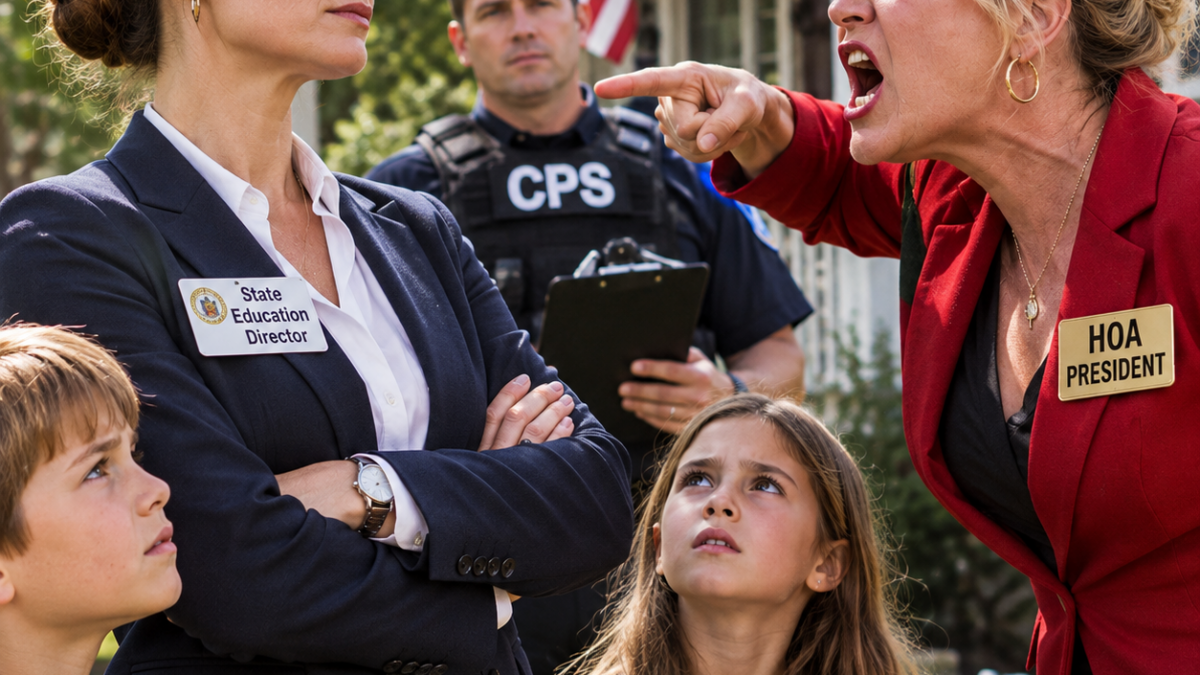
The CPS worker stood on my porch with a tablet in her hands and told me someone had reported my ten-year-old daughter for “educational neglect,” while across the street our HOA president watched from the sidewalk with the satisfied expression of a woman who believed she had finally found a weapon powerful enough to force my family into submission.
My wife had spent years teaching children, our daughter was performing well above grade level, and every page of our homeschool program had been filed legally with the state, yet in that moment none of those facts stopped the cold fear that comes when a stranger with government authority shows up at your home because someone decided to turn your child into ammunition.
Karen Miller thought she was about to teach the quiet family at the end of Willow Creek Drive a lesson about what happened when people refused to follow her version of “community standards,” but she had no idea how carefully I had been watching her—or how much damage one malicious phone call could eventually do to the person who made it.
“My name is Angela Albright,” the social worker said.
She looked exhausted rather than threatening.
That helped.
Her coat was wrinkled. Her coffee had gone cold in the cup holder of the county sedan behind her. There were faint circles beneath her eyes that told me she had probably spent the morning dealing with situations far more serious than mine.
“I’m with Child Protective Services. We received an anonymous report concerning your daughter, Lily Thompson.”
Behind me, I heard Sarah stop moving in the kitchen.
I kept my voice steady.
“What kind of report?”
Ms. Albright glanced at her tablet.
“The caller alleged that Lily has not been attending school this year and expressed concerns about educational neglect, academic development, and possible isolation.”
There are sentences that make you angry.
Then there are sentences that hit something deeper than anger.
My daughter’s name beside the words neglect and isolation felt like an accusation against every breakfast Sarah had eaten beside her during math lessons, every science experiment they had cleaned off our kitchen counters, every library trip, soccer game, co-op class, history project, and late-night conversation about whatever question Lily had become obsessed with that week.
I looked past Ms. Albright.
Karen Miller was standing near the curb.
She wore white slacks, a navy polo embroidered with the Willow Creek Estates crest, and the expression she always wore when she believed she was witnessing consequences she had personally arranged.
Her arms were folded.
She pretended to examine a flower bed.
Our eyes met.
She smiled.
Not broadly.
Just enough.
That was when I knew.
Six months earlier, Karen had appeared at this same front door holding a clipboard and asked why my daughter was “home during school hours.”
I had told her the truth.
“We homeschool.”
Her face had tightened.
“As a permanent arrangement?”
“Yes.”
“That’s highly unusual in Willow Creek.”
“It’s legal.”
“I’m aware families sometimes make unconventional choices.”
That phrasing had stayed with me.
Not illegal.
Not harmful.
Unconventional.
To Karen, difference itself was a violation waiting for a number.
I had explained that Sarah was a former teacher with a master’s degree in curriculum development, that we had completed every state requirement, and that Lily’s education was none of the HOA’s business.
Karen had left angry.
After that came the notices.
A painted garden gnome Lily had made was “unapproved decorative material.”
Our welcome mat was the wrong shade of blue.
The recycling bin remained visible seventeen minutes beyond the permitted collection window.
Each notice went into a folder.
I had learned long ago that angry people often talked themselves into trouble if you let them.
Paperwork simply made sure they couldn’t rewrite the conversation afterward.
Now Karen had escalated from nuisance letters to my child.
Ms. Albright shifted slightly.
“Mr. Thompson?”
I looked back at her.
“Yes.”
“We’ll need to conduct an initial assessment.”
“Of course.”
Sarah appeared behind me.
Her face was pale.
I reached back and found her hand.
Then I stepped aside.
“Please come in.”
Ms. Albright looked almost surprised.
“We’re going to cooperate fully,” I said. “You can review our state registration, curriculum approvals, attendance records, lesson plans, portfolio, standardized testing, co-op participation, extracurricular schedule, and anything else you reasonably need.”
Karen’s smile disappeared across the street.
Ms. Albright raised her eyebrows.
“That’s… thorough.”
“My wife takes Lily’s education very seriously.”
Sarah squeezed my hand.
“So do I.”
I held the door wider.
“And after we establish that our daughter is safe, educated, healthy, and thriving, I’d also like to discuss what happens when someone knowingly files a false report to punish a family over a neighborhood dispute.”
For the first time, Ms. Albright looked toward Karen.
Karen immediately turned away.
I watched her walk back toward her house.
She believed she had just frightened us into obedience.
She was right about one thing.
We were frightened.
But fear and surrender are not the same thing.
And before that day ended, I had already decided that Karen Miller would never again get to confuse them.
PART 2
Ms. Albright stepped inside.
Lily was sitting at the dining table with a book open in front of her.
She looked up.
“Dad?”
Ten years old.
Brown hair pulled into a messy ponytail.
Pencil tucked behind one ear.
She had been working on a model of the solar system that morning and had managed to get silver paint on three fingers, her cheek, and somehow the dog.
I smiled.
“Everything’s okay, sweetheart.”
That was the first lie I told that day.
Not because something terrible was happening.
Because she didn’t need to carry the full weight of adult fear before we even knew what the investigation would involve.
“This is Ms. Albright. She works for the state. She wants to talk to us about school.”
Lily looked at Sarah.
Sarah nodded.
“Just answer honestly.”
Lily shrugged.
“Okay.”
Children can make terrifying situations look ordinary.
She went back to drawing Saturn’s rings.
Ms. Albright watched her for a moment, then said quietly, “Could we sit somewhere?”
We took the living room.
She explained the process.
The report was anonymous.
CPS was required to review allegations that could indicate neglect.
Educational neglect was handled somewhat differently depending on the facts, but because the report had mentioned welfare concerns, her office had opened an assessment.
I listened.
No interruptions.
No outrage.
No speech about my rights.
My career had taught me that when you are dealing with an investigator doing legitimate work, hostility rarely helps.
Ms. Albright was not the enemy.
The person who had deliberately sent her here was.
“Would you like to see our records now?” Sarah asked.
“If you have them.”
Sarah stood.
“I’ll get the main binder.”
I almost smiled.
The main binder.
Sarah had more than one.
She returned with a thick blue folder.
Inside were copies of our homeschool notification, approved curriculum outline, reading lists, assessment plans, weekly schedules, samples of Lily’s work, and documentation of the state requirements we had fulfilled.
Ms. Albright turned pages slowly.
“Mrs. Thompson, you prepared this?”
“Yes.”
“You were a teacher?”
“Ten years.”
“What level?”
“Middle school language arts and social studies. Then I moved into curriculum development before Lily was born.”
Ms. Albright looked at Lily’s writing samples.
“She wrote this?”
“A month ago.”
It was an essay about Abigail Adams.
Lily had become fascinated by letters between John and Abigail during a history unit and had written seven pages when Sarah asked for three.
Ms. Albright read part of it.
Then looked up.
“She’s ten?”
“Yes.”
I saw some tension leave her shoulders.
Not all.
A responsible social worker doesn’t decide a case from one essay.
But it was a start.
“What about math?”
Sarah opened another section.
“Currently working a year and a half above grade level.”
“Science?”
“Project-based. We combine a structured curriculum with hands-on labs and field work.”
“Social interaction?”
“Soccer twice a week. Homeschool co-op on Tuesdays and Thursdays. Library book club every other Saturday. Animal shelter volunteering twice a month with me. Theater workshop starting next semester.”
Ms. Albright looked almost embarrassed.
“I have to ask these questions.”
“I know,” Sarah said.
That answer mattered.
The last thing we wanted was to make Ms. Albright feel blamed for doing her job.
She stayed nearly ninety minutes.
She spoke to Lily.
Asked what she studied.
Asked whether she liked homeschooling.
Asked if she had friends.
Asked what happened when she didn’t understand something.
Lily answered in the way only Lily could.
“My mom explains it differently until I get it.”
“What if you don’t want to do school?”
“I still do school.”
“What’s your favorite subject?”
“History.”
“Least favorite?”
“Fractions.”
“Those aren’t a subject.”
“They feel like one.”
Ms. Albright laughed.
So did Sarah.
I didn’t.
Not at first.
My chest was still too tight.
But then Lily started explaining a science project involving monarch butterflies, and Ms. Albright leaned toward the table with genuine interest.
By the time the social worker stood to leave, the atmosphere had changed.
“I’ll need to complete the paperwork,” she said. “There may be a follow-up visit.”
“Understood.”
“But based on what I saw today, I’m not seeing evidence that Lily is being educationally neglected.”
Sarah exhaled.
It was barely audible.
I heard it anyway.
Ms. Albright looked at us.
“I know these visits are stressful.”
I nodded.
“That’s probably an understatement.”
“I understand.”
“Then I want to ask you something.”
She waited.
“If a person knowingly makes a false report to settle a personal dispute, what happens?”
Her expression changed.
“Anonymous reporting protections are strong for a reason.”
“I understand.”
“We don’t want people who genuinely suspect abuse to be afraid to call.”
“Neither do I.”
“Proving malicious intent can be difficult.”
“What if there’s a documented pattern?”
“What kind of pattern?”
“Harassment. Retaliatory notices. Threats. A dispute involving the same person before the report.”
Ms. Albright studied me.
“You know who called?”
“I believe I do.”
“Believing is different from proving.”
“I know.”
She nodded slowly.
“If the report is unsubstantiated, that will be documented. If we see evidence suggesting malicious use of the hotline, that can also be noted. Depending on state law and the facts, there may be other remedies.”
“Thank you.”
She started toward the door.
Then turned.
“One thing, Mr. Thompson.”
“Yes?”
“Don’t interfere with the investigation trying to prove who called.”
“I won’t.”
That answer was easy.
I didn’t need to chase Karen.
Karen had a habit of leaving evidence everywhere she went.
—
The door closed.
Sarah stood in the foyer staring at it.
Then she turned toward me.
“She called CPS on us.”
Her voice broke on the word CPS.
I reached for her.
“She actually called them.”
“I know.”
“What if the worker had been different?”
“I know.”
“What if Lily said something weird?”
“I know.”
“What if they—”
“Sarah.”
She looked at me.
Her eyes were wet.
“This is our daughter.”
I pulled her against me.
For years, I had watched my wife handle difficult classrooms, impossible parents, district politics, lesson plans, career changes, military moves, my deployments, my injuries, and every unpredictable turn our life had taken.
Sarah did not scare easily.
Karen had scared her.
That made my anger sharper.
“She wanted this,” Sarah whispered.
“The fear?”
“Yes.”
I looked toward the window.
Karen’s house sat half a block away.
“She wanted us to associate resisting her with danger.”
Sarah stepped back.
“What are you going to do?”
The honest answer would have been: everything legally available.
But I knew what she was really asking.
Are you going to make this worse?
So I said, “First, we make sure the CPS case disappears.”
“And then?”
“Then we make sure nobody ever gets to do this to us again.”
She watched me.
“Mark.”
“What?”
“Don’t become Colonel Thompson.”
I almost smiled.
Twenty-two years in the Army.
Much of it in the Judge Advocate General’s Corps.
Negotiations.
Investigations.
Administrative law.
Command disputes.
Situations where the loudest person in the room was usually not the most dangerous.
I had retired as a colonel.
Civilian life had been supposed to be quieter.
My current job was not.
But home was meant to be.
“What exactly does Colonel Thompson look like?” I asked.
“You know.”
“I want to hear you say it.”
“Cold.”
“That’s unfair.”
“Organized.”
“Better.”
“Patient enough to terrify people.”
I smiled.
“There it is.”
She pointed at me.
“That smile.”
“What smile?”
“The one that means someone has made a procedural mistake.”
I kissed her forehead.
“I’m going to make coffee.”
“That wasn’t reassuring.”
“It wasn’t supposed to be.”
—
For the next forty-eight hours, Sarah and I did exactly what I had told Ms. Albright we would do.
We cooperated.
Not defensively.
Comprehensively.
Sarah built three additional binders.
The first covered legal compliance.
State notice.
Curriculum submission.
Required assessments.
Attendance.
Instructional calendar.
Everything.
The second was Lily’s academic portfolio.
Essays.
Math.
Science reports.
Reading logs.
Art.
Projects.
State test scores.
The third documented what homeschool critics always asked about first.
Socialization.
Soccer photographs.
Team rosters.
Co-op calendar.
Volunteer records.
Library club.
Theater registration.
Birthday parties.
Field trips.
A letter from Lily’s soccer coach.
A note from the animal shelter coordinator.
Then I prepared a fourth binder.
Mine.
At the front was a one-page summary.
**Mark Thompson — Professional Background**
Retired Colonel, U.S. Army JAG Corps.
Former legal adviser, administrative law specialist, and senior command counsel.
Current position:
**State Director of Education.**
I placed official documentation behind it.
Sarah watched me close the binder.
“Are you really putting that in?”
“Yes.”
“Why?”
“Because it’s relevant.”
“To Lily’s education?”
“To the allegation that we don’t understand state education requirements.”
She stared at me.
“Have you told Karen what you do?”
“No.”
“Does she know?”
“Apparently not.”
Sarah shook her head.
“How?”
“I don’t discuss work at HOA meetings.”
“You’re literally responsible for statewide education policy.”
“I know.”
“And she thinks you’re illegally homeschooling?”
“Apparently.”
Sarah looked toward the ceiling.
“I almost feel sorry for her.”
“Don’t rush.”
—
Ms. Albright returned three days later.
This time Karen was nowhere outside.
Probably smart.
We sat at the dining table.
Four binders.
Ms. Albright looked at them.
“You were serious.”
“Very.”
For an hour, she and Sarah went through everything.
She read Lily’s work.
Reviewed compliance.
Looked through photos.
Checked dates.
Asked questions.
Then she reached the fourth binder.
She opened it.
Read the top page.
Stopped.
Looked up.
Then looked down again.
“Mr. Thompson.”
“Yes?”
“You’re the State Director of Education?”
“Yes.”
“The State Director.”
“That’s the title.”
Sarah covered a smile with her hand.
Ms. Albright leaned back.
“You’re my director’s interagency counterpart.”
“We’ve probably been on some of the same policy distribution lists.”
“You chair the statewide student outcomes commission.”
“I do.”
She blinked.
“Why didn’t you say this on the first visit?”
“Would it have changed whether you needed to assess the report?”
“No.”
“Then it wasn’t important yet.”
That answer seemed to settle something for her.
She closed the binder.
“Mr. and Mrs. Thompson, based on the evidence I’ve reviewed, I’m recommending immediate closure.”
Sarah’s shoulders dropped.
“Thank you.”
“This report is baseless.”
Ms. Albright’s voice had changed.
Not deference.
Anger.
Not at us.
“At minimum, whoever made this complaint demonstrated a serious misunderstanding of homeschooling law.”
I said, “Or understood it and lied.”
She met my eyes.
“That’s possible.”
“Can the case file reflect the apparent malicious context?”
“I can document that the allegation was unsubstantiated and that the family was in full compliance. I can also note information you provide regarding potential harassment.”
“That’s all I’m asking.”
“For now?”
I smiled faintly.
“For now.”
She almost smiled back.
Then she said something that stayed with me.
“You know what bothers me most?”
“What?”
“My office has kids sleeping in motels tonight because their parents disappeared.”
I waited.
“We have families with actual neglect. Actual abuse. Actual hunger.”
She tapped the closed CPS folder.
“Every hour we spend investigating a lie is an hour we don’t spend somewhere else.”
Sarah nodded.
“That’s why this matters.”
“Yes.”
Ms. Albright stood.
“I’ll complete the closure.”
Then she looked at me.
“Director Thompson.”
“Mark is fine.”
“I think you’re going to do something with this.”
“I think so.”
She sighed.
“Just remember what you said before.”
“What?”
“Anonymous reporting exists for a reason.”
“I know.”
“Protect the system while you punish abuse of it.”
That was good advice.
I would remember it.
—
The CPS case was closed.
Karen’s problem was just beginning.
I did not confront her.
That disappointed Sarah slightly.
She expected at least a conversation.
“Nothing?” she asked that night.
“Nothing.”
“You’re not even going over there?”
“No.”
“Why?”
“Because Karen thinks the CPS call worked.”
“It didn’t.”
“She doesn’t know that yet.”
Sarah stared at me.
“You are being scary.”
“I’m making pasta.”
“Those things are not mutually exclusive.”
—
Instead of Karen, I started with the HOA.
I pulled everything publicly available.
Bylaws.
CC&Rs.
Board minutes.
Budgets.
Annual reports.
Contracts referenced in meeting summaries.
Reserve studies.
Vendor names.
The pattern appeared quickly.
Karen’s enforcement was inconsistent.
People she liked received warnings.
People who challenged her received fines.
Certain contractors appeared repeatedly.
“Community enhancement” spending had increased every year.
Administrative costs had doubled.
Vendor selection was vague.
Then I found George.
He lived two houses down.
Seventy-four.
Widower.
Former electrical engineer.
He had a little birdbath beneath an oak tree.
Karen hated it.
Apparently the basin was not from an approved manufacturer.
I found him fighting with his recycling bin.
“Need a hand?”
“I’ve got it.”
The wheel came off.
He stared at it.
“Fine. I need a hand.”
We dragged it beside his garage.
He was breathing harder than he wanted me to notice.
“You okay?”
“I’m seventy-four, Mark. Nothing works exactly according to specifications anymore.”
“That seems unfair.”
“File a complaint.”
“Karen probably has a form.”
George laughed.
That was my opening.
“Speaking of Karen.”
His face changed.
“What about her?”
“She’s been after us.”
“Join the club.”
I looked toward the birdbath.
“That the infamous violation?”
George’s eyes narrowed.
“How’d you know?”
“I saw the notice on your door.”
“Two hundred dollars.”
“For that?”
“My granddaughter gave it to me.”
He looked embarrassed.
“As if that matters legally.”
“It matters to you.”
“That’s apparently not part of the bylaws.”
“What else?”
George hesitated.
Then looked around.
Nobody.
“She fined me because my granddaughter left a tricycle in the driveway overnight.”
“How much?”
“One hundred.”
“Did you appeal?”
“Karen chaired the hearing.”
Of course.
“She denied it.”
“Of course.”
George’s shoulders slumped.
“It wasn’t like this before her.”
“What was it like?”
“Boring.”
“That sounds good.”
“It was wonderful.”
I handed him my card.
Not my state office card.
Personal.
“If you ever want to compare notes.”
George read it.
“You going after her?”
“I’m figuring out whether there’s anything to go after.”
He looked at me for a long moment.
Then pocketed it.
“Talk to Susan on Willow Lane.”
“Why?”
“Her son’s car.”
“What about it?”
“Ask her.”
—
Susan called me that night.
George had called her first.
Then came Ben and Maria.
Then another neighbor.
Within a week, I had coffee with five people at a place five miles outside Willow Creek.
Nobody wanted Karen to see their cars together.
That alone told me everything.
We sat in the back corner.
George.
Susan.
Ben.
Maria.
And me.
I listened.
Wrong shade of trim.
Unapproved car.
Birdbath.
Tricycle.
Mailbox half an inch too low.
A basketball hoop.
Trash can timing.
Holiday lights left up three days too long.
Nothing individually catastrophic.
Together?
A system.
Karen used rules the way a bad supervisor uses performance reviews.
Not to maintain standards.
To remind people who could hurt them.
Susan stirred her coffee.
“My son bought that car himself.”
“What kind?” I asked.
“2008 Honda Civic.”
“Runs?”
“Every day.”
“Unsafe?”
“No.”
“Why the fine?”
“Unsightly.”
Ben shook his head.
“She told him to park it blocks away.”
Maria said, “She measured our mailbox.”
I thought she was exaggerating.
“She what?”
“With a tape measure.”
“How far off?”
“Half an inch.”
George said, “Mine was fine.”
Everyone looked at him.
“She didn’t like me for other reasons.”
We laughed.
Then the laughter stopped.
Susan looked at me.
“What did she do to you?”
I hesitated.
The CPS matter involved Lily.
I was not ready to turn my daughter into coalition material.
“Something serious.”
“That all?”
“For now.”
Ben leaned back.
“So what do we do?”
“You’ve all tried individual appeals.”
“Yes.”
“Letters?”
“Yes.”
“Board meetings?”
“Yes.”
“What happened?”
“Her two allies vote with her,” Maria said. “Frank and Linda.”
“And the other board members?”
“Quiet.”
“Then stop fighting individual fines.”
George frowned.
“What does that mean?”
“It means Karen wants every dispute isolated.”
I looked around the table.
“Your mailbox.”
“Your car.”
“Your birdbath.”
“My family.”
“As long as each person thinks their problem is unique, she controls the process.”
Ben leaned forward.
“So?”
“We build one record.”
“Of everything?”
“Yes.”
“Every notice.”
“Yes.”
“Emails?”
“Yes.”
“Photos?”
“Yes.”
“Meeting statements?”
“Yes.”
Susan looked uncertain.
“And then?”
“We follow the bylaws exactly.”
Maria laughed.
“Use her rules against her?”
“No.”
I shook my head.
“We use the actual rules.”
There was a difference.
—
That night, I drafted a formal request to the board and management company.
I documented selective enforcement concerns.
Retaliatory conduct.
Due-process issues.
Board conflicts.
I demanded a hearing under the bylaws.
Then I requested access to financial records.
Vendor contracts.
Expense reports.
Invoices.
Payments.
Two years.
Certified mail.
Karen answered with a violation notice.
Of course she did.
**UNAPPROVED LANDSCAPING MODIFICATION**
The violation?
Sarah and Lily’s vegetable garden.
Behind our house.
Invisible from the street.
I photographed the notice.
Added it to the file.
Sarah read it.
Then looked outside.
“Our tomatoes are now enemies of property values?”
“Apparently.”
Lily walked in.
“Who hates tomatoes?”
“Mrs. Miller.”
“Why?”
“Long story.”
Lily shrugged.
“She’s weird.”
Children remain efficient.
—
The management company rejected my harassment complaint as “without merit.”
But they had a problem.
The bylaws gave homeowners access to financial records.
They couldn’t legally invent that rule away.
So they gave me a two-hour inspection window.
Tuesday.
10:00 to noon.
Management office.
Supervised.
No removal of originals.
I arrived at 9:55 with a legal pad and portable scanner.
The account manager, Dave, looked miserable.
“You have two hours.”
“I know.”
“I’m required to remain nearby.”
“Understood.”
“Please don’t make my day worse.”
“I’ll try.”
He gave me binders.
Invoices.
Statements.
Minutes.
I started.
Evergreen Solutions.
Landscaping contractor.
Payments dramatically above comparable local rates.
I searched the state corporate registry.
Owner:
Harold Miller.
Karen’s husband.
Interesting.
Then Premium Pool and Patio.
Twenty-thousand-dollar resurfacing contract.
I found another bid in the file.
Twelve thousand.
Reputable contractor.
Rejected.
Why?
Minutes said “quality concerns.”
Premium Pool belonged to Linda’s brother-in-law.
More interesting.
Office supplies.
Luxury stationery.
Personalized gold-letterhead purchases.
Catering.
Dates matched photos from Karen’s public social media showing family celebrations.
I photographed.
Scanned.
Cross-referenced.
Dave knocked after one hour and fifty-nine minutes.
“Time.”
I finished the page.
Closed the scanner.
“Thank you.”
His eyes moved toward my equipment.
“Did you find what you were looking for?”
“I didn’t know what I was looking for.”
“That’s not an answer.”
“No.”
He sighed.
“I really hate this job.”
—
I took the records home.
Spread copies across my office.
Sarah stood in the doorway.
“That bad?”
“Worse.”
“Criminal?”
“I’m not making that claim yet.”
“Mark.”
“Potentially.”
“What did you find?”
“Self-dealing. Conflicts. Questionable expenses.”
“Karen?”
“And at least one board ally.”
Sarah sat down.
“So what now?”
“We wait for the special meeting.”
“What special meeting?”
I handed her the envelope that had arrived that afternoon.
She read it.
Her face changed.
**PROPOSAL 714**
To “protect educational quality and community standards,” any household conducting “at-home educational activity” would be required to submit curriculum, schedules, instructional credentials, and annual educational plans to the HOA Architectural Control Committee for review.
Sarah finished reading.
Then read it again.
“This can’t be real.”
“It’s real.”
“She wants the architectural committee to approve homeschool curriculum?”
“Yes.”
“They approve fences.”
“And roofs.”
“They have no education authority.”
“I know.”
“This is illegal.”
“I know.”
“She wrote this because of us.”
“Yes.”
Sarah stared at the page.
“She called CPS, that failed, and now she’s trying to invent an HOA law to control Lily’s school.”
“Yes.”
My wife looked at me.
This time she wasn’t afraid.
She was furious.
“Destroy her.”
I raised an eyebrow.
“Interesting shift.”
“Legally.”
“Good clarification.”
—
We mobilized.
Fifty homeowners came to the meeting.
Karen entered expecting obedience.
She got a full room.
Frank and Linda sat beside her.
The other two board members looked nervous.
Karen hit the gavel.
“Order.”
People quieted.
She launched into Proposal 714.
Children.
Standards.
Property values.
Community cohesion.
Academic integrity.
She spoke as though homeschooling in a private residence threatened the subdivision’s resale market.
Then Maria raised her hand.
“What educational qualifications does the Architectural Control Committee have?”
Karen waved dismissively.
“This is about general standards.”
“Curriculum standards?”
“Yes.”
“Are you a licensed educator?”
“That is irrelevant.”
“No,” Maria said. “It seems pretty relevant.”
Murmurs.
Ben stood.
“You’re asking families to hand private educational records to an HOA committee.”
“For review.”
“What privacy protections exist?”
Karen’s jaw tightened.
“If you have nothing to hide, there is nothing to fear.”
That sentence made something inside me go cold.
Nothing to hide.
Nothing to fear.
It is the favorite argument of people who never imagine themselves being inspected.
I stood.
The room quieted.
Karen saw me.
“Mr. Thompson, you’ll wait to be recognized.”
“I’m requesting recognition.”
She hesitated.
“Briefly.”
“Thank you.”
I faced the room.
“Proposal 714 should not be tabled.”
Karen smiled.
For half a second.
“It should be withdrawn entirely.”
The smile disappeared.
“This association has no lawful authority to license, approve, supervise, or review homeschool curriculum.”
Karen struck the gavel.
“That is your opinion.”
“No.”
I looked at her.
“That is state law.”
“You are not counsel to this association.”
“No.”
I paused.
“But I am familiar with the statute.”
Somebody laughed.
Karen glared.
I continued.
“Before anyone votes on expanding this board’s authority, residents should understand how existing authority has been used.”
I placed one document on the table.
“Evergreen Solutions.”
Karen froze.
“Landscaping vendor.”
Silence.
“Owned by Harold Miller.”
Her husband.
The room shifted.
Karen said, “That relationship was disclosed.”
“Where?”
No answer.
I placed another document.
“More than thirty thousand dollars above estimated market cost over the relevant period.”
Frank leaned toward Karen.
I kept going.
“Premium Pool and Patio.”
Linda went pale.
“Twenty thousand dollars.”
I held up the competing bid.
“Alternative bid: twelve thousand.”
Murmurs turned into voices.
“The selected contractor is owned by Linda’s brother-in-law.”
Linda said, “That’s not illegal.”
“I didn’t say it was.”
I looked at the crowd.
“I said residents were entitled to know.”
Karen hit the gavel.
“This is a smear campaign.”
“No.”
Another document.
“Luxury stationery.”
Another.
“Catering charges coinciding with private events.”
Another.
“Administrative spending with no detailed explanation.”
I faced the homeowners.
“This is not about homeschooling.”
I pointed at Proposal 714.
“This is about control.”
Then I pointed toward the financial documents.
“And this is about accountability.”
Karen stood.
“You have no right to make defamatory accusations.”
“I’m reading your association’s own records.”
“You are twisting them.”
“Then an independent forensic audit should clear everything up.”
The room went silent.
Karen stared.
I continued.
“I formally move that Proposal 714 be withdrawn, that the association retain an independent auditor, and that the membership hold a vote of no confidence in Karen Miller.”
The clubhouse exploded.
Questions.
Shouting.
Residents standing.
“Is this true?”
“Where are the invoices?”
“Why didn’t we know?”
“Show us the contracts!”
Karen hammered the gavel.
“ORDER!”
Nobody listened.
Frank looked like he wanted to disappear.
Linda was whispering rapidly.
Then Arthur, one of the quiet board members, stood.
He was an accountant.
Soft-spoken.
Avoided conflict.
“I second the motion for an audit.”
Karen turned.
“Arthur.”
He swallowed.
“And I second the vote of no confidence.”
That was the moment her power broke.
Not later.
Right there.
Because fear is contagious.
So is courage.
—
The management company moved fast once liability became obvious.
Assets were temporarily restricted.
An independent auditor was hired.
Karen was suspended pending review.
Frank resigned from the board.
Linda initially refused.
Then the audit started.
The findings were worse than mine.
Evergreen Solutions was essentially a shell arrangement.
Inflated landscaping invoices.
Poor documentation.
Contracts awarded without genuine competitive review.
Pool work had used cheaper materials than billed.
Expense reimbursements were mixed with personal purchases.
The total questionable amount exceeded seventy-five thousand dollars.
Residents were furious.
Not because Karen had fined birdbaths.
Because she had treated their money the same way she treated their homes.
As hers.
The board removed her.
Civil counsel was retained.
Recovery action began.
A FOR SALE sign appeared in Karen’s yard.
Less than a month later.
But I still had one unfinished matter.
CPS.
—
I waited until the audit report was public.
Then I called Ms. Albright.
“Angela, it’s Mark Thompson.”
“Mr. Thompson.”
“Is the case officially closed?”
“Yes.”
“Unsubstantiated?”
“Completely.”
“Any notation regarding malicious context?”
“Yes. As we discussed.”
“Good.”
“Is something happening?”
“Yes.”
I explained Karen’s removal.
The financial investigation.
Pattern of retaliation.
Multiple residents.
Proposal 714.
Silence.
Then Ms. Albright said, “That does create context.”
“I agree.”
I paused.
“And as State Director of Education, I think that context matters beyond my family.”
Silence again.
Longer.
“Director Thompson?”
“Yes.”
“I knew what the binder said, but I didn’t realize you were planning to…”
“Do my job?”
“That’s not what I meant.”
“I know.”
I softened my voice.
“I’m not asking CPS to punish Karen because she targeted my family.”
“Okay.”
“I’m asking whether the state has enough safeguards when social-service reporting is knowingly weaponized in disputes over lawful education choices.”
Ms. Albright exhaled.
“That’s a much bigger question.”
“Yes.”
“Are you launching a review?”
“Yes.”
She went quiet.
Then: “Good.”
That surprised me.
“Good?”
“My office loses time on bad-faith reports.”
“I know.”
“We also have to protect anonymous reporters.”
“I know that too.”
“If your review scares legitimate callers away—”
“It fails.”
“Exactly.”
“We’re not weakening child protection.”
“Then what are you proposing?”
“Better identification of repeated malicious reporting patterns. Improved interagency guidance. Stronger consequences where intent can actually be proven. Clearer protection for families using lawful alternative education.”
Ms. Albright said nothing.
Then:
“I’ll cooperate.”
“Thank you.”
“Not because you’re my director’s counterpart.”
“Good.”
“Because whoever did this wasted time that should have gone to an actual child.”
That was the right reason.
—
Within a week, I sat with Daniel Reyes, Director of Family Services.
We had worked together on interagency budgets.
He read the file.
Then closed it.
“This is disgusting.”
“It’s also useful.”
He frowned.
“That’s a strange word.”
“As a case study.”
“You want to build policy around what happened to your family?”
“I want to examine whether it happens to other families.”
“Homeschoolers?”
“Any lawful alternative education model.”
Daniel leaned back.
“You know how politically explosive this could get.”
“Yes.”
“People will say you’re using your office because someone targeted you.”
“They’ll be partly right.”
He raised an eyebrow.
“The experience revealed a policy problem.”
“Still.”
“So we design the review independently.”
“You recuse from individual enforcement?”
“Yes.”
“You don’t touch Karen’s referral?”
“Correct.”
“Family Services handles that.”
“Yes.”
“Your office handles statewide education guidance.”
“Yes.”
Daniel smiled.
“You really were JAG.”
“I’ve heard rumors.”
—
The state review began.
Not a crusade.
Data.
Anonymous complaint trends.
Homeschool-related welfare reports.
Disposition rates.
Repeated reporters where legally available.
Coordination between school districts and child welfare.
We found something important.
Most reports were legitimate or at least made in good faith.
Some were mistaken.
A smaller category showed clear signs of misuse.
Custody disputes.
Neighbor conflicts.
Religious disputes.
HOA conflicts.
Family feuds.
The system had safeguards, but they were inconsistent.
That meant Karen’s case was not unique.
It was simply unusually well documented.
Family Services referred her matter to the district attorney.
I did not participate.
Did not call.
Did not pressure.
Did not request charges.
That was essential.
Accountability becomes corruption if you use public office to manufacture personal punishment.
Karen had already demonstrated that.
I refused to repeat her mistake.
—
Back in Willow Creek, George became HOA president.
He hated it.
Which made him perfect.
“I didn’t retire from engineering to become dictator of trash cans,” he told me.
“Then don’t.”
“That simple?”
“Mostly.”
“What do I do when neighbors fight?”
“Listen.”
“What if both are idiots?”
“Listen longer.”
He glared.
“You’re enjoying this.”
“A little.”
The new board included Ben and Maria.
Their first symbolic act happened beside the pool.
A commercial shredder.
Residents brought copies of Karen-era rules.
Approved welcome-mat colors.
Tricycle restrictions.
Overly specific mailbox requirements.
Decorative-object lists.
Pages went into the machine.
Lily stood beside Sarah.
She held the vegetable-garden violation.
“Can I?”
Sarah looked at me.
I nodded.
Lily fed it into the shredder.
The page disappeared.
She grinned.
“Can I shred the CPS lady?”
“No.”
Sarah nearly choked laughing.
“The paper,” Lily said quickly. “I meant her paper.”
“Still no.”
“Fine.”
—
Karen moved.
A moving truck pulled up early one Saturday.
George and I stood outside.
Not celebrating.
Watching.
Her husband carried boxes.
Karen directed movers.
No clipboard.
No HOA polo.
She never looked toward my house.
George rubbed his hands together.
“For two years I was afraid to put a birdbath in my yard.”
“You still have it?”
“In the garage.”
“Put it back.”
“Maybe.”
“George.”
“What?”
“You’re president.”
He stared at me.
Then smiled.
“Damn right.”
The moving truck pulled away.
George watched it disappear.
“You feel good?”
“Yes.”
“Revenge?”
I thought about it.
“Some.”
“Appreciate honesty.”
“But mostly relief.”
He nodded.
“Me too.”
—
The district attorney filed a charge related to knowingly making a false report.
Karen’s attorney negotiated.
Eventually she accepted a plea.
Fine.
Community service.
Permanent record.
No jail.
Some neighbors were disappointed.
They wanted handcuffs.
Courtroom humiliation.
A dramatic sentence.
I didn’t.
I had spent too much of my career around the justice system to confuse punishment with theater.
The important part was that the report was no longer anonymous power without consequence.
A legal record now said what happened.
She lied.
She weaponized a child-protection system.
There was accountability.
That was enough.
Almost.
—
The larger policy review produced recommendations.
Better interagency guidance.
Training for investigators when educational neglect allegations involved lawful homeschooling.
Procedures for identifying repeated demonstrably malicious reports without discouraging good-faith reporting.
Clearer penalties for proven misuse.
Legislators became interested.
Then politics did what politics does.
Some wanted broad criminalization.
I opposed that.
Some wanted to weaken anonymous reporting.
I opposed that too.
One senator asked me during a hearing:
“Director Thompson, given what happened to your own family, why shouldn’t we simply require every caller to identify themselves publicly?”
“Because abused children sometimes depend on frightened adults being able to report safely.”
“So anonymity stays?”
“Yes.”
“Even though it protected the person who targeted you?”
“Yes.”
He looked surprised.
“Why?”
“Because good policy should survive my personal anger.”
The room went quiet.
That became the line reporters quoted.
I didn’t mind.
It was true.
—
The final bill was narrower.
Stronger penalties for repeated knowingly false reports.
Clear standards of intent.
Interagency review.
Explicit protections for lawful homeschool compliance.
Education for investigators so homeschool status alone could never be treated as evidence of neglect.
The press called it the Homeschool Family Protection Act.
I hated the name.
Sarah liked it.
“It’s memorable.”
“It sounds political.”
“You’re the State Director of Education.”
“That doesn’t mean I have to enjoy politics.”
She laughed.
The bill passed with broad bipartisan support.
I testified.
Not as Karen’s enemy.
As a father.
I told the committee about Lily.
Not her private details.
Just enough.
A child doing well.
A lawful educational choice.
A false allegation.
State resources diverted.
Fear introduced into a family because one neighbor wanted leverage.
Then I talked about Ms. Albright.
The actual social worker.
Tired.
Overworked.
Trying to protect real children.
“If you want to understand the harm of malicious reporting,” I said, “do not look only at the innocent family investigated. Look at the child in actual danger whose case waits because somebody used a hotline to settle a personal score.”
That changed the conversation.
The bill passed.
The governor signed it.
No celebration at home.
Sarah ordered pizza.
Lily asked whether the law meant she could skip fractions.
“No.”
“Then I don’t see the benefit.”
—
The civil case against Karen and her former board allies dragged on.
The HOA recovered a substantial portion of the misused funds.
Karen agreed to a settlement.
Part of it included a permanent injunction barring her from serving on an HOA board within the jurisdiction covered by the agreement.
George called me.
“You did that?”
“No.”
“Who did?”
“The HOA’s attorney.”
“I want to send that lawyer flowers.”
“Probably inappropriate.”
“Fruit basket?”
“Also strange.”
“Birdbath?”
“Perfect.”
—
Willow Creek changed.
Not immediately.
Fear has habits.
For months, residents still looked over their shoulders when leaving trash cans out.
Susan’s son kept parking his Civic in the garage even after the old rule disappeared.
Maria asked permission before repainting her trim.
George had to remind her:
“You don’t need permission.”
She painted it the exact same “wrong” shade.
On purpose.
Everyone noticed.
Nobody cared.
The world continued.
Children left bikes in driveways.
Someone put up a basketball hoop.
A neighbor installed a plastic slide.
George restored the birdbath.
His granddaughter came over.
Saw it.
Cried.
George later told me he had cried too.
He made me promise not to repeat that.
I repeated it to Sarah immediately.
—
Sarah’s garden grew.
Tomatoes.
Cucumbers.
Peppers.
Lily added sunflowers.
One afternoon, I found an old HOA violation folded beneath a seed catalog.
I held it up.
**UNAPPROVED LANDSCAPING MODIFICATION**
Sarah looked over.
“Frame it?”
“No.”
“Compost it?”
I smiled.
“Appropriate.”
We tore it into small pieces.
It disappeared into the compost pile.
Paper becoming soil.
That felt better than shredding.
—
A year after Karen moved, Ms. Albright called my office.
My assistant buzzed.
“Director Thompson, Angela Albright from Family Services.”
I took it.
“Angela.”
“Mr. Director.”
“Still Mark.”
“Right.”
She sounded different.
Lighter.
“I wanted to tell you something.”
“What?”
“We had a case last week.”
I waited.
“Anonymous report. Educational neglect. Homeschool family.”
My stomach tightened.
“What happened?”
“The caller had an ongoing property dispute with the family.”
“HOA?”
“Yes.”
“Of course.”
“We used the new guidance.”
“And?”
“The family was compliant. Child was doing well.”
“Good.”
“We also informed the caller that knowingly false repeat reporting could carry enhanced penalties.”
“What happened?”
“The caller withdrew the complaint.”
I leaned back.
“That’s the best thing I’ve heard all week.”
Angela laughed.
“You saved us several days.”
“No.”
“I mean it.”
“The policy helped.”
“You built the policy.”
“A lot of people did.”
“Still.”
There was a pause.
“Your case mattered.”
After the call ended, I sat in my office for a long time.
That was the first moment the entire fight felt worth it.
Not Karen moving.
Not the audit.
Not the plea.
Not the HOA shredding party.
Somewhere in the state, a family I would never meet avoided the fear Sarah had carried at our kitchen table.
That was victory.
—
Lily kept learning.
Her education did not become a political symbol inside our home.
That was important.
She was a child.
Not a case study.
Not a headline.
Not “the State Director’s homeschooled daughter.”
She became obsessed with theater.
Joined a local youth production.
Forgot lines during rehearsal.
Recovered.
Loved the stage.
At twelve, she announced she wanted to become an actress.
At thirteen, a marine biologist.
At fourteen, an attorney.
I objected to the last one.
“Why?”
“Too many lawyers in the family already.”
“You’re the only lawyer.”
“Exactly.”
Sarah started consulting.
Other homeschool families asked for help building curriculum plans.
She charged reasonable rates.
Sometimes she helped for free.
One family arrived terrified because a school administrator had told them homeschooling was “basically illegal.”
Sarah showed them the statute.
They left smiling.
I watched from the kitchen.
“You like this.”
She nodded.
“I missed teaching.”
“You’re teaching.”
“Different.”
“Better?”
She thought about it.
“Different.”
That was enough.
—
The strangest change happened to me.
Before Karen, I had believed good systems were mostly about correct rules.
I still believed rules mattered.
But I understood something better afterward.
Ordinary families rarely experience policy as statutes.
They experience it as the person at the door.
The clerk on the phone.
The school administrator.
The social worker.
The HOA president.
The person holding the clipboard.
A fair law badly administered can still hurt people.
An imperfect law administered with humility can sometimes protect them.
So I changed how our department wrote guidance.
Less jargon.
Clearer explanations.
Better appeal instructions.
More transparency.
Every time someone said, “Families should already know this,” I asked:
“How?”
That one word became annoying.
Good.
—
Two years after Karen left, a new family bought the house.
Young couple.
Toddler.
Bright plastic slide in the backyard.
Exactly the kind of thing Karen would have called an aesthetic violation.
Lily saw it.
“Dad.”
“What?”
“Look.”
“I see it.”
“That slide is neon green.”
“Yes.”
“Mrs. Miller would have exploded.”
“Probably.”
Lily grinned.
“I love it.”
The new family waved.
We waved back.
No clipboard.
No suspicion.
Just neighbors.
—
One summer evening, Sarah and I sat on the deck.
Fireflies.
Warm air.
Lily inside reading.
“Do you ever think about Karen?” Sarah asked.
“Sometimes.”
“Still angry?”
“Not really.”
“That surprises me.”
“Me too.”
“What do you feel?”
I looked toward Karen’s old house.
“Pity, maybe.”
Sarah nodded.
“She destroyed her own life over control.”
“Not completely.”
“You know what I mean.”
“I do.”
“She could have just left us alone.”
“Yes.”
“She could have disagreed with homeschooling.”
“Yes.”
“She could have thought it was weird.”
“Yes.”
“And then gone home.”
I smiled.
“That would have saved everyone a lot of paperwork.”
Sarah leaned against me.
“She really hated being told no.”
“That was the whole thing.”
“No birdbath.”
“No wrong white paint.”
“No ugly car.”
“No homeschooling.”
“No vegetable garden.”
“No independence.”
Sarah looked at me.
“She thought difference was defiance.”
Exactly.
—
There is a kind of person who cannot tolerate choices they did not authorize.
They confuse order with obedience.
Community with conformity.
Leadership with control.
Karen’s tragedy was not that she liked rules.
Rules can protect people.
Her tragedy was that she needed every rule to point toward her.
She wanted to be the interpreter.
The judge.
The exception.
The final word.
And once someone like that gets a little authority, everyone around them has a choice.
Comply forever.
Leave.
Or build limits.
Willow Creek finally built limits.
—
The new HOA adopted financial safeguards.
Contracts above a certain amount required multiple bids.
Board members had to disclose relationships.
Financial reports went online.
Appeals were heard by people who had not issued the original violation.
Meeting minutes became detailed.
No educational policy.
No family lifestyle rules.
No secret committees.
George insisted on one philosophical principle:
“If it isn’t about safety, shared property, or a real community expense, ask why we’re regulating it.”
It wasn’t perfect.
Nothing is.
Residents still argued.
Parking.
Noise.
Dogs.
Fence lines.
But now disagreement didn’t mean war.
That was progress.
—
George served two years.
Then resigned.
At his last meeting, I asked why.
“I’m tired.”
“Of leadership?”
“Of Carol complaining about leaf blowers.”
“That seems reasonable.”
“Also, I want to enjoy my birdbath without fiduciary duty.”
He deserved that.
Residents gave him a plaque.
He hated it.
Lily gave him a miniature toy tricycle.
He laughed until he cried.
Again.
He still denies the crying.
—
Karen’s name faded.
At first, people used it as a verb.
“Don’t Karen me.”
“She’s pulling a Karen.”
That annoyed me.
Not because I cared about Karen’s feelings.
Because turning one person into a caricature makes it too easy to believe the problem can never return.
The problem was not a name.
It was unchecked authority.
Selective enforcement.
Fear.
Silence.
So at a board meeting one year, I said exactly that.
Ben laughed.
“Mark is asking us to stop making Karen jokes.”
“I’m asking you to remember the mechanism.”
“That sounds like a state director.”
“Unfortunately.”
Maria said, “Can we keep some jokes?”
“Yes.”
“Good.”
—
The legislation took effect.
Family Services issued new training.
My department issued guidance.
Homeschool groups praised it.
Some school associations criticized pieces.
We revised.
That mattered too.
Policy born from anger can overcorrect.
I refused to let my experience become an excuse for weakening legitimate oversight.
Children can be neglected in homeschooling environments.
Pretending otherwise would be dishonest.
The goal was not to shield every homeschool family from scrutiny.
It was to distinguish lawful educational choice from evidence of actual neglect.
That distinction became the center of our work.
At one hearing, a legislator asked:
“So you support CPS investigating homeschool families?”
“If there is credible evidence of neglect, yes.”
He looked surprised.
“After what happened to you?”
“Especially after what happened to me.”
“Explain.”
“Because my complaint was false. The solution to a false complaint is not to ignore true ones.”
That answer ended up in another headline.
Sarah framed it.
I asked her to stop framing my quotes.
She did not.
—
Lily eventually learned the full story.
We had shielded her from parts.
At fifteen, she found an old binder.
“What’s this?”
I looked over.
CPS.
My stomach dropped.
She opened it.
Read.
Then looked at me.
“Someone reported me?”
“Yes.”
“For homeschooling?”
“Yes.”
“Mrs. Miller?”
“We believe so, and later evidence supported the conclusion.”
Lily sat down.
“Why didn’t you tell me?”
“You were ten.”
“I knew something was happening.”
“I know.”
“I thought you and Mom were fighting.”
That hurt.
“We weren’t.”
“I know now.”
She read more.
Then found the closure letter.
“Did they think I was stupid?”
“No.”
“Neglected?”
“The report alleged it.”
“That’s horrible.”
“Yes.”
She went quiet.
Then asked:
“Is that why the law happened?”
“Partly.”
Her eyes filled.
“You made a law because of me?”
“No.”
I sat beside her.
“A lot of people made a law because the system had a weakness.”
“But it started here.”
“It became visible here.”
She looked at the binder.
“Did Mom cry?”
I answered honestly.
“Yes.”
“Did you?”
“Not then.”
“Later?”
“Yes.”
She leaned into me.
For a while, neither of us spoke.
Then Lily said:
“I still hate fractions.”
I laughed.
“So the system failed.”
“Clearly.”
—
At seventeen, Lily testified before a youth education panel.
Not because I asked.
She volunteered.
Her topic was student agency in alternative education.
She mentioned homeschooling.
Co-ops.
Theater.
Self-directed research.
She did not mention Karen.
Afterward, I asked why.
“That’s your story.”
“No.”
She looked at me.
“It’s our family’s story.”
“Then why leave it out?”
“Because I don’t want the worst thing somebody did to us to become the most interesting thing about my education.”
I stared at her.
Then smiled.
“Your mother taught you that.”
“Probably.”
“She’s smarter.”
“I know.”
—
The final legal notice involving Karen arrived years earlier, but I kept a copy.
Settlement.
Repayment.
Restrictions.
Civil closure.
It was dry.
No dramatic confession.
No emotional climax.
Real accountability often arrives in boring documents.
I liked that.
Karen had loved paperwork when she believed paper made her powerful.
In the end, paper documented her limits.
There was symmetry in that.
—
One afternoon, my assistant told me a journalist wanted an interview about “the HOA revenge case.”
I declined.
“Why?” she asked.
“Because that title is wrong.”
“People like revenge stories.”
“I know.”
“Wasn’t there revenge?”
“Yes.”
“Then?”
“Revenge was not the useful part.”
“What was?”
“The change.”
She smiled.
“You’re getting philosophical.”
“I’m aging.”
“Same thing?”
“Possibly.”
—
I still remember the first CPS visit more clearly than the board meeting.
More clearly than the audit.
More clearly than Karen’s moving truck.
Ms. Albright on my porch.
Sarah behind me.
Karen across the street.
That moment taught me how vulnerable a family can feel even when they’ve done everything right.
You can know the law.
Have paperwork.
Have credentials.
Have resources.
And still feel fear when someone says your child’s name and the word neglect in the same sentence.
Most families do not have my background.
They don’t have a retired JAG colonel in the house.
They don’t have the State Director of Education at the dining table.
That became the reason I could not treat what happened as a private feud.
If the system only works smoothly for people who understand it professionally, the system is not working smoothly.
—
Years later, I gave a speech to new school administrators.
I told them:
“When someone says, ‘Families should know the rules,’ ask whether the rules are understandable.”
“When someone says, ‘We’ve always done it this way,’ ask whether that way is fair.”
“When someone says, ‘If they have nothing to hide, they have nothing to fear,’ become very careful.”
That last line made people laugh.
I didn’t.
Not immediately.
Then I smiled.
“Trust me.”
They laughed harder.
—
Willow Creek became ordinary.
That was the ending I wanted.
Potlucks.
Birth announcements.
Block parties.
Bad holiday decorations.
Kids leaving scooters on sidewalks.
George complaining about squirrels.
Susan’s son eventually replaced the old Civic.
Not because Karen forced him.
Because the transmission died.
At the farewell party for the car, Ben made a cardboard sign:
**UNSIGHTLY BUT FREE**
Susan laughed until she cried.
The new car was uglier.
On purpose.
—
One Saturday, Sarah and Lily were in the garden.
I was repairing a deck board.
The new family from Karen’s old house walked by.
Their toddler was dragging a red wagon.
The father waved.
“Morning!”
I waved back.
That was it.
No history.
No tension.
No performance.
I looked around.
A normal neighborhood.
I had come to Willow Creek after twenty-two years in the Army because I wanted normal.
For a while, I thought Karen had ruined that dream.
She didn’t.
She forced us to define what normal should actually mean.
Not identical.
Not silent.
Not obedient.
Safe enough to disagree.
Free enough to be different.
Connected enough to stand together when someone abuses power.
That was better than the brochure.
—
Sarah sat beside me that evening.
“You know what’s funny?”
“What?”
“Karen was obsessed with community unity.”
“Yes.”
“She created it.”
I laughed.
“Not intentionally.”
“Still.”
She looked toward the street.
“Before all this, we barely knew George.”
“True.”
“Or Ben.”
“True.”
“Or Maria.”
“True.”
“Susan.”
“True.”
“She united the entire neighborhood.”
“Against her.”
Sarah smiled.
“Details.”
—
The irony went deeper.
Karen believed homeschooling made us outsiders.
But fighting for our right to do it made us part of Willow Creek.
Not because everyone suddenly loved homeschooling.
Some didn’t.
George thought public school was better.
Ben and Maria sent their kids to private school.
Susan’s son had graduated from the local district.
Nobody needed to agree.
That was the point.
A healthy community does not require everyone to make the same choice.
It requires people to respect one another’s lawful choices.
Karen never learned that.
Willow Creek did.
—
Years after the legislation passed, I received a handwritten note from a family in another county.
They had faced a malicious educational-neglect report during a custody dispute.
The new guidance helped investigators quickly confirm compliance.
The case closed.
They wrote:
**We slept for the first time in a week after the worker told us she understood the homeschool law.**
I read that sentence twice.
Then handed the note to Sarah.
She cried.
I did too.
There are victories that look like applause.
There are victories that look like a family sleeping.
I prefer the second kind.
—
Karen’s downfall became less important with time.
That was healthy.
At first, I wanted consequences.
Then I wanted reform.
Eventually, I wanted peace.
Those are different goals.
Revenge asks:
Did she hurt enough?
Accountability asks:
Did she answer for what she did?
Justice asks:
Did we protect others from the same harm?
Peace asks:
Can we finally stop organizing our lives around her?
We reached peace last.
—
One day, Lily asked me whether I had enjoyed beating Karen.
We were driving home.
She was nineteen.
College application season.
“What kind of question is that?”
“A direct one.”
“I taught you too well.”
“Answer.”
I thought.
“Parts of it.”
“Which parts?”
“The board meeting.”
She smiled.
“Knew it.”
“The audit reveal.”
“Obviously.”
“The moving truck.”
“Dad.”
“What?”
“That’s petty.”
“I’m human.”
She laughed.
“Did you enjoy the CPS part?”
“No.”
“Her charge?”
“No.”
“Why not?”
“Because by then it wasn’t fun.”
“What was it?”
“Necessary.”
She looked out the window.
“Mom says revenge makes good stories but bad life plans.”
“Your mother is annoyingly wise.”
“She says the same about you.”
“I doubt that.”
—
Lily went to college.
Not because homeschooling failed.
Because it succeeded.
She walked onto campus confident.
Curious.
Independent.
She studied public policy for one semester.
Then switched to theater.
Then added education as a minor.
I never commented.
Much.
Sarah reminded me that parental rights included the right to make career choices I found confusing.
Fair.
—
On Lily’s first Thanksgiving home, George came over.
He brought pie.
And a tiny ceramic birdbath.
For Lily’s dorm room.
She stared at it.
“What am I supposed to do with this?”
“Put it on your desk.”
“Why?”
“Freedom.”
She looked at me.
I shrugged.
“Long story.”
George said, “Your father started a revolution over lawn ornaments.”
“That is not what happened.”
“Close enough.”
—
I eventually retired from the state department.
My final day was quiet.
Staff gave speeches.
Someone mentioned the Homeschool Family Protection Act.
Another mentioned statewide reporting reforms.
My chief of staff presented me with a framed copy of the first policy memo.
I groaned.
“More framed words.”
“You love framed words.”
“I don’t.”
“You have three in your office.”
“They were forced on me.”
She smiled.
“Sure.”
Then Ms. Albright appeared.
Older.
Still carrying coffee.
I laughed.
“You still drinking bad coffee?”
“Government tradition.”
She hugged me.
“Congratulations.”
“Thank you.”
“You know what I remember?”
“The binders?”
“The four binders.”
“Sarah’s work.”
“Of course.”
She smiled.
“I remember opening that fourth one and thinking, ‘This anonymous caller has absolutely no idea what she just did.’”
I laughed.
“For the record, neither did I.”
“Yes, you did.”
“Not all of it.”
She nodded.
“That’s probably true.”
—
At my retirement dinner, Sarah spoke.
Dangerous.
She told the story of moving every few years.
My deployments.
Lily growing up.
The dream of a normal home.
Then Willow Creek.
She didn’t mention Karen by name.
She said:
“We thought peace meant finding a place where nothing difficult happened.”
I looked at her.
She continued.
“We learned peace is finding a place worth protecting, with people willing to protect one another.”
That was better than anything I had ever said in a hearing.
I told her afterward.
She said:
“I know.”
Marriage keeps you humble.
—
We still live in Willow Creek.
The vegetable garden is bigger.
The welcome mat changes whenever Sarah wants.
George’s birdbath remains.
Ben’s trim is still the wrong white.
Susan’s son visits sometimes.
The green plastic slide at Karen’s old house eventually faded to a terrible gray.
Nobody cited it.
Civilization survived.
—
Sometimes new residents hear the story.
They ask:
“Is it true the HOA president called CPS because you homeschooled?”
“Yes.”
“Is it true she didn’t know your job?”
“Yes.”
“Is it true you were State Director of Education?”
“Yes.”
Then comes the question they really want answered.
“What did her face look like when she found out?”
I disappoint them.
“She wasn’t there.”
“What?”
“The reveal didn’t happen in some dramatic hallway confrontation.”
“That’s boring.”
“Most real consequences are.”
“So you never told her?”
“Not directly.”
“She found out.”
“How?”
“Eventually everyone did.”
“That’s not satisfying.”
I smile.
“It was to me.”
Because the most important part wasn’t Karen realizing who I was.
The most important part was that my title should not have been necessary.
Our family was legal before she knew my job.
Lily was thriving before anyone saw my credentials.
Sarah was a qualified educator before Karen ever picked up the phone.
A family should not need power to be treated fairly.
That lesson mattered more than the reveal.
—
If I could go back to the first day Karen knocked on our door and asked why Lily was home during school hours, I would still answer the same way.
“We homeschool.”
If she asked whether that was permanent:
“Yes.”
If she called it unusual:
“That’s okay.”
If she implied it harmed community unity:
“We disagree.”
If she demanded curriculum records:
“No.”
Simple answers.
Boundaries do not need speeches.
People who respect boundaries usually accept that.
People who don’t often reveal themselves by what they do next.
Karen revealed everything.
—
The CPS report was her biggest mistake because she stopped targeting things and started targeting our family.
A mailbox fine can be annoying.
A garden violation can be fought.
A welcome mat notice can be laughed at.
But when someone intentionally tells the state that your child may be neglected, the conflict changes.
Karen expected fear to make us smaller.
Instead, fear made us careful.
Careful became organized.
Organized became collective.
Collective became powerful.
Not my power.
The neighborhood’s.
The auditors’.
The legal process.
The policy process.
The families who eventually benefited.
Karen had spent years concentrating authority around herself.
The moment she attacked my daughter, she accidentally distributed courage across everyone she had already hurt.
That was why she lost.
—
I still have the original CPS closure letter.
Not framed.
Never framed.
It sits in a file.
The top line is dry.
Administrative.
Unsubstantiated.
No danger identified.
Family compliant.
Case closed.
To anyone else, boring.
To me, it marks the day Sarah slept normally again.
It marks the day Lily went back to her lessons without wondering why a stranger had been asking questions about her life.
It marks the line between fear and response.
—
I also kept Proposal 714.
The proposed HOA homeschool rule.
Sometimes I pull it out when I speak to new administrators.
I hold it up.
“Someone wrote this.”
People laugh.
I explain.
An architectural committee wanted authority to review educational curriculum.
More laughter.
Then I ask:
“What makes obviously bad authority possible?”
The room gets quieter.
Because ridiculous rules rarely arrive wearing a sign that says tyranny.
They arrive as concern.
Safety.
Standards.
Quality.
Unity.
They use words everyone likes.
The question is not whether the stated goal sounds good.
The question is whether the person claiming authority actually has it.
Karen never asked that.
She assumed wanting control created jurisdiction.
That mistake ended her presidency.
—
My favorite memory from the entire fight is not the board meeting.
Not the audit.
Not the legislation.
It happened months later.
Lily was outside in the garden.
She had just harvested a tomato.
The same garden Karen cited.
She walked inside holding it like a trophy.
“Dad.”
“What?”
“This is illegal.”
I stared.
“What?”
She pointed at the tomato.
“Unapproved agricultural activity.”
I laughed so hard I had to sit down.
Sarah shouted from outside:
“Don’t encourage her!”
Too late.
Lily took a bite.
Juice ran down her wrist.
“Crime tastes good.”
That child was going to be fine.
—
Years later, when she left for college, she gave me a box.
Inside was the old painted garden gnome.
The one Karen had cited.
I had forgotten we still owned it.
Lily had repainted the base.
On the bottom she wrote:
**APPROVED BY THE ONLY PEOPLE WHO MATTER**
I looked at her.
“You did this?”
“When I was ten.”
“You wrote like this at ten?”
“No. I added the words yesterday.”
“Better.”
She hugged me.
“Don’t start another HOA war while I’m gone.”
“No promises.”
“Dad.”
“Kidding.”
“Mom says you’re not.”
“She knows me too well.”
—
I never saw Karen again after she moved.
I heard things.
Court.
Community service.
Repayment.
A smaller house in another town.
I didn’t investigate.
That was important.
For a while, knowing what happened to her felt like control.
Then I understood I did not need to manage her consequences.
The legal system had done what it was going to do.
The HOA had recovered what it could.
The state had changed its policy.
My family was safe.
The neighborhood had healed.
Following Karen’s suffering after that would not have been justice.
It would have been attachment.
I wanted freedom.
—
That was the last lesson.
People think revenge means hurting the person who hurt you.
Sometimes it does.
But the most complete revenge is eventually becoming uninterested in their life.
Karen had occupied too much space in our home.
On the counter.
In the mailbox.
In our conversations.
In Sarah’s fear.
In Lily’s confusion.
In my files.
The day we stopped talking about her at dinner was the day we truly won.
—
One evening, long after everything ended, Sarah and I sat on the deck.
Fireflies again.
Same as years earlier.
Lily away at college.
George yelling at a squirrel next door.
Somebody’s dog barking.
A basketball bouncing two streets over.
Sarah took my hand.
“This is boring.”
“Finally.”
“You happy?”
“Yes.”
“No battle?”
“No.”
“No audit?”
“No.”
“No legislation?”
“Please no.”
“No Karen?”
I looked toward the quiet street.
“No Karen.”
She smiled.
“Perfect.”
And it was.
—
Karen thought our homeschooling threatened Willow Creek because it did not fit her picture of a proper family.
She thought difference meant disorder.
She believed authority meant deciding how everyone else should live.
So when fines and petty violations failed, she reached for the most frightening weapon she could imagine.
Child Protective Services.
She expected a frightened father.
A shaken mother.
A family desperate to prove itself.
She got all three.
We were frightened.
We were shaken.
We did prove ourselves.
But she also got something she never expected.
Records.
Neighbors comparing stories.
Financial scrutiny.
An audit.
A no-confidence vote.
Civil consequences.
A criminal case for the false report.
And eventually a statewide reform designed to make her tactic harder to repeat.
That is the part people call revenge.
I don’t.
Revenge was watching the moving truck.
I enjoyed that more than I should admit.
Accountability was the audit.
Justice was the legal consequence.
The real victory was Ms. Albright calling years later to say another family had been protected.
—
If Karen had known my title that first day, maybe she never would have called.
That thought used to satisfy me.
Now it bothers me.
Because she should not have needed to know.
I should not have had to be the State Director of Education.
I should not have needed twenty-two years of legal experience.
Sarah should not have needed a master’s degree.
Lily should not have needed ninety-percentile scores.
The basic facts should have been enough.
We were following the law.
Our daughter was safe.
Our educational choice was ours.
A powerful title should not be the shield that makes ordinary rights real.
That became the principle I carried into every policy discussion afterward.
Make the system understandable enough for the parent who has no lawyer.
Fair enough for the family with no connections.
Strong enough to investigate real danger.
Careful enough not to become a weapon in someone else’s personal war.
That was the standard.
—
The plaque from my retirement office now hangs in the garage.
The CPS binder is in storage.
Proposal 714 is in a folder labeled **BAD IDEAS**.
Sarah thinks that is childish.
She is correct.
I kept the label anyway.
The old gnome sits beside the vegetable garden.
Its paint is fading.
One eye has chipped.
Lily refuses to let us replace it.
George’s birdbath still stands beneath his oak.
Ben and Maria eventually repainted their house again.
Different shade.
Nobody measured anything.
The HOA newsletter announces potlucks.
Not lawn-height warnings.
Life went on.
That was what we had been fighting for all along.
Not domination.
Not revenge.
Normal life.
The right to be boring in your own home.
—
And if I could speak to Karen one last time, I would not tell her I defeated her.
That would give me too much credit.
I would tell her something simpler.
“You defeated yourself.”
Every step had an exit.
She could have ignored our homeschooling.
She could have accepted my explanation.
She could have stopped the petty notices.
She could have left the garden alone.
She could have listened when residents complained.
She could have disclosed the contracts.
She could have withdrawn Proposal 714.
She could have admitted the CPS report was wrong.
She could have stopped.
Instead, every boundary felt like humiliation.
Every “no” felt like rebellion.
Every disagreement required escalation.
People like that eventually create consequences larger than their original conflict.
Karen did.
—
She called CPS because my daughter was learning at home.
Years later, because of that phone call, investigators across the state had clearer guidance for distinguishing lawful homeschooling from actual educational neglect.
She tried to make one family afraid.
Her actions helped build protections for thousands.
She tried to isolate us.
She united our neighborhood.
She tried to control our daughter’s education.
Lily grew up more independent than ever.
She tried to use bureaucracy as a weapon.
We turned bureaucracy into a shield.
That is the irony I still appreciate.
—
The night the bill passed, I went into Lily’s room.
She was reading.
“Hey.”
“Hey.”
“Something happened today.”
“What?”
“The legislature passed the family-protection bill.”
“Oh.”
I waited.
She kept reading.
“That’s it?”
She looked up.
“Am I supposed to clap?”
“No.”
“Cool.”
Then she returned to her book.
I stood there.
A statewide policy.
Months of hearings.
Negotiations.
Drafts.
Amendments.
And my daughter had already moved on.
At first I was offended.
Then I understood.
That was success.
The whole point was that she could be a kid again.
The conflict belonged to the adults.
Her life did not have to orbit it.
I closed the door quietly.
—
That is how I prefer to remember the end.
Not Karen leaving.
Not the criminal plea.
Not the audit report.
My daughter reading a book and barely caring that the government had passed a law partly inspired by what happened to her.
Because she felt safe enough not to care.
She had homework.
Friends.
Soccer.
Theater.
Plans.
Curiosity.
The future.
Karen had tried to turn Lily into leverage.
We made sure she remained a child.
And in the end, that was the most satisfying victory of all.








