PART 2: HOA Karen Called Cops to Throw Me Off My Own Lake—Then One 2003 Agreement Let Me Ban Her Entire HOA From the Water
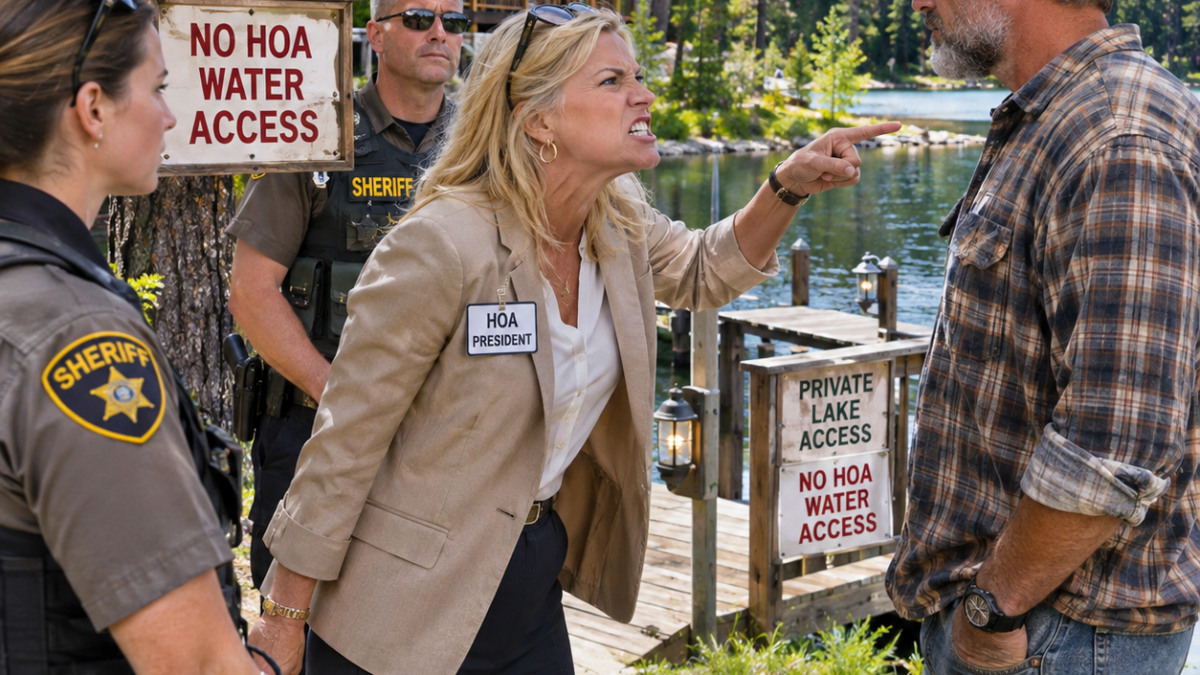
PART 2
The following Saturday morning, Colton and I started replacing the dock boards. It was the first project we had really done together since Sarah died, and I didn’t want Brenda Whitfield taking up space in my head while we worked. Colton pulled screws while I measured the cedar, and for the first time in months he was talking about ordinary fourteen-year-old things—school, a girl who apparently did not know he existed, whether he could eventually get a small jon boat—when I heard tires on the gravel road.
Not one vehicle.
Two.
Sheriff’s cruisers.
No sirens, but lights flashing.
Colton stopped moving.
That bothered me more than anything Brenda had said.
My son had already learned that unexpected cars could bring bad news. Doctors. Family. Funeral arrangements. Now two police cars were rolling onto the property where I had promised him we could start over.
I put down the drill and rested my hand briefly on his shoulder.
“It’s okay.”
“You sure?”
“Yes.”
I wasn’t completely sure.
A deputy named Travis Kemp stepped out of the first cruiser. Tall, lean, tired-looking in the way experienced deputies often are when they already suspect the call they received was nonsense. His partner remained near the second car.
Kemp approached slowly.
“Morning, sir.”
“Morning.”
“We received a complaint about unauthorized construction and trespassing on HOA common property.”
“Specifically?”
“The lake and dock.”
I glanced past him.
Brenda was standing near the road.
Clipboard.
Arms crossed.
Waiting.
I almost admired the confidence.
“Deputy,” I said, “this is my property.”
He looked at the lake.
“The whole lake?”
“Yes.”
“The dock?”
“Yes.”
“The ground we’re standing on?”
“Yes.”
I pulled out my phone.
After Brenda’s first visit, I had already downloaded the county assessor page, deed and recorded plat.
Kemp studied them.
Zoomed.
Read.
Then looked toward Brenda.
I watched the exact second he understood.
He exhaled slowly.
“Ma’am?”
Brenda approached.
Her expression suggested she expected handcuffs.
Just not for herself.
“Officer, I’m glad you’re here. This individual has refused to recognize HOA authority, and he is performing unauthorized modifications to a community recreational amenity.”
Kemp looked at her.
“Mrs. Whitfield, the documents indicate Mr. Ellison owns the parcel and the lake.”
Her expression froze.
“That can’t be correct.”
“It appears to be.”
“We’ve managed this lake for years.”
“That doesn’t make you the owner.”
“I am president of Lakeview Crossing.”
Kemp nodded.
“I understand.”
“I have authority over all community amenities.”
He looked down at my deed once more.
Then said the sentence Colton would repeat for months afterward.
“Ma’am, a deed outranks a clipboard.”
Colton covered his mouth.
I pretended not to notice.
Brenda’s face turned red.
“This is unacceptable.”
“I’m afraid it’s not a law-enforcement matter.”
“He is threatening our community!”
I hadn’t said a word to her.
Kemp looked at me.
I raised both hands.
He turned back.
“We cannot remove a property owner from his own property.”
Brenda stared at him.
Then at me.
Then at Colton.
Something in her expression changed.
The embarrassment disappeared.
Anger replaced it.
“This isn’t over.”
I picked up my drill.
“Ma’am, I’m fixing a dock.”
She walked back to her Denali and slammed the door hard enough to shake the mirror.
Gravel flew when she left.
Colton waited until the cruisers followed.
Then:
“She’s coming back.”
“Oh, absolutely.”
“How do you know?”
“People like Brenda don’t lose once and go home.”
“What do they do?”
I picked up the cedar board.
“They form committees.”
## **THE EMAIL**
Forty-eight hours later, every homeowner in Lakeview Crossing received an emergency message from the HOA.
Nora Pennington later showed me the original.
Subject:
**URGENT — COMMUNITY LAKE ACCESS UNDER THREAT**
According to Brenda, a hostile outsider had “seized control” of their beloved community lake.
That outsider was me.
The man whose father built it.
She called me a squatter.
A safety threat.
A danger to children.
She referred to “our beloved lake” four separate times.
What she did not include was my name on the deed.
That would have complicated the narrative.
By Tuesday, twelve aluminum signs appeared around the shoreline.
Bright red lettering.
**NO TRESPASSING — HOA PROPERTY**
Lakeview Crossing logo underneath.
I walked the shoreline that evening.
Coffee in one hand.
Phone in the other.
I counted all twelve.
Eight were clearly well inside my property.
The others sat close to the boundary.
I considered pulling them.
Then stopped.
Evidence is often more useful before you remove it.
So I photographed every sign.
Coordinates.
Time.
Distance from known markers.
Then left them standing.
## **FIFTY-THREE SIGNATURES**
Wednesday brought the petition.
Brenda went door to door telling residents my dock was unsafe.
To one family, she said I was planning commercial fishing.
Another was told I intended to build a marina.
A marina.
On a thirty-acre private lake.
By Thursday, she had fifty-three signatures.
Most of those people had never met me.
That hurt more than I expected.
Not because strangers disliked me.
Because some of them had spent years swimming, fishing and paddling on water my father had allowed them to enjoy, yet Brenda had convinced them in a few days that I had arrived to steal something from them.
Colton noticed.
“Do they hate us?”
“No.”
“They signed.”
“They’re scared.”
“Of what?”
“Losing something they think they own.”
He looked across the lake.
“But they don’t own it.”
“No.”
He frowned.
“That’s weird.”
“It gets weirder.”
## **NORA PENNINGTON**
Thursday evening brought the first honest knock on my door.
Nora Pennington was seventy-two and carried a Pyrex dish filled with homemade chili.
“You’re Howard’s boy.”
Not a question.
“Yes, ma’am.”
She shoved the chili toward me.
“Your daddy was a good man. Take this before I drop it.”
We sat on the porch.
Nora lived at the end of Sycamore Lane.
She had known Dad.
And she knew Brenda.
For nine years, Brenda had run Lakeview Crossing like private territory.
Fines.
Threats.
Letters.
Three families had moved after prolonged HOA disputes.
Annual dues increased.
Then Nora told me about the lake fee.
“How much?”
“Two hundred dollars.”
“Per household?”
“Every year.”
“For what?”
“Lake maintenance and recreation.”
I looked toward the water.
“Maintenance?”
“That’s what the bill says.”
“How many homes?”
“One hundred forty-two.”
I took out my phone.
142 × $200 = $28,400 per year.
Nine years.
$255,600.
A quarter-million dollars.
“To maintain my lake?”
Nora leaned toward me.
“Honey, I have lived there twelve years. I’ve never seen Brenda’s HOA test that water, repair your dock, treat erosion or do a damn thing to that lake.”
The chili sat cooling between us.
“Where did the money go?”
Nora gave me a look.
“That is why I came.”
## **DAD’S FILING CABINET**
Dad stored records in a green steel cabinet inside his workshop.
Four drawers.
Padlock.
No key.
I cut the lock.
Colton watched.
“Grandpa would be mad.”
“Grandpa would be madder if we didn’t read his paperwork.”
Inside was forty years of Howard Ellison in document form.
Permits.
Deeds.
Water authority letters.
Dam inspections.
Soil reports.
Surveys.
Tax records.
Every folder labeled in his block handwriting.
I spent hours going through them.
Near the back of the third drawer, I found one marked:
**LAKEVIEW — DEVELOPER AGREEMENT**
I pulled it out.
That folder would eventually end Brenda’s control of the lake.
But not yet.
Because the following morning her husband entered the story.
## **DALE WHITFIELD**
I needed a permit to repair the dock.
Nothing dramatic.
Replace rotten boards.
Reinforce pilings.
Install safer railing.
My first application came back denied.
**Pending environmental review.**
No explanation.
No timeline.
I reapplied.
Denied again.
Third application, same answer.
So I drove to the Blount County Planning and Development Office.
Behind the service counter was a wall of official portraits.
Commissioners.
Board members.
Planning officials.
Third from the left:
**DALE WHITFIELD.**
Brenda’s husband.
Planning Commissioner.
I stared at his portrait.
Then asked the clerk why my repair had been flagged.
She hesitated.
Looked toward Dale’s photograph.
Then back at her computer.
That told me enough.
Brenda had the clipboard.
Dale had the government stamp.
That combination was considerably more dangerous.
I went back to my truck.
Sat for ten minutes.
Then searched for the state public-records process.
That afternoon, I requested years of planning commission records involving Lakeview Crossing, Ridgeline Development Corporation and properties surrounding my land.
If Dale was using a public position to fight Brenda’s private war, I wanted paper.
## **EMINENT DOMAIN**
While I waited for records, Brenda held an emergency HOA meeting.
Nora recorded it.
Brenda proposed that Lakeview Crossing acquire Ellison Lake through eminent domain.
When Nora showed me the video, I actually paused it.
Rewound.
Watched again.
A man in the back asked the obvious question:
“Can an HOA use eminent domain?”
Brenda adjusted her glasses.
“I have consulted legal counsel.”
She had apparently consulted no one who understood the term.
Her confidence was spectacular.
Colton watched over my shoulder.
“Can they?”
“No.”
“Not even close?”
“Not in the universe we currently occupy.”
He laughed.
That felt good.
We had not laughed much since Sarah.
## **PAGE FOUR**
That Thursday night, Colton did homework in the kitchen while I sat at Dad’s old workshop desk with the Lakeview folder.
Three documents.
A 2003 letter from Ridgeline Development.
A six-page agreement.
Recorded plat.
Ridgeline’s attorney had asked Dad for recreational access to Ellison Lake for future Lakeview residents.
Swimming.
Fishing.
Non-motorized boats.
Dad agreed.
Then I read page four.
Section seven.
Paragraph two.
I read it once.
Then twice.
Then again.
The agreement granted a license.
Not permanent ownership.
Not an easement.
Not a covenant running with the homes.
A license.
And Dad had inserted a termination clause.
The owner—or heirs and successors—could revoke the entire arrangement with ninety days written notice.
I sat completely still.
Dad had built an off switch.
Of course he had.
Howard Ellison did not trust any system without one.
## **CONNOR BRIGGS**
The next morning I drove to Maryville and met Connor Briggs.
Real-estate attorney.
Young.
Cowboy boots under a suit.
He read the papers silently.
Six minutes.
Then looked at me.
“You own the kill switch.”
“What does that mean?”
“This is a revocable license.”
“I know what it says.”
“I’m telling you what it means. These people do not have permanent lake rights. Your father gave the developer permission.”
“And I can revoke it?”
“Ninety days notice.”
He leaned back.
“The entire subdivision.”
I felt no triumph yet.
Only weight.
One hundred forty-two homes.
Families.
Children.
People who had spent twenty years being told this was their community lake.
Then Connor opened the HOA financial records Nora had provided.
$255,600 collected.
He flipped pages.
“Where are the expenses?”
“There aren’t any.”
“No water testing.”
“No.”
“Dock repair?”
“No.”
“Erosion management?”
“No.”
He closed the folder.
“You have two separate problems.”
“Brenda?”
“Brenda is one of them.”
“What’s the other?”
“Everyone who trusted her.”
## **THE POWER I DIDN’T WANT**
Driving home, I kept thinking about the ninety-day clause.
It was easy to imagine revenge.
Brenda calls cops?
Fine.
No lake.
Brenda plants signs?
Fine.
No lake.
Brenda blocks my permits?
Fine.
Nobody swims.
But there were children in that neighborhood.
Retirees.
Families who had not threatened me.
People like Nora.
So I did not send the notice.
Not yet.
I needed to know exactly what Brenda had done.
## **THE SURVEY**
Jennings and Associates surveyed the shoreline.
Two days.
GPS.
Laser rangefinders.
Certified map.
Result:
Eight of Brenda’s twelve HOA signs were between fifteen and thirty-seven feet inside my property.
Then came the funnier discovery.
Brenda’s private floating dock.
Four feet seven inches of it extended over submerged land belonging to me.
Her pontoon had been tied over my property.
The woman accusing me of trespassing had physically encroached on my land.
Connor smiled when I showed him.
“Do not remove it.”
“I wasn’t planning to.”
“Good.”
“Evidence?”
“Exactly.”
## **THE REVOCATION LETTER**
Connor drafted it.
Three pages.
Cold.
Professional.
No insults.
No mention of police.
No mention of Brenda.
Just the 2003 agreement.
Section seven.
Ninety days.
All recreational lake access terminated upon the effective date.
Certified mail.
Return receipt.
We prepared it.
But still did not send it.
Timing mattered.
## **CAMERAS**
I bought four trail cameras.
Infrared.
Motion activated.
Weather sealed.
One watched the dock.
One covered the north shoreline.
One watched the access road.
One faced the gate.
Brenda had already planted signs on my land.
I wanted to know what came next.
The cameras also gave me something I had not felt since her first visit.
Control.
Not over her.
Over facts.
## **DALE’S RECORDS**
The public-records response contained 312 pages.
I spent two nights highlighting.
Dale Whitfield had voted on three matters tied directly to Lakeview Crossing interests.
Expansion.
Commercial easement.
Road project.
All benefited Ridgeline Development.
Then another document connected Brenda financially to Ridgeline through consulting payments.
Approximately $41,000 over four years.
I called Connor.
He listened.
Then:
“Did Dale disclose the relationship?”
“Not in any of these minutes.”
“Keep everything.”
That was becoming a theme.
## **THE FIFTEEN HOMEOWNERS**
Nora introduced me to fifteen residents.
They brought files.
Fines for trash cans.
Flowerpots.
Paint shades.
Flags.
One retired postal worker named Glenn had been fined $300 because his American flag was six inches larger than the HOA standard allowed.
He slid the notice toward me.
“I fought in Desert Storm.”
I read it.
“He fined your flag?”
“Brenda did.”
“Did you pay?”
“My wife made me.”
The room laughed.
Glenn didn’t.
Then he finally smiled.
One by one, residents signed statements.
Patterns matter.
One complaint is a dispute.
Fifteen people telling similar stories is something else.
## **TAMMY VOSS**
Tammy was a reporter at the Blount County Herald.
Black coffee.
Legal pad.
No laptop.
I met her at a diner.
Off the record.
I gave her the license.
Financial records.
Survey.
Planning records.
Resident statements.
She read for nearly an hour.
Finally:
“When does this run?”
“Not yet.”
She looked disappointed.
“When?”
“You’ll know.”
Then she smiled.
That smile told me Brenda eventually would too.
## **THE NINETY-DAY CLOCK**
We served the revocation.
Certified.
Signed.
The ninety days began.
Outwardly, I lived normally.
Fixed the dock.
Mowed.
Drove Colton to school.
Fished.
Cooked badly.
Tried to help with algebra even though he insisted engineers were supposed to understand math better.
But inside the house, the case file grew.
Brenda did not know how much had changed.
She kept behaving like HOA president meant lake owner.
That assumption was about to become expensive.
## **THE LAWSUIT**
Two weeks into the notice period, Brenda sued me.
Thirty-eight pages.
Half a million dollars in claimed damages.
Interference with community access.
Private nuisance.
Emotional distress.
She also claimed the neighborhood had acquired permanent rights through long use.
Connor read the lawsuit.
Then started laughing.
“Good news.”
“She wants five hundred thousand.”
“That’s not the good news.”
“What is?”
“She just destroyed her own best argument.”
“How?”
“Prescriptive rights require adverse use. Your father gave them permission in writing. They weren’t using the lake against his ownership. They were using it because he allowed them.”
He tapped the 2003 agreement.
“This paper kills that theory.”
Within forty-eight hours he filed our response.
Deed.
License.
Financial records.
Survey.
Planning records.
Then counterclaims.
Trespass.
Misappropriated funds issues.
Abuse of process.
Brenda’s attorney called Connor shortly afterward.
Then withdrew.
Three more firms declined her case.
One lawyer reportedly told her he could not represent a client who was producing evidence faster than the other side could collect it.
I cannot confirm the exact quote.
I hope it was real.
## **DALE COMES TO MY HOUSE**
Dale appeared one evening.
He stayed outside the property line.
That told me lawyers had finally started speaking to him.
“Mr. Ellison.”
“Mr. Whitfield.”
“I think this has gotten out of hand.”
“We’ve never spoken before.”
“Exactly. Maybe we should.”
He smiled.
Then came the threat disguised as cooperation.
He knew inspectors.
Officials.
Developers.
Clerks.
If I wanted permits approved smoothly, he could make things easier.
Or harder.
He never said the final words explicitly.
He didn’t need to.
What Dale did not notice was the trail camera above him.
Blinking.
Recording.
When he left, I checked the footage.
Clear.
I saved it.
Three copies.
## **2:14 A.M.**
The notification woke me.
Motion detected.
North dock.
I opened the live feed.
Infrared image.
A figure.
Brenda.
Dark jacket.
Yoga pants.
Flashlight.
Hacksaw.
For several seconds my brain refused to accept what my eyes were showing me.
Then she knelt.
Started sawing through my mooring line.
Back.
Forward.
Back.
Forward.
The rope snapped.
She moved to the repaired dock section.
Kicked two loose planks into the water.
Then stood and looked around.
She believed darkness protected her.
The camera could see eighty feet in infrared.
It could read the embroidered words on her jacket.
**LAKEVIEW CROSSING HOA.**
She had worn the organization’s logo.
Colton later called that “evidence with branding.”
Four cameras recorded her.
License plate.
Vehicle.
Time.
Movement.
Four minutes and twenty-two seconds.
Cloud backup updated every thirty seconds.
By the time Brenda reached home, the evidence was already stored somewhere she could never reach.
## **CONNOR WATCHES THE VIDEO**
He stared at the screen.
“Is that really her?”
“Yes.”
“She’s wearing the HOA jacket.”
“Yes.”
He leaned back.
“I almost feel insulted.”
“Why?”
“Usually opposing parties make me work.”
He listed the potential issues.
Trespass.
Property damage.
Criminal mischief.
Then looked at me.
“This is bad for her.”
“She’s not done.”
I didn’t know why I said it.
But I was right.
## **THE WHITE SEDAN**
Two days later a county vehicle came up the driveway.
A woman stepped out.
Gray blazer.
ID.
Child Protective Services.
Everything in me went cold.
Colton was at school.
Thank God.
“Mr. Ellison?”
“Yes.”
“We received a report concerning the safety of a minor in your home.”
My jaw tightened.
“What allegation?”
“A child being left unsupervised around open water without adequate safety precautions.”
I knew.
She knew I knew.
But I did not say Brenda’s name.
I invited her inside.
Showed her the property.
Railings.
Safety gate.
Depth markers.
Colton’s room.
School record.
Honor roll.
Attendance.
Books.
Fishing equipment.
She was professional.
Kind.
Forty-five minutes later, she said the report would be closed.
I thanked her.
Then she left.
## **MY LINE**
That night, after Colton went to sleep, I sat alone on the dock.
Moonlight across the lake.
Sarah used to sit beside me when we visited Dad.
I could almost see her.
Brenda had gone after my land.
Fine.
My permit.
Fine.
My reputation.
My money.
The dock.
Even the lake.
But now she had involved my son.
Colton had already lost his mother.
His grandfather.
His old home.
He had come to Tennessee because I promised stability.
And Brenda Whitfield had turned a government child-welfare agency toward him because she was losing a property dispute.
That was my line.
Patience had been strategy.
Beyond that point it would become cowardice.
I called Connor.
“Serve everything.”
“When?”
“Annual HOA meeting.”
Silence.
“You want it public.”
“She called police publicly.”
“Different.”
“She told the neighborhood I stole their lake.”
“True.”
“She involved my son.”
Another silence.
“All right.”
Then I called Tammy.
“Thursday night.”
“What’s happening?”
“Bring a photographer.”
She didn’t ask another question.
## **THE ANNUAL MEETING**
Lakeview Crossing Community Center smelled like floor wax, instant coffee and years of people being afraid to challenge the person sitting at the front table.
Brenda wore cream linen.
Hair perfect.
Agenda printed on heavy cardstock.
Item six:
**LAKE ACCESS UPDATE.**
She planned to rally the neighborhood against me.
She never reached it.
I entered at 7:12.
Connor behind me.
Tammy Voss behind him.
Photographer.
Then Sheriff Boyd Langston.
The room changed.
Brenda saw me first.
Then Connor.
Then the reporter.
Then the uniform.
Color drained from her face.
“This is a private HOA meeting.”
Connor stepped forward.
“My client has legal interests directly implicated by this association’s actions.”
Brenda stood.
“He is not a resident.”
“No.”
Connor put his briefcase on the table.
“He’s the property owner whose lake you’ve been managing.”
Nobody spoke.
## **ONE DOCUMENT AT A TIME**
I placed the deed down first.
Ellison Lake.
My property.
Then the 2003 agreement.
Connor opened it to page four.
Section seven.
Revocable license.
Ninety-day termination.
Then the certified revocation.
The effective date.
Silence spread.
Someone whispered:
“So we don’t own access?”
I answered.
“No.”
Brenda interrupted.
“That agreement has been superseded by years of community use.”
Connor looked at her.
“No, ma’am.”
She tried again.
“Our attorneys—”
“You currently do not have counsel in the pending matter.”
That landed badly.
Then came the financials.
Nine years.
One hundred forty-two households.
Two hundred dollars per year.
$255,600 collected.
Zero documented lake-maintenance expenditures.
I looked at the room.
Then Brenda.
“Where did the money go?”
No answer.
People started shifting.
Whispering.
Nora remained motionless in the third row.
She had waited years for this.
## **THE VIDEO**
Connor connected his laptop to Brenda’s own projector.
The lights dimmed.
Infrared footage filled the screen.
2:14 a.m.
Brenda walking onto my dock.
The embroidered HOA logo visible.
Hacksaw.
Mooring line.
Boards kicked into the lake.
Four minutes and twenty-two seconds.
Nobody breathed.
When the video ended, Connor did not say anything.
He didn’t have to.
Someone in the back said:
“Oh my God.”
Brenda looked around the room.
“You don’t understand the context.”
Nora finally spoke.
“What context do you need for a hacksaw, Brenda?”
A few people laughed.
Brenda did not.
## **DALE’S RECORDS**
Next came the planning commission documents.
Three votes.
Ridgeline projects.
Brenda’s $41,000 consulting relationship.
No conflict disclosures in the records we had obtained.
Dale was sitting near the back.
When his name appeared on the screen, he stood.
Sheriff Langston shifted into the aisle.
Dale reconsidered.
Sat down.
## **THEN I SPOKE**
I had rehearsed nothing.
That helped.
I looked at the residents.
“Your HOA president called police to remove me from the lake my father built.”
Some people looked down.
“She told you I seized your community property.”
I held up the deed.
“It was never community property.”
Then the agreement.
“Your original developer asked my father for permission. He gave it.”
I looked at Brenda.
“Permission is not ownership.”
Then the financial statement.
“You paid $200 a year for nine years under the description of lake maintenance and recreation.”
Then the zero expenditure page.
“No money was spent maintaining my lake.”
Then the trail-camera image.
“My dock was vandalized in the middle of the night.”
I paused.
“And when that didn’t work, someone filed a report involving my fourteen-year-old son.”
My voice changed there.
I couldn’t help it.
Colton was not in the room.
I was glad.
“Enough.”
One word.
It echoed harder than I expected.
“As of the effective date in this notice, Lakeview Crossing has no automatic right to use Ellison Lake.”
The room exploded.
Not screaming.
Questions.
Shock.
People turning toward Brenda.
Toward board members.
Toward each other.
“How long?”
“Can he do that?”
“What about boats?”
“What did we pay for?”
“Where’s the money?”
Brenda banged a gavel.
Nobody cared.
Her authority was already gone.
## **THE SHERIFF**
Sheriff Langston stepped forward.
The room quieted.
“Brenda Whitfield?”
She looked at him.
He removed a folded document.
“I have a warrant.”
Her knees seemed to weaken.
The alleged offenses included embezzlement-related charges, criminal mischief, trespass and the false-report matter described in the source.
Brenda looked at me.
“You did this.”
I shook my head.
“No.”
Her face twisted.
“You planned all of this.”
“No.”
She looked toward the projector.
The paperwork.
The residents.
The sheriff.
I said:
“You did all of it. I just kept copies.”
He placed her in handcuffs.
The cream blazer wrinkled behind her back.
Tammy’s photographer captured the moment.
Above Brenda hung the Lakeview Crossing banner:
**BUILDING COMMUNITY TOGETHER**
Even I could not have written better irony.
She walked through the residents she had fined, threatened and controlled for nine years.
Nobody said goodbye.
## **DALE**
Dale left separately.
He did not speak.
Within days, he resigned from the planning commission before a formal ethics investigation developed further.
His resignation cited personal reasons.
Everyone in Lakeview knew how personal those reasons had become.
## **THE TEN SECONDS AFTERWARD**
When the doors closed behind the sheriff, the room stayed silent.
Ten seconds.
Maybe twelve.
Then Nora stood.
Adjusted her purse strap.
“Well.”
Everyone turned.
“I move that we elect a new board.”
The applause began in one corner.
Then another.
Within seconds almost everyone was standing.
I wasn’t.
I sat down.
For the first time since returning to Tennessee, I felt tired enough to notice.
## **THE FRONT PAGE**
Saturday’s Blount County Herald ran the photograph above the fold.
Brenda.
Handcuffs.
Community banner overhead.
Tammy’s article laid out the lake ownership, financial questions, access agreement and overnight vandalism evidence.
Regional outlets picked it up.
So did HOA-focused websites.
The woman who had controlled the neighborhood narrative for nine years lost control of it in less than forty-eight hours.
## **THE FORENSIC ACCOUNTANT**
The new interim board hired an independent accountant.
Records were examined.
Lake fund.
Payments.
Transfers.
Expenses.
Residents finally began seeing where their money had gone and what documentation existed.
Brenda’s bond was set at $75,000 according to the source.
She posted it.
Meanwhile, legal and financial investigations continued.
I did not celebrate any of that.
Colton asked why.
“She tried to ruin you.”
“I know.”
“Then why aren’t you happy?”
“Because ruining her was never the job.”
“What was?”
I looked at the lake.
“Stopping her.”
He thought about that.
Then nodded.
## **NORA WINS**
Lakeview Crossing held a special election.
Nora Pennington won 131 votes.
Four residents voted against her.
Even they applauded when she took the chair.
Her first call was to me.
“Mr. Ellison.”
“Nora, you’ve been eating chili on my porch. You can stop calling me Mr. Ellison.”
“Fine. I’m president.”
“My condolences.”
She laughed.
Then got serious.
“We need to talk about the lake.”
## **I COULD HAVE KEPT THEM OUT**
Legally, the revocation had done its job.
The old license was gone.
I could have kept Lakeview Crossing off Ellison Lake.
Every boat.
Every swimmer.
Every fisherman.
Every resident.
Some people expected me to.
A few even encouraged it.
“They backed Brenda.”
Some did.
“They signed her petition.”
Some did.
“They treated you like a criminal.”
Some did.
But when I looked across the water, I remembered Dad.
Howard had not built the lake to create a private kingdom.
He had permitted the subdivision to use it because neighbors were neighbors.
Brenda had corrupted the arrangement.
That did not mean the arrangement itself had been wrong.
So I met with Nora, Connor and the new board.
## **A REAL AGREEMENT**
We did not restore Brenda’s system.
We replaced it.
The old revocable license had been deliberately temporary.
The new agreement would be clear.
Recorded.
Transparent.
A properly structured easement governing lake use.
Fees reduced from $200 to $75 annually.
No vague “maintenance fund.”
Independent account.
Every dollar restricted to actual lake purposes.
Water testing.
Erosion control.
Dock maintenance.
Safety equipment.
Two signatures required for withdrawals.
Quarterly public accounting.
No president with unilateral control.
Nora asked:
“Anything else?”
“Yes.”
“What?”
“Children.”
## **THE HOWARD ELLISON YOUTH FISHING INITIATIVE**
Dad taught me to fish.
I wanted the lake to keep doing that.
So children under sixteen received free access through the new program.
Not just Lakeview children.
Any kid in Blount County participating in the program.
Rods provided.
Tackle.
Bait.
Basic safety instruction.
Catch-and-release education.
Saturday mornings from April through October.
We named it after Dad.
The first opening day, thirty-one kids arrived.
Thirty-one.
I had expected maybe eight.
Colton ended up teaching a nine-year-old girl to put a worm on a hook.
She screamed.
Dropped it.
Tried again.
Screamed less.
Then finally got it.
Colton high-fived her.
Both of them had worm guts on their fingers.
I stood on shore with coffee.
For a second I had to look away.
Sarah would have loved seeing him like that.
Dad too.
## **WHAT COLTON SAID**
That evening we sat at the end of the repaired dock.
He kicked his shoes against the boards.
“Dad?”
“Yeah?”
“Did we win?”
I thought about Brenda.
The police.
The cameras.
The meeting.
The charges.
Then the thirty-one kids.
“What do you think?”
He looked across the water.
“They can use it again.”
“Yes.”
“So you banned them just to let them back?”
“I banned Brenda’s version.”
He frowned.
“What’s the difference?”
“Her version said the HOA owned the lake.”
“And ours?”
“Ours says they’re guests with recorded rights and rules everybody can read.”
He thought.
“And nobody can steal the money?”
“They can try.”
He smiled.
“But?”
“We made it harder.”
“Two signatures.”
“Exactly.”
“Quarterly audits.”
I looked at him.
“You were listening.”
“Sometimes.”
## **DAD’S LESSON**
Years earlier, Dad once told me that good engineering did not mean building something nobody could ever break.
That was impossible.
Good engineering meant anticipating where failure was most likely and designing around it.
I finally understood that his 2003 lake agreement worked the same way.
He liked Lakeview residents.
He wanted them to enjoy the water.
But he knew organizations changed.
Boards changed.
People changed.
So he wrote an off switch.
Ninety days.
Not because he expected someone like Brenda.
Because Howard Ellison understood systems.
And every system needs a way to shut down when it becomes unsafe.
## **THE OLD CABINET**
I kept Dad’s filing cabinet.
Replaced the cut padlock.
New key.
Colton asked why I didn’t buy something nicer.
“Because this worked.”
“You had to cut it open.”
“Eventually.”
“That’s not a strong argument.”
He had me there.
Inside, the Lakeview developer agreement now sits in a fresh protective sleeve.
Beside it is the new easement.
Old system.
New system.
Permission.
Accountability.
History.
## **THE TWELVE SIGNS**
Remember Brenda’s signs?
The ones reading:
**NO TRESPASSING — HOA PROPERTY.**
After the case broke open, we removed them.
All twelve.
Colton helped.
At the eighth one, he said:
“What are we doing with these?”
“Storage.”
“Why?”
“Evidence.”
“Forever?”
“Probably.”
He rolled his eyes.
“You really are Grandpa’s son.”
That might be the nicest insult he has ever given me.
## **BRENDA’S DOCK**
The survey showed part of Brenda’s floating dock intruded over my submerged property.
I could have demanded removal.
Instead, once the new board was functioning, we incorporated shoreline standards into the new agreement.
The dock had to be brought into compliance.
Measured.
Adjusted.
Permitted.
Boring.
Correct.
That is how property problems should end.
Not with somebody swinging a hammer.
With somebody reading a survey.
## **GLENN’S FLAG**
Nora’s new board reviewed old fines.
Glenn Shepherd got his $300 flag fine reversed.
He came to my dock afterward carrying the flag.
“Six inches too wide.”
“I heard.”
“Brenda said it disrupted visual uniformity.”
“What did you say?”
“I said it disrupted Normandy too.”
I laughed.
He grinned.
Then we raised it by his porch.
No committee required.
## **THE WOMAN WITH THE FLOWERPOTS**
Another resident had spent years fighting over two flowerpots sitting inches outside some landscaping standard.
The new board dismissed that too.
Not every rule disappeared.
Good rules still existed.
Roads.
Noise.
Drainage.
Shared property.
But punishment stopped being entertainment.
That was the biggest difference.
## **NORA’S FIRST BUDGET MEETING**
She invited me.
I declined.
“You’re basically our lake partner now.”
“I own the lake.”
“Exactly.”
“Then I especially shouldn’t run your HOA.”
She laughed.
“Fair.”
The independent lake fund reported every dollar.
Residents could see balances.
Invoices.
Testing costs.
Repairs.
For the first time, the annual lake fee meant something real.
## **THE FIRST WATER TEST**
The first professional water-quality sampling under the new agreement cost less than Brenda had collected from seven households in one year.
Seven.
That number made residents furious all over again.
Nora called me.
“Don’t tell them that at the meeting.”
“Why?”
“I have to survive the meeting.”
“Good luck, Madam President.”
“I hate you.”
“No, you don’t.”
“No. But I understand why Brenda preferred dictatorship.”
## **THE CPS REPORT**
That part took longer for me to let go.
Property fights become abstract after enough paperwork.
CPS was different.
Someone had looked at my son—already grieving his mother—and decided he was a useful pressure point.
I did not forgive that quickly.
I still haven’t completely.
But Colton did something surprising.
Months later he said:
“Dad, stop making that face.”
“What face?”
“The Brenda face.”
“I don’t have a Brenda face.”
“You do.”
“What does it look like?”
“Like you’re chewing metal.”
He was right.
Then he said:
“She’s gone.”
I looked at him.
“We’re here.”
Again, fourteen-year-olds occasionally achieve clarity adults spend years avoiding.
## **SARAH’S EMPTY CHAIR**
The house had felt wrong after Sarah died.
Even in Tennessee.
Different house.
Same absence.
At dinner, I still sometimes expected her to speak.
At the fishing program, I imagined her laughing at Colton trying to pretend worms did not disgust him.
Grief does strange things.
You can rebuild a dock faster than a life.
But that summer, something shifted.
Colton had friends.
Purpose.
Lake mornings.
Kids he helped.
I had work that wasn’t just fighting Brenda.
For the first time in three years, the future stopped feeling like something happening without Sarah.
It felt like something we were allowed to enter.
## **THE HERON**
A great blue heron lived around the shallows.
Dad used to call him the inspector.
Probably not the same bird after all those years, but I kept the name.
Every Saturday during youth fishing, he appeared somewhere nearby.
Motionless.
Judging.
Colton told the kids:
“That’s my grandpa’s security system.”
One child believed him.
For three weeks.
## **THE FIRST BASS**
A boy named Marcus caught the first decent bass of the program.
Maybe three pounds.
He nearly fell off the dock.
Colton grabbed his life vest.
They landed it.
Marcus stared like he had discovered a dinosaur.
“Can I keep it?”
I knelt beside him.
“What do you think?”
He looked at the fish.
Then the water.
“Maybe he should get bigger.”
We released it.
The bass disappeared.
Marcus sat quietly for a moment.
Then:
“That was awesome.”
That was what Dad wanted from the lake.
Not Brenda’s fund.
Not my revenge.
That.
## **THE DENALI**
Someone bought Brenda’s white Yukon after it went up for sale.
I saw it once in Maryville.
For half a second my body reacted before my brain did.
Then I saw a young couple inside.
Completely different people.
I laughed at myself.
A car is a car.
Objects should not inherit grudges.
Neither should lakes.
## **THE PLANNING OFFICE**
Dale’s resignation changed things at the county office too.
My dock repair permit eventually went through.
The same clerk, Patty, handed it to me.
“Congratulations.”
“For replacing cedar boards?”
“For surviving paperwork.”
“Fair.”
She leaned closer.
“Your father used to come in here.”
“You remember him?”
“Everybody remembered Howard.”
“Why?”
“He brought exact drawings.”
“That sounds like Dad.”
“And donuts.”
“That also sounds like Dad.”
## **THE DOCK**
We finished it late summer.
Colton drove the final screw.
I stepped back.
New cedar.
Railings.
Safety gate.
Old pilings reinforced.
Same place Dad had built the original.
Colton said:
“Looks different.”
“It is.”
“Still Grandpa’s?”
I thought about that.
“Yes.”
“How?”
“Because replacing parts doesn’t erase what something is.”
He looked at me strangely.
“You talking about the dock?”
“Mostly.”
## **THE ANNUAL MEETING ONE YEAR LATER**
I attended.
Nora sat at the front.
No linen blazer.
No theatrical gavel.
Budget.
Road maintenance.
Landscaping.
Lake account.
Audit.
Questions.
Forty-three minutes.
Then adjournment.
I stood afterward.
“That’s it?”
Nora looked offended.
“What did you want?”
“Police.”
“Get out.”
“No lawsuit?”
“Go home.”
“No projector footage?”
She threw a napkin at me.
Healthy governance is disappointing television.
That is probably a compliment.
## **THE NEW LAKE AGREEMENT**
Some residents initially disliked the new easement terms.
No motorized boats beyond certain limits.
No shoreline alterations without written permission.
No private docks extending into my property without compliance.
Fishing rules.
Quiet hours.
Environmental protections.
Then Connor reminded them what the alternative was.
No access at all.
The complaints ended quickly.
Over time, the rules stopped feeling punitive.
They became normal.
Because everyone knew where they came from.
Transparency changes how rules feel.
## **THE ACCOUNTING RULE**
Two signatures for every withdrawal.
Quarterly statements.
Independent annual review.
Residents laughed when I insisted.
Then the first report came.
Every dollar listed.
Water test.
Shoreline erosion mats.
Dock fasteners.
Trash cleanup.
Insurance.
People stopped laughing.
Trust is easier when there is a receipt.
## **THE THING BRENDA NEVER UNDERSTOOD**
She believed authority came from being the person willing to use it hardest.
More letters.
More fines.
More complaints.
More pressure.
But real authority has boundaries.
A deed.
A contract.
A statute.
A vote.
A fiduciary obligation.
Once you operate outside those boundaries, you are not becoming more powerful.
You are creating evidence.
## **WHY I DIDN’T KEEP THE HOA BANNED**
Some readers would probably prefer that ending.
Brenda calls cops.
I ban everybody forever.
Perfect revenge.
But revenge is satisfying in a title.
Life is more complicated.
Nora never stole from me.
Glenn didn’t.
The children certainly didn’t.
Many residents had been misled for years.
They thought their dues bought something legitimate.
Punishing them permanently would have made me another person using control because I could.
I had already met one of those.
I didn’t want to become her.
## **COLTON UNDERSTOOD BEFORE I DID**
One afternoon he asked:
“If Grandma—I mean Mom—were here, would she let them back?”
Sarah.
I looked at him.
“What do you think?”
“Yes.”
“Why?”
“She hated people being excluded.”
He was right.
Sarah would have hated Brenda.
She also would have hated me turning the lake into a monument to that hatred.
So the gates opened again.
With rules.
With accountability.
With kids laughing on Saturdays.
## **THE MAN WHO BUILT IT**
Dad never charged people to fish.
He did expect respect.
No trash.
No destroying banks.
No motors tearing through nesting areas.
No pretending ownership.
If Dad had been alive when Brenda called police, I suspect he would have walked outside with the original agreement already in his hand.
He probably would have remembered the page number.
I needed a filing cabinet.
Different generations.
Same paperwork.
## **THE LAST FILE**
I found one more note from Dad months later.
It wasn’t legal.
It was tucked behind an old dam-inspection report.
Yellow paper.
His handwriting.
A rough list:
**Check spillway after heavy rain.**
**Replace west dock cleat.**
**Call county re shoreline erosion.**
Then at the bottom:
**Lakeview folks mostly good. Keep it friendly.**
I sat down.
Mostly good.
That was Howard.
He understood organizations could fail without deciding every person inside them was bad.
I put the note beside the new agreement.
## **NORA SAW IT**
She came over one afternoon.
I showed her.
She read the line.
Then wiped one eye.
“Your father liked us?”
“Apparently.”
“He hated Brenda?”
“He died before she got this bad.”
“Lucky man.”
I laughed.
Then Nora said:
“We’ll take care of it.”
I believed her.
## **THE FIRST FULL YEAR**
The new lake account ended the year with money remaining.
No mystery.
No missing transactions.
Water quality good.
Several erosion points repaired.
Dock areas inspected.
Trash removed after summer weekends.
Youth program funded partly through donations.
Nora sent every homeowner the statement.
At the bottom:
**Questions welcome.**
Brenda’s newsletters had never welcomed questions.
That sentence told me more about the new HOA than the balance sheet.
## **COLTON TURNS FIFTEEN**
We held his birthday near the water.
Not a huge party.
Friends.
Pizza.
Fishing.
Someone pushed someone else off the dock.
Nobody died.
No CPS investigation.
Colton caught me watching from the porch.
“Dad.”
“What?”
“Stop supervising.”
“This is my lake.”
He stared.
I heard my own words.
Then laughed.
“Fair.”
I went inside.
## **THE DIFFERENCE BETWEEN OWNERSHIP AND CONTROL**
I own Ellison Lake.
That doesn’t mean I should control every human moment on it.
Ownership carries responsibility.
Safety.
Stewardship.
Boundaries.
Documentation.
Dad understood that.
Brenda confused access with ownership, and ownership with power.
Those are three different things.
## **TAMMY’S FOLLOW-UP ARTICLE**
A year later, Tammy wrote about the youth program.
The photograph showed Colton teaching children to cast.
Not Brenda.
Not handcuffs.
Not court papers.
That pleased me.
Tammy asked:
“Which story do you think people will remember?”
“The arrest.”
“Probably.”
“Which one do you want remembered?”
I pointed toward the kids.
“That.”
## **THE OLD PHOTO**
There is a photograph of Dad standing beside the dam around 1980.
Young.
Hard hat.
Mud on his boots.
Behind him, the lake is barely full.
I keep it in the workshop.
Colton looked at it one afternoon.
“Grandpa looks like you.”
“Poor man.”
“No. You look like him.”
“That’s different?”
“Yes.”
“How?”
“I don’t know.”
Teenagers.
## **THE DAM**
We had it professionally inspected.
No drama.
No scandal.
Just maintenance.
The engineer was younger than me.
He walked the spillway.
Reviewed Dad’s original drawings.
Then said:
“Your father overbuilt this.”
I smiled.
“Of course he did.”
“How much?”
“Enough that you noticed forty-five years later.”
He nodded.
“Fair.”
## **THE NEW GENERATION**
Colton started talking about environmental engineering.
Maybe he will.
Maybe he won’t.
I’ve learned not to build somebody else’s future for them.
He might become a musician.
Teacher.
Mechanic.
Something I cannot imagine.
I will try to support him.
That may be the most important thing Sarah taught me by leaving too soon.
People are not projects.
## **THE POLICE CALL I REMEMBER DIFFERENTLY NOW**
At first, I remembered Brenda’s police call as humiliation.
Two cruisers.
My son watching.
A stranger trying to remove me.
Now I think of Deputy Kemp.
A deed outranks a clipboard.
Simple.
That moment prevented something worse.
Systems are not automatically corrupt because someone tries to weaponize them.
Sometimes the system works because one tired deputy bothers to read the paper.
## **THE CPS WORKER**
Same lesson.
Brenda allegedly tried to weaponize child welfare.
The worker did her job.
Checked.
Observed.
Closed the case.
I resented the visit.
I did not resent her.
Important distinction.
## **THE PERMIT CLERK**
Patty did not block my permit because she hated me.
She followed a flag in the system.
Once the conflict became visible, the process moved.
People inside institutions and people abusing institutions are not the same thing.
That realization kept me from becoming bitter at everybody.
## **THE SHERIFF**
Sheriff Langston later came to one youth fishing Saturday.
No uniform.
Grandson beside him.
I handed the kid a rod.
Langston smiled.
“Quieter than the annual meeting.”
“Usually.”
“Any warrants today?”
“Depends how the bluegill behave.”
He laughed.
## **NORA’S CHILI**
She still brings chili.
Too much chili.
Every time.
I once said:
“You know we can cook.”
She looked toward my kitchen.
“No offense, sweetheart, but I’ve met you.”
I stopped arguing.
## **THE SIGN WE PUT UP**
Not one of Brenda’s signs.
A new one near the public-facing youth-program area:
**ELLISON LAKE**
**PRIVATE WATER — ACCESS BY AGREEMENT**
**PLEASE RESPECT THE LAKE HOWARD BUILT**
Colton designed the wording.
I approved it.
Two generations.
One sign.
No HOA logo.
## **THE COST OF A LIE**
Brenda’s biggest lie was not that she owned the lake.
It was that everybody needed her to protect it.
The lake existed before her presidency.
The neighborhood continued after it.
Dues dropped.
Water still got tested.
Roads remained paved.
People kept living.
Communities are usually stronger than the person claiming to be indispensable.
## **WHY THE TITLE IS TRUE**
Yes, she called cops to remove me from my own lake.
Yes, I revoked the entire HOA’s access.
For ninety days, that revocation changed every relationship around the water.
But I did not revoke them because I wanted children standing behind fences staring at a lake they could never touch.
I revoked them because the old arrangement had been corrupted beyond repair.
Sometimes you have to shut a system down before you can rebuild it correctly.
Dad would understand that.
Engineers do it all the time.
## **THE MORNING AFTER EVERYTHING**
The morning after Brenda’s arrest, I woke before sunrise.
Habit.
I walked to the dock.
No reporters.
No sheriff.
No residents.
Just mist.
The repaired cedar boards were cold under my feet.
I sat.
For a while, I felt nothing.
Then relief.
Then sadness.
Then guilt for feeling relieved.
Then I stopped trying to name it.
The heron stood in the shallows.
Water moved lightly.
Dad’s lake did not know Brenda existed.
That helped.
## **COLTON FINDS ME**
He came down in socks.
No shoes.
“You okay?”
“Yeah.”
“You’re sitting alone in the dark.”
“That’s allowed.”
He sat beside me.
“Is she going to jail?”
“I don’t know how the case ends.”
“She deserves it.”
“Maybe.”
“You don’t sound sure.”
“I’m sure she should face consequences.”
“What’s the difference?”
“Consequences are for what she did. Revenge is about what I want to feel.”
He was quiet.
“Do you feel better?”
I looked at him.
“Yes.”
“Then maybe a little revenge is okay.”
I laughed.
Sarah would have liked that answer.
## **NINETY DAYS LATER**
The old license expired.
For the first time since 2003, Lakeview Crossing had no automatic recreational permission on Ellison Lake.
It was quiet.
Then the new agreement took effect.
Different document.
Different philosophy.
Access returned under recorded terms.
This time nobody could pretend they owned the water.
Nobody could collect secret maintenance money.
Nobody could make unilateral rules.
The relationship had become boring.
Legally boring.
Financially boring.
Beautifully boring.
## **THE FIRST KID OF THE NEXT SEASON**
A little boy arrived with no fishing experience.
His mother apologized.
“For what?”
“He doesn’t know anything.”
“That’s what lessons are for.”
Colton showed him how to cast.
First attempt hit a bush.
Second hit the dock.
Third reached water.
The kid shouted like he had won the Bassmaster Classic.
I watched from Dad’s old chair.
That was the lake again.
Not Brenda’s lake.
Not my weapon.
Howard’s lake.
Our home.
## **WHAT SARAH WOULD HAVE SEEN**
I think Sarah would have recognized the real restoration before I did.
Not the dock.
Not the HOA.
Me and Colton.
We had arrived carrying grief like luggage we couldn’t put down.
Fixing the property gave us something physical to do.
Brenda gave us an enemy for a while.
But the kids gave us a future.
That is the part I did not expect.
## **THE FINAL LESSON FROM HOWARD**
Dad measured everything twice and built once.
But his smartest construction was probably not the dam.
It was one paragraph in a six-page agreement.
He knew access should never become ownership by assumption.
So he wrote the relationship clearly.
Then gave future owners a way out.
That clause slept inside a steel cabinet for more than twenty years.
It did nothing until somebody needed it.
That is what good paperwork does.
It waits.
## **THE END**
Brenda Whitfield looked at Ellison Lake and saw authority.
She saw 142 homes.
Annual fees.
A community amenity.
A place where she could make rules and collect money.
My father looked at the same water and saw something entirely different.
He saw a creek.
A dam.
Stone.
Concrete.
A place where his family could swim and fish.
A place neighbors could share if they respected it.
He built the lake.
Then he built rules around access that were simple enough to survive him.
Brenda ignored those rules because for nine years nobody challenged her version.
Then I came home.
She told me I needed HOA permission.
I showed her ownership.
She called police.
The deputy read the deed.
She sent panic emails.
I kept copies.
She planted signs.
I surveyed them.
She circulated petitions.
Nora brought chili.
She blocked my permit.
I requested public records.
She talked about eminent domain.
I opened Dad’s filing cabinet.
She sued me.
Her own complaint reinforced the existence of Dad’s written permission.
Dale threatened my permits.
The camera recorded him.
Brenda came to my dock after midnight with a hacksaw.
Four cameras recorded her.
Then somebody brought my son into it.
That was when the ninety-day switch stopped being theoretical.
At her own annual HOA meeting, the kingdom she had built finally had to face the documents underneath it.
The deed said the lake was mine.
The 2003 agreement said the HOA’s access was permission.
The financial statements showed more than a quarter-million dollars collected in the lake’s name with no documented lake-maintenance spending in those records.
The camera showed Brenda on my dock in the dark.
The public records raised questions about Dale.
And the sheriff had his own paperwork.
For nine years, Brenda had controlled that room because she controlled information.
That night everybody received the information at once.
Her authority vanished faster than I ever imagined it could.
But that still was not the ending.
The ending came months later on a Saturday morning when thirty-one children lined Dad’s dock holding fishing rods.
Colton stood at the end teaching a little girl to bait a hook.
Nora was collecting waiver forms.
Glenn was helping untangle fishing line.
An independent lake account was paying for actual maintenance instead of mystery.
The new HOA had rules everyone could see.
The water belonged to me.
The access belonged to the agreement.
The money belonged to the purpose people paid it for.
Everything finally had the right owner.
I stood with coffee near the shoreline.
Mist lifted from the surface.
A heron waited in the cattails.
Colton glanced back at me.
He was smiling.
For a second he looked younger than fourteen.
Before hospitals.
Before Sarah’s funeral.
Before Dad’s funeral.
Before Tennessee became our emergency exit.
I smiled back.
That was when I understood what Dad had really left me.
Not 140 acres.
Not a dam.
Not even a lake.
He left me a place where broken things could be rebuilt.
The dock.
The neighborhood.
Trust.
A father and son.
Brenda called police because she believed ownership was whatever the loudest authority figure declared it to be.
Dad knew better.
Ownership lives in deeds.
Rights live in agreements.
Trust lives in what you do when you finally have enough power to hurt the people who hurt you.
I had enough power to keep every Lakeview resident away forever.
I chose not to.
I shut Brenda’s system down.
Then we built something better.
That is why, when people tell me I “banned an entire HOA from my lake,” I usually smile.
They are technically right.
For a while, I did.
But the part I am proud of came afterward.
I let the neighbors back.
Not under Brenda’s rules.
Under Howard Ellison’s principle.
Respect the water.
Respect the people.
Keep the books honest.
And never confuse permission with ownership.
Last Saturday, after the fishing program ended, Colton and I stayed on the dock.
The sun was dropping behind the Smokies.
The repaired cedar had started fading from gold toward silver.
He cast once.
Waited.
Then said:
“Dad?”
“Yeah?”
“Think Grandpa would like what we did?”
I looked across the lake Howard built.
Children’s footprints were still wet along the boards.
A bucket of spare tackle sat near the railing.
The new sign stood at the trail.
**ELLISON LAKE — PRIVATE WATER — ACCESS BY AGREEMENT.**
“I think he’d complain about my railing design.”
Colton laughed.
“Seriously.”
I looked at him.
“Yeah, buddy.”
I swallowed.
“I think he’d like it.”
His bobber moved.
He leaned forward.
The line tightened.
And somewhere behind us, in Dad’s workshop, the old green filing cabinet sat locked again, holding one yellowed six-page agreement that had waited more than twenty years for someone to remember the difference between being allowed onto a lake and believing you owned it.
Brenda never understood that difference.
My father did.
And in the end, so did everyone else.








