PART 2: HOA Karen Called Code Enforcement on My Fence—She Went Pale When the County Inspector Stepped Out of My House
PART 2
I didn’t smile long enough for Karen to notice.
Years in the Marines had taught me something useful about confrontations: the person doing the most talking was usually the person giving away the most information.
So I let her finish.
“Friday,” she repeated.
Then she stepped off my lawn, turned sharply, and marched toward the sidewalk.
Halfway across the yard she stopped.
“And another thing.”
I waited.
“If the board has to hire a contractor to remove that monstrosity, every dollar will be charged to your account. Removal. Disposal. Administration. Legal fees.”
She looked directly at Sarah when she said the last part.
That bothered me more than anything she had said to me.
Sarah wasn’t built for conflict.
She taught kindergarten at a public school fifteen minutes away and could spend twenty minutes worrying that she had sounded impatient with a cashier.
She believed most disagreements could be solved by two people sitting down and talking.
Usually she was right.
Karen had already figured that out.
And she was using it.
“I understand,” I said.
“No,” Karen replied. “I don’t think you do.”
Then she walked away.
We watched her cross the street and disappear into a silver SUV parked beside her house.
The moment her door slammed, Sarah exhaled.
“Mark.”
“I know.”
“This can’t become our life.”
“It won’t.”
She looked at me.
“You said that when the first letter came.”
I looked through the glass door.
Duke was still standing inside.
His ears were back.
“Come on,” I said quietly.
We went into the house.
Duke immediately crossed the kitchen and pressed his head against my thigh.
I scratched the fur behind his ears.
“See?” Sarah said. “Even he’s stressed.”
“He’s stressed because she was yelling.”
“So am I.”
That stopped me.
I looked at my wife.
Sarah had spent fifteen years adjusting to the rhythms of military life.
Deployments.
Moves.
Phone calls at strange hours.
Long stretches when she had to handle everything alone.
When I finally left active service, I promised her our next chapter would be quieter.
Oakmont Estates had looked like that chapter.
Tree-lined streets.
A little park.
Families riding bicycles.
Old couples walking in the evening.
A backyard big enough for the garden Sarah wanted.
A house with a spare room she had already begun turning into a reading room.
Peace.
Three months after moving in, my wife was standing in our kitchen afraid our neighbors were going to destroy our fence.
“I can submit the application,” she said.
I knew exactly what she meant.
“Sarah—”
“We can pay the hundred dollars.”
“No.”
“Mark.”
“No.”
She folded her arms.
“Why?”
“Because we didn’t do anything wrong.”
“Sometimes being right costs more than being wrong.”
That landed harder than she probably intended.
I pulled out a chair and sat.
She sat across from me.
For a moment neither of us spoke.
Duke lay beneath the table between us.
Finally I said, “If the rule exists, I’ll follow it.”
“And if it doesn’t?”
“Then I’m not teaching her that she can invent one.”
Sarah rubbed her forehead.
“I don’t care about winning.”
“Neither do I.”
She gave me a look.
I almost laughed.
“All right,” I said. “I care a little about winning.”
Despite herself, she smiled.
Then I reached across the table.
“But I care more about what happens next time.”
Her expression changed.
“What do you mean?”
“If she can force us to tear down a legal fence because she says so, then what happens when she decides your garden boxes are ugly? Or somebody’s wheelchair ramp hurts property values? Or Henderson’s front door isn’t the right shade?”
Sarah glanced toward the window.
Mr. Henderson lived across the street.
Quiet man.
Late seventies, maybe early eighties.
We rarely saw him except when he trimmed his roses.
I continued.
“People like Karen don’t stop when you give them what they want. They learn that pressure works.”
Sarah looked down at Duke.
He had rested his muzzle on her slipper.
“What are you going to do?”
“Read.”
That night, our dining room became an evidence room.
I placed Oakmont’s covenant packet on one side of the table.
My county permit went beside it.
Then the plat map.
Then the fence drawings.
Then photographs taken during construction showing post depth and setbacks.
Then receipts from the lumber supplier.
Sarah came downstairs around midnight wearing her robe.
“You’re still doing this?”
“I found something.”
She walked over.
I had two copies of the HOA covenants open side by side.
One was the glossy version Karen had placed in our welcome basket.
The other was a digital copy I had downloaded through county records.
At first glance, they looked identical.
Same headings.
Same formatting.
Same sections.
But buried under Article Eight was a difference.
Karen’s copy contained a paragraph stating:
ALL EXTERIOR IMPROVEMENTS, INCLUDING FENCES, LANDSCAPING STRUCTURES, RECREATIONAL EQUIPMENT, AND DECORATIVE INSTALLATIONS, REQUIRE PRIOR WRITTEN APPROVAL OF THE ARCHITECTURAL REVIEW COMMITTEE.
The recorded version did not.
Sarah leaned closer.
“Maybe the online one is old.”
“That was my first thought.”
“So?”
“Tomorrow I’m going to the clerk’s office.”
She looked at the clock.
“Tomorrow you’re supposed to work.”
“I have personal leave.”
“You’re taking a day off because of Karen?”
“No.”
I closed the binder.
“I’m taking a day off because someone threatening my property appears to be enforcing a rule that may not legally exist.”
The next morning, I drove to the county courthouse.
I did not use my employee access.
That mattered.
I went through the same public records process any homeowner could use.
Oakmont Estates had been developed in 1998.
I requested the original declaration of covenants and every amendment recorded afterward.
A clerk brought me a folder.
It was thinner than expected.
I went through each document carefully.
Original covenants.
2001 amendment regarding satellite dishes.
2004 amendment adjusting annual assessment procedures.
2009 amendment concerning rental properties.
2013 amendment dealing with pool access.
Nothing about fences requiring prior architectural approval.
Nothing resembling the paragraph in Karen’s packet.
I checked again.
Then a third time.
The rule was not there.
I requested certified copies.
The clerk stamped them.
I stared at that certification longer than necessary.
There is a particular satisfaction in finding the piece of paper that turns an argument into a fact.
When I returned home, Karen’s second violation notice was waiting in the mailbox.
NEW BALANCE: $125.
I put it in a folder.
On the tab I wrote one word.
OAKMONT.
I didn’t know then how thick that folder would become.
Over the next ten days, Karen sent four more notices.
$150.
$175.
$200.
$225.
Each one contained increasingly aggressive language.
Failure to comply.
Intentional disregard.
Continued defiance.
Potential lien.
Possible legal action.
I answered only once.
My letter was short.
I informed the board that my fence complied with the recorded covenants and all county requirements.
I attached the relevant covenant section.
I included my permit number.
I requested written identification of the legally recorded amendment that supposedly required prior approval.
Karen’s answer arrived two days later.
It did not provide one.
Instead, it accused me of attempting to “circumvent community governance through technical interpretation.”
I read that sentence twice.
Then I handed it to Sarah.
She stared at it.
“What does that even mean?”
“It means she doesn’t have the document.”
“You sound happy about that.”
“I am.”
“You’re strange.”
“I’ve been told.”
But beneath the humor, something else was happening.
I had begun to notice how the neighborhood reacted to Karen.
People didn’t disagree with her.
They avoided her.
If she approached someone near the mailboxes, shoulders tightened.
Conversations shortened.
A neighbor who had been laughing would suddenly become careful.
One evening I was walking Duke when I passed Karen’s property.
And that was when professional habit took over.
I wasn’t looking for trouble.
I simply noticed things.
Her rose bushes extended across nearly half the public sidewalk.
Behind the house was a storage shed that appeared larger than the county’s permit exemption allowed.
Her decorative lighthouse mailbox didn’t match the uniform design required by Oakmont’s own covenants.
Across the street, Bob Lambert—the HOA treasurer—had a visibly improvised electrical run feeding a detached garage.
Carol, the board secretary, had an elevated deck extension that looked newer than the rest of her house.
I didn’t write citations.
I wasn’t there in my official capacity.
I did something more useful.
I remembered.
At home, I searched public permit records.
No shed permit for Karen’s address.
No electrical permit for Bob’s garage work.
No permit matching Carol’s deck expansion.
Sarah found me staring at my laptop.
“Please tell me you aren’t planning to inspect the entire neighborhood.”
“I’m not.”
She leaned against the kitchen counter.
“That sounded like a lawyer answer.”
“It was an accurate answer.”
“Mark.”
I looked up.
“I won’t use my job against her.”
“Promise?”
“Yes.”
She relaxed.
I added, “But if she voluntarily brings the county into this, I won’t hide information either.”
Sarah closed her eyes.
“Oh, Lord.”
I smiled.
“You married me.”
“I know. There was paperwork.”
A few days later, Oakmont held its annual summer picnic.
Sarah wanted to go.
I didn’t.
“We have to live here,” she said.
“We already live here.”
“You know what I mean.”
I did.
So Saturday afternoon, we walked down to the community park.
Families had folding chairs scattered across the grass.
Children ran around with water balloons.
Someone had set up a grill.
For twenty minutes, it almost felt normal.
Then Karen arrived.
She saw us immediately.
She crossed the park with Bob and Carol behind her.
I watched conversations slow as she approached.
That told me more than anything Karen could have said.
“Mr. Johnson.”
“Karen.”
“I see the fence remains.”
“It does.”
“Your outstanding account balance is now more than five hundred dollars.”
“I’ve received the notices.”
She glanced around.
An audience was forming.
That was intentional.
“A community only functions when everyone respects the same standards,” she said loudly. “We cannot allow individual homeowners to decide which rules apply to them.”
A few people looked down at their plates.
I said, “I agree.”
Karen blinked.
Then smiled.
“Wonderful. So you’ll remove it?”
“No.”
The smile vanished.
I continued.
“I believe everyone should follow the same rules. Especially the board.”
A murmur went through the people nearest us.
Sarah touched my arm.
Karen’s face reddened.
“This isn’t about the board.”
“It became about the board when you began fining me under a provision that isn’t in the recorded covenants.”
“You have been told repeatedly how our architectural standards work.”
“And I’ve repeatedly asked you to identify the recorded authority.”
“You’re playing games.”
“No. I’m reading documents.”
She took a step toward me.
“You think because you know how to shuffle paperwork you can intimidate this board?”
“No.”
My voice stayed quiet.
“I think the paperwork speaks for itself.”
Her eyes narrowed.
I could see she wanted me angry.
She needed me angry.
An angry former Marine yelling at the HOA president would fit the story she wanted to tell.
So I refused to give it to her.
Karen turned slightly toward the crowd.
“People like Mr. Johnson move into established communities and immediately assume their individual preferences matter more than decades of neighborhood standards.”
I heard Sarah inhale beside me.
Karen continued.
“Rules prevent chaos.”
That was when I finally answered in a tone she understood.
“I spent fifteen years in an institution built around rules.”
The park went quiet.
“I respect rules enough not to invent them.”
Her face changed.
Only for a second.
But everyone saw it.
“You’re insolent,” she said.
“No. I’m asking for evidence.”
“The board has authorized all available remedies.”
She raised her voice.
“That includes a lien against your property and physical removal of the fence.”
Someone behind her whispered, “Can they even do that?”
Karen heard it.
She turned.
“Nobody asked you, Linda.”
The woman went silent.
And suddenly I understood why nobody had challenged Karen successfully.
It wasn’t because she was powerful.
It was because she had convinced everyone else that they were alone.
Karen turned back to me.
“One final warning.”
“I’ve heard you.”
“Good.”
She walked away.
Bob followed.
Carol hesitated.
For half a second, she looked at me.
Not angrily.
Nervously.
Then she hurried after Karen.
The picnic never recovered.
People began leaving early.
On the walk home, Sarah said nothing.
Once we reached our porch, she sat on the top step.
I sat beside her.
Duke pushed his nose between us.
Sarah scratched his head.
“I hated that.”
“I know.”
“They were all staring.”
“I know.”
“What if we’re making this worse?”
I waited.
She looked at me.
“I don’t want to be afraid to walk through my own neighborhood.”
“You shouldn’t have to be.”
“But I am.”
That hurt.
Not because she blamed me.
She didn’t.
It hurt because this was supposed to be the place where Sarah finally didn’t have to live around somebody else’s mission.
I took her hand.
“Give me a little more time.”
“For what?”
“To find out whether we’re really alone.”
We weren’t.
The first person to prove it was Mr. Henderson.
The next afternoon, I saw him trimming roses.
I walked over.
“Mr. Henderson?”
He looked up.
“Saw the fireworks yesterday.”
“I was hoping you might have.”
He gave a dry laugh.
“Hard to miss Karen when she’s performing.”
“How long have you lived here?”
“Since 1999.”
“Then you’ve seen a few HOA boards.”
His expression changed.
“I’ve seen one board and then I’ve seen Karen.”
That was enough.
I told him about the two versions of the covenants.
When I mentioned the added architectural approval paragraph, his hands stopped moving.
“She used that against you?”
“Yes.”
He stared at me for several seconds.
Then he set down his clippers.
“Come inside.”
His house smelled faintly of coffee and furniture polish.
Photographs covered the walls.
Mr. Henderson with a woman I assumed was his wife.
The same woman holding babies who grew older from frame to frame.
At the back of the house, he opened a filing cabinet.
From the bottom drawer he removed an accordion folder.
“I should’ve thrown this away years ago,” he said.
Inside were HOA letters.
Dozens.
A violation for a bird feeder.
A violation for a front door color.
A violation for a small stone retaining wall.
I read the retaining-wall notice.
The same architectural approval paragraph appeared.
“What happened?”
“I tore it down.”
“Why?”
He glanced toward a photograph on his desk.
His wife.
“Martha had cancer. Chemo twice a week. I didn’t have the energy to fight about rocks.”
His voice remained steady, but his hand trembled.
“She knew that.”
“Karen?”
“She knew Martha was sick. Everybody knew.”
I felt my jaw tighten.
“She gave you the violation during treatment?”
“Three days after Martha came home from the hospital.”
He looked embarrassed by the memory.
“I asked for thirty days. Karen said granting exceptions would undermine enforcement.”
I looked at the letter again.
Mr. Henderson continued.
“So I tore the wall down.”
“How much?”
“Couple hundred dollars. Didn’t matter compared with everything else back then.”
“But you remember.”
He looked at me.
“I remember because Martha sat at that window watching me do it. She kept saying she was sorry.”
That sentence stayed with me.
His wife had been dying, and she had apologized because her illness prevented her husband from fighting an HOA president over a retaining wall.
This wasn’t about a fence anymore.
“Who else?” I asked.
Mr. Henderson studied me.
“You planning something?”
“I’m trying to understand the pattern.”
He named the Millers.
Young couple.
Two children.
Karen had forced them to remove a playset after claiming its roof color violated architectural standards.
Then Mrs. Davis.
Widow.
Forced to repaint her house because Karen decided the approved beige was the wrong beige.
Then the Parkers, fined repeatedly over their son’s work van.
Then Linda Morales, threatened because her elderly mother’s portable accessibility ramp was visible from the street.
I stared at him.
“The ramp?”
“Karen called it temporary clutter.”
“What happened?”
“Linda paid to have a permanent one built earlier than she could afford.”
The next question came out quietly.
“Will you talk to these people?”
Mr. Henderson’s eyes sharpened.
“What are you doing, son?”
“I don’t know yet.”
That was true.
“But I know Karen has been counting on everyone believing they’re the only one.”
Two nights later, six of us met at a coffee shop outside Oakmont.
Neutral ground.
Me.
Sarah.
Mr. Henderson.
Mike and Jenny Miller.
Mrs. Davis.
Linda Morales arrived ten minutes later.
I laid out the certified covenants.
Then Karen’s altered version.
I placed them side by side.
Nobody spoke for almost a minute.
Finally Mike Miller pointed to the added paragraph.
“That’s the rule she used on our playset.”
“Yes.”
“Where is it in the real one?”
“It isn’t.”
Jenny covered her mouth.
Mrs. Davis shook her head.
“She told me I could lose my house if I kept refusing to pay.”
Linda whispered something under her breath.
Sarah reached across the table and touched her hand.
I explained what I knew.
For a covenant amendment to become enforceable, Oakmont required approval by the membership and formal recording.
There was no recorded amendment creating Karen’s expanded architectural power.
I wasn’t their attorney.
I made that clear.
But I knew enough to understand what the records showed.
Mike leaned back.
“So she made up a rule.”
“It appears someone inserted language into the distributed version that isn’t in the recorded declaration.”
“Karen,” he said.
“I can’t prove who typed it.”
Mr. Henderson gave a humorless laugh.
“We all know who.”
“I need proof,” I said.
That became the theme of the next month.
Proof.
Not gossip.
Not revenge fantasies.
Not angry Facebook posts.
Documents.
Receipts.
Notices.
Emails.
Photographs.
Meeting minutes.
Canceled checks.
Every family contributed something.
The Miller file contained nearly $1,400 in fines and replacement costs.
Mrs. Davis had paid $2,300 to repaint her house.
Linda had emails where Karen repeatedly referred to the unrecorded architectural language as “binding community law.”
Mr. Henderson had a decade of letters.
Then another neighbor joined us.
Then two more.
By the end of the month, my dining room table was buried beneath enough paper to explain exactly how Karen Peterson had governed Oakmont Estates through fear.
Sarah stood in the doorway one evening looking at it.
“You realize this has become your second job.”
“Temporary assignment.”
She smiled faintly.
Then her expression turned serious.
“Promise me something.”
“What?”
“When this ends, we become normal people.”
“I don’t know if I’ve ever qualified.”
She threw a dish towel at me.
I caught it.
Duke barked once.
For the first time in weeks, Sarah laughed.
That mattered.
The next step was finding a lawyer.
Franklin Miller had been recommended by a Marine I served with years earlier.
Frank was in his late fifties, with silver hair, heavy glasses, and the calm expression of a man who had spent decades watching people lie badly.
His office walls were lined with law books and framed military photographs.
I placed the binder on his desk.
He looked at the thickness.
“All this over a fence?”
“No, sir.”
I opened the first tab.
“This is over a pattern.”
For the next half hour, Frank barely spoke.
He read.
Compared documents.
Made notes.
Listened to the audio from the picnic.
Read Mr. Henderson’s affidavit.
Then the Millers’.
Then Linda’s.
He removed his glasses.
“How long did it take you to assemble this?”
“About a month.”
“What do you do for a living?”
Sarah and I looked at each other.
I said, “County code compliance.”
Frank leaned back.
Then he laughed.
Not mockingly.
The slow laugh of a man who had just discovered the ending of a joke before everyone else.
“Does your HOA president know that?”
“No.”
“Are you sure?”
“My occupation is listed in some neighborhood paperwork as county employee. I don’t think she’s ever cared enough to ask what department.”
Frank looked toward Sarah.
“Mrs. Johnson, has your husband always been like this?”
“Yes.”
She didn’t hesitate.
Frank laughed again.
Then he became serious.
“This documentation is strong.”
“How strong?”
“Strong enough that I’m going to advise you not to do anything dramatic.”
I nodded.
“What do you recommend?”
“We give Karen a final opportunity to stop.”
Frank drafted a formal letter.
It identified the recorded covenants.
Referenced my valid county permit.
Rejected the HOA’s fines.
Demanded written proof of the alleged amendment.
Instructed the board not to enter my property or interfere with the fence.
And warned that continued collection activity based on an unrecorded provision could expose the association and individual decision-makers to liability.
The letter ended politely.
Almost painfully politely.
Matter closed unless the board could provide lawful authority.
I mailed it certified.
Karen signed for it.
Then nothing happened.
For seven days.
No notices.
No drive-bys.
No confrontation.
Sarah became cautiously hopeful.
“Maybe Frank scared her.”
“Maybe.”
“You don’t believe that.”
“I want to.”
On the eighth night, Mr. Henderson called.
“You awake?”
“It isn’t even nine.”
“I go to bed early.”
“What happened?”
“Emergency board meeting.”
I sat straighter.
“How do you know?”
“Carol’s husband plays poker with me on Wednesdays.”
“And?”
“He said Carol came home shaking. Karen was waving your lawyer’s letter around like somebody declared war.”
I almost felt sorry for Carol.
Almost.
“What did Karen say?”
“That she’s done playing with you.”
There was a pause.
“Henderson.”
“Yeah?”
“What exactly is she planning?”
He chuckled.
“You’re going to like this.”
The next morning, I arrived at work at 7:30.
Our county compliance office occupied the second floor of an administrative building most people never noticed until they needed something.
Permit disputes.
Unsafe structures.
Right-of-way issues.
Illegal additions.
Drainage complaints.
Fence setbacks.
My supervisor, Tom Reeves, was already in his office.
He looked up as I walked past.
“Johnson.”
“Morning.”
“Come here.”
I stepped inside.
He pointed toward a chair.
On his computer screen was an incoming complaint.
Property address:
124 Oakmont Court.
My house.
Complainant:
Karen Peterson, Oakmont Estates HOA President.
Allegation:
ILLEGAL FENCE STRUCTURE. HEIGHT/SETBACK CONCERNS. POSSIBLE UNPERMITTED CONSTRUCTION. REQUEST IMMEDIATE COUNTY ENFORCEMENT.
Tom looked at me.
“This your neighborhood problem?”
“Yes.”
“She knows you work here?”
“Apparently not what I do.”
Tom rubbed his forehead.
“This is going to be fun.”
“Depends on your definition.”
“We need conflict protocol.”
“I know.”
Our department’s policy required disclosure, documentation, independent supervisory review, and—depending on circumstances—either reassignment or a primary inspection subject to validation by another official.
Tom read the complaint again.
“She specifically requested an inspection.”
“Looks that way.”
“You’re not making any enforcement decisions involving her property without secondary review.”
“Agreed.”
“And anything involving your own property gets independently verified.”
“Agreed.”
Tom leaned back.
“You already have a permit?”
I gave him the number.
He pulled it up.
Approved.
Final documentation present.
No deviations noted.
Tom whistled.
“Why is she filing this?”
“Long story.”
“I’ve got coffee.”
I gave him the short version.
By the time I finished, his expression had moved from amusement to concern.
“She altered the covenant packet?”
“The copy distributed by the HOA contains language not in the recorded version. I can’t establish who inserted it.”
“Good answer.”
“I have counsel.”
“Better answer.”
He thought for a moment.
Then he said, “I’ll handle final verification personally.”
That protected both of us.
Karen had wanted the county.
She was going to get the county.
But not the way she expected.
I sent the inspection notice from my official email.
Ms. Peterson,
In response to the complaint submitted regarding the fence at 124 Oakmont Court, an inspection has been scheduled for Friday at 10:00 a.m.
As the complainant, you may be present.
Mark Johnson
County Code Compliance
I stared at the message before sending it.
My title was there.
Department included.
Nothing hidden.
Nothing misleading.
Whether she actually read the signature was not my problem.
She responded twelve minutes later.
I WILL BE PRESENT. PLEASE BRING ALL NECESSARY ENFORCEMENT PAPERWORK.
I showed Tom.
He shook his head.
“She seems pleasant.”
“Very community-minded.”
“Johnson.”
“Sir?”
“Do this clean.”
“I intend to.”
Friday morning came bright and cloudless.
At 9:45, I was already home.
Sarah stood in the kitchen while I clipped my county ID onto my belt.
She had seen me in uniform hundreds of times.
Never like this.
“You’re enjoying this.”
“No.”
She raised an eyebrow.
“I’m enjoying one very specific part.”
“I knew it.”
Duke circled my legs.
I bent and scratched his ears.
“What happens?”
“I inspect the fence.”
“And then?”
“Tom verifies.”
“And Karen?”
“She receives the result.”
Sarah stared at me.
“You’ve thought of something else.”
Before I could answer, we heard voices outside.
Karen.
Bob.
Carol.
Sarah looked through the window.
“They’re standing across the street.”
I checked the time.
9:53.
Karen wore a floral dress and carried the same clipboard she had brought to my lawn weeks earlier.
Bob wore khakis and a golf shirt.
Carol looked like she wished she were somewhere else.
I picked up my inspection bag.
Sarah touched my arm.
“Don’t become her.”
The sentence hit me harder than anything Karen had said.
I looked at my wife.
“I won’t.”
“Promise?”
“I promise.”
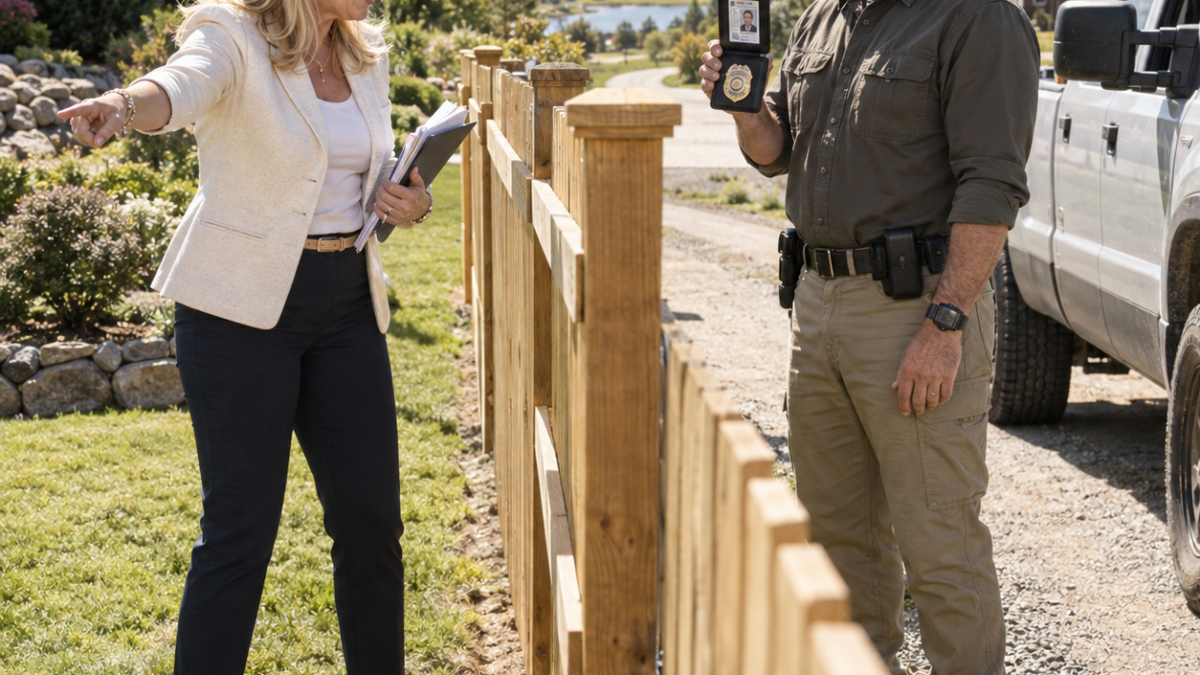
At exactly ten, I stepped out of my front door.
Karen looked confused.
I walked to the county vehicle that Tom had brought over earlier and parked at the curb.
My magnetic county inspection placard was mounted on the door.
I retrieved my clipboard.
When I turned around, Karen was staring at my shirt.
Then at my ID.
Then at the truck.
Her face changed slowly.
“Good morning,” I said.
She didn’t answer.
I walked toward the fence.
Finally she said, “Where’s the inspector?”
I stopped.
“I’m the assigned primary inspector.”
Her mouth opened.
Bob looked at Karen.
Carol looked at me.
Karen laughed.
It was too loud.
“No.”
“Yes.”
“You work for code enforcement?”
“I told you I was familiar with county requirements.”
“You never said—”
“You never asked.”
Her face drained of color.
“This is a conflict of interest.”
“Which is why my supervisor is conducting independent verification and signing the final determination.”
She stared at me.
“You can’t inspect your own property.”
“I can document measurements under our conflict procedure. I cannot independently close enforcement action involving myself. My supervisor will verify the findings.”
Karen pointed toward the street.
“I want another inspector.”
“You’re welcome to make that request.”
“I am making it.”
“Fine.”
I wrote it on the form.
She stared at my pen.
For the first time since I had met her, Karen had nothing to say.
I started measuring.
Fence height.
Six feet.
Setback.
Compliant.
Material.
Permitted cedar.
Visibility triangle.
Clear.
Gate.
Compliant.
Post placement.
Consistent with approved plan.
Permit number matched.
I photographed the fence.
Documented the measurements.
Then Tom arrived.
He stepped out of his own vehicle and introduced himself.
“Thomas Reeves, county compliance supervisor.”
Karen practically rushed toward him.
“Thank God. This man is abusing his office.”
Tom held up one hand.
“Ma’am, I’m here specifically to prevent that.”
He reviewed my measurements himself.
Measured the fence again.
Checked the plat.
Checked the permit.
Walked the property line.
Then he looked at Karen.
“The fence is compliant.”
She blinked.
“With county standards?”
“Yes.”
“What about the HOA?”
“We don’t enforce private covenants unless incorporated into a matter under our jurisdiction. But the recorded documents Mr. Johnson provided also appear consistent with the fence.”
Karen’s face turned red.
“He did this without architectural approval.”
Tom looked at her.
“That’s between your association and your attorney.”
“The county should order it removed.”
“We have no legal basis to do that.”
“I filed a complaint.”
“Yes.”
“And you found nothing?”
“We found a permitted fence.”
Someone laughed.
Quietly.
Across the street, Mr. Henderson stood on his porch.
Two other neighbors had emerged.
Karen heard them.
Humiliation was something she could not tolerate.
She pointed toward my house.
“What about the rest of the property?”
Tom frowned.
“What about it?”
“If you’re supposedly so committed to enforcement, inspect everything.”
I said nothing.
Tom looked at me.
Then at her.
“Are you requesting a broader visible-compliance review associated with your complaint?”
“Yes.”
Carol grabbed Karen’s arm.
“Karen.”
She shook her off.
“I want this entire area inspected. Every visible violation. Everything.”
Tom’s expression became very still.
“Every visible issue in the immediate complaint area?”
“Yes.”
Bob whispered, “Maybe we should—”
Karen turned on him.
“No. He wants rules? We’ll give him rules.”
I thought about Sarah’s warning.
Don’t become her.
So I stayed silent.
Tom took out another form.
“All right.”
That was the moment Karen’s own complaint stopped being about my fence.
We began on my property.
Tom checked the porch.
No issue.
Drainage.
No issue.
Accessory structures.
None.
Driveway.
Clear.
House numbers.
Compliant.
Then we moved to the public sidewalk.
Karen followed us.
Her confidence slowly returned.
Until Tom stopped in front of her roses.
He looked down.
Branches extended almost three feet into the required pedestrian clearance.
“Whose property?”
Nobody answered.
Tom checked the address.
Karen’s.
“These need to be trimmed.”
Her face tightened.
“Those roses have been there for years.”
“Then they’ve been obstructing the right-of-way for years.”
“They’re award-winning.”
“Congratulations.”
Mr. Henderson coughed to hide a laugh.
Tom continued.
From the sidewalk, the upper portion of Karen’s backyard shed was visible.
He checked our permit database on his tablet.
“No permit.”
Karen stepped forward.
“That was installed before your records were digitized.”
“Possible.”
She smiled.
“Exactly.”
“So we’ll check archived permits.”
Her smile disappeared.
Next came Bob’s garage.
Visible electrical work raised a legitimate safety concern.
Tom documented it for referral to building inspections.
Carol’s deck extension was visible from the street.
Another permit check.
Nothing immediately found.
Tom did not issue instant fines.
He did not grandstand.
He documented.
That mattered.
Because it wasn’t revenge.
It was procedure.
Karen had spent years using procedure as theater.
For the first time, she was watching what real procedure looked like.
Before leaving, Tom handed her a copy of the preliminary inspection record.
“My fence?” she demanded.
“Complaint unsupported.”
She stared at the words.
“And these?”
He pointed toward the additional entries.
“Those will be reviewed. If permits exist, cases close. If correction is required, property owners receive standard notice and appeal rights.”
Karen looked at me.
“This was planned.”
“No.”
“You knew this would happen.”
“I knew my fence was legal.”
“You set me up.”
I shook my head.
“You filed the complaint.”
Her hands trembled.
“You humiliated me.”
I glanced at the neighbors watching.
Then back at her.
“Karen, I asked you for weeks to show me the rule.”
She said nothing.
“I asked you privately.”
Nothing.
“I asked you in writing.”
Nothing.
“You threatened my home in public.”
Her mouth tightened.
“And then you called the county.”
I lowered my voice.
“You weren’t trapped because I was a county inspector. You were trapped because you never imagined the rules might apply to you too.”
She turned and walked away.
But the county inspection was only the first crack.
The real collapse began three days later.
Frank filed our petition for declaratory relief.
He also sent the HOA’s insurance carrier a preservation notice.
Then he demanded the complete association records:
Meeting minutes.
Voting records.
Covenant amendments.
Fine ledgers.
Architectural committee records.
Legal invoices.
Correspondence.
Bank statements connected with penalty collections.
Karen initially refused.
Frank sent another letter.
This one was shorter.
The records arrived.
And inside them was the document that changed everything.
The architectural approval language had first appeared in an internal board packet six years earlier.
No homeowner vote.
No recorded amendment.
No attorney opinion authorizing its enforcement.
Minutes from that year’s board meeting contained a line written in Karen’s own hand:
“Implement expanded ARC standards immediately. Formal membership amendment can be addressed later if needed.”
Later had never happened.
Yet the rule had been enforced for six years.
Homeowners had paid thousands in fines.
Some had altered or removed perfectly lawful improvements.
Some had incurred legal fees.
Mr. Henderson had torn down Martha’s retaining wall.
When Frank showed me the scanned meeting notes, I sat silent.
Sarah was beside me.
She read the sentence twice.
“Oh my God.”
Frank leaned back.
“This is what we needed.”
“Fraud?”
“Careful. Fraud has specific elements. We’ll plead what the evidence supports. But this is exceptionally damaging.”
I looked at Karen’s handwriting.
Formal membership amendment can be addressed later if needed.
She had known.
That changed my anger.
Before that moment, part of me had believed Karen genuinely thought she was protecting Oakmont.
Maybe she was arrogant.
Maybe rigid.
Maybe obsessed with control.
But perhaps she had convinced herself that she was enforcing legitimate standards.
The note erased that possibility.
She knew the rule had not been adopted.
She enforced it anyway.
I thought about Martha Henderson sitting by the window while her husband tore down the retaining wall.
I thought about Linda borrowing money to replace a temporary wheelchair ramp.
I thought about Mrs. Davis repainting a house she could barely afford to maintain.
I thought about Sarah sitting on our porch asking whether we should surrender because she couldn’t bear becoming hated in the place we had chosen as home.
Frank watched me.
“Mark.”
“What?”
“Don’t do anything.”
“I wasn’t planning to.”
“Your face says otherwise.”
“My face says I’m angry.”
“Be angry in here.”
He tapped the binder.
“Not out there.”
I nodded.
He was right.
Real justice is often less cinematic than revenge.
It happens through certified mail.
Recorded votes.
Court filings.
Insurance adjusters.
Discovery requests.
Audits.
People who finally decide to testify.
Karen had always relied on spectacle.
We were going to beat her with facts.
The recall petition circulated that weekend.
Oakmont’s bylaws allowed homeowners to demand a special meeting if enough members signed.
We needed thirty-eight signatures.
By Sunday night, we had fifty-seven.
By Monday, seventy-one.
People came to my door carrying old violation letters.
A father from the far end of the subdivision brought an envelope documenting $900 in fines because his daughter’s wheelchair-accessible van had been parked in the driveway.
A retired firefighter showed me warnings over a flagpole.
A young couple brought notices about a vegetable garden that Karen considered “visually inconsistent.”
One woman cried at our kitchen table.
Her name was Teresa.
She had cared for her mother during hospice.
Karen had repeatedly cited the portable medical ramp outside Teresa’s front entrance.
“I paid the fines,” she said, wiping her face. “I didn’t have time to fight. Mom was dying.”
Sarah moved beside her and wrapped an arm around her shoulders.
Teresa continued.
“The week after the funeral, Karen sent another violation because the ramp was still there.”
Nobody said anything.
Teresa looked at me.
“Take her off that board.”
I didn’t promise revenge.
I promised a vote.
The meeting was scheduled for a Thursday evening.
For the first time in Oakmont history, there weren’t enough chairs in the clubhouse.
People stood against the walls.
Others crowded near the doors.
Karen sat behind the board table with Bob and Carol.
She looked exhausted.
Her famous clipboard sat untouched.
When I entered with Sarah, conversations softened.
Karen watched us walk to the back row.
I intentionally did not sit near the front.
This wasn’t my meeting.
It belonged to the homeowners.
Karen tapped the microphone.
“I’m calling this unauthorized gathering—”
“It is authorized.”
Frank’s voice came from near the front.
Karen stopped.
He stood and identified himself as counsel for several members.
He handed the association’s attorney a document.
The attorney read it, then whispered to Karen.
Her face tightened.
Mr. Henderson had been nominated as temporary meeting moderator.
When he stood, the room became quiet.
He walked slowly.
Age had curved his shoulders, but his voice was steady.
“I’ve lived here twenty-seven years.”
Karen stared at him.
Mr. Henderson continued.
“My wife Martha and I were among the first families on our street.”
He looked around.
“This used to be a place where neighbors argued about whether the Fourth of July picnic needed one grill or two.”
A few people laughed.
“Then somewhere along the way, we stopped being neighbors.”
Silence.
“We became afraid of letters.”
He held up his old HOA file.
“Afraid of fines.”
Another pause.
“Afraid that disagreeing with the board would make us targets.”
Karen reached toward her microphone.
The association attorney touched her wrist.
She stopped.
Mr. Henderson pulled out one letter.
“Five years ago, my wife was receiving chemotherapy.”
His voice changed.
I saw Sarah reach for my hand.
“I built a little retaining wall beside our garden because Martha loved sitting near the roses.”
He swallowed.
“The board ordered me to tear it down because I had supposedly violated an architectural approval rule.”
He held up the certified covenants.
“That rule never legally existed.”
Someone whispered, “Jesus.”
Mr. Henderson’s eyes filled.
“I tore the wall down while my wife watched through the window.”
His voice cracked.
“She died four months later.”
The room was utterly still.
“For years, I blamed myself for not fighting.”
He looked toward Karen.
“I don’t anymore.”
Karen stared at the table.
One by one, homeowners spoke.
The Millers.
Mrs. Davis.
Linda.
Teresa.
A dozen others.
Nobody screamed.
Nobody threatened.
That made it more powerful.
Karen had always won by making people feel emotional and isolated.
Now their stories were calm.
Documented.
Shared.
Finally Karen stood.
“I have served this community for eight years.”
Her voice shook.
“Every decision I made was made to preserve property values and neighborhood standards.”
Someone shouted, “By lying?”
The moderator raised his hand.
“Let her speak.”
Karen looked around.
“You may not like my methods, but Oakmont has remained one of the most desirable communities in the county.”
I saw several people shaking their heads.
She continued.
“Do you think that happens accidentally? Do you think neighborhoods remain attractive when everyone is allowed to do whatever they want?”
“No,” I said.
Every head turned.
I hadn’t planned to speak.
Karen looked at me.
I stood.
“No one is asking for a community without rules.”
I walked toward the front.
“We’re asking for rules that actually exist.”
Karen’s lips tightened.
“We’re asking for rules applied equally.”
I looked around the room.
“For notices that tell the truth.”
Then I looked at her.
“For boards that understand they work for homeowners. Homeowners do not work for them.”
Applause began.
I raised a hand.
It stopped.
“This isn’t about humiliating Karen.”
She laughed bitterly.
“Could’ve fooled me.”
“It isn’t.”
I meant it.
“Humiliation disappears. Systems remain.”
I turned toward everyone.
“If all we do tonight is replace one bully with another, nothing changes.”
Mr. Henderson nodded slowly.
“So whatever happens with this vote, rewrite the procedures. Require recorded authority for enforcement. Require hearings. Require conflicts to be disclosed. Publish minutes. Audit fines. Give homeowners an appeal process.”
Then I looked at Karen again.
“The answer to abusive power isn’t different abusive power.”
Sarah’s hand covered her mouth.
Later she told me that was when she knew I had kept my promise.
I hadn’t become Karen.
The vote began.
Paper ballots.
Verified homeowners.
Independent count.
Karen sat motionless.
Bob whispered repeatedly to the HOA attorney.
Carol cried silently.
Twenty minutes later, Mr. Henderson received the result.
He looked down.
Then up.
“Total eligible votes cast: ninety-two.”
Nobody moved.
“Votes in favor of recalling President Karen Peterson: eighty-seven.”
A sound moved through the clubhouse.
Not cheering at first.
Relief.
“Votes opposed: five.”
Karen closed her eyes.
Mr. Henderson continued.
“The recall passes.”
Bob was recalled eighty-four to eight.
Carol eighty-one to eleven.
Karen opened her eyes.
She looked smaller.
For years I had imagined people like her were fueled by confidence.
That night I understood something different.
Some people control everything around them because without control, they do not know who they are.
Karen packed her papers.
Nobody stopped her.
Nobody mocked her.
That seemed to hurt more.
At the door she turned toward me.
“This is what you wanted.”
“No.”
“You expect me to believe that?”
“I wanted my fence left alone.”
She stared at me.
“All this happened because you couldn’t fill out one simple form.”
I shook my head.
“No, Karen.”
I looked at the room behind us.
“All this happened because you couldn’t hear the word no.”
She left.
The interim board took office that night.
Mr. Henderson reluctantly agreed to serve as president until elections could be held.
His first proposal was simple.
Independent legal review of every fine issued under the unrecorded architectural rule.
Passed unanimously.
Second proposal.
No enforcement notice could be issued without citation to the exact governing provision.
Passed unanimously.
Third.
All board meetings open except sessions legally requiring confidentiality.
Passed.
Fourth.
A homeowner appeals panel would include at least one resident who was not a board member.
Passed.
The neighborhood changed faster than I expected.
Not physically.
Oakmont still had the same streets.
Same houses.
Same park.
But people began standing outside longer.
They talked.
Children returned to playing basketball in driveways.
Henderson rebuilt his retaining wall.
The first Saturday he worked on it, I walked over carrying two bags of concrete.
He stared at them.
“What’s that?”
“You look old.”
“Get off my property.”
“Need help?”
He looked toward the roses.
For a second his eyes became distant.
Then he nodded.
We spent the morning rebuilding the wall.
Not exactly as it had been.
Better.
Sarah brought lemonade.
Duke lay in the shade watching us.
When the last stone went into place, Henderson ran his hand across the top.
“Martha would’ve liked this.”
I didn’t say anything.
Some moments don’t need words.
The county cases triggered by Karen’s complaint continued separately.
Archived records confirmed she had never permitted the shed.
She applied retroactively.
Inspection found foundation and setback issues.
Rather than bring it into compliance, she chose removal.
One Monday morning, a contractor dismantled it.
I watched only briefly from my driveway.
There was no satisfaction in the shed coming down.
The satisfying part was simpler.
Karen received notice.
Karen received evidence.
Karen received time to respond.
Karen received appeal rights.
Everything she had denied others.
Her roses were trimmed back to restore sidewalk clearance.
Bob’s garage wiring required correction by a licensed electrician.
Carol’s deck required engineering review and modifications.
They were not destroyed.
They were not ambushed.
They were treated like everyone else.
That was enough.
The civil dispute took longer.
Lawyers negotiated.
The association’s insurer became involved.
The independent review identified dozens of fines based wholly or partly on the unrecorded rule.
Some money could be refunded directly.
Some cases involved improvements homeowners had already removed, which made compensation more complicated.
Eventually a settlement was reached.
The HOA agreed to void unpaid fines tied to the invalid provision.
Affected homeowners received reimbursement from available association and insurance funds according to documented losses.
The board issued written corrections to property files.
Most importantly, the settlement required governance reforms.
No invented amendments.
No selective private versions of covenants.
No fines without written authority.
Karen personally did not walk away untouched.
Claims against her were resolved under confidential terms, but she resigned from every remaining committee position and agreed she had no authority to represent the association.
She also had to live with something money could not fix.
Everyone knew.
Not rumors.
Not gossip.
Records.
People she had intimidated for years could finally see the machinery behind the illusion.
She had never been a queen.
She had been a volunteer board president whose power existed only because people believed resistance was impossible.
A month after the recall, I saw her at the grocery store.
I was standing near the produce section examining avocados when I heard a cart stop behind me.
“Mark.”
I turned.
Karen looked tired.
No clipboard.
No board badge.
No entourage.
Just Karen.
“You happy now?”
I placed one avocado in my basket.
“About what?”
“Don’t do that.”
“Do what?”
“Pretend you don’t know.”
Her voice lowered.
“My friends won’t speak to me.”
I said nothing.
“Carol blames me.”
Still nothing.
“Bob is selling his house.”
I waited.
“My name is a joke in the neighborhood.”
I looked at her.
“You think I wanted that?”
“Yes.”
She answered instantly.
“You planned everything.”
“No.”
“You let me call the county.”
“I told you my fence was compliant.”
“You knew who they’d send.”
“I knew the complaint would be handled under department procedure.”
Her eyes filled with anger.
“You could have stopped me.”
That almost made me laugh.
But I didn’t.
“Karen, I tried.”
She stared at me.
“I asked you to show me the rule.”
Silence.
“I gave you the permit.”
Silence.
“My lawyer told you the provision wasn’t recorded.”
She looked away.
“You had every opportunity to stop.”
Her voice became quieter.
“You wanted me embarrassed.”
I thought about that.
There had been a moment when I did.
The morning I put on my county polo, part of me had wanted to see her face when she realized who I was.
I’d be lying if I claimed otherwise.
But revenge had stopped mattering somewhere between Henderson’s file and Teresa’s tears.
“I wanted you accountable.”
“Same thing.”
“No.”
I shook my head.
“Embarrassment is people laughing at you. Accountability is having to answer for what you did.”
Her expression hardened.
“You ruined everything I built.”
I looked around the grocery store.
A child begged his father for cereal.
Someone dropped a jar two aisles over.
A woman compared tomatoes.
Ordinary life.
“No,” I said.
“You built something that could only survive while everyone was afraid.”
I picked up another avocado.
“When they stopped being afraid, it collapsed.”
Karen’s eyes went wet.
For one brief second, I saw something behind the anger.
Loneliness.
Maybe fear.
Maybe regret.
I didn’t know.
I didn’t ask.
She whispered, “I was trying to keep the neighborhood from turning into a mess.”
“Maybe you believed that once.”
She looked at me.
“But somewhere along the way, keeping the neighborhood nice became keeping everyone obedient.”
Her shoulders dropped.
I turned my cart.
Before leaving, I stopped.
“For what it’s worth, Karen, none of this had to happen.”
She looked at me.
“You could have knocked on my door and said you didn’t like my fence.”
Her mouth trembled.
“We could have disagreed.”
I nodded toward the imaginary clipboard she no longer carried.
“You chose everything after that.”
I walked away.
I never had another real conversation with her.
Six months later, Bob moved.
Carol followed a few months after him.
Karen stayed almost a year.
Her house became quiet.
No board meetings.
No neighbors stopping by.
No clipboard patrols.
One spring morning, a FOR SALE sign appeared in her front yard.
Sarah saw it first.
She came into the kitchen carrying coffee.
“Look.”
I glanced through the window.
There it was.
I expected some rush of victory.
I felt almost nothing.
“She leaving?” Sarah asked.
“Looks like it.”
“Does that make you happy?”
I thought about the question.
“No.”
She smiled.
“Good.”
“Why good?”
“Because a year ago it would’ve.”
She was right.
A month later, a moving truck arrived.
Karen supervised quietly.
At one point she stood in her driveway looking toward our house.
I was outside with Duke.
Our fence remained behind me.
Same cedar.
Weathered slightly now.
Still straight.
Still legal.
Duke had changed more than the fence.
He no longer flinched at every car door.
He had gained weight.
His coat was thick and glossy.
Most evenings he slept beneath the maple tree.
Sometimes he chased squirrels with the seriousness of a police operation.
That morning he sat beside me watching the movers.
Karen looked at him.
Then at me.
I raised one hand.
Not triumphantly.
Just goodbye.
After a moment, she nodded.
Then she got into her car and left Oakmont Estates.
I thought that would be the ending.
It wasn’t.
The real ending came several weeks later.
Mr. Henderson proposed a neighborhood barbecue.
Not an HOA event.
A neighborhood event.
The distinction mattered.
Everyone brought something.
No committees.
No approved decorations.
No clipboard.
We held it in the same park where Karen had publicly threatened me.
The difference was almost surreal.
Children ran through the grass.
Somebody played music.
Two grills smoked beneath the trees.
Linda’s mother had passed months earlier, but Linda brought her nieces.
The Millers installed another play structure in their backyard—a compliant one—and nobody demanded they remove it.
Mrs. Davis had repainted her front door bright blue.
It complied with the new published guidelines.
She told me she chose the color because Karen would’ve hated it.
Sarah laughed so hard she nearly spilled her drink.
I was at the grill when Mr. Henderson walked over carrying two beers.
He handed me one.
“I’ve been thinking.”
“Dangerous.”
“Shut up.”
I smiled.
He looked around the park.
“You know what changed?”
“The HOA president?”
“No.”
He pointed toward a group of neighbors talking under a tree.
“That.”
I followed his finger.
People who had lived within two hundred feet of one another for years were behaving like neighbors for the first time.
Henderson said, “Karen didn’t just control rules.”
He took a drink.
“She kept everybody suspicious of everybody else.”
I nodded.
“If I complained, you might report me. If you complained, somebody might tell the board. So everyone stayed quiet.”
“And isolated.”
“Exactly.”
Duke ran past us chasing a Frisbee thrown by one of the Miller kids.
Henderson watched him.
“All because of that dog.”
I laughed.
“He’d take credit.”
Sarah walked over.
She slipped one arm around my waist.
“You two solving civilization?”
“We’re drinking beer.”
“So no.”
“Correct.”
She rested her head against my shoulder.
Across the park, someone called for Henderson.
“President!”
He grimaced.
“I hate when they call me that.”
“You wanted the job.”
“I absolutely did not.”
He started away, then turned.
“Mark?”
“Yeah?”
“Thank you.”
I knew what he meant.
I also knew the truth.
“You gave me the file.”
He smiled.
“You knocked on the door.”
Then he walked away.
Sarah watched him go.
“You know,” she said, “I was wrong.”
That got my attention.
“What?”
“Say it again.”
“No.”
“Please.”
She elbowed me.
“I thought fighting Karen would destroy the reason we moved here.”
She looked across the park.
“It almost did.”
“I know.”
“But giving in would’ve been worse.”
I put an arm around her.
“Probably.”
“You’re supposed to say I was right to be afraid.”
“You were right to be afraid.”
“And?”
“And I was right about the fence.”
She sighed.
“There he is.”
I laughed.
Then Duke returned carrying the Frisbee.
He dropped it at Sarah’s feet.
She threw it.
He sprinted across the grass.
For a moment, I remembered the dog we had brought home from the shelter.
Terrified of doors.
Terrified of engines.
Terrified of sudden movement.
The first night, he had slept behind our couch because the open room made him nervous.
The fence had been for him.
That simple fact almost seemed ridiculous now.
Six cedar feet.
A backyard boundary.
Something I built so a frightened dog could learn what safety felt like.
Karen saw it as defiance.
I saw it as protection.
Maybe that’s why neither of us ever understood the other.
To her, boundaries were about control.
To me, the right boundary created freedom.
Inside that fence, Duke learned he could run without being chased.
Sarah planted tomatoes.
We put two chairs beneath the maple tree.
On summer nights, I could sit there and hear laughter from houses where people had once closed their blinds when Karen walked by.
The county complaint had been closed permanently.
My permit remained valid.
The civil case was resolved.
The refunds were issued.
The fake architectural paragraph was removed from every HOA packet.
A lawyer redrafted the rules in plain language.
Homeowners voted on the changes.
They were properly recorded.
For the first time in years, everyone knew exactly what the rules were.
More importantly, everyone knew who the rules belonged to.
All of us.
Not one person.
I kept the original violation notice.
Sarah asked me once why I didn’t throw it away.
It sat in a folder in my desk beside the certified covenant copies.
“You keeping trophies now?” she asked.
“No.”
“Then why save it?”
I thought for a moment.
“Reminder.”
“Of Karen?”
“No.”
I looked through the window at Duke asleep in the yard.
“Of how small these things look at the beginning.”
A letter.
A hundred-dollar fine.
A woman with a clipboard.
It would have been easy to pay.
Easy to remove the fence.
Easy to tell ourselves peace was worth more than principle.
And sometimes, honestly, it is.
Not every disagreement deserves a war.
Not every petty rule deserves months of your life.
But there are moments when giving in doesn’t end the problem.
It teaches the problem where your boundary is.
Karen believed mine could be moved with enough fines, enough shame, enough threats.
She was wrong.
Not because I was tougher than she was.
Not because I had been a Marine.
Not even because I happened to work for the county office she foolishly called.
She was wrong because the authority she claimed was never hers to begin with.
The county badge didn’t defeat her.
The lawyer didn’t defeat her.
The recall vote didn’t defeat her.
The neighbors stopped being afraid.
That defeated her.
A year after the barbecue, Mr. Henderson completed the garden beside his rebuilt retaining wall.
He planted Martha’s favorite roses.
On the anniversary of her death, he invited Sarah and me over.
There was no big ceremony.
Just the three of us standing beside the flowers.
Henderson touched one pale pink bloom.
“She wanted this wall.”
His voice was quiet.
“Not because it was special.”
He smiled faintly.
“She just liked sitting here.”
I looked at the stones we had laid together.
“Then it belongs here.”
He nodded.
Duke wandered over and sat beside him.
Henderson scratched behind his ears.
“You caused a lot of trouble, didn’t you?”
Duke wagged his tail.
“Absolutely no remorse.”
Sarah laughed.
And standing there, I finally understood what I considered the real victory.
It wasn’t Karen losing her title.
It wasn’t seeing her unpermitted shed removed.
It wasn’t the fines reversed or the settlement checks or the county determination proving my fence legal.
It was an old man getting his garden back.
It was Linda learning she could question a board letter without risking her home.
It was Teresa no longer feeling ashamed for having needed a medical ramp while caring for her dying mother.
It was the Millers’ children playing outside.
It was Sarah feeling comfortable enough to walk through Oakmont without wondering who was judging us.
It was Duke asleep under a tree.
Months earlier, Karen had stood on my lawn and told me she would tear my fence down by Friday.
She had been so certain.
Certain of her authority.
Certain of everyone else’s fear.
Certain that one more threat would make me bend.
Instead, she called code enforcement.
And she discovered something that changed Oakmont forever.
The man whose fence she wanted condemned wasn’t afraid of the rulebook.
He spent every working day inside it.
But even that wasn’t the lesson that mattered.
The lesson was simpler.
A rule deserves respect when it is lawful, clear, and applied fairly.
Power deserves scrutiny when someone uses it to make other people smaller.
And a community stops belonging to a bully the moment ordinary people realize they are allowed to stand beside one another.
My fence still stands today.
The cedar has faded from honey brown to soft gray.
There are scratches near the gate where Duke gets excited when the neighborhood kids visit.
Sarah’s tomatoes grow along one section every summer.
Sometimes I notice the fence when I’m mowing.
Most days I don’t.
It’s just part of the house now.
But every so often I remember Karen standing beside it with her clipboard.
I remember her promising to bring the full force of county government down on me.
And I remember the look on her face when I walked out of my own front door wearing my county ID.
That part still makes me smile.
Not because she lost.
Because everyone else finally realized they didn’t have to.
And that was worth every letter, every sleepless night, every meeting, and every single cedar board.








