PART 2: HOA Karen Called 911 While I Changed My Own Locks—Then the Officers Recognized Me
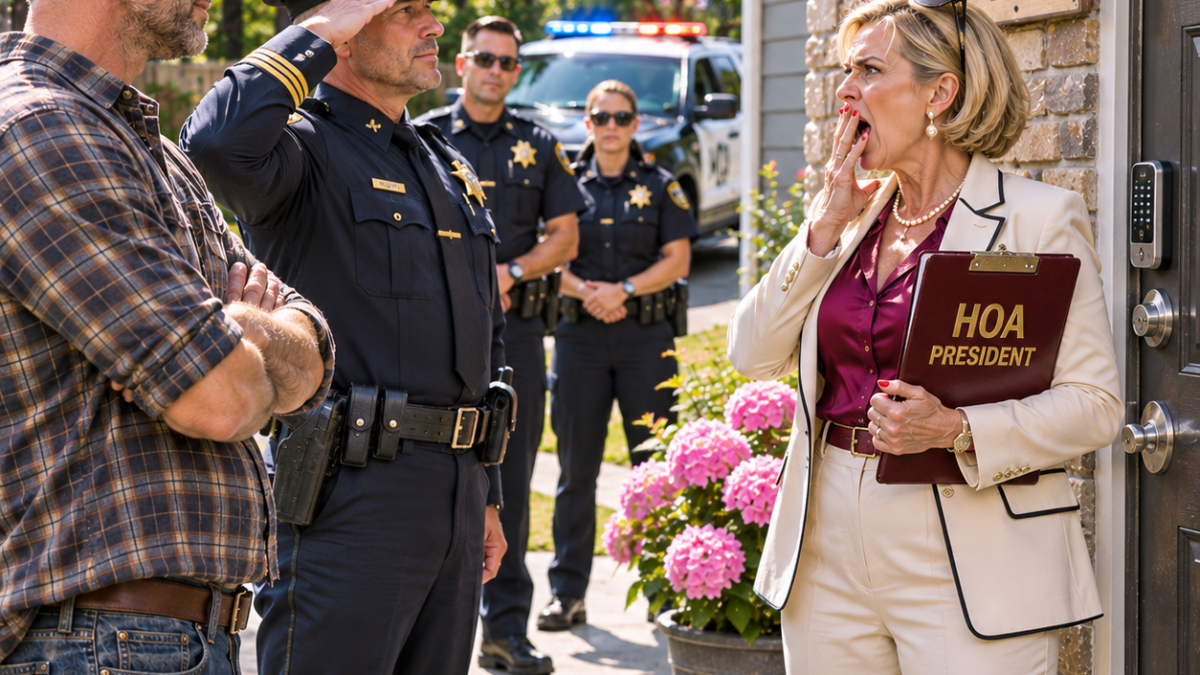
The first thing I heard when I stepped onto my own porch carrying a bag of brand-new locks was my HOA president screaming into her phone that a dangerous stranger was breaking into the house across from hers.
What Karen Whitmore didn’t mention was that I was the homeowner, the only reason I was changing those locks was because she had already entered my house without permission while I was out of town, and I had security footage of her photographing documents inside my private office.
By the time the police cars turned onto Maplewood Drive, Karen was standing at the end of my driveway smiling like she had finally caught me doing something wrong, completely unaware that the next few minutes were going to expose far more than she intended.
My name is James Carter.
Three months earlier, I had moved into Maplewood Estates because I wanted something I had almost forgotten how to enjoy.
Quiet.
I had spent twenty years in federal service, most of them with the U.S. Marshals, eventually serving in senior operational leadership before retiring and taking occasional consulting work with Homeland Security.
After years of fugitives, warrants, tactical briefings, airports, hotel rooms, and phones ringing at two in the morning, suburban boredom sounded wonderful.
Maplewood looked designed for it.
Trimmed lawns.
Matching mailboxes.
Clean sidewalks.
Trees spaced almost perfectly along the road.
Then I met Karen Whitmore.
She appeared while the moving truck was still in my driveway, wearing a lavender blazer, pearl earrings, and sunglasses resting on top of her hair.
A clipboard was pressed against her chest.
“Mr…?”
“Carter.”
She checked something.
“James Carter?”
“That’s me.”
She gave me the kind of smile people use when they already assume they’re in charge.
“Welcome to Maplewood Estates. I’m Karen Whitmore, HOA president.”
“Nice to meet you.”
“You’ll receive our guidelines tomorrow.”
I did.
All fifty pages.
Rules covered everything from mailbox colors to porch-light temperature, grass height, garbage-bin visibility, curtain opacity, driveway parking, and what counted as an “excessive seasonal decoration.”
My first violation arrived four days later.
My trash cans had remained visible six minutes too long after collection.
Six minutes.
The next notice complained that my porch bulb was too warm.
Then came one about my American flag being larger than “preferred proportional standards.”
I laughed at all three.
Karen didn’t.
Every notice carried her name in bold.
KAREN WHITMORE
HOA PRESIDENT
I began noticing her watching the house.
Sometimes through her blinds.
Sometimes from the sidewalk.
Once I found her crouched near my mailbox taking a photograph.
“What are you doing?”
She jumped.
“Documenting landscaping concerns.”
“My mailbox is landscaping?”
She straightened.
“You’re still learning our procedures.”
That became her favorite sentence.
Then I left for a three-day security seminar in Washington.
When I returned, the back door was slightly open.
I stopped before crossing the threshold.
Twenty years of training came back instantly.
The house was quiet.
Nothing obviously missing.
But a dining chair had moved.
Mud marked the hallway.
And there was a faint smell of lavender perfume.
I checked the security system.
At 2:13 Thursday afternoon, my back gate opened.
Karen walked in.
Beside her was a maintenance worker I recognized from the neighborhood.
They did not knock.
Karen used a key.
They entered through the back door.
For the next eleven minutes, my cameras recorded her walking through my kitchen, inspecting my thermostat, opening cabinets, looking inside the refrigerator, and finally entering my office.
That was where my anger changed.
Karen picked up my mail.
She moved papers on my desk.
Then she photographed documents related to the property.
I watched the video twice.
Then once more.
I did not march across the street.
I did not yell.
Experience had taught me something Karen apparently never learned.
When someone abuses authority, anger gives them a story.
Evidence takes their story away.
I copied every file.
Saved the originals.
Sent them to my attorney.
And the next morning, I called a locksmith named Roy.
He arrived at two.
Karen appeared at two-oh-seven.
“What is going on?”
“Changing my locks.”
“You can’t do that without architectural approval.”
I stared at her.
“I need your permission to secure my own house?”
“All exterior modifications require—”
“Like the contractor you brought inside while I was in Washington?”
Her face changed.
Only for a second.
Then she recovered.
“I have no idea what you’re talking about.”
“Good. Then this should be an interesting afternoon.”
She walked away.
Five minutes later, I heard her voice from across the street.
“Yes, officer. There’s a man breaking into the house. I don’t believe he lives there.”
Roy stopped working.
I didn’t.
Then the sirens started getting closer.
PART 2
Roy stared at me with the screwdriver still in his hand.
“You want me to stop?”
“No.”
“Police are coming.”
“I heard them.”
“And she told them you’re burglarizing your own house.”
“Apparently.”
He looked toward Karen.
She was standing beside her driveway with one hand on her hip and the phone pressed dramatically to her ear.
Neighbors were already beginning to notice.
Curtains moved.
A garage door opened.
An older man across the street stepped onto his porch holding a newspaper he clearly wasn’t reading.
Roy lowered his voice.
“You seem weirdly calm about this.”
“I’ve had worse afternoons.”
“What kind of afternoons?”
“Long story.”
The first cruiser turned onto Maplewood Drive.
Then another.
Karen walked toward them before they had fully stopped.
“There!” she shouted.
She pointed straight at me.
“That’s him!”
I remained beside the porch.
Roy slowly placed his tools on the step.
The officers got out.
Both looked alert.
Professional.
Not panicked.
That told me Karen had probably exaggerated, but the dispatcher hadn’t classified me as an immediate armed threat.
Good.
The older officer held up a hand.
“Sir?”
“Yes.”
“We received a report of a possible burglary in progress.”
“I know.”
Karen rushed closer.
“He doesn’t belong there. He showed up with some worker and started changing the locks.”
I looked at her.
“Some worker?”
Roy raised a hand awkwardly.
“Licensed locksmith.”
Karen ignored him.
The officer looked toward me.
“Can we see identification?”
“Of course.”
I moved slowly.
Not because I was nervous.
Because I knew exactly how much a routine call could change when people made sudden movements.
I reached into my jacket and removed my wallet.
Before I handed over my driver’s license, the younger officer looked at the badge case beside it.
His eyes narrowed.
Then widened.
“Sir?”
I opened it.
The insignia was old now, carried more from habit than need.
The younger officer straightened immediately.
“Deputy Director Carter?”
Karen stopped talking.
I gave the officer a small smile.
“Former Deputy Director.”
The older officer studied me for another second.
Recognition crossed his face too.
Then both officers straightened and gave a brief professional salute.
“Sir.”
I returned it almost automatically.
Karen’s face went completely blank.
Not angry.
Not embarrassed.
Blank.
It was the first time I had ever seen her without a prepared expression.
Roy whispered behind me.
“Oh, this is unbelievable.”
Karen finally found her voice.
“What are you doing?”
The younger officer lowered his hand.
“Ma’am?”
“I called about him.”
“Yes.”
“He’s breaking into that house.”
I handed over my license.
The address matched.
The officer looked at the house number.
Then at me.
Then at Karen.
“This is his residence.”
Karen blinked.
“That can’t be right.”
I laughed.
“You’ve sent me seven violation letters here.”
“That doesn’t mean—”
“You personally delivered two.”
She looked toward the neighbors.
Too late.
People were watching now.
Some openly.
Others through windows.
The older officer said, “Mrs. Whitmore, did you verify who owns the property before reporting a burglary?”
“I had reason to believe something suspicious was happening.”
“What reason?”
“He was changing locks.”
The officer waited.
Karen seemed not to understand why that answer wasn’t enough.
“He didn’t request HOA approval.”
The younger officer glanced at the locksmith.
Roy raised both hands.
“I’m literally replacing deadbolts.”
The officer almost smiled.
I decided it was time.
“There’s another reason I’m changing them.”
Karen turned toward me.
“James.”
It was the first time she had used my first name.
I took out my phone.
“Last Thursday, while I was in Washington, someone entered my home.”
Karen’s face tightened.
The older officer became serious.
“You reported that?”
“My attorney has the footage. I intended to make a formal report today after the locks were secured.”
Karen stepped forward.
“This has nothing to do with—”
“It has everything to do with this.”
I opened the video.
The first frame showed the backyard.
Timestamp.
2:13 p.m.
Karen entered through the gate.
The younger officer watched.
Then the older one.
Karen’s voice sharpened.
“That footage was taken without my consent.”
Nobody answered.
The video continued.
Karen opened my back door.
Entered.
The maintenance worker followed.
The officers watched her move through my kitchen.
Open cabinets.
Look in the refrigerator.
Then enter my office.
Her hand reached toward the papers on my desk.
The camera caught the flash from her phone.
The younger officer slowly looked at her.
Karen’s face had gone pale.
“I was conducting an inspection.”
The older officer looked back at the screen.
“Inside the refrigerator?”
“It was a compliance matter.”
“What compliance issue requires accessing his refrigerator?”
She hesitated.
“Energy usage.”
I stared at her.
That was new.
The officer did not look impressed.
“And his private papers?”
“I was documenting property records.”
“Why?”
“Because the HOA has authority to—”
“No,” I said.
Karen turned.
“No what?”
“No, you don’t.”
“I absolutely do.”
“Show me the bylaw permitting warrantless entry into a homeowner’s residence.”
“This isn’t federal enforcement, James.”
“That is the first correct thing you’ve said.”
A few neighbors laughed.
Karen spun toward them.
“This is not funny.”
The older officer raised a hand.
“Ma’am, calm down.”
“I am calm.”
“You’re shouting.”
“I’m being targeted.”
I took my coffee from the porch railing.
“By the consequences of entering my house?”
Her eyes flashed.
“You don’t understand how this community operates.”
The younger officer glanced at me.
I could almost see the thought.
There it is.
Every officer who works long enough learns to recognize the moment a dispute stops being about facts and becomes about someone’s need to control the story.
Karen continued.
“I have a responsibility to protect property values.”
“By entering homes?”
“The HOA has inspection authority.”
“Outside,” I said.
She ignored me.
The older officer asked, “Did Mr. Carter give you permission to enter?”
“I didn’t need his permission.”
“Did he give it?”
“No.”
“Did anyone living here give it?”
“No.”
“Was there an emergency?”
“No, but—”
He wrote something in his notebook.
Karen noticed.
“What are you writing?”
“My report.”
“I’m the complainant.”
“For the burglary call.”
“Yes.”
“And now we’re documenting additional information.”
Her mouth tightened.
“About me?”
“Yes.”
That word hit her hard.
I almost felt sorry for her.
Almost.
Then she pointed at Roy.
“He’s still modifying the property.”
The older officer looked at Roy.
“You licensed?”
“Yes, sir.”
“Homeowner hired you?”
“Yes.”
“Continue.”
Roy picked up his screwdriver.
Karen made a sound of disbelief.
“You can’t authorize that.”
The officer looked at her.
“Ma’am, I’m not authorizing his lock. I’m telling his contractor that we don’t have a law-enforcement reason to stop him.”
“This is HOA jurisdiction.”
“Then deal with it through your civil procedures.”
“I am.”
“Not through 911.”
The street had become completely quiet.
The older officer continued.
“Emergency resources aren’t for architecture disputes.”
“I reported a burglary.”
“After failing to confirm that the person standing at the home was the homeowner.”
“I believed he was dangerous.”
I looked down at my coffee mug.
Then at the bag of locks.
Then back at Karen.
“What exactly was dangerous?”
Her face flushed.
“Your behavior.”
“I was drinking coffee.”
“You were hostile.”
“I wasn’t speaking to you.”
“You challenged my authority yesterday.”
“There it is.”
The younger officer looked away, hiding a smile.
Karen heard the neighbors whispering.
She turned.
Frank—the older man with the newspaper—was now standing at the edge of his lawn.
He called over.
“Karen, you sent me three notices last year for parking my own truck in my own driveway. You definitely know homeowners are allowed to use their houses.”
More laughter.
Karen glared at him.
“This doesn’t concern you.”
Frank folded his newspaper.
“You made it concern the whole street when you called two police cars.”
The balance shifted right there.
Before that moment, Karen had been the authority figure.
Not legally.
Socially.
She wrote letters.
Ran meetings.
Interpreted rules.
People complained privately but obeyed publicly.
Now everyone had watched her call the police on a homeowner for securing his own house.
And the police themselves were telling her she was wrong.
That kind of authority rarely survives public daylight.
The older officer handed back my identification.
“We’ll need your statement about the unauthorized entry.”
“Of course.”
“Original video too.”
“You’ll have it.”
Karen stepped forward.
“Wait. He’s pressing charges?”
I looked at her.
“I haven’t decided.”
The officer said nothing.
Karen’s voice softened.
“James.”
Interesting.
Suddenly I wasn’t Mr. Carter.
“I think we’re letting a misunderstanding become something larger.”
“A misunderstanding?”
“The inspection.”
“You entered my home.”
“I was concerned about compliance.”
“You photographed documents.”
“I thought they related to the property.”
“You opened my refrigerator.”
She closed her mouth.
Roy made a noise that sounded suspiciously like a cough hiding laughter.
Karen turned toward the officers.
“This is harassment.”
The older officer’s expression hardened.
“Mrs. Whitmore, nobody is detaining you.”
“I feel threatened.”
“Then return to your residence.”
“I’m allowed to stand here.”
“You are. But if you continue interfering with an active investigation, we’re going to have a different conversation.”
That finally moved her.
She stared at me.
“You’ll regret embarrassing me.”
The older officer looked up from his notes.
“Ma’am.”
Karen stopped.
He had heard it.
So had everyone else.
She turned and walked across the street.
Duchess, her tiny Pomeranian, began barking from behind the window as if personally offended by the collapse of local government.
When Karen reached her porch, she turned back once.
Her eyes met mine.
No smile.
No clipboard raised like a shield.
Just anger.
Then she went inside.
The officers remained another fifteen minutes.
I gave them copies of the footage.
The older one introduced himself as Sergeant Daniels.
The younger officer was Mason Reed.
Daniels looked toward Karen’s closed curtains.
“You get a lot of this?”
“Only since moving here.”
“You know her history?”
“No.”
Frank answered from his lawn.
“We do.”
Daniels looked at him.
Frank walked closer.
“She’s been running this place like her private county for years.”
“Any previous entries into homes?”
Frank hesitated.
“I don’t know about inside.”
A woman farther down the street said, “She used my spare garage code once.”
Everyone turned.
Her name was Linda Moreno.
Karen had apparently been given the code years earlier when Linda’s husband was in the hospital.
“I changed it later,” Linda said. “She got angry.”
Daniels looked at me.
“Sounds like you should talk to your HOA board.”
“I plan to.”
“And your attorney.”
“Already have.”
He smiled faintly.
“Of course you have.”
Before leaving, Reed looked at my mug.
WORLD’S MOST PATIENT MAN.
“Gift?”
“My daughter.”
“Accurate?”
“Depends who you ask.”
He looked toward Karen’s house.
“Today, probably.”
They left.
The second the cruisers turned the corner, Roy stopped pretending professionalism.
He leaned against his truck laughing so hard he had to wipe his eyes.
“You let me stand here changing locks while the president of your HOA called the police on a former deputy director of the Marshals.”
“I didn’t let you. You chose a career.”
“You could have warned me.”
“Would you have believed me?”
“No.”
“Exactly.”
He pointed his screwdriver toward Karen’s house.
“She’s going to come back.”
“I know.”
“How do you know?”
“Humiliation makes certain people reflect.”
He waited.
“And?”
“Others retaliate.”
Roy nodded slowly.
“You think she’s the second kind.”
I looked at her curtains.
“Yes.”
I was right.
Less than an hour after the locksmith left, a courier delivered an HOA notice.
UNAUTHORIZED SECURITY ALTERATION.
Failure to obtain architectural approval before modification of visible exterior hardware.
Potential fine: five hundred dollars per occurrence.
I read the letter twice.
Then laughed.
The police were barely gone.
Karen had already transformed her embarrassment into paperwork.
I scanned the notice.
Sent it to my attorney, Rebecca Sloan.
She called ten minutes later.
“James.”
“Yes.”
“Please tell me this woman did not enter your house without permission, call 911 when you changed the locks, and then fine you for changing them.”
“That’s the condensed version.”
Rebecca was silent.
Then I heard her laugh.
“I’m sorry.”
“No, you’re not.”
“Not remotely.”
“What do you recommend?”
“Do not communicate with her verbally unless necessary.”
“Agreed.”
“Preserve every HOA notice.”
“Done.”
“Save all camera footage.”
“Done.”
“Request the complete bylaws and inspection policies.”
“Already have them.”
Another pause.
“You were probably unbearable at work.”
“I was efficient.”
“That’s lawyer language for unbearable.”
“What about the fine?”
“Don’t pay it yet. Appeal formally.”
“That will go to Karen.”
“Good.”
“Good?”
“I want her answer in writing.”
That was why I liked Rebecca.
She understood the difference between conflict and evidence.
By nine that evening, I had submitted the appeal.
The next morning, a white envelope appeared in my mailbox.
No postage.
HOA summons.
I was ordered to appear within forty-eight hours to address:
Unauthorized property modification.
Hostile conduct toward an HOA officer.
Improper use of law enforcement personnel.
Conduct damaging community harmony.
I read the third item three times.
Improper use of law enforcement personnel.
She had called them.
Now I was being accused of using them.
I forwarded the summons to Rebecca.
Her response:
Please attend.
Bring everything.
Do not rescue her from herself.
The neighborhood group chat had already exploded.
Someone had recorded part of the police encounter.
The clip showed Karen pointing at me.
Then the officers recognizing me.
Then the salute.
I hated that part becoming entertainment.
My old career was not a magic trick.
I did not want neighbors treating me like I had won because of a badge.
The important fact was simpler.
I owned the house.
Even if I had been an accountant, mechanic, teacher, or unemployed man changing his own deadbolt, Karen would still have been wrong.
That mattered.
So when Frank knocked on my door and said, “Man, you should’ve seen the video,” I told him exactly that.
“This isn’t about who I used to be.”
“Sure looked cool.”
“Frank.”
“Fine.”
“It matters.”
He studied me.
“Why?”
“Because if everyone thinks she only lost because she picked the wrong federal guy, nothing changes.”
His smile faded.
I continued.
“She needs to lose because what she did was wrong.”
Frank nodded.
“That’s fair.”
Then he handed me a beer.
“Still looked cool.”
I took it.
“That’s also fair.”
The HOA meeting was held Thursday evening.
I arrived five minutes early.
The clubhouse parking lot was full.
Karen had turned what should have been an administrative hearing into neighborhood theater.
Residents filled almost every chair.
Walter Greene, an older board member I had met once, sat at the front.
Beside him were Linda Cho, the treasurer, and two other directors.
Karen occupied the center chair.
Lavender had been replaced by deep purple.
Pearls.
Clipboard.
Stack of papers.
Her armor.
I placed my binder on the table.
Karen looked at it.
Then at me.
“Mr. Carter.”
“Mrs. Whitmore.”
“Please sit.”
I did.
She began immediately.
“This hearing concerns a pattern of hostile conduct by a new resident who has demonstrated repeated unwillingness to follow Maplewood’s established procedures.”
I said nothing.
Rebecca had not come.
By design.
She wanted me to listen first.
Karen continued.
“Mr. Carter has made unauthorized exterior alterations, displayed aggressive behavior toward community leadership, introduced law enforcement into a civil neighborhood issue, and publicly damaged the reputation of this association.”
Walter frowned.
“Karen.”
She looked at him.
“What?”
“The police came because you called them.”
A ripple of laughter moved through the room.
Karen’s jaw tightened.
“I was misled.”
“How?”
“The situation appeared suspicious.”
I raised my hand.
She stared at me.
“You do not need to raise your hand.”
“Good.”
I lowered it.
“May I ask what was suspicious?”
“You were replacing locks.”
“To my house.”
“You had an unknown contractor.”
“Licensed locksmith.”
“You were evasive.”
“I told you exactly what I was doing.”
“You became hostile.”
“I asked why you needed authority over my deadbolt.”
“That tone is exactly the issue.”
There it was.
Not conduct.
Tone.
People like Karen often retreat to tone when facts stop cooperating.
Walter leaned toward his microphone.
“Mr. Carter, do you have documentation regarding the unauthorized entry?”
“Yes.”
Karen interrupted.
“That’s not the subject.”
“It absolutely is,” Walter said.
Her eyes snapped toward him.
“This is my hearing.”
“No,” he said. “This is a board hearing.”
Another shift.
Small.
But visible.
I opened the binder.
The first page was a still photograph.
Karen entering my backyard.
Second.
Karen opening my back door.
Third.
Karen inside the kitchen.
Fourth.
Karen photographing the documents on my desk.
I passed copies to each board member.
Nobody spoke.
The silence felt heavier with every page.
Walter finally looked up.
“Karen?”
She folded her arms.
“Routine inspection.”
“Where is the notice?”
“What notice?”
“The written notice sent to Mr. Carter before entry.”
She hesitated.
“Emergency access doesn’t require notice.”
“What emergency?”
“Potential compliance risks.”
Linda Cho frowned.
“What risks?”
Karen turned.
“This property had unresolved concerns.”
“Such as?”
“Thermostat compliance.”
I stared at her.
Walter blinked.
“Thermostat?”
Karen’s voice sharpened.
“Energy efficiency is part of our sustainability framework.”
Linda looked confused.
“We don’t regulate interior thermostats.”
“We have discussed it.”
“That is not the same thing as a rule.”
Karen looked toward me.
“He is manipulating this conversation.”
I slid the police report across the table.
“Then this should help.”
Walter read.
Karen watched him.
His expression became more serious.
“What is this?”
“The incident report from when Karen called 911.”
“I know that.”
“Page three.”
He turned.
The responding officers had documented the security footage.
Potential unauthorized entry.
Potential misuse of emergency services.
Homeowner identified and verified.
No burglary.
No threat.
No probable cause against the homeowner.
Walter looked at Karen.
“You told us yesterday the police confirmed he was suspicious.”
“I said they understood my concern.”
“That is not what this says.”
“I’m not responsible for how an officer phrases a report.”
Frank muttered from the back.
“Apparently you’re only responsible for how everyone else phrases everything.”
Laughter.
Karen slammed her palm on the table.
“This behavior is exactly what I’m talking about!”
Walter remained calm.
“Karen.”
“No. I have served this community for eleven years. I have protected property values. I have enforced standards everyone else was too afraid to enforce.”
Linda spoke quietly.
“Maybe people weren’t afraid.”
Karen turned.
Linda continued.
“Maybe they disagreed with you.”
Karen’s face changed.
“What is that supposed to mean?”
Linda picked up one of my photographs.
“It means entering someone’s home is not leadership.”
Karen stood.
“I had authority.”
“Show us.”
“I don’t need to justify every operational decision.”
“You do when the decision involves someone’s private house.”
The room murmured.
I stayed quiet.
I could have piled on.
I didn’t need to.
Karen was doing what people like her always do when control slips.
She was revealing how much she believed she deserved it.
Walter asked, “Is there any provision permitting interior entry without notice absent an emergency?”
Karen searched her stack.
One page.
Then another.
Then another.
She knew there wasn’t.
I knew it.
The board knew it.
Finally she said, “The bylaws grant broad inspection authority.”
“Exterior compliance inspection,” Walter corrected.
She snapped.
“That interpretation is unnecessarily narrow.”
“It is written in the document.”
“You’re taking his side.”
Walter leaned back.
“This is not about sides.”
“Yes, it is.”
“No. It’s about conduct.”
Karen looked around the room.
Her eyes landed on neighbors who had spent years lowering their voices whenever she walked near them.
Something in her shifted.
“You people have no idea how much I’ve done for this neighborhood.”
Nobody answered.
“I kept property values high.”
Silence.
“I handled vendors.”
Silence.
“I dealt with complaints at all hours.”
Frank finally said, “You also fined me fifty dollars for putting my trash can out twelve minutes early.”
The room laughed.
Even Walter smiled.
Karen pointed at him.
“And rules like that are why your property is worth what it is.”
Frank shook his head.
“No, Karen. The roof, kitchen, and four bedrooms probably helped.”
More laughter.
Her face reddened.
I almost felt bad.
Then she looked at me.
“This is your fault.”
“No.”
“You came here and immediately started challenging everything.”
“I moved here and changed my locks after you entered my home.”
“You embarrassed me in front of law enforcement.”
“You called them.”
“You showed them private HOA business.”
“You broke into my house.”
“I inspected—”
“You opened my refrigerator.”
Silence.
Someone in the back whispered, “Why does that keep being the funniest part?”
Karen’s shoulders tightened.
Walter raised his hand.
“I think we’ve heard enough.”
“No.”
Karen’s voice cracked.
“You have not heard enough.”
She grabbed one of her pages.
“Mr. Carter’s porch light violates temperature standards.”
Walter stared at her.
“What?”
“His flag dimensions are outside preferred ratios.”
Linda lowered her face into her hands.
“He has repeatedly left waste containers visible after collection.”
Walter looked at me.
“How long?”
“Six minutes once.”
The room erupted.
Karen struck the table.
“This is serious!”
Walter waited until everyone quieted.
Then he said something that changed Maplewood.
“No, Karen.”
She froze.
“No?”
“This is not serious.”
Her face went pale.
“Entering Mr. Carter’s home is serious.”
He held up the police report.
“Calling 911 on a verified homeowner because you were angry about lock replacement is serious.”
He held up the HOA fine.
“Attempting to punish him for securing a property you entered without consent is serious.”
Then he dropped the trash-bin notice onto the table.
“This is six minutes.”
Nobody laughed this time.
Karen stared at him.
Walter looked toward the other directors.
“I move that Karen Whitmore’s presidential authority be suspended immediately pending formal review.”
Linda seconded.
Karen shot upright.
“You can’t.”
Walter looked at the remaining directors.
One voted yes.
Then another.
Karen’s own vote was no.
Four to one.
Suspended.
Her fingers tightened around the clipboard.
“You are making a terrible mistake.”
Walter’s voice was quiet.
“We’ve been making one for years.”
That hurt her.
I saw it.
Karen gathered her papers.
Then looked at me.
“You think you won.”
I shook my head.
“I changed my locks.”
Her eyes filled with something between anger and humiliation.
“You ruined my reputation.”
“No.”
“You turned people against me.”
“No.”
“Stop saying no!”
I stood.
“The word is the reason we’re here.”
She stared at me.
“You entered my house because you didn’t think I could say no.”
The room became silent.
“You called the police because I said no to your authority over my locks.”
Her face trembled.
“You fined me because I said no again.”
I stepped back from the table.
“You’re not angry because I did something to you, Karen.”
She said nothing.
“You’re angry because I stopped letting you do things to me.”
That landed.
She grabbed the clipboard.
Walked out.
The door slammed.
For a few seconds, nobody moved.
Then Frank began clapping.
I turned.
“Don’t.”
He stopped.
The room quieted again.
Walter looked at me.
“Why?”
“Because this shouldn’t be entertainment.”
That surprised people.
“It’s someone’s house,” I continued. “Mine. Next time it could be yours. If this becomes a story about everyone finally humiliating Karen, you’ll miss the point.”
Linda nodded slowly.
“What’s the point?”
“That none of this should have gotten this far.”
Nobody argued.
The board dismissed the lock violation.
Every fine related to my security changes was suspended.
A formal investigation into Karen’s conduct began.
I went home.
I should have felt victorious.
Instead, I felt tired.
That night I sat on the porch.
My new deadbolt was behind me.
Karen’s house across the street was dark.
Then my phone buzzed.
Unknown number.
I opened the message.
YOU HUMILIATED ME.
Nothing else.
I saved it.
Screenshot.
Timestamp.
Folder.
Then I turned the phone facedown.
The next morning, Maplewood felt different.
People waved.
Not cautiously.
Normally.
Frank walked across carrying coffee.
“You’re going viral.”
“No.”
He held up his phone.
“Yes.”
Someone had uploaded the police clip.
Karen screaming.
Officers arriving.
The salute.
Caption:
WHEN HOA KAREN CALLS 911 ON THE WRONG HOMEOWNER.
The views were climbing.
I hated it.
Not because it embarrassed me.
Because it simplified everything.
People online thought the salute was the justice.
It wasn’t.
The justice was documentation.
The title.
The police report.
The board vote.
The fact that Karen could no longer redefine reality simply by speaking louder.
I called Frank.
“Do you know who posted it?”
“No.”
“Ask around.”
“Why?”
“I want it down.”
He stared.
“Seriously?”
“Yes.”
“But she—”
“I don’t want strangers turning my house into content.”
He nodded.
“Fair.”
The original poster removed it.
Copies remained.
That’s the internet.
But I stopped feeding it.
Karen did not.
She began posting long messages.
First in the neighborhood group.
Then on a community forum.
She claimed I had used federal connections to intimidate the HOA.
She claimed police officers had been pressured.
She claimed my security system was illegally recording neighbors.
She claimed I had moved to Maplewood specifically to “destabilize community leadership.”
That one almost impressed me.
Rebecca called.
“Do not respond.”
“I wasn’t planning to.”
“She wants an argument.”
“I know.”
“She needs you angry.”
“I know.”
“She may sue.”
“I know.”
Rebecca paused.
“Do you ever get tired of saying that?”
“Constantly.”
Three days later, I received notice of another HOA hearing.
Karen’s initials were at the bottom.
But she had been suspended.
I called Walter.
“Did the board authorize this?”
Silence.
“Walter?”
“No.”
“Then why is she still using the letterhead?”
“I don’t know.”
“You need to know.”
“I agree.”
The next morning, the HOA website displayed a new notice.
ALL COMMUNITY GATHERINGS REQUIRE PRIOR PRESIDENTIAL APPROVAL.
Karen’s name remained listed as president.
Walter had never controlled the site.
Karen did.
That was when I realized suspension was not enough.
Her authority was built into systems.
Passwords.
Email lists.
Templates.
Vendor contacts.
Resident records.
She had spent years becoming inseparable from the machinery.
Remove the title and she still controlled the switches.
I called Walter again.
“Change every password.”
“We’re working on it.”
“Today.”
“James—”
“You suspended a woman who entered my house and falsely reported a burglary, and she still controls the HOA website.”
Silence.
Then:
“You’re right.”
By afternoon, Karen lost administrative access.
That triggered another explosion.
She stood in her driveway shouting into her phone.
I heard my name twice.
Then “attorney.”
Then “federal intimidation.”
I went inside.
Two days later, Maplewood held a special board session.
Karen was not invited as president.
She attended as a homeowner.
Walter announced an independent review of every inspection, fine, and enforcement action she had authorized during the previous three years.
That changed the room.
People began talking.
Linda Moreno brought records showing Karen had accessed her garage after being told the code was no longer valid.
Frank produced seventeen violation notices, many issued immediately after disagreements at meetings.
A young couple named Brian and Chloe Foster described being fined repeatedly after refusing to remove a children’s basketball hoop.
Mrs. Patel showed emails in which Karen threatened escalating penalties after she questioned a landscaping contract.
One story became ten.
Ten became twenty.
It wasn’t that everyone had been silent.
They had complained individually.
Karen had isolated every complaint.
She told each person they were the unreasonable one.
That method only works while people remain separated.
Now they were in the same room.
Comparing notes.
Walter sat at the front looking increasingly sick.
“How did we not see this?”
Frank answered.
“We did.”
Walter looked at him.
“We just didn’t do anything.”
That was harder.
And truer.
Karen sat in the back row.
Silent.
For once.
Then Linda Cho, the treasurer, opened a folder.
“We need to discuss vendor approvals.”
Karen’s head lifted.
Linda continued.
“Several maintenance companies appear to have been selected directly through Karen’s office without competitive review.”
Walter frowned.
“Is that allowed?”
“Not above certain amounts.”
“How much?”
Linda turned a page.
“Collectively? More than eighty thousand dollars over three years.”
Karen stood.
“That has nothing to do with Mr. Carter.”
Linda looked at her.
“This meeting is no longer about Mr. Carter.”
That sentence landed like a door closing.
Karen walked toward the front.
“I negotiated those contracts because nobody else was willing to do the work.”
“Then the records should be clear.”
“They are.”
Linda held up a page.
“This vendor address is a mailbox.”
“So?”
“This landscaping company has no active registration.”
Karen hesitated.
Walter sat forward.
“What?”
Karen’s voice hardened.
“Small businesses aren’t always good with paperwork.”
Linda continued.
“And this security consultant was paid twelve thousand dollars last year.”
“Correct.”
“For what?”
“Neighborhood risk assessment.”
Walter looked confused.
“I don’t remember that.”
“You approved the budget.”
“A general security budget.”
“Exactly.”
“Where is the report?”
Silence.
Linda repeated.
“Where is the report?”
Karen folded her arms.
“I don’t personally archive every deliverable.”
The room had gone quiet.
I watched.
This was no longer my fight.
That mattered.
Linda looked toward the board.
“I recommend an audit.”
Karen laughed.
“You’re auditing me now?”
“We’re auditing the HOA.”
“Same thing.”
The room reacted.
Not loudly.
A collective shift.
Same thing.
Karen had finally said out loud what she believed.
She and the HOA were interchangeable.
Walter stared at her.
“No, Karen.”
Her face tightened.
“No what?”
“You are not the HOA.”
She looked around.
Nobody came to her defense.
The audit began the following week.
Karen’s retaliation toward me intensified.
Anonymous complaints were filed with the county about my fence.
My security cameras.
My American flag.
My consulting work.
Someone reported “unusual government vehicles” visiting my home.
That last one made me laugh.
I knew who had probably filed it.
Rebecca did not.
“This is harassment.”
“I know.”
“Stop enjoying it.”
“I’m not.”
“You’re smiling.”
“Old habit.”
She filed for a protective order based on the documented pattern.
Meanwhile, the sheriff’s office completed its review of Karen’s entry into my home.
The maintenance worker who accompanied her gave a statement.
His name was Kevin Moss.
Karen had told him the homeowner had authorized an inspection.
He believed her.
When he realized she had lied, he handed over text messages.
One was particularly useful.
Need you at Carter property Thursday. Owner away. Easier if we handle interior before he returns.
Rebecca read it twice.
“Well.”
“That seems bad.”
“That seems extremely bad.”
Another message:
He’s former government, thinks rules don’t apply. Need documentation before he starts fighting us.
Rebecca looked up.
“She knew who you were.”
I sat back.
“What?”
“She called 911 pretending she didn’t know you lived there.”
I read the message.
Owner away.
Carter property.
The date was before the burglary call.
Karen had known exactly who owned the house.
Exactly who I was.
She had not misidentified me.
She had lied.
The sheriff’s office updated the report.
Potential false reporting.
Potential criminal trespass.
Harassment.
My attorney asked whether I wanted to pursue everything available.
I thought about it.
“Yes.”
No dramatic smile.
No revenge speech.
Just yes.
Because letting it go would have recreated the same pattern that allowed Karen to become Karen.
People avoiding inconvenience.
People choosing peace before accountability.
Sometimes peace requires accountability first.
The audit findings arrived three weeks later.
They did not prove the criminal empire neighborhood gossip had imagined.
Reality was less dramatic.
But still damaging.
Multiple vendor contracts lacked proper approval.
Some bills were inflated.
Several reimbursements were inadequately supported.
Karen had bypassed board votes.
She had used HOA administrative access to create notices without authorization.
She had retained old keys and entry codes that should have been returned.
She had maintained resident information on a personal device.
And she had repeatedly acted outside her authority while claiming she was carrying out official business.
Walter called an emergency election.
Karen announced she would fight.
Her campaign flyer arrived on every porch.
PROTECT MAPLEWOOD FROM OUTSIDE INFLUENCE.
I stared at it.
Outside influence.
I had lived there almost four months.
Apparently citizenship required Karen’s approval.
Frank called.
“You running?”
“For HOA president?”
“Yes.”
“No.”
“Why not?”
“I have survived federal bureaucracy. I’m not voluntarily entering suburban bureaucracy.”
“You’d win.”
“Absolutely not.”
“Vice president?”
“Frank.”
“Fine.”
Alice Monroe ran instead.
She was sixty-one, a retired elementary-school principal who had lived in Maplewood for eighteen years.
Quiet.
Practical.
No clipboard.
Her campaign statement was one paragraph.
The HOA should maintain common property, protect shared financial interests, apply rules consistently, and otherwise leave people alone.
She won by a landslide.
Karen received eleven votes.
She demanded a recount.
The recount gave her eleven votes.
That was the beginning of the end.
But humiliation made her dangerous again.
The night after the election, someone left a handwritten note beneath my doormat.
YOU TOOK EVERYTHING.
I called the sheriff’s office.
Not because I was afraid of the paper.
Because patterns matter.
The next morning, Karen appeared outside my gate.
No blazer.
No clipboard.
Her hair was tied back.
She looked tired.
I remained inside the property line.
“You shouldn’t be here.”
“I’m on a public sidewalk.”
“Then stay there.”
She laughed bitterly.
“You really think I’m a criminal.”
“I think you entered my home without permission.”
“I was doing my job.”
“You lost that argument.”
“You turned everyone against me.”
“No.”
“They loved me before you came.”
I almost answered immediately.
Then stopped.
“Did they?”
She stared.
“What is that supposed to mean?”
“You got eleven votes.”
Her face tightened.
“That election was manipulated.”
“By whom?”
“You.”
“I wasn’t running.”
“You made me look unstable.”
“You called 911 because I changed a lock.”
“You knew what you were doing.”
“What was I doing?”
“Provoking me.”
I actually laughed.
Karen’s eyes filled with tears.
That stopped me.
For months she had been loud.
Aggressive.
Certain.
Seeing her cry felt almost wrong.
“I gave eleven years to this place,” she said.
“I know.”
“No, you don’t.”
Her voice cracked.
“Nobody else wanted the work. Nobody wanted to answer complaints. Nobody wanted to call contractors. Nobody wanted to review rules.”
“That may be true.”
“I made this neighborhood good.”
“You also made people afraid of disagreeing with you.”
Her face hardened.
“So now I’m a monster.”
“I didn’t say that.”
“You don’t have to.”
I leaned against the fence.
“Karen, why did you enter my house?”
She looked away.
“Inspection.”
“No.”
“That’s the reason.”
“No. That’s the label.”
She looked back.
“Why?”
Silence.
“Why did you need to go through my desk?”
“I was concerned.”
“About what?”
“You.”
“Why?”
“You had federal experience.”
“So?”
“I wanted to know what you were planning.”
I stared at her.
“You broke into my house because you were afraid I might challenge you.”
She said nothing.
That was the answer.
“You didn’t know me.”
“I knew your background.”
“How?”
“Closing records.”
“My name and employment history weren’t all in HOA documents.”
Her eyes shifted.
There it was.
Another problem.
“How much did you look into me?”
“Enough.”
“Why?”
“Because people like you come in thinking rules don’t apply.”
I shook my head.
“I changed a porch bulb.”
“You challenged the first notice.”
“I asked a question.”
“You laughed.”
I remembered.
The trash-can fine.
I had laughed in front of her.
That had been enough.
Karen didn’t fear criminals.
She feared ridicule.
She feared people who didn’t accept the performance.
“I wasn’t trying to overthrow you.”
“Well, congratulations.”
She wiped her cheek angrily.
“You did.”
I almost said she overthrew herself.
But the phrase felt too easy.
Instead:
“You could have stopped.”
“When?”
“Any time.”
She looked at me.
“After the first bad notice. After the mailbox photo. Before entering my house. After entering it. Before calling 911. Before lying to the board. Before the second hearing. Before the election.”
Her shoulders sagged slightly.
“You always make everything sound simple.”
“It wasn’t simple.”
“No?”
“No.”
I looked toward my front door.
“For weeks, I checked my security system every time I walked into my own house.”
That surprised her.
“You were afraid of me?”
“I was alert because of you.”
Something in her expression changed.
“I didn’t think…”
“That’s the problem.”
She looked down.
A car passed.
Neither of us spoke.
Then Karen said:
“I wanted order.”
“I believe you.”
She looked up.
“You do?”
“Yes.”
“Then why does everyone act like I’m evil?”
“Because wanting order doesn’t excuse what you did to create it.”
Her eyes filled again.
“My husband says I ruined everything.”
I had barely seen Robert Whitmore during the entire conflict.
“He might be angry.”
“He moved out.”
I didn’t know.
Karen laughed bitterly.
“He said he spent ten years apologizing for me.”
I had no response.
“He says I care more about being right than being loved.”
“That sounds painful.”
“You don’t have to pretend sympathy.”
“I’m not.”
She looked at me carefully.
For once, there was no strategy in her face.
Just exhaustion.
“I still hate you.”
“That’s allowed.”
A tiny, involuntary laugh escaped her.
Then she caught herself.
“You’re infuriating.”
“I’ve heard that.”
She looked toward the house.
“The locks look exactly the same.”
“They are.”
“All this because of locks.”
“No.”
She waited.
“All this because you thought I needed your permission to feel safe in my own home.”
She stared at me.
Then turned.
Before walking away, she said:
“You should have just talked to me.”
I almost called after her.
Then decided not to.
Some lessons arrive too late to be argued.
Two days later, Rebecca called.
“The county attorney is offering resolution options.”
Karen could avoid a more serious prosecution path if she accepted responsibility for specific conduct, complied with no-contact provisions, covered certain costs, and ceased representing herself as an HOA authority.
“What do you want?” Rebecca asked.
“Accountability.”
“That’s not a legal term.”
“Then translate it.”
She did.
Karen accepted.
There was no dramatic arrest.
No handcuffs in front of cheering neighbors.
I preferred it that way.
She received formal consequences.
The unauthorized entry was documented.
The false report remained in the record.
A protective order restricted contact.
She paid legal costs and restitution tied to the break-in and security work.
The HOA formally removed her from all administrative access.
More importantly, every resident received a notice explaining that board members could not enter private residences without consent except in genuine emergencies defined by law.
It sounded obvious.
Apparently Maplewood needed it written down.
Alice became president.
Her first meeting lasted twenty-eight minutes.
Frank stood afterward looking disappointed.
“That’s it?”
Alice stared at him.
“What did you want?”
“Shouting.”
“No.”
“Threats?”
“No.”
“Someone storming out?”
“No.”
Frank shook his head.
“What even is this?”
“A functioning meeting.”
“I don’t like it.”
She smiled.
“You’ll adjust.”
Maplewood changed quickly.
Not dramatically.
Quietly.
Residents appealed dozens of old fines.
Some were upheld.
Many were canceled.
The six-minute trash-bin rule disappeared.
Porch-light temperature remained in the design guidelines but became advisory.
Flag restrictions were rewritten to comply with actual law instead of Karen’s personal preferences.
Inspection procedures required written notice.
Access keys were audited.
Old copies were destroyed.
Administrative passwords changed.
No single officer could issue major fines without board review.
It was boring.
I loved it.
Then I made one mistake.
I hosted a barbecue.
It began innocently.
Officer Reed had joked during the original incident that I owed him food for making him work an HOA call.
Sergeant Daniels agreed.
Then two former colleagues heard about it.
Then Frank invited himself.
Then Alice.
Then half the street.
By Saturday, my backyard held nearly thirty people.
Off-duty officers.
Two retired marshals.
Neighbors.
Kids.
Families.
No official uniforms other than a couple of people who had come directly from shifts.
No government event.
No show of force.
Just food.
Unfortunately, Karen saw the vehicles.
She walked across the street halfway through lunch.
The conversations quieted.
She stood outside the gate.
I walked over.
“Can I help you?”
“What is this?”
“Barbecue.”
“You’re gathering law enforcement officers here?”
“Some of my friends work in law enforcement.”
“This is intimidation.”
Officer Reed was standing near the grill holding a paper plate.
“Ma’am, I’m eating ribs.”
Karen pointed toward him.
“You shouldn’t even be here.”
He looked at me.
“Am I trespassing?”
“You were invited.”
He looked back at Karen.
“Seems fine.”
A few people laughed.
Karen reddened.
“You’re making a spectacle of me.”
I shook my head.
“You came to my party.”
“This gathering violates HOA procedure.”
Alice stepped forward.
“No, it doesn’t.”
Karen stared.
Alice continued.
“Private gatherings no longer require approval.”
“You changed that rule?”
“The board voted.”
“You can’t erase years of standards in one month.”
“We can amend rules according to the bylaws.”
“You’re destroying the neighborhood.”
Frank took a bite of brisket.
“Tastes fine to me.”
Laughter.
Karen looked around.
The new board.
Neighbors.
Officers.
Former colleagues.
Nobody feared her.
That was the moment her anger collapsed into something else.
Her eyes filled.
“You all hate me.”
Nobody answered.
I felt the mood change.
This had stopped being funny.
I walked closer to the gate.
“Karen.”
She looked at me.
“You should go home.”
Her face tightened.
“Of course you’d say that.”
“Not because you’re banned.”
“Then why?”
“Because this isn’t helping you.”
For a second, I saw the fight leave her.
Then pride put it back.
“You’ll regret this.”
She turned.
Walked home.
The party continued.
But I didn’t enjoy the next hour as much.
Revenge sounds satisfying when it is theoretical.
In reality, watching someone lose everything they built—even through their own choices—can feel ugly.
That night I found a folded note under the doormat.
You humiliated me. I’ll never forgive you.
I saved a photograph.
Then tore the note in half.
Not because I wanted to destroy evidence.
I already had the image.
I simply didn’t want her words sitting in my house.
A week later, another notice appeared.
NOTICE OF HOA INVESTIGATION.
This one was fake.
Alice confirmed it immediately.
Karen had used an old template to threaten disciplinary action despite having no authority.
Rebecca filed it with the existing case.
That was the last violation Karen was allowed to make without immediate consequence.
The protective order was tightened.
She could not contact me directly.
Could not approach my property.
Could not represent herself as an HOA officer.
Within two weeks, a FOR SALE sign appeared in her yard.
I expected relief.
Instead, I felt almost nothing.
Frank came over.
“You see it?”
“Yes.”
“She’s leaving.”
“Looks like it.”
“That’s all you’ve got?”
“What do you want me to do?”
“Fireworks?”
“No.”
“Parade?”
“No.”
“Tiny brass band?”
I laughed.
“Definitely no.”
He looked toward Karen’s house.
“You feel sorry for her?”
“I don’t know.”
“She did all this to herself.”
“I know.”
“But?”
I watched the sign move in the wind.
“But people rarely wake up planning to destroy their own life.”
Frank became quiet.
“Maybe not.”
Karen disappeared for almost three weeks.
Then one Saturday morning, while I repaired the hinge on my side gate, a black sedan stopped near the curb.
She stepped out.
No blazer.
No pearls.
No clipboard.
Plain sweater.
Dark pants.
Sunglasses.
She remained on the public sidewalk.
Smart.
“The order expired Friday,” she said.
“I know.”
“I checked.”
“I assumed.”
She crossed her arms.
“I wanted to say something before I leave.”
I put down the drill.
“Okay.”
“The house sold.”
“I saw.”
“My sister lives in Georgia.”
“Good place?”
“I don’t know.”
Silence.
Then she said:
“You ruined my life.”
There it was.
I leaned against the fence.
“No.”
Her lips tightened.
“Don’t.”
“I didn’t enter my own house without permission.”
“You know what I mean.”
“I didn’t call 911.”
“You made me look insane.”
“I stood on my porch.”
“You used your background.”
“The police recognized me.”
“You let them salute.”
I almost laughed.
“How exactly was I supposed to stop that?”
“You enjoyed it.”
That accusation was harder.
Because maybe for one second, I had.
Not the power.
The reversal.
Watching her certainty collapse.
“I enjoyed being believed,” I said.
She seemed surprised.
“That’s different.”
“Not to me.”
“It should be.”
She took off her sunglasses.
Her eyes looked older.
“I spent eleven years making Maplewood perfect.”
“No.”
She flinched.
I softened my voice.
“You spent eleven years trying to make it predictable.”
“What’s the difference?”
“People.”
She looked confused.
“Perfect places don’t have people making choices you dislike.”
I nodded toward Frank’s house.
“Frank leaves his trash can out too long.”
Then Linda’s.
“Linda changes her garage code.”
Then mine.
“I change my locks.”
I looked back at Karen.
“A community is messy because people are allowed to own their lives.”
She stared.
“You always talk like everything is some lesson.”
“Occupational damage.”
That almost made her smile.
Almost.
Then she said:
“When I was a kid, my father lost our house.”
I had not expected that.
“He stopped paying the mortgage. Hid everything from my mother. Bills. Notices. Calls. Then one morning men showed up and we had three weeks to leave.”
Her voice stayed flat.
“I was fifteen.”
I said nothing.
“We lived with my aunt for a year. My mother never recovered from the humiliation.”
Karen looked toward Maplewood’s neat roofs.
“When Robert and I finally bought here, I thought… if everything stayed organized, nothing could fall apart.”
I understood something then.
Not an excuse.
A mechanism.
Order had once meant safety to her.
Then she turned safety into control.
“I started volunteering,” she continued. “Nobody wanted to run anything. So I did.”
“Then you kept doing more.”
“Yes.”
“Until you thought nobody could do anything without you.”
She looked at me.
“Yes.”
That might have been the most honest word she ever said.
“I didn’t mean to become…” She stopped.
“A dictator?”
Her eyes narrowed.
“You couldn’t give me another word?”
“You called the police on my locksmith.”
She actually laughed.
A small sound.
Then she covered her mouth.
“I still think you enjoyed that.”
“Maybe a little.”
“I knew it.”
“But that wasn’t why I fought you.”
“Why did you?”
I looked at the new lock on the gate.
“Because after twenty years of walking into other people’s worst days, I wanted one place where I could close the door and know it was mine.”
Karen looked toward the house.
“You really felt unsafe?”
“You were inside my office.”
She looked down.
“I shouldn’t have done that.”
“No.”
“I shouldn’t have called 911.”
“No.”
“I shouldn’t have kept issuing notices.”
“No.”
She looked up.
“You could say something besides no.”
“I waited months to hear you say those things.”
Her eyes filled.
“I’m sorry.”
That was it.
No speech.
No justification.
Just two words.
I believed she meant them.
That didn’t erase anything.
But it mattered.
“Thank you.”
She wiped one eye angrily.
“I still don’t like you.”
“I’ll recover.”
“There you go again.”
“What?”
“Always needing the last word.”
“I learned from the best.”
She shook her head.
Then put the sunglasses back on.
“I’m leaving Tuesday.”
“Safe trip.”
She walked toward the car.
Then stopped.
“James?”
“Yes?”
“The locks look good.”
I laughed.
“Thank you.”
She got into the sedan.
Drove away.
Tuesday morning, the moving truck arrived.
No neighborhood crowd.
No cheering.
That made me proud of Maplewood.
People watched.
Some waved.
Karen did not come to my door.
By sunset, the house was empty.
Robert had already moved elsewhere.
The Pomeranian went with Karen.
Frank came over carrying two beers.
“End of an era.”
“Hopefully.”
He handed me one.
“You think she changes?”
“I don’t know.”
“People like that ever change?”
“Everybody changes.”
“That optimistic?”
“No.”
I looked at the empty house.
“Sometimes they change for the worse.”
He laughed.
Alice turned Maplewood’s HOA into the most boring organization imaginable.
Quarterly meetings.
Public budgets.
Normal landscaping.
No surprise inspections.
No unofficial committees.
No enforcement crusades.
People still argued.
One resident wanted blue recycling bins hidden behind fences.
Another wanted pickleball hours reduced.
Frank repeatedly demanded the right to install what he called “tasteful giant Christmas inflatables.”
Alice rejected the phrase tasteful giant anything.
Normal disagreement.
Nobody treated disagreement as treason.
Six months after Karen moved, Maplewood held a summer picnic.
Frank manned the grill.
His apron read:
CERTIFIED HOA MENACE.
Linda brought potato salad.
Alice organized a kids’ game.
Officer Reed stopped by off duty with his wife and daughter.
When he saw me, he saluted dramatically.
I pointed at him.
“Don’t start.”
He laughed.
His wife asked, “Is this the guy?”
“The guy.”
She looked at me.
“I’ve heard the story.”
“Unfortunately, everyone has.”
Reed picked up a burger.
“You know what I remember?”
“What?”
“The coffee mug.”
I groaned.
“WORLD’S MOST PATIENT MAN.”
“My daughter gave me that.”
“Karen almost disproved it.”
“Almost.”
We laughed.
Later, Alice approached.
“You still refuse to join the board?”
“Yes.”
“You’d be useful.”
“That sounds like how all disasters begin.”
She smiled.
“Fair.”
She looked around the park.
Kids ran across the grass.
Older neighbors sat under shade tents.
Someone played music quietly.
No one measured anything.
“Feels different,” she said.
“It does.”
“We owe you.”
“No.”
“We do.”
I shook my head.
“You owe yourselves.”
She looked at me.
“For what?”
“For finally saying no.”
That word again.
The smallest word in the story.
The hardest one for Maplewood to learn.
No, you can’t enter.
No, you can’t invent authority.
No, you can’t punish disagreement.
No, you can’t call fear leadership.
Months later, I received a letter.
Handwritten.
No return address.
I recognized Karen’s writing immediately.
I almost put it aside.
Then opened it.
James,
I sold the house.
That made me smile.
Obviously.
She continued.
I’m staying with my sister in Georgia while I figure out what comes next.
I know you probably believe I’m writing because I want forgiveness.
I’m not.
I don’t know if I deserve it, and I’m not sure I would know what to do with it if you offered.
I sat down.
That didn’t sound like the Karen I had known.
I kept reading.
She wrote about working temporarily at her sister’s small accounting office.
No title.
No committee.
No board.
She said her sister had already told her twice to stop reorganizing everyone’s desks.
I laughed out loud.
Then came the line that stayed with me.
I spent years thinking rules made people safe. What I actually wanted was for rules to make me feel safe.
I read it twice.
She continued.
Those are not the same thing.
I used rules to avoid uncertainty.
Then I used authority to avoid disagreement.
Eventually I used both to avoid hearing no.
You were right about that.
I leaned back.
The next paragraph was harder.
When you changed those locks, I didn’t see a homeowner protecting his house. I saw someone closing a door on me.
That made me angry in a way I didn’t understand until recently.
I thought being needed gave me the right to enter every problem.
Then eventually I thought it gave me the right to enter every place.
It didn’t.
Near the bottom:
I am sorry I entered your home.
I am sorry I lied to the police.
I am sorry I tried to punish you because you embarrassed me.
I still think the barbecue was excessive.
I laughed again.
There she was.
Then:
But the ribs smelled good.
I folded the letter.
For a long time, I sat at the kitchen table.
I had spent most of my career seeing people at their worst.
One thing federal work teaches you is that accountability and humanity are not opposites.
Someone can deserve consequences and still be a person.
Karen deserved every lawful consequence she received.
She also had a story.
Pain.
Fear.
Choices.
Explanations that did not become excuses.
I wrote back.
Karen,
Thank you for the letter.
For what it’s worth, the ribs were excellent.
I don’t think you were wrong to care about Maplewood.
I think you forgot Maplewood belonged to everyone.
I hope Georgia gives you a quieter chapter.
And I hope your sister hides the office keys.
—James
I mailed it.
I never expected another reply.
One came at Christmas.
A card.
Front: a cartoon house covered in absurdly large lights.
Inside:
I asked permission before decorating.
Growth.
—Karen
I laughed until my daughter asked what was wrong with me.
Life moved on.
That mattered more than any courtroom victory.
My consulting work became lighter.
I started traveling less.
For the first time in decades, I learned my neighbors’ names without needing them for an investigation.
Frank’s granddaughter called me Uncle James.
Linda asked me to watch her house when she traveled.
Alice convinced me to help with one security review but kept her promise not to put me on a committee.
The locks Roy installed stayed in place.
I checked them every night for the first few months.
Then one evening I realized I had gone three days without thinking about them.
That was when I knew the house had finally become home.
Not when the police recognized me.
Not when Karen lost the board vote.
Not when the protective order arrived.
Not when her FOR SALE sign appeared.
Home happened when I stopped expecting somebody to challenge my right to close the door.
Years later, Roy came by to replace one of the original deadbolts after the mechanism started sticking.
He held up the old lock.
“This one famous?”
“Unfortunately.”
“You keeping it?”
“No.”
“Come on.”
“It’s a deadbolt.”
“It started a neighborhood revolution.”
“Karen started the neighborhood revolution.”
“You sure?”
I looked at the scratched metal in his hand.
Maybe he had a point.
I took it.
Mounted it on a small wooden board in the garage.
My daughter visited that weekend.
She stared at it.
“What is that?”
“The lock.”
She blinked.
“The lock?”
“The one.”
Her eyes widened.
“Oh.”
Underneath, I had screwed in a small brass plate.
She leaned closer and read it.
HOMEOWNER AUTHORIZATION REQUIRED.
She laughed.
“That’s petty.”
“Educational.”
“You’re retired law enforcement. You’re supposed to know the difference.”
“I do.”
“Do you?”
“Usually.”
That evening, she sat with me on the porch.
Maplewood was quiet.
Not sterile.
Quiet.
A bicycle lay on Frank’s lawn.
Linda’s trash cans were still visible even though collection had ended an hour earlier.
Nobody had died.
A porch light down the street was probably too warm under Karen’s old standards.
It looked beautiful.
My daughter looked at the neighborhood.
“You happy here?”
I thought about the question.
“Yes.”
“You almost sold.”
“I did.”
“Why didn’t you?”
“Stubbornness.”
She smiled.
“Genetic.”
“Unfortunately.”
Then she became serious.
“Did the salute really happen?”
I groaned.
“You’ve seen the video.”
“I know.”
“Then why ask?”
“Because it’s still funny.”
“It was not the important part.”
“I know.”
She looked toward the street.
“What was?”
I thought about Karen.
The cameras.
The board.
The note.
The locks.
Then I said:
“That I shouldn’t have needed a badge for people to believe I owned my own home.”
My daughter nodded.
That was it.
That was the lesson people online always missed.
The officers recognizing me made a dramatic moment.
But if the only reason Karen’s accusation failed was because of who I had been, then nothing had been fixed.
What changed Maplewood was everything afterward.
Neighbors stopped assuming authority deserved obedience.
The board stopped treating convenience as fairness.
People demanded records.
Not personalities.
Procedures.
Not threats.
Consent.
Not invented power.
One spring morning, several years after Karen left, I found another envelope in the mailbox.
Georgia return address.
Inside was a photograph.
Karen stood in front of a modest house with her sister.
No blazer.
No clipboard.
Duchess, older now, sat between them.
Behind the house was a small vegetable garden.
On the back, Karen had written:
Joined the neighborhood garden committee.
Asked first.
One-year term.
No keys.
I smiled.
Underneath she had added:
Still hate your barbecue.
I placed the photograph in the same drawer as her first letter.
Not as evidence.
Just history.
That evening, Frank invited me over.
He had finally been approved for a Christmas decoration.
It was May.
“What are you doing?”
“Testing it.”
In his front yard stood a twelve-foot inflatable snowman.
Alice walked down the sidewalk and stopped.
She stared.
“Frank.”
“Yes?”
“It is May.”
“Show me the rule.”
She closed her eyes.
I started laughing.
Frank pointed at me.
“This is your fault.”
“How?”
“You taught us to challenge authority.”
Alice looked at me.
“Fix him.”
“I’m retired.”
She sighed.
The snowman remained for six hours.
No fines.
No emergency meeting.
No police.
By sunset Frank took it down because his wife threatened to unplug it.
That was Maplewood now.
Not lawless.
Human.
People argued.
Compromised.
Laughed.
Apologized.
The HOA still maintained the entrance sign.
Paid for landscaping.
Handled common insurance.
Did the boring things an HOA was supposed to do.
It stopped trying to run people’s lives.
And the house across from mine changed too.
A young family bought it.
Two children.
Golden retriever.
The first week they moved in, the father came over.
“James?”
“Yes.”
“I’m Michael.”
We shook hands.
“Welcome.”
He looked toward my front door.
“I heard there’s a story about your locks.”
I stared at Frank’s house.
His curtain moved.
Of course.
“What did Frank tell you?”
“That the HOA president called the police because you were changing them.”
“Broadly accurate.”
“And the cops saluted you.”
“Less important.”
Michael smiled.
“Apparently not to Frank.”
“Nothing is less important to Frank once it becomes funny.”
Michael hesitated.
“I also heard the old president entered your house.”
“She did.”
His smile faded.
“That’s crazy.”
“Yes.”
“I just wanted you to know we’re not like that.”
I looked at him.
“You don’t need to tell me that.”
“No?”
“No. Just be neighbors.”
He smiled.
“I can do that.”
And he did.
His kids occasionally left scooters on the sidewalk.
His dog once dug under the fence and appeared on my porch.
His wife brought me banana bread after I helped them reset their alarm system.
Normal.
Perfectly imperfect.
One night, many years after the original incident, I returned home after dinner with friends.
The neighborhood was dark.
I walked up the porch steps.
Took out my key.
Then stopped.
For a second, I remembered the afternoon Roy had installed the first replacement lock.
Karen standing across the street.
Phone raised.
Sirens approaching.
That old surge of alertness.
Then the memory passed.
I unlocked the door.
The deadbolt turned smoothly.
Inside, the house smelled faintly of coffee from that morning.
My jacket hung where I had left it.
Mail sat unopened on the counter.
Nothing disturbed.
Nothing inspected.
Nothing photographed.
Mine.
I closed the door.
Turned the deadbolt.
Click.
Such a small sound.
Years earlier, that sound had meant defiance.
Then security.
Then victory.
Now it meant almost nothing.
And that was the best part.
I no longer needed my home to feel like a statement.
I no longer needed the lock to prove a point.
I no longer looked across the street expecting lavender.
The house was simply safe.
Maplewood was simply home.
And sometimes, after everything else finally falls quiet, that is the most satisfying revenge there is.
[END OF STORY]
:::








