PART 2: HOA KAREN Called 911 When I Took Back My Own Package — She Had No Idea What the Tracker Had Already Shown Me
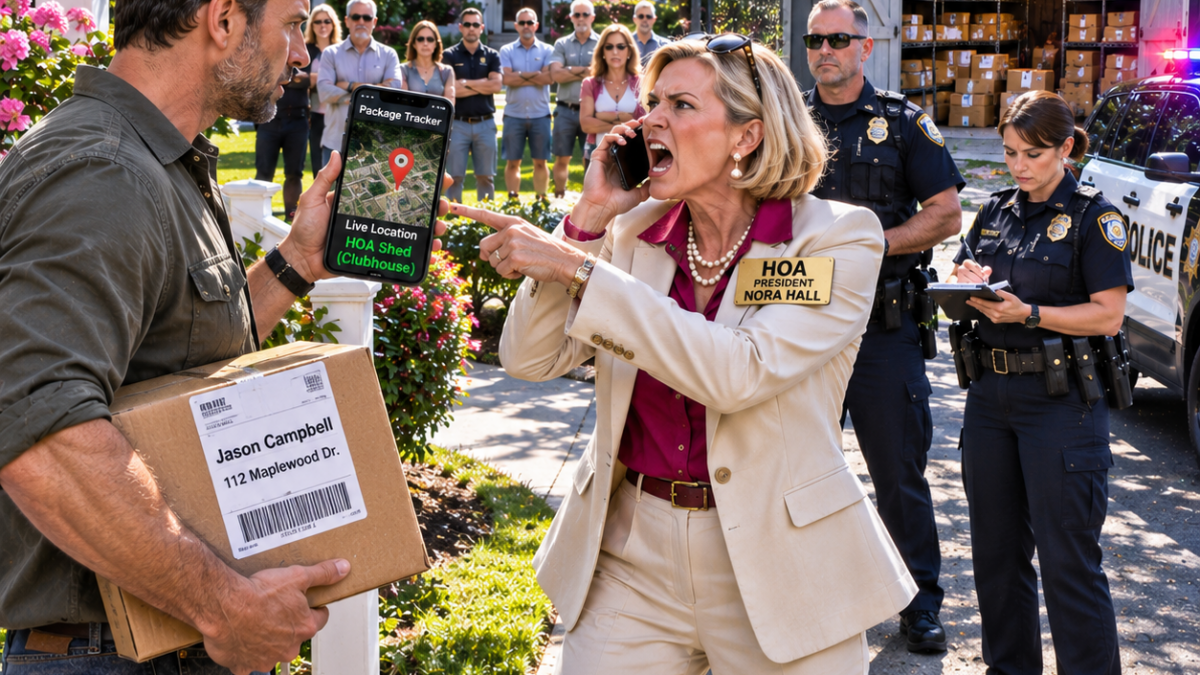
The first time Nora Hall called 911 on me, I was standing on my own front porch holding a package with my name printed across the label while she shouted into the phone that I was stealing “HOA property.” The absurdity would have been funny if half the neighborhood hadn’t been watching from behind curtains and if I hadn’t already spent weeks documenting packages disappearing from porches minutes after delivery. What Nora didn’t know was that I had finally connected those missing boxes to a locked maintenance shed behind the clubhouse, and the tiny tracking signal blinking on my phone was about to turn a petty HOA feud into something far more dangerous.
My name is Jason Campbell, and I had lived in Maplewood Estates for three years by then.
From the street, Maplewood looked engineered to be harmless. White fences. Matching mailboxes. Lawns trimmed to the same height. Sprinklers clicking on at nearly the same hour every Saturday morning.
I worked from home designing stormwater and drainage systems for small towns, so quiet suited me. I had no interest in neighborhood politics. I paid my dues, kept my place clean, and tried not to give our HOA president, Nora Hall, a reason to notice me.
That lasted until I painted my porch railing.
“Wrong gray,” she said, appearing at the edge of my driveway with a laminated color chart.
I looked at the wet paint.
“It’s gray.”
“It’s storm gray. The approved color is driftwood gray.”
I honestly thought she was joking.
She wasn’t.
I repainted it.
That was how life worked in Maplewood. Nora decided something mattered, and everybody else calculated whether arguing was worth the energy.
A year later, my packages started disappearing.
The first contained custom mechanical fittings I needed for a client prototype. Tracking showed delivered at 1:14 p.m. When I checked twenty minutes later, the porch was empty.
Then a tool order vanished.
Then a package from my daughter’s university.
By the fourth disappearance, I started asking neighbors.
Mrs. Sanders had lost three deliveries.
The Millers were missing patio lights.
Mr. Jenkins, who was seventy-eight, told me a prescription shipment had disappeared after the carrier marked it delivered.
That bothered me more than the tools.
I called Nora.
“Have people reported stolen packages?”
She paused.
“Residents frequently leave unsightly boxes visible from the street.”
“I’m talking about theft.”
“The HOA may inspect suspicious items if they create a safety concern.”
I sat up.
“Inspect?”
“You know what people order online now.”
“Nora, are you telling me the HOA takes packages off private porches?”
“Don’t be dramatic, Jason. We ensure compliance.”
“Show me the bylaw.”
She hung up.
I read the entire HOA handbook that night.
Nothing authorized package collection.
Nothing authorized opening mail.
Nothing even came close.
So I started logging every delivery.
Dates.
Times.
Carrier scans.
Doorbell footage.
A week later, I saw Nora do it with my own eyes.
A USPS van stopped outside my house and left a small box by the door. Fourteen minutes later, Nora’s Lexus rolled to the curb.
She got out.
Walked straight up my path.
Looked once toward the street.
Then picked up my package.
No hesitation.
No knock.
No note.
She carried it to her SUV like it belonged to her.
I wanted to run outside.
Instead, I stayed behind the window and recorded.
That evening I installed a second camera and ordered a cheap electronic component I didn’t need.
Inside the shipping box, I placed a legal Bluetooth tracker linked to my phone.
Two days later, the package arrived.
Seventeen minutes after that, Nora took it.
I watched the little dot move across Maplewood, past the tennis courts, then stop behind the HOA clubhouse.
At the maintenance shed.
I drove over but stayed on the public parking area.
The shed had one narrow window.
Through it, I could see shelves.
Boxes.
Dozens of them.
Some sealed.
Some opened.
One had Mrs. Sanders’s name on it.
Another had the Millers’.
My tracker was still blinking from somewhere inside.
I took photographs through the window and called my next-door neighbor, Mark Davis, a retired postal worker.
He arrived five minutes later, studied the boxes, then looked at me.
“Jason, don’t touch that door.”
“I wasn’t planning to.”
“Good.”
He pointed toward the stacks inside.
“If those are stolen deliveries, this is way beyond an HOA violation.”
My phone buzzed.
Another tracker update.
Then headlights swept across the clubhouse lot.
Mark grabbed my arm.
“Someone’s coming.”
A black sedan turned toward the shed, and Nora stepped out carrying a clipboard.
She wasn’t alone.
PART 2
The passenger door opened.
A man stepped out.
Tall, maybe fifty, charcoal suit beneath a dark raincoat despite the warm evening. He wasn’t somebody I recognized from Maplewood.
Nora walked toward the shed.
The man stayed near the sedan.
Mark and I were standing beside my truck at the far end of the lot. We had every right to be in the parking area, but suddenly I felt as if we were somewhere we shouldn’t be.
“Know him?” I whispered.
Mark shook his head.
“No.”
Nora unlocked the shed.
That answered one question.
She had access.
The man retrieved a banker-style storage box from the sedan’s trunk and carried it toward her.
Nora moved aside.
He went into the shed.
A minute later, he came back without the box.
Then Nora handed him a large white envelope.
Mark leaned closer to me.
“Film.”
I already was.
Not zoomed into faces through private windows.
Just what was visible from the public parking lot.
The man tucked the envelope inside his coat.
They spoke for another minute.
I couldn’t hear them.
Then Nora locked the shed.
The man drove away.
Nora stayed behind.
She checked something on her phone.
Then turned in our direction.
My stomach tightened.
“Time to go,” Mark said.
We got into my truck.
I backed out normally.
No speeding.
No dramatic escape.
As I pulled onto Maplewood Drive, I checked the tracker.
Still inside the shed.
Mark stared ahead.
“You have the carrier scan?”
“Yes.”
“Footage of Nora taking the package?”
“Yes.”
“Tracker showing where it went?”
“Yes.”
“Photos through the window?”
“Yes.”
“And other residents reporting missing deliveries?”
“Several.”
He nodded.
“Then you have enough to make a real report.”
“To local police?”
“Postal inspectors first.”
I glanced over.
“You still know somebody?”
“I retired six years ago. Everybody I knew retired before me.”
“Helpful.”
“There’s a public reporting process, smart guy.”
I laughed despite the tension.
Then Mark became serious.
“Jason, do not go into that shed.”
“I already told you—”
“I’m saying it again because curiosity makes otherwise intelligent people stupid.”
“What do you think is inside?”
“I think your package is inside.”
“Besides that.”
He looked back toward the clubhouse in the mirror.
“I don’t know.”
Neither did I.
That was the problem.
By the time I got home, I had saved copies of everything in three places.
Camera footage.
Tracker screenshots.
Delivery confirmation.
Photographs.
Names of neighbors who had reported losses.
I wrote down exactly what Mark and I had observed, including the approximate time the black sedan arrived.
No guesses.
No accusations about what the man had been doing.
Just facts.
Mark watched me type.
“You always document like this?”
“Engineering.”
“Remind me never to lie about your drainage calculations.”
I submitted a report through the U.S. Postal Inspection Service and also filed a non-emergency police report for the stolen package.
Then I emailed Nora.
Short.
Professional.
Nora,
At approximately 12:17 p.m. today, my camera recorded you removing a package addressed to me from my front porch. Please return my property immediately.
Jason Campbell
Mark read it.
“That’s it?”
“That’s it.”
“No threats?”
“No.”
“No mention of tracker?”
“No.”
He smiled.
“You’re learning.”
“From you?”
“Don’t ruin the moment.”
The reply came fourteen minutes later.
Jason,
The item was collected pursuant to HOA safety and compliance procedures. Items creating potential safety concerns may be temporarily held for inspection.
Please refer to community standards.
Nora Hall
President, Maplewood Estates HOA
I read it twice.
Then forwarded it to myself and saved a PDF.
Mark leaned over my shoulder.
“She admitted taking it.”
“Yes.”
“That’s considerate.”
I wrote back:
Please identify the exact bylaw authorizing the HOA to remove delivered mail or packages from privately owned residential property.
No answer.
At 8:10 the next morning, my doorbell rang.
Nora stood outside.
Pink blazer.
Clipboard.
And my package.
The cardboard had been opened.
Tape had been cut and replaced.
I stared at it through the camera for a few seconds before opening the door.
“Morning, Jason.”
“That’s mine.”
She held it against her chest.
“This item was inspected because it contained suspicious electronic equipment.”
“The tracker?”
Her expression shifted.
Tiny.
But I saw it.
“What tracker?”
I smiled.
“Exactly.”
She recovered quickly.
“The HOA does not disclose internal inspection methods.”
“You opened my package.”
“We opened an item abandoned in public view.”
“My front porch isn’t public property.”
“Jason, I’m not going to debate semantics.”
“Then give it back.”
She held out a yellow sheet instead.
“Sign acknowledgment of inspection.”
I looked at it.
HOA SAFETY HOLD RELEASE FORM.
Someone had typed my name.
Violation listed:
UNREGISTERED ELECTRONIC MONITORING DEVICE.
I almost laughed.
“I’m not signing this.”
“Then the package remains HOA property pending compliance.”
“No.”
I reached for it.
Nora moved it away.
“Do not touch HOA evidence.”
“My name is on the label.”
“It has been entered into a compliance proceeding.”
“There’s no such proceeding.”
“You don’t determine that.”
“Nora.”
I kept my voice low.
“Give me my package.”
She stepped backward.
I didn’t follow.
Instead, I pulled out my phone.
“I have video of you taking it yesterday.”
Her jaw tightened.
“And I have your email admitting the HOA collected it.”
“I suggest you think carefully before accusing me of theft.”
“I just described what happened.”
“Take down the cameras.”
“No.”
“Sign the form.”
“No.”
She looked toward the neighboring houses.
Then back at me.
“You’re becoming hostile.”
I actually glanced around.
I was standing inside my doorway wearing socks.
“Nora, you’re holding my property.”
“This belongs to the HOA until—”
I reached out.
Not suddenly.
Not violently.
I took hold of the side of the box.
She tightened her grip.
For perhaps two seconds, both of us held it.
Then she let go.
I stepped back inside my doorway with the package.
“That is theft!” she shouted.
I stared at the shipping label.
JASON CAMPBELL.
My address.
“Nora.”
She pulled out her phone.
“You’ve just stolen evidence from an HOA officer.”
“An HOA president isn’t a police officer.”
“I am calling 911.”
“Go ahead.”
She did.
Loudly.
“Yes, I need police assistance. A resident has taken property belonging to the association and he’s becoming aggressive.”
I rubbed my forehead.
Mrs. Sanders opened her front door.
Mark came outside next door.
Across the street, somebody’s blinds moved.
Nora pointed at me while still speaking to dispatch.
“He physically grabbed it from me.”
“I took my package.”
“Stay back!”
I hadn’t moved.
Mark called from his lawn.
“Nora, he’s twenty feet away from you.”
“Stay out of this, Mark.”
“I’d love to.”
A patrol car arrived about eight minutes later.
Two officers.
Officer Riley and Officer Shaw.
Riley had been to Maplewood before for a fence dispute.
He stepped out looking tired already.
“What’s going on?”
Nora rushed toward him.
“This resident seized HOA property from me after I attempted to serve a compliance notice.”
Riley looked at me.
“What property?”
I held up the box.
“This.”
He read the label from several feet away.
“Your name?”
“Yes.”
“Your address?”
“Yes.”
Nora interrupted.
“It had been legally confiscated.”
Riley turned.
“Confiscated under what authority?”
“HOA community safety provisions.”
“Do you have a court order?”
“We don’t need one.”
Riley looked at Shaw.
Shaw looked away, which I suspect was professional courtesy.
Riley asked me:
“Did you threaten her?”
“No.”
“Touch her?”
“No.”
“Take the box out of her hands?”
“We both had hold of it for maybe two seconds. She released it. My doorbell camera recorded everything.”
Nora snapped:
“He grabbed it violently.”
“Then let’s watch,” I said.
Her head turned toward me.
I opened the camera app.
Riley watched the clip.
So did Shaw.
There I was.
Inside my doorway.
Calm.
Nora refusing to release the package.
Me placing one hand on it.
Nora letting go.
No shove.
No threat.
No raised fist.
No charge down the steps.
Nothing.
Riley handed the phone back.
“Ms. Hall, I’m not seeing an assault.”
“She stole HOA property.”
“He.”
“What?”
“Mr. Campbell is male.”
Nora’s face reddened.
“You know what I mean.”
Riley pointed toward the label.
“It’s addressed to him.”
“Because it was intercepted during an investigation.”
“What investigation?”
“Community compliance.”
“That’s not a criminal investigation.”
“I never said it was.”
Riley took a slow breath.
“Did you remove this from his porch yesterday?”
Nora hesitated.
“We collected it.”
“Did he give permission?”
“No.”
“Did you have a warrant?”
“This isn’t a police matter.”
Riley stared at her.
“You called 911.”
For one glorious second, nobody said anything.
Then Mark coughed to hide a laugh.
Riley turned to me.
“Mr. Campbell, keep the package. Don’t engage with Ms. Hall beyond what’s necessary. If you believe mail or deliveries are being stolen, continue with the report you said you’ve already filed.”
“I will.”
Nora looked stunned.
“You’re allowing him to keep evidence?”
Riley’s voice hardened.
“Ma’am, unless you produce some legal authority I’m unaware of, I’m not taking a package bearing his name away from him.”
“This is outrageous.”
“It may be. But it’s not an emergency anymore.”
They left.
Nora remained on the sidewalk.
Her eyes fixed on the box.
Not me.
The box.
That was when I knew there was something else going on.
“You really want this back.”
She smiled.
Too quickly.
“I want HOA property returned.”
“You’ve said that.”
“Jason, you have no idea what you’ve inserted yourself into.”
I stared at her.
“Was that a threat?”
“No.”
Her smile vanished.
“It’s advice.”
Then she turned and walked toward her Lexus.
Mark waited until she drove away before crossing the lawn.
“You opening that?”
“Not outside.”
“Good answer.”
We went into my kitchen.
I photographed every side first.
Cut tape.
Opened the flaps.
The cheap electronic component I’d ordered was there.
So was the tracker.
But there was something else beneath the packing paper.
A padded gray envelope.
No shipping label.
No postage.
Just handwritten letters:
DM — BATCH 3
Mark stopped breathing for half a second.
“That yours?”
“No.”
“Don’t open it.”
I looked at him.
“You’re the one who used to open mail all day.”
“Mail addressed to people who asked us to deliver it. That’s not the same thing.”
He was right.
We photographed the envelope exactly where it sat.
Then I called the number provided after my postal-inspection report had been acknowledged that morning.
An inspector returned my call twenty minutes later.
His name was Luis Ramirez.
He didn’t sound excited.
That immediately reassured me.
Excited investigators made good television.
Calm ones made good cases.
“Mr. Campbell, walk me through the package from the beginning.”
I did.
Delivery.
Nora’s removal.
Tracker.
Shed.
My written demand.
Her email.
Her return that morning.
911.
The unexpected envelope.
Ramirez asked:
“You haven’t opened the gray envelope?”
“No.”
“Good.”
“Should I?”
“No.”
“What do you think it is?”
“I don’t speculate before I see evidence.”
Mark pointed at the phone and mouthed, I like him.
Ramirez continued.
“Do you still have the original packaging?”
“Yes.”
“Don’t alter anything else.”
“When can somebody collect it?”
“We’ll coordinate.”
“Are you coming today?”
A pause.
“I didn’t say that.”
Right.
He wasn’t going to tell me operational details.
“Understood.”
“And Mr. Campbell?”
“Yeah?”
“Don’t visit the shed again.”
“I wasn’t planning to.”
“Don’t confront Ms. Hall.”
“I definitely wasn’t planning to.”
“Your report mentions other residents.”
“Yes.”
“We’ll need names.”
I gave him what I had.
Then he asked about Mark.
Mark spoke with him directly.
Former postal employee.
Thirty-one years.
No current law-enforcement role.
No entry into the shed.
No handling of the packages visible inside.
Good.
When the call ended, Mark sat back.
“Now we wait.”
I hated waiting.
Engineers are problem solvers.
We identify failure.
Measure it.
Model it.
Fix it.
Waiting while somebody else investigates feels like having a pipe burst behind a wall and being told not to turn off the water until the paperwork arrives.
But I waited.
Inspector Ramirez collected the package that afternoon with another investigator.
They photographed the box.
The tracker.
The internal envelope.
He had me sign a receipt.
“What happens now?”
“We preserve it.”
“And the shed?”
He looked at me.
“Mr. Campbell.”
“I know. You can’t tell me.”
“Correct.”
“Had to try.”
He almost smiled.
Then he became serious.
“Your cameras.”
“What about them?”
“Keep them running.”
That stayed with me.
For the next four days, Nora acted as if nothing had happened.
Violation notices still appeared.
Trash bins.
Fence stains.
Garden lights.
She even issued me a citation for “unauthorized surveillance equipment.”
I appealed it in writing.
No argument.
No sarcasm.
Just:
Please identify the recorded covenant authorizing this violation.
No response.
Meanwhile, neighbors started talking.
Mrs. Sanders showed me delivery records for three missing packages.
Mr. Jenkins had pharmacy confirmations.
The Millers had video of a package sitting on their porch at 11:32 and gone by noon.
No camera captured who took it.
But noon mattered.
That was Nora’s inspection route.
Then Mark knocked on my door with a folder.
“Sixteen.”
“Sixteen what?”
“Households with missing deliveries in the last five months.”
I stared.
“You asked everybody?”
“I’ve been retired too long.”
“Mark.”
“Relax. I asked if people had experienced missing packages. I didn’t tell them Nora did it.”
“Good.”
“Four have video.”
“Of her?”
“Two show her vehicle. One shows her walking up a driveway. One actually shows her carrying a box.”
That was significant.
“Send them to Ramirez.”
“Already did.”
“You’re enjoying this.”
“No.”
He paused.
“A little.”
The first real break came from somebody I hadn’t expected.
Janet Mills.
Nora’s HOA administrative assistant.
She knocked on my door after nine one night.
When I opened it, she immediately looked over her shoulder.
“Can I come in?”
I moved aside.
She entered.
Mark happened to be there drinking coffee at my kitchen table.
Janet stopped.
“Oh.”
“Mark knows.”
“Knows what?”
“That depends on what you’re about to tell us.”
Her hands were shaking.
I poured water.
She didn’t drink.
“Nora has been having packages brought to the maintenance shed for months.”
Mark and I exchanged a glance.
“Who brings them?” I asked.
“Sometimes Nora. Sometimes compliance volunteers.”
“Do the volunteers know they’re stolen?”
“I don’t think so. She tells them packages left visible after delivery are ‘abandoned visual nuisances.’”
“That’s ridiculous.”
“I know.”
“What happens to them?”
Janet looked at the floor.
“Some are returned.”
“Some?”
“Some aren’t.”
“Where do those go?”
“I don’t know.”
I believed the first half.
Not yet the second.
“What does DM mean?”
Her head snapped up.
“Where did you see that?”
There.
Fear.
“On an envelope.”
Janet went pale.
“Jason, you need to stop.”
“Stop what?”
“Everything.”
“Who is DM?”
She stood.
“I shouldn’t have come.”
I stepped away from the door rather than blocking her.
“Janet, you’re free to leave.”
She stopped.
That seemed to calm her.
“I’m not trapping you here.”
She sat again slowly.
“Dominion Management.”
Mark frowned.
“Property-management company?”
“Yes.”
I had heard the name.
Barely.
The HOA used an outside vendor for bookkeeping, collections, and compliance software.
“Nora hired them?”
“Two years ago.”
“Who owns it?”
“I don’t know.”
“Why are you afraid of them?”
Janet looked at me.
“Because every time somebody falls behind on dues, Dominion knows everything.”
“That’s normal for collections.”
“Not everything.”
“What do you mean?”
“Bank information. Mortgage data. Employment. Copies of IDs. Sometimes medical hardship letters. Divorce papers. Estate documents.”
Mark’s expression changed.
“How?”
“People submit records when they appeal liens or fines.”
“Okay.”
Janet shook her head.
“But Dominion asks for more than it needs.”
I leaned forward.
“Have you seen anything illegal?”
“I’ve seen files I don’t understand.”
“That’s not the same.”
“I know.”
“What files?”
She whispered:
“Property conversion.”
My skin prickled.
That phrase sounded familiar even though I’d never heard it before.
“What does it mean?”
“I don’t know.”
“Janet.”
“I swear.”
She looked close to tears.
“I saw folders labeled Conversion Candidate and Recovery Asset.”
“How many?”
“Dozens.”
“Maplewood residents?”
“Some.”
“Who?”
She hesitated.
“Mr. Jenkins.”
The elderly man missing medication.
“Why him?”
“He has no mortgage.”
I stared.
“What does that have to do with anything?”
“I don’t know.”
Maybe she truly didn’t.
“Me?”
Her eyes moved away.
That was an answer.
“Am I in one?”
“Yes.”
“Why?”
“Your second parcel.”
Everything inside me went still.
“What second parcel?”
“The wooded acreage behind Maplewood.”
My father.
When he died, I inherited seven acres beyond the rear subdivision boundary.
No house.
No HOA.
Just woods, a gravel path, and an old workshop foundation where Dad had spent half his weekends.
I’d never mentioned it to Nora.
The parcel was valuable mostly because it bordered future development.
“How does Dominion know about that?”
“Public records.”
Mark said:
“What does it have to do with HOA packages?”
Janet shook her head.
“I don’t know.”
Then she reached into her purse.
My body tightened.
She pulled out nothing dramatic.
Just a folded invoice.
“I copied this before Nora told me to shred the original.”
I didn’t take it.
“Is that HOA property?”
“Yes.”
“Then you should give it to Inspector Ramirez, not me.”
She looked almost relieved.
“You have his number?”
I wrote it down.
Janet left through the front door ten minutes later.
I watched from the window until she reached her car.
Mark said:
“This is getting ugly.”
“Property conversion.”
“Could mean a hundred things.”
“I know.”
“Don’t decide what it means before investigators do.”
“You’re enjoying telling me not to be stupid.”
“Retirement needs hobbies.”
The next morning, my father’s parcel appeared in a county-record notification email.
I had set up alerts after inheriting it because I’d dealt with enough municipal land records to know mistakes happen.
The alert said:
DOCUMENT SUBMISSION PENDING REVIEW.
I nearly spilled coffee.
I logged into the county portal.
A lien-related document had been submitted against the parcel.
Not recorded yet.
Submitted.
Claimant:
MAPLEWOOD COMMUNITY SERVICES / ASSIGNMENT AGENT: DOMINION MANAGEMENT LLC.
Amount:
$18,740.
Basis:
UNPAID COMMUNITY ASSESSMENTS AND PROPERTY MAINTENANCE.
I stared at the screen.
The parcel wasn’t in Maplewood.
Never had been.
I called Jim Kelley, the real-estate attorney who had handled my father’s estate.
“Jason?”
“I need you to look at something.”
He pulled up the parcel.
Silence.
Then:
“That’s not good.”
“Can they do this?”
“Anyone can submit something. That doesn’t mean it’s valid.”
“They claim HOA assessments.”
“Your father’s parcel is outside the HOA boundary.”
“I know.”
“I’m filing an immediate objection and fraud alert.”
My hands had started shaking.
That surprised me.
The missing tools had angered me.
The packages had angered me.
This felt different.
Dad had bought those seven acres when I was fourteen.
He never had much money.
He was a heavy-equipment mechanic who saved for years because he wanted somewhere he could stand without hearing traffic.
After he died, people asked why I kept land I barely used.
Because he had.
That was enough.
“Jim.”
“Yes?”
“Can somebody transfer ownership using something like this?”
“Not cleanly. There are safeguards. But fraudulent liens can create title problems, force legal expenses, and sometimes become part of larger foreclosure schemes if owners don’t respond.”
“Could that be what they’re doing?”
“Don’t jump ahead.”
Everybody kept telling me that.
Probably because I kept jumping ahead.
“I want it stopped.”
“It will be.”
“When?”
“I’ll file today.”
I called Ramirez immediately afterward.
He listened.
Then asked me to forward the county alert.
His voice changed when he saw Dominion’s name.
“Don’t contact them.”
“I wasn’t planning to.”
“Don’t contact Nora.”
“Definitely not.”
“And don’t visit your father’s parcel alone for the moment.”
“Why?”
“Precaution.”
That answer did not help.
“What have you found?”
“I can’t discuss an active investigation.”
“Is my property at risk?”
“You have an attorney challenging the filing, correct?”
“Yes.”
“Then legally, you’re doing what you should.”
“That’s not what I asked.”
He was quiet.
Then:
“Keep your documentation current.”
The call ended.
I sat in my office staring at an old photograph of Dad.
He was standing beside his 1988 Ford pickup on that property, holding a thermos, smiling at something outside the frame.
For the first time, Nora’s HOA nonsense didn’t feel ridiculous.
It felt invasive.
They hadn’t just reached onto my porch.
They had reached backward into my family.
That afternoon, Nora scheduled an emergency HOA meeting.
The subject line:
COMMUNITY SAFETY, DEFAMATION, AND UNAUTHORIZED SURVEILLANCE.
Attendance strongly encouraged.
Mark read it over my shoulder.
“She is going after you.”
“Obviously.”
“You going?”
“Yes.”
“Ramirez told you not to confront her.”
“Attending my HOA meeting isn’t confronting her.”
He sighed.
“I’ll come.”
The clubhouse was packed by seven.
Forty or fifty residents.
More standing along the walls.
Nora sat at the front.
Janet wasn’t beside her.
Interesting.
The seat was empty.
Nora struck the gavel.
“Thank you for attending.”
Her voice was steady.
Too steady.
“Maplewood Estates has recently become the target of serious misinformation.”
Eyes turned toward me.
She continued.
“Certain residents have accused HOA personnel of mail theft and financial misconduct.”
Mrs. Sanders muttered:
“Because my packages disappeared.”
Nora ignored her.
“We have also discovered unauthorized surveillance of community operations and unlawful possession of HOA records.”
Mark whispered:
“Here it comes.”
Nora clicked a remote.
The screen showed a still image from my doorbell camera.
Me reaching toward the package.
Next slide.
A cropped video.
It began with Nora holding the box.
It ended the moment I touched it.
No earlier footage of her refusing to return it.
No shipping label close-up.
No police review.
Nora paused it.
“This is a resident forcibly taking an item under official HOA inspection.”
I stood.
Not shouting.
Just standing.
“That isn’t the complete video.”
“You’ll have an opportunity during comment.”
“You called 911 over that.”
“And the police report documents your conduct.”
Officer Riley’s report did not support her version.
I knew because I had requested a copy.
Nora continued.
“The HOA is considering legal action against Mr. Campbell for harassment, unauthorized surveillance, and theft of proprietary records.”
A few neighbors turned toward me.
Some looked doubtful.
Others nervous.
Nora had always been good at confidence.
If you didn’t know the facts, confidence felt a lot like truth.
Then Mrs. Sanders stood.
“What about my packages?”
Nora’s jaw tightened.
“Individual delivery problems are not tonight’s topic.”
“They are for me.”
“Please sit down.”
“No.”
That surprised everybody.
Mrs. Sanders was sixty-eight, five feet tall, and had spent three years apologizing when other people bumped into her grocery cart.
She held up three delivery printouts.
“These disappeared.”
Nora said:
“Porch theft is a police issue.”
Mrs. Sanders pointed at me.
“Then why did you take his?”
Murmurs.
Nora struck the gavel.
“Enough.”
Mark stood next.
“I worked for the postal service thirty-one years.”
Nora’s face darkened.
“We know, Mark.”
“Then you know private deliveries aren’t HOA inspection material.”
“We have community-safety authority.”
“Show the rule.”
Same question I’d asked.
She didn’t.
Instead:
“We’re not turning this into a mob.”
Then the clubhouse doors opened.
Two men and a woman entered.
No dramatic tactical gear.
No shouting.
Just dark jackets.
Badges.
Behind them stood Officer Riley.
The woman at the front walked toward Nora.
“Ms. Hall?”
Nora stared.
“Yes?”
“I’m Inspector Chen with the U.S. Postal Inspection Service. We have a federal search warrant covering the maintenance structure and specified association records.”
The room changed.
Not loudly.
You could almost feel forty people inhale.
Nora stood.
“There must be some mistake.”
Inspector Chen handed paperwork to the HOA attorney, who had been sitting near the wall.
He read the first page.
Then looked at Nora.
“No.”
Her voice became thin.
“No?”
He didn’t answer her.
Inspector Ramirez entered behind them.
He saw me.
Gave the slightest nod.
Then addressed the room.
“We’re not here to interfere with your meeting. We do need everyone to remain away from the rear maintenance area while the warrant is executed.”
Nora gripped the podium.
“This is based on fabricated accusations.”
Ramirez didn’t debate her.
“We’ll follow the evidence.”
That sentence hurt her more than an argument would have.
Agents moved toward the back doors.
Nora suddenly stepped down.
“I need to call counsel.”
The HOA attorney said:
“You should.”
Her head snapped toward him.
“You are counsel.”
“I represent the association, Nora.”
The same distinction Deborah Frost had learned in another HOA story would have felt poetic if I hadn’t been living it.
Nora stared at him.
Then at me.
“This is because of you.”
I shook my head.
“No. This is because packages went missing.”
“You planted that tracker.”
“In my own property.”
“You created this.”
“No.”
My voice came out quieter than I expected.
“I noticed it.”
For the first time in three years, Nora Hall didn’t have an answer.
The search lasted hours.
Residents went home slowly.
Mark and I stayed at my house.
Around eleven, unmarked vehicles were still behind the clubhouse.
At midnight, Ramirez called.
“You awake?”
“Yes.”
“We recovered your tracker.”
“I figured.”
“And property belonging to multiple residents.”
“How much?”
“I can’t give you a final count.”
“Dozens?”
A pause.
“Yes.”
My stomach tightened.
“Opened mail?”
“Some.”
“Financial documents?”
Another pause.
“Jason, this is becoming broader than package theft.”
“Dominion?”
“I can’t discuss targets.”
“That means yes.”
“That means I can’t discuss targets.”
Fair.
“What about my father’s parcel?”
“We found materials referencing it.”
I closed my eyes.
“What kind?”
“We’ll discuss that formally.”
“When?”
“Tomorrow.”
Then he added:
“Your attorney should be present.”
That sentence kept me awake.
Jim joined me at the postal-inspection office the next afternoon.
Ramirez sat across from us with Inspector Chen.
On the table was a folder.
No stolen mail.
No dramatic evidence bag.
Paper.
Sometimes paper is worse.
Ramirez opened it.
“The gray envelope found inside your returned package contained a USB storage device.”
I waited.
“We obtained lawful authority to examine it.”
“What’s on it?”
“Resident data exported from HOA management systems.”
“What kind?”
“Names. Addresses. Account status. Portions of financial information. Copies of identity documents in some cases.”
Jim asked:
“Source?”
“Several HOAs.”
“Dominion-managed?”
Ramirez looked at him.
“Yes.”
My stomach dropped.
“How many?”
“Enough that we’re coordinating with other offices.”
“What did Nora have to do with it?”
“That’s still being investigated.”
“What about my land?”
Ramirez slid one page toward Jim.
It was a copy.
Not original evidence.
A spreadsheet row.
CAMPBELL, JASON M.
Maplewood address.
Then:
SECONDARY ASSET: 7.14 ACRES
STATUS: CLEAR TITLE / NO MORTGAGE
ACTION: HOA LIEN PATHWAY
ASSIGNMENT: DM
My hands tightened beneath the table.
“Clear title.”
Jim read slowly.
“They were selecting unencumbered property.”
Inspector Chen said:
“That’s one working theory.”
“What does ‘conversion’ mean?”
Ramirez answered carefully.
“Documents recovered from the shed suggest a system where fabricated HOA debt could be used to create collection pressure against properties. In some cases, false documents appear to have been prepared to support liens or transfers.”
“Appear?”
“Until every document is verified, yes.”
“Were they stealing houses?”
Jim touched my arm.
“Jason.”
“No. I want to hear it.”
Ramirez leaned forward.
“We have evidence of attempted property fraud. We do not yet know how many attempts succeeded.”
That was worse.
Not because the answer was dramatic.
Because it wasn’t finished.
“Mr. Jenkins?”
Ramirez’s expression told me he knew the name.
“He’s being contacted.”
“He’s seventy-eight.”
“We know.”
“He lives alone.”
“We know.”
I looked down at the spreadsheet.
My father had worked thirty-six years to own seven acres outright.
Somebody had reduced that history to:
CLEAR TITLE.
Like a target characteristic.
“What does DM stand for?”
Ramirez and Chen exchanged a glance.
Then Chen said:
“Dominion Management LLC.”
“Who runs it?”
“Derek Matthews.”
The initials clicked.
DM.
Dominion Management.
Derek Matthews.
Both.
“Was he the man with Nora at the shed?”
Ramirez placed a photograph on the table.
Same tall man.
Same face.
“Yes.”
“What is he?”
“Managing member of Dominion. The company provides collections, compliance software, financial administration, and consulting services to multiple homeowners associations.”
“Legitimate company?”
“Parts of it appear legitimate.”
Jim said:
“Which makes the illegitimate parts harder to see.”
Ramirez nodded.
“Exactly.”
“How many HOAs?”
“Six currently relevant to this investigation.”
“Six in this state?”
“Across several jurisdictions.”
I leaned back.
Maplewood suddenly felt small.
“How did this get into my package?”
Inspector Chen answered.
“We believe your box was opened and moved through the shed during sorting. The gray envelope was likely placed inside accidentally when materials were being consolidated.”
“That’s the mistake that exposed them?”
“One mistake.”
She looked at me.
“Your tracker exposed the storage location.”
Mark would enjoy that distinction.
“Can Nora be arrested?”
Ramirez’s expression didn’t change.
“When probable cause and charging decisions support it, appropriate action will be taken.”
That was the most federal answer I’d ever heard.
Nora resigned as HOA president the following morning.
Not voluntarily, no matter what her email claimed.
Her message said:
Due to sustained harassment and personal threats, I am temporarily stepping away to protect my health and family.
The board held an emergency vote two hours later and formally suspended her access to all accounts, records, offices, and HOA facilities.
Janet called me after.
“She tried to get into the clubhouse.”
“When?”
“Six this morning.”
“Why?”
“She said she needed personal items.”
“Did they let her?”
“No.”
“Good.”
There was a pause.
“Jason.”
“Yeah?”
“I gave Ramirez the invoice.”
“The Dominion one?”
“Yes.”
“And?”
“He asked for everything.”
“Did you give it?”
“Yes.”
Her voice shook.
“I think Nora is going to blame me.”
“She may.”
“What do I do?”
“Tell the truth.”
“That sounds simple.”
“It isn’t.”
“No.”
“But it’s still the answer.”
Nora came back to Maplewood three days later.
Her Lexus stopped across from my house.
I was outside installing a replacement sprinkler head.
She didn’t enter my driveway.
Smart.
“Jason.”
I stood.
“What?”
Her face looked different without the clipboard.
Still controlled.
Less certain.
“You’ve destroyed this community.”
I almost laughed.
Instead:
“How?”
“Federal agents. News vans. Frozen accounts. People accusing each other.”
“Packages were being stolen.”
“You don’t know the whole story.”
“Then tell me.”
Her mouth tightened.
“You think Dominion is some criminal organization because they manage collections aggressively?”
“I think somebody used stolen mail and resident data to prepare fraudulent property documents.”
“Allegedly.”
“Yes.”
That seemed to surprise her.
“You expected me to say otherwise?”
“You’ve already convicted everybody.”
“No. Investigators are investigating.”
She stepped closer to the curb.
“You have records that belong to Maplewood.”
“No.”
“The package.”
“Federal investigators have it.”
“The USB.”
“Federal investigators have it.”
“The copies.”
“I don’t have copies of the drive.”
That was true.
“You expect me to believe that?”
“I don’t care what you believe.”
Her face tightened.
“Dominion has lawyers who will bury you.”
I stared at her.
“Is that advice or a message?”
“You always twist everything.”
“You drove onto my property and took deliveries.”
“I was told those procedures were legal.”
“By Derek?”
She froze.
There.
A name did what accusations hadn’t.
“You’ve met him.”
She recovered.
“Dominion works with the HOA.”
“Did Derek tell you to collect packages?”
“I’m done with this conversation.”
She turned.
Then stopped.
“You should be very careful about your father’s property.”
My anger arrived so quickly I had to put down the wrench.
“How do you know about that?”
She smiled.
Not smugly.
Sadly.
“Because you were never the only person they were watching.”
Then she left.
I called Ramirez before her Lexus reached the corner.
He wasn’t happy.
“Why were you talking to her?”
“She came to my house.”
“Did she threaten you?”
“She mentioned my father’s property.”
“Exact words.”
I repeated them.
He was quiet.
“We’ll document it.”
“That’s it?”
“What would you like me to do?”
“Tell me whether my house is next.”
“You have counsel monitoring the title.”
“Yes.”
“Your land records are flagged.”
“Yes.”
“Then don’t let fear push you into doing something reckless.”
I hated that answer.
Mostly because it was right.
The intimidation started small.
Unknown calls.
No one speaking.
Then hang-ups.
A black SUV parked near the entrance twice.
It might have been nothing.
After everything that happened, my brain didn’t treat anything as nothing.
I gave license-plate information to Ramirez.
He later told me the vehicle was registered to a private investigator hired by Dominion’s law firm.
Legal.
Unsettling.
Not a mysterious hit squad.
That distinction mattered.
Mark found it hilarious.
“You were expecting criminals?”
“I wasn’t expecting anything.”
“You spent two days checking the blinds every ten minutes.”
“I work near the window.”
“Sure.”
Then something happened that scared me more than the SUV.
Mr. Jenkins knocked on my door.
He carried an envelope.
His hands trembled.
“Jason, they say I owe forty-three thousand dollars.”
“Who?”
He handed it to me.
A collection notice.
Dominion Management.
It claimed years of unpaid special assessments, penalties, legal fees, and property-maintenance charges.
Mr. Jenkins had lived in Maplewood twenty-two years.
“I pay every bill,” he said.
“I know.”
“They say there’s a lien.”
“Have you called a lawyer?”
“I don’t have a lawyer.”
Mark came over.
We sat Mr. Jenkins down.
I called Jim.
Within an hour, Jim had referred him to a legal-aid attorney specializing in elder property issues.
The supposed lien document had inconsistencies.
Wrong legal description.
Wrong board authorization date.
A signature from a former HOA treasurer who had died the previous year.
That last part was particularly inconvenient for Dominion.
“What happens now?” Mr. Jenkins asked.
Jim answered over speakerphone.
“We challenge it.”
“Can they take my house?”
“Not tomorrow. And not through an invalid lien if we respond correctly.”
Mr. Jenkins looked at me.
“I almost paid them.”
“How much?”
“They offered to settle for twelve thousand.”
That was the business model.
At least part of it.
Not always taking houses.
Sometimes frightening people with enough paper that they’d pay to make the threat disappear.
A few thousand here.
Twelve thousand there.
A bogus late fee.
An inflated lien.
And if somebody was elderly, absent, grieving, divorced, or holding unencumbered property?
Maybe the target became larger.
Ramirez called that afternoon.
“You were right about Jenkins.”
“I wasn’t trying to be.”
“We’re adding his documents.”
“How many others?”
“I can’t tell you.”
“More than one?”
“Yes.”
I looked at Mr. Jenkins sitting in my kitchen.
“That’s enough.”
The federal investigation widened.
Subpoenas went to banks.
Title companies.
HOA vendors.
Dominion.
Nora’s attorney advised her not to speak publicly.
For once, she listened.
Maplewood’s board hired an independent forensic accountant.
The results were ugly.
Not because Nora had simply been stealing dues for handbags and vacations.
Reality was more complicated.
Dominion charged the HOA for layers of “compliance processing,” “resident verification,” “collections support,” and “data management.”
Some services existed.
Some were wildly inflated.
Some payments flowed into affiliated companies.
Several invoices were approved by Nora without competitive review.
One company receiving payments shared an address with another company tied to Derek Matthews.
The board treasurer, Glenn Porter, claimed he had never seen the underlying contracts.
I asked Patricia Sanders—not Mrs. Sanders, a different neighbor who served on the finance committee—how that was possible.
She looked embarrassed.
“Nora told us the contracts were confidential because they involved collection strategy.”
“And everybody accepted that?”
“She had legal-looking paperwork.”
“Legal-looking.”
“I know how it sounds now.”
“What did it sound like then?”
“Professional.”
There was the word again.
Confidence.
Professionalism.
Authority.
All easy to imitate if nobody checks.
Nora was formally indicted several weeks later on charges tied to mail theft, conspiracy, identity-document misuse, and financial fraud.
Derek Matthews was charged in a broader case involving Dominion.
The exact counts changed as prosecutors consolidated evidence.
No dramatic arrest at an HOA meeting.
No handcuffs while neighbors applauded.
Nora surrendered through her attorney.
That was more ordinary.
More real.
And somehow more devastating.
The woman who used to walk Maplewood like she owned the pavement entered a federal building through a side door carrying a clear plastic folder.
The local news still found her.
She covered her face.
I turned the television off.
Mark looked at me.
“Don’t want to watch?”
“No.”
“Why?”
“Because I’m tired of her being entertainment.”
He nodded.
“That’s healthier than where I was.”
“Where were you?”
“I wanted a marching band.”
I laughed.
Then came the part I hadn’t expected.
Nora’s attorney contacted Jim.
“She wants to cooperate.”
“With us?”
“With prosecutors.”
“Why tell me?”
“Because she may provide information affecting your father’s parcel.”
I sat back.
“What does she want?”
“She’s negotiating. That’s all I know.”
“You think she’s trying to save herself.”
“Of course she is.”
“Does that make the information worthless?”
“No.”
I knew that answer before asking.
A guilty person could tell the truth for selfish reasons.
Truth didn’t become false because the motivation was ugly.
Weeks later, prosecutors disclosed through proper channels that Nora had entered a cooperation agreement.
Not immunity.
Not freedom.
A plea arrangement.
She provided access credentials.
Emails.
Messages.
Internal Dominion instructions.
Most importantly for me, she explained how “property conversion” worked.
Dominion identified HOA residents or nearby landowners with low mortgage balances or clear title.
Then aggressive or fabricated association debts were created.
For property inside HOAs, the debt could be used as leverage.
For adjacent parcels outside HOA boundaries, operators sometimes fabricated boundary claims, maintenance obligations, or easements to create confusion.
The goal wasn’t always an actual foreclosure.
Sometimes it was settlement money.
Sometimes a below-market purchase.
Sometimes pressure that made an owner sell.
In a smaller number of cases investigators believed false identity documents had been prepared to support fraudulent transfers.
My father’s parcel had been flagged because a planned commercial-access project made it valuable.
That part hit me hardest.
There was a proposed connector road two miles away.
If it was approved, Dad’s seven acres could become attractive to developers.
Dominion knew before I did.
Derek had contacts in local real-estate circles.
They weren’t stealing wilderness because they liked trees.
They were positioning themselves for future value.
Jim slid the planning map across his desk.
“Your father paid twenty-eight thousand dollars for this property.”
“Twenty-six.”
“Current estimate?”
I looked at the appraisal.
“Over four hundred thousand if the access project happens.”
“That explains interest.”
“No.”
He frowned.
“No?”
“It explains greed.”
Jim smiled faintly.
“Lawyers call that motive.”
I looked at Dad’s parcel highlighted in yellow.
For the first time, I understood why the package theft had felt so systematic.
Mail wasn’t the entire crime.
It was information.
Statements.
Insurance documents.
Loan papers.
Medical bills.
Property-tax notices.
People leave their lives in envelopes and boxes.
Nora and Dominion weren’t stealing random objects.
They were learning who had money.
Who owed money.
Who lived alone.
Who traveled.
Who had medical problems.
Who had inherited property.
Who was vulnerable.
That realization made me physically sick.
Mrs. Sanders lost patio lights.
Mr. Jenkins nearly lost twelve thousand dollars.
I nearly had a cloud placed over land my father had spent his life protecting.
Different outcomes.
Same machinery.
The biggest confrontation came months later during an evidentiary hearing.
Derek’s defense argued that some early evidence had been tainted because I had “conducted a private search” of HOA property.
I sat beside Jim in the gallery.
Derek wore a navy suit.
He looked ordinary.
That was unsettling.
No villainous smile.
No bodyguards.
Just a man with expensive glasses and a legal team.
His attorney said:
“Mr. Campbell unlawfully used an electronic tracker to surveil association property and approached a secured maintenance structure without authorization.”
My stomach tightened.
Jim whispered:
“Relax.”
“I was in the parking lot.”
“I know.”
“Tracker was in my package.”
“I know.”
“Why am I whispering?”
“Because courts make everyone feel guilty.”
The prosecutor called Inspector Chen.
She explained the chain.
The tracker was placed by me in my own property before delivery.
Nora removed the package without my consent.
I observed the tracker location from public property.
I did not enter the shed.
I did not defeat a lock.
I did not search containers.
I photographed what was plainly visible through a window from an area residents were permitted to access.
Then I reported it.
The search of the shed occurred later under a federal warrant.
The gray envelope came from a package returned to me by Nora.
I did not open it.
I surrendered it intact.
Forensic examination occurred under legal authority.
Derek’s attorney tried another angle.
“Isn’t it true that Mr. Campbell manipulated circumstances to induce Ms. Hall to take a tracked package?”
Chen answered:
“He put a tracker in his own package.”
“But he expected it to be taken.”
“Expectation does not create permission.”
The attorney paused.
Then asked:
“Without Mr. Campbell’s tracker, you would not have found the shed.”
Chen looked at him.
“We had multiple reports. Mr. Campbell’s evidence accelerated the investigation.”
“Accelerated.”
“Yes.”
“So he functioned as an agent of law enforcement.”
“No.”
“Why not?”
“Because law enforcement did not direct him to place the tracker.”
The judge wrote something.
Derek’s expression remained calm.
Then the prosecutor produced a message recovered from Dominion’s systems.
Sent from Nora.
To Derek.
Timestamped the day before she called 911.
Campbell is tracking deliveries. I took another box. Need instructions.
Derek’s reply:
Move all held material to rear storage. Separate resident packets by batch. Do not return anything until verified.
Then another from Nora the next morning:
He demanded his package back.
Derek:
If he gets it, recover it. Call police if necessary. Treat as association evidence.
The courtroom went silent.
I felt the hairs rise on my arms.
Nora had called 911 because Derek told her to.
Not because she spontaneously believed the box was HOA property.
Because she needed it back.
The prosecutor continued.
A final message.
Nora:
Package may contain Batch 3 envelope. I think it was packed wrong.
Derek:
Then get it back today.
There it was.
The entire absurd morning on my porch.
The yelling.
The 911 call.
The accusation that I was stealing my own package.
It hadn’t been random HOA insanity.
She was trying to recover evidence before I opened the box.
Derek’s attorney stood.
“Your Honor, these messages lack context.”
The judge looked at him.
“Then I assume you’ll provide it at the appropriate stage.”
He sat.
Derek turned toward Nora, who was seated with her own counsel farther down.
For the first time, his composure cracked.
Not much.
A tightening around his mouth.
A short stare.
Nora looked away.
That was the moment the balance changed.
Not with shouting.
With text messages.
Derek’s own words.
Nora’s own panic.
Their own attempt to use police as a tool to recover stolen evidence.
I didn’t feel triumphant.
I felt cold.
Months of confusion had condensed into four lines on a screen.
The criminal cases did not end that day.
Real cases rarely do.
There were motions.
Negotiations.
Cooperating witnesses.
Financial tracing.
Victim statements.
More victims from other communities.
Derek eventually entered a guilty plea to multiple federal offenses involving mail fraud, wire fraud, identity-related fraud, and conspiracy rather than risk trial on the entire indictment.
Nora pleaded guilty to a narrower set of charges and received credit for substantial cooperation.
She still faced incarceration.
Restitution.
Supervised release.
A prohibition on serving in fiduciary or HOA-management roles.
Derek received a significantly longer federal sentence.
Dominion Management collapsed.
Its accounts were frozen and assets pursued through forfeiture and restitution proceedings.
The investigation reached affiliated vendors and individuals in other states.
Not every suspicious HOA turned out to be criminal.
Not every Dominion employee knew what Derek was doing.
That mattered too.
Dozens of people worked there.
Some were bookkeepers.
Call-center staff.
Software technicians.
People doing ordinary jobs inside a company whose owners used legitimate systems for illegitimate purposes.
Ramirez explained it once over coffee.
“Fraud rarely looks like a room full of villains.”
“What does it look like?”
“A normal office where three people know why certain numbers don’t make sense and everyone else assumes somebody above them checked.”
That sounded familiar.
Maplewood’s old HOA nearly collapsed financially.
Between frozen funds, legal expenses, forensic accounting, and distrust, several residents wanted to abolish it immediately.
Others pointed out that shared landscaping, stormwater ponds, private entrance lighting, and the clubhouse still needed to be maintained.
That led to the ugliest meeting after Nora.
Not because anybody was stealing.
Because everybody was suddenly afraid of authority.
One neighbor shouted:
“No more board.”
Another:
“Then who pays the electric bill?”
“Make it voluntary.”
“The entrance road isn’t voluntary.”
“Sell the clubhouse.”
“To who?”
“Burn it.”
Mark leaned toward me.
“Democracy.”
“Beautiful.”
Patricia—the finance-committee member—finally stood.
“Can everybody stop screaming for ten seconds?”
Miraculously, they did.
She held up a proposed reform plan.
Independent management bids.
Quarterly public statements.
Two-signature disbursement rules.
Resident access to non-privileged records.
No individual board officer with unilateral compliance authority.
No collection vendor allowed access to personal financial documents beyond what was legally necessary.
No holding packages.
That last one got laughter.
Even me.
The neighborhood voted to retain a dramatically limited HOA because the common property still required administration.
But it no longer functioned like Nora’s little kingdom.
Mark became election monitor.
He complained.
“You volunteered.”
“I was tricked.”
“You stood up and said, ‘I’ll make sure nobody cheats.’”
“I was emotional.”
Mrs. Sanders joined the board.
That delighted me.
At her first meeting, she placed a package on the table.
Everyone froze.
Then she opened it.
Cookies.
“No inspection required,” she said.
We laughed until half the room cried.
Mr. Jenkins kept his house.
His false lien was canceled.
He recovered the legal expenses through victim-assistance and restitution channels after the fraud was established.
The first afternoon his title report came back clean, he walked to my house carrying a bottle of cheap bourbon.
“I don’t drink bourbon,” I told him.
“Neither do I.”
“Then why’d you buy it?”
“Men on television always celebrate legal victories with bourbon.”
I looked at the bottle.
“That’s terrible bourbon.”
“Then it’s appropriate for HOA law.”
We drank one small glass each.
It was awful.
We finished our glasses anyway.
My father’s parcel was formally cleared months later.
The county recorded notices confirming the fraudulent claim had no legal effect.
Jim insisted we update title monitoring and create a trust structure that would simplify inheritance for my daughter someday.
That conversation hit me unexpectedly.
“My daughter?”
“You plan to live forever?”
“I had considered it.”
“Tax implications are unfavorable.”
Classic Jim.
My daughter, Emily, came home from college that weekend.
We drove to the seven acres.
She hadn’t visited since Dad’s memorial.
The old gravel road was rough.
We walked the last quarter mile.
Dad’s workshop foundation was still there.
Weeds through the cracks.
A rusted bolt embedded in one corner.
Emily crouched.
“Grandpa built motorcycles here?”
“Mostly repaired things people shouldn’t have broken.”
“Sounds like you.”
“I’m more expensive.”
She smiled.
Then looked around.
“You almost lost this?”
“No.”
She gave me the look children give parents who lie badly.
“They tried.”
“Yes.”
“Because of an HOA?”
“Because of criminals using an HOA.”
“Difference?”
“Important one.”
She nodded slowly.
“What are you going to do with the land?”
“Nothing.”
“Nothing?”
“That was Grandpa’s favorite use.”
She laughed.
Then became quiet.
“Can we keep it?”
The question surprised me.
“You want to?”
“I don’t know.”
She kicked a pinecone.
“But I don’t want some company deciding it’s theirs because nobody cares enough to notice.”
I looked at her.
“Then yes.”
We stood there for a while.
No dramatic speech.
No promise to preserve it forever.
Just agreement.
Sometimes ownership isn’t about value.
It’s about remembering whose hands put the fence posts in.
The federal sentencing happened almost a year after Nora took that first package.
I attended hers.
I almost didn’t.
Ramirez didn’t ask me to.
Jim didn’t recommend one way or the other.
Emily said:
“Go if you need to.”
I didn’t know if I needed to.
So I went.
Nora looked smaller.
Not physically.
Without the blazer, clipboard, microphone, and board table, there wasn’t much separating her from anybody else waiting for judgment.
Her attorney spoke about her cooperation.
No prior criminal history.
Community involvement.
Personal pressure.
How gradually the line between aggressive HOA enforcement and illegal conduct had eroded.
The prosecutor acknowledged her assistance but emphasized something important.
Nora had not simply been manipulated.
She knowingly removed packages.
Opened deliveries.
Helped categorize resident information.
Approved fraudulent fees.
Attempted to retrieve the Batch 3 package by calling police and falsely characterizing it as HOA property.
She had opportunities to stop.
She didn’t.
Then Nora spoke.
“I told myself I was protecting Maplewood.”
Her voice shook.
“I thought difficult residents were people who didn’t understand how communities work.”
She looked toward me.
I didn’t move.
“Dominion made me feel like I finally had real authority. They had lawyers. Software. Forms. Training. They always knew what rule to cite.”
She swallowed.
“When questions started, I chose them over my neighbors because admitting they were wrong meant admitting I had been wrong for years.”
That was probably the most honest thing I’d ever heard her say.
The judge sentenced her to a federal custodial term followed by supervised release and substantial restitution obligations, taking her cooperation into account.
Not a life sentence.
Not theatrical ruin.
A serious consequence.
When court adjourned, she passed me on the way out.
Marshals beside her.
She stopped.
They allowed it for a second.
“Jason.”
I looked at her.
“That package.”
“What about it?”
“I knew the gray envelope was probably inside.”
“I know.”
Her eyes closed briefly.
“When you took the box back, I panicked.”
“I know that too.”
“I actually believed calling 911 might work.”
That almost made me laugh.
Instead:
“You’d gotten used to people believing the clipboard.”
Her mouth moved into something like a sad smile.
“Yes.”
Then:
“I’m sorry about your father’s land.”
That one landed.
I hadn’t expected it.
“You didn’t get it.”
“No.”
She looked down.
“But I helped them try.”
“Yes.”
There was nothing else to say.
She walked away.
Derek’s sentencing happened later.
I did not attend.
I read the outcome through the case updates.
Longer sentence.
Larger restitution.
Forfeiture.
Multiple victims.
Enough.
I didn’t need to see him again.
Agent Ramirez visited Maplewood one final time in early spring.
No suit.
No tactical team.
Just coffee.
We sat on my porch.
The same porch where Nora had called 911.
A delivery truck stopped three houses down.
I watched it automatically.
Ramirez noticed.
“You still do that?”
“Do what?”
“Track every delivery truck with your eyes.”
I laughed.
“Apparently.”
“It’ll fade.”
“You a therapist now?”
“No.”
“Good.”
He sipped coffee.
“Most of the Dominion cases are wrapped.”
“Most?”
“There’s always cleanup.”
“Any more property conversions?”
“Several attempts. A few losses. Some recoveries.”
“That’s vague.”
“Intentionally.”
“Five states?”
“More leads than that. Fewer cases than rumors suggested.”
I nodded.
That was usually how reality worked.
Messier than official statements.
Smaller than conspiracy theories.
Still bad enough.
Ramirez reached into his bag.
For one irrational second, I thought he was giving me another flash drive.
Instead, he handed me a sealed evidence-release form.
“What?”
“Your tracker.”
I laughed.
“They’re giving it back?”
“Case disposition allows release.”
“You kept a twenty-dollar tracker for a year.”
“It had an exciting career.”
I signed.
He handed me a small evidence bag.
Inside was the little black device.
A scratch across one side.
I held it in my palm.
“This stupid thing.”
“Helped.”
“Yes.”
“Don’t put it in another package.”
“No promises.”
“Jason.”
“Kidding.”
Mostly.
He finished his coffee.
At the driveway, he stopped.
“One thing.”
“What?”
“When you first reported this, your case looked like neighborhood package theft.”
“I remember.”
“You did something most people don’t.”
“What?”
“You documented what you knew and separated it from what you suspected.”
I laughed.
“Mark spent six months telling me not to be stupid.”
“Mark was useful.”
“Don’t tell him.”
“Too late. I already did.”
He drove away.
Maplewood got quieter.
The good kind.
No black SUVs.
No federal tape.
No news vans.
No Nora pacing around with color charts.
Packages appeared on porches and remained there until people came home.
The first few weeks, everybody collected them immediately.
Then gradually people relaxed.
Mrs. Sanders left a delivery outside for four hours.
Mark texted me a photograph.
HISTORY MADE.
I replied:
CALL THE HOA.
He sent back something unprintable.
Janet kept working for the new board.
For a while, some residents distrusted her because she had been Nora’s assistant.
That bothered me.
Janet had made mistakes.
She had stayed quiet longer than she wished she had.
But when she understood what was happening, she came forward.
That mattered.
At a board meeting, someone suggested firing her.
I stood.
“Why?”
The man shrugged.
“She worked for Nora.”
“So did the board.”
Silence.
“She helped uncover the Dominion contracts.”
“She should’ve done it earlier.”
“Probably.”
Janet looked down.
I continued.
“So should all of us.”
Nobody answered.
She kept her job.
A year later, she became the person who posted every monthly financial report online before anybody asked.
Fear can make people silent.
Responsibility can make them useful afterward.
Mark became insufferable.
His non-conforming mailbox—the one he’d once fought the HOA over—remained bright blue.
When the new architectural committee politely asked whether he planned to repaint it, he called me.
“They’re coming for me.”
“Is blue approved?”
“No.”
“Then repaint it.”
“You traitor.”
“Rules aren’t automatically tyranny because you don’t like them.”
He hung up.
Two days later, the mailbox was gray.
Driftwood gray.
I took a picture and framed it.
He hasn’t forgiven me.
My biggest change was smaller.
I stopped checking the camera every time my phone buzzed.
At first, I thought that would never happen.
For months, every delivery notification made my chest tighten.
Delivered.
That word had become a countdown.
Carrier leaves.
Nora arrives.
Box disappears.
Even after Nora was gone, my body remembered the pattern.
Then one Tuesday afternoon, I was working on a drainage model when a notification appeared.
PACKAGE DELIVERED.
I glanced at it.
Kept working.
Twenty minutes passed.
Then forty.
Then an hour.
I didn’t notice until Emily called.
“Dad.”
“Hey.”
“Did you get it?”
“Get what?”
“The package.”
I froze.
Then laughed.
“I forgot.”
“You forgot a package?”
“Apparently.”
“Are you dying?”
“Possibly.”
I walked to the front door.
A brown box sat on the porch.
Exactly where the driver had left it.
Nobody hovering.
Nobody inspecting.
Nobody claiming community safety.
I picked it up.
Emily’s name was on the return label.
Inside was a small wooden plaque.
She had made it at the university fabrication lab.
Dark walnut.
Brass lettering.
CAMPBELL LAND
EST. 1987
Underneath, smaller:
NOT HOA PROPERTY
I laughed so loudly Mark came outside.
“What?”
I held it up.
He crossed the lawn.
“Oh, that’s beautiful.”
“Emily made it.”
“Where you putting it?”
“Dad’s parcel.”
“Need help?”
“Sure.”
We drove out that evening.
The sun was low.
Pines threw long shadows across the gravel road.
We mounted the plaque on a post near the entrance.
Not as a threat.
Not a battle sign.
Just a marker.
Mark stepped back.
“You know someone’s going to steal that.”
I looked at him.
“Don’t.”
“Too soon?”
“Always.”
He laughed.
We stood there until the light faded.
Dad’s land remained exactly what it had always been.
Quiet.
Uneven.
Unimproved.
No Dominion stakes.
No false liens.
No HOA signs.
On the drive home, Mark asked:
“Do you ever think about how ridiculous this started?”
“All the time.”
“A porch package.”
“Yep.”
“And Nora calling 911 because you took it back.”
“Yep.”
“Hard to top.”
“I don’t want to.”
That was true.
For a long time, I thought the satisfying ending would be watching Nora fall.
Then Derek.
Then Dominion.
The arrests.
Sentences.
Frozen accounts.
Canceled liens.
All of that mattered.
But none of it felt as good as watching Mr. Jenkins bring his groceries into the house he still owned.
Or seeing Janet upload a clean financial statement.
Or hearing Emily ask whether we could keep Grandpa’s land.
Or forgetting a package on my own porch for an hour.
That last one surprised me most.
Freedom isn’t always dramatic.
Sometimes it’s not thinking about the person who once made ordinary things feel dangerous.
A few weeks later, I was sitting outside with coffee when the mail truck stopped at my house.
The carrier stepped out holding a box.
Young guy.
New route.
“Jason Campbell?”
“That’s me.”
He put it beside the door.
“Have a good one.”
“You too.”
He started back toward the truck.
“Hey.”
He turned.
“Yeah?”
“Thanks.”
He looked confused.
“For what?”
I glanced at the package.
“Getting it to the right house.”
He laughed.
“That’s the job.”
Then he drove away.
I stayed on the porch.
The box sat beside me.
I didn’t pick it up immediately.
Didn’t scan the street.
Didn’t open the camera app.
Didn’t check whether a Lexus was coming around the corner.
I just finished my coffee.
And for the first time since Nora Hall decided my front porch belonged to her, a package with my name on it was nothing more than a package with my name on it.
That was enough.
[END OF STORY]








