PART 2: HOA Karen Called 911 When I Locked My Private Pool — Then I Found Out Why She Needed That Gate Open
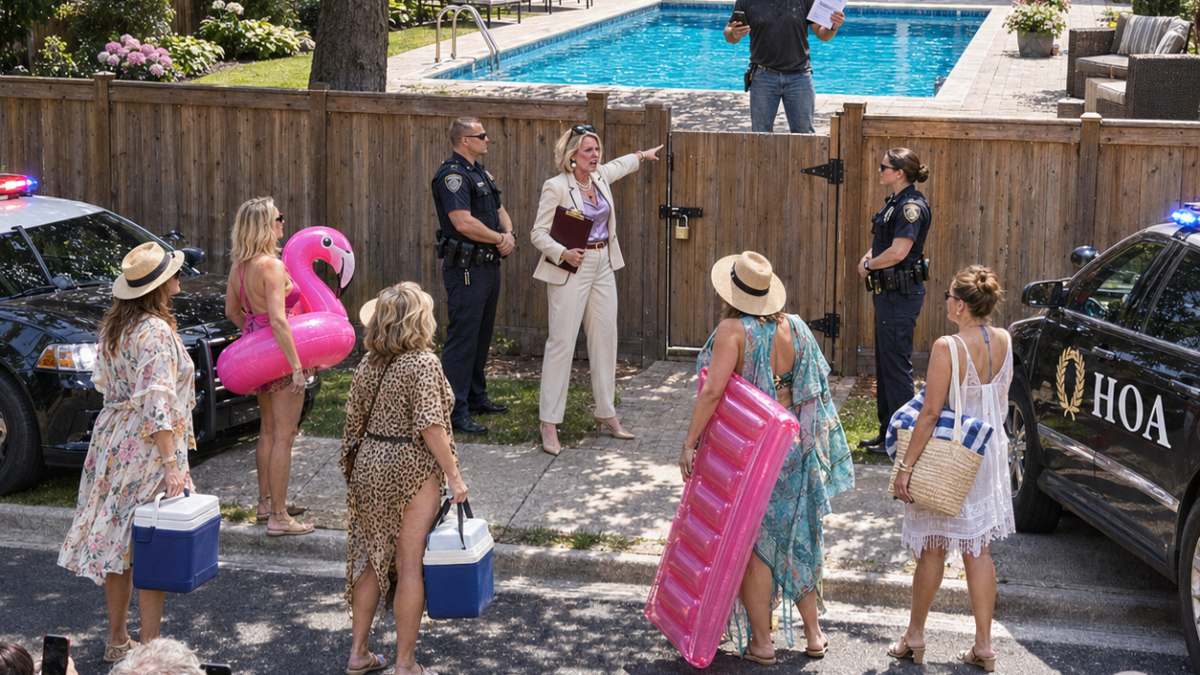
PART 2
I sat there staring at the screen.
The label didn’t make sense.
My closing packet contained a certified survey.
The title company had reviewed the parcel.
The appraiser had photographed the pool and listed it as a private residential improvement.
There was no easement around it.
No shared recreational designation.
No HOA ownership interest.
Nothing.
Yet the county’s online map showed a pending change that seemed to carve the pool area away from the rest of my backyard.
I clicked the information icon.
A submission number appeared.
I wrote it down.
Then I opened the county archive.
The current parcel map had five historical versions.
I started with the most recent and worked backward.
Six months ago: no dotted line.
One year ago: no dotted line.
Five years ago: nothing.
Ten years ago: private residential parcel, exactly as my paper survey showed.
The strange notation had appeared only in the pending layer.
That mattered.
It meant the county had not approved anything.
Someone had submitted something.
That was different.
I clicked the application detail.
A name appeared beneath AUTHORIZED REPRESENTATIVE.
William Harlan.
I didn’t recognize it.
Under TITLE:
Oakridge Estates Board Secretary.
There was only one problem.
When I searched the HOA website, William Harlan wasn’t on the board.
Not president.
Not secretary.
Not anything.
The current secretary was a woman named Lisa Vaughn.
I went through archived HOA newsletters.
William had served on the board years earlier.
Then I found his resignation announcement.
Five years ago.
I leaned back from the computer.
“That’s interesting.”
I called the former owner, Robert Ellis.
He answered on the third ring.
“Grant?”
“Sorry to bother you again.”
“Don’t tell me the pool woman came back.”
“Worse.”
I explained what I had found.
Robert went quiet.
Finally he said, “I don’t know anything about that.”
“Did the HOA ever ask you for a shared-use easement?”
“No.”
“Any boundary adjustment?”
“No.”
“Any wellness project?”
There was a pause.
“Well.”
I sat straighter.
“What?”
“Karen talked about building community amenities.”
“When?”
“Maybe a year before we moved.”
“Did she mention my pool?”
“Once.”
My hand tightened around the phone.
“What did she say?”
“She said the neighborhood needed a community swimming facility and asked whether we’d ever consider selling a piece of the backyard.”
“And?”
“My wife laughed at her.”
“Seriously?”
“We told her no.”
“Did she come back?”
“More than once.”
That was new.
Robert continued.
“Karen kept saying it would raise everybody’s property values. She wanted to create some kind of wellness area. Yoga deck, small gym, pool access, maybe a clubhouse expansion. It sounded expensive and ridiculous.”
“Did the HOA vote?”
“Not while I was there.”
“Did you sign anything?”
“Absolutely not.”
“What about William Harlan?”
Another silence.
“That name sounds familiar.”
“He was secretary.”
“Oh. Right. He quit years ago.”
“Would he have had authority to submit a boundary request after resigning?”
Robert laughed once.
“No.”
I didn’t laugh.
“Grant?”
“Yeah?”
“You need a lawyer.”
“I was thinking the same thing.”
I ended the call and stared at the pending map again.
I had spent most of my working life in construction.
People think construction is all concrete, framing, steel, and machines.
Half of it is paperwork.
Permits.
Drawings.
Change orders.
Inspection reports.
Signatures.
A job can look perfect in the field and still become a disaster because one line on one document is wrong.
I knew what a bad paper trail looked like.
This looked worse.
I printed everything.
The parcel map.
The archived maps.
William Harlan’s old board position.
His resignation notice.
Robert’s email confirming the pool had never been shared.
The HOA violation letter.
The next morning, I went to the county clerk’s office before it opened.
At nine exactly, the doors unlocked.
A man with round glasses and a tired expression called me to the counter.
“What can I help you with?”
“I need the filing history for my parcel.”
I slid him the number.
He typed.
His expression changed.
“Hmm.”
That is not a sound you want a government clerk to make while looking at your property records.
“What?”
“There’s a pending supplemental filing.”
“I know.”
“You submitted this?”
“No.”
He looked at me.
“Are you the current owner?”
I gave him my driver’s license.
Then my deed.
He compared the names.
“Okay.”
He typed again.
“That’s odd.”
“Second ‘odd’ in thirty seconds.”
He ignored the joke.
“This application was submitted electronically.”
“By William Harlan?”
He looked at me sharply.
“You’ve already seen it?”
“Only the online record.”
He turned the screen slightly away.
“I can’t speculate about intent. But Mr. Harlan isn’t currently registered as an authorized association officer.”
“He hasn’t been for five years.”
The clerk adjusted his glasses.
“That would explain the validation issue.”
“What validation issue?”
“The filing never completed.”
“Why?”
“It lacks owner consent and adjoining-interest certifications.”
“So somebody tried to change the use status around my pool without the homeowner signing?”
He chose his words carefully.
“Someone submitted a request that could not be finalized because required signatures were missing.”
“Can I get a copy?”
“As the owner, yes.”
He printed it.
Then another page.
Then another.
I took the packet to a small table.
The first document was a proposed site modification.
My property.
My pool.
A dotted outline around approximately a third of the backyard.
PROPOSED SHARED-USE IMPROVEMENT ZONE.
My stomach tightened.
The second document was worse.
It described the pool as a “historically accessible recreational resource serving Oakridge Estates.”
That was false.
Robert had told me so.
The third page contained a signature block.
William Harlan.
HOA BOARD SECRETARY.
The submission date was three months before I bought the house.
I returned to the counter.
“Can I ask one more question?”
The clerk nodded.
“If Mr. Harlan resigned five years ago, how could his electronic authorization still work?”
“It shouldn’t.”
“Meaning?”
“The county system doesn’t keep inactive officer credentials indefinitely.”
“So someone could have uploaded an old document?”
“Possibly.”
“Or reused a signature image?”
“Possibly.”
“Would that be legal?”
He looked at me over the top of his glasses.
“That’s a question for an attorney.”
Fair enough.
My next stop was the county surveyor.
The surveyor’s name was Ben Wallace.
He was built like a retired linebacker, with a gray beard and the calm manner of a man who spent his career settling fights over invisible lines.
He pulled my parcel record.
“Oh.”
There was that sound again.
“You’ve seen this?”
“I remember the request.”
“What happened?”
“Rejected.”
“Immediately?”
“Not immediately. We sent it back for required approvals.”
“Mine?”
“Owner’s signature, yes. Depending on the proposed easement configuration, potentially additional acknowledgments.”
“I never signed anything.”
“That’s why it didn’t advance.”
“So the dotted line online—”
“Pending overlay. Not a legal boundary.”
I exhaled.
For the first time all morning, my shoulders dropped.
“They didn’t take anything.”
“No.”
“Could they?”
“Not like this.”
He looked at the file.
“To alter ownership, create a permanent easement, or record a binding use interest, you’d need appropriate legal instruments. Your HOA cannot simply redraw your residential lot because it likes your pool.”
That sentence should have made me feel safe.
Instead, it made me angry.
Because someone had tried.
“Can I get a letter confirming the request was rejected?”
“Yes.”
“And that I never authorized it?”
“We can confirm our records contain no owner authorization.”
“Good.”
Ben watched me gather my papers.
“You expecting a fight?”
“Already in one.”
He nodded toward the packet.
“Then keep originals.”
“I will.”
I sat in my truck outside the surveyor’s office and called Karen.
I don’t know why.
Maybe I wanted to hear whether she would lie when she didn’t have time to prepare.
She answered.
“What?”
No hello.
No surprise.
Just irritation.
“Karen, who’s William Harlan?”
Silence.
Not long.
Maybe two seconds.
But long enough.
“I don’t know what you’re talking about.”
“Former HOA secretary.”
“Oh. William.”
“You do know him.”
“He was on the board.”
“Five years ago.”
“So?”
“His name is on a county filing involving my pool.”
Another pause.
Then her voice changed.
“You went to the county?”
Not confusion.
Alarm.
I stared through the windshield.
“Yes.”
“You had no reason to do that.”
“I had every reason.”
“That filing isn’t your concern.”
“It involves my property.”
“It involves HOA planning.”
“Using a former officer’s authorization?”
“You don’t understand the process.”
“Then explain it.”
She inhaled sharply.
“Just unlock the gate.”
I almost laughed.
“What?”
“This entire thing goes away if you stop being difficult.”
There it was.
“Karen, why is my pool so important to you?”
“It’s important to the community.”
“No. It’s important to you.”
“You just moved here. You don’t understand what people expect.”
“I understand my deed.”
“You can’t fight the HOA over every little thing.”
“Forgery isn’t little.”
Her voice dropped.
“You should be careful using that word.”
“I should be careful?”
“You have no idea what you’re getting involved in.”
The line went dead.
I sat motionless.
She had not denied knowing about the filing.
She had not asked what filing.
She had not sounded surprised that William’s name was on it.
She had asked why I went to the county.
That told me more than anything else.
I drove home.
Karen was standing on her front lawn before I had shut my truck door.
“You really did it,” she said.
“Did what?”
“Went digging.”
I carried my folder toward the house.
“You left me a violation notice claiming my private pool belongs to everybody. Digging seemed reasonable.”
“You’re making this much harder than it needs to be.”
I stopped.
“For who?”
She stepped closer to the edge of her lawn.
“If you’d cooperate, the neighborhood would benefit.”
“By taking part of my property?”
“Nobody is taking anything.”
“Then why is there a proposed shared-use zone around my pool?”
Her mouth tightened.
“Planning documents aren’t ownership documents.”
“Good. Then withdraw them.”
“I can’t.”
“Can’t or won’t?”
She looked toward the street.
That tiny movement caught my attention.
For the first time since I met her, Karen seemed worried about being overheard.
“You don’t know how much work has gone into this.”
“Not my problem.”
“It will be.”
“That a threat?”
“No.”
She answered too quickly.
I stepped closer to my porch camera.
Karen noticed.
Her eyes went to the lens.
Then back to me.
“You think cameras protect you from everything?”
“No. They protect me from people lying about what happened.”
Her face hardened.
“Unlock the gate.”
“No.”
“Final answer?”
“Yes.”
She stared at me for several seconds.
Then walked home.
That evening I pulled every HOA document I could find online.
Budgets.
Newsletters.
Meeting summaries.
Capital improvement proposals.
Most of it was boring.
Fence guidelines.
Reserve studies.
Drainage repairs.
Streetlight replacement.
Then I found a phrase.
RIDGEVIEW WELLNESS EXPANSION.
The proposal was two years old.
Phase One described a landscaped gathering area, exercise deck, covered pavilion, and “future aquatic access.”
Future aquatic access.
I opened another meeting summary.
Karen’s name appeared repeatedly.
Vice President Reynolds discussed the need for a central community recreational asset.
Vice President Reynolds proposed researching existing water amenities near the planned corridor.
Vice President Reynolds requested preliminary cost analysis for shared aquatic infrastructure.
There was no HOA pool.
Except mine.
I opened a neighborhood map.
The proposed wellness corridor ended directly behind my backyard.
I sat there until nearly midnight.
What Karen had been calling tradition looked increasingly like groundwork.
If she could establish that residents had historically used my pool, she could argue that the HOA was preserving an existing community practice rather than creating a new amenity.
Would that magically give them ownership?
No.
But it could create pressure.
Confusion.
Litigation.
Maybe enough uncertainty to scare a homeowner into signing something.
Maybe that had been the plan with Robert.
Maybe they expected the new owner to be easier.
Me.
I remembered Karen floating on the pink lounger.
Gate was open.
We’re neighbors.
It’s basically community space.
She had been creating a story.
A story where my pool already belonged to everybody.
The next morning, I called a real-estate attorney.
His name was Tom Reeves.
Mid-fifties.
Gray at the temples.
No dramatic office.
No movie-star swagger.
Just three shelves of property-law books and a desk covered in yellow pads.
I put the entire folder in front of him.
He read quietly.
Every few pages he asked a question.
“Did you sign any HOA easement?”
“No.”
“Any covenant amendment?”
“No.”
“Did your title policy exclude the pool area?”
“No.”
“Previous owner confirm no community license?”
“In writing.”
“Police report from the gate incident?”
“Yes.”
“Security video?”
“Saved.”
He reached the pending county filing.
His eyes slowed.
“Where did you get this?”
“County clerk.”
He read William Harlan’s signature block.
“Former officer?”
“Resigned five years ago.”
Tom looked at me.
“That’s a problem.”
“For them?”
“Potentially.”
“Is it fraud?”
“Don’t jump ahead.”
“Karen told me to be careful using that word.”
“Then for once, take Karen’s advice.”
I frowned.
He smiled slightly.
“We call things what we can prove, not what we’re angry enough to believe.”
That was probably the moment I decided I trusted him.
“So what can we prove?”
Tom tapped the page.
“We can prove somebody submitted a proposed property-related filing using the name and purported authority of a person who was not an active board officer.”
He tapped another.
“We can prove the required owner consent wasn’t provided.”
Another.
“We can prove the previous owner disputes the claim of historical community access.”
Then the HOA notice.
“And we can prove the association is currently using the alleged shared status to accuse you of a violation.”
“Enough to stop them?”
“Probably.”
“Enough to find out who did it?”
“That takes records.”
“How?”
“We demand them.”
Tom outlined the plan.
First, send a formal records request to the HOA for every communication involving my parcel, the pool, Ridgeview Wellness Expansion, William Harlan, shared-use planning, and any county submission.
Second, notify my title insurer.
“They don’t like people creating phantom property interests,” Tom said.
Third, notify the county in writing that I disputed the pending filing and had never authorized it.
Fourth, preserve everything.
“No Facebook fights,” he said.
“I don’t use Facebook much.”
“Good.”
“No confronting Karen.”
“That one may be harder.”
“Make it easier.”
He leaned back.
“If there’s misconduct, angry homeowners ruin good cases by giving the other side noise to point at. Your advantage is paperwork.”
I understood paperwork.
“I can do that.”
“Good.”
Tom drafted the letter.
The HOA received it the next morning.
By noon, my phone rang.
The HOA president, Richard Bell, asked whether he and two board members could come over.
“Is Karen coming?”
“No.”
“Then yes.”
Richard arrived with the treasurer, Diane Mercer, and another board member named Alan.
They looked like people arriving to tell a family that a wedding venue had burned down.
We sat at my dining table.
Richard folded his hands.
“Mr. Grant, we’d like to de-escalate.”
“Retract the violation.”
“We’re reviewing that.”
“Then we’re not de-escalating.”
Diane looked at him.
Richard continued.
“There appears to have been confusion about the status of the pool.”
“No confusion on my side.”
“We relied on historical information.”
“From Karen.”
He didn’t answer.
I slid the county filing across the table.
“What historical information explains this?”
Diane’s face changed.
Alan leaned closer.
Richard didn’t touch the paper.
“You’ve obtained legal counsel?”
“Yes.”
“This escalation really isn’t necessary.”
“Somebody used a former board officer’s name to submit a shared-use proposal around my private pool.”
Richard swallowed.
“We’re investigating.”
Diane suddenly said, “This wasn’t my idea.”
Richard turned.
“Diane.”
“No. I’m not taking responsibility for this.”
She looked at me.
“Karen told us the previous owners had agreed in principle.”
“They didn’t.”
“She said they allowed community use for years.”
“They didn’t.”
Diane’s face went pale.
“She told us the county filing was administrative.”
“Using William Harlan’s authority?”
“I never saw that page.”
Richard said sharply, “That’s enough.”
Diane pushed back from the table.
“No, it isn’t.”
Nobody spoke.
She stood.
“I told Karen we needed written owner consent before anything moved forward. She said she was handling it.”
Richard closed his eyes.
There it was.
Not the whole truth.
But the first crack.
“Did the board vote to submit the county request?” I asked.
Diane shook her head.
Richard said, “We need to review our records.”
Tom had warned me not to argue.
So I didn’t.
I gathered the papers.
“My attorney’s letter gives you ten business days.”
Richard stood.
“We’ll respond sooner.”
They left.
Two hours later, my backyard camera alerted.
Karen stood outside the fence.
Not touching it.
Just staring through the slats toward the pool.
She remained there almost a minute.
Then she looked directly at the camera.
And smiled.
I saved the clip.
The next morning, a man named Mike Dawson knocked on my door.
He lived four houses down.
We had waved before.
That was about it.
He held his baseball cap in both hands.
“I thought you should know something.”
I invited him inside.
He sat at the kitchen counter.
“Karen’s going door to door.”
“Saying what?”
“That you’re trying to destroy the HOA.”
I laughed.
Mike didn’t.
“She says you’re going to bankrupt the association with legal fees.”
“I’m asking them to stop claiming my pool.”
“I know.”
“She says the pool has always been community property.”
“That’s what she’s telling people.”
I shook my head.
Mike stared at his cap.
“There’s something else.”
“What?”
“This isn’t the first time she has done this kind of thing.”
I waited.
“There was a guy named Peter Lawson. Lived on Brookfield Court.”
“What happened?”
“He challenged one of Karen’s pet projects.”
“What project?”
“Traffic gates.”
“And?”
“Suddenly he had violations every week.”
Mike started counting.
“Fence stain. Landscaping. Trailer in his driveway. Work van. Garbage cans. A shed she said was two inches over the approved height.”
“Two inches?”
“He appealed.”
“What happened?”
“More fines.”
“Did he sue?”
“No. His wife got sick of it. They sold.”
“How do you know Karen was behind it?”
Mike looked at me.
“She bragged.”
That quieted me.
“She told people?”
“Not everybody. Just people she trusted.”
“What did she say?”
“That Peter learned who actually runs Oakridge.”
I sat back.
For weeks, I’d viewed Karen as an entitled woman obsessed with my pool.
Now a different picture was forming.
She didn’t just push until someone said no.
She pushed until saying no became expensive.
The HOA wasn’t merely protection.
It was leverage.
Mike stood.
“Be careful.”
“I am.”
“No, I mean really.”
He looked toward the window.
“Karen doesn’t handle losing well.”
After he left, I made three copies of everything.
One stayed home.
One went to Tom.
One went into a safe-deposit box at my bank.
Maybe that was excessive.
At the time, it felt sensible.
Nine days after the records demand, the HOA sent its response.
The email subject line read:
PARTIAL PRODUCTION.
Tom called before I had finished opening the attachments.
“Don’t assume partial means sinister.”
“I wasn’t.”
“You were.”
“Maybe a little.”
There were hundreds of pages.
Budgets.
Minutes.
Email threads.
Vendor proposals.
Architectural sketches.
But strangely, very little about my parcel.
The Ridgeview Wellness Expansion appeared.
My pool did not.
William Harlan appeared in old records.
Not in any current submission.
Karen’s messages discussing shared amenities were missing.
The county filing was missing.
“What do you think?” I asked.
Tom was quiet.
“I think either their recordkeeping is terrible or this production is incomplete.”
“Which?”
“I don’t guess.”
“You say that a lot.”
“That’s why I still have a law license.”
He sent a follow-up identifying the omissions.
The HOA responded that no additional responsive documents existed.
That became harder to believe when I found an old public meeting summary on their own website.
It referred to:
“ongoing parcel-access discussions related to proposed aquatic integration.”
The date matched the county submission period.
I sent it to Tom.
His response came fifteen minutes later.
Good catch.
Then:
Do not contact Karen.
I wasn’t planning to.
Mostly.
I made a decision that evening.
If the board wanted to pretend nothing existed, I would stop letting the issue remain private.
Not through accusations.
Through documents.
I created an online folder containing only material I was legally comfortable sharing:
The public county filing.
The rejected status.
The old HOA meeting summary.
The previous owner’s written statement that the pool had never been shared.
My violation notice.
The police incident number from Karen’s 911 call.
I wrote no editorial.
No “Karen is a criminal.”
No dramatic labels.
Just filenames and dates.
Then I sent the link to every board member and copied the neighborhood association email directory.
Subject:
DOCUMENTS REGARDING 114 RIDGEVIEW DRIVE POOL DISPUTE.
My phone started ringing within twenty minutes.
I ignored most calls.
One email caught my attention.
From Lisa Vaughn.
Current HOA secretary.
Can we meet privately? There are things you don’t know.
I forwarded it to Tom.
He replied:
Meet in public. Don’t promise anything. Record only if lawful. Take notes.
The next afternoon I met Lisa at a coffee shop fifteen minutes away.
She chose a corner table.
When I arrived, she was already there.
She kept looking toward the door.
“You okay?” I asked.
“No.”
She wrapped both hands around her coffee.
“I should have said something earlier.”
“About what?”
“Karen.”
I waited.
Lisa stared at the foam in her cup.
“She has controlled the board for years.”
“She isn’t president.”
“She doesn’t need to be.”
“How?”
“Pressure.”
She gave a tired laugh.
“Exhaustion. Mostly.”
“Explain.”
“If someone disagrees, she finds a rule. If a board member questions her, suddenly that person has complaints from residents. If somebody wants to resign, she reminds them they can be blamed for unfinished projects.”
“Richard?”
“Scared of conflict.”
“Diane?”
“Scared of Karen.”
“And you?”
Lisa looked at me.
“Also scared of Karen.”
At least she was honest.
“Why my pool?”
Lisa exhaled slowly.
“The wellness expansion.”
“I know about it.”
“Not all of it.”
My shoulders tightened.
“What don’t I know?”
“Karen promised the board she could make it work without building a new pool.”
“How?”
“She said there was an existing amenity we could integrate.”
“Mine.”
Lisa nodded.
“Did the board approve taking my property?”
“No.”
“Did they approve the county filing?”
“Not the way it was submitted.”
“What does that mean?”
“We discussed preliminary feasibility.”
“That’s not what I asked.”
She looked down.
“No. There was no vote authorizing a filing under William’s name.”
“Did Karen do it?”
Lisa hesitated.
Then reached into her bag.
She removed a flash drive.
“I have emails.”
My pulse increased.
“What kind of emails?”
“Drafts. Messages. Voice notes.”
“Why do you have them?”
“Because I’m secretary.”
“Why weren’t they in the HOA production?”
She looked ashamed.
“Karen told Richard they weren’t official records.”
“Are they?”
“Yes.”
I didn’t touch the drive.
“Have you shown Tom?”
“No.”
“Then that’s the next step.”
Lisa looked relieved.
“You believe me?”
“I believe documents.”
That almost made her smile.
She slid the flash drive across the table.
“There’s something else.”
“What?”
“The money.”
My hand stopped halfway toward the drive.
“What money?”
“The wellness reserve.”
I stared at her.
“What wellness reserve?”
Lisa’s face tightened.
“That’s why I wanted to meet.”
We sat there another forty minutes.
She didn’t know everything.
That became clear quickly.
But she knew enough to make the pool dispute look small.
Two years earlier, the HOA had begun collecting money under broad “community enhancement” budget categories.
Not a separate special assessment with WELLNESS POOL printed across the top.
That would have attracted too much attention.
Instead, funds moved through reserve transfers, landscaping upgrades, planning fees, consulting expenses, and recreational development.
Karen had championed the spending.
Some services were real.
Concept drawings.
Preliminary landscaping consultation.
Insurance review.
But Lisa had noticed invoices that never seemed to correspond to anything physical.
“Why didn’t you question them?”
“I did.”
“What happened?”
“Karen told me the work was confidential until acquisition negotiations were complete.”
“Acquisition of my backyard?”
“She didn’t call it that.”
“What did she call it?”
“Integration.”
I almost laughed.
“Of course she did.”
Lisa continued.
“The amounts kept growing.”
“How much?”
“I don’t know.”
“Thousands?”
“Yes.”
“Tens of thousands?”
She looked away.
That was answer enough.
I called Tom from the parking lot.
He listened.
Then said, “Do not plug that flash drive into your computer.”
“Why?”
“Chain of custody. Metadata. Also basic cybersecurity.”
“Right.”
“Bring it here.”
I drove directly to his office.
Lisa met us there later and signed a statement explaining how she obtained the files through her role as secretary.
Tom made a forensic copy.
Then we started reading.
The first emails were mostly boring.
Karen pushing deadlines.
Karen berating vendors.
Karen telling board members the project needed “strong executive leadership.”
Then we found a message to Lisa.
We move forward regardless of homeowner cooperation. Historical use gives us leverage.
Another:
Once the parcel adjustment is active, resistance becomes a legal-cost problem, not an HOA problem.
Tom read that twice.
“That’s ugly.”
“Illegal?”
“Ugly first.”
He kept reading.
Then a message mentioning William Harlan.
Use prior template. No reason to rebuild documents from scratch.
Lisa had replied:
William isn’t secretary anymore.
Karen:
It’s a preliminary submission, not a final instrument. Stop making this harder than it is.
I felt heat climb into my face.
“She knew.”
Tom nodded.
“She certainly knew William wasn’t current.”
Then came the voice notes.
Karen sounded different in them.
Less polished.
More commanding.
One began:
“The board will vote how I tell them to vote. Richard folds every time anyone raises their voice.”
Lisa closed her eyes.
Another:
“We need the expansion on paper before the next financial review.”
Tom paused the recording.
“What financial review?”
Lisa swallowed.
“The annual reserve audit.”
He continued.
Karen’s voice returned.
“If the project is recognized as active, the expenditures make sense. If it isn’t, people start asking why we spent that money.”
Nobody spoke.
Tom replayed it.
“If the project is recognized as active, the expenditures make sense.”
I looked at him.
“That’s motive.”
“It’s a clue.”
“Tom.”
“I know what it sounds like.”
“What does it sound like?”
“That someone may have been using an unfinished project to justify expenses.”
“Missing money?”
“Maybe.”
Lisa whispered, “There are invoices.”
Tom looked at her.
“What invoices?”
“Consultants.”
“Who?”
“I don’t know all of them.”
“Related parties?”
“I don’t know.”
“Did Karen approve them?”
“Some.”
Tom leaned back.
Now he looked concerned.
“This is no longer just a property dispute.”
I had known that.
Hearing him say it made it real.
The following week became a blur.
Tom notified my title insurer about the disputed county filing.
Their counsel contacted the county recorder.
The recorder placed an administrative hold on the pending submission.
The HOA’s attorney received a preservation demand covering emails, drafts, invoices, vendor records, and board communications.
Lisa provided a sworn declaration.
Robert, the previous owner, signed an affidavit stating that he had never granted shared pool rights and had expressly rejected Karen’s proposal.
The county surveyor confirmed no owner authorization existed.
Then Karen came to my house.
It was after six.
My doorbell camera caught her before she knocked.
I opened the door but kept the storm door between us.
“This is your fault,” she said.
No greeting.
No pretense.
“Good evening to you too.”
“You sent those documents to everybody.”
“I sent public records.”
“You made the whole neighborhood think I’m a criminal.”
“I didn’t use that word.”
“You didn’t have to.”
“Then maybe you should explain the documents.”
Her jaw tightened.
“You have no idea what you’ve damaged.”
“My property?”
“The project.”
“What project?”
She stared at me.
We both knew.
I wanted her to say it.
“The wellness expansion.”
“My pool.”
“The community needs it.”
“The community needs my backyard?”
“You’re being deliberately simplistic.”
“I’m being deliberately possessive about property I own.”
“You could have negotiated.”
“You never asked.”
“We tried with Robert.”
“He said no.”
“He was unreasonable too.”
That told me something.
“Then the answer was no before I bought the house.”
Karen gripped the porch railing.
“You think communities grow by letting every individual homeowner veto progress?”
“When progress requires my land? Yes.”
“You don’t understand what was promised.”
“To who?”
She froze.
“What was promised, Karen?”
“Nothing.”
“You just said—”
“I misspoke.”
“Where did the money go?”
Her face changed completely.
Not anger.
Fear.
It flashed across her expression before she could hide it.
“What money?”
“The wellness reserve.”
“You have no right to HOA financial records.”
“Homeowners do.”
“You’ve been here three months.”
“And?”
“You don’t know anything.”
“Then explain it.”
She stepped closer to the storm door.
“You should stop.”
“Stop what?”
“Digging.”
“Why?”
“Because this is bigger than your pool.”
Her voice had dropped almost to a whisper.
I felt the hair rise along my arms.
“Bigger how?”
She looked at the camera.
Then at me.
“You think you caught me doing something stupid with a map.”
“I think somebody used a former board officer’s authority on a county submission.”
“You don’t understand what happens if this project dies.”
“What happens?”
She shook her head.
“You weren’t supposed to find any of this.”
The words hung between us.
Karen seemed to realize what she had said.
She stepped back.
“Good night.”
“Karen—”
She walked across the lawn without turning around.
I locked the door.
Then downloaded the doorbell footage immediately.
Tom called it “helpful but not a confession.”
I called it terrifying.
Two days later Lisa sent an email.
I’m ready to give you everything.
She did.
Thirty-four files.
Full email threads.
Vendor spreadsheets.
Board drafts.
Voice notes.
One spreadsheet listed payments from “Community Enhancement Planning” to three consulting businesses.
Tom’s investigator checked them.
One used a mailbox store.
One had been dissolved before two invoices were supposedly issued.
The third belonged to a relative of Karen’s former business partner.
That did not prove theft by itself.
But it justified questions.
A lot of them.
The association’s insurer demanded an independent forensic audit.
Richard finally stopped trying to “de-escalate” and hired outside counsel.
Diane resigned as treasurer.
Not from the board.
From the officer position.
She sent a neighborhood email admitting the financial controls had been inadequate.
Karen responded with fury.
She went door to door.
Mike called me after she visited his house.
“She says you fabricated the county records.”
“Good trick if I can alter county archives.”
“She says Lisa stole confidential documents.”
“Lisa’s attorney can deal with that.”
“She says Tom is trying to take over the HOA.”
I laughed.
“What does she say she wants?”
Mike paused.
“Community unity.”
That one made both of us laugh.
The jokes didn’t last.
Anonymous complaints started appearing.
Code enforcement received a report that my pool fence was unsafe.
It wasn’t.
The city inspected it anyway.
Passed.
Then an anonymous complaint alleged I was operating a construction business from my house.
I wasn’t.
Then someone reported excessive nighttime lighting.
My motion lights met code.
Passed again.
Tom told me not to react.
“Every failed complaint becomes part of the pattern.”
“I’d rather not have a pattern.”
“I know.”
The pressure got to me more than I admitted.
I stopped enjoying the backyard.
The pool stayed covered for almost a week even though the weather was perfect.
Every time a car slowed outside, I looked through the blinds.
Every notification from my camera tightened my stomach.
This was supposed to be the house where I finally rested.
Instead, I was building evidence folders at midnight.
One evening, Mike leaned over the fence.
“You look awful.”
“Thank you.”
“You eating?”
“Yes.”
“Sleeping?”
“Define sleeping.”
He nodded toward the pool cover.
“You know she won if you stop using it.”
“I know.”
“You keep saying that.”
I looked at him.
“Everybody keeps telling me what I know.”
He raised both hands.
“Fair.”
I sat on the patio.
Mike stayed on his side of the fence.
After a while he said, “You want to know why people didn’t stop her sooner?”
“Because they’re afraid?”
“Partly.”
He looked toward Karen’s house.
“Mostly because every individual thing was small.”
That made sense immediately.
A strange fine.
A threatening letter.
A bad meeting.
A neighbor moving.
A questionable expense.
A woman swimming in somebody else’s pool.
Each incident could be dismissed.
Misunderstanding.
Personality conflict.
Poor management.
But stacked together, they became something else.
Systems don’t become abusive in one giant moment.
They become abusive when everybody gets tired of objecting to little ones.
Three weeks after the first records demand, the forensic accountant issued an interim report to the HOA.
Tom received a copy because some of the expenditures related directly to the disputed wellness project.
He called me.
“Come in.”
“Bad?”
“For somebody.”
I drove downtown.
The report wasn’t final.
It was fifty-eight pages.
I understood maybe half the accounting language.
Tom translated.
Approximately forty thousand dollars in expenditures lacked adequate supporting documentation or had conflicts requiring further investigation.
Not every dollar was necessarily stolen.
That mattered.
Some might be legitimate expenses documented badly.
But several payments were serious enough that the accountant recommended referral to the association’s insurer and law enforcement.
One category stood out.
Recreational Asset Integration.
“What is that?” I asked.
Tom turned the page.
“According to the invoices, preliminary site planning, access analysis, vendor coordination, and community-use conversion.”
“For my pool?”
“That’s what the project map indicates.”
“They spent money preparing to use my property without permission.”
“Appears so.”
“Who got paid?”
“That’s the interesting part.”
He showed me.
Two vendors.
One was legitimate and had done limited concept work.
The second had received almost eighteen thousand dollars across multiple invoices.
The address led to a registered agent service.
The listed manager shared a last name with Karen’s former business partner.
Tom had already sent it to investigators.
I stared at the number.
“Why did she need the pool so badly?”
Tom tapped the report.
“Think about the voice note.”
If the project is recognized as active, the expenditures make sense.
He continued.
“If a substantial amount had already been booked to this expansion, killing the project forces everyone to ask what they paid for.”
“So she needed something physical.”
“Potentially.”
“A pool.”
“Potentially.”
“My pool.”
He nodded.
“Potentially.”
I hated that word.
But he was right to use it.
We didn’t know enough yet.
A week later, we knew more.
Lisa found an old presentation Karen had given privately to several board members.
The title:
RIDGEVIEW WELLNESS — PHASE I ACTIVATION.
Slide six showed a rendering.
A fitness deck.
Landscaping.
A walking path.
And a swimming pool.
My swimming pool.
The rendering had removed my fence.
Part of my patio had become a “community relaxation terrace.”
I stared at the image.
They had designed furniture placement on land they did not own.
There were umbrella tables where my grill sat.
Lounge chairs where I kept two planters.
A path cut through my side yard.
Tom watched my face.
“Breathe.”
“I’m breathing.”
“Not convincingly.”
I pointed at the rendering.
“They erased my fence.”
“Yes.”
“They designed around my house.”
“Yes.”
“Did Robert ever see this?”
“Not according to Lisa.”
I called him.
He had not.
When I emailed him the rendering, he phoned immediately.
“What the hell is that?”
“That was my reaction.”
“They made plans after I said no?”
“Looks like it.”
Robert swore for nearly a full minute.
Then became very quiet.
“My wife was sick when Karen kept coming around.”
I hadn’t known that part.
“She knew?”
“Yes.”
“She came by three times asking me to reconsider selling the pool strip. I finally told her to stay off the property.”
“Did she?”
“For a while.”
Robert’s voice tightened.
“My wife died eight months later. I put the house up for sale.”
I looked at the rendering again.
The proposed submission appeared before my purchase.
They had waited until the property changed hands.
Maybe Karen assumed grief and a sale had created an opportunity.
New owner.
Incomplete history.
Paperwork already prepared.
A story about longstanding community use.
Then I ruined it by locking a gate.
Tom assembled a formal complaint package for the county recorder’s fraud review team.
The association’s outside counsel delivered the accounting issues to the county prosecutor’s office.
Nobody promised arrests.
Nobody said Karen was going to prison.
Real investigations are slower and less satisfying than television.
Requests went out.
Interviews happened.
Records were preserved.
Bank statements were subpoenaed later.
The county removed the pending shared-use overlay from the public-facing parcel map while the filing was investigated.
That was the first concrete victory.
I printed the corrected map.
For a full minute, I just looked at it.
One clean lot line.
No dotted box.
No pending shared zone.
My backyard again.
Legally, it had never stopped being mine.
Emotionally, seeing the clean map mattered.
Karen saw it too.
Her reaction came the same day.
At 6:14 p.m., my backyard camera alerted.
She stood outside the gate.
Hands at her sides.
No screaming.
No rattling.
She stared through the fence toward the pool.
Then she looked at the camera.
The anger was gone.
What I saw instead was desperation.
Five minutes later she knocked on my front door.
I didn’t open it fully.
“What?”
“You got the overlay removed.”
“The county suspended it.”
“You’re proud of yourself?”
“I feel pretty good about having accurate property records.”
“You have no idea what you just did.”
“You keep saying things like that without explaining.”
“The neighborhood needed that project.”
“You needed that project.”
She flinched.
I continued.
“Was the audit the deadline?”
Her face went still.
“Lisa told you.”
“Lisa gave investigators records.”
“You’re destroying people who trusted you.”
“I’ve lived here three months. Nobody trusted me.”
“They trusted the board.”
“Did they trust you to spend forty thousand dollars they can’t explain?”
Her eyes widened.
There.
I had hit the right thing.
“I didn’t steal anything.”
It was the first time she had used the word steal.
I hadn’t.
“I didn’t say you did.”
Her mouth opened.
Closed.
I leaned closer.
“Why did you say that?”
“You’ve been spreading lies.”
“No. I’ve been sending documents.”
“This community would have had a pool, fitness area, new landscaping. Property values would have risen. Everybody would have benefited.”
“Except the guy whose yard you planned to use.”
“You could have been compensated.”
“Nobody offered.”
“You refused before negotiations could happen.”
“I refused trespassing.”
She grabbed the porch rail.
“Do you know how much money has already gone into this?”
There it was again.
“How much?”
“That’s not what I meant.”
“How much, Karen?”
She stepped back.
“You think you won because you closed a gate.”
“I never thought this was a contest.”
“It is now.”
She walked away.
I saved that footage too.
The emergency HOA meeting happened almost a month later.
By then, rumors had spread everywhere.
Financial misconduct.
Forged records.
Unauthorized filings.
Vendor conflicts.
Some rumors were accurate.
Some were ridiculous.
One neighbor claimed Karen had stolen two hundred thousand dollars and bought a vacation condo.
No evidence supported that.
Another said the entire board was about to be arrested.
Also wrong.
Tom repeatedly warned me not to repeat anything I couldn’t prove.
The association rented the community-center gym because the clubhouse was too small.
Nearly every homeowner showed up.
I arrived with Tom.
Lisa sat near the front beside her attorney.
Diane was three rows back.
Richard stood at a folding table with the association’s outside counsel.
Karen was there too.
She wore a dark blazer.
No sunglasses.
No dramatic pool clothes.
No clipboard.
Just a stack of papers held tightly against her chest.
When she saw me, she looked away.
Richard called the meeting to order.
The microphone squealed.
People complained.
Someone shouted, “Tell us where the money went.”
The association lawyer took over.
“We are here to provide an update regarding the Ridgeview Wellness project, disputed property filings, and an independent financial review.”
Karen stood.
“This entire process has been contaminated by one disgruntled homeowner.”
The lawyer said, “Karen, please sit down.”
“I will not sit down while I’m being defamed.”
Lisa looked at the floor.
Richard rubbed his forehead.
Karen continued.
“Mr. Grant has manipulated private records, harassed board members, and used legal threats to undermine a project approved for community benefit.”
I stood.
Tom put one hand on my arm.
“Don’t.”
I sat back.
The lawyer handled it.
“For clarity, no final membership approval for acquisition of Mr. Grant’s property has been produced.”
Karen said, “It wasn’t acquisition.”
“What was it?”
“Shared-use integration.”
A voice from the audience called:
“You can’t integrate somebody else’s backyard.”
Laughter broke out.
Karen turned red.
The lawyer continued.
“The county has confirmed the pending filing lacked required owner authorization.”
Karen lifted papers.
“Preliminary filings do not require final authorization.”
“Some preliminary inquiries do not. The submission at issue represented William Harlan as a current board officer.”
Silence.
Karen’s fingers tightened around the papers.
“He prepared the original template.”
“He resigned five years before the submission.”
“That doesn’t invalidate historical work.”
“No,” the lawyer said. “But using his name and title on a current submission raises obvious questions.”
More murmurs.
Then the side door opened.
Two people entered with a sheriff’s investigator.
Not uniforms rushing the stage.
No dramatic raid.
One woman wore an identification badge from the county recorder’s office.
The man beside her was an investigator attached to the prosecutor’s financial-crimes unit.
The deputy remained near the door.
The entire room seemed to inhale at once.
Karen stopped speaking.
The county official approached the association lawyer.
They whispered.
Then the investigator asked Karen to step outside.
She laughed nervously.
“Why?”
“We need to speak with you regarding the property filing and financial records.”
“Right now?”
“Yes.”
Her face changed.
“I have counsel.”
“You are entitled to contact your attorney.”
Karen looked around the gym.
For years, according to everyone I’d spoken with, she had been the person who decided who should be uncomfortable.
Now fifty homeowners were watching her experience it.
“This is because of him,” she said, pointing at me.
The investigator didn’t look at me.
“Ms. Reynolds, please come with us.”
“I didn’t do anything.”
Nobody responded.
“The project needed to move.”
Her lawyer, sitting along the wall, stood.
“Karen, stop talking.”
She ignored him.
“We had deadlines.”
“Karen.”
“If the audit happened before—”
Her lawyer crossed the room quickly.
“Stop.”
She finally did.
Too late.
The investigator guided her toward the side door.
She wasn’t handcuffed in the gym.
Not yet.
That part of the neighborhood rumor grew more dramatic every time it was retold.
What happened was simpler.
Karen left with her lawyer and investigators.
Several hours later, according to public booking records, she was arrested after an interview and processing of warrants that had already been approved based on the accumulated evidence.
That distinction mattered to me.
I didn’t expose some magical crime and cause instant justice.
A lot of people did their jobs.
Lisa spoke.
Tom pushed records.
Accountants traced money.
County employees checked filings.
Investigators interviewed witnesses.
And Karen kept leaving evidence.
The meeting continued without her.
It was ugly.
Homeowners demanded resignations.
Richard admitted the board had relied too heavily on Karen.
Someone shouted that “relied” was a polite word for cowardice.
Richard didn’t argue.
Diane stood and apologized.
“I should have questioned the spending.”
A woman near the back said, “You were treasurer.”
“I know.”
Diane’s voice broke.
“I kept telling myself the receipts would catch up. Then I told myself the next audit would fix it. Then I was afraid if I pushed harder Karen would turn the board against me.”
Nobody comforted her.
But nobody shouted either.
Lisa took the microphone.
“I have no excuse.”
She looked around the room.
“I was scared too. I saved the messages because I knew something was wrong. I should have spoken sooner.”
Mike leaned toward me.
“At least she did eventually.”
“Yeah.”
Richard announced that all current board officers would step aside from enforcement and financial authority while an interim committee and outside management firm took control.
Every violation related to my pool was suspended immediately.
Three days later, officially rescinded.
The association sent me a written apology.
It wasn’t poetic.
Lawyers had clearly drafted it.
But I didn’t need poetry.
The letter stated:
The Oakridge Estates Association recognizes that the swimming pool located at 114 Ridgeview Drive is privately owned and is not a community amenity.
I framed that sentence.
Not in the living room.
I’m not insane.
It went above my workbench.
The investigation lasted months.
That part rarely makes good stories.
People want the dramatic meeting.
The arrest.
The confrontation.
What comes afterward is mostly waiting.
Document requests.
Court dates.
Audit revisions.
Insurance letters.
Legal bills.
Karen was released pending proceedings.
A no-contact order kept her away from me.
For a while, she stayed in the neighborhood.
Her house was only two streets over.
I occasionally saw her SUV.
She never looked toward my property when she passed.
The forensic audit became final near the end of winter.
The number everybody repeated was approximately forty thousand dollars.
That was the amount investigators ultimately tied to unsupported or fraudulent expenditures serious enough to become part of the criminal case.
Some money had gone to legitimate planning.
Some had been moved through vendors with misleading descriptions.
Some had been paid for work that investigators concluded either had not occurred or could not be substantiated.
The state alleged Karen had diverted association money over several years and used the wellness expansion as both justification and cover.
The plan for my pool mattered because it would have created a visible project against which years of questionable “community enhancement” expenses could be explained.
Karen hadn’t simply wanted somewhere to swim.
She needed the project to exist.
She needed the neighborhood to believe the pool was already halfway communal.
She needed the board to stop asking what exactly it had been paying for.
And when I locked the gate, I didn’t just interrupt her afternoons.
I interrupted the story she needed the paperwork to tell.
That realization bothered me more than the trespassing.
Someone had looked at my home and seen accounting cover.
Not a house.
Not a person.
A line item.
The case did not take every board member down.
That mattered too.
Richard was negligent.
Weak.
Too willing to let Karen dominate.
But investigators did not charge him with stealing money.
Diane’s failures were serious governance failures, but the evidence supported fear and incompetence more than conspiracy.
Lisa became the most important witness.
William Harlan, whose old authorization had been reused, cooperated fully.
When investigators interviewed him, he reportedly reacted with genuine fury.
He signed an affidavit stating he had not submitted, authorized, or approved the recent county filing.
That transformed the signature issue from suspicious to much harder to explain.
Karen’s attorney fought several counts.
Some allegations were narrowed.
Others survived.
The civil side moved separately.
My title insurer paid legal costs associated with clearing the disputed filing.
The HOA’s insurer funded portions of the association investigation.
The association later pursued restitution for misappropriated money.
My direct claim was simpler.
Trespass.
Harassment.
Improper violation notices.
Legal expenses.
We settled without trial.
The HOA reimbursed part of my attorney fees, erased every fine, and agreed in writing that no association representative could enter or inspect my backyard without my consent except where governing documents and actual emergency law clearly allowed it.
Karen’s criminal case ended the following year.
I attended sentencing.
Not because Tom thought I needed to.
He actually suggested I didn’t.
I went because I wanted the last chapter to happen somewhere other than my imagination.
Karen entered the courtroom wearing a plain navy suit.
No sunglasses.
No sharp HOA voice.
She looked older.
Smaller.
Her hair was pulled back.
She sat beside her attorney and barely turned toward the gallery.
The prosecutor described the property filing.
The vendor payments.
The false documentation.
The misused association funds.
The pattern of pressure surrounding the wellness project.
Karen’s attorney argued that she had begun with legitimate intentions.
That part interested me.
He said she genuinely believed Oakridge needed shared recreational facilities and that, over time, she began making increasingly improper choices to protect a project she had tied to her own reputation.
In other words, she hadn’t awakened one morning deciding to become a criminal mastermind.
She started wanting something.
Then decided rules were obstacles.
Then decided people were obstacles.
Then decided paperwork could be bent because the goal was worth it.
Then she needed money already spent to make sense.
Then she needed the pool.
Then she needed me to give up.
One bad decision built scaffolding for the next.
I understood that better than I wanted to.
When Karen finally spoke, she didn’t apologize to me directly.
She apologized to “the community.”
She said she had allowed pressure to distort her judgment.
The judge didn’t look impressed.
“You did more than exercise poor judgment,” he said. “You repeatedly treated authority entrusted to you as personal authority.”
That sentence stayed with me.
The final sentence included incarceration, restitution, and supervised conditions after release.
The combined custodial term was eighteen months.
There were additional financial orders related to the HOA losses.
Some charges had been consolidated.
Others were resolved as part of the plea.
When the judge finished, Karen sat very still.
I expected satisfaction.
I had imagined that moment many times.
Karen finally unable to argue.
Unable to call the board.
Unable to call 911 and rewrite the story.
But I didn’t feel victorious.
Mostly, I felt tired.
Tom leaned toward me.
“You okay?”
“Yeah.”
“You sure?”
I looked at Karen.
“I’m done.”
And I was.
Outside the courthouse, reporters weren’t waiting.
There were no crowds.
No dramatic rain.
Just traffic.
People carrying coffee.
A delivery truck blocking half a loading zone.
Ordinary life.
I drove home.
The pool was covered for winter.
One brown leaf rested in the center of the cover.
I stood at the gate.
The lock Karen once shook so violently was still there.
Same metal.
Same scratches.
I touched it.
For months, that gate had felt like a border checkpoint.
Now it was just a gate.
The HOA rebuilt itself slowly.
“Rebuilt” is the right word.
Nobody trusted anybody enough to simply elect a new group and pretend the old problems were finished.
The association hired outside management for a year.
Financial statements went online.
Invoices above a set threshold required two approvals.
Board members had to disclose related-party vendors.
Meeting minutes became detailed enough that you could actually tell what happened.
And the new property rule passed unanimously:
No proposed change affecting an individually owned parcel, easement, access right, or private amenity could move forward without documented owner consent, professional review, and the voting procedures required by the governing documents.
It was an obvious rule.
The fact that it needed to be written said everything.
Lisa ran for the new board.
I asked why.
She laughed.
“Guilt, probably.”
“Bad reason.”
“Then let’s call it responsibility.”
“Better.”
She won.
Diane didn’t run.
Richard moved the following summer.
Before he left, he stopped at my house.
He stood outside the gate.
That detail mattered.
He didn’t walk in.
“I owe you an apology.”
“You already sent one.”
“The lawyers sent one.”
“Fair.”
He looked toward the pool.
“I should have stopped Karen.”
“Yes.”
He nodded.
No excuses.
That surprised me.
“I kept thinking keeping the peace was my job.”
“Wasn’t it?”
“I confused peace with avoiding conflict.”
I understood that.
“Karen made conflict exhausting.”
“She did.”
“So whenever she pushed, you let somebody else absorb it.”
He looked down.
“Yes.”
We stood in silence.
Finally I said, “I appreciate you saying it.”
He offered his hand.
I shook it.
That was enough.
Mike became one of my closest friends in the neighborhood.
It happened gradually.
A beer over the fence.
Helping him repair a sprinkler line.
Him helping me replace a section of gate Karen had damaged.
The day we installed the new latch, he held up the old one.
“Keeping this?”
“Why would I?”
“Historical artifact.”
“Trash.”
He tossed it into the garbage can.
I liked that.
Some things don’t need memorials.
The first warm Saturday of spring, I uncovered the pool.
The water underneath was dark and ugly from winter.
I cleaned for hours.
Vacuum.
Filter.
Chemicals.
Leaves.
Scrubbing tile.
By late afternoon it was blue again.
Mike leaned over the fence.
“You getting in?”
“Water’s fifty-eight degrees.”
“So?”
“So I’m not twenty.”
He laughed.
Two weeks later, I finally swam.
No audience.
No inflatable flamingos.
No security alert.
No angry voice at the gate.
I walked down the steps and let the water reach my chest.
Then I pushed off.
For months, I had imagined reclaiming the pool would feel triumphant.
It didn’t.
It felt quiet.
Better.
I floated on my back beneath the maple tree.
The branches moved slowly against the sky.
I could hear someone mowing a lawn three houses away.
A child laughing.
Mike arguing with his grill.
Normal sounds.
I closed my eyes.
The pool had never mattered because it was expensive.
It mattered because it represented the first thing I had bought purely for peace.
Not investment.
Not work.
Not necessity.
Peace.
Karen had turned it into evidence.
Then the HOA turned it into a development asset.
Then lawyers turned it into a parcel description.
Then investigators turned it into motive.
Now it was water again.
That was what I wanted.
Later that summer, Oakridge held its first truly open neighborhood meeting.
No mandatory attendance.
No shouting.
No Karen at the front.
People sat in folding chairs with paper plates and iced tea.
Lisa gave an audit update.
A resident asked why the new rules were so strict about private property.
Lisa looked at me.
I shook my head.
She smiled.
“You want to explain?”
“Not especially.”
People laughed.
I stood anyway.
I told them the short version.
Not the criminal case.
Not every ugly detail.
Just the part that mattered.
“I bought a house with a private pool. Someone decided the community had a better use for it than I did. Instead of asking, they started acting as if permission was inevitable.”
Nobody spoke.
“So if there’s one thing I hope we keep from this, it’s simple. Ask. Document. Vote when you’re supposed to vote. And when somebody says no about property that belongs to them, don’t treat that as the beginning of negotiations unless they invite you to.”
A man near the back stood.
I recognized him but didn’t know his name.
“I’m sorry.”
“For what?”
“For believing Karen when she said you were trying to steal community property.”
Another woman spoke.
“I believed her too.”
Then Mike said, “I believed she was crazy from the beginning.”
Everybody laughed.
The tension broke.
I sat down.
Nobody applauded.
I’m glad they didn’t.
I didn’t want to be a hero.
Heroes get volunteered for committees.
I wanted neighbors who understood boundaries.
That’s all.
By the end of the year, Oakridge felt different.
People attended meetings.
Not everybody.
That would have been suspicious.
But enough.
Residents asked questions about budgets.
Invoices were posted.
Board votes happened in the open.
Violations became boring again.
Grass.
Parking.
Fence colors.
The sorts of things an HOA should argue about if it insists on existing.
Karen’s house was eventually sold.
Her sister handled most of it while Karen’s legal case continued.
A family with two boys moved in.
The first week, one of the boys kicked a soccer ball over my fence.
I heard a knock.
A kid stood on my porch.
“Sorry, Mr. Grant.”
“For what?”
“My ball went in your yard.”
“Okay.”
“Can I get it?”
I stared at him for a second.
He looked nervous.
Then I smiled.
“Yeah. Come on.”
I unlocked the gate.
He waited until I opened it.
He did not walk around me.
He did not announce that children had historically enjoyed access to my landscaping.
He did not produce an HOA filing.
He retrieved his ball.
“Thanks.”
“You’re welcome.”
He ran home.
I stood beside the open gate laughing to myself.
A ten-year-old understood property law better than Karen had pretended to.
That fall, I closed the pool for winter.
The same job that had started the entire nightmare.
I drained the lines.
Cleaned the filter.
Covered the water.
Checked the equipment.
Then I walked to the gate.
For a second, I remembered that morning.
Karen shaking the metal.
Calling 911.
Accusing me of keeping her out.
She had been right about one thing.
I was keeping her out.
I had just never understood why she was so desperate to get in.
By the time I discovered the answer, the pool itself had almost become secondary.
It was never really about water.
It was about what happens when someone with a little authority decides consent is inconvenient.
Karen believed the board would follow her because it always had.
She believed the county filing would slide through because nobody would look closely.
She believed Robert’s refusal could be erased by a change of ownership.
She believed I would accept the violation letter because most homeowners didn’t have the time, money, or energy to fight.
Most importantly, she believed everybody else would remain isolated.
That was the mistake.
A clerk noticed an inactive officer name.
A surveyor confirmed missing signatures.
A previous owner spoke up.
Mike told me about the pattern.
Lisa finally handed over the records.
Tom knew where to push.
Accountants followed money.
Investigators followed documents.
Neighbors stopped being afraid separately.
No single dramatic act brought Karen down.
The opposite happened.
Dozens of ordinary acts finally stacked higher than her intimidation.
I locked the gate.
Click.
For months, that sound had meant defense.
That evening it meant nothing more than the pool was closed for winter.
I walked toward the house.
Halfway across the patio, I realized I hadn’t tugged the gate twice to make sure it was secure.
I hadn’t checked the camera.
I hadn’t looked toward Karen’s old house.
I hadn’t thought about the HOA.
So I kept walking.
Behind me, the covered pool sat quietly beneath the maple tree, exactly where it had always been, completely ordinary and completely mine.
[END OF STORY]








