PART 2: HOA Karen Called 911 When I Locked My Own Pool—Then I Found the Forged Papers Behind Her “Community” Claim
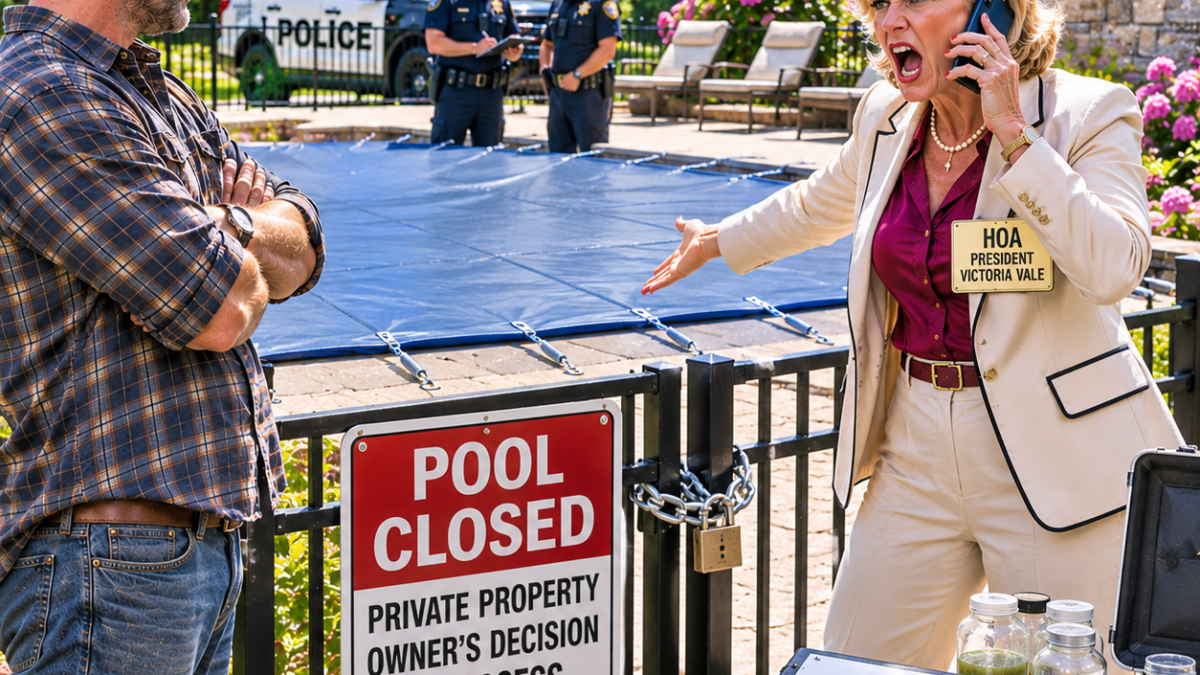
The first time Karen Reynolds called 911 on me, I was standing beside my own swimming pool with a padlock in one hand and the deed to my house sitting safely inside the kitchen, while she screamed from the other side of the fence that I was illegally blocking residents from “community property.”
She had already climbed into my backyard more than once, brought friends into the water without permission, ignored every warning I gave her, and somehow convinced herself that because the previous owners had once tolerated neighbors around the pool, she had inherited a permanent right to use something I had spent twenty-five years working to own.
What I didn’t know yet was why she cared so desperately about that pool—or why the people running my HOA suddenly became nervous every time I asked them to prove that any part of my backyard belonged to them.
My name is Daniel Grant, and when I bought the house in Ridgeview Estates, the pool was one of the reasons I signed the papers.
It wasn’t huge.
No waterfall.
No fancy resort design.
Just a clean rectangular pool behind a cedar fence, with a small stone patio, two maple trees, and enough privacy that I could sit outside after work without hearing anyone except birds and the low hum of the filter.
After twenty-five years in construction management, side jobs, overtime, and more six-day workweeks than I wanted to remember, it felt like a reward.
A little rectangle of blue that said I had finally made it somewhere.
Three weeks after moving in, I stepped outside with coffee and found a woman floating in it.
She wore oversized sunglasses and rested on a neon-pink lounger with a drink balanced against her stomach.
For a second, I honestly wondered whether I had walked into the wrong backyard.
“Can I help you?”
She barely lifted her head.
“The gate was open.”
I stared at her.
“Yes. But this is my yard.”
She sighed.
“We’re neighbors. It’s basically community space.”
That was my introduction to Karen Reynolds.
Vice president of the Ridgeview Estates HOA.
Professional boundary tester.
She climbed out of the pool as though I had inconvenienced her.
I explained politely that the property was private.
She told me I was being territorial.
The next afternoon, she returned.
Then again.
One day she brought another woman.
Two days later, she brought three friends and a cooler.
Each time, I told her the same thing.
“This is private property.”
And every time, Karen produced another excuse.
“The old owners let people use it.”
“There’s a neighborhood tradition.”
“This area has always been treated as shared.”
None of it matched my closing documents.
I called the previous owners.
They confirmed the pool had always been private.
I checked my deed.
Private.
The survey.
Private.
The appraisal.
Private.
So I changed the gate lock.
Installed cameras.
Added motion lights.
And mounted a sign that read:
PRIVATE PROPERTY — NO UNAUTHORIZED POOL ACCESS.
For two peaceful days, nobody came in.
On the third afternoon, my phone buzzed.
Motion detected.
Karen stood outside the gate.
She yanked the handle.
Shook the metal frame.
Pulled again.
Then leaned toward the camera.
“This is unbelievable.”
I watched from inside.
She paced.
Tried the latch again.
Then took out her phone.
A minute later, I heard her yelling.
“Yes, 911? There’s a man here threatening residents and blocking access to a shared community facility.”
I actually looked around my own kitchen.
A shared community facility?
Apparently my mortgage company had forgotten to mention that.
Two patrol cars arrived.
Karen ran toward them before the doors were fully open.
“That’s him!”
She pointed at me as I stepped onto my porch.
“He locked us out. He’s aggressive. He’s trying to intimidate the neighborhood.”
The older officer looked tired before anyone had even spoken to him.
“Sir, are you the homeowner?”
“Yes.”
I showed him identification.
Then the property records on my phone.
Then the camera footage of Karen shaking the locked gate.
The younger officer watched it twice.
When he turned back toward her, Karen’s confidence had changed.
“Ma’am,” he said, “this gentleman owns the property.”
Karen crossed her arms.
“The HOA recognizes that pool as shared.”
“Do you have documentation?”
Her mouth opened.
Nothing came out.
The older officer pointed toward my gate.
“He has every right to secure his backyard. You do not have permission to enter.”
Karen’s face flushed.
“He’s doing this deliberately.”
I looked at the padlock.
“That’s generally why people lock things.”
The younger officer almost smiled.
Karen did not.
And before she stormed away, she turned toward me and said something I would remember much later.
“You have no idea what you’re interfering with.”
At the time, I thought it was another threat from an entitled neighbor.
By the following morning, I would realize it was something else entirely.
PART 2
The letter was waiting on my front door before eight the next morning.
Bright white paper.
Ridgeview Estates logo.
Bold heading.
NOTICE OF COMMUNITY VIOLATION.
I stood on my porch in pajama pants and read it twice because the first time I assumed I had misunderstood.
According to the HOA, I had violated community rules by “restricting resident access to a historically shared recreational amenity.”
My pool.
My fence.
My land.
The letter claimed I had interfered with “customary neighborhood access” and ordered me to remove the new gate lock within seventy-two hours.
At the bottom were two signatures.
The HOA president, Charles Benton.
And beneath his:
Karen Reynolds
Vice President
I laughed.
Then I stopped laughing.
Because Karen could write whatever fantasy she wanted.
Charles signing it made the fantasy official.
I went inside, opened the closing folder, and spread everything across my kitchen table.
Warranty deed.
Title report.
Survey.
Pool permit.
Property tax map.
Homeowner’s insurance documentation.
Not one document described my pool as shared.
Not one easement crossed that portion of the backyard.
Not one HOA provision granted residents access.
I called Charles.
He answered on the fourth ring.
“Charles Benton.”
“This is Daniel Grant.”
A pause.
“Good morning, Mr. Grant.”
“I received your pool notice.”
“Yes.”
“I’d like you to explain it.”
“Well, there appears to be a disagreement regarding historical use.”
“There’s no disagreement.”
“Karen tells us—”
“I don’t care what Karen tells you. I’m asking what your records say.”
He became quieter.
“We’re reviewing them.”
“Then why did you send a violation before reviewing them?”
Another pause.
“Mr. Grant, perhaps you should attend the board meeting this afternoon.”
“I was planning to.”
“The board may be able to clarify—”
“I’ll bring the deed.”
“Good.”
“And the survey.”
“Fine.”
“And the police report from yesterday.”
Silence.
Then:
“That shouldn’t be necessary.”
“It shouldn’t have been necessary yesterday either.”
I hung up.
The HOA office sat near the entrance of Ridgeview Estates, beside a small clubhouse I had barely noticed before.
Perfect lawn.
Fresh mulch.
White columns.
A brass sign with the association name.
The sort of building designed to make power look friendly.
A receptionist named Marsha sat behind the desk.
When I showed her the violation notice, her expression changed instantly.
“Oh.”
“That sounds promising.”
She lowered her voice.
“You’re the pool house.”
“I prefer Daniel.”
A tiny smile appeared.
“Board’s meeting in the conference room.”
“Excellent.”
“You aren’t scheduled.”
“I’m sure they’ll survive.”
She hesitated, then stood.
“I’ll tell them you’re here.”
Before she could, Karen’s voice came through the closed conference-room door.
“He cannot be allowed to lock everyone out.”
Another voice answered.
“Karen, we don’t even know whether there’s a legal access right.”
“There has always been access.”
“Informal access isn’t necessarily legal access.”
Karen snapped back.
“If we let one homeowner do this, what happens next? Everyone fences off things the community uses?”
I opened the door.
Everyone stopped talking.
Karen sat at one end of the table.
Charles sat at the center.
Beside him were three other board members.
A thin woman with glasses.
A heavyset man in a golf shirt.
A younger woman who looked like she regretted volunteering for anything.
I held up the notice.
“Since my property is apparently the main topic, I figured I should join.”
Charles cleared his throat.
“Mr. Grant.”
“Daniel is fine.”
Karen crossed her arms.
“You were supposed to submit your documents.”
“I brought them.”
I set the folder on the table.
She barely glanced at it.
“The pool has been available to residents for years.”
“That’s not what the previous owners told me.”
Karen’s jaw tightened.
“They allowed community use.”
“Occasionally.”
“Regularly.”
“I spoke to them yesterday.”
Her eyes flickered.
Just for a second.
Charles reached for the deed.
“This states the property line includes the pool area.”
“Yes.”
The woman with glasses adjusted them.
“I’m Lisa Morgan. Secretary.”
“Nice to meet you.”
She studied the survey.
“There’s no easement shown here.”
“No.”
Karen leaned forward.
“Physical easements aren’t the only basis for community rights.”
I looked at her.
“What legal basis are you claiming?”
She hesitated.
“Historical use.”
“Adverse use?”
“No.”
“Recorded easement?”
“No.”
“Written agreement?”
“The HOA is reviewing—”
“That’s not an answer.”
Karen’s face reddened.
Charles held up a hand.
“Daniel, please.”
I looked at him.
“You signed a notice ordering me to unlock my backyard.”
“We relied on information presented to us.”
“By Karen?”
No one answered.
That was answer enough.
The treasurer, a woman named Susan Cole, cleared her throat.
“There may be archived documents related to a proposed recreation agreement.”
“Proposed?”
She looked toward Karen.
Karen answered.
“The previous owner participated in discussions.”
I turned to Susan.
“Was anything finalized?”
“I don’t know.”
Karen said, “The intent was clear.”
I laughed.
“Intent doesn’t transfer land.”
“Stop being hostile.”
“You called 911 yesterday.”
“I called because you were aggressive.”
“I was inside my house.”
“You intentionally locked residents out.”
“Of my property.”
“Community tradition matters.”
“So does a deed.”
Charles pinched the bridge of his nose.
“Enough.”
Karen looked at him sharply.
He continued.
“We will review the records.”
I crossed my arms.
“And the violation notice?”
“Temporarily suspended.”
“Retracted.”
“Daniel—”
“Retracted.”
Karen leaned forward.
“You don’t dictate to the board.”
I looked at her.
“No. And the board doesn’t dictate ownership of my pool.”
The room went silent.
Charles finally said:
“We’ll issue a temporary suspension pending document review.”
I almost pushed harder.
Then stopped.
Sometimes you get more information by letting people think they still have room to maneuver.
“Fine.”
I gathered my copies.
Karen smiled faintly.
She thought compromise meant weakness.
Before leaving, I turned to Charles.
“One more thing.”
“Yes?”
“No inspection.”
Karen laughed.
“If there’s an access dispute, the HOA has the right—”
I looked at her.
“If you enter my backyard without written permission, I’ll call the same police you called yesterday.”
Her smile vanished.
I left.
That night, I reviewed the closing documents again.
Everything was clean.
Too clean.
If the HOA genuinely believed they had rights, where was their paperwork?
Maybe Karen had invented the entire claim.
But Charles’s hesitation bothered me.
So did Susan’s phrase.
Archived documents.
I logged into the county property portal.
Pulled up parcel 14B.
My parcel.
At first, everything looked normal.
Lot outline.
House footprint.
Pool.
Detached shed.
Then I noticed something.
A faint dotted boundary surrounding the pool deck.
It wasn’t a standard parcel line.
The label read:
SHARED UTILITY / RECREATIONAL ACCESS — PENDING REVIEW.
I stared at it.
That line did not exist on my survey.
I opened the PDF map from closing.
No dotted boundary.
I refreshed the county portal.
Still there.
Pending review.
I clicked the filing history.
The request had been submitted six months before I bought the house.
That made no sense.
The title company had not flagged an easement because the request was unfinished.
But someone had started a process.
Someone had tried to designate part of the property as shared access.
I opened the supporting document.
HOA REQUEST FOR COMMUNITY USE RECLASSIFICATION.
The language was bureaucratic.
“Historic recreational use.”
“Community benefit.”
“Shared maintenance.”
“Neighborhood wellness.”
At the bottom was an authorization signature.
Martin Hale.
Former HOA president.
I remembered the name from a plaque inside the clubhouse.
Martin Hale had served five years earlier.
Yet the digital filing date was recent.
I sat back.
Something cold moved through me.
Maybe an old authorization had been uploaded.
Maybe there was a legitimate explanation.
I did not assume fraud.
Not yet.
I printed everything.
The next morning, I was at the county clerk’s office before it opened.
The clerk who helped me was named Peter.
Round glasses.
Navy sweater.
Expression of a man who had spent half his career explaining tax liens to people who believed yelling improved mathematics.
“I need the full filing history for parcel 14B.”
He typed.
“Property owner?”
“Yes.”
He checked my ID.
“Give me a minute.”
I waited.
Peter’s expression changed.
“Huh.”
“What?”
“There are two recent property-boundary submissions associated with this parcel.”
“Two?”
“One standard survey record from your closing.”
“And the other?”
He clicked.
“Community-use adjustment request.”
“That’s the one I’m asking about.”
He leaned closer.
“This wasn’t finalized.”
“Why not?”
“Missing required property-owner authorization.”
“So the HOA couldn’t do it without the owner.”
“Correct.”
I pointed toward the digital signature.
“What about this?”
Peter frowned.
“Martin Hale.”
“Wasn’t he HOA president years ago?”
Peter checked another record.
“His authorization status expired.”
“So how could his digital signature be used?”
“It shouldn’t have been.”
He said it casually.
Then the implications caught up with him.
He sat straighter.
“Do you know Mr. Hale?”
“No.”
“Is he still involved with the HOA?”
“Not as far as I know.”
Peter clicked through the audit log.
“This credential was uploaded as a document image, not a live authenticated signature.”
“What does that mean?”
“Someone attached a prior signature image.”
“Is that allowed?”
“Not as authorization.”
“So whoever filed this used an old signature?”
“Looks that way.”
My stomach tightened.
“Can I have certified copies?”
“Yes.”
He paused.
“You may also want to speak with the survey department.”
“I’m going there next.”
He printed the documents.
Before I left, he looked at me.
“Mr. Grant?”
“Yes?”
“If you didn’t authorize this, tell the surveyor clearly.”
“I will.”
The county survey office occupied another floor.
A man named Raymond Ellis reviewed the parcel number.
His face showed recognition.
“Ridgeview?”
“Yes.”
“I remember this one.”
“Why?”
“Because the application was unusual.”
“How?”
“HOAs normally don’t initiate boundary-use changes for privately owned recreational features.”
“What happened?”
“We rejected it.”
“Because?”
“Homeowner signature missing.”
“Anything else?”
“Adjacent-owner consent incomplete.”
“So there was never any legal right to my pool.”
“Not from this application.”
“Could there be another?”
“Not recorded here.”
I slid the HOA notice across his desk.
Raymond read it.
His eyebrows rose.
“They’re calling this shared?”
“Yes.”
He looked at the county map.
“That pending layer shouldn’t really be represented as an active right.”
“Can it be removed?”
“We can flag it as rejected and correct the public-facing map.”
“Please do.”
He nodded.
Then looked at the old Martin Hale signature.
“That’s concerning.”
“How concerning?”
“If someone knowingly submitted authorization they weren’t entitled to use, you should talk to counsel.”
That was the second government employee in one morning telling me this was not normal.
I left carrying a file thick enough to change the way I viewed my neighborhood.
Karen’s obsession with the pool no longer looked like entitlement.
Not entirely.
There was paperwork behind it.
Paperwork started before I moved in.
That meant the fight had started before I knew there was one.
On the drive home, I called the previous owner.
His name was Robert Lang.
He answered from Arizona.
“Daniel, everything okay with the house?”
“Did the HOA ever ask to convert the pool into a community amenity?”
Silence.
Then:
“They’re still doing that?”
My grip tightened around the steering wheel.
“So they did ask.”
“Karen did.”
“When?”
“Maybe a year and a half ago.”
“What exactly happened?”
Robert sighed.
“She came to me with some wellness-center proposal.”
“What proposal?”
“Yoga deck. Small fitness area. Landscaping. Access to the pool.”
“Did you agree?”
“Absolutely not.”
“Did you sign anything?”
“No.”
“Did Martin Hale?”
Robert laughed.
“Martin left the board years before that.”
“Did you know someone filed a county request using his signature?”
“No.”
His tone changed.
“Daniel, what did they do?”
I explained.
When I finished, Robert sounded angry.
“I told them in writing the pool was private.”
“Do you still have that?”
“Yes.”
“Send it.”
“I’ll send everything.”
Within an hour, my inbox filled.
Emails between Robert and Karen.
One subject line:
RIDGEVIEW WELLNESS EXPANSION — OPPORTUNITY FOR 14B.
Karen wrote:
The association believes integrating your pool into our proposed wellness plan would substantially increase neighborhood property values.
Robert answered:
No.
Not interested.
Pool is part of my private lot and will remain private.
Karen replied:
Perhaps we can revisit after community consultation.
Robert:
No consultation is required. It is my property.
Another message, three months later:
Karen:
We are exploring alternatives that may not require full conveyance.
Robert:
Do not contact me about my pool again.
I printed everything.
That afternoon, Karen stood on her lawn when I pulled into my driveway.
Arms crossed.
Sunglasses.
Expression tight.
“You went to the county.”
It wasn’t a question.
“I did.”
“Why?”
I stared at her.
“Because the HOA filed paperwork involving my property.”
“You’re making this bigger than it needs to be.”
“Someone used Martin Hale’s old signature.”
Her face changed.
Not much.
But enough.
“You don’t know what you’re talking about.”
“I know the filing was rejected.”
She stepped closer to the curb.
“That project was approved in concept.”
“By whom?”
“The board.”
“Not the owner.”
“You’re new here.”
“That doesn’t change ownership.”
“You’re disrupting years of planning.”
There.
Years of planning.
I kept my voice calm.
“For what?”
She realized she had said too much.
“The neighborhood.”
“What project?”
“You’ve seen the documents.”
“I’ve seen a vague wellness proposal.”
Karen’s jaw tightened.
“Ridgeview needs shared facilities.”
“Then build them on shared land.”
“We don’t have suitable land.”
“That sounds like an HOA problem.”
Her face flushed.
“You think you can move in and destroy everything people worked for?”
“I think I can lock my own gate.”
She took another step.
“You don’t understand what this project means.”
“To who?”
“Everyone.”
“To you?”
Her mouth tightened.
“Unlock the gate.”
“No.”
“You’re going to regret turning this into a legal fight.”
“If the paperwork is legitimate, you have nothing to worry about.”
For the first time, she looked frightened.
Not angry.
Frightened.
Then the expression disappeared.
“You can’t fight the HOA.”
“I’m not fighting the HOA.”
I lifted the county file.
“I’m fighting fraud.”
She turned and walked away.
Her front door slammed.
That evening, I found something else.
Buried in archived HOA meeting notes.
RIDGEVIEW WELLNESS EXPANSION.
Phase One:
Outdoor seating.
Small fitness pavilion.
Landscaped walking path.
Potential integration of existing recreational-water facility.
Existing recreational-water facility.
My pool.
The budget estimate stopped me.
Two hundred eighty thousand dollars.
Where was that money coming from?
I downloaded the association’s publicly available annual budgets.
There it was.
Community Enhancement Reserve.
For three years, the HOA had collected special assessments and transferred money into “future wellness infrastructure.”
Total allocated:
More than one hundred thousand dollars.
Yet nothing had been built.
No pavilion.
No yoga deck.
No walking path.
No land purchase.
Where was the money?
That question was outside my immediate property dispute, but it made the dispute more dangerous.
If the HOA had already collected money promising future community facilities, my pool might be the physical centerpiece they needed to justify those assessments.
I called a real estate attorney.
Thomas Reeves.
He had represented a contractor I knew in a boundary dispute.
His office was thirty minutes away.
I arrived with two binders.
He opened the first.
Then the second.
Twenty minutes passed.
He barely spoke.
Finally:
“Interesting.”
“That sounds expensive.”
“It often is.”
“Am I wrong?”
“No.”
He tapped the forged authorization.
“This is bad.”
“For them?”
“For whoever submitted it knowingly.”
He opened Robert’s emails.
“This helps.”
“How?”
“Clear written refusal.”
He studied the HOA violation.
“This is worse.”
“How?”
“They’re representing a private amenity as shared despite contrary title records.”
“Could they actually take it?”
“Not simply because they want it.”
“What if the filing went through?”
“You would still have legal remedies, but correcting a bad record after reliance becomes much more expensive.”
“So I caught it early.”
“Yes.”
I leaned back.
“What do you think is happening?”
Tom was careful.
“A few possibilities.”
He counted them.
“One, Karen is simply overreaching and the board incompetently believed her.”
“Possible.”
“Two, the board intended to pressure you into a voluntary access agreement.”
“Also possible.”
“Three, someone was trying to create enough documentary confusion that future owners, insurers, lenders, or local officials might treat this as a legitimate community claim.”
“That sounds deliberate.”
“It would be.”
“And the money?”
He looked at the budgets.
“That interests me.”
“Why?”
“Because the HOA appears to have collected funds for projects not yet completed.”
“Could be reserves.”
“Could be.”
“Or?”
“Could be something else.”
I waited.
“I don’t speculate without records.”
Of course.
Lawyers survive by disappointing dramatic people.
“What do we do?”
Tom closed the binder.
“Records demand.”
“To the HOA?”
“Everything related to your property, the wellness project, the boundary request, shared amenities, county filings, vendor payments, votes, and authorizations.”
“Can they refuse?”
“They can try.”
“And county?”
“We notify them in writing that the filing is disputed and potentially unauthorized.”
“Title company?”
“Yes.”
“My insurer?”
“Yes.”
“What about Karen?”
“Do not confront her unnecessarily.”
“I already did.”
Tom looked at me.
“How unnecessarily?”
“Moderately.”
He sighed.
“From now on, let paper do the talking.”
That afternoon, Tom sent the formal demand.
Copies went to Charles.
Karen.
All board members.
HOA management.
County property office.
My title insurer.
Robert Lang.
The response came the next morning.
Not from Karen.
From Charles.
He requested a meeting at my house.
At ten, Charles arrived with Susan and another board member named Doug Palmer.
No Karen.
That alone told me everything.
We sat at the dining table.
Charles looked exhausted.
“This has gotten out of hand.”
I placed the violation notice between us.
“It started out of hand.”
He ignored that.
“We believe there may have been procedural errors.”
“Forgery is a procedural error?”
Susan flinched.
Charles looked at her.
Then at me.
“We don’t know who uploaded that document.”
“Karen?”
“We don’t know.”
“Who initiated the community-access request?”
Silence.
Susan looked down.
Charles answered.
“Karen.”
“Did the board approve it?”
“In principle.”
“Did you vote to claim my pool?”
“No.”
“Then what did you vote on?”
“Exploration of possible recreational options.”
“Was my pool named?”
Susan spoke.
“Yes.”
Charles looked at her sharply.
She continued.
“It was.”
I sat back.
Charles exhaled.
“Susan.”
“He’s going to find it anyway.”
Good.
One honest person.
I looked at her.
“What exactly did Karen tell the board?”
Susan’s voice shook slightly.
“That Robert had been open to community use.”
“He wasn’t.”
“I know that now.”
“What else?”
“That the HOA had historical access.”
“False.”
“She showed us photographs of residents using the pool.”
“Robert hosted two neighborhood gatherings.”
Susan looked sick.
“She said it was regular.”
“What about the county filing?”
Charles answered quickly.
“The board did not authorize forgery.”
“That isn’t what I asked.”
He folded his hands.
“We authorized Karen to research whether the property could be integrated into the wellness plan.”
“Did you authorize submission?”
“No.”
Susan looked at him.
“You told her to proceed with preliminary paperwork.”
“Research.”
“You said paperwork.”
Charles’s face hardened.
This was unraveling faster than I expected.
I looked at Doug.
He had barely spoken.
“Did you know?”
“No.”
“About any filing?”
“No.”
“About old signatures being used?”
“No.”
He sounded genuine.
Charles leaned forward.
“Daniel, we want to resolve this.”
“Retract the violation.”
“We can.”
“Correct the county filing.”
“We can cooperate.”
“Confirm in writing the pool is private.”
“Yes.”
“Produce every requested record.”
Charles hesitated.
There it was.
“What’s the problem?”
“Volume.”
“Tom gave you ten days.”
“We may need more.”
“Ask him.”
Susan suddenly said:
“Karen is going to fight this.”
Charles glared at her again.
She ignored him.
“She thinks the wellness expansion is essential.”
“Why?”
Susan shook her head.
“She’s obsessed with it.”
“Why?”
“I don’t know.”
Charles stood.
“We’ll respond formally.”
I remained seated.
“You should.”
Before leaving, Susan quietly touched the edge of the table.
“I’m sorry.”
Charles heard her.
He said nothing.
Two hours later, my backyard camera pinged.
Karen stood beside the fence.
She did not touch it.
She stared through the slats.
At the pool.
Then she looked directly into the camera.
And smiled.
Not happy.
Not smug.
Something colder.
I saved the clip.
That evening, Mike O’Hara knocked on my door.
He lived four houses away.
Mid-forties.
IT consultant.
Quiet guy.
We had exchanged maybe six words since I moved in.
“Got a minute?”
“Sure.”
He stepped inside.
“Karen’s going door to door.”
“I assumed.”
“She says you’re trying to bankrupt the HOA.”
“I’m trying to keep my pool.”
“She says the neighborhood will lose the wellness project because of you.”
“There is no wellness project.”
Mike looked uncomfortable.
“That’s not what people were told.”
“What were they told?”
“That the association already secured the centerpiece.”
My stomach tightened.
“What centerpiece?”
He looked toward the backyard.
“Your pool.”
I laughed once.
Not because it was funny.
Because sometimes the only alternative is breaking something.
“They told residents they already had access?”
“Karen did.”
“When?”
“Last year.”
“Before I bought the house?”
“Yes.”
“Did Robert know?”
“No idea.”
I took out my phone.
“Would you say that to my attorney?”
Mike hesitated.
Then nodded.
“Yes.”
“Why now?”
He looked down.
“Because I watched her do this to someone else.”
“Who?”
“Mark Ellis. Lived on Cedar Way.”
“What happened?”
“He challenged a drainage assessment.”
“And?”
“Suddenly everything on his property violated something.”
“Everything?”
“Fence. Shed. Truck. Tree trimming. Satellite dish. Parking.”
“He moved?”
“Yes.”
“Karen?”
Mike looked directly at me.
“She bragged about wearing him down.”
That sat in the room like something rotten.
“Did Charles know?”
“I don’t know.”
“Anyone else?”
“Some.”
“Why didn’t people stop her?”
Mike gave me the same answer I would hear again and again.
“Because it was easier not to be next.”
I nodded.
Fear and convenience.
The twin foundations of every petty empire.
The HOA sent its first response to Tom the next morning.
Partial records.
Meeting minutes.
Old newsletters.
Some budget summaries.
No internal emails.
No draft boundary documents.
No attachments tied to the county application.
No correspondence between Karen and Robert.
No wellness-project vendor proposals.
Tom called me.
“They’re withholding.”
“Can they?”
“Not indefinitely.”
“Next step?”
“Formal deficiency notice.”
He paused.
“Do you want this public?”
“What do you mean?”
“They’re counting on residents not understanding the issue.”
“That sounds familiar.”
“Transparency changes pressure.”
I thought about Karen telling people I wanted to bankrupt the HOA.
“Do it.”
Tom advised me not to editorialize.
So I didn’t.
I created a folder containing only public documents and records I was legally entitled to share.
Original survey.
County map.
Rejected boundary application.
Robert’s written refusal.
Violation notice.
Police incident report.
Archived HOA wellness proposal.
Then I emailed a short message to homeowners.
Neighbors,
Because inaccurate claims are circulating regarding my pool and the ongoing property dispute, I am sharing the relevant documents here.
I am not asking anyone to take sides.
Please review them yourself.
—Daniel Grant
No accusations.
No adjectives.
No “Karen.”
Facts.
My phone began vibrating within twenty minutes.
Mike:
People are losing it.
George from the next street:
Is that signature really from Martin Hale?
Unknown number:
Call me.
Charles:
Please stop distributing internal association matters.
I replied:
The documents are public property records and correspondence relating to my property.
Then another message came.
Lisa Morgan.
Can we meet somewhere outside Ridgeview? There are things you don’t know.
We met at a coffee shop near the interstate.
Lisa chose a table in the corner.
She kept glancing toward the door.
“You okay?”
“No.”
“What happened?”
She slid her phone across the table.
“Karen’s been doing this for years.”
On the screen was an email chain.
Karen to board members.
Push the shared-use designation before the Lang sale closes. New owner can be dealt with afterward.
My hands tightened.
“Before I bought?”
“Yes.”
“Charles saw this?”
“Some messages.”
“Did he approve?”
“Sometimes he told her to slow down.”
“That’s not the same as stopping.”
“I know.”
“What did Karen mean by dealt with?”
Lisa looked ashamed.
“Pressure.”
“What kind?”
“Violations. Hearings. Legal warnings. Social pressure.”
“Did she say that?”
Lisa opened another message.
We cannot allow one homeowner to obstruct a community-wide investment. If the buyer resists, enforcement options may encourage cooperation.
I read it twice.
“That sounds like extortion with better grammar.”
Lisa gave a weak laugh.
“It gets worse.”
“Of course.”
She played a voice note.
Karen’s voice.
Calm.
Controlled.
“If we establish a usage pattern before closing, the new owner will have a harder time claiming exclusive control.”
My stomach turned.
That explained why she kept using the pool immediately after I moved in.
It wasn’t simply because she wanted to swim.
She was manufacturing a pattern.
Creating witnesses.
Building a story.
Lisa played another.
“The board will support the expansion once they see the dues projections.”
Another.
“We need the pool classified before the financial review.”
I stopped her.
“What financial review?”
“That’s the part I’m scared about.”
“Why?”
Lisa leaned closer.
“Karen controls most of the enhancement spending.”
“She’s vice president.”
“She also chairs the project committee.”
“How much money?”
“Maybe forty thousand missing.”
I stared.
“Missing?”
“Not officially.”
“What does that mean?”
“Budgeted.”
“For?”
“Consulting. Planning. Vendor assessments.”
“Work actually done?”
“Some.”
“And the rest?”
She shook her head.
“I don’t know.”
“Does Charles?”
“He knows things don’t reconcile.”
“Then why hasn’t he acted?”
“Because Karen told him the wellness project would absorb the discrepancies once construction started.”
I sat back.
Everything clicked.
If funds had already been spent—or stolen—under the label of planning and community enhancement, Karen needed a physical project.
A pool.
A pavilion.
Landscaping.
Something large enough to bury questionable expenses inside a legitimate construction budget.
My pool was not just convenient.
It was necessary.
“You have proof?”
Lisa looked terrified.
“Emails.”
“Voice messages?”
“Yes.”
“Financial records?”
“Some.”
“Will you give them to Tom?”
She hesitated.
Then nodded.
“I’m tired.”
That sentence carried years inside it.
“Tired of what?”
“Being afraid every time she calls.”
I watched her.
“She threatened you?”
“Not directly.”
“How?”
“She always knows where to apply pressure.”
“What pressure?”
“My husband runs a home business.”
I understood.
“HOA approval.”
“She reminds me whenever I disagree with her.”
I felt anger rise.
“Lisa, give the records to the attorney.”
She nodded.
“I will.”
“Today.”
“Yes.”
“And do not delete anything.”
“I won’t.”
When I returned home, Karen was standing near my gate again.
This time she walked straight to my porch.
I opened the door but did not invite her inside.
“This is your fault.”
“Good afternoon to you too.”
“You shared private board information.”
“I shared public records.”
“You’re turning people against us.”
“Us?”
“The board.”
“Lisa?”
Karen’s face changed.
Only slightly.
I knew.
She knew I knew.
“You’ve been talking to her.”
“I talk to neighbors.”
“Stay away from board members.”
“You don’t control who speaks to me.”
“You are destroying years of work.”
“What work?”
“You know.”
“The wellness project?”
Her eyes narrowed.
“Yes.”
“My pool is essential?”
“You have no idea how much planning has gone into this.”
“Then build something on HOA land.”
“We don’t have suitable land.”
“Still not my problem.”
“You’re selfish.”
“For owning the property I bought?”
“The community needs facilities.”
“Then the community can pay for facilities.”
“They have.”
I stared at her.
“What?”
She froze.
There.
Another mistake.
“They have what?”
“Nothing.”
“No. You said they have.”
Karen stepped closer.
“You’re twisting words.”
“How much money has the HOA already collected?”
Her face hardened.
“You don’t understand what’s coming.”
“What’s coming?”
She lowered her voice.
“You think this is about a swimming pool?”
I said nothing.
“You think this is about me?”
“What is it about?”
For a moment, her face collapsed.
Panic.
Pure panic.
Then:
“You should stop digging.”
“Why?”
She looked toward the street.
Then back at me.
“Because bigger people than me are involved.”
That sounded theatrical.
Maybe deliberate.
Maybe not.
“What people?”
She shook her head.
“I’m telling you for your own good.”
“No, you’re trying to scare me.”
She turned.
Before walking away, she said:
“If that audit starts before this project is approved, everything falls apart.”
She stopped.
Realized what she had said.
Then left.
I stood on the porch.
Audit.
Everything falls apart.
I called Tom.
He answered immediately.
“Karen just threatened me.”
“Physical?”
“No.”
“Tell me exactly.”
I did.
Silence.
Then:
“Lisa sent the files.”
“How bad?”
“Come to my office.”
I drove there.
Tom had printed spreadsheets across his conference table.
Enhancement Reserve.
Consulting payments.
Feasibility study.
Environmental assessment.
Design concept.
Legal planning.
Community wellness outreach.
Dozens of charges.
Some vendors were legitimate.
Others were strange.
One company shared an address with a mailbox store.
Another had no functioning website.
Another received twelve thousand dollars for “recreational integration strategy.”
“What is that?”
Tom shrugged.
“No deliverable provided.”
“Who approved it?”
He pointed.
Karen.
“Charles?”
“Some payments have his signature too.”
My stomach sank.
“Is he involved?”
“Not necessarily.”
“But?”
“Bad oversight at minimum.”
“What does Lisa say?”
“That Karen presented many of the expenses as preliminary project costs.”
“Could they just be messy accounting?”
“Yes.”
“Could they be theft?”
“Yes.”
I leaned back.
“What’s our role?”
“Property dispute first.”
“And the money?”
“I’m referring the records to appropriate authorities through counsel.”
“So now this is bigger.”
“Yes.”
I remembered Karen’s warning.
“Damn.”
Tom looked at me.
“She was right about one thing.”
“What?”
“This stopped being about your pool.”
Within forty-eight hours, the county formally flagged the boundary application.
My title insurer opened a fraud review.
The HOA received a second records demand.
Lisa provided a sworn statement.
Robert Lang confirmed again that he had never granted permanent access.
Martin Hale was contacted.
He was seventy-two and living in North Carolina.
Tom called me after speaking with him.
“He did not authorize anything.”
“Did he know his signature was used?”
“No.”
“Will he say that formally?”
“Yes.”
That ended any possibility of innocent paperwork confusion.
Someone had used an old signature without authorization.
The HOA announced an emergency meeting.
Not the clubhouse.
Too many residents.
They rented the gym at the community center.
Every homeowner received a notice.
MANDATORY SPECIAL MEETING — GOVERNANCE AND FINANCIAL REVIEW.
I arrived with Tom.
The parking lot was full.
Inside, neighbors sat in folding chairs arranged across the basketball court.
Some whispered.
Some looked angry.
Others looked frightened.
Karen stood near the front wearing a cream blazer.
Charles sat beside her.
Susan.
Doug.
Lisa sat farther away.
Not at the board table.
Karen saw me.
Her expression did not change.
But her hand tightened around the folder she carried.
Charles stepped to the microphone.
“We’re here tonight to address allegations involving property records, community project planning, and association finances.”
Murmurs.
He continued.
“I want to remind everyone that allegations are not conclusions.”
Karen whispered something to him.
He shook his head.
Then the side door opened.
Two county officials walked in.
Behind them was a sheriff’s deputy.
The room became silent.
Karen’s face drained.
The first official introduced herself.
“Rachel Simmons, county property compliance.”
The second:
“David Morales, community financial oversight.”
The deputy remained beside them.
Rachel spoke first.
“Our office has opened a formal inquiry into an unauthorized property-boundary filing associated with parcel 14B.”
Every head turned toward me.
I hated that.
She continued.
“The filing contained documentation attributed to a former HOA officer who has denied providing authorization.”
Karen stood.
“This meeting is becoming a public trial.”
Charles looked at her.
“Sit down.”
She stared at him.
He repeated:
“Karen. Sit.”
She did.
Rachel continued.
“The county map has been corrected pending investigation. No shared-use designation exists for the property.”
That was the first thing I wanted everyone to hear.
My pool was private.
Officially.
Publicly.
No ambiguity.
Then Morales stepped forward.
“Our office has also received records indicating potential irregularities in association enhancement spending.”
The gym erupted.
Charles raised both hands.
“Please.”
Morales continued.
“No conclusion has been reached. However, certain payments and authorizations require explanation.”
Karen stood again.
“This is outrageous.”
The deputy stepped slightly closer.
She noticed.
Sat again.
Lisa raised her hand.
Charles looked at her.
She stood.
“I need to say something.”
Karen whispered:
“Don’t.”
Lisa heard.
So did everyone nearby.
She looked at Karen.
Then at the room.
“For years, I went along with things I knew were wrong.”
The room quieted.
“Not because I wanted them.”
Her voice shook.
“Because I was afraid of what happened if I disagreed.”
Karen stood.
“That is a lie.”
Charles slammed the gavel.
“Karen!”
Lisa continued.
“She threatened enforcement actions against people who challenged her.”
“I never—”
“She told me Daniel could be pressured into signing access rights.”
Gasps.
Karen’s face twisted.
“She’s twisting private discussions.”
Lisa pulled out her phone.
“I have recordings.”
That ended the argument.
Tom leaned toward me.
“Don’t react.”
“I’m sitting.”
“Keep sitting.”
Lisa played the first voice note through the microphone.
Karen’s voice filled the gym.
“If we establish a usage pattern before closing, the new owner will have a harder time claiming exclusive control.”
People turned toward Karen.
She stood.
“That was strategic discussion!”
Another recording.
“If the buyer resists, enforcement options may encourage cooperation.”
Murmurs became anger.
Then the last.
“We need the expansion finalized before the audit. If they find out where the funds came from or where they went, I’m done.”
The gym became completely silent.
Karen stared at Lisa.
Betrayal.
Hatred.
Fear.
Charles looked like someone had hit him.
“What audit?”
Karen said nothing.
Morales stepped forward.
“That is part of our question.”
Karen backed away from the table.
“No.”
The deputy moved closer.
“Mrs. Reynolds.”
“This is a setup.”
“Ma’am.”
“He did this.”
She pointed at me.
Every face turned.
I stayed seated.
Karen’s voice rose.
“He moved in and started disrupting everything.”
The deputy said:
“Mrs. Reynolds, calm down.”
“He locked a community facility.”
Rachel said:
“The county has confirmed that facility is private.”
“No.”
Karen shook her head.
“No, you don’t understand.”
Charles stood.
“Karen, stop.”
She turned on him.
“You knew.”
His face changed.
“Knew what?”
“You approved the project.”
“I approved feasibility review.”
“You signed budgets.”
“Budgets you presented.”
“You knew the money was spent.”
The room erupted.
Charles shouted:
“I did not know you were using forged records!”
Karen froze.
Too late.
Everything was now public.
Morales turned toward Charles.
“You’ll need to provide a statement.”
Karen backed farther away.
“This isn’t happening.”
The deputy approached.
“Mrs. Reynolds, we need to speak privately.”
“No.”
“Ma’am.”
“You’re not arresting me.”
“I didn’t say that.”
“You came here for me.”
“We have questions.”
She pointed at me again.
“He engineered this.”
I stood.
Tom grabbed my arm.
“Don’t.”
I stayed where I was.
Karen’s voice cracked.
“I did everything for this neighborhood!”
Nobody answered.
“I got the landscaping fixed!”
Silence.
“I negotiated contracts!”
Silence.
“I kept property values high!”
Someone in the audience shouted:
“You tried to take his backyard!”
Karen spun.
“The community needed that pool!”
There it was.
Public.
Undeniable.
She continued, losing control.
“We already spent money planning the expansion!”
Morales became very still.
“How much?”
Karen’s mouth closed.
He repeated.
“How much money?”
“I want my attorney.”
Smartest thing she said all night.
The deputy nodded.
“That’s your right.”
Karen gathered her folder.
Then stopped.
Looked at me.
For one second, the room disappeared.
We were back at the gate.
Her shaking the lock.
Me wondering why a stranger cared so much about my pool.
Now I knew.
She didn’t just want to swim.
She needed the pool to make her plan real.
Without it, the paperwork remained paperwork.
The missing money remained missing.
The promises remained empty.
My locked gate had become the one physical object she could not manipulate.
She whispered:
“You ruined everything.”
I answered quietly.
“No.”
Her eyes filled.
“You did.”
“You called 911 because I locked my own gate.”
She said nothing.
“That’s where this started.”
The deputy guided her toward the side door.
Not handcuffed.
Not yet.
The crowd watched.
No cheers.
No applause.
Just stunned silence.
Tom leaned toward me.
“This is not over.”
I knew.
The audit took three months.
Three long months.
The HOA suspended normal board operations.
An interim committee handled basic expenses.
County investigators reviewed the filing.
Financial auditors traced payments.
Residents began coming forward.
One by one.
Mike told investigators about retaliatory fines.
A woman named Denise Porter described being threatened with architectural penalties after opposing Karen’s landscaping proposal.
An older couple named the Harpers produced emails showing Karen pressuring them to support a dues increase.
Robert Lang provided every message about the pool.
Martin Hale signed an affidavit confirming he never authorized the recent filing.
The numbers came later.
Nearly forty thousand dollars in association money could not initially be justified.
Some had gone to actual consultants.
Some to real planning work.
But thousands were tied to questionable invoices.
Companies that barely existed.
Services without deliverables.
Payments labeled:
Wellness outreach.
Boundary consulting.
Recreational transition planning.
Karen had been trying to create an entire project around an asset the HOA did not own.
My pool.
Without it, the spending looked absurd.
With it, she could have claimed the costs were part of development.
Tom explained it one afternoon.
“She needed the project to exist.”
“So the money could look legitimate.”
“Some of it.”
“She stole forty thousand?”
“Don’t simplify.”
“Why not?”
“Because investigators haven’t concluded every questionable dollar was stolen.”
“Fine.”
He pointed at the spreadsheet.
“Some payments may be unauthorized but not personally diverted.”
“Meaning?”
“Bad governance.”
“Not theft.”
“Correct.”
“And others?”
“Potentially criminal.”
“How much?”
“Enough.”
I leaned back.
“Charles?”
“Poor oversight. Possibly more.”
“Did he know?”
“Investigators will decide.”
“What about Karen?”
Tom closed the file.
“She’s in serious trouble.”
The HOA sent me a formal apology.
Not Karen.
The association.
It retracted every violation related to pool access.
Confirmed my backyard and pool were private.
Agreed to cover part of my legal costs.
Paid for a new survey.
Corrected all internal maps.
The county removed the pending shared-access layer entirely.
I stood beside the pool the day the revised parcel map arrived.
No dotted line.
No “pending update.”
Just my boundary.
Exactly where it had always been.
I expected triumph.
Instead, I felt tired.
That surprised me.
For months, I had imagined the moment the whole thing was settled.
I thought I would pour a drink.
Jump into the pool.
Toast Karen’s downfall.
Instead, I sat on the edge with my feet in the water.
The house was quiet.
The gate was locked.
Nothing had changed physically.
Yet everything felt different.
Mike came over that evening.
“Got the map?”
I nodded.
“Pool still yours?”
“Apparently the Republic survives.”
He laughed.
“Big party?”
“No.”
“You sure?”
“Yes.”
He sat beside me.
“Can I ask something?”
“Go ahead.”
“Why aren’t you happier?”
I watched the water.
“Because I keep thinking about how close it came.”
“To what?”
“One bad filing.”
I pointed toward the fence.
“One board believing the wrong person.”
Then the house.
“One title company missing something.”
Mike nodded.
“I almost bought a home with a fight already attached to it.”
“But you won.”
“Eventually.”
“That matters.”
“It does.”
He was quiet.
Then:
“You know what Karen hated about you?”
“What?”
“You checked.”
I looked at him.
“That simple?”
“Most people don’t.”
That was probably true.
Karen’s court process began months later.
The charges were narrower than neighborhood gossip predicted.
Fraudulent filing.
Misappropriation tied to specific transactions.
False reporting related to the 911 call.
Harassment and trespass issues resolved through related proceedings.
The dramatic stories people told online were bigger.
Reality was more precise.
But precision did not save her.
The evidence was too consistent.
Emails.
Voice messages.
Financial records.
County audit logs.
Lisa’s testimony.
Martin’s affidavit.
Robert’s written refusal.
My cameras.
Karen eventually entered a plea agreement.
I attended the sentencing.
Not because I wanted to see her punished.
At least that’s what I told myself.
Maybe part of me did.
The courtroom was smaller than I expected.
Karen sat beside her attorney.
No cream blazer.
No clipboard.
Gray suit.
Hair tied back.
She looked older.
The prosecutor described the scheme.
Karen had pushed the wellness project beyond her authority.
Used documents she had no right to use.
Pressured board members.
Participated in unauthorized expenditures.
Attempted to create a community claim over private property.
The judge listened.
Then asked Karen whether she wanted to speak.
She stood.
Her hands trembled.
“I wanted to improve Ridgeview.”
The judge waited.
Karen continued.
“I know how that sounds now.”
No one moved.
“The neighborhood had no amenities.”
She swallowed.
“People complained constantly.”
Her voice became stronger.
“They wanted property values to rise. They wanted a pool. They wanted a fitness area. They wanted events.”
The judge interrupted.
“Did Mr. Grant want his property used?”
Karen looked down.
“No.”
“Did the previous owner?”
“No.”
“Then why did you continue?”
She closed her eyes.
“Because I thought eventually they would see it was better.”
The judge studied her.
“You thought you were entitled to decide what was better for another person’s property?”
“Yes.”
It was the first time I heard her answer without defense.
The judge continued.
“And the forged authorization?”
Karen’s voice became almost inaudible.
“I told someone to reuse an old document.”
A murmur moved through the courtroom.
Her attorney touched her arm.
She stopped.
The judge asked:
“Why?”
“To keep the process moving.”
“And the money?”
Karen looked toward the floor.
“I used project funds before final approvals.”
“Why?”
“Because I believed approval would come.”
There it was.
She had spent ahead of reality.
Then tried to force reality to catch up.
A dangerous kind of certainty.
The judge’s sentence included county jail time, restitution, probation afterward, restrictions involving financial responsibilities, and repayment tied to verified losses.
Not decades.
Not some movie ending.
Consequences.
Real ones.
When the hearing ended, I stood.
Karen looked at me.
I looked away.
Then heard:
“Daniel.”
I stopped.
Her attorney watched us.
Karen walked closer.
“I hated you.”
“That was obvious.”
She almost smiled.
Almost.
“I thought you were selfish.”
“For locking my pool?”
“For refusing to see what I was trying to build.”
I studied her.
“And now?”
She looked tired.
“Now I think I stopped seeing people.”
That answer surprised me.
She continued.
“The project became more important than anyone.”
“Yes.”
“I told myself the neighborhood would thank me.”
“Did they?”
“No.”
Silence.
“I’m sorry.”
I waited.
She understood.
“For the pool.”
I said nothing.
“For the police call.”
Still nothing.
“For the filing.”
Her eyes filled.
“And for making you feel like you had to defend your own home from the people who were supposed to represent you.”
That was the apology.
The real one.
I nodded.
“Thank you.”
She looked almost disappointed.
“You don’t forgive me?”
“I didn’t say that.”
“Do you?”
I considered it.
“I don’t know.”
Her face tightened.
“That’s fair.”
She walked away.
I thought that would be the last time I saw her.
It wasn’t.
But the next time came much later.
Ridgeview reorganized.
Charles resigned.
He avoided criminal charges tied to Karen’s core actions but accepted responsibility publicly for failing to supervise the project properly.
At the final meeting before leaving, he stood at the front of the clubhouse.
No microphone.
No polished speech.
“I kept telling myself Karen was difficult but effective.”
The room listened.
“I thought managing her meant occasionally slowing her down.”
He looked toward me.
“It should have meant stopping her when she crossed the line.”
Nobody applauded.
He continued.
“I was more afraid of conflict inside this board than I was concerned about the people the board affected.”
That sentence mattered.
“I confused keeping meetings calm with governing well.”
Lisa sat in the front row.
Charles looked at her.
“I’m sorry.”
She nodded.
Then he resigned.
Lisa later became interim president.
She did not want the job.
That was one reason everyone trusted her.
Her first major proposal involved governance reform.
All property-access changes required written homeowner consent.
Independent survey.
Recorded legal review.
Board vote.
No single officer could submit county property requests.
Financial transactions above a threshold required two approvals.
All enhancement projects needed documented bids.
Executive-session records were preserved.
No personal email for official business.
Residents could access approved meeting minutes online.
Boring.
Beautifully boring.
At the meeting where the reforms passed, Mike whispered:
“Karen would hate this.”
“Why?”
“Too many people can see what’s happening.”
Exactly.
The wellness project was canceled.
The HOA returned the unused portion of the special assessment.
Some funds recovered through restitution went back into the association reserve.
No pool.
No spa.
No yoga deck.
Instead, residents voted for something smaller.
A shaded picnic area on actual HOA land.
Two benches.
Walking path repairs.
That was it.
When Lisa asked whether I wanted to serve on the planning committee, I laughed.
“No.”
“You’re good with construction.”
“Exactly why I’m saying no.”
“Why?”
“I retired from having people call me because a concrete slab is three inches wrong.”
She smiled.
“Fair.”
I helped them review bids anyway.
Unofficially.
The picnic area opened the following spring.
At the dedication, George from two blocks over grilled burgers.
Kids ran around.
Mike brought drinks.
Someone joked that we finally had a real community amenity.
Everyone looked at me.
I raised both hands.
“Don’t even think about my pool.”
Laughter.
That was the first time the subject became funny without making me angry.
Healing is strange that way.
You don’t notice when something stops hurting until someone touches it and you don’t flinch.
That summer, I invited neighbors over.
Not everyone.
Just people I liked.
Mike.
Lisa.
George.
The Harpers.
Robert and his wife were visiting from Arizona and happened to be in town, so I invited them too.
Robert stood at the gate.
“You sure?”
“What?”
“That I’m allowed in.”
I laughed.
“Written invitation.”
“Witnesses?”
“Plenty.”
He walked through.
We spent the afternoon swimming.
Eating.
Talking.
Nobody called it a community pool.
Nobody pretended access was a right.
People asked before bringing drinks near the water.
Asked whether kids could use the floats.
Asked where towels were.
Every small act of permission made me smile.
At one point, Robert sat beside me.
“I’m sorry.”
“For what?”
“I should have warned you.”
“About Karen?”
“About the project.”
“You didn’t know they were still pursuing it.”
“I knew she wouldn’t let it go.”
“That would’ve been useful.”
He nodded.
“I wanted to sell the house and be done.”
“I understand.”
“That’s not a good excuse.”
“No.”
He looked toward the pool.
“She asked me for access maybe twenty times.”
“I saw the emails.”
“She wore people down.”
“I noticed.”
Robert laughed quietly.
“I always assumed eventually the board would stop her.”
“Everyone assumed someone else would.”
“Yeah.”
We watched his wife playing with one of the kids in the shallow end.
Robert said:
“Funny thing.”
“What?”
“I probably would have let the neighborhood use the pool a few times a year if she had simply accepted no when I said no to permanent access.”
I understood immediately.
“That’s the part people like Karen never get.”
“What?”
“Permission becomes generosity only when refusal is allowed.”
Robert looked at me.
“That’s good.”
“I’ve had time to think.”
Later that year, Lisa called.
“Did you hear?”
“Hear what?”
“Karen’s being released soon.”
I had not thought about her in months.
That surprised me.
“What do you want me to do with that information?”
“Nothing.”
“Then why call?”
“Because I thought you should know.”
“Is she moving back?”
“No. House sold.”
“Good.”
“You okay?”
“Yes.”
And I was.
That surprised me too.
For so long, Karen had occupied space in my head even when she was nowhere near my property.
Every gate rattle.
Every email.
Every car slowing down.
That constant calculation had become normal.
Then one day it wasn’t there anymore.
Months passed.
One afternoon, I received a letter.
No return address.
Handwritten.
Daniel,
I’m writing because my counselor says apologies shouldn’t be used to get forgiveness.
That was an unexpectedly strong opening.
I sat at the kitchen table.
The letter continued.
Karen had moved in with her sister after release.
She was working at a garden center.
No board.
No committees.
No authority.
She wrote:
The strangest thing about having no title is discovering how many people still listen when you speak normally.
I smiled.
Then:
I thought leadership meant being the person who could force movement when everyone else hesitated.
Sometimes it does mean making decisions.
But I stopped understanding the difference between making a decision for a group and making a decision for another person.
She mentioned the pool.
I told myself you were selfish because you would not share.
The truth was I was furious because you could stop me.
I read that line twice.
There it was.
The simplest explanation.
You could stop me.
My locked gate had represented something Karen could not tolerate.
A boundary beyond her authority.
She continued.
When the police told me I had no right to enter, I did not hear a legal explanation.
I heard humiliation.
When the board questioned me, I heard betrayal.
When you went to the county, I heard threat.
I never asked why everyone around me was eventually saying no.
I only kept looking for ways to make no disappear.
I leaned back.
Outside, the pool reflected late-afternoon sunlight.
The next section surprised me most.
My mother was like me.
That is not an excuse.
She ran our house through fear of disorder.
Everything had a place. Every mistake became a crisis.
I used to promise myself I would never become controlling.
Then I discovered control can feel like competence when people praise you for solving problems.
That was honest.
Painfully honest.
At the bottom she wrote:
I am sorry I tried to take something from you because I believed my plan mattered more than your right to choose.
I am sorry I made your home feel unsafe.
I hope your gate is still locked.
—Karen
I read it three times.
Then folded it.
I did not respond that day.
Or the next.
A week later, I wrote:
Karen,
The gate is still locked.
Sometimes it’s open too.
That’s the point.
I hope you’re well.
—Daniel
That was all.
Months later, a Christmas card arrived.
A photograph of Karen and her sister standing beside a small apartment complex pool.
On the back:
Guest access only. I asked.
I laughed.
I put the card in a drawer.
Life kept moving.
Ridgeview changed too.
Not overnight.
Some residents still wanted strict rules.
Others wanted almost none.
Meetings sometimes became arguments.
People complained about dogs.
Parking.
Trees.
Noise.
Holiday lights.
Normal neighborhood problems.
But the tone was different.
No one person controlled the interpretation of everything.
Residents asked questions.
Requested records.
Voted.
Disagreed publicly.
That was healthier than fake harmony.
Mike once told me:
“Meetings are louder now.”
“Good.”
“You like arguing?”
“No.”
“Then why good?”
“Because silence scared me more.”
He nodded.
“Fair.”
Three years after the original 911 call, the pool pump failed.
I called a contractor.
He arrived on a Saturday.
While we worked, a woman walking her dog stopped outside the gate.
New resident.
She had moved into Karen’s old house.
Her name was Melissa Ward.
“Daniel?”
“Yeah?”
She smiled.
“I’ve heard about this pool.”
I groaned.
“From who?”
“Everyone.”
“Of course.”
“My daughter keeps asking if this is the famous HOA pool.”
“It’s famous for all the wrong reasons.”
Melissa laughed.
“I told her it’s private.”
“Thank you.”
“She wanted me to ask whether she could swim sometime.”
That simple question stopped me.
Ask.
I smiled.
“How old?”
“Eleven.”
“Can she swim?”
“Better than me.”
“Bring her Saturday.”
Melissa looked surprised.
“Really?”
“Sure.”
“Do we need to sign something?”
“No.”
“HOA form?”
“Absolutely not.”
She laughed.
The following Saturday, Melissa brought her daughter, Chloe.
Mike came.
Lisa came.
George brought too much food.
By noon, eight people were in the yard.
Chloe jumped into the pool with a cannonball that soaked three adults.
I laughed.
At one point, Melissa looked around.
“This feels very community.”
I pointed at her.
“Careful.”
She raised both hands.
“Not community property.”
“Better.”
We laughed.
That evening, after everyone left, I sat alone by the water.
Wet towels lay across two chairs.
Plastic cups on the table.
One inflatable ring drifted in the shallow end.
Years earlier, that exact scene would have made my blood pressure rise.
Not because of the mess.
Because of who had decided they belonged there.
Now the scene felt warm.
The difference was permission.
Such a small concept.
Ask.
Wait.
Respect the answer.
Human civilization could probably eliminate half its problems with those three steps.
The next summer, Lisa officially stepped down from the board.
Term limits had been adopted.
She was almost relieved.
At her final meeting, residents gave her flowers.
She looked at me.
“You still won’t run?”
“No.”
“You’d win.”
“Exactly why I won’t.”
Mike whispered:
“He’s afraid of power.”
I looked at him.
“I’ve seen what happens when people enjoy it too much.”
Lisa smiled.
“Fair answer.”
A man named Aaron Kim became president.
Accountant.
Quiet.
Almost painfully procedural.
His first act was to announce:
“I intend for this board to be so boring nobody ever makes a documentary about us.”
Standing ovation.
That became Ridgeview’s unofficial mission statement.
Boring was good.
Then, four years after everything began, Martin Hale visited.
The former HOA president whose old signature Karen had reused.
He had family nearby.
He called me.
“I’d like to meet.”
We sat on my porch.
Martin was tall, thin, white hair, careful movements.
“I’m sorry my name was involved.”
“You didn’t do it.”
“No.”
He looked toward the pool.
“But I could have prevented some of this.”
“How?”
“Karen brought the idea to me years ago.”
“I read the minutes.”
“I shut her down.”
“Yes.”
“Then I resigned.”
“You had health issues.”
“My wife had cancer.”
“I’m sorry.”
“She recovered.”
“Good.”
Martin nodded.
“But when I left, I knew Karen would keep pushing.”
“Why didn’t you warn Charles?”
“I did.”
“What did he say?”
“He thought he could manage her.”
I laughed softly.
“That phrase again.”
“What?”
“Manage her.”
Martin looked ashamed.
“Karen was useful.”
“Everyone says that.”
“She worked harder than anybody.”
“Also heard that.”
“She could organize a fundraiser in two days. Negotiate landscaping contracts. Get twenty residents to show up for cleanup.”
“And?”
“And we started letting effectiveness excuse behavior.”
That was it.
A lesson larger than Karen.
“Did she always want the pool?”
Martin nodded.
“She thought Ridgeview needed a status symbol.”
“A status symbol?”
“She was obsessed with competing neighborhoods.”
I stared.
“She wanted property values.”
“She wanted Ridgeview to look successful.”
“So she decided my backyard should become a brochure.”
Martin smiled sadly.
“Basically.”
He looked toward the pool.
“Nice place.”
“Thanks.”
“Worth all the trouble?”
I thought about it.
The legal bills.
The police.
The fear.
The months of tension.
Lisa’s breakdown at the coffee shop.
Karen in court.
The audit.
Then Melissa’s daughter laughing in the water.
“Yes.”
Martin nodded.
“Good.”
The years softened everything.
Even the memory of Karen calling 911 became funny.
Not immediately.
But eventually.
At neighborhood cookouts, someone occasionally asked:
“Is it true she called the police because you locked your own gate?”
“Yes.”
“And told them you were trespassing?”
“Basically.”
“What did the cops say?”
“That locks generally exist to keep unauthorized people out.”
People laughed.
The story became folklore.
What most people never understood was how close the joke came to something serious.
Karen’s 911 call was ridiculous.
The forged filing wasn’t.
The missing money wasn’t.
The attempt to blur ownership wasn’t.
That was why I kept the original county map.
Framed.
Not the corrected one.
The one with the dotted line around my pool.
It hung in my home office.
Visitors sometimes asked why.
Under it, I placed a small plaque.
CHECK THE PAPERWORK.
That was the lesson.
Not fight your HOA.
Not distrust every neighbor.
Not assume every mistake is corruption.
Check.
Ask.
Document.
Because authority loves ambiguity.
Healthy authority survives questions.
Unhealthy authority treats questions as rebellion.
One autumn afternoon, my daughter visited.
She had recently gotten engaged.
We sat beside the pool.
She looked at the framed map through the office window.
“You still have that ugly thing?”
“Yes.”
“Why?”
“History.”
“You’re becoming one of those dads.”
“What dads?”
“The ones who keep documents like war trophies.”
“I also have receipts.”
“That proves my point.”
She smiled.
Then looked toward the water.
“You ever think about selling?”
“Sometimes.”
“And?”
“I like it here.”
“Because of the pool?”
I considered it.
“No.”
“What then?”
“The people.”
She laughed.
“That’s ironic.”
“Very.”
“The whole fight started because you didn’t want people in your pool.”
“No.”
She looked at me.
“It started because I wanted to decide.”
She nodded.
“Better answer.”
The wedding happened the next spring.
Small ceremony.
Family.
Close friends.
At the reception, Mike gave a toast I had not authorized.
He raised his glass.
“To Daniel, who taught an entire HOA that private property means private property.”
I covered my face.
Everyone laughed.
My daughter pointed at him.
“Keep going.”
Mike continued.
“And who eventually learned that a locked gate is not the same thing as a closed heart.”
That one got me.
I looked toward my daughter.
She smiled.
Later, I told Mike:
“That was annoyingly good.”
“I practiced.”
“Never do it again.”
“No promises.”
Six years after Karen’s arrest, I received another card.
No return address.
Inside:
Daniel,
I’m moving again.
Nothing dramatic.
My sister is selling her house and I found a small condo.
There is an HOA.
I nearly threw the card away from laughter.
Then:
I read every page before buying.
I have never been so afraid of a clipboard.
I laughed harder.
At the bottom:
I attended my first meeting.
I disagreed with the president.
Then I went home.
Progress.
—Karen
I smiled.
People are not one thing forever.
That does not mean consequences were unnecessary.
Maybe consequences were part of how she changed.
Maybe not.
I never knew.
What I did know was that hatred had stopped being useful.
It had protected me when I needed anger.
Then anger had finished its job.
I could let it go.
Ridgeview eventually completed a modest wellness project after all.
On HOA land.
A covered pavilion.
Walking loop.
Outdoor exercise stations.
No pool.
The total cost was approved publicly.
Bids posted online.
Residents voted.
I attended the ribbon cutting.
Aaron handed me oversized ceremonial scissors.
“No.”
“You helped review the contractor.”
“Still no.”
“Why?”
“I don’t trust symbolic authority.”
He laughed.
Lisa cut the ribbon instead.
Afterward, Aaron stood beside me.
“Imagine if we’d just done this years ago.”
“Would have saved everyone time.”
“And legal fees.”
“Especially legal fees.”
He nodded toward the pavilion.
“Think Karen would like it?”
“Probably complain the roof angle is wrong.”
We laughed.
A group of kids ran past.
Nobody cared.
That evening, I went home and opened the pool gate.
No cameras triggered.
No angry voice.
No police.
I left it open while I cleaned.
That may sound meaningless.
It wasn’t.
For years, that gate had represented defense.
Then law.
Then victory.
Eventually it became a gate again.
Just metal hinges.
Latch.
Lock.
Something you opened when you wanted people in and closed when you wanted privacy.
Exactly what it should have been from the beginning.
I finished skimming the pool.
Set the net aside.
Sat on the edge.
The sunset turned the water orange.
I thought about the first morning I saw Karen floating there.
Sunglasses.
Pink lounger.
Drink in hand.
“It’s basically community space.”
At the time, I thought I had met the most entitled woman alive.
Later, I learned entitlement was only the surface.
Underneath was fear.
Ambition.
Financial pressure.
A neighborhood that had stopped asking questions.
A board that confused one person’s efficiency with competence.
Residents who believed silence bought peace.
And one project that became so important the people behind it forgot the property already belonged to someone.
Me.
The most important thing I discovered was not that Karen forged a document.
Not even that money was missing.
It was how systems become dangerous.
Slowly.
A shortcut nobody challenges.
A signature nobody verifies.
A meeting where everyone is too tired to argue.
A leader who says, “Trust me.”
A neighbor who says, “It’s easier to let her have it.”
Then another shortcut.
Another silence.
Another compromise.
Until one day someone is calling 911 because a homeowner locked his own gate.
Years later, that part still makes me laugh.
But I’m glad I didn’t laugh it off.
Because sometimes ridiculous behavior is only ridiculous on the surface.
Sometimes it is the loose thread hanging from something much larger.
Pull it carefully enough, and the entire thing comes apart.
I stood.
Closed the pool for the evening.
Walked toward the gate.
Before locking it, I looked back.
Quiet water.
Empty chairs.
The house behind me.
Mine.
Not because Karen lost.
Not because the HOA apologized.
Not because the county corrected the map.
Mine because ownership had never depended on any of those things.
I had simply been forced to defend what should have been obvious.
I closed the gate.
Turned the key.
Click.
For a moment, I remembered the sirens from years earlier.
Karen shouting.
Officers explaining that I had the right to lock my own property.
My younger self angry enough to feel his pulse in his jaw.
I almost wanted to tell that version of me something.
Not that everything would be fine.
It wasn’t fine for a long time.
Not that Karen would get what she deserved.
Life is more complicated than that.
I would tell him:
Keep the gate locked.
Keep the paperwork.
Stay calm.
Ask one more question than they want you to ask.
And when everyone says it would be easier to give in, remember that easy and right are not always neighbors.
Then I went inside.
The porch lights came on.
Across Ridgeview, people cooked dinner.
Walked dogs.
Argued with children.
Left trash cans out too long.
Lived.
No one was watching from behind curtains with a clipboard.
No one was deciding who deserved access to someone else’s home.
The HOA existed.
The rules existed.
But the fear was gone.
And that, more than the pool, more than the court ruling, more than any apology Karen ever wrote, was the ending I wanted.
My home was mine.
The community belonged to everyone.
And for the first time since I bought that little rectangle of blue, those two truths were finally allowed to exist at the same time.
[END OF STORY]
:::








